Infection Control:
        Clostridium difficile


           Clinical Guided Project - Presentation
    NUR 440: Dr. Deborah Garrison and Nancy Bucher
    By: Krystal DeSantis, Lucy George & Melinda Gillies
1                Due: November 28, 2012
Clinical Issue

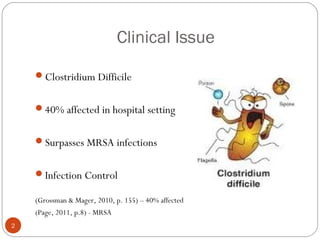
    Clostridium Difficile


    40% affected in hospital setting


    Surpasses MRSA infections


    Infection Control

    (Grossman & Mager, 2010, p. 155) – 40% affected
    (Page, 2011, p.8) - MRSA
2
Evolution of Clostridium difficile

    1930’s: Identification


    1970’s: Health issues


    1978: “Infectious cause of antibiotic-associated diarrhea”


    (Keske & Letizia, 2010, p. 329)

3
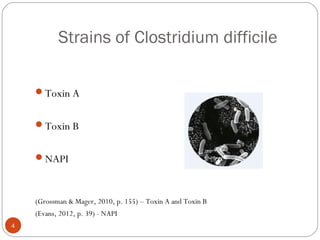
Strains of Clostridium difficile

    Toxin A


    Toxin B


    NAPI


    (Grossman & Mager, 2010, p. 155) – Toxin A and Toxin B
    (Evans, 2012, p. 39) - NAPI
4
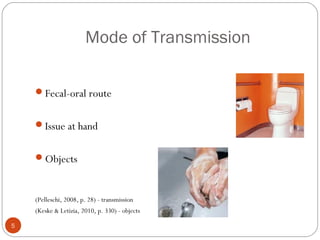
Mode of Transmission

    Fecal-oral route


    Issue at hand


    Objects


    (Pelleschi, 2008, p. 28) - transmission
    (Keske & Letizia, 2010, p. 330) - objects

5
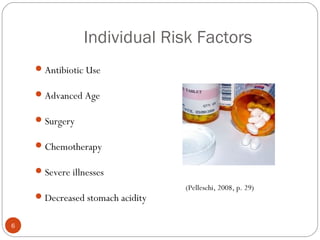
Individual Risk Factors
     Antibiotic Use

     Advanced Age

     Surgery

     Chemotherapy

     Severe illnesses
                                  (Pelleschi, 2008, p. 29)
     Decreased stomach acidity


6
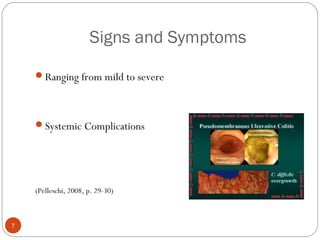
Signs and Symptoms

    Ranging from mild to severe


    Systemic Complications


    (Pelleschi, 2008, p. 29-30)


7
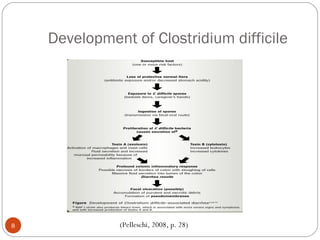
Development of Clostridium difficile


8             (Pelleschi, 2008, p. 28)
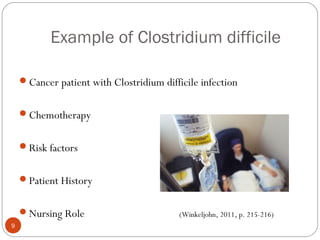
Example of Clostridium difficile

    Cancer patient with Clostridium difficile infection


    Chemotherapy


    Risk factors


    Patient History


    Nursing Role                         (Winkeljohn, 2011, p. 215-216)
9
Quantitative Data: Clostridium difficile

       Age group affected


       Amount of individuals affected


       Costs for treatment


       Mortality rate


       (CDC, 2012, p. 157-158)
10
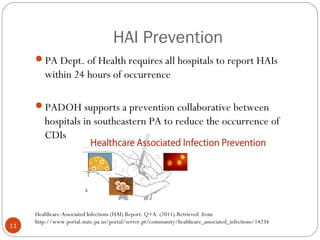
HAI Prevention
     PA Dept. of Health requires all hospitals to report HAIs
        within 24 hours of occurrence

     PADOH supports a prevention collaborative between
        hospitals in southeastern PA to reduce the occurrence of
        CDIs


     Healthcare-Associated Infections (HAI) Report: Q+A. (2011).Retrieved from
     http://www.portal.state.pa.us/portal/server.pt/community/healthcare_associated_infections/14234
11
Infection Control & Prevention

     An estimated 94% of CDIs are potentially avoidable through
       responsible antibiotic use and the prevention of
       horizontal transmission (Cohen et al., 2010)

      Hospitals instituting infection control and prevention
       programs were successful in reducing CDI rates by 20% over
       a period of 21 months. (CDC, 2012)


       Cohen S et al. Infect Control Hosp Epidemiology 2010; 31(5), 431-455.CDC (2012). Vital signs:
       Preventing Clostridium difficile infections. Morbidity & Mortality Weekly Report – MMWR, 61(9),
12     pp. 157-162.
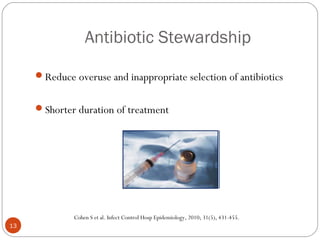
Antibiotic Stewardship

     Reduce overuse and inappropriate selection of antibiotics


     Shorter duration of treatment


              Cohen S et al. Infect Control Hosp Epidemiology, 2010; 31(5), 431-455.
13
Components of an Infection Control
           & Prevention Plan

     An early detection system
     Interruption of person-to-person spread
     Elimination of environmental contamination
     Education, and
     Monitoring


14
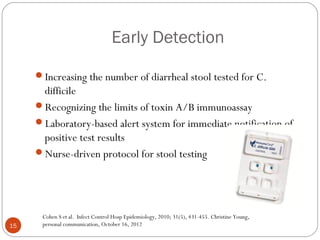
Early Detection

     Increasing the number of diarrheal stool tested for C.
      difficile
     Recognizing the limits of toxin A/B immunoassay
     Laboratory-based alert system for immediate notification of
      positive test results
     Nurse-driven protocol for stool testing


      Cohen S et al. Infect Control Hosp Epidemiology, 2010; 31(5), 431-455. Christine Young,
15    personal communication, October 16, 2012
Interruption of Horizontal
                        Transmission
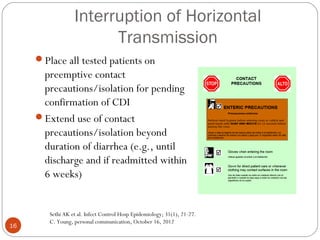
     Place all tested patients on
      preemptive contact
      precautions/isolation for pending
      confirmation of CDI
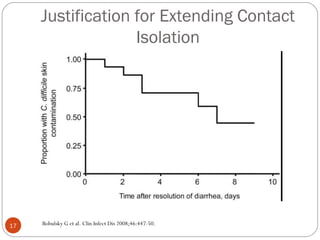
     Extend use of contact
      precautions/isolation beyond
      duration of diarrhea (e.g., until
      discharge and if readmitted within
      6 weeks)


        Sethi AK et al. Infect Control Hosp Epidemiology; 31(1), 21-27.
        C. Young, personal communication, October 16, 2012
16
Justification for Extending Contact
                   Isolation


17   Bobulsky G et al. Clin Infect Dis 2008;46:447-50.
Interruption of Horizontal
                   Transmission

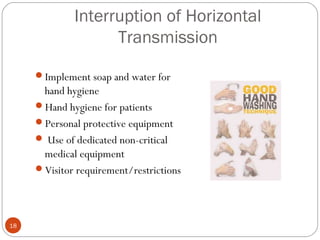
     Implement soap and water for
      hand hygiene
     Hand hygiene for patients
     Personal protective equipment
      Use of dedicated non-critical
      medical equipment
     Visitor requirement/restrictions


18
Elimination of Environmental
                    Contamination

      C. difficile spores can remain on surfaces for long periods of time
        and are resistant to commonly used disinfectants.

      Transmission of C. difficile from patient-to-patient is directly
        proportional to the amount of environmental contamination.


19   Weber D et al. Am J Infect Control 2010; 38(5 Suppl 1):S25-33.
Environmental Cleaning
      Reduces the load of C. difficile spores within the environment
       preventing the transmission of the disease to uninfected patients.

      Recommendations include routine daily isolation cleaning using a
       low-level disinfectant.

      Terminal cleaning with a 10% chlorine-based product: results in a
       48% reduction in the prevalence density of C. difficile.


         CDC (2012). Vital signs: Preventing Clostridium difficile infections. Morbidity & Mortality Weekly
         Report – MMWR, 61(9), pp. 157-162. Hacek, D et al. Am J Infect Control 2010; 38(5), 350-3.
20
Supplemental Measures for High –
               Risk Units

     High loads of C. difficile spores or outbreaks of CDI will
       necessitate daily cleaning with Clorox ultra-germicidal
       bleach wipes containing 6.15 percent sodium hypochlorite.

     Orenstein (2011) showed daily use of these wipes on a high-
       risk unit “effectively reduced the acquisition rates of CDI by
       one-third and time between cases from 8 to 80 days.”


               Orenstein R et al. Infect Control Hosp Epidemiology 2011;32(11), 1137-9.

21
Education of Hospital Personnel
      Annual education regarding CDI prevention with special attention
       to appropriate hand hygiene and contact isolation precautions

      Re-education of staff if the hospital experiences an outbreak


      Allen and Nones-Cronin (2012) report an increase in staff
       members’ compliance with infection control measures after
       educational intervention


          Allen S et al. Dim Crit Care Nurs 2012, 31(5), 290-294. Retrieved from CINAHL database. Carboneau C
          et al. J Healthc Qual 2010 ; 34(4) 61-70.
22
Impact of Education Intervention

     Important in overcoming barriers to effective
       implementation

     Inconsistent cleaning of high-touch surfaces (i.e. bedrails,
       telephones, call buttons, door knobs, toilet seats, and
       bedside tables)

     Educational intervention for housekeeping staff resulted in a
       70% reduction in positive cultures for C. difficile

23                   Eckstein B et al. BMC Infect Dis 2007; 7, 61.
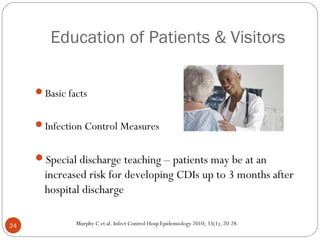
Education of Patients & Visitors

     Basic facts


     Infection Control Measures


     Special discharge teaching – patients may be at an
       increased risk for developing CDIs up to 3 months after
       hospital discharge

24            Murphy C et al. Infect Control Hosp Epidemiology 2010; 33(1), 20-28.
Monitoring
      Determines the success of the infection control and prevention
       program

      Ensures the continual use of best practices by hospital staff and
       helps to determine if interventions are positively impacting
       patient outcomes

      Effectiveness of environmental cleaning by housekeeping


        Guh, A., & Carling, P. (2010). Options for evaluating environmental cleaning. Retrieved from the
        Centers for Disease Control and Prevention website:
25      http://www.cdc.gov/HAI/pdfs/toolkits/Environ-Cleaning-Eval-Toolkit12-2-2010.pdf
Monitoring (continued)

     Track monthly compliance with infection control measures
     including hand hygiene and PPE use

     Track number of CDIs per 1,000 patient days


     Effectiveness of environmental cleaning by housekeeping
     staff will also be assessed.


26
Cost Savings
      Centers for Medicare and Medicaid Services (CMS) will reduce or
       eliminate payment for hospital-acquired CDI.

      Hospitals responsible for cost of treatment estimated at $35.7
       billion to $45 billion for in-patient services

      Potential annual savings due to infection control measures range
       from $5.7 billion to $31.5 billion

          Scott, R. (2009). The direct medical costs of healthcare-associated infections in U.S. hospitals
          and the benefits of prevention. Retrieved from the Centers for Disease Control and Prevention
          website: http://www.cdc.gov/HAI/pdfs/hai/Scott_CostPaper.pdf
27
Quantum Leadership Theory

           Shared decision making
                 Coaching
                Mentoring
          Employee empowerment


28
Successful and Effective Leader

     Constructs effective teams


     Shared vision


     Believes every employee is unique and important


     (Ercetin and kamaci, 2008)


29
Communication

     Necessary for successful decision making and implementing
       change

     Active listening essential


     Leader must be able to acknowledge and respond to staff
       emotions


     (Porter-O’Grady & Malloch, 2011)

30
Communication (continued)

     Important to have effective plan of early communication to
       implement a change

     Everyone affected by proposed plan of change should be
       involved

     Imperative to provide as much information as possible


31
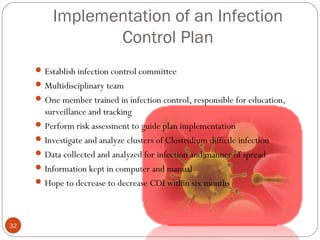
Implementation of an Infection
                 Control Plan
      Establish infection control committee
      Multidisciplinary team
      One member trained in infection control, responsible for education,
       surveillance and tracking
      Perform risk assessment to guide plan implementation
      Investigate and analyze clusters of Clostridium difficile infection
      Data collected and analyzed for infection and manner of spread
      Information kept in computer and manual
      Hope to decrease to decrease CDI within six months


32
Proposed CDI Plan
      Hold in-service for all medical staff
      Educate staff regarding what C.diff is and the mode of infection
       transmission
      Explain importance of rapid identification to place patient in
       isolation
      Importance of contact precautions explained


      Educate staff on personal protective equipment (PPE)
      PPE includes use of gloves and gowns
      Educate staff on how to put on and remove PPE

33
Implementation of Contact
              Precautions Protocols

     Staff expected to demonstrate proper way to put on and
       remove PPE

     Point person assigned to units to assure PPE readily available


     Point person to ensure staff compliance


     Point person will keep surveillance forms and send to
       infection control committee
34
Hand Hygiene Education

     Critical element of plan


     Essential to eliminating CDI outbreaks


     Only acceptable method is soap and water


     Quizzes given to staff to ensure understanding


35
Implementation of Hand Hygiene
                  Protocols
      Hands to be washed for at least 15 seconds before and after
        entering a patient’s room

      Point person assigned to perform hand washing checks
      Monitor use of soap and water
      Use skill validation check list
      Use check list as a tool to counsel staff as needed


      Staff encouraged to ask each other about hand washing


36
     (Pyrek & Orenstein, 2010)
Environmental Cleaning
      Transmission of contaminated patient surfaces and medical equipment is
       significant if not cleaned properly
      Important to educate housekeeping on cleaning high touch areas to eliminate
       spread of infection
      Daily cleaning of high touch areas vital
      Educate staff to use 10% chlorine bleach solution or bleach wipes.
      Educate importance of cleaning bathrooms twice a day
      Educate importance of dedicated cleaning equipment to be kept in patient’s
       bathroom


37
Implementation of Environmental
            Cleaning Hygiene

     Environmental manager in charge of monitoring appropriate
       chemicals being used

     Environmental manager will utilize Digiglo light to evaluate
       proper disinfecting

     Digiglo will be used to decide if further education is needed
       regarding cleaning is required


38
Conclusion
      Not one strategy alone can eradicate or lower CDI
      Combination of antibiotic control, good hygiene and
       environmental cleaning
      Hold staff accountable with help of management and infection
       control committee
      Regular education of staff is an important driving force behind
       lowering CDI rates
      Have staff demonstrate competency
      Most important factor behind implementing change is patient
       safety


39
References
      Allen, S., & Nones-Cronin, S. (2012). Improving staff compliance with isolation
        precautions through use of an educational intervention and behavioral contract.
        Dimensions of Critical Care Nursing, 31(5), 290-294. Retrieved from CINAHL
        database.
      Bobulsky, G., Al Nassir, W., & Riggs, M. (2008). Clostridium difficile skin
        contamination in patients with C. difficile-associated disease. Clinical Infectious
        Diseases, 46, 447–450.
      Carboneau, C., Benge, E., Mary T. Jaco, M., & Robinson, M. (2010). A lean six sigma
        team increases hand hygiene compliance and reduces hospital-acquired MRSA infections
        by 51%. Journal for Healthcare Quality, 34(4) 61-70. Retrieved from CINAHL
        database.
      Cohen, S., Gerding, D., Johnson, S., Kelly, C., Loo, V., McDonald, L., Pepin, J., &
        Wilcox, M.(2010). Clinical practice guidelines for C. difficile infection in adults: 2010
        update by the Society for Healthcare Epidemiology of America and the Infectious
        Diseases Society of America. Infection Control and Hospital Epidemiology, 31(5), 431-
        455. Retrieved from CINAHL database.
40
References (continued)
      Eckstein B., Adams, D., Eckstein, E., Rao, A., Sethi, A., Yadavalli, G., & Donskey, C.
        (2007). Reduction of Clostridium Difficile and vancomycin-resistant Enterococcus
        contamination of environmental surfaces after an intervention to improve cleaning
        methods. BioMed Central Infectious Diseases, 7, 61. Retrieved from CINAHL database.
      Ercetin, S., & Kamaci, M., (2008). Quantum Leadership Paradigm. World Applied
        Sciences Journal, 3(6), 865-868. Retrieved from
        http://www.idosi.org/wasj/wasj3(6)/1.pdf
      Evans, G. (2012). Time to put the gloves on: C. diff patients death hit a historic high.
        Hospital Infection Control & Prevention, 39(4), pp. 37-42. Retrieved from CINAHL EBSCO
        Host database.
      Grossman, S. & Mager, D. (2010). Clostridium difficile: Implications for nursing.
        MEDSURG Nursing, 19(3), pp. 155-158. Retrieved from CINAHL EBSCO Host database.
      Guh, A., & Carling, P. (2010). Options for evaluating environmental cleaning. Retrieved
        from the Centers for Disease Control and Prevention website:
        http://www.cdc.gov/HAI/pdfs/toolkits/Environ-Cleaning-Eval-Toolkit12-2-2010.pdf
41
References (continued)
      Hacek, D., Ogle, A., Fisher, A., Robicsek, A., Peterson, L. (2010). Significant impact
        of terminal room cleaning with bleach on reducing nosocomial Clostridium difficile.
        American Journal of Infection Control, 38(5), 350-3.
      Healthcare-Associated Infections (HAI) Report: Q+A. (2011). Retrieved from
        http://www.portal.state.pa.us/portal/server.pt/community/healthcare_associated_in
        fections/14234
      Keske L. A. & Letizia, M. (2010). Clostridium difficile infection: Essential information
        for nurses. MEDSURG Nursing, 19(6), pp. 329-333. Retrieved from CINAHL EBSCO
        Host database.
      Murphy, C., Avery, T., Dubberke, E., & Huang, S. (2012). Frequent hospital
        readmissions for Clostridium difficile infection and the impact on estimates of hospital-
        associated C. difficile burden. Infection Control and Hospital Epidemiology, 33(1), 20-
        28. Retrieved from CINAHL database.
      Orenstein, R., Aronhalt, K., & McManus, J. (2011). A targeted strategy to wipe out
        Clostridium difficile. Infection Control and Hospital Epidemiology, 32(11), 1137-9.
        Retrieved from CINAHL database.
42
References (continued)
      Page, S. (2011). C. difficile surpasses MRSA as leading cause of nosocomial infections in
        community hospitals. New Hampshire Nursing News, 35(1), p. 8. Retrieved from CINAHL
        EBSCO Host database.
      Pelleschi, M. E. (2008). Clostridium difficile – Associated Disease: Diagnosis,
        prevention, treatment and nursing care. Critical Care Nurse, 28(1), pp. 27-36. Retrieved
        from CINAHL EBSCO Host database.
      Porter-O’Grady, T., & Malloch, K. (2011). Quantum leadership: Advancing
        innovation,
        transforming healthcare. Sudbury, MA: Jones & Bartlett Learning.
      Pyrek, K., & Orenstein, R., (2010). Cleaning Intervention Cuts C. difficile Acquisition
        Rates by One-Third. Retrieved fromhttp://www.infectioncontroltoday.com/s.aspx?
        exp=1&u=http%3A//www.infectioncontroltoday.com/
      Scott, R. (2009). The direct medical costs of healthcare-associated infections in U.S.
        hospitals and the benefits of prevention. Retrieved from the Centers for Disease
        Control and Prevention website:
        http://www.cdc.gov/HAI/pdfs/hai/Scott_CostPaper.pdf
43
References (continued)
      Sethi, A., Al-Nassir, W., Nerandzic, M., Bobulsky, G., & Donskey, C. (2010).
        Persistence of skin contamination and environmental shedding of C. difficile during and
        after treatment of C. difficile infection. Infection Control and Hospital Epidemiology, 31(1),
        21-27.
      Weber, D., Rutala, W., Miller, M., Huslage, K., & Sickbert-Bennett, E. (2010). Role
        of hospital surfaces in the transmission of emerging health care-associated pathogens:
        norovirus, Clostridium difficile, and Acinetobacter species. American Journal of Infection
        Control, 38(5 Suppl 1):S25-33. Retrieved from CINAHL database.
      Weiss, K., Boisvert, A., Chagnon, M., Duchesne, C., Habash, S., Lepage, Y.,
        Letourneau, J., Raty, J., & Savoie, M. (2009). Multipronged intervention strategy to
        control an outbreak of Clostridium difficile infection (CDI) and its impact on the rates
        of CDI from 2002 to 2007. Infection Control & Hospital Epidemiology, 30(2), 156-162.
      Winkeljohn, D. (2011). Clostridium difficile infection in patients with cancer. Clinical
        Journal of Oncology Nursing, 15(2), pp. 215-217. doi:10.1188/11.CJON.215-21


44

Clinical guided project presentation

  • 1.
    Infection Control: Clostridium difficile Clinical Guided Project - Presentation NUR 440: Dr. Deborah Garrison and Nancy Bucher By: Krystal DeSantis, Lucy George & Melinda Gillies 1 Due: November 28, 2012
  • 2.
    Clinical Issue Clostridium Difficile 40% affected in hospital setting Surpasses MRSA infections Infection Control (Grossman & Mager, 2010, p. 155) – 40% affected (Page, 2011, p.8) - MRSA 2
  • 3.
    Evolution of Clostridiumdifficile 1930’s: Identification 1970’s: Health issues 1978: “Infectious cause of antibiotic-associated diarrhea” (Keske & Letizia, 2010, p. 329) 3
  • 4.
    Strains of Clostridiumdifficile Toxin A Toxin B NAPI (Grossman & Mager, 2010, p. 155) – Toxin A and Toxin B (Evans, 2012, p. 39) - NAPI 4
  • 5.
    Mode of Transmission Fecal-oral route Issue at hand Objects (Pelleschi, 2008, p. 28) - transmission (Keske & Letizia, 2010, p. 330) - objects 5
  • 6.
    Individual Risk Factors  Antibiotic Use  Advanced Age  Surgery  Chemotherapy  Severe illnesses (Pelleschi, 2008, p. 29)  Decreased stomach acidity 6
  • 7.
    Signs and Symptoms Ranging from mild to severe Systemic Complications (Pelleschi, 2008, p. 29-30) 7
  • 8.
    Development of Clostridiumdifficile 8 (Pelleschi, 2008, p. 28)
  • 9.
    Example of Clostridiumdifficile Cancer patient with Clostridium difficile infection Chemotherapy Risk factors Patient History Nursing Role (Winkeljohn, 2011, p. 215-216) 9
  • 10.
    Quantitative Data: Clostridiumdifficile Age group affected Amount of individuals affected Costs for treatment Mortality rate (CDC, 2012, p. 157-158) 10
  • 11.
    HAI Prevention PA Dept. of Health requires all hospitals to report HAIs within 24 hours of occurrence PADOH supports a prevention collaborative between hospitals in southeastern PA to reduce the occurrence of CDIs Healthcare-Associated Infections (HAI) Report: Q+A. (2011).Retrieved from http://www.portal.state.pa.us/portal/server.pt/community/healthcare_associated_infections/14234 11
  • 12.
    Infection Control &Prevention An estimated 94% of CDIs are potentially avoidable through responsible antibiotic use and the prevention of horizontal transmission (Cohen et al., 2010)  Hospitals instituting infection control and prevention programs were successful in reducing CDI rates by 20% over a period of 21 months. (CDC, 2012) Cohen S et al. Infect Control Hosp Epidemiology 2010; 31(5), 431-455.CDC (2012). Vital signs: Preventing Clostridium difficile infections. Morbidity & Mortality Weekly Report – MMWR, 61(9), 12 pp. 157-162.
  • 13.
    Antibiotic Stewardship Reduce overuse and inappropriate selection of antibiotics Shorter duration of treatment Cohen S et al. Infect Control Hosp Epidemiology, 2010; 31(5), 431-455. 13
  • 14.
    Components of anInfection Control & Prevention Plan An early detection system Interruption of person-to-person spread Elimination of environmental contamination Education, and Monitoring 14
  • 15.
    Early Detection Increasing the number of diarrheal stool tested for C. difficile Recognizing the limits of toxin A/B immunoassay Laboratory-based alert system for immediate notification of positive test results Nurse-driven protocol for stool testing Cohen S et al. Infect Control Hosp Epidemiology, 2010; 31(5), 431-455. Christine Young, 15 personal communication, October 16, 2012
  • 16.
    Interruption of Horizontal Transmission Place all tested patients on preemptive contact precautions/isolation for pending confirmation of CDI Extend use of contact precautions/isolation beyond duration of diarrhea (e.g., until discharge and if readmitted within 6 weeks) Sethi AK et al. Infect Control Hosp Epidemiology; 31(1), 21-27. C. Young, personal communication, October 16, 2012 16
  • 17.
    Justification for ExtendingContact Isolation 17 Bobulsky G et al. Clin Infect Dis 2008;46:447-50.
  • 18.
    Interruption of Horizontal Transmission Implement soap and water for hand hygiene Hand hygiene for patients Personal protective equipment  Use of dedicated non-critical medical equipment Visitor requirement/restrictions 18
  • 19.
    Elimination of Environmental Contamination  C. difficile spores can remain on surfaces for long periods of time and are resistant to commonly used disinfectants.  Transmission of C. difficile from patient-to-patient is directly proportional to the amount of environmental contamination. 19 Weber D et al. Am J Infect Control 2010; 38(5 Suppl 1):S25-33.
  • 20.
    Environmental Cleaning  Reduces the load of C. difficile spores within the environment preventing the transmission of the disease to uninfected patients.  Recommendations include routine daily isolation cleaning using a low-level disinfectant.  Terminal cleaning with a 10% chlorine-based product: results in a 48% reduction in the prevalence density of C. difficile. CDC (2012). Vital signs: Preventing Clostridium difficile infections. Morbidity & Mortality Weekly Report – MMWR, 61(9), pp. 157-162. Hacek, D et al. Am J Infect Control 2010; 38(5), 350-3. 20
  • 21.
    Supplemental Measures forHigh – Risk Units High loads of C. difficile spores or outbreaks of CDI will necessitate daily cleaning with Clorox ultra-germicidal bleach wipes containing 6.15 percent sodium hypochlorite. Orenstein (2011) showed daily use of these wipes on a high- risk unit “effectively reduced the acquisition rates of CDI by one-third and time between cases from 8 to 80 days.” Orenstein R et al. Infect Control Hosp Epidemiology 2011;32(11), 1137-9. 21
  • 22.
    Education of HospitalPersonnel  Annual education regarding CDI prevention with special attention to appropriate hand hygiene and contact isolation precautions  Re-education of staff if the hospital experiences an outbreak  Allen and Nones-Cronin (2012) report an increase in staff members’ compliance with infection control measures after educational intervention Allen S et al. Dim Crit Care Nurs 2012, 31(5), 290-294. Retrieved from CINAHL database. Carboneau C et al. J Healthc Qual 2010 ; 34(4) 61-70. 22
  • 23.
    Impact of EducationIntervention Important in overcoming barriers to effective implementation Inconsistent cleaning of high-touch surfaces (i.e. bedrails, telephones, call buttons, door knobs, toilet seats, and bedside tables) Educational intervention for housekeeping staff resulted in a 70% reduction in positive cultures for C. difficile 23 Eckstein B et al. BMC Infect Dis 2007; 7, 61.
  • 24.
    Education of Patients& Visitors Basic facts Infection Control Measures Special discharge teaching – patients may be at an increased risk for developing CDIs up to 3 months after hospital discharge 24 Murphy C et al. Infect Control Hosp Epidemiology 2010; 33(1), 20-28.
  • 25.
    Monitoring  Determines the success of the infection control and prevention program  Ensures the continual use of best practices by hospital staff and helps to determine if interventions are positively impacting patient outcomes  Effectiveness of environmental cleaning by housekeeping Guh, A., & Carling, P. (2010). Options for evaluating environmental cleaning. Retrieved from the Centers for Disease Control and Prevention website: 25 http://www.cdc.gov/HAI/pdfs/toolkits/Environ-Cleaning-Eval-Toolkit12-2-2010.pdf
  • 26.
    Monitoring (continued) Track monthly compliance with infection control measures including hand hygiene and PPE use Track number of CDIs per 1,000 patient days Effectiveness of environmental cleaning by housekeeping staff will also be assessed. 26
  • 27.
    Cost Savings  Centers for Medicare and Medicaid Services (CMS) will reduce or eliminate payment for hospital-acquired CDI.  Hospitals responsible for cost of treatment estimated at $35.7 billion to $45 billion for in-patient services  Potential annual savings due to infection control measures range from $5.7 billion to $31.5 billion Scott, R. (2009). The direct medical costs of healthcare-associated infections in U.S. hospitals and the benefits of prevention. Retrieved from the Centers for Disease Control and Prevention website: http://www.cdc.gov/HAI/pdfs/hai/Scott_CostPaper.pdf 27
  • 28.
    Quantum Leadership Theory Shared decision making Coaching Mentoring Employee empowerment 28
  • 29.
    Successful and EffectiveLeader Constructs effective teams Shared vision Believes every employee is unique and important (Ercetin and kamaci, 2008) 29
  • 30.
    Communication Necessary for successful decision making and implementing change Active listening essential Leader must be able to acknowledge and respond to staff emotions (Porter-O’Grady & Malloch, 2011) 30
  • 31.
    Communication (continued) Important to have effective plan of early communication to implement a change Everyone affected by proposed plan of change should be involved Imperative to provide as much information as possible 31
  • 32.
    Implementation of anInfection Control Plan  Establish infection control committee  Multidisciplinary team  One member trained in infection control, responsible for education, surveillance and tracking  Perform risk assessment to guide plan implementation  Investigate and analyze clusters of Clostridium difficile infection  Data collected and analyzed for infection and manner of spread  Information kept in computer and manual  Hope to decrease to decrease CDI within six months 32
  • 33.
    Proposed CDI Plan  Hold in-service for all medical staff  Educate staff regarding what C.diff is and the mode of infection transmission  Explain importance of rapid identification to place patient in isolation  Importance of contact precautions explained  Educate staff on personal protective equipment (PPE)  PPE includes use of gloves and gowns  Educate staff on how to put on and remove PPE 33
  • 34.
    Implementation of Contact Precautions Protocols Staff expected to demonstrate proper way to put on and remove PPE Point person assigned to units to assure PPE readily available Point person to ensure staff compliance Point person will keep surveillance forms and send to infection control committee 34
  • 35.
    Hand Hygiene Education Critical element of plan Essential to eliminating CDI outbreaks Only acceptable method is soap and water Quizzes given to staff to ensure understanding 35
  • 36.
    Implementation of HandHygiene Protocols  Hands to be washed for at least 15 seconds before and after entering a patient’s room  Point person assigned to perform hand washing checks  Monitor use of soap and water  Use skill validation check list  Use check list as a tool to counsel staff as needed  Staff encouraged to ask each other about hand washing 36 (Pyrek & Orenstein, 2010)
  • 37.
    Environmental Cleaning  Transmission of contaminated patient surfaces and medical equipment is significant if not cleaned properly  Important to educate housekeeping on cleaning high touch areas to eliminate spread of infection  Daily cleaning of high touch areas vital  Educate staff to use 10% chlorine bleach solution or bleach wipes.  Educate importance of cleaning bathrooms twice a day  Educate importance of dedicated cleaning equipment to be kept in patient’s bathroom 37
  • 38.
    Implementation of Environmental Cleaning Hygiene Environmental manager in charge of monitoring appropriate chemicals being used Environmental manager will utilize Digiglo light to evaluate proper disinfecting Digiglo will be used to decide if further education is needed regarding cleaning is required 38
  • 39.
    Conclusion  Not one strategy alone can eradicate or lower CDI  Combination of antibiotic control, good hygiene and environmental cleaning  Hold staff accountable with help of management and infection control committee  Regular education of staff is an important driving force behind lowering CDI rates  Have staff demonstrate competency  Most important factor behind implementing change is patient safety 39
  • 40.
    References  Allen, S., & Nones-Cronin, S. (2012). Improving staff compliance with isolation precautions through use of an educational intervention and behavioral contract. Dimensions of Critical Care Nursing, 31(5), 290-294. Retrieved from CINAHL database.  Bobulsky, G., Al Nassir, W., & Riggs, M. (2008). Clostridium difficile skin contamination in patients with C. difficile-associated disease. Clinical Infectious Diseases, 46, 447–450.  Carboneau, C., Benge, E., Mary T. Jaco, M., & Robinson, M. (2010). A lean six sigma team increases hand hygiene compliance and reduces hospital-acquired MRSA infections by 51%. Journal for Healthcare Quality, 34(4) 61-70. Retrieved from CINAHL database.  Cohen, S., Gerding, D., Johnson, S., Kelly, C., Loo, V., McDonald, L., Pepin, J., & Wilcox, M.(2010). Clinical practice guidelines for C. difficile infection in adults: 2010 update by the Society for Healthcare Epidemiology of America and the Infectious Diseases Society of America. Infection Control and Hospital Epidemiology, 31(5), 431- 455. Retrieved from CINAHL database. 40
  • 41.
    References (continued)  Eckstein B., Adams, D., Eckstein, E., Rao, A., Sethi, A., Yadavalli, G., & Donskey, C. (2007). Reduction of Clostridium Difficile and vancomycin-resistant Enterococcus contamination of environmental surfaces after an intervention to improve cleaning methods. BioMed Central Infectious Diseases, 7, 61. Retrieved from CINAHL database.  Ercetin, S., & Kamaci, M., (2008). Quantum Leadership Paradigm. World Applied Sciences Journal, 3(6), 865-868. Retrieved from http://www.idosi.org/wasj/wasj3(6)/1.pdf  Evans, G. (2012). Time to put the gloves on: C. diff patients death hit a historic high. Hospital Infection Control & Prevention, 39(4), pp. 37-42. Retrieved from CINAHL EBSCO Host database.  Grossman, S. & Mager, D. (2010). Clostridium difficile: Implications for nursing. MEDSURG Nursing, 19(3), pp. 155-158. Retrieved from CINAHL EBSCO Host database.  Guh, A., & Carling, P. (2010). Options for evaluating environmental cleaning. Retrieved from the Centers for Disease Control and Prevention website: http://www.cdc.gov/HAI/pdfs/toolkits/Environ-Cleaning-Eval-Toolkit12-2-2010.pdf 41
  • 42.
    References (continued)  Hacek, D., Ogle, A., Fisher, A., Robicsek, A., Peterson, L. (2010). Significant impact of terminal room cleaning with bleach on reducing nosocomial Clostridium difficile. American Journal of Infection Control, 38(5), 350-3.  Healthcare-Associated Infections (HAI) Report: Q+A. (2011). Retrieved from http://www.portal.state.pa.us/portal/server.pt/community/healthcare_associated_in fections/14234  Keske L. A. & Letizia, M. (2010). Clostridium difficile infection: Essential information for nurses. MEDSURG Nursing, 19(6), pp. 329-333. Retrieved from CINAHL EBSCO Host database.  Murphy, C., Avery, T., Dubberke, E., & Huang, S. (2012). Frequent hospital readmissions for Clostridium difficile infection and the impact on estimates of hospital- associated C. difficile burden. Infection Control and Hospital Epidemiology, 33(1), 20- 28. Retrieved from CINAHL database.  Orenstein, R., Aronhalt, K., & McManus, J. (2011). A targeted strategy to wipe out Clostridium difficile. Infection Control and Hospital Epidemiology, 32(11), 1137-9. Retrieved from CINAHL database. 42
  • 43.
    References (continued)  Page, S. (2011). C. difficile surpasses MRSA as leading cause of nosocomial infections in community hospitals. New Hampshire Nursing News, 35(1), p. 8. Retrieved from CINAHL EBSCO Host database.  Pelleschi, M. E. (2008). Clostridium difficile – Associated Disease: Diagnosis, prevention, treatment and nursing care. Critical Care Nurse, 28(1), pp. 27-36. Retrieved from CINAHL EBSCO Host database.  Porter-O’Grady, T., & Malloch, K. (2011). Quantum leadership: Advancing innovation, transforming healthcare. Sudbury, MA: Jones & Bartlett Learning.  Pyrek, K., & Orenstein, R., (2010). Cleaning Intervention Cuts C. difficile Acquisition Rates by One-Third. Retrieved fromhttp://www.infectioncontroltoday.com/s.aspx? exp=1&u=http%3A//www.infectioncontroltoday.com/  Scott, R. (2009). The direct medical costs of healthcare-associated infections in U.S. hospitals and the benefits of prevention. Retrieved from the Centers for Disease Control and Prevention website: http://www.cdc.gov/HAI/pdfs/hai/Scott_CostPaper.pdf 43
  • 44.
    References (continued)  Sethi, A., Al-Nassir, W., Nerandzic, M., Bobulsky, G., & Donskey, C. (2010). Persistence of skin contamination and environmental shedding of C. difficile during and after treatment of C. difficile infection. Infection Control and Hospital Epidemiology, 31(1), 21-27.  Weber, D., Rutala, W., Miller, M., Huslage, K., & Sickbert-Bennett, E. (2010). Role of hospital surfaces in the transmission of emerging health care-associated pathogens: norovirus, Clostridium difficile, and Acinetobacter species. American Journal of Infection Control, 38(5 Suppl 1):S25-33. Retrieved from CINAHL database.  Weiss, K., Boisvert, A., Chagnon, M., Duchesne, C., Habash, S., Lepage, Y., Letourneau, J., Raty, J., & Savoie, M. (2009). Multipronged intervention strategy to control an outbreak of Clostridium difficile infection (CDI) and its impact on the rates of CDI from 2002 to 2007. Infection Control & Hospital Epidemiology, 30(2), 156-162.  Winkeljohn, D. (2011). Clostridium difficile infection in patients with cancer. Clinical Journal of Oncology Nursing, 15(2), pp. 215-217. doi:10.1188/11.CJON.215-21 44