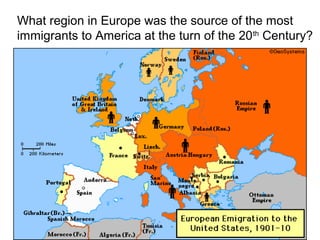
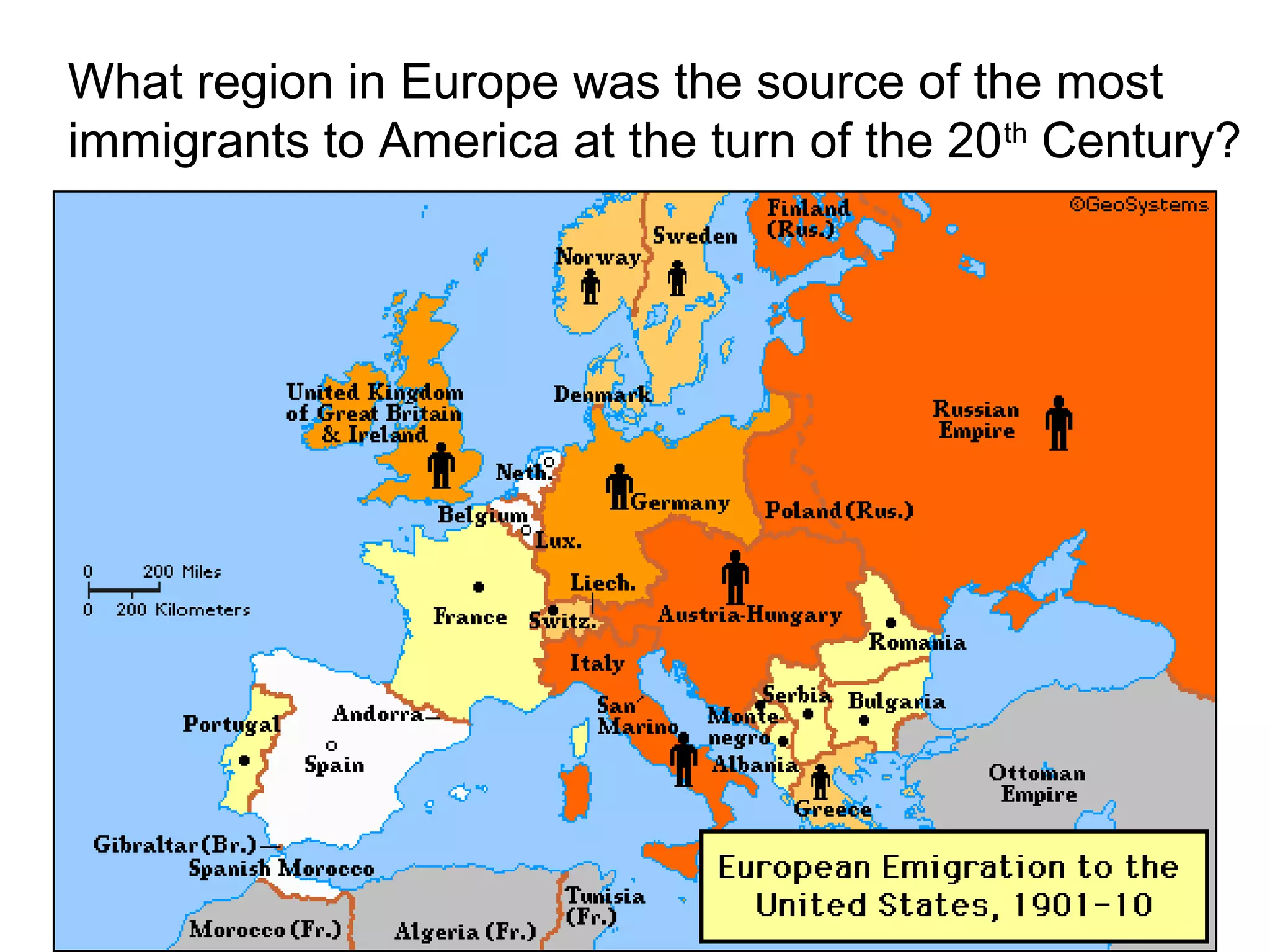
What region in Europe was the source of the most
immigrants to America at the turn of the 20 th Century?
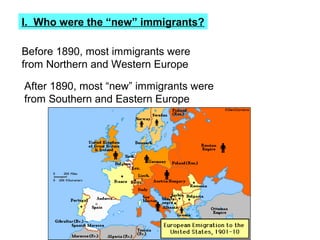
I. Who were the “new” immigrants?

Before 1890, most immigrants were
from Northern and Western Europe

After 1890, most “new” immigrants were
from Southern and Eastern Europe
II. Reasons for immigration:

       “Push” Factors         “Pull” Factors
     -Unemployment
     -Poverty
     -Famine
     -Overpopulation
     -Political Persecution
     -Anti-Semitism
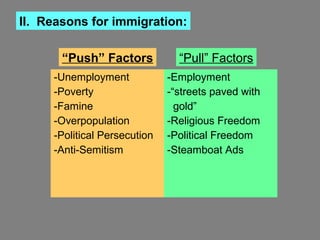
II. Reasons for immigration:

       “Push” Factors           “Pull” Factors
     -Unemployment            -Employment
     -Poverty                 -“streets paved with
     -Famine                    gold”
     -Overpopulation          -Religious Freedom
     -Political Persecution   -Political Freedom
     -Anti-Semitism           -Steamboat Ads
America as a land of opportunity and freedom
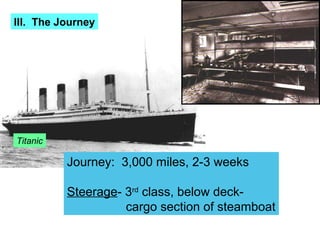
III. The Journey


Titanic

          Journey: 3,000 miles, 2-3 weeks

          Steerage- 3rd class, below deck-
                    cargo section of steamboat
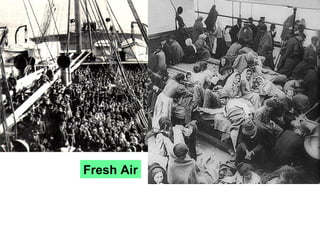
“First-Class people, all the
rich people, were way
above. I’d look up at them,
they were all dressed nice,
and we were like a flock of
sheep down below.”

Paulina Caramando,
Sicily
Fresh Air
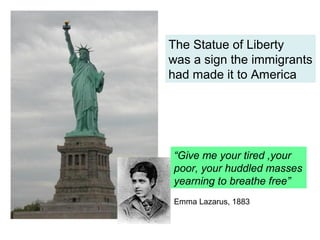
The Statue of Liberty
was a sign the immigrants
had made it to America


“Give me your tired ,your
poor, your huddled masses
yearning to breathe free”
Emma Lazarus, 1883
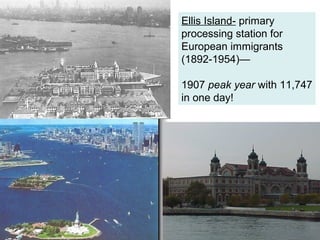
Ellis Island- primary
processing station for
European immigrants
(1892-1954)—

1907 peak year with 11,747
in one day!
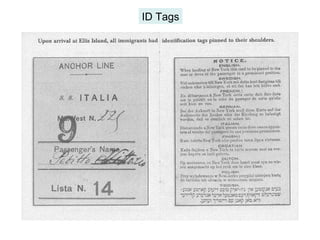
ID Tags
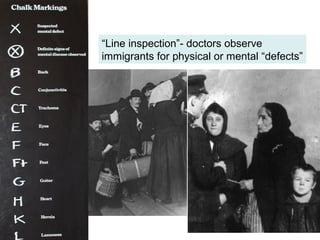
“Line inspection”- doctors observe
immigrants for physical or mental “defects”
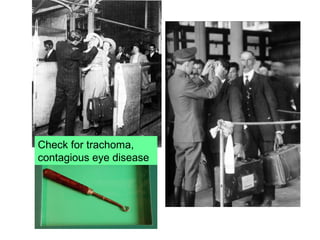
Check for trachoma,
contagious eye disease
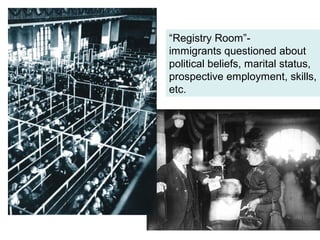
“Registry Room”-
immigrants questioned about
political beliefs, marital status,
prospective employment, skills,
etc.
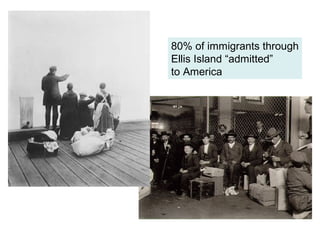
80% of immigrants through
Ellis Island “admitted”
to America
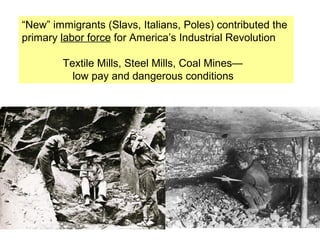
“New” immigrants (Slavs, Italians, Poles) contributed the
primary labor force for America’s Industrial Revolution

        Textile Mills, Steel Mills, Coal Mines—
          low pay and dangerous conditions
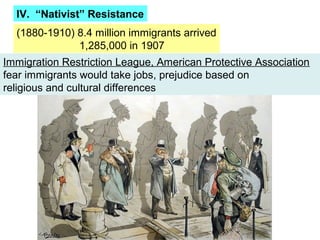
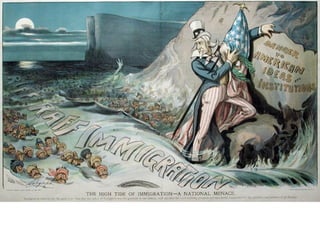
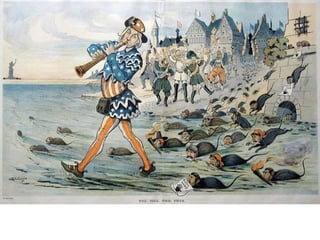
IV. “Nativist” Resistance
  (1880-1910) 8.4 million immigrants arrived
              1,285,000 in 1907
Immigration Restriction League, American Protective Association
fear immigrants would take jobs, prejudice based on
religious and cultural differences
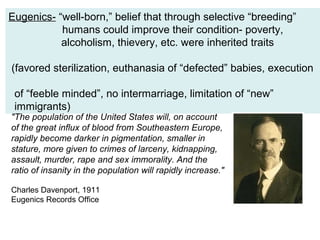
Eugenics- “well-born,” belief that through selective “breeding”
           humans could improve their condition- poverty,
           alcoholism, thievery, etc. were inherited traits

(favored sterilization, euthanasia of “defected” babies, execution

 of “feeble minded”, no intermarriage, limitation of “new”
 immigrants)
"The population of the United States will, on account
of the great influx of blood from Southeastern Europe,
rapidly become darker in pigmentation, smaller in
stature, more given to crimes of larceny, kidnapping,
assault, murder, rape and sex immorality. And the
ratio of insanity in the population will rapidly increase."

Charles Davenport, 1911
Eugenics Records Office
“Black Stork”


Dr. Haiselden
allowed
children with
“defects”
to die–
supported by
some as humane
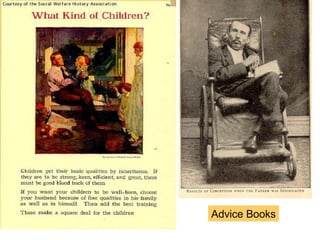
Advice Books
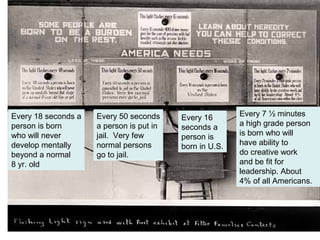
Every 18 seconds a   Every 50 seconds     Every 16       Every 7 ½ minutes
person is born       a person is put in   seconds a      a high grade person
who will never       jail. Very few       person is      is born who will
develop mentally     normal persons       born in U.S.   have ability to
beyond a normal      go to jail.                         do creative work
8 yr. old                                                and be fit for
                                                         leadership. About
                                                         4% of all Americans.
“Every 15 seconds $100 of your money goes for the case of persons
with bad heredity such as the insane feeble minded criminals and other
defectives”
Fitter Family Contests-

measured beauty, intelligence,
morality, mental health
What does
this political
cartoon suggest
to solve the
immigrant problem?
V. Congress Acts to “Protect” America from
   “inferior” peoples- “genetic suicide”

  Immigration Restriction Act of 1921
  (Emergency Quota Act)- limit each nationality
                           to 3% of census in 1910


  Johnson-Reid Act 1924- limited each nationality to 2% of
                          census in 1890

***Both lows cut off most immigration to America for several decades
VI. Huge influx of immigrants lead to the development
    of cities (urbanization): New York, Chicago, Detroit,
    Cleveland, Pittsburgh
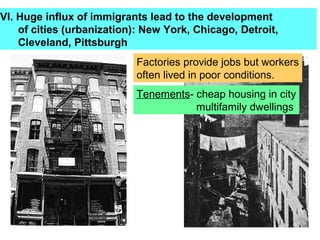
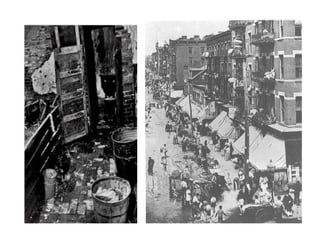
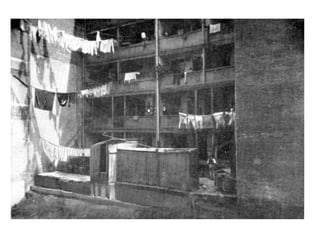
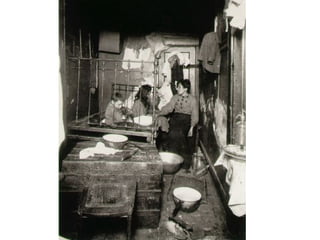
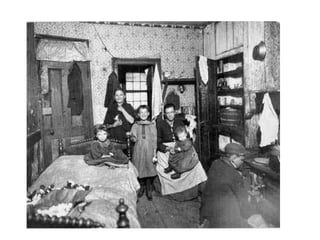
                           Factories provide jobs but workers
                           often lived in poor conditions.
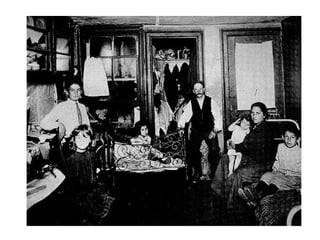
                           Tenements- cheap housing in city
                                      multifamily dwellings
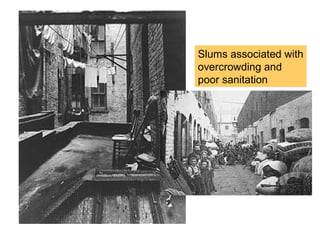
Slums associated with
overcrowding and
poor sanitation
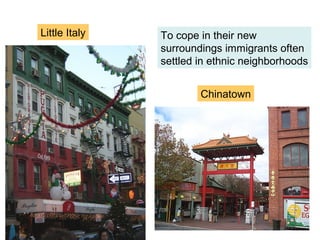
Little Italy   To cope in their new
               surroundings immigrants often
               settled in ethnic neighborhoods


                       Chinatown
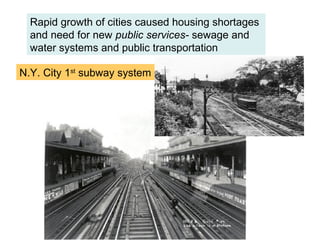
Rapid growth of cities caused housing shortages
  and need for new public services- sewage and
  water systems and public transportation

N.Y. City 1st subway system
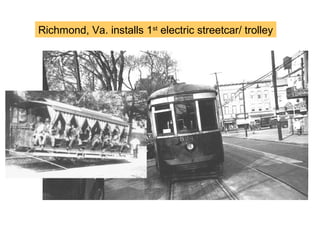
Richmond, Va. installs 1st electric streetcar/ trolley
VII. Becoming American

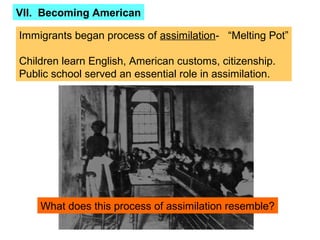
Immigrants began process of assimilation- “Melting Pot”

Children learn English, American customs, citizenship.
Public school served an essential role in assimilation.


    What does this process of assimilation resemble?
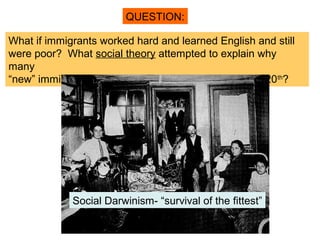
QUESTION:

What if immigrants worked hard and learned English and still
were poor? What social theory attempted to explain why
many
“new” immigrants lived in poor slums at the turn of the 20th?


             Social Darwinism- “survival of the fittest”
Jane Adams- opens settlement house in
Chicago called Hull House. Outlet for
charity work. Rejected blaming
immigrants for being poor.
Hull House provided classes--
English, civics, cooking, dress making

kindergarten, laundry, employment, day care, legal aid, health care
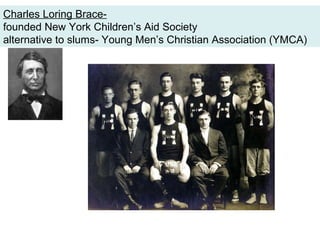
Charles Loring Brace-
founded New York Children’s Aid Society
alternative to slums- Young Men’s Christian Association (YMCA)
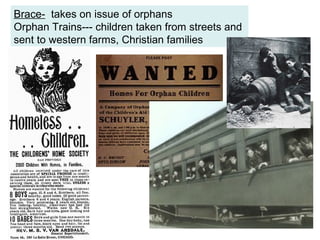
Brace- takes on issue of orphans
Orphan Trains--- children taken from streets and
sent to western farms, Christian families

Push and Pull Factors

  • 1.
    What region inEurope was the source of the most immigrants to America at the turn of the 20 th Century?
  • 2.
    I. Who werethe “new” immigrants? Before 1890, most immigrants were from Northern and Western Europe After 1890, most “new” immigrants were from Southern and Eastern Europe
  • 3.
    II. Reasons forimmigration: “Push” Factors “Pull” Factors -Unemployment -Poverty -Famine -Overpopulation -Political Persecution -Anti-Semitism
  • 4.
    II. Reasons forimmigration: “Push” Factors “Pull” Factors -Unemployment -Employment -Poverty -“streets paved with -Famine gold” -Overpopulation -Religious Freedom -Political Persecution -Political Freedom -Anti-Semitism -Steamboat Ads
  • 5.
    America as aland of opportunity and freedom
  • 6.
    III. The Journey Titanic Journey: 3,000 miles, 2-3 weeks Steerage- 3rd class, below deck- cargo section of steamboat
  • 7.
    “First-Class people, allthe rich people, were way above. I’d look up at them, they were all dressed nice, and we were like a flock of sheep down below.” Paulina Caramando, Sicily
  • 8.
  • 9.
    The Statue ofLiberty was a sign the immigrants had made it to America “Give me your tired ,your poor, your huddled masses yearning to breathe free” Emma Lazarus, 1883
  • 10.
    Ellis Island- primary processingstation for European immigrants (1892-1954)— 1907 peak year with 11,747 in one day!
  • 11.
  • 12.
    “Line inspection”- doctorsobserve immigrants for physical or mental “defects”
  • 13.
  • 14.
    “Registry Room”- immigrants questionedabout political beliefs, marital status, prospective employment, skills, etc.
  • 15.
    80% of immigrantsthrough Ellis Island “admitted” to America
  • 16.
    “New” immigrants (Slavs,Italians, Poles) contributed the primary labor force for America’s Industrial Revolution Textile Mills, Steel Mills, Coal Mines— low pay and dangerous conditions
  • 17.
    IV. “Nativist” Resistance (1880-1910) 8.4 million immigrants arrived 1,285,000 in 1907 Immigration Restriction League, American Protective Association fear immigrants would take jobs, prejudice based on religious and cultural differences
  • 21.
    Eugenics- “well-born,” beliefthat through selective “breeding” humans could improve their condition- poverty, alcoholism, thievery, etc. were inherited traits (favored sterilization, euthanasia of “defected” babies, execution of “feeble minded”, no intermarriage, limitation of “new” immigrants) "The population of the United States will, on account of the great influx of blood from Southeastern Europe, rapidly become darker in pigmentation, smaller in stature, more given to crimes of larceny, kidnapping, assault, murder, rape and sex immorality. And the ratio of insanity in the population will rapidly increase." Charles Davenport, 1911 Eugenics Records Office
  • 22.
    “Black Stork” Dr. Haiselden allowed childrenwith “defects” to die– supported by some as humane
  • 23.
  • 24.
    Every 18 secondsa Every 50 seconds Every 16 Every 7 ½ minutes person is born a person is put in seconds a a high grade person who will never jail. Very few person is is born who will develop mentally normal persons born in U.S. have ability to beyond a normal go to jail. do creative work 8 yr. old and be fit for leadership. About 4% of all Americans.
  • 25.
    “Every 15 seconds$100 of your money goes for the case of persons with bad heredity such as the insane feeble minded criminals and other defectives”
  • 26.
    Fitter Family Contests- measuredbeauty, intelligence, morality, mental health
  • 27.
    What does this political cartoonsuggest to solve the immigrant problem?
  • 28.
    V. Congress Actsto “Protect” America from “inferior” peoples- “genetic suicide” Immigration Restriction Act of 1921 (Emergency Quota Act)- limit each nationality to 3% of census in 1910 Johnson-Reid Act 1924- limited each nationality to 2% of census in 1890 ***Both lows cut off most immigration to America for several decades
  • 29.
    VI. Huge influxof immigrants lead to the development of cities (urbanization): New York, Chicago, Detroit, Cleveland, Pittsburgh Factories provide jobs but workers often lived in poor conditions. Tenements- cheap housing in city multifamily dwellings
  • 30.
  • 36.
    Little Italy To cope in their new surroundings immigrants often settled in ethnic neighborhoods Chinatown
  • 37.
    Rapid growth ofcities caused housing shortages and need for new public services- sewage and water systems and public transportation N.Y. City 1st subway system
  • 38.
    Richmond, Va. installs1st electric streetcar/ trolley
  • 39.
    VII. Becoming American Immigrantsbegan process of assimilation- “Melting Pot” Children learn English, American customs, citizenship. Public school served an essential role in assimilation. What does this process of assimilation resemble?
  • 40.
    QUESTION: What if immigrantsworked hard and learned English and still were poor? What social theory attempted to explain why many “new” immigrants lived in poor slums at the turn of the 20th? Social Darwinism- “survival of the fittest”
  • 41.
    Jane Adams- openssettlement house in Chicago called Hull House. Outlet for charity work. Rejected blaming immigrants for being poor.
  • 42.
    Hull House providedclasses-- English, civics, cooking, dress making kindergarten, laundry, employment, day care, legal aid, health care
  • 43.
    Charles Loring Brace- foundedNew York Children’s Aid Society alternative to slums- Young Men’s Christian Association (YMCA)
  • 44.
    Brace- takes onissue of orphans Orphan Trains--- children taken from streets and sent to western farms, Christian families