Developing & implementing ICT Project Plansauthor: Eric Kluijfhout, eric.kluijfhout@gmail.com This work is licensed under the Creative Commons Attribution-NonCommercial-ShareAlike License. To view a copy of this license, visit http://creativecommons.org/licenses/devnations/2.0/ or send a letter to Creative Commons, 559 Nathan Abbott Way, Stanford, California 94305, USA.Bahir Dar, Ethiopia, 24-08/28-08, 2009 
Developing & implementing ICT Project PlansDr Eric KluijfhoutWorkshop on ICT Policy Development, August 24-28, 2009,Bahir Dar University&VU University
OutlineContext and purpose of ICT project planningComponents of an ICT project planProject types and their managementStaffing your projectExample
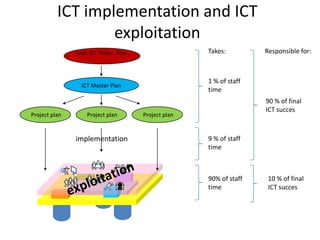
Inst. ICT PolicyPlanICT Master PlanProject planProject planProject planICT implementation and ICT exploitationTakes:Responsible for:1 % of stafftime90 % of final ICT succesimplementation9 % of stafftimeexploitation90% of stafftime10 % of finalICT succes
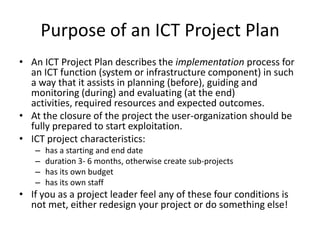
Purpose of an ICT Project PlanAn ICT Project Plan describes the implementation process for an ICT function (system or infrastructure component) in such a way that it assists in planning (before), guiding and monitoring (during) and evaluating (at the end) activities, required resources and expected outcomes.At the closure of the project the user-organization should be fully prepared to start exploitation.ICT project characteristics:has a starting and end dateduration 3- 6 months, otherwise create sub-projectshas its own budgethas its own staffIf you as a project leader feel any of these four conditions is not met, either redesign your project or do something else!
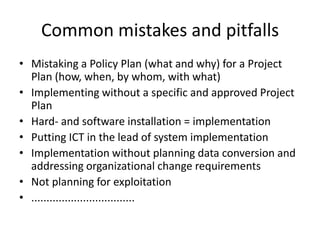
Common mistakes and pitfallsMistaking a Policy Plan (what and why) for a Project Plan (how, when, by whom, with what)Implementing without a specific and approved Project PlanHard- and software installation = implementationPutting ICT in the lead of system implementationImplementation without planning data conversion and addressing organizational change requirementsNot planning for exploitation..................................
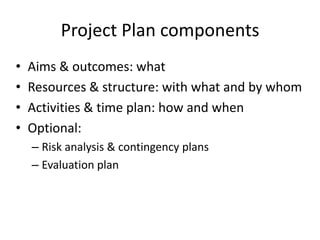
Project Plan componentsAims & outcomes: whatResources & structure: with what and by whomActivities & time plan: how and whenOptional:Risk analysis & contingency plansEvaluation plan
But first ......
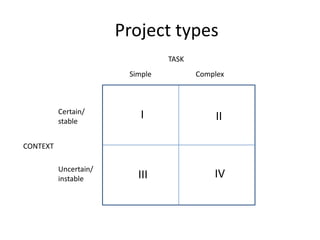
   Project typesTASKSimpleComplexICertain/stableIICONTEXTUncertain/instableIVIII
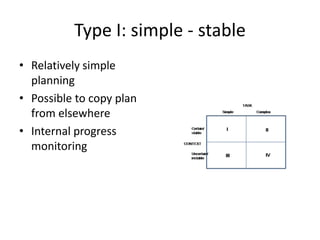
Type I: simple - stable Relatively simple planningPossible to copy plan from elsewhereInternal progress monitoring
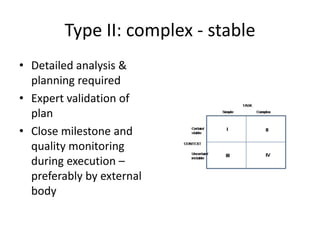
Type II: complex - stableDetailed analysis & planning requiredExpert validation of planClose milestone and quality monitoring during execution – preferably by external body
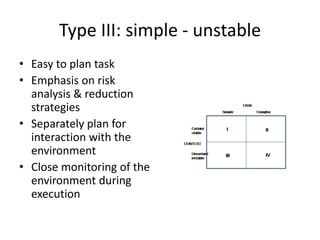
Type III: simple - unstableEasy to plan taskEmphasis on risk analysis & reduction strategiesSeparately plan for interaction with the environmentClose monitoring of the environment during execution
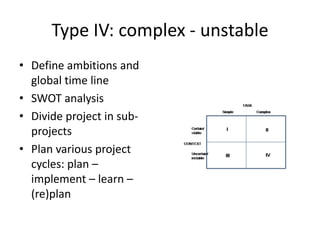
Type IV: complex - unstableDefine ambitions and global time lineSWOT analysisDivide project in sub-projectsPlan various project cycles: plan – implement – learn – (re)plan
Project aims & outcomesAims to be copied or derived from the Policy PlanDefine project outcomes that are directly – and veryfiably – derived from the aimsDefine milestones (critical intermediate products or decisions that need formal approval/acceptance)Define responsibilities for each milestone and outcome (delivery and acceptance)
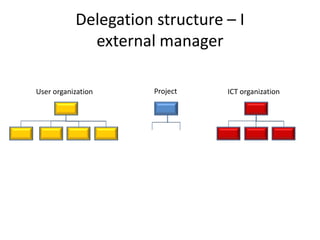
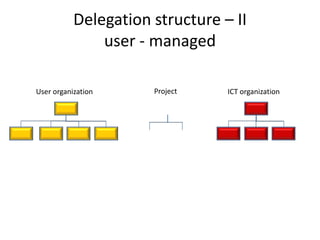
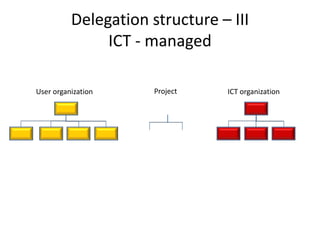
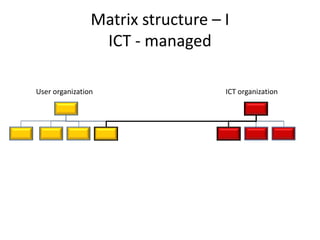
Project resources & structureResource types:Staff (roles, quantity, quality)FundsFacilitiesExternal servicesProject structure options (next pages):Independent structureDelegation structureMatrix structure
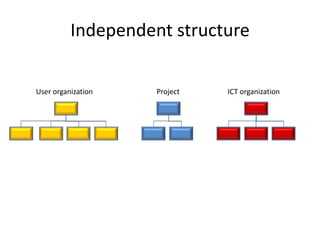
Independent structureUser organizationICT organizationProject
Delegation structure – Iexternal managerProjectUser organizationICT organization
Delegation structure – IIuser - managedProjectUser organizationICT organization
Delegation structure – IIIICT - managedProjectUser organizationICT organization
Matrix structure – IICT - managedICT organization User organization
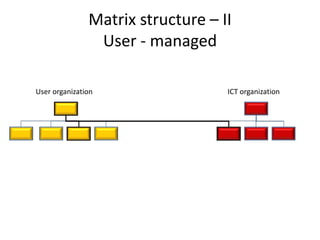
Matrix structure – IIUser - managedUser organizationICT organization
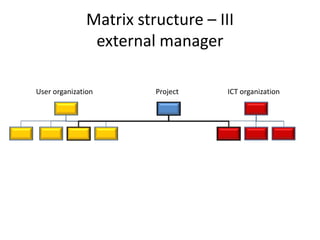
Matrix structure – IIIexternal managerUser organizationICT organizationProject
Project activities & time planDefine activities directly related to the delivery of milestones and/or outcomesLink activities to rolesIdentify dependencies between activitiesIn case of dependency, check whether a milestone delivery is requiredCombine all into a time planThis is an iterative planning process!
Sample ICT Project Plan Implementing the Virtual Learning Environment ‘Moodle’ at the UNESCO/IHE Institute for Water EducationAs part of the institution’s vision to strategically employ ICT to remain the number-1 international centre of excellence in the field of Water EducationStarting from a context of little experience with techhnology enhanced learning
Thank youeric.kluijfhout@gmail.com

Developing and implementing ict project plans

  • 1.
    Developing & implementingICT Project Plansauthor: Eric Kluijfhout, eric.kluijfhout@gmail.com This work is licensed under the Creative Commons Attribution-NonCommercial-ShareAlike License. To view a copy of this license, visit http://creativecommons.org/licenses/devnations/2.0/ or send a letter to Creative Commons, 559 Nathan Abbott Way, Stanford, California 94305, USA.Bahir Dar, Ethiopia, 24-08/28-08, 2009 
  • 2.
    Developing & implementingICT Project PlansDr Eric KluijfhoutWorkshop on ICT Policy Development, August 24-28, 2009,Bahir Dar University&VU University
  • 3.
    OutlineContext and purposeof ICT project planningComponents of an ICT project planProject types and their managementStaffing your projectExample
  • 4.
    Inst. ICT PolicyPlanICTMaster PlanProject planProject planProject planICT implementation and ICT exploitationTakes:Responsible for:1 % of stafftime90 % of final ICT succesimplementation9 % of stafftimeexploitation90% of stafftime10 % of finalICT succes
  • 5.
    Purpose of anICT Project PlanAn ICT Project Plan describes the implementation process for an ICT function (system or infrastructure component) in such a way that it assists in planning (before), guiding and monitoring (during) and evaluating (at the end) activities, required resources and expected outcomes.At the closure of the project the user-organization should be fully prepared to start exploitation.ICT project characteristics:has a starting and end dateduration 3- 6 months, otherwise create sub-projectshas its own budgethas its own staffIf you as a project leader feel any of these four conditions is not met, either redesign your project or do something else!
  • 6.
    Common mistakes andpitfallsMistaking a Policy Plan (what and why) for a Project Plan (how, when, by whom, with what)Implementing without a specific and approved Project PlanHard- and software installation = implementationPutting ICT in the lead of system implementationImplementation without planning data conversion and addressing organizational change requirementsNot planning for exploitation..................................
  • 7.
    Project Plan componentsAims& outcomes: whatResources & structure: with what and by whomActivities & time plan: how and whenOptional:Risk analysis & contingency plansEvaluation plan
  • 8.
  • 9.
    Project typesTASKSimpleComplexICertain/stableIICONTEXTUncertain/instableIVIII
  • 10.
    Type I: simple- stable Relatively simple planningPossible to copy plan from elsewhereInternal progress monitoring
  • 11.
    Type II: complex- stableDetailed analysis & planning requiredExpert validation of planClose milestone and quality monitoring during execution – preferably by external body
  • 12.
    Type III: simple- unstableEasy to plan taskEmphasis on risk analysis & reduction strategiesSeparately plan for interaction with the environmentClose monitoring of the environment during execution
  • 13.
    Type IV: complex- unstableDefine ambitions and global time lineSWOT analysisDivide project in sub-projectsPlan various project cycles: plan – implement – learn – (re)plan
  • 14.
    Project aims &outcomesAims to be copied or derived from the Policy PlanDefine project outcomes that are directly – and veryfiably – derived from the aimsDefine milestones (critical intermediate products or decisions that need formal approval/acceptance)Define responsibilities for each milestone and outcome (delivery and acceptance)
  • 15.
    Project resources &structureResource types:Staff (roles, quantity, quality)FundsFacilitiesExternal servicesProject structure options (next pages):Independent structureDelegation structureMatrix structure
  • 16.
  • 17.
    Delegation structure –Iexternal managerProjectUser organizationICT organization
  • 18.
    Delegation structure –IIuser - managedProjectUser organizationICT organization
  • 19.
    Delegation structure –IIIICT - managedProjectUser organizationICT organization
  • 20.
    Matrix structure –IICT - managedICT organization User organization
  • 21.
    Matrix structure –IIUser - managedUser organizationICT organization
  • 22.
    Matrix structure –IIIexternal managerUser organizationICT organizationProject
  • 23.
    Project activities &time planDefine activities directly related to the delivery of milestones and/or outcomesLink activities to rolesIdentify dependencies between activitiesIn case of dependency, check whether a milestone delivery is requiredCombine all into a time planThis is an iterative planning process!
  • 24.
    Sample ICT ProjectPlan Implementing the Virtual Learning Environment ‘Moodle’ at the UNESCO/IHE Institute for Water EducationAs part of the institution’s vision to strategically employ ICT to remain the number-1 international centre of excellence in the field of Water EducationStarting from a context of little experience with techhnology enhanced learning
  • 25.