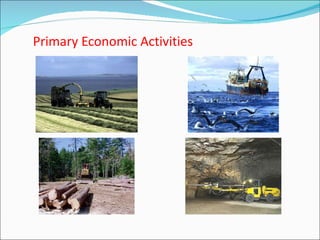
Taking resources from the land or the sea
Economic Activity Economic Activity can be divided into 3 categories. These are; 1. Primary Economic Activity 2. Secondary Economic Activity 3. Tertiary Economic Activity What is Primary Economic Activity? Primary economic activity involves taking natural resources from the land or the sea. Q. What is a natural resource? Q. What natural resources are available from the land or the sea?
Primary Economic Activity We now know that Primary economic activity involves taking natural resources from the land or the sea. We take resources from the land and the sea in the following ways; 1. Farming 2. Fishing 3. Forestry 4. Mining 5. Quarrying Q. Many people work in the primary economic sector. List some jobs that people do in the primary economic sector.
Primary Economic Activities
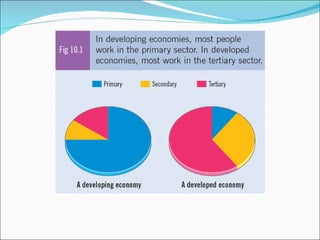
Primary Economic Activity In developing (poorer) countries many people are employed in primary economic activities. Q. Why do you think this is? In developed (rich) countries less people are employed in primary economic activities. Q. Why do you think this is?
 
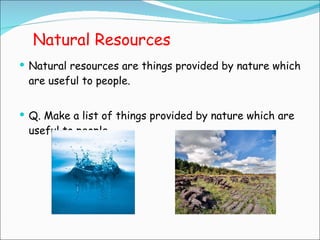
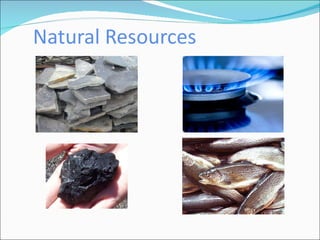
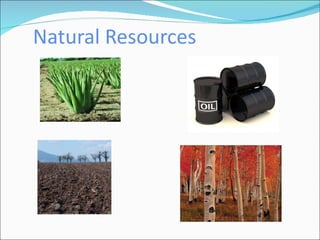
Natural Resources Natural resources are things provided by nature which are useful to people.  Q. Make a list of things provided by nature which are useful to people.
Natural Resources
Natural Resources
Types of Natural Resources There are 2 types of natural resources. 1. Renewable resources 2. Non-renewable resources Q. How do you think these types of resources are different?
Renewable Resources Renewable resources are resources that can be used over and over again. With careful management, they will not run out. For example, if we cut down trees to make wood, we can plant new trees to take their place. Q. Can you think of any other examples? Other examples include water, fish, plants/crops. Q. Explain why these examples are renewable resources.
Non-Renewable Resources Non-renewable resources are resources that can only be used once. Each time such resources are used less of that resource is left for the future. Non-renewable resources will eventually run out. Q. Can you think of any examples of non-renewable resources? Examples include coal, oil, gas, and peat.  Q. Explain why these examples are non renewable resources.
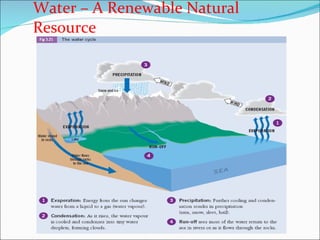
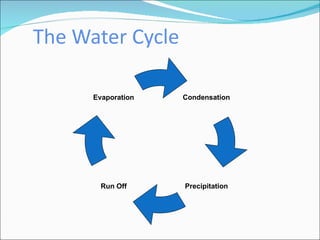
Water – A renewable Resource It can be reproduced and replenished BUT only if it is properly used and conserved The Hydrological Cycle is the continuous movement of water between the land, the sea and the air This is how nature cleans and renews our water supply
Water – A Renewable Natural Resource
The Water Cycle Condensation Run Off Evaporation Precipitation
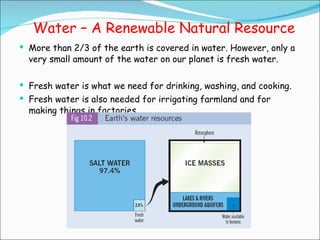
Water – A Renewable Natural Resource More than 2/3 of the earth is covered in water. However, only a very small amount of the water on our planet is fresh water. Fresh water is what we need for drinking, washing, and cooking.  Fresh water is also needed for irrigating farmland and for making things in factories.
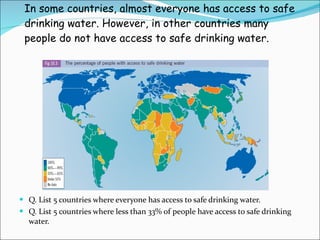
In some countries, almost everyone has access to safe drinking water. However, in other countries many people do not have access to safe drinking water. Q. List 5 countries where everyone has access to safe drinking water. Q. List 5 countries where less than 33% of people have access to safe drinking water.
Water Use
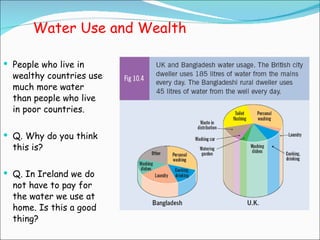
Water Use and Wealth People who live in wealthy countries use much more water than people who live in poor countries. Q. Why do you think this is? Q. In Ireland we do not have to pay for the water we use at home. Is this a good thing?
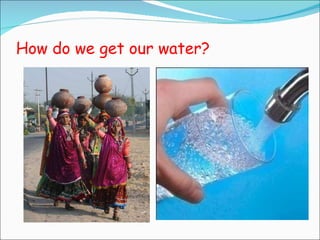
How do we get our water?
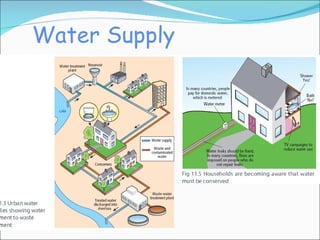
Water Supply
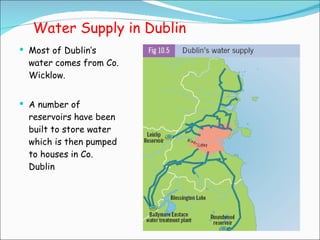
Water Supply in Dublin Most of Dublin’s water comes from Co. Wicklow. A number of reservoirs have been built to store water which is then pumped to houses in Co. Dublin
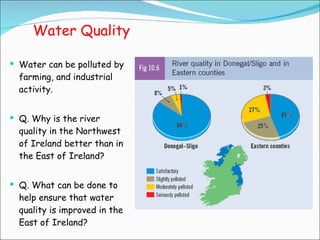
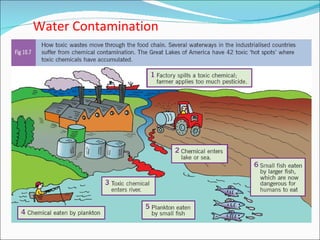
Water Quality Water can be polluted by farming, and industrial activity. Q. Why is the river quality in the Northwest of Ireland better than in the East of Ireland? Q. What can be done to help ensure that water quality is improved in the East of Ireland?
Water Contamination

Primary economic-activity classroomcobalt

  • 1.
    Taking resources fromthe land or the sea
  • 2.
    Economic Activity EconomicActivity can be divided into 3 categories. These are; 1. Primary Economic Activity 2. Secondary Economic Activity 3. Tertiary Economic Activity What is Primary Economic Activity? Primary economic activity involves taking natural resources from the land or the sea. Q. What is a natural resource? Q. What natural resources are available from the land or the sea?
  • 3.
    Primary Economic ActivityWe now know that Primary economic activity involves taking natural resources from the land or the sea. We take resources from the land and the sea in the following ways; 1. Farming 2. Fishing 3. Forestry 4. Mining 5. Quarrying Q. Many people work in the primary economic sector. List some jobs that people do in the primary economic sector.
  • 4.
  • 5.
    Primary Economic ActivityIn developing (poorer) countries many people are employed in primary economic activities. Q. Why do you think this is? In developed (rich) countries less people are employed in primary economic activities. Q. Why do you think this is?
  • 6.
  • 7.
    Natural Resources Naturalresources are things provided by nature which are useful to people. Q. Make a list of things provided by nature which are useful to people.
  • 8.
  • 9.
  • 10.
    Types of NaturalResources There are 2 types of natural resources. 1. Renewable resources 2. Non-renewable resources Q. How do you think these types of resources are different?
  • 11.
    Renewable Resources Renewableresources are resources that can be used over and over again. With careful management, they will not run out. For example, if we cut down trees to make wood, we can plant new trees to take their place. Q. Can you think of any other examples? Other examples include water, fish, plants/crops. Q. Explain why these examples are renewable resources.
  • 12.
    Non-Renewable Resources Non-renewableresources are resources that can only be used once. Each time such resources are used less of that resource is left for the future. Non-renewable resources will eventually run out. Q. Can you think of any examples of non-renewable resources? Examples include coal, oil, gas, and peat. Q. Explain why these examples are non renewable resources.
  • 13.
    Water – Arenewable Resource It can be reproduced and replenished BUT only if it is properly used and conserved The Hydrological Cycle is the continuous movement of water between the land, the sea and the air This is how nature cleans and renews our water supply
  • 14.
    Water – ARenewable Natural Resource
  • 15.
    The Water CycleCondensation Run Off Evaporation Precipitation
  • 16.
    Water – ARenewable Natural Resource More than 2/3 of the earth is covered in water. However, only a very small amount of the water on our planet is fresh water. Fresh water is what we need for drinking, washing, and cooking. Fresh water is also needed for irrigating farmland and for making things in factories.
  • 17.
    In some countries,almost everyone has access to safe drinking water. However, in other countries many people do not have access to safe drinking water. Q. List 5 countries where everyone has access to safe drinking water. Q. List 5 countries where less than 33% of people have access to safe drinking water.
  • 18.
  • 19.
    Water Use andWealth People who live in wealthy countries use much more water than people who live in poor countries. Q. Why do you think this is? Q. In Ireland we do not have to pay for the water we use at home. Is this a good thing?
  • 20.
    How do weget our water?
  • 21.
  • 22.
    Water Supply inDublin Most of Dublin’s water comes from Co. Wicklow. A number of reservoirs have been built to store water which is then pumped to houses in Co. Dublin
  • 23.
    Water Quality Watercan be polluted by farming, and industrial activity. Q. Why is the river quality in the Northwest of Ireland better than in the East of Ireland? Q. What can be done to help ensure that water quality is improved in the East of Ireland?
  • 24.