Natural resources are useful raw materials that we get from the Earth.
They occur naturally, which means that humans cannot make natural resources.
Instead, we use and modify natural resources in ways that are beneficial to us.
The materials used in human-made objects are natural resources
Natural resources are those resources that occur within the environment
In their original and natural form, undisturbed by humanity. They take years to form
without the intervention of humans. The Mother Earth is abundant with natural resources
thatdevelop on this planet using its surrounding environment. These natural resources
arederived from the environment. While few of them are used for our survival like water,
air, rest of them like coal, gas, oil are used for satisfying our daily needs. From forests
to mountains to minerals to coastal shores and wetlands, each of these natural resource
has its own importance.
Water resources are sources of water that are useful or potentially useful. Uses of
water include agricultural, industrial, household, recreational and environmental
activities. The majority of human uses require fresh water.
Air is a wonderful and precious natural resource gifted by the Almighty. It is the main
natural source which helps all life to sustain on this Mother Earth. The Earth’s
atmosphere is made up of different gases that keep plants, animals and people alive.
Soil provides much of the food consumed by people. It supports the growth of
agricultural crops. Soil is also responsible for maintaining natural and artificial
vegetation. Soil supports foundations of buildings, roads and communication
infrastructures.
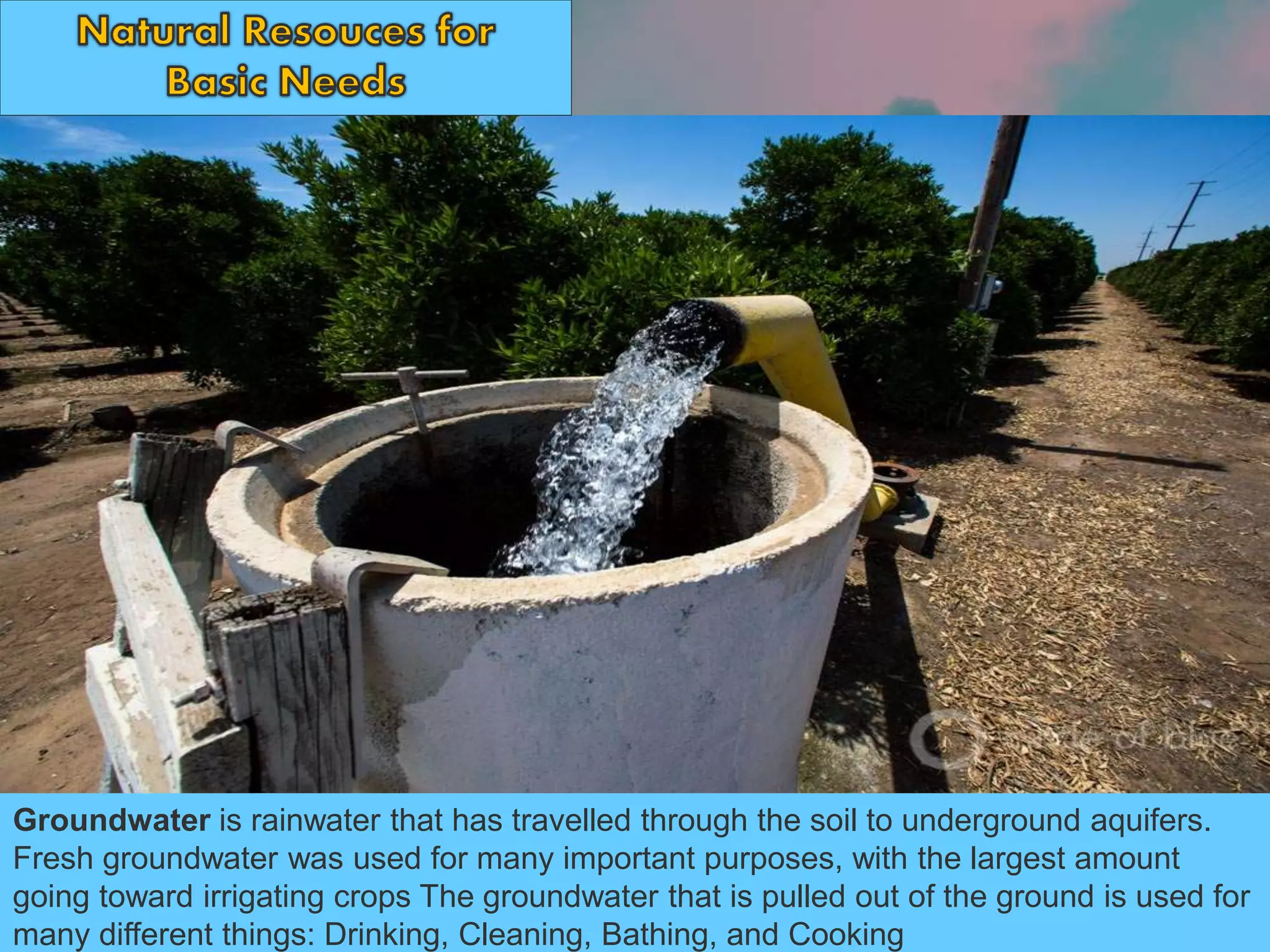
Groundwater is rainwater that has travelled through the soil to underground aquifers.
Fresh groundwater was used for many important purposes, with the largest amount
going toward irrigating crops The groundwater that is pulled out of the ground is used for
many different things: Drinking, Cleaning, Bathing, and Cooking
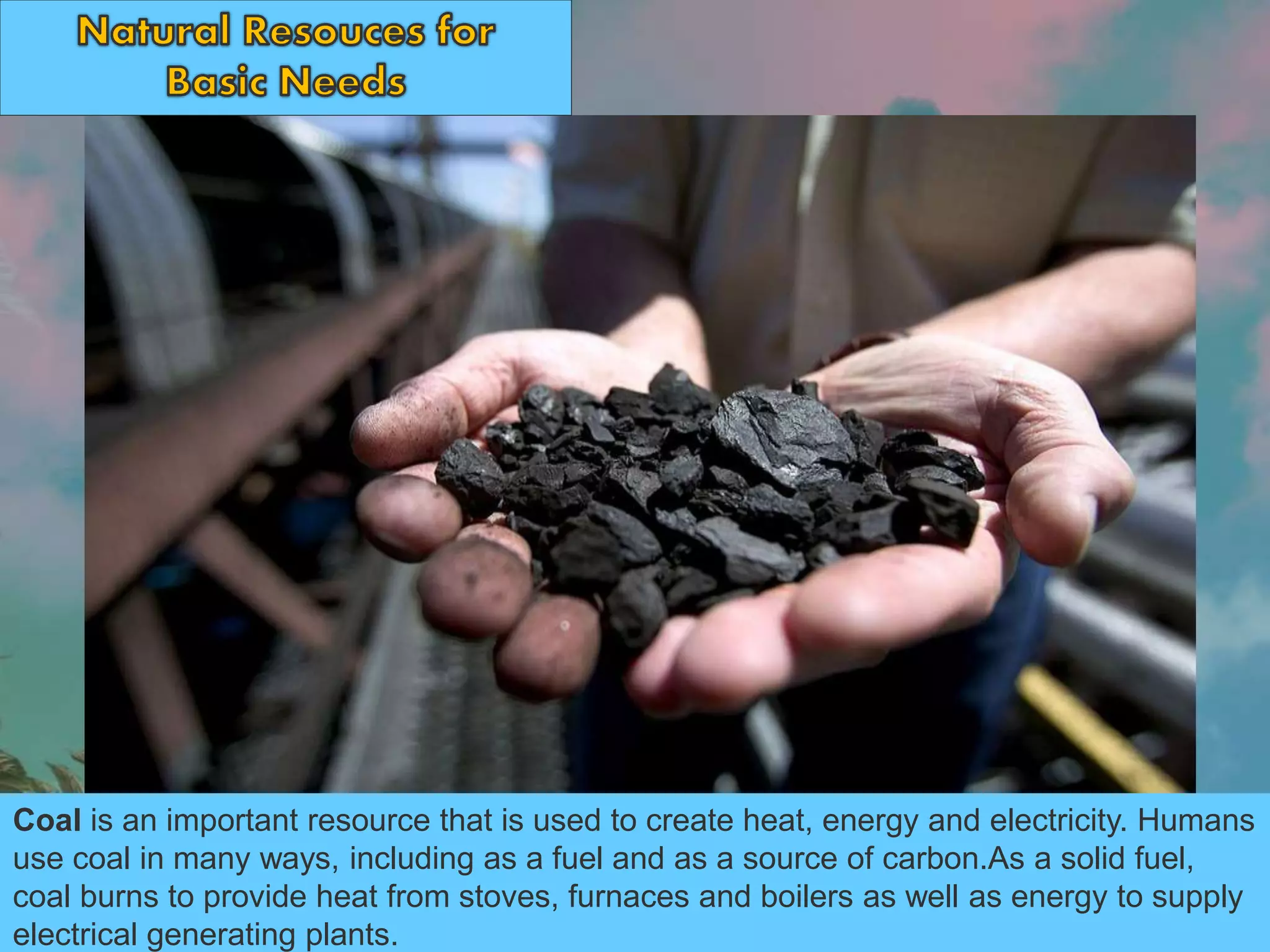
Coal is an important resource that is used to create heat, energy and electricity. Humans
use coal in many ways, including as a fuel and as a source of carbon.As a solid fuel,
coal burns to provide heat from stoves, furnaces and boilers as well as energy to supply
electrical generating plants.
Oil has been used in one form or another over thousands of years but it has become
really important to our economy in the last 2 centuries. Oil powers our industries, heats
our buildings, and provides the raw material for plastics, paints, textiles, and other
materials. But it is in transportation that oil is most essential
Natural gas is a fossil fuel used as a source of energy for heating, cooking, and
electricity generation. It is also used as fuel for vehicles and as a chemical feedstock in
the manufacture of plastics and other commercially important organic chemicals.
Forests and Timber: As the world gets more modern and population grows, there is
more of a demand for housing and construction projects. This reduces open green
spaces. Forests are necessary to preserve the ecology of the world that supports all of
the natural resources and life. Forests also play a critical role in providing clean air and
the lumber that builds the homes.
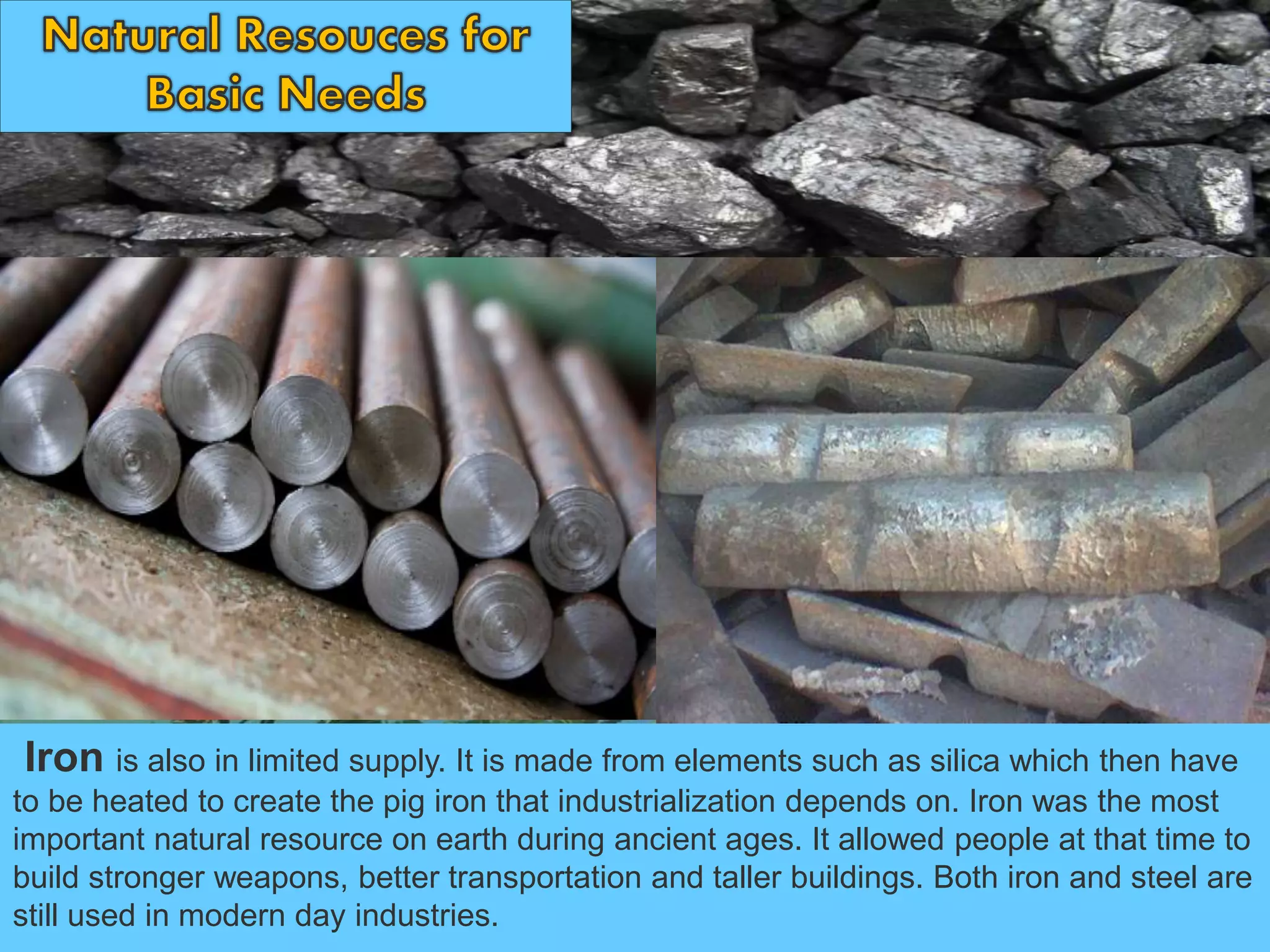
Iron is also in limited supply. It is made from elements such as silica which then have
to be heated to create the pig iron that industrialization depends on. Iron was the most
important natural resource on earth during ancient ages. It allowed people at that time to
build stronger weapons, better transportation and taller buildings. Both iron and steel are
still used in modern day industries.
Phosphorus comes from phosphate rock and is used to grow all of our food and crops.
Unfortunately, phosphate rock is only found in three places on Earth – the US, China
and Morocco. The projected lifespan of the current known resources is about a 100
years. There has not been significant research in developing new and safe fertilizers that
can be effective replacements for phosphorus.
Red Phosphorus is used in match heads.
A match is a tool for starting a fire.
Fertilizer; phosphorus is known for being essential to
DNA and to extent fertilizer.
Solar energy is an important part of almost every life process, if not, all life processes. Plants and
animals, alike, use solar energy to produce important nutrients in their cells. Plants use the energy
to produce the green chlorophyll that they need to survive, while humans use the sun rays to
produce vitamin D in their bodies. However, when man learned to actually convert solar energy into
usable energy, it became even more important.
Wind power is the use of air flow through wind turbines to mechanically power generators
for electricity. Wind power, as an alternative to burning fossil fuels, is plentiful, renewable, widely
distributed, clean, produces nogreenhouse gas emissions during operation, consumes no water,
and uses little land.[2] The net effects on the environment are far less problematic than those
of nonrenewable power sources.
Hydropower is fueled by water, so it's a clean fuel source, meaning it won't
pollute the air like powerplants that burn fossil fuels, such as coal or natural
gas. Hydroelectric power is a domestic source of energy, allowing each state
to produce their own energy without being reliant on international fuel sources.
Biomass is a biological material that is an important energy source for humans. It is composed of
a mixture of organic molecules including carbon, hydrogen, oxygen, nitrogen and alkaline earth
metals. Biomass is a renewable energy source that reduces carbon emissions and can be good for
the environment. As a fuel source, biomass can help create steam and electricity and help fuel
vehicles.
Wood is considered humankind’s very first source of energy. Today it still is the most
important single source of renewable energy providing over 9% of the global
total primary energy supply. It is technically a renewable source of energy, since it is a
form of biomass. All biomass is traditionally considered a renewable source of energy
because it is part of the natural carbon cycle on Earth. .
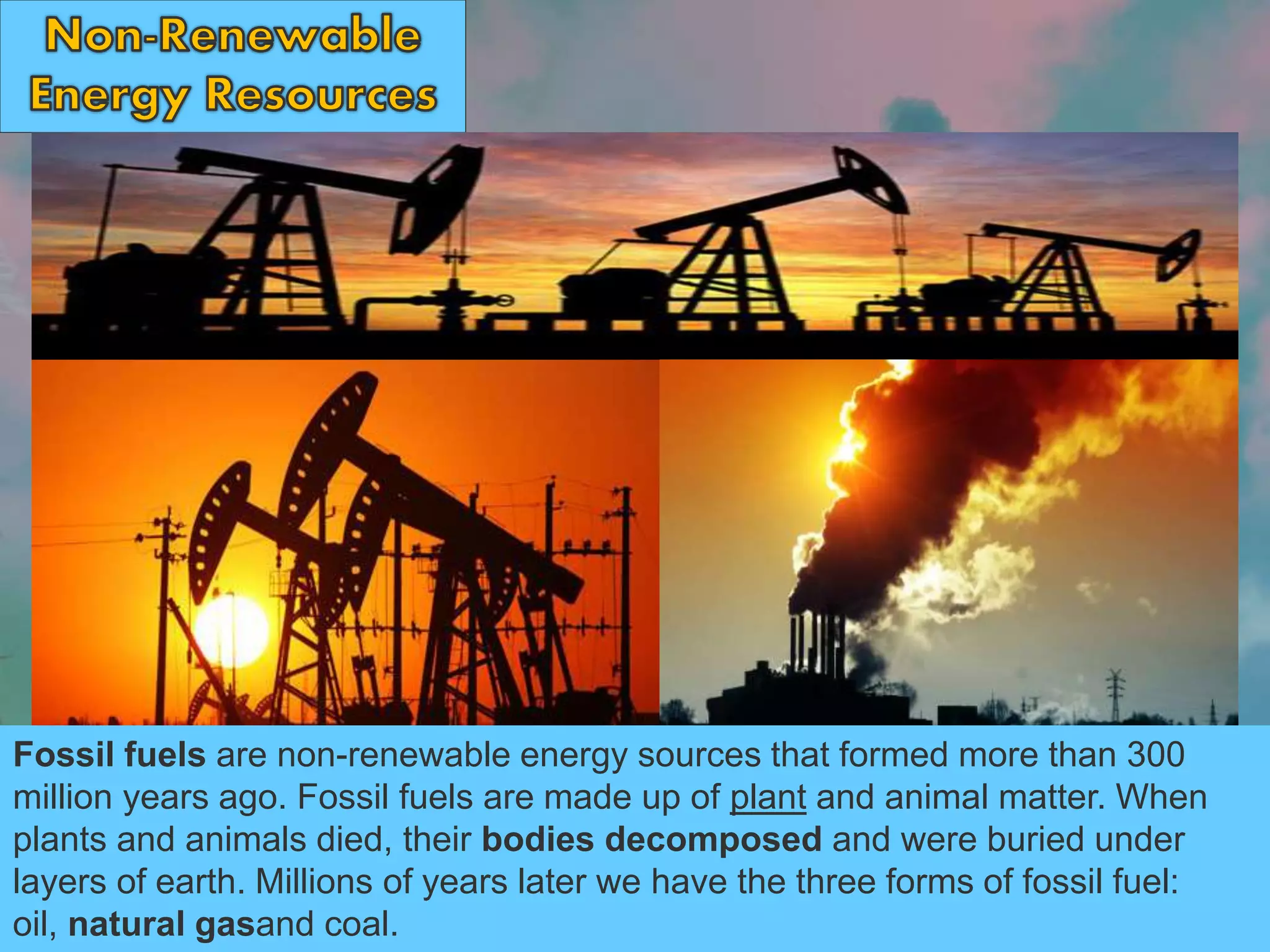
Fossil fuels are non-renewable energy sources that formed more than 300
million years ago. Fossil fuels are made up of plant and animal matter. When
plants and animals died, their bodies decomposed and were buried under
layers of earth. Millions of years later we have the three forms of fossil fuel:
oil, natural gasand coal.
Islands. Made up of more than 7,100 islands, the Philippines is the third-largest English-speaking
country in the world. The island nation lies in the South China Sea and serves as the crossroads of
the Orient. This country is well known for its popular tourism spots and its varied culture stemming
from occupation of several different nations over the centuries. But it is also a land of rich natural
resources that help sustain the nation and make it an important economy in the region.
Oceans.Being surrounded by the ocean, it is no surprise that the Philippines relies on the waters as an important
natural resource. There are more than 640,000 square miles of territorial waters in the Philippines and within these
waters, there is an abundance of marine life and materials that are valuable to the nation's people and those
across the world. At least 65 species of the 2,400 available species in Filipino waters have solid commercial value,
and the crabs, seaweed, pearls and other ocean treasures make the sea among the top resources for this
archipelago.
Major Crops
The volcanic history of the archipelago combined with the wide plains available throughout the nation make the
Philippines a prime spot for growing crops for domestic use and export. The Central Luzon, Cagayan Valley and
Negros are among the many places with fertile soil in the Philippines. This land is the nation's primary source of
livelihood. The chief crops of the nation include rice, corn, sugarcane, abaca and tobacco, according to the
Philippine History website. The rice and corn are used domestically, but the rest is used as a major export.
MineralsThe country’s mineral deposits can be classified into metals and non-metals. Our metal deposits are
estimated at 21.5 billion metric tons, while non-metal deposits are projected at 19.3 billion metric
tons. Nickel ranks first in terms of deposits and size, it is found in Surigao del Norte, Davao, Palawan, Romblon
and Samar. Iron is found in Ilocos Norte, Nueva Ecija, Camarines Norte and Cotabato. While copper in Zambales,
Batangas, Mindoro, Panay and Negros. Among non-metal deposits, the most abundant are cement, lime,
and marble. Other non-metals include asbestos, clay, guano, asphalt, feldspar, sulfur, talc, silicon, phosphate,
and marble.
Flora.The tropical climate in the Philippines makes it an ideal location for flowers and plants. The
islands have more than 2 million species of plants, and several of them are found nowhere else on
the planet. Much of the flora in the Philippines, while diminished by over harvesting, is used as an
important natural resource as ingredients in commercially exported products
Fishery Resources. With its territorial waters measuring as much as 1.67 million square kilometers and located in
the worlds fishing center, the Philippines is definitely rich in marine resources. Of the 2,400 fish species found in
the country. 65 have good commercial value. Other marine products include corals, pearls, crabs and seaweeds.
Some of the countries best salt water fishing area’s are found in Sintangki Island in Sulu Estancia in Bohol,
Malampaya in Palawan, Lingayen Gulf in Pangasinan, San Miguel lake in Camarines Norte, Bantayan Channel
in Cebu, and the seas of Quezon and Sorsogon.
Our Forests
The Philippines also boasts of wide tracts of lush, green forests. In fact, almost half of the country’s
total land area is forested. Sixty percent of these forests are found in Mindanao
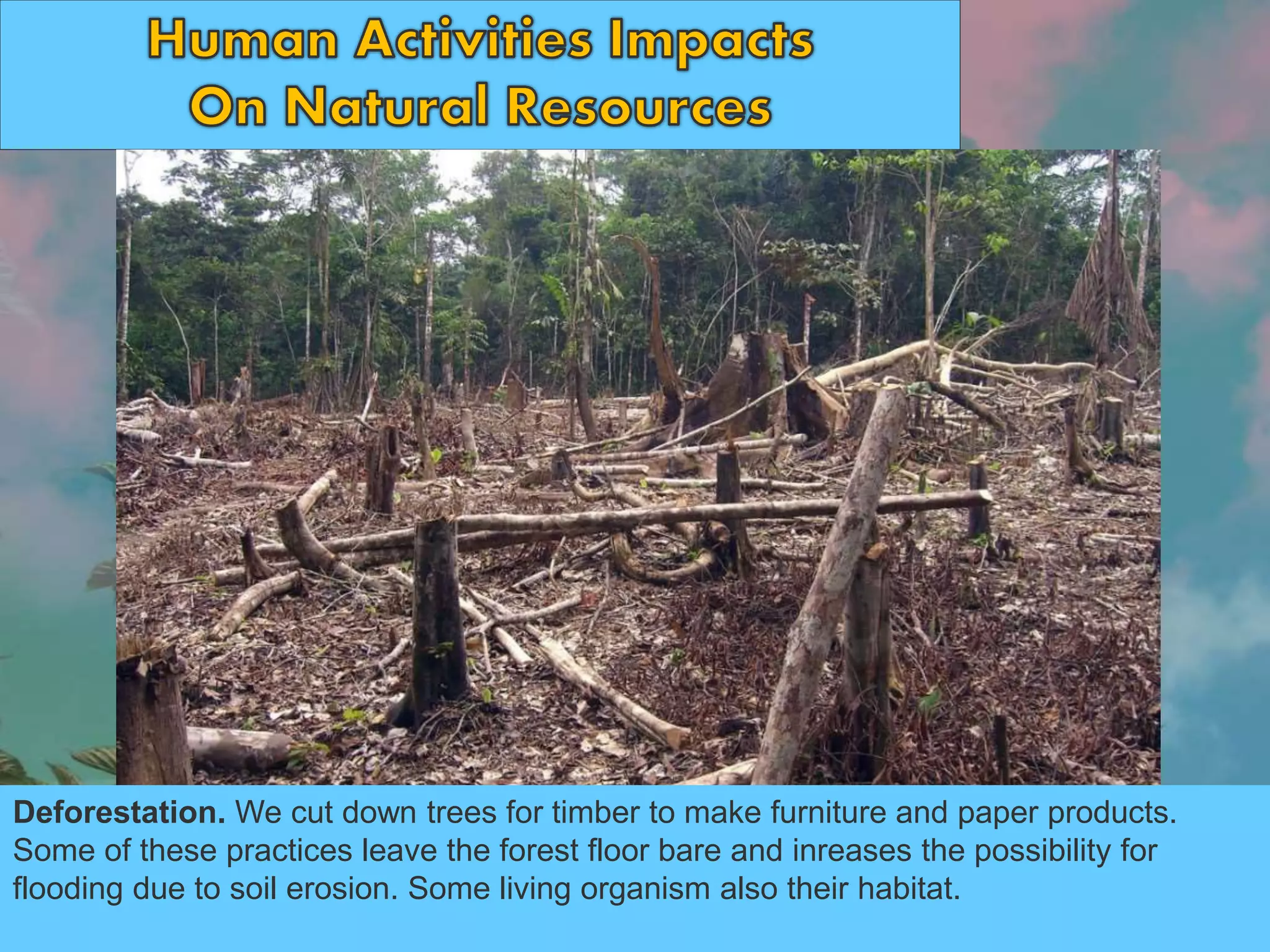
Deforestation. We cut down trees for timber to make furniture and paper products.
Some of these practices leave the forest floor bare and inreases the possibility for
flooding due to soil erosion. Some living organism also their habitat.
Over-Fishing. Animals from the marine environment are hunted as a food by other
animals and humans. It can lead to reduction in animal numbers and human activities
lead to pollution of marine waters and destruction of habitat.
Water Pollution. Too many nutrients can rapidly reduce water quality by causing
overgrowth of certain bacteria and algae that use the oxygen necessary for other
species to survive. Even more problematic is that these nutrients can be transported
downstream to other streams, rivers and bays. Therefore, nutrients can reduce water
quality in places far removed from where they were first introduced.
Air PollutionThe majority of air pollution is the result of human activities. For example, increased
fossil fuel combustion from motor vehicles, industrial factories and power plants all pump large
quantities of air pollutants, such as carbon monoxide, ozone and nitrous oxides, into the
atmosphere. Other air pollutants, such as lead-based compounds, can lead to serious health
effects like cancer, or other types of reproductive effects and birth defects.
Due to the increase in the human population, natural resources are being used up at a more
rapid rate than in the past. Although renewable natural resources can be replenished, when they
are used too rapidly they cannot replenish fast enough to meet the human demand. Even worse,
when nonrenewable natural resources are used too rapidly, they are even closer to running out
completely and being gone forever.
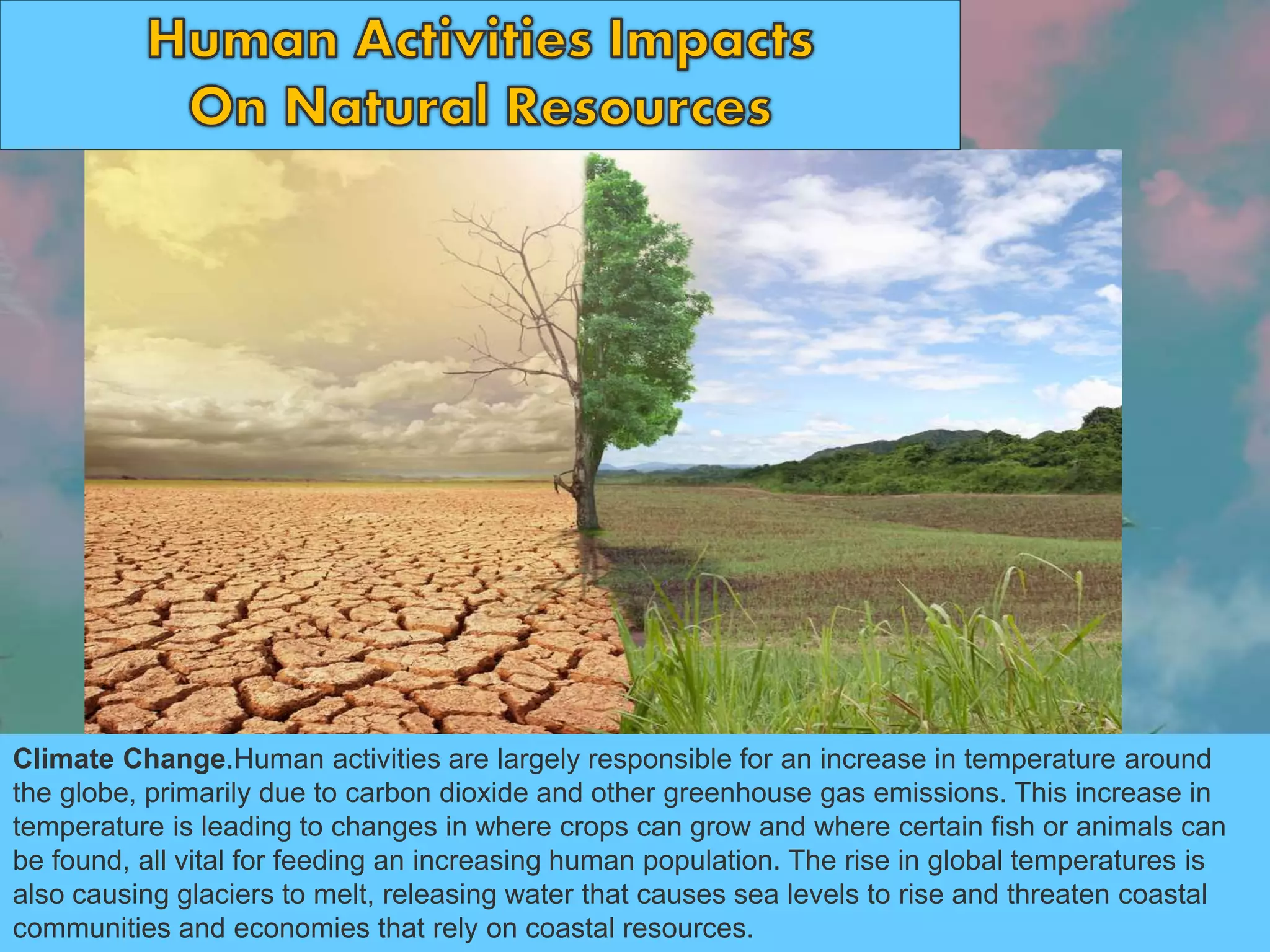
Climate Change.Human activities are largely responsible for an increase in temperature around
the globe, primarily due to carbon dioxide and other greenhouse gas emissions. This increase in
temperature is leading to changes in where crops can grow and where certain fish or animals can
be found, all vital for feeding an increasing human population. The rise in global temperatures is
also causing glaciers to melt, releasing water that causes sea levels to rise and threaten coastal
communities and economies that rely on coastal resources.
Reforestation. Instead of deforestation, representation should keep in mind. We should
take help from the Govt, for plantation programmes. Everybody should take part in
plantation and care the plants.
Proper waste disposal. We should make habit for waste disposal, compose
and to restore biodiversity.
Mixed cropping, crop rotation, and proper use of fertilizer, insecticide and
pesticides should be taught to farmers. Encourage the use of manures,
biofertilizers and organic fertilizers.
We should protect wildlife. Though hunting is not allowed even then the
persons are doing so. For this educated young should teach the lesson of
wildlife act.
Save Energy. We must develop energy saving methods to avoid wastage of
energy. We should remember "energy saved is energy produced.“
Use drip irrigation and sprinkling irrigation to improve irrigation efficiency and
reduce evaporation.
We should recycle the waste and waste water for agriculture
purposes.
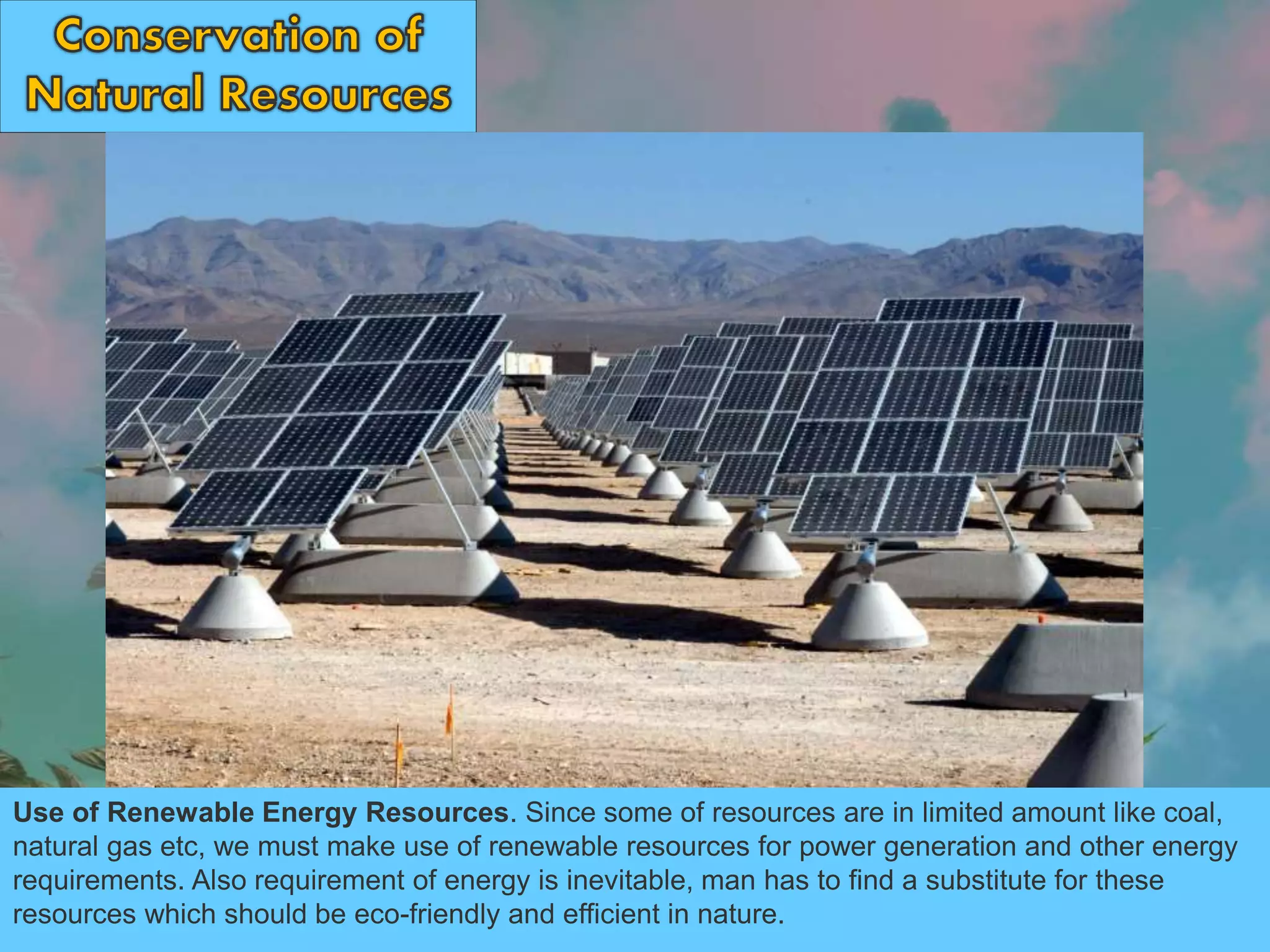
Use of Renewable Energy Resources. Since some of resources are in limited amount like coal,
natural gas etc, we must make use of renewable resources for power generation and other energy
requirements. Also requirement of energy is inevitable, man has to find a substitute for these
resources which should be eco-friendly and efficient in nature.
Install rain water harvesting system in houses, colonies.
Try to educate local people for the protection and judicious use of natural
resources.

EARTH'S NATURAL RESOURCES

  • 2.
    Natural resources areuseful raw materials that we get from the Earth. They occur naturally, which means that humans cannot make natural resources. Instead, we use and modify natural resources in ways that are beneficial to us. The materials used in human-made objects are natural resources Natural resources are those resources that occur within the environment In their original and natural form, undisturbed by humanity. They take years to form without the intervention of humans. The Mother Earth is abundant with natural resources thatdevelop on this planet using its surrounding environment. These natural resources arederived from the environment. While few of them are used for our survival like water, air, rest of them like coal, gas, oil are used for satisfying our daily needs. From forests to mountains to minerals to coastal shores and wetlands, each of these natural resource has its own importance.
  • 4.
    Water resources aresources of water that are useful or potentially useful. Uses of water include agricultural, industrial, household, recreational and environmental activities. The majority of human uses require fresh water.
  • 5.
    Air is awonderful and precious natural resource gifted by the Almighty. It is the main natural source which helps all life to sustain on this Mother Earth. The Earth’s atmosphere is made up of different gases that keep plants, animals and people alive.
  • 6.
    Soil provides muchof the food consumed by people. It supports the growth of agricultural crops. Soil is also responsible for maintaining natural and artificial vegetation. Soil supports foundations of buildings, roads and communication infrastructures.
  • 8.
    Groundwater is rainwaterthat has travelled through the soil to underground aquifers. Fresh groundwater was used for many important purposes, with the largest amount going toward irrigating crops The groundwater that is pulled out of the ground is used for many different things: Drinking, Cleaning, Bathing, and Cooking
  • 9.
    Coal is animportant resource that is used to create heat, energy and electricity. Humans use coal in many ways, including as a fuel and as a source of carbon.As a solid fuel, coal burns to provide heat from stoves, furnaces and boilers as well as energy to supply electrical generating plants.
  • 10.
    Oil has beenused in one form or another over thousands of years but it has become really important to our economy in the last 2 centuries. Oil powers our industries, heats our buildings, and provides the raw material for plastics, paints, textiles, and other materials. But it is in transportation that oil is most essential
  • 11.
    Natural gas isa fossil fuel used as a source of energy for heating, cooking, and electricity generation. It is also used as fuel for vehicles and as a chemical feedstock in the manufacture of plastics and other commercially important organic chemicals.
  • 12.
    Forests and Timber:As the world gets more modern and population grows, there is more of a demand for housing and construction projects. This reduces open green spaces. Forests are necessary to preserve the ecology of the world that supports all of the natural resources and life. Forests also play a critical role in providing clean air and the lumber that builds the homes.
  • 13.
    Iron is alsoin limited supply. It is made from elements such as silica which then have to be heated to create the pig iron that industrialization depends on. Iron was the most important natural resource on earth during ancient ages. It allowed people at that time to build stronger weapons, better transportation and taller buildings. Both iron and steel are still used in modern day industries.
  • 14.
    Phosphorus comes fromphosphate rock and is used to grow all of our food and crops. Unfortunately, phosphate rock is only found in three places on Earth – the US, China and Morocco. The projected lifespan of the current known resources is about a 100 years. There has not been significant research in developing new and safe fertilizers that can be effective replacements for phosphorus.
  • 15.
    Red Phosphorus isused in match heads. A match is a tool for starting a fire.
  • 16.
    Fertilizer; phosphorus isknown for being essential to DNA and to extent fertilizer.
  • 18.
    Solar energy isan important part of almost every life process, if not, all life processes. Plants and animals, alike, use solar energy to produce important nutrients in their cells. Plants use the energy to produce the green chlorophyll that they need to survive, while humans use the sun rays to produce vitamin D in their bodies. However, when man learned to actually convert solar energy into usable energy, it became even more important.
  • 19.
    Wind power isthe use of air flow through wind turbines to mechanically power generators for electricity. Wind power, as an alternative to burning fossil fuels, is plentiful, renewable, widely distributed, clean, produces nogreenhouse gas emissions during operation, consumes no water, and uses little land.[2] The net effects on the environment are far less problematic than those of nonrenewable power sources.
  • 20.
    Hydropower is fueledby water, so it's a clean fuel source, meaning it won't pollute the air like powerplants that burn fossil fuels, such as coal or natural gas. Hydroelectric power is a domestic source of energy, allowing each state to produce their own energy without being reliant on international fuel sources.
  • 21.
    Biomass is abiological material that is an important energy source for humans. It is composed of a mixture of organic molecules including carbon, hydrogen, oxygen, nitrogen and alkaline earth metals. Biomass is a renewable energy source that reduces carbon emissions and can be good for the environment. As a fuel source, biomass can help create steam and electricity and help fuel vehicles.
  • 22.
    Wood is consideredhumankind’s very first source of energy. Today it still is the most important single source of renewable energy providing over 9% of the global total primary energy supply. It is technically a renewable source of energy, since it is a form of biomass. All biomass is traditionally considered a renewable source of energy because it is part of the natural carbon cycle on Earth. .
  • 24.
    Fossil fuels arenon-renewable energy sources that formed more than 300 million years ago. Fossil fuels are made up of plant and animal matter. When plants and animals died, their bodies decomposed and were buried under layers of earth. Millions of years later we have the three forms of fossil fuel: oil, natural gasand coal.
  • 26.
    Islands. Made upof more than 7,100 islands, the Philippines is the third-largest English-speaking country in the world. The island nation lies in the South China Sea and serves as the crossroads of the Orient. This country is well known for its popular tourism spots and its varied culture stemming from occupation of several different nations over the centuries. But it is also a land of rich natural resources that help sustain the nation and make it an important economy in the region.
  • 27.
    Oceans.Being surrounded bythe ocean, it is no surprise that the Philippines relies on the waters as an important natural resource. There are more than 640,000 square miles of territorial waters in the Philippines and within these waters, there is an abundance of marine life and materials that are valuable to the nation's people and those across the world. At least 65 species of the 2,400 available species in Filipino waters have solid commercial value, and the crabs, seaweed, pearls and other ocean treasures make the sea among the top resources for this archipelago.
  • 28.
    Major Crops The volcanichistory of the archipelago combined with the wide plains available throughout the nation make the Philippines a prime spot for growing crops for domestic use and export. The Central Luzon, Cagayan Valley and Negros are among the many places with fertile soil in the Philippines. This land is the nation's primary source of livelihood. The chief crops of the nation include rice, corn, sugarcane, abaca and tobacco, according to the Philippine History website. The rice and corn are used domestically, but the rest is used as a major export.
  • 29.
    MineralsThe country’s mineraldeposits can be classified into metals and non-metals. Our metal deposits are estimated at 21.5 billion metric tons, while non-metal deposits are projected at 19.3 billion metric tons. Nickel ranks first in terms of deposits and size, it is found in Surigao del Norte, Davao, Palawan, Romblon and Samar. Iron is found in Ilocos Norte, Nueva Ecija, Camarines Norte and Cotabato. While copper in Zambales, Batangas, Mindoro, Panay and Negros. Among non-metal deposits, the most abundant are cement, lime, and marble. Other non-metals include asbestos, clay, guano, asphalt, feldspar, sulfur, talc, silicon, phosphate, and marble.
  • 30.
    Flora.The tropical climatein the Philippines makes it an ideal location for flowers and plants. The islands have more than 2 million species of plants, and several of them are found nowhere else on the planet. Much of the flora in the Philippines, while diminished by over harvesting, is used as an important natural resource as ingredients in commercially exported products
  • 31.
    Fishery Resources. Withits territorial waters measuring as much as 1.67 million square kilometers and located in the worlds fishing center, the Philippines is definitely rich in marine resources. Of the 2,400 fish species found in the country. 65 have good commercial value. Other marine products include corals, pearls, crabs and seaweeds. Some of the countries best salt water fishing area’s are found in Sintangki Island in Sulu Estancia in Bohol, Malampaya in Palawan, Lingayen Gulf in Pangasinan, San Miguel lake in Camarines Norte, Bantayan Channel in Cebu, and the seas of Quezon and Sorsogon.
  • 32.
    Our Forests The Philippinesalso boasts of wide tracts of lush, green forests. In fact, almost half of the country’s total land area is forested. Sixty percent of these forests are found in Mindanao
  • 34.
    Deforestation. We cutdown trees for timber to make furniture and paper products. Some of these practices leave the forest floor bare and inreases the possibility for flooding due to soil erosion. Some living organism also their habitat.
  • 35.
    Over-Fishing. Animals fromthe marine environment are hunted as a food by other animals and humans. It can lead to reduction in animal numbers and human activities lead to pollution of marine waters and destruction of habitat.
  • 36.
    Water Pollution. Toomany nutrients can rapidly reduce water quality by causing overgrowth of certain bacteria and algae that use the oxygen necessary for other species to survive. Even more problematic is that these nutrients can be transported downstream to other streams, rivers and bays. Therefore, nutrients can reduce water quality in places far removed from where they were first introduced.
  • 37.
    Air PollutionThe majorityof air pollution is the result of human activities. For example, increased fossil fuel combustion from motor vehicles, industrial factories and power plants all pump large quantities of air pollutants, such as carbon monoxide, ozone and nitrous oxides, into the atmosphere. Other air pollutants, such as lead-based compounds, can lead to serious health effects like cancer, or other types of reproductive effects and birth defects.
  • 38.
    Due to theincrease in the human population, natural resources are being used up at a more rapid rate than in the past. Although renewable natural resources can be replenished, when they are used too rapidly they cannot replenish fast enough to meet the human demand. Even worse, when nonrenewable natural resources are used too rapidly, they are even closer to running out completely and being gone forever.
  • 39.
    Climate Change.Human activitiesare largely responsible for an increase in temperature around the globe, primarily due to carbon dioxide and other greenhouse gas emissions. This increase in temperature is leading to changes in where crops can grow and where certain fish or animals can be found, all vital for feeding an increasing human population. The rise in global temperatures is also causing glaciers to melt, releasing water that causes sea levels to rise and threaten coastal communities and economies that rely on coastal resources.
  • 41.
    Reforestation. Instead ofdeforestation, representation should keep in mind. We should take help from the Govt, for plantation programmes. Everybody should take part in plantation and care the plants.
  • 42.
    Proper waste disposal.We should make habit for waste disposal, compose and to restore biodiversity.
  • 43.
    Mixed cropping, croprotation, and proper use of fertilizer, insecticide and pesticides should be taught to farmers. Encourage the use of manures, biofertilizers and organic fertilizers.
  • 44.
    We should protectwildlife. Though hunting is not allowed even then the persons are doing so. For this educated young should teach the lesson of wildlife act.
  • 45.
    Save Energy. Wemust develop energy saving methods to avoid wastage of energy. We should remember "energy saved is energy produced.“
  • 46.
    Use drip irrigationand sprinkling irrigation to improve irrigation efficiency and reduce evaporation.
  • 47.
    We should recyclethe waste and waste water for agriculture purposes.
  • 48.
    Use of RenewableEnergy Resources. Since some of resources are in limited amount like coal, natural gas etc, we must make use of renewable resources for power generation and other energy requirements. Also requirement of energy is inevitable, man has to find a substitute for these resources which should be eco-friendly and efficient in nature.
  • 49.
    Install rain waterharvesting system in houses, colonies.
  • 50.
    Try to educatelocal people for the protection and judicious use of natural resources.