Knowledge Code Theory
Richard Pountney
Sheffield Hallam University
7th November 2015
Social Realism
• Beyond knowledge as power relations (from
‘relations to’ to ‘relations within’)
• Rejects the choice between essentialism and
relativism as false
• we can say knowledge is historically and
socially constructed and shaped by struggles
among social groups without saying that all
knowledge is equal and that its status merely
reflects social power
Definitions (1)
practice(s): used generally as a synonym for activity in the context of learning and
teaching (practices), but also in a specific sense to refer to knowledge practices and
pedagogic practices used in a social realism meaning as the meeting of two logics:
context (field) and dispositions (habitus) (Bourdieu, 1986).
Bernstein’s 3 message systems: Curriculum, Pedagogy and Assessment
curriculum: a plan for learning that has a number of components including
programme and content, learning objectives and learning strategies, assessment
methods and resources. This view of curriculum as primarily ‘content’ is the aspect
‘most visible to students’, and which is often synonymous with curriculum structure
at the programme (course) or module (unit) level in HE.
pedagogy/pedagogic practice: what defines what counts as a valid transmission of
knowledge.
assessment: the process of identifying a mark or grade for students’ work in a module,
including the defined tasks, or assignments, that the student must undertake, and the
learning outcomes and criteria required for the evaluation of the submitted work.
Cracking the code of education
• Curriculum
– Everyday / Specialised
• Pedagogy
– Selection, sequencing and pacing
– Assessment
– Relationship
• Levels
• Stages
Wayne Hugo: 10 Questions to Cracking the Code
Basil Bernstein (1924-2000)
• Basis in sociolinguistics: sociolinguistic theory
of language codes (elaborated and restricted
codes in 1971)
• Code: ‘a set of organizing principles behind
the language employed by members of a
social group’
• Sociology of education: the ordered
regulation and distribution of a society’s
worthwhile knowledge store
• The transformation into a pedagogic
discourse
• Further transformation into a set of criterial
standards to be attained
https://en.wikipedia.org/wiki/Basil_Bernstein
www.legitimationcodetheory.c
om
5
6
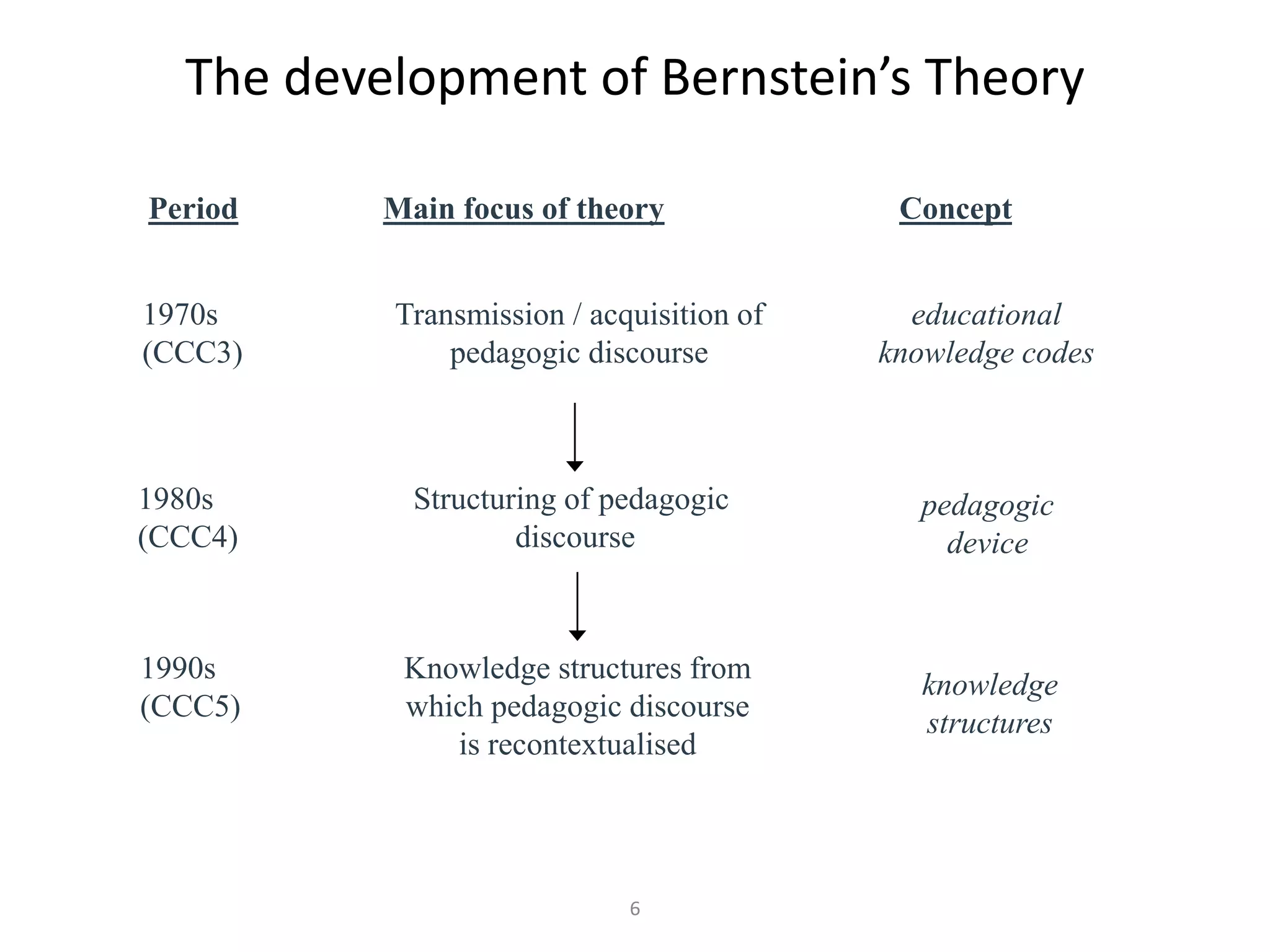
Period Main focus of theory
Transmission / acquisition of
pedagogic discourse
1970s
(CCC3)
Structuring of pedagogic
discourse
1980s
(CCC4)
Knowledge structures from
which pedagogic discourse
is recontextualised
1990s
(CCC5)
educational
knowledge codes
pedagogic
device
knowledge
structures
Concept
The development of Bernstein’s Theory
7
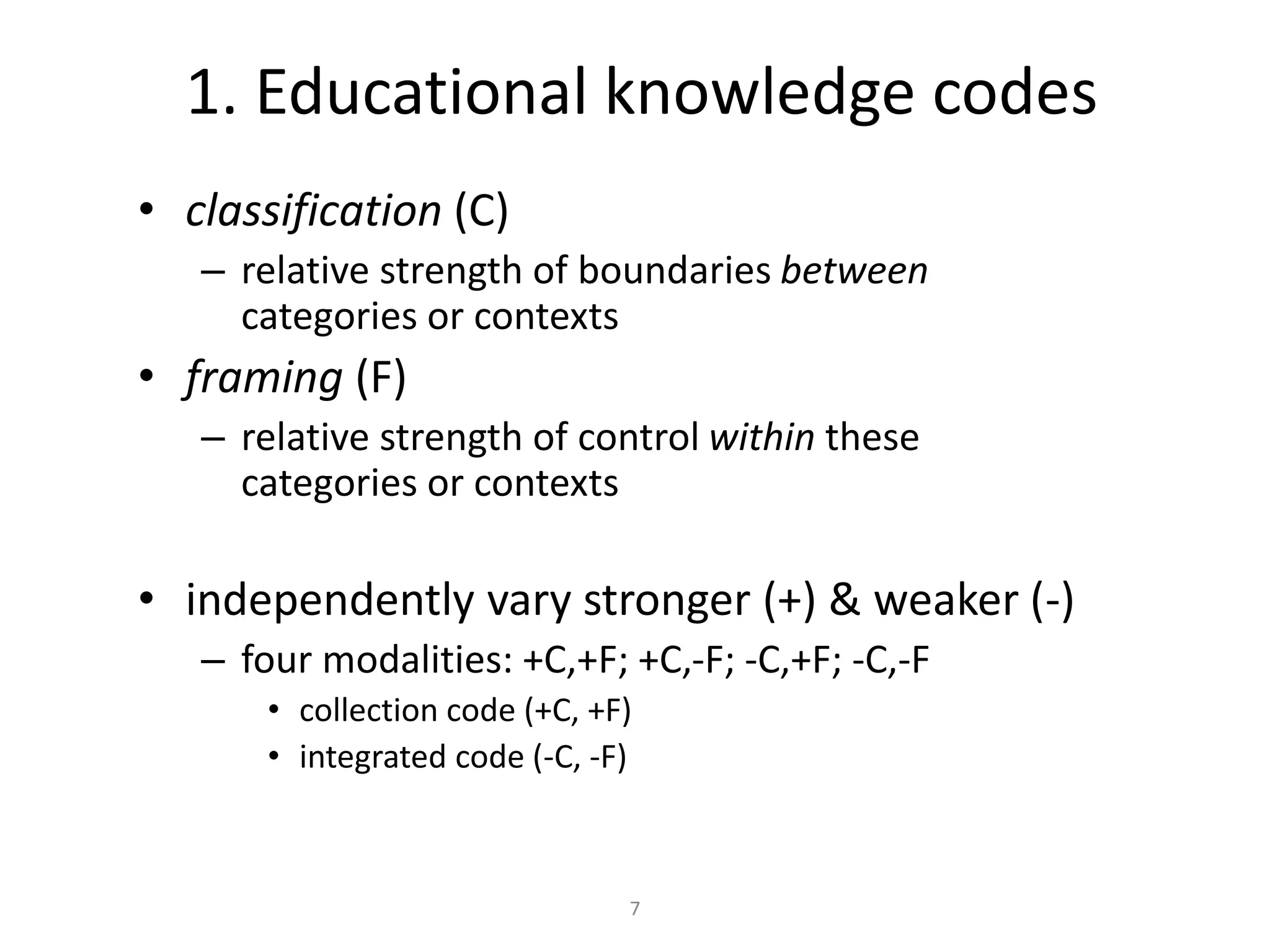
1. Educational knowledge codes
• classification (C)
– relative strength of boundaries between
categories or contexts
• framing (F)
– relative strength of control within these
categories or contexts
• independently vary stronger (+) & weaker (-)
– four modalities: +C,+F; +C,-F; -C,+F; -C,-F
• collection code (+C, +F)
• integrated code (-C, -F)
8
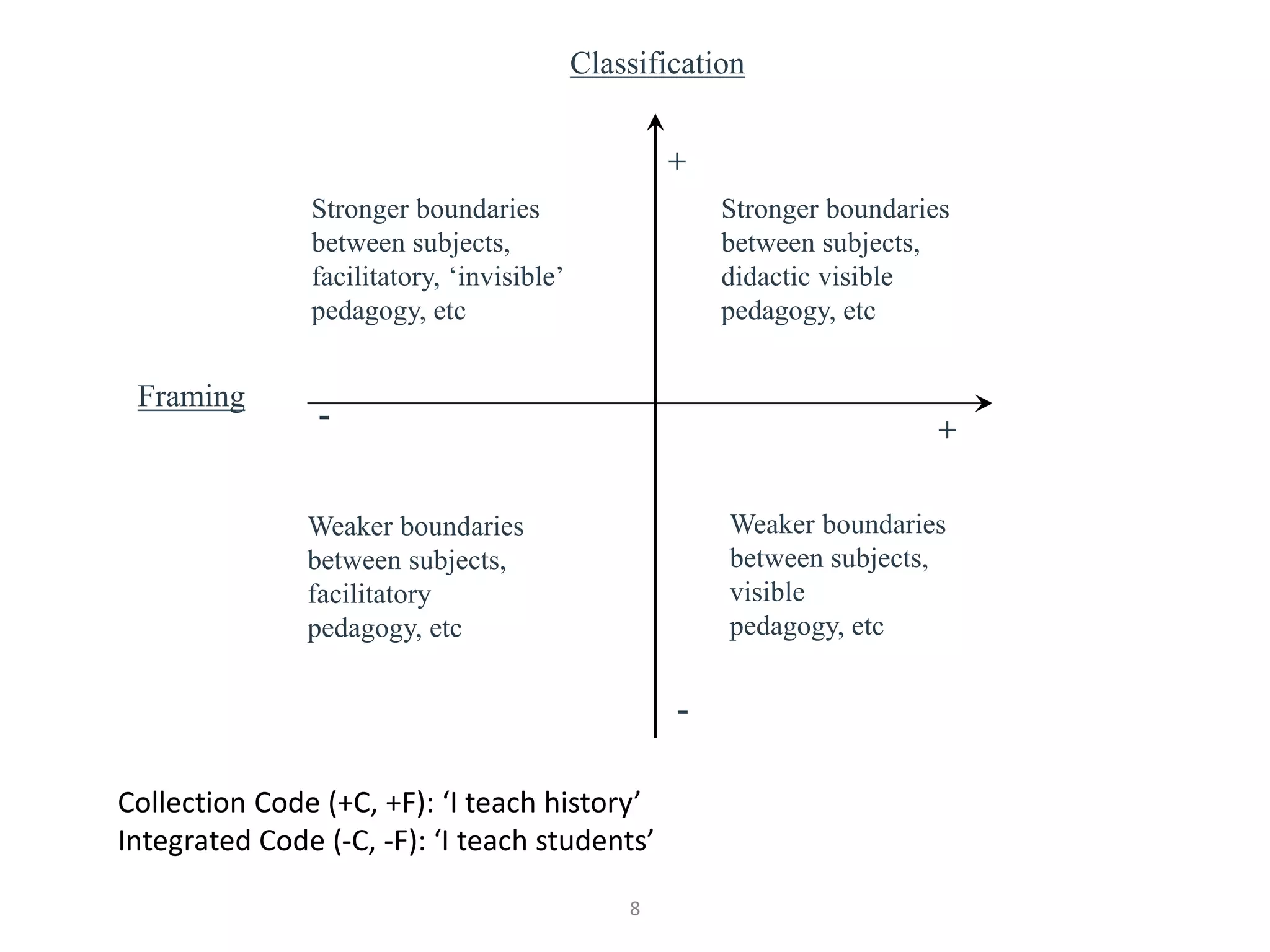
-
Classification
Framing
+
- +
Weaker boundaries
between subjects,
facilitatory
pedagogy, etc
Stronger boundaries
between subjects,
didactic visible
pedagogy, etc
Weaker boundaries
between subjects,
visible
pedagogy, etc
Stronger boundaries
between subjects,
facilitatory, ‘invisible’
pedagogy, etc
Collection Code (+C, +F): ‘I teach history’
Integrated Code (-C, -F): ‘I teach students’
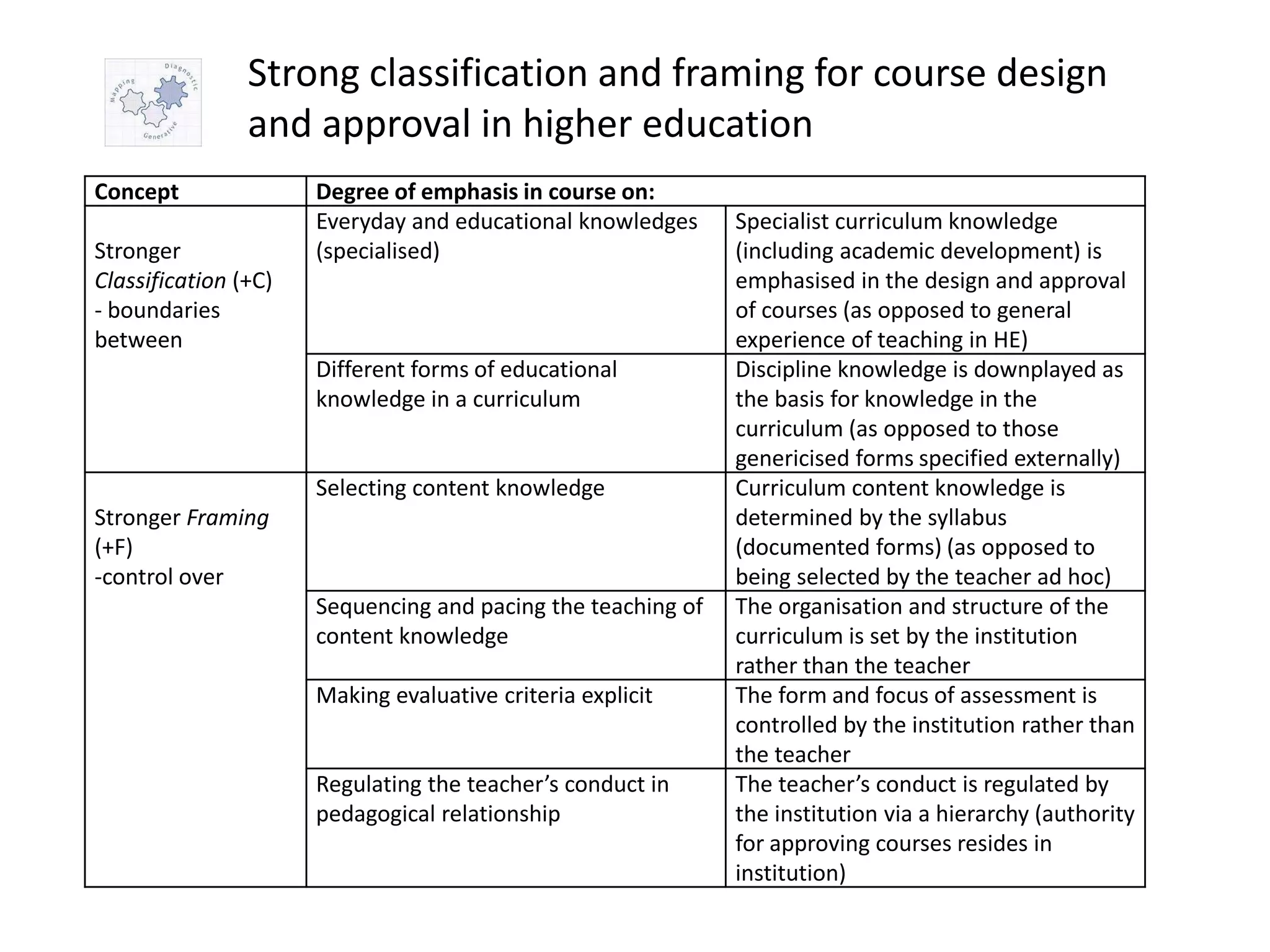
Strong classification and framing for course design
and approval in higher education
Concept Degree of emphasis in course on:
Stronger
Classification (+C)
- boundaries
between
Everyday and educational knowledges
(specialised)
Specialist curriculum knowledge
(including academic development) is
emphasised in the design and approval
of courses (as opposed to general
experience of teaching in HE)
Different forms of educational
knowledge in a curriculum
Discipline knowledge is downplayed as
the basis for knowledge in the
curriculum (as opposed to those
genericised forms specified externally)
Stronger Framing
(+F)
-control over
Selecting content knowledge Curriculum content knowledge is
determined by the syllabus
(documented forms) (as opposed to
being selected by the teacher ad hoc)
Sequencing and pacing the teaching of
content knowledge
The organisation and structure of the
curriculum is set by the institution
rather than the teacher
Making evaluative criteria explicit The form and focus of assessment is
controlled by the institution rather than
the teacher
Regulating the teacher’s conduct in
pedagogical relationship
The teacher’s conduct is regulated by
the institution via a hierarchy (authority
for approving courses resides in
institution)
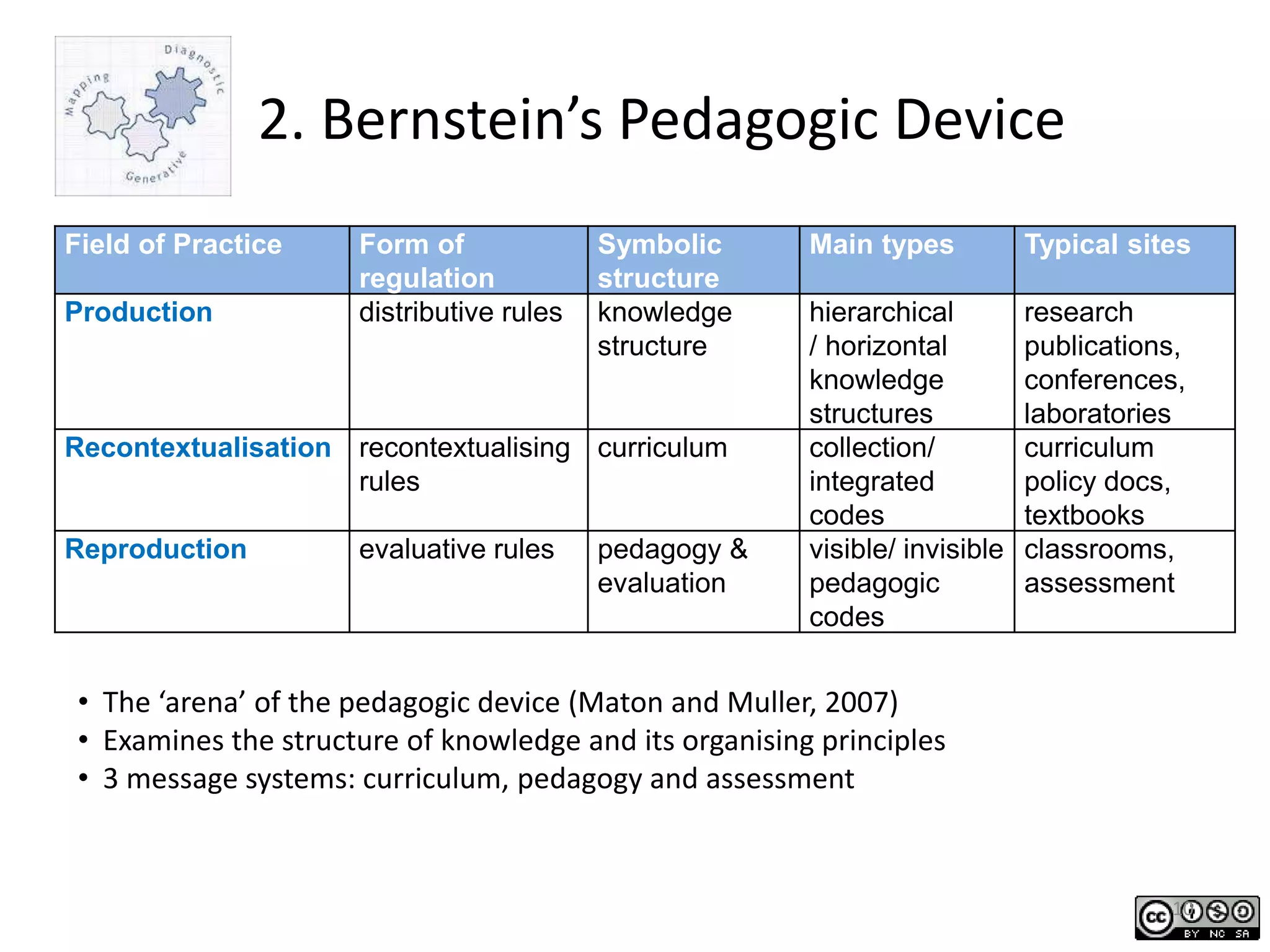
2. Bernstein’s Pedagogic Device
Field of Practice Form of
regulation
Symbolic
structure
Main types Typical sites
Production distributive rules knowledge
structure
hierarchical
/ horizontal
knowledge
structures
research
publications,
conferences,
laboratories
Recontextualisation recontextualising
rules
curriculum collection/
integrated
codes
curriculum
policy docs,
textbooks
Reproduction evaluative rules pedagogy &
evaluation
visible/ invisible
pedagogic
codes
classrooms,
assessment
• The ‘arena’ of the pedagogic device (Maton and Muller, 2007)
• Examines the structure of knowledge and its organising principles
• 3 message systems: curriculum, pedagogy and assessment
10
www.legitimationcodetheory.c
om
11
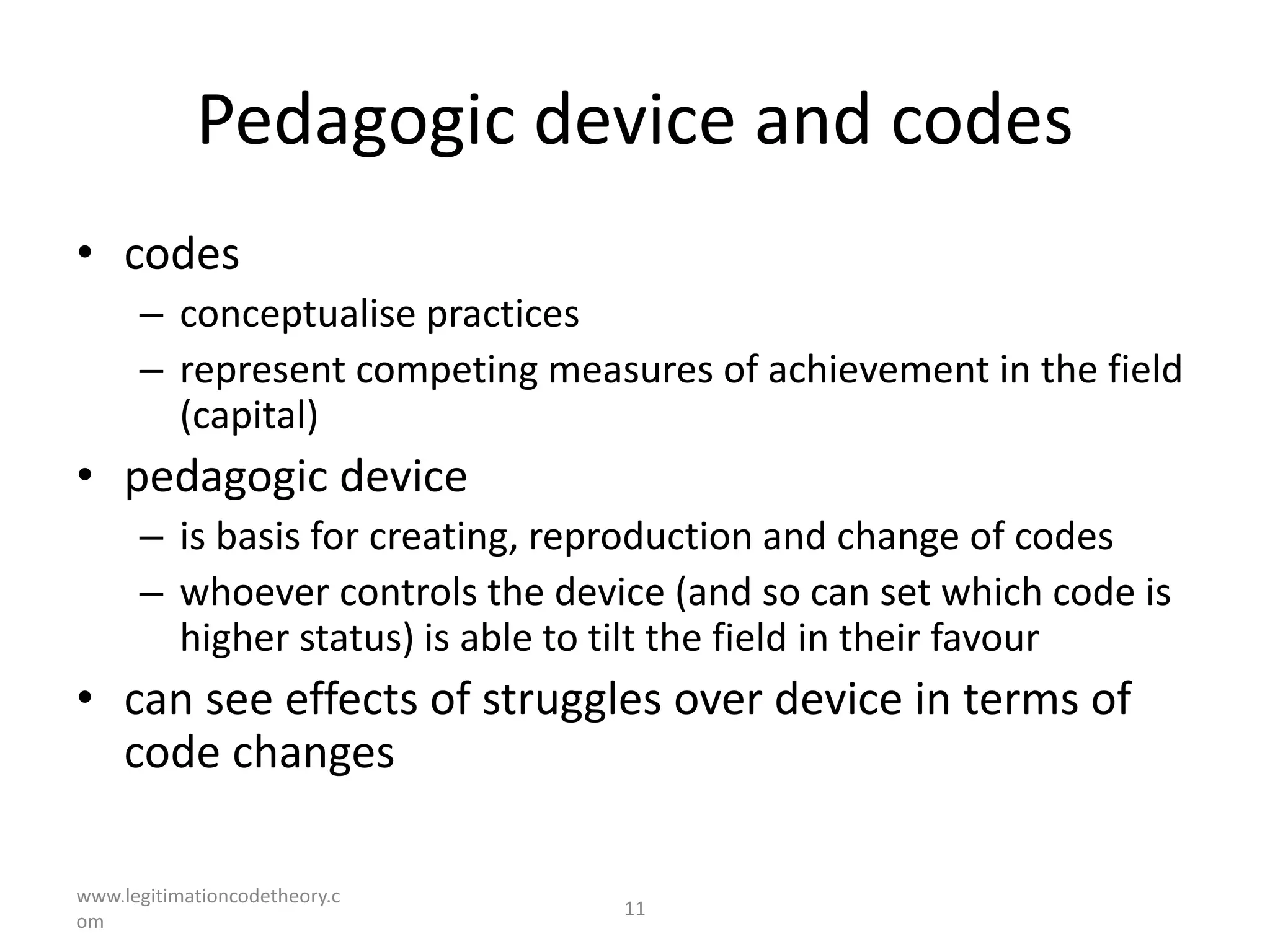
Pedagogic device and codes
• codes
– conceptualise practices
– represent competing measures of achievement in the field
(capital)
• pedagogic device
– is basis for creating, reproduction and change of codes
– whoever controls the device (and so can set which code is
higher status) is able to tilt the field in their favour
• can see effects of struggles over device in terms of
code changes
12
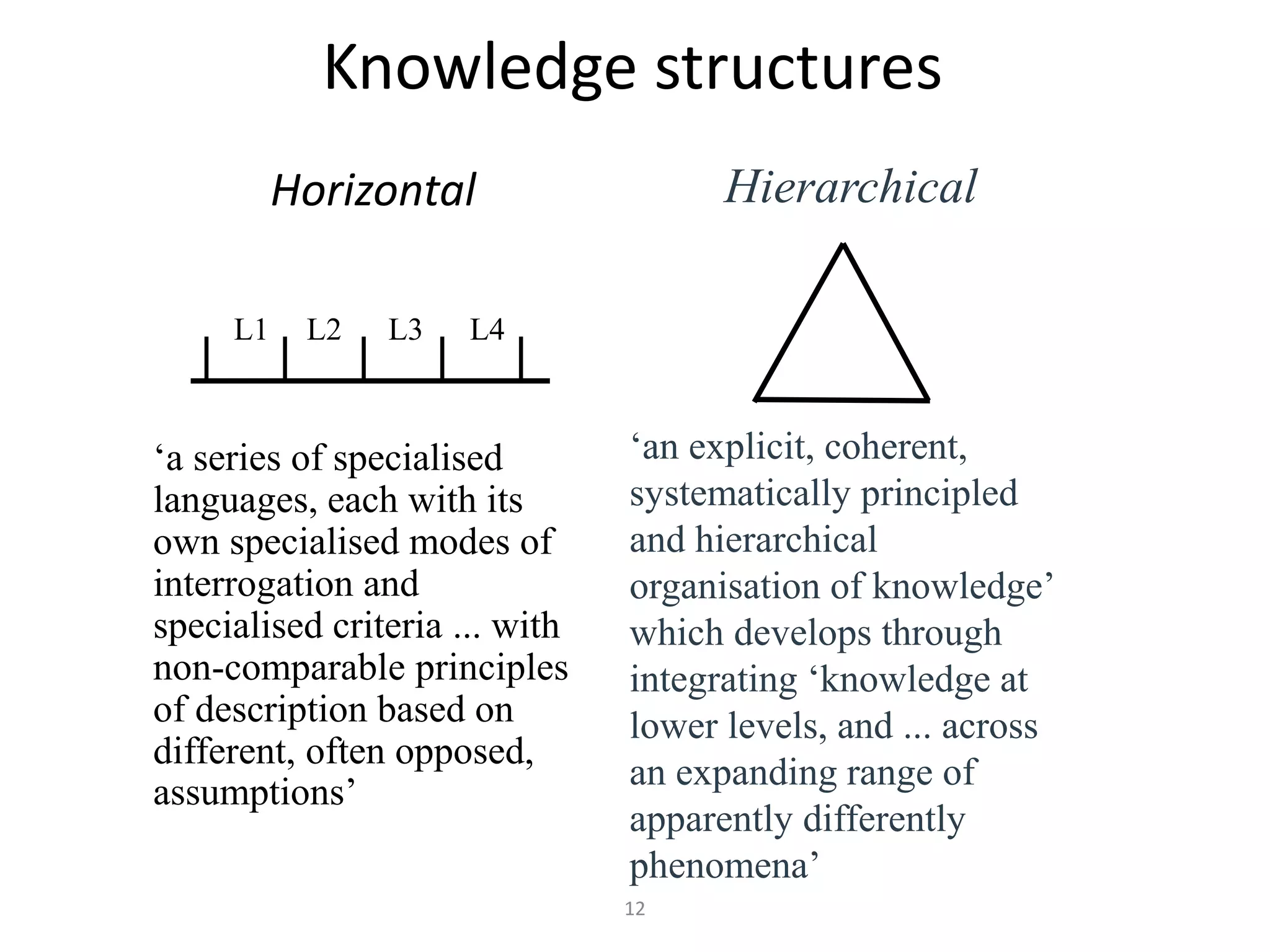
Knowledge structures
Horizontal
‘a series of specialised
languages, each with its
own specialised modes of
interrogation and
specialised criteria ... with
non-comparable principles
of description based on
different, often opposed,
assumptions’
Hierarchical
‘an explicit, coherent,
systematically principled
and hierarchical
organisation of knowledge’
which develops through
integrating ‘knowledge at
lower levels, and ... across
an expanding range of
apparently differently
phenomena’
L1 L2 L3 L4
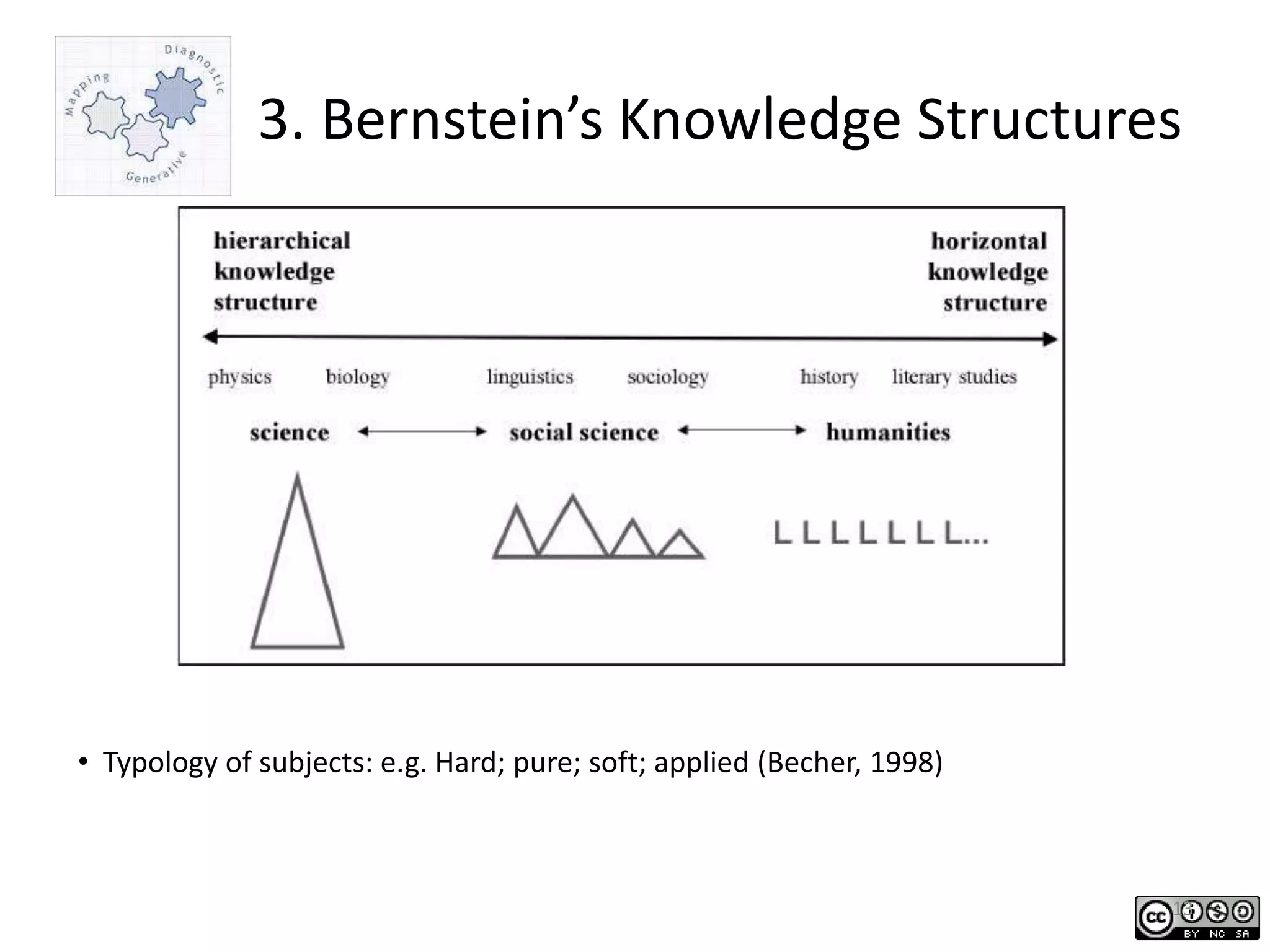
3. Bernstein’s Knowledge Structures
• Typology of subjects: e.g. Hard; pure; soft; applied (Becher, 1998)
13
Code theory and the curriculum
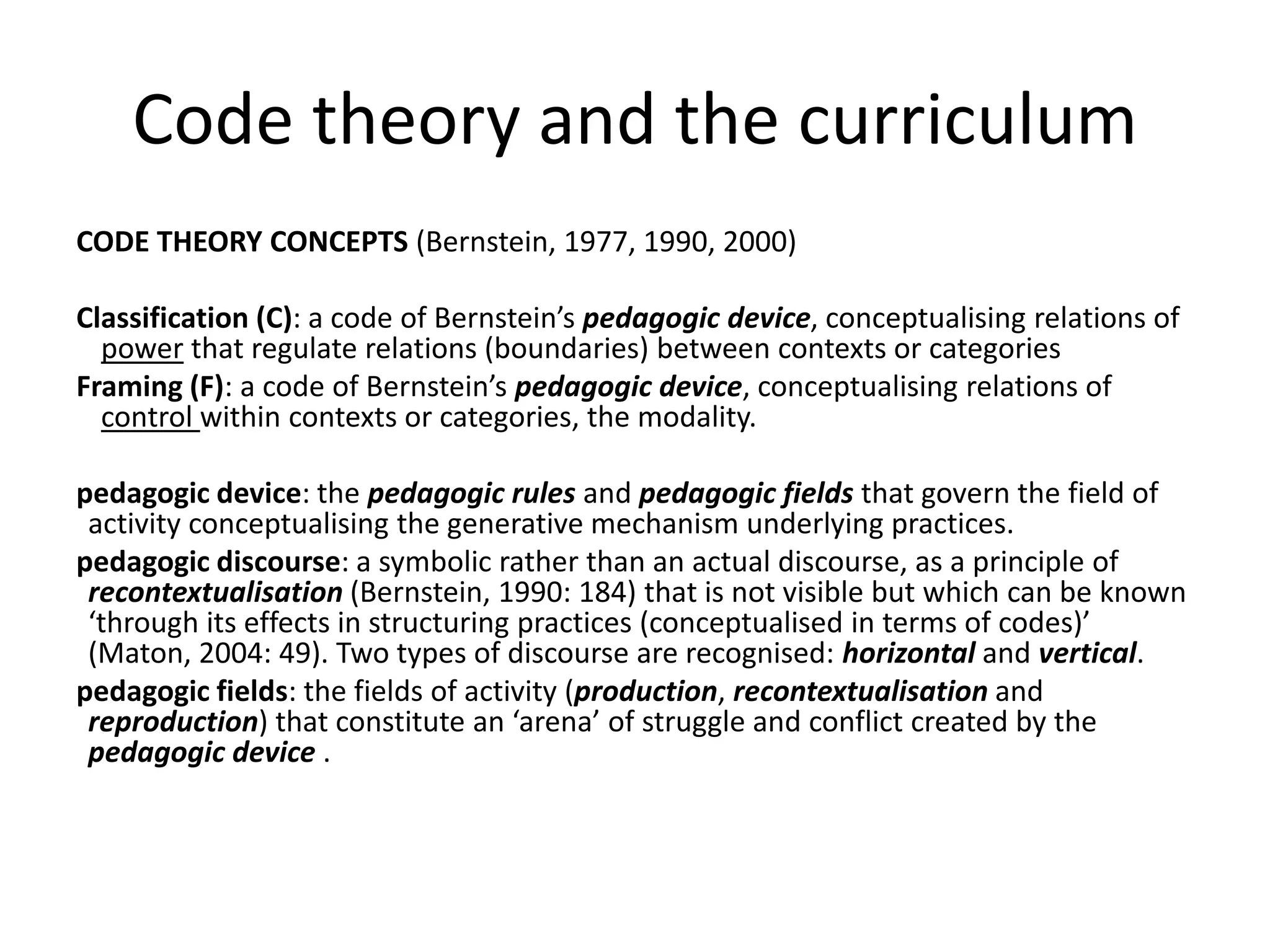
CODE THEORY CONCEPTS (Bernstein, 1977, 1990, 2000)
Classification (C): a code of Bernstein’s pedagogic device, conceptualising relations of
power that regulate relations (boundaries) between contexts or categories
Framing (F): a code of Bernstein’s pedagogic device, conceptualising relations of
control within contexts or categories, the modality.
pedagogic device: the pedagogic rules and pedagogic fields that govern the field of
activity conceptualising the generative mechanism underlying practices.
pedagogic discourse: a symbolic rather than an actual discourse, as a principle of
recontextualisation (Bernstein, 1990: 184) that is not visible but which can be known
‘through its effects in structuring practices (conceptualised in terms of codes)’
(Maton, 2004: 49). Two types of discourse are recognised: horizontal and vertical.
pedagogic fields: the fields of activity (production, recontextualisation and
reproduction) that constitute an ‘arena’ of struggle and conflict created by the
pedagogic device .
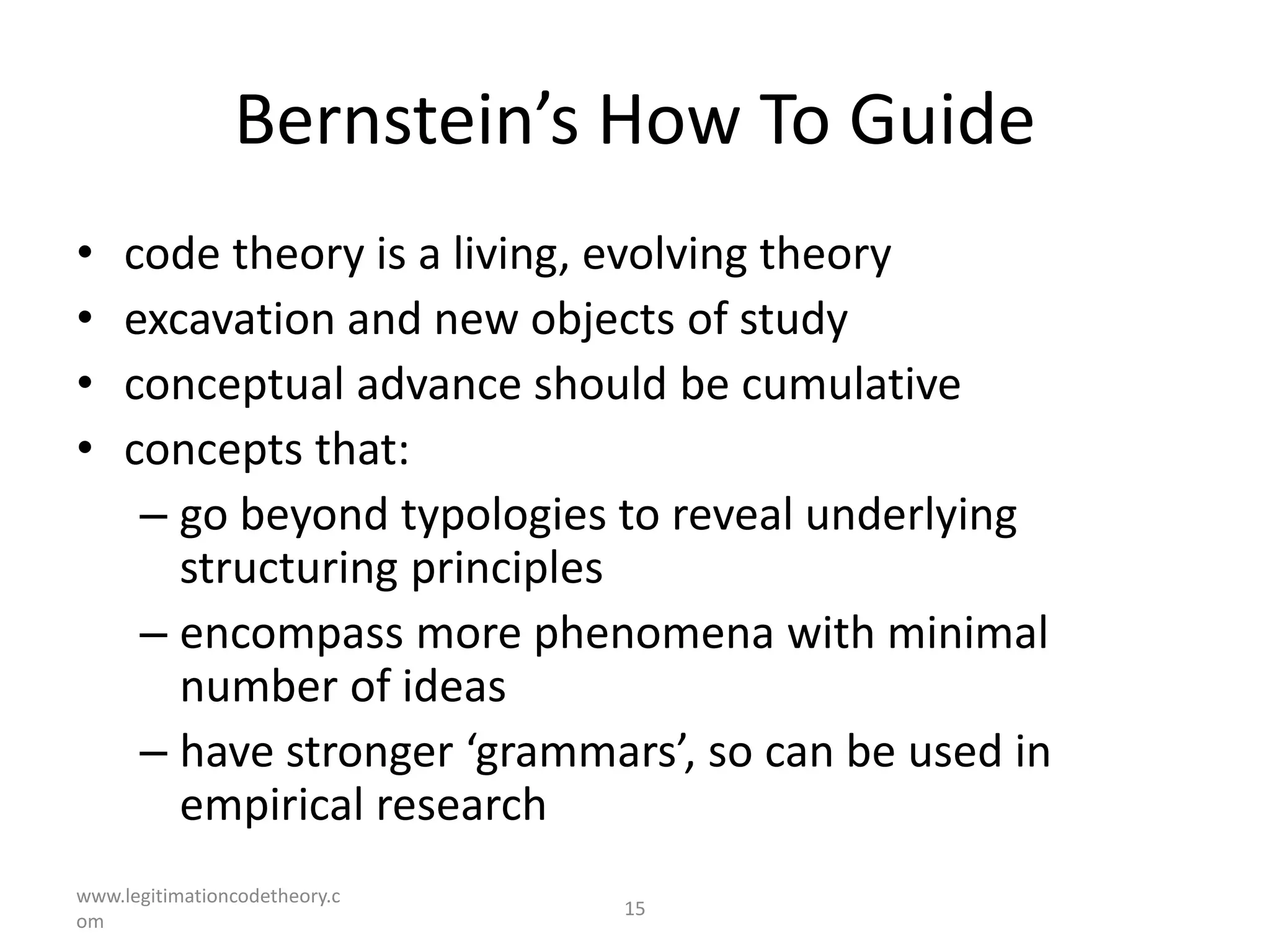
Bernstein’s How To Guide
• code theory is a living, evolving theory
• excavation and new objects of study
• conceptual advance should be cumulative
• concepts that:
– go beyond typologies to reveal underlying
structuring principles
– encompass more phenomena with minimal
number of ideas
– have stronger ‘grammars’, so can be used in
empirical research
www.legitimationcodetheory.c
om
15
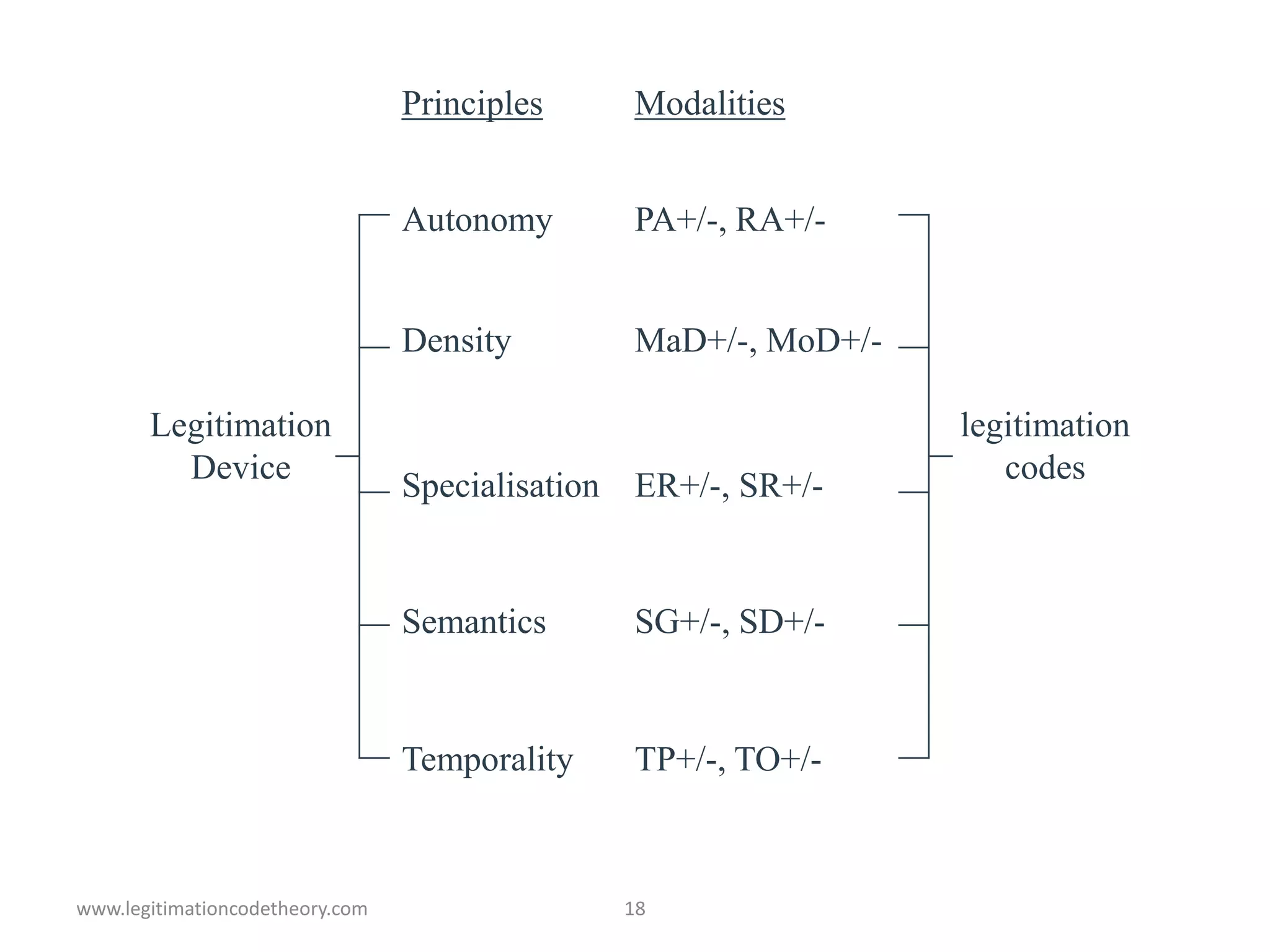
www.legitimationcodetheory.com 16
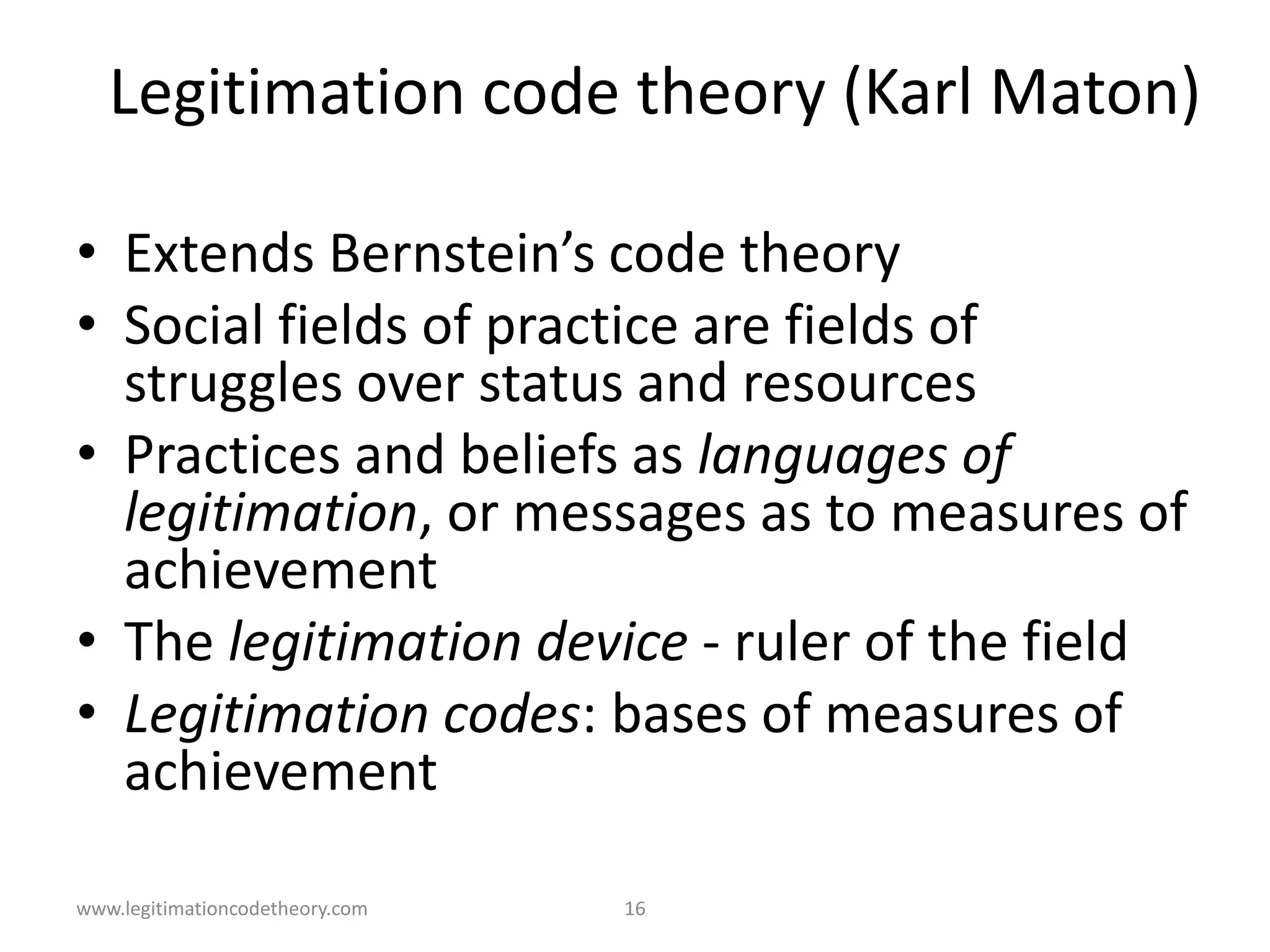
Legitimation code theory (Karl Maton)
• Extends Bernstein’s code theory
• Social fields of practice are fields of
struggles over status and resources
• Practices and beliefs as languages of
legitimation, or messages as to measures of
achievement
• The legitimation device - ruler of the field
• Legitimation codes: bases of measures of
achievement
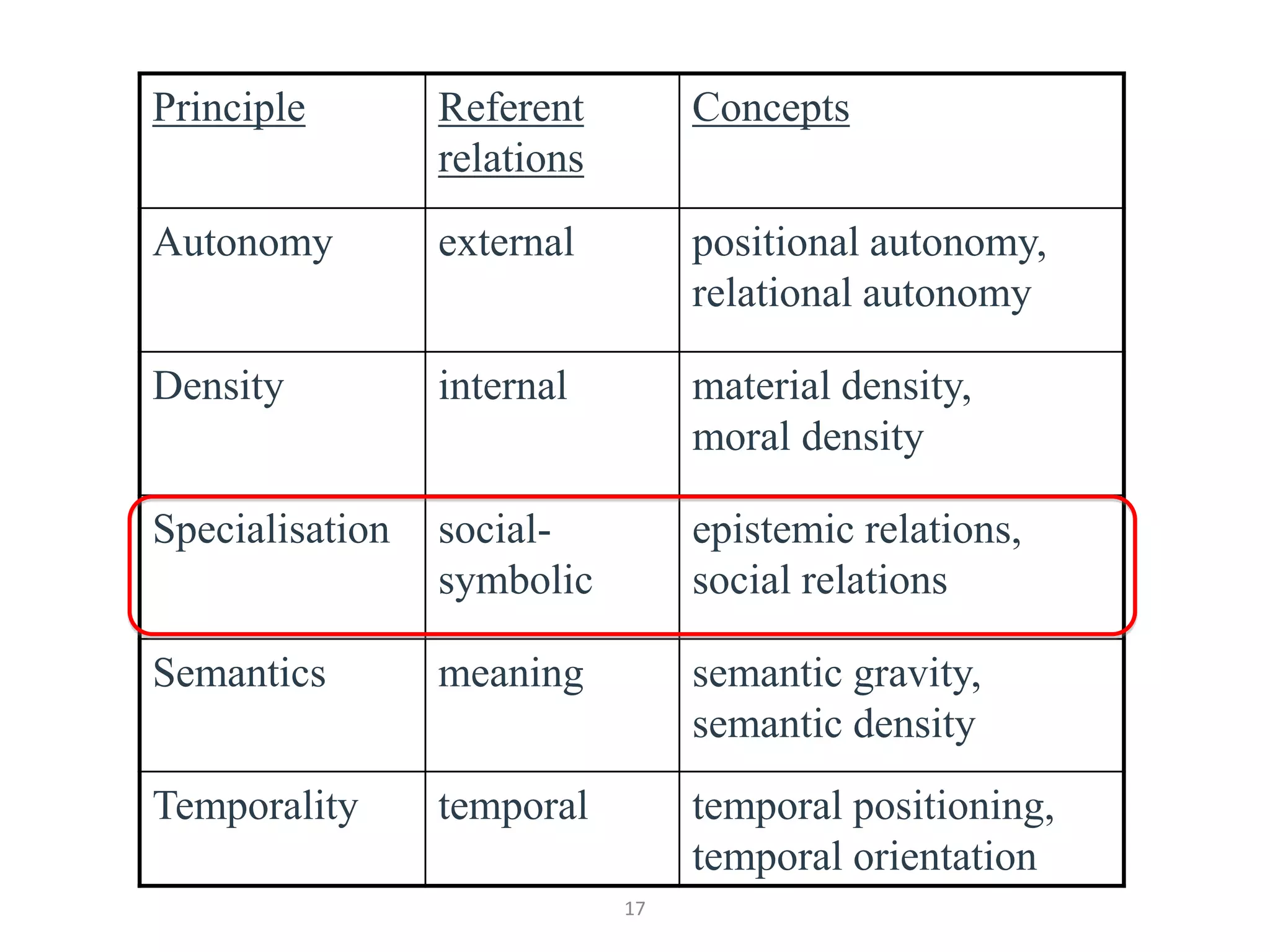
17
Principle Referent
relations
Concepts
Autonomy external positional autonomy,
relational autonomy
Density internal material density,
moral density
Specialisation social-
symbolic
epistemic relations,
social relations
Semantics meaning semantic gravity,
semantic density
Temporality temporal temporal positioning,
temporal orientation
www.legitimationcodetheory.com 18
ModalitiesPrinciples
Legitimation
Device
Autonomy
Density
Specialisation
Temporality
legitimation
codes
PA+/-, RA+/-
MaD+/-, MoD+/-
ER+/-, SR+/-
TP+/-, TO+/-
Semantics SG+/-, SD+/-
www.legitimationcodetheory.c
om
19
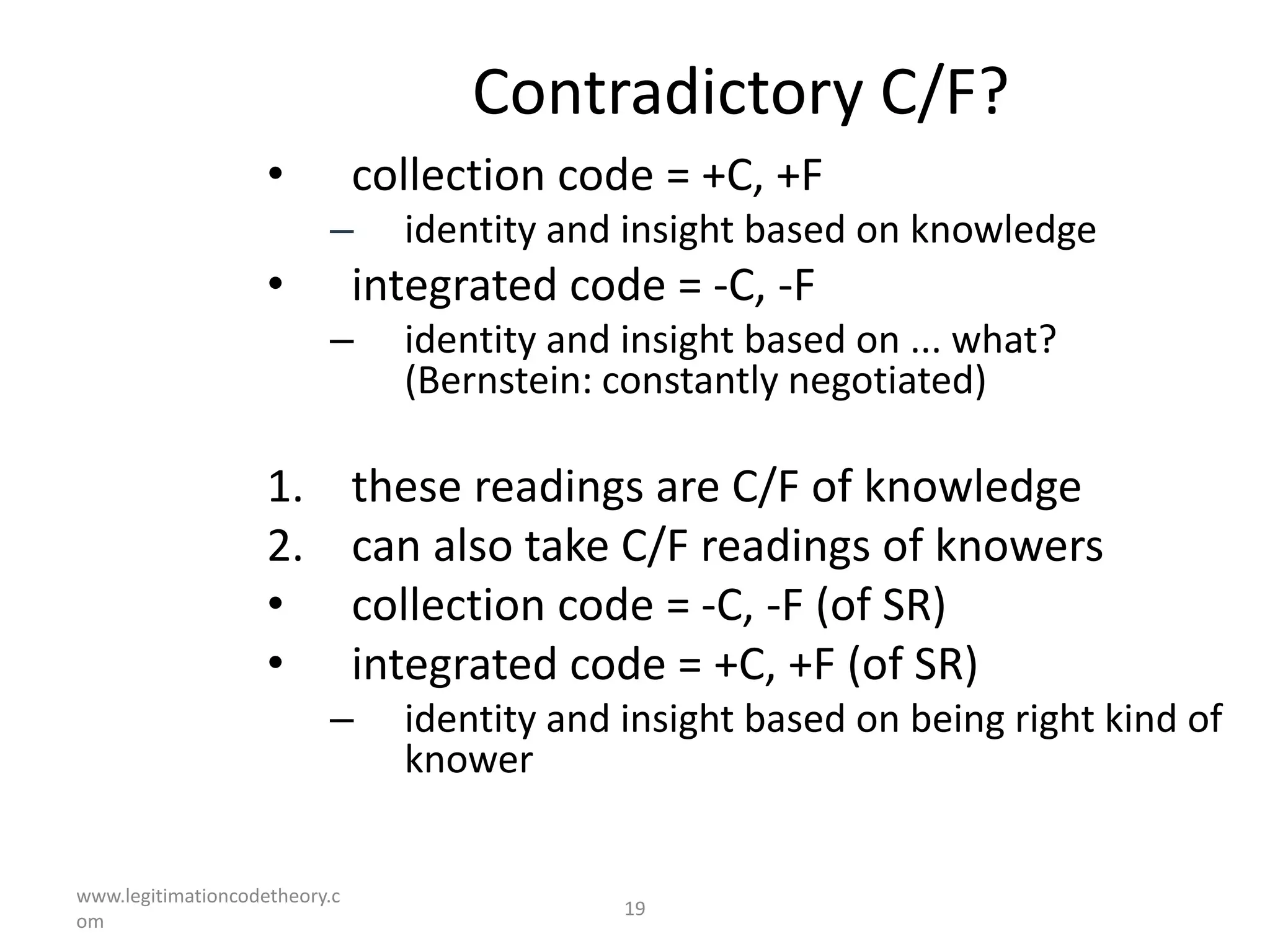
Contradictory C/F?
• collection code = +C, +F
– identity and insight based on knowledge
• integrated code = -C, -F
– identity and insight based on ... what?
(Bernstein: constantly negotiated)
1. these readings are C/F of knowledge
2. can also take C/F readings of knowers
• collection code = -C, -F (of SR)
• integrated code = +C, +F (of SR)
– identity and insight based on being right kind of
knower
www.legitimationcodetheory.c
om
20
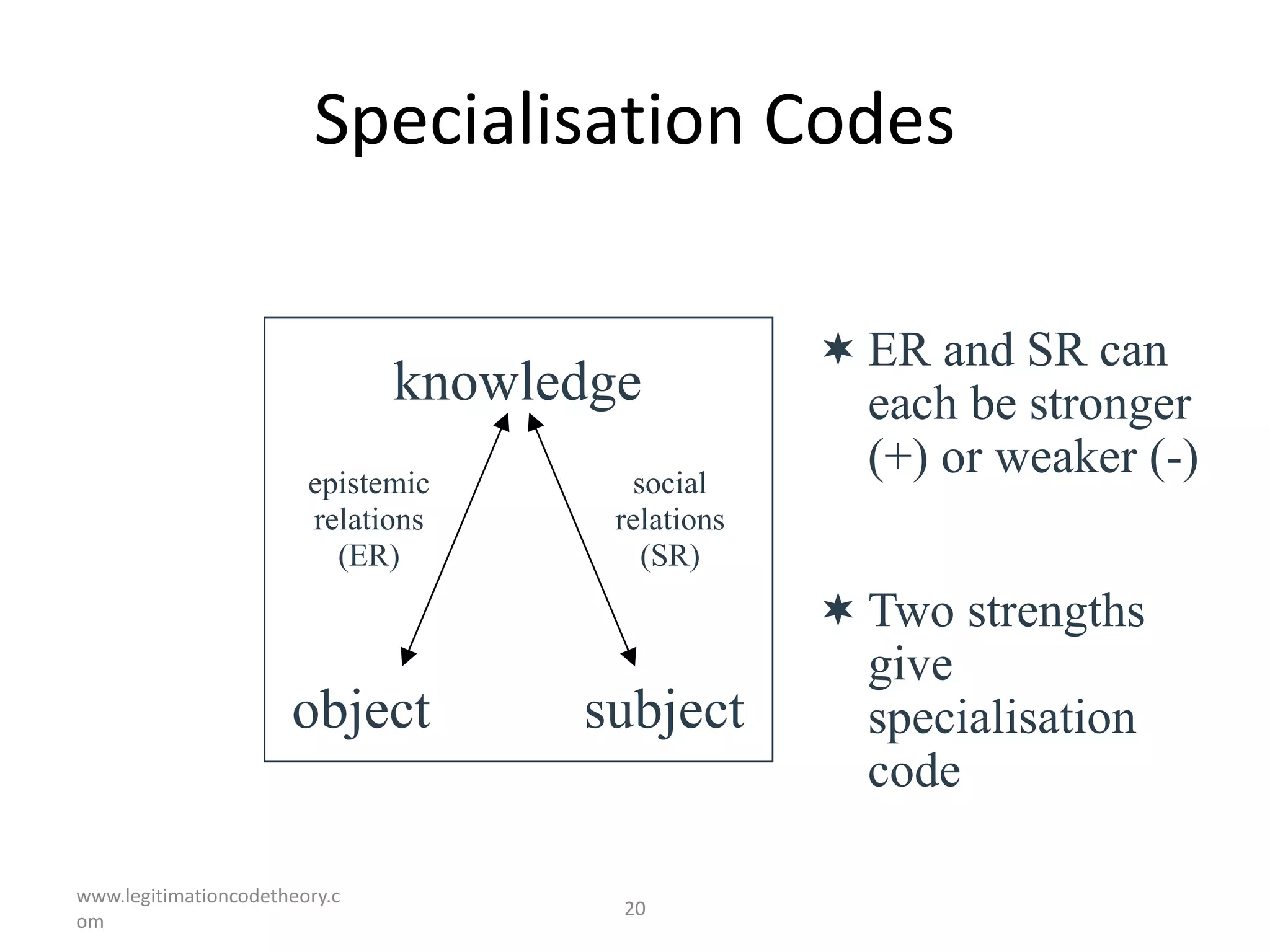
Specialisation Codes
object subject
knowledge
epistemic
relations
(ER)
social
relations
(SR)
 ER and SR can
each be stronger
(+) or weaker (-)
 Two strengths
give
specialisation
code
www.legitimationcodetheory.com 21
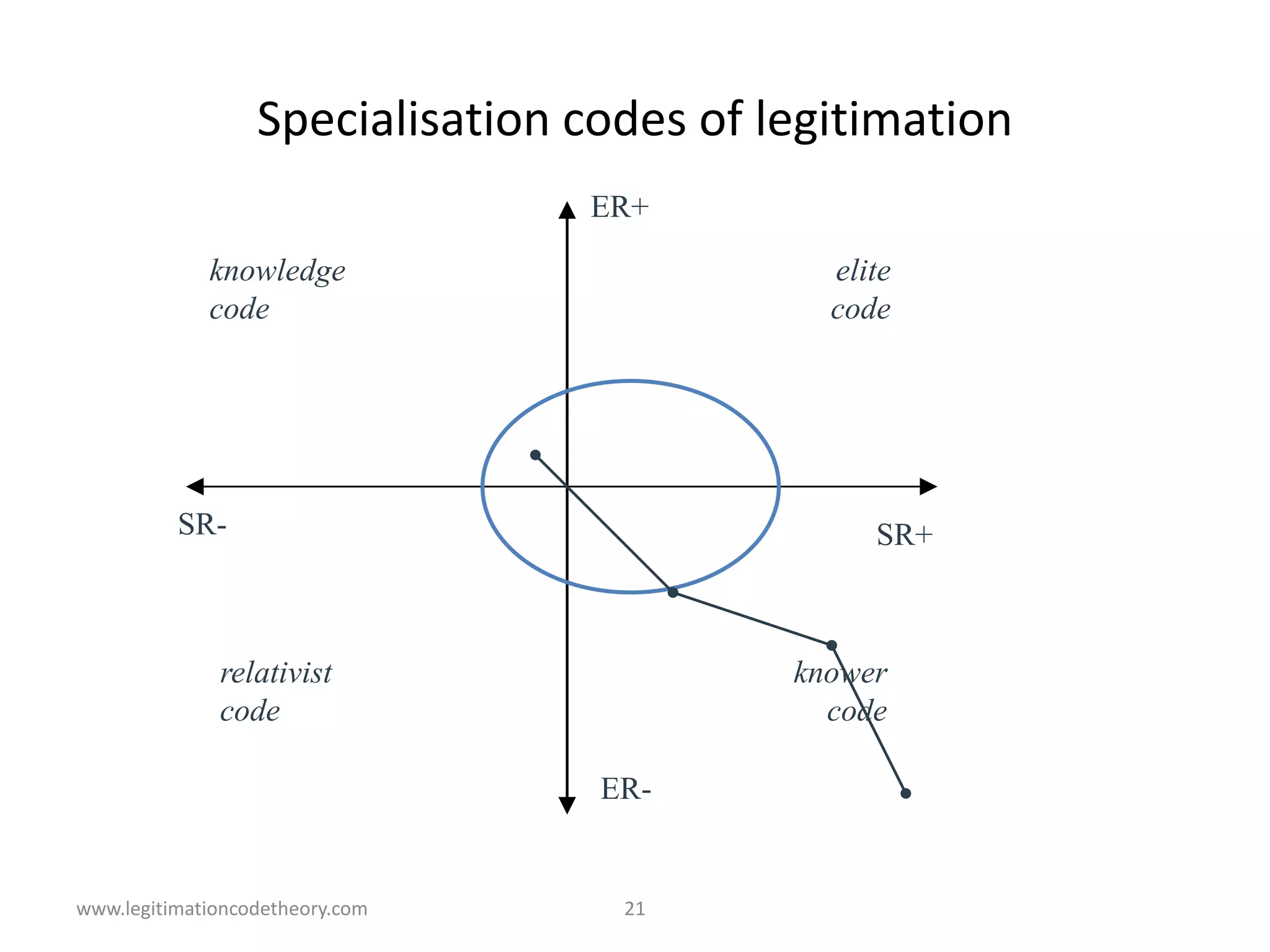
Specialisation codes of legitimation
ER+
ER-
SR+SR-
elite
code
knower
code
knowledge
code
relativist
code
www.legitimationcodetheory.c
om 22
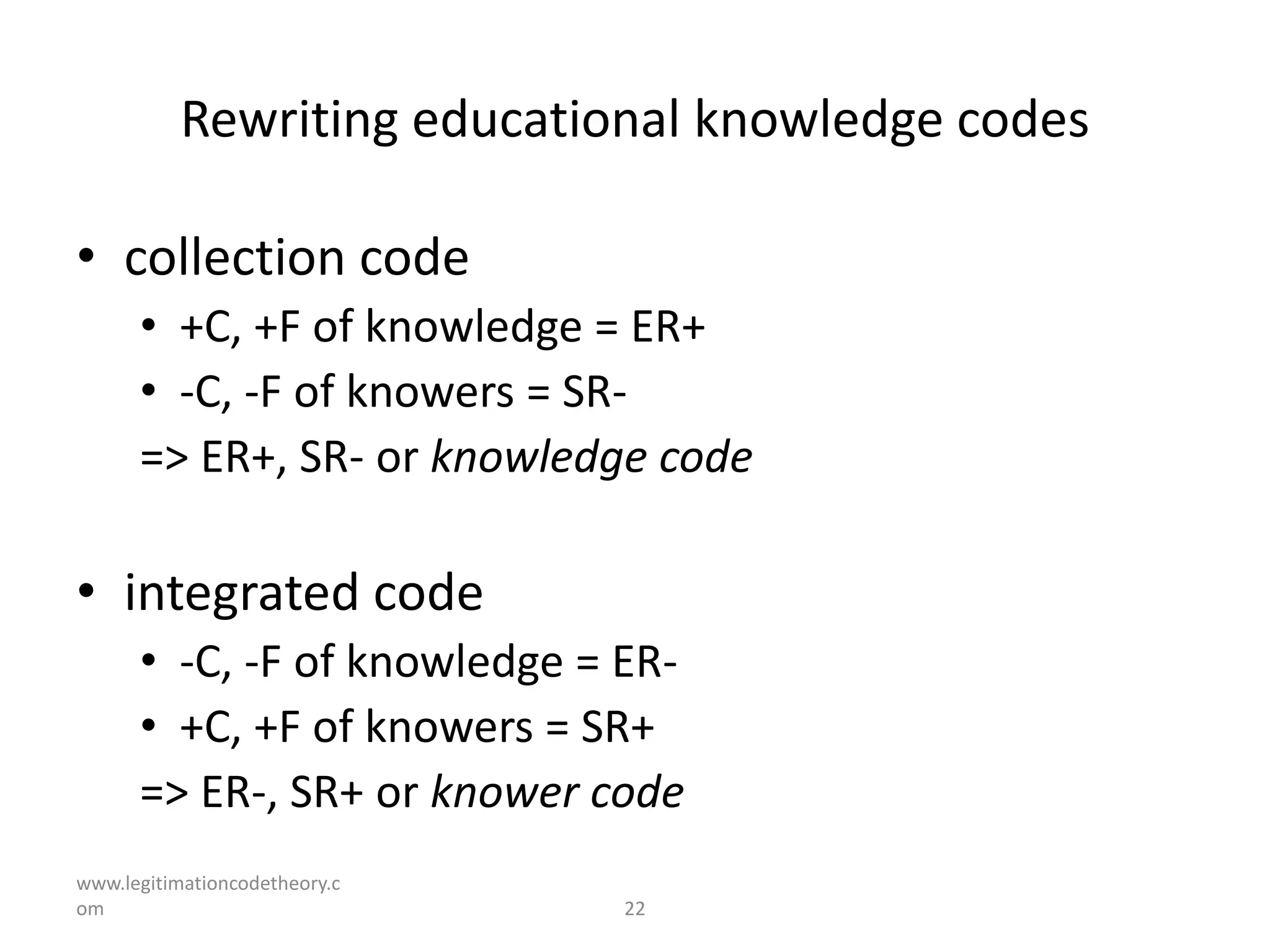
Rewriting educational knowledge codes
• collection code
• +C, +F of knowledge = ER+
• -C, -F of knowers = SR-
=> ER+, SR- or knowledge code
• integrated code
• -C, -F of knowledge = ER-
• +C, +F of knowers = SR+
=> ER-, SR+ or knower code
www.legitimationcodetheory.c
om
23
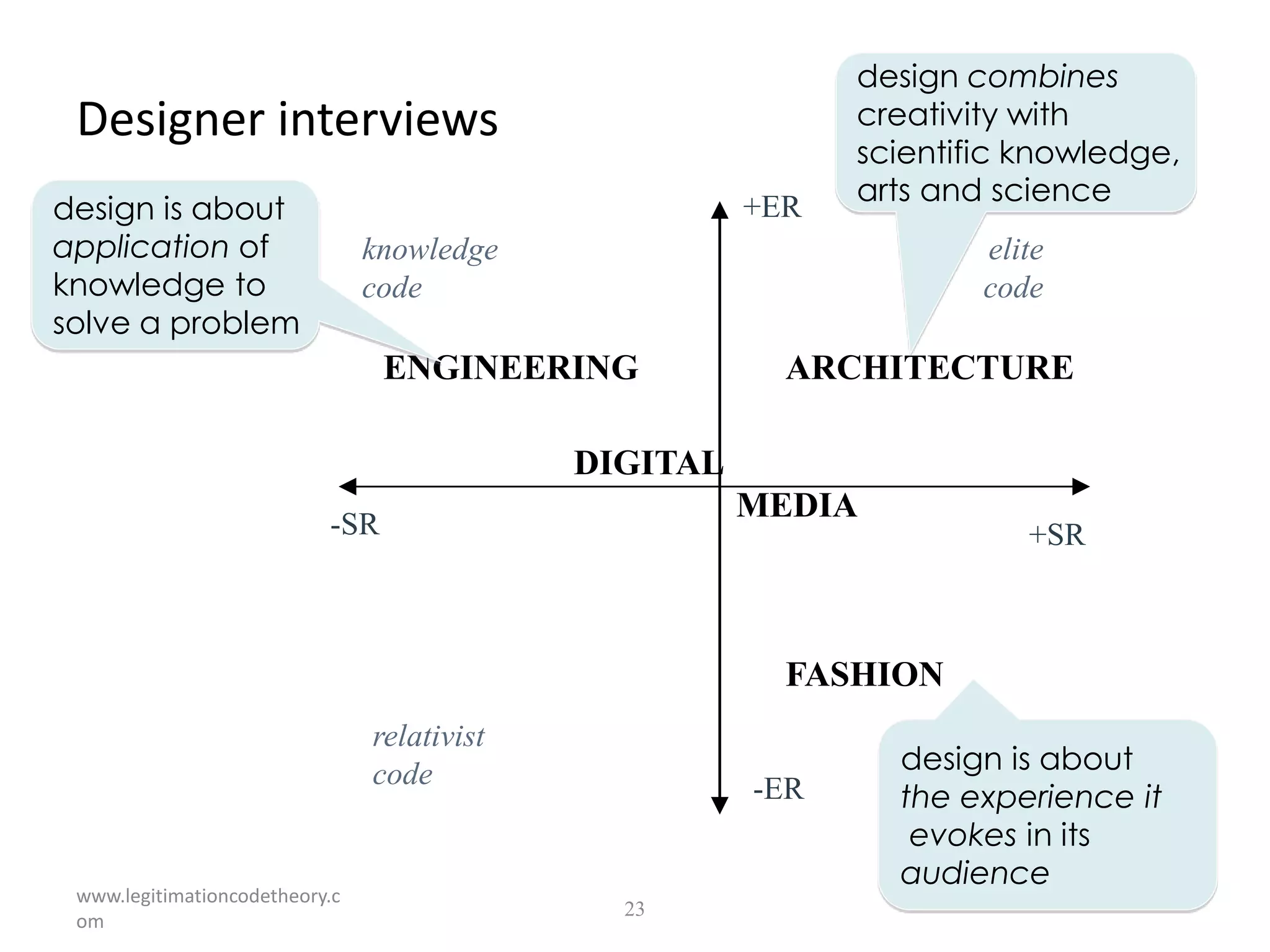
Designer interviews
+ER
-ER
+SR-SR
elite
code
knower
code
knowledge
code
relativist
code
ENGINEERING ARCHITECTURE
FASHION
DIGITAL
MEDIA
design is about
application of
knowledge to
solve a problem
design combines
creativity with
scientific knowledge,
arts and science
design is about
the experience it
evokes in its
audience
www.karlmaton.com 24
www.karlmaton.com 25
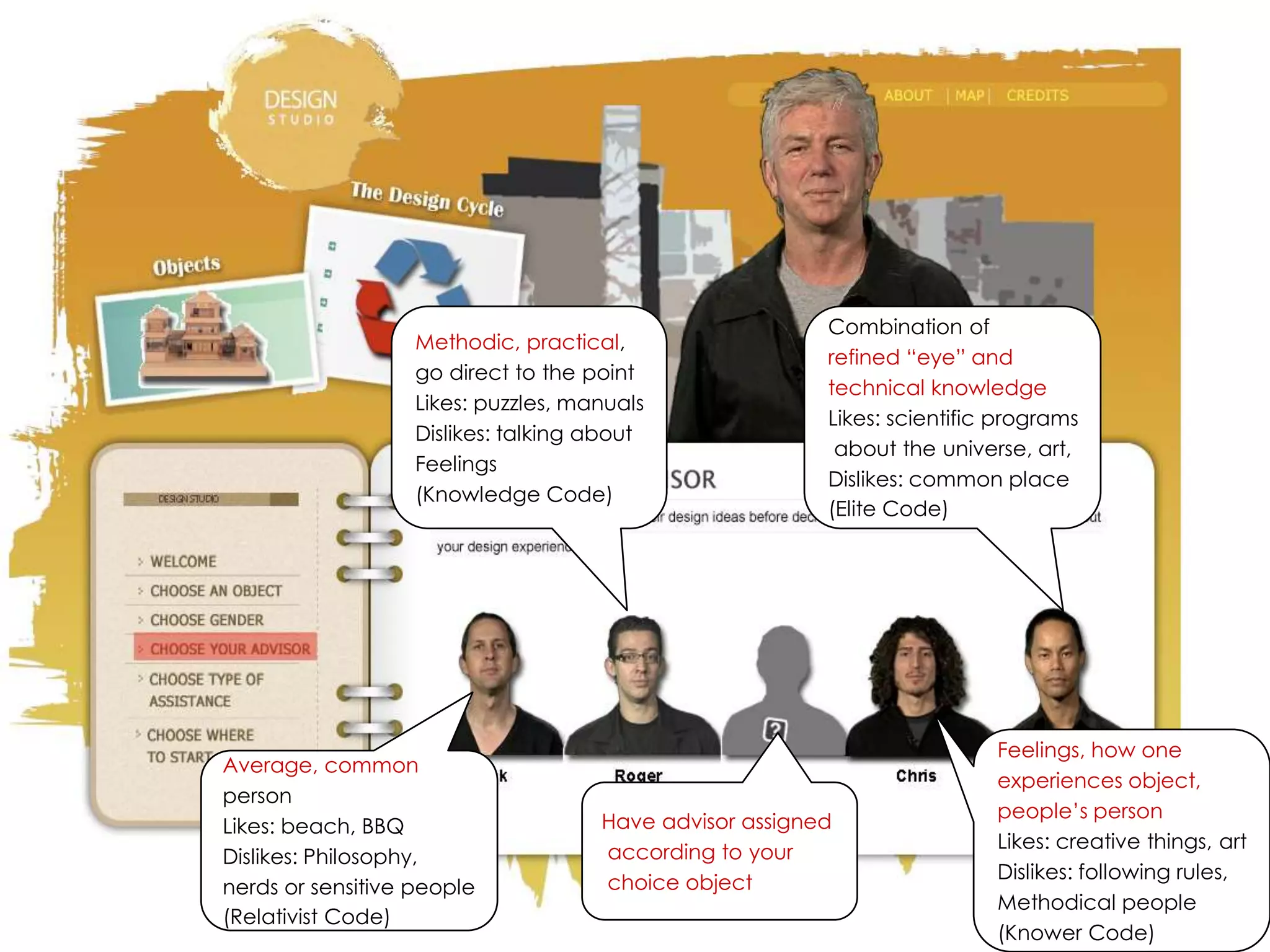
Average, common
person
Likes: beach, BBQ
Dislikes: Philosophy,
nerds or sensitive people
(Relativist Code)
Methodic, practical,
go direct to the point
Likes: puzzles, manuals
Dislikes: talking about
Feelings
(Knowledge Code)
Combination of
refined “eye” and
technical knowledge
Likes: scientific programs
about the universe, art,
Dislikes: common place
(Elite Code)
Feelings, how one
experiences object,
people’s person
Likes: creative things, art
Dislikes: following rules,
Methodical people
(Knower Code)
Have advisor assigned
according to your
choice object
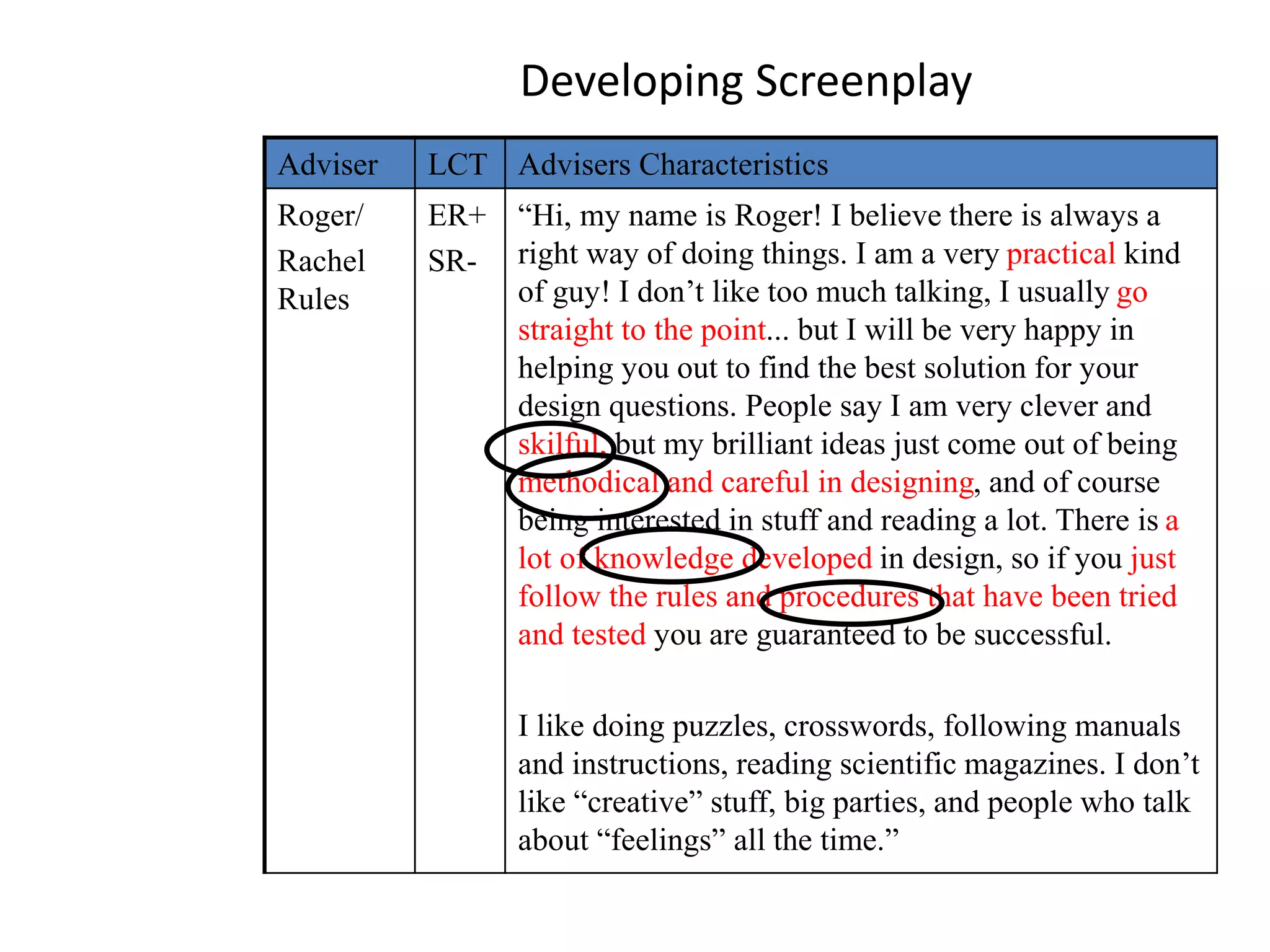
Developing Screenplay
Adviser LCT Advisers Characteristics
Roger/
Rachel
Rules
ER+
SR-
“Hi, my name is Roger! I believe there is always a
right way of doing things. I am a very practical kind
of guy! I don’t like too much talking, I usually go
straight to the point... but I will be very happy in
helping you out to find the best solution for your
design questions. People say I am very clever and
skilful, but my brilliant ideas just come out of being
methodical and careful in designing, and of course
being interested in stuff and reading a lot. There is a
lot of knowledge developed in design, so if you just
follow the rules and procedures that have been tried
and tested you are guaranteed to be successful.
I like doing puzzles, crosswords, following manuals
and instructions, reading scientific magazines. I don’t
like “creative” stuff, big parties, and people who talk
about “feelings” all the time.”

Knowledge Code Theory

  • 1.
    Knowledge Code Theory RichardPountney Sheffield Hallam University 7th November 2015
  • 2.
    Social Realism • Beyondknowledge as power relations (from ‘relations to’ to ‘relations within’) • Rejects the choice between essentialism and relativism as false • we can say knowledge is historically and socially constructed and shaped by struggles among social groups without saying that all knowledge is equal and that its status merely reflects social power
  • 3.
    Definitions (1) practice(s): usedgenerally as a synonym for activity in the context of learning and teaching (practices), but also in a specific sense to refer to knowledge practices and pedagogic practices used in a social realism meaning as the meeting of two logics: context (field) and dispositions (habitus) (Bourdieu, 1986). Bernstein’s 3 message systems: Curriculum, Pedagogy and Assessment curriculum: a plan for learning that has a number of components including programme and content, learning objectives and learning strategies, assessment methods and resources. This view of curriculum as primarily ‘content’ is the aspect ‘most visible to students’, and which is often synonymous with curriculum structure at the programme (course) or module (unit) level in HE. pedagogy/pedagogic practice: what defines what counts as a valid transmission of knowledge. assessment: the process of identifying a mark or grade for students’ work in a module, including the defined tasks, or assignments, that the student must undertake, and the learning outcomes and criteria required for the evaluation of the submitted work.
  • 4.
    Cracking the codeof education • Curriculum – Everyday / Specialised • Pedagogy – Selection, sequencing and pacing – Assessment – Relationship • Levels • Stages Wayne Hugo: 10 Questions to Cracking the Code
  • 5.
    Basil Bernstein (1924-2000) •Basis in sociolinguistics: sociolinguistic theory of language codes (elaborated and restricted codes in 1971) • Code: ‘a set of organizing principles behind the language employed by members of a social group’ • Sociology of education: the ordered regulation and distribution of a society’s worthwhile knowledge store • The transformation into a pedagogic discourse • Further transformation into a set of criterial standards to be attained https://en.wikipedia.org/wiki/Basil_Bernstein www.legitimationcodetheory.c om 5
  • 6.
    6 Period Main focusof theory Transmission / acquisition of pedagogic discourse 1970s (CCC3) Structuring of pedagogic discourse 1980s (CCC4) Knowledge structures from which pedagogic discourse is recontextualised 1990s (CCC5) educational knowledge codes pedagogic device knowledge structures Concept The development of Bernstein’s Theory
  • 7.
    7 1. Educational knowledgecodes • classification (C) – relative strength of boundaries between categories or contexts • framing (F) – relative strength of control within these categories or contexts • independently vary stronger (+) & weaker (-) – four modalities: +C,+F; +C,-F; -C,+F; -C,-F • collection code (+C, +F) • integrated code (-C, -F)
  • 8.
    8 - Classification Framing + - + Weaker boundaries betweensubjects, facilitatory pedagogy, etc Stronger boundaries between subjects, didactic visible pedagogy, etc Weaker boundaries between subjects, visible pedagogy, etc Stronger boundaries between subjects, facilitatory, ‘invisible’ pedagogy, etc Collection Code (+C, +F): ‘I teach history’ Integrated Code (-C, -F): ‘I teach students’
  • 9.
    Strong classification andframing for course design and approval in higher education Concept Degree of emphasis in course on: Stronger Classification (+C) - boundaries between Everyday and educational knowledges (specialised) Specialist curriculum knowledge (including academic development) is emphasised in the design and approval of courses (as opposed to general experience of teaching in HE) Different forms of educational knowledge in a curriculum Discipline knowledge is downplayed as the basis for knowledge in the curriculum (as opposed to those genericised forms specified externally) Stronger Framing (+F) -control over Selecting content knowledge Curriculum content knowledge is determined by the syllabus (documented forms) (as opposed to being selected by the teacher ad hoc) Sequencing and pacing the teaching of content knowledge The organisation and structure of the curriculum is set by the institution rather than the teacher Making evaluative criteria explicit The form and focus of assessment is controlled by the institution rather than the teacher Regulating the teacher’s conduct in pedagogical relationship The teacher’s conduct is regulated by the institution via a hierarchy (authority for approving courses resides in institution)
  • 10.
    2. Bernstein’s PedagogicDevice Field of Practice Form of regulation Symbolic structure Main types Typical sites Production distributive rules knowledge structure hierarchical / horizontal knowledge structures research publications, conferences, laboratories Recontextualisation recontextualising rules curriculum collection/ integrated codes curriculum policy docs, textbooks Reproduction evaluative rules pedagogy & evaluation visible/ invisible pedagogic codes classrooms, assessment • The ‘arena’ of the pedagogic device (Maton and Muller, 2007) • Examines the structure of knowledge and its organising principles • 3 message systems: curriculum, pedagogy and assessment 10
  • 11.
    www.legitimationcodetheory.c om 11 Pedagogic device andcodes • codes – conceptualise practices – represent competing measures of achievement in the field (capital) • pedagogic device – is basis for creating, reproduction and change of codes – whoever controls the device (and so can set which code is higher status) is able to tilt the field in their favour • can see effects of struggles over device in terms of code changes
  • 12.
    12 Knowledge structures Horizontal ‘a seriesof specialised languages, each with its own specialised modes of interrogation and specialised criteria ... with non-comparable principles of description based on different, often opposed, assumptions’ Hierarchical ‘an explicit, coherent, systematically principled and hierarchical organisation of knowledge’ which develops through integrating ‘knowledge at lower levels, and ... across an expanding range of apparently differently phenomena’ L1 L2 L3 L4
  • 13.
    3. Bernstein’s KnowledgeStructures • Typology of subjects: e.g. Hard; pure; soft; applied (Becher, 1998) 13
  • 14.
    Code theory andthe curriculum CODE THEORY CONCEPTS (Bernstein, 1977, 1990, 2000) Classification (C): a code of Bernstein’s pedagogic device, conceptualising relations of power that regulate relations (boundaries) between contexts or categories Framing (F): a code of Bernstein’s pedagogic device, conceptualising relations of control within contexts or categories, the modality. pedagogic device: the pedagogic rules and pedagogic fields that govern the field of activity conceptualising the generative mechanism underlying practices. pedagogic discourse: a symbolic rather than an actual discourse, as a principle of recontextualisation (Bernstein, 1990: 184) that is not visible but which can be known ‘through its effects in structuring practices (conceptualised in terms of codes)’ (Maton, 2004: 49). Two types of discourse are recognised: horizontal and vertical. pedagogic fields: the fields of activity (production, recontextualisation and reproduction) that constitute an ‘arena’ of struggle and conflict created by the pedagogic device .
  • 15.
    Bernstein’s How ToGuide • code theory is a living, evolving theory • excavation and new objects of study • conceptual advance should be cumulative • concepts that: – go beyond typologies to reveal underlying structuring principles – encompass more phenomena with minimal number of ideas – have stronger ‘grammars’, so can be used in empirical research www.legitimationcodetheory.c om 15
  • 16.
    www.legitimationcodetheory.com 16 Legitimation codetheory (Karl Maton) • Extends Bernstein’s code theory • Social fields of practice are fields of struggles over status and resources • Practices and beliefs as languages of legitimation, or messages as to measures of achievement • The legitimation device - ruler of the field • Legitimation codes: bases of measures of achievement
  • 17.
    17 Principle Referent relations Concepts Autonomy externalpositional autonomy, relational autonomy Density internal material density, moral density Specialisation social- symbolic epistemic relations, social relations Semantics meaning semantic gravity, semantic density Temporality temporal temporal positioning, temporal orientation
  • 18.
  • 19.
    www.legitimationcodetheory.c om 19 Contradictory C/F? • collectioncode = +C, +F – identity and insight based on knowledge • integrated code = -C, -F – identity and insight based on ... what? (Bernstein: constantly negotiated) 1. these readings are C/F of knowledge 2. can also take C/F readings of knowers • collection code = -C, -F (of SR) • integrated code = +C, +F (of SR) – identity and insight based on being right kind of knower
  • 20.
    www.legitimationcodetheory.c om 20 Specialisation Codes object subject knowledge epistemic relations (ER) social relations (SR) ER and SR can each be stronger (+) or weaker (-)  Two strengths give specialisation code
  • 21.
    www.legitimationcodetheory.com 21 Specialisation codesof legitimation ER+ ER- SR+SR- elite code knower code knowledge code relativist code
  • 22.
    www.legitimationcodetheory.c om 22 Rewriting educationalknowledge codes • collection code • +C, +F of knowledge = ER+ • -C, -F of knowers = SR- => ER+, SR- or knowledge code • integrated code • -C, -F of knowledge = ER- • +C, +F of knowers = SR+ => ER-, SR+ or knower code
  • 23.
    www.legitimationcodetheory.c om 23 Designer interviews +ER -ER +SR-SR elite code knower code knowledge code relativist code ENGINEERING ARCHITECTURE FASHION DIGITAL MEDIA designis about application of knowledge to solve a problem design combines creativity with scientific knowledge, arts and science design is about the experience it evokes in its audience
  • 24.
  • 25.
    www.karlmaton.com 25 Average, common person Likes:beach, BBQ Dislikes: Philosophy, nerds or sensitive people (Relativist Code) Methodic, practical, go direct to the point Likes: puzzles, manuals Dislikes: talking about Feelings (Knowledge Code) Combination of refined “eye” and technical knowledge Likes: scientific programs about the universe, art, Dislikes: common place (Elite Code) Feelings, how one experiences object, people’s person Likes: creative things, art Dislikes: following rules, Methodical people (Knower Code) Have advisor assigned according to your choice object
  • 26.
    Developing Screenplay Adviser LCTAdvisers Characteristics Roger/ Rachel Rules ER+ SR- “Hi, my name is Roger! I believe there is always a right way of doing things. I am a very practical kind of guy! I don’t like too much talking, I usually go straight to the point... but I will be very happy in helping you out to find the best solution for your design questions. People say I am very clever and skilful, but my brilliant ideas just come out of being methodical and careful in designing, and of course being interested in stuff and reading a lot. There is a lot of knowledge developed in design, so if you just follow the rules and procedures that have been tried and tested you are guaranteed to be successful. I like doing puzzles, crosswords, following manuals and instructions, reading scientific magazines. I don’t like “creative” stuff, big parties, and people who talk about “feelings” all the time.”