11 | Oligopoly 
Cournot model, Stackelberg model, Isoprofit curves 
ECO217 Microeconomics I
Oligopoly 
Oligopoly – market organization in which are few sellers of a commodity 
Seller side is few big participants – oligopolists 
Demand side – many participants – none of them can influence price 
Oligopolists can compete with 
homogenous good – like steel, aluminum, cement or with 
heterogeneous good – automobiles, tires, television sets etc. 
Supply side participants has full information about number of competitors and their sales. 
Information about other competitors price can be full or partial 
Oligopoly usually generate high profit and has strategies to deter other from coming into market 
ECO217 Autumn 2013/2014 2 of 29
Oligopoly 
Actions of each seller will affect other sellers 
Reactions of other firms are unknown 
Since cannot construct one definite demand curve, oligopoly have indeterminate solutions 
Each behavioral assumption will have different solution 
No general theory of oligopoly exist 
Duopoly – market organization where are two firms selling product 
ECO217 Autumn 2013/2014 3 of 29
In Cournot model each firm 
assumes that other firm will 
keep output constant Cournot model 
ECO217 Autumn 2013/2014 4 of 29
Cournot model 
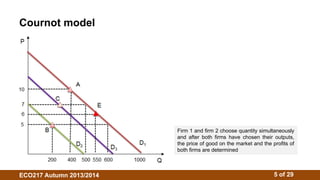
Firm 1 and firm 2 choose quantity simultaneously 
and after both firms have chosen their outputs, 
the price of good on the market and the profits of 
both firms are determined 
ECO217 Autumn 2013/2014 5 of 29
Reaction function 
Reaction function – function 
that specifies a firms optimal 
choice for some variable such as 
output, given choices of its 
competitors 
ECO217 Autumn 2013/2014 6 of 29
Reaction function; Quantity Competition 
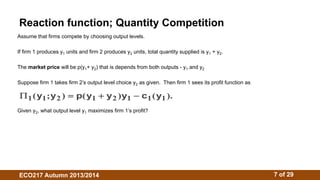
Assume that firms compete by choosing output levels. 
If firm 1 produces y1 units and firm 2 produces y2 units, total quantity supplied is y1 + y2. 
The market price will be p(y1+ y2) that is depends from both outputs - y1 and y2 
Suppose firm 1 takes firm 2’s output level choice y2 as given. Then firm 1 sees its profit function as 
1(y1;y2)  p(y1  y2)y1  c1(y1). 
Given y2, what output level y1 maximizes firm 1’s profit? 
ECO217 Autumn 2013/2014 7 of 29
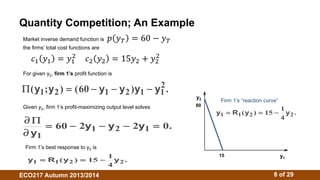
Quantity Competition; An Example 
Market inverse demand function is ݌ ݕ் = 60 − ݕ் 
the firms’ total cost functions are 
ܿଵ ݕଵ = ݕଵ 
ଶ ܿଶ ݕଶ = 15ݕଶ + ݕଶ 
For given y2, firm 1’s profit function is 
ଶ 
( y 1 ; y 2 )  ( 60  y 1  y 2 ) y 1  
y 2 
. 1 Given y2, firm 1’s profit-maximizing output level solves 
 
 
 
y 
y y y 
1 
 60  2 1  2  2 1  0. 
Firm 1’s best response to y2 is 
y1 R1 y2 15 1y2 
 ( )   . 
4 
y2 
Firm 1’s “reaction curve” 
y1 R1 y2 15 1y2 
 ( )   . 
4 
y1 
60 
15 
ECO217 Autumn 2013/2014 8 of 29
Quantity Competition; An Example 
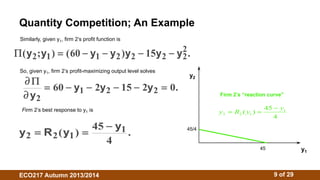
Similarly, given y1, firm 2’s profit function is 
( y 2 
2 ; y 1 )  ( 60  y 1  y 2 ) y 2  15 y 2  
y . 2 So, given y1, firm 2’s profit-maximizing output level solves 
 
 
 
y 
y y y 
2 
 60  1  2 2  15  2 2  0. 
Firm 2’s best response to y1 is 
y R y y 
2 2 1 
45 1 
 ( )   . 
4 
y2 
( ) 45 1 
y  R y   y 
ECO217 Autumn 2013/2014 9 of 29 
y1 
Firm 2’s “reaction curve” 
4 
2 2 1 
45/4 
45
Quantity Competition; An Example 
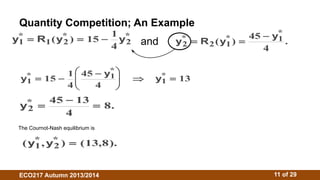
An equilibrium is when each firm’s output level is a best response to the other firm’s output level, for then neither 
wants to deviate from its output level. 
A pair of output levels (y1*,y2*) is a Cournot-Nash equilibrium if 
y1* = R1(y2*) and y2* = R2(y1*) 
ECO217 Autumn 2013/2014 10 of 29
Quantity Competition; An Example 
y1 R1 y2 15 1y2 
* 
*  ( * )   * y R y y 
4 
and *  ( * 
)   . 
2 2 1 
45 1 
4 
* 
     
* 
y1 y y 
15 1 1 
* 1 
13 
4 
45 
4 
  
  
  
*    8. 
y2 
45 13 
4 
The Cournot-Nash equilibrium is 
(y*1,y*2 )  (13,8). 
ECO217 Autumn 2013/2014 11 of 29
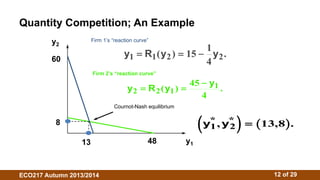
Quantity Competition; An Example 
y2 
y1 R1 y2 15 1y2 
 ( )   . 
y R y y 
2 2 1 
45 1 
 ( )   . 
y1 
Firm 1’s “reaction curve” 
Firm 2’s “reaction curve” 
Cournot-Nash equilibrium 
48 
60 
4 
8 
13 
4 
y*1,y*2  13,8. 
ECO217 Autumn 2013/2014 12 of 29
Iso-Profit Curves 
ECO217 Autumn 2013/2014 13 of 29
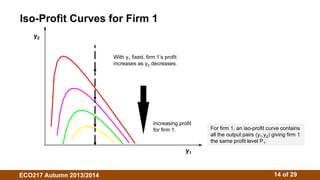
Iso-Profit Curves for Firm 1 
y2 
Increasing profit 
for firm 1. For firm 1, an iso-profit curve contains 
y1 
With y1 fixed, firm 1’s profit 
increases as y2 decreases. 
all the output pairs (y1,y2) giving firm 1 
the same profit level P1. 
ECO217 Autumn 2013/2014 14 of 29
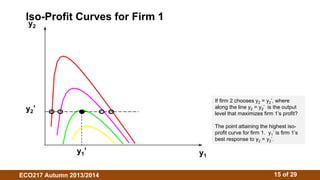
Iso-Profit Curves for Firm 1 
y2 
y1 
If firm 2 chooses y2 = y2’, where 
along the line y2 = y2’ is the output 
level that maximizes firm 1’s profit? 
The point attaining the highest iso-profit 
curve for firm 1. y1’ is firm 1’s 
best response to y2 = y2’. 
y2’ 
y1’ 
ECO217 Autumn 2013/2014 15 of 29
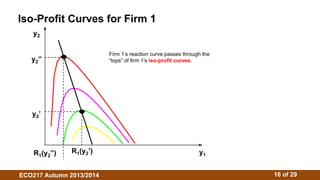
Iso-Profit Curves for Firm 1 
y2 
Firm 1’s reaction curve passes through the 
“tops” of firm 1’s iso-profit curves. 
y1 
y2” 
y2’ 
R1(y2”) R1(y2’) 
ECO217 Autumn 2013/2014 16 of 29
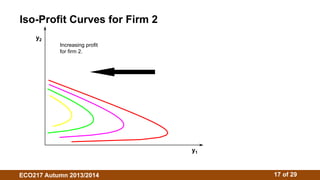
Iso-Profit Curves for Firm 2 
y2 
y1 
Increasing profit 
for firm 2. 
ECO217 Autumn 2013/2014 17 of 29
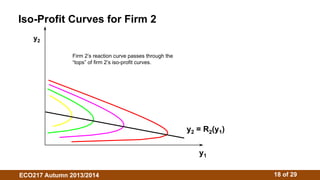
Iso-Profit Curves for Firm 2 
y2 
y2 = R2(y1) 
y1 
Firm 2’s reaction curve passes through the 
“tops” of firm 2’s iso-profit curves. 
ECO217 Autumn 2013/2014 18 of 29
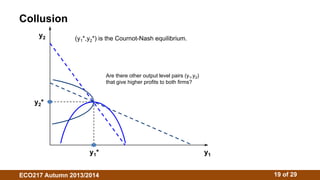
Collusion 
y2 
(y1*,y2*) is the Cournot-Nash equilibrium. 
Are there other output level pairs (y1,y2) 
that give higher profits to both firms? 
y1* y1 
y2* 
ECO217 Autumn 2013/2014 19 of 29
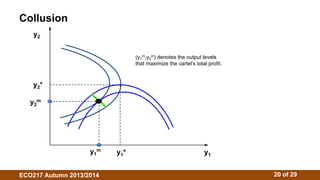
Collusion 
y2 
(y1 
m,y2 
m) denotes the output levels 
that maximize the cartel’s total profit. 
y1* y1 
y2* 
y2 
m 
y1 
m 
ECO217 Autumn 2013/2014 20 of 29
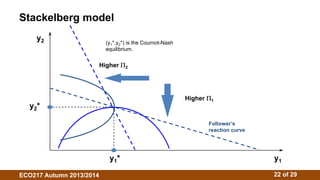
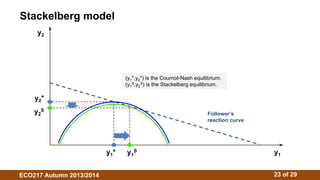
Stackelberg – sequential 
competition in quantities 
where on firm acts as a 
quantity leader, choosing 
quantity first, with other firm 
acting as follower 
Stackelberg model 
ECO217 Autumn 2013/2014 21 of 29
Stackelberg model 
y2 
(y1*,y2*) is the Cournot-Nash 
equilibrium. 
Higher 2 
Higher 1 
Follower’s 
reaction curve 
y1* y1 
y2* 
ECO217 Autumn 2013/2014 22 of 29
Stackelberg model 
y2 
(y1*,y2*) is the Cournot-Nash equilibrium. 
(y1 
S,y2 
S) is the Stackelberg equilibrium. 
Follower’s 
reaction curve 
y1* y1 
y2* 
y1 
S 
y2 
S 
ECO217 Autumn 2013/2014 23 of 29
A model of oligopolistic 
competition where firms 
compete by setting prices Bertrand model 
ECO217 Autumn 2013/2014 24 of 29
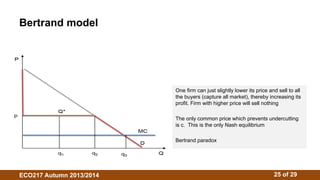
Bertrand model 
One firm can just slightly lower its price and sell to all 
the buyers (capture all market), thereby increasing its 
profit. Firm with higher price will sell nothing 
The only common price which prevents undercutting 
is c. This is the only Nash equilibrium 
Bertrand paradox 
ECO217 Autumn 2013/2014 25 of 29
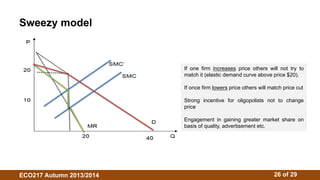
Sweezy model 
If one firm increases price others will not try to 
match it (elastic demand curve above price $20). 
If once firm lowers price others will match price cut 
Strong incentive for oligopolists not to change 
price 
Engagement in gaining greater market share on 
basis of quality, advertisement etc. 
ECO217 Autumn 2013/2014 26 of 29
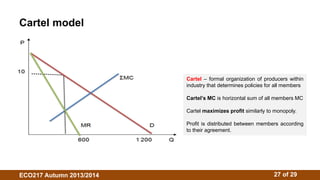
Cartel model 
Cartel – formal organization of producers within 
industry that determines policies for all members 
Cartel’s MC is horizontal sum of all members MC 
Cartel maximizes profit similarly to monopoly. 
Profit is distributed between members according 
to their agreement. 
ECO217 Autumn 2013/2014 27 of 29
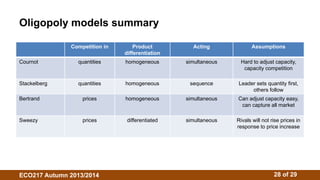
Oligopoly models summary 
Competition in Product 
differentiation 
Acting Assumptions 
Cournot quantities homogeneous simultaneous Hard to adjust capacity, 
capacity competition 
Stackelberg quantities homogeneous sequence Leader sets quantity first, 
others follow 
Bertrand prices homogeneous simultaneous Can adjust capacity easy, 
can capture all market 
Sweezy prices differentiated simultaneous Rivals will not rise prices in 
response to price increase 
ECO217 Autumn 2013/2014 28 of 29
Dr. Martins Priede 
ECO217 Microeconomics I 
martins.priede@xjtlu.edu.cn 
ECO217 Autumn 2013/2014 29 of 29

Oligopoly, Microeconomics

  • 1.
    11 | Oligopoly Cournot model, Stackelberg model, Isoprofit curves ECO217 Microeconomics I
  • 2.
    Oligopoly Oligopoly –market organization in which are few sellers of a commodity Seller side is few big participants – oligopolists Demand side – many participants – none of them can influence price Oligopolists can compete with homogenous good – like steel, aluminum, cement or with heterogeneous good – automobiles, tires, television sets etc. Supply side participants has full information about number of competitors and their sales. Information about other competitors price can be full or partial Oligopoly usually generate high profit and has strategies to deter other from coming into market ECO217 Autumn 2013/2014 2 of 29
  • 3.
    Oligopoly Actions ofeach seller will affect other sellers Reactions of other firms are unknown Since cannot construct one definite demand curve, oligopoly have indeterminate solutions Each behavioral assumption will have different solution No general theory of oligopoly exist Duopoly – market organization where are two firms selling product ECO217 Autumn 2013/2014 3 of 29
  • 4.
    In Cournot modeleach firm assumes that other firm will keep output constant Cournot model ECO217 Autumn 2013/2014 4 of 29
  • 5.
    Cournot model Firm1 and firm 2 choose quantity simultaneously and after both firms have chosen their outputs, the price of good on the market and the profits of both firms are determined ECO217 Autumn 2013/2014 5 of 29
  • 6.
    Reaction function Reactionfunction – function that specifies a firms optimal choice for some variable such as output, given choices of its competitors ECO217 Autumn 2013/2014 6 of 29
  • 7.
    Reaction function; QuantityCompetition Assume that firms compete by choosing output levels. If firm 1 produces y1 units and firm 2 produces y2 units, total quantity supplied is y1 + y2. The market price will be p(y1+ y2) that is depends from both outputs - y1 and y2 Suppose firm 1 takes firm 2’s output level choice y2 as given. Then firm 1 sees its profit function as 1(y1;y2)  p(y1  y2)y1  c1(y1). Given y2, what output level y1 maximizes firm 1’s profit? ECO217 Autumn 2013/2014 7 of 29
  • 8.
    Quantity Competition; AnExample Market inverse demand function is ݌ ݕ் = 60 − ݕ் the firms’ total cost functions are ܿଵ ݕଵ = ݕଵ ଶ ܿଶ ݕଶ = 15ݕଶ + ݕଶ For given y2, firm 1’s profit function is ଶ ( y 1 ; y 2 )  ( 60  y 1  y 2 ) y 1  y 2 . 1 Given y2, firm 1’s profit-maximizing output level solves    y y y y 1  60  2 1  2  2 1  0. Firm 1’s best response to y2 is y1 R1 y2 15 1y2  ( )   . 4 y2 Firm 1’s “reaction curve” y1 R1 y2 15 1y2  ( )   . 4 y1 60 15 ECO217 Autumn 2013/2014 8 of 29
  • 9.
    Quantity Competition; AnExample Similarly, given y1, firm 2’s profit function is ( y 2 2 ; y 1 )  ( 60  y 1  y 2 ) y 2  15 y 2  y . 2 So, given y1, firm 2’s profit-maximizing output level solves    y y y y 2  60  1  2 2  15  2 2  0. Firm 2’s best response to y1 is y R y y 2 2 1 45 1  ( )   . 4 y2 ( ) 45 1 y  R y   y ECO217 Autumn 2013/2014 9 of 29 y1 Firm 2’s “reaction curve” 4 2 2 1 45/4 45
  • 10.
    Quantity Competition; AnExample An equilibrium is when each firm’s output level is a best response to the other firm’s output level, for then neither wants to deviate from its output level. A pair of output levels (y1*,y2*) is a Cournot-Nash equilibrium if y1* = R1(y2*) and y2* = R2(y1*) ECO217 Autumn 2013/2014 10 of 29
  • 11.
    Quantity Competition; AnExample y1 R1 y2 15 1y2 * *  ( * )   * y R y y 4 and *  ( * )   . 2 2 1 45 1 4 *      * y1 y y 15 1 1 * 1 13 4 45 4       *    8. y2 45 13 4 The Cournot-Nash equilibrium is (y*1,y*2 )  (13,8). ECO217 Autumn 2013/2014 11 of 29
  • 12.
    Quantity Competition; AnExample y2 y1 R1 y2 15 1y2  ( )   . y R y y 2 2 1 45 1  ( )   . y1 Firm 1’s “reaction curve” Firm 2’s “reaction curve” Cournot-Nash equilibrium 48 60 4 8 13 4 y*1,y*2  13,8. ECO217 Autumn 2013/2014 12 of 29
  • 13.
    Iso-Profit Curves ECO217Autumn 2013/2014 13 of 29
  • 14.
    Iso-Profit Curves forFirm 1 y2 Increasing profit for firm 1. For firm 1, an iso-profit curve contains y1 With y1 fixed, firm 1’s profit increases as y2 decreases. all the output pairs (y1,y2) giving firm 1 the same profit level P1. ECO217 Autumn 2013/2014 14 of 29
  • 15.
    Iso-Profit Curves forFirm 1 y2 y1 If firm 2 chooses y2 = y2’, where along the line y2 = y2’ is the output level that maximizes firm 1’s profit? The point attaining the highest iso-profit curve for firm 1. y1’ is firm 1’s best response to y2 = y2’. y2’ y1’ ECO217 Autumn 2013/2014 15 of 29
  • 16.
    Iso-Profit Curves forFirm 1 y2 Firm 1’s reaction curve passes through the “tops” of firm 1’s iso-profit curves. y1 y2” y2’ R1(y2”) R1(y2’) ECO217 Autumn 2013/2014 16 of 29
  • 17.
    Iso-Profit Curves forFirm 2 y2 y1 Increasing profit for firm 2. ECO217 Autumn 2013/2014 17 of 29
  • 18.
    Iso-Profit Curves forFirm 2 y2 y2 = R2(y1) y1 Firm 2’s reaction curve passes through the “tops” of firm 2’s iso-profit curves. ECO217 Autumn 2013/2014 18 of 29
  • 19.
    Collusion y2 (y1*,y2*)is the Cournot-Nash equilibrium. Are there other output level pairs (y1,y2) that give higher profits to both firms? y1* y1 y2* ECO217 Autumn 2013/2014 19 of 29
  • 20.
    Collusion y2 (y1 m,y2 m) denotes the output levels that maximize the cartel’s total profit. y1* y1 y2* y2 m y1 m ECO217 Autumn 2013/2014 20 of 29
  • 21.
    Stackelberg – sequential competition in quantities where on firm acts as a quantity leader, choosing quantity first, with other firm acting as follower Stackelberg model ECO217 Autumn 2013/2014 21 of 29
  • 22.
    Stackelberg model y2 (y1*,y2*) is the Cournot-Nash equilibrium. Higher 2 Higher 1 Follower’s reaction curve y1* y1 y2* ECO217 Autumn 2013/2014 22 of 29
  • 23.
    Stackelberg model y2 (y1*,y2*) is the Cournot-Nash equilibrium. (y1 S,y2 S) is the Stackelberg equilibrium. Follower’s reaction curve y1* y1 y2* y1 S y2 S ECO217 Autumn 2013/2014 23 of 29
  • 24.
    A model ofoligopolistic competition where firms compete by setting prices Bertrand model ECO217 Autumn 2013/2014 24 of 29
  • 25.
    Bertrand model Onefirm can just slightly lower its price and sell to all the buyers (capture all market), thereby increasing its profit. Firm with higher price will sell nothing The only common price which prevents undercutting is c. This is the only Nash equilibrium Bertrand paradox ECO217 Autumn 2013/2014 25 of 29
  • 26.
    Sweezy model Ifone firm increases price others will not try to match it (elastic demand curve above price $20). If once firm lowers price others will match price cut Strong incentive for oligopolists not to change price Engagement in gaining greater market share on basis of quality, advertisement etc. ECO217 Autumn 2013/2014 26 of 29
  • 27.
    Cartel model Cartel– formal organization of producers within industry that determines policies for all members Cartel’s MC is horizontal sum of all members MC Cartel maximizes profit similarly to monopoly. Profit is distributed between members according to their agreement. ECO217 Autumn 2013/2014 27 of 29
  • 28.
    Oligopoly models summary Competition in Product differentiation Acting Assumptions Cournot quantities homogeneous simultaneous Hard to adjust capacity, capacity competition Stackelberg quantities homogeneous sequence Leader sets quantity first, others follow Bertrand prices homogeneous simultaneous Can adjust capacity easy, can capture all market Sweezy prices differentiated simultaneous Rivals will not rise prices in response to price increase ECO217 Autumn 2013/2014 28 of 29
  • 29.
    Dr. Martins Priede ECO217 Microeconomics I martins.priede@xjtlu.edu.cn ECO217 Autumn 2013/2014 29 of 29