


Getting The Mix Right
Terumi Miyazoe, PhD
Tokyo Denki University
Terry Anderson, PhD
Athabasca University
1
Values
• We can (and must) continuously improve the
quality, effectiveness, appeal, cost and time
efficiency of the learning experience.
• Student control and freedom is integral to 21st
century life-long education and learning.
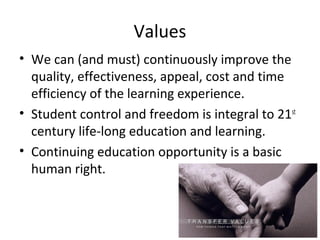
• Continuing education opportunity is a basic
human right.
Drivers for Change
• New demands of knowledge society
• New expectations of students
• New Technology Opportunity
3
Same Institutional Models, Less public resources
4
Interaction
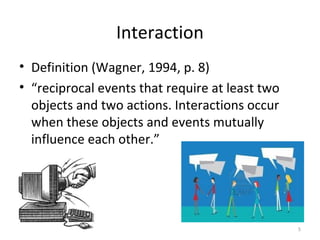
• Definition (Wagner, 1994, p. 8)
• “reciprocal events that require at least two
objects and two actions. Interactions occur
when these objects and events mutually
influence each other.”
5
• “More than anything else, being an educated
person means being able to see connections
that allow one to make sense of the world and
act within it in creative ways.” (Cronon, 1998)
• “Learning may reside in non-human
appliances” George Siemens – Connectivism
6
Cronon, W. (1998). "Only Connect": The goals of a liberal education. The American Scholar,
67(4). http://www.williamcronon.net/writing/Cronon_Only_Connect.pdf.
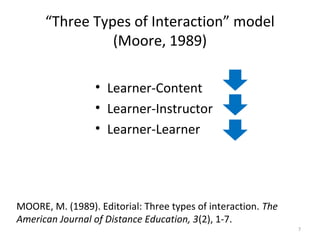
“Three Types of Interaction” model
(Moore, 1989)
• Learner-Content
• Learner-Instructor
• Learner-Learner
7
MOORE, M. (1989). Editorial: Three types of interaction. The
American Journal of Distance Education, 3(2), 1-7.
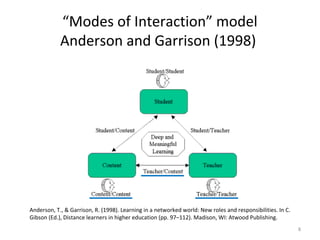
“Modes of Interaction” model
Anderson and Garrison (1998)
8
Anderson, T., & Garrison, R. (1998). Learning in a networked world: New roles and responsibilities. In C.
Gibson (Ed.), Distance learners in higher education (pp. 97–112). Madison, WI: Atwood Publishing.
9
Anderson, T. (2003). Getting the mix right again: An updated and theoretical rationale for
interaction. The International Review of Research in Open and Distance Learning, 4(2)
Daniel, J., & Marquis, C. (1977). Interaction and independence:
Getting the mixture right. Teaching at a Distance, 14, 29–44.
The EQuiv
• Thesis 1. Deep and meaningful formal learning is
supported as long as one of the three forms of
interaction (student–teacher; student–student;
student–content) is at a high level. The other two may
be offered at minimal levels, or even eliminated,
without degrading the educational experience.
• Thesis 2. High levels of more than one of these three
modes will likely provide a more satisfying educational
experience, although these experiences may not be as
cost- or time-effective as less interactive learning
sequences.
10
11
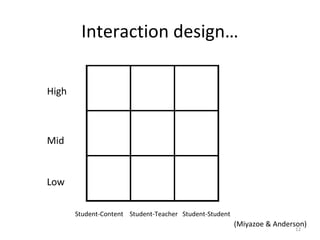
Interaction design…
(Miyazoe & Anderson)
Student-Content Student-Teacher Student-Student
High
Mid
Low
12
EQuiv Visualization
13
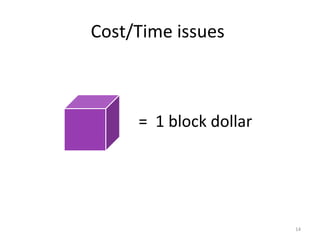
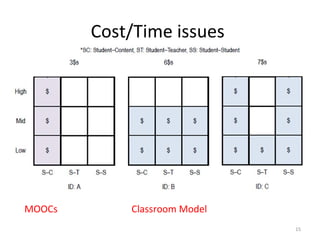
Cost/Time issues
14
= 1 block dollar
Cost/Time issues
15
MOOCs Classroom Model
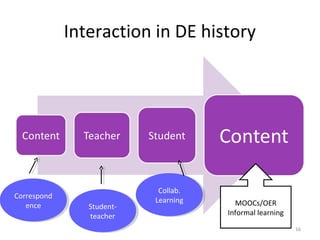
Interaction in DE history
16
Correspond
ence
Correspond
ence Student-
teacher
Student-
teacher
Collab.
Learning
Collab.
Learning MOOCs/OER
Informal learning
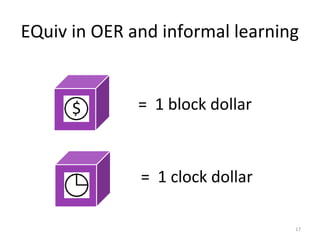
EQuiv in OER and informal learning
17
= 1 block dollar
= 1 clock dollar
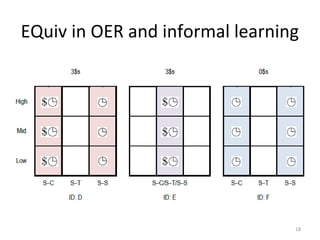
EQuiv in OER and informal learning
18
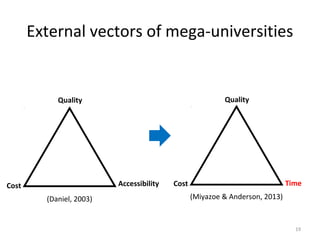
External vectors of mega-universities
19
(Daniel, 2003)
Quality
Cost Accessibility
Quality
Cost Time
(Miyazoe & Anderson, 2013)
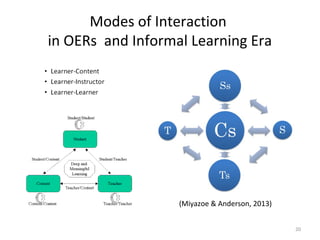
Modes of Interaction
in OERs and Informal Learning Era
20
(Miyazoe & Anderson, 2013)
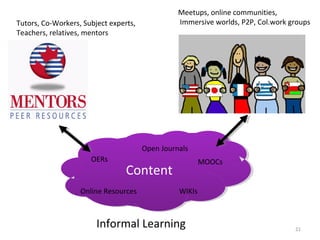
ContentContent
OERs MOOCs
Online Resources WIKIs
Open Journals
21
Tutors, Co-Workers, Subject experts,
Teachers, relatives, mentors
Meetups, online communities,
Immersive worlds, P2P, Col.work groups
Informal Learning
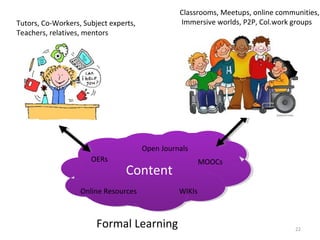
22
ContentContent
OERs MOOCs
Online Resources WIKIs
Open Journals
Tutors, Co-Workers, Subject experts,
Teachers, relatives, mentors
Classrooms, Meetups, online communities,
Immersive worlds, P2P, Col.work groups
Formal Learning
23
“Only connect! That was the whole of her sermon.
Only connect the prose and the passion, and both
will be exalted,
And human love will be seen at its height.
Live in fragments no longer.
Only connect...”
• --E.M. Forster, (1910) Howards End
24
Thank you for listening!
For questions/suggestions:
terrya@athabascau.ca
t.miyazoe@mail.dendai.ac.jp
25
Core References
• Anderson, T., & Garrison, R. (1998). Learning in a networked world: New roles and responsibilities.
In C. Gibson (Ed.), Distance learners in higher education (pp. 97–112). Madison, WI: Atwood
Publishing.
• Anderson, T. (2003). Getting the mix right again: An updated and theoretical rationale for
interaction. The International Review of Research in Open and Distance Learning, 4(2), from
http://www.irrodl.org/index.php/irrodl/article/view/149/230
• Daniel, J. (2003). Mega-universities = mega-impact on access, cost and quality. Retrieved from
http://portal.unesco.org/education/en/ev.php-
URL_ID=26277&URL_DO=DO_TOPIC&URL_SECTION=201.html
• Daniel, J., & Marquis, C. (1977). Interaction and independence: Getting the mixture right. Teaching
at a Distance, 14, 29–44.
• Miyazoe, T. (2012). Getting the mix right once again: A peek into the interaction equivalency
theorem and interaction Design. Retrieved from http://newsletter.alt.ac.uk/2012/02/getting-the-
mix-right-once-again-a-peek-into-the-interaction-equivalency-theorem-and-interaction-design/
• Moore, M. (1989). Editorial: Three types of interaction. The American Journal of Distance
Education, 3(2), 1-7.
26

Terry Anderson. Getting the Mix Right

  • 1.
    Getting The MixRight Terumi Miyazoe, PhD Tokyo Denki University Terry Anderson, PhD Athabasca University 1
  • 2.
    Values • We can(and must) continuously improve the quality, effectiveness, appeal, cost and time efficiency of the learning experience. • Student control and freedom is integral to 21st century life-long education and learning. • Continuing education opportunity is a basic human right.
  • 3.
    Drivers for Change •New demands of knowledge society • New expectations of students • New Technology Opportunity 3 Same Institutional Models, Less public resources
  • 4.
  • 5.
    Interaction • Definition (Wagner,1994, p. 8) • “reciprocal events that require at least two objects and two actions. Interactions occur when these objects and events mutually influence each other.” 5
  • 6.
    • “More thananything else, being an educated person means being able to see connections that allow one to make sense of the world and act within it in creative ways.” (Cronon, 1998) • “Learning may reside in non-human appliances” George Siemens – Connectivism 6 Cronon, W. (1998). "Only Connect": The goals of a liberal education. The American Scholar, 67(4). http://www.williamcronon.net/writing/Cronon_Only_Connect.pdf.
  • 7.
    “Three Types ofInteraction” model (Moore, 1989) • Learner-Content • Learner-Instructor • Learner-Learner 7 MOORE, M. (1989). Editorial: Three types of interaction. The American Journal of Distance Education, 3(2), 1-7.
  • 8.
    “Modes of Interaction”model Anderson and Garrison (1998) 8 Anderson, T., & Garrison, R. (1998). Learning in a networked world: New roles and responsibilities. In C. Gibson (Ed.), Distance learners in higher education (pp. 97–112). Madison, WI: Atwood Publishing.
  • 9.
    9 Anderson, T. (2003).Getting the mix right again: An updated and theoretical rationale for interaction. The International Review of Research in Open and Distance Learning, 4(2) Daniel, J., & Marquis, C. (1977). Interaction and independence: Getting the mixture right. Teaching at a Distance, 14, 29–44.
  • 10.
    The EQuiv • Thesis1. Deep and meaningful formal learning is supported as long as one of the three forms of interaction (student–teacher; student–student; student–content) is at a high level. The other two may be offered at minimal levels, or even eliminated, without degrading the educational experience. • Thesis 2. High levels of more than one of these three modes will likely provide a more satisfying educational experience, although these experiences may not be as cost- or time-effective as less interactive learning sequences. 10
  • 11.
  • 12.
    Interaction design… (Miyazoe &Anderson) Student-Content Student-Teacher Student-Student High Mid Low 12
  • 13.
  • 14.
  • 15.
  • 16.
    Interaction in DEhistory 16 Correspond ence Correspond ence Student- teacher Student- teacher Collab. Learning Collab. Learning MOOCs/OER Informal learning
  • 17.
    EQuiv in OERand informal learning 17 = 1 block dollar = 1 clock dollar
  • 18.
    EQuiv in OERand informal learning 18
  • 19.
    External vectors ofmega-universities 19 (Daniel, 2003) Quality Cost Accessibility Quality Cost Time (Miyazoe & Anderson, 2013)
  • 20.
    Modes of Interaction inOERs and Informal Learning Era 20 (Miyazoe & Anderson, 2013)
  • 21.
    ContentContent OERs MOOCs Online ResourcesWIKIs Open Journals 21 Tutors, Co-Workers, Subject experts, Teachers, relatives, mentors Meetups, online communities, Immersive worlds, P2P, Col.work groups Informal Learning
  • 22.
    22 ContentContent OERs MOOCs Online ResourcesWIKIs Open Journals Tutors, Co-Workers, Subject experts, Teachers, relatives, mentors Classrooms, Meetups, online communities, Immersive worlds, P2P, Col.work groups Formal Learning
  • 23.
  • 24.
    “Only connect! Thatwas the whole of her sermon. Only connect the prose and the passion, and both will be exalted, And human love will be seen at its height. Live in fragments no longer. Only connect...” • --E.M. Forster, (1910) Howards End 24
  • 25.
    Thank you forlistening! For questions/suggestions: terrya@athabascau.ca t.miyazoe@mail.dendai.ac.jp 25
  • 26.
    Core References • Anderson,T., & Garrison, R. (1998). Learning in a networked world: New roles and responsibilities. In C. Gibson (Ed.), Distance learners in higher education (pp. 97–112). Madison, WI: Atwood Publishing. • Anderson, T. (2003). Getting the mix right again: An updated and theoretical rationale for interaction. The International Review of Research in Open and Distance Learning, 4(2), from http://www.irrodl.org/index.php/irrodl/article/view/149/230 • Daniel, J. (2003). Mega-universities = mega-impact on access, cost and quality. Retrieved from http://portal.unesco.org/education/en/ev.php- URL_ID=26277&URL_DO=DO_TOPIC&URL_SECTION=201.html • Daniel, J., & Marquis, C. (1977). Interaction and independence: Getting the mixture right. Teaching at a Distance, 14, 29–44. • Miyazoe, T. (2012). Getting the mix right once again: A peek into the interaction equivalency theorem and interaction Design. Retrieved from http://newsletter.alt.ac.uk/2012/02/getting-the- mix-right-once-again-a-peek-into-the-interaction-equivalency-theorem-and-interaction-design/ • Moore, M. (1989). Editorial: Three types of interaction. The American Journal of Distance Education, 3(2), 1-7. 26

Editor's Notes

  • #2 This presentation is intended to share common issues that have arisen from the proliferation of informal learning resources such as open education resources (OERs) and massive open online courses (MOOCs), which the world of learning is facing.   In particular, I would like to approach this topic by relying on the Interaction Equivalency Theory posited by Dr. Terry Anderson of Athabasca University.   Dr. Anderson has been my research mentor since the winter of 2005.   He was my research advisor when I completed my Master’s degree in Distance Education at Athabasca University after I had completed my first PhD.   My research topic focused on his Interaction theory and he has continuously assisted me in my research.
  • #6 Before going further, I would like to clarify what we mean by interaction.   This slide presents the definition of interaction by Wagner, from which Terry Anderson developed his interaction arguments. Wagner defines interaction as “reciprocal events that require at least two objects and two actions.   Interactions occur when these objects and events mutually influence each other.”   The importance of this definition is the idea of two agencies and their bidirectional influence.   I would also like to point out that in Anderson’s concept the two agencies do not necessarily have to be human.   I will return to this point later.  
  • #8 The Three Types of Interaction by Michael Moore in 1989 is said to be the first interaction model that systematically clarifies interaction in distance education.   From a learner’s perspective, Moore divides interaction into three types, namely, learner–content, learner–instructor, and learner–learner, all of which encompass learning experience in distance education. Moore posited his model in descriptive sentences, which appeared as an editorial in an issue of the American Journal of Distance Education.   The editorial comprised seven pages with no graphical figures.   Although the model appears simple, it is highly recognized in the field and has become the basis for analysis in educational settings.   Moore’s model is a good reflection of the history of distance education.   Distance education has depended on the learner’s self-disciplinary ability to study with print materials delivered by post system.   At the time, in most of the cases, only learner–content interaction with minimum Q&A with the instructor was existent.   Learner–learner interaction is more recent and only became widespread due to the high availability of the Internet, through which a high level of interaction among learners in distance learning can be achieved.   The emergence of this new element led to Moore proposing this model to clarify the new context of learning.
  • #9 Later in 1998, Terry Anderson and Randy Garrison posited the extended model of interaction, namely, Modes of Interaction, which appeared as a book chapter entitled “Distance Learners in Higher Education” and was edited by Campbell Gibson.   Moore’s model is characterized by learner-centric typology; it looks at the learning experience from a learner’s perspective and describes how a learner interacts with other agents within a learning context.   On the other hand, Anderson and Garrison’s model looks at the educational experience from outside.   Their view is sort of “above” the context.   Each of the three agents of student–content–teacher claims its own status more equally.   More importantly, Anderson and Garrison’s model has three additional interaction types: teacher–content, content–content, and teacher–teacher.   Thus, their model consists of six types of interaction.   With the limited time, I will avoid dwelling too much in details.   In brief,   teacher–content interaction refers to, for instance, teachers’ material making and course design process;   teacher–teacher interaction refers to teachers’ collaborative professional development; and   content–content interaction is, for instance, what artificial intelligence is doing with lesser and lesser intervention of human agents, such as Google’s gathering of huge amounts of information without our noticing it.
  • #10 Now I am going on to explain Anderson’s Interaction Equivalency Theory.   The theory deals with optimal interaction design.   He recounts the theory in a journal paper entitled “Getting the mix right again” in the International Review of Research in Open and Distance Learning.   The paper has already been cited in a few hundred articles, and thus, I believe his interaction theory is gaining increasing attention in the field.   The article is actually an echo of another paper entitled, “Interaction and Independence: Getting the Mixture Right” by Sir Daniel and Marquis, which appeared in Teaching at a Distance in 1977 from the Open University UK.   This information was provided by Dr. Anderson himself.   As a non-native speaker of English, it is not always easy for me to understand the play on words.   However, as many of you may know, Terry Anderson is quite a witty individual and this is an example from which we could find hidden clues to restore historical relation among important scholars in the field.  
  • #11 On this slide, I highlighted the theses in red to clarify their main points.   The two theses are working hypotheses on interaction design to realize effective and efficient learning and consider interaction from its intensity level.   The relation of interaction to quality learning, learner satisfaction, cost, and time effectiveness is the core.   The theses were conceived for formal learning, but in our presentation today, I intend to show its applicability to formal learning as blended with a large amount of informal learning elements.   The theses are descriptive, but when I read them the first time, I recognized common concepts often used in economics and considered whether we could quantify interaction design for educational purposes.   This thought was how I first encountered Anderson’s EQuiv theory and our gradual collaboration since 2005.
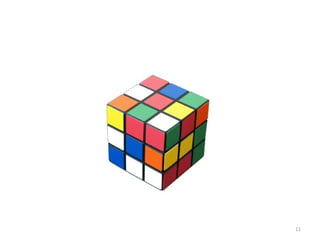
  • #12 While working on quantification, a Rubik’s cube given to me as a party gift sat on my desk near my PC. The 3 by 3 cube grid was talking to me.
  • #13 Now you see what I mean: the 3 by 3 cube grid appears to be a fitting description of Anderson’s idea of high–moderate–low level interaction intensity for student–content, student–teacher, and student–student interactions.
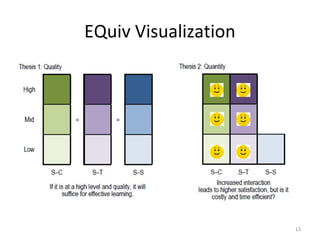
  • #14 In this manner, my visualization of the EQuiv with Dr. Anderson began to take shape.   Thesis 1 considers that one kind of high-level interaction is sufficient to realize quality learning, thereby implying that any one kind of high-level interaction is equally effective.   The Equivalency Theorem originated from this implication: That is, “Equivalency” means, literarily speaking, equal + value.   Thesis 2 is more difficult to visualize, so I created trial-and-error efforts in several papers for its visualization.   Simply speaking, if there is more than one high-level interaction, students will be happier but it will cost more and take more time.
  • #15 The EQuiv thinking becomes critically important at the time when the world economy is weakening and formal education has to face cost restriction.   Imagine one block of interaction costs one block dollar.   At its extreme, we could gain quality learning for only three block dollars; however, in many cases, with the hope of fitting various kinds of learners’ needs, we may tend to design a distance course with all the three interaction types at a so-so level.   In this case, deep learning does not occur, and thus, the entire six block dollars may just be wasted.   On the other hand, an interaction design such as C could realize deep learning with a high level of satisfaction by spending seven block dollars.   Learner satisfaction is important, but a design like C may actually be waste of four block dollars because the three block dollar design A may realize a similar level of expected quality learning.   Although these are hypothetical arguments, EQuiv thinking is helpful in analyzing what can be retained and what must be cut, or in other words, the surpluses or reductions necessary to produce quality learning with the highest cost/time efficiency.  
  • #16 The EQuiv thinking becomes critically important at the time when the world economy is weakening and formal education has to face cost restriction.   Imagine one block of interaction costs one block dollar.   At its extreme, we could gain quality learning for only three block dollars; however, in many cases, with the hope of fitting various kinds of learners’ needs, we may tend to design a distance course with all the three interaction types at a so-so level.   In this case, deep learning does not occur, and thus, the entire six block dollars may just be wasted.   On the other hand, an interaction design such as C could realize deep learning with a high level of satisfaction by spending seven block dollars.   Learner satisfaction is important, but a design like C may actually be waste of four block dollars because the three block dollar design A may realize a similar level of expected quality learning.   Although these are hypothetical arguments, EQuiv thinking is helpful in analyzing what can be retained and what must be cut, or in other words, the surpluses or reductions necessary to produce quality learning with the highest cost/time efficiency.  
  • #17 For the rest of the presentation, I will share how we can consider the new mode of learning as having enormous opportunities for open and free educational resources by relying on the EQuiv concepts.   As I have explained earlier, Moore’s interaction model is a good reflection of change in educational interaction: distance education started with content delivery, then interaction with tutor became possible, and finally came the growing possibility of student–student interaction.   What we now see is the enormous amount of free educational resources represented by OERs and MOOCs.   Therefore, what we are witnessing is the unprecedented amount of digital content beyond our ability to control and consume.
  • #18 The predominant feature of OERs and MOOCs is its cost-effectiveness. And the EQuiv analysis is useful for clarifying the situations that formal educational instruction faces.   This slide presents three interaction design patterns. The block with a dollar mark is the one in formal education that learners usually have to pay tuition fees for.   The blocks with a clock mark are the ones provided by open educational resources. Interaction design D is the case where formal education incorporates OERs in their course design: the learners pay only three dollars, and their satisfaction levels would be high if we follow Thesis 2.   Interaction design E in the middle refers to the Thesis 1 situation in formal learning, where the minimum three clock dollars are necessary to realize quality learning.   With interaction design F, learners do not have to pay anything, but they could learn and be satisfied. This means that, firstly, a formal program that costs more than three block dollars with the traditional approach would lose its competitiveness in terms of cost-effectiveness.   Secondly, even though OERs and other free educational resources may be effectively used to keep the price at minimum, learner satisfaction and the time learners spend on OER-based learning are lost.   Thus, the use of OERs may appear to be cost-effective, but not time-effective, in the true sense.   And another more critical point is that this ineffectiveness applies to both learners and educational providers, including tutors and institutions that spend their time incorporating the OERs and taking care of the learners.
  • #19 The predominant feature of OERs and MOOCs is its cost-effectiveness. And the EQuiv analysis is useful for clarifying the situations that formal educational instruction faces.   This slide presents three interaction design patterns. The block with a dollar mark is the one in formal education that learners usually have to pay tuition fees for.   The blocks with a clock mark are the ones provided by open educational resources. Interaction design D is the case where formal education incorporates OERs in their course design: the learners pay only three dollars, and their satisfaction levels would be high if we follow Thesis 2.   Interaction design E in the middle refers to the Thesis 1 situation in formal learning, where the minimum three clock dollars are necessary to realize quality learning.   With interaction design F, learners do not have to pay anything, but they could learn and be satisfied. This means that, firstly, a formal program that costs more than three block dollars with the traditional approach would lose its competitiveness in terms of cost-effectiveness.   Secondly, even though OERs and other free educational resources may be effectively used to keep the price at minimum, learner satisfaction and the time learners spend on OER-based learning are lost.   Thus, the use of OERs may appear to be cost-effective, but not time-effective, in the true sense.   And another more critical point is that this ineffectiveness applies to both learners and educational providers, including tutors and institutions that spend their time incorporating the OERs and taking care of the learners.
  • #20 Sir John Daniel in 2003 posited quality–cost–accessibility as the three vectors that distance education has to cope with.   However, these vectors or issues may change from quality–cost–accessibility to quality–cost–time, especially in areas where the availability of the Internet and of digital resources is growing rapidly.   These changes coincidentally and exactly correspond to the three factor elements in Anderson’s Equiv, namely, quality, cost, and time.
  • #21 Although we should skip much of the details, this slide also shows the most recent re-capturing or re-interpretation of the Modes of Interaction model, which we created and which encompasses the current ongoing state of learning in the digital era.   We are now surrounded by an overwhelming amount of self-multiplying digital content for learning, which has allowed content to take increasingly larger roles in our new mode of learning.   Digital content sits in between the teacher and the student, and connects us more and more indirectly.   The traditionally dense relation between the teacher and the student is increasingly becoming scarcer and unstable.   The presence of each teacher and student has increasingly faded, and learning is made, connected, and consumed by teachers and students who may barely feel each other as reality.
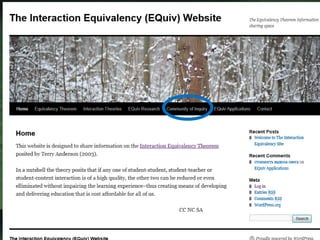
  • #24 Finally, Dr. Anderson and I have accumulated and shared our works and all other information relevant to EQuiv on a website.   Just type the key word, such as EQuiv, Anderson, interaction, or Miyazoe, and the website will provide the information needed.   If you are interested in the topics of community of inquiry, you can also find the close relationship between CoI and Equiv, which has developed together within Anderson’s years of footprints.
  • #26 That is all for now. I would be happy to hear any suggestions or questions.