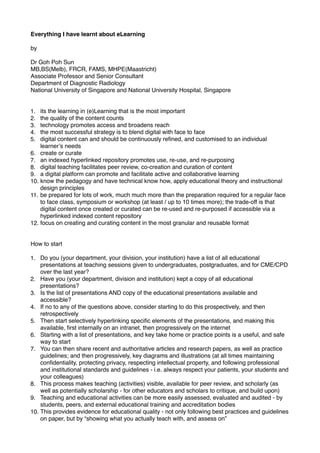
Everything I have learnt about eLearning
by
Dr Goh Poh Sun
MB,BS(Melb), FRCR, FAMS, MHPE(Maastricht), FAMEE
Associate Professor and Senior Consultant
Department of Diagnostic Radiology
National University of Singapore and National University Hospital, Singapore
1. its the learning in (e)Learning that is the most important
2. the quality of the content counts
3. technology promotes access and broadens reach
4. the most successful strategy is to blend digital with face to face
5. digital content can and should be continuously refined, and customised to an individual
learner’s needs
6. create or curate
7. an indexed hyperlinked repository promotes use, re-use, and re-purposing
8. digital teaching facilitates peer review, co-creation and curation of content
9. a digital platform can promote and facilitate active and collaborative learning
10. know the pedagogy and have technical know how, apply educational theory and instructional
design principles
11. be prepared for lots of work, much much more than the preparation required for a regular face
to face class, symposium or workshop (at least / up to 10 times more); the trade-off is that
digital content once created or curated can be re-used and re-purposed if accessible via a
hyperlinked indexed content repository
12. focus on creating and curating content in the most granular and reusable format
How to start
1. Do you (your department, your division, your institution) have a list of all educational
presentations at teaching sessions given to undergraduates, postgraduates, and for CME/CPD
over the last year?
2. Have you (your department, division and institution) kept a copy of all educational
presentations?
3. Is the list of presentations AND copy of the educational presentations available and
accessible?
4. If no to any of the questions above, consider starting to do this prospectively, and then
retrospectively
5. Then start selectively hyperlinking specific elements of the presentations, and making this
available, first internally on an intranet, then progressively on the internet
6. Starting with a list of presentations, and key take home or practice points is a useful, and safe
way to start
7. You can then share recent and authoritative articles and research papers, as well as practice
guidelines; and then progressively, key diagrams and illustrations (at all times maintaining
confidentiality, protecting privacy, respecting intellectual property, and following professional
and institutional standards and guidelines - i.e. always respect your patients, your students and
your colleagues)
8. This process makes teaching (activities) visible, available for peer review, and scholarly (as
well as potentially scholarship - for other educators and scholars to critique, and build upon)
9. Teaching and educational activities can be more easily assessed, evaluated and audited - by
students, peers, and external educational training and accreditation bodies
10. This provides evidence for educational quality - not only following best practices and guidelines
on paper, but by “showing what you actually teach with, and assess on”

Everything I have learnt about eLearning

  • 1.
    Everything I havelearnt about eLearning by Dr Goh Poh Sun MB,BS(Melb), FRCR, FAMS, MHPE(Maastricht), FAMEE Associate Professor and Senior Consultant Department of Diagnostic Radiology National University of Singapore and National University Hospital, Singapore 1. its the learning in (e)Learning that is the most important 2. the quality of the content counts 3. technology promotes access and broadens reach 4. the most successful strategy is to blend digital with face to face 5. digital content can and should be continuously refined, and customised to an individual learner’s needs 6. create or curate 7. an indexed hyperlinked repository promotes use, re-use, and re-purposing 8. digital teaching facilitates peer review, co-creation and curation of content 9. a digital platform can promote and facilitate active and collaborative learning 10. know the pedagogy and have technical know how, apply educational theory and instructional design principles 11. be prepared for lots of work, much much more than the preparation required for a regular face to face class, symposium or workshop (at least / up to 10 times more); the trade-off is that digital content once created or curated can be re-used and re-purposed if accessible via a hyperlinked indexed content repository 12. focus on creating and curating content in the most granular and reusable format How to start 1. Do you (your department, your division, your institution) have a list of all educational presentations at teaching sessions given to undergraduates, postgraduates, and for CME/CPD over the last year? 2. Have you (your department, division and institution) kept a copy of all educational presentations? 3. Is the list of presentations AND copy of the educational presentations available and accessible? 4. If no to any of the questions above, consider starting to do this prospectively, and then retrospectively 5. Then start selectively hyperlinking specific elements of the presentations, and making this available, first internally on an intranet, then progressively on the internet 6. Starting with a list of presentations, and key take home or practice points is a useful, and safe way to start 7. You can then share recent and authoritative articles and research papers, as well as practice guidelines; and then progressively, key diagrams and illustrations (at all times maintaining confidentiality, protecting privacy, respecting intellectual property, and following professional and institutional standards and guidelines - i.e. always respect your patients, your students and your colleagues) 8. This process makes teaching (activities) visible, available for peer review, and scholarly (as well as potentially scholarship - for other educators and scholars to critique, and build upon) 9. Teaching and educational activities can be more easily assessed, evaluated and audited - by students, peers, and external educational training and accreditation bodies 10. This provides evidence for educational quality - not only following best practices and guidelines on paper, but by “showing what you actually teach with, and assess on”