Pagedundee.ac.uk
Dr Susie Schofield & Ms Jordan Napier
Building your toolkit for online learning &
teaching in Medical Education
Centre for Medical Education
1
University of the Year for Student Experience (The Times/Sunday Times Good University Guide 2020)
→Consider the benefits and challenges of
online learning in medicine during COVID-
19
→Reflect on aspects of your ‘normal’
teaching practice you will utilise as an
‘educator at a distance’
→Reflect on the gaps in your toolkit and
identify ways to address these
By the end of this webinar,
you will be able to…
2
Dr Susie Schofield – online teacher,
champion for trying new teaching
techniques, distance learning lead, overall
enthusiast
Ms Jordan Napier - lover of challenges,
believer in people, digital native, always an
optimist.
About us
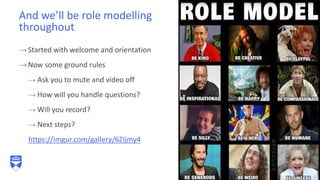
→Started with welcome and orientation
→Now some ground rules
→ Ask you to mute and video off
→ How will you handle questions?
→ Will you record?
→ Next steps?
https://imgur.com/gallery/6ZIjmy4
And we’ll be role modelling
throughout
4
Pagedundee.ac.uk 5
Pagedundee.ac.uk
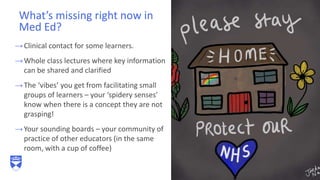
→Clinical contact for some learners.
→Whole class lectures where key information
can be shared and clarified
→The ‘vibes’ you get from facilitating small
groups of learners – your ‘spidery senses’
know when there is a concept they are not
grasping!
→Your sounding boards – your community of
practice of other educators (in the same
room, with a cup of coffee)
What’s missing right now in
Med Ed?
7
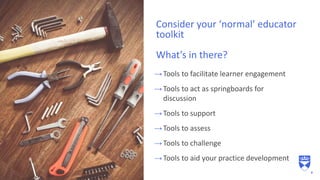
→Tools to facilitate learner engagement
→Tools to act as springboards for
discussion
→Tools to support
→Tools to assess
→Tools to challenge
→Tools to aid your practice development
Consider your ‘normal’ educator
toolkit
What’s in there?
8
• Revisit ‘what is core?’
• Try activities we’ve been avoiding
• Our classrooms have been flipped for us
• The novelty of online learning
approaches may in themselves spark
learner engagement
How can we view this as an
opportunity?
Pagedundee.ac.uk
What’s missing right now in Med Ed?
→Patient contact for some learners.
→Whole class lectures where key
information can be shared and clarified
→The ‘vibes’ you get from facilitating
small groups of learners – your ‘spidey
senses’ know when there is a concept
they are not grasping!
→Your sounding boards – your
community of practice of other
educators (in the same room, with a
cup of coffee)
10
→Patient stories & data can still be shared
and discussed.
→Lecture recordings enable students to
digest information at their own pace
→Small group teaching via video-
call/webinar is possible, and the same
‘reading the room’ can and will apply
→Your sounding boards are still around.
The way you access them will have
changed.
→Tools to facilitate learner engagement
→Tools to act as springboards for
discussion
→Tools to support
→Tools to assess
→Tools to challenge
→Tools to aid your practice development
How do we evolve & expand our
toolkit for distance learning?
11
• Think about what the students need to know / be
able to do, and how is that best supported?
• What cannot be done online but maybe at home?
• Synchronous or asynchronous?
• How can I best support many to many
communication?
• Discussion boards
• Short video e.g. summing up discussions
• How can I support formative?
• Tutor-marked; peer evaluated; computer
marked; self-assessed
• How do I stay legal?
• https://pixabay.com/images/search/phoenix/
Finding new life in a blended approach
Pagedundee.ac.uk
Accessibility
13
• Both disability access and technology access
• Video material should be captioned (Teams does live caption – not perfect but
a good start. Youtube will apply captioning which you can then edit for
accuracy)
• Provide original file format and PDF version to participants (writing a script for
yourself will do both jobs and can save ums and ers)
• Use structure in documents – e.g. word Styles and Headings
• Do not use bold and resizing of text to make a heading
• Think contrast & text size to aid readability
• Use Alt text for graphics
• Avoid text over images or in graphics
• Ensure reasonably good quality audio
Pagedundee.ac.uk
Accessibility…
• Reading material
• Reading lists – check if a digital copy available to buy from amazon or other suppliers
• Does your institution use a reading list? E.g. Talis software
• Does your library support Digitisation? This will ensure CLA and accessibility-compliance.
(Remember, putting a pdf you don’t have copyright permission for is illegal and students
may not be able to access the physical library)
• Put in a time estimate for how long the activity will take
• Good for student to see depth of study
• Good for tutors to check size of expectation
• Good for QA to see how time equivalence is being handled
• Good for funders to see value for money is being maintained
• Consider where students should report broken links
14
Pagedundee.ac.uk
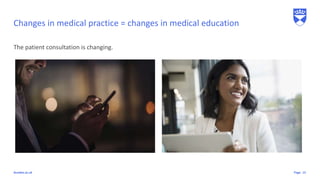
Changes in medical practice = changes in medical education
The patient consultation is changing.
15
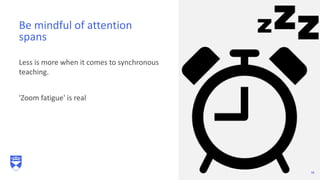
Less is more when it comes to synchronous
teaching.
'Zoom fatigue' is real
Be mindful of attention
spans
16
Pagedundee.ac.uk
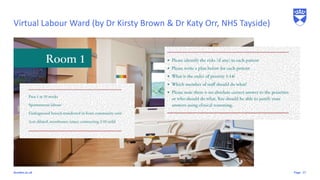
Virtual Labour Ward (by Dr Kirsty Brown & Dr Katy Orr, NHS Tayside)
17
Pagedundee.ac.uk
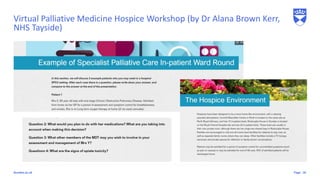
Virtual Palliative Medicine Hospice Workshop (by Dr Alana Brown Kerr,
NHS Tayside)
18
Pagedundee.ac.uk
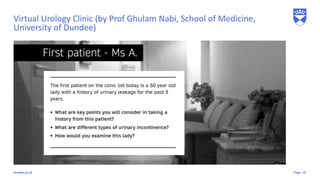
Virtual Urology Clinic (by Prof Ghulam Nabi, School of Medicine,
University of Dundee)
19
Pagedundee.ac.uk
Pagedundee.ac.uk
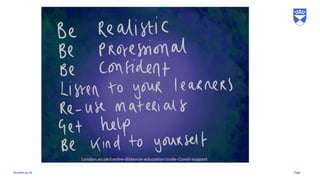
Be realistic
Be Professional
Listen to your learners
Re-use material
Get help
Be Kind to yourself
https://london.ac.uk/centre-distance-education/cde-covid-support
Pagedundee.ac.uk
Good places for free images and guidance:
Flickr: https://www.flickr.com/
Pixabay: https://pixabay.com
Wikimedia Commons: https://commons.wikimedia.org/wiki/Main_Page
Medical Library Gateaway: http://www.samlib.com/medicalimages.aspx#Microbiology
The National Library of Medicine (MedPix): https://medpix.nlm.nih.gov/home
Public Health Image Library: https://phil.cdc.gov/Default.aspx
Cancer Image Archive: http://www.cancerimagingarchive.net/
Open Access Biomedical Image: https://openi.nlm.nih.gov/
GMC making and using visual and audio recordings of patients: https://www.gmc-uk.org/ethical-
guidance/ethical-guidance-for-doctors/making-and-using-visual-and-audio-recordings-of-patients
22
Pagedundee.ac.uk
Your questions from the chat box
23
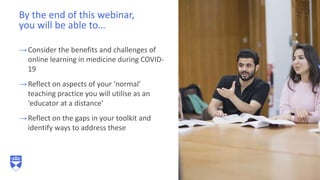
→Consider the benefits and challenges of
online learning in medicine during COVID-
19
→Reflect on aspects of your ‘normal’
teaching practice you will utilise as an
‘educator at a distance’
→Reflect on the gaps in your toolkit and
identify ways to address these
By the end of this webinar,
you will be able to…
24
Pagedundee.ac.uk
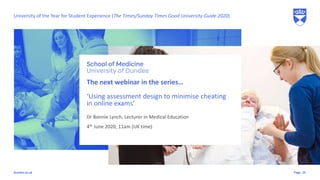
The next webinar in the series…
‘Using assessment design to minimise cheating
in online exams’
25
University of the Year for Student Experience (The Times/Sunday Times Good University Guide 2020)
Dr Bonnie Lynch, Lecturer in Medical Education
4th June 2020, 11am (UK time)

Building your toolkit for online learning & teaching

  • 1.
    Pagedundee.ac.uk Dr Susie Schofield& Ms Jordan Napier Building your toolkit for online learning & teaching in Medical Education Centre for Medical Education 1 University of the Year for Student Experience (The Times/Sunday Times Good University Guide 2020)
  • 2.
    →Consider the benefitsand challenges of online learning in medicine during COVID- 19 →Reflect on aspects of your ‘normal’ teaching practice you will utilise as an ‘educator at a distance’ →Reflect on the gaps in your toolkit and identify ways to address these By the end of this webinar, you will be able to… 2
  • 3.
    Dr Susie Schofield– online teacher, champion for trying new teaching techniques, distance learning lead, overall enthusiast Ms Jordan Napier - lover of challenges, believer in people, digital native, always an optimist. About us
  • 4.
    →Started with welcomeand orientation →Now some ground rules → Ask you to mute and video off → How will you handle questions? → Will you record? → Next steps? https://imgur.com/gallery/6ZIjmy4 And we’ll be role modelling throughout 4
  • 5.
  • 6.
  • 7.
    →Clinical contact forsome learners. →Whole class lectures where key information can be shared and clarified →The ‘vibes’ you get from facilitating small groups of learners – your ‘spidery senses’ know when there is a concept they are not grasping! →Your sounding boards – your community of practice of other educators (in the same room, with a cup of coffee) What’s missing right now in Med Ed? 7
  • 8.
    →Tools to facilitatelearner engagement →Tools to act as springboards for discussion →Tools to support →Tools to assess →Tools to challenge →Tools to aid your practice development Consider your ‘normal’ educator toolkit What’s in there? 8
  • 9.
    • Revisit ‘whatis core?’ • Try activities we’ve been avoiding • Our classrooms have been flipped for us • The novelty of online learning approaches may in themselves spark learner engagement How can we view this as an opportunity?
  • 10.
    Pagedundee.ac.uk What’s missing rightnow in Med Ed? →Patient contact for some learners. →Whole class lectures where key information can be shared and clarified →The ‘vibes’ you get from facilitating small groups of learners – your ‘spidey senses’ know when there is a concept they are not grasping! →Your sounding boards – your community of practice of other educators (in the same room, with a cup of coffee) 10 →Patient stories & data can still be shared and discussed. →Lecture recordings enable students to digest information at their own pace →Small group teaching via video- call/webinar is possible, and the same ‘reading the room’ can and will apply →Your sounding boards are still around. The way you access them will have changed.
  • 11.
    →Tools to facilitatelearner engagement →Tools to act as springboards for discussion →Tools to support →Tools to assess →Tools to challenge →Tools to aid your practice development How do we evolve & expand our toolkit for distance learning? 11
  • 12.
    • Think aboutwhat the students need to know / be able to do, and how is that best supported? • What cannot be done online but maybe at home? • Synchronous or asynchronous? • How can I best support many to many communication? • Discussion boards • Short video e.g. summing up discussions • How can I support formative? • Tutor-marked; peer evaluated; computer marked; self-assessed • How do I stay legal? • https://pixabay.com/images/search/phoenix/ Finding new life in a blended approach
  • 13.
    Pagedundee.ac.uk Accessibility 13 • Both disabilityaccess and technology access • Video material should be captioned (Teams does live caption – not perfect but a good start. Youtube will apply captioning which you can then edit for accuracy) • Provide original file format and PDF version to participants (writing a script for yourself will do both jobs and can save ums and ers) • Use structure in documents – e.g. word Styles and Headings • Do not use bold and resizing of text to make a heading • Think contrast & text size to aid readability • Use Alt text for graphics • Avoid text over images or in graphics • Ensure reasonably good quality audio
  • 14.
    Pagedundee.ac.uk Accessibility… • Reading material •Reading lists – check if a digital copy available to buy from amazon or other suppliers • Does your institution use a reading list? E.g. Talis software • Does your library support Digitisation? This will ensure CLA and accessibility-compliance. (Remember, putting a pdf you don’t have copyright permission for is illegal and students may not be able to access the physical library) • Put in a time estimate for how long the activity will take • Good for student to see depth of study • Good for tutors to check size of expectation • Good for QA to see how time equivalence is being handled • Good for funders to see value for money is being maintained • Consider where students should report broken links 14
  • 15.
    Pagedundee.ac.uk Changes in medicalpractice = changes in medical education The patient consultation is changing. 15
  • 16.
    Less is morewhen it comes to synchronous teaching. 'Zoom fatigue' is real Be mindful of attention spans 16
  • 17.
    Pagedundee.ac.uk Virtual Labour Ward(by Dr Kirsty Brown & Dr Katy Orr, NHS Tayside) 17
  • 18.
    Pagedundee.ac.uk Virtual Palliative MedicineHospice Workshop (by Dr Alana Brown Kerr, NHS Tayside) 18
  • 19.
    Pagedundee.ac.uk Virtual Urology Clinic(by Prof Ghulam Nabi, School of Medicine, University of Dundee) 19
  • 20.
  • 21.
    Pagedundee.ac.uk Be realistic Be Professional Listento your learners Re-use material Get help Be Kind to yourself https://london.ac.uk/centre-distance-education/cde-covid-support
  • 22.
    Pagedundee.ac.uk Good places forfree images and guidance: Flickr: https://www.flickr.com/ Pixabay: https://pixabay.com Wikimedia Commons: https://commons.wikimedia.org/wiki/Main_Page Medical Library Gateaway: http://www.samlib.com/medicalimages.aspx#Microbiology The National Library of Medicine (MedPix): https://medpix.nlm.nih.gov/home Public Health Image Library: https://phil.cdc.gov/Default.aspx Cancer Image Archive: http://www.cancerimagingarchive.net/ Open Access Biomedical Image: https://openi.nlm.nih.gov/ GMC making and using visual and audio recordings of patients: https://www.gmc-uk.org/ethical- guidance/ethical-guidance-for-doctors/making-and-using-visual-and-audio-recordings-of-patients 22
  • 23.
  • 24.
    →Consider the benefitsand challenges of online learning in medicine during COVID- 19 →Reflect on aspects of your ‘normal’ teaching practice you will utilise as an ‘educator at a distance’ →Reflect on the gaps in your toolkit and identify ways to address these By the end of this webinar, you will be able to… 24
  • 25.
    Pagedundee.ac.uk The next webinarin the series… ‘Using assessment design to minimise cheating in online exams’ 25 University of the Year for Student Experience (The Times/Sunday Times Good University Guide 2020) Dr Bonnie Lynch, Lecturer in Medical Education 4th June 2020, 11am (UK time)

Editor's Notes

  • #9 We might facilitate learning engagement in classrooms by asking for paired discussion, setting problems for small groups to work on together. We might use patient stories as springboards for discussion, or of course actual patients.
  • #12 We might facilitate learning engagement in classrooms by asking for paired discussion, setting problems for small groups to work on together. We might use patient stories as springboards for discussion, or of course actual patients.