
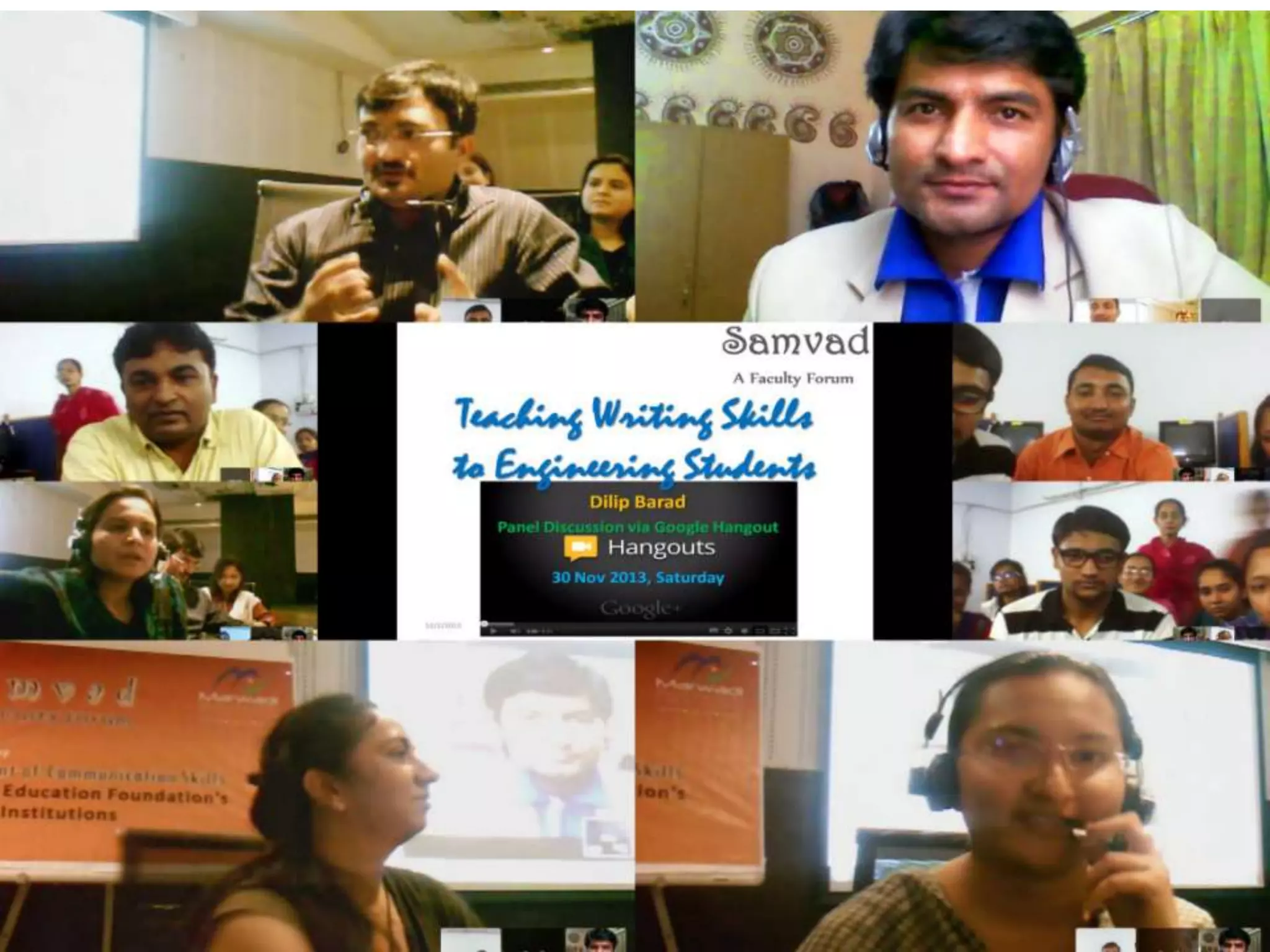
Teaching Writing Skills
to Engineering Students
Dilip Barad
Panel Discussion via Google Hangout

30 Nov 2013, Saturday
12/2/2013
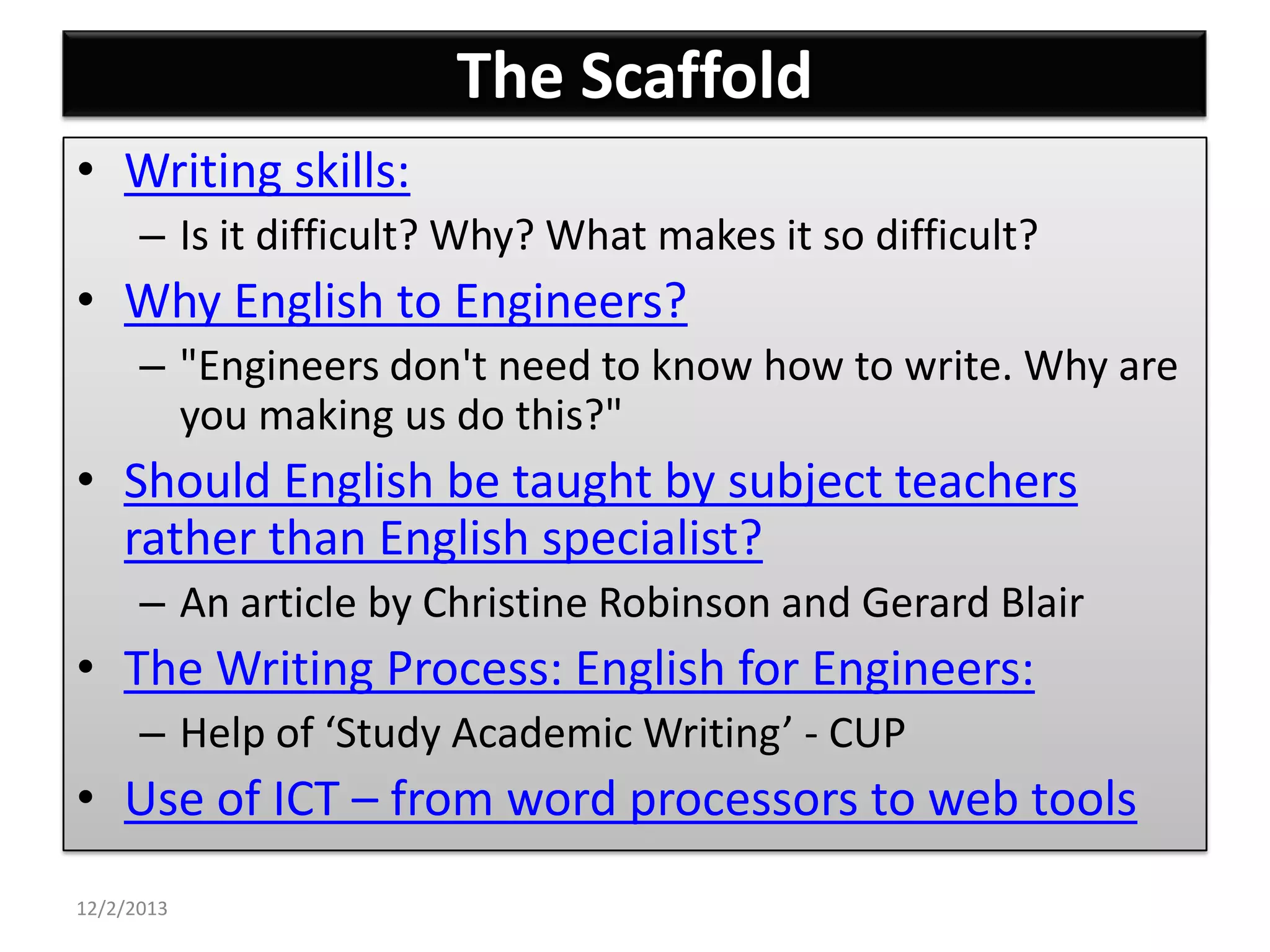
The Scaffold
• Writing skills:
– Is it difficult? Why? What makes it so difficult?

• Why English to Engineers?
– "Engineers don't need to know how to write. Why are
you making us do this?"

• Should English be taught by subject teachers
rather than English specialist?
– An article by Christine Robinson and Gerard Blair

• The Writing Process: English for Engineers:
– Help of ‘Study Academic Writing’ - CUP

• Use of ICT – from word processors to web tools
12/2/2013
Writing skills:
Is it difficult? Why? What makes it so difficult?
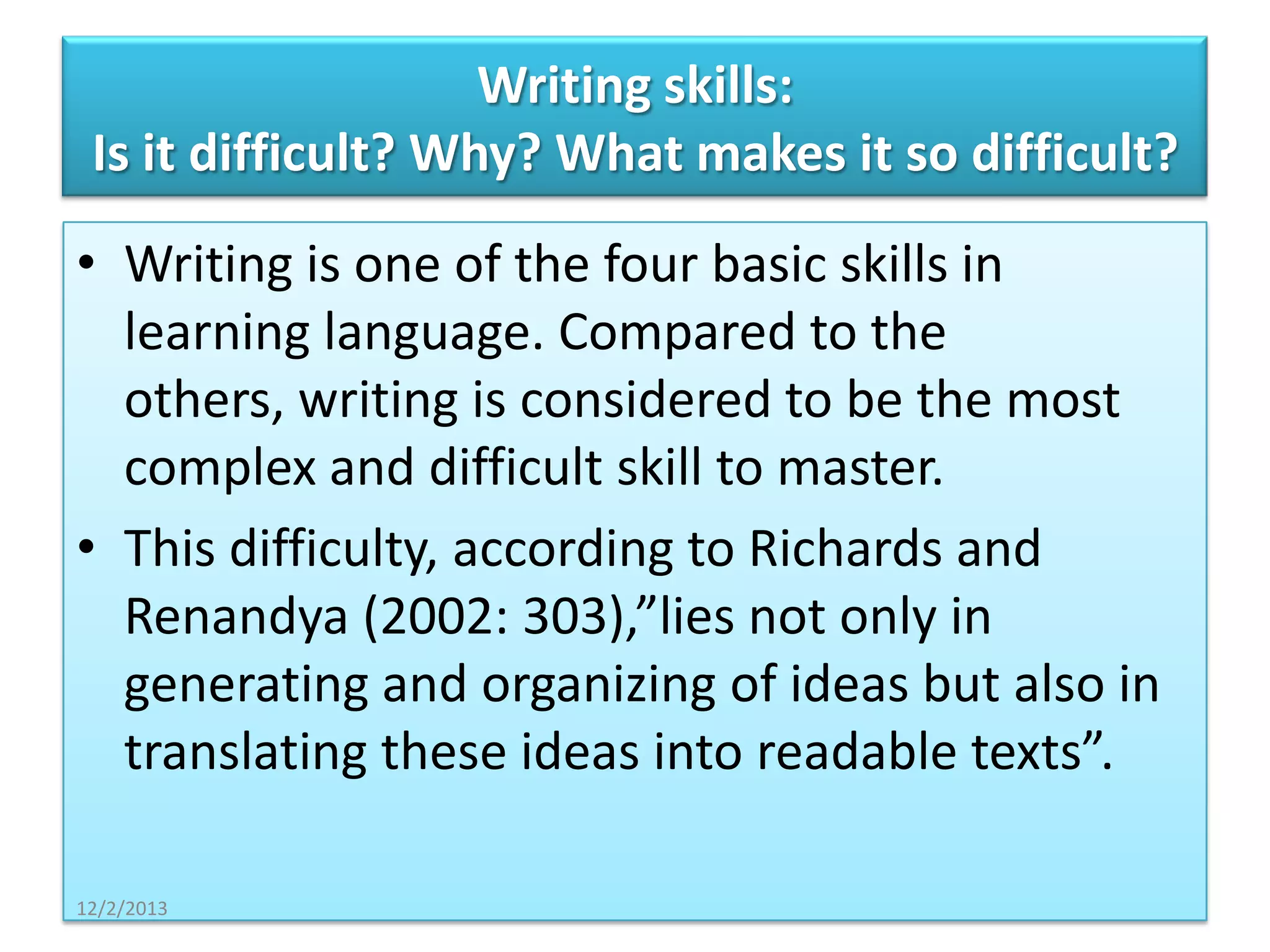
• Writing is one of the four basic skills in
learning language. Compared to the
others, writing is considered to be the most
complex and difficult skill to master.
• This difficulty, according to Richards and
Renandya (2002: 303),”lies not only in
generating and organizing of ideas but also in
translating these ideas into readable texts”.
12/2/2013
Writing skills:
Is it difficult? Why? What makes it so difficult?
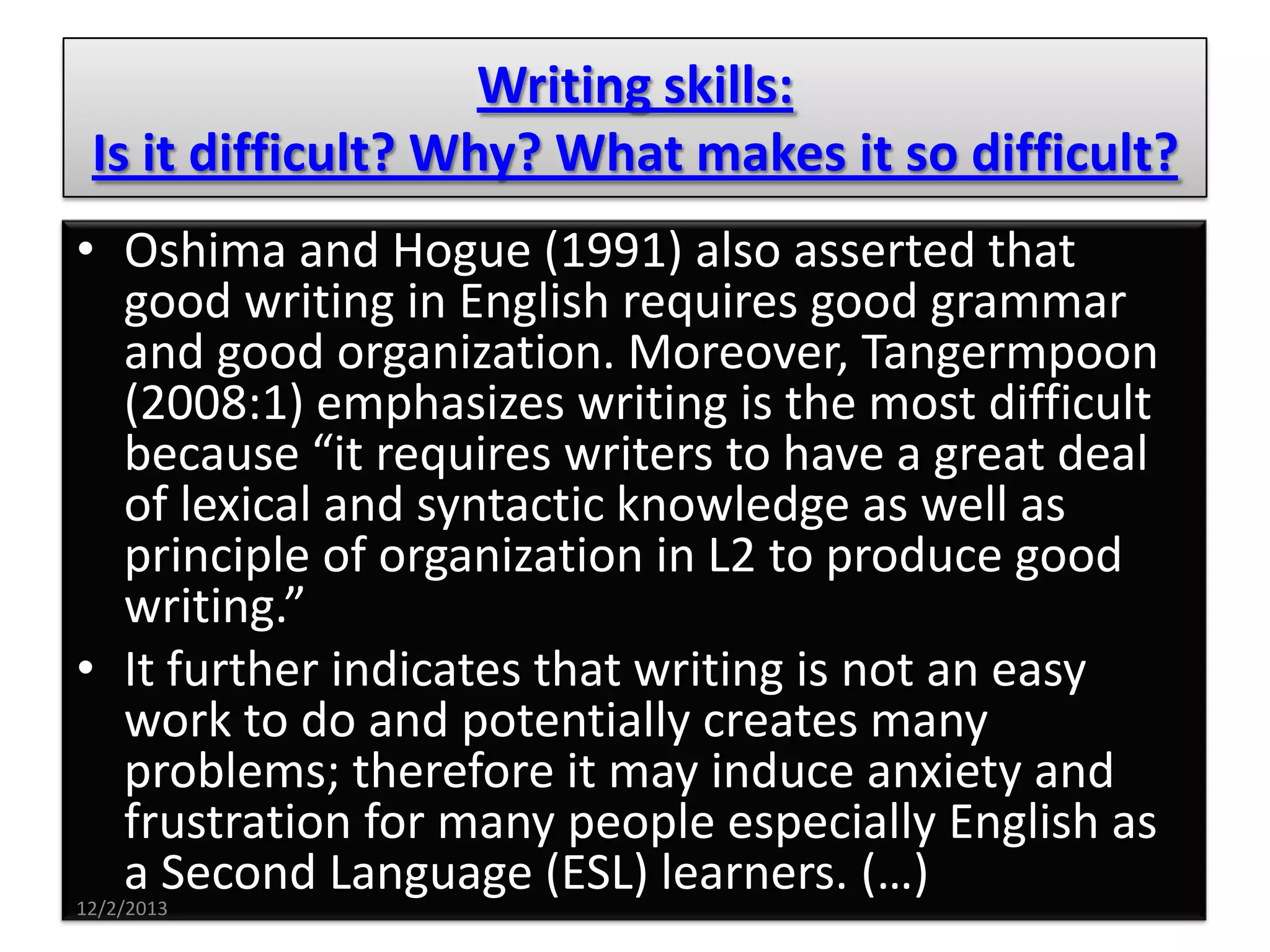
• Oshima and Hogue (1991) also asserted that
good writing in English requires good grammar
and good organization. Moreover, Tangermpoon
(2008:1) emphasizes writing is the most difficult
because “it requires writers to have a great deal
of lexical and syntactic knowledge as well as
principle of organization in L2 to produce good
writing.”
• It further indicates that writing is not an easy
work to do and potentially creates many
problems; therefore it may induce anxiety and
frustration for many people especially English as
a Second Language (ESL) learners. (…)
12/2/2013
Why English to Engineers?
Why language proficiency to Engineers?
• In engineering, the transition from idea to
product requires that the engineer produce
clear proposals demonstrating the idea's
practicality and economic feasibility.
• Writing is a key element in this process.

12/2/2013
Should English be taught by subject
teachers rather than English specialist?
• This leads us to the question of ‘who is the
English specialist?’
• Masters of Arts with English, are they
specialist to do this job?
• Are the recent recruits to teach English to
Engineering students capable to teach?
• Are they good enough to be called ‘English
specialist’?
12/2/2013
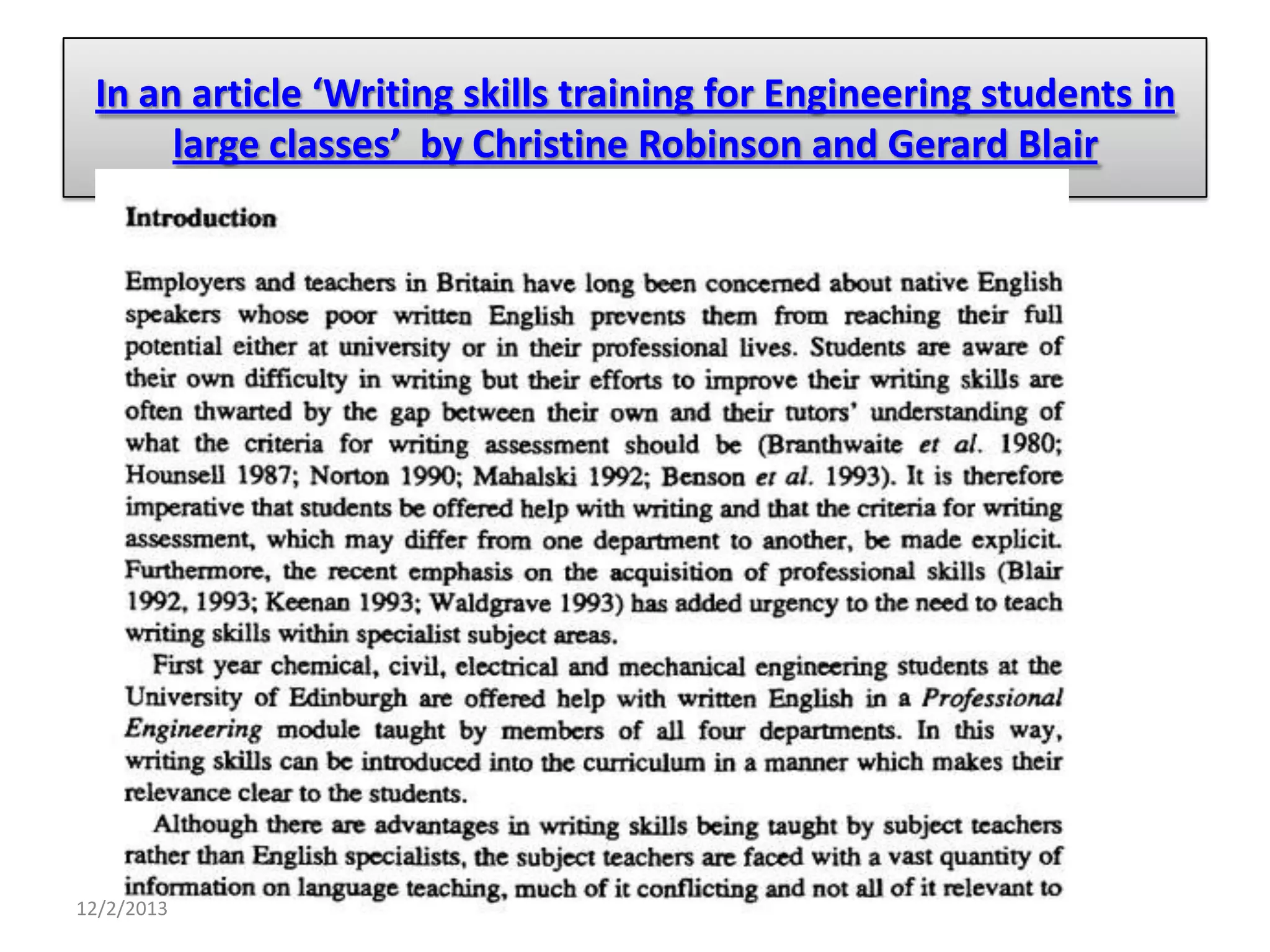
In an article ‘Writing skills training for Engineering students in
large classes’ by Christine Robinson and Gerard Blair

12/2/2013
English Writing processes
• The aim of teacher is to:
1. Introducing the idea that writing is a set of
processes.
2. Showing how to distinguish between formal
and personal styles of writing.
3. Looking at the grammar of formal discourse.
4. Practicing visualizing text as a pre-writing
step.
12/2/2013
Thinking about writing processes:
1. When you write an important text, do you make
more than one draft?
2. If option is given, do you prefer to write on paper
or use a computer? Have you ever asked yourself

why?
3. What do you do before you start writing?
4. How do you start writing? Do you begin at ‘the
beginning’ or jump in wherever you have some
ideas? Do you think one approach is better than
another?
12/2/2013
Thinking about writing processes:
5. What do you do while you are writing? Do
you stop and think? Do you ever go back to
the beginning and start again?
6. When you finish your first complete
draft, what do you do next?

12/2/2013
Recognizing technical writing
• Read:
– Linguists were and remain convinced by Noam
Chomsky of the Massachusetts Institute of
Technology, who discovered that however
disparate human languages seem, all share a
common, basic structure, seemingly hardwired into
the brain.
* Identify three features of this sentence that you
think are technical or formal.
12/2/2013
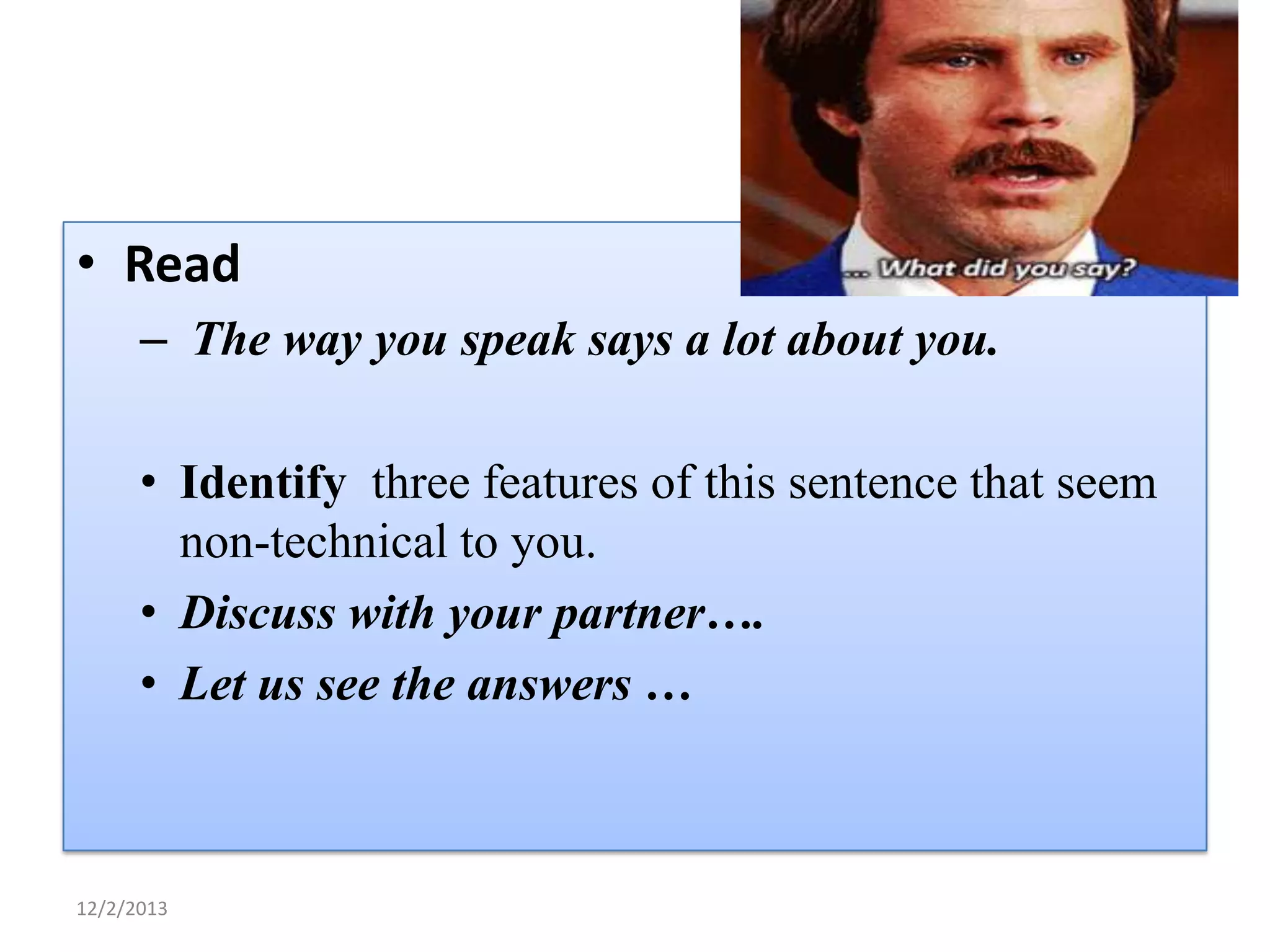
• Read
– The way you speak says a lot about you.
• Identify three features of this sentence that seem
non-technical to you.
• Discuss with your partner….
• Let us see the answers …

12/2/2013
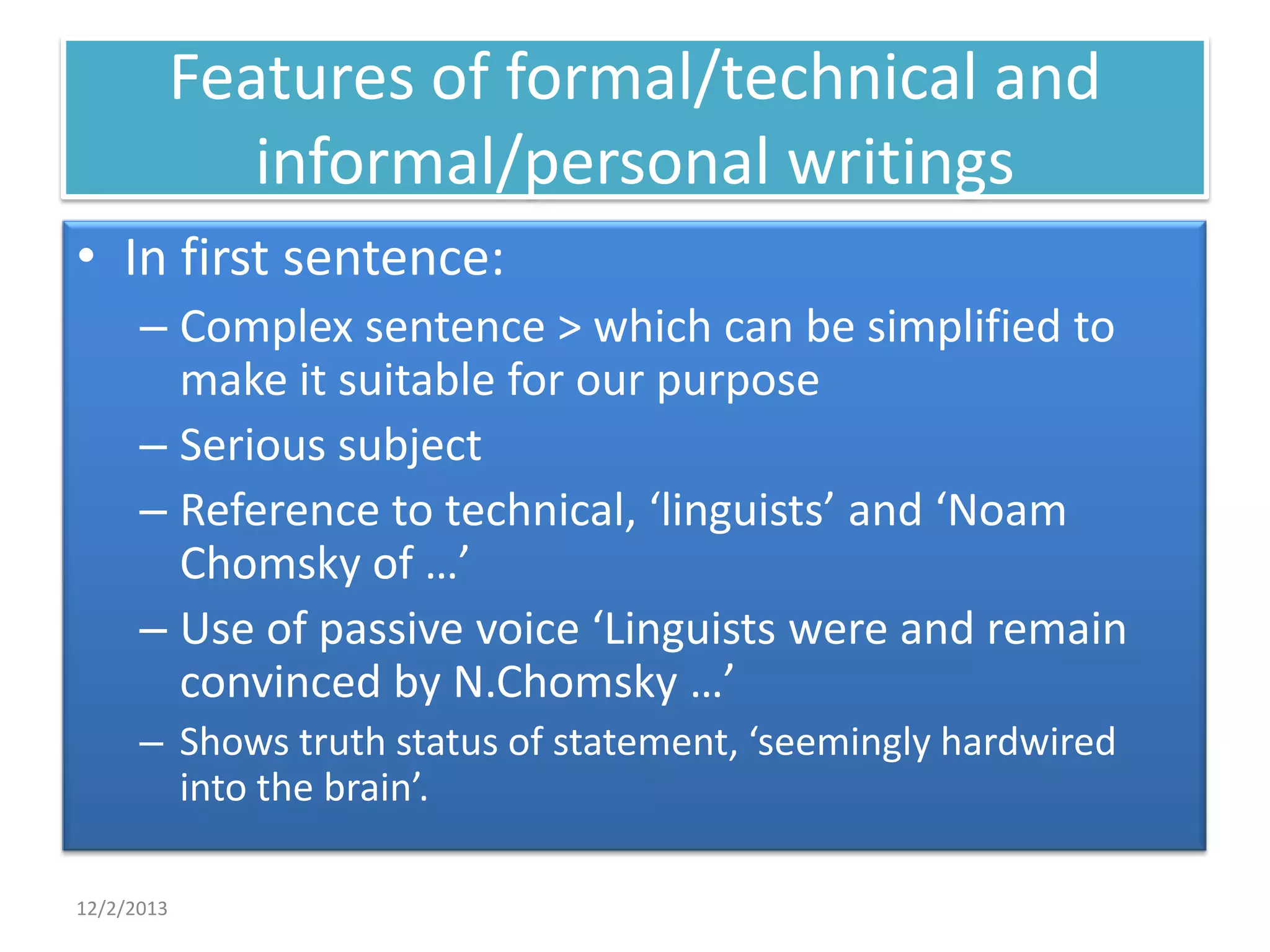
Features of formal/technical and
informal/personal writings
• In first sentence:
– Complex sentence > which can be simplified to
make it suitable for our purpose
– Serious subject
– Reference to technical, ‘linguists’ and ‘Noam
Chomsky of …’
– Use of passive voice ‘Linguists were and remain
convinced by N.Chomsky …’
– Shows truth status of statement, ‘seemingly hardwired
into the brain’.
12/2/2013
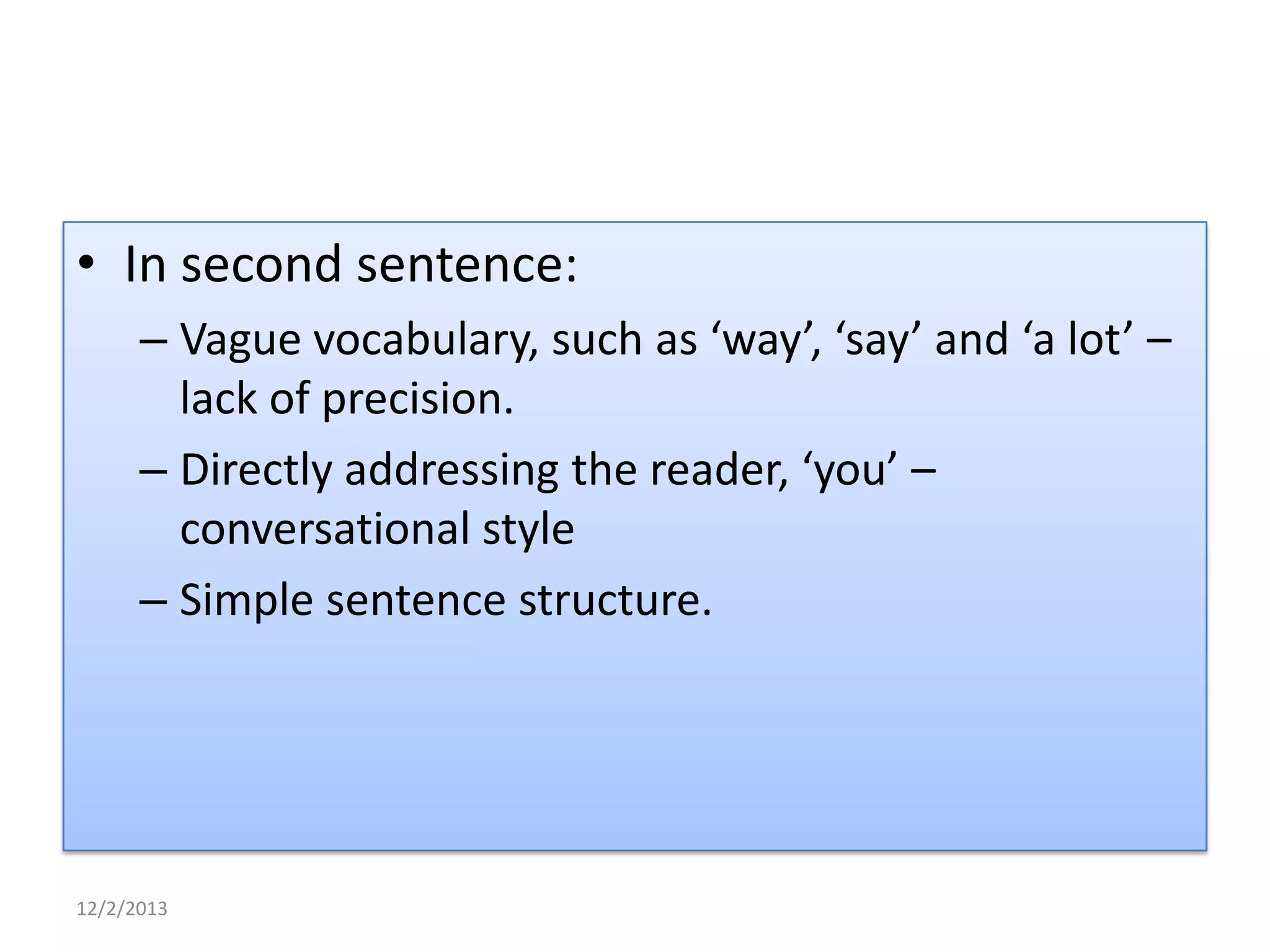
• In second sentence:
– Vague vocabulary, such as ‘way’, ‘say’ and ‘a lot’ –
lack of precision.
– Directly addressing the reader, ‘you’ –
conversational style
– Simple sentence structure.

12/2/2013
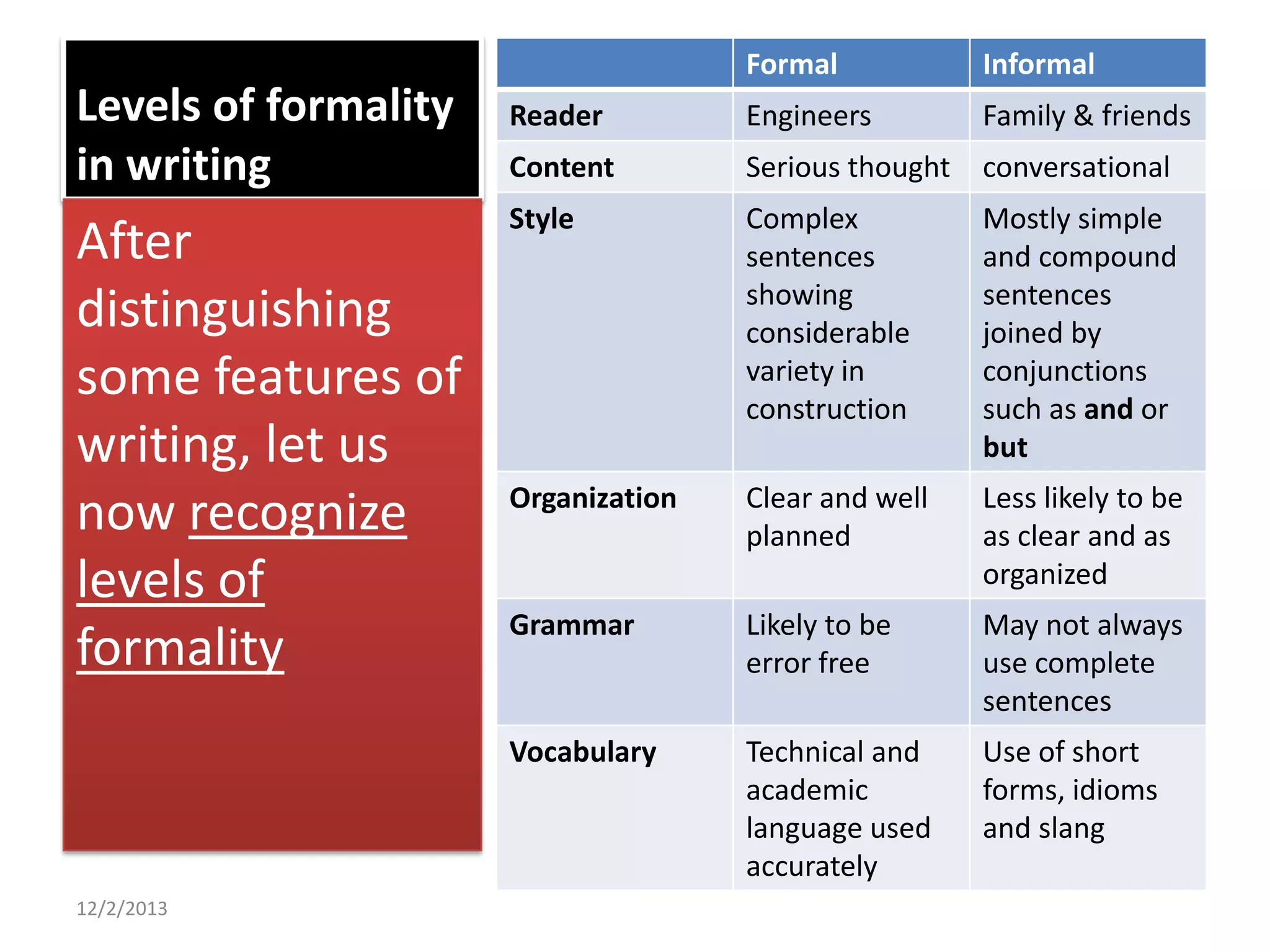
Formal

After
distinguishing
some features of
writing, let us
now recognize
levels of
formality

12/2/2013

Reader

Engineers

Family & friends

Content

Serious thought

conversational

Style

Complex
sentences
showing
considerable
variety in
construction

Mostly simple
and compound
sentences
joined by
conjunctions
such as and or
but

Organization

Clear and well
planned

Less likely to be
as clear and as
organized

Grammar

Likely to be
error free

May not always
use complete
sentences

Vocabulary

Levels of formality
in writing

Informal

Technical and
academic
language used
accurately

Use of short
forms, idioms
and slang
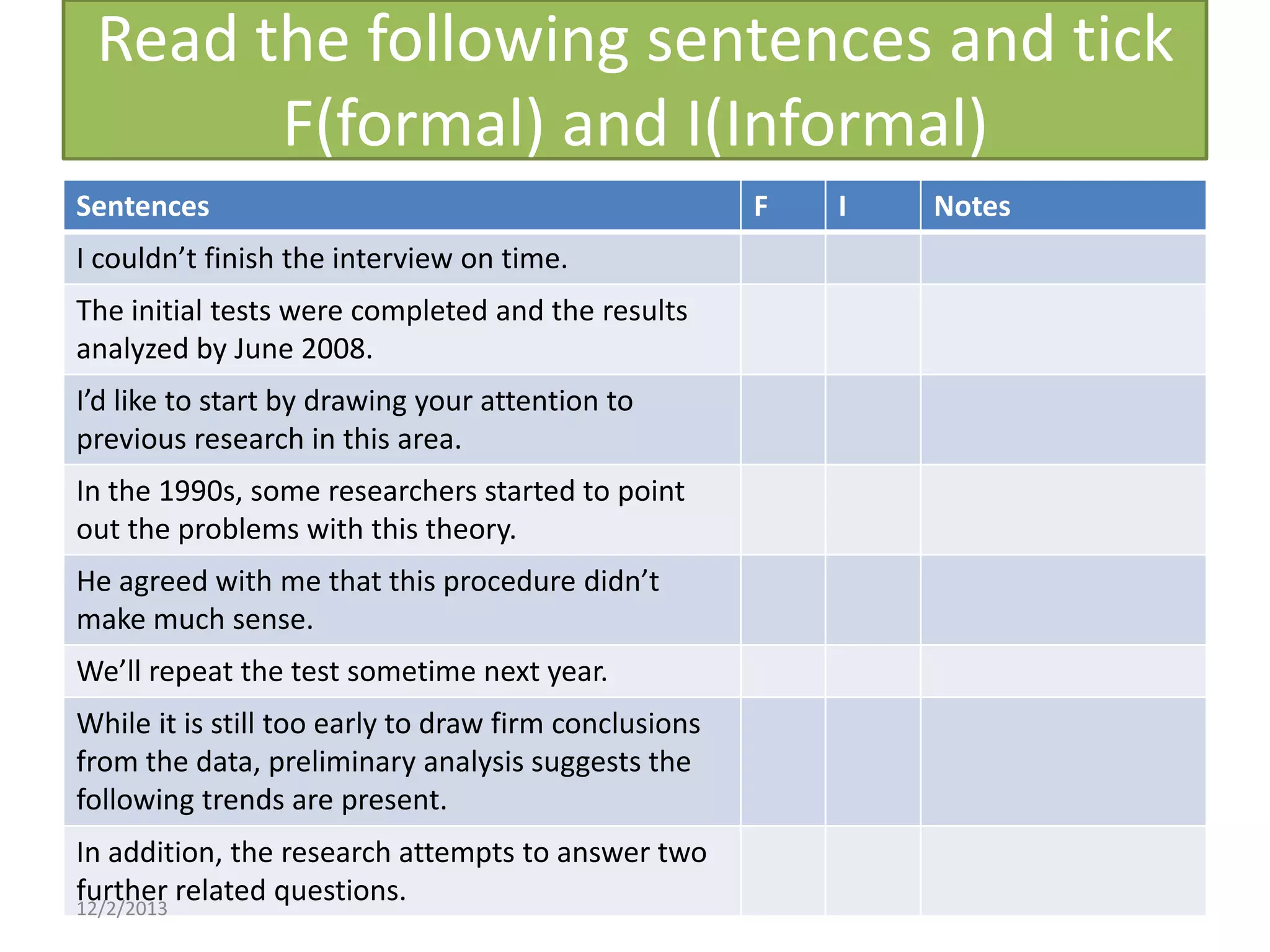
Read the following sentences and tick
F(formal) and I(Informal)
Sentences
I couldn’t finish the interview on time.
The initial tests were completed and the results
analyzed by June 2008.
I’d like to start by drawing your attention to
previous research in this area.
In the 1990s, some researchers started to point
out the problems with this theory.
He agreed with me that this procedure didn’t
make much sense.
We’ll repeat the test sometime next year.
While it is still too early to draw firm conclusions
from the data, preliminary analysis suggests the
following trends are present.
In addition, the research attempts to answer two
further related questions.
12/2/2013

F

I

Notes
The writing process:
Visualizing your text
• Before we study Grammar and Linguistic
relativity of formal writing, let us see how can
we visualize our text?
• To write texts that are technical, begin by
thinking about three key elements: audience,
purpose and material.
• Ask yourself 3 questions…

12/2/2013
Ask yourself:
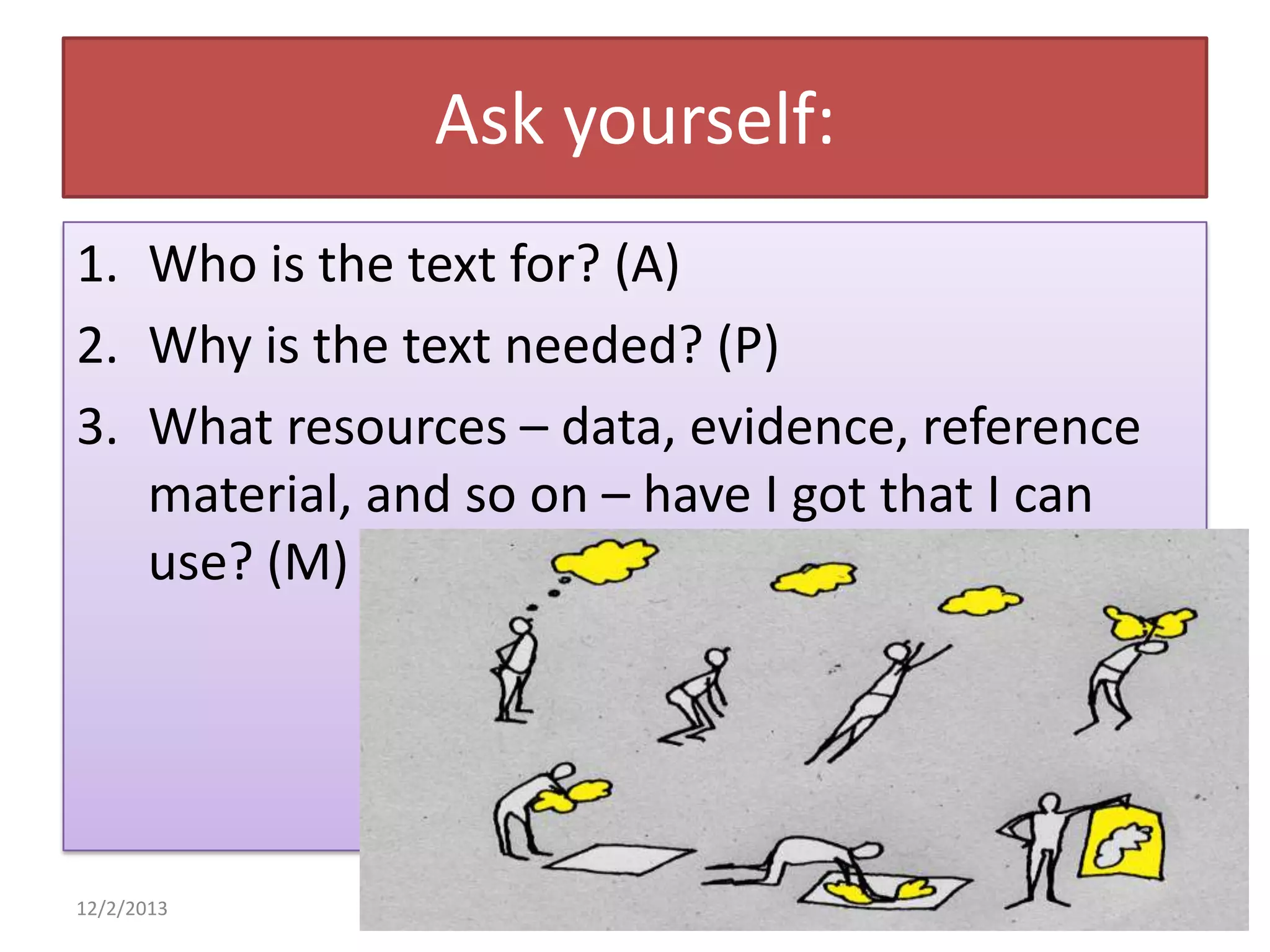
1. Who is the text for? (A)
2. Why is the text needed? (P)
3. What resources – data, evidence, reference
material, and so on – have I got that I can
use? (M)

12/2/2013
Ideas for starting technical text
• Material: make sure you have enough
material, resources, data, evidence etc
available.
• Highlight ideas, evidence and arguments.
• Purpose: is it report or argument. Going to be
used for???
• Audience: who are readers? How will they use
the text? Their depth of knowledge n reading?
12/2/2013
Use of ICT: from word processors to web tools
• Word processor, in this case MS Word, offers
some handy tools under its Tools menu which
can be applied in improving writing skill. For
examples:
• Spell checking
• Grammar checking
• Thesaurus
• Dictionary
• Synonym and antonym
12/2/2013
It is supported by research
• Kulik (2003) claimed that in three out of the four
studies that have been conducted, word
processing produced significant positive effects
on student writing skills.
• He also asserted with regular use of word
processors, young writers might even get into the
habit of revising and reorganizing their
compositions, and this habit might affect the
quality of their writing even when they were
writing with paper and pencil alone.
12/2/2013
Internet
• Blog
– Seriousness
– Published globally
– better output than pen-pencil tasks

• eGroups: Yahoo or Google
– Threaded interaction
– Dual benefit: Teacher controlled as well as peer
learning
12/2/2013
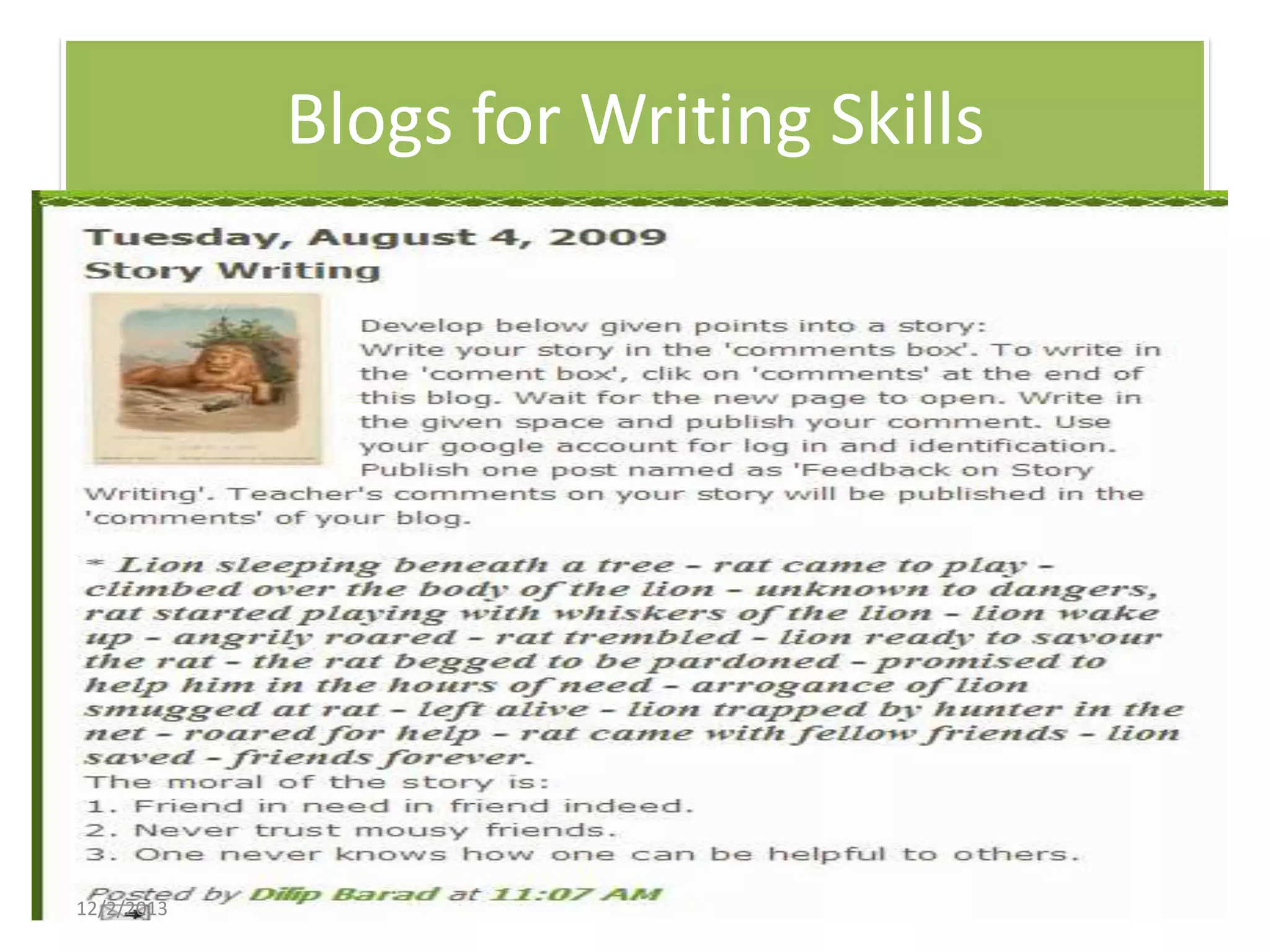
Blogs for Writing Skills

12/2/2013
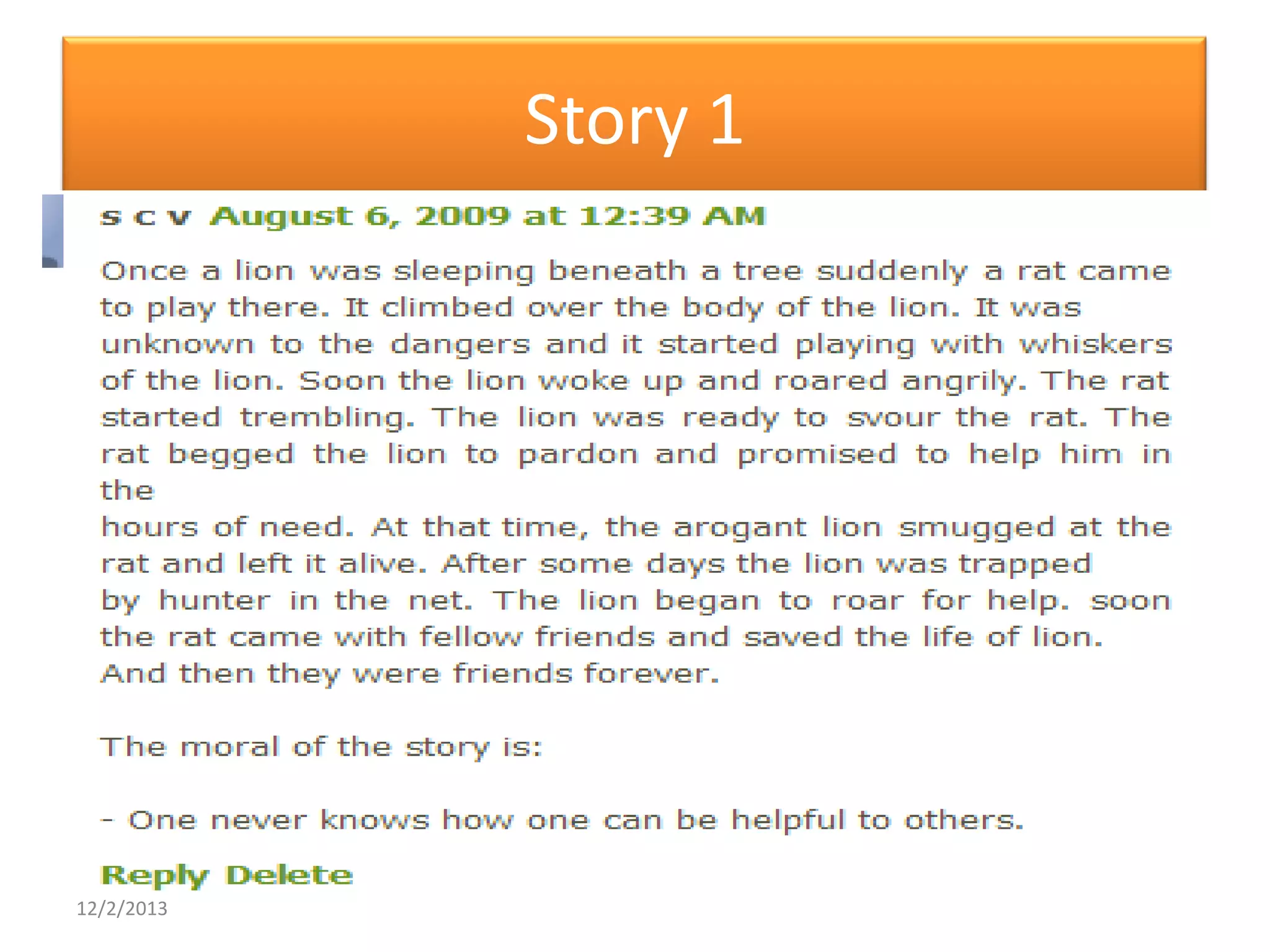
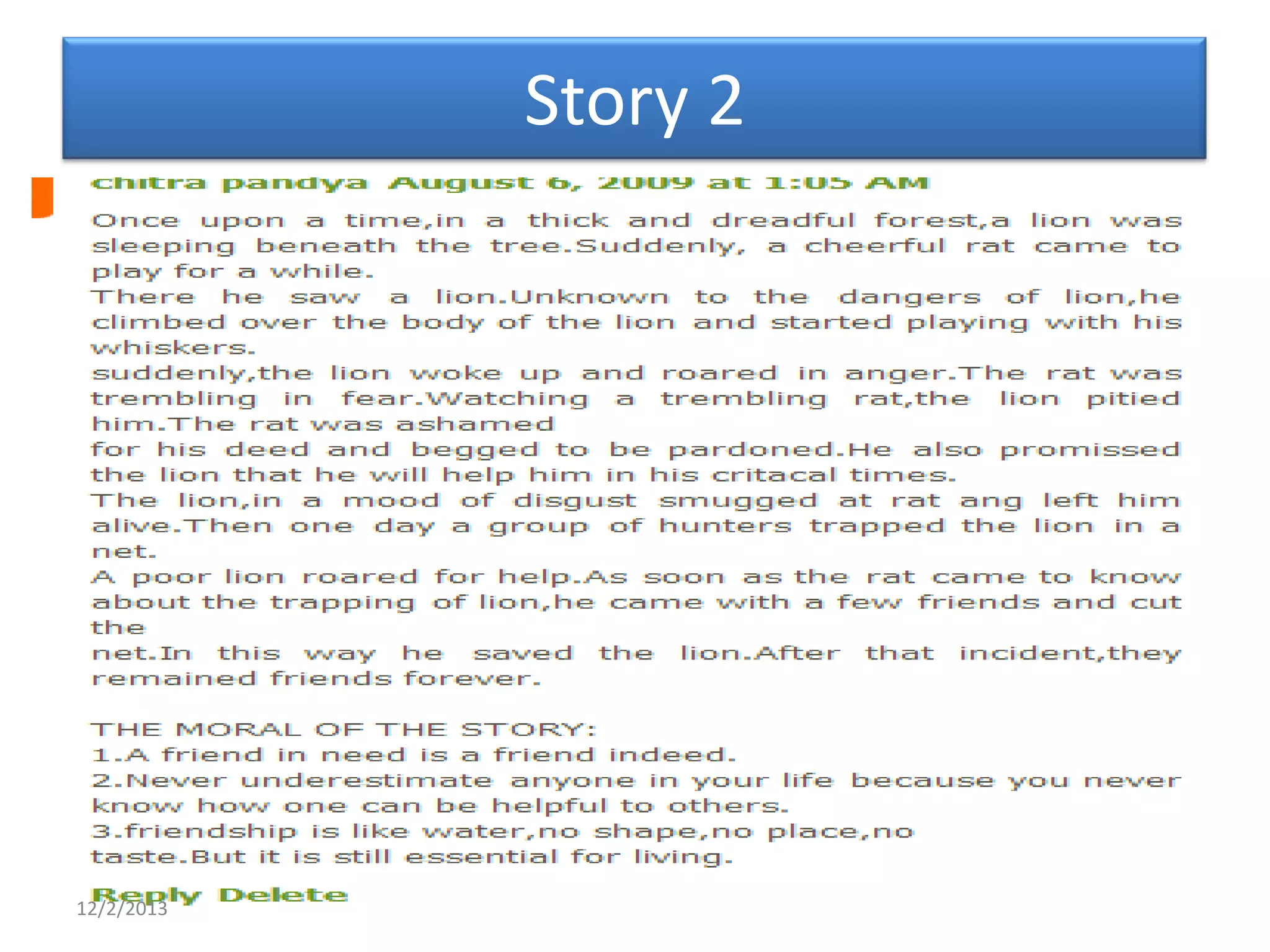
Story 1

12/2/2013
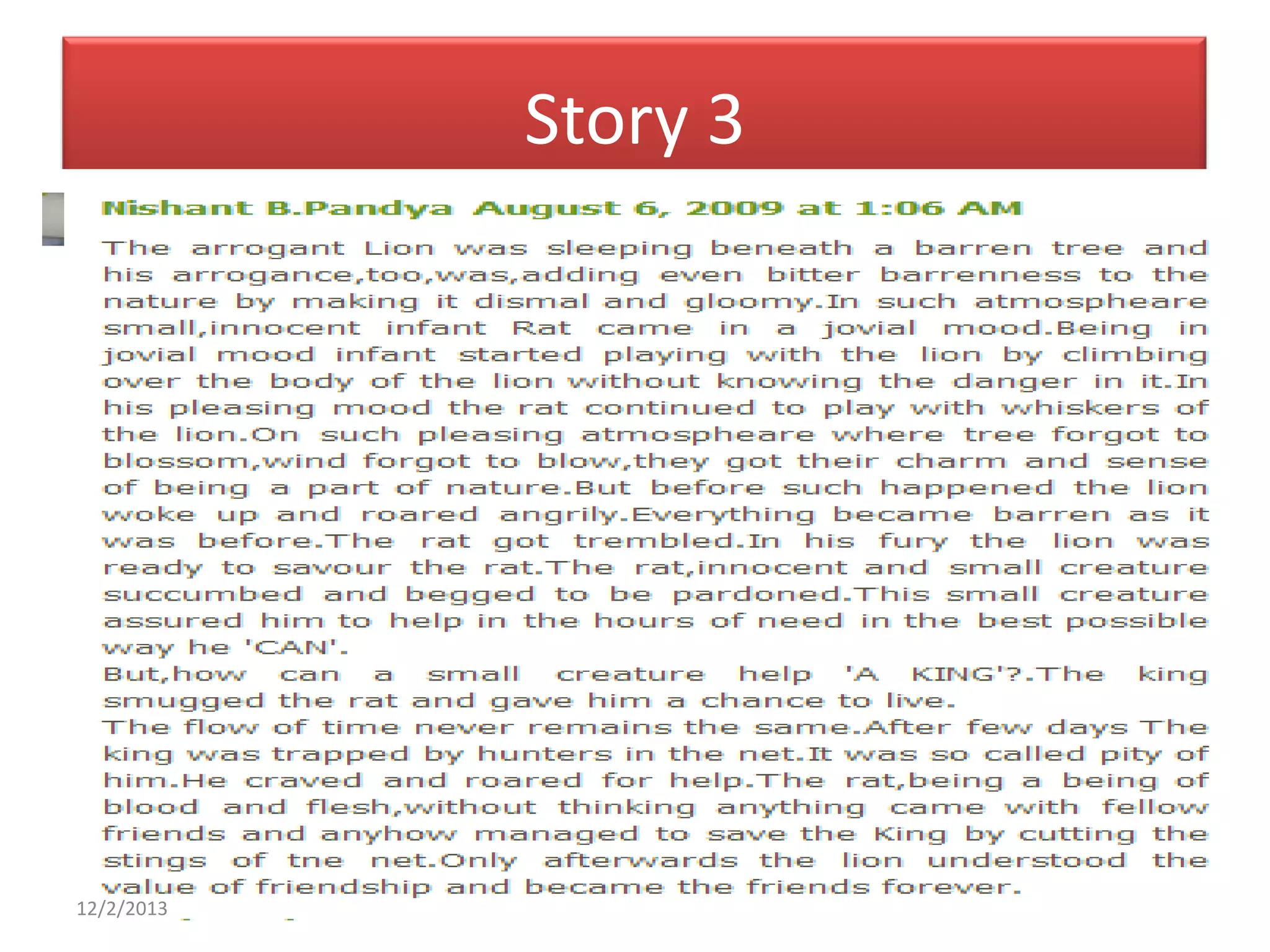
Story 2

12/2/2013
Story 3

12/2/2013
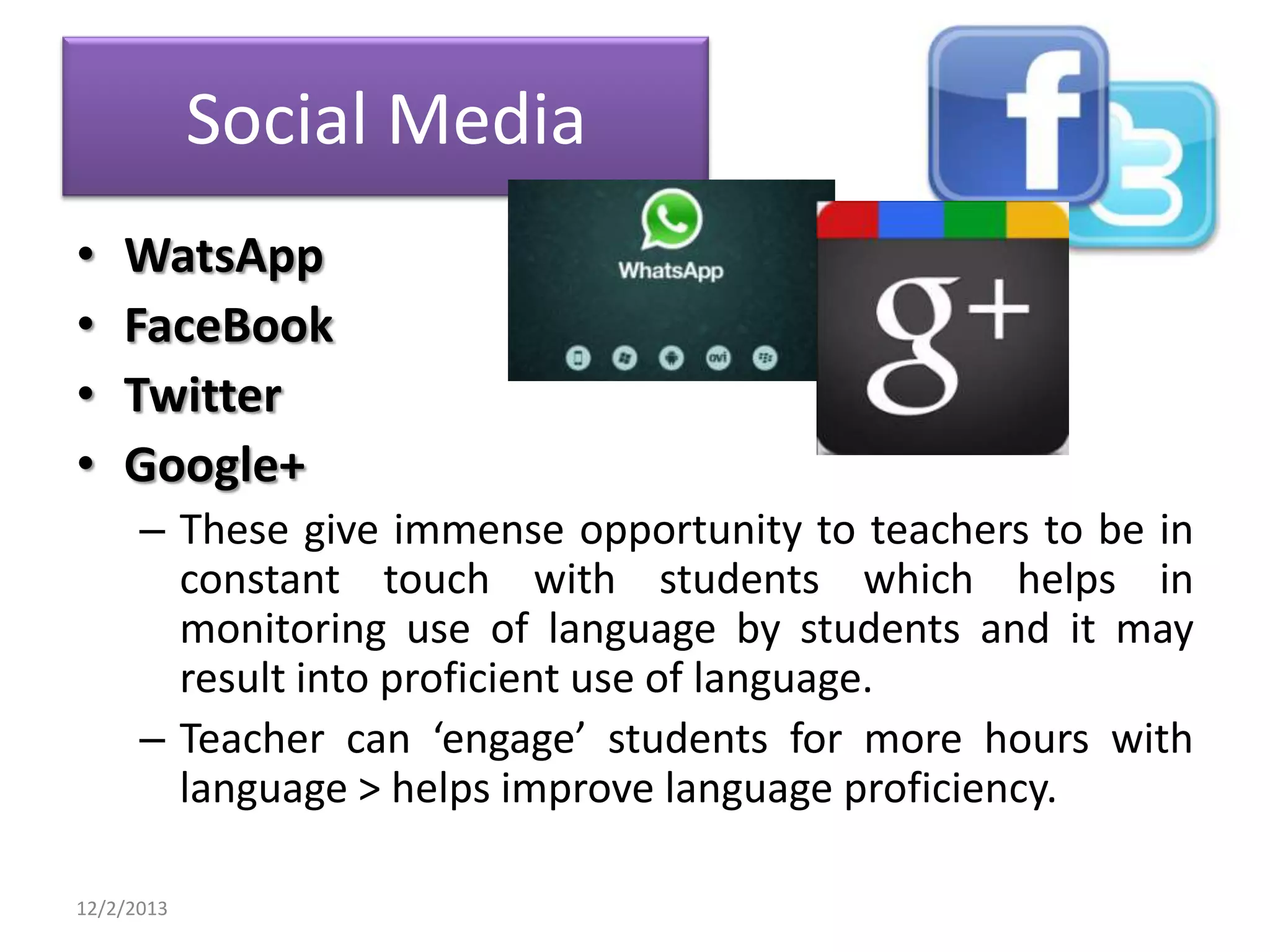
Social Media
•
•
•
•

WatsApp
FaceBook
Twitter
Google+
– These give immense opportunity to teachers to be in
constant touch with students which helps in
monitoring use of language by students and it may
result into proficient use of language.
– Teacher can ‘engage’ students for more hours with
language > helps improve language proficiency.

12/2/2013
References:
• Hampton, Roberta S. 1989a. “Community involvement in alphabet and
material development.” Notes on Literacy.Interest level: lay specialist.
• Writing skills training for engineering students > large classes >
http://www.jstor.org/discover/10.2307/3447697?uid=3738256&uid=3108
85715&uid=2134&uid=2&uid=70&uid=3&uid=60&sid=21103081617713
• http://www.nwp.org/cs/public/print/resource/241
• http://www.nwp.org/cs/public/download/nwp_file/437/How_to_Build.pd
f?x-r=pcfile_d > download article
• http://www.monash.edu.au/lls/llonline/writing/engineering/index.xml
• https://owl.english.purdue.edu/owl/section/4/19/
• http://www.ryerson.ca/feas/students/current/wst/index.html
• http://www.writing.engr.psu.edu/
• http://neeyhapuzee.wordpress.com/2011/01/30/the-use-of-computer-inimproving-writing-skills/
• http://www.youtube.com/user/OWLPurdue#p/u/0/cV6ycLsAXrQ >
vidcast on YouTube

12/2/2013
Thank You
Department of Communication Skills

Rajkot (Gujarat – India)
www.dilipbarad.com
12/2/2013
12/2/2013

Teaching Writing Skills to Engineering Students: Panel Discussion via Google Hangout

  • 1.
    Teaching Writing Skills toEngineering Students Dilip Barad Panel Discussion via Google Hangout 30 Nov 2013, Saturday 12/2/2013
  • 2.
    The Scaffold • Writingskills: – Is it difficult? Why? What makes it so difficult? • Why English to Engineers? – "Engineers don't need to know how to write. Why are you making us do this?" • Should English be taught by subject teachers rather than English specialist? – An article by Christine Robinson and Gerard Blair • The Writing Process: English for Engineers: – Help of ‘Study Academic Writing’ - CUP • Use of ICT – from word processors to web tools 12/2/2013
  • 3.
    Writing skills: Is itdifficult? Why? What makes it so difficult? • Writing is one of the four basic skills in learning language. Compared to the others, writing is considered to be the most complex and difficult skill to master. • This difficulty, according to Richards and Renandya (2002: 303),”lies not only in generating and organizing of ideas but also in translating these ideas into readable texts”. 12/2/2013
  • 4.
    Writing skills: Is itdifficult? Why? What makes it so difficult? • Oshima and Hogue (1991) also asserted that good writing in English requires good grammar and good organization. Moreover, Tangermpoon (2008:1) emphasizes writing is the most difficult because “it requires writers to have a great deal of lexical and syntactic knowledge as well as principle of organization in L2 to produce good writing.” • It further indicates that writing is not an easy work to do and potentially creates many problems; therefore it may induce anxiety and frustration for many people especially English as a Second Language (ESL) learners. (…) 12/2/2013
  • 5.
    Why English toEngineers? Why language proficiency to Engineers? • In engineering, the transition from idea to product requires that the engineer produce clear proposals demonstrating the idea's practicality and economic feasibility. • Writing is a key element in this process. 12/2/2013
  • 6.
    Should English betaught by subject teachers rather than English specialist? • This leads us to the question of ‘who is the English specialist?’ • Masters of Arts with English, are they specialist to do this job? • Are the recent recruits to teach English to Engineering students capable to teach? • Are they good enough to be called ‘English specialist’? 12/2/2013
  • 7.
    In an article‘Writing skills training for Engineering students in large classes’ by Christine Robinson and Gerard Blair 12/2/2013
  • 8.
    English Writing processes •The aim of teacher is to: 1. Introducing the idea that writing is a set of processes. 2. Showing how to distinguish between formal and personal styles of writing. 3. Looking at the grammar of formal discourse. 4. Practicing visualizing text as a pre-writing step. 12/2/2013
  • 9.
    Thinking about writingprocesses: 1. When you write an important text, do you make more than one draft? 2. If option is given, do you prefer to write on paper or use a computer? Have you ever asked yourself why? 3. What do you do before you start writing? 4. How do you start writing? Do you begin at ‘the beginning’ or jump in wherever you have some ideas? Do you think one approach is better than another? 12/2/2013
  • 10.
    Thinking about writingprocesses: 5. What do you do while you are writing? Do you stop and think? Do you ever go back to the beginning and start again? 6. When you finish your first complete draft, what do you do next? 12/2/2013
  • 11.
    Recognizing technical writing •Read: – Linguists were and remain convinced by Noam Chomsky of the Massachusetts Institute of Technology, who discovered that however disparate human languages seem, all share a common, basic structure, seemingly hardwired into the brain. * Identify three features of this sentence that you think are technical or formal. 12/2/2013
  • 12.
    • Read – Theway you speak says a lot about you. • Identify three features of this sentence that seem non-technical to you. • Discuss with your partner…. • Let us see the answers … 12/2/2013
  • 13.
    Features of formal/technicaland informal/personal writings • In first sentence: – Complex sentence > which can be simplified to make it suitable for our purpose – Serious subject – Reference to technical, ‘linguists’ and ‘Noam Chomsky of …’ – Use of passive voice ‘Linguists were and remain convinced by N.Chomsky …’ – Shows truth status of statement, ‘seemingly hardwired into the brain’. 12/2/2013
  • 14.
    • In secondsentence: – Vague vocabulary, such as ‘way’, ‘say’ and ‘a lot’ – lack of precision. – Directly addressing the reader, ‘you’ – conversational style – Simple sentence structure. 12/2/2013
  • 15.
    Formal After distinguishing some features of writing,let us now recognize levels of formality 12/2/2013 Reader Engineers Family & friends Content Serious thought conversational Style Complex sentences showing considerable variety in construction Mostly simple and compound sentences joined by conjunctions such as and or but Organization Clear and well planned Less likely to be as clear and as organized Grammar Likely to be error free May not always use complete sentences Vocabulary Levels of formality in writing Informal Technical and academic language used accurately Use of short forms, idioms and slang
  • 16.
    Read the followingsentences and tick F(formal) and I(Informal) Sentences I couldn’t finish the interview on time. The initial tests were completed and the results analyzed by June 2008. I’d like to start by drawing your attention to previous research in this area. In the 1990s, some researchers started to point out the problems with this theory. He agreed with me that this procedure didn’t make much sense. We’ll repeat the test sometime next year. While it is still too early to draw firm conclusions from the data, preliminary analysis suggests the following trends are present. In addition, the research attempts to answer two further related questions. 12/2/2013 F I Notes
  • 17.
    The writing process: Visualizingyour text • Before we study Grammar and Linguistic relativity of formal writing, let us see how can we visualize our text? • To write texts that are technical, begin by thinking about three key elements: audience, purpose and material. • Ask yourself 3 questions… 12/2/2013
  • 18.
    Ask yourself: 1. Whois the text for? (A) 2. Why is the text needed? (P) 3. What resources – data, evidence, reference material, and so on – have I got that I can use? (M) 12/2/2013
  • 19.
    Ideas for startingtechnical text • Material: make sure you have enough material, resources, data, evidence etc available. • Highlight ideas, evidence and arguments. • Purpose: is it report or argument. Going to be used for??? • Audience: who are readers? How will they use the text? Their depth of knowledge n reading? 12/2/2013
  • 20.
    Use of ICT:from word processors to web tools • Word processor, in this case MS Word, offers some handy tools under its Tools menu which can be applied in improving writing skill. For examples: • Spell checking • Grammar checking • Thesaurus • Dictionary • Synonym and antonym 12/2/2013
  • 21.
    It is supportedby research • Kulik (2003) claimed that in three out of the four studies that have been conducted, word processing produced significant positive effects on student writing skills. • He also asserted with regular use of word processors, young writers might even get into the habit of revising and reorganizing their compositions, and this habit might affect the quality of their writing even when they were writing with paper and pencil alone. 12/2/2013
  • 22.
    Internet • Blog – Seriousness –Published globally – better output than pen-pencil tasks • eGroups: Yahoo or Google – Threaded interaction – Dual benefit: Teacher controlled as well as peer learning 12/2/2013
  • 23.
    Blogs for WritingSkills 12/2/2013
  • 24.
  • 25.
  • 26.
  • 27.
    Social Media • • • • WatsApp FaceBook Twitter Google+ – Thesegive immense opportunity to teachers to be in constant touch with students which helps in monitoring use of language by students and it may result into proficient use of language. – Teacher can ‘engage’ students for more hours with language > helps improve language proficiency. 12/2/2013
  • 28.
    References: • Hampton, RobertaS. 1989a. “Community involvement in alphabet and material development.” Notes on Literacy.Interest level: lay specialist. • Writing skills training for engineering students > large classes > http://www.jstor.org/discover/10.2307/3447697?uid=3738256&uid=3108 85715&uid=2134&uid=2&uid=70&uid=3&uid=60&sid=21103081617713 • http://www.nwp.org/cs/public/print/resource/241 • http://www.nwp.org/cs/public/download/nwp_file/437/How_to_Build.pd f?x-r=pcfile_d > download article • http://www.monash.edu.au/lls/llonline/writing/engineering/index.xml • https://owl.english.purdue.edu/owl/section/4/19/ • http://www.ryerson.ca/feas/students/current/wst/index.html • http://www.writing.engr.psu.edu/ • http://neeyhapuzee.wordpress.com/2011/01/30/the-use-of-computer-inimproving-writing-skills/ • http://www.youtube.com/user/OWLPurdue#p/u/0/cV6ycLsAXrQ > vidcast on YouTube 12/2/2013
  • 29.
    Thank You Department ofCommunication Skills Rajkot (Gujarat – India) www.dilipbarad.com 12/2/2013
  • 30.

Editor's Notes

  • #8 http://www.jstor.org/discover/10.2307/3447697?uid=3738256&uid=310885715&uid=2&uid=3&uid=60&sid=21103082275313
  • #22 Kulik, James A. 1994. “Meta-Analytic Studies of Findings on Computer-Based Instruction.” In Baker, Eva L. and O’Neil, Harold F., Jr., eds., Technology Assessment in Education and Training, pp. 9–33. Hillsdale, NJ: Lawrence Erlbaum Associates.