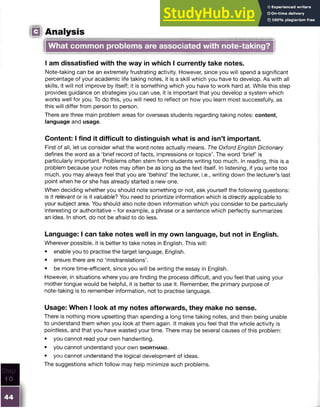
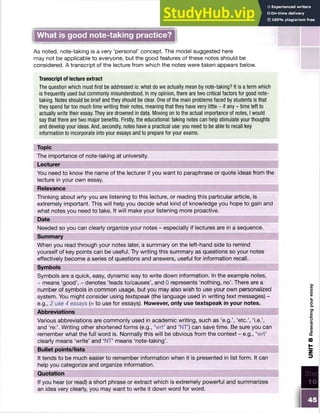
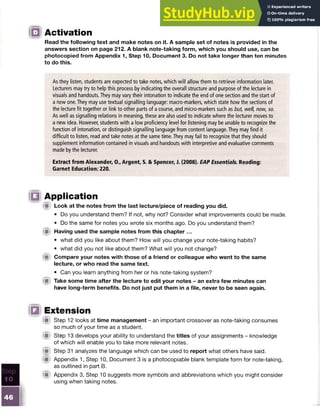
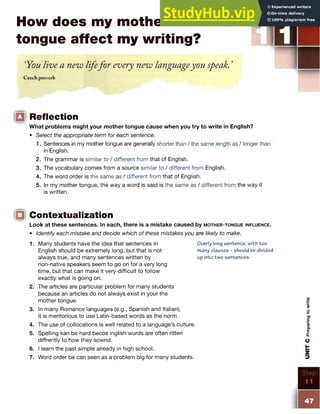
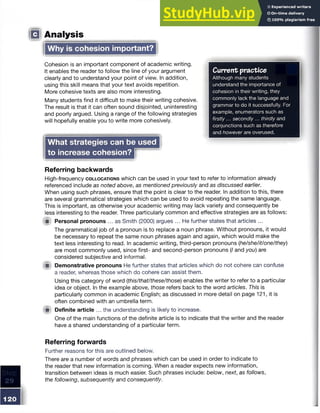
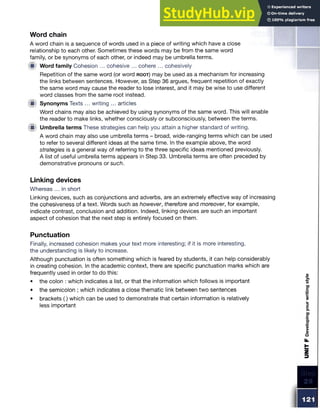
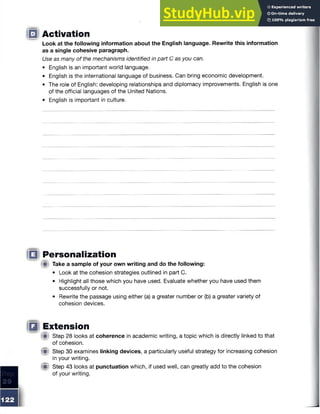
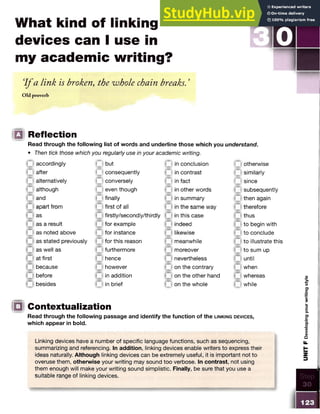
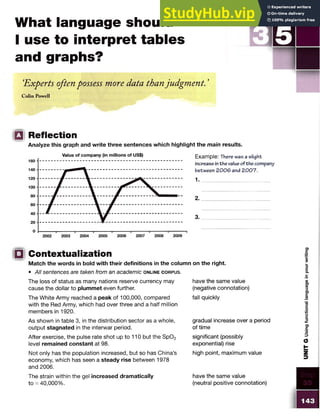
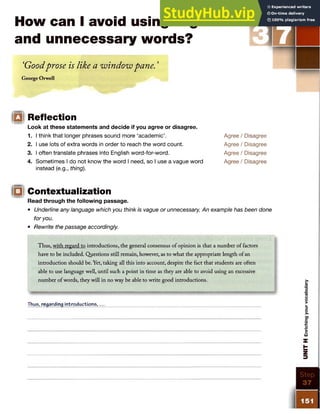
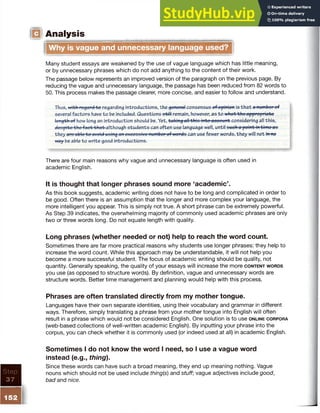
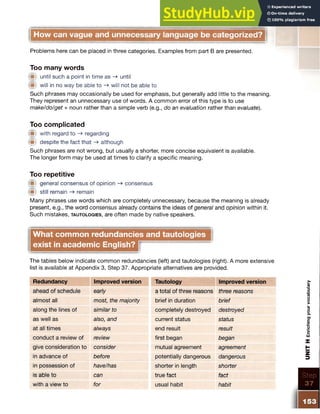
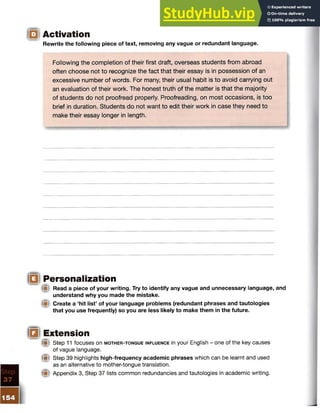
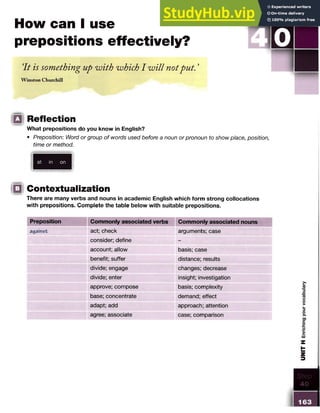
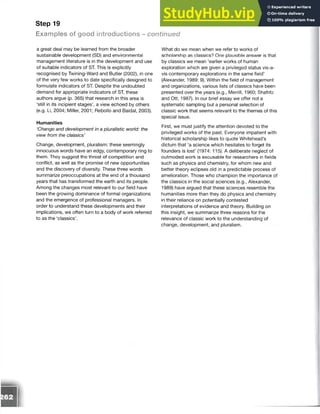
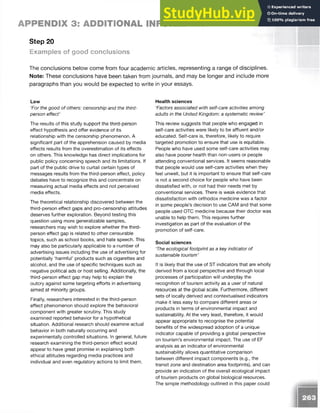
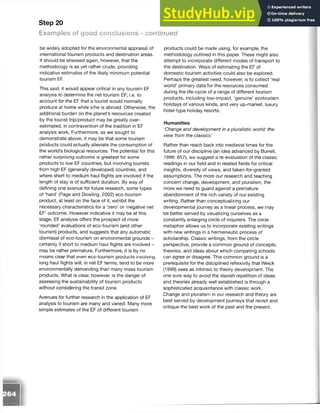
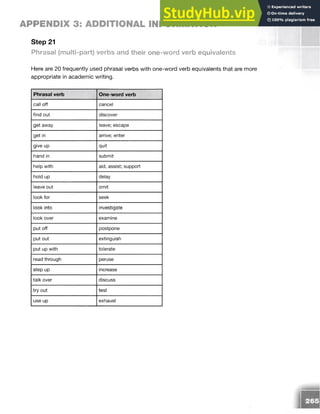
Chris Sowton a r n e t
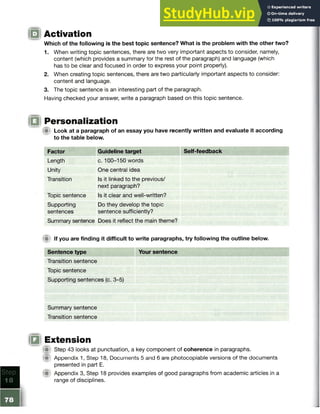
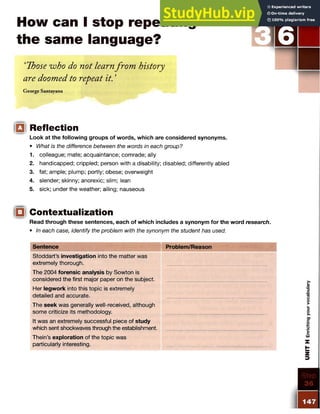
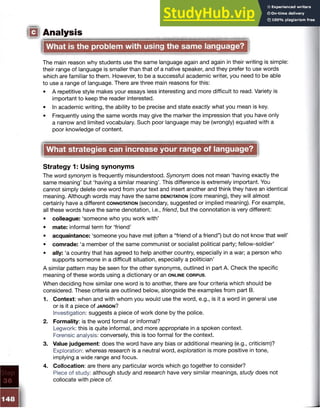
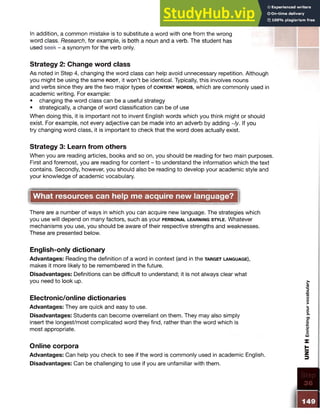
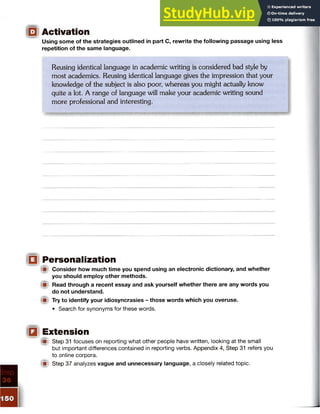
E D U C A T I O N
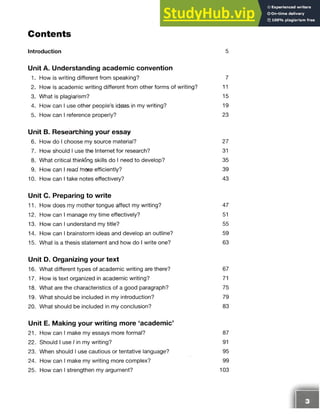
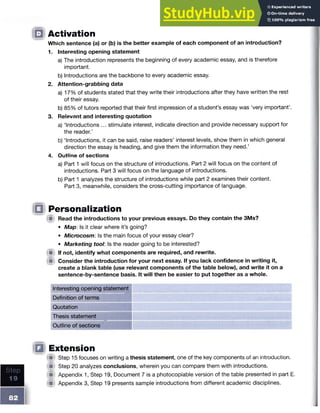
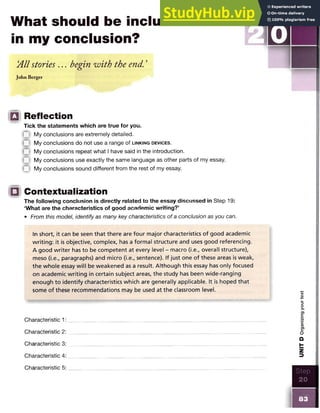
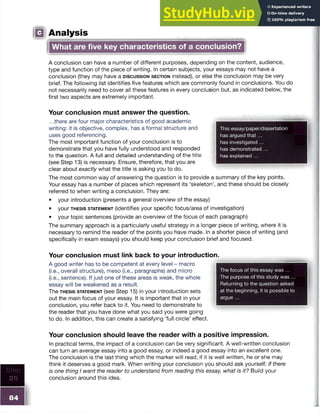
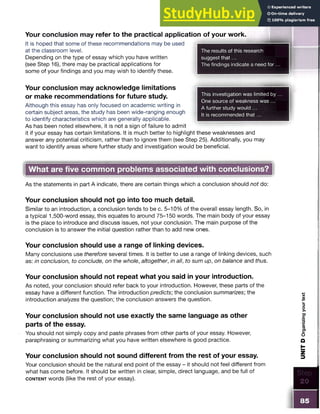
Contents
Introduction 5
Unit A. Understanding academic convention
1. How is writing different from speaking? 7
2. How is academic writing different from other forms of writing? 11
3. What is plagiarism? 15
4. How can I use other people’s ideas in my writing? 19
5. How can I reference properly? 23
Unit B. Researching your essay
6. How do I choose my source material? 27
7. How should I use the Internet for research? 31
8. What critical thinking skills do I need to develop? 35
9. How can I read mote efficiently? 39
10. How can I take notes effectively? 43
Unit C. Preparing to write
11. How does my mother tongue affect my writing? 47
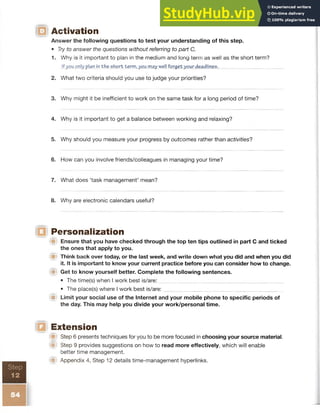
12. How can I manage my time effectively? 51
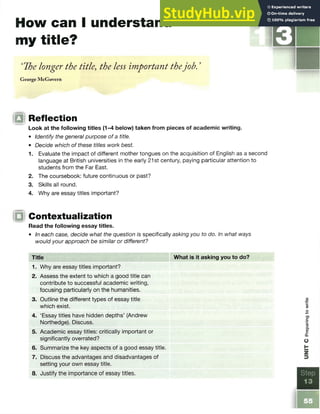
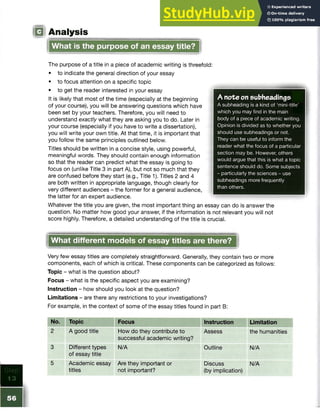
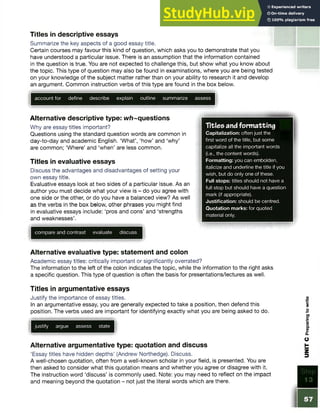
13. How can I understand my title? 55
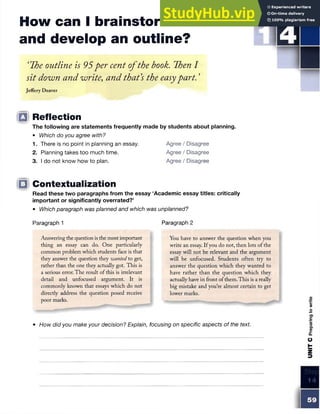
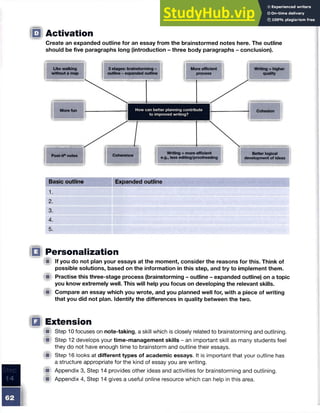
14. How can I brainstorm ideas and develop an outline? 59
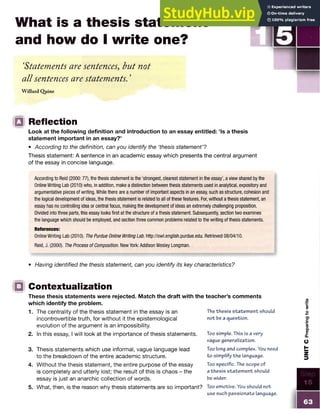
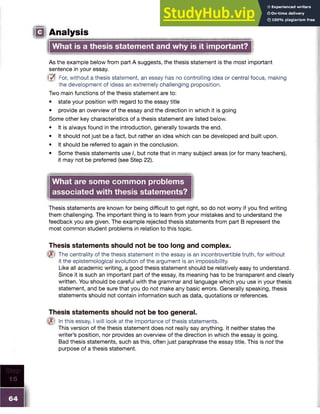
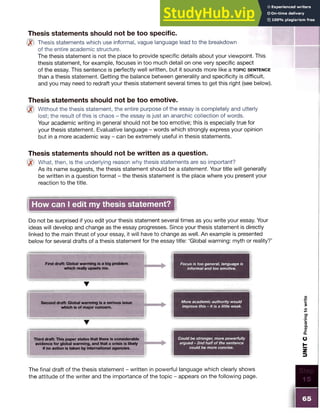
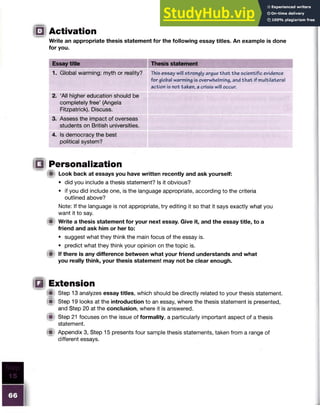
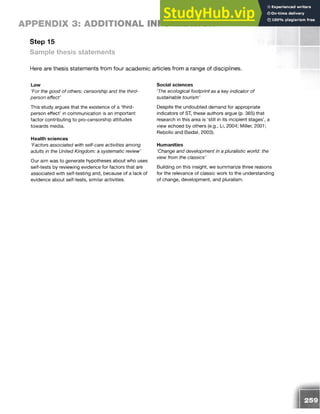
15. What is a thesis statement and how do I write one? 63
Unit D. Organizing your text
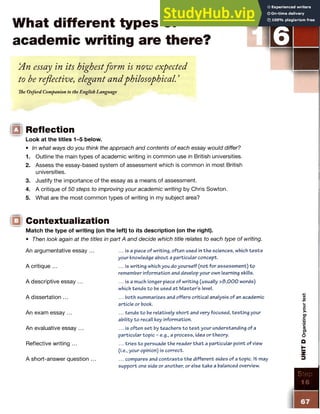
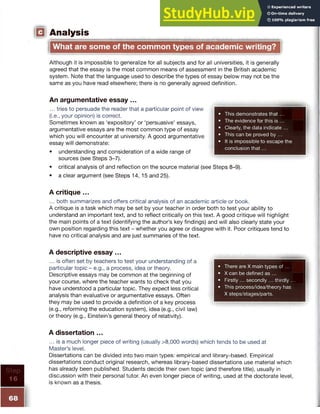
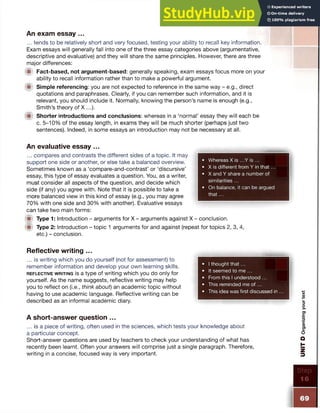
16. What different types of academic writing are there? 67
17. How is text organized in academic writing? 71
18. What are the characteristics of a good paragraph? 75
19. What should be included in my introduction? 79
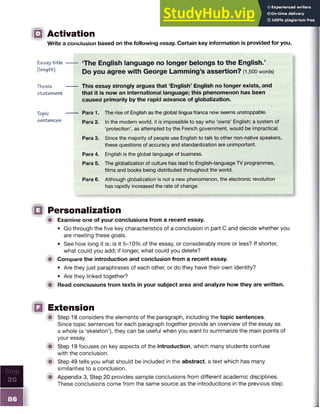
20. What should be included in my conclusion? 83
Unit E. Making your writing more ‘academic’
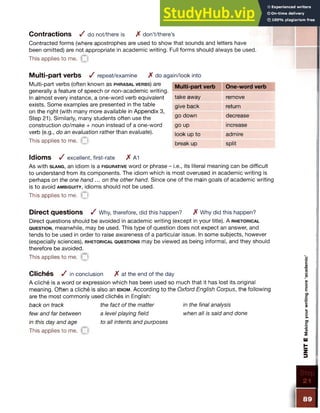
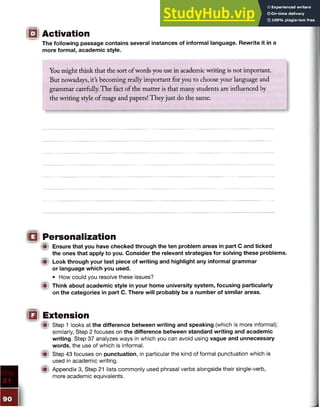
21. How can I make my essays more formal? 87
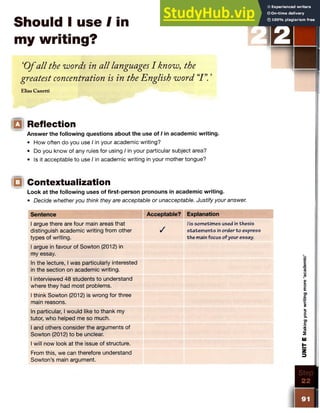
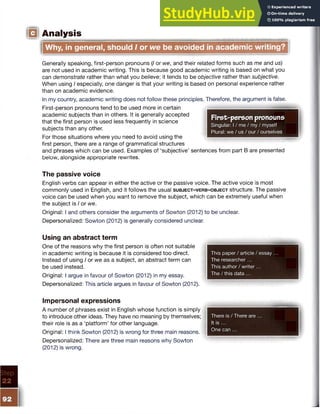
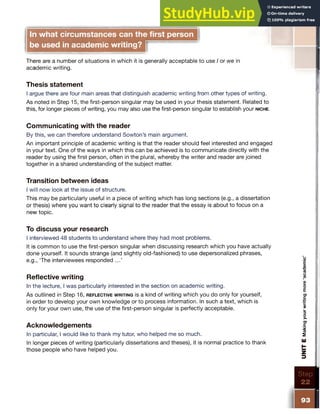
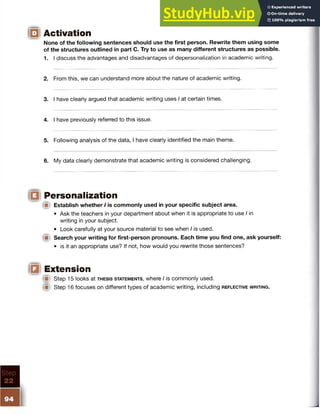
22. Should I use I in my writing? 91
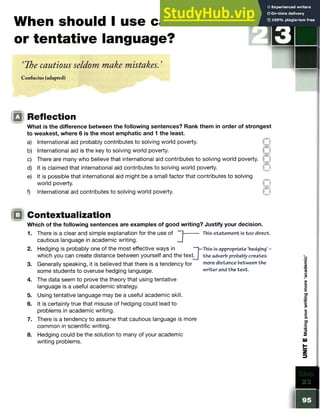
23. When should I use cautious or tentative language? 95
24. How can I make my writing more complex? 99
25. How can I strengthen my argument? 103
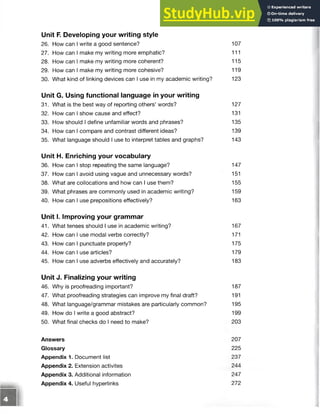
Unit F
. Developing your writing style
26. How can I write a good sentence? 107
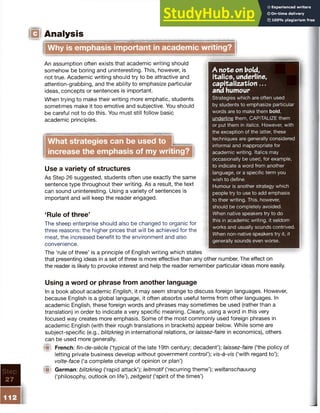
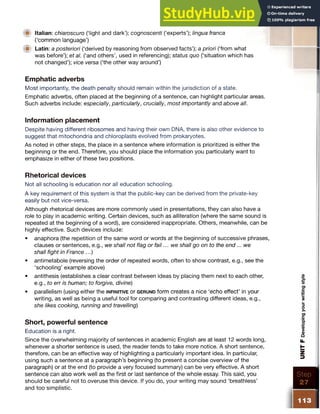
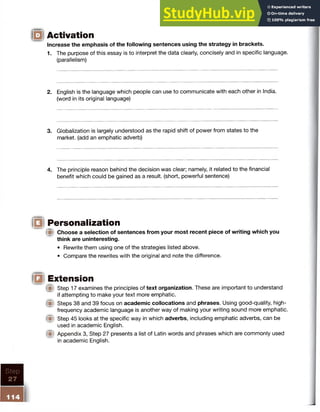
27. How can I make my writing more emphatic? 111
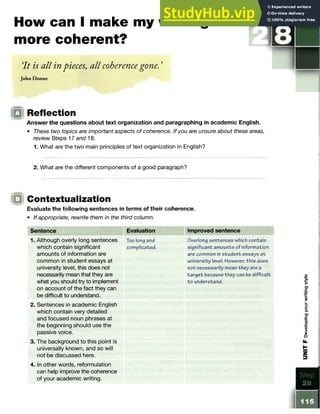
28. How can I make my writing more coherent? 115
29. How can I make my writing more cohesive? 119
30. What kind of linking devices can I use in my academic writing? 123
Unit G. Using functional language in your writing
31. What is the best way of reporting others’ words? 127
32. How can I show cause and effect? 131
33. How should I define unfamiliar words and phrases? 135
34. How can I compare and contrast different ideas? 139
35. What language should I use to interpret tables and graphs? 143
Unit H. Enriching your vocabulary
36. How can I stop repeating the same language? 147
37. How can I avoid using vague and unnecessary words? 151
38. What are collocations and how can I use them? 155
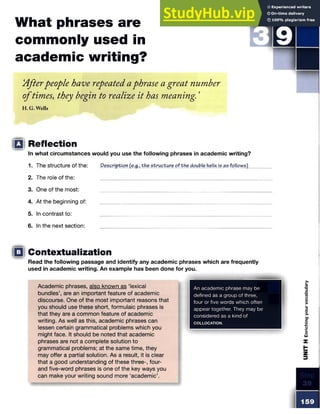
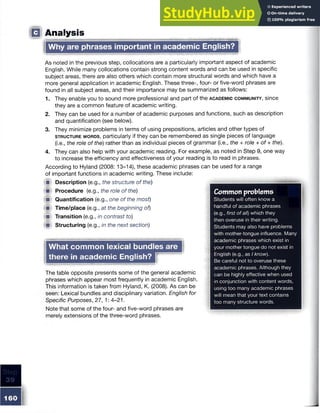
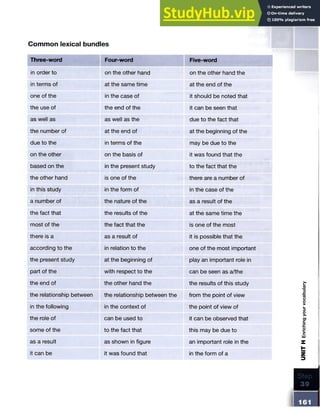
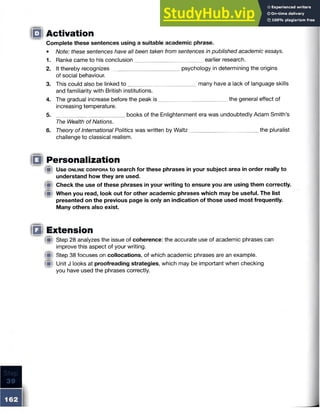
39. What phrases are commonly used in academic writing? 159
40. How can I use prepositions effectively? 163
Unit I. Improving your grammar
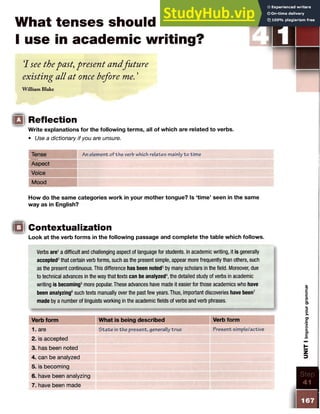
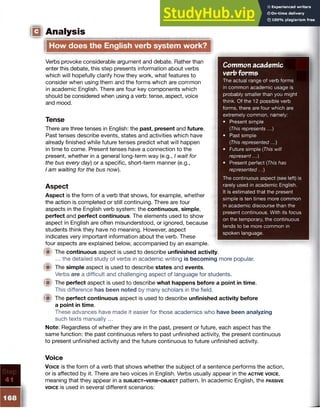
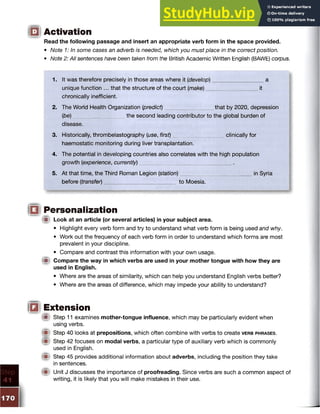
41. What tenses should I use in academic writing? 167
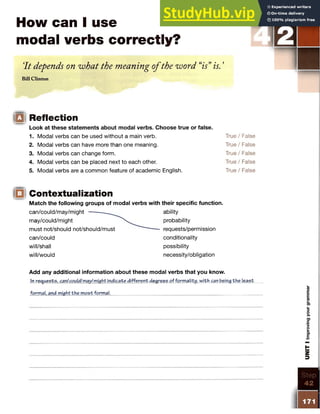
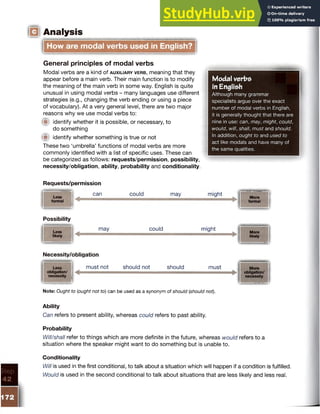
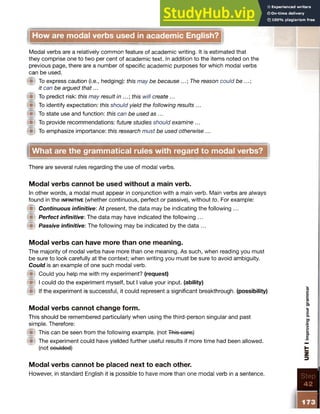
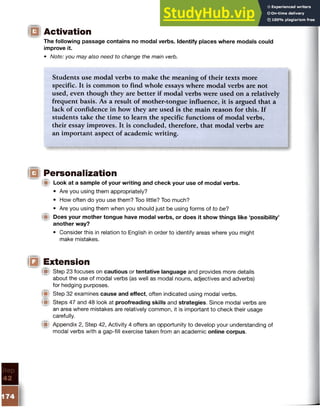
42. How can I use modal verbs correctly? 171
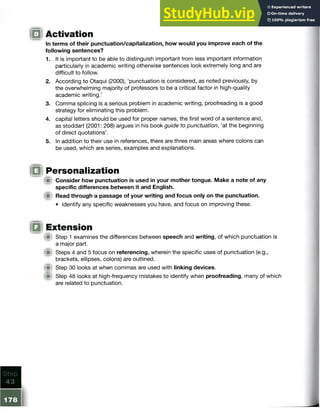
43. How can I punctuate properly? 175
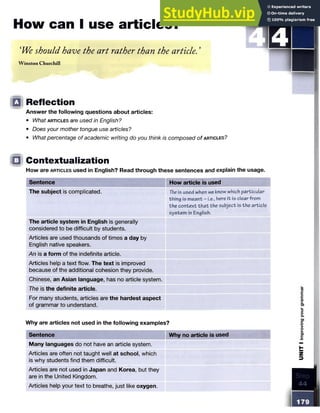
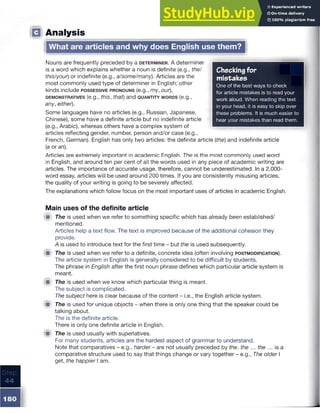
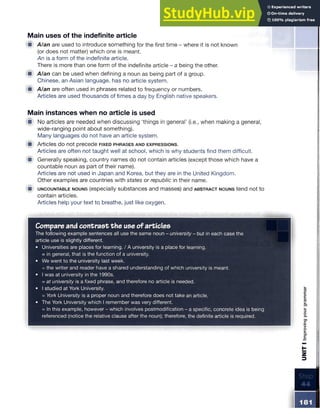
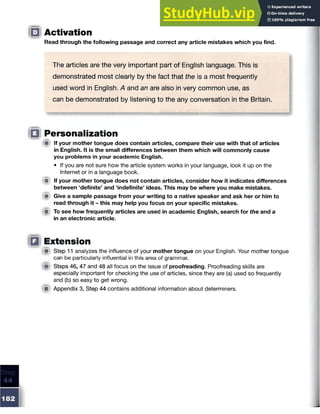
44. How can I use articles? 179
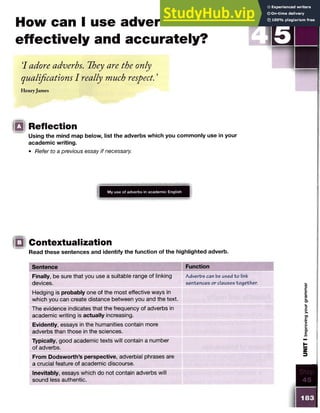
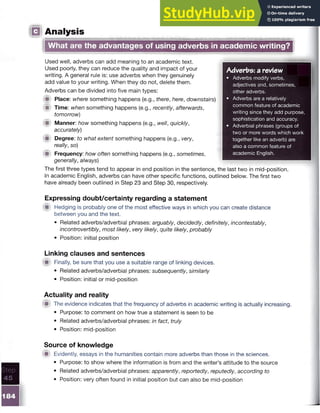
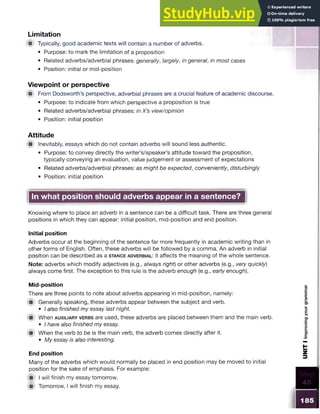
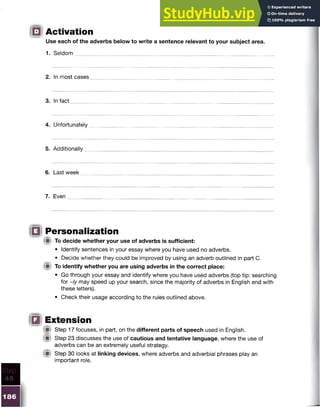
45. How can I use adverbs effectively and accurately? 183
Unit J. Finalizing your writing
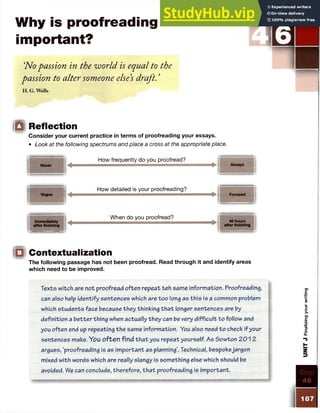
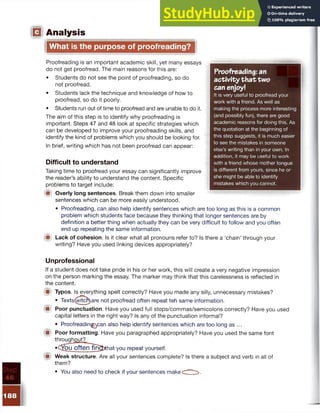
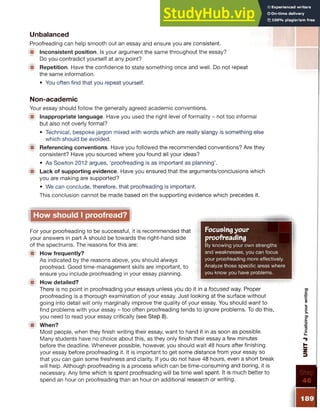
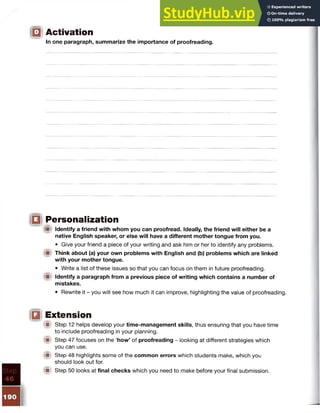
46. Why is proofreading important? 187
47. What proofreading strategies can improve my final draft? 191
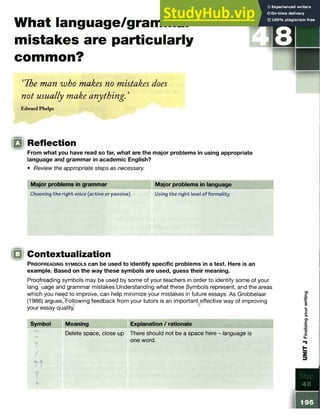
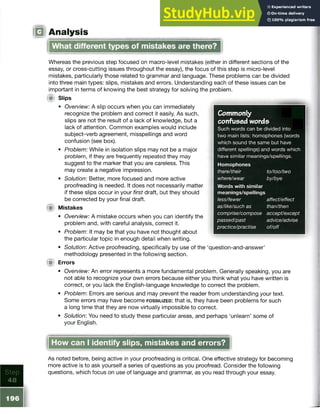
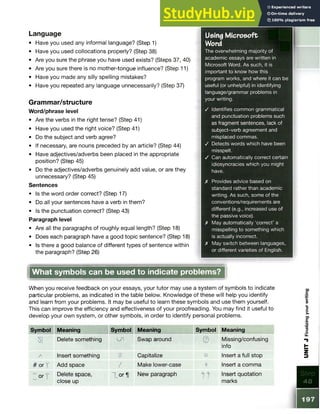
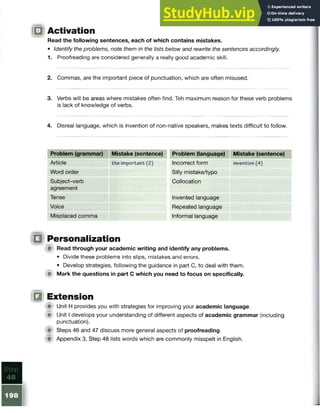
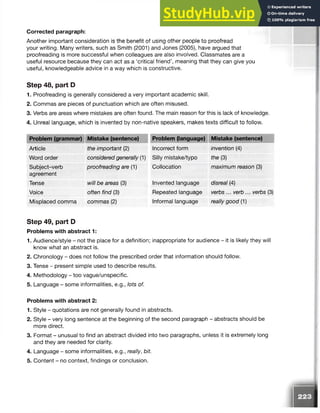
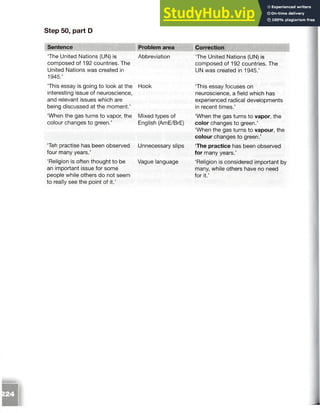
48. What language/grammar mistakes are particularly common? 195
49. How do I write a good abstract? 199
50. What final checks do I need to make? 203
Answers 207
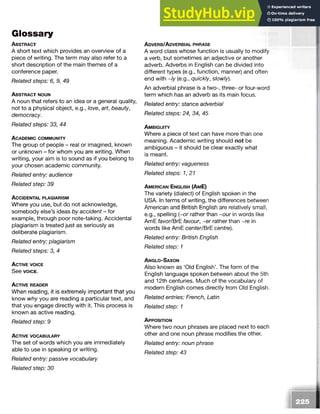
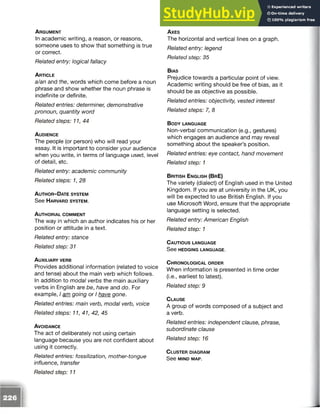
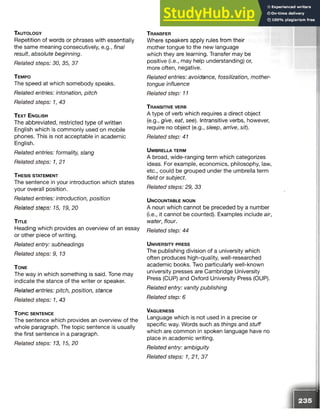
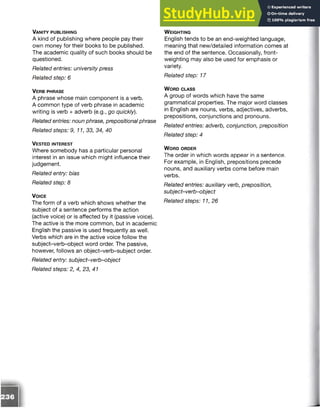
Glossary 225
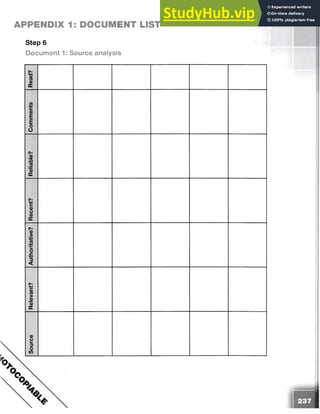
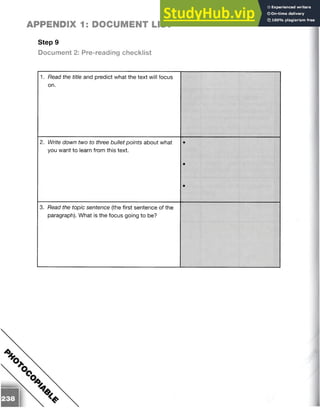
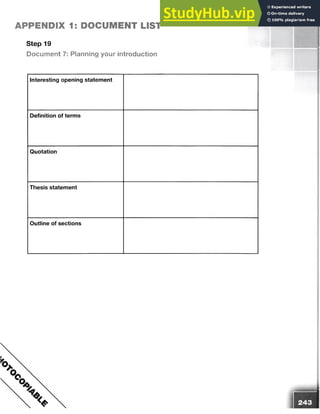
Appendix 1. Document list 237
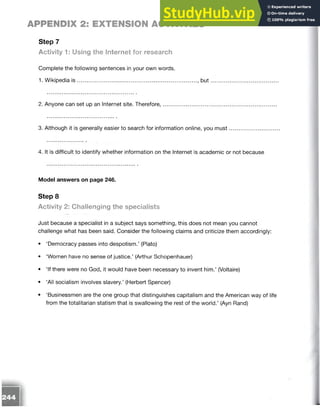
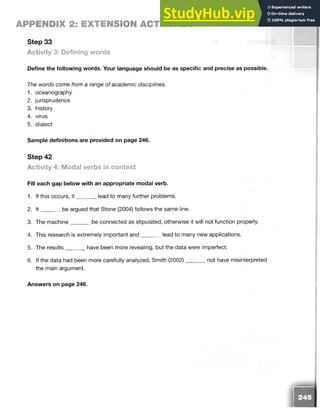
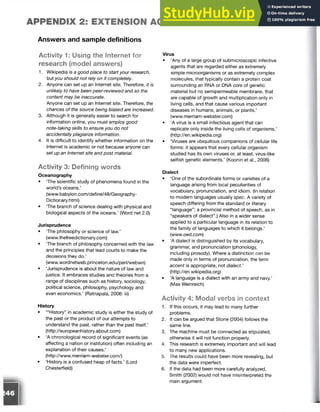
Appendix 2. Extension activites 244
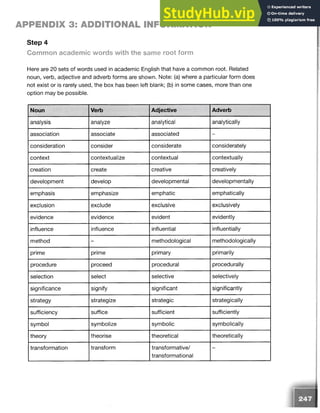
Appendix 3. Additional information 247
Appendix 4. Useful hyperlinks 272
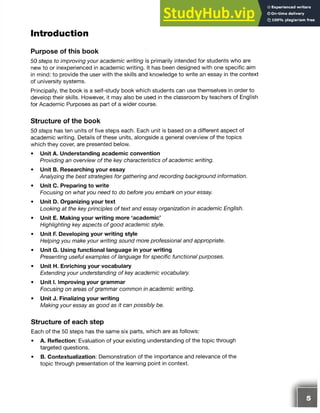
Introduction
Purpose of this book
50 steps to improving your academic writing is primarily intended for students who are
new to or inexperienced in academic writing. It has been designed with one specific aim
in mind: to provide the user with the skills and knowledge to write an essay in the context
of university systems.
Principally, the book is a self-study book which students can use themselves in order to
develop their skills. However, it may also be used in the classroom by teachers of English
for Academic Purposes as part of a wider course.
Structure of the book
50 steps has ten units of five steps each. Each unit is based on a different aspect of
academic writing. Details of these units, alongside a general overview of the topics
which they cover, are presented below.
• Unit A. Understanding academic convention
Providing an overview of the key characteristics of academic writing.
• Unit B. Researching your essay
Analyzing the best strategies for gathering and recording background information.
• Unit C. Preparing to write
Focusing on what you need to do before you embark on your essay.
• Unit D. Organizing your text
Looking at the key principles of text and essay organization in academic English.
• Unit E. Making your writing more ‘academic’
Highlighting key aspects of good academic style.
• Unit F. Developing your writing style
Helping you make your writing sound more professional and appropriate.
• Unit G. Using functional language in your writing
Presenting useful examples of language for specific functional purposes.
• Unit H. Enriching your vocabulary
Extending your understanding of key academic vocabulary.
• Unit I. Improving your grammar
Focusing on areas of grammar common in academic writing.
• Unit J. Finalizing your writing
Making your essay as good as it can possibly be.
Structure of each step
Each of the 50 steps has the same six parts, which are as follows:
• A. Reflection: Evaluation of your existing understanding of the topic through
targeted questions.
• B. Contextualization: Demonstration of the importance and relevance of the
topic through presentation of the learning point in context.
• C. Analysis: Explanation of the topic, delivered by answering the specific questions
posed in part B.
• D. Activation: Application of what you have learnt through a range of test activities.
• E. Personalization: Provision of practical strategies which can be used to apply what
you have learnt to your own academic writing.
• F. Extension: Indication of other steps in the book which may provide additional
support. This also refers to the resource materials to be found at the back of the book.
The answer key to the questions posed in part D, Activation, can be found on pages
207-224. In addition, on pages 225-236 you will find a glossary, which will help explain
key words and terms useful for academic writing. The resource materials on pages
237-272 include photocopiable documents, a range of additional information, extension
activities and useful hyperlinks.
How to use this book
Each of the steps should take you approximately one hour to complete. Evidently, exactly
how long you spend will depend on the precise details of the step and your existing level
of knowledge.
The structure of the book means that you can decide how best to use it. If you are already
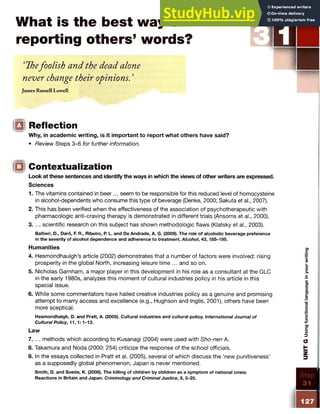
aware of your areas of weakness in academic writing, and feel you only need support in
certain key areas, then you should focus on those particular steps. If, however, you feel
you need more support, it will be more beneficial to follow through the book from beginning
to end.
However you use this book, it is important that you try to apply what you learn as much
as you possibly can. Academic writing is not something which you can learn and then
ignore. In order to improve your writing, you must constantly try to apply the knowledge
and skills you gain.
How is writing different
from speaking?
‘
I f we spoke as we write, we shouldfind no one to listen.
I f we wrote as we speak, we shouldfind no one to read. ’
T. S. Eliot
ID Reflection
How is language used differently in speaking and writing?
• Write ‘S’ for words to use in spoken and ‘W’ for those to use in written English.
um 5 then I mean _
_ consequently er L8R
Contextualization
What are the key differences between speaking and writing?
• By analyzing the ‘spoken’ text and the ‘written’ text below, both of which focus on the
same subject matter, complete the column on the right
Spoken text: Speaking is [pause] er
something we learn without really thinking
about it [volume drops] usually from our mums
and dads, but writing is something we really
have to think about. It is [pause] um an expar-
expertise not everybody has. [intonation rises]
Understand? Let me put it another way. Loads
of people still can’t write [points finger]. Now.
Written text: Speaking is a skill which we
develop subconsciously (usually from our
parents). Writing, however, has to be
consciously developed. It is an expertise
which, surprisingly, many people still do not
possess. This is true even in the 21st century!
Question Speaking Writing
How is the skill acquired? Natural, unconscious process,
usually from parents.
Conscious, time-intensive
process, mainly a t school.
How is the language joined
together?
Simple LINKING DEVICES
(e.g., and/but).
How formal is the grammar? Flexible.
How can extra meaning be
communicated?
E.g., BODY LANGUAGE,
including h a n d m o v e m e n t s .
How is emphasis created? Changes in volume/tone.
Is variety possible? Different accents acceptable.
How do you interact with
the audience?
Audience is often known;
can clarify meaning instantly.
Can you change what you said? No - you cannot delete speech.
Step
UNIT
A
Understanding
academic
convention
□ Analysis
What are the different uses of w§
language in speaking and writing?
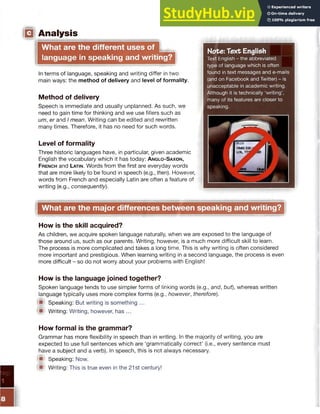
Note: Text English
Text English - the abbreviated
type of language which is often
found in text messages and e-mails
(and on Facebook and Twitter) - is
unacceptable in academic writing.
Although it is technically ‘writing’,
many of its features are closer to
speaking.
In terms of language, speaking and writing differ in two
main ways: the method of delivery and level of formality.
Method of delivery
Speech is immediate and usually unplanned. As such, we
need to gain time for thinking and we use fillers such as
um, er and I mean. Writing can be edited and rewritten
many times. Therefore, it has no need for such words.
Level of formality
Three historic languages have, in particular, given academic
English the vocabulary which it has today: A nglo-Saxon,
French and Latin. Words from the first are everyday words
that are more likely to be found in speech (e.g., then). However,
words from French and especially Latin are often a feature of
writing (e.g., consequently).
What are the major differences between speaking and writing?
How is the skill acquired?
As children, we acquire spoken language naturally, when we are exposed to the language of
those around us, such as our parents. Writing, however, is a much more difficult skill to learn.
The process is more complicated and takes a long time. This is why writing is often considered
more important and prestigious. When learning writing in a second language, the process is even
more difficult - so do not worry about your problems with English!
How is the language joined together?
Spoken language tends to use simpler forms of linking words (e.g., and, but), whereas written
language typically uses more complex forms (e.g., however, therefore).
■ Speaking: But writing is something ...
■ Writing: Writing, however, has ...
How formal is the grammar?
Grammar has more flexibility in speech than in writing. In the majority of writing, you are
expected to use full sentences which are ‘grammatically correct’ (i.e., every sentence must
have a subject and a verb). In speech, this is not always necessary.
*■' Speaking: Now.
<■ Writing: This is true even in the 21st century!
How can extra meaning be communicated?
There are many ways to communicate your meaning in speech without using language
(e.g., b o d y l a n g u a g e ). Obviously, in writing, these techniques are not available. This means that
your writing has to be as specific and clear as possible. In the example below, the writer has to
use particular words (surprisingly) and punctuation (an exclamation mark -!) to do the same job
as pointing a finger for emphasis.
!■ Speaking: Loads of people still can’t write [points finger].
!P Writing: It is an expertise which, surprisingly, many people still do not possess. This is true
even in the 21st century!
How can specific emphasis becreated? speech Writing
In speech, there are a range of effects by whichwe can Voice gets louder !
indicate e m p h a s is . These include: Tone rises ?
• Volume (e.g., soft/loud) Pitch/voice drops ()or...
• P it c h / t o n e (e.g., rising/falling) Shorter pause
• T e m p o (e.g., slowly/quickly) Longer pause .or,
In writing, we have to use punctuation to perform the same role. A brief comparison of the
two media is presented in the table. The example below is from the text.
W Speaking: ... [volume drops] usually from our mums and dads ...
■ Writing: (usually from our parents).
Is variety possible?
Spoken language varies greatly from region to region. Indeed, two speakers of the same
language may find it very difficult to understand each other. To take the example of the word
about: its written form does not change, but it can be said in different ways. For example,
someone from London would typically pronounce the word as /a'baut/ (to rhyme with ‘shout’);
a Glaswegian might pronounce it /a'buit/ (to rhyme with ‘flute’). Writing, on the other hand, is
more standardized. Different types of English (e.g., A m e r ic a n E n g l is h and B r it is h E n g l is h ) only
have very small differences in spelling.
How do you interact with the audience?
When speaking, we almost always know who we are speaking to. In writing, however, our
words might be read by anyone. Our audience, therefore, has to be considered more carefully
beforehand, and v a g u e n e s s and a m b ig u it y must be avoided. In addition, when writing you only
have one opportunity to make yourself understood, whereas in speaking you can explain
yourself as many times as necessary. Here, the speaker is able to rephrase what they have
just said, so that the other person can understand.
Speaking: [intonation rises] Understand? Let me put it another way.
Can you change what you said?
Once something has been said, it has been said. It cannot be ‘deleted’ (though of course it can
be clarified). In writing, texts can be edited and redrafted as often as necessary. In this example,
the speaker tries twice to pronounce this difficult word correctly. When writing, however, he or
she can look the word up in a dictionary, or use spellcheck, to get it right first time.
■ Speaking: It is ... an expar- expertise ...
9
UNIT
A
Understanding
academic
convention
IQ Activation
The sentences below are all examples of spoken English. Rewrite them to make them
more typical of written English.
1. ‘Speaking and writing are really really different skills ... um ... there are three ways this
is true - how they’re learnt, what they contain, and how they’re done.’
2. ‘It’s clear, isn’t it, that yer grammar has gotta be better in writing.’
3. The main differences in speaking and writing [intonation rises]'? Difficult question.’
4. Things don’t really change in writing, wherever you are, but in speaking they can
change loads.’
1 1 Personalization
ffi In your mother tongue, discuss an academic subject with a friend.
• Record this conversation.
• Following this, write a short summary (c. 100 words) on the same topic.
• Compare the recording and the written summary, and identify the differences between
the two.
M Review some of your previous writing. Does it sound more like speech?
Can you identify any words which should not be there? In particular, you
may want to check for:
• the influence of text English
• sentences which are not grammatically correct
• repetition of the same language
• informal linking words
IQ Extension
® Step 21 focuses on strategies for increasing the f o r m a l it y of your language -
a crucial difference between speaking and writing.
( p Step 43 analyzes punctuation - a skill specifically required for writing as opposed
to speaking.
® Unit J (Steps 46-50) looks in detail at the issue of p r o o f r e a d in g , and how you
can ensure your final written text avoids some of the problems listed above.
How is academic writing
different from other forms
of writing?
‘Talent alone cannot make a writer.'
Ralph Waldo Emerson
o Reflection
What are the key characteristics of academic writing?
• Select the appropriate term - more or less - in the middle box.
is more / less objective
Generally speaking, uses more / less referencing
academic writing is more / less complex
has a more/less formal structure
than other forms of writing.
O Contextualization
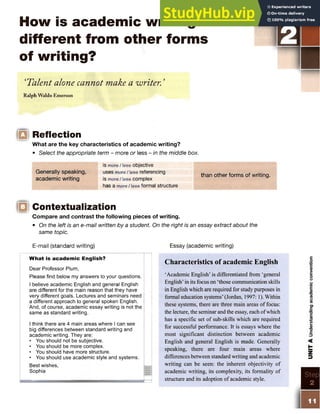
Compare and contrast the following pieces of writing.
• On the left is an e-mail written by a student. On the right is an essay extract about the
same topic.
E-mail (standard writing) Essay (academic writing)
What is academic English?
Dear Professor Plum,
Please find below my answers to your questions.
I believe academic English and general English
are different for the main reason that they have
very different goals. Lectures and seminars need
a different approach to general spoken English.
And, of course, academic essay writing is not the
same as standard writing.
I think there are 4 main areas where I can see
big differences between standard writing and
academic writing. They are:
• You should not be subjective.
• You should be more complex.
• You should have more structure.
• You should use academic style and systems.
Best wishes,
Sophia
Characteristics of academic English
‘Academic English’ is differentiated from ‘general
English’in its focus on ‘those communication skills
in English which are required for study purposes in
formal education systems’(Jordan, 1997: 1). Within
these systems, there are three main areas of focus:
the lecture, the seminar and the essay, each ofwhich
has a specific set of sub-skills which are required
for successful performance. It is essays where the
most significant distinction between academic
English and general English is made. Generally
speaking, there are four main areas where
differences between standard writing and academic
writing can be seen: the inherent objectivity of
academic writing, its complexity, its formality of
structure and its adoption of academic style.
Analysis
What are the key characteristics
of academic writing? I
(I
It is almost impossible to define good academic writing
exactly. However, it is certainly possible to identify some
key characteristics. The ones listed on the right are four
of the most important features.
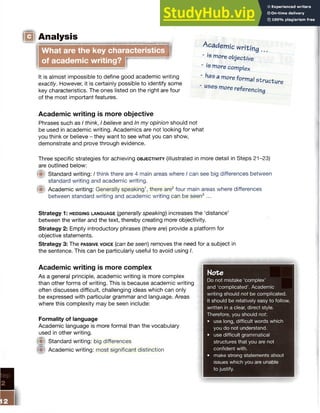
Academic writing.
- is more objective
- is more complex
- has a more formal structure
• uses more referencing
Academic writing is more objective
Phrases such as I think, I believe and In my opinion should not
be used in academic writing. Academics are not looking for what
you think or believe - they want to see what you can show,
demonstrate and prove through evidence.
Three specific strategies for achieving o b je c t iv it y (illustrated in more detail in Steps 21-23)
are outlined below:
Standard writing: I think there are 4 main areas where I can see big differences between
standard writing and academic writing.
Academic writing: Generally speaking1, there are2four main areas where differences
between standard writing and academic writing can be seen3 ...
Strategy 1: h e d g in g la n g u a g e {generally speaking) increases the ‘distance’
between the writer and the text, thereby creating more objectivity.
Strategy 2: Empty introductory phrases (there are) provide a platform for
objective statements.
Strategy 3: The pa ssive v o ic e (can be seen) removes the need for a subject in
the sentence. This can be particularly useful to avoid using /.
Academic writing is more complex
As a general principle, academic writing is more complex
than other forms of writing. This is because academic writing
often discusses difficult, challenging ideas which can only
be expressed with particular grammar and language. Areas
where this complexity may be seen include:
Formality of language
Academic language is more formal than the vocabulary
used in other writing.
fit Standard writing: big differences
(ft Academic writing: most significant distinction
Note
Do not mistake ‘complex’
and ‘complicated’. Academic
writing should not be complicated.
It should be relatively easy to follow,
written in a clear, direct style.
Therefore, you should not:
• use long, difficult words which
you do not understand.
• use difficult grammatical
structures that you are not
confident with.
• make strong statements about
issues which you are unable
to justify.
•mmmm
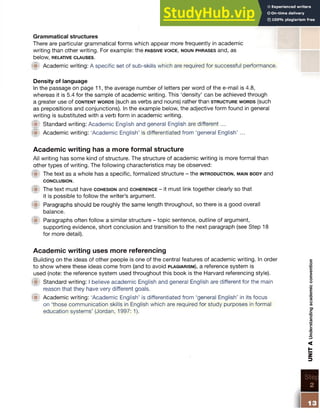
Grammatical structures
There are particular grammatical forms which appear more frequently in academic
writing than other writing. For example: the pa ssive v o ic e , n o u n p h r a s e s and, as
below, RELATIVE CLAUSES.
@ Academic writing: A specific set of sub-skills which are required for successful performance.
Density of language
In the passage on page 11, the average number of letters per word of the e-mail is 4.8,
whereas it is 5.4 for the sample of academic writing. This ‘density’ can be achieved through
a greater use of c o n t e n t w o r d s (such as verbs and nouns) rather than s t r u c t u r e w o r d s (such
as prepositions and conjunctions). In the example below, the adjective form found in general
writing is substituted with a verb form in academic writing.
f t Standard writing: Academic English and general English are different...
<■1 Academic writing: ‘Academic English’ is differentiated from ‘general English’ ...
Academic writing has a more formal structure
All writing has some kind of structure. The structure of academic writing is more formal than
other types of writing. The following characteristics may be observed:
f t The text as a whole has a specific, formalized structure - the in t r o d u c t io n , m a in b o d y and
CONCLUSION.
f t The text must have c o h e s io n and c o h e r e n c e - it must link together clearly so that
it is possible to follow the writer’s argument.
f t Paragraphs should be roughly the same length throughout, so there is a good overall
balance.
{■t Paragraphs often follow a similar structure - topic sentence, outline of argument,
supporting evidence, short conclusion and transition to the next paragraph (see Step 18
for more detail).
Academic writing uses more referencing
Building on the ideas of other people is one of the central features of academic writing. In order
to show where these ideas come from (and to avoid p l a g ia r is m ), a reference system is
used (note: the reference system used throughout this book is the Harvard referencing style).
f t Standard writing: I believe academic English and general English are different for the main
reason that they have very different goals.
f t Academic writing: ‘Academic English’ is differentiated from ‘general English’ in its focus
on ‘those communication skills in English which are required for study purposes in formal
education systems’ (Jordan, 1997: 1). UNIT
A
Understanding
academic
convention
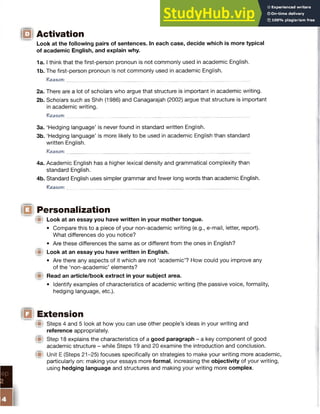
ID Activation
Look at the following pairs of sentences. In each case, decide which is more typical
of academic English, and explain why.
1a. I think that the first-person pronoun is not commonly used in academic English.
1b. The first-person pronoun is not commonly used in academic English.
Reason:
2a. There are a lot of scholars who argue that structure is important in academic writing.
2b. Scholars such as Shih (1986) and Canagarajah (2002) argue that structure is important
in academic writing.
Reason: __
3a. ‘Hedging language’ is never found in standard written English.
3b. ‘Hedging language’ is more likely to be used in academic English than standard
written English.
R e a so n:___________________________________________________________________________
4a. Academic English has a higher lexical density and grammatical complexity than
standard English.
4b. Standard English uses simpler grammar and fewer long words than academic English.
R e a so n:_________________________________________________________________________
(E§ Personalization
(St Look at an essay you have written in your mother tongue.
• Compare this to a piece of your non-academic writing (e.g., e-mail, letter, report).
What differences do you notice?
• Are these differences the same as or different from the ones in English?
^St Look at an essay you have written in English.
• Are there any aspects of it which are not ‘academic’? How could you improve any
of the ‘non-academic’ elements?
(■) Read an article/book extract in your subject area.
• Identify examples of characteristics of academic writing (the passive voice, formality,
hedging language, etc.).
(El Extension
(St Steps 4 and 5 look at how you can use other people’s ideas in your writing and
reference appropriately.
(■I Step 18 explains the characteristics of a good paragraph - a key component of good
academic structure - while Steps 19 and 20 examine the introduction and conclusion.
Unit E (Steps 21-25) focuses specifically on strategies to make your writing more academic,
particularly on: making your essays more formal, increasing the objectivity of your writing,
using hedging language and structures and making your writing more complex.
What is plagiarism?
‘
Fine words! I wonder whereyou stole themV
Jonathan Swift
- _ _ j _ ,
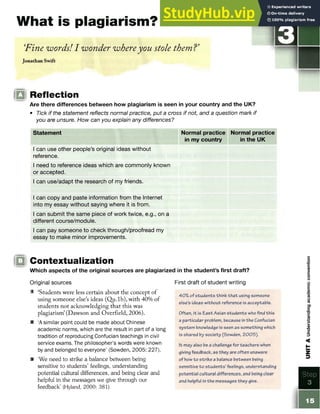
□ Reflection
Are there differences between how plagiarism is seen in your country and the UK?
• Tick if the statement reflects normal practice, put a cross if not, and a question mark if
you are unsure. How can you explain any differences?
Statement Normal practice Normal practice
in my country in the UK
I can use other people’s original ideas without
reference.
I need to reference ideas which are commonly known
or accepted.
I can use/adapt the research of my friends.
I can copy and paste information from the Internet
into my essay without saying where it is from.
I can submit the same piece of work twice, e.g., on a
different course/module.
I can pay someone to check through/proofread my
essay to make minor improvements.
|Q Contextualization
Which aspects of the original sources are plagiarized in the student’s first draft?
Original sources
® ‘Students were less certain about the concept of
using someone else’s ideas (Qu.lb), with 40% of
students not acknowledging that this was
plagiarism’(Dawson and Overfield, 2006).
* ‘A similar point could be made about Chinese
academic norms, which are the result in part of a long
tradition of reproducing Confucian teachings in civil
service exams. The philosopher’s words were known
by and belonged to everyone’ (Sowden, 2005: 227).
& ‘We need to strike a balance between being
sensitive to students’ feelings, understanding
potential cultural differences, and being clear and
helpful in the messages we give through our
feedback’ (Hyland, 2000: 381).
First draft of student writing
40%of students think that using someone
else’s ideas without reference is acceptable.
Often, it is East Asian students who find this
a particular problem, because in the Confucian
system knowledge is seen as something which
is shared by society (5owden, 2005).
It may also be a challenge for teachers when
giving feedback, as they are often unaware
of howto strike a balance between being
sensitive to students’feelings, understanding
potential cultural differences, and being clear
and helpful in the messages they give.
15
UNIT
A
Understanding
academic
convention
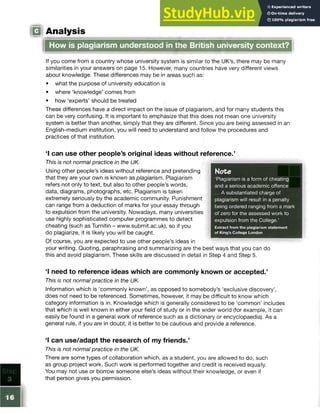
m Analysis
If you come from a country whose university system is similar to the UK’s, there may be many
similarities in your answers on page 15. However, many countries have very different views
about knowledge. These differences may be in areas such as:
• what the purpose of university education is
• where ‘knowledge’ comes from
• how ‘experts’ should be treated
These differences have a direct impact on the issue of plagiarism, and for many students this
can be very confusing. It is important to emphasize that this does not mean one university
system is better than another, simply that they are different. Since you are being assessed in an
English-medium institution, you will need to understand and follow the procedures and
practices of that institution.
1 can use other people’s original ideas without reference/
This is not normal practice in the UK.
Using other people’s ideas without reference and pretending
that they are your own is known as plagiarism. Plagiarism
refers not only to text, but also to other people’s words,
data, diagrams, photographs, etc. Plagiarism is taken
extremely seriously by the academic community. Punishment
can range from a deduction of marks for your essay through
to expulsion from the university. Nowadays, many universities
use highly sophisticated computer programmes to detect
cheating (such as Turnitin - www.submit.ac.uk), so if you
do plagiarize, it is likely you will be caught.
Of course, you are expected to use other people’s ideas in
your writing. Quoting, paraphrasing and summarizing are the best ways that you can do
this and avoid plagiarism. These skills are discussed in detail in Step 4 and Step 5.
1 need to reference ideas which are commonly known or accepted,’
This is not normal practice in the UK.
Information which is ‘commonly known’, as opposed to somebody’s ‘exclusive discovery’,
does not need to be referenced. Sometimes, however, it may be difficult to know which
category information is in. Knowledge which is generally considered to be ‘common’ includes
that which is well known in either your field of study or in the wider world (for example, it can
easily be found in a general work of reference such as a dictionary or encyclopaedia). As a
general rule, if you are in doubt, it is better to be cautious and provide a reference.
‘I can use/adapt the research of my friends.’
This is not normal practice in the UK.
There are some types of collaboration which, as a student, you are allowed to do, such
as group project work. Such work is performed together and credit is received equally.
You may not use or borrow someone else’s ideas without their knowledge, or even if
that person gives you permission.
Note
‘Plagiarism is a form of cheating
and a serious academic offence
... A substantiated charge of
plagiarism will result in a penalty
being ordered ranging from a mark
of zero for the assessed work to
expulsion from the College.’
Extract from the plagiarism statement
of King’s College London
How is plagiarism understood in the British university context?
‘I can copy and paste information from the Internet into my essay,
without saying where it is from.’
This is not normal practice in the UK.
A distinction has to be made between ‘searching5and ‘researching’. At a British
university, you are not assessed on your ability to find information, but rather on your
ability to understand and process it. Be careful when downloading information from the
Internet that you would like to paraphrase or quote in your essay. Mixing up your own
words and original material is dangerous. This kind of a c c id e n t a l p l a g ia r is m is treated
just as seriously as deliberate plagiarism.
1 can submit the same piece of work twice
e.g., on a different course/module.’
This is not normal practice in the UK.
This kind of plagiarism, often referred to as self-plagiarism,
is also unacceptable. Every piece of work which you present
for assessment should be unique.
‘I can pay someone to check through/proofread
my essay to make minor improvements.’
This is normal practice in the UK.
The key word here is minor. Normally you may use proofreaders
to improve the grammar or language in your essay. However,
as soon as the proofreader makes significant or fundamental
changes to your essay - for example expressing his or her own
point of view in ‘your’ essay - then plagiarism has occurred.
Essay-writing
services: a warning
Using an essay-writing service
- a phenomenon which has
become increasingly popular in
the last few years - is completely
unacceptable. Since the
overwhelming majority of essays
which you can buy are already
known to electronic software, you
will be caught anyway, and the
process will also have cost you a
considerable amount of money.
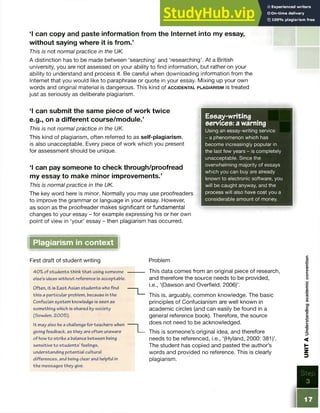
Plagiarism in context
First draft of student writing
40%of students think that using someone
else’s ideas without reference is acceptable.
Often, it is East Asian students who find
this a particular problem, because inthe
Confucian system knowledge is seen as
something which is shared by society
(Sowden, 2005).
It may also be a challenge for teachers when
giving feedback, as they are often unaware
of howto strike a balance between being
sensitive to students’feelings,
understanding potential cultural
differences, and being dear and helpful in
the messages they give.
T _
Problem
This data comes from an original piece of research,
and therefore the source needs to be provided,
i.e., ‘(Dawson and Overfield, 2006)’.
This is, arguably, common knowledge. The basic
principles of Confucianism are well known in
academic circles (and can easily be found in a
general reference book). Therefore, the source
does not need to be acknowledged.
This is someone’s original idea, and therefore
needs to be referenced, i.e., ‘(Hyland, 2000: 381)’.
The student has copied and pasted the author’s
words and provided no reference. This is clearly
plagiarism.
Step
3
UNIT
A
Understanding
academic
convention
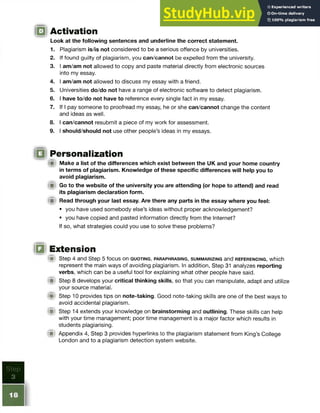
Activation
Look at the following sentences and underline the correct statement.
1. Plagiarism is/is not considered to be a serious offence by universities.
2. If found guilty of plagiarism, you can/cannot be expelled from the university.
3. I am/am not allowed to copy and paste material directly from electronic sources
into my essay.
4. I am/am not allowed to discuss my essay with a friend.
5. Universities do/do not have a range of electronic software to detect plagiarism.
6. I have to/do not have to reference every single fact in my essay.
7. If I pay someone to proofread my essay, he or she can/cannot change the content
and ideas as well.
8. I can/cannot resubmit a piece of my work for assessment.
9. I should/should not use other people’s ideas in my essays.
I Personalization
(ft Make a list of the differences which exist between the UK and your home country
in terms of plagiarism. Knowledge of these specific differences will help you to
avoid plagiarism.
W Go to the website of the university you are attending (or hope to attend) and read
its plagiarism declaration form.
(■! Read through your last essay. Are there any parts in the essay where you feel:
• you have used somebody else’s ideas without proper acknowledgement?
• you have copied and pasted information directly from the Internet?
If so, what strategies could you use to solve these problems?
Extension
§ | Step 4 and Step 5 focus on q u o t in g , p a r a p h r a s in g , s u m m a r iz in g and r e f e r e n c in g , which
represent the main ways of avoiding plagiarism. In addition, Step 31 analyzes reporting
verbs, which can be a useful tool for explaining what other people have said.
f i Step 8 develops your critical thinking skills, so that you can manipulate, adapt and utilize
your source material.
(m Step 10 provides tips on note-taking. Good note-taking skills are one of the best ways to
avoid accidental plagiarism.
<
■ Step 14 extends your knowledge on brainstorming and outlining. These skills can help
with your time management; poor time management is a major factor which results in
students plagiarising.
f i l Appendix 4, Step 3 provides hyperlinks to the plagiarism statement from King’s College
London and to a plagiarism detection system website.
How can I use other
people’s ideas in
my writing?
I f I have seen a littlefurther; it is by standing
on the shoulders ofgiants. ’
S TE P
Sir Isaac Newton
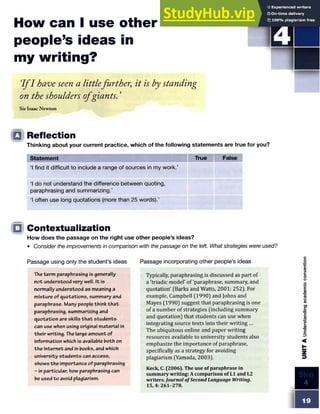
□ Reflection
Thinking about your current practice, which of the following statements are true for you?
Statement True False
‘1find it difficult to include a range of sources in my work.’
‘1do not understand the difference between quoting,
paraphrasing and summarizing.’
£
l often use long quotations (more than 25 words).’
□ Contextualization
How does the passage on the right use other people’s ideas?
• Consider the improvements in comparison with the passage on the left. What strategies were used?
Passage using only the student’s ideas Passage incorporating other people’s ideas
The term paraphrasing is generally
not understood very well. It is
normally understood as meaning a
mixture of quotations, summary and
paraphrase. Many people think th a t
paraphrasing, summarizing and
quotation are skills th a t students
can use when using original material in
their writing. The large amount of
information which is available both on
the Internet and in books, and which
university students can access,
shows the importance of paraphrasing
- in particular, how paraphrasing can
be used to avoid plagiarism.
Typically, paraphrasing is discussed as part of
a 'triadic model' of'paraphrase, summary, and
quotation' (Barks and Watts, 2001: 252). For
example, Campbell (1990) and Johns and
Mayes (1990) suggest that paraphrasing is one
of a number of strategies (including summary
and quotation) that students can use when
integrating source texts into their writing ...
The ubiquitous online and paper writing
resources available to university students also
emphasize the importance of paraphrase,
specifically as a strategy for avoiding
plagiarism (Yamada, 2003).
Keck, C. (2006). The use of paraphrase in
summary writing: A comparison of LI and L2
writers. Journal ofSecond Language Writing.
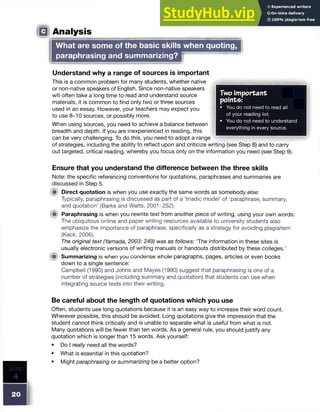
□ Analysis
What are some of the basic skills when quoting,
paraphrasing and summarizing?
Twoimportant
points:
• You do not need to read all
of your reading list.
• You do not need to understand
everything in every source.
Understand why a range of sources is important
This is a common problem for many students, whether native
or non-native speakers of English. Since non-native speakers
will often take a long time to read and understand source
materials, it is common to find only two or three sources
used in an essay. However, your teachers may expect you
to use 8-10 sources, or possibly more.
When using sources, you need to achieve a balance between
breadth and depth. If you are inexperienced in reading, this
can be very challenging. To do this, you need to adopt a range
of strategies, including the ability to reflect upon and criticize writing (see Step 8) and to carry
out targeted, critical reading, whereby you focus only on the information you need (see Step 9).
Ensure that you understand the difference between the three skills
Note: the specific referencing conventions for quotations, paraphrases and summaries are
discussed in Step 5.
m Direct quotation is when you use exactly the same words as somebody else:
Typically, paraphrasing is discussed as part of a ‘triadic model’ of ‘paraphrase, summary,
and quotation’ (Barks and Watts, 2001: 252).
(m Paraphrasing is when you rewrite text from another piece of writing, using your own words:
The ubiquitous online and paper writing resources available to university students also
emphasize the importance of paraphrase, specifically as a strategy for avoiding plagiarism
(Keck, 2006).
The original text (Yamada, 2003: 249) was as follows: The information in these sites is
usually electronic versions of writing manuals or handouts distributed by these colleges.’
<■ Summarizing is when you condense whole paragraphs, pages, articles or even books
down to a single sentence:
Campbell (1990) and Johns and Mayes (1990) suggest that paraphrasing is one of a
number of strategies (including summary and quotation) that students can use when
integrating source texts into their writing.
Be careful about the length of quotations which you use
Often, students use long quotations because it is an easy way to increase their word count.
Wherever possible, this should be avoided. Long quotations give the impression that the
student cannot think critically and is unable to separate what is useful from what is not.
Many quotations will be fewer than ten words. As a general rule, you should justify any
quotation which is longer than 15 words. Ask yourself:
• Do I really need all the words?
• What is essential in this quotation?
• Might paraphrasing or summarizing be a better option?
How can these skills improve your writing?
Quoting, paraphrasing and summarizing can be beneficial to your writing in
three main ways: they add clarity, authority and support.
f i t Clarity: Experts in the field may often be able to say things in a more specific,
precise way than you.
tf§i Authority: As the quotation by Sir Isaac Newton at the beginning of this step suggests,
a good essay will build on the work of experts in the field. Also, you need to demonstrate
that you have a good overall understanding of the topic, and that you are considering the
issues from all angles.
<jp Support: A good balance of theory and evidence is required in academic writing.
Published works can add relevant support to your own thoughts and reflections
about a particular subject.
What different strategies are there for paraphrasing?
There are two key strategies for successful paraphrasing: changing the words and changing
the grammar. In both cases, the idea should remain the same, but the specific detail should
be different. Often both strategies will be used together, i.e., a good paraphrase will often
involve changes to both the words and the grammar.
Strategy 1: Changing the words
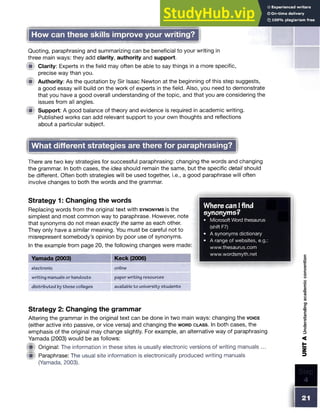
Replacing words from the original text with s y n o n y m s is the
simplest and most common way to paraphrase. However, note
that synonyms do not mean exactly the same as each other.
They only have a similar meaning. You must be careful not to
misrepresent somebody’s opinion by poor use of synonyms.
In the example from page 20, the following changes were made:
Yamada (2003) Keck (2006)
electronic online
writing manuals or handouts paper writing resources
distributed bythese colleges available to university students
Where can Ifind
synonyms?
• Microsoft Word thesaurus
(shift F7)
• A synonyms dictionary
• A range of websites, e.g.:
www.thesaurus.com
www.wordsmyth.net
Strategy 2: Changing the grammar
Altering the grammar in the original text can be done in two main ways: changing the v o ic e
(either active into passive, or vice versa) and changing the w o r d c l a s s . In both cases, the
emphasis of the original may change slightly. For example, an alternative way of paraphrasing
Yamada (2003) would be as follows:
m Original: The information in these sites is usually electronic versions of writing manuals ...
<■' Paraphrase: The usual site information is electronically produced writing manuals
(Yamada, 2003).
21
UNIT
A
Understanding
academic
convention
□ Activation
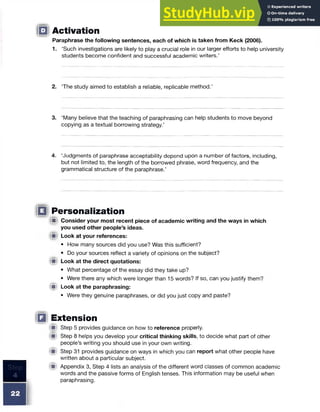
Paraphrase the following sentences, each of which is taken from Keck (2006).
1. ‘Such investigations are likely to play a crucial role in our larger efforts to help university
students become confident and successful academic writers.’
2. The study aimed to establish a reliable, replicable method.’
3. ‘Many believe that the teaching of paraphrasing can help students to move beyond
copying as a textual borrowing strategy.’
4. ‘Judgments of paraphrase acceptability depend upon a number of factors, including,
but not limited to, the length of the borrowed phrase, word frequency, and the
grammatical structure of the paraphrase.’
IB) Personalization
(jp Consider your most recent piece of academic writing and the ways in which
you used other people’s ideas.
«■ Look at your references:
• How many sources did you use? Was this sufficient?
• Do your sources reflect a variety of opinions on the subject?
■ Look at the direct quotations:
• What percentage of the essay did they take up?
• Were there any which were longer than 15 words? If so, can you justify them?
■ Look at the paraphrasing:
• Were they genuine paraphrases, or did you just copy and paste?
□ Extension
■ Step 5 provides guidance on how to reference properly.
<■ Step 8 helps you develop your critical thinking skills, to decide what part of other
people’s writing you should use in your own writing.
■ Step 31 provides guidance on ways in which you can report what other people have
written about a particular subject.
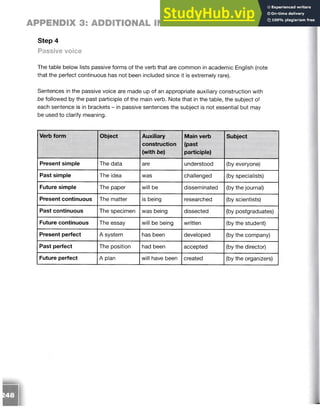
# Appendix 3, Step 4 lists an analysis of the different word classes of common academic
words and the passive forms of English tenses. This information may be useful when
paraphrasing.
22
How can I reference
properly?
‘The value ofan idea lies in the using ofit. ’
Thomas Edison
O' Reflection
Match the following words/phrases with the appropriate definition.
Paraphrase — ^ The exact words of another author which you use in your essay.
In-text citation Additional information found at the bottom of a page (end of the essay).
Bibliography Detailed description of all the sources/influences for your essay.
References A rewrite of an original piece of writing, in your own words.
Direct quotation A list of the sources which you quote in your essay.
Footnotes (endnotes) A reference in the text of your essay to the source you have
paraphrased or quoted from.
>□ Contextualization
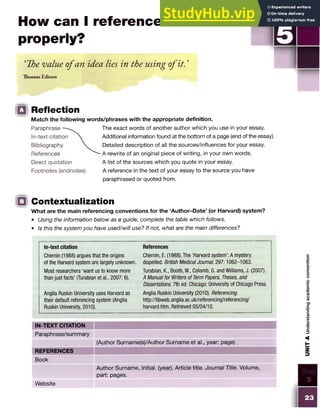
What are the main referencing conventions for the ‘Author-Date’ (or Harvard) system?
• Using the information below as a guide, complete the table which follows.
• Is this the system you have used/will use? If not, what are the main differences?
In-text citation
Chernin (1988) argues that the origins
of the Harvard system are largely unknown
Most researchers ‘want us to know more
than just facts’ (Turabian et al., 2007:6).
Anglia Ruskin University uses Harvard as
their default referencing system (Anglia
Ruskin University, 2010).
References
Chernin, E
. (1988). The ‘Harvard system’:A mystery
dispelled. British MedicalJournal. 297:1062-1063.
Turabian, K., Booth, W
., Colomb, G
. and Williams, J. (2007).
A Manual for Writers of TermPapers, Theses, and
Dissertations. 7th ed. Chicago: University of Chicago Press.
Anglia Ruskin University (2010). Referencing.
http://libweb.anglia.ac.uk/referencing/referencing/
harvard.htm. Retrieved 05/04/10.
IN-TEXT CITATION
Paraphrase/summary
(Author Surname(s)/Author Surname et al., year: page)
REFERENCES
Book
*
■
■
Author Surname, Initial, (year). Article title. Journal Title. Volume,
part: pages.
Website
23
UNIT
A
Understanding
academic
convention
□
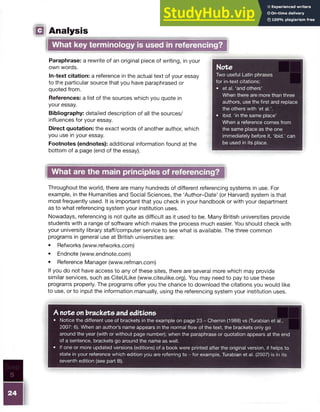
Paraphrase: a rewrite of an original piece of writing, in your
own words.
In-text citation: a reference in the actual text of your essay
to the particular source that you have paraphrased or
quoted from.
References: a list of the sources which you quote in
your essay.
Bibliography: detailed description of all the sources/
influences for your essay.
Direct quotation: the exact words of another author, which
you use in your essay.
Footnotes (endnotes): additional information found at the
bottom of a page (end of the essay).
Analysis
What key terminology is used in referencing?
Note
Two useful Latin phrases
for in-text citations:
• et al. ‘and others’
When there are more than three
authors, use the first and replace
the others with ‘et al.’.
• ibid. ‘in the same place’
When a reference comes from
the same place as the one
immediately before it, ‘ibid.’ can
be used in its place.
|whatarethema^^
Throughout the world, there are many hundreds of different referencing systems in use. For
example, in the Humanities and Social Sciences, the ‘Author-Date’ (or Harvard) system is that
most frequently used. It is important that you check in your handbook or with your department
as to what referencing system your institution uses.
Nowadays, referencing is not quite as difficult as it used to be. Many British universities provide
students with a range of software which makes the process much easier. You should check with
your university library staff/computer service to see what is available. The three common
programs in general use at British universities are:
• Refworks (www.refworks.com)
• Endnote (www.endnote.com)
• Reference Manager (www.refman.com)
If you do not have access to any of these sites, there are several more which may provide
similar services, such as CiteULike (www.citeulike.org). You may need to pay to use these
programs properly. The programs offer you the chance to download the citations you would like
to use, or to input the information manually, using the referencing system your institution uses.
A note on brackets and editions
• Notice the different use of brackets in the example on page 23 - Chernin (1988) vs (Turabian et al.,
2007: 6). When an author’s name appears in the normal flow of the text, the brackets only go
around the year (with or without page number); when the paraphrase or quotation appears at the end
of a sentence, brackets go around the name as well.
• If one or more updated versions (editions) of a book were printed after the original version, it helps to
state in your reference which edition you are referring to - for example, Turabian et al. (2007) is in its
seventh edition (see part B).
Step
5
What is the Harvard referencing system?
In-text citation
Paraphrase: Author Surname(s) (year)
Chernin (1988) argues that the origins of the Harvard system are largely unknown.
Direct quotation: (Author Surname[s],/Author Surname et al., year: page)
Most researchers ‘want us to know more than just facts’ (Turabian et al., 2007: 6).
References
Book (multiple authors): Author Surnames, Author Initials, (year). Title of Book. Edition. City of
Publication: Publisher.
Turabian, K., Booth, W., Colomb, G. and Williams, J. (2007). A Manual for Writers of Term
Papers, Theses, and Dissertations. 7th ed. Chicago: University of Chicago Press.
Journal: Author Surname(s), Initial(s). (year). Title of article. Title of Journal. Volume, part: pages.
Chernin, E. (1988). The ‘Harvard system’: A mystery dispelled. British Medical Journal, 297,
6655: 1062-1063.
Website: Organization (year). Title of Website. URL. Date retrieved.
Anglia Ruskin University (2010). Referencing.
http://libweb.anglia.ac.uk/referencing/referencing.htm. Retrieved 05/04/10.
What other referencing systems are there?
As noted above, there is no universal system for referencing. As a student, there are three
golden rules to follow:
• Follow the guidelines of your department: look in your handbook, talk to your teachers
or the administrative staff and find out which is used.
• Be consistent: do not mix and match the systems that you use. This is something which
can irritate university teachers.
• Ensure that your in-text citations match your references: anything that you quote in
the text must also appear in your references.
This is a list of other commonly used referencing systems and their key features. For each,
URLs for websites where further information can be obtained are included.
Modern Languages Association www.mla.org. The MLA system is widely used in North
America, particularly in the humanities.
Modern Humanities Research Association www.mhra.org.uk. The MHRA system is widely
used in the United Kingdom, particularly in the arts and humanities.
Chicago www.chicagomanualofstyle.org. This footnote-based system is often used in
historical journals and the social sciences.
American Psychological Association www.apastyle.org. APA is similar to Harvard as it also
uses author-date order, and is used predominantly in the social sciences.
Vancouver www.nlm.nih.gov/citingmedicine. Also known as the ‘Author-Number’ system, it is
commonly used in the physical sciences (particularly medicine). I
Oscola www.law.ox.ac.uk/publications/oscola.php. A system specifically used in law.
I!
UNIT
A
Understanding
academic
convention
Activation
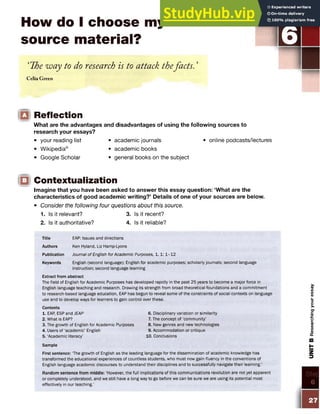
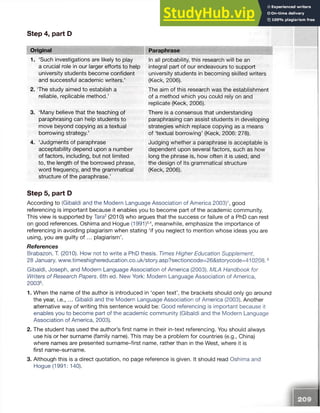
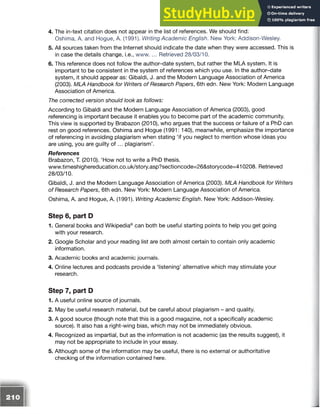
Look at the following essay extract and the accompanying references.
Identify the six mistakes.
According to (Gibaldi and the Modern Language Association of America 2003), good
referencing is important because it enables you to become part of the academic
community. This view is supported by Tara (2010), who argues that the success or failure of
a PhD can rest on good references. Oshima and Hogue (1991), meanwhile, emphasize the
importance of referencing in avoiding plagiarism when stating ‘if you neglect to mention
whose ideas you are using, you are guilty o f ... plagiarism.’
References
Brabazon, T. (2010). How not to write a PhD thesis. Times Higher Education Supplement,
28 January.
www.timeshighereducation.co.uk/story.asp?sectioncode=26&storycode=410208.
Gibaldi, Joseph, and Modern Language Association of America. MLA Handbook for Writers
of Research Papers. 6th ed. New York: Modern Language Association of America, 2003.
Personalization
HP Check your department’s handbook to see which system is used.
• Learn about this system. A simple Internet search will identify the information
you need. Look at books and articles which use this system to see how it
works in context.
M Check whether your university uses any electronic referencing systems. This
can save you time. If not, there is a range of both free and paid-for software
which you may consider obtaining.
i i Examine your recent writing and assess the quality of your referencing.
Ask yourself the following questions:
• Did I use more than one system?
• Did all my in-text citations appear in my references?
Extension
!■> Step 3 and Step 4 outline the reasons for using source material in your writing which
you will need to reference.
(S) Unit J describes strategies for proofreading. It is important to check your use of
references, as this is often an area where unnecessary mistakes are made.
® Appendix 4, Step 5 lists hyperlinks for all the websites on pages 24-25, along with others
which provide detailed information about referencing systems.
How do I choose my
source material?
‘The way to do research is to attack thefacts. ’
Celia Green
STE P UNIT B
6
Reflection
What are the advantages and disadvantages of using the following sources to
research your essays?
• your reading list • academic journals • online podcasts/lectures
• Wikipedia® • academic books
• Google Scholar • general books on the subject
IQ Contextualization
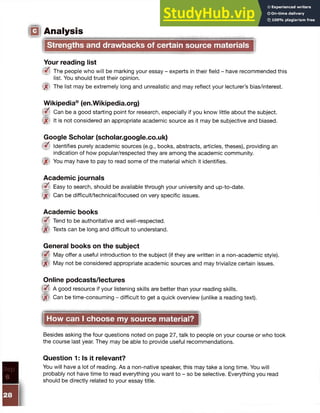
Imagine that you have been asked to answer this essay question: ‘What are the
characteristics of good academic writing?’ Details of one of your sources are below.
• Consider the following four questions about this source.
1. Is it relevant? 3. Is it recent?
2. Is it authoritative? 4. Is it reliable?
Title EAP: Issues and directions
Authors Ken Hyland, Liz Hamp-Lyons
Publication Journal of English for AcademicPurposes, 1 ,1 :1 -1 2
Keywords English (second language); English for academic purposes; scholarly journals; second language
instruction; second language learning
Extract from abstract
The field of English for Academic Purposes has developed rapidly in the past 25 years to become a major force in
English language teaching and research. Drawing its strength from broad theoretical foundations and a commitment
to research-based language education, EAP has begun to reveal some of the constraints of social contexts on language
use and to develop ways for learners to gain control over these.
Contents
1. EAP, ESP and JEAP
2. What is EAP?
3. The growth of English for Academic Purposes
4. Users of ‘academic’ English
5. ‘Academic literacy’
6. Disciplinary variation or similarity
7. The concept of ‘community’
8. New genres and new technologies
9. Accommodation or critique
10. Conclusions
Sample
First sentence: The growth of English as the leading language for the dissemination of academic knowledge has
transformed the educational experiences of countless students, who must now gain fluency in the conventions of
English language academic discourses to understand their disciplines and to successfully navigate their learning.’
Random sentence from middle: ‘However, the full implications of this communications revolution are not yet apparent
or completely understood, and we still have a long way to go before we can be sure we are using its potential most
effectively in our teaching.’
27
UNIT
B
Researching
your
essay
I Analysis
Strengths and drawbacks of certain source materials
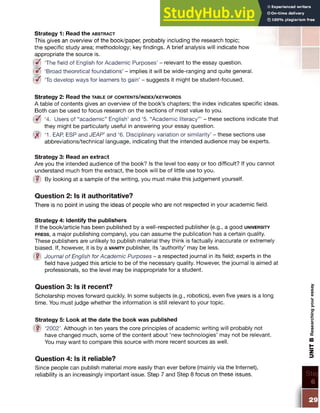
Your reading list
The people who will be marking your essay - experts in their field - have recommended this
list. You should trust their opinion.
<
jj£
' The list may be extremely long and unrealistic and may reflect your lecturer’s bias/interest.
Wikipedia® (en.Wikipedia.org)
0  Can be a good starting point for research, especially if you know little about the subject.
It is not considered an appropriate academic source as it may be subjective and biased.
Google Scholar (scholar.google.co.uk)
0 Identifies purely academic sources (e.g., books, abstracts, articles, theses), providing an
indication of how popular/respected they are among the academic community.
You may have to pay to read some of the material which it identifies.
Academic journals
(jjt Easy to search, should be available through your university and up-to-date.
ijgi Can be difficult/technical/focused on very specific issues.
Academic books
01 Tend to be authoritative and well-respected.
§1 Texts can be long and difficult to understand.
General books on the subject
May offer a useful introduction to the subject (if they are written in a non-academic style).
IJgt May not be considered appropriate academic sources and may trivialize certain issues.
Online podcasts/lectures
0  A good resource if your listening skills are better than your reading skills,
yp Can be time-consuming - difficult to get a quick overview (unlike a reading text).
How can I choose my source material?
Besides asking the four questions noted on page 27, talk to people on your course or who took
the course last year. They may be able to provide useful recommendations.
Question 1: Is it relevant?
You will have a lot of reading. As a non-native speaker, this may take a long time. You will
probably not have time to read everything you want to - so be selective. Everything you read
should be directly related to your essay title.
28
Strategy 1: Read the a b s t r a c t
This gives an overview of the book/paper, probably including the research topic;
the specific study area; methodology; key findings. A brief analysis will indicate how
appropriate the source is.
i3 f ‘The field of English for Academic Purposes’ - relevant to the essay question.
W ‘Broad theoretical foundations’ - implies it will be wide-ranging and quite general.
{ I f ‘To develop ways for learners to gain’ - suggests it might be student-focused.
Strategy 2: Read the ta ble o f c o n t e n t s / in d e x / k e y w o r d s
A table of contents gives an overview of the book’s chapters; the index indicates specific ideas.
Both can be used to focus research on the sections of most value to you.
(Bf ‘4. Users of “academic” English’ and ‘5. “Academic literacy”’ - these sections indicate that
they might be particularly useful in answering your essay question.
ijf ‘1. EAR ESP and JEAP’ and ‘6. Disciplinary variation or similarity’ - these sections use
abbreviations/technical language, indicating that the intended audience may be experts.
Strategy 3: Read an extract
Are you the intended audience of the book? Is the level too easy or too difficult? If you cannot
understand much from the extract, the book will be of little use to you.
|¥) By looking at a sample of the writing, you must make this judgement yourself.
Question 2: Is it authoritative?
There is no point in using the ideas of people who are not respected in your academic field.
Strategy 4: Identify the publishers
If the book/article has been published by a well-respected publisher (e.g., a good u n iv e r s it y
p r e s s , a major publishing company), you can assume the publication has a certain quality.
These publishers are unlikely to publish material they think is factually inaccurate or extremely
biased. If, however, it is by a v a n it y publisher, its ‘authority’ may be less.
■ Journal of English for Academic Purposes - a respected journal in its field; experts in the
field have judged this article to be of the necessary quality. However, the journal is aimed at
professionals, so the level may be inappropriate for a student.
Question 3: Is it recent?
Scholarship moves forward quickly. In some subjects (e.g., robotics), even five years is a long
time. You must judge whether the information is still relevant to your topic.
Strategy 5: Look at the date the book was published
fill ‘2002’. Although in ten years the core principles of academic writing will probably not
have changed much, some of the content about ‘new technologies’ may not be relevant.
You may want to compare this source with more recent sources as well.
Question 4: Is it reliable?
Since people can publish material more easily than ever before (mainly via the Internet),
reliability is an increasingly important issue. Step 7 and Step 8 focus on these issues.
29
UNIT
B
Researching
your
essay
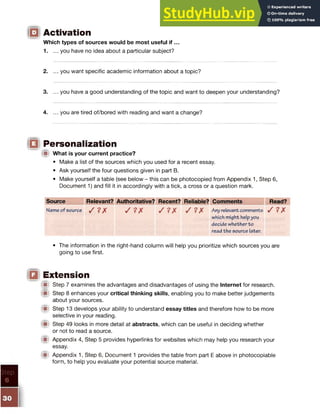
Activation
Which types of sources would be most useful if ...
1. ... you have no idea about a particular subject?
2. ... you want specific academic information about a topic?
3. ... you have a good understanding of the topic and want to deepen your understanding?
4. ... you are tired of/bored with reading and want a change?
Personalization
m What is your current practice?
• Make a list of the sources which you used for a recent essay.
• Ask yourself the four questions given in part B.
• Make yourself a table (see below - this can be photocopied from Appendix 1, Step 6,
Document 1) and fill it in accordingly with a tick, a cross or a question mark.
Source Relevant? Authoritative? Recent? Reliable? Comments Read?
Name of source / 2 ) ( / ? / / ? ?( / ? X Any relevant comments / ? X
which might help you
decide whether to
read the source later.
• The information in the right-hand column will help you prioritize which sources you are
going to use first.
Extension
iW Step 7 examines the advantages and disadvantages of using the Internet for research.
iW Step 8 enhances your critical thinking skills, enabling you to make better judgements
about your sources.
im Step 13 develops your ability to understand essay titles and therefore how to be more
selective in your reading.
■ Step 49 looks in more detail at abstracts, which can be useful in deciding whether
or not to read a source.
W Appendix 4, Step 5 provides hyperlinks for websites which may help you research your
essay.
W Appendix 1, Step 6, Document 1 provides the table from part E above in photocopiable
form, to help you evaluate your potential source material.
How should I use the
Internet for research?
‘Getting information offthe Internet is
like taking a drinkfrom afire hydrant. ’
Mitch Kapor
□ I Reflection
Consider the following statements about researching essays on the Internet, as opposed
to using printed sources. Do you agree or disagree with them?
1. It is easier to find the information I want. Agree / Disagree
2. It is more difficult to judge whether the information is academic or not. Agree / Disagree
3. The sources are more likely to be subjective. Agree / Disagree
4. I am more likely to commit plagiarism accidentally. Agree / Disagree
5. The information is more relevant. Agree / Disagree
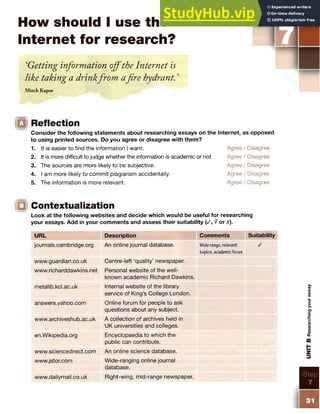
IO Contextualization
Look at the following websites and decide which would be useful for researching
your essays. Add in your comments and assess their suitability ( /, ? or X).
URL
journals.cambridge.org
www.guardian.co.uk
www.richarddawkins.net
metalib.kcl.ac.uk
answers.yahoo.com
www.archiveshub.ac.uk
en.Wikipedia.org
www.sciencedirect.com
www.jstor.com
www.dailymail.co.uk
Description
An online journal database.
Centre-left ‘quality’ newspaper.
Personal website of the well-
known academic Richard Dawkins.
Internal website of the library
service of King’s College London.
Online forum for people to ask
questions about any subject.
A collection of archives held in
UK universities and colleges.
Encyclopaedia to which the
public can contribute.
An online science database.
Wide-ranging online journal
database.
Right-wing, mid-range newspaper.
Comments
Wide range, relevant
topics, academicfocus
Suitability
/
IIIIUM ,
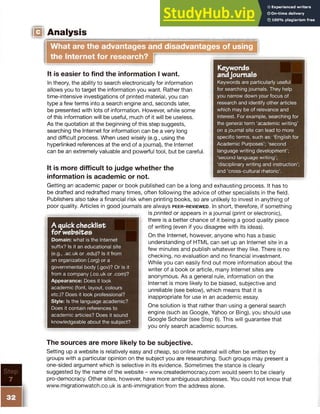
IO Analysis
What are the advantages and disadvantages of using
the Internet for research?
Keywords
andjournals
Keywords are particularly useful
for searching journals. They help
you narrow down your focus of
research and identify other articles
which may be of relevance and
interest. For example, searching for
the general term ‘academic writing’
on a journal site can lead to more
specific terms, such as: ‘English for
Academic Purposes’; ‘second
language writing development’;
‘second language writing’;
‘disciplinary writing and instruction’;
and ‘cross-cultural rhetoric’.
It is easier to find the information I want.
In theory, the ability to search electronically for information
allows you to target the information you want. Rather than
time-intensive investigations of printed material, you can
type a few terms into a search engine and, seconds later,
be presented with lots of information. However, while some
of this information will be useful, much of it will be useless.
As the quotation at the beginning of this step suggests,
searching the Internet for information can be a very long
and difficult process. When used wisely (e.g., using the
hyperlinked references at the end of a journal), the Internet
can be an extremely valuable and powerful tool, but be careful.
It is more difficult to judge whether the
information is academic or not.
Getting an academic paper or book published can be a long and exhausting process. It has to
be drafted and redrafted many times, often following the advice of other specialists in the field.
Publishers also take a financial risk when printing books, so are unlikely to invest in anything of
poor quality. Articles in good journals are always p e e r - r e v ie w e d . In short, therefore, if something
is printed or appears in a journal (print or electronic),
there is a better chance of it being a good quality piece
of writing (even if you disagree with its ideas).
On the Internet, however, anyone who has a basic
understanding of HTML can set up an Internet site in a
few minutes and publish whatever they like. There is no
checking, no evaluation and no financial investment.
While you can easily find out more information about the
writer of a book or article, many Internet sites are
anonymous. As a general rule, information on the
Internet is more likely to be biased, subjective and
unreliable (see below), which means that it is
inappropriate for use in an academic essay.
One solution is that rather than using a general search
engine (such as Google, Yahoo or Bing), you should use
Google Scholar (see Step 6). This will guarantee that
you only search academic sources.
A quickchecklist
for websites
Domain: what is the Internet
suffix? Is it an educational site
(e.g., .ac.uk or .edu)? Is it from
an organization (.org) or a
governmental body (.gov)? Or is it
from a company (.co.uk or .com)?
Appearance: Does it look
academic (font, layout, colours
etc.)? Does it look professional?
Style: Is the language academic?
Does it contain references to
academic articles? Does it sound
knowledgeable about the subject?
The sources are more likely to be subjective.
Setting up a website is relatively easy and cheap, so online material will often be written by
groups with a particular opinion on the subject you are researching. Such groups may present a
one-sided argument which is selective in its evidence. Sometimes the stance is clearly
suggested by the name of the website - www.createdemocracy.com would seem to be clearly
pro-democracy. Other sites, however, have more ambiguous addresses. You could not know that
www.migrationwatch.co.uk is anti-immigration from the address alone.
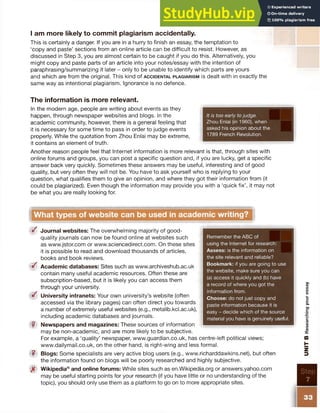
I am more likely to commit plagiarism accidentally.
This is certainly a danger. If you are in a hurry to finish an essay, the temptation to
‘copy and paste’ sections from an online article can be difficult to resist. However, as
discussed in Step 3, you are almost certain to be caught if you do this. Alternatively, you
might copy and paste parts of an article into your notes/essay with the intention of
paraphrasing/summarizing it later - only to be unable to identify which parts are yours
and which are from the original. This kind of a c c id e n t a l p l a g ia r is m is dealt with in exactly the
same way as intentional plagiarism. Ignorance is no defence.
The information is more relevant.
In the modern age, people are writing about events as they
happen, through newspaper websites and blogs. In the
academic community, however, there is a general feeling that
it is necessary for some time to pass in order to judge events
properly. While the quotation from Zhou Enlai may be extreme,
it contains an element of truth.
Another reason people feel that Internet information is more relevant is that, through sites with
online forums and groups, you can post a specific question and, if you are lucky, get a specific
answer back very quickly. Sometimes these answers may be useful, interesting and of good
quality, but very often they will not be. You have to ask yourself who is replying to your
question, what qualifies them to give an opinion, and where they got their information from (it
could be plagiarized). Even though the information may provide you with a ‘quick fix’, it may not
be what you are really looking for.
What types of website can be used in academic writing?
<§f Journal websites: The overwhelming majority of good-
quality journals can now be found online at websites such
as www.jstor.com or www.sciencedirect.com. On these sites
it is possible to read and download thousands of articles,
books and book reviews.
S Academic databases: Sites such as www.archiveshub.ac.uk
contain many useful academic resources. Often these are
subscription-based, but it is likely you can access them
through your university.
S University intranets: Your own university’s website (often
accessed via the library pages) can often direct you towards
a number of extremely useful websites (e.g., metalib.kcl.ac.uk),
including academic databases and journals.
? Newspapers and magazines: These sources of information
may be non-academic, and are more likely to be subjective.
For example, a ‘quality’ newspaper, www.guardian.co.uk, has centre-left political views;
www.dailymail.co.uk, on the other hand, is right-wing and less formal.
? Blogs: Some specialists are very active blog users (e.g., www.richarddawkins.net), but often
the information found on blogs will be poorly researched and highly subjective.
Wikipedia® and online forums: While sites such as en.Wikipedia.org or answers.yahoo.com
may be useful starting points for your research (if you have little or no understanding of the
topic), you should only use them as a platform to go on to more appropriate sites.
Remember the ABC of
using the Internet for research:
Assess: is the information on
the site relevant and reliable?
Bookmark: if you are going to use
the website, make sure you can
(a) access it quickly and (b) have
a record of where you got the
information from.
Choose: do not just copy and
paste information because it is
easy - decide which of the source
material you have is genuinely useful.
It is too early to judge.
Zhou Enlai (in 1960), when
asked his opinion about the
1789 French Revolution.
Step
7
33
UNIT
B
Researching
your
essay
Step
7
ID Activation
Assess the usefulness of the following websites for academic research, based
on the results of web searches given.
1. EBSCOhost - world’s foremost premium research database service
EBSCOhost (ebscohost.com) serves thousands of libraries and other institutions
with premium content in every subject area.
2. 32504 university essays & university coursework documents ...
Academic DB is the UK’s largest university essay and coursework database.
3. Economist.com
Authoritative weekly newspaper focusing on international politics and business news
and opinion.
4. BBC - Homepage
Breaking news, sport, TV, radio and a whole lot more. The BBC informs, educates and
entertains - wherever you are, whatever your age.
5. Answers.com: Wiki Q&A combined with free online dictionary ...
Wiki Q&A combined with free online dictionary, thesaurus and encyclopaedias.
IQ Personalization
!■! Examine the Internet source material which you used in recent essays (you may
find this information in the browsing history of your Internet browser).
• According to the criteria listed above, do you think these sources were suitable
for academic writing?
ijji If you are a regular user of Wikipedia®:
• Look at some of the references used and go back to the original source.
IW Identify which online academic resources you have access to through your institution.
• What general academic resources are there? Explore these resources so you know
exactly what is available.
IB Extension
Steps 3, 4 and 5 looked at the issues of plagiarism and referencing. When taking any
kind of notes, but especially notes from electronic sources, it is important that you
understand these topics. If you are still unclear, revisit these steps.
(S> Step 8 helps sharpen your critical evaluation skills, which are essential when using
web-based information.
Step 10 explains how you can take notes more effectively, which is important when
using any kind of resource material.
(St Step 13 looks at how you can fully understand your title. Because of the huge amount
of information on the Internet, it is important that you focus on information which is
directly relevant.
)■» Appendix 2, Step 7, Activity 1 is a short additional test of your knowledge on how to use
the Internet appropriately for researching essays.
Appendix 4, Step 7 lists the hyperlinks you considered in part B. Check their suitability
for your research purposes.
What critical thinking skills
do I need to develop?
‘ There is nothing eithergood or bad but
thinking makes it so.’
William Shakespeare (HamletAct 2, Scene 2)
STE P
IQ Reflection
Which of these three definitions of ‘critical thinking’ do you think is correct?
iW Critical thinking means reading what experts have said and presenting a general
summary of their ideas.
!■) Critical thinking means saying that everything you read is wrong.
W Critical thinking means not being afraid to challenge what experts have said, and
using this as a way of shaping your own view about a topic.
Contextualization
Look at the two pieces of writing below. The first is purely descriptive (i.e., it only
summarizes what other people have said, offering no authorial opinion), whereas
the second is more analytical.
• Why is the second text a more appropriate piece of academic writing?
Descriptive writing
Fisher and Scriven describe critical thinking as
'a skilled, active interpretation and evaluation of
observations, communications, information,
and argumentation' (1997: 20). Russell states
that 'the intelligent are full of doubt' (1998: 28].
Facione et al. (2000:101) argue that without
scrutiny, the following type of texts would be
common: 'intellectually dishonest (e.g., in the
use of data), intolerant (e.g., of opposing ideas),
inattentive (e.g., to implications of proposals),
haphazard (e.g., procedurally), mistrustful of
reason (e.g., hostile toward sound scientific
inquiry), indifferent (e.g., toward new findings),
and simplistic (e.g., naively dualistic).' Orwell
has the following attributed to him: 'During
times of universal deceit, telling the truth
becomes a revolutionary act.'
Analytical writing
Critical thinking is a notoriously difficult term to
define, although Fisher and Scriven’s classification
of it as ‘a skilled, active interpretation and
evaluation of observations, communications,
information, and argumentation’ (1997: 20)
captures many of its essential details. Echoing
Russell’s truism that ‘the intelligent are full of
doubt’ (1998: 28), Facione et al. (2000:101) argue
that without this doubt, academic study would
allow biased, prejudiced and illogical texts to not
be scrutinized properly. Although the saying
attributed to Orwell that ‘during times of universal
deceit, telling the truth becomes a revolutionary
act’ may be a little too political for the academic
context, the idea is still a strong one.
References
Facione, P., Facione, N. and Giancarlo, C. (2000). The disposition toward critical thinking: Character, measurement,
and relationship to critical thinking. Informal Logic, 20, 1: 61-84.
Fisher, A. and Scriven, M. (1997). Critical Thinking: Its Definition and Assessment. Norwich: Centre for Research in
Critical Thinking.
Russell, B. (1998). Mortals and Others: Bertrand Russell’s American Essays 1931-1935. London: Routledge.
0Analysis
The word critical
Although the word critical has
a purely negative connotation
in day-to-day English, in academic
language it means ‘evaluative’ or
‘analytical’.
Why is critical thinking important?
Critical thinking is a term which you will frequently read
and hear during your time at university. Feedback for student
essays often says that they ‘lack critical thinking’. However,
little guidance may be given as to what this means, or how
you can improve. Although it is difficult to give an exact
definition of the term, it is possible to identify some key
characteristics. Three important ideas - identified here as the ‘3 Cs’ - are as follows:
Challenge: Do not be afraid of questioning what ‘experts’ and scholars have written
about a particular topic. They are not always right.
Consider: Reflect on what you have read, and identify what your p o s it io n is. As the
second text in part B shows, good academic writing is analytical rather than just
descriptive (i.e., it says why and how, not just what, when and where).
Combine: Having read a range of sources, you need to synthesize your ideas. Good
academic writing analyzes the issues from all angles and is based on a wide range
of evidence and sources.
Critical thinking is much more important in the British university system than in many other
countries (see Step 3). In some cultures, it is not considered good practice to challenge the
views of authorities and well-respected writers. In the UK, however, a culture of s c e p t ic is m
exists: you are encouraged to test and challenge ideas. Of course, any criticisms you make
must be supported by evidence: you cannot disagree with something without saying why. As
such, many students find critical thinking difficult, and find it strange when their essays (which
would have received good marks in their home academic system) score poorly. When looking
at texts critically, there are several important questions which you can ask, including:
• Are there n e c e s s a r y a n d s u f f ic ie n t c o n d it io n s for the claims which are being made (i.e.,
based on the evidence which exists, are the conclusions reasonable)?
• Does the text show b ia s ? For example, does the author have particular beliefs which may
unfairly influence his or her writing? Or, if the research has been funded by a particular
organization, might this influence the results?
• Is the text censored? Has the government, or another agency, hidden any of the information?
This is not to say that you should avoid any material which may be affected in these ways, but
you should be careful about how you use it. Sources which might be considered ‘propaganda’
are, academically speaking, much weaker.
Developing your critical thinking skills
The following technique, known as the Socratic method (named after Socrates, the Greek
philosopher who developed it), is an effective way of testing the truth of statements. This
system is based on the idea of s c e p t ic is m , and proceeds as follows:
Read statement and
assume that it is false
Search for situations in which
the statement is not true, or
where exceptions exist
E.g., ‘All foreign students have poor critical thinking skills.’
There are many thousands of overseas students at British
universities who, every year, graduate with excellent
degrees. If they all had poor critical thinking skills, this
could not happen.
If any such situation can be found,
the statement must be either false
or inaccurate
Thus, the statement is false and could be challenged in
an essay: ‘Sowton’s assertion lacks evidence’; ‘Sowton’s
claim is false.’
Additionally, your reaction can be modified in two ways:
’■ Expanding your objection: you might criticize the evidence or methodology which the
author used - or you might present c o u n t e r - e v id e n c e which strengthens your opposition.
For example:
• Sowton’s study not only focused on a small sample but also usedambiguous questions.
• The data gathered do not support Sowton’s conclusion.
• The high number of foreign students at UK universities demonstrates the weakness
of Sowton’s argument.
ifii Offering a concession: you might try to explain the reason why the writer came to a
wrong decision. For example:
• Although many students come from countries where critical thinkingis not valued as
highly as in the UK, Sowton’s conclusions are still too extreme.
Using critical thinking in your own proofreading
Critical thinking can also play an important role in checking your own writing. For example,
the sentence above can be improved by repeatedly using the Socratic method, until a suitable
sentence is produced.
All foreign students have poor critical thinking skills. This is too direct, too general.
▼
Some foreign students have poor critical thinking skills. While this is true, the statement
is vague and unacademic.
T
Foreign students who come from countries with a different
academic culture have poor critical thinking skills.
The first part is better but the
statement is still too emphatic.
T
There is a tendency for foreign students who come from
countries with a different academic culture to have poor
critical thinking skills.
Step
8
UNIT
B
Researching
your
essay
IQ Activation
Read the following passage and highlight any assertion which you feel can be challenged
using the strategies listed overleaf. In each case, explain why.
Students from countries which can broadly be said to have a 'Confucian system' (particularly
China, Japan and South Korea) have difficulty with critical thinking because of the academic
cultures found in these countries. I have taught many people from this part of the world, and
they always seem to have difficulties. Clearly, therefore, your mother tongue is also an
important factor. In my opinion, French and German speakers also have significant problems in
this respect. Recent research (e.g., Smith, 2001; Barton 2004) indicates that it is not only
overseas students who have problems with critical thinking, but British students as well. This
research is supported by www.criticalthinkingcourses.com.
IQ Personalization
{■) Examine a recent essay you have written and:
• highlight any unsupported arguments, or arguments which have weak
supporting evidence
• challenge these arguments (following the Socratic method outlined overleaf)
• rewrite them accordingly
Consider whether you yourself:
• have any particular bias (e.g., political, national, cultural) which may influence
either your reading or writing
<■ If you decide you have, consider how you can reduce this bias, or at least
minimize it.
O Extension
Steps 6 and 7 analyzed the best way to choose your source material, both print and
online, a process which is greatly aided by good critical thinking skills.
■ Step 9 focuses on the development of reading skills - including critical reading - an idea
closely related to this step.
f i t Step 23 looks at hedging language, which is useful when you need to modify your
statements.
A Step 25 concentrates on the ways in which you can develop your arguments clearly,
a process which requires good critical thinking skills.
W Unit J focuses on proofreading, where critical thinking skills are imperative.
m Appendix 2, Step 8, Activity 2 provides a list of controversial, unsupported quotations by
so-called ‘experts’ - your job is to challenge them using your critical thinking skills.
□
How can I read more
efficiently?
i
‘
Reading is thinking with someone else’
s
head instead ofone’
s own. ’
Arthur Schopenhauer
□ Reflection
Look at the following statements about reading and tick the ones which apply
to you. In each case, consider why.
f i I often have to read a passage two or three times to understand it.
■ I always read in c h r o n o l o g ic a l o r d e r .
W I read every single word in the text.
■ I spend lots of time looking up new words.
IQ Contextualization
Look at the text in the box below:
1. Read the title and predict the text’s focus.
2. Write down 2-3 bullet points in the box on the
right about what you want to learn from this text.
3. What is the focus going to be? Read the topic •
sentence (the first sentence of the paragraph).
4. Read the full text in no more than three minutes, but:
• do not read every single word: divide the text into phrases
• do not use a dictionary, guess at the meaning of unfamiliar words
• focus particularly on s ig n p o s t in g l a n g u a g e : this may help your understanding
Step
9
What specific strategies can improve reading skills?
In trying to develop reading skills, there are four key areas which students should try to improve:
understanding, flexibility, speed and comprehension. Greater understanding comes through more active
involvement in the text. Rather than just hoping that understanding will develop passively, it is imperative
to examine the text analytically - whether autobiography, academic essay or newspaper article. Increased
flexibility comes from not slavishly following the linear order of the text, but by adapting your reading
strategies accordingly (e.g., reading the conclusion first). Turning to the issue of speed, focusing on the
content-carrying words of the language, and reading in clusters of words (i.e., two-, three- and four-word
phrases) can be beneficial. Finally, greater comprehension can be realized by focusing more on your
prediction skills and your general understanding of the English language, and less time on your electronic
dictionary. In brief, while reading may appear to be an insurmountable problem, by adopting a few key
strategies, significant improvements can be made.
39
UNIT
B
Researching
your
essay
Analysis
Academic reading: an overview
There are two main reasons we read: for pleasure and for information. Hopefully, your
academic reading is both pleasurable and informative, although it is more likely to be
the latter! Academic reading differs from other types of reading in that the texts tend to
be longer and more challenging. This means that you have to be an a c t iv e r e a d e r to
understand the texts in as much detail as possible.
For many students, reading is the strongest of the four skills. However, many still face
significant challenges when starting at British universities. Reading lists can be very long,
and the texts may be far more difficult than anything you have seen before. Even confident
readers may need to make several important modifications to their reading skills.
Developing your reading skills
Achieving greater understanding: I often have to read a passage
two or three times to understand it.
As a student, you do not have time to reread long texts. It is normal to reread certain difficult
sentences or paragraphs, but if you need to read whole texts again and again in order to
understand them, the problem is more serious. In your reading, you need to achieve a balance
between breadth (i.e., to gain a good overall understanding of the subject) and depth (i.e., a
reasonable level of detail). Becoming an a c tiv e r e a d e r is the best way to achieve a greater
understanding of the text. There are two main strategies for doing this:
Strategy 1: Predict content. Use the t it l e , s u b - h e a d in g s , a b s t r a c t and k e y w o r d s to predict
what you think will be included in the text. This will ‘warm-up’ your brain, and you may find that
you already have some knowledge of the topic.
Title: What specific strategies can improve reading skills?
You may be able to predict what might follow using your knowledge of reading skills in your
mother tongue and your previous experience of learning English.
Strategy 2: Ensure you know why you are reading the text. It is important that you know why
you are reading a text. Ask yourself what you want to learn from it. You tend to get more out of a
text if you are actively searching for answers as you read it. For this particular text, you might ask:
• What general skills can I develop and use in my reading?
• What are the major problems non-native speakers face in reading academic texts?
Achieving greater flexibility: I always read in chronological order.
Academic reading is not like reading a novel: you can read the information in the order which
works best for you. You should think of it like making orange juice: you want to squeeze out all
the useful information you can (the juice) and then throw the rest away.
Strategy 3: Read the ‘high-value’ parts of a text first. For example, the topic sentence (the
first sentence of a paragraph, which outlines its theme), the introduction and the conclusion.
S k im - r e a d in g is a skill which can be usefully employed here.
In trying to develop reading skills, there are four key areas which students should try to improve:
understanding, flexibility, speed and comprehension.
This sentence provides a clear overview of the theme of the paragraph - and makes it clear that
there are four particular issues which will be discussed.
Achieving greater speed: I read every single word in the text.
Reading every word in a text is simply not an option. Not only does it take too long,
it actually makes comprehension more difficult. It is important to see how the text works
as a whole, rather than as a series of individual words. Two useful strategies for increasing
your speed are as follows:
Strategy 4: Read in p h r a s e s . It is usually possible to break English texts up into phrases of
two, three or four words. Looking at the first three sentences, it is clear that these phrases
will often be adjectival phrases and n o u n p h r a s e s (four key areas, greater understanding) and
v e r b p h r a s e s (to develop, will develop passively).
Strategy 5: Focus on c o n t e n t w o r d s (e.g., n o u n s a n d v e rb s ) ra th e r th a n s t r u c t u r e w o r d s
(e.g., prepositions and conjunctions). As such, by focusing on them, you are more likely to
gain a general understanding of the information which really matters. The following example is
taken from the penultimate sentence of the text. It is much easier to understand the main idea of
the text which contains only the content words.
Structure words only Content words only
Finally, can be , greater comprehension realized
by more on your focusing prediction skills
and your general of understanding English
the language, ...
Achieving greater comprehension: I spend lots of time looking up new words.
An understanding of how words work, and how they relate to each other, can help in your
comprehension of the text - in particular, how the text develops and how the sentences are
organized.
Strategy 6: Guess the meaning of words. Constantly looking up words is very time-consuming,
and just because you have an electronic dictionary, it does not mean you have to use it. There
are many clues within the text which you can use to guess at the meaning of unfamiliar words.
Most of the time, an approximate meaning of the word is enough - you do not need to know
the exact meaning.
■ Contextualization: guess the meaning of the word from the context. Put in a likely synonym
and see whether it makes sense.
... reading in clusters of words (i.e., two-, three- and four-word phrases) can be beneficial...
Imagine clusters was not there; what would you put in its place? Perhaps groups. This
meaning is confirmed by the definition which follows (i.e., two-, three- and four-word phrases).
■ Prefixes and suffixes: the beginning and ending of the word may contain parts which tell
you something about it.
Autobiography: written by a person about their own life {auto = ‘self’, bio = ‘living’,
graphy = ‘writing’).
■ Word family: although you may not be able to recognize the word, you may recognize
words which have the same r o o t , helping you to guess its meaning.
Analytically: this word may be unfamiliar, but analysis is relatively common. From this (and
out of knowledge that ~/y is a common suffix for adverbs), it is possible to understand that
analytically means ‘looking at something closely and in detail’.
Strategy 7: Look for cohesion. Good writers use a range of language in the text to tell the
reader where it is going. This s ig n p o s t in g l a n g u a g e can be an extremely useful ‘map’.
Turning to the issue of speed: indicates that the author is moving on to a different subject.
In brief: indicates that a summary will follow.
□ Activation
Read the following sentence from part B and complete tasks 1-4.
‘[Increased flexibility] comes from not slavishly following the linear order of
the text, but by adapting your reading strategies accordingly (e.g., reading
the conclusion first)/
1. Using square brackets, divide the sentence into meaningful phrases (e.g., increased flexibility).
2. Underline the c o n t e n t w o r d s in the text (e.g., adapting).
3. Without using a dictionary, guess the meaning of the following words:
• Slavishly
• Linear
• Accordingly
4. Is there anything in the passage which can help with cohesion (e.g., but, indicating
contradictory information)?
□ Personalization
fif Analyze the source material which you used for recent essays and ask yourself:
• how long did it take to read?
• were there any texts which I found particularly difficult? If so, could I have read any
of them more effectively?
fit Practise the strategies identified in part D with a short text.
W Identify your reading speed. There are many websites where you can get this information
- e.g., www.readingsoft.com. Knowledge of this can help you plan better and be more
realistic about how much background reading you can do.
® For your next piece of reading, set yourself a time limit and stickto it.The time
limit should be challenging but reasonable.
IQ Extension
(A Step 12 looks at time management, crucial because reading takes up such a high
percentage of your time as a student.
® Step 18 focuses on topic sentences, which can be an extremely useful tool in reading
more quickly.
W Steps 19 (introductions), 20 (conclusions) and 49 (abstracts) all focus on high-content,
fact-focused parts of the essay.
® Steps 29 (cohesion) and 30 (linking devices) provide extra explanations on s ig n p o s t in g
LANGUAGE.
(Sf Appendix 1, Step 9, Document 2 is a photocopiable document based on part B, which
you can use before reading a text.
® Appendix 3, Step 9 lists high-frequency prefixes and suffixes in academic English;
Appendix 4, Step 9 provides a link to a reading evaluation website.
How can I take notes
effectively?
'I dont like the sound ofall those lists he's making
it's like taking too many notes at school;youfeel
youve achieved something when you haven t. ’
Dodie Smith
S TE P
□
□ Reflection
Which of the following are true for you? Consider where these problems may originate.
1. I am dissatisfied with the way in which I currently take notes. Agree / Disagree
2. I find it difficult to distinguish what is and isn’t important. Agree / Disagree
3. I can take notes well in my own language, but not in English. Agree / Disagree
4. When I look at my notes afterwards, they make no sense. Agree / Disagree
Contextualization
Below are some well-taken notes from a lecture. Analyze them, then complete the table.
Topic1 Theimportanceofnote-takingat university Lecturer2 MissIngaStructure
Relevance3 1,500-wordessay(duenextweek)ison‘goodacademicskills’ Date4 25June2011
Summary5 Mainnotes
Definitionofnote-taking +6N
T7is: - brief
- clear®
Sstake26longto wrt7notes 606timeleftto writeessays: ‘drownedindata’9
W
hyisNTimportant? 2v.imp7reasonsfor N
T
:
Edu:2dvpyrideasft
Prac: 2 use4 essays&exam
s®
Note Aspect How can this feature improve the quality of your notes?
1 Topic For organizing your notes properly and remembering the main focus.
2 Lecturer
3 Relevance
4 Date
5 Summary
6 Symbols
7 Abbreviations
8 Bullets/lists
9 Quotation
IQ Analysis
What common problems are associated with note-taking?
I am dissatisfied with the way in which I currently take notes.
Note-taking can be an extremely frustrating activity. However, since you will spend a significant
percentage of your academic life taking notes, it is a skill which you have to develop. As with all
skills, it will not improve by itself; it is something which you have to work hard at. While this step
provides guidance on strategies you can use, it is important that you develop a system which
works well for you. To do this, you will need to reflect on how you learn most successfully, as
this will differ from person to person.
There are three main problem areas for overseas students regarding taking notes: content,
language and usage.
Content: I find it difficult to distinguish what is and isn’t important.
First of all, let us consider what the word notes actually means. The Oxford English Dictionary
defines the word as a ‘brief record of facts, impressions or topics’. The word ‘brief’ is
particularly important. Problems often stem from students writing too much. In reading, this is a
problem because your notes may often be as long as the text itself. In listening, if you write too
much, you may always feel that you are ‘behind’ the lecturer, i.e., writing down the lecturer’s last
point when he or she has already started a new one.
When deciding whether you should note something or not, ask yourself the following questions:
is it relevant or is it valuable? You need to prioritize information which is directly applicable to
your subject area. You should also note down information which you consider to be particularly
interesting or authoritative - for example, a phrase or a sentence which perfectly summarizes
an idea. In short, do not be afraid to do less.
Language: I can take notes well in my own language, but not in English.
Wherever possible, it is better to take notes in English. This will:
• enable you to practise the target language, English.
• ensure there are no ‘mistranslations’.
• be more time-efficient, since you will be writing the essay in English.
However, in situations where you are finding the process difficult, and you feel that using your
mother tongue would be helpful, it is better to use it. Remember, the primary purpose of
note-taking is to remember information, not to practise language.
Usage: When I look at my notes afterwards, they make no sense.
There is nothing more upsetting than spending a long time taking notes, and then being unable
to understand them when you look at them again. It makes you feel that the whole activity is
pointless, and that you have wasted your time. There may be several causes of this problem:
• you cannot read your own handwriting.
• you cannot understand your own s h o r t h a n d .
• you cannot understand the logical development of ideas.
The suggestions which follow may help minimize such problems.
What is good note-taking practice?
As noted, note-taking is a very ‘personal’ concept. The model suggested here
may not be applicable to everyone, but the good features of these notes should be
considered. A transcript of the lecture from which the notes were taken appears below.
Transcript of lecture extract
The question which must first be addressed is: what do we actually mean by note-taking? It is aterm which
is frequently used but commonly misunderstood. In my opinion, there are two critical factors for good note-
taking. Notes should be brief and they should be clear. One of the main problems faced by students is that
they spend far too much time writing their notes, meaning that they have very little - if any - time left to
actually write their essay. They are drowned in data. Moving on to the actual importance of notes, Iwould
say that there are two major benefits. Firstly, the educational: taking notes can help stimulate your thoughts
and develop your ideas. And, secondly, notes have a practical use: you need to be able to recall key
information to incorporate into your essays and to prepare for your exams.
Topic
The importance of note-taking at university.
Lecturer
You need to know the name of the lecturer if you want to paraphrase or quote ideas from the
lecture in your own essay.
Relevance
Thinking about why you are listening to this lecture, or reading this particular article, is
extremely important. This will help you decide what kind of knowledge you hope to gain and
what notes you need to take. It will make your listening more proactive.
When you read through your notes later, a summary on the left-hand side to remind
yourself of key points can be useful. Try writing this summary as questions so your notes
effectively become a series of questions and answers, useful for information recall.
Symbols
Symbols are a quick, easy, dynamic way to write down information. In the example notes,
+ means ‘good’, - denotes ‘leads to/causes’, and 0 represents ‘nothing, no’. There are a
number of symbols in common usage, but you may also wish to use your own personalized
system. You might consider using textspeak (the language used in writing text messages) -
e.g., 2 use 4 essays (= to use for essays). However, only use textspeak in your notes.
Abbreviations
Various abbreviations are commonly used in academic writing, such as ‘e.g.’, ‘etc.’, ‘i.e.’,
and ‘re:’. Writing other shortened forms (e.g., ‘wrt’ and ‘NT’) can save time. Be sure you can
remember what the full word is. Normally this will be obvious from the context - e.g., ‘wrt’
clearly means ‘write’ and ‘NT’ means ‘note-taking’.
UNIT
B
Researching
your
essay
ID Activation
Read the following text and make notes on it. A sample set of notes is provided in the
answers section on page 212. A blank note-taking form, which you should use, can be
photocopied from Appendix 1, Step 10, Document 3. Do not take longer than ten minutes
to do this.
As they listen, students are expected to take notes, which will allow them to retrieve information later.
Lecturers may try to help this process by indicating the overall structure and purpose of the lecture in
visuals and handouts. They may vary their intonation to indicate the end of one section and the start of
a new one. They may use textual signalling language: macro-markers, which state how the sections of
the lecture fit together or link to other parts of a course, and micro-markers such as but, well, now, so.
As well as signalling relations in meaning, these are also used to indicate where the lecturer moves to
a new idea. However, students with a low proficiency level for listening may be unable to recognize the
function of intonation, or distinguish signalling language from content language. They may find it
difficult to listen, read and take notes at the same time. They may fail to recognize that they should
supplement information contained in visuals and handouts with interpretive and evaluative comments
made by the lecturer.
Extract from Alexander, 0.fArgent, S. & Spencer, J. (2008). EAP Essentials. Reading:
Garnet Education: 220.
IQ Application
ift Look at the notes from the last lecture/piece of reading you did.
• Do you understand them? If not, why not? Consider what improvements could be made.
• Do the same for notes you wrote six months ago. Do you understand them?
A Having used the sample notes from this chapter ...
• what did you like about them? How will you change your note-taking habits?
• what did you not like about them? What will you not change?
fit Compare your notes with those of a friend or colleague who went to the same
lecture, or who read the same text.
• Can you learn anything from her or his note-taking system?
lit Take some time after the lecture to edit your notes - an extra few minutes can
have long-term benefits. Do not just put them in a file, never to be seen again.
!{§ Extension
( ft Step 12 looks at time management - an important crossover as note-taking consumes
so much of your time as a student.
( ft Step 13 develops your ability to understand the titles of your assignments - knowledge
of which will enable you to take more relevant notes.
(ft Step 31 analyzes the language which can be used to report what others have said.
( ft Appendix 1, Step 10, Document 3 is a photocopiable blank template form for note-taking,
as outlined in part B.
if t Appendix 3, Step 10 suggests more symbols and abbreviations which you might consider
using when taking notes.
How does my mother
tongue affect my writing?
m
STE P UNIT C
□ 1
y
*
Czech proverb
Reflection
What problems might your mother tongue cause when you try to write in English?
• Select the appropriate term for each sentence.
1. Sentences in my mother tongue are generally shorter than / the same length as / longer than
in English.
2. The grammar is similar to / different from that of English.
3. The vocabulary comes from a source similar to / different from English.
4. The word order is the same as / different from that of English.
5. In my mother tongue, the way a word is said is the same as / different from the way it
is written.
IH Contextualization
Look at these sentences. In each, there is a mistake caused b y m o t h e r - t o n g u e in f l u e n c e .
• Identify each mistake and decide which of these mistakes you are likely to make.
Many students have the idea that sentences in
English should be extremely long, but that is not
always true, and many sentences written by
non-native speakers seem to go on for a very long
time, but that can make it very difficult to follow
exactly what is going on.
2. The articles are particular problem for many students
because an articles do not always exist in your the
mother tongue.
3. In many Romance languages (e.g., Spanish and Italian),
it is meritorious to use Latin-based words as the norm.
4. The use of collocations is well related to a language’s culture.
5. Spelling kan be hard becos inglish wurds are often ritten
diffrently to how they sownd.
6. I learn the past simple already in high school.
7. Word order be can seen as a problem big for many students.
Overly long sentence, with too
many clauses - should be divided
up into two sentences.
5
2
U
)
c
'C
C
O
Q
.
2
Q
.
o
I-
IQ Analysis
What problems can be caused by mother-tongue influence?
Some of the mistakes you make in English may be caused
by the influence of your mother tongue. Additional problems
which may be caused include:
(■ I Avoidance, where you deliberately do not use particular
grammar/language because you are worried you will use
it incorrectly.
{■ I Fossilization, where you have been making mistakes for
such a long time that they now seem natural to you, and
you cannot identify the mistake.
To counteract these problems, you need to understand the
characteristics of your own language and to analyze both
its similarities to and differences from English. However, it is
also important to emphasize that the influence of your mother
tongue is only one of many factors which impacts on your learning of English. The purpose of
this step is to raise awareness of some of the other major factors, focusing on three areas
where mother-tongue influence can often be seen: g ra m m a r, la n g u a g e and s ty le .
No two grammar systems are exactly alike. Since the grammar of your mother tongue has such
a big influence on the way you speak, it can be difficult to forget about it when using English.
This is particularly evident in students’ use of v e rb s and a r t ic l e s , and w o r d o r d e r choices.
Verbs
I learn the past simple already in high school. The way in which different languages express
time varies considerably. English may use one tense, whereas another language may use a
completely different tense (see Step 41).
Articles
The articles are particular problem for many students because an articles do not always exist in
your the mother tongue. Many languages have no article system (see Step 44) but use other
methods to express ‘definiteness’. As articles are so common in English they may be involved
in the mistakes you see most frequently.
Word order
Word order be can seen as a problem big for many students. English, like around 75% of the
world’s languages, has a basic Subject-Verb-Object order. However, many languages, including
Japanese, Korean and Turkish, are Subject-Object-Verb. In other languages (such as Russian),
word order is less important because they use in f l e c t io n to show ‘who is doing what to whom’.
m o t h e r - t o n g u e in f l u e n c e means students sometimes write English sentences following the
word order of their mother tongue, as in the example above. Such students may also use
‘postpositions’ rather than p r e p o s it io n s (e.g., I am going school to instead of I am going to
school) or to place a u x il ia r y v e r b s after m a in v e r b s (e.g., I going am instead of I am going).
What grammatical differences may be seen?
^ --------------
Positivetransfer
Although the focus of this
step is on some of the problems
caused by m o t h e r -to n g u e
in flu en c e (resulting in negative
transfer ), it is important to note that
po sitive tr a n sfer also exists - i.e.,
that it may be easier for you to learn
certain aspects of English because
of similarities to the grammar or
language of your mother tongue.
What language differences may be seen?
Vocabulary
In many Romance languages (e.g., Spanish and Italian), it is meritorious to use Latin-based
words as the norm. English has borrowed many words from Romance languages, especially
French. Speakers of Romance languages such as Spanish or Italian may want to use the
English word that is related to a word in their own language - but the Romance-derived word
may be considered overly formal in English. The example here - ‘meritorious’ - sounds too
formal, even in academic writing (‘better’ or ‘good practice’ would be more suitable).
Spelling
Spelling kan be hard becos inglish wurds are often ritten
diffrently to how they sownd. In English, the sound and the
spelling do not always match. This contrasts with many other
languages, which are ‘written exactly as they sound’. This
causes serious problems with regard to knowing how to spell
certain words. It is, therefore, important to check a good
dictionary and/or to make use of computer spellcheckers.
‘Ghoti’
This is how you can spell
fish, according to George
Bernard Shaw - using the gh from
enough, the o from women and the
ti from motion.
Collocations
The use of collocations is well related to a language’s culture. All languages use particular
c o l l o c a t io n s (words which frequently appear together with other words). Using collocations
can be difficult, as they are hard to predict. In this example, the phrase well related would not
be used; the normal collocation is strongly related. This is one reason why it is important to try
to think in English, rather than translate directly from your mother tongue.
What stylistic differences may be seen?
As previous steps have outlined, English academic writing has a particular style, which may
be different to the academic writing style in your country.
Sentence length
Many students have the idea that sentences in English should be extremely long, but that is not
always true, and many sentences written by non-native speakers seem to go on for a very long
time, but that can make it very difficult to follow exactly what is going on. In many cultures, long
sentences are seen as evidence of good academic writing. British academic style, however,
tends to prefer a simpler, more direct style in which long sentences are avoided. One particular
problem which some students have, as in this example, is the overuse of and and but.
Idea development
There are some who believe that different cultures have different ideas about the way in which a
piece of writing should develop. It is important to consider the way in which ideas are presented
in your mother tongue, and compare that with English (see Step 17).
Concept of knowledge
As outlined in Step 3, some cultures tend to view ‘knowledge’ in different ways from others.
Step
11
UNIT
C
Preparing
to
write
Activation
Look through the following passage and identify the mistakes which have been made.
In addition to an influence of your mother tongue, one populer theory about second language acquisition
isthe ‘natural order hypothesis’.This theory states that when learning any language (whether your first
or second language) there is a order specific in which grammar is learnt. It is argued that there is a high
relationship between ~ing, plural ~s and the verb to be. Avivid understanding of this grammar comes
before, for example, irregular past forms. This theory has been developed initially by Stephen Krashen.
Problem area Example from the text Problem area Example from the text
Verbs Vocabulary
Articles Spelling
Word order Collocations
Personalization
■ Analyze your own language according to the criteria listed below.
Area Academic English My language Pos/Neg transfer
Verbs 12 x forms (3 x tenses, 4 x
aspects); active/passive voice
Articles Frequently used, definite
and indefinite
Word order Subject-Verb-Object the norm
Choice of Words from different sources,
vocabulary especially native Anglo-Saxon;
French; Latin
Spelling Spelling and sound do not
necessarily match
Sentence Shorter, more concise
length sentences generally preferred
■ For any cases of negative transfer which you have identified, try to find some examples
in a recent piece of your writing and identify how you can solve the problem.
Extension
■ Step 3 looks at plagiarism, a subject which highlights some of the problems which
come from differences in academic cultures.
■ Step 38 looks specifically at collocations, which are typically highly language-specific.
■ Unit I helps you with aspects of grammar, which students often find difficult.
■ Appendix 1, Step 11, Document 4 is a photocopiable table for analyzing mother-tongue influence.
■ Unit J focuses predominantly on proofreading. Good knowledge of this skill can help edit
out some of those mistakes which are caused by mother-tongue influence.
How can I manage
my time effectively?
STE P
‘
A ll work and noplay makesJack a dull boy. ’
English proverb
|Q Reflection
Consider the following statements and state whether you agree/disagree with them.
1. I never have enough time to do everything I want. Agree / Disagree
2. I have trouble meeting my deadlines. Agree / Disagree
3. I spend all my time reading and never have time to write my essays. Agree / Disagree
ID Contextualization
The following table contains extracts from the diary of Ming, a first-year undergraduate
student. In the table which follows, assess her time-management skills.
Monday
Checke-mail (1430-1500)
Background readingfor essay (1500-1300)
Filinq (2000-2130)
Thursday
Brainstorm/plan essay incafe (1500-1600)
Write essay(1600-2200)
Proofread essay (2330-0200)
Tuesday
Talkto Ayumi about Heressay (1100-1130)
Instant Messenger (1130-1200)
Background readingfor essay (1200-1300)
Meetfriends (1900-2130)
Friday
Reviewnotes (1100-1200)
Planweekahead [Outlook] andalter as necessary
(1200-1230)
Lunch (1230-1300)
Read (1300-1415)
Wednesday
Background readingfor essay (0300-1200)
Lecture 2 (1300-1500)
Saturday
Dayoff. Nowork.
Good time management
Saturday has been taken as a day off - it is
important to rest.
Poor time management
II Analysis
Time-management overview
The issue of time management is a critical one to be a successful student. The most important
aspect of time management is planning. This section will identify reasons why planning is
important and introduce strategies for time management which you can experiment with.
I never have enough time to do everything I want.
Causes:
You are trying
to achieve too
much
You are
not working
efficiently
Explanations/impacts:
It is understandable that you
want to do as well as possible,
but you have to be realistic in
your goals. In addition to the
‘knowledge’ challenge, you have
the ‘language’ challenge.
It is difficult to ‘juggle’ lots of
different tasks, especially if you
have not had experience of this
before. When you have a lot to
do, it can be difficult to know
where to start. Sometimes it
can feel as if you are not
achieving anything.
Solutions:
You must prioritize your workload - focus
on the tasks which are (i) most important
and (ii) have the closest deadline.
Sometimes you must make difficult
decisions about how much time you can
spend on a particular task.
You need to develop in f o r m a t io n -
MANAGEMENT SYSTEMS w hich Can Support
what you do. Initially, it may take time to
get familiar with these systems, but over
time they will save you time (see below
and Appendix 4, Step 12 for more
details).
I have trouble meeting my deadlines.
Causes: Explanations/impacts: Solutions:
You are
looking at
things on a
short-term
basis
If you only plan your workload
over the short term, you will
forget your deadlines - the
danger is that you will only
remember them when it is too late.
You need to plan for the medium and
long term as well - plan not only for the
day, but for the week, month and course
as a whole.
I spend all my time reading and never have time to write my essays.
Causes: Explanations/Impacts: Solutions:
You feel that
you do not
know enough
about the
subject
It may be that you lack confidence
in your own knowledge, and you
do not feel you know enough to
start writing. But there has to be
a point where you stop reading
and start writing, otherwise you
will not produce anything. Do
not be afraid to stop reading.
You need to be more selective and
focused in your reading (see Steps 6 and
9). In addition, you should decide how
much time you can spend reading for an
essay and follow this plan - 40% of the
time available should be for reading,
60% for writing.
Top ten tips for managing your time
Tick the tips which relate to you. Examples from part B are used.
1. Be honest about what you do.
Background reading for essay (Mon 1500-1800; Tue 1200-1800; Wed 0800-1200)
‘Spending time in the library’ does not always equate to ‘reading for your essay’.
Progress should be measured by outcomes rather than activities. I need to do this. ~
2. Work when you know you are most effective.
Filing (Mon 2000-2130) Most people find that working on complex, difficult tasks (e.g.,
reading a difficult text) is better earlier in the day. Time-intensive but relatively simple tasks
(e.g., filing) may be better when your brain is more tired. I need to do this. (
3. Work where you know you are most effective.
Brainstorm/plan essay in cafe (Thu 1500-1600) Some work best in their room, some in
cafes. For some people, this may depend on the type of work involved. I need to do this. C
4. Change the task when you start to feel bored.
Range of activities (Fri 1100-1415) When a task starts to make you feel tired, do something
different. For example, writing an essay when you have no motivation will result in bad
writing and you will just have to rewrite it. I need to do this. ~
5. Be prepared to be flexible.
Plan week ahead [Outlook] and alter as necessary (Fri 1200-1230) You do not have to
follow your schedule if it is not working. It is only a guide. I need to do this. *
6. Manage your time day by day and also by task.
Brainstorm/plan/write/proofread (Thu all day) ta sk m a n a g e m e n t is important: plan out an
individual task, developing a series of mini-deadlines. I need to do this, f
7. Involve your friends and colleagues.
Talk to Ayumi about her essay (Tue 1100-1130) It can be useful to involve others. Creating
artificial deadlines (e.g., showing a draft to a friend) can help you focus on important tasks.
I need to do this. Q
8. Do not be distracted.
Check e-mail (Mon 1430-1500); Instant Messenger (Tue 1130-1200) When you are working,
work; when you are relaxing, relax. I need to do this. M
9. Use electronic calendars.
Plan week ahead [Outlook] and alter as necessary (Fri 1200-1230) Many people find
electronic calendars a useful tool for managing schedules. I need to do this. C
10. Take time off.
Day off. No work. (Sat all day) It is important to take time off. The brain needs to be
refreshed. Being a good student is about quality, not quantity. I need to do this. T
Activation
Answer the following questions to test your understanding of this step.
• Try to answer the questions without referring to part C.
1. W hy is it important to plan in the medium and long term as well as the short term?
If you only plan in the short terrn, you may well forget your deadlines.
2. What two criteria should you use to judge your priorities?
3. Why might it be inefficient to work on the same task for a long period of time?
4. Why is it important to get a balance between working and relaxing?
5. Why should you measure your progress by outcomes rather than activities?
6. How can you involve friends/colleagues in managing your time?
7. What does ‘task management’ mean?
8. Why are electronic calendars useful?
Personalization
W Ensure that you have checked through the top ten tips outlined in part C and ticked
the ones that apply to you.
Think back over today, or the last week, and write down what you did and when you did
it. It is important to know your current practice before you can consider how to change.
m  Get to know yourself better. Complete the following sentences.
• The time(s) when I work best is/are:
• The place(s) where I work best is/are:
■ Limit your social use of the Internet and your mobile phone to specific periods of
the day. This may help you divide your work/personal time.
Extension
Step 6 presents techniques for you to be more focused in choosing your source material.
® Step 9 provides suggestions on how to read more effectively, which will enable
better time management.
W Appendix 4, Step 12 details time-management hyperlinks.
How can 1understand B
my title?
‘The longer the title, the less important thejob. ’
George McGovern
Q Reflection
Look at the following titles (1-4 below) taken from pieces of academic writing.
• Identify the general purpose of a title.
• Decide which of these titles work best.
1. Evaluate the impact of different mother tongues on the acquisition of English as a second
language at British universities in the early 21st century, paying particular attention to
students from the Far East.
2. The coursebook: future continuous or past?
3. Skills all round.
4. Why are essay titles important?
IQ Contextualization
Read the following essay titles.
• In each case, decide what the question is specifically asking you to do. In what ways
would your approach be similar or different?
Title What is it asking you to do?
1. Why are essay titles important?
2. Assess the extent to which a good title can
contribute to successful academic writing,
focusing particularly on the humanities.
3. Outline the different types of essay title
which exist.
4. ‘Essay titles have hidden depths’ (Andrew
Northedge). Discuss.
5. Academic essay titles: critically important or
significantly overrated?
6. Summarize the key aspects of a good essay title.
7. Discuss the advantages and disadvantages of
setting your own essay title.
8. Justify the importance of essay titles.
G Analysis
The purpose of a title in a piece of academic writing is threefold:
• to indicate the general direction of your essay
• to focus attention on a specific topic
• to get the reader interested in your essay
It is likely that most of the time (especially at the beginning
of your course), you will be answering questions which have
been set by your teachers. Therefore, you will need to
understand exactly what they are asking you to do. Later in
your course (especially if you have to write a dissertation),
you will write your own title. At that time, it is important that
you follow the same principles outlined below.
Titles should be written in a concise style, using powerful,
meaningful words. They should contain enough information
so that the reader can predict what the essay is going to
focus on (unlike Title 3 in part A), but not so much that they
are confused before they start (e.g., Title 1). Titles 2 and 4
are both written in appropriate language, though clearly for
very different audiences - the former for a general audience,
the latter for an expert audience.
Whatever the title you are given, the most important thing an essay can do is answer the
question. No matter how good your answer, if the information is not relevant you will not
score highly. Therefore, a detailed understanding of the title is crucial.
A note on subheadings
A subheading is a kind of ‘mini-title’
which you may find in the main
body of a piece of academic writing.
Opinion is divided as to whether you
should use subheadings or not.
They can be useful to inform the
reader what the focus of a particular
section may be. However, others
would argue that this is what a topic
sentence should do. Some subjects
- particularly the sciences - use
subheadings more frequently
than others.
What is the purpose of an essay title?
What different models of essay titles are there?
Very few essay titles are completely straightforward. Generally, they contain two or more
components, each of which is critical. These components can be categorized as follows:
Topic - what is the question about?
Focus - what is the specific aspect you are examining?
Instruction - how should you look at the question?
Limitations - are there any restrictions to your investigations?
For example, in the context of some of the essay titles found in part B:
No. Topic Focus Instruction Limitation
2 A good title How do they contribute to
successful academic writing?
Assess the humanities
3 Different types
of essay title
N/A Outline N/A
5 Academic essay
titles
Are they important or
not important?
Discuss
(by implication)
N/A
Titles in descriptive essays
Summarize the key aspects of a good essay title.
Certain courses may favour this kind of question, which asks you to demonstrate that you
have understood a particular issue. There is an assumption that the information contained
in the question is true. You are not expected to challenge this, but show what you know about
the topic. This type of question may also be found in examinations, where you are being tested
on your knowledge of the subject matter rather than on your ability to research it and develop
an argument. Common instruction verbs of this type are found in the box below.
account for define describe explain outline summarize assess
Alternative descriptive type: w/)~questions
Why are essay titles important?
Questions using the standard question words are common in
day-to-day and academic English. ‘What’, ‘how’ and ‘why’
are common; ‘Where’ and ‘when’ are less common.
Titles in evaluative essays
Discuss the advantages and disadvantages of setting your
own essay title.
Evaluative essays look at two sides of a particular issue. As an
author you must decide what your view is - do you agree with
one side or the other, or do you have a balanced view? As well
as the verbs in the box below, other phrases you might find
in evaluative essays include: ‘pros and cons’ and ‘strengths
and weaknesses’.
compare and contrast evaluate discuss
Alternative evaluative type: statement and colon
Academic essay titles: critically important or significantly overrated?
The information to the left of the colon indicates the topic, while the information to the right asks
a specific question. This type of question is often the basis for presentations/lectures as well.
Titles in argumentative essays
Justify the importance of essay titles.
In an argumentative essay, you are generally expected to take a position, then defend this
position. The verbs used are important for identifying exactly what you are being asked to do.
justify argue assess state
Alternative argumentative type: quotation and discuss
‘Essay titles have hidden depths’ (Andrew Northedge). Discuss.
A well-chosen quotation, often from a well-known scholar in your field, is presented. You are
then asked to consider what this quotation means and whether you agree or disagree with it.
The instruction word ‘discuss’ is commonly used. Note: you may need to reflect on the impact
and meaning beyond the quotation - not just the literal words which are there.
Titles and formatting
Capitalization: often just the
first word of the title, but some
capitalize all the important words
(i.e., the content words).
Formatting: you can embolden,
italicize and underline the title if you
wish, but do only one of these.
Full stops: titles should not have a
full stop but should have a question
mark (if appropriate).
Justification: should be centred.
Quotation marks: for quoted
material only.
Activation
You have been asked to write an essay on The dominance of the English language
in the 21st century5
. Write a title according to each of the templates on page 57.
Template
1. Descriptive (verb)
2. Descriptive (w/7~question)
3. Evaluative (verb)
4. Evaluative (statement and colon)
5. Argumentative (verb)
6. Argumentative (quotation and discuss)
Personalization
A Read through previous essays which you have written and ask yourself:
• did I answer the question in the most appropriate way?
• what should I have included/not included in my response?
• was the focus of my essay correct?
(A If you are creating your own essay title:
• write out a number of examples and choose the one you prefer. It may take several
drafts to get it exactly right.
• check with a friend that the title is clear and makes sense.
Extension
| p Step 6 - a good understanding of a book or article’s title can help you in selecting your
source material.
M Unit J - proofreading. One of the key criteria (many would argue the most important) for a
good academic essay is that you answer the question. Strategies for checking whether you
have done this are presented in this section.
<■ Appendix 3, Step 13 lists several genuine academic titles within four different academic
fields.
Example
Account for the dominance of the English
language in the 21 s t century.
How can I brainstorm ideas
and develop an outline?
S TE P
‘The outline is 95per cent ofthe book. Then I
sit down and write, and that's the easypart. ’
Jeffery Deaver
Q Reflection
The following are statements frequently made by students about planning.
• Which do you agree with?
1. There is no point in planning an essay. Agree / Disagree
2. Planning takes too much time. Agree / Disagree
3. I do not know how to plan. Agree / Disagree
|Q Contextualization
Read these two paragraphs from the essay ‘Academic essay titles: critically
important or significantly overrated?’
• Which paragraph was planned and which was unplanned?
Paragraph 1
Answering the question is the most important
thing an essay can do. One particularly
common problem which students face is that
they answer the question they wanted to get,
rather than the one they actually got. This is
a serious error. The result of this is irrelevant
detail and unfocused argument. It is
commonly known that essays which do not
directly address the question posed receive
poor marks.
Paragraph 2
You have to answer the question when you
write an essay. If you do not, then lots of the
essay will not be relevant and the argument
will be unfocused. Students often try to
answer the question which they wanted to
have rather than the question which they
actually have in front ofthem. This is a really
big mistake and you’re almost certain to get
lower marks.
• How did you make your decision? Explain, focusing on specific aspects of the text
ID Analysis
Why should I plan my essays?
There is no point in planning an essay.
This statement is simply wrong. As can be clearly seen from the texts in part B, Paragraph 1
(which has been planned) is far better than Paragraph 2 (which has not). Just by looking at
Paragraph 2 you can see that it is:
1. Disorganized
If you do not, then lots of the essay will not be relevant and the argument will be unfocused.
The arguments appear in a s t r e a m o f c o n s c io u s n e s s , rather than carefully developed.
2. Poorly written
This is a really big mistake and you’re almost certain to get lower marks.
The style is extremely informal. The text sounds more like a conversation than a piece of
academic writing.
In short, writing an essay without having an outline is like going somewhere new without a map.
Planning takes too much time.
There are two reasons why this statement is untrue. The first is that when you develop good
planning techniques, the planning process is actually relatively quick. It does not take hours and
hours to plan your essay; the majority of essays can be planned in less than an hour. Secondly,
whatever time you spend on planning is time well spent. The quality of your first draft will be far
better, meaning that the editing and proofreading stages will be much easier. Planning is
important in all academic writing situations - even exams. In exams, five minutes spent
planning an essay is definitely better than five extra minutes of writing.
How can I plan my essays?
I do not know how to plan.
If you feel you have no idea how to begin the planning process, do not worry: you are not
alone. There are few things more terrifying than a blank piece of paper staring at you.
However, by following the three-stage process outlined here, planning can become a simple
and effective process.
Stage 1: Brainstorming
Brainstorming is a process where you simply write down all the information you know about a
particular topic. Brainstorming can help you identify what you know (and, importantly, do not
know) about a subject. There are three key principles to brainstorming:
4St Quantity: specific detail and accuracy are not important at the brainstorming stage. You are
simply trying to empty your head of everything you know on the subject.
(■I Variation: a range of different ideas is to be encouraged - quotations, data, arguments,
ideas, background information. They all help to shape and develop your argument.
Combination: once you have listed all your ideas, it becomes much easier to see the main
themes, and therefore to build your argument.
Some people prefer to brainstorm on a computer, some by hand. You should do
whatever you feel most comfortable with. The most popular method of brainstorming
is the m in d m a p (or c l u s t e r d ia g r a m ), like the example below. Using Post-it® notes and putting
them on a wall (where you can rearrange and order them) is also useful.
Stage 2: Creating an outline
Once you have brainstormed your ideas, you may come to one of two conclusions: either
you are ready to develop your outline and start writing your essay, or you do not know enough
about the subject. If it is the latter, then you need to read more to develop your knowledge.
There is no point trying to start writing an essay if the content is not going to be good enough.
When you look at your brainstormed ideas, do not be afraid
to delete many of them. Try to find links between topics (and
combine ideas). An outline should contain brief information
about what the focus of each of the sections is going to be.
For shorter pieces of writing (e.g., less than 15 paragraphs),
this may be on a paragraph-by-paragraph basis. To decide
how many paragraphs an essay should have, use the
following equation: 80% of essay length/150. The first figure
relates to the essay length minus 10% for the introduction
and 10% for the conclusion; the second figure relates to the
average length of each paragraph. So, in a 1,500-word essay,
this would mean around eight body paragraphs.
Stage 3: Expanding your outline
A third stage, which develops the outline further, is to either (a) write brief notes about what will
be included or (b) write the accompanying topic sentence for each paragraph. For example:
Basic outline Expanded outline
Introduction Topic sentence: This essay will argue that understanding the title of
your essay is absolutely critical to producing a good piece of writing.
Answering the question Topic sentence: Answering the question is the most important
thing an essay can do.
What different
titles mean
Notes: Ref. to diff. types of essay - language analysis (esp. verbs) -
examples from various subjects.
Consideration of
counter-arguments
Topic sentence: However, there are others who argue that the title
is simply a guide, and that your style of writing is more important.
Conclusion Notes: Summary of key points - how can this knowledge be
applied?
Many people omit this stage, but it can be useful. It can be particularly helpful if you are having
problems in areas such as coherence, logical development or structure.
Twotop tips for
writing outlines
The outline should be written in
simple language - bullet points
can be particularly useful. Do not
just keep your essay outline on your
computer: print it out and put it on
your wall.
Activation
Create an expanded outline for an essay from the brainstormed notes here. The outline
should be five paragraphs long (introduction - three body paragraphs - conclusion).
Basic outline Expanded outline
1.
2.
3.
4.
5.
Personalization
0 If you do not plan your essays at the moment, consider the reasons for this. Think of
possible solutions, based on the information in this step, and try to implement them.
W Practise this three-stage process (brainstorming - outline - expanded outline) on a topic
you know extremely well. This will help you focus on developing the relevant skills.
!■ Compare an essay which you wrote, and you planned well for, with a piece of writing
that you did not plan. Identify the differences in quality between the two.
Extension
# Step 10 focuses on note-taking, a skill which is closely related to brainstorming and outlining.
!■ Step 12 develops your time-management skills - an important skill as many students feel
they do not have enough time to brainstorm and outline their essays.
<■ Step 16 looks at different types of academic essays. It is important that your outline has
a structure appropriate for the kind of essay you are writing.
■ Appendix 3, Step 14 provides other ideas and activities for brainstorming and outlining.
M Appendix 4, Step 14 gives a useful online resource which can help in this area.
What is a thesis statement
and how do I write one?
‘
Statements are sentences, but not
allsentences are statements. ’
Willard Quine
m
STE P
□
Q Reflection
Look at the following definition and introduction to an essay entitled: ‘Is a thesis
statement important in an essay?’
• According to the definition, can you identify the ‘thesis statement’?
Thesis statement: A sentence in an academic essay which presents the central argument
of the essay in concise language.
According to Reid (2000:77), thethesis statement isthe ‘strongest, clearest statement inthe essay’,aviewshared bythe
OnlineWriting Lab(2010) who, inaddition, make adistinction betweenthesis statements used inanalytical, expository and
argumentative piecesof writing. Whilethere areanumber of important aspects inan essay, such asstructure, cohesion and
the logical development of ideas, thethesis statement isrelatedtoall of thesefeatures. For, without athesis statement, an
essay has nocontrolling ideaor central focus, makingthe development of ideas an extremely challenging proposition.
Divided intothree parts, this essay looksfirst at the structure of athesis statement. Subsequently, section two examines
the languagewhich should beemployed, and sectionthree common problems relatedto thewriting of thesis statements.
References:
OnlineWriting Lab (2010). ThePurdue Online WritingLab. http://owl.english.purdue.edu.Retrieved 08/04/10.
Reid, J. (2000). TheProcessof Composition. NewYork:AddisonW
esley Longman.
• Having identified the thesis statement, can you identify its key characteristics?
Q Contextualization
These thesis statements were rejected. Match the draft with the teacher’s comments
which identify the problem.
1. The centrality of the thesis statement in the essay is an
incontrovertible truth, for without it the epistemological
evolution of the argument is an impossibility.
2. In this essay, I will look at the importance of thesis statements.
The thesis statem ent should
not be a question.
3. Thesis statements which use informal, vague language lead
to the breakdown of the entire academic structure.
4. Without the thesis statement, the entire purpose of the essay
is completely and utterly lost; the result of this is chaos - the
essay is just an anarchic collection of words.
5. What, then, is the reason why thesis statements are so important?
Too simple. This is a very
vague generalization.
Too long and complex. You need
to simplify the language.
Too specific. The scope of
a thesis statem ent should
be wider.
Too emotive. You should not
use such passionate language.
IB Analysis
What is a thesis statement and why is it important?
As the example below from part A suggests, the thesis statement is the most important
sentence in your essay.
Of For, without a thesis statement, an essay has no controlling idea or central focus, making
the development of ideas an extremely challenging proposition.
Two main functions of the thesis statement are to:
• state your position with regard to the essay title
• provide an overview of the essay and the direction in which it is going
Some other key characteristics of a thesis statement are listed below.
• It is always found in the introduction, generally towards the end.
• It should not just be a fact, but rather an idea which can be developed and built upon.
• It should be referred to again in the conclusion.
• Some thesis statements use /, but note that in many subject areas (or for many teachers),
it may not be preferred (see Step 22).
What are some common problems
associated with thesis statements?
Thesis statements are known for being difficult to get right, so do not worry if you find writing
them challenging. The important thing is to learn from your mistakes and to understand the
feedback you are given. The example rejected thesis statements from part B represent the
most common student problems in relation to this topic.
Thesis statements should not be too long and complex.
The centrality of the thesis statement in the essay is an incontrovertible truth, for without
it the epistemological evolution of the argument is an impossibility.
Like all academic writing, a good thesis statement should be relatively easy to understand.
Since it is such an important part of the essay, its meaning has to be transparent and clearly
written. You should be careful with the grammar and language which you use in your thesis
statement, and be sure that you do not make any basic errors. Generally speaking, thesis
statements should not contain information such as data, quotations or references.
Thesis statements should not be too general.
In this essay, I will look at the importance of thesis statements.
This version of the thesis statement does not really say anything. It neither states the
writer’s position, nor provides an overview of the direction in which the essay is going.
Bad thesis statements, such as this, often just paraphrase the essay title. This is not the
purpose of a thesis statement.
Thesis statements should not be too specific.
Q? Thesis statements which use informal, vague language lead to the breakdown
of the entire academic structure.
The thesis statement is not the place to provide specific details about your viewpoint. This
thesis statement, for example, focuses in too much detail on one very specific aspect
of the essay. This sentence is perfectly well written, but it sounds more like a t o p ic s e n t e n c e
than a thesis statement. Getting the balance between generality and specificity is difficult,
and you may need to redraft your thesis statement several times to get this right (see below).
Thesis statements should not be too emotive.
Without the thesis statement, the entire purpose of the essay is completely and utterly
lost; the result of this is chaos - the essay is just an anarchic collection of words.
Your academic writing in general should not be too emotive; this is especially true for
your thesis statement. Evaluative language - words which strongly express your opinion
but in a more academic way - can be extremely useful in thesis statements.
Thesis statements should not be written as a question.
What, then, is the underlying reason why thesis statements are so important?
As its name suggests, the thesis statement should be a statement. Your title will generally
be written in a question format - the thesis statement is the place where you present your
reaction to the title.
How can I edit my thesis statement?
Do not be surprised if you edit your thesis statement several times as you write your essay. Your
ideas will develop and change as the essay progresses. Since your thesis statement is directly
linked to the main thrust of your essay, it will have to change as well. An example is presented
below for several drafts of a thesis statement for the essay title: ‘Global warming: myth or reality?’
First draft: Global warming is a big problem Focus is too general, language is
which really upsets me. informal and too emotive.
T
Second draft: Global warming is a serious issue
which is of major concern.
More academic authority would
improve this - it is a little weak.
▼
Third draft: This paper states that there is considerable
evidence for global warming, and that a crisis is likely
if no action is taken by international agencies.
Could be stronger, more powerfully
argued - 2nd half of the sentence
could be more concise.
The final draft of the thesis statement - written in powerful language which clearly shows
the attitude of the writer and the importance of the topic - appears on the following page.
65
UNIT
C
Preparing
to
write
□ Activation
Write an appropriate thesis statement for the following essay titles. An example is done
for you.
Essay title Thesis statement
1. Global warming: myth or reality? This essay will strongly argue th at the scientific evidence
for global warming is overwhelming, and th at if multilateral
action is not taken, a crisis will occur.
2. ‘All higher education should be
completely free’ (Angela
Fitzpatrick). Discuss.
3. Assess the impact of overseas
students on British universities.
4. Is democracy the best
political system?
B Personalization
ffit Look back at essays you have written recently and ask yourself:
• did you include a thesis statement? Is it obvious?
• if you did include one, is the language appropriate, according to the criteria
outlined above?
Note: If the language is not appropriate, try editing it so that it says exactly what you
want it to say.
ii Write a thesis statement for your next essay. Give it, and the essay title, to a
friend and ask him or her to:
• suggest what they think the main focus of the essay is.
• predict what they think your opinion on the topic is.
(fit If there is any difference between what your friend understands and what
you really think, your thesis statement may not be clear enough.
B Extension
® Step 13 analyzes essay titles, which should be directly related to your thesis statement.
m
< Step 19 looks at the introduction to an essay, where the thesis statement is presented,
and Step 20 at the conclusion, where it is answered.
Step 21 focuses on the issue of formality, a particularly important aspect of a thesis
statement.
(■ Appendix 3, Step 15 presents four sample thesis statements, taken from a range of
different essays.
What different types of
academic writing are there?
‘
An essay in its highestform is now expected
to be reflective, elegant andphilosophical. ’
The Oxford Companion to the English Language
IQ Reflection
Look at the titles 1-5 below.
• In what ways do you think the approach and contents of each essay would differ?
1. Outline the main types of academic writing in common use in British universities.
2. Assess the essay-based system of assessment which is common in most British
universities.
3. Justify the importance of the essay as a means of assessment.
4. A critique of 50 steps to improving your academic writing by Chris Sowton.
5. What are the most common types of writing in my subject area?
Contextualization
Match the type of writing (on the left) to its description (on the right).
• Then look again at the titles in part A and decide which title relates to each type of writing.
An argumentative essay
A critique ...
A descriptive essay ...
A dissertation ...
An exam essay ...
An evaluative essay
Reflective writing ...
A short-answer question
... is a piece of writing, often used in the sciences, which te s ts
your knowledge about a particular concept.
... is writing which you do yourself (not for assessm ent) to
remember information and develop your own learning skills.
... is a much longer piece of writing (usually >3,000 words)
which tends to be used a t M aster’s level.
... both summarizes and offers critical analysis of an academic
article or book.
... tends to be relatively short and very focused, testing your
ability to recall key information.
... is often set by teachers to te s t your understanding of a
particular topic - e.g., a process, idea or theory.
... tries to persuade the reader th a t a particular point of view
(i.e., your opinion) is correct.
... compares and contrasts the different sides of a topic. It may
support one side or another, or else take a balanced overview.
Eep
16
67
UNIT
D
Organizing
your
text
□ Analysis
What are some of the common types of academic writing?
Step
16
Although it is impossible to generalize for all subjects and for all universities, it is generally
agreed that the essay is the most common means of assessment in the British academic
system. Note that the language used to describe the types of essay below may not be the
same as you have read elsewhere; there is no generally agreed definition.
• This demonstrates that...
• The evidence for this is ...
• Clearly, the data indicate ...
• This can be proved by ...
• It is impossible to escape the
conclusion that...
An argumentative essay ...
... tries to persuade the reader that a particular point of view
(i.e., your opinion) is correct.
Sometimes known as ‘expository’ or ‘persuasive’ essays,
argumentative essays are the most common type of essay
which you will encounter at university. A good argumentative
essay will demonstrate:
• understanding and consideration of a wide range of
sources (see Steps 3-7).
• critical analysis of and reflection on the source material (see Steps 8-9).
• a clear argument (see Steps 14,15 and 25).
A critique ...
... both summarizes and offers critical analysis of an academic article or book.
A critique is a task which may be set by your teacher in order both to test your ability to
understand an important text, and to reflect critically on this text. A good critique will highlight
the main points of a text (identifying the author’s key findings) and will also clearly state your
own position regarding this text - whether you agree or disagree with it. Poor critiques tend to
have no critical analysis and are just summaries of the text.
• There are X main types o f...
• X can be defined as ...
• Firstly ... secondly ... thirdly ...
• This process/idea/theory has
X steps/stages/parts.
A descriptive essay...
...is often set by teachers to test your understanding of a
particular topic - e.g., a process, idea or theory.
Descriptive essays may be common at the beginning of
your course, where the teacher wants to check that you
have understood a particular topic. They expect less critical
analysis than evaluative or argumentative essays. Often
they may be used to provide a definition of a key process
(e.g., reforming the education system), idea (e.g., civil law)
or theory (e.g., Einstein’s general theory of relativity).
A dissertation ...
... is a much longer piece of writing (usually >8,000 words) which tends to be used at
Master’s level.
Dissertations can be divided into two main types: empirical and library-based. Empirical
dissertations conduct original research, whereas library-based dissertations use material which
has already been published. Students decide their own topic (and therefore title), usually in
discussion with their personal tutor. An even longer piece of writing, used at the doctorate level,
is known as a thesis.
An exam essay ...
... tends to be relatively short and very focused, testing your ability to recall key information.
Exam essays will generally fall into one of the three essay categories above (argumentative,
descriptive and evaluative) and they will share the same principles. However, there are three
major differences:
f i Fact-based, not argument-based: generally speaking, exam essays focus more on your
ability to recall information rather than to make a powerful argument.
# Simple referencing: you are not expected to reference in the same way - e.g., direct
quotations and paraphrases. Clearly, if you can remember such information, and it is
relevant, you should include it. Normally, knowing the person’s name is enough (e.g.,
Smith’s theory of X ...).
fir Shorter introductions and conclusions: whereas in a ‘normal’ essay they will each be
c. 5-10% of the essay length, in exams they will be much shorter (perhaps just two
sentences). Indeed, in some essays an introduction may not be necessary at all.
An evaluative essay...
... compares and contrasts the different sides of a topic. It may
support one side or another, or else take a balanced overview.
Sometimes known as a ‘compare-and-contrast’ or ‘discursive’
essay, this type of essay evaluates a question. You, as a writer,
must consider all aspects of the question, and decide which
side (if any) you agree with. Note that it is possible to take a
more balanced view in this kind of essay (e.g., you may agree
70% with one side and 30% with another). Evaluative essays
can take two main forms:
# Type 1: Introduction - arguments for X - arguments against X - conclusion.
!■ Type 2: Introduction - topic 1 arguments for and against (repeat for topics 2, 3, 4,
etc.) - conclusion.
Reflective writing ...
... is writing which you do yourself (not for assessment) to
remember information and develop your own learning skills.
r e f l e c t iv e w r it in g is a type of writing which you do only for
yourself. As the name suggests, reflective writing may help
you to reflect on (i.e., think about) an academic topic without
having to use academic language. Reflective writing can be
described as an informal academic diary.
A short-answer question ...
... is a piece of writing, often used in the sciences, which tests your knowledge about
a particular concept.
Short-answer questions are used by teachers to check your understanding of what has
recently been learnt. Often your answers will comprise just a single paragraph. Therefore,
writing in a concise, focused way is very important.
• I thought that...
• It seemed to me ...
• From this I understood ...
• This reminded me o f...
• This idea was first discussed in ...
• Whereas X is ...Y is ...
• X is different from Y in that...
• X and Y share a number of
similarities ...
• On balance, it can be argued
that...
lot Activation
Read the following thesis statements and decide which type of writing they would be
most appropriate for.
• Then refer to part A and decide which title would be most appropriate.
Thesis statement Type of essay
There are generally considered to be
three main types of essays (as well as
other writing forms) used in British
universities; I will investigate each of
these in turn.
This essay analyzes the advantages and
disadvantages of the essay, arguing that
although it is not a perfect means of
assessment, it is the best system
which exists.
The essay is a short, dynamic and
powerful piece of writing which has been
important for hundreds of years in the
British academic system.
Having summarized the main points of
this article, I will challenge its main
findings, which are based on poor data,
unreliable sources and bad arguments.
IQ Personalization
(lj[l What essays are most common in your subject area?
• Check with your teachers/other students/the departmental handbook.
(■I Are you following the rules for each type of writing?
• Show your recent essays to a friend or colleague. Without telling them, ask
them to guess what type of writing it was. If they cannot do this, it may be
that your focus is not right.
|QI Extension
{■I Step 10 examines note-taking - the type of essay which you write will determine
what information you note.
{■! Step 13 looks at titles, which will be directly related to the type of writing you are
expected to produce.
(■I Step 14 focuses on the skills of brainstorming and outlining. The outline you
eventually produce will be directly related to the particular type of writing.
{■! Step 22 looks at reflective writing in more detail.
How is text organized
in academic writing?
‘Order is never observed; it is disorder
that attracts attention. ’
Eliphas Levi
IQ Reflection
What are the functions of the parts of speech in English?
• Based on your analysis of the passage below, complete the table with the
appropriate information.
The organization of text in academic writing can initially appear a mystery. However, careful study soon
reveals that the basic principles are relatively simple. Therefore, it is important to focus your attention on
developing your understanding of this knowledge.
Part of speech Example(s) from passages Further information
Noun
appear; reveals; is;
Describes (modifies) the noun/pronoun.
initially; soon
Can replace a noun.
Conjunction
Preposition
(□I Contextualization
Read these two passages. Decide which sounds more ‘natural’ and typical of
academic English.
Passage A
Important in the development of discourse analysis
is the work of text grammarians. Such grammarians
view texts as elements strung together in definable
relationships ... closely related to such work is that
of J. Firbas and F
. Danes in the Prague School in the
1970s ... There has also been research on
anaphora, topic progression, and ... grammatical
choices at clause level (such as tense, voice, aspects
and modality).
Texts from, and adapted from McArthur, T. (ed.) (1992). The Oxford Companion to the English Language.
Oxford: Oxford University Press.
Passage B
Text grammarians have played an important part
in the development of discourse analysis. Elements
strung together as definable relationships are the way
in which grammarians view texts ... In the 1970s in ...
the Prague School were J. Firbas and F
. Danes, whose
work is closely related to this... Tense, voice, aspects
and modality (grammatical choices), as well as
anaphora and topic progression, have been some
of the major research areas.
IQ Analysis
---------------------------------------------------------------------------------------------------------------------------------«
What is the function of each main word class in English? j m
A good understanding of the different types of words (parts of speech) is integral to
understanding the key principles of organization in English.
Part of speech Example(s) from passage Further information
Noun organization; text;
mystery; study
Refers to a person, place or object which
forms the subject or object of the sentence.
Generally appears with an a r tic le or d e t e r m in e r .
Verb appear; reveals; is;
developing
Describes what the subject does - relating
to events, actions, states of being.
Adjective basic; simple Describes (modifies) the noun.
Adverb initially; soon Describes (modifies) adverbs and adjectives.
Pronoun it Can replace a noun.
Conjunction however; therefore Links sentences together.
Preposition of; in Precedes nouns and pronouns, indicating a
range of different relationships including
space, time, cause, agent, possession.
Key organizational principles:
• the basic word order of English is s u b je c t - v e r b - o b je c t
• adjectives come before nouns
• the position of adverbs is flexible - if in doubt, place them in m id - p o s it io n
• prepositions come before nouns
What are the key principles of organization in English?
Having looked at word order, we now turn to how content is organized in English. Two main
principles govern this: old information comes before new information; and topic (general
information) comes before comment (specific information); see below. Examples of good
practice come from passage A, the original piece of writing on page 71.
Principle 1: old information precedes new information
‘Old’ information here means information the reader is already familiar with. This information
may already have been discussed in a previous paragraph, or may be ‘common knowledge’
and need no introduction. New information - the information which we are waiting for - comes
at the end of the sentence. This principle is known as e n d - w e ig h t in g .
Step
7
Old information New information
Such grammarians view texts as elements strung together in definable relationships
Closely related to such work is th at of J. Firbasand F. Danes
Here, ‘new information’ quickly becomes ‘old information’ as the text progresses.
This adds to the cohesion of a text by creating a chain between ideas.
Principle 2: topic precedes comment
We need to understand what the topic is before we move on to making a comment about it.
Compare this to looking at a painting in an art gallery: most people would look at the whole
painting first - to get an idea of what it is about - before looking at the interesting details.
Topic Comment
Im portant in the development is the work of tex t grammarians
of discourse analysis
Grammatical choices a t (such as tense, voice, aspect and modality)
clause level
Useful phrases which
can introduce a topic:
• considering ...
• regarding ...
• talking of...
• speaking o f...
• with regard to ...
• as fo r...
In academic writing, this will often express itself as theory-
example. This principle is particularly important in relation to
increasing the cohesion of your written text (see Step 29).
What flexibility is there in the order that
text is organized?
As noted above, academic writing in English follows two main
principles in terms of its organization. However, depending on the
particular emphasis you may want to put on a sentence, there is some flexibility. For example,
some sentences may be fr o n t- w e ig h t e d rather than e n d - w e ig h t e d (i.e., the new information
precedes the old information) and in others the comment may come before the topic. The
reasons for doing this are:
# Surprise: doing the unexpected is a good way of generating interest
Explanation: justifying a situation before it happens, so the reader is prepared
# Persuasion: putting your key information first may help to convince your reader
W Clarity: changing the structure of the sentence may aid understanding
Front-weighting can be done in various ways, as shown below. These strategies are developed
in more detail elsewhere - predominantly Unit E (see Steps 21-25).
Strategy 1: Changing the order of c l a u s e s will change the emphasis of the sentence.
End-weighted (BN): I am not clear about how text is organized because of my difficulties
in English.
Front-weighted (FW): As a result of my difficulties in English, I am not clear how the text
is organized.
Strategy 2: Clefting (using cleft sentences) places a particular clause at the beginning of the
sentence, giving it prominence.
EW: The emphasis of the sentence is changed by clefting.
FW: What clefting does is to change the emphasis of the sentence.
Strategy 3: Using the passive places the object at the beginning of the sentence, changing the
emphasis.
EW: The Online Writing Lab at Purdue University has created many academic writing resources.
FW: Many academic writing resources have been created by the Online Writing Lab at Purdue
University.
Step
7
UNIT
D
Organizing
your
text
Activation
Write a paragraph describing your area of study, paying close attention to the two
principles outlined on pages 72-73.
iQi Personalization
(■I Consider whether your writing follows the two key principles of organization in English.
• Go through and mark it appropriately to check - ‘O’ for old information, ‘N’ for new,
‘T’ for topic and ‘C’ for comment.
• Wherever you do not follow these principles, try to present the information in a more
orthodox way.
In your writing, consider whether there are any points where you use front-weighting
strategies.
• If not, practise them. Look through your previous writing and identify sentences which
may benefit from this.
jf§! Extension
Steps 28 and 29 look at c o h e r e n c e and c o h e s io n , both of which are fundamental to
good text organization.
Step 30 focuses on l in k in g d e v ic e s - useful pieces of language which clearly show
relationships within the text.
Step 43 discusses punctuation, an important aspect of text organization.
W Unit J examines proofreading strategies, which may assist you in checking that
your writing has suitable organization and that w o r d c l a s s e s are used appropriately.
What are the characteristics
of a good paragraph?
‘
A sentence should contain no unnecessary words,
aparagraph no unnecessary sentences. ’
William Strunk
IQ Reflection
Select the statement in each case which is most typical of your current practice.
1. How do you currently make decisions about when you use paragraphs?
a) After I have written 10-12 lines of text and it looks a bit long.
b) Through a process of logical, ordered reason.
c) Complete guesswork.
2. How many ideas do you include in each paragraph?
a) One.
b) More than one.
c) Not sure.
Q Contextualization
Put the sentences in order to form a coherent paragraph.
• In summary, the paragraph has to be planned carefully so that all these aspects are
covered fully.
• Logical development is closely related to the idea of coherence, but places a greater
emphasis on content rather than language and grammar.
• If this idea is too specific or too general, then your paragraphs may be too long, short
or ambiguous.
• Paragraph unity can be achieved through the quality of your controlling idea (as expressed
by your topic sentence).
• It is commonly argued that a good paragraph has three specific aspects: unity, coherence
and logical development.
• This essay now turns to the specific unit of the paragraph.
• Moreover, the use of linking words (e.g., therefore, however and in conclusion)is
considered one of the best ways to ensure that this happens.
• Coherence may, in particular, be developed by appropriate use ofreferents,such as
pronouns, determiners and restatements.
Step
18
75
UNIT
D
Organizing
your
text
! Analysis
What is a good paragraph?
This essay now turns to the specific unit of the paragraph. It is commonly argued that
a good paragraph has three specific aspects: unity, coherence and logical development.
Paragraph unity can be achieved through the quality of your controlling idea (as
expressed by your topic sentence). If this idea is too specific or too general, then your
paragraphs may be too long, short or ambiguous. Coherence may, in particular, be
developed by appropriate use of referents, such as pronouns, determiners and
restatements. Logical development is closely related to the idea of coherence, but
places a greater emphasis on content rather than language and grammar. In summary,
the paragraph has to be planned carefully so that all these aspects are covered fully.
Moreover, the use of linking devices (e.g., therefore, however and in conclusion) is
considered one of the best ways to ensure these three characteristics.
Paragraphs are the building blocks of writing, giving shape and meaning. Without them, it would
be extremely difficult to follow the argument. They are particularly important in academic writing,
where the ideas are complex. As in the example above, three key aspects of good paragraphs,
like that above, are:
Unity
Unity, coherence and logical development
One paragraph = one idea. This will give each paragraph a clear unity throughout. Importantly,
a paragraph is not defined by its length. A paragraph should be as long as it needs to be, but in
academic writing, many paragraphs will be around 100-150 words long.
Coherence
Now turns to ... closely related to ... greater emphasis ... rather than ... in summary ... moreover...
Each paragraph should develop your overall argument, helping to answer your question in some
way. A good paragraph is composed of several sentences which link together well. Similarly, a
piece of writing is composed of several paragraphs which connect clearly to each other.
A transition phrase at the start of the paragraph (e.g., this said, having looked at) and/or a
transition sentence at the end can help integrate the overall text.
Logical development
If this idea is ...
A good paragraph will develop an idea logically, which in academic English generally means
theory first, followed by examples, or a general idea, followed by a more specific analysis.
In Step 17 you looked at these principles in more detail.
What problems are common in paragraphs?
It is too long: It may be that your paragraph contains more than one idea. If so, dividing
the paragraph in two may be the appropriate solution.
It is too short: Do you explore the idea in enough detail? Is the central idea enough
for one paragraph or do you need to combine it with another idea?
It is not clear how the ideas link together: You may need to plan the paragraph in
more detail (see part E). It may also help to use more linking devices (see Step 30).
The main theme is not clear: Have you written a clear topic sentence? Alternatively,
you may have more than one controlling idea and need to revise your focus.
What kind of sentences might you find in a paragraph?
Like an essay, a paragraph needs planning before you begin to write
it. Although there is no fixed order in which sentences in a paragraph
should come, some principles are outlined below. The diagram
indicates the order in which these sentences tend to appear.
Transition sentence from previous paragraph □
This essay now turns to the specific unit of the paragraph.
Links between paragraphs are very important. A short sentence (or a
few words, combined with your topic sentence) at the start of the
paragraph can often make this transition clear.
Topic sentence B
It is commonly argued that a good paragraph has three specific aspects ...
The topic sentence is the most important sentence in the paragraph. It almost always appears
as either the first or second sentence of the paragraph. Its function is to:
• illustrate the central theme of the paragraph
• act as a platform for the rest of the paragraph
• get the reader interested and give an idea of the direction in which the paragraph is going
Topic sentences tend to be relatively short, concisely written and full of c o n t e n t w o r d s .
Supporting sentences B
Paragraph unity can be achieved through the quality of your controlling idea ...
Your supporting sentences follow your topic sentence, and develop the main ideas outlined.
Supporting sentences can have several different functions (e.g., defining, showing cause and
effect, comparing and contrasting), many of which are covered in Unit G. These sentences may
use a range of devices - argument, counter-argument, quotations, examples and evidence - to
develop the central theme. There is no limit to how many supporting sentences you can include,
but be careful not to go into too much detail in one paragraph.
Summary sentence □
... the paragraph has to be planned carefully so that all these aspects are covered fully.
The penultimate or last sentence of a paragraph will often give a short summary of the main
point of the paragraph. It may well act as a ‘bridge’, referring to the topic sentence.
Transition sentence to next paragraph B
... the use of linking devices (e.g., therefore, however and in conclusion) is considered one of
the best ways to ensure these three characteristics.
To improve the cohesion of your writing, you may wish to include a transition sentence to the
next paragraph. This may be in the form of an ‘open statement’, later developed in more detail.
Step
18
UNIT
D
Organizing
your
text
Activation
Which of the following is the best topic sentence? What is the problem with the other two?
1. When writing topic sentences, there are two very important aspects to consider, namely,
content (which provides a summary for the rest of the paragraph) and language (which
has to be clear and focused in order to express your point properly).
2. When creating topic sentences, there are two particularly important aspects to consider:
content and language.
3. The topic sentence is an interesting part of the paragraph.
Having checked your answer, write a paragraph based on this topic sentence.
Personalization
(Ilf Look at a paragraph of an essay you have recently written and evaluate it according
to the table below.
Factor Guideline target Self-feedback
Length c. 100-150 words
Unity One central idea
Transition Is it linked to the previous/
next paragraph?
Topic sentence Is it clear and well-written?
Supporting Do they develop the topic
sentences sentence sufficiently?
Summary sentence Does it reflect the main theme?
f i If you are finding it difficult to write paragraphs, try following the outline below.
Sentence type Your sentence
Transition sentence
Topic sentence
Supporting sentences (c. 3-5)
Summary sentence
Transition sentence
Extension
H i Step 43 looks at punctuation, a key component of coherence in paragraphs.
® Appendix 1, Step 18, Documents 5 and 6 are photocopiable versions of the documents
presented in part E.
m Appendix 3, Step 18 provides examples of good paragraphs from academic articles in a
range of disciplines.
What should be included
in my introduction?
‘Thefirst impression is the last impression. ’
Nepalese proverb
STE P
I
II
Q Reflection
Using the skills learnt in
in academic writing.
should bee. 5-10%
of the essay length.
□ Contextualization
The following is an introduction from an essay entitled ‘What are the characteristics
of good academic writing?’ Several important components of the introduction have
been highlighted. Label them accordingly.
The question of good writing is one of crucial
importance to anyone involved in academia. According
to one recent survey, 55% of overseas students stated -
that they find academic writing difficult (Jones, 2008) -
a term which is defined, for the purposes of this essay, as
referring to all disciplines from the Bachelor’s level and
beyond. This finding is supported by Fitzpatrick (2003:
208), who maintains that academic writing is ‘one of the-
biggest challenges that overseas students face, and yet
there is little support provided to them’;this viewpoint
echoes the general trend of the literature (e.g., Kenyon,
2007; Clarke and Wood, 2009). This essay uses both
reports from the literature as well as data from both EAP
teachers and student|, although it confines itself to the
humanities and social sciences. It argues that to be a —
successful academic writer, competence must be
developed at the macro-, meso- and micro-level. As
such, section 1 focuses on macro-level issues of
academic writing, such as structure, section 2
concentrates on academic writing at the paragraph level,
and section 3 considers the unit level of the sentence.
■ ■ 1
"""""
Step 14, brainstorm everything you know about introductions
IQ Analysis
What is the general purpose of an introduction?
It may be said that an introduction has three key functions, also know as ‘the 3Ms
A Map A Microcosm A Marketing tool
To guide the reader through
your essay, and show them
the direction you will be going.
To give an overview of the
main points of the essay and
an indication of some of the
main conclusions.
To ‘sell’ yourself to potential
readers, showing them that
your essay is interesting and
worth reading.
JWhat are the key components of an irrtroduct^
When to w rite
your introduction
Although it may seem strange
to say so, the introduction is not
necessarily the best place to start
writing. Many people find it is
actually easier to write the
introduction when they know more
about the essay.
_______________________________
The following list identifies the major components which
your introduction may include. Depending on the length,
type and focus of your essay, however, it may not include
all of the aspects outlined below.
Interesting opening statement
The question of good writing is one of crucial importance
to anyone involved in academia.
An interesting fact, statement or anecdote will both gain
the reader’s interest and indicate that you have something
interesting to say.
TOP TIP: A short, powerful, dynamic sentence (rather than a long, detailed one) can often be
highly effective in stimulating interest - think of it like the trailer for a film.
Attention-grabbing data
... 55% of overseas students stated that they find academic writing difficult (Jones, 2008).
A well-chosen and interesting number or statistic can sometimes say more than a hundred
words of text.
TOP TIP: Do not just use a random number that you find: choose the data carefully, otherwise
it will not have the desired effect.
Definition of terms
...a term which is defined, for the purposes of this essay, as ...
If you are using specific terms which may be unfamiliar to the reader, or if your essay contains
a number of complex technical terms, then it is best to define these at an early opportunity.
TOP TIP: Use a subject-specific dictionary for definitions rather than a general dictionary.
Step
9
Relevant and interesting quotation
... Fitzpatrick (2003: 208) ... maintains that academic writing is ‘one of the biggest challenges
that overseas students face, and yet there is little support provided to them’ ...
A well-chosen and appropriate quotation can give focus and clarity to the specific question
you wish to address.
TOP TIP: Any quotation that you use should be better than what you could say
yourself, otherwise there is no point in using it.
Background information
... this viewpoint echoes the general trend of the literature (e.g., Kenyon, 2007; Clarke and
Wood, 2009).
Identify major scholars who have written on the subject before and why their work is important.
TOP TIP: Be brief - you can go into the detailed background information in the second
paragraph (and beyond). You should just give an overview in the introductory paragraph.
Methodology
... reports from the literature as well as data from both EAP teachers and students ...
This is important, particularly if your essay is research-based. You do not need to go into
detailed analysis at this point, but an overview may be useful.
TOP TIP: This may be more relevant for science/social science students.
Limitations
... although it confines itself to the humanities and social sciences.
If there are any major restrictions to your investigations, you may want to outline them in the
introduction.
TOP TIP: It is not a sign of weakness to present your limitations - it is better to tell the reader at
the beginning.
Thesis statement
It argues that to be a successful academic writer, competence must be developed at the
macro-, meso- and micro-level.
It is important to tell the reader what the main purpose/central argument of your essay is.
TOP TIP: Ideally, there should be no ambiguity; your idea should be clearly, precisely expressed.
Outline of sections
... section 1 focuses on ... section 2 concentrates on ... section 3 considers ...
Present what you will be looking at in the rest of the essay to show the reader the direction in
which you are going.
TOP TIP: It is important to use a range of verbs here, and it is common to use the present
simple tense.
Students often confuse these two components of the essay, resulting in repetition of both
content and language. The key distinction between these two parts of the essay is as follows:
• The focus of an introduction is to indicate to the reader what you are going to say.
• The focus of a conclusion is to remind the reader what you have said.
Conclusions are the specific focus of Step 20.
How does the introduction differ from the conclusion?
ID
ID
Activation
Which sentence (a) or (b) is the better example of each component of an introduction?
1. Interesting opening statement
a) The introduction represents the beginning of every academic essay, and is therefore
important.
b) Introductions are the backbone to every academic essay.
2. Attention-grabbing data
a) 17% of students stated that they write their introductions after they have written the rest
of their essay.
b) 85% of tutors reported that their first impression of a student’s essay was ‘very important’.
3. Relevant and interesting quotation
a) ‘Introductions ... stimulate interest, indicate direction and provide necessary support for
the reader.’
b) ‘Introductions, it can be said, raise readers’ interest levels, show them in which general
direction the essay is heading, and give them the information they need.’
4. Outline of sections
a) Part 1 will focus on the structure of introductions. Part 2 will focus on the content of
introductions. Part 3 will focus on the language of introductions.
b) Part 1 analyzes the structure of introductions while part 2 examines their content.
Part 3, meanwhile, considers the cross-cutting importance of language.
Personalization
!■ Read the introductions to your previous essays. Do they contain the 3Ms?
• Map: Is it clear where it’s going?
• Microcosm: Is the main focus of your essay clear?
• Marketing tool: Is the reader going to be interested?
Ip If not, identify what components are required, and rewrite.
iU Consider the introduction for your next essay. If you lack confidence in writing it,
create a blank table (use relevant components of the table below), and write it on a
sentence-by-sentence basis. It will then be easier to put together as a whole.
Interesting opening statement
Definition of terms
Quotation
Thesis statement
Outline of sections
Extension
■ Step 15 focuses on writing a thesis statement, one of the key components of an introduction.
(■ Step 20 analyzes conclusions, wherein you can compare them with introductions.
(■ Appendix 1, Step 19, Document 7 is a photocopiable version of the table presented in part E.
(■ Appendix 3, Step 19 presents sample introductions from different academic disciplines.
What should be included
in my conclusion?
A ll stories . . . begin with the end. ’
John Berger
□ Reflection
Tick the statements which are true for you.
Q My conclusions are extremely detailed.
Q My conclusions do not use a range of l in k in g d e v ic e s .
My conclusions repeat what I have said in the introduction.
Q My conclusions use exactly the same language as other parts of my essay,
( n My conclusions sound different from the rest of my essay.
□ Contextualization
The following conclusion is directly related to the essay discussed in Step 19:
‘What are the characteristics of good academic writing?’
• From this model, identify as many key characteristics of a conclusion as you can.
In short, it can be seen that there are four major characteristics of good academic
writing: it is objective, complex, has a formal structure and uses good referencing.
A good w riter has to be competent at every level - macro (i.e., overall structure),
meso (i.e., paragraphs) and micro (i.e., sentence). If just one of these areas is weak,
the whole essay will be weakened as a result. Although this essay has only focused
on academic writing in certain subject areas, the study has been wide-ranging
enough to identify characteristics which are generally applicable. It is hoped that
some of these recommendations may be used at the classroom level.
Characteristic 1:
Characteristic 2:
Characteristic 3:
Characteristic 4
Characteristic 5
Step
20
m
UNIT
D
Organizing
your
text
Step
20
IQ Analysis
What are five key characteristics of a conclusion?
A conclusion can have a number of different purposes, depending on the content, audience,
type and function of the piece of writing. In certain subjects, your essays may not have a
conclusion (they may have a d is c u s s io n s e c t io n instead), or else the conclusion may be very
brief. The following list identifies five features which are commonly found in conclusions. You do
not necessarily need to cover all these features in every conclusion but, as indicated below, the
first two aspects are extremely important.
Your conclusion must answer the question.
...there are four major characteristics of good academic
writing: it is objective, complex, has a formal structure and
uses good referencing.
The most important function of your conclusion is to
demonstrate that you have fully understood and responded
to the question. A full and detailed understanding of the title
(see Step 13) is necessary. Ensure, therefore, that you are
clear about exactly what the title is asking you to do.
The most common way of answering the question is to provide a summary of the key points.
Your essay has a number of places which represent its ‘skeleton’, and these should be closely
referred to when writing a conclusion. They are:
• your introduction (presents a general overview of the essay)
• your t h e s is st a t e m e n t (identifies your specific focus/area of investigation)
• your topic sentences (provide an overview of the focus of each paragraph)
The summary approach is a particularly useful strategy in a longer piece of writing, where it is
necessary to remind the reader of the points you have made. In a shorter piece of writing (and
specifically in exam essays) you should keep your conclusion brief and focused.
Your conclusion must link back to your introduction.
A good writer has to be competent at every level - macro
(i.e., overall structure), meso (i.e., paragraphs) and micro
(i.e., sentence). If just one of these areas is weak, the whole
essay will be weakened as a result.
The t h e s is s t a te m e n t (see Step 15) in your introduction sets
out the main focus of your essay. It is important that in your
conclusion, you refer back to it. You need to demonstrate to
the reader that you have done what you said you were going
to do. In addition, this can create a satisfying ‘full circle’ effect.
Your conclusion should leave the reader with a positive impression.
In practical terms, the impact of a conclusion can be very significant. A well-written conclusion
can turn an average essay into a good essay, or indeed a good essay into an excellent one.
The conclusion is the last thing which the marker will read; if it is well written, he or she may
think it deserves a good mark. When writing your conclusion you should ask yourself: if there
is one thing I want the reader to understand from reading this essay, what is it? Build your
conclusion around this idea.
The focus of this essay was ...
The purpose of this study was ...
Returning to the question asked
at the beginning, it is possible to
argue ...
This essay/paper/dissertation
has argued that...
has investigated ...
has demonstrated ...
has explained ...
Your conclusion may refer to the practical application of your work.
It is hoped that some of these recommendations may be used
at the classroom level.
Depending on the type of essay which you have written
(see Step 16), there may be practical applications for
some of your findings and you may wish to identify these.
The results of this research
suggest that...
The findings indicate a need fo r...
This investigation was limited by ...
One source of weakness was ...
A further study would ...
It is recommended that...
Your conclusion may acknowledge limitations
or make recommendations for future study.
Although this essay has only focused on academic writing in
certain subject areas, the study has been wide-ranging enough
to identify characteristics which are generally applicable.
As has been noted elsewhere, it is not a sign of failure to admit
it if your essay has certain limitations. It is much better to highlight these weaknesses and
answer any potential criticism, rather than to ignore them (see Step 25). Additionally, you may
want to identify areas where further study and investigation would be beneficial.
What are five common problems associated with conclusions?
As the statements in part A indicate, there are certain things which a conclusion should not do:
Your conclusion should not go into too much detail.
Similar to an introduction, a conclusion tends to be c. 5-10% of the overall essay length. So, in
a typical 1,500-word essay, this equates to around 75-150 words. The main body of your essay
is the place to introduce and discuss issues, not your conclusion. The main purpose of the
conclusion is to answer the initial question rather than to add new ones.
Your conclusion should use a range of linking devices.
Many conclusions use therefore several times. It is better to use a range of linking devices, such
as: in conclusion, to conclude, on the whole, altogether, in all, to sum up, on balance and thus.
Your conclusion should not repeat what you said in your introduction.
As noted, your conclusion should refer back to your introduction. However, these parts of the
essay have a different function. The introduction predicts; the conclusion summarizes; the
introduction analyzes the question; the conclusion answers the question.
Your conclusion should not use exactly the same language as other
parts of the essay.
You should not simply copy and paste phrases from other parts of your essay. However,
paraphrasing or summarizing what you have written elsewhere is good practice.
Your conclusion should not sound different from the rest of your essay.
Your conclusion should be the natural end point of the essay - it should not feel different from
what has come before. It should be written in clear, simple, direct language, and be full of
c o n t e n t words (like the rest of your essay).
85
UNIT
D
Organizing
your
text
Step
20
86
□ Activation
Write a conclusion based on the following essay. Certain key information is provided for you.
Essay t it le ------- ‘The English language no longer belongs to the English.’
(length) Do you agree wjth George Lamming’s assertion? (1,500 words)
Thesis ------- This essay strongly argues that ‘English’ English no longer exists, and
statement that it is now an international language; this phenomenon has been
caused primarily by the rapid advance of globalization.
Topic — Para 1. The rise of English as the global lingua franca now seems unstoppable.
sentences Para 2. In the modern world, it is impossible to say who ‘owns’ English; a system of
‘protection’, as attempted by the French government, would be impractical.
Para 3. Since the majority of people use English to talk to other non-native speakers,
these questions of accuracy and standardization are unimportant.
Para 4. English is the global language of business.
Para 5. The globalization of culture has lead to English-language TV programmes,
films and books being distributed throughout the world.
Para 6. Although globalization is not a new phenomenon, the electronic revolution
has rapidly increased the rate of change.
□ Personalization
■ Examine one of your conclusions from a recent essay.
• Go through the five key characteristics of a conclusion in part C and decide whether you
are meeting these goals.
• See how long it is: is it 5-10% of the essay, or considerably more or less? If shorter,
what could you add; if longer, what could you delete?
■ Compare tne introduction and conclusion from a recent essay.
• Are they just paraphrases of each other, or do they have their own identity?
• Are they linked together?
■ Read conclusions trom texts in your subject area and analyze how they are written.
Q Extension
■ Step 18 considers the elements of the paragraph, including the topic sentences.
Since topic sentences for each paragraph together provide an overview of the essay as
a whole (a ‘skeleton’), they can be useful when you want to summarize the main points of
your essay.
■ Step 19 focuses on key aspects of the introduction, which many students confuse
with the conclusion.
■ Step 49 tells you what should be included in the abstract, a text which has many
similarities to a conclusion.
■ Appendix 3, Step 20 provides sample conclusions from different academic disciplines.
These conclusions come from the same source as the introductions in the previous step.
How can I make my essays
more formal?
'High thoughts must have high language. ’
Aristophanes
STE P
@1 Reflection
Which of these three sentences would be most appropriate in an essay?
1. Informal language is a load of rubbish you should avoid as much as you possibly can.
2. Informal language is abysmal contumely which it is imperative to eschew wherever feasible.
3. Informal language is a negative concept which should be avoided wherever possible.
Contextualization
Fill in the blank spaces in the table below, which emphasizes specific differences
between informal and formal English.
Informal English Formal English Rule
you can see from
this graph th a t...
this graph shows that... Pronouns - especially first- and second-person
pronouns - are associated with less formal English.
a bit; a lot of Formal language should be more precise and
of an appropriate academic r e g is t e r .
! _ 9
not many Often there is a more formal negative
expression which can be used.
kids children
don’t; there’s Full forms, rather than contractions, are
used in academic writing.
do again; look into
A1 excellent, first-rate
Why did this happen?
[question expecting
an answer]
Why, therefore, did
this happen? [no
answer expected]
at the end of
the day
Cliches should be avoided in academic
writing.
0
1
<
1
>
■
D
ra
o
ra
fi
o
E
o
>
c
D
O
>
»
U
)
c
j*
c
u
5
111
Step
21
IQ Analysis
What are students’ major problems with informality?
The idea of formality is one of the key features of academic English. This said, it is also
important to note that while informality in academic English should be avoided, so should
over-formality. In part A, just as sentence 1 is too informal for academic writing, sentence 2 is
too formal. Sentence 3 has a good balance and is appropriate.
Whereas other steps have looked at macro-level issues, such as academic style (see Step 2), this
step concentrates on the micro-level - at language and grammar choices. The list below identifies
ten common areas where students face difficulties. As you read, tick the box which says ‘this
applies to me’ if informality has been a problem for you in your previous essays.
Pronouns / this graph shows that X you can see from this graph that
Pronouns are relatively uncommon in academic English. Both the second-person pronoun you
and the first-person I (discussed in more detail in Step 22) are seldom used. Third-person
pronouns (especially it) are used occasionally.
This applies to me. Q
Unspecific language / somewhat; considerable/significant X a bit; a lot of
Precision is a key aspect of academic writing. Words which are very general, and which can have
many different meanings, should not be used. Other expressions which should be avoided include
stuff, thing and sort of. Step 37 focuses on vague and redundant language in more detail.
This applies to me. Q
Punctuation / ;[] X !-
There are some punctuation marks which are considered to be more informal (e.g., the
exclamation mark (!) and the dash (-)), and these are generally not used in academic English.
Certain punctuation marks (e.g., the semicolon (;) or square brackets ([ ])) are, however, used
more frequently. See Step 43 for full details.
This applies to me. £ 3
Negative forms / few X not many
Other informal negative forms include not much (a more formal equivalent would be little)
and not any (‘no’). It is generally better to use the construction positive verb + negative
adjective rather than negative verb + positive adjective e.g., is bad (rather than is not good)
or has been unrealistic (as opposed to has not been realistic).
This applies to me.
Slang words / children X kids
sla n g words are words which are not considered
‘standard’ in a language, or are considered more
typical in the spoken form of a language. Such
words, as well as t e x t En g l is h (see Step 2), should
be avoided in academic writing.
This applies to me. Q
Slang Formal
etc. and so on
really extremely
more and more increasingly
nowadays currently
like such as
Contractions / do not/there is X don’t/there’s
Contracted forms (where apostrophes are used to show that sounds and letters have
been omitted) are not appropriate in academic writing. Full forms should always be used.
This applies to me. Q
Multi-part verbs / repeat/examine X do again/look into
Multi-part verbs (often known as p h r a s a l v e r b s ) are
generally a feature of speech or non-academic writing.
In almost every instance, a one-word verb equivalent
exists. Some examples are presented in the table
on the right (with many more available in Appendix 3,
Step 21). Similarly, many students often use the
construction do/make + noun instead of a one-word
verb (e.g., do an evaluation rather than evaluate).
This applies to me. ( 3
Idioms y excellent, first-rate X A1
As with s l a n g , an idiom is a fig u r a tiv e word or phrase - i.e., its literal meaning can be difficult
to understand from its components. The idiom which is most overused in academic writing is
perhaps on the one hand... on the other hand. Since one of the main goals of academic writing
is to avoid a m b ig u it y , idioms should not be used.
This applies to me.
Multi-part verb One-word verb
take away remove
give back return
go down decrease
go up increase
look up to admire
break up split
Direct questions / Why, therefore, did this happen? X Why did this happen?
Direct questions should be avoided in academic writing (except in your title). A r h e t o r ic a l
q u e s t io n , meanwhile, may be used. This type of question does not expect an answer, and
tends to be used in order to raise awareness of a particular issue. In some subjects, however
(especially sciences), r h e t o r ic a l q u e s t io n s may be viewed as being informal, and they should
therefore be avoided.
This applies to me. O
Cliches / in conclusion X at the end of the day
A cliche is a word or expression which has been used so much that it has lost its original
meaning. Often a cliche is also an id io m . According to the Oxford English Corpus, the following
are the most commonly used cliches in English:
back on track the fact of the matter in the final analysis
few and far between a level playing field when all is said and done
in this day and age to all intents and purposes
This applies to me. Q
89
UNIT
E
Making
your
writing
more
‘academ
ic’
The following passage contains several instances of informal language. Rewrite it in a
more formal, academic style.
IQ Activation
You might think that the sort ofwords you use in academic writing is not important.
But nowadays, its becoming really important for you to choose your language and
grammar carefully. The fact of the matter is that many students are influenced by
the writing style of mags and papers! They just do the same.
□ Personalization
W Ensure that you have checked through the ten problem areas in part C and ticked
the ones that apply to you. Consider the relevant strategies for solving these problems.
m Look through your last piece of writing and highlight any informal grammar
or language which you used.
• How could you resolve these issues?
lit Think about academic style in your home university system, focusing particularly
on the categories in part C. There will probably be a number of similar areas.
Qi Extension
Step 1 looks at the difference between writing and speaking (which is more informal);
similarly, Step 2 focuses on the difference between standard writing and academic
writing. Step 37 analyzes ways in which you can avoid using vague and unnecessary
words, the use of which is informal.
® Step 43 focuses on punctuation, in particular the kind of formal punctuation which is
used in academic writing.
!■> Appendix 3, Step 21 lists commonly used phrasal verbs alongside their single-verb,
more academic equivalents.
Should I use I in
my writing?
‘O fall the words in all languages I know, the
greatest concentration is in the English word “
I ”
.’
Elias Canetti
IQ Reflection
Answer the following questions about the use of I in academic writing.
• How often do you use I in your academic writing?
• Do you know of any rules for using I in your particular subject area?
• Is it acceptable to use I in academic writing in your mother tongue?
IQ Contextualization
Look at the following uses of first-person pronouns in academic writing.
• Decide whether you think they are acceptable or unacceptable. Justify your answer.
Sentence Acceptable? Explanation
1argue there are four main areas that
distinguish academic writing from other
types of writing.
1argue in favour of Sowton (2012) in
my essay.
/
/ is sometimes used in thesis
statem ents in order to express
the main focus of your essay.
In the lecture, I was particularly interested
in the section on academic writing.
I interviewed 48 students to understand
where they had most problems.
I think Sowton (2012) is wrong for three
main reasons.
In particular, I would like to thank my
tutor, who helped me so much.
I and others consider the arguments of
Sowton (2012) to be unclear.
I will now look at the issue of structure.
From this, we can therefore understand
Sowton’s main argument.
UNIT
E
Making
your
writing
more
‘academ
ic’
IQ Analysis
Why, in general, should I or webe avoided in academic writing?
Generally speaking, first-person pronouns (/ or we, and their related forms such as me and us)
are not used in academic writing. This is because good academic writing is based on what you
can demonstrate rather than what you believe; it tends to be objective rather than subjective.
When using I especially, one danger is that your writing is based on personal experience rather
than on academic evidence.
In my country, academic writing does not follow these principles. Therefore, the argument is false.
First-person pronouns tend to be used more in certain
academic subjects than in others. It is generally accepted
that the first person is used less frequently in science
subjects than any other.
For those situations where you need to avoid using the
first person, there are a range of grammatical structures
and phrases which can be used. Examples of ‘subjective’ sentences from part B are presented
below, alongside appropriate rewrites.
First-person pronouns
Singular: I / me / my / myself
Plural: we / us / our / ourselves
The passive voice
English verbs can appear in either the active or the passive voice. The active voice is most
commonly used in English, and it follows the usual s u b j e c t - v e r b - o b j e c t structure. The passive
voice can be used when you want to remove the subject, which can be extremely useful when
the subject is I or we.
Original: I and others consider the arguments of Sowton (2012) to be unclear.
Depersonalized: Sowton (2012) is generally considered unclear.
Using an abstract term
One of the reasons why the first person is often not suitable
in academic writing is because it is considered too direct.
Instead of using I or we as a subject, an abstract term can
be used instead.
Original: I argue in favour of Sowton (2012) in my essay.
Depersonalized: This article argues in favour of Sowton (2012).
This paper / article / essay
The researcher...
This author / writer...
The / this data ...
Impersonal expressions
A number of phrases exist in English whose function is simply
to introduce other ideas. They have no meaning by themselves;
their role is as a ‘platform’ for other language.
Original: I think Sowton (2012) is wrong for three main reasons.
Depersonalized: There are three main reasons why Sowton
(2012) is wrong.
There is / There are ...
It is ...
One can ...
In what circumstances can the first person
be used in academic writing?
There are a number of situations in which it is generally acceptable to use I or we in
academic writing.
Thesis statement
I argue there are four main areas that distinguish academic writing from other types of writing.
As noted in Step 15, the first-person singular may be used in your thesis statement. Related to
this, for longer pieces of writing, you may also use the first-person singular to establish your n ic h e .
Communicating with the reader
By this, we can therefore understand Sowton’s main argument.
An important principle of academic writing is that the reader should feel interested and engaged
in your text. One of the ways in which this can be achieved is to communicate directly with the
reader by using the first person, often in the plural, whereby the writer and reader are joined
together in a shared understanding of the subject matter.
Transition between ideas
I will now look at the issue of structure.
This may be particularly useful in a piece of writing which has long sections (e.g., a dissertation
or thesis) where you want to clearly signal to the reader that the essay is about to focus on a
new topic.
To discuss your research
I interviewed 48 students to understand where they had most problems.
It is common to use the first-person singular when discussing research which you have actually
done yourself. It sounds strange (and slightly old-fashioned) to use depersonalized phrases,
e.g., The interviewees responded ...’
Reflective writing
In the lecture, I was particularly interested in the section on academic writing.
As outlined in Step 16, r e f l e c t iv e w r it in g is a kind of writing which you do only for yourself,
in order to develop your own knowledge or to process information. In such a text, which is
only for your own use, the use of the first-person singular is perfectly acceptable.
Acknowledgements
In particular, I would like to thank my tutor, who helped me so much.
In longer pieces of writing (particularly dissertations and theses), it is normal practice to thank
those people who have helped you.
I
UNIT
E
Making
your
writing
more
‘academ
ic’
Activation
None of the following sentences should use the first person. Rewrite them using some
of the structures outlined in part C. Try to use as many different structures as possible.
1. I discuss the advantages and disadvantages of depersonalization in academic writing.
2. From this, we can understand more about the nature of academic writing.
3. I have clearly argued that academic writing uses I at certain times.
4. I have previously referred to this issue.
5. Following analysis of the data, I have clearly identified the main theme.
6. My data clearly demonstrate that academic writing is considered challenging.
Personalization
Ip Establish whether I is commonly used in your specific subject area.
• Ask the teachers in your department about when it is appropriate to use / in
writing in your subject.
• Look carefully at your source material to see when I is used.
f it Search your writing for first-person pronouns. Each time you find one, ask yourself:
• is it an appropriate use? If not, how would you rewrite those sentences?
Extension
III Step 15 looks at th e s is statem e n ts , where I is commonly used.
W Step 16 focuses on different types of academic writing, including r e f l e c t iv e w r it in g .
When should I use cautious
or tentative language?
‘The cautious seldom make mistakes. ’
Confucius (adapted)
STE P
iQ Reflection
What is the difference between the following sentences? Rank them in order of strongest
to weakest, where 6 is the most emphatic and 1 the least.
a) International aid probably contributes to solving world poverty.
b) International aid is the key to solving world poverty.
c) There are many who believe that international aid contributes to solvingworld poverty.
d) It is claimed that international aid contributes to solving world poverty.
e) It is possible that international aid might be a small factor that contributesto solving
world poverty.
f) International aid contributes to solving world poverty.
Contextualization
Which of the following sentences are examples of good writing? Justify your decision.
1. There is a clear and simple explanation for the use of ” 1-------- This statement is too direct.
cautious language in academic writing.
2. Hedging is probably one of the most effective ways in [—
This is appropriate ‘hedging’ -
which you can create distance between yourself and the te x tj the adverb probablycreates
3. Generally speaking, it is believed that there is a tendency for more distance between the
some students to overuse hedging language. writer and the text.
4. The data seem to prove the theory that using tentative
language is a useful academic strategy.
5. Using tentative language may be a useful academic skill.
6. It is certainly true that misuse of hedging could lead to
problems in academic writing.
7. There is a tendency to assume that cautious language is more
common in scientific writing.
8. Hedging could be the solution to many of your academic
writing problems.
Step
2 3
■
(Q Analysis
What is the purpose of cautious language?
Cautious or tentative language - or h e d g in g la n g u a g e - can have an important influence on
how emphatic a sentence is. The sentences presented in part A demonstrate this clearly:
whereas the tone of sentence (b) is extremely certain, the rest of the sentences have small
and subtle changes (e.g., changing the verb, adding an adverb) which indicate that the writer
has a different point of view. When ranked from strongest to weakest (b-f-a-c-d-e), these
differences are very clear.
Hedging language is an important aspect of academic writing. It is particularly common when
writing for the sciences. However, it is also commonly used in other subject areas. There are
four main reasons why hedging is important in your academic writing:
• Professional writers frequently use hedging language to sound more ‘professional’;
it is important to use it.
• Hedging reduces the author’s ‘degree of liability’ (Huebler, 1983: 18) - useful if you are
not 100% sure about something.
• Hedging enables writers to ‘use language with subtlety’ and ‘to mean precisely’ what
you want (Skelton, 1988: 107).
• Hedging makes your writing sound more polite - adding ‘modesty and humility’
(Hyland, 1994: 241) to your text.
What are some of the main difficulties in
using cautious language?
Strong language
You should also be careful
about using very strong language
in your writing - words such as
clearly, obviously, certainly,
undoubtedly, absolutely, always,
never, every and all.
This does not mean that you cannot
use this language, but you should
consider whether it is acceptable.
Under-hedging
There is a clear and simple explanation for the use of
cautious language in academic writing.
You should be extremely careful about making statements
in your academic writing which are too strong and therefore
cannot be justified (see Step 8). Of course, if you are
100% sure about something, or if the information can be
considered ‘common knowledge’ (see Step 3), then
hedging may not be required. However, as this example
suggests, when discussing academic topics, there is seldom
a clear and simple explanation.
Over-hedging
Using tentative language may be a useful academic skill.
Students often overuse hedging. You must be careful to use it only when necessary, according
to the criteria listed above. If appropriate, do not be afraid just to use the verb to be - as in the
example above.
Additionally, although compound hedges (see next page) are considered to be good practice,
you should be careful about using too many next to each other. This may have the effect of
weakening your argument to such an extent that it has virtually no meaning at all. For example:
96
Generally speaking, it is believed that there is a tendency for some students
to overuse hedging language.
Unbalanced hedging
It is certainly true that misuse of hedging could lead to problems in academic writing.
Unbalanced hedging occurs when strong and weak forms are placed next to each other. The
example above is typical - a strong phrase (it is certainly true that) mixed with a weak modal
form (could). The tone of the sentence - and therefore the position of the writer - is unclear.
Compound hedge
There is a tendency to assume that cautious language is more common in scientific writing.
The combination of two (or sometimes more) of the above forms creates what is known as a
‘compound hedge’. Such structures can be an effective way of using hedging, but be careful
not to overdo it. Examples of some common compound hedges are:
• It could be claimed that...
• The data indicate that the probable outcome is ...
• Conceivably, the most likely explanation is ...
What language can I use to hedge?
A range of different grammatical structures are used in hedging. The most common are
outlined below.
Introductory verbs
The data seem to prove the theory that using tentative language is a useful academic strategy.
Other verbs in this category include: tend to, assume, believe, indicate, suggest, appear to be.
Modal verbs
Hedging could be the solution to many of your academic writing problems.
Other verbs in this category include: will, may, might and would.
Modal adverbs, adjectives and nouns
Hedging is probably one of the most effective ways in which you can create distance between
yourself and the text.
Modal adverbs Modal adjectives Modal nouns
possibly, probably, sometimes, possible, probable, likely, possibility, probability,
often, generally, perhaps, (not) certain, (not) definite likelihood, assumption,
usually, commonly, conceivably, tendency, trend, claim
largely, apparently
IQ Activation
Evaluate the following sentences and decide whether the hedging used is appropriate.
• Correct the sentences accordingly.
1. The Earth’s diameter might be 12,756 kilometres.
2. The opinion polls prove that the Liberal Party will win the election.
3. One of the main functions of the pancreas is to produce hormones.
4. There is always a tendency for the graph to rise sharply.
5. The data seem to suggest that Sowton’s argument is correct.
6. It is assumed that civil law and criminal law are different.
7. The USA’s lies created disorder.
8. Undoubtedly, these problems may have begun last year.
IQ Personalization
(Si Read a text in your subject area and try to find as many examples of cautious
language as you can. Try to find at least one example of the four types noted in
part C.
im Search recent pieces of your writing for examples of the type of strong language
referred to in the box in part C.
■ Using the critical thinking skills learned in Step 8, are these statements justified,
or do you need to use more caution?
For any of the language used in part C which you do not understand, look up the
words in an o n l in e c o r p u s s o that you can see how they are used in context.
IQ Extension
A Step 8 looks at critical analysis - a topic where hedging may often be needed in
order to modify statements which are too direct.
m Step 45 focuses on adverbs, a word class which is frequently used in hedging.
How can I make my writing
more complex?
‘
Let us reserve the term “
advanced”
for those who deserve it. ’
Robert Simpson
Q Reflection
In what ways can writing be made complex in your mother tongue? Brainstorm
your ideas.
• Consider aspects such as sentence length, grammatical structures, language choice, punctuation.
□ Contextualization
Compare the passages below. The sentences on the left are written simply, whereas
those on the right use a more complex structure.
• Identify the major differences between the two sets of sentences.
Simple Complex
1. Complexity is an important issue in
academic writing. Subordination is a key
aspect of this.
1. When examining complexity in academic
writing, subordination is an important issue.
2. Relative clauses make your writing
more complex. They enable you to
combine two sentences.
2. Relative clauses, which enable you to
combine two sentences, make your
writing more complex.
3. Stance adverbials can increase the
complexity of your writing.
3. Interestingly, stance adverbials can
increase the complexity of your writing.
4. The process of turning many words into one
powerful noun is a useful academic strategy.
4. Nominalization is a useful academic
strategy.
5. Punctuation is a strategy which can clarify
texts. It is particularly important in
academic writing. Therefore, careful
attention should be given to it.
5. Punctuation (a skill used to clarify texts) is
particularly important in academic writing;
therefore, careful attention should be given
to it.
2.
3.
UNIT
E
Making
your
writing
more
‘academic’
IQ Analysis
Complex writing: An overview
It is important to differentiate between complex and complicated. While these terms may have
the same d e n o ta t io n (basic meaning), they have a different c o n n o t a t io n (secondary or
suggested meaning). Complicated is a negative word, also implying ‘difficult’ and ‘hard to
understand’; complicated language should be avoided in academic writing if you want your
reader to understand what you have written. Complex, however, is a more positive word,
suggesting a structure which has many different components, all of which work together
successfully.
In some circumstances, a simple, direct style may be appropriate. In others, a more complex
style is necessary. This is because in academic writing you will often need to:
• discuss challenging ideas
• show the relationships between these ideas
• comment on these relationships
In such circumstances, a simple sentence structure is insufficient. A range of strategies for
improving the complexity of your academic writing is presented below. The numbers used refer
to the examples in part B. These strategies have been chosen using two criteria. Firstly, their
frequency in academic writing: they are all common structures which you would regularly find
in academic writing. Secondly, the language and grammar which they use is relatively
straightforward, meaning that you should be able to incorporate them into your writing.
Strategy 1: Complex sentences
The basic structure of the sentence in English is s u b j e c t -
v e r b - o b j e c t . A piece of writing which is composed only of
this kind of sentence would be grammatically accurate, but it
would not necessarily be the most suitable or effective style
for academic writing. This topic is explored in more detail in
Step 26. Cleft sentences, already outlined in Step 17, are
another more complex form of the sentence.
Strategy 2: Relative clauses
The function of a relative clause is to provide more information
about a noun. Relative clauses use relative pronouns such as
which, that and who in their structure.
Often, a relative clause appears at the end of a sentence or,
as in the example in part B, it can divide the subject and the
complement. Relative clauses used in this second way are an
effective way of using a new term and defining it.
Types of relative clause
Students frequently find it difficult to
know whether to use a comma in
relative clauses. The basic principle
is as follows: where the information
which follows is ‘extra’ or
‘additional’, then a comma should
be used (see type 1 below). Where
the information which follows is
critical to understanding the noun,
there is no comma (type 2):
Type 1: Commas, which are used in
certain types of relative clauses, are
useful pieces of punctuation.
Type 2: Commas which are placed
around direct speech are sometimes
known as ‘inverted commas’.
Note: The word that can be
substituted for which in type 2
relative clauses, but not for type 1.
Strategy 3: Stance adverbials
A d v e r b s (or a d v e r b ia l p h r a s e s ) are often used at the beginning of sentences in academic
English. There are a number of reasons why they may appear here:
• Authorial comment (known as ‘stance’) on a particular topic. This may include:
Doubt (seemingly, apparently, arguably, presumably)
Certainty (without doubt, undoubtedly, unquestionably, undeniably)
Reality (in fact, actually, in truth)
Expectation (predictably, inevitably)
Reaction (interestingly, surprisingly, unexpectedly, as might be expected)
• Cohesion/linking to previous idea (similarly, likewise, in the same way, on the contrary)
Strategy 4: Nominalization and creation of phrases
In your academic writing, you should try to maximize the
number of c o n t e n t w o r d s . One way to do this is to increase
the number of nouns or noun phrases which you use with
n o m in a l iz a t io n and creation of phrases.
A noun is only a single word. However, you can use phrases of
two or more words which work together as a single unit. Such
noun phrases can be extremely dense in their meaning, i.e.,
you can say a lot in few words. If you can do this on a regular
basis in your academic writing, you will be a very successful
writer. One type of phrase is adjective + noun.
• The author presented an argument which will challenge you.
The author presented a challenging argument.
The juxtaposition (placing next to each other) and hyphenation
of nouns is also an effective way of creating noun phrases:
• The organizations which compose the United Nations ...
The United Nations organizations ...
• The insect which causes the disease ...
The disease-causing insect. ...
Strategy 5: Punctuation
There are three types of punctuation mark which can enable greater complexity in your writing
(see Step 43 for more detail):
• Brackets: to add additional information which is less important than the rest of
the sentence.
• Semicolon: semicolons are a way of combining two sentences which have a close
relationship into one.
• Colon: to provide a list of information - enabling you to include more information but still
be clear.
Toptip:
It is, of course, difficult to learn
such complex phrases. As you
are reading, it is important that
you identify phrases which may
be particularly useful in your field.
It is not possible to place as many
nouns next to each other as we like.
A general rule is that once there are
three or more, it becomes difficult
to understand the term.
101
UNIT
E
Making
your
writing
more
‘academic1
□ Activation
The following passage is perfectly acceptable, although it is written in relatively
simple language.
• Using some of the strategies outlined above, rewrite the passage in more complex language.
Language which is written in a complex way is a challenge for many students.
However, it is a normal expectation at British universities. It is important to note
that many universities have responded to this problem by providing writing
courses which occur during term-time. It is not surprising that many students
attend one or two classes and then leave. Others do attend the whole course.
Q Personalization
■ How complex is your own academic writing?
• Look through your recent writing and evaluate its complexity using the criteria
outlined above.
• If you find any sentences/passages which are too simple, attempt to rewrite them
in a more complex fashion.
■ Consider how professional writers create complex text:
• Try to find examples of complex writing and the strategies used in your current reading.
• Pinpoint your search by looking for particular grammatical features - e.g., which or that
(leading you to relative clauses), of (guiding you to complex noun phrases) or ~/y
(directing you to adverbs).
□ Extension
■ Step 26 looks at different types of sentences, specifically more complex types
of sentences.
■ Step 30 analyzes linking devices, which can be extremely useful in making your
writing more complex.
■ Step 43 focuses on punctuation, which can greatly add to the complexity of your writing.
■ Step 45 develops your understanding of adverbs.
How can I strengthen
my argument?
‘Convincingyourselfdoes not win an argument. ’
Robert Half
Q Reflection
Read these arguments and decide which are true and which are false.
• Justify your answer.
Example 2
• I am a student.
• Students attend university. • I am clever.
• Thus, I attend university.• Hence, I am a student.
Example 1
• I am a student.
• All students like English.
• Therefore, I like English.
Example 3
• Students are clever.
o True/false & reason: n True/false & reason: True/false & reason:
!Q Contextualization
Based only on your reading of this passage, which of the following conclusions do
you think are true?
Arguments are a very important aspect of academic writing, and it is important that students understand how
they work. Syllogisms are tools which can be used in making arguments. There are also other mechanisms,
which are equally useful. The idea of the syllogism has ancient origins; Aristotle himself said an argument could
be expressed as two premises and a conclusion, and he was never wrong. Proper analysis of the premises of
your argument will lead to a suitable conclusion. Based on my teaching experience, it is clear that almost all
students have difficulty using syllogisms - in the last class I taught, 7 out of 9 students found them difficult.
Conclusion According to text Explanation
True False
Arguments are unimportant in daily life.
Most students have difficulty using
syllogisms.
Without a good argument, you cannot
write well.
Syllogisms are the best tool for
making arguments.
UNIT
E
Making
your
writing
more
‘academic’
IQ Analysis
What are the general principlesm
of arguments in academic writing?
The word argument has a different meaning in an academic context compared with its meaning
in day-to-day English, where it suggests a conversation in which people disagree (perhaps
angrily). In academic writing, there is only one side (you) and the language tends to be less
aggressive. Arguments in academic writing are complex. They must be analytical, thorough and
persuasive. A good argument has two components: the p r e m is e and the c o n c l u s io n .
Premise
The premise of an argument is the supporting information on which any claim or conclusion
is based. Arguments generally have two premises, and for an argument to be true, all the
premises must be true. If any of the premises are false, then the conclusion will be false and
the argument invalid. Example 1 from part A is false for this reason:
• I am a student: A true statement.
• All students like English: A false statement. Not all students like English.
• Therefore, I like English: A false conclusion, because one of the premises is false.
In Example 2, however, there is a clear relationship between the ideas. There is a logical
progression from the first premise (the ‘major’) to the second premise (the ‘minor’), thus it is true.
Conclusion
An argument’s conclusion (also known as a statement or claim) must be directly related
to the premises. Unlike Example 2, Example 3 is not reasonable based on the premises. It is
important to ensure that the combination of your argument’s premises genuinely does lead to
the conclusion (i.e., that A + B = C). The evidence which you choose should therefore be both
relevant and rational (i.e., not based on emotion, superstition or cultural/national influences).
Persuasion
When using arguments, you are attempting to convince the
reader of your position. This process, known as persuasion,
is a central concept in academic writing. In order to maximize
your ability to persuade others of your opinions, persuasive
language should be used.
Deduction and inference
The conclusion of many arguments is based on the principle of deduction, where there is a
clear, logical relationship between the premises - i.e., A = B, B = C, therefore A = C. However,
when reading academic texts, the conclusion is not always clear. In such circumstances you
may need to infer meaning. For example, from part B it is possible to argue, with a reasonable
degree of confidence, that the statement Without a good argument, you cannot write well is
true, even though the text does not say this directly. This is supported by the general tone of
the passage, as well as by specific language clues (e.g., very important aspect).
Note: while it is important to develop the skill of inference in order to understand academic
reading, you should try to be as clear as possible in your own writing.
Persuasive language
It is claimed...
It can be seen that...
The reason for this is ...
As a result o f...
What are some of the common mistakes found
in academic arguments?
Although the principles of good arguments are apparent, mistakes in academic writing are
still relatively common. Whether in your own text or when reading other texts, it is important
to be able to detect poor arguments.
Making a conclusion which is not supported by the premises
This kind of argument is known as a lo g ic a l f a l l a c y . There are many different types of logical
fallacies, some of which are easy to identify, others which are difficult. Three of the most
common logical fallacies found in academic English are presented below. A more detailed list
can be found in Appendix 3, Step 25.
• Arguments are unimportant in day-to-day life.
Fallacy of inversion: Where the conclusion to an argument contradicts another statement
earlier in the text. In the example given, it is impossible to draw this conclusion based on the
information in the text, namely ‘Arguments are a very important aspect of academic writing’.
• ... it is clear that almost all students have difficulty using syllogisms - in the last class I
taught, 7 out of 9 students found them difficult.
Generalization: You should not make general statements based on specific examples. In this
example, the sample information is extremely small, and yet the writer has presented an
extremely strong general conclusion.
• Aristotle ... was never wrong.
Defence of experts: As noted previously (e.g., Step 8), critical analysis is important in British
universities. It is the content of an argument which is important rather than the person who said
it, even if they are a well-known scholar or world-famous expert.
Using premises based on personal experience
rather than proper sources of information
• Based on my teaching experience, it is clear that almost
all students have difficulty in using syllogisms.
This conclusion is unreasonable because it is not based on
sufficient evidence. It is only based on the writer’s own
experience (my ... experience) and it uses vague language
(almost all).
Presenting a strong conclusion with weak
supporting evidence
• Syllogisms are the best tool for making arguments.
Generally speaking, the stronger or more complex your claim,
the more evidence you need to justify it. In the example above,
the evidence from the text is insufficient for the conclusion; it
merely describes syllogisms as a tool (i.e., one of many). The
subsequent sentence confirms this. A related danger is that the
process of the argument is reversed - i.e., that the writer starts
with the conclusion, and then works backwards to try to find
suitable premises. This is not how good arguments are constructed.
Facts vs arguments
vs assertions
An argument is very different
from a fact or an assertion and you
should be careful to distinguish
between them. A ‘fact’ represents
‘accepted knowledge’ (see Step 3)
- for example ‘Water boils at
100°C’. An argument, however,
may not be generally accepted,
although over time it may become
a fact (e.g., Galileo’s argument
that the Earth moves around the
Sun ...). An assertion, meanwhile,
is a strong statement of belief,
rather than an argument based on
logical premises.
105
UNIT
E
Making
your
writing
more
‘academic’
Activation
The following statements were written by students.
• What feedback would you give them to improve the quality of their arguments?
1. I based my argument on the experiences of my friend John.
2. This essay has so many appendices and uses so much data that the argument must
be correct.
3. My tutor wrote this book, therefore the arguments must be good.
4. In my opinion, the argument is very strong.
5. Since 52% of the respondents agreed that the plan was good, it should definitely
be implemented.
Personalization
M When checking your arguments, ask yourself the following questions:
• Have you ignored any facts?
• Have you manipulated any facts?
• Do you have enough evidence to make your claims?
• Is your evidence of good enough quality?
® Use the technique of playing devil’s advocate (see Step 47). Go through your essay
and deliberately try to find problems with its logic.
Extension
W Step 8 examines critical thinking, a skill which helps you not only to develop good
arguments in your own writing, but to recognize bad arguments in the writing of others.
Step 9 helps you to develop your reading skills, important to identify the flaws in any
arguments.
(p Step 32 examines the language of cause and effect, which is often used when presenting
arguments.
Appendix 3, Step 25 develops your understanding of logical fallacies, presenting other
high-frequency examples.
How can I write
a good sentence?
In my sentences, I go where no man hasgone before.'
George W. Bush
□ Reflection
Answer the following questions about sentences:
• What is a sentence?_____
• For an academic text, what is the ideal length of sentence?
a) As long as possible. c) As long as it needs to be.
b) At least 18 words. d) No fewer than eight words.
□ Contextualization
Read the following passage. Identify:
a) which sentences represent the four types of English sentence
b) which sentences represent four major problems in using sentences
Sentences are the fundamental building blocks of a text1
. Because sentences are important2. Although sentences in
academic writing may be quite long, you do not necessarily need to imitate this yet3. Longer and more fully-formed
sentences may be a goal, for they represent a more mature form of writing4. In addition, the issue of sentence variety
is important but it is often not noticed by students or taught in classrooms and this is an error but one which is common
and found throughout the world5. Sentence variety, which is absent from many student essays, can be achieved in a
number of different ways and is an important aspect of academic writing6. It is often ignored7. One of these ways is
to ensure that you use lots of different types of sentences another way is to use a range of different language8.
Types of sentence Sentence number/comment
Simple 1 - containsjust one independent clause
Compound
Complex
Complex-compound
Sentence problems Sentence number/comment
Short sentence
Overlong sentence
Run-on sentence
Sentence fragment
Analysis
What is a sentence?
A common myth about academic writing is that sentences have to be extremely long. This is
simply not true. There is no specific or required length for a sentence: sentences should be as
long as they need to be. The most important thing is that you are comfortable with the length of
sentence you are writing. Problems can arise when people try to write sentences which are too
long: one mistake can make the whole sentence difficult to understand.
Before analyzing what makes a good sentence, it may be
useful to review what its core principles are. Grammatically
speaking, a sentence contains at least one c l a u s e which
contains both a subject and a verb. In addition, writing good
sentences requires you to have a good understanding of
w o r d c l a s s (see opposite). You will also need to know the
basic rules of s y n t a x , the principles and rules which govern
how a sentence is constructed. In English, some of these
key principles are as follows:
• w o rd o rd e r is s u b j e c t - v e r b - o b je c t
• adjectives precede nouns
• prepositions precede the words to which they refer
• adverbs can have a flexible position
Review: word class
(see Step 17)
Noun: person, place or thing
Verb: the action of a sentence
Adjective: describes a noun
Adverb: modifies a verb/adjective
Pronoun: replaces a noun or noun
phrase
Conjunction: links sentences together
Preposition: shows relationships
between nouns in terms of space,
time, movement, etc.
What different types of sentences are there in English?
Good texts tend to contain a mixture of different types of
sentences. Variety is an extremely important aspect of
academic writing. An outline of the four basic sentence
types in English appears below.
Simple sentences
Sentences are the fundamental building blocks of a text.
Simple sentences are composed of a single independent
clause (i.e., a subject and a verb). By definition, simple
sentences tend to be relatively short. If you lack confidence
in writing sentences, it is best to focus on using this type
of sentence.
Compound sentences
Longer and more fully-formed sentences may be a goal, for they represent a more
mature form of writing.
Compound sentences are composed of two independent clauses joined together by a
c o o r d in a t in g c o n j u n c t io n . Commonly used coordinating conjunctions include for, and,
but, not, or, yet and so. Compound sentences can be particularly effective when you want
to compare or contrast the relationship between two equally important pieces of information.
Other ways of
categorizing sentences
Topic sentence: the sentence at the
beginning of a paragraph which
provides an overview of what follows.
Supporting sentences: sentences in
a paragraph which develop your
argument and provide evidence.
Concluding sentence: a sentence
which may appear at the end of a
paragraph and summarizes the
main point.
Complex sentences
Although sentences in academic writing may be quite long, you do not necessarily
need to imitate this yet.
A complex sentence consists of both an independent and a s u b o r d in a t e c l a u s e . Complex
sentences, which always contain either a s u b o r d in a t in g c o n j u n c t io n (e.g., because, although)
or a r e la tiv e p r o n o u n (e.g., who, that), are composed of an independent clause and a
dependent clause.
Complex-compound sentences
Sentence variety, which is absent from many student essays, can be achieved in a number
of different ways and is an important aspect of academic writing.
A complex-compound sentence mixes the previous two sentence types. As such, it consists of
at least two independent clauses and at least one subordinate clause. While this type of
sentence is common in academic English, such sentences can be challenging to write at first.
What sentence problems are common in English?
Short sentences
It is often ignored.
Too many short sentences can make your text sound immature. One important aspect of academic
writing is to show clearly the relationship between different ideas; this is difficult to do on a regular
basis by only using short sentences. A balance between different forms is, therefore, important.
Overlong sentences
In addition, the issue of sentence variety is important but it is often not noticed by students
or taught in classrooms and this is an error but one which is common and found throughout
the world.
This is not to say that long sentences are inherently bad. However, problems emerge when
students write sentences which are longer than they are capable of writing. The s y n ta x may
become extremely confusing and difficult to follow. One common problem is that a number of
sentences are linked together by simple conjunctions such as and and but.
Run-on sentences
One of these ways is to ensure that you use lots of different types of sentences another way
is to use a range of different language.
In an attempt to sound more ‘academic’, students may join sentences together with a comma
(or even just place two sentences next to each other without any punctuation).
Sentence fragments
Because sentences are important.
Sentence fragments may just be a subordinate clause (not an independent clause). You can check
if you have written a sentence fragment rather than a full sentence by asking three questions:
• Is there a verb? If not, add one.
• Is there a subject? If not, add one.
• Is there a s u b o r d in a t in g c o n j u n c t io n ? If so, delete it, or add asubordinate clause.
O Activation
Write a paragraph in response to the following question: ‘What different types of
sentence are there in English?’
• Ensure that you use each of the sentence types outlined in part B at least once.
10 Personalization
W Read through your writing and identify what kind of sentences you tend to use.
• Mark the relevant clues, such as in d e p e n d e n t c l a u s e s , s u b o r d in a t e c l a u s e s ,
COORDINATING CONJUNCTIONS, SUBORDINATING CONJUNCTIONS and RELATIVE PRONOUNS.
If you find it difficult to do this, there may be fundamental problems with your
structure and use of parts of speech.
• Do the same for texts in your subject area.
• Decide whether your writing adopts a similar style/balance of sentences as the
‘professional’ text. If not, identify those areas where you need to make changes.
■ Practise writing each of the different types of sentence, gaining confidence
in how they are structured.
• It is best to start with simple sentences, and then move to the more
challenging sentences.
□ Extension
{ it Step 17 contains more details about parts of speech, the building blocks of sentences.
ip Step 18 analyzes paragraphs, the building blocks of which are sentences.
( p Step 30 looks at linking devices, which are a key feature of complex, compound
and complex-compound sentences.
im Step 37 helps you minimize the problem of vague and redundant language, which
can make sentences extremely difficult to read.
(S Step 43 focuses on punctuation, an important aspect of good sentence construction.
(■I Appendix 4, Step 26 contains details of a useful website which can provide you with
information about how complex/complicated your sentences are.
How can I make my
writing more emphatic?
‘True eloquence is emphasis. ’
William Alger
IQ Reflection
Using a m in d m a p , brainstorm a list of ways in which you currently add emphasis to
your writing.
|Q Contextualization
Read the following sentences and state how particular emphasis is achieved
in each case.
Emphatic form How the emphasis is achieved
The sheep enterprise should also be changed to organic
for three reasons: the higher prices that will be achieved
for the meat, the increased benefit to the environment and
also convenience.
A key requirement of this system is that the public-key can
be derived from the private-key easily but not vice-versa.
Education is a right.
Despite having different ribosomes and their own DNA,
there is evidence to suggest that mitochondria and
chloroplasts evolved from prokaryotes.
Not all schooling is education nor all education, schooling.
Most importantly, the death penalty should remain within
the jurisdiction of a state.
IQ Analysis
Step
27
Why is emphasis important in academic writing?
An assumption often exists that academic writing should
somehow be boring and uninteresting. This, however, is
not true. Academic writing should try to be attractive and
attention-grabbing, and the ability to emphasize particular
ideas, concepts or sentences is important.
When trying to make their writing more emphatic, students
sometimes make it too emotive and subjective. You should
be careful not to do this. You must still follow basic
academic principles.
What strategies can be used to |____
increase the emphasis of my writing?
Use a variety of structures
As Step 26 suggested, students often use exactly the same
sentence type throughout their writing. As a result, the text
can sound uninteresting. Using a variety of sentences is
important and will keep the reader engaged.
‘Rule of three’
The sheep enterprise should also be changed to organic for
three reasons: the higher prices that will be achieved for the
meat, the increased benefit to the environment and also
convenience.
The ‘rule of three’ is a principle of English writing which states
that presenting ideas in a set of three is more effective than any other number. The effect on
the reader is likely to provoke interest and help the reader remember particular ideas more easily.
A note on bold,
italics, underline,
capitalization...
and humour
Strategies which are often used
by students to emphasize particular
words are to make them bold,
underline them, CAPITALIZE them
or put them in italics. However, with
the exception of the latter, these
techniques are generally considered
informal and inappropriate for
academic writing. Italics may
occasionally be used, for example,
to indicate a word from another
language, or a specific term you
wish to define.
Humour is another strategy which
people try to use to add emphasis
to their writing. This, however,
should be completely avoided.
When native speakers try to do
this in academic writing, it seldom
works and usually sounds contrived.
When non-native speakers try it, it
generally sounds even worse.
Using a word or phrase from another language
In a book about academic English, it may seem strange to discuss foreign languages. However,
because English is a global language, it often absorbs useful terms from other languages. In
academic English, these foreign words and phrases may sometimes be used (rather than a
translation) in order to indicate a very specific meaning. Clearly, using a word in this very
focused way creates more emphasis. Some of the most commonly used foreign phrases in
academic English (with their rough translations in brackets) appear below. While some are
subject-specific (e.g., blitzkrieg in international relations, or laissez-faire in economics), others
can be used more generally.
® French: fin-de-siecle (‘typical of the late 19th century; decadent’); laissez-faire (‘the policy of
letting private business develop without government control’); vis-a-vis (‘with regard to’);
volte-face (‘a complete change of opinion or plan’)
m German: blitzkrieg (‘rapid attack’); leitmotif (‘recurring theme’); Weltanschauung
(‘philosophy, outlook on life’), Zeitgeist (‘spirit of the times’)
■ Italian: chiaroscuro (‘light and dark’); cognoscenti (‘experts’); lingua franca
(‘common language’)
W Latin: a posteriori (‘derived by reasoning from observed facts’); a priori (‘from what
was before’); et al. (‘and others’, used in referencing); status quo (‘situation which has
not changed’); vice versa (‘the other way around’)
Emphatic adverbs
Most importantly, the death penalty should remain within the jurisdiction of a state.
Emphatic adverbs, often placed at the beginning of a sentence, can highlight particular areas.
Such adverbs include: especially, particularly, crucially, most importantly and above all.
Information placement
Despite having different ribosomes and having their own DNA, there is also other evidence to
suggest that mitochondria and chloroplasts evolved from prokaryotes.
As noted in other steps, the place in a sentence where information is prioritized is either the
beginning or the end. Therefore, you should place the information you particularly want to
emphasize in either of these two positions.
Rhetorical devices
Not all schooling is education nor all education schooling.
A key requirement of this system is that the public-key can be derived from the private-key
easily but not vice-versa.
Although rhetorical devices are more commonly used in presentations, they can also have a
role to play in academic writing. Certain devices, such as alliteration (where the same sound is
repeated at the beginning of a word), are considered inappropriate. Others, meanwhile, can be
highly effective. Such devices include:
• anaphora (the repetition of the same word or words at the beginning of successive phrases,
clauses or sentences, e.g., we shall not flag or fail ...w e shall go on to the end... we
shall fight in France ...)
• antimetabole (reversing the order of repeated words, often to show contrast, e.g., see the
‘schooling’ example above)
• antithesis (establishes a clear contrast between ideas by placing them next to each other,
e.g., to err is human; to forgive, divine)
• parallelism (using either the in f in it iv e or g e r u n d form creates a nice ‘echo effect’ in your
writing, as well as being a useful tool for comparing and contrasting different ideas, e.g.,
she likes cooking, running and travelling)
Short, powerful sentence
Education is a right.
Since the overwhelming majority of sentences in academic English are at least 12 words long,
whenever a shorter sentence is used, the reader tends to take more notice. A short sentence,
therefore, can be an effective way of highlighting a particularly important idea. In particular,
using such a sentence at a paragraph’s beginning (to present a concise overview of the
paragraph) or at the end (to provide a very focused summary) can be very effective. A short
sentence can also work well as the first or last sentence of the whole essay. This said, you
should be careful not to overuse this device. If you do, your writing may sound ‘breathless’
and too simplistic.
Activation
Increase the emphasis of the following sentences using the strategy in brackets.
1. The purpose of this essay is to interpret the data clearly, concisely and in specific language,
(parallelism)
2. English is the language which people can use to communicate with each other in India,
(word in its original language)
3. Globalization is largely understood as the rapid shift of power from states to the
market, (add an emphatic adverb)
4. The principle reason behind the decision was clear; namely, it related to the financial
benefit which could be gained as a result, (short, powerful sentence)
|f§l Personalization
(■I Choose a selection of sentences from your most recent piece of writing which you
think are uninteresting.
• Rewrite them using one of the strategies listed above.
• Compare the rewrites with the original and note the difference.
IE9 Extension
® Step 17 examines the principles of text organization. These are important to understand
if attempting to make your text more emphatic.
® Steps 38 and 39 focus on academic collocations and phrases. Using good-quality, high-
frequency academic language is another way of making your writing sound more emphatic.
® Step 45 looks at the specific way in which adverbs, including emphatic adverbs, can be
used in academic English.
® Appendix 3, Step 27 presents a list of Latin words and phrases which are commonly used
in academic English.
Step
27
How can I make my writing
more coherent?
‘
It is all in pieces, all coherencegone. ’
John Donne
|Q Reflection
Answer the questions about text organization and paragraphing in academic English.
• These two topics are important aspects of coherence. If you are unsure about these areas,
review Steps 17 and 18.
1. What are the two main principles of text organization in English?
2. What are the different components of a good paragraph?
Contextualization
Evaluate the following sentences in terms of their coherence.
• If appropriate, rewrite them in the third column.
Sentence
1. Although overly long sentences
which contain significant
amounts of information are
common in student essays at
university level, this does not
necessarily mean that they are
what you should try to implement
on account of the fact they can
be difficult to understand.
2. Sentences in academic English
which contain very detailed
and focused noun phrases at
the beginning should use the
passive voice.
3. The background to this point is
universally known, and so will
not be discussed here.
4. In other words, reformulation
can help improve the coherence
of your academic writing.
Evaluation
Too long and
complicated.
Improved sentence
Overlong sentences which contain
significant amounts of information
are common in student essays a t
university level. However, this does
not necessarily mean they are a
target because they can be difficult
to understand.
0
)
§
o>
c
3
o
>
O
)
c
■
q.
o
Q
)
>
<
1
>
o
Step
28
115
IQ Analysis
Time management:
a review
Incoherent text is often the
result of poor planning, organization
and time management. It is
important to follow each stage of
writing an essay (i.e., brainstorming,
outlining, writing and proofreading)
so that your essay is coherent.
Review Step 12 for more details.
What does ‘coherence’ mean?
The areas of ‘coherence’ and ‘cohesion’ (see Steps 28 and 29)
are closely related to each other. While cohesion generally
refers to the way in which a text links together, coherence
relates to the overall idea of logical development and whether
your argument is consistent throughout. There are three key
questions which can be asked in order to see if your text
is coherent:
W Is it clear?
• Can the reader easily follow your line of argument?
• Does the argument develop in a clear, logical,
step-by-step fashion?
• Have you chosen the correct overall structure for
your essay?
• Have you written good topic sentences which clearly outline each paragraph?
Is it consistent?
• Is your argument/position the same at the beginning as at the end?
• Are you clear exactly what the title is asking you to do, and how you intend to answer it?
(S Is it concise?
• Does each paragraph contain only one main idea?
What makes academic writing incoherent?
The following list identifies four of the most common factors that may make academic writing
incoherent, along with some potential solutions.
Sentence length
fit Problem: Overlong sentences are a common feature of poor academic writing. Many
non-native speakers write very long sentences, believing that such sentences are more
‘academic’. This is not true. It is much better to write a sentence which is shorterandmore
accurate than one which is long and difficult to follow. Three of the best indicatorsthat your
sentence may be too long are that it has:
• too many words (if more than 25, it should be checked carefully)
• too many prepositions (more than four can make it difficult to understand the meaning)
• too many conjunctions or relative pronouns (more than three suggests that the
sentence may be too complicated)
Solutions:
• Divide the sentence into two (using a full stop or semicolon).
• Change the structure of the sentence.
• Simplify the idea of the sentence - do not try to achieve too much.
The Fog Index
The Fog Index is a way of measuring a sentence’s level of difficulty. The index indicates how many
years of schooling it would typically require to understand a particular sentence.
For example, the Fog Index of the following sentence is 8, and can be considered too simple:
The Fog Index is a way of checking how clear your essay is.
This sentence, however, has a score of 19, which is too complicated and, potentially, hard to understand:
The Fog Index is a sophisticated mechanism for scrutinizing the intelligibility of your academic prose.
The aim should be a score of about 12-16:
The Fog Index is a useful device for analyzing the clarity of your text.
It is possible to check the Fog Index of your writing at several websites, including:
www.online-utility.org/english/readability_test_and_improve.jsp
Inappropriate grammar
Problem: Non-native speakers often try to use ‘complicated’ grammar which they do not fully
understand. It is important to recognize that the grammar used in academic writing is actually
relatively simple. A good understanding of a few key frequently occurring forms
(e.g., the present simple, relative clauses and modal verbs) will make your text more coherent.
Solution: Use grammar which you are (a) confident with and (b) makes your writing as clear
as it can be. For example, sentence 2 in part B is grammatically accurate, but it lacks
coherence because of the very long subject. Replacing the active voice with the passive
would create greater coherence:
The passive voice should be used for sentences in academic English which contain
very detailed and focused noun phrases at the beginning.
Idea development
(jgl Problem: In academic English, your ideas should flow clearly and be developed
step-by-step. In poorly written essays, the argument may be circular, or repeated within
a paragraph.
jfifr Solutions:
• Do not analyze or expand upon an idea before you have defined it.
• Ensure that your text follows the rules of text organization and paragraph development
(see Steps 17 and 18.)
• Do not omit any relevant details of your argument. Missing out a step can cause
confusion. If the information is obvious or commonly known, this may be possible: you
must judge your a u d ie n c e carefully when making this decision. For example, sentence 3
in part B may or may not be acceptable, depending on the audience.
The background to this point is universally known, and so will not be discussed here.
Reformulation
( p Problem: Some points you need to make will be complicated and difficult to understand.
This is the nature of academic writing. Aim to make these points as coherent as possible.
(■t Solutions:
• Provide an ongoing summary (e.g., towards the end of paragraph) if you feel this would
help understanding.
• Use signposting language such as in other words, to put it simply, in short, in brief.
In other words, reformulation can help improve the coherence of your academic writing.
Activation
The following paragraph has been written in an incoherent way.
• Identify three relevant problems.
• Rewrite it accordingly.
There are many and varied important academic skills which exist and coherence is one
of the more important ones, although it is one which many people do not always know
much about. The logical progression of your argument should occur on a step-by-step
basis. An argument means the position you take with regard to the essay title. To
concern arguments you need ensure that you have particularly been careful and that
your position is consistent throughout.
Major problems Rewritten paragraph
1.
2.
3.
Personalization
M Give a recent essay or piece of writing to someone who speaks a different language
to you or studies a different subject,
f i Ask them whether they are able to follow and understand your argument.
f il Copy and paste a sample of your own writing into the Fog Index readability
calculator on the website given in part C.
• What is your overall score? Is it appropriate? Too simple? Too complicated?
• Look at the specific sentences which were considered problematic. Rewrite
them accordingly.
Extension
(Si Steps 8 and 25 analyze the components of a strong argument in more detail.
f f l Step 12 focuses on the development of time-management skills. Poor time-management
skills are a major cause of incoherence in academic writing,
f i t Steps 17 and 18 look at aspects of text organization and paragraphing. A good
understanding of these areas can lead to more coherent text.
( p Step 30 provides additional information about linking devices.
How can I make my writing
more cohesive?
‘We must all hang together. . .
or we shall all hang separately. ’
Benjamin Franklin
IDI Reflection
Which of the following sentences best describes your current writing?
• My writing links together well and there is clear transition between the ideas.
• My writing does contain aspects of cohesion, but I only use a very narrow range of language.
• My writing jumps about and sometimes the sentences have no relationship to each other.
Look at the following text, which contains several useful cohesive devices.
• Complete the table with examples from the text.
There are three major reasons why cohesion is such an important academic skill. Firstly, as
Smith (2000) argues, cohesive texts are much easier to follow than pieces of writing which lack
cohesion. He further states that articles which do not cohere can confuse a reader, whereas
those which do cohere can assist them. The second reason is that linking your ideas cohesively
ensures that your writing is not repetitive. Finally, increased cohesion makes your text more
interesting; if it is more interesting, the understanding is likely to increase. In short, these strategies
can help you attain a higher standard of writing. Further reasons for this are outlined below.
Aspect of cohesion Examples
Enumerators Three major reasons... Firstly... Thesecond reason ... Finally...
Word family
Personal pronouns
Synonyms
Demonstrative pronouns
Umbrella terms
Definite article
Linking devices
Words referring backwards/forwards
Academic punctuation
Contextualization
Current practice
Although many students
understand the importance of
cohesion in their writing, they
commonly lack the language and
grammar to do it successfully. For
example, enumerators such as
firstly... secondly... thirdly and
conjunctions such as therefore
and however are overused.
120
!Q Analysis
Cohesion is an important component of academic writing.
It enables the reader to follow the line of your argument
clearly and to understand your point of view. In addition,
using this skill means that your text avoids repetition.
More cohesive texts are also more interesting.
Many students find it difficult to make their writing cohesive.
The result is that it can often sound disjointed, uninteresting
and poorly argued. Using a range of the following strategies
will hopefully enable you to write more cohesively.
Why is cohesion important?
What strategies can be used j
to increase cohesion? I f l B I
Referring backwards
High-frequency c o l l o c a t io n s which can be used in your text to refer to information already
referenced include as noted above, as mentioned previously and as discussed earlier.
When using such phrases, ensure that the point is clear to the reader. In addition to this, there
are several grammatical strategies which can be used to avoid repeating the same language.
This is important, as otherwise your academic writing may lack variety and consequently be
less interesting to the reader. Three particularly common and effective strategies are as follows:
fit Personal pronouns ... as Smith (2000) argues ... He further states that articles ...
The grammatical job of a pronoun is to replace a noun phrase. Without pronouns, it would
be necessary to repeat the same noun phrases again and again, which would make the
text less interesting to read. In academic writing, third-person pronouns (he/she/it/one/they)
are most commonly used, since first- and second-person pronouns (/ and you) are
considered subjective and informal.
f il Demonstrative pronouns He further states that articles which do not cohere can confuse
a reader, whereas those which do cohere can assist them.
Using this category of word (this/that/these/those) enables the writer to refer to a particular
idea or object. In the example above, those refers back to the word articles. This is
particularly common in academic English; as discussed in more detail on page 121, it is
often combined with an umbrella term.
f i t Definite article ... the understanding is likely to increase.
One of the main functions of the definite article is to indicate that the writer and the reader
have a shared understanding of a particular term.
Referring forwards
Further reasons for this are outlined below.
There are a number of words and phrases which can be used in order to indicate to
the reader that new information is coming. When a reader expects new information,
transition between ideas is much easier. Such phrases include: below, next, as follows,
the following, subsequently and consequently.
Word chain
A word chain is a sequence of words used in a piece of writing which have a close
relationship to each other. Sometimes these words may be from the same word
family, or be synonyms of each other, or indeed may be umbrella terms.
!■ Word family Cohesion ... cohesive ... cohere ... cohesively
Repetition of the same word (or word r o o t ) may be used as a mechanism for increasing
the links between sentences. However, as Step 36 argues, frequent repetition of exactly
the same word may cause the reader to lose interest, and it may be wise to use different
word classes from the same root instead.
<■ Synonyms Texts ... writing ... articles
Word chains may also be achieved by using synonyms of the same word. This will enable
the reader to make links, whether consciously or subconsciously, between the terms.
W Umbrella terms These strategies can help you attain a higher standard of writing.
A word chain may also use umbrella terms - broad, wide-ranging terms which can be used
to refer to several different ideas at the same time. In the example above, the word
strategies is a general way of referring to the three specific ideas mentioned previously.
A list of useful umbrella terms appears in Step 33. Umbrella terms are often preceded by
demonstrative pronouns or such.
Linking devices
Whereas ... in short
Linking devices, such as conjunctions and adverbs, are an extremely effective way of increasing
the cohesiveness of a text. Words such as however, therefore and moreover, for example,
indicate contrast, conclusion and addition. Indeed, linking devices are such an important
aspect of cohesion that the next step is entirely focused on them.
Punctuation
Finally, increased cohesion makes your text more interesting; if it is more interesting,
the understanding is likely to increase.
Although punctuation is often something which is feared by students, it can help considerably
in creating cohesion. In the academic context, there are specific punctuation marks which are
frequently used in order to do this:
• the colon : which indicates a list, or that the information which follows is important
• the semicolon ; which indicates a close thematic link between two sentences
• brackets () which can be used to demonstrate that certain information is relatively
less important
□ Activation
Look at the following information about the English language. Rewrite this information
as a single cohesive paragraph.
Use as many of the mechanisms identified in part C as you can.
• English is an important world language.
• English is the international language of business. Can bring economic development.
• The role of English: developing relationships and diplomacy improvements. English is one
of the official languages of the United Nations.
• English is important in culture.
|(§ Personalization
(■I Take a sample of your own writing and do the following:
• Look at the cohesion strategies outlined in part C.
• Highlight all those which you have used. Evaluate whether you have used them
successfully or not.
• Rewrite the passage using either (a) a greater number or (b) a greater variety of
cohesion devices.
IB Extension
f it Step 28 looks at coherence in academic writing, a topic which is directly linked to that
of cohesion.
(Mi Step 30 examines linking devices, a particularly useful strategy for increasing cohesion
in your writing.
(■! Step 43 looks at punctuation which, if used well, can greatly add to the cohesion
of your writing.
What kind of linking
devices can I use in
my academic writing?
I f a link is broken, the whole chain breaks. ’
Old proverb
□ Reflection
Read through the following list of words and underline those which you understand.
• Then tick those which you regularly use in your academic writing.
accordingly
after
alternatively
although
and
apart from
as
as a result
as noted above
as stated previously
as well as
at first
because
before
besides
Qbut
O consequently
O conversely
O even though
O finally
f t first of all
firstly/secondly/thirdly
for example
for instance
for this reason
furthermore
hence
however
in addition
in brief
in conclusion
in contrast
in fact
in other words
in summary
in the same way
in this case
indeed
likewise
meanwhile
moreover
nevertheless
on the contrary
on the other hand
on the whole
c otherwise
similarly
0 since
subsequently
then again
therefore
thus
to begin with
to conclude
to illustrate this
to sum up
until
when
whereas
while
|Q Contextualization
Read through the following passage and identify the function of the l in k in g d e v ic e s ,
which appear in bold.
Linking devices have a number of specific language functions, such as sequencing,
summarizing and referencing. In addition, linking devices enable writers to express their
ideas naturally. Although linking devices can be extremely useful, it is important not to
overuse them, otherwise your writing may sound too verbose. In contrast, not using
them enough will make your writing sound simplistic. Finally, be sure that you use a
suitable range of linking devices.
UNIT
F
Developing
your
writing
style
Q Analysis
What is the purpose of linking devices?
Function
L in k in g d e v ic e s (LDs) are a common feature of academic writing. There are three main ways
in which they can improve the quality of your academic writing:
• LDs increase the cohesion of your academic writing, showing the relationship between
your different ideas.
• LDs add shape and clarity to your academic writing, enabling you to express exactly
what you want to say.
• LDs make your academic writing sound more professional.
To demonstrate this, compare the passage in part B with the one below. They are identical,
except that the LDs have been deleted in the examples below.
Linking devices have a number of specific language functions, such as sequencing,
summarizing and referencing. Linking devices enable writers to express their ideas naturally.
Linking devices can be extremely useful, it is important not to overuse them, your writing may
sound too verbose. Not using them enough will make your writing sound simplistic. Be sure
that you use a suitable range of linking devices.
Common problems
Since LDs are so common in both spoken and written English, students can normally
understand a considerable number of them. They are part of your pa ssive v o c a b u l a r y but not
necessarily your a c t iv e v o c a b u l a r y . A s a result, it is common to either (a) not use enough LDs
or (b) continually use ‘old favourites’ such as however, therefore, although and on the other
hand in your writing. The problem with using the same LDs all the time is that your writing will
lack variety, specificity and sophistication.
In addition, there is a third problem which some students face: the overuse of LDs. When LDs
are overused, they tend to lose their impact, and your writing may become repetitive and
vague. This example of t a u t o l o g y is demonstrated below, by adding an unnecessary LD to two
sentences from the text:
...Furthermore, in addition, linking devices enable writers to express their ideas naturally.
...In contrast, on the other-hand-
,
■not using them enough will make your writing sound simplistic.
Grammar
Grammatically speaking, an LD can either join a sentence to a previous sentence, or else link a
s u b o r d in a t e c l a u s e to an in d e p e n d e n t c l a u s e . When an LD joins a new sentence to a previous
sentence, it is followed by a comma. However, for the sake of emphasis/variety, it may also
appear later in the sentence, where it is surrounded by commas:
In contrast, not using them enough will make your writing sound simplistic.
Not using them enough, in contrast, will make your writing sound simplistic.
However, when an LD joins two clauses, it precedes the subordinate clause, and is not followed
by a comma. Since the subordinate clause can usually appear either before or after the main
clause, the LD may therefore also appear in the middle of a sentence:
Although linking devices can be extremely useful, it is important not to overuse them.
It is important not to overuse linking devices, although they can be extremely useful.
What is the function of linking devices?
This list also includes examples of signposting language - language such as as noted
previously - which can be used by the reader to navigate through a text. In addition, some
of the expressions below must be followed by a noun to make sense (e.g., besides). The ‘X’
indicates where this is the case.
Function Sentence to previous sentence Subordinate clause to
main clause
To add information furthermore, in addition, moreover,
besides X, apart from X
and, as well as
To show cause
and effect
therefore, thus, hence, consequently,
as a result, for this reason, accordingly
because, since, as,
otherwise
To contrast/contradict
information
in contrast, on the other hand,
conversely, however, nevertheless,
meanwhile, on the contrary
whereas, while, although,
even though, but
To emphasize/highlight in fact, indeed
To equate/show
similarity
in the same way, similarly, likewise
To refer back as noted above, as stated previously
To present alternatives alternatively, on the other hand,
then again
To provide supporting
information
for example, for instance, in this case,
to illustrate this
To show a sequence finally, subsequently, first of all, to
begin with, at first, firstly, secondly,
thirdly, etc.
after, before, when, while,
as, until
To summarize/simplify on the whole, in brief, to conclude,
in conclusion, in summary, to sum up,
in other words
Note: Many of the words within the same table cell have similar rather than identical meanings. Check them
in context to see how they work.
125
UNIT
F
Developing
your
writing
style
Activation
In the following passage, written by a student, the teacher has identified a number
of mistakes related to linking devices.
• Complete the table which follows with appropriate feedback for the student.
Some call these kinds of words linking devices. Others1call them transitional devices.
Because2students do not have a sufficient range of linking devices, they tend to overuse
the same ones. Students could benefit significantly by learning 15 to 20 key linking
devices, but they do not want to take the time to learn them3
. As a result4they seldom
improve and the problem remains. Therefore, in conclusion5
,teachers should provide
more support in this important area.
Teacher feedback
1. These two sentences could be more cohesive if a contrastive linking device such as whileor
whereaswas used.
2.
3.
4.
5.
Personalization
*■ Look at a three-paragraph sample of your own academic writing.
■ Underline/highlight all the linking devices which you can find.
M Evaluate your writing - i.e., Do I overuse the same LDs? Do I use too many?
Too few? Compare with published academic writing.
■ Identify strategies to solve your problems. For example:
• Same LDs: ban yourself from using those LDs you overuse.
• Too many LDs: limit yourself to a maximum of one LD per sentence.
• Too few LDs: learn a small number (e.g., 10-15) of LDs which you can use accurately
and effectively.
Extension
f it Step 17 looks at the issue of how text should be organized.
W Steps 24 and 29 focus on wider strategies to make your academic writing more
complex and cohesive.
Step 32 examines, in detail, the language of cause and effect.
What is the best way of
reporting others’ words?
‘Thefoolish and the dead alone
never change their opinions. ’
James Russell Lowell
IQ Reflection
Why, in academic writing, is it important to report what others have said?
• Review Steps 3-6 for further information.
Contextualization
Look at these sentences and identify the ways in which the views of other writers are expressed.
1. The vitamins contained in beer... seem to be responsible for this reduced level of homocysteine
in alcohol-dependents who consume this type of beverage (Denke, 2000; Sakuta et al., 2007).
2. This has been verified when the effectiveness of the association of psychotherapeutic with
pharmacologic anti-craving therapy is demonstrated in different trials (Ansoms et al., 2000).
3. ... scientific research on this subject has shown methodologic flaws (Klatsky et al., 2003).
Baltieri, D., Daro, F. R., Ribeiro, R L. and De Andrade, A. G. (2009). The role of alcoholic beverage preference
in the severity of alcohol dependence and adherence to treatment. Alcohol, 43,185-195.
Humanities
4. Hesmondhaulgh’s article (2002) demonstrates that a number of factors were involved: rising
prosperity in the global North, increasing leisure time ... and so on.
5. Nicholas Garnham, a major player in this development in his role as a consultant at the GLC
in the early 1980s, analyzes this moment of cultural industries policy in his article in this
special issue.
6. While some commentators have hailed creative industries policy as a genuine and promising
attempt to marry access and excellence (e.g., Hughson and Inglis, 2001), others have been
more sceptical.
Hesmondhalgh, D. and Pratt, A. (2005). Cultural industries and cultural policy. International Journal of
Cultural Policy, 11,1:1-13.
Law
7. ... methods which according to Kusanagi (2004) were used with Sho-nen A.
8. Takamura and Noda (2000: 254) criticize the response of the school officials.
9. In the essays collected in Pratt et al. (2005), several of which discuss the ‘new punitiveness’
as a supposedly global phenomenon, Japan is never mentioned.
Smith, D. and Sueda, K. (2008). The killing of children by children as a symptom of national crisis:
Reactions in Britain and Japan. Criminology and Criminal Justice, 8, 5-25.
Sciences
IQ Analysis
What is the purpose of reporting what others have written?
Reporting what others have written or said about a particular issue is an extremely important
component of your writing. In particular pieces of academic writing, e.g., a literature review
(in a dissertation or thesis), the entire focus is on what other people have written.
• It shows that you have read, analyzed and synthesized a range of sources, thereby
demonstrating that you have a broad understanding of the subject area.
• It shows that you have considered these sources critically, i.e., in an analytical way, rather
than just descriptive. In particular, your choice of reporting verb enables you to add
AUTHORIAL COMMENT.
• It shows that you are academically responsible: that you are not plagiarizing, and that
you are trying to represent others’ views fairly.
When you report on what other people have written, the importance of critical reading skills
(see Step 9) cannot be underestimated. When reading academic texts, it is often necessary to
go beneath the surface to identify what a writer really thinks about a subject.
Specific language which may be used to report what others have said includes the phrase
according to X, which is very commonly used in academic writing, e.g., (7) according to
Kusanagi (2004). However, this phrase is often overused and alternatives should be used, such
as For X, ... and In X’s opinion/view. Another common strategy is to use the author’s name
followed by a relevant noun, such as X’s article/paper/research’ e.g., (4) (Hesmondhalgh’s
article (2002) demonstrates that). A more advanced and extremely effective strategy is to
contrast the view of two different authors (or sets of authors) in one sentence by using an
appropriate linking device. Sentence (6) does this:
While some commentators have hailed creative industries policy as a genuine and promising
attempt to marry access and excellence (e.g., Hughson and Inglis, 2001), others have been
more sceptical.
However, by far the most prevalent way to report what other people have said is to use
reporting verbs. Examples from part B include verify (2), show (3), analyze (5), criticize (8)
and discuss (9). The next section looks at these verbs in more detail.
How can reporting verbs be used?
One of the major difficulties faced by native and non-native
speakers alike is knowing the differences between reporting
verbs. The differences can be very subtle and not immediately
obvious. In order to fully understand how a reporting verb can
be used, it is important to consider three aspects:
• The verb’s d e n o t a t io n : the core meaning of the verb.
• The verb’s c o n n o t a t io n : the secondary, suggested
(or implied) meaning of the verb.
• The verb’s strength: is the verb particularly strong
(emphatic), neutral or weak?
The following table outlines some of the most commonly
used reporting verbs in academic English.
Reporting verbs
to avoid
Say, mention, come up with,
reckon, guess, feel may all be
considered informal and should
thus be avoided.
Point out is sometimes used, but it
is a phrasal verb and there are many
who would consider it informal.
Write is vague and unsophisticated;
many alternatives exist.
State is a perfectly acceptable
reporting verb, but is often used too
much. Variety (as well as accuracy)
is important.
128
l
Verb Denotation Connotation Strength
add Provide extra information May be considered informal Neutral
advocate Strongly support/recommend Formal Neutral/strong
affirm Declare positively Useful when comparing the
views of two or more authors
Strong
agree Share the opinion - Neutral
analyze Examine closely’ (compare
examine)
- Neutral/strong
calculate Determine mathematically Often used with
quantitative data
Neutral
challenge Present a contradictory view to - Strong
claim* Make an argument for Can imply criticism/lack
of data
Neutral/weak
comment* Express an opinion about - Neutral/weak
conjecture Suggest an idea/theory Can imply criticism/lack
of data
Weak
describe Say what something is like - Neutral
discuss Talk about Quite general Neutral
establish Create a strong position - Strong
highlight Focus on a specific point
(compare underline)
— Strong
hypothesize Present a hypothesis The idea is being tested Varies
illustrate Demonstrate with an example - Neutral
imply Indicate indirectly - Weak
insist* Emphasize (compare assert,
maintain)
Can imply criticism/lack
of data
Strong
investigate Examine to discover the truth Detailed lengthy process Neutral
measure Gather information about Often in a scientific context Neutral
misinterpret Draw an incorrect conclusion Very critical Strong
observe* Notice, record Quite general Neutral/weak
overlook Ignore Critical Neutral
posit Propose an explanation Very formal Neutral/strong
postulate Strongly argue Very formal Strong
predict State what may happen May be quite vague Neutral
propose* Put forward an argument May be tentative Weak
prove Demonstrate using evidence
(compare reveal)
— Strong
quantify Demonstrate using
numbers/data
— Neutral
show Provide information about Weaker than prove Neutral/strong
speculate Predict with limited evidence/
reason
Very critical Strong
state* Report what has been said
(compare argue*)
- Neutral
suggest* Provide an explanation for May suggest slight
authorial criticism
Neutral/weak
‘Typically followed by a that-clause
Activation
Read the following passage and choose the correct word(s) in each case (it may be
possible for two words to be correct).
Sowton (2012) (1) {argues/conjectures/illustrates)____________________ that reporting
verbs are a common feature of academic discourse. His specific (2) (analysis/examination/
explanation)____________________ of the topic is, however, (3) (advocated/challenged/
described)____________________ by Otaqui (2011). Matthewman (2011) (4) (affirms/
misinterprets/proves)____________________ this viewpoint when she (5)
(notes/reveals/suggests)____________________ that Sowton’s data might be incorrect.
Personalization
A Read through a recent essay and identify how you report other people’s writing.
• Is it satisfactory?
• Are you fairly representing other writers’ viewpoints?
• Is there any language which you overuse (e.g., state, according to)?
{■! Identify 5-10 verbs from the previous page which are unfamiliar.
• Using an o n l in e c o r p u s , see how they are used in your particular subject area.
• Learn and practise using them until you are confident.
Extension
fif Steps 3-6 focus on the closely related topics of plagiarism, referencing and using
academic sources.
Step 23 focuses on cautious or tentative language, which may be used when referring
to other writers’ views.
im Step 36 concentrates on the issue of repeated language, looking in particular at the issue
of denotation and connotation.
{fit Step 45 examines the specific use of adverbs, which are often combined with
reporting verbs.
ifh Appendix 4, Step 31 provides additional information on reporting verbs in context from
corpora.
How can I show
cause and effect?
‘Great events do not necessarily havegreat causes.’
A.J. P,Taylor
Q Reflection
What are the possible causes of the following effect?
• Brainstorm as many ideas as you can.
Climate change
<□ Contextualization
Read the following text and identify any language which can be used to express
cause and effect.
• What other language do you know which indicates cause and effect relationships?
Increased use of cause and effect language results in better academic writing. On account of this,
academic writing uses a range of different structures to show these relationships. Therefore, it is
important for students to become familiar with as many of these terms as possible, since a good
understanding of how they are used will inevitably improve the quality of your academic writing.
In short, the message is clear: if you use cause and effect language, your writing will be more
sophisticated. The reasons for this will become clearer the more you read academic articles
and see how frequently professional writers use this type of language.
Step
32
UNIT
G
Using
functional
language
i
n
your
writing
Analysis
Why is cause and effect language useful in academic writing?
The idea of cause and effect is at the very heart of academic writing. Conclusions (‘effects’)
which are not supported by reasons (‘causes’) may be considered poor arguments (see Step 25).
Likewise, it is bad practice to list lots of information without presenting what conclusions can be
drawn. This kind of writing is more descriptive than analytical, which is usually not the aim of
academic writing (see Step 25). Good academic writing is about why and how, not just where,
when and what As per the patterns of organization in academic writing outlined in Step 17, the
cause normally precedes the effect:
High levels of carbon emissions have caused climate change.
Of course, it is possible to swap the sentence round (‘passivize’ it) if the result needs to be
emphasized.
What grammatical devices can be used to
express cause and effect?
A range of grammatical devices can be used to express cause and effect. It is important to
become familiar with the strategies outlined below so that your writing has variety.
-----------------------------------------------------
A note on because
Note: because should not
generally be used at the beginning
of a sentence. This is considered
poor style.
---------------------------------------------------1
Strategy 1: Using conjunctions to indicate causes
On account of this, academic writing uses a range of
different structures to show these relationships.
Probably the most common way to express cause and effect
is through c o n j u n c t io n s (l in k in g d e v ic e s ). In this respect,
because is the most commonly used in academic English.
In fact, at times, it may be overused. Synonyms also include
due to, owing to and as a result of. All three are considered
formal, and therefore acceptable to use in academic English.
As and since have a similar meaning and often appear at the beginning of a sentence. If you
use these conjunctions, it is important to ensure that the sentences contain both a cause and
an effect. A common mistake is to only include one or the other.
Strategy 2: Using conjunctions to indicate effects
Several conjunctions can be used at the beginning of sentences to indicate an effect or result.
As these conjunctions are ‘sentence-to-sentence’ linkers, they should be followed by a comma.
The most commonly used conjunction to indicate effect in academic writing is therefore:
Therefore, it is important for students to become familiar with as many of these terms as
possible...
Other examples include: consequently, so, thus, hence, because of this, for this reason.
Step
32
132
Strategy 3: Using verb phrases
Increased use of cause and effect language results in better academic writing.
A number of verb phrases can indicate cause and effect. These are near-exact synonyms,
i.e., there is not much difference in either d e n o ta tio n or c o n n o t a t io n . The following substitution
table presents those verb phrases which are most appropriate in the academic context.
Cause Verb phrase Effect
High levels of carbon emissions lead to/result in climate change.
cause/are the cause of
produce
give rise to
As noted, the usual word order of English is S u b je c t - V er b - O b j e c t . However, if you wish to
emphasize the effect (conclusion) rather than the cause (reason), you can use the passive and
swap subject and object, e.g., Climate change is caused by high levels of carbon emissions.
Strategy 4: Using noun phrases
The reasons for this will become clearer the more you read academic articles ...
Some high-frequency language in this category includes:
Explaining causes Explaining effects
The reason/explanation/cause for this is ... The consequence/result is therefore ...
The grounds/basis for this are as follows: The effect of this is ...
The source/foundation for this claim is ... The outcome is ...
Strategy 5: Using conditionals
...if you use cause and effect language, your writing will be more sophisticated.
The zero or first conditional can be used to talk about possible causes and effects, the second
and third conditionals for causes and effects which are unlikely or impossible.
Zero conditional
If + present simple + present simple
If climate change worsens, humans are to blame.
Second conditional
If + past simple + would + infinitive
If governments agreed on a strategy, climate
change would slow down.
Hedging and cause and effect
When you are not entirely certain of the relationship between a cause and an effect, it is
common practice to use h e d g in g l a n g u a g e (see Steps 22 and 23).
Impersonal expression: It is possible that high levels of carbon emissions lead to climate change.
Modal verb: High levels of carbon emissions could lead to climate change.
Introductory verbs: High levels of carbon emissions appear to lead to climate change.
Distancing phrase: It is generally believed that high levels of carbon emissions lead to
climate change.
First conditional
If + present simple + future simple
If carbon emissions increase, sea levels
will rise.
Third conditional
If + past perfect + would have + simple
past participle
If the Kyoto Protocol had been followed,
carbon emissions would have decreased.
id Activation
Look at the flow chart below and write a short paragraph describing the
processes involved.
• Use as much of the language from part C as possible.
Using cause and
effect language
Ideas are developed in
a more logical way
Arguments are made
more coherent
Achieve a
higher mark!
Overall quality of your
essay improves J
□ Personalization
W Go through a recent essay and identify the cause and effect language used.
• Do you use a good range of devices?
• Are you using them all correctly?
IW Look up any of the grammatical devices from part C that you are not familiar with
in online corpora to see how they function.
Extension
( p Steps 8 and 25 discuss the issues of critical thinking and arguments, both of which
require a range of cause and effect language.
M Step 23 focuses on cautious or tentative language.
« Step 30 details the use of linking devices in academic writing.
How should I define
unfamiliar words and phrases?
‘
I wish he would explain his explanation. ’
Lord Byron
Q Reflection
How would you explain the meaning of the following terms?
• Try to write definitions for each term using no more than 15 words.
• What problems do you envisage there might be in defining these terms?
Democracy
Beauty
Courage
Justice
Criticize
iQ Contextualization
Look at the following essay titles and decide which of the terms used would require
definition.
1. Explain the difference between civil law and common law. (Law)
2. What is palaeography, and what are its applications in the modern world? (Humanities)
3. In what way can game theory be used to understand the concept of ‘perfect competition’?
(Business)
4. To what extent should the state fund universities? (Humanities)
5. What is Keynes’ theory of full employment? (Economics)
Look at the following definitions of the term state and explain the differences between them.
• Consider where these definitions may have come from.
Definition 1: A nation, or country.
Definition 2: A distinct set of political institutions whose specific concern is with the
organization of domination, in the name of the common interest, within a delimited territory.
Definition 3: That organization that successfully claims a monopoly on the legitimate use
of physical force within a given territory.
i
a
! Analysis
Why do I need to define certain words and phrases?
Reasons for defining
Academic writing regularly uses language which needs to be defined and explained to the
reader. There are three main reasons for this:
• Some words have a different meaning in academic English than in general English (e.g.,
criticize).
• A b s tr a c t n o u n s which, as their name suggests, do not have a universally agreed meaning,
are used on a fairly frequent basis (e.g., democracy, beauty).
• Some terms may be unfamiliar to your audience and therefore need explaining so that the
essay can be fully understood. This is particularly important for k e y w o r d s .
Many of the words that require definition will be found in your title. When given an essay
question, one of the first jobs you need to do is decide which terms require definition. From the
example questions in part B, it is likely that the following words would need to be defined.
These definitions should appear in either the introduction or the second paragraph.
1. civil law/common law 4. state
2. palaeography 5. full employment
3. game theory/perfect competition
Different purposes
When defining or explaining a term, it is important to know why you are doing so. The language
you use, and the focus you have, will differ according to your purpose. The table below
indicates three different ways the term euthanasia may be defined or explained, according to
different requirements.
Purpose
To explain its basic
meaning (denotation)
To state its relevance
To indicate something
interesting about it
Example definition/explanation
Euthanasia is a process which enables someone to end their
life prematurely.
Euthanasia is a topic which has been discussed at length in the
media over the past few years.
As its controversial nature suggests, euthanasia is an issue which
divides opinion sharply.
Level of commitment to a statement
It may be necessary to indicate your level of commitment to a statement. On the spectrum
below, statements towards the right are more certain, whereas those to the left are less certain.
■
in broad terms is generally may be defined as can be defined as is/are
understood to be
-
136
-
What language can I use when providing definitions?
Three-part definition: introduction
A range of l a n g u a g e f r a m e s can be used to define words. The
most common - and the easiest to use - is the three-part
definition, with a ve r b p h r a s e , u m b r e l l a t e r m and a r elative
c l a u s e . Three-part definitions for some of the words in part B are:
Common law describes a branch of law in which the decisions
of judges are most important.
In simple terms, palaeography can be defined as a discipline
which focuses on the study of ancient writing.
Full employment can be described as the state in which all the
economic resources of a country are fully utilized.
Introductory language
When defining a term, there may
be introductory language you can
use. Examples include:
Although there is no universal
definition of X ...
In this essay/paper/article...
The term X is used to refer to ...
... are used interchangeably...
According to X ...
By this we mean ...
Three-part definition: analysis of the component parts
1. Verb phrase Useful verbs include define, describe, classify,
characterize, label, explain and clarify.
2. Umbrella term An umbrella term is a broad, wide-ranging
term related to the term being defined. Institution, for
example, would be an umbrella term for university, as well
as school, prison, hospital. A selection of useful
umbrella terms appears in the box on the right.
3. Relative clause As outlined elsewhere, a relative clause is
a grammatical structure which provides additional information
about a noun. Ensure that you go into sufficient detail to
distinguish the term from any other. The type of relative
clauses used will be defining, so no comma is required.
Useful umbrella terms
Organization: institution/
body/association
Words: term/expression
Idea: concept/notion
Process: system/method/
mechanism
Academic field: subject/discipline/
area
Subject: topic/issue/matter
General terms: branch/type/
example/illustration/model/state
What other considerations are there?
Using dictionaries
It is generally inappropriate to use a general dictionary of English in an academic essay. It is better
to use either a subject-specific dictionary or a direct quotation or paraphrase by a well-known
writer in the field. Notice the difference in emphasis of the definitions of state in part B:
• Definition 1 comes from the Macmillan Essential Dictionary for Learners of English and
provides only a very basic explanation, which is unsuitable for an academic essay.
• Definition 2 comes from the Oxford Concise Dictionary of Politics and offers a more
focused, detailed, academic description.
• Definition 3 is the view of a specific scholar in the field (Max Weber). His definition
represents his own attitude towards the term.
Style and formatting
There is no universal agreement on the styling of terms that require definition. This said,
quotation marks are often used around terms where there is ambiguity (particularly if the
term has a meaning in general as well as academic English), e.g., ‘state’. Italics are often used
in definitions of foreign-language terms, e.g., Zeitgeist.
IQ Activation
Write definitions for these terms.
1. Economics,
2. Malaria
3. Cirrhosis
4. Photosynthesis
5. Modern history
6. Duty of care
IQ Personalization
{■) Identify terms in your field which are either controversial or difficult to define.
• Write your own definition for these terms, practising the language identified in part C.
• Show your definitions to a friend/colleague on the same course and ask them to identify
the word you are describing.
• Check your definitions against those provided in a subject-specific dictionary.
(if Look at your recent essays:
• Decide whether the definitions you wrote were suitable. If not, why not?
• Decide whether you defined all the words you should have.
IQ Extension
(jj! Step 19 focuses on the introduction to an essay, where a definition is likely to appear.
I j l Step 23 looks at cautious or tentative language, which may be used when defining.
(■I Step 31 analyzes strategies for reporting others’ words, which may be helpful when
referring to a particular scholar’s definition of a key term.
ffil Step 37 suggests strategies for avoiding vague and unnecessary words.
!■) Appendix 2, Step 33, Activity 3 presents a list of more words to define, with a range of
sample definitions.
How can I compare and
contrast different ideas?
STE P
‘We are so made that we can derive
intense enjoymentfrom a contrast. ’
Sigmund Freud
Q Reflection
Using the mind map below, brainstorm the situations in which you would need
to use the language of comparison and contrast.
□ Contextualization
Look at these sentences and identify the language which is used for comparison and
contrast.
• Able (2001) and Cole (2004) adopt contradictory positions over the issue of nuclear weapons.
Whereas Able argues that an increase in the number of weapons leads to increased security,
Cole suggests the opposite.
• There are close parallels between the characters of Hamlet and Othello: they are both
outsiders and find interaction with other people difficult. In contrast, Othello can be viewed
as a man of action, whereas Hamlet is a man who thinks, and does nothing.
• In the United Kingdom, both government and privately run schools must be inspected by
the government. By the same token, students tend to take the same exams at 16 and 18,
namely GCSEs and A-levels. However, many argue that there is a significant disparity in the
quality of education offered by both types of institution, although exam results for the
best-performing schools are quite similar.
• Economics today is a considerably more interesting subject than it was 150 years ago.
Back then, it was known as the ‘dismal science’. The recent publication of books such as
Freakonomics has created a more positive impression of the subject, although many are
still suspicious.
O Analysis
What is the importance of comparing and contrasting?
Comparing and contrasting ideas is an important academic
writing skill which is required in all subject areas. Indeed,
such is its importance that some essays (so-called
‘evaluative’ essays) have this idea of comparison and
contrast at their very core (see Step 16). Many students
tend to use the same language whenever comparing or
contrasting different ideas. This language includes vague
comparative adjectives (e.g., better than), overused nouns
(e.g., similarity) and conjunctions (e.g., on the other hand).
However, a wide range of language exists to perform this
function. A good knowledge of these forms, outlined below, can not only add variety to your
language but also improve accuracy and specificity.
Review: evaluative
essays
The purpose of this type of essay
is to compare and contrast the
different views on a topic. It may
support one side or another, or
else take a balanced overview.
How can I identify similarities and differences?
At times, it can be difficult to identify exactly what the similarities and differences are.
One technique which can help you is the Venn diagram.
Stage 1: Draw two circles which intersect with each other.
Stage 2: Label each of the circles, using the terms which you are comparing (e.g., academic
writing/standard writing).
Stage 3: Brainstorm ideas connected with each topic and place them in the appropriate part of
the Venn diagram (e.g., use of referencing is related only to academic writing because it is not a
feature of standard writing; rules of syntax, however, is important in both types of writing and
therefore appears in the middle).
Academic
writing
Use of/
Use of bullet points
Can be similar to
spoken English
Standard
writing
By analyzing this diagram, the following example sentences can be made:
• Both academic writing and standard writing have the same text organization; namely, ‘topic
before comment’ and ‘old before new’.
• Standard writing differs from academic writing in its use of I and bullet points.
• One key distinction between the two types of writing is the way that text is organized.
What specific language can be used?
Comparative and superlative adjectives
Both of these forms are commonly used in comparing and contrasting ideas.
The basic rules which govern their usage are:
One- or two-syllable words Other words
Comparative Add -er to the adjective, add than Precede the adjective with more
Superlative Add ~est to the adjective, add the Precede the adjective with the most
To provide additional details in the comparative, the adjective can be preceded by an adverb:
• to strengthen the comparison: considerably, significantly, rather, somewhat
• to weaken the comparison: slightly, scarcely, hardly, barely
Conjunctions and linking devices
A number of linking devices can be used to compare and contrast, e.g., both ... and, neither...
nor, whereas, while, however, nevertheless, although, even though, despite; see Step 30.
Nouns, verbs, adjectives and adverbs
Comparison (nouns) Contrast (nouns)
similarity, comparison, likeness, correspondence, difference, dissimilarity, disparity, distinction,
parallel, connection, relationship divergence, variation, discrepancy, opposition
Note: Adjectives to intensify the meaning which can be used with both sets of nouns include important, relevant,
specific and apposite. Additionally, for contrast nouns such as distinct, discrete, clear, clear-cut, well-defined and
marked can be used. For comparison, close and strong perform the same function.
Comparison (verbs) Contrast (verbs)
compare, relate, equate, link contrast, differ, vary, change, diverge
Note: Comparison verbs are often used in the passive voice with a modal verb (e.g., X and Y can be compared).
Comparison (adjectives) Contrast (adjectives)
similar, like, alike, comparable, parallel,
analogous, related, akin
dissimilar, unlike, unrelated, divergent,
unalike, contradictory, opposite
Comparison (adverbs/adverbial phrases) Contrast (adverbs/adverbial phrases)
Sentence-sentence linking: similarly, equally,
likewise, correspondingly, by the same token
Main-subordinate clause: just as, in the
same way
conversely, on the contrary
Notes on comparing and contrasting:
1. A number of hedging adverbial phrases can be combined with some of the forms above, e.g., in a number of
respects, to some extent, in part, to a degree and in some measure.
2. Impersonal expressions (see Step 22) are often used to introduce comparisons and contrasts, e.g., there is, it is
possible to see, one can identify.
3. Confusion often exists over how to use prepositions when comparing and contrasting. For example, there is a subtle
difference between compared to and compared with. Note: compared to is preferred when the similarity between two
things is the point of comparison; compared with suggests that the differences are as important, or more important,
than the similarities, different from and in contrast are more common than different to and by contrast, and similar is
often followed by to.
Step
3 4
UNIT
G
Using
functional
language
i
n
your
writing
□ Activation
Compare and/or contrast the following.
Learning English and learning another foreign language
Your country and the United Kingdom
Any two famous thinkers
Two writers/scholars in your subject area who have contradictory views
Q Personalization
A Consider the words and phrases used on the previous page and identify any
which are unfamiliar.
• Look them up in a dictionary or in an online corpus so that you understand how they are used.
• Ensure that you are clear about the small differences in meaning, noting that synonyms
are not exactly the same as each other, only similar (see Step 36).
• Using the online corpus, identify if there are any particular words with which they form
a strong c o l l o c a t io n .
• Read through articles in your subject area. Look in particular for combinations
of the forms and see how they contribute to the overall effect of the text.
m Search your writing and identify how you compare and contrast ideas at the
moment. Focus on:
• any forms which you frequently repeat
• any vague or unspecific language which you use
Q Extension
W Step 16 focuses on different types of academic essay, including the evaluative essay,
which has the notion of comparison and contrast at its centre.
W Step 30 analyzes the use of linking devices in English.
'■ Step 31 looks at reporting verbs, which are used to compare and contrast what
different writers think about a particular subject.
JV Step 35 includes reference to comparison and contrast language in its focus on
interpreting information from tables and graphs.
What language should
I use to interpret tables
and graphs?
!
Experts oftenpossess more data thanjudgment. ’
Colin Powell
J S TE P
■ 3
O
il
■ A
Reflection
Analyze this graph and write three sentences which highlight the main results.
Value of company (in millions of US$) Example: There was a slight
increase inthe valueofthe company
between 2006 and 2007.
1.
2.
3.
Contextualization
Match the words in bold with their definitions in the column on the right.
• All sentences are taken from an academic o n l in e c o r p u s .
The loss of status as many nations reserve currency may
cause the dollar to plummet even further.
The White Army reached a peak of 100,000, compared
with the Red Army, which had over three and a half million
members in 1920.
As shown in table 3, in the distribution sector as a whole,
output stagnated in the interwar period.
After exercise, the pulse rate shot up to 110 but the Sp02
level remained constant at 98.
Not only has the population increased, but so has China’s
economy, which has seen a steady rise between 1978
and 2006.
The strain within the gel increased dramatically
to -40,000%.
have the same value
(negative connotation)
fall quickly
gradual increase over a period
of time
significant (possibly
exponential) rise
high point, maximum value
have the same value
(neutral positive connotation)
Q Analysis
What information should I analyze in a table or graph?
Tables and graphs are a core component of many essays, especially those in the sciences or
social sciences. These tables and graphs may either be cited from books and articles, or they
may have emerged from your own e m p ir ic a l r e s e a r c h .
When interpreting tables and graphs, it is important to identify the main results and relate these
to the reader. Poor essays will often describe everything, even minor, unimportant points.
Detailed description of a table or graph may, at times, be necessary; however, good academic
writing will tend to analyze tables and graphs to focus on either meaningful issues or overall
patterns and trends.
Meaningful issues (e.g., high point, low point, significant differences, surprising similarities)
• The company’s value was highest in 2004.
• There was a sharp drop in the company’s value between 2004 and 2005.
Overall patterns and trends (e.g., trends over time, long-term analysis)
• The value of the company fluctuated significantly between 2002 and 2006.
• The company price has stabilized somewhat since 2006.
Tentop tips for usingtables and graphs successfully
• Ensure that you use the appropriate type of graph, i.e., the graph which will most clearly
show the main points you will focus on. Graphs used frequently in academic writing are line
graphs, pie charts, bar graphs and histograms.
• Label your graphs clearly and appropriately (especially the axes and the legend), otherwise the
information will mean nothing to the reader.
• Give an appropriate title to the table or graph. It should be brief and concise, and does not
necessarily have to be grammatically ‘perfect’ (e.g., often no verb will be included).
• Provide a caption/label for the graph so that it can be easily referenced in the text (e.g., ‘graph 1’
or ‘table 2’).
• Include raw data in an appendix if you feel that it might be useful or interesting to the reader.
• Compare two or more graphs/tables for effective analysis.
• Use a range of appropriate reporting verbs to interpret the graphs/tables.
• Scan in tables and graphs from original sources carefully. Poor-quality images will not be clear to
the reader. If the original source is poor quality, it may be necessary to create the table or graph
yourself electronically.
• Learn more about this topic by assessing the way in which professional writers interpret tables
and graphs.
• Remember that the connotations of the language you use are very important (see below).
What language can be used to interpret tables and graphs?
Step
35
The idea of c o n n o t a t io n is very important when interpreting tables and graphs. For example,
while stagnate and remain constant may be synonyms, the former has a negative connotation
whereas the latter has a neutral one. It is therefore important to check the specific meaning
of these words in a dictionary or, better still, an o n l in e c o r p u s .
Value of company (in millions of US$)
Language notes
Words which discuss extremes cannot generally be intensified
(e.g., you cannot say complete apex or absolute nadir). These
would be TAUTOLOGIES.
Choose adjectives and adverbs carefully. While they can add
detail, accuracy and analysis to your writing, they can also be
unnecessary.
C ollocation is a particularly important issue in this field.
Interpretation ofgraph
1. The company’s value rose
sharply/markedly/dramatically/
suddenly/considerably between
2002 and 2003.
2. The company’s value increased
slightly between 2003 and 2004.
3. The company’s value reached
its zenith/summit/highest
point/apex/peak in 2004.
4. There was a sharp/significant fall
in the company’s value between
2004 and 2005. Its price
tumbled/collapsed/plummeted.
5. The company’s nadir/lowest
point/all-time low was in 2005.
6. The company experienced
gradual/steady/moderate growth
between 2006 and 2007.
7. The company’s value
stagnated/flatlined between
2008 and 2009.
What grammar can be used ™
to interpret tables and graphs?
The following aspects of grammar are commonly used when
interpreting tables and graphs:
• the pa ssive v o ic e (see Step 41), especially with expressions
using as (e.g., as can be seen/as is shown)
• c o m p a r a t iv e and s u p e r la tiv e forms (see Step 34)
• impersonal expressions (see Step 22)
• the present perfect and past simple verb forms (see
Step 41)
Prepositions which
are commonlyused
Since time is one of the key
components of tables and graphs,
prepositions of time are important:
1. Between 1999 and 2001/from
1999 to 2001: gap between two
points in time
2. In 2008: months/years/long
period of time
3. At 20:00: specific time
4. After/before: time following/
preceding
5. Since 2004: from a point in time
6. For 12years: for a length of time
UNIT
G
Using
functional
language
i
n
your
writing
□Activation
Write five sentences to describe the data in the following table.
Number of undergraduate students in England, analyzed by place of origin
Year UK Other EU countries Non-EU countries
2008-9 1,403,755 56,340 96,430
2007-8 1,360,015 53,915 91,090
2006-7 1,636,200 64,235 102,990
2005-6 1,349,865 45,290 86,830
2004-5 1,320,440 41,650 86,290
Source: Higher Education Statistics Agency
1. ____________________________
2.
3.
4.
5.
o Personalization
W Consider how important this topic is in your subject area. For different subjects
it will have a higher or lower importance.
(if Check using an online corpus to see how the language noted above is used in
your subject area.
fit Evaluate your previous use of language in this area against the model presented
in part C.
E3 Extension
Ifil Step 23 examines cautious or tentative language, while Step 42 looks at modal verbs.
There may be occasions where you are not 100% certain how a table or graph should be
explained. In such circumstances, this language may be useful.
f it Step 31 discusses different ways in which other people’s ideas can be reported - a skill
which is often used when analyzing data presented in tables and graphs.
01 Step 34 focuses on different strategies for comparing or contrasting. The language
presented in this step is useful for analyzing two or more graphs.
im Step 38 analyzes collocations, which are particularly relevant in this topic area.
How can I stop repeating
the same language?
‘Those who do not learnfrom history
are doomed to repeat it. ’
George Santayana
iQi Reflection
Look at the following groups of words, which are considered synonyms.
• What is the difference between the words in each group?
1. colleague; mate; acquaintance; comrade; ally
2. handicapped; crippled; person with a disability; disabled; differently abled
3. fat; ample; plump; portly; obese; overweight
4. slender; skinny; anorexic; slim; lean
5. sick; under the weather; ailing; nauseous
!□( Contextualization
Read through these sentences, each of which includes a synonym for the word research.
• In each case, identify the problem with the synonym the student has used.
Sentence Problem/Reason Wmm
Stoddart’s investigation into the matter was
extremely thorough.
The 2004 forensic analysis by Sowton is
considered the first major paper on the subject.
Her legwork into this topic is extremely
detailed and accurate.
The seek was generally well-received, although
some criticize its methodology.
It was an extremely successful piece of study
which sent shockwaves through the establishment.
Thein’s exploration of the topic was
particularly interesting.
IQ Analysis
What is the problem with using the same language?
The main reason why students use the same language again and again in their writing is simple:
their range of language is smaller than that of a native speaker, and they prefer to use words
which are familiar to them. However, to be a successful academic writer, you need to be able
to use a range of language. There are three main reasons for this:
• A repetitive style makes your essays less interesting and more difficult to read. Variety is
important to keep the reader interested.
• In academic writing, the ability to be precise and state exactly what you mean is key.
• Frequently using the same words may give the marker the impression that you have only
a narrow and limited vocabulary. Such poor language may be (wrongly) equated with a
poor knowledge of content.
What strategies can increase your range of language?
Strategy 1: Using synonyms
The word synonym is frequently misunderstood. Synonym does not mean ‘having exactly the
same meaning’ but ‘having a similar meaning’. This difference is extremely important. You
cannot simply delete one word from your text and insert another and think they have an identical
meaning. Although words may have the same d en o ta tio n (core meaning), they will almost
certainly have a different c o n n o t a tio n (secondary, suggested or implied meaning). For example,
all these words have the same denotation, i.e., friend, but the connotation is very different:
• colleague: ‘someone who you work with’
• mate: informal term for ‘friend’
• acquaintance: ‘someone you have met (often a “friend of a friend”) but do not know that well’
• comrade: ‘a member of the same communist or socialist political party; fellow-soldier’
• ally: ‘a country that has agreed to help another country, especially in a war; a person who
supports someone in a difficult situation, especially a politician’
A similar pattern may be seen for the other synonyms, outlined in part A. Check the specific
meaning of these words using a dictionary or an o n l in e c o r p u s .
When deciding how similar one word is to another, there are four criteria which should be
considered. These criteria are outlined below, alongside the examples from part B.
1. Context: w h en an d w ith w h o m you w ould use th e w o rd , e.g ., is it a w o rd in g eneral use
o r is it a p iece o f j a r g o n ?
Investigation: suggests a piece of work done by the police.
2. Formality: is the word formal or informal?
Legwork: this is quite informal, and more appropriate in a spoken context.
Forensic analysis: conversely, this is too formal for the context.
3. Value judgement: does the word have any bias or additional meaning (e.g., criticism)?
Exploration: whereas research is a neutral word, exploration is more positive in tone,
implying a wide range and focus.
4. Collocation: are there any particular words which go together to consider?
Piece of study: although study and research have very similar meanings, study does not
collocate with piece of.
In addition, a common mistake is to substitute a word with one from the wrong
word class. Research, for example, is both a noun and a verb. The student has
used seek - a synonym for the verb only.
Strategy 2: Change word class
As noted in Step 4, changing the word class can help avoid unnecessary repetition. Although
you might be using the same r o o t , it won’t be identical. Typically, this involves nouns
and verbs since they are the two major types of c o n t e n t w o r d s , which are commonly used in
academic writing. For example:
• changing the word class can be a useful strategy
• strategically, a change of word classification can be of use
When doing this, it is important not to invent English words which you think might or should
exist. For example, not every adjective can be made into an adverb by adding ~/y. If you
try changing word class, it is important to check that the word does actually exist.
Strategy 3: Learn from others
When you are reading articles, books and so on, you should be reading for two main purposes.
First and foremost, you are reading for content - to understand the information which the text
contains. Secondly, however, you should also be reading to develop your academic style and
your knowledge of academic vocabulary.
What resources can help me acquire new language?
There are a number of ways in which you can acquire new language. The strategies which
you use will depend on many factors, such as your p e r s o n a l le a r n in g s t y l e . Whatever
mechanisms you use, you should be aware of their respective strengths and weaknesses.
These are presented below.
English-only dictionary
Advantages: Reading the definition of a word in context (and in the ta r g e t la n g u a g e ),
makes it more likely to be remembered in the future.
Disadvantages: Definitions can be difficult to understand; it is not always clear what
you need to look up.
Electronic/online dictionaries
Advantages: They are quick and easy to use.
Disadvantages: Students can become overreliant on them. They may also simply
insert the longest/most complicated word they find, rather than the word which is
most appropriate.
Online corpora
Advantages: Can help you check to see if the word is commonly used in academic English.
Disadvantages: Can be challenging to use if you are unfamiliar with them.
UNIT
H
Enriching
your
vocabulary
Using some of the strategies outlined in part C, rewrite the following passage using less
repetition of the same language.
Reusing identical language in academic writing is considered bad style by
most academics. Reusing identical language gives the impression that your
knowledge of the subject is also poor, whereas you might actually know
quite a lot. A range of language will make your academic writing sound
more professional and interesting.
j(U Personalization
f il Consider how much time you spend using an electronic dictionary, and whether
you should employ other methods.
Read through a recent essay and ask yourself whether there are any words you
do not understand.
A Try to identify your idiosyncrasies - those words which you overuse.
• Search for synonyms for these words.
iflt Extension
I® Step 31 focuses on reporting what other people have written, looking at the small
but important differences contained in reporting verbs. Appendix 4, Step 31 refers you
to online corpora.
f i Step 37 analyzes vague and unnecessary language, a closely related topic.
How can I avoid using vague
and unnecessary words?
STE P
‘Goodprose is like a window pane. ’
George Orwell
□ I Reflection
Look at these statements and decide if you agree or disagree.
1. I think that longer phrases sound more ‘academic’.
2. I use lots of extra words in order to reach the word count.
3. I often translate phrases into English word-for-word.
4. Sometimes I do not know the word I need, so I use a vague word
instead (e.g., thing).
Agree / Disagree
Agree / Disagree
Agree / Disagree
Agree / Disagree
Ql Contextualization
IIfliw tll
Read through the following passage.
• Underline any language which you think is vague or unnecessary. An example has been done
for you.
• Rewrite the passage accordingly.
Thus, with regard to introductions, the general consensus of opinion is that a number of factors
have to be included. Questions still remain, however, as to what the appropriate length of an
introduction should be. Yet, taking all this into account, despite the fact that students are often
able to use language well, until such a point in time as they are able to avoid using an excessive
number of words, they will in no way be able to write good introductions.
Thus, regarding introductions,.
Analysis
Step
37
■
Why is vague and unnecessary language used?
Many student essays are weakened by the use of vague language which has little meaning,
or by unnecessary phrases which do not add anything to the content of their work.
The passage below represents an improved version of the paragraph on the previous page. By
reducing the vague and unnecessary language, the passage has been reduced from 82 words to
50. This process makes the passage clearer, more concise, and easier to follow and understand.
Thus, with rogard-fee regarding introductions, the general consensus of opinion is th at a number of
several factors have to be included. Questions sfctWremain, however, as to what the appropriate
length of how long an introduction should be. Yet, taking-attthio into-aeeoufffcconsidering ail this,
despite the faet-frhat a lthough students can often use language well, until such a point in t ime as
they are able to avoid using an excessive number of words can use fewer words, they will not h w
way be able to write good introductions.
There are four main reasons why vague and unnecessary language is often used in
academic English.
It is thought that longer phrases sound more ‘academic’.
As this book suggests, academic writing does not have to be long and complicated in order to
be good. Often there is an assumption that the longer and more complex your language, the
more intelligent you appear. This is simply not true. A short phrase can be extremely powerful.
As Step 39 indicates, the overwhelming majority of commonly used academic phrases are only
two or three words long. Do not equate length with quality.
Long phrases (whether needed or not) help to reach the word count.
Sometimes there are far more practical reasons why students use longer phrases: they help to
increase the word count. While this approach may be understandable, it will not help you
become a more successful student. The focus of academic writing should be quality, not
quantity. Generally speaking, the quality of your essays will increase the more c o n t e n t w o r d s
you use (as opposed to structure words). By definition, vague and unnecessary words are
structure words. Better time management and planning would help with this process.
Phrases are often translated directly from my mother tongue.
Languages have their own separate identities, using their vocabulary and grammar in different
ways. Therefore, simply translating a phrase from your mother tongue into English will often
result in a phrase which would not be considered English. One solution is to use o n l in e c o r p o r a
(web-based collections of well-written academic English). By inputting your phrase into the
corpus, you can check whether it is commonly used (or indeed used at all) in academic English.
Sometimes I do not know the word I need, so I use a vague word
instead (e.g., thing).
Since these words can have such a broad meaning, they end up meaning nothing. Vague
nouns which should not be used include thing(s) and stuff; vague adjectives include good,
bad and nice.
152
How can vague and unnecessary language be categorized?
Problems here can be placed in three categories. Examples from part B are presented.
Too many words
® until such a point in time as -> until
will in no way be able to -» will not be able to
Such phrases may occasionally be used for emphasis, but generally add little to the meaning.
They represent an unnecessary use of words. A common error of this type is to use
make/do/get + noun rather than a simple verb (e.g., do an evaluation rather than evaluate).
Too complicated
!■ with regard to -> regarding
if despite the fact that -» although
Such phrases are not wrong, but usually a shorter, more concise equivalent is available.
The longer form may be used at times to clarify a specific meaning.
Too repetitive
{■t general consensus of opinion -» consensus
I p still remain remain
Many phrases use words which are completely unnecessary, because the meaning is already
present, e.g., the word consensus already contains the ideas of general and opinion within it.
Such mistakes, t a u t o l o g ie s , are often made by native speakers.
What common redundancies and tautologies
exist in academic English?
The tables below indicate common redundancies (left) and tautologies (right). A more extensive
list is available at Appendix 3, Step 37. Appropriate alternatives are provided.
Redundancy Improved version Tautology Improved version
ahead of schedule early
almost all most, the majority
along the lines of similar to
as well as also, and
at all times always
conduct a review of review
give consideration to consider
in advance of before
in possession of have/has
is able to can
with a view to for
a total of three reasons three reasons
brief in duration brief
completely destroyed destroyed
current status status
end result result
first began began
mutual agreement agreement
potentially dangerous dangerous
shorter in length shorter
true fact fact
usual habit habit
Step
37
UNIT
H
Enriching
your
vocabulary
Activation
Rewrite the following piece of text, removing any vague or redundant language.
Following the completion of their first draft, overseas students from abroad
often choose not to recognize the fact that their essay is in possession of an
excessive number of words. For many, their usual habit is to avoid carrying out
an evaluation of their work. The honest truth of the matter is that the majority
of students do not proofread properly. Proofreading, on most occasions, is too
brief in duration. Students do not want to edit their work in case they need to
make their essay longer in length.
Personalization
(■I Read a piece of your writing. Try to identify any vague and unnecessary language, and
understand why you made the mistake.
Create a ‘hit list5of your language problems (redundant phrases and tautologies
that you use frequently) so you are less likely to make them in the future.
Extension
(■I Step 11 focuses on m o t h e r - t o n g u e in f l u e n c e in your English - one of the key causes
of vague language.
® Step 39 highlights high-frequency academic phrases which can be learnt and used
as an alternative to mother-tongue translation.
Appendix 3, Step 37 lists common redundancies and tautologies in academic writing.
What are collocations
and how can I use them?
‘You shall know a word by the company it keeps. ’
John Firth
S TE P
m Reflection
Look at these pairs of words. Circle the phrase which you think is most commonly
used in English.
• fast car / quick car • fully recognize / completely recognize
• fast shower / quick shower • fully broken / completely broken
• smoke fatly / smoke heavily • cause problems / provide problems
• make homework / do homework • have a job / work a job
The word education has many collocations. Think of as many as you can.
!□ Contextualization
Read through the following passage, identify any c o l l o c a t io n s and complete the table.
An example has been done for you.
Collocations are particularly useful in academic English, and indeed when students are
taught about the topic, their interest levels are generally high. At least, this is what the research
indicates. Reading critically is a good way of developing your understanding of collocations.
One of the key criteria in using collocations is identifying the frequency with which they
appear together.
Verb + noun
Verb + adverb
Noun + verb
Noun + noun
Adjective + noun
Adverb + adverb
Adverb + adjective particularly useful
Analysis
Step
3 8
What are collocations and why are they important?
first-class (adj)
formal (n)
materials (n)
receive (v)
A collocation is a series of words that will often appear together. Collocations exist in all
languages. Although they are an important part of the language, they can be very difficult to use
correctly. There is often no apparent logical reason why one particular word goes with another.
For example, in English we always say fast car and quick shower, even though the two adjectives
are close synonyms of each other. Although one could understand what is meant by quick car
and fast shower, a native speaker would never say either. An additional problem is that
collocations are often not transferable between languages.
For example, in English students do homework, but in many
other languages they make homework.
Much language teaching research literature identifies
a strong link between knowledge of collocations and good
academic writing skills. Generally speaking, text which
contains collocations:
• sounds more professional and closer to that of a native
speaker
• is richer, and consequently more interesting to the reader
• appears more precise, enabling you to express your
meaning as clearly as possible (e.g., avoiding general
language which has no real meaning)
Note
It is important to distinguish
academic collocations from idioms.
Idioms (such as up to the minute
or figure something out) tend to
be more informal, and therefore are
not much used in academic English.
Phrasal verbs may also be
categorized as collocations, but
these are generally considered too
informal for academic writing as well.
Collocational strength
Strong collocations are those in which one of the
components can only appear with a very limited number
of other words. An example is auspicious, an adjective
which can only precede a very small group of nouns,
i.e., day, occasion, moment and event. Weak collocations
can collocate with many other words. Tall, for example, can
appear alongside many other words {tree, man, latte and
story). In your academic writing, the majority of collocations
will be towards the medium/strong end of the scale.
Types of collocation
There are a number of grammatical structures which can
form collocations. Some of the most common combinations
appear in part B.
Developingyour
knowledge of collocations
Learn them as whole pieces of
vocabulary rather than by their
component parts (i.e., do
homework rather than do +
homework). This will help to
minimize mistakes.
When learning new words, ensure that
you learn which words they collocate
with as well as their meaning.
Use a collocation dictionary
(e.g., the Oxford Collocations
Dictionary) and online corpora
to develop your knowledge.
Which common collocations exist in English?
The following table provides a list of useful collocations used generally in academic language.
These collocations are all c o n t e n t w o r d focused. Step 39 provides examples of collocations
which contain more s t r u c t u r e w o r d s .
Verb + noun
• develop + an understanding/a framework/
a plan
• do business/an experiment/homework
• find an answer/a solution/time
• follow advice/an example/a procedure
• give a definition/a description/
an explanation
• make an attempt/a criticism/
a reference/an effort
• reach an agreement/a conclusion/
a decision
• submit an application/an essay/
your resignation
• take an opportunity
Verb + adverb
• reading critically/carefully/with interest
• strongly suggest/argue
• dramatically increase/change
• fundamentally change/disagree
• recently develop/arrive/start
Noun + noun
• s a m p le size
• d a ta set
• control group
• quality a s su ran ce/co n tro l
Adjective + noun
• key c rite ria /re a s o n /id e a
• m ajo r p ro b le m /is s u e /c h a lle n g e
• d e ta ile d /in -d e p th /g ro u n d -b re a k in g
research
• significant d ifferen ces
• sp ecific a rg u m e n t/reas o n
• p res e n t/c u rre n t stu d y
• previous stu d ies
Adverb + adverb
• m uch m o re /less
• alm o st ce rtain ly/en tirely
• very in teres tin g ly /im p o rtan tly/n o tic eab ly
• interestingly en ou g h
Noun + verb
• the research indicates/shows/
demonstrates
• X’s argument illustrates/justifies/supports
• the figure shows/reveals
Adverb + adjective
• particularly useful/challenging/important
• significantly higher/different/changed
• relatively interesting/important/high
Note: Collocations may be combined in order to create ‘high-density’, extremely powerful academic writing.
For example: This ground-breaking research demonstrates the particularly challenging issue of heart disease.
Step
38
UNIT
H
Enriching
your
vocabulary
Activation
Using a collocation dictionary and/or the corpus-based collocation website
http://www.collins.co.uk/Corpus/CorpusSearch.aspx, identify which content words
collocate with the following; and in what order.
Word Collocates
development (D) economic D, early D, rapid D, industrial D, child D, language D,
(noun) research and D, D grant, facilitate D
significant (adjective)
completely (adverb)
confidence (noun)
indicate (verb)
Personalization
(■ Consider the use of collocations in your mother tongue and compare this with English.
• Are collocations common? Are there any particular structures which occur frequently?
• Do you know any which are the same as or different to English?
(■t Look again at a recent article which you have read, and try to identify any two- or
three-word collocations.
<■ Search the Internet for lists of collocations which may be relevant to your subject
area. There are a number of academic articles which have these. Learn them.
Extension
(■t Step 39 focuses on the related area of le x ic a l b u n d l e s - collocations which use more
STRUCTURE WORDS.
f i t Collocations dictionaries can be a useful study aid. One of the most well-known is the
Oxford Collocations Dictionary.
What phrases are
commonly used in
academic writing?
'Afterpeople have repeatedaphrase a great number
oftimes, they begin to realize it has meaning. 5
H.G. Wells
□ Reflection
In what circumstances would you use the following phrases in academic writing?
1. The structure of the: Description (e.g., the structure of the double helix is as follows)
2. The role of the:
3. One of the most:
4. At the beginning of:
5. In contrast to:
6. In the next section:
Contextualization
Read the following passage and identify any academic phrases which are frequently
used in academic writing. An example has been done for you.
Academic phrases, also known as ‘lexical
bundles’, are an important feature of academic
discourse. One of the most important reasons that
you should use these short, formulaic phrases is
that they are a common feature of academic
writing. As well as this, academic phrases can
lessen certain grammatical problems which you
might face. It should be noted that academic
phrases are not a complete solution to
grammatical problems; at the same time, they
may offer a partial solution. As a result, it is clear
that a good understanding of these three-, four-
and five-word phrases is one of the key ways you
can make your writing sound more ‘academic’.
An academic phrase may be
defined as a group of three,
four or five words which often
appear together. They may be
considered as a kind of
COLLOCATION.
UNIT
H
Enriching
your
vocabulary
□ Analysis
Why are phrases important in academic English?
As noted in the previous step, collocations are a particularly important aspect of academic
English. While many collocations contain strong content words and can be used in specific
subject areas, there are also others which contain more structural words and which have a
more general application in academic English. These three-, four- or five-word phrases are
found in all subject areas, and their importance may be summarized as follows:
1. They enable you to sound more professional and part of the a c a d e m ic c o m m u n it y , since
they are a common feature of academic writing.
2. They can be used for a number of academic purposes and functions, such as description
and quantification (see below).
3. They minimize problems in terms of using prepositions, articles and other types of
s t r u c t u r e w o r d s , particularly if they can be remembered as single pieces of language
(i.e., the role of the) rather than as individual pieces of grammar (i.e., the + role + of + the).
4. They can also help with your academic reading. For example, as noted in Step 9, one way
to increase the efficiency and effectiveness of your reading is to read in phrases.
According to Hyland (2008: 13-14), these academic phrases can be used for a range
of important functions in academic writing. These include:
M Description (e.g., the structure of the)
W Procedure (e.g., the role of the)
■ Quantification (e.g., one of the most)
fit Time/place (e.g., at the beginning of)
W Transition (e.g., in contrast to)
■ Structuring (e.g., in the next section)
What common lexical bundles are
there in academic English?
The table opposite presents some of the general academic
phrases which appear most frequently in academic English.
This information is taken from Hyland, K. (2008). As can be
seen: Lexical bundles and disciplinary variation. English for
Specific Purposes, 27, 1: 4-21.
Note that some of the four- and five-word phrases are
merely extensions of the three-word phrases.
Common problems
Students will often know a
handful of academic phrases
(e.g., first of all) which they
then overuse in their writing.
Students may also have problems
with mother-tongue influence. Many
academic phrases which exist in
your mother tongue do not exist in
English (e.g., as I know).
Be careful not to overuse these
academic phrases. Although they
can be highly effective when used
in conjunction with content words,
using too many academic phrases
will mean that your text contains
too many structure words.
Common lexical bundles
Three-word Four-word Five-word
in o rd er to on th e o th er hand on th e o th er h and th e
in term s o f at th e s a m e tim e at th e end o f th e
o n e o f th e in th e c a s e o f it should b e n oted th at
th e use of th e en d o f th e it can b e seen th at
as w ell as as w ell as th e d u e to th e fa c t th a t
th e n u m b er of at th e en d o f a t th e beginning o f th e
d u e to th e in te rm s o f th e m ay b e d u e to th e
on th e o th er on th e basis of it w a s fo u nd th a t th e
b a s e d on th e in th e p resen t stu d y to th e fa c t th a t th e
th e o th er hand is o n e o f th e th e re are a n u m b e r of
in this stu d y in th e fo rm o f in th e c a s e o f th e
a n u m b e r of th e n atu re o f th e as a result o f th e
th e fa c t th a t th e results o f th e at th e s a m e tim e th e
m o st o f th e th e fa c t th a t th e is o n e o f th e m o st
th e re is a as a result of it is p o ssib le th a t th e
ac co rd in g to th e in relation to th e o n e o f th e m o st im p o rtan t
th e p resen t stu d y at th e beginning o f play an im p o rtan t role in
p art o f th e w ith re s p e c t to th e can b e seen as a /th e
th e end of th e o th e r h and th e th e results o f this stu d y
th e relationship b e tw e e n th e relationship b e tw e e n th e from th e poin t o f view
in th e follow ing in th e c o n te x t of th e p oin t o f vie w o f
th e role o f can b e used to it can be o b served th at
s o m e o f th e to th e fa c t th a t this m a y b e d u e to
as a result as sh o w n in figure an im p o rta n t role in th e
it can be it w a s fo u nd th a t in th e fo rm o f a
Step
39
UNIT
H
Enriching
your
vocabulary
Activation
Complete these sentences using a suitable academic phrase.
• Note: these sentences have all been taken from sentences in published academic essays.
1. Ranke came to his conclusion______________________ earlier research.
2. It thereby recognizes______________________ psychology in determining the origins
of social behaviour.
3. This could also be linked to ________________________many have a lack of language skills
and familiarity with British institutions.
4. The gradual increase before the peak is ___ _____ the general effect of
increasing temperature.
5. ______________________ books of the Enlightenment era was undoubtedly Adam Smith’s
The Wealth of Nations.
6. Theory of International Politics was written by Waltz _____ _____ the pluralist
challenge to classical realism.
IQi Personalization
!■) Use o n l in e c o r p o r a to search for these phrases in your subject area in order really to
understand how they are used.
Check the use of these phrases in your writing to ensure you are using them correctly.
When you read, look out for other academic phrases which may be useful. The list
presented on the previous page is only an indication of those used most frequently.
Many others also exist.
Ill Extension
{W Step 28 analyzes the issue of coherence: the accurate use of academic phrases can
improve this aspect of your writing.
Step 38 focuses on collocations, of which academic phrases are an example.
Unit J looks at proofreading strategies, which may be important when checking
you have used the phrases correctly.
IQI
How can I use
prepositions effectively?
‘
It is something up with which I will notput. ’
W inston Churchill
13 Reflection
What prepositions do you know in English?
• Preposition: Word or group of words used before a noun or pronoun to show place, position,
time or method.
at in on
□ Contextualization
There are many verbs and nouns in academic English which form strong collocations
with prepositions. Complete the table below with suitable prepositions.
Preposition Commonly associated verbs Commonly associated nouns
against act; check arguments; case
consider; define -
account; allow basis; case
benefit; suffer distance; results
divide; engage changes; decrease
divide; enter insight; investigation
approve; compose basis; complexity
base; concentrate demand; effect
adapt; add approach; attention
agree; associate case; comparison
IQ Analysis
Commonlyused
prepositions inEnglish
about; above; across; after;
against; along; among; around; as;
at; before; behind; below; beneath;
beside; between; beyond; but; by;
despite; down; during; except; for;
from; in; inside; into; like; near; of;
off; on; onto; out; outside; over; past;
since; through; throughout; till; to;
toward; under; underneath; until; up;
upon; versus; with; within; without.
What is a preposition?
A preposition is a word or group of words used before a
noun or pronoun to show place, position, time or method.
The importance of prepositions can be seen by the frequency
with which they occur in English. Of the top 25 most
commonly used words in writing, at least a third are
prepositions. The words in the box are the most common.
When used alone, their specific focus is on factors such as
tim e (e.g., in 2004), p la c e (e.g., under the table) and
d ire c tio n (e.g., towards the back). However, their particular
importance can be seen in the way in which they can be
combined with words of other classes (especially nouns and
verbs) to form n o u n c o llo c a tio n s , p h ra s a l ve rb s and
PREPOSITIONAL PHRASES.
m o th e r-to n g u e in flu e n c e is a major reason why students find prepositions so difficult. Some
languages place prepositions after the word they refer to (English generally places them before);
others change the form of the word itself (especially the ending), as with in fle c tio n , to perform
the same task. Moreover, different languages may use different prepositions to express the
same idea - e.g., where English might use on, another language may use the equivalent of ‘in’.
Which prepositions collocate with which nouns/verbs?
In academic writing, nouns and verbs often form strong collocations with specific prepositions.
For example, the p h ra s a l v e rb account for is relatively common (not account from or account
m), as is the noun c o llo c a tio n research into (not research as or research with). The table below
indicates high-frequency verbs and nouns in academic English and the prepositions they are
normally associated with.
Step
Preposition Commonly associated verbs Commonly associated nouns
against act; check; compare; decide;
direct; protest; vote; warn
arguments; case; decisions;
struggle
as consider*; define*; know*; regard*; see* -
for account*; allow*; apply*; argue; ask;
look; prepare; require*; stand; vote
basis; case; evidence; need;
opportunity; reason; precedent;
preference; quest; stimulus
from benefit; suffer; come; derive*; differ;
exclude*; subtract*
distance; results; transition
in divide*; engage*; express*;
include*; involve*; participate;
result; see*; specialize; succeed
changes; decrease; differences;
error; increase; reduction; rise; shift
into divide*; enter; incorporate*; segment* insight; investigation; research
of approve; compose*; conceive*; consist;
convince*; dispose; know; made*; think
basis; complexity; exploration;
extent; idea; lack; means; number;
part; role; significance
164
Preposition Commonly associated verbs Commonly associated nouns
on base*; concentrate; decide; depend;
expand; experiment; insist; occur;
operate; rely; work
demand; effect; emphasis;
influence; law; reliance; research;
pressure; section; work
to adapt; add*; adjust*; assign*; belong;
consent; lead; react; refer; relate*;
respond; turn
approach; attention; key; response;
relation; right; shift
with agree; associate*; compare*; connect*;
couple*; deal; equip*; involve
case; comparison; ease;
obsession; problem
* These verbs generally or frequently appear in the passive voice.
What prepositional phrases are common in academic English?
p r e p o s it io n a l p h r a s e s are relatively common in academic English. They comprise a preposition
and a n o u n p h r a s e . Prepositional phrases can add richness to your academic writing, and
knowledge of them can aid your academic reading. Recognizing these two- to four-word
phrases can help you break the text into meaningful units, increasing your reading efficiency.
The following prepositional phrases are some of the most common in academic English.
against
against the backdrop of
as
as far as
as a result of
as the representative
as well as
at
at an advantage
at any rate
at a disadvantage
at the expense of
at first
at the latest
at least
at most
at times
at risk
by
by accident
by means of
by the time of
by then
fo r
for example
for instance
for the moment
for the sake of
for use in
in over
in accordance with over a period of
in addition to through
in case of
in compliance with
through the use of
in conjunction with u nder
in contrast to under consideration
in the face of under the control of
in lieu of under discussion
in line with under duress
in order to under the impression
in need of upon
in place of upon the basis of
in search of
in the short/long term up to
in spite of up to the value of
in view of w ith £
into
with the exception of
<
U
D
into line with with regard to -D
0
3
(3
with respect to o
>
on with the development of ■
5
on account of with the threat of
on behalf of O
)
on the basis of w ithin c
on the grounds of within the framework of o
on purpose w ith o ut
c
L
D
on the side of without exception X
on the verge of without success H
out
without the support of Z
3
out of hand
m
m
out of touch with
Note: It is sometimes said that you should never end a sentence with a preposition. Few people follow this
old-fashioned view, but ending a sentence with a preposition is generally more informal in style.
I
I 165
Complete these sentences using a preposition and a commonly associated verb from the
table in part C.
□ Activation
• Ensure that you use the right tense and voice.
1. The appendices should as necessary.
2. These proposals research undertaken by Dyer (2007).
3. The delegates the candidate they wish to take control.
4. Many scholars the need for further research.
5. It is hoped that this paper practical implementation in
the appropriate sectors.
6. This setback should not the excellent achievements
of the project.
7. Both engines a particular type of flywheel.
8. Despite overwhelming support, the government
supporting the project.
9. This feedback the overall report.
10. She one of the finest scholars of her generation.
10 Personalization
i§ Search for high-frequency prepositions in your writing to see whether you are
using them correctly.
A Search an o n lin e c o rp u s to see how the words presented in part C are used.
IQ Extension
m Steps 28 and 29 analyze coherence and cohesion. Overuse or misuse of prepositions
may lead to problems in both of these areas.
W Step 30 looks at linking devices and Step 39 at common academic phrases. Much
of this language involves prepositions.
A Step 38 examines collocations, a closely-related topic.
What tenses should
I use in academic writing?
7 see thepast, present and,future
existing all at once before me. ’
William Blake
ID Reflection
Write explanations for the following terms, all of which are related to verbs.
• Use a dictionary if you are unsure.
Tense An element of the verb which relates mainly to time
Aspect
Voice
Mood
How do the same categories work in your mother tongue? Is ‘time’ seen in the same
way as in English?
o Contextualization
Look at the verb forms in the following passage and complete the table which follows.
Verbs are1a difficult and challenging aspect of language for students. In academic writing, it is generally
accepted2that certain verb forms, such as the present simple, appear more frequently than others, such
as the present continuous. This difference has been noted3by many scholars in the field. Moreover, due
to technical advances in the way that texts can be analyzed4,the detailed study of verbs in academic
writing is becoming5more popular. These advances have made it easier for those academics who have
been analyzing6such texts manually over the past few years. Thus, important discoveries have been7
made by a number of linguists working in the academic fields of verbs and verb phrases.
Verb form What is being described Verb form
1. are S tate in the present, generally true Present simple/active
2. is accepted
3. has been noted
4. can be analyzed
5. is becoming
6. have been analyzing
7. have been made
167
UNIT
I
Improving
your
gramm
ar
Common academ ic
verb form s
The actual range of verb forms
in common academic usage is
probably smaller than you might
think. Of the 12 possible verb
forms, there are four which are
extremely common, namely:
• Present simple
(This represents ...)
• Past simple
(This represented...)
• Future simple (This will
represent...)
• Present perfect (This has
represented...)
The continuous aspect (see left) is
rarely used in academic English.
It is estimated that the present
simple is ten times more common
in academic discourse than the
present continuous. With its focus
on the temporary, the continuous
tends to be more common in
spoken language.
IQ Analysis
How does the English verb system work?
Verbs provoke considerable argument and debate. Rather than
enter this debate, this step presents information about verbs
which will hopefully clarify how they work, what features to
consider when using them and the forms which are common
in academic English. There are four key components which
should be considered when using a verb: tense, aspect, voice
and mood.
Tense
There are three tenses in English: the past, present and future.
Past tenses describe events, states and activities which have
already finished while future tenses predict what will happen
in time to come. Present tenses have a connection to the
present, whether in a general long-term way (e.g., I wait for
the bus every day) or a specific, short-term manner (e.g.,
I am waiting for the bus now).
Aspect
Aspect is the form of a verb that shows, for example, whether
the action is completed or still continuing. There are four
aspects in the English verb system: the continuous, simple,
perfect and perfect continuous. The elements used to show
aspect in English are often misunderstood, or ignored, because
students think they have no meaning. However, aspect
indicates very important information about the verb. These
four aspects are explained below, accompanied by an example.
m The continuous aspect is used to describe unfinished activity.
... the detailed study of verbs in academic writing is becoming more popular.
fjp The simple aspect is used to describe states and events.
Verbs are a difficult and challenging aspect of language for students.
® The perfect aspect is used to describe what happens before a point in time.
This difference has been noted by many scholars in the field.
® The perfect continuous aspect is used to describe unfinished activity before
a point in time.
These advances have made it easier for those academics who have been analyzing
such texts manually ...
Note: Regardless of whether they are in the past, present or future, each aspect has the
same function: the past continuous refers to past unfinished activity, the present continuous
to present unfinished activity and the future continuous to future unfinished activity.
Voice
V o ice is the form of a verb that shows whether the subject of a sentence performs the action,
or is affected by it. There are two voices in English. Verbs usually appear in the a c tiv e voice,
meaning that they appear in a s u b je c t-v e r b -o b je c t pattern. In academic English, the passive
voice is used in several different scenarios:
Five top tip s fo r
using verbs
• Ensure that the auxiliary
verbs are being correctly
used (i.e., do/be/have).
• The present simple is extremely
common in academic writing;
it is far more common than you
might think. It should be your
default option if you are unsure
which verb form to use.
• Verify additional information
about the verb, such as whether
it is regular or irregular, transitive
or intransitive.
• Do not be afraid of using the
verb to be: it is not ‘unacademic’
as some think, but common in
academic English.
• Check that your verbs are in
grammatical agreement (i.e.,
singular/plural).
■ When the subject of the sentence is either absent,
unknown or unimportant.
... it is generally accepted that certain verb forms ...
appear more frequently than others ...
When you want to emphasize the object of the sentence.
This difference has been noted by many scholars in the field.
■ When there is a very long subject.
Thus, important discoveries have been made by a number
of linguists working in the academic fields of verbs and
verb phrases.
The passive is used in academic English much more frequently
than in standard English. This is because in academic writing,
who does something is less important than what happens.
For this reason, the passive voice is, for example, commonly
used in the methodology section of a research paper. This said,
it is important not to overuse the passive voice, as your text
may sound dry and uninteresting.
Mood
The mood of a verb identifies the degree to which a verb is
factual or non-factual. There are three moods in English.
1. Indicative: a factual mood, which is used for the
overwhelming majority of verbs in both standard and
academic English (e.g., she goes).
2. Subjunctive: a non-factual mood, rarely used, which refers to hypothetical and conditional
situations (e.g., If I were you, I would go.).
3. Imperative: a non-factual mood relating to requests or commands (e.g., go/be gone).
How can ‘time’ expressions be used?
‘Time’ expressions are an important accompaniment to verbs and are frequently used in academic
English. Generally speaking, ‘time’ expressions are either adverbs (e.g., historically), adverbial
phrases (e.g., in the past) or prepositions (e.g., at). The table below indicates some common
academic time words, categorized according to the verb form they most frequently appear with.
Past perfect Past simple Past continuous
after; before; already ... by;
until
historically; in the past;
yesterday; last year;
X years ago
between X and Y; from X to Y;
when; while
Present perfect Present simple Present continuous
since; for; until now; just;
in the last year; recently;
lately; already
every day; regularly; always;
never
at the moment; now; currently
Future perfect Future simple Future continuous
by; by the time; within tomorrow; in X years’ time [see future simple] Step
Note: Although year has been used in the examples above, other measures of time could be used instead.
169
UNIT
I
Improving
your
gramm
ar
Q Activation
Read the following passage and insert an appropriate verb form in the space provided.
• Note 1: In some cases an adverb is needed, which you must place in the correct position.
• Note 2: All sentences have been taken from the British Academic Written English (BAWE) corpus.
1. It was therefore precisely in those areas where it (develop) a
unique function ... that the structure of the court (make) it
chronically inefficient.
2. The World Health Organization (predict) that by 2020, depression
(be) the second leading contributor to the global burden of
disease.
3. Historically, thrombelastography (use, first) clinically for
haemostatic monitoring during liver transplantation.
4. The potential in developing countries also correlates with the high population
growth (experience, currently)
5. At that time, the Third Roman Legion (station) in Syria
before (transfer) to Moesia.
□ Personalization
{■I Look at an article (or several articles) in your subject area.
• Highlight every verb form and try to understand what verb form is being used and why.
• Work out the frequency of each verb form in order to understand which forms are most
prevalent in your discipline.
• Compare and contrast this information with your own usage.
(■I Compare the way in which verbs are used in your mother tongue with how they are
used in English.
• Where are the areas of similarity, which can help you understand English verbs better?
• Where are the areas of difference, which may impede your ability to understand?
IQI Extension
# Step 11 examines mother-tongue influence, which may be particularly evident when
using verbs.
Step 40 looks at prepositions, which often combine with verbs to create v e rb phrases.
Step 42 focuses on modal verbs, a particular type of auxiliary verb which is commonly
used in English.
Step 45 provides additional information about adverbs, including the position they take
in sentences.
Unit J discusses the importance of proofreading. Since verbs are such a common aspect of
writing, it is likely that you will make mistakes in their use.
How can I use
modal verbs correctly?
'It depends on what the meaning ofthe word “
is”is. ’
Bill Clinton
S TEP
g Reflection
Look at these statements about modal verbs. Choose true or false.
1. Modal verbs can be used without a main verb. True / False
2. Modal verbs can have more than one meaning. True / False
3. Modal verbs can change form. True / False
4. Modal verbs can be placed next to each other. True / False
5. Modal verbs are a common feature of academic English. True / False
Contextualization
Match the following groups of modal verbs with their specific function.
can/couId/m ay/might — ------- ability
may/could/might probability
must not/should not/should/must requests/permission
can/could conditionality
will/shall possibility
will/would necessity/obligation
Add any additional information about these modal verbs that you know.
In requests, can/could/may/might indicate different degrees of formality, with can being the least
formal, and might the m ost formal.___________________________________________________
Analysis
Modal verbs
in English
Although many grammar
specialists argue over the exact
number of modal verbs in English,
it is generally thought that there are
nine in use: can, may, might, could,
would, will, shall, must and should.
In addition, ought to and used to
act like modals and have many of
the same qualities.
How are modal verbs used in English?
General principles of modal verbs
Modal verbs are a kind of a u x ilia ry v e rb , meaning that they
appear before a main verb. Their main function is to modify
the meaning of the main verb in some way. English is quite
unusual in using modal verbs - many languages use different
strategies (e.g., changing the verb ending or using a piece
of vocabulary). At a very general level, there are two major
reasons why we use modal verbs to:
m identify whether it is possible, or necessary, to
do something
® identify whether something is true or not
These two ‘umbrella’ functions of modal verbs are more
commonly identified with a list of specific uses. These can
be categorized as follows: requests/permission, possibility,
necessity/obligation, ability, probability and conditionality.
Requests/permission
Less
formal
can could may might
More
formal
Possibility
Less
likely
may could might
More
likely
Necessity/obligation
Less
obligation/
necessity
must not should not should must More
obligation/
necessity
Note: Ought to (ought not to) can be used as a synonym of should (should not).
Ability
Can refers to present ability, whereas could refers to past ability.
Probability
Will/shall refer to things which are more definite in the future, whereas would refers to a
situation where the speaker might want to do something but is unable to.
Conditionality
Will is used in the first conditional, to talk about a situation which will happen if a condition is fulfilled.
Would is used in the second conditional to talk about situations that are less likely and less real.
How are modal verbs used in academic English?
Modal verbs are a relatively common feature of academic writing. It is estimated that
they comprise one to two per cent of academic text. In addition to the items noted on the
previous page, there are a number of specific academic purposes for which modal verbs
can be used.
I® To express caution (i.e., hedging): this may be because The reason could be ...;
it can be argued that...
ill To predict risk: this may result in this will create ...
W To identify expectation: this should yield the following results ...
W To state use and function: this can be used as ...
W To provide recommendations: future studies should examine ...
l i t To emphasize importance: this research must be used otherwise ...
There are several rules regarding the use of modal verbs.
Modal verbs cannot be used without a main verb.
In other words, a modal must appear in conjunction with a main verb. Main verbs are always
found in the in fin itiv e (whether continuous, perfect or passive), without to. For example:
I® Continuous infinitive: At present, the data may be indicating the following ...
W Perfect infinitive: The data may have indicated the following ...
0 Passive infinitive: The following may be indicated by the data ...
Modal verbs can have more than one meaning.
The majority of modal verbs have more than one meaning. As such, when reading you must
be sure to look carefully at the context; when writing you must be sure to avoid ambiguity.
Could is an example of one such modal verb.
W Could you help me with my experiment? (request)
w I could do the experiment myself, but I value your input, (ability)
0 If the experiment is successful, it could represent a significant breakthrough, (possibility)
Modal verbs cannot change form.
This should be remembered particularly when using the third-person singular and past
simple. Therefore:
0 This can be seen from the following example, (not This cans)
@ The experiment could have yielded further useful results if more time had been allowed,
(not coulded)
Modal verbs cannot be placed next to each other.
However, in standard English it is possible to have more than one modal verb in a sentence.
What are the grammatical rules with regard to modal verbs?
IQ Activation
The following passage contains no modal verbs. Identify places where modals could
improve it.
• Note: you may also need to change the main verb.
Students use modal verbs to make the meaning of their texts more
specific. It is common to find whole essays where modal verbs are not
used, even though they are better if modal verbs were used on a relatively
frequent basis. As a result of mother-tongue influence, it is argued that a
lack of confidence in how they are used is the main reason for this. If
students take the time to learn the specific functions of modal verbs,
their essay improves. It is concluded, therefore, that modal verbs are
an important aspect of academic writing.
|Q Personalization
IB Look at a sample of your writing and check your use of modal verbs.
• Are you using them appropriately?
• How often do you use them? Too little? Too much?
• Are you using them when you should just be using forms of to be?
■ Does your mother tongue have modal verbs, or does it show things like ‘possibility’
another way?
• Consider this in relation to English in order to identify areas where you might
make mistakes.
IQ Extension
Ip Step 23 focuses on cautious or tentative language and provides more details
about the use of modal verbs (as well as modal nouns, adjectives and adverbs)
for hedging purposes.
Step 32 examines cause and effect, often indicated using modal verbs.
W Steps 47 and 48 look at proofreading skills and strategies. Since modal verbs are
an area where mistakes are relatively common, it is important to check their usage
carefully.
W Appendix 2, Step 42, Activity 4 offers an opportunity to develop your understanding of
modal verbs with a gap-fill exercise taken from an academic online corpus.
How can I punctuate
properly?
‘The olderI grow, the less important the comma
becomes. Let the reader catch his own breath. ’
Elizabeth Clarkson Zwart
STE P
IQ Reflection
Answer the following questions:
• What is the purpose of punctuation?
• How is punctuation used in your mother tongue? Is it the same as or different from English?
ID Contextualization
What different kinds of punctuation marks exist?
• Using the passage below as a guide, complete the table.
As Sowton (2012) argued, ‘Academic writing is a multi-faceted idea ... it is complex yet simple,
confusing yet surprisingly easy to understand the basic concepts’. It is something very different
from text messages or e-mail; however, it is surprising how often phrases of the type ‘LOL!’ or
‘Hi - wot ru doin I8r - me x’ find their way into essays. Sowton’s argument can be divided into
three main areas: language, grammar and structure.
Punctuation
mark
Name Function(s) of punctuation mark
apostrophe
( ) [ ]
To introduce a series, example or explanation.
comma
To represent a break in thought or idea.
ellipsis
!
To mark the end of a sentence.
hyphen
To indicate that a question is being asked.
‘ ’ and “ ”
semi-colon
Step
4 3
!□ Analysis
What is the purpose of punctuation?
In speech, features such as intonation, pitch and pauses can be used to clarify meaning. In
writing, punctuation performs this function. Punctuation enables the writer to say exactly what
they want to say and therefore minimize misunderstanding. It is therefore extremely important in
academic writing. The following table identifies the most commonly used punctuation marks in
English and their functions. You should refer back to the text on the previous page to see the
punctuation in context.
Punctuation
mark
Name Function(s) of punctuation mark
J apostrophe 1 To designate possession (with nouns).
2 To replace deleted letters in words (contraction).
( ) [ ] brackets 1 To add information which is important, but not directly
relevant to the sentence.
2 To indicate authorship when referencing.
■ colon 1 To introduce a series, example or explanation.
2 To separate the year and page (in referencing).
J comma To divide the sentence into smaller units of meaning
(e.g., re la tiv e c la u s e s , s u b o rd in a te c la u s e s , lists).
See below for further details.
-a b c - dashes To represent a break in thought or idea.
... ellipsis To show where words/sentences have been deleted
in a longer passage of writing.
i exclamation
mark
To indicate extreme emotion, e.g., surprise, amazement
or happiness.
. full stop/period To mark the end of a sentence.
- hyphen To join separate words together to form com pound w o rd s .
? question mark To indicate that a question is being asked.
‘ ’ and “ ” quotation
marks
To make it explicit that an author’s exact words are
being used.
j semicolon 1 To specify a close thematic relationship between two
clauses within a sentence.
2 To divide a list of bullet points.
In lists: Commas can be used to separate items in lists,
for introductory adverbs and for apposition.
Separating clauses: If a s u b o rd in a te c la u s e precedes an
independent c la u s e , a comma can be used.
Certain relative clauses: Non-defining relative clauses,
which add information, need commas.
A pposition: a way of defining nouns by using commas
is an effective academic tool.
A note on commas
Commas are a very important piece
of punctuation which have a number
of different functions. Many
languages (especially European) have
them, but their usage can be quite
varied. Therefore, a more detailed
analysis of their use in academic
English is presented on the left.
176
■ Before quotations: According to Sowton (2012), ‘Commas are ... very important’.
■ Before introductory adverbs: Clearly, commas can be effectively used after
introductory adverbs.
Note: they should not be used to link sentences together. This ‘comma splicing’ is a common
error. A full stop or, if the sentences are closely related, a semicolon should be used instead.
Punctuation which does not generally occur in academic writing
Certain punctuation is generally considered informal, and is not commonly used in academic
writing. In the table below, acceptable academic alternatives are provided.
Punctuation mark Alternative
exclamation mark • Stance adverbials (e.g., controversially, importantly)
• Emphatic adjectives (e.g., revolutionary work, groundbreaking paper,
radical thesis)
dashes • Brackets
• Relative clauses
• Prepositions (e.g., 12 to 15 not 12-15)
apostrophes
(for contraction)
Full forms (e.g., cannot, do not, will not, it is, they are)
Punctuation which does generally occur in academic writing
In contrast, the following punctuation marks are commonly used in academic English.
The reasons for this, or the particular context in which these marks may be used, are
explained in the right-hand column.
Punctuation mark Rationale
semicolon • Aids cohesion between complex ideas
• Helps break up long sentences
colon • Enables clarity when listing and can add greater emphasis to the
information which follows the colon
brackets • Round brackets - () - divide crucial information related to your
argument from that which is supplementary
• Square brackets - [ ] - may be used within direct quotations to
clarify exactly what is meant, e.g., when a pronoun is used and it
is impossible to understand what it means from the context (e.g.,
it was argued that ‘She [the Prime Minister] was angry’.)
ellipsis • Allows you to follow good academic style and quote only the exact
words necessary (e.g., ‘She [the Prime Minister] was angry because
... of indiscipline’).
quotation marks • Single quotation marks are generally preferred in academic English
hyphen • C o m p o u n d a d je c t iv e s are frequently used, and they are often
created using a hyphen (e.g., first-class, well-known)
m
Step
4 3
What punctuation is/is not used in an academic context?
UNIT
I
Improving
your
gramm
ar
o Activation
In terms of their punctuation/capitalization, how would you improve each of the
following sentences?
1. It is important to be able to distinguish important from less important information
particularly in academic writing otherwise sentences look extremely long and are
difficult to follow.
2. According to Otaqui (2000), ‘punctuation is considered, as noted previously, by
the overwhelming majority of professors to be a critical factor in high-quality
academic writing.’
3. Comma splicing is a serious problem in academic writing, proofreading is a good
strategy for eliminating this problem.
4. capital letters should be used for proper names, the first word of a sentence and,
as stoddart (2001: 208) argues in his book guide to punctuation, ‘at the beginning
of direct quotations’.
5. In addition to their use in references, there are three main areas where colons can
be used, which are series, examples and explanations.
(fit Consider how punctuation is used in your mother tongue. Make a note of any
specific differences between it and English.
(■) Read through a passage of your writing and focus only on the punctuation.
• Identify any specific weaknesses you have, and focus on improving these.
« Step 1 examines the differences between speech and writing, of which punctuation is
a major part.
@ Steps 4 and 5 focus on referencing, wherein the specific uses of punctuation (e.g.,
brackets, ellipses, colons) are outlined.
f i t Step 30 looks at when commas are used with linking devices.
Step 48 looks at high-frequency mistakes to identify when proofreading, many of which
are related to punctuation.
Personalization
How can I use articles?
‘We should have the art rather than the article. ’
W inston Churchill
STEP
Q Reflection
Answer the following questions about articles:
• What a r t ic le s are used in English?
• Does your mother tongue use articles?
• What percentage of academic writing do you think is composed of a rtic le s ?
□ Contextualization
How are a r t ic le s used in English? Read through these sentences and explain the usage.
Sentence How article is used
The subject is complicated. Theis used when we know which particular
thing is meant - i.e., here it is clear from
the context th at the subject is the article
system in English.
The article system in English is generally
considered to be difficult by students.
Articles are used thousands of times a day by
English native speakers.
An is a form of the indefinite article.
Articles help a text flow. The text is improved
because of the additional cohesion they provide.
Chinese, an Asian language, has no article system.
The is the definite article.
For many students, articles are the hardest aspect
of grammar to understand.
Why are articles not used in the following examples?
Sentence Why no article is used
Many languages do not have an article system.
Articles are often not taught well at school, which
is why students find them difficult.
Articles are not used in Japan and Korea, but they
are in the United Kingdom.
Articles help your text to breathe, just like oxygen.
□ Analysis
What are articles and why does English use them?
Checkingfor
mistakes
One of the best ways to check
for article mistakes is to read your
work aloud. When reading the text
in your head, it is easy to skip over
these problems. It is much easier to
hear your mistakes than read them.
Nouns are frequently preceded by a d e te rm in e r. A determiner
is a word which explains whether a noun is definite (e.g., the/
this/your) or indefinite (e.g., a/some/many). Articles are the
most commonly used type of determiner in English; other
kinds include possessive p ro n o u n s (e.g., my, our),
d e m o n strative s (e.g., this, that) and q u a n tity w o rd s (e.g.,
any, either).
Some languages have no articles (e.g., Russian, Japanese,
Chinese), some have a definite article but no indefinite article
(e.g., Arabic), whereas others have a complex system of
articles reflecting gender, number, person and/or case (e.g.,
French, German). English has only two articles: the definite article (the) and indefinite article
(a or an).
Articles are extremely important in academic English. The is the most commonly used word
in English, and around ten per cent of all the words used in any piece of academic writing are
articles. The importance of accurate usage, therefore, cannot be underestimated. In a 2,000-
word essay, articles will be used around 200 times. If you are consistently misusing articles,
the quality of your writing is going to be severely affected.
The explanations which follow focus on the most important uses of articles in academic English
Main uses of the definite article
■ The is used when we refer to something specific which has already been established/
mentioned.
Articles help a text flow. The text is improved because of the additional cohesion they
provide.
A is used to introduce text for the first time - but the is used subsequently.
iW The is used when we refer to a definite, concrete idea (often involving p o stm o d ificatio n ).
The article system in English is generally considered to be difficult by students.
The phrase in English after the first noun phrase defines which particular article system is
meant.
& The is used when we know which particular thing is meant.
The subject is complicated.
The subject here is clear because of the content - i.e., the English article system.
■ The is used for unique objects - when there is only one thing that the speaker could be
talking about.
The is the definite article.
There is only one definite article in English.
■ The is used usually with superlatives.
For many students, articles are the hardest aspect of grammar to understand.
Note that comparatives - e.g., harder- are not usually preceded by the. the ... the ... is a
comparative structure used to say that things change or vary together - e.g., The older I
get, the happier I am.
Main uses of the indefinite article
■ Alan are used to introduce something for the first time - where it is not known
(or does not matter) which one is meant.
An is a form of the indefinite article.
There is more than one form of the indefinite article - a being the other.
■ A/an can be used when defining a noun as being part of a group.
Chinese, an Asian language, has no article system.
■ A/an are often used in phrases related to frequency or numbers.
Articles are used thousands of times a day by English native speakers.
Main instances when no article is used
■ No articles are needed when discussing ‘things in general’ (i.e., when making a general,
wide-ranging point about something).
Many languages do not have an article system.
■ Articles do not precede fixed p h rase s and expressions.
Articles are often not taught well at school, which is why students find them difficult.
■ Generally speaking, country names do not contain articles (except those which have a
countable noun as part of their name).
Articles are not used in Japan and Korea, but they are in the United Kingdom.
Other examples are countries with states or republic in their name.
H
i u n c o u n ta b le nouns (especially substances and masses) and a b s tr a c t nouns tend not to
contain articles.
Articles help your text to breathe, just like oxygen.
Compareand contrast the use ofarticles
The following example sentences all use the same noun - university - but in each case the
article use is slightly different.
• Universities are places for learning. / A university is a place for learning.
= in general, that is the function of a university.
• We went to the university last week.
= the writer and reader have a shared understanding of which university is meant.
• I was at university in the 1990s.
= at university is a fixed phrase, and therefore no article is needed.
• I studied at York University.
= York University is a proper noun and therefore does not take an article.
• The York University which I remember was very different.
= In this example, however - which involves postmodification - a specific, concrete idea is being
referenced (notice the relative clause after the noun); therefore, the definite article is required.
UNIT
I
Improving
your
grammar
0 Activation
Read through the following passage and correct any article mistakes which you find.
The articles are the very important part of English language. This is
demonstrated most clearly by the fact that the is a most frequently
used word in English. A and an are also in very common use, as
can be demonstrated by listening to the any conversation in the Britain.
□ Personalization
{■I If your mother tongue does contain articles, compare their use with that of articles
in English. It is the small differences between them which will commonly cause
you problems in your academic English.
• If you are not sure how the article system works in your language, look it up on the
Internet or in a language book.
m If your mother tongue does not contain articles, consider how it indicates differences
between ‘definite’ and ‘indefinite’ ideas. This may be where you make mistakes.
# Give a sample passage from your writing to a native speaker and ask her or him to
read through it - this may help you focus on your specific mistakes.
im To see how frequently articles are used in academic English, search for the and a
in an electronic article.
Q Extension
( p Step 11 analyzes the influence of your mother tongue on your English. Your mother tongue
can be particularly influential in this area of grammar.
■ Steps 46, 47 and 48 all focus on the issue of proofreading. Proofreading skills are
especially important for checking the use of articles, since they are (a) used so frequently
and (b) so easy to get wrong.
(St Appendix 3, Step 44 contains additional information about determiners.
How can I use adverbs
effectively and accurately?
7 adore adverbs. They are the only
qualifications I really much respect. ’
Henryjames
Reflection
Using the mind map below, list the adverbs which you commonly use in your
academic writing.
• Refer to a previous essay if necessary.
My use of adverbs in academic English
!Q Contextualization
Read these sentences and identify the function of the highlighted adverb.
Sentence Function
Finally, be sure that you use a suitable range of linking
devices.
Adverbs can be used to link
sentences or clauses together.
Hedging is probably one of the most effective ways in
which you can create distance between you and the text.
The evidence indicates that the frequency of adverbs in
academic writing is actually increasing.
Evidently, essays in the humanities contain more
adverbs than those in the sciences.
Typically, good academic texts will contain a number
of adverbs.
From Dodsworth’s perspective, adverbial phrases are
a crucial feature of academic discourse.
Inevitably, essays which do not contain adverbs will
sound less authentic.
183
UNIT
I
Improving
your
grammar
□ Analysis
Step
45
What are the advantages of using adverbs in academic writing?
Used well, adverbs can add meaning to an academic text.
Used poorly, they can reduce the quality and impact of your
writing. A general rule is: use adverbs when they genuinely
add value to your writing. When they do not, delete them.
Adverbs can be divided into five main types:
■ Place: where something happens (e.g., there, here, downstairs)
# Time: when something happens (e.g., recently, afterwards,
tomorrow)
;■ Manner: how something happens (e.g., well, quickly,
accurately)
<■
> Degree: to what extent something happens (e.g., very,
really, so)
■ Frequency: how often something happens (e.g., sometimes,
generally, always)
The first three types tend to appear in end position in the sentence, the last two in mid-position
In academic English, adverbs can have other specific functions, outlined below. The first two
have already been outlined in Step 23 and Step 30, respectively.
Adverbs: a review
• Adverbs modify verbs,
adjectives and, sometimes,
other adverbs.
• Adverbs are a relatively
common feature of academic
writing since they add purpose,
sophistication and accuracy.
• Adverbial phrases (groups of
two or more words which work
together like an adverb) are
also a common feature of
academic English.
Expressing doubt/certainty regarding a statement
IW Hedging is probably one of the most effective ways in which you can create distance
between you and the text.
• Related adverbs/adverbial phrases: arguably, decidedly, definitely, incontestably,
incontrovertibly, most likely, very likely, quite likely, probably
• Position: initial position
Linking clauses and sentences
% Finally, be sure that you use a suitable range of linking devices.
• Related adverbs/adverbial phrases: subsequently, similarly
• Position: initial or mid-position
Actuality and reality
■ The evidence indicates that the frequency of adverbs in academic writing is actually increasing.
• Purpose: to comment on how true a statement is seen to be
• Related adverbs/adverbial phrases: in fact, truly
• Position: mid-position
Source of knowledge
Evidently, essays in the humanities contain more adverbs than those in the sciences.
• Purpose: to show where the information is from and the writer’s attitude to the source
• Related adverbs/adverbial phrases: apparently, reportedly, reputedly, according to
• Position: very often found in initial position but can also be mid-position
Limitation
■ Typically, good academic texts will contain a number of adverbs.
• Purpose: to mark the limitation of a proposition
• Related adverbs/adverbial phrases: generally, largely, in general, in most cases
• Position: initial or mid-position
Viewpoint or perspective
■ From Dodsworth’s perspective, adverbial phrases are a crucial feature of academic discourse.
• Purpose: to indicate from which perspective a proposition is true
• Related adverbs/adverbial phrases: in X’s view/opinion
• Position: initial position
Attitude
■ Inevitably, essays which do not contain adverbs will sound less authentic.
• Purpose: to convey directly the writer’s/speaker’s attitude toward the proposition,
typically conveying an evaluation, value judgement or assessment of expectations
• Related adverbs/adverbial phrases: as might be expected, conveniently, disturbingly
• Position: initial position
In what position should adverbs appear in a sentence?
Knowing where to place an adverb in a sentence can be a difficult task. There are three general
positions in which they can appear: initial position, mid-position and end position.
Initial position
Adverbs occur at the beginning of the sentence far more frequently in academic writing than in
other forms of English. Often, these adverbs will be followed by a comma. An adverb in initial
position can be described as a sta n c e a d v e rb ia l: it affects the meaning of the whole sentence.
Note: adverbs which modify adjectives (e.g., always right) or other adverbs (e.g., very quickly)
always come first. The exception to this rule is the adverb enough (e.g., early enough).
Mid-position
There are three points to note about adverbs appearing in mid-position, namely:
m Generally speaking, these adverbs appear between the subject and verb.
• I also finished my essay last night
■ When a u x ilia ry v e rb s are used, these adverbs are placed between them and the main verb.
• I have also finished my essay.
■ When the verb to be is the main verb, the adverb comes directly after it.
• My essay is also interesting.
End position
Many of the adverbs which would normally be placed in end position may be moved to initial
position for the sake of emphasis. For example:
m I will finish my essay tomorrow.
■ Tomorrow, I will finish my essay.
IB Activation
Use each of the adverbs below to write a sentence relevant to your subject area.
1. Seldom
2. In most cases
3. In fact
4. Unfortunately
5. Additionally
6. Last week
7. Even
111 Personalization
l i t To decide whether your use of adverbs is sufficient:
• Identify sentences in your essay where you have used no adverbs.
• Decide whether they could be improved by using an adverb outlined in part C.
(Bl To identify whether you are using adverbs in the correct place:
• Go through your essay and identify where you have used adverbs (top tip: searching
for ~/y may speed up your search, since the majority of adverbs in English end with
these letters).
• Check their usage according to the rules outlined above.
!Q Extension
M Step 17 focuses, in part, on the different parts of speech used in English.
( it Step 23 discusses the use of cautious and tentative language, where the use of
adverbs can be an extremely useful strategy.
W Step 30 looks at linking devices, where adverbs and adverbial phrases play an
important role.
Why is proofreading
important?
‘
No passion in the world is equal to the
passion to alter someone else’
s draft. ’
H .G . Wells
STEP UNIT J
p V
6
"l
m
□ Reflection
Consider your current practice in terms of proofreading your essays.
• Look at the following spectrums and place a cross at the appropriate place.
Never
How frequently do you proofread?
Always
Immediately
after finishing
Vague
How detailed is your proofreading?
When do you proofread?
Focused
48 hours
after finishing
□ Contextualization
The following passage has not been proofread. Read through it and identify areas
which need to be improved.
Texts witch are not proofread often repeat teh same information. Proofreading,
can also help identify sentences which are too long as th is is a common problem
which students face because they thinking th a t longer sentences are by
definition a better thing when actually they can be very d ifficu lt to follow and
you often end up repeating the same information. You also need to check if your
sentences make. You often find th a t you repeat yourself. As Sowton 201 2
argues, ‘proofreading is as im portant as planning’. Technical, bespokejargon
mixed with words which are really slangy is something else which should be
avoided. We can conclude, therefore, th a t proofreading is important.
187
UNIT
J
Finalizing
your
writing
B Analysis
Proofreading: an
activity that two
can enjoy!
It is very useful to proofread your
work with a friend. As well as
making the process more interesting
(and possibly fun), there are good
academic reasons for doing this. As
the quotation at the beginning of
this step suggests, it is much easier
to see the mistakes in someone
else’s writing than in your own. In
addition, it may be useful to work
with a friend whose mother tongue
is different from yours, since he or
she might be able to identify
mistakes which you cannot.
What is the purpose of proofreading?
Proofreading is an important academic skill, yet many essays
do not get proofread. The main reasons for this are:
• Students do not see the point of proofreading, so do
not proofread.
• Students lack the technique and knowledge of how to
proofread, so do it poorly.
• Students run out of time to proofread and are unable to do it.
The aim of this step is to identify why proofreading is
important. Steps 47 and 48 look at specific strategies which
can be developed to improve your proofreading skills, and
identify the kind of problems which you should be looking for.
In brief, writing which has not been proofread can appear:
Difficult to understand
Taking time to proofread your essay can significantly improve
the reader’s ability to understand the content. Specific
problems to target include:
■ Overly long sentences. Break them down into smaller
sentences which can be more easily understood.
• Proofreading, can also help identify sentences which are too long as this is a common
problem which students face because they thinking that longer sentences are by
definition a better thing when actually they can be very difficult to follow and you often
end up repeating the same information.
Lack of cohesion. Is it clear what all pronouns refer to? Is there a ‘chain’ through your
writing? Have you used linking devices appropriately?
Unprofessional
If a student does not take pride in his or her work, this will create a very negative impression
on the person marking the essay. The marker may think that this carelessness is reflected in
the content.
# Typos. Is everything spelt correctly? Have you made any silly, unnecessary mistakes?
• Texts(witclj)are not proofread often repeat teh same information.
W Poor punctuation. Have you used full stops/commas/semicolons correctly? Have you used
capital letters in the right way? Is any of the punctuation informal?
• Proofreadin^£)can also help identify sentences which are too long as ...
m Poor formatting. Have you paragraphed appropriately? Have you used the same font
throughout?
•C^ jj^ fte r v fiP jg ^that you repeat yourself.
W Weak structure. Are all your sentences complete? Is there a subject and verb in all of
them?
• You also need to check if your sentences make C ^ .
Unbalanced
Proofreading can help smooth out an essay and ensure you are consistent.
■ Inconsistent position. Is your argument the same throughout the essay?
Do you contradict yourself at any point?
■ Repetition. Have the confidence to state something once and well. Do not repeat
the same information.
• You often find that you repeat yourself.
Non-academic
Your essay should follow the generally agreed academic conventions.
■ Inappropriate language. Have you used the right level of formality - not too informal
but also not overly formal?
• Technical, bespoke jargon mixed with words which are really slangy is something else
which should be avoided.
■ Referencing conventions. Have you followed the recommended conventions? Are they
consistent? Have you sourced where you found all your ideas?
• As Sowton 2012 argues, ‘proofreading is as important as planning’.
■ Lack of supporting evidence. Have you ensured that the arguments/conclusions which
you are making are supported?
• We can conclude, therefore, that proofreading is important.
This conclusion cannot be made based on the supporting evidence which precedes it.
Focusingyour
proofreading
By knowing your own strengths
and weaknesses, you can focus
your proofreading more effectively.
Analyze those specific areas where
you know you have problems.
How should I proofread?
For your proofreading to be successful, it is recommended that
your answers in part A should be towards the right-hand side
of the spectrums. The reasons for this are:
■ How frequently?
As indicated by the reasons above, you should always
proofread. Good time-management skills are important, to
ensure you include proofreading in your essay planning.
■ How detailed?
There is no point in proofreading your essays unless you do it in a focused way. Proper
proofreading is a thorough examination of your essay. Just looking at the surface without
going into detail will only marginally improve the quality of your essay. You should want to
find problems with your essay - too often proofreading tends to ignore problems. To do this,
you need to read your essay critically (see Step 8).
1 When?
Most people, when they finish writing their essay, want to hand it in as soon as possible.
Many students have no choice about this, as they only finish their essay a few minutes
before the deadline. Whenever possible, however, you should wait 48 hours after finishing
your essay before proofreading it. It is important to get some distance from your essay so
that you can gain some freshness and clarity. If you do not have 48 hours, even a short break
will help. Although proofreading is a process which can be time-consuming and boring, it is
necessary. Any time which is spent proofreading will be time well spent. It is much better to
spend an hour on proofreading than an hour on additional research or writing.
igi Activation
In one paragraph, summarize the importance of proofreading.
ill Personalization
im Identify a friend with whom you can proofread. Ideally, the friend will either be a
native English speaker, or else will have a different mother tongue from you.
• Give your friend a piece of your writing and ask him or her to identify any problems.
Think about (a) your own problems with English and (b) problems which are linked
with your mother tongue.
• Write a list of these issues so that you can focus on them in future proofreading.
Identify a paragraph from a previous piece of writing which contains a number of
mistakes.
• Rewrite it - you will see how much it can improve, highlighting the value of proofreading.
IQ Extension
M Step 12 helps develop your time-management skills, thus ensuring that you have time
to include proofreading in your planning.
W Step 47 focuses on the ‘how’ of proofreading - looking at different strategies which
you can use.
{■t Step 48 highlights some of the common errors which students make, which you
should look out for.
'■ Step 50 looks at final checks which you need to make before your final submission.
What proofreading
strategies can improve
my final draft?
‘
I believe more in the scissors than I do thepencil. ’
Truman Capote
|Q Reflection
The following are all important cross-cutting themes in your essay, which should be
considered when proofreading.
• How could you check whether these themes have been used effectively in your essay?
Argument
Structure_____________
Layout__________________________________________________
Relevance
Grammar_________________ ___________________________________
Clarity___________________________________________________
Language_________ __________________________________________________________
IQ Contextualization
This is the conclusion to a student-written essay entitled ‘Why is proofreading important,
and what are the major problems students face in doing it successfully?’
• Thinking at a more generalImacro-level, what problems can you identify?
This essay has identified four key reasons why essays should be proofread, all
of which show how important this skill is. It seems like a very important area to
focus on. One key reason is that students run out of time in writing their essays
and so consequently have no time left for proofreading. The overwhelming
majority face this problem, so it is an important one to examine.
IIS T E P
1
IQ Analysis
What section-by-section strategies can I use?
As noted in the previous step, it is important to be active in your proofreading. It can therefore
be highly productive to think of a specific set of questions to ask yourself about each of the
different sections of the essay. If the answer to any of the questions is ‘no’ (or you are not sure),
you need to consider rewriting parts of that section. Questions that you might consider include:
■ Does your introduction:
• provide an overview of the whole essay?
• indicate the direction in which the essay will be going?
• engage the reader’s interest?
t■ Do your body paragraphs:
• focus on the main points of the essay?
• present a consistent argument throughout?
• give the quantity and quality of detail necessary to support your ideas?
■ Does your conclusion:
• highlight the main ideas of the essay?
• leave the reader with a positive impression of your work?
• answer the question?
Topten general tips for proofreading
1. Print the essay out. It is very difficult to proofread properly on your computer screen.
2. Look for mistakes in groups. Mistakes will often come together, so if you find one, there may
be others nearby.
3. Use different-coloured pens to indicate different types of mistakes (e.g., blue for grammar, red
for language, etc.).
4. If you are having problems with particular sections of the text, read them aloud. It is often easier
to hear mistakes than to read them.
5. Get others involved in proofreading. Work with a colleague or friend to increase the effectiveness
(and interest) of the task.
6. Leave time between finishing writing and proofreading - 48 hours is ideal.
7. Proofread more than once - you will not find all your mistakes the first time.
8. Search actively for your mistakes.
9. Note the comments from the marker of your previous essays. You may have repeated previous
mistakes.
10. Include proofreading in your planning. Do not see it as an ‘extra’ but as a fundamental aspect
of your work.
Using these questions, we can say that the conclusion outlined in part B is problematic for the
following reasons:
• It did not answer the second part of the question.
• It did not highlight the main points of the essay (e.g., it stated that there were four key
reasons why essays should be proofread but only focused on one point, in too much detail).
• It is poorly written, leaving a bad impression (e.g., vague language such as It seems like
a very important area to focus on).
What general proofreading strategies can I use?
As well as a section-by-section review, it is important to consider a number of cross-cutting
themes that run throughout the essay. To ensure that the essay’s argument and ideas are solid,
and that an appropriate academic style has been used, you need a detailed analysis of these
themes. The table identifies some themes and strategies you can use to analyze them.
Theme Questions to ask Strategy and rationale Support
Argument Do you justify all
your points? Do you
use appropriate
evidence?
Criticize your own essay.
Play devil’s advocate: read your essay
with the deliberate intention of finding
as many problems as possible.
Steps 6, 7,
25, 28
Structure Is there a clear path
through the essay?
Does it have a good
backbone?
Read the topic sentences.
Read the first sentence of every
paragraph. From this, can you understand
the main direction of the essay?
Steps 18-20
Layout Have you laid out
the essay correctly?
What about bold,
italics and
underline? Is the
essay spaced
correctly?
Visually check the essay.
Look at the essay as a painting. Ignore
the actual words and content and decide
whether it looks like an essay. Is there
enough white space? Are there any
paragraphs which are too long or too
short? Is the correct font used?
Check your
departmental
handbook.
Relevance Is everything you
write necessary and
important, or could
some parts be
deleted?
Write the essay title on a piece of
paper and reread your essay.
An essay must answer the question. Be
constantly reminded of the title. Delete
or rewrite any sections as needed.
Step 13
Grammar Are all the tenses
you have used
appropriate? What
about articles? Is
there any m o th e r-
TONGUE INFLUENCE?
Read the text backwards, sentence by
sentence.
This strategy will force you to only look
at the words and to focus on the syn tax
rather than the meaning. Reading the
text aloud can be particularly effective.
Steps 41-45
Clarity Can the reader
understand your
essay, or is it very
difficult to
understand the
core meaning?
Write a 100-word summary of your
own essay.
Write this based only on what is in your
essay (i.e., on what you have written
rather than what you know). If you find
this difficult, it may be that the essay
lacks clarity. You could ask a friend to do
this, and in return summarize their essay.
Step 29,
Step 37
Language Are there words or
phrases which you
use too frequently?
Is the language the
right level of
formality?
Search your essay.
Use your computer to search for terms
which you know you tend to overuse (e.g.,
in Word, use Ctrl-F). This will show you
all the places where these words appear,
and you can make appropriate changes.
Step 36
Step
47
UNIT
J
Finalizing
your
writing
ID Activation
Below is a body paragraph from the same essay as in part B.
• Using some of the strategies outlined in part C, proofread and rewrite this passage.
Step
47
Another important consideration is the benefit of using other people to proofread
your writing. A lot of data suggests that proofreading is more successful when
colleagues are also involved. Colleagues will be a useful resource because they
could act as a ‘critical friend’, meaning that they can give you useful,
knowledgeable advice in a way which is constructive. The colleague you
chose can be someone you sit next to in class, or who you attend lectures with,
or even someone you only occasionally see in the library.
IQ Personalization
A Proofread a recent essay that you wrote - ideally, one which received a low mark -
and ask the section-by-section questions listed in part C.
ip Experiment with all the strategies listed on the previous page and decide which
ones work for you. You may find some useful and others not.
Compile a list of all the comments made by your essay markers. Consider this
feedback when proofreading.
(p Consider which of the cross-cutting themes identified in part C are the biggest
problems for you and try to implement some of the strategies outlined.
I{§ Extension
(■I A list of specific steps which can help with proofreading are presented in part C.
& Steps 46 and 48 also focus on the issue of proofreading.
194
I
What language/grammar
mistakes are particularly
common?
‘The man who makes no mistakes does
not usually make anything.'
Edward Phelps
S t Reflection
From what you have read so far, what are the major problems in using appropriate
language and grammar in academic English?
• Review the appropriate steps as necessary.
Major problems in grammar Major problems in language
Choosing the right voice (active or passive) Using the right level of formality
IQ Contextualization
P ro o fre a d in g sym b o ls can be used to identify specific problems in a text. Here is an
example. Based on the way these symbols are used, guess their meaning.
Proofreading symbols may be used by some of your teachers in order to identify some of your
lang uage and grammar mistakes:Understanding what these Symbols represent, and the areas
which you need to improve, can help minimize your mistakes in future essays. As Grobbelaar
(1986) argues^Following feedback from your tutors is an importanteffective way of improving
your essay quality?
Symbol Meaning Explanation / rationale
Delete space, close up There should not be a space here - language is
one word.
T
/
11
o
>
c
1
3
£
u
>
c
"t
o
c
Step
4 8
195
IB Analysis
What different types of mistakes are there?
Whereas the previous step focused on macro-level mistakes (either in different sections of the
essay, or cross-cutting issues throughout the essay), the focus of this step is micro-level
mistakes, particularly those related to grammar and language. These problems can be divided
into three main types: slips, mistakes and errors. Understanding each of these issues can be
important in terms of knowing the best strategy for solving the problem.
Ip Slips
• Overview: A slip occurs when you can immediately
recognize the problem and correct it easily. As such,
slips are not the result of a lack of knowledge, but a
lack of attention. Common examples would include
subject-verb agreement, misspellings and word
confusion (see box).
• Problem: While in isolation slips may not be a major
problem, if they are frequently repeated they may
suggest to the marker that you are careless. This
may create a negative impression.
• Solution: Better, more focused and more active
proofreading is needed. It does not necessarily matter
if these slips occur in your first draft, but they should
be corrected by your final draft.
fit Mistakes
• Overview: A mistake occurs when you can identify the
problem and, with careful analysis, correct it.
• Problem: It may be that you have not thought about
the particular topic in enough detail when writing.
• Solution: Active proofreading, specifically by use of the ‘question-and-answer’
methodology presented in the following section.
4» Errors
• Overview: An error represents a more fundamental problem. Generally speaking, you are
not able to recognize your own errors because either you think what you have written is
correct, or you lack the English-language knowledge to correct the problem.
• Problem: Errors are serious and may prevent the reader from understanding your text.
Some errors may have become fo s s ilize d ; that is, they have been problems for such
a long time that they are now virtually impossible to correct.
• Solution: You need to study these particular areas, and perhaps ‘unlearn’ some of
your English.
Commonly
confused words
Such words can be divided into
two main lists: homophones (words
which sound the same but have
different spellings) and words which
have similar meanings/spellings.
Homophones
there/their to/too/two
where/wear by/bye
Words with similar
meanings/spellings
less/fewer affect/effect
as/like/such as than/then
comprise/compose accept/except
passed/past advice/advise
practice/practise of/off
Step
4 8
How can I identify slips, mistakes and errors?
As noted before, being active in your proofreading is critical. One effective strategy for becoming
more active is to ask yourself a series of questions as you proofread. Consider the following
questions, which focus on use of language and grammar, as you read through your essay.
Using Microsoft
Word
The overwhelming majority of
academic essays are written in
Microsoft Word. As such, it is
important to know how this
program works, and where it can be
useful (or unhelpful) in identifying
language/grammar problems in
your writing.
/ Identifies common grammatical
and punctuation problems such
as fragment sentences, lack of
subject-verb agreement and
misplaced commas.
/ Detects words which have been
misspelt.
/ Can automatically correct certain
idiosyncracies which you might
have.
X Provides advice based on
standard rather than academic
writing. As such, some of the
conventions/requirements are
different (e.g., increased use of
the passive voice).
X May automatically ‘correct’ a
misspelling to something which
is actually incorrect.
X May switch between languages,
or different varieties of English.
Language
• Have you used any informal language? (Step 1)
• Have you used collocations properly? (Step 38)
• Are you sure the phrase you have used exists? (Steps 37, 40)
• Are you sure there is no mother-tongue influence? (Step 11)
• Have you made any silly spelling mistakes?
• Have you repeated any language unnecessarily? (Step 37)
Grammar/structure
Word/phrase level
• Are the verbs in the right tense? (Step 41)
• Have you used the right voice? (Step 41)
• Do the subject and verb agree?
• If necessary, are nouns preceded by an article? (Step 44)
• Have adjectives/adverbs been placed in the appropriate
position? (Step 45)
• Do the adjectives/adverbs genuinely add value, or are they
unnecessary? (Step 45)
Sentences
• Is the word order correct? (Step 17)
• Do all your sentences have a verb in them?
• Is the punctuation correct? (Step 43)
Paragraph level
• Are all the paragraphs of roughly equal length? (Step 18)
• Does each paragraph have a good topic sentence? (Step 18)
• Is there a good balance of different types of sentence within
the paragraph? (Step 26)
What symbols can be used to indicate problems?
When you receive feedback on your essays, your tutor may use a system of symbols to indicate
particular problems, as indicated in the table below. Knowledge of these will help you identify
and learn from your problems. It may be useful to learn these symbols and use them yourself.
This can improve the efficiency and effectiveness of your proofreading. You may find it useful to
develop your own system, or other symbols, in order to identify personal problems.
Symbol Meaning
Delete something
a Insert something
# or Y Add space
~ or t Delete space,
close up
Symbol Meaning
LA) Swap around
Capitalize
/ Make lower-case
"I or H New paragraph
Symbol Meaning
Missing/confusing
info
o Insert a full stop
Insert a comma
Insert quotation
marks
3
o
>
.
Ui
c
N
1
5
c
H
Z
D
Step
4 8
197
□Activation
Read the following sentences, each of which contains mistakes.
• Identify the problems, note them in the lists below and rewrite the sentences accordingly.
1. Proofreading are considered generally a really good academic skill.
2. Commas, are the important piece of punctuation, which are often misused.
3. Verbs will be areas where mistakes often find. Teh maximum reason for these verb problems
is lack of knowledge of verbs.
4. Disreal language, which is invention of non-native speakers, makes texts difficult to follow.
Problem (grammar) Mistake (sentence)
Article the important (2)
Word order
Subject-verb
agreement
Tense
Voice
Misplaced comma
Problem (language) Mistake (sentence)
Incorrect form invention (4)
Silly mistake/typo
Collocation
Invented language
Repeated language
Informal language
IQ Personalization
(jp Read through your academic writing and identify any problems.
• Divide these problems into slips, mistakes and errors.
• Develop strategies, following the guidance in part C, to deal with them.
I■ Mark the questions in part C which you need to focus on specifically.
IQ Extension
% Unit H provides you with strategies for improving your academic language.
# Unit I develops your understanding of different aspects of academic grammar (including
punctuation).
Steps 46 and 47 discuss more general aspects of proofreading.
W Appendix 3, Step 48 lists words which are commonly misspelt in English.
How do I write
a good abstract?
STE P
‘To make abstract that which is concrete.’
Siegfried Sassoon
Q Reflection
Answer the following questions about abstracts:
• When doing research for essays, why do you read abstracts?
• How long should an abstract be?
• What is the difference between an abstract and an introduction?
• At which stage of the writing process should you write your abstract?
□Contextualization
Read the following abstract, written for an essay entitled ‘What are the characteristics
of good abstracts?’
• Identify the purpose of each section.
1- Abstracts are a key component of academic writing,
a window to the potential reader. This said, many
students find it difficult to write a good abstract. This--------] 4.
paper argues that there are two main reasons for this:
they do not understand what the key aspects of a good
abstract are, and they do not know the strategies which
can be used to write one. In response to this situation,
2.
this paper analyzed 500 abstracts from a range of
different academic sources and surveyed 1,000
students. From the former, a list of important, recurring----- 5.
components was identified; from the latter, quantitative
and qualitative data provided insight into students
levels of understanding. From this research, two main
I 3a
findings emerge: students need greater exposure to
abstracts throughout their studies and they require
more training in writing them. iiiiiii«i—in
Keywords: academic writing, abstracts, essay structure,— 6.
concise language
□ Analysis
What is an abstract?
In simple terms, an abstract is a short passage which
appears at the beginning of your essay, usually just after
the title. The primary function of an abstract is to be a ‘shop-
window’ - to provide the reader (or the potential reader) with
an overview of the piece of writing which follows, and to
indicate its key characteristics.
At the student level, abstracts are generally associated with
longer pieces of writing, namely dissertations and theses.
Additionally, professionally written academic articles will
always have an abstract, which you can use to decide
whether or not the article is relevant for your own writing
(see Step 9).
There is no specific length for an abstract. Very often, they
will be 100-150 words long. However, a PhD abstract can
be in excess of 300 words, and an abstract for a paper given
at a conference may only be 50-80 words.
What are the key ‘structural’ aspects of an abstract?
The following numbers refer to the order of the abstract sections presented on the previous page.
1. Establish the context of the research
Abstracts are a key component of academic writing, a window to the potential reader.
This said, many students find it difficult to write a good abstract.
2. Establish the topic of the research/research problem
This paper argues that there are two main reasons for this: they do not understand what
the key aspects of a good abstract are, and they do not know the strategies which can
be used to write one.
3. Indicate the methodology
In response to this situation, this paper analyzed 500 abstracts from a range of different
academic sources and surveyed 1,000 students.
4. Present the main findings
From the former, a list of important, recurring components was identified; from the latter,
quantitative and qualitative data provided insight into students’ levels of understanding.
5. Indicate the main conclusion
From this research, two main findings emerge: students need greater exposure to
abstracts throughout their studies and they require more training in writing them.
6. Keywords
Academic writing, abstracts, essay structure, concise language
If your essay can be searched by means of an online database, you will be required to put in
keywords, which will help potential readers narrow the search. You must therefore choose those
words which most accurately and powerfully encapsulate your essay.
Three top tips for
writing abstracts:
• Does it ‘sell’ your essay? If
you read the abstract, would
you want to read the essay?
• Write the abstract at the very
end, when you know the exact
scope of your essay.
• Be patient - the abstract is not
easy to write. It has many
different functions and has to be
extremely well-written. It will take
time to do this.
What are the key language/grammar aspects of an abstract?
Language
As the abstract needs to give a lot of information in few words (more so even than the
introduction), the language used must be clear, concise and direct. To ensure this, it is
important to use powerful c o n te n t w o rd s as far as possible.
• Abstracts are a key component of academic writing ...
Grammar
Use the present simple to introduce the topic and describe results and conclusions.
• From this research, two main findings emerge ...
Use the past simple (often in the passive voice) to describe research methodology and results.
• ... this paper analyzed 500 abstracts from a range of different academic sources ...
Style
An abstract should follow the same principles as any piece of academic writing. Short, powerful
but grammatically correct sentences tend to be more common. Good cohesion and linking
between sentences is critical. References may be included, if relevant.
Audience
A good abstract should be accessible and interesting to both experts and general readers.
You want to encourage people to read your essay, but also to sound professional. You must,
therefore, judge both the content and the language you use accordingly.
Format
Usually, abstracts are written as one paragraph and appear in a slightly smaller font than the
rest of the essay.
Common problems associated with abstracts
The following list represents some of the main problems faced by students when writing
abstracts. Explanations of these problems, and possible solutions, are outlined below.
Problem 1: The abstract is too long/overly detailed. It should just be a snapshot of your
essay. They will often be of fewer than 150 words.
Solution: Focus on key points; write in a more concise way; delete unnecessary information.
Problem 2: The abstract is poorly written/not well edited. Often, poor time management is
the reason for this - students leave the writing of the abstract to the very last minute and do not
have time to edit it. Its importance, however, demands that you spend more time on it.
Solution: Better time-management skills; include writing the abstract in your overall planning.
Problem 3: The abstract sounds like the introduction. Although they are related, the abstract
and introduction have different purposes.
Solution: Be clear about the specific purpose/function of each (see Step 19).
Problem 4: The abstract misjudges its audience. It may be too complicated - or too simple.
Solution: Write in a style appropriate for the average or ‘median’ reader.
Below are two ‘first drafts’ for the abstract which appears in part B. In each case, identify
five problems.
Activation
Abstract 1 Abstract 2
An abstract is a short piece of writing which
goes at the beginning of an academic essay
in order to give an overview of the main points.
Two main findings emerge from this study:
students need greater exposure to abstracts
throughout their studies and they require more
training in writing them. This essay analyzed
lots of abstracts from many different sources.
It discovers that students have problems in
understanding the key components of an
abstract, and that they require skills
development.
‘Abstracts are easily accessible online and are
useful as miniaturized texts, providing a rich
source of characteristic patterns of text
organization and language.’
Abstracts are a really important bit of
academic writing which appear at the
beginning of a piece of academic writing and
which, in this essay, are analyzed from 500
different sources and from the responses of
1,000 students.
Problems with abstract 1 Problems with abstract 2
1. 1.
2. 2.
3. 3.
4. 4.
5. 5.
Personalization
A Look at abstracts in your subject area. Examine them in relation to the information
presented in part C.
i ) Write an abstract for the last essay which you wrote, following the procedure
outlined previously.
Extension
W Steps 28 and 29 analyze ways to improve the cohesion and coherence of your academic
writing, both of which help to make your abstract as clear as possible.
m Step 30 focuses on linking words, which are commonly used in abstracts.
m Step 37 develops your ability to use concise and specific language, an extremely
important feature of an abstract.
<■ Appendix 3, Step 49 provides examples of abstracts from a range of subject areas.
What final checks
do I need to make?
‘
I have made this letter longer only because _______
I have not had time to make it shorter. ’
Blaise Pascal
o Reflection
Having finished 50 steps to improving your academic writing, what are the five main
things you have learnt about academic writing?
1.
2.
3.
4.
5.
ID Contextualization
The following terms represent important final checks or useful strategies which
can be used before submitting your essay.
• In each case, write a question that could help you check if you are ready to submit
Ifyou haveincludedanyabbreviations,
Abbreviations havey0
Uexplainedwhat they referto? Number of copies
Bibliography and citations Official information
Deadline Page numbers
Extension Question
Font Reliability
Gauging your audience Sources
Hook Type of English
Idiosyncrasies Unnecessary slips
Jargon Vague language
Keeping the reader interested
Word count Haveyouwritten the appropriate number
Labelling X-rated language
Mother-tongue interference Your voice
S TEP
0
0
203
UNIT
J
Finalizing
your
writing
Analysis
What final checks do you need to make before submission?
The following list represents an A-Z guide to some of the major areas which you need to
consider in your final analysis. In each case, it may be useful to identify those areas which you
personally need to address. Ask yourself which areas you need to think about before you
submit your essay or, if possible, have a friend or colleague use the list when he or she checks
your essay.
Abbreviations 3 1need to think about this
If you have included any abbreviations, have you explained what they refer to?
Bibliography and Citations ( jt I need to think about this
Can all the texts you mention in your references be found in the essay as citations?
Likewise, can all the work you quote in-text be found in your references?
Deadline I need to think about this
Are you sure when the deadline for the essay is? It is important to double-check, as the
penalties can be very severe. You may be penalized a percentage of your mark (typically 5-10%
per day you are late) or your essay may not be marked at all.
Extension 3 I need to think about this
Do you need to request an extension for any reason? Depending on the circumstances (e.g.,
illness, personal reasons), you may be able to get an extension to your deadline. If you do need
one, it is always better to ask earlier rather than later.
Font ( j I need to think about this
Have you used the correct font for your essay? Sometimes, departments have strict
requirements about this, so you should check your departmental handbook.
Gauging your audience £ ) I need to think about this
Have you judged your audience correctly?
Hook £ ) I need to think about this
Does your essay engage the reader from the beginning? Is there a ‘hook’ in the introduction?
Topic sentences are also a good place to include hooks.
idiosyncrasies £ ) I need to think about this
Have you checked the essay for your ‘personal’ mistakes? Double-check the feedback from
previous essays to ensure that you have not repeated any mistakes.
Jargon Q I need to think about this
Have you used any unnecessary jargon? If so, replace it with simpler language.
Keeping the reader interested £ ) I need to think about this
Is there any part of the essay where the reader might become less interested? Essays
sometimes have a middle part which is less interesting and less coherent than the rest of
the essay.
Labelling Q I need to think about this
Are all your graphs, charts and tables labelled appropriately and clearly?
Mother-tongue interference I need to think about this
Have you identified and corrected all those issues which are the result of mother-
tongue interference? Getting a native speaker (or someone with a different mother
tongue) to check your essay can be helpful.
Number of copies 0 I need to think about this
How many copies of your essay do you need to submit? Do you need to submit it in print/
electronically/both?
Official information I need to think about this
Have you included all the relevant details - e.g., course name/module - which are officially
required?
Page numbers Q I need to think about this
Have you included these? Even if they are not a requirement, they can be extremely helpful to
the person marking the essay.
Question (31
need to think about this
Have you answered it properly? The most important thing you have to do in any essay is
answer the question.
Reliability M I need to think about this
Have you used reliable and authoritative sources? If not, delete those which weaken your essay
and find alternative sources of evidence.
Sources Q I need to think about this
Have you sourced all the information which you need to? Are you sure you have not committed
plagiarism, even ‘accidentally’?
Type of English Q I need to think about this
Have you been consistent in your use throughout? You can use either British English or
American English. The most important thing is not to mix the two forms.
Unnecessary slips £ I need to think about this
Have you checked your writing several times to ensure that you haven’t made any unnecessary
mistakes?
Vague language 3 ^neec*to think about this
Is there any unnecessarily vague language used?
Word count 0 I need to think about this
Have you written the appropriate number of words? The majority ofuniversitieshave very strict
penalties if you are over or under the stated word count.
X-rated language Q I need to think about this
Have you used any language which is more commonly used, for example, in e-mails or text
messages?
Your voice 0I need to think about this
Is your ‘voice’ clear in the essay? While it is important that you use relevantacademic sources
and evidence, it is important that your own view/opinion is clear as well.
Zzzzzzz 3 I need to think about this
Now you have planned, written, rewritten, finished and submitted your essay ... go and have a
good rest! You deserve it!
Activation
The following table presents examples of some of the problems listed in part C.
• Identify each problem and correct the sentence.
Sentence Problem area Correction
The United Nations (UN) is
composed of 192 countries.
The United Nations was
created in 19 4 5.’
Abbreviation ‘The United Nations (UN) is composed of
1 9 2 countries. The UN was created in
1 9 4 5 .’
‘This essay is going to look at
the interesting issue of
neuroscience, and relevant
issues which are being
discussed at the moment.’
‘When the gas turns to vapor,
the colour changes to green.’
Teh practise has been
observed four many years.’
‘Religion is often thought to
be an important issue for
some people while others
do not seem to really see
the point of it.’
Personalization
■ Ensure that you have been through the A-Z list and ticked the boxes which apply
to you.
■ As noted elsewhere, it can be useful to get a friend/colleague to check through
your work, using the list. Often, he or she will be able to identify mistakes which
you cannot.
■ What do you still need to work on in terms of your academic development?
• How are you going to improve your existing weak areas?
Extension
iU Steps 1-50! Go back through the book. Hopefully, you have developed your writing skills
and feel more confident writing in English. Writing an academic essay in any language is a
difficult task; doing so in a second language is an even bigger challenge. Therefore, focus
on those areas which are still weak and learn from the feedback which you get from your
essays. Appendices 1-4 provide additional information and support which may help to
develop further your skills and knowledge.
ANSWERS
Step 1, part D
1. Aspects which need changing:
• Repetition (really really)
• Speech-specific words (um)
• Informal and vague language (how they’re done)
Original ‘Written’ version
‘Speaking and writing are really really
different skills ... um ... there are three
ways this is true - how they’re learnt,
what they contain, and how they’re done.’
Speaking and writing can be seen as very different
skills in three main areas: their development,
content and presentation.
2. Aspects which need changing:
• Contraction (it’s)
• Checking understanding (isn’t it)
• Standardization of written form (yer, gotta)
• Non-specific language (better)
Original ‘Written’ version
‘It’s clear, isn’t it, that yer grammar has
gotta be better in writing.’
It is clear that your grammar has to be more
formal in writing.
3. Aspects which need changing:
• Speech-specific devices {intonation rises)
• Informal grammar (no question word)
Original ‘Written’ version
‘The main differences in speaking and
writing [intonation rises]. Difficult
question.’
What are the main differences between speaking
and writing? That is a difficult question.
4. Aspects which need changing:
• Informal linking word (but)
• Vague language (things, loads)
Original ‘Written’ version
Things don’t really change in writing,
wherever you are, but in speaking they
can change loads.’
There are a number of differences which exist in
speaking which do not exist in writing.
Step 2, part D
1b. is more objective. We do not tend to use I in academic English.
2b. employs appropriate academic convention, referencing the source of information.
3b. uses hedging language (more likely to be), thus making the statement less direct and
more balanced.
4a. has a higher lexical density and more specific, richer language.
Step 3, part D
1. Plagiarism is considered to be a serious offence by universities.
All universities have plagiarism committees where they consider cases of plagiarism.
Punishment can range from deduction of marks to expulsion.
2. If found guilty of plagiarism, you can be expelled from the university.
Although it is not common, every year there are a number of students who are expelled
from British universities for plagiarism.
3. I am not allowed to copy and paste material directly from electronic sources into my essay.
While you can, of course, use electronic resources in your essays, copying and pasting
(without proper referencing) is plagiarism.
4. I am allowed to discuss my essay with a friend.
You may discuss the essay with a friend, but ensure that whatever you submit for assessment
is all your own work. If you incorporate any of your friend’s original ideas, you must
acknowledge this.
5. Universities do have a range of electronic software to detect plagiarism.
Programmes such as Turnitin are used in almost every university and place of higher education.
6. I do not have to reference every single fact in my essay.
Knowledge which is considered ‘common’ does not need to be referenced.
7. If I pay someone to proofread my essay, they cannot change the content and ideas as well.
Proofreaders should really only focus on issues such as language and grammar. If they
change the content/structure/ideas, this is plagiarism.
8. I cannot resubmit a piece of my work for assessment.
You are only allowed to submit a piece of work once for assessment. Resubmitting an essay
is an example of self-plagiarism.
9. I should use other people’s ideas in my essays.
You absolutely should use other people’s ideas in your essays, but make sure you correctly
and appropriately reference them.
Step 4, part D
Original Paraphrase
1. ‘Such investigations are likely to play
a crucial role in our larger efforts to help
university students become confident
and successful academic writers.’
2. The study aimed to establish a
reliable, replicable method.’
3. ‘Many believe that the teaching of
paraphrasing can help students to
move beyond copying as a textual
borrowing strategy.’
4. ‘Judgments of paraphrase
acceptability depend upon a number
of factors, including, but not limited
to, the length of the borrowed phrase,
word frequency, and the grammatical
structure of the paraphrase.’
In all probability, this research will be an
integral part of our endeavours to support
university students in becoming skilled writers
(Keck, 2006).
The aim of this research was the establishment
of a method which you could rely on and
replicate (Keck, 2006).
There is a consensus that understanding
paraphrasing can assist students in developing
strategies which replace copying as a means
of ‘textual borrowing’ (Keck, 2006: 278).
Judging whether a paraphrase is acceptable is
dependent upon several factors, such as how
long the phrase is, how often it is used, and
the design of its grammatical structure
(Keck, 2006).
Step 5, part D
According to (Gibaldi and the Modern Language Association of America 2003)1, good
referencing is important because it enables you to become part of the academic community.
This view is supported by Tara2(2010) who argues that the success or failure of a PhD can rest
on good references. Oshima and Hogue (1991)3-4, meanwhile, emphasize the importance of
referencing in avoiding plagiarism when stating ‘if you neglect to mention whose ideas you are
using, you are guilty o f ... plagiarism’.
References
Brabazon, T. (2010). How not to write a PhD thesis. Times Higher Education Supplement,
28 January. www.timeshighereducation.co.uk/story.asp?sectioncode=26&storycode=410208.5
Gibaldi, Joseph, and Modern Language Association of America (2003). MLA Handbook for
Writers of Research Papers. 6th ed. New York: Modern Language Association of America,
20036.
1. When the name of the author is introduced in ‘open text’, the brackets should only go around
the year, i.e., ... Gibaldi and the Modern Language Association of America (2003). Another
alternative way of writing this sentence would be: Good referencing is important because it
enables you to become part of the academic community (Gibaldi and the Modern Language
Association of America, 2003).
2. The student has used the author’s first name in their in-text referencing. You should always
use his or her surname (family name). This may be a problem for countries (e.g., China)
where names are presented surname-first name, rather than in the West, where it is
first name-surname.
3. Although this is a direct quotation, no page reference is given. It should read Oshima and
Hogue (1991: 140).
4. The in-text citation does not appear in the list of references. We should find:
Oshima, A. and Hogue, A. (1991). Writing Academic English. New York: Addison-Wesley.
5. All sources taken from the Internet should indicate the date when they were accessed. This is
in case the details change, i.e., www. ... Retrieved 28/03/10.
6. This reference does not follow the author-date system, but rather the MLA system. It is
important to be consistent in the system of references which you use. In the author-date
system, it should appear as: Gibaldi, J. and the Modern Language Association of America
(2003). MLA Handbook for Writers of Research Papers, 6th edn. New York: Modern Language
Association of America.
The corrected version should look as follows:
According to Gibaldi and the Modern Language Association of America (2003), good
referencing is important because it enables you to become part of the academic community.
This view is supported by Brabazon (2010), who argues that the success or failure of a PhD can
rest on good references. Oshima and Hogue (1991: 140), meanwhile, emphasize the importance
of referencing in avoiding plagiarism when stating ‘if you neglect to mention whose ideas you
are using, you are guilty o f ... plagiarism’.
References
Brabazon, T. (2010). ‘How not to write a PhD thesis.
www.timeshighereducation.co.uk/story.asp?sectioncode=26&storycode=410208. Retrieved
28/03/10.
Gibaldi, J. and the Modern Language Association of America (2003). MLA Handbook for Writers
of Research Papers, 6th edn. New York: Modern Language Association of America.
Oshima, A. and Hogue, A. (1991). Writing Academic English. New York: Addison-Wesley.
Step 6, part D
1. General books and Wikipedia® can both be useful starting points to help you get going
with your research.
2. Google Scholar and your reading list are both almost certain to contain only academic
information.
3. Academic books and academic journals.
4. Online lectures and podcasts provide a ‘listening’ alternative which may stimulate your
research.
Step 7, part D
1. A useful online source of journals.
2. May be useful research material, but be careful about plagiarism - and quality.
3. A good source (though note that this is a good magazine, not a specifically academic
source). It also has a right-wing bias, which may not be immediately obvious.
4. Recognized as impartial, but as the information is not academic (as the results suggest), it
may not be appropriate to include in your essay.
5. Although some of the information may be useful, there is no external or authoritative
checking of the information contained here.
Students from countries which can broadly be said to have a ‘Confucian system’
(particularly China, Japan and South Korea) have difficulty with critical thinking because
of the academic cultures found in these countries1.1 have taught many people from this part
of the world, and they always seem to have difficulties2. Clearly, therefore, your mother tongue
is also an important factor3. In my opinion, French and German speakers also have significant
problems in this respect4. Recent research (e.g., Smith, 2001; Barton, 2004) indicates that it is
not only overseas students who have problems with critical thinking, but British students as
well5. This research is supported by www.criticalthinkingcourses.com6.
1. This is fine. However, although an explanation is offered, you are of course able to challenge
the premise if you wish.
2. The evidence provided is weak and is based on personal experience. You cannot draw such
strong conclusions from unscientific sources.
3. There is no justification for this assertion. Specific language is being used to try to convince
you of the strength of the argument - clearly (i.e., you are stupid if you cannot see this) and
therefore (i.e., there is a cause and effect link), but no reasoning is provided.
4. This statement is not based on reason, but on personal experience. This is not appropriate in
academic writing.
5. Makes reference to recent research. Also, it uses some hedging devices and does not try to
claim too much. This assertion is appropriate.
6. The Internet suffix indicates that this site belongs to a company, and the website name
suggests that the company has a vested interest in students who may have weak critical
thinking skills (i.e., the company can sell such students its products).
Step 9, part D
1. [Increased flexibility] [comes from] [not slavishly following] [the linear order] [of the text],
[but] [by adapting] [your reading strategies] [accordingly] [(e.g.,] [reading the conclusion]
[first]).
The benefit of dividing up the text in this way can be seen more clearly if it is presented
in a single column:
Increased flexibility
comes from
not slavishly following
the linear order
of the text,
but
by adapting
your reading strategies
accordingly
(e.g.,
reading the conclusion
first).
2. Increased flexibility comes from not slavishly following the linear order of the text, but by
adapting your reading strategies accordingly (e.g., reading the conclusion first).
Note: Some words (e.g., adverbs) may be considered ‘content’ depending on the context -
e.g., slavishly/accordingly.
Step 8, part D
3. Slavishly - can be guessed by knowledge of the word slave. The ~/y ending indicates an
adverb.
Linear -can be guessed by knowledge of the word line and its contextualization with the
word order.
Accordingly - can be guessed by knowledge of according to.
4. E.g., - indicates an example; brackets - indicate less important information; parallel structure
of adverb + ~ing form (slavishly following ... adapting accordingly).
Step 10, part D
Topic: Listening skills
Relevance: I want specific strategies
to help me follow my lectures, as I
have been finding it difficult.
Summary
How can lecturers help?
Possible danger
Authors: Alexander, O., et al. (2008)
Publication year: 6 January 2011
Main notes
Ss - shd take notes
Ls - can help with:
Visuals
Handouts
Intonation
Textual signalling e.g., macro/micro-markers
But: Ss with poor L skills
hard 2 diff. signals & content
Listening + reading + NT = difficult
Also NB: ‘fact’ vs ‘opinion’
Step 11, part D
Verbs: has been developed (present perfect) should be was developed (past simple)
Articles: an influence of your mother tongue. This is a specific idea, and therefore needs the
definite article - i.e., the influence of your mother tongue.
Word order: order specific (noun-adjective) should be specific order.
Vocabulary: vivid understanding should be clear understanding or good understanding.
Spelling: populer should be popular.
Collocations: high relationship should be strong relationship.
Step 12, part D
The relevant quotation from the text (which contains the answer) is given.
1. ‘If you only plan your workload over the short term, you will forget your deadlines.’
2. ‘You must prioritize your workload - focus on the tasks which are (i) most important and
(ii) have the closest deadline.’
3. ‘When a task starts to make you feel tired, you should do something different. For
example, writing an essay when you have no motivation will result in bad writing
and you will just have to rewrite it.’
4. ‘The brain needs to be refreshed. Being a good student is about quality, not quantity.’
5. “ ‘Spending time in the library’ does not always equate to ‘reading for your essay’.
Progress should be measured by outcomes rather than activities.”
6. ‘Creating artificial deadlines (e.g., showing a draft to a friend) can help you focus on
important tasks.’
7. Task management is important: you need to plan out an individual task, developing a series
of mini-deadlines.’
8. ‘Many people find electronic calendars a useful tool for managing schedules.’
Step 13, part D
Please note that these are ‘model’ rather than ‘final’ answers. Many other examples exist.
1. Account for the dominance of the English language in the 21st century.
2. How did English come to be the dominant world language?
3. Evaluate the advantages and disadvantages of a world language?
4. The dominance of the English language: a force for good or the continuation of empire?
5. Assess the impact of the English language on communication technology in the modern world.
6. The English language no longer belongs to the English.’ Do you agree with George Lamming’s
assertion?
Step 14, part D
Basic outline Expanded outline
1. Introduction
2. Makes writing more efficient
3. Makes writing higher quality
4. Makes writing more enjoyable
5. Conclusion
Topic sentence: Writing an essay without a plan is
like going for a walk without a map: you may get to
your destination, but it will take much longer and
be much more difficult.
Topic sentence: Contrary to what many students
believe, brainstorming and outlining your essay
can actually save you time.
Notes: Coherence - logic - cohesion
Topic sentence: The writing process has to
be enjoyable.
Notes: Recap three main points.
Step 15, part D
Remember: these are only model answers. There are many other acceptable thesis statements.
1. This essay will strongly argue that the scientific evidence for global warming is overwhelming,
and that if multilateral action is not taken, a crisis will occur.
2 .1will challenge Fitzpatrick’s assertion, and argue that while higher education should, in
certain circumstances, be free, it is impossible to make it free for all.
3. Overseas students, it is argued, have a predominantly positive impact on the British
universities, although there are a number of areas where negative impacts can be seen.
4. This paper strongly advocates democracy as the most effective political system, and
maintains that all countries should adopt it.
Step 16, part D
1. Descriptive: Outline the main types of academic writing in common use in British universities.
2. Evaluative: Assess the essay-based system of assessment which is common in most British
universities.
3. Argumentative: Justify the importance of the essay as a means of assessment.
4. Critique: A critique of 50 steps to improving your academic writing by Chris Sowton.
Step 17, part D
Student’s own answers.
Step 18, part D
1. Sentence is written in too much detail. A good topic sentence should just give an overview
of what is to follow rather than go into specifics.
2. Sentence is the best topic sentence as it is short, concisely written and provides a good
overview of the paragraph.
3. Sentence is too general. Although it focuses on the main theme, it does not give any real
indication of the specific direction in which the paragraph is going.
Sample paragraph
When creating topic sentences, there are two particularly important aspects to consider:
content and language. The content should be a preview of the rest of the paragraph,
highlighting certain key features. As with all good academic writing, the language should be
concise and focused. In the topic sentence this is especially important, because if the language
is unclear or confusing, the reader will soon lose interest. In fact, these two areas are not
exclusive of each other, but should be considered together, for if either one is missing then the
paragraph is significantly weakened. Needless to say, it does not matter how good your topic
sentence is if the supporting statement does not develop the main theme of the paragraph.
Step 19, part D
1. Interesting opening statement
(b) is better because it is an interesting idea which, presumably, the writer is going to develop
as the paragraph continues. Most importantly, it is a hook which gets the reader interested,
(a), meanwhile, merely states the obvious, telling the reader nothing new.
2. Attention-grabbing data
(a) is irrelevant and uninteresting. It is certainly not a statistic which will make the reader more
engaged in the essay, (b), however, immediately demonstrates to the reader why this essay is
important.
3. Relevant and interesting quotation
(a) is written in a good, compact academic style (using parallelism, for example) and is a well-
chosen quotation as it is full of content (rather than structure) language. Conversely, (b) uses
vague and redundant language, and is overly long.
4. Outline of sections
(a) feels like it has been written by a robot - as if the writer is just trying to tell the
reader the information without any variation in style, (b) has a preferable style and
also gives an indication of the kind of information to expect in these sections. It also
uses the present simple tense, which is most common when outlining sections.
Step 20, part D
Since the essay is 1,500 words long, the length of the conclusion should be c. 75-150 words.
It should relate directly back to the thesis statement, and provide a summary of some of the key
points (which will often be outlined in the topic sentences).
To conclude, this essay has shown that even if it was desirable to standardize English, it would
be impossible to develop a system. The majority of the world has some competence in English,
with the language being commonly used in both work and personal life. To say that it still
somehow ‘belongs’ to the English is absurd. Lamming’s conclusion, therefore, seems
inescapable. However, the slightly negative implication of his assertion (i.e., that this
phenomenon is a bad thing) could be challenged because the process of internationalization can
bring many benefits. English truly is a world language and, as the electronic revolution continues,
it will probably only become more dominant. If managed carefully, this is to be welcomed.
Step 21, part D
You1might think that the sort of2words3you use in academic writing is not important4. But5
nowadays6, it’s7becoming really8important for you9to choose your language and grammar
carefully10. The fact of the matter1
1 is that many students are influenced by the writing style of
mags and papers12!1
3They just do the same14.
1
Second-person pronoun
2Unspecific language
3Unspecific language - a broader generalization needed
informal negative expression
Sentences should not start with but
informal language
Contraction
informal language
9Second-person pronoun
1
0
Adverbial position - placing the adverb at the end of the sentence is associated with a more
informal writing style
1
1
Cliche
1
2
Slang
13Punctuation
1
4
Do + word
Corrected passage:
The kind of language used in academic writing may be considered unimportant. Currently,
however, it is becoming extremely important for students carefully to choose their language
and grammatical structures. Many students are influenced by the writing style of magazines
and newspapers. They simply copy what they find.
Step 22, part D
Please note that these are only model answers. Other alternatives are possible.
1. This paper discusses the advantages and disadvantages of depersonalization in academic
writing.
2. From this, more about the nature of academic writing can be understood.
3. It has been clearly argued that academic writing uses I at certain times.
4. This author has previously referred to this issue.
5. Following analysis of the data, one can clearly identify the main theme.
6. The data clearly demonstrate that academic writing is considered challenging.
Step 23, part D
1. The Earth’s diameter might bo is 12,756 kilometres.
Overhedging: this is an unambiguous fact, so using a form of to be (is, here) is acceptable.
2. The opinion polls provo suggest/indicate that the Liberal Party will win the election.
Underhedging: this sentence can only be a prediction - therefore the verb prove is too strong.
3. One of the main functions of the pancreas is to produce hormones.
This is a fact - therefore there is no need for hedging language.
4. There is always a tendency for the graph to rise sharply.
Unbalanced hedging: always is an extremely strong word, whereas tendency is weak.
5. The data seem to suggest that Sowton’s argument is correct.
Appropriate hedging.
6. it is assumed that civil law and criminal law are different.
Overhedging: they are clearly different.
7. The USA’s lies created disorder.
Underhedging: this is too direct - and a controversial statement. Perhaps add the word
alleged before lies.
8. Undoubtedly, these problems may have begun last year.
Unbalanced hedging: undoubtedly is an extremely strong word, whereas may have
suggests doubt.
Step 24, part D
Sample paragraph:
Complex language, which is a challenge for many students, is often a normal expectation at
British universities. Importantly, many universities have responded to this problem through the
provision of in-sessional writing courses. Predictably, while many students only attend one or
two classes and then leave, others attend the whole course.
Step 25, part D
1. Arguments based on personal experience are not considered ‘academic’. They should be
based on appropriate evidence.
2. Simply because a lot of information is presented does not mean the argument is right. It is
quality, not quantity, that is important.
3. You cannot assume that the book is right just because your tutor wrote it. The quality of the
argument has to be considered.
4. This is an assertion, as indicated by the phrase In my opinion.
5. The conclusion is extremely strong (it should definitely...) based on the evidence
(i.e., what about the 48% of people who disagreed?).
Step 26, part D
There are four types of sentences in English1. The most basic type, which is known as a ‘simple
sentence’, consists only of an independent clause2. Compound sentences have two independent
clauses, which are joined by a coordinating conjunction3. Complex sentences, however, contain
both an independent and subordinate clause, and are particularly useful for comparing and
contrasting ideas4. This is an important skill in academic writing5. The last type of sentence is a
mixture of these last two forms and can be quite challenging to write6. These sentences, which
form an important part of academic discourse, contain at least two independent clauses and one
dependent clause and are known as ‘complex-compound sentences’7.
Sentences 1 and 5 are simple.
Sentences 2 and 3 are complex.
Sentences 4 and 6 are compound.
Sentence 7 is complex-compound.
Step 27, part D
1. The purpose of this essay is to interpret the data clearly, concisely and specifically.
2. English is the lingua franca of India.
3. Above all, globalization is largely understood as the rapid shift of power from the state to
the market.
4. Money was the motivation.
Step 28, part D
Major problems Rewritten paragraph
1. Poor topic sentence - too detailed Coherence is an important, but often ignored,
and specific.
2. The term argument is analyzed/
discussed before it is defined.
3. Overcomplicated grammar which
is used incorrectly.
academic skill. The logical progression of your
argument, meaning the position you take with regard
to the essay title, should occur on a step-by-step
basis. Concerning arguments, you need to ensure
that you have been particularly careful and that your
position is consistent throughout.
Step 29, part D
This is a model answer only. The table that follows examines the aspects of cohesion that this
paragraph demonstrates.
It can be said that English is an important world language for three key reasons, which are
outlined below. To begin with, it is the international language of business: this can lead to
significant economic development. Furthermore, as a world language which people from all
countries can use, English has a role in developing relationships and increasing diplomacy
(among other things, it is also one of the official languages of the United Nations). Lastly,
English has an importance in developing cultural relations between countries.
Aspect of cohesion Examples
Enumerators Three key reasons ... to begin with ... furthermore
... lastly ...
it is the international language of business
this can lead to significant economic development
which are outlined below
important... importance ...
... it is the international language of business: this
can lead to significant economic development.
Personal pronouns
Demonstrative pronouns
Words referring backwards/forwards
Word family
Academic punctuation
Step 30, part D
Teacher feedback
1. These two sentences could be more cohesive if a contrastive linking device such as while
or whereas was used.
2. It is not common academic practice to start a sentence with because. Since would be more
appropriate.
3. The linking device (but) is informal and the sentence is poorly written. An improvement
would be: Although students could benefit significantly by learning 15 to 20 key linking
devices, they do not want to take the time to learn them.
4. Since this linking device is linking a sentence to a previous sentence, a comma is required.
5. Repetition of the same idea - a tautology.
Step 31, part D
1. Argues introduces a new idea that requires a balanced/neutral verb. Additionally, illustrate
is not followed by a that-clause, and conjecture is too weak.
2. Analysis and examination are both acceptable.
3. The conjunction however suggests an opposing point of view. Therefore, challenged is
correct.
4. Affirms indicates that Matthewman (2011) is following Otaqui (2011).
5. Using reveals would unbalance the sentence (with the subsequent hedging). Therefore,
notes and suggests are appropriate.
Step 32, part D
Sample paragraph:
If you use cause and effect language in your essays, your ideas are developed in a more
logical way. The result of this is that your arguments are more coherent which, in turn, leads
to an improvement in the overall quality of your essay. Finally, as a result of all this, your essay
will achieve a higher mark.
Step 33, part D
1. Economics is a field which focuses on the financial relations of different factors.
2. Malaria is a terrible disease which is carried by mosquitoes and kills around two million
people per year.
3. Cirrhosis is a liver disease which is characterized by serious damage to liver tissue.
4. In simple terms, photosynthesis is a process which converts carbon dioxide into an organic
compound using the energy from sunlight.
5. For the purposes of this essay, modern history is defined as the period from the end of the
First World War to the present day.
6. In legal terms, ‘duty of care’ is a legal obligation which represents the first action which
must be proved before an action in negligence.
Step 34, part D
Student’s own answers.
Step 35, part D
Note: these are five example sentences; there are many other possibilities.
1. Between 2004 and 2009, the number of students from EU countries increased significantly.
2. The number of non-EU students rose sharply between 2006 and 2007.
3. Compared with the previous year, the number of students from non-EU countries rose
slightly in the period 2005 to 2006.
4. The number of British undergraduates peaked between 2006 and 2007.
5. Since 2004, there has been an upward trend in the number of undergraduate students at
British universities.
Step 36, part D
Reusing identical language in academic writing is considered bad style by most academics.
Repeating the same words gives the impression that your knowledge of the subject is also
poor, whereas you might actually have a good understanding. A range of vocabulary will make
your texts sound more professional and interesting.
Step 37, part D
Following the completion of their first draft, overseas students from abroad1often choose not to
recognize tho fact2that their essay io in possession of contains3an excessive number of too many4
words. For many, their usual5habit is to avoid carrying out an ovaluatiorvef evaluating6their work.
The honest7truth of the matter is that tho majority of most8 students do not proofread properly.
Proofreading, on most occasions usually9, is too brief in duration1
0. Students do not want to edit
their work in case they need to make thoir ossay longer in length lengthen their essay1
1.
A key to the changes made above appears below, referring to the three-problem system
outlined in Step 37, namely:
Problem 1. Too many words are used, making the phrase difficult to understand.
Problem 2. An unnecessarily complicated phrase is used, where a simpler version is available.
Problem 3. Language is used which only repeats the information already there.
1. Problem 3 - overseas means from abroad.
2. Problem 1 - the fact, while not being wrong, adds nothing to the meaning.
3. Problem 2 - contains is a much more precise phrase (one instead of four words).
4. Problem 2 - as above, two instead of four words.
5. Problem 3 - if something is a habit, it is, by definition, usual.
6. Problem 1 - evaluating is a much neater, easier way of saying thesame thing.
7. Problem 3 - truth is, by definition, honest.
8. Problem 2 - most conveys the same idea in a third of the words.
9. Problem 2 - usually is only one word instead of on most occasions, whichis three.
10. Problem 3 - if something is described as brief, it implicitly contains the idea of in duration.
11. Problem 1 - an example of a complicated make + noun phrase structure (i.e., make ...
longer in length). A one-word verb is much more powerful (i.e., lengthen).
Step 38, part D
Word Collocates
development (noun)
significant (adjective)
completely (adverb)
confidence (noun)
indicate (verb)
economic D; early D; rapid D; industrial D; child D;
language D; research and D; D grant; facilitate D
very S; S number; S changes; S differences;
S contribution; S role; statistically S
C different; C free; C wrong; C new; C gone;
C satisfied
total C; increased C; lack of C; crisis of C;
rebuild C; vote of no C
reports I; studies I; I whether; may I; figures I;
clearly I; seem to I
Step 39, part D
1. Ranke came to his conclusion on the basis of earlier research.
2. It thereby recognizes the role of psychology in determining the origins of social behaviour.
3. This could also be linked to the fact that many have a lack of language skills and familiarity
with British institutions.
4. The gradual increase before the peak is as a result of the general effect of increasing
temperature.
5. One of the most important books of the Enlightenment era was undoubtedly Adam Smith’s
The Wealth of Nations.
6. Theory of International Politics was written by Waltz in the context of the pluralist challenge
to classical realism.
Step 40, part D
1. The appendices should be referred to as necessary.
2. These proposals are based on research undertaken by Dyer (2007).
3. The delegates vote for the candidate they wish to take control.
4. Many scholars are convinced of the need for further research.
5. It is hoped that this paper will result in practical implementation in the appropriate sectors.
6. This setback should not subtract from the excellent achievements of the project.
7. Both engines were equipped with a particular type of flywheel.
8. Despite overwhelming support, the government decided against supporting the project.
9. This feedback will be incorporated into the overall report.
10. She is regarded as one of the finest scholars of her generation.
Step 41, part D
1. It was therefore precisely in those areas where it had developed a unique function ... that
the structure of the court made it chronically inefficient.
2. The World Health Organization predicts that by 2020, depression will be the second leading
contributor to the global burden of disease.
3. Historically, thrombelastography was first used clinically for haemostatic monitoring during
liver transplantation.
4. The potential in developing countries also correlates with the high population growth
currently being experienced.
5. The Third Legion had been stationed in Syria before being transferred to Moesia.
Step 42, part D
Note: These modal verbs are simply suggestions - there are others that are also correct.
Students should use modal verbs to make the meaning of their texts more specific. It is common
to find whole essays where modal verbs are not used, even though they would be better if modal
verbs were used on a relatively frequent basis. As a result of mother-tongue influence, it can be
argued that a lack of confidence in how they are used is the main reason for this. If students take
the time to learn the specific functions of modal verbs, their essay will improve. It must be
concluded, therefore, that modal verbs are an important aspect of academic writing.
Step 43, part D
1. It is important to be able to distinguish important from less important information (particularly
in academic writing), otherwise sentences look extremely long and are difficult to follow.
2. According to Otaqui (2000), ‘Punctuation is ... a critical factor in high-quality academic writing.’
3. Comma splicing is a serious problem in academic writing; proofreading is a good strategy for
eliminating this problem. [Note: a full stop could also be used here.]
4. Capital letters should be used for proper names, the first word of a sentence and, as
Stoddart (2001: 208) argues in his book Guide to Punctuation, ‘At the beginning of direct
quotations’.
5. In addition to their use in references, there are three main areas where colons can be used:
series, examples and explanations.
Step 44, part D
Articles1are a very important part2of the English language3. This is demonstrated most
clearly by the fact that the is the most frequently used word4in English. A and an are also in
very common use, as can be demonstrated by listening to any conversation5in Britain6.
1. No article needed as a general idea is being referenced.
2. A is needed here because this refers to one of many important parts of the English language.
3. The English language is a unique, specific idea, and therefore the is needed.
4. A superlative form.
5. Already has a determiner (any) so no article is needed.
6. Country name but no countable noun. Note the difference with the United Kingdom.
Step 45, part D
Sentences from a range of subject areas (as well as generic academic sentences) are
presented below.
1. In the UK, law cases are seldom decided in the House of Lords.
2. In most cases, the plays of Shakespeare are no longer performed in traditional costume.
3. In fact, heart disease is one of the biggest health problems in the United Kingdom.
4. Unfortunately, reliable data on this mountain range does not exist.
5. Additionally, a further reason for this could be a lack of sufficient analysis.
6. The research paper was finally completed last week.
7. This archaeological discovery may even be more important than was originally thought.
Step 46, part D
Student’s own answer.
Step 47, part D
Argument:
This statement
is extremely
vague and
needs more
support/detail.
Language:
The word
‘colleague’ is
used three times
throughout the
paragraph.
The use of
synonyms
would be
appropriate.
Another important consideration is the benefit of using
other people to proofread your writing. A lot of data
suggest that proofreading is more successful when
colleagues are also involved. Colleagues will be a
useful resource because they could act as a ‘critical
friend’, meaning that they can give you useful,
knowledgeable advice in a way which is constructive.
Relevance:
The colleague you choose can be someone you sit next
to in class, or who you attend lectures with, or even
someone you only occasionally see in the library.
This is irrelevant
detail and does
not push the
argument
forward at all.
Grammar:
Inconsistent
use of tenses.
Corrected paragraph:
Another important consideration is the benefit of using other people to proofread
your writing. Many writers, such as Smith (2001) and Jones (2005), have argued that
proofreading is more successful when colleagues are also involved. Classmates are a
useful resource because they can act as a ‘critical friend’, meaning that they can give you
useful, knowledgeable advice in a way which is constructive.
Step 48, part D
1. Proofreading is generally considered a very important academic skill.
2. Commas are pieces of punctuation which are often misused.
3. Verbs are areas where mistakes are often found. The main reason for this is lack of knowledge.
4. Unreal language, which is invented by non-native speakers, makes texts difficult to follow.
Problem (grammar) Mistake (sentence) Problem (language) Mistake (sentence)
Article the important (2) Incorrect form invention (4)
Word order considered generally (1) Silly mistake/typo the (3)
Subject-verb
agreement
proofreading are (1) Collocation maximum reason (3)
Tense will be areas (3) Invented language disreal (4)
Voice often find (3) Repeated language verbs ... verb ... verbs (3)
Misplaced comma commas (2) Informal language really good (1)
Step 49, part D
Problems with abstract 1:
1. Audience/style - not the place for a definition; inappropriate for audience - it is likely they will
know what an abstract is.
2. Chronology - does not follow the prescribed order that information should follow.
3. Tense - present simple used to describe results.
4. Methodology - too vague/unspecific.
5. Language - some informalities, e.g., lots of.
Problems with abstract 2:
1. Style - quotations are not generally found in abstracts.
2. Style - very long sentence at the beginning of the second paragraph - abstracts should be
more direct.
3. Format - unusual to find an abstract divided into two paragraphs, unless it is extremely long
and they are needed for clarity.
4. Language - some informalities, e.g., really, bit.
5. Content - no context, findings or conclusion.
Step 50, part D
Sentence
The United Nations (UN) is
composed of 192 countries. The
United Nations was created in
1945.’
This essay is going to look at the Hook
interesting issue of neuroscience,
and relevant issues which are
being discussed at the moment.’
‘When the gas turns to vapor, the
colour changes to green.’
Teh practise has been observed
four many years.’
‘Religion is often thought to be
an important issue for some
people while others do not seem
to really see the point of it.’
Problem area
Abbreviation
Mixed types of
English (AmE/BrE)
Unnecessary slips
Vague language
Correction
The United Nations (UN) is
composed of 192 countries. The
UN was created in 1945.’
This essay focuses on
neuroscience, a field which has
experienced radical developments
in recent times.’
‘When the gas turns to vapor, the
color changes to green.’
‘When the gas turns to vapour, the
colour changes to green.’
The practice has been observed
for many years.’
‘Religion is considered important by
many, while others have no need
for it.’
Glossary
A b s t r a c t
A short text which provides an overview of a
piece of writing. The term may also refer to a
short description of the main themes of a
conference paper.
Related steps: 6, 9, 49
A b s t r a c t n o u n
A noun that refers to an idea or a general quality,
not to a physical object, e.g., love, art, beauty,
democracy.
Related steps: 33, 44
A c a d e m ic c o m m u n it y
The group of people - real or imagined, known
or unknown - for whom you are writing. When
writing, your aim is to sound as if you belong to
your chosen academic community.
Related entry: audience
Related step: 39
A c c id e n t a l p l a g ia r is m
Where you use, but do not acknowledge,
somebody else’s ideas by accident - for
example, through poor note-taking. Accidental
plagiarism is treated just as seriously as
deliberate plagiarism.
Related entry: plagiarism
Related steps: 3, 4
A c t iv e v o ic e
See v o ic e .
A c t iv e r e a d e r
When reading, it is extremely important that you
know why you are reading a particular text, and
that you engage directly with it. This process is
known as active reading.
Related step: 9
A c t iv e v o c a b u l a r y
The set of words which you are immediately
able to use in speaking or writing.
Related entry: passive vocabulary
Related step: 30
A d v e r b /A d v e r b ia l p h r a s e
A word class whose function is usually to modify
a verb, but sometimes an adjective or another
adverb. Adverbs in English can be divided into
different types (e.g., function, manner) and often
end with ~/y (e.g., quickly, slowly).
An adverbial phrase is a two-, three- or four-word
term which has an adverb as its main focus.
Related entry: stance adverbial
Related steps: 24, 34, 45
A m b ig u it y
Where a piece of text can have more than one
meaning. Academic writing should not be
ambiguous - it should be clear exactly what
is meant.
Related entry: vagueness
Related steps: 1,21
A m e r ic a n E n g lis h (A m E)
The variety (dialect) of English spoken in the
USA. In terms of writing, the differences between
American and British English are relatively small,
e.g., spelling (~or rather than ~our in words like
AmE favor/BrE. favour, ~er rather than ~re in
words like AmE center/BrE centre).
Related entry: British English
Related step: 1
A n g l o -S a x o n
Also known as ‘Old English’. The form of the
English language spoken between about the 5th
and 12th centuries. Much of the vocabulary of
modern English comes directly from Old English.
Related entries: French, Latin
Related step: 1
A p p o s it io n
Where two noun phrases are placed next to each
other and one noun phrase modifies the other.
Related entry: noun phrase
Related step: 43
A r g u m e n t
In academic writing, a reason, or reasons,
someone uses to show that something is true
or correct.
Related entry: logical fallacy
A r t ic l e
a/an and the, words which come before a noun
phrase and show whether the noun phrase is
indefinite or definite.
Related entries: determiner, demonstrative
pronoun, quantity word
Related steps: 11, 44
A u d ie n c e
The people (or person) who will read your
essay. It is important to consider your audience
when you write, in terms of language used, level
of detail, etc.
Related entry: academic community
Related steps: 1, 28
A u t h o r - D ate s y s t e m
See H ar va r d s y s t e m .
A u t h o r ia l c o m m e n t
The way in which an author indicates his or her
position or attitude in a text.
Related entry: stance
Related step: 31
A u x il ia r y ve r b
Provides additional information (related to voice
and tense) about the main verb which follows.
In addition to modal verbs the main auxiliary
verbs in English are be, have and do. For
example, I am going or I have gone.
Related entries: main verb, modal verb, voice
Related steps: 11, 41, 42, 45
A v o id a n c e
The act of deliberately not using certain
language because you are not confident about
using it correctly.
Related entries: fossilization, mother-tongue
influence, transfer
A x e s
The horizontal and vertical lines on a graph.
Related entry: legend
Related step: 35
B ias
Prejudice towards a particular point of view.
Academic writing should be free of bias, as it
should be as objective as possible.
Related entries: objectivity, vested interest
Related steps: 7, 8
B o d y la n g u a g e
Non-verbal communication (e.g., gestures)
which engages an audience and may reveal
something about the speaker’s position.
Related entries: eye contact, hand movement
Related step: 1
B r it is h E n g l is h (B r E)
The variety (dialect) of English used in the United
Kingdom. If you are at university in the UK, you
will be expected to use British English. If you
use Microsoft Word, ensure that the appropriate
language setting is selected.
Related entry: American English
Related step: 1
C a u t io u s la n g u a g e
See HEDGING LANGUAGE.
C h r o n o l o g ic a l o r d e r
When information is presented in time order
(i.e., earliest to latest).
Related step: 9
C la u se
A group of words composed of a subject and
a verb.
Related entries: independent clause, phrase,
subordinate clause
Related step: 16
C lu s te r d ia g r a m
See MIND MAP.
Related step: 11
C o h e r e n c e
The logical organization of a piece of writing.
Related entries: cohesion, subject-verb-object,
weighting, word order
Related steps: 2, 18, 28, 29
C o h e s io n
The relationship between parts of a sentence
which helps give it meaning. Cohesion may be
either grammatical (e.g., parallel structures) or
lexical (e.g., linking devices).
Related entries: coherence, linking devices
Related steps: 9, 17, 28, 29, 40, 43, 44, 46
C o l l o c a t io n
Where two or more words frequently appear
together. For example, in English, if someone
smokes a lot they are a heavy smoker (rather
than a large smoker). Collocations are an
effective way of sounding more natural.
Related steps: 11, 29, 34, 35, 38
C o m p a r a tiv e
The form of an adjective (or adverb) which
indicates a contrast with another person or
object.
Related entry: superlative
Related step: 35
C o m p o u n d a d je c t iv e
See c o m p o u n d w o r d .
C o m p o u n d w o r d
A combination of two or more words
which form a single word or phrase (e.g.,
bus stop). Sometimes, in writing, such words
may be linked by a hyphen (e.g., first-class).
Related step: 43
C o n c l u s io n
The last paragraph(s) of a piece of academic
writing. A conclusion tends to follow a number
of conventions, including providing a summary
of the essay and linking back to the thesis
statement.
Related entries: introduction, main body, thesis
statement
C o n j u n c t io n
A class of words which link words,
phrases or clauses together.
Related entries: linking device, word class
Related steps: 28, 30, 34
C o n n o ta tio n
The secondary, suggested or implied meaning
of a word in addition to its core meaning.
Related entry: denotation
Related steps: 24, 31, 32, 35, 36
C o n t e n t w o r d
A content word carries meaning, specifically
nouns and verbs. The use of these words should
be maximized in academic writing.
Related entries: noun phrase, structure word,
verb phrase, word class
Related steps: 2, 9, 13, 24, 36, 37, 38
C o o r d in a t in g c o n j u n c t io n
A type of conjunction which links two
independent clauses together. Common
examples include and, but, for and or.
Related entries: conjunction, independent
clause, subordinating conjunction
Related steps: 26, 43
C o u n t e r - e v id e n c e
Evidence which is presented to challenge or
disprove an argument.
Related step: 8
D e m o n s t r a t iv e p r o n o u n
A pronoun is used to identify the person
or thing that is being referred to. The main
demonstrative pronouns are this, that, these
and those.
Related entries: cohesion, determiner
Related steps: 44
D en o ta tio n
The core, central meaning of a word.
Related entry: connotation
Related steps: 24, 31, 32, 36
Related steps: 2, 19, 20
D e t e r m in e r
A word used before a noun phrase to indicate
something specific about it. Determiners include
articles (a, an, the), demonstrative pronouns
(that, those) and quantity words (enough, either).
Related entries: article, demonstrative pronoun,
quantity word
Related step: 44
D is c u s s io n s e c t io n
The part of a piece of writing (often scientific
writing) which discusses the implications of any
results.
Related step: 20
E m p h a s is
The process of highlighting information which is
of particular importance.
Related steps: 1,27
E m p ir ic a l r e s e a r c h
Research based on gathering information
through a variety of mechanisms, such as
experiments and interviews.
Related step: 35
E n d - w e ig h t e d
See w e ig h t in g .
Ey e c o n t a c t
The extent to which you look directly at your
audience when delivering a presentation.
Related entries: body language, hand movement
Related step: 1
F ig u r a tiv e la n g u a g e
Language which may have a non-literal
meaning, e.g., idioms.
Related entry: idiom
Related step: 21
F iller
A word which you use in conversation to
indicate to the speaker that you are listening,
e.g., ah and mmm.
Related step: 1
F ix e d p h r a s e / e x p r e s s io n
A phrase whose parts cannot be changed.
Related entries: figurative language, idiom,
lexical bundle
Related step: 44
F o r m a l it y
The type of language which is used in academic
writing should be formal and appropriate - for
example, no slang words. Formal language will
often come from Latin.
Related entries: Anglo-Saxon, Latin, slang
Related step: 21
F o s s il iz a t io n
The process by which a language mistake
becomes ‘normalized’, and consequently very
difficult to remove from your own language.
Related entries: avoidance, mother-tongue
influence, transfer
Related steps: 11, 48
F r e n c h
A language which, like Latin, has had an
important influence on the vocabulary of English
(especially from the 11th century onwards). Many
French-derived terms are considered formal.
Related entries: Anglo-Saxon, Latin
F r o n t- w e ig h t e d
See WEIGHTING.
G e r u n d
The usage of a verb as a noun (in its ~/ng form).
For example, ‘I enjoy writing’.
Related entry: infinitive
Related step: 27
H a n d m o v e m e n t
The use of your hands to help convey meaning
when speaking.
Related entries: body language, eye contact
Related step: 1
H a r v a r d s y s t e m
A type of referencing system, also known as the
Author-Date system.
Related entry: referencing
Related step: 5
H e d g in g l a n g u a g e
Language which reduces the strength and
directness of a particular claim, such as modal
adverbs (e.g., probably) and particular verbs
(e.g., seem). Hedging language is a particularly
common aspect of academic writing.
Related entries: adverb, modal verb
Related steps: 23, 32
Id io m
A phrase or clause whose meaning is not literal.
For example, to throw in the towel, taken from
boxing, means ‘to quit’. Idioms should not
generally be used in academic writing.
Related entry: figurative language
Related steps: 21,39
In d e p e n d e n t c l a u s e
A clause which can exist by itself and
requires no other information to support
it (contrasting with a subordinate clause).
Related entries: clause, subordinate clause
Related steps: 26, 30, 43
In d e x
The section at the end of a book which details
its main themes. An index can help you pinpoint
the pages of a book which you want to read.
Indexes are usually alphabetical, so that you can
find the term as easily as possible.
Related entry: table of contents
Related step: 6
In f in it iv e
The basic form of the verb, usually preceeded
by to (e.g., to run). There are four types of
infinitive in English: the perfect (to have + past
participle), the continuous (to be + present
participle), the perfect continuous (to have been
+ present participle) and the passive (to be +
past participle). Sometimes an infinitive is ‘bare’,
i.e., it is not preceded by to (e.g., she can run).
Related entry: gerund
Related steps: 27, 42
In f l e c t io n
A change in the form of a word, especially the
endings, according to its grammatical function
in the sentence.
Related steps: 11, 40
In f o r m a t io n - m a n a g e m e n t s y s t e m s
Ways in which you can organize your time more
efficiently, e.g., using lists, Gantt charts,
electronic calendars.
Related step: 12
In to n a tio n
The rise and fall of the voice in speaking so as to
affect meaning.
Related entries: pitch, tempo, tone
Related step: 1
In t r a n s it iv e ve r b
S e e TRANSITIVE VERB.
In t r o d u c t io n
The opening section of your essay. In shorter
essays, the introduction will only be one
paragraph; in longer essays, it may be more.
Related entries: conclusion, main body, thesis
statement
Related steps: 2, 19
Irr eg u la r ve r b
S e e REGULAR VERB.
J a r g o n
Language or terminology which is used by a
particular group. Jargon can show that you
‘belong’ to a specific academic community;
however, overuse of jargon is considered poor
academic style.
Related entries: academic community, audience
Related step: 36
K ey w o r d s
Those words in a text which are frequently
repeated and which are vital to know if you
want to understand the text.
Related steps: 6, 9, 33
La n g u a g e f r a m e
A fixed set of structure words which can be
used in a number of different situations (e.g.,
according to X).
Related entry: fixed phrase/expression
Related step: 33
Latin
The language originally spoken by the Romans,
which had considerable influence on English,
particularly on its vocabulary. Words which come
from Latin are often considered to be formal.
Related entries: Anglo-Saxon, formality; French
Related step: 1
L e g e n d
Information which explains the various
components of a graph.
Related entry: axes
Related step: 35
L e x ic a l b u n d l e
A type of fixed phrase.
Related entry: fixed phrase/expression
Related steps: 38, 39
L in k in g d e v ic e / w o r d
A linking device joins text together, thereby
improving both the cohesion and coherence
of writing. These are usually adverbs or
conjunctions. Linking devices may join either
clauses or sentences.
Related entries: adverb, clause, coherence,
cohesion, conjunction
Related steps: 1, 30, 34
L o g ic a l fa llac y
A mistake which arises from poor reasoning and
argumentation, which may lead to an incorrect
conclusion.
Related entry: argument
Related step: 25
M a in b o d y
The middle part of an essay, which is neither the
introduction nor the conclusion.
Related entries: conclusion, introduction
Related steps: 2, 13
M a in ve r b
The verb in a sentence which carries the main
meaning.
Related entries: auxiliary verb, modal verb
Related step: 11
M id - p o s it io n
One of the positions in which an adverb can
come in a sentence - either between the subject
and the verb, or immediately after be when used
as a main verb.
Related entry: adverb
Related step: 17
M in d m a p
A diagram which represents ideas linked to a
central concept. Mind maps are useful techniques
for generating ideas when planning an essay.
Related step: 14
M o d a l v e r b
A type of auxiliary verb which indicates
something about a speaker’s opinion or attitude
towards a main verb (e.g., might, could, must).
Related entry: auxiliary verb
Related steps: 23, 42
M o t h e r - t o n g u e in f l u e n c e
The extent to which your mother tongue (your
first language) can influence the way you learn
English. Often this influence is negative, though
it can also be positive.
Related entry: transfer
Related steps: 11, 39, 40, 47
N e c e s s a r y a n d s u f f ic ie n t c o n d it io n s
Term used in critical thinking. A necessary
condition is one without which something could
not happen (e.g., being female is necessary for
giving birth). A sufficient condition is one where,
if a particular situation is achieved, a particular
outcome will follow (e.g., a lack of water is
sufficient for a plant to die).
Related step: 8
N eg ative tr a n s f e r
S e e TRANSFER.
N ic h e
The specific area of research on which you are
focusing.
Related step: 22
N o m in a l iz a t io n
The process of forming a noun from a verb or
adjective.
Related entries: content word, noun phrase,
word class
Related step: 24
N o u n p h r a s e
A phrase in which the main word is a noun.
Information may be added before a noun
phrase (e.g., an adjective) or afterwards (e.g.,
a relative clause).
Related entries: phrase, postmodification,
prepositional phrase, relative clause, verb phrase
Related steps: 2, 9, 40
O b j e c t iv it y
An impartial, unbiased attitude which is
based on evidence and analysis. Subjectivity,
by contrast, indicates an attitude which
comes only from an individual’s thoughts
and feelings.
Related entries: bias, vested interest
Related step: 22
O n l in e c o r p u s
A collection of academic essays which can be
searched electronically. Searching an online
corpus can be useful to see if a particular word
or phrase is commonly used in academic
writing.
Related steps: 23, 32, 35, 36, 37, 40
Pa r a p h r a s in g
Rewriting text from another piece of writing,
using your own words.
Related entries: quotation, referencing,
summarizing
Related step: 4
Pa s s iv e v o ic e
See v o ic e .
Pa s s iv e v o c a b u l a r y
The group of words which you are able to
understand (either in listening or reading) but
not use when speaking or writing.
Related entry: active vocabulary
Related steps: 30, 35
P e e r - r e v ie w e d a r t ic l e
An article which has been evaluated and
checked by experts in the relevant field.
Related step: 7
P e r s o n a l l e a r n in g s t y l e
The different ways in which people learn
languages, e.g., some people are ‘visual’
learners (i.e., they learn best when presented
with images), while others are ‘auditory’ learners
(i.e., they learn more through listening).
Related step: 36
P h r a s a l ve r b
A type of verb composed of a main verb and
one or more preposition (e.g., look for/look into).
Academic writing tends to prefer one-word
verbs (e.g., search/investigate).
Related entries: formality, preposition
Related steps: 21, 38
P hr a s e
A group of words that forms a component of
a sentence.
Related entries: noun phrase, prepositional
phrase, verb phrase
Related steps: 1, 9, 21, 33, 37, 39
P itc h
The way in which a particular syllable or word is
given prominence or emphasis in a sentence.
Related entries: tempo, tone
Related steps: 1, 43
P l a g ia r is m
Academic theft: the act of stealing another
person’s idea and pretending that it is your own.
There are very strict penalties for plagiarism in
British universities.
Related entries: accidental plagiarism,
paraphrasing, referencing, summarizing
Related steps: 3, 4
P o s it io n
The writer’s attitude towards the subject matter.
Related step: 8
P o s it iv e t r a n s fe r
S e e TRANSFER.
P o s t m o d if ic a t io n
Where a phrase (often in the form of a relative
clause) follows a noun, providing more specific
information about the noun.
Related entries: phrase, relative clause
Related step: 44
P r e m is e
A statement on which an argument is based,
and which may lead to a conclusion.
Related entries: argument, logical fallacy,
necessary and sufficient condition
Related steps: 8, 25
P r e p o s it io n
A word or group of words used before a
noun/pronoun to show place, position, time or
method (e.g., at, on, in).
Related entries: phrasal verb, prepositional
phrase, structure words
Related steps: 11, 28, 39, 40
P r e p o s it io n a l p h r a s e
A phrase which has a preposition (or
prepositions) as its main component.
Related entries: noun phrase, preposition,
verb phrase
Related step: 40
P r o o f r e a d in g s y m b o l s
A specific set of symbols used by proofreaders
which indicate problems in the text in areas such
as layout, punctuation and grammar.
Related step: 48
Q u a n t it y w o r d
A kind of determiner which precedes a noun,
and says something about its quantity (e.g., any,
some).
Related entry: determiner
Related step: 44
Q u o t in g
Using the exact words from somebody else’s
writing in your own essay.
Related entries: paraphrasing, plagiarism,
referencing, summarizing
Related step: 4
R e a d in g list
The set of books which your university
recommends that you read for a particular
module/course.
Related step: 6
R e f e r e n c in g
The mechanism by which you show the source
of your quotations, paraphrases and summaries.
Referencing is an important tool for reducing the
possibility of plagiarism. There are several
different referencing systems.
Related entries: Harvard system, paraphrasing,
plagiarism, quotation, summarizing
Related steps: 2, 5
R e f l e c t iv e w r it in g
The kind of writing which you do only for
yourself, whereby you think about what you
have learnt in order to improve in the future.
This may often be in note or diary form.
Related step: 16
R eg is te r
The level and style of a piece of writing (or
speech) appropriate to the situation in which it
is used.
Related step: 21
R eg u l a r ve r b
A type of verb which follows the ~ed pattern
when forming past forms (e.g., look ~ looked).
Irregular verbs have various past forms (e.g.,
go ~ went).
Related entry: main verb
Related step: 41
R elative c l a u s e
A type of subordinate clause, often starting with
which, that or who, which provides additional
information about a noun phrase.
Related entries: noun phrase, relative pronoun,
subordinate clause
Related steps: 2, 33, 44
R e la tive p r o n o u n
A word which introduces a relative clause. The
relative pronouns used in English are who,
whom, which, whose and that.
Related entry: relative clause
Related steps: 26, 28
R h e t o r ic a l q u e s t io n
A question for which no answer is expected.
Its main function is to highlight or emphasize a
particular point (e.g., So what is the reason for
this?). Note that question marks are still needed
for rhetorical questions. Rhetorical questions are
more common in spoken English.
Related step: 21
R o o t
The root is the base form of a word. Words with
the same base form are in the same word family,
e.g., noun sign', verb signify, adjective
significant, adverb significantly).
Related entry: word class
Related steps: 9, 29, 36
S c a n - r e a d in g
The act of quickly reading a text looking for
specific information (e.g., a particular name or
data).
Related entries: active reading, skim-reading
Related step: 9
S c e p t ic is m
To adopt a questioning attitude towards
information. The British university system has
this concept at its centre.
Related step: 8
S h o r t h a n d
An abbreviated form of writing which can be
particularly useful for taking notes quickly.
Related step: 10
S ig n p o s t in g la n g u a g e
Words which indicate to the reader the
direction in which a text is going and
can help guide him/her through (e.g., as
mentioned above, this said).
Related entries: authorial comment, linking
device
Related steps: 9, 30
S k im - r e a d in g
The act of reading through a piece of writing
quickly in order to understand the main point.
Related entries: active reading, scan-reading
Related step: 9
S la ng
Very informal words and expressions which
should be avoided in academic writing.
Related entry: formality
Related step: 21
S ta n c e
An author’s position on or attitude towards an
idea.
Related entries: audience, authorial comment,
stance adverbial
Related step: 24
S ta n c e a d v e r b ia l
An adverb used as the first word of a sentence
which provides a general comment on the
whole sentence. For example, Clearly, it can be
seen that...
Related entry: adverb, stance
Related step: 45
S t r e a m o f c o n s c io u s n e s s
A style of writing which is unedited - as if the
ideas have come directly from your brain without
any changes.
Related step: 14
S t r e s s
To pronounce a word or part of a word (syllable)
with greater force than other words or syllables.
Related entry: emphasis
Related step: 1
S t r u c t u r e w o r d
A class of words, such as prepositions and
conjunctions, which have no meaning by
themselves. They only have a meaning when
combined with a content word. Structure words
help glue language together.
Related entries: content word, preposition,
syntax
Related steps: 2, 9, 37, 38, 39
S u b h e a d in g s
Mini-titles which may appear in a text, to provide
an ongoing summary of the contents.
Related entry: title
Related step: 9
SUBJECT-VERB-OBJECT
The basic order of words in English, as well as
many other languages (e.g., Chinese, Russian,
Thai). Some languages have a different basic
word order.
Related entries: voice, word order
Related steps: 11,17, 22, 26, 41
S u b je c t iv it y
See OBJECTIVITY.
S u b o r d in a te c l a u s e
A clause which is not a complete sentence.
A subordinate clause must be linked to an
independent clause to have meaning.
Related entries: clause, independent clause,
subordinating conjunction
Related steps: 26, 30
S u b o r d in a t in g c o n j u n c t io n
A conjunction which links a subordinate clause
to an independent clause. Common examples
include although, because, until and while.
Related entries: conjunction, coordinating
conjunction, independent clause, subordinate
clause
Related step: 26
S u m m a r iz in g
Condensing whole paragraphs, pages, articles
or even books to provide a short account of the
most important facts or features.
Related entries: paraphrasing, quotation,
referencing
Related step: 4
S u p e r la tiv e
The form of an adjective (or adverb) that
expresses the highest degree of something
(e.g., the biggest/longest/most interesting).
Related entry: comparative
Related step: 35
S y n o n y m s
Words which have a similar but not identical
meaning.
Related entry: paraphrasing
Related step: 4
S y n ta x
The rules which govern the way words and
phrases are put together to form sentences,
including aspects such as grammar and
word order.
Related entry: word order
Related steps: 26, 47
Ta b le o f c o n t e n t s
The part of a book which provides an overview
of what it contains.
Related entry: index
Related step: 6
Ta r g e t la n g u a g e
The foreign language, or parts of it, which you
are in the process of learning.
Related step: 36
Ta s k m a n a g e m e n t
The way in which you can organize your time
according to a particular task, i.e., thinking and
planning all the specific stages which are
required.
Related step: 12
Ta u t o l o g y
Repetition of words or phrases with essentially
the same meaning consecutively, e.g., final
result, absolute beginning.
Related steps: 30, 35, 37
T e m p o
The speed at which somebody speaks.
Related entries: intonation, pitch
Related steps: 1, 43
T e x t E n g l is h
The abbreviated, restricted type of written
English which is commonly used on mobile
phones. This is not acceptable in academic
English.
Related entries: formality, slang
Related steps: 1,21
T h e s is s t a te m e n t
The sentence in your introduction which states
your overall position.
Related entries: introduction, position
Related steps: 15, 19, 20
T itle
Heading which provides an overview of an essay
or other piece of writing.
Related entry: subheadings
Related steps: 9, 13
T o n e
The way in which something is said. Tone may
indicate the stance of the writer or speaker.
Related entries: pitch, position, stance
Related steps: 1, 43
T o p ic s e n t e n c e
The sentence which provides an overview of the
whole paragraph. The topic sentence is usually
the first sentence in a paragraph.
Related steps: 13, 15, 20
T r a n s fe r
Where speakers apply rules from their
mother tongue to the new language
which they are learning. Transfer may be
positive (i.e., may help understanding) or,
more often, negative.
Related entries: avoidance, fossilization, mother-
tongue influence
Related step: 11
T r a n s it iv e v e r b
A type of verb which requires a direct object
(e.g., give, eat, see). Intransitive verbs, however,
require no object (e.g., sleep, arrive, sit).
Related step: 41
U m b r e l l a t e r m
A broad, wide-ranging term which categorizes
ideas. For example, economics, philosophy, law,
etc., could be grouped under the umbrella term
field or subject.
Related steps: 29, 33
U n c o u n t a b l e n o u n
A noun which cannot be preceded by a number
(i.e., it cannot be counted). Examples include air,
water, flour.
Related step: 44
U n iv e r s it y p r e s s
The publishing division of a university which
often produces high-quality, well-researched
academic books. Two particularly well-known
university presses are Cambridge University
Press (CUP) and Oxford University Press (OUP).
Related entry: vanity publishing
Related step: 6
Va g u e n e s s
Language which is not used in a precise or
specific way. Words such as things and stuff
which are common in spoken language have no
place in academic writing.
Related entry: ambiguity
Related steps: 1, 21, 37
Va n it y p u b l is h in g
A kind of publishing where people pay their
own money for their books to be published.
The academic quality of such books should be
questioned.
Related entries: university press
Related step: 6
V er b p h r a se
A phrase whose main component is a verb.
A common type of verb phrase in academic
writing is verb + adverb (e.g., go quickly).
Related entries: noun phrase, prepositional phrase
Related steps: 9,11, 33, 34, 40
V e s te d in t e r e s t
Where somebody has a particular personal
interest in an issue which might influence their
judgement.
Related entry: bias
Related step: 8
V o ic e
The form of a verb which shows whether the
subject of a sentence performs the action
(active voice) or is affected by it (passive voice).
The active is the more common, but in academic
English the passive is used frequently as well.
Verbs which are in the active voice follow the
subject-verb-object word order. The passive,
however, follows an object-verb-subject order.
Related entry: subject-verb-object
Related steps: 2, 4, 23, 41
W e ig h t in g
English tends to be an end-weighted language,
meaning that new/detailed information comes at
the end of the sentence. Occasionally, front-
weighting may also be used for emphasis or
variety.
Related step: 17
W o r d c l a s s
A group of words which have the same
grammatical properties. The major word classes
in English are nouns, verbs, adjectives, adverbs,
prepositions, conjunctions and pronouns.
Related entries: adverb, conjunction, preposition
Related step: 4
W o r d o r d e r
The order in which words appear in a sentence.
For example, in English, prepositions precede
nouns, and auxiliary verbs come before main
verbs.
Related entries: auxiliary verb, preposition,
subject-verb-object
Related steps: 11,26
APPENDIX 1: DOCUMENT LIST
Step 6
Document 1: Source analysis
Read?
Comments
Reliable?
Recent?
Authoritative?
Relevant?
Source
Step 9
Document 2: Pre-reading checklist
APPENDIX 1: DOCUMENT LIST
1. Read the title and predict what the text will focus
on.
2. Write down two to three bullet points about what •
you want to learn from this text.
•
•
3. Read the topic sentence (the first sentence of the
paragraph). What is the focus going to be?
Step 10
Document 3: Blank note-taking form
APPENDIX 1: DOCUMENT LIST
Topic
Relevance
Summary Main notes
Author(s)
Publication year
Step 11
Document 4: Analysis of the influence of your mother tongue on
learning English
APPENDIX 1: DOCUMENT LIST
Area Academic English My language Positive/negative
transfer?
Verbs 12 x verb forms (3 x
tenses, 4 x aspects);
active/passive voice
Articles Frequent (c. 10% of
words used); definite
and indefinite
Word order Subject-Verb-0 bject
the norm
Choice of
vocabulary
Words from different
sources, especially
native Anglo-Saxon;
French; Latin
Spelling Spelling and sound
do not necessarily
match
Sentence
length
Shorter, more
concise sentences
generally preferred
Step 18
Document 5: Paragraph self-evaluation
APPENDIX 1: DOCUMENT LIST
Factor Guideline target Self-feedback
Length c. 100-150 words
Unity One central idea
Transition Is it linked to the
previous/next
paragraph?
Topic
sentence
Is it clear and
well-written?
•
Supporting
sentences
Do they develop the
topic sentence
sufficiently?
Summary
sentence
Does it reflect the
main theme?
Step 18
Document 6: Paragraph step-by-step guide
APPENDIX 1: DOCUMENT LIST
Sentence type Your sentence
Transition sentence
Topic sentence
Supporting sentences
(c. 3-5)
Summary sentence
Transition sentence •
Step 19
Document 7: Planning your introduction
APPENDIX 1: DOCUMENT LIST
Interesting opening statement
Definition of terms
Quotation
Thesis statement
Outline of sections
APPENDIX 2: EXTENSION ACTIVITIES
Step 7
Activity 1: Using the Internet for research
Complete the following sentences in your own words.
1. Wikipedia is .............................................................................. , b u t....................................
2. Anyone can set up an Internet site. Therefore,...................................................................
3. Although it is generally easier to search for information online, you m ust.......................
4. It is difficult to identify whether information on the Internet is academic or not because
Model answers on page 246.
Step 8
Activity 2: ChaHenging the specialists
Just because a specialist in a subject says something, this does not mean you cannot
challenge what has been said. Consider the following claims and criticize them accordingly:
• ‘Democracy passes into despotism.’ (Plato)
• ‘Women have no sense of justice.’ (Arthur Schopenhauer)
• ‘If there were no God, it would have been necessary to invent him.’ (Voltaire)
• ‘All socialism involves slavery.’ (Herbert Spencer)
• ‘Businessmen are the one group that distinguishes capitalism and the American way of life
from the totalitarian statism that is swallowing the rest of the world.’ (Ayn Rand)
APPENDIX 2: EXTENSION ACTIVITIES
Step 33
Activity 3: Defining words
Define the following words. Your language should be as specific and precise as possible.
The words come from a range of academic disciplines.
1. oceanography
2. jurisprudence
3. history
4. virus
5. dialect
Sample definitions are provided on page 246.
Step 42
Activity 4: Modal verbs in context
Fill each gap below with an appropriate modal verb.
1. If this occurs, it lead to many further problems.
2. It be argued that Stone (2004) follows the same line.
3. The machine be connected as stipulated, otherwise it will not function properly.
4. This research is extremely important and lead to many new applications.
5. The results have been more revealing, but the data were imperfect.
6. If the data had been more carefully analyzed, Smith (2002)
the main argument.
not have misinterpreted
Answers on page 246.
a
2
APPENDIX 2: EXTENSION ACTIVITIES
Answers and sample definitions
Activity 1: Using the Internet for
research (model answers)
1. Wikipedia is a good place to start your research,
but you should not rely on it completely.
2. Anyone can set up an Internet site. Therefore, it is
unlikely to have been peer-reviewed and so the
content may be inaccurate.
Anyone can set up an Internet site. Therefore, the
chances of the source being biased are increased.
3. Although it is generally easier to search for
information online, you must employ good
note-taking skills to ensure you do not
accidentallyplagiarize information.
4. It is difficult to identify whether information on the
Internet is academic or not because anyone can
set up an Internet site and post material.
Activity 3: Defining words
Oceanography
• The scientific study of phenomena found in the
world’s oceans.’
(www.babylon.com/define/48/Geography-
Dictionary.html)
• The branch of science dealing with physical and
biological aspects of the oceans.’ (Word net 2.0)
Jurisprudence
• The philosophy or science of law.’
(www.thefreedictionary.com)
• The branch of philosophy concerned with the law
and the principles that lead courts to make the
decisions they do.’
(www.wordnetweb.princeton.edu/perl/webwn)
• ‘Jurisprudence is about the nature of law and
justice. It embraces studies and theories from a
range of disciplines such as history, sociology,
political science, philosophy, psychology and
even economics.’ (Ratnapala, 2006: iii)
History
• ‘“History” in academic study is either the study of
the past or the product of our attempts to
understand the past, rather than the past itself.’
(http://europeanhistory.about.com)
• ‘A chronological record of significant events (as
affecting a nation or institution) often including an
explanation of their causes.’
(http://www.merriam-webster.com/)
• ‘History is a confused heap of facts.’ (Lord
Chesterfield)
Virus
• ‘Any of a large group of submicroscopic infective
agents that are regarded either as extremely
simple microorganisms or as extremely complex
molecules, that typically contain a protein coat
surrounding an RNA or DNA core of genetic
material but no semipermeable membrane, that
are capable of growth and multiplication only in
living cells, and that cause various important
diseases in humans, animals, or plants.’
(www.merriam-webster.com)
• ‘A virus is a small infectious agent that can
replicate only inside the living cells of organisms.’
(http://en.wikipedia.org)
• ‘Viruses are ubiquitous companions of cellular life
forms: it appears that every cellular organism
studied has its own viruses or, at least, virus-like
selfish genetic elements.’ (Koonin et al., 2006)
Dialect
• ‘One of the subordinate forms or varieties of a
language arising from local peculiarities of
vocabulary, pronunciation, and idiom. (In relation
to modern languages usually spec. A variety of
speech differing from the standard or literary
“language”; a provincial method of speech, as in
“speakers of dialect”.) Also in a wider sense
applied to a particular language in its relation to
the family of languages to which it belongs.’
(www.oed.com)
• ‘A dialect is distinguished by its vocabulary,
grammar, and pronunciation (phonology,
including prosody). Where a distinction can be
made only in terms of pronunciation, the term
accent is appropriate, not dialect.'
(http://en.wikipedia.org)
• ‘A language is a dialect with an army and navy.’
(Max Weinreich)
Activity 4: Modal verbs in context
1. If this occurs, it may lead to many further
problems.
2. It can be argued that Stone (2004) follows the
same line.
3. The machine must be connected as stipulated,
otherwise it will not function properly.
4. This research is extremely important and will lead
to many new applications.
5. The results could have been more revealing, but
the data were imperfect.
6. If the data had been more carefully analyzed,
Smith (2002) would not have misinterpreted the
main argument.
APPENDIX 3: ADDITIONAL INFORMATION
Step 4
Common academic words with the same root form
Here are 20 sets of words used in academic English that have a common root. Related
noun, verb, adjective and adverb forms are shown. Note: (a) where a particular form does
not exist or is rarely used, the box has been left blank; (b) in some cases, more than one
option may be possible.
Noun Verb Adjective Adverb
analysis analyze analytical analytically
association associate associated -
consideration consider considerate considerately
context contextualize contextual contextually
creation create creative creatively
development develop developmental developmentally
emphasis emphasize emphatic emphatically
exclusion exclude exclusive exclusively
evidence evidence evident evidently
influence influence influential influentially
method - methodological methodologically
prime prime primary primarily
procedure proceed procedural procedurally
selection select selective selectively
significance signify significant significantly
strategy strategize strategic strategically
sufficiency suffice sufficient sufficiently
symbol symbolize symbolic symbolically
theory theorise theoretical theoretically
transformation transform transformative/
transformational
-
247
APPENDIX 3: ADDITIONAL INFORMATION
Step 4
Passive voice
The table below lists passive forms of the verb that are common in academic English (note
that the perfect continuous has not been included since it is extremely rare).
Sentences in the passive voice are made up of an appropriate auxiliary construction with
be followed by the past participle of the main verb. Note that in the table, the subject of
each sentence is in brackets - in passive sentences the subject is not essential but may
be used to clarify meaning.
Verb form Object Auxiliary
construction
(with be)
Main verb
(past
participle)
Subject
Present simple The data are understood (by everyone)
Past simple The idea was challenged (by specialists)
Future simple The paper will be disseminated (by the journal)
Present continuous The matter is being researched (by scientists)
Past continuous The specimen was being dissected (by postgraduates)
Future continuous The essay will be being written (by the student)
Present perfect A system has been developed (by the company)
Past perfect The position had been accepted (by the director)
Future perfect A plan will have been created (by the organizers)
APPENDIX 3: ADDITIONAL INFORMATION
Step 9
High-frequency prefixes in academic English
Prefix Meaning Examples
a~, an- not, without,
lacking in
anarchy ‘without order’
anonymous ‘with a name that is not known’
ab~ away absent ‘not present’
abduction ‘taking somebody away illegally’
aero- high acrobat ‘entertainer who balances on high ropes’
acropolis ‘castle on a hill in an ancient Greek city’
aero- air aeroplane ‘a flying vehicle with wings’
aeronautics ‘the science of building and flying aircraft’
alter- another alternative ‘another option’
alter ego ‘another personality’
altr- high altitude ‘height above sea level’
altimeter ‘instrument for showing height above sea level’
anglo- English anglocentric ‘focused on England’
anglophone ‘a person who speaks English’
ante- before a.m. (ante meridian) ‘before 12 o’clock midday’
antenatal ‘during pregnancy (i.e., before birth)’
anti- against antisocial ‘harmful or annoying to other people’
anticlockwise ‘opposite of clockwise’
auto- self autobiography ‘biography written by oneself’
automobile ‘vehicle that moves under its own power - a car’
bi­ two bicycle ‘two-wheeled road vehicle that you ride using pedals’
biped ‘animal with two feet’
bio- life biology ‘the study of living things’
biography ‘the story of a person’s life’
cent- hundred centimetre ‘one-hundredth of a metre’
century ‘one hundred years’
co- together cooperation ‘working together’
coordinate (v) ‘enable people to work together’
con- with,
together
congregation ‘group of people gathered together in church to worship God’
congress ‘large meeting of representatives of different groups’
contr- against,
opposite
contradict ‘say that something someone said is wrong, and the opposite is true’
controversy ‘public argument over something people widely disagree about’
crypto- secret,
hidden
cryptography ‘the art of writing or solving codes’
cryptogram ‘secret message’
culp- guilty, at fault culprit ‘someone who has done something wrong or illegal’
culpable ‘blameworthy’
de- opposite of,
removing
something
decelerate ‘reduce speed, get slower’
decentralization ‘to move organizational power away from the centre’
dec~ ten December ‘tenth month of the year (in old calendar)’
decimal ‘counted in units of ten’
Step 9
High-frequency prefixes in academic English - continued
Prefix Meaning Examples
demo- people democracy ‘government of the people’
demographics ‘data relating to the population’
dis~ not, the
opposite of
disinformation ‘false information that is given deliberately’
disprove ‘show that something is wrong or false’
dynam- movement,
power
dynamics ‘science of the forces involved in movement’
dynamite ‘a type of explosive’
eco- home economy ‘domestic finance’
ecosystem ‘creatures living in a particular area considered in relation to their physical
environment’
ethno- nation, race,
people
ethnic ‘connected with or belonging to a nation, race or people’
ethnology ‘the scientific study of human races’
eu~ good eulogy ‘speech or piece of writing praising someone’
euphemism ‘an indirect expression referring to something unpleasant, sometimes
to make it seem more acceptable’
ex- former,
previous
ex-wife ‘former wife’
ex-president ‘former president’
extra- outside, more
than usual
extra time ‘time at the end of a sports match’
extraterrestrial ‘connected with life outside planet Earth’
hydro- water hydrogen ‘gas combined with oxygen to form water’
hydroelectric ‘using water power to obtain electricity’
hyper- more than
normal
hyperactive ‘too active’
hypersensitive ‘too sensitive’
hypo- below, under hypodermic syringe ‘a syringe that injects under the skin’
hypocrite ‘someone who pretends to have moral standards that they do not
actually have’
in~ not inability ‘the fact of not being able to do something’
inaudible ‘not able to be heard’
inter- between intervention ‘to become involved in a situation in order to improve it’
interlocutor ‘a person taking part in a conversation’
intra­ within intravenous ‘into a vein’
intranet ‘computer network within an organization’
kilo- thousand kilogram ‘one thousand grams’
kilometre ‘one thousand metres’
mal- bad malnutrition ‘poor condition of health due to lack of (good) food’
malice ‘feeling of hatred for someone that causes a desire to harm them’
maxi- most maximum ‘greatest amount, size, speed, etc., that is possible, recorded or allowed’
maximal ‘as great or large as possible’
mega- million (lit)
large (colloq)
megawatt ‘a million watts’
megalith ‘very large stone’
micro- small (colloq) microgram ‘a millionth of a gram’
microchip ‘a very small piece of a material that is a semiconductor’
milli- thousandth millimetre ‘a thousandth of a metre’
millilitre ‘a thousandth of a litre’
Step 9
High-frequency prefixes in academic English - continued
Prefix Meaning Examples
mini­ small/tiny miniskirt ‘very short skirt’
minimum ‘smallest that is possible or allowed’
mis- dislikes, bad,
wrong
misanthrope ‘person who hates and avoids other people’
misbehaviour ‘bad behaviour’
mono- one, single monorail ‘railway system in which trains travel along a single-rail track’
monotony ‘boring lack of variety’
multi- many multiple ‘involving many different people or things’
multilingual ‘speaking many languages’
non- not nondescript ‘having no interesting or unusual features’
nonsense ‘ideas, statements or beliefs you think are ridiculous or untrue’
omni­ all omnipotent ‘all-powerful’
omnivore ‘animal or person that eats all types of food’
out­ greater,
better, further
outrun ‘run faster or further than someone’
outperform ‘perform better than someone’
post- after,
following
postnatal ‘after giving birth’
post-op ‘after a surgical operation’
pre- before prediction ‘a statement of what you think will happen’
preview ‘to see a film or show before it is shown to the general public’
pro- in favour of,
supporting
promote ‘to help something happen or develop’
propose ‘to put forward a plan’
re- again redo ‘do something again’
review ‘carefully look at something again’
retro- backwards retrospective ‘thinking about something that happened in the past’
retrograde ‘returning to how something was in the past’
semi­ half semi-detached ‘house joined to one other house by a shared wall’
semicolon ‘half a colon’
sub- below, under,
less than
substandard ‘not as good as normal’
subway ‘path underneath a road’ (BrE); ‘underground train’ (AmE)
super- above, over superhuman ‘having greater power or knowledge than is normal’
supersonic ‘faster than the speed of sound’
tele- far, distant television ‘device for watching pictures from far away’
telephone ‘device for speaking to somebody far away’
trans- across transfer ‘move from one place to another’
transatlantic ‘crossing the Atlantic Ocean’
tri- three triangle ‘flat shape with three straight sides and three angles’
triptych ‘picture in three panels’
ultra- extremely ultraviolet light ‘very high-frequency light’
ultrasonic ‘higher-pitched than humans can hear’
un- not, the
opposite of
unattractive ‘not attractive’
undeniable ‘cannot be denied’
uni- one, single unicycle ‘cycle with one wheel’
uniform ‘special set of clothes worn by all members of an organization’
APPENDIX 3: ADDITIONAL INFORMATION
Step 9
High-frequency suffixes in academic English
Suffix Meaning Examples
~able can be, has the quality
of
This piece of equipment is still usable.
1am being very reasonable about this.
~arch(y) rule, leadership Queen Elizabeth II is Britain’s current monarch.
Anarchy is a situation in a country, organization, etc. where nobody is in charge.
~athlon athletic event She’s competing in the Olympic heptathlon.
The decathlon is made up of ten events.
~cide killing They think it was suicide - that he killed himself.
He works in the police homicide department.
~cracy government, rule In a democracy people can vote how they like.
An aristocracy is the rule of many by a few.
~dom condition or
state of
1value my freedom above anything else.
1get bored easily - my boredom threshold is very low.
~duce bring, lead I’d like to introduce you to my friend.
I’m trying to reduce the amount 1smoke.
~ess female Can you ask the waitress for our bill?
The air stewardess will show you to your seat.
~fu1 full of Are you hopeful about your interview?
1am rather fearful about this new job.
~fusion mixing together All these ideas have created a lot of confusion.
When you have a blood transfusion, you receive somebody else’s blood.
~gress go, walk To regress means ‘to go backwards’.
People came to the congress from all over the world.
~holic someone who is
addicted to something
1used to be an alcoholic, but 1don’t drink any more.
I’m such a chocoholic - which is why I’m so fat.
~hood state or quality of They were a brotherhood, helping each other all the time.
Parenthood is difficult to begin with, but you get better at looking after
your children.
~ics scientific study of
something
Physics was his favourite subject at school.
Ballistics is the study of missiles.
~{i)fy to make or become Can you please clarify your name and address?
The seawall needed to be fortified against higher tides.
~illion large number If you are a good businessman, you might earn a million dollars.
If you are a really good businessman, you might earn a billion dollars.
~ism state or quality of,
teachings of
Alcoholism is an increasingly serious problem.
Hinduism is the predominant religion in India.
~ist member of a profess­
ion or business activity
The receptionist will be able to help you.
You should go to the chemist and get something to help your headache.
~ity quality or state of Thank God normality has returned to the streets.
It would be a calamity if we were late.
Step 9
High-frequency suffixes in academic English - continued
Prefix Meaning Examples
-ium metallic element Magnesium and calcium are well-known metals.
-ize (also
~ise)
become, make It materialized from nowhere!
Have you organized your wedding yet?
-ject throw Why were you ejected from the meeting?
The proposal was rejected.
-less without My husband is useless at buying presents.
Why does he look so sad? He is sojoyless.
-let small, not very
important
There’s a tiny droplet of water on the window.
A hamlet is a very small village.
-ly in the way mentioned He ran home very quickly.
She was terribly fat.
- man person When 1grow up 1want to be apoliceman.
A cameraman filmed the entire wedding.
-mania uncontrollable belief,
desire
A kleptomaniac can’t help stealing things.
The dictator was a megalomaniac - he loved power.
-meter
-metre
-metry
measurement A thermometer tells us how hot or cold it is.
Geometry is about the measurement of angles.
-mit send Marconi successfully transmitted a radio message across the Atlantic.
How much light do these lamps emit'?
-ography
-ograph
writing, study Geography is the study of the Earth.
A tachograph measures a vehicle’s travels.
-ology
-ologist
concerning study,
science o f...
someone who studies
a particular subject
Theology is the study of religion.
His father was an archaeologist who specialized in ancient Egypt.
-onym word, name ‘Happy’ is a synonym of ‘cheerful’.
‘Happy’ is an antonym of ‘sad’.
-phile a person who likes a
particular thing
An Anglophile loves all things English.
A Francophile loves all things French.
-phobia fear 1am claustrophobic - 1hate being in small spaces.
Agoraphobia is the fear of open spaces.
-phone to do with sound Can 1use your telephone to call a taxi?
1would like to live in an Anglophone country,
-plete to fill Have you completed that form yet?
1am quite replete, thank you - 1couldn’t eat any more.
-polis referring to city or
urban area
Tokyo is the largest metropolis 1have been to.
Greek cities were often built around a fortified acropolis.
-port to carry people or
goods
1like airports - they bring people from all over the world.
My company exports to over 50 countries worldwide.
Step 9
High-frequency suffixes in academic English - continued
Prefix Meaning Examples
-pose to put Have you submitted your proposal yet?
These laws have been imposed on us unfairly.
~potent
~potence
having power
power
The President can do nothing about the situation - he is impotent.
Many believe in the omnipotence of a mighty God.
~science
~scient
what is in the mind
knowing
My conscience is clear - 1have nothing to be ashamed of.
How does the boss know everything that is going on? Is he omniscient?
~script something written This 2,000-year-old manuscript was written with a reed pen.
I’ve written a transcript of our meeting with the boss.
~semble to be like or with other
people
Your daughter really resembles you.
As evening came the crowd started to assemble.
~sert to join Insert the needle into your arm and press the plunger.
Why did you desert me when 1needed you most?
~ship state or quality of Friendship is so important in this life.
The authorship of this book is unknown.
~stan country, land Afghanistan and Pakistan are both countries in Asia.
~ster person of a particular
type
Ayoungster is a person less than 18 years old.
A fraudster is somebody who commits fraud.
~struct to place, be placed How was the building constructed so fast? It seems it was put up
overnight!
A fallen tree was obstructing the road.
~tain to hold, keep I won’t detain you any longer.
I’ve obtained the documents you require.
~th ordinal number This is the fourth time I have been to Paris.
For the millionth time, stop exaggerating.
~voke to call I revoke my promise to you.
He hit you because you provoked him.
~vore
~vorous
an animal that eats a
particular kind of food
eating a particular kind
of food
Carnivores only eat meat.
Chimpanzees, like humans, are omnivorous - they eat a range of foods.
~ward{s) in the direction of I wish I was homeward bound.
During the 17th century, English settlers headed westwards.
~where location, place I don’t know anywhere like this!
The key must be somewhere - just look for it.
~y full of, having the
quality of
It’s a lovely sunny day today.
He’s an extremely funny person who makes me laugh all the time.
APPENDIX 3: ADDITIONAL INFORMATION
Step 10
Useful symbols and abbreviations for note-taking
The following symbols and abbreviations are commonly used in written English.
You may wish to use them when taking notes yourself.
Symbols Abbreviations
Abbreviations Meaning
w/ with
w/o without
i.e. that is
e.g. for example
etc. et cetera, and so forth
b/c because
b/4 before
re: regarding, about
esp. especially
min. minimum
max. maximum
no. number
ASAP as soon as possible
yr year
c. circa, about (with dates)
vs versus, against
Q, A question, answer
ref. reference
diff. difference
Prefix Meaning
—
> lead(s) to, cause(s)
— come(s) from, is/are the result of
T increase(s), rise(s)
1 decrease(s), decline(s)
& and
@ at
/ per
+ in addition, and
- minus
= is/are equal to; is/are
* is/are not equal to; is/are not
~ or ± about, approximately
X times, multiplied by
> greater than
< less than
£,$ money; cost, price
therefore
# number
APPENDIX 3: ADDITIONAL INFORMATION
Step 13
Sample essay titles
Examples of essay titles from four academic fields are presented below.
Law
1. The decision in R. (Jackson and others) vs.
Attorney-General (2005) can be used to support
both the orthodox and the alternative (or new)
view of parliamentary sovereignty.’ Discuss.
2. Outline the main remedies provided by the
Human Rights Act 1998.
3. The Human Rights Act 1998 continues to provide
a justiciable declaration of rights which gives
citizens effective safeguards against the misuse
of public power.’ Discuss
Health sciences
1. Discuss the process of type 1 hypersensitivity,
explaining how it arises, how it is mediated, and
the range of pathological symptoms it produces.
2. Explain how certain HLA antigens can predispose
the possessor to develop particular diseases.
Show, with examples, how this predisposition is
detected and quantified and discuss why it might
occur.
3. Describe how Agrobacterium tumefaciens may be
used to engineer commercially useful traits into
crop plants.
4. Discuss the mechanisms whereby the integrity of
the female reproductive system can be altered by
exposure to xenobiotics.
5. Describe how tissues are prepared for light
microscopy and discuss process by which dyes
bind to the tissues and how this is exploited in
clinical histopathology.
6. Discuss the mechanisms of action and problems
of drugs used in anaerobic therapy.
Social sciences
1. The Cold War was inevitable’. Discuss with
reference to competing explanations of the
origins of the Cold War.
2. The UN Security Council is a relic of the
immediate aftermath of the Second World War
and as such is ill-suited to the management of
security in today’s world.’ Discuss.
3. Is armed intervention by the international
community the best way to deal with large-scale
human-rights abuses within states?
4. Outline what you understand by the term
‘globalization’ and assess its key implications for
international politics.
5. Show how competition between land uses in
tropical moist forests can result in deforestation.
6. In what ways are virtual communities different
from place-based communities?
Humanities
1. ‘China in 1600 is the most sophisticated realm on
earth’. (Jonathan Spence). Discuss.
2. To what extent can Yojimbo (1961) be considered
a ‘typical’ Kurosawa film?
3. In what ways and to what extent does ‘refugee
studies’ differ from ‘refugee history’?
APPENDIX 3: ADDITIONAL INFORMATION
Step 14
Brainstorming ideas
Here is additional information about techniques and mechanisms you can use for
brainstorming. There are three main categories of brainstorming techniques - those which
generate ideas, those which evaluate ideas and those which aggregate ideas.
1. GENERATING IDEAS
To begin with, you want to write all your ideas down as
a list so that you can see the scope of your essay. There
are two main ways in which you can do this.
A. Creating a list
What is good academic writing?
Structure v. important
Coherence - needs to be logical
Suitable layout
Simple-to-complex style
Linking words (conjunctions) important
Bad things include: v. long sentences,
bad punctuation, jargon
Transitional devices
The most basic method for most brainstorming is
simply to list ideas that you think will be relevant to your
essay. You can do this electronically, although some
people find it easier and more effective to write
it by hand.
B. Using a cluster diagram
This allows you to develop ideas in a linear fashion (i.e.,
x leads toy, which in turn leads toz). Drawing a cluster
diagram (Figure 1) is useful in that it can allow you can
see the flow of ideas. The size and range of your cluster
diagram is entirely up to you, depending on how many
ideas you have about a particular subject.
2. EVALUATING IDEAS
Having listed your ideas, you want to put them into
some kind of order. Here are two ways you can do this.
A. Creating a hierarchy of ideas
In trying to build your argument, it is crucial to know
how different ideas relate to each other and what the
relationship is between these different ideas. The
distinction is not always clear, but to help you identify
the hierarchy of ideas you can place them in the
following diagram (Figure 2) according to whether they
are at the macro-level (general), meso-level (middle) or
micro-level (specific). Take the following example
looking at logic and coherence (Step 28).
Logic
Using
► simple
language
No word
redundancy
Avoidance
of tautology
Linking
► ideas
together
Appropriate
register
Transitional
devices
Topic
sentences
Explain
jargon
No slang
Para­
graphing
properly
► Layout
► Sense
Figure 2: Hierarchy of ideas diagram
B. Assessing the importance of your ideas
One of hardest things to do when confronted with a
long list of ideas is to decide which are the most
important. Normally, you want to start each section with
your strongest or most general idea, and then to work
down to less important or more specific levels.
A ‘cross diagram’, as outlined in Figure 3 on page 258,
can help you place each idea at an appropriate point.
Note: you can change the label on the x and y axis
accordingly, depending on what type of essay you are
writing and the essay’s content.
Figure 1: Cluster diagram
Step 14
Brainstorming ideas - continued
General
Selected ideas (adjusted from ‘Creating a list’, p. 257)
1. Structure
2. Transitional devices
3. Using conjunctions
4. Explaining jargon
5. Logic and coherence
6. Layout
Figure 3: Cross diagram
3. AGGREGATING IDEAS
Once you have a list of all your ideas, it becomes easier
to see the patterns, themes and links between them.
The following two types of diagram help you to
categorize and aggregate your ideas.
A. Venn diagram
The Venn diagram is more normally associated with
mathematics, but it also provides a useful way to
identify the connections between two or more ideas. For
example, the diagram in Figure 4 considers
introductions and conclusions. If desired, a further circle
(e.g., ‘body of the essay’) could be included, and so on.
Introductions Conclusions
Answer 
/ Outline
/ sections
/ Powerful 
/ language 
question 
in title 
 Statement
Place essay j
 in context /
I Identify I
future
research J
 of intent possibilities /
Figure 4: Venn diagram
This Venn diagram indicates that both introductions and
conclusions should include ‘powerful language’ and
should ‘place the essay in context’, since these items
occur in the subset (the overlap between the circles).
B. Logframe
A logframe (Table 1) is a more advanced analytical tool,
requiring more thought and consideration than some of
the other brainstorming techniques. However, creating a
logframe will give you a very good overview of how your
essay might develop. A logframe is essentially a table
with different categories for the columns and rows. In a
logframe you can analyze information both horizontally
and vertically; this lets you identify crosscutting themes
in your essay. You can use as many rows and columns
as you feel appropriate. The headings used in this
logframe (which focuses on the essay as a whole) can
be used generally. ‘Outputs’ (what you are aiming to
do), ‘rationale’ (why this is important) and ‘areas to
cover’ (specific items that you will be examining) are all
useful analytical functions.
Table 1: Logframe
Cross-cutting themes
Sections
o
f
th
e
essay
Outputs Rationale Areas to cover
Structure To identify the core
components of a well-
structured essay.
Without a good structure,
essays (however good the
content) can be poor.
Mindmaps, logframes, cluster
diagrams, Venn diagrams.
Logic and
coherence
To identify how to build your
argument.
Convincing arguments must
be logical, clear and concise.
Topic sentences, transitional
devices, proper paragraphing,
simple-to-complex style.
Flow and
accuracy
To keep the essay moving
forward, to be readable and to
ensure quality.
A good essay is not just about
the content, but also the way
in which it is presented.
Sentence variation, tautology,
circumlocution, punctuation.
APPENDIX 3: ADDITIONAL INFORMATION
Step 15
Sample thesis statements
Here are thesis statements from four academic articles from a range of disciplines.
Law
‘For the good of others: censorship and the third-
person effect’
This study argues that the existence of a ‘third-
person effect’ in communication is an important
factor contributing to pro-censorship attitudes
towards media.
Health sciences
‘Factors associated with self-care activities among
adults in the United Kingdom: a systematic review’
Our aim was to generate hypotheses about who uses
self-tests by reviewing evidence for factors that are
associated with self-testing and, because of a lack of
evidence about self-tests, similar activities.
Social sciences
‘The ecological footprint as a key indicator of
sustainable tourism’
Despite the undoubted demand for appropriate
indicators of ST, these authors argue (p. 365) that
research in this area is ‘still in its incipient stages’, a
view echoed by others (e.g., Li, 2004; Miller, 2001;
Rebollo and Baidal, 2003).
Humanities
‘Change and development in a pluralistic world: the
view from the classics’
Building on this insight, we summarize three reasons
for the relevance of classic work to the understanding
of change, development, and pluralism.
APPENDIX 3: ADDITIONAL INFORMATION
Step 18
Examples of good paragraphs
The following body paragraphs come from academic articles in a range of disciplines.
Law
‘For the good of others: censorship and the third-
person effect’
The first regression was run with the overall
censorship scale as the dependent variable and the
corresponding effects gap as the final independent
variable (see Table 4). This analysis demonstrated
that the media effects gap was significantly related to
the willingness to censor even after accounting for
the influence of demographic, media use, and
attitudinal variables. The conventional variables did
account for a considerable amount of variance in the
censorship scale: variables included in the first three
blocks explained a combined 23 percent of variance
in the measure. In total, the four blocks accounted for
26 percent of variance in the measure. All significant
relationships were in the expected direction: women
were more willing to censor than men, while age,
religiosity and conservatism were positively
associated with censorship. Consistent with the
perspective offered by many researchers, a
particularly important, and statistically significant,
variable block was individual attitudes.
Health sciences
‘Factors associated with self-care activities among
adults in the United Kingdom: a systematic review’
A link with poor health was supported by several
studies. Using adjusted analyses, the high quality
population-based survey found that people with a
long-standing illness or who saw their GP more often
were more likely to have seen a CAM practitioner
recently than other people [11, 12], and a medium
quality study found that CAM patients were more
likely than GP patients to have psychiatric morbidity
[29]. Using unadjusted analyses, a low quality
population-based survey found that CAM users had
higher GP attendance rates and were more likely to
have severe or chronic conditions than non-users
[18], and two medium quality studies found that
CAM patients were more likely than GP patients to
have had a serious illness [30], chronic illness [30]
and longer illness [30, 32]. Two medium quality
studies also looked at symptom length: one
described most Chinese medicine patients as having
symptoms for over a year [20], and the other
described new CAM patients as having longer
symptoms than GP patients, although CAM patients
also had lower pain scores [31].
Social sciences
‘The ecological footprint as a key indicator of
sustainable tourism’
Gossling et al. (2002) provide a component-based
framework for the calculation of a leisure tourism EF
for the Seychelles, using secondary data sources.
These authors found that the per tourist EF to be
some 1.9 gha/year (similar to the fair earthshare value
of some 2 gha/capita/ year), with an average holiday
in the Seychelles equivalent to 17-37% of the annual
EF of a citizen of an industrialised country. Well over
90% of the total leisure tourism footprint was found
to be due to air travel to and from the destination.
Critically, the authors conclude that, in part, the
Seychelles maintains a high quality local environment
for tourists at the expense of a much larger
hinterland, and that traditional approaches used to
assess sustainability, such as limits of acceptable
change or environmental impact assessment, would
fail to provide the required global perspective on the
sustainability of tourism activity in the Seychelles.
Indeed, focusing on the air travel component, the
authors argue (p. 210) that ‘[t]aking these results
seriously, air travel should, from an ecological
perspective, be actively discouraged’. The key point
here, echoing that made by Gossling et al. (2002), is
that locally derived and based indicators of ST are
not, by their very nature, capable of providing a
global perspective on tourism’s resource demands
and impacts.
Humanities
‘Change and development in a pluralistic world: the
view from the classics’
Crazier (1964) carefully analyzed the tendency for
bureaucratic organizations to resist change and
maintain inertia in a French setting. In a startling
anticipation of the punctuated equilibrium model,
Crazier described how the rhythm of bureaucratic
organization consisted of long periods of reliance on a
protective system of rules and regulations punctuated
by ‘very short periods of crisis and change’ (1964:
196). The rules and regulations were maintained with
such consistency because they guaranteed a degree
of independence from arbitrary authority. To focus
only on this apparent stability, however, was to omit a
‘distinctive and necessary element of the bureaucratic
system’ (Crazier, 1964: 196).
APPENDIX 3: ADDITIONAL INFORMATION
Step 19
Examples of good introductions
The introductions below come from four academic articles, representing a range of
disciplines. Note: These introductions have been taken from journals, and may be longer
and include more paragraphs than you would be expected to write in your essays.
Law
‘For the good of others: censorship and the third-
person effect’
The first amendment to the U.S. Constitution states
that Congress shall make no law abridging the
freedom of speech. Yet, despite this amendment,
there appears to be a growing trend towards the
support of censorship for several types of
communication. These areas include: pornography
(Ritts and Engbretson, 1991, Cowan, 1992), books
(Wellborn, 1982, Yudof, 1983), the press (Schwartz,
1977, Picard, 1982), television violence (Rowland,
1983) and neo-fascism (Hentoff, 1989, Brown, 1990).
Expectations about the potentially ‘dangerous’
effects of communication messages seem to lie at
the heart of the censorship phenomenon. One area of
research that may shed some light on pro-censorship
attitudes is the third-person effect (Davison, 1983).
According to the third-person effect hypothesis,
individuals exposed to a mass media message will
expect the communication to have a greater effect on
others than on themselves. Individuals assume that
the effects of communication ‘will not be on “me” or
“you”, but on “them” - the third-persons’ (Davison,
1983: 3). Furthermore, it has been suggested that the
observer’s expectation of the communication’s
impact may lead that individual to take some action.
The third-person effect may lead to greater support
for media censorship because of exaggerated
expectations about media effects on others.
Advocates for censorship seem particularly likely to
be overestimating the effects of media on others -
the ‘gullible’ public. This study argues that the
existence of a third-person effect in communication is
an important factor contributing to pro-censorship
attitudes towards media. The discrepancy between
perceived media effects on others and self is
expected to contribute to explaining variance in
censorship attitudes. This will be examined regarding
the media in general, as well as two important areas
of media content: violence on television and
pornography.
Health sciences
‘Factors associated with self-care activities among
adults in the United Kingdom: a systematic review’
Self-care is ‘the care taken by individuals towards
their own health and well being’ [1]. The Government
has promoted self-care on the basis that the public
favour more control over their health [1] and self-care
improves health outcomes and appropriate use of
health and social care services [2].
Diagnostic self-tests for over 20 conditions can be
bought in pharmacies or over the internet [3]. Some
provide results at home or a sample is sent to a
laboratory and results are returned by post or email.
Either way, people who self-test do not need to
discuss why they decided to have the test or the
results with a clinician. Members of the public may
consider that using self-tests is self-care and,
therefore, desirable, but direct access to self-tests
has the potential to reduce or reinforce inequity.
People who can afford a test may simply wish to
check on their health, for example with a home
cholesterol test, and this could free up conventional
services for other people. Alternatively, people who
are unable to communicate their needs to a health
professional could buy expensive and perhaps
undesirable tests for home use. It is, therefore,
important to understand who uses self-tests so that
targeted education about appropriate testing can be
provided and equitable access to corresponding
conventional services can be assured. Our aim was
to generate hypotheses about who uses self-tests by
reviewing evidence for factors that are associated
with self-testing and, because of a lack of evidence
about self-tests, similar activities.
Social sciences
‘The ecological footprint as a key indicator of
sustainable tourism'
The importance of learning from related fields and
disciplines is increasingly being recognised in the
sustainable tourism (ST) literature, both as a means
of advancing knowledge and understanding of ST,
and as a means of avoiding ‘re-inventing the wheel’
in ST practice (e.g., Farrell and Twining-Ward, 2003;
Hunter, 2002a; Ko, 2001). Potentially, one area where
Step 19
Examples of good introductions - continued
a great deal may be learned from the broader
sustainable development (SD) and environmental
management literature is in the development and use
of suitable indicators of ST. This is explicitly
recognised by Twining-Ward and Butler (2002), in one
of the very few works to date specifically designed to
formulate indicators of ST. Despite the undoubted
demand for appropriate indicators of ST, these
authors argue (p. 365) that research in this area is
‘still in its incipient stages’, a view echoed by others
(e.g. Li, 2004; Miller, 2001; Rebollo and Baidal, 2003).
Humanities
‘Change and development in a pluralistic world: the
view from the classics’
Change, development, pluralism: these seemingly
innocuous words have an edgy, contemporary ring to
them. They suggest the threat of competition and
conflict, as well as the promise of new opportunities
and the discovery of diversity. These three words
summarize preoccupations at the end of a thousand
years that has transformed the earth and its people.
Among the changes most relevant to our field have
been the growing dominance of formal organizations
and the emergence of professional managers. In
order to understand these developments and their
implications, we often turn to a body of work referred
to as the ‘classics’.
What do we mean when we refer to works of
scholarship as classics? One plausible answer is that
by classics we mean ‘earlier works of human
exploration which are given a privileged status vis-a-
vis contemporary explorations in the same field’
(Alexander, 1989: 9). Within the field of management
and organizations, various lists of classics have been
presented over the years (e.g., Merrill, 1960; Shafritz
and Ott, 1987). In our brief essay we offer not a
systematic sampling but a personal selection of
classic work that seems relevant to the themes of this
special issue.
First, we must justify the attention devoted to the
privileged works of the past. Everyone impatient with
historical scholarship likes to quote Whitehead’s
dictum that ‘a science which hesitates to forget its
founders is lost’ (1974: 115). A deliberate neglect of
outmoded work is excusable for researchers in fields
such as physics and chemistry, for whom new and
better theory eclipses old in a predictable process of
amelioration. Those who champion the importance of
the classics in the social sciences (e.g., Alexander,
1989) have argued that these sciences resemble the
humanities more than they do physics and chemistry
in their reliance on potentially contested
interpretations of evidence and theory. Building on
this insight, we summarize three reasons for the
relevance of classic work to the understanding of
change, development, and pluralism.
APPENDIX 3: ADDITIONAL INFORMATION
Step 20
Examples of good conclusions
The conclusions below come from four academic articles, representing a range of disciplines.
Note: These conclusions have been taken from journals, and may be longer and include more
paragraphs than you would be expected to write in your essays.
Law
‘For the good of others: censorship and the third-
person effect’
The results of this study support the third-person
effect hypothesis and offer evidence of its
relationship with the censorship phenomenon. A
significant part of the apprehension caused by media
effects results from the overestimation of its effects
on others. This knowledge has direct implications for
public policy concerning speech and its limitations. If
part of the public drive to curtail certain types of
messages results from the third-person effect, policy
debates have to recognize this and concentrate on
measuring actual media effects and not perceived
media effects.
The theoretical relationship discovered between the
third-person effect gaps and pro-censorship attitudes
deserves further exploration. Beyond testing this
question using more generalizable samples,
researchers may wish to explore whether the third-
person effect gap is related to other censurable
topics, such as school books, and hate speech. This
may also be particularly applicable to a number of
advertising issues including the use of advertising for
potentially ‘harmful’ products such as cigarettes and
alcohol, and the use of specific techniques such as
negative political ads or host selling. Additionally, the
third-person effect gap may help to explain the
outcry against some targeting efforts in advertising
aimed at minority groups.
Finally, researchers interested in the third-person
effect phenomenon should explore the behavioral
component with greater scrutiny. This study
examined reported behavior for a hypothetical
situation. Additional research should examine actual
behavior in both naturally occurring and
experimentally controlled situations. In general, future
research examining the third-person effect would
appear to have great promise in explaining both
ethical attitudes regarding media practices and
individual and even regulatory actions to limit them.
Health sciences
‘Factors associated with self-care activities among
adults in the United Kingdom: a systematic review’
This review suggests that people who engaged in
self-care activities were likely to be affluent and/or
educated. Self-care is, therefore, likely to require
targeted promotion to ensure that use is equitable.
People who have used some self-care activities may
also have poorer health than non-users or people
attending conventional services. It seems reasonable
that people would use self-care activities when they
feel unwell, but it is important to ensure that self-care
is not a second choice for people who have been
dissatisfied with, or not had their needs met by
conventional services. There is weak evidence that
dissatisfaction with orthodox medicine was a factor
in some people’s decision to use CAM and that some
people used OTC medicine because their doctor was
unable to help them. This requires further
investigation as part of the evaluation of the
promotion of self-care.
Social sciences
‘The ecological footprint as a key indicator of
sustainable tourism’
It is likely that the use of ST indicators that are wholly
derived from a local perspective and through local
processes of participation will underplay the
recognition of tourism activity as a user of natural
resources at the global scale. Furthermore, different
sets of locally derived and contextualised indicators
make it less easy to compare different areas or
products in terms of environmental impact and
sustainability. At the very least, therefore, it would
appear appropriate to recognise the potential
benefits of the widespread adoption of a unique
indicator capable of providing a global perspective
on tourism’s environmental impact. The use of EF
analysis as an indicator of environmental
sustainability allows quantitative comparison
between different impact components (e.g., the
transit zone and destination area footprints), and can
provide an indication of the overall ecological impact
of tourism products on global biological resources.
The simple methodology outlined in this paper could
Step 20
Examples of good conclusions - continued
be widely adopted for the environmental appraisal of
international tourism products and destination areas.
It should be stressed again, however, that the
methodology is as yet rather crude, providing
indicative estimates of the likely minimum potential
tourism E
F.
This said, it would appear critical in any tourism EF
analysis to determine the net tourism EF; i.e. to
account for the EF that a tourist would normally
produce at home while s/he is abroad. Otherwise, the
additional burden on the planet’s resources created
by the tourist trip/product may be greatly over­
estimated, in contravention of the tradition in EF
analysis work. Furthermore, as we sought to
demonstrate above, it may be that some tourism
products could actually alleviate the consumption of
the world’s biological resources. The potential for this
rather surprising outcome is greatest for some
products to low EF countries, but involving tourists
from high EF (generally developed) countries, and
where short to medium haul flights are involved if the
length of stay is of sufficient duration. By way of
defining one avenue for future research, some types
of ‘hard’ (Page and Dowling, 2002) eco-tourism
product, at least on the face of it, exhibit the
necessary characteristics for a ‘zero’ or ‘negative net
EF’ outcome. However indicative it may be at this
stage, EF analysis offers the prospect of more
‘rounded’ evaluations of eco-tourism (and other
tourism) products, and suggests that any automatic
dismissal of eco-tourism on environmental grounds -
certainly if short to medium haul flights are involved -
may be rather premature. Furthermore, it is by no
means clear that even eco-tourism products involving
long haul flights will, in net EF terms, tend to be more
environmentally demanding than many mass tourism
products. What is clear, however, is the danger of
assessing the sustainability of tourism products
without considering the transit zone.
Avenues for further research in the application of EF
analysis to tourism are many and varied. Many more
simple estimates of the EF of different tourism
products could be made using, for example, the
methodology outlined in this paper. These might also
attempt to incorporate different modes of transport to
the destination. Ways of estimating the EF of
domestic tourism activities could also be explored.
Perhaps the greatest need, however, is to collect ‘real
world’ primary data for the resources consumed
during the life-cycle of a range of different tourism
products, including low-impact, ‘genuine’ ecotourism
holidays of various kinds, and very up-market, luxury
hotel-type holiday resorts.
Humanities
‘Change and development in a pluralistic world: the
view from the classics’
Rather than reach back into medieval times for the
future of our discipline (an idea advanced by Burrell,
1996: 657), we suggest a re-evaluation of the classic
readings in our field and in related fields for critical
insights, diversity of views, and taken-for-granted
assumptions. The more our research and teaching
concern change, development, and pluralism, the
more we need to guard against a premature
abandonment of the rich variety of our existing
writing. Rather than conceptualizing our
developmental journey as a linear process, we may
be better served by visualizing ourselves as a
constantly enlarging circle of inquirers. The circle
metaphor allows us to incorporate existing writings
with new writings in a hermeneutic process of
scholarship. Classic writings, from the circle
perspective, provide a common ground of concepts,
theories, and ideas about which competing schools
can agree or disagree. This common ground is a
prerequisite for the disciplined reflexivity that Weick
(1999) sees as intrinsic to theory development. The
one sure way to avoid the slavish repetition of ideas
and theories already well established is through a
sophisticated acquaintance with classic work.
Change and pluralism in our research and theory are
best served by development journeys that revisit and
critique the best work of the past and the present.
Step 21
Phrasal (multi-part) verbs and their one-word verb equivalents
Here are 20 frequently used phrasal verbs with one-word verb equivalents that are more
appropriate in academic writing.
APPENDIX 3: ADDITIONAL INFORMATION
Phrasal verb One-word verb
call off cancel
find out discover
get away leave; escape
get in arrive; enter
give up quit
hand in submit
help with aid, assist; support
hold up delay
leave out omit
look for seek
look into investigate
look over examine
put off postpone
put out extinguish
put up with tolerate
read through peruse
step up increase
talk over discuss
try out test
use up exhaust
265
APPENDIX 3: ADDITIONAL INFORMATION
Step 25
Examples of logical fallacies
Here are examples of different types of logical fallacy that you may encounter in your academic
reading - or commit yourself in your academic writing.
Fallacies of relevance: there is no relationship
between the premise and conclusion of an argument
‘Only a traitor would agree with what you’ve just said.’ -
Appeal to emotion: reason is replaced by an emotional
reaction.
‘If you vote for them then you’d better start praying.’ -
Appeal to force: reason is replaced by military, political,
legal or other power.
‘If he agrees, the idea must be ridiculous.’ - Argument
against the person: the validity of an argument is
questioned because of the individual personality of its
proponent.
‘Everyone else agrees with me, so you must be wrong.’ -
Irrelevant conclusion (‘red herring’): the central point of an
argument is replaced by irrelevant detail - for example,
majority opinion.
Fallacies of defective induction: the premise is
irrelevant to the conclusion
‘You may disagree with me, but Aristotle says very much
the same thing.’ - Argument from authority: the ‘who’ of an
argument is considered more important than the ‘what’.
‘If my teacher teaches well, she is happy. Since she is
happy now, she must have taught well.’ - Affirming the
consequent: a conclusion is drawn from an irrelevant
premise, i.e., assuming that Q implies P because P implies
Q. In the example, the teacher’s happiness could easily be
due to something other than how well she has taught.
‘If I do lots of background reading, I write a good essay. I
didn’t do lots of background reading; therefore I wrote a
bad essay.’ - Denying the antecedent: the opposite of
affirming the consequent (above), i.e., assuming that Q
does not imply P because P does not imply Q. In the
example, the high quality of the essay could easily be due
to other factors, not just the amount of background
reading - e.g., good time management, quality of writing.
‘I spent lots of time on my essay and so it will get a high
mark.’ - Non sequitur (Latin: ‘it does not follow’): there is
confusion between cause and effect, i.e., just because Q
happened, this does not necessarily mean P was the
result. More specifically, the example is a case of post hoc
ergo propter hoc (Latin: ‘after this, therefore because of
this’): temporal succession (things happening one after
the other) is mistaken for causal relation (one thing that
happens necessarily being caused by something else that
happened earlier).
‘Every teacher I have met has been nice, so all teachers
must be nice.’ - Reverse accident: arguing that a general
case can be made on the basis of a specific fact or rule.
Fallacies of presumption: the conclusion of an
argument is based on a false premise
‘Killing people is a crime. Soldiers kill people. Therefore,
soldiers are criminals.’ - Fallacy of accident: a
generalization is made which disregards any exception.
‘Have you been cheating in your exams again?’ - Many
questions: a single question is asked; however, in reality it
is made up of several different questions that require
different answers. In the example, even if the person
responding answers ‘no’ he or she is still having to admit
to cheating.
‘My professor is always right, so he must be right about
this too.’ - Assuming the answer: circular reasoning is
used - i.e., the conclusion is demonstrated by a premise
which intrinsically assumes the conclusion.
Fallacies of ambiguity: the precise meaning of the
language or grammar used in the argument is unclear
‘Neo-conservatives believe in a liberal economic theory.
Neo-conservatives dislike liberals. Therefore, neo­
conservatives dislike themselves.’ - Equivocation: in
setting out the argument a word is used in two different
senses; this leads to a faulty conclusion.
‘She only likes chocolate.’ - Amphiboly: there is
grammatical ambiguity. In the example, the adverb only can
modify any of the other words so the sentence could mean
several different things. In spoken English this problem
typically does not arise because the meaning is made clear
by means of prosody (stress and/or intonation patterns).
‘Every flower in my garden is beautiful, therefore my
garden is beautiful.’ - Fallacy of composition: the
individual elements of a word or phrase do not necessarily
lead to a correct conclusion for the sentence as a whole.
‘I will prove my point by looking at all the data from 1648
to the present day ...’ - Proof by verbosity: facts are
submerged beneath a mass of information and the reader
or listener is asked to merely accept that they are true.
APPENDIX 3: ADDITIONAL INFORMATION
Step 27
Latin words and phrases in common use in academic English
a posteriori
a priori
ad absurdum
ad hominem
ad infinitum
addenda
bona fide (adjective)
bona fides (noun)
circa (c.)
compos mentis
confer (cf.)
curriculum vitae
de facto
de jure
emeritus
ergo
errata
et alia
et alii [et al.)
et cetera (etc.)
ibidem (ibid.)
idem
ipso facto
mutatis mutandis
non sequitur
nota bene (NB)
passim
per annum
per se
prima facie
sic
status quo
derived by reasoning from observed facts
derived from a general law to a specific instance
to the point of absurdity
appealing to feelings or emotions rather than logic
without limit
things to be added
genuine, sincere
honest intentions
about (used with dates)
sane, of sound mind
compare with
a summary of a person’s career and skills
in fact
by right
(of a professor) retired after long, distinguished service and holding an
honorary title
therefore
a list of errors (in a book)
and other things
and others (often used in referencing, to refer to further authors)
and so on
in the same place (often used in referencing, to refer again to a source just
mentioned)
the same
by that very fact
the necessary changes being made
it does not follow (an example of a logical fallacy)
note well
in various places (used for citing sources)
per year
taken alone
on a first view
thus (used in quoted passages to indicate that an error or apparent error has
been deliberately reproduced)
the existing condition
APPENDIX 3: ADDITIONAL INFORMATION
Step 37
Reducing overcomplexity and redundancy in academic writing
Here are examples of phrases which are commonly used but are overcomplex or overlong or
use redundant language (tautology), and how they can be improved. The phrases are relatively
common in general academic English.
Overcomplex or overlong phrases
In these phrases either of the following has occurred:
1. A complex phrase, is used when a much simpler version is possible.
2. Too many words are used, making the phrase difficult to understand.
In each case, the overcomplex, longer and/or tautologous phrase is given in plain text and the shorter, more
dynamic equivalent in bold.
along the lines of - similar to
at all times - always
at the time that - when
by the name of - named, called
came to an agreement - agreed
carry out an evaluation of -
evaluate
comply with - follow
conduct a review of - review
despite the fact that - although
due to the fact that - because
employment opportunities - jobs
excessive number of - too many
extend an invitation to - invite
give an indication of - show
give rise to - cause, lead to
give consideration to - consider
has the capability to - can
if that/this is not the case - if not
if that/this is the case - if so
in addition to - besides
in advance of - ahead of, before,
by
in conjunction with - along with
or with
in excess of - more than
in possession of - has, have
in proximity to - close to, near
in spite of the fact that - although
in the absence of - without
in the course of - during
in the event that - if
in view of the fact - because
is able to - can
it would appear that - apparently,
it seems (that)
make a statement - say
make an application - apply
make an examination of - examine
make reference to - refer to
is/are not in a position to - will not
be able to
not many - few
not old enough - too young
not possible - impossible
not the same - different
on most occasions - usually
perform an assessment of -
assess
refer to as - call
some of the - some
a sufficient number of - enough
take action - act
until such a point in time as - until
use up - use
with a view to - to, for
with regard to - regarding
with the exception of - except
Redundant language (tautology)
Here are examples of phrases where the language used just repeats information that is already there. In each
case, the phrase can be cut down to include just the language in bold.
a total of 28 weeks
brief in duration
CD disk
close proximity
completely destroyed
completely unanimous
consensus of opinion
cooperate together
costs a total of
CPU unit
current status
each and every
end result
exactly equidistant
exactly the same
few in number
filled to capacity
first began
foreign imports
free gift
future plans
group together
honest truth
HIV virus
join together
month of January
mutual agreement,
mutual cooperation
new innovations
period of four days
personally responsible
PIN number
postpone until later
potentially dangerous
potentially hazardous
present incumbent
red in colour
return again
safe haven
shorter in length
small in size
square in shape
still remain
sum total
summarize briefly
the reason is because
total monopoly
true fact
usual custom
usual habit
warn in advance
weather conditions
Step 44
APPENDIX 3: ADDITIONAL INFORMATION
Determiners: an overview
A. DEFINITION OF TERMS
Determiners are those little words that precede and
modify nouns; they include articles, demonstratives and
quantifiers. For example:
• Articles: the teacher, a college
• Demonstratives: that person, those people
• Quantifiers: enough eggs, either way
These words are usually short and may seem irrelevant -
however, they actually tell us a lot about nouns. They tell us
whether the speaker is talking about something in general
or about a specific case, as well as about how much or
how many of something the speaker is talking about.
The difficulty of understanding how determiners (and
especially articles) are used in English will vary depending
on what your mother tongue (L1) is like. For example, if
your L1 has articles and uses them similarly to English,
understanding the English system will be relatively easy;
but if your L1 does not use articles at all, understanding
the English system will be difficult.
B. ARTICLES
Articles are the most commonly used determiners in
English. Indeed, the definite article the is the most
commonly used word in English; the indefinite article a{n)
takes fifth place. Therefore, a good understanding of how
they are used is imperative.
The main uses of each type of article are set out below.
Definite article
In general, the is used when referring to things that the
speaker/writer and listener/reader are assumed to know
about already.
• The is used when we refer to something specific
which has already been established or mentioned,
e.g.:
• She told me a story the other day. The story was
very funny.
• The thing youjust mentioned - could you repeat it?
• The is used when we know which particular thing is
meant, e.g.:
• I’vejust been to the zoo (i.e., it is obvious which
zoo I am talking about) versus A zoo should look
after its animals (i.e., any zoo, in general)
• Have you fed the cats (i.e., the cats we own) versus
Do you like cats? (i.e., cats in general)
• The is used for unique objects - when there is only one
thing that the speaker could be talking about, e.g.:
• The Moon rotates around the Earth.
• The Japanese are a friendly people.
• The is used with superlatives, e.g.:
• You’re the best friend I’ve ever had.
• The most annoying thing I ever heard was ...
Indefinite article
• A(n) is used when it is not known which one is meant
[the is used subsequently), e.g.:
• I bought an apple on the way to work. The apple
tastes lovely.
• A thing of beauty is ajoy forever.
• A(n) is used when it does not matter which one is
meant, e.g.:
• Could I borrow a pen, please?
• I’d like an official to help me.
No article
There are some instances where you might think an article
was needed, but it is not.
• Use no article for things in general (when making a
general, wide-ranging point about something), e.g.:
• Dogs are stupid.
• Mobile phones are the curse of the modern world.
• Use no article for the names of countries (except in
the few cases which have a countable noun as part of
the name), e.g.:
• I went travelling to France, Germany, Italy and the
UK (because UK = United Kingdom).
• I once went to America (versus I once went to the
United States of America).
• Uncountable nouns
• Water is wet (not a wator is wot).
• Humans need air to breathe (not humans need an
a* to breathe).
C. QUANTIFIERS
Quantifiers, like articles, precede and modify nouns. They
tell us ‘how many’ or ‘how much’. Selecting the correct
quantifier depends on your understanding the distinction
between countable and uncountable nouns.
The following quantifiers will work with countable nouns:
• many trees
• a few trees
• few trees
• several trees
• a couple of trees
• none of the trees
Step 44
Determiners: an overview - continued
The following quantifiers will work with uncountable
nouns:
• not much water
• a little water
• little water
• a bit o f water
• a good deal o f water
• a great deal o f water
• no water
The following quantifiers will work with both countable
and uncountable nouns:
• all of the trees/water
• some trees/water
• most o f the trees/water
• enough trees/water
• a lot o f trees/water
• lots of trees/water
• plenty o f trees/water
• a lack o f trees/water
Notes
1. In formal academic writing, it is usually better to use
many and much rather than phrases such as a lot of,
lots of or plenty of.
2. There is an important difference between a little and
little (used with uncountable nouns) and between a
few and few (used with countable nouns). Look at the
following sentences, for example:
• David has a little experience in teaching (= David is
no expert but has some experience, which may be
sufficient).
• David has little experience in teaching (= David
doesn’t have enough experience).
• Susan owns a few books about engineering
(= Susan owns enough for her needs).
• Susan owns few books about engineering
{= there are insufficient for her needs).
3. The quantifier much is reserved for questions and
negative statements, unless it is combined with of.
Compare:
• Much of the snow has already melted.
• How much snow fell yesterday?
• Not much.
4. Note that the quantifier most of the must include the
definite article the when it modifies a specific noun -
whether the latter is countable or uncountable, e.g.:
• Most of the instructors at this college have a
doctorate.
• Most of the water has evaporated.
However, with a general plural noun (when you are not
referring to a specific entity), of the is dropped:
• Most colleges have their own admissions policy.
• Most students apply to several colleges.
D. Predeterminers
Predeterminers occur before other determiners (as you
can guess from the name). This class of words includes:
• multipliers (e.g., double, twice, four times, five times)
• fractional expressions (e.g., one-third, three-quarters)
• the words both, half and all
• intensifiers (e.g., quite, rather, such)
APPENDIX 3: ADDITIONAL INFORMATION
Step 48
Words that are commonly misspelt
The following words, which are relatively common in academic English, are often misspelt.
accommodate, acknowledge, across, actually, analyze, appearance, appreciate, argument,
beginning, belief, business, committee, criticism, definitely, dependent, difference, discipline,
discussed, eighth, eliminate, environment, especially, exaggerate, excellent, experience, extremely,
foreign, government, guarantee, height, immediately, independent, intelligence, interest,
knowledge, laboratory, library, meant, neither, nuclear, occasionally, parallel, persuade, physically,
possible, practical, privilege, probably, psychology, receipt, recommend, reference, repetition,
rhythm, ridiculous, scene, schedule, separate, similar, sincerely, succeed, surprise, thoroughly,
unusual, usually
APPENDIX 3: ADDITIONAL INFORMATION
Step 49
Sample abstracts
Adapted abstracts from four academic articles, representing a range of different disciplines.
Law
‘For the good of others: censorship and the third-person
effect’
The third person effect hypothesis, which states that
individuals exposed to a mass media message will expect
the communication to have a greater effect on others than
on themselves, may help to explain the growing trend in
support of media censorship. It is suggested here that
overestimating the effect of media on others may play an
important role in the forces underlying a willingness to
restrict various types of communication. To examine this
relationship, this study focused on the discrepancy
between perceived media effects on others and self, and
its relation to pro-censorship attitudes within three major
topics: the media in general, violence on television, and
pornography. The results of this study support the
existence of the third-person effect in mass
communication. The findings also indicate that as the gap
between perceived firsthand third-person effects
increases, individuals are more likely to manifest pro­
censorship attitudes. This relationship remained for all
three topics even when a variety of potentially
confounding demographic, media use, and attitudinal
variables were controlled. The data also suggest that for
pornography the effects gap is related to a willingness to
act in favor of censoring.
Health sciences
Factors associated with self-care activities among adults
in the United Kingdom: a systematic review’
Background: The Government has promoted self-care.
Our aim was to review evidence about who uses self-tests
and other self-care activities.
Methods: During April 2007, relevant bibliographic
databases were searched, and potentially relevant studies
were reviewed against eligibility criteria. Studies were
included if they were published during the last 15 years
and identified factors, reasons or characteristics
associated with a relevant activity among UK adults. Two
independent reviewers used proformas to assess the
quality of eligible studies.
Results: 206 potentially relevant papers were identified,
157 were excluded, and 49 papers related to 46 studies
were included. Available evidence suggests that users of
complementary and alternative medicine (CAM) and over-
the-counter medicine are female, middle-aged, affluent
and/or educated with some measure of poor health, and
that people who use the private sector are affluent and/or
educated.
Conclusion: People who engage in these activities are
likely to be affluent. Targeted promotion may, therefore,
be needed to ensure that use is equitable. People who
use some activities also appear to have poorer measures
of health than non-users or people attending conventional
services. It is, therefore, also important to ensure that self-
care is not used as a second choice for people who have
not had their needs met by conventional services.
Social sciences
‘The ecological footprint as a key indicator of sustainable
tourism’
This paper argues for ecological footprint (EF) analysis to
become widely adopted as a key environmental indicator
of sustainable tourism (ST). It is suggested that EF
analysis provides a unique, global perspective on
sustainability that is absent with the use of locally derived
and contextualised ST indicators. A simple methodology
to estimate indicative, minimum EF values for international
tourism activities involving air travel is presented.
Critically, the methodology accounts for the EF that would
have been used by a tourist at home during the tourist
trip, providing an estimate of the net, as well as the gross,
tourism-related EF. Illustrations of the application of the
methodology are provided, including the evaluation and
comparison of specific tourism products. It is suggested
that some (eco)tourism products may, potentially, make a
positive contribution to resource conservation at the
global scale. Areas for further research in applying EF
analysis to tourism are outlined.
Keywords: Sustainable tourism; Indicator; Ecological
footprint
Humanities
‘Change and development in a pluralistic world: the view
from the classics’
The study of the classics in our field is important to the
themes of this special issue because (1) the classics have
shaped the world we live in; (2) studying the classics
enlarges our theoretical alternatives; and (3) the critique of
taken-for-granted assumptions enshrined in the classics
can spur change, development, and pluralism. We briefly
review a selection of classic writings to illustrate how
change and pluralism have been presented as threats, as
opportunities for the management of innovation, and as
intrinsic aspects of management.
APPENDIX 4: USEFUL HYPERLINKS
List of hyperlinks
Step 3: Plagiarism
• Full plagiarism statement (from King’s College
London):
www.kcl.ac.uk/college/policyzone/assets/files/
assessment/Plagiarism strategy for the web final.pdf
• Turnitin - the program used by many British
universities to detect plagiarism and cheating:
www.submit.ac.uk/staticjisc/ac_uk_index.html
Step 5: Referencing
General websites:
• Refworks: www.refworks.com
• Endnote: www.endnote.com
• Refman: www.refman.com
• Citeulike: www.citeulike.org
Specific referencing systems:
• American Psychological Association:
www.apastyle.org
• Author-date (Harvard):
http://libweb.anglia.ac.uk/referencing/harvard.htm
• Modern Languages Association: www.mla.org
• Modern Humanities Research Association:
www.mhra.org.uk
• Chicago: www.chicagomanualofstyle.org
• Vancouver: www.nlm.nih.gov/citingmedicine
• Oscola: www.law.ox.ac.uk/publications/oscola.php
Step 5: Useful essay research websites
General:
• Google Scholar: scholar.google.co.uk
• Wikipedia: en.wikipedia.org
Academic journals/databases:
• Athens (gateway to academic journals):
www.athens.ac.uk
• JSTOR (major source of academic content):
www.jstor.org
• Cambridge University Press (more than 220 peer-
reviewed journals): http://journals.cambridge.org/
• Archives Hub (enables searches across archives at
nearly 200 UK institutions): www.archiveshub.ac.uk
• ScienceDirect (scientific database containing journal
articles and book chapters): www.sciencedirect.com
• Open University (free learning units):
www.openlearn.open.ac.uk
• Openculture (free educational and cultural media):
www.openculture.com
• Glossary of the Humanities (explanations of words
commonly used in humanities):
http://web.mac.com/radney/humanities/glossary.htm
Online podcasts/lectures:
• Academic Earth (US-based site with lectures from a
range of disciplines): http://academicearth.org
• University Channel (videos of academic lectures from
all over the world): http://uc.princeton.edu/main/
• TED Talks (talks by ‘remarkable people’, free; often
with PowerPoint presentations): www.tedtalks.com
• Massachusetts Institute of Technology (free videos,
lecture notes and exams from MIT): www.ocw.mit.edu
Step 7: Using the Internet for research
A list of the sources referenced in the step.
• journals.cambridge.org
• www.guardian.co.uk
• www.richarddawkins.net
• metalib.kcl.ac.uk/V
• answers.yahoo.com
• www.archiveshub.ac.uk
• en.wikipedia.org
• www.sciencedirect.com
• www.jstor.com
• www.dailymail.co.uk
Step 9: Reading
• Readingsoft (reading speed and accuracy level):
www.readingsoft.com
Step 12: Time-management resources
• Mindtools:
www.mindtools.com/pages/main/newMN_HTE.htm
• Timemanagement: www.timemanagement.com
Step 14: Brainstorming and planning
• Mindmeister: www.mindmeister.com
Step 26: Online writing tools
• Online Utility (calculates the readability of text):
www.online-utility.org/english/readability_test_and_
improve.jsp
Step 31: Online corpora
• BAWE Corpus Search: http://ca.sketchengine.co.uk/
open/corpus/bawe2/ske/first_form
• Corpus Concordance English (useful resource for
spoken and written academic and general English):
www.lextutor.ca/concordancers/concord_e.html
• Cobuild Concordance and Collocations Sampler:
www.collins.co.uk/Corpus/CorpusSearch.aspx

50 Steps to Improving Your Academic Writing.pdf

  • 1.
    Chris Sowton ar n e t E D U C A T I O N
  • 2.
    Contents Introduction 5 Unit A.Understanding academic convention 1. How is writing different from speaking? 7 2. How is academic writing different from other forms of writing? 11 3. What is plagiarism? 15 4. How can I use other people’s ideas in my writing? 19 5. How can I reference properly? 23 Unit B. Researching your essay 6. How do I choose my source material? 27 7. How should I use the Internet for research? 31 8. What critical thinking skills do I need to develop? 35 9. How can I read mote efficiently? 39 10. How can I take notes effectively? 43 Unit C. Preparing to write 11. How does my mother tongue affect my writing? 47 12. How can I manage my time effectively? 51 13. How can I understand my title? 55 14. How can I brainstorm ideas and develop an outline? 59 15. What is a thesis statement and how do I write one? 63 Unit D. Organizing your text 16. What different types of academic writing are there? 67 17. How is text organized in academic writing? 71 18. What are the characteristics of a good paragraph? 75 19. What should be included in my introduction? 79 20. What should be included in my conclusion? 83 Unit E. Making your writing more ‘academic’ 21. How can I make my essays more formal? 87 22. Should I use I in my writing? 91 23. When should I use cautious or tentative language? 95 24. How can I make my writing more complex? 99 25. How can I strengthen my argument? 103
  • 3.
    Unit F . Developingyour writing style 26. How can I write a good sentence? 107 27. How can I make my writing more emphatic? 111 28. How can I make my writing more coherent? 115 29. How can I make my writing more cohesive? 119 30. What kind of linking devices can I use in my academic writing? 123 Unit G. Using functional language in your writing 31. What is the best way of reporting others’ words? 127 32. How can I show cause and effect? 131 33. How should I define unfamiliar words and phrases? 135 34. How can I compare and contrast different ideas? 139 35. What language should I use to interpret tables and graphs? 143 Unit H. Enriching your vocabulary 36. How can I stop repeating the same language? 147 37. How can I avoid using vague and unnecessary words? 151 38. What are collocations and how can I use them? 155 39. What phrases are commonly used in academic writing? 159 40. How can I use prepositions effectively? 163 Unit I. Improving your grammar 41. What tenses should I use in academic writing? 167 42. How can I use modal verbs correctly? 171 43. How can I punctuate properly? 175 44. How can I use articles? 179 45. How can I use adverbs effectively and accurately? 183 Unit J. Finalizing your writing 46. Why is proofreading important? 187 47. What proofreading strategies can improve my final draft? 191 48. What language/grammar mistakes are particularly common? 195 49. How do I write a good abstract? 199 50. What final checks do I need to make? 203 Answers 207 Glossary 225 Appendix 1. Document list 237 Appendix 2. Extension activites 244 Appendix 3. Additional information 247 Appendix 4. Useful hyperlinks 272
  • 4.
    Introduction Purpose of thisbook 50 steps to improving your academic writing is primarily intended for students who are new to or inexperienced in academic writing. It has been designed with one specific aim in mind: to provide the user with the skills and knowledge to write an essay in the context of university systems. Principally, the book is a self-study book which students can use themselves in order to develop their skills. However, it may also be used in the classroom by teachers of English for Academic Purposes as part of a wider course. Structure of the book 50 steps has ten units of five steps each. Each unit is based on a different aspect of academic writing. Details of these units, alongside a general overview of the topics which they cover, are presented below. • Unit A. Understanding academic convention Providing an overview of the key characteristics of academic writing. • Unit B. Researching your essay Analyzing the best strategies for gathering and recording background information. • Unit C. Preparing to write Focusing on what you need to do before you embark on your essay. • Unit D. Organizing your text Looking at the key principles of text and essay organization in academic English. • Unit E. Making your writing more ‘academic’ Highlighting key aspects of good academic style. • Unit F. Developing your writing style Helping you make your writing sound more professional and appropriate. • Unit G. Using functional language in your writing Presenting useful examples of language for specific functional purposes. • Unit H. Enriching your vocabulary Extending your understanding of key academic vocabulary. • Unit I. Improving your grammar Focusing on areas of grammar common in academic writing. • Unit J. Finalizing your writing Making your essay as good as it can possibly be. Structure of each step Each of the 50 steps has the same six parts, which are as follows: • A. Reflection: Evaluation of your existing understanding of the topic through targeted questions. • B. Contextualization: Demonstration of the importance and relevance of the topic through presentation of the learning point in context.
  • 5.
    • C. Analysis:Explanation of the topic, delivered by answering the specific questions posed in part B. • D. Activation: Application of what you have learnt through a range of test activities. • E. Personalization: Provision of practical strategies which can be used to apply what you have learnt to your own academic writing. • F. Extension: Indication of other steps in the book which may provide additional support. This also refers to the resource materials to be found at the back of the book. The answer key to the questions posed in part D, Activation, can be found on pages 207-224. In addition, on pages 225-236 you will find a glossary, which will help explain key words and terms useful for academic writing. The resource materials on pages 237-272 include photocopiable documents, a range of additional information, extension activities and useful hyperlinks. How to use this book Each of the steps should take you approximately one hour to complete. Evidently, exactly how long you spend will depend on the precise details of the step and your existing level of knowledge. The structure of the book means that you can decide how best to use it. If you are already aware of your areas of weakness in academic writing, and feel you only need support in certain key areas, then you should focus on those particular steps. If, however, you feel you need more support, it will be more beneficial to follow through the book from beginning to end. However you use this book, it is important that you try to apply what you learn as much as you possibly can. Academic writing is not something which you can learn and then ignore. In order to improve your writing, you must constantly try to apply the knowledge and skills you gain.
  • 6.
    How is writingdifferent from speaking? ‘ I f we spoke as we write, we shouldfind no one to listen. I f we wrote as we speak, we shouldfind no one to read. ’ T. S. Eliot ID Reflection How is language used differently in speaking and writing? • Write ‘S’ for words to use in spoken and ‘W’ for those to use in written English. um 5 then I mean _ _ consequently er L8R Contextualization What are the key differences between speaking and writing? • By analyzing the ‘spoken’ text and the ‘written’ text below, both of which focus on the same subject matter, complete the column on the right Spoken text: Speaking is [pause] er something we learn without really thinking about it [volume drops] usually from our mums and dads, but writing is something we really have to think about. It is [pause] um an expar- expertise not everybody has. [intonation rises] Understand? Let me put it another way. Loads of people still can’t write [points finger]. Now. Written text: Speaking is a skill which we develop subconsciously (usually from our parents). Writing, however, has to be consciously developed. It is an expertise which, surprisingly, many people still do not possess. This is true even in the 21st century! Question Speaking Writing How is the skill acquired? Natural, unconscious process, usually from parents. Conscious, time-intensive process, mainly a t school. How is the language joined together? Simple LINKING DEVICES (e.g., and/but). How formal is the grammar? Flexible. How can extra meaning be communicated? E.g., BODY LANGUAGE, including h a n d m o v e m e n t s . How is emphasis created? Changes in volume/tone. Is variety possible? Different accents acceptable. How do you interact with the audience? Audience is often known; can clarify meaning instantly. Can you change what you said? No - you cannot delete speech. Step UNIT A Understanding academic convention
  • 7.
    □ Analysis What arethe different uses of w§ language in speaking and writing? Note: Text English Text English - the abbreviated type of language which is often found in text messages and e-mails (and on Facebook and Twitter) - is unacceptable in academic writing. Although it is technically ‘writing’, many of its features are closer to speaking. In terms of language, speaking and writing differ in two main ways: the method of delivery and level of formality. Method of delivery Speech is immediate and usually unplanned. As such, we need to gain time for thinking and we use fillers such as um, er and I mean. Writing can be edited and rewritten many times. Therefore, it has no need for such words. Level of formality Three historic languages have, in particular, given academic English the vocabulary which it has today: A nglo-Saxon, French and Latin. Words from the first are everyday words that are more likely to be found in speech (e.g., then). However, words from French and especially Latin are often a feature of writing (e.g., consequently). What are the major differences between speaking and writing? How is the skill acquired? As children, we acquire spoken language naturally, when we are exposed to the language of those around us, such as our parents. Writing, however, is a much more difficult skill to learn. The process is more complicated and takes a long time. This is why writing is often considered more important and prestigious. When learning writing in a second language, the process is even more difficult - so do not worry about your problems with English! How is the language joined together? Spoken language tends to use simpler forms of linking words (e.g., and, but), whereas written language typically uses more complex forms (e.g., however, therefore). ■ Speaking: But writing is something ... ■ Writing: Writing, however, has ... How formal is the grammar? Grammar has more flexibility in speech than in writing. In the majority of writing, you are expected to use full sentences which are ‘grammatically correct’ (i.e., every sentence must have a subject and a verb). In speech, this is not always necessary. *■' Speaking: Now. <■ Writing: This is true even in the 21st century!
  • 8.
    How can extrameaning be communicated? There are many ways to communicate your meaning in speech without using language (e.g., b o d y l a n g u a g e ). Obviously, in writing, these techniques are not available. This means that your writing has to be as specific and clear as possible. In the example below, the writer has to use particular words (surprisingly) and punctuation (an exclamation mark -!) to do the same job as pointing a finger for emphasis. !■ Speaking: Loads of people still can’t write [points finger]. !P Writing: It is an expertise which, surprisingly, many people still do not possess. This is true even in the 21st century! How can specific emphasis becreated? speech Writing In speech, there are a range of effects by whichwe can Voice gets louder ! indicate e m p h a s is . These include: Tone rises ? • Volume (e.g., soft/loud) Pitch/voice drops ()or... • P it c h / t o n e (e.g., rising/falling) Shorter pause • T e m p o (e.g., slowly/quickly) Longer pause .or, In writing, we have to use punctuation to perform the same role. A brief comparison of the two media is presented in the table. The example below is from the text. W Speaking: ... [volume drops] usually from our mums and dads ... ■ Writing: (usually from our parents). Is variety possible? Spoken language varies greatly from region to region. Indeed, two speakers of the same language may find it very difficult to understand each other. To take the example of the word about: its written form does not change, but it can be said in different ways. For example, someone from London would typically pronounce the word as /a'baut/ (to rhyme with ‘shout’); a Glaswegian might pronounce it /a'buit/ (to rhyme with ‘flute’). Writing, on the other hand, is more standardized. Different types of English (e.g., A m e r ic a n E n g l is h and B r it is h E n g l is h ) only have very small differences in spelling. How do you interact with the audience? When speaking, we almost always know who we are speaking to. In writing, however, our words might be read by anyone. Our audience, therefore, has to be considered more carefully beforehand, and v a g u e n e s s and a m b ig u it y must be avoided. In addition, when writing you only have one opportunity to make yourself understood, whereas in speaking you can explain yourself as many times as necessary. Here, the speaker is able to rephrase what they have just said, so that the other person can understand. Speaking: [intonation rises] Understand? Let me put it another way. Can you change what you said? Once something has been said, it has been said. It cannot be ‘deleted’ (though of course it can be clarified). In writing, texts can be edited and redrafted as often as necessary. In this example, the speaker tries twice to pronounce this difficult word correctly. When writing, however, he or she can look the word up in a dictionary, or use spellcheck, to get it right first time. ■ Speaking: It is ... an expar- expertise ... 9 UNIT A Understanding academic convention
  • 9.
    IQ Activation The sentencesbelow are all examples of spoken English. Rewrite them to make them more typical of written English. 1. ‘Speaking and writing are really really different skills ... um ... there are three ways this is true - how they’re learnt, what they contain, and how they’re done.’ 2. ‘It’s clear, isn’t it, that yer grammar has gotta be better in writing.’ 3. The main differences in speaking and writing [intonation rises]'? Difficult question.’ 4. Things don’t really change in writing, wherever you are, but in speaking they can change loads.’ 1 1 Personalization ffi In your mother tongue, discuss an academic subject with a friend. • Record this conversation. • Following this, write a short summary (c. 100 words) on the same topic. • Compare the recording and the written summary, and identify the differences between the two. M Review some of your previous writing. Does it sound more like speech? Can you identify any words which should not be there? In particular, you may want to check for: • the influence of text English • sentences which are not grammatically correct • repetition of the same language • informal linking words IQ Extension ® Step 21 focuses on strategies for increasing the f o r m a l it y of your language - a crucial difference between speaking and writing. ( p Step 43 analyzes punctuation - a skill specifically required for writing as opposed to speaking. ® Unit J (Steps 46-50) looks in detail at the issue of p r o o f r e a d in g , and how you can ensure your final written text avoids some of the problems listed above.
  • 10.
    How is academicwriting different from other forms of writing? ‘Talent alone cannot make a writer.' Ralph Waldo Emerson o Reflection What are the key characteristics of academic writing? • Select the appropriate term - more or less - in the middle box. is more / less objective Generally speaking, uses more / less referencing academic writing is more / less complex has a more/less formal structure than other forms of writing. O Contextualization Compare and contrast the following pieces of writing. • On the left is an e-mail written by a student. On the right is an essay extract about the same topic. E-mail (standard writing) Essay (academic writing) What is academic English? Dear Professor Plum, Please find below my answers to your questions. I believe academic English and general English are different for the main reason that they have very different goals. Lectures and seminars need a different approach to general spoken English. And, of course, academic essay writing is not the same as standard writing. I think there are 4 main areas where I can see big differences between standard writing and academic writing. They are: • You should not be subjective. • You should be more complex. • You should have more structure. • You should use academic style and systems. Best wishes, Sophia Characteristics of academic English ‘Academic English’ is differentiated from ‘general English’in its focus on ‘those communication skills in English which are required for study purposes in formal education systems’(Jordan, 1997: 1). Within these systems, there are three main areas of focus: the lecture, the seminar and the essay, each ofwhich has a specific set of sub-skills which are required for successful performance. It is essays where the most significant distinction between academic English and general English is made. Generally speaking, there are four main areas where differences between standard writing and academic writing can be seen: the inherent objectivity of academic writing, its complexity, its formality of structure and its adoption of academic style.
  • 11.
    Analysis What are thekey characteristics of academic writing? I (I It is almost impossible to define good academic writing exactly. However, it is certainly possible to identify some key characteristics. The ones listed on the right are four of the most important features. Academic writing. - is more objective - is more complex - has a more formal structure • uses more referencing Academic writing is more objective Phrases such as I think, I believe and In my opinion should not be used in academic writing. Academics are not looking for what you think or believe - they want to see what you can show, demonstrate and prove through evidence. Three specific strategies for achieving o b je c t iv it y (illustrated in more detail in Steps 21-23) are outlined below: Standard writing: I think there are 4 main areas where I can see big differences between standard writing and academic writing. Academic writing: Generally speaking1, there are2four main areas where differences between standard writing and academic writing can be seen3 ... Strategy 1: h e d g in g la n g u a g e {generally speaking) increases the ‘distance’ between the writer and the text, thereby creating more objectivity. Strategy 2: Empty introductory phrases (there are) provide a platform for objective statements. Strategy 3: The pa ssive v o ic e (can be seen) removes the need for a subject in the sentence. This can be particularly useful to avoid using /. Academic writing is more complex As a general principle, academic writing is more complex than other forms of writing. This is because academic writing often discusses difficult, challenging ideas which can only be expressed with particular grammar and language. Areas where this complexity may be seen include: Formality of language Academic language is more formal than the vocabulary used in other writing. fit Standard writing: big differences (ft Academic writing: most significant distinction Note Do not mistake ‘complex’ and ‘complicated’. Academic writing should not be complicated. It should be relatively easy to follow, written in a clear, direct style. Therefore, you should not: • use long, difficult words which you do not understand. • use difficult grammatical structures that you are not confident with. • make strong statements about issues which you are unable to justify. •mmmm
  • 12.
    Grammatical structures There areparticular grammatical forms which appear more frequently in academic writing than other writing. For example: the pa ssive v o ic e , n o u n p h r a s e s and, as below, RELATIVE CLAUSES. @ Academic writing: A specific set of sub-skills which are required for successful performance. Density of language In the passage on page 11, the average number of letters per word of the e-mail is 4.8, whereas it is 5.4 for the sample of academic writing. This ‘density’ can be achieved through a greater use of c o n t e n t w o r d s (such as verbs and nouns) rather than s t r u c t u r e w o r d s (such as prepositions and conjunctions). In the example below, the adjective form found in general writing is substituted with a verb form in academic writing. f t Standard writing: Academic English and general English are different... <■1 Academic writing: ‘Academic English’ is differentiated from ‘general English’ ... Academic writing has a more formal structure All writing has some kind of structure. The structure of academic writing is more formal than other types of writing. The following characteristics may be observed: f t The text as a whole has a specific, formalized structure - the in t r o d u c t io n , m a in b o d y and CONCLUSION. f t The text must have c o h e s io n and c o h e r e n c e - it must link together clearly so that it is possible to follow the writer’s argument. f t Paragraphs should be roughly the same length throughout, so there is a good overall balance. {■t Paragraphs often follow a similar structure - topic sentence, outline of argument, supporting evidence, short conclusion and transition to the next paragraph (see Step 18 for more detail). Academic writing uses more referencing Building on the ideas of other people is one of the central features of academic writing. In order to show where these ideas come from (and to avoid p l a g ia r is m ), a reference system is used (note: the reference system used throughout this book is the Harvard referencing style). f t Standard writing: I believe academic English and general English are different for the main reason that they have very different goals. f t Academic writing: ‘Academic English’ is differentiated from ‘general English’ in its focus on ‘those communication skills in English which are required for study purposes in formal education systems’ (Jordan, 1997: 1). UNIT A Understanding academic convention
  • 13.
    ID Activation Look atthe following pairs of sentences. In each case, decide which is more typical of academic English, and explain why. 1a. I think that the first-person pronoun is not commonly used in academic English. 1b. The first-person pronoun is not commonly used in academic English. Reason: 2a. There are a lot of scholars who argue that structure is important in academic writing. 2b. Scholars such as Shih (1986) and Canagarajah (2002) argue that structure is important in academic writing. Reason: __ 3a. ‘Hedging language’ is never found in standard written English. 3b. ‘Hedging language’ is more likely to be used in academic English than standard written English. R e a so n:___________________________________________________________________________ 4a. Academic English has a higher lexical density and grammatical complexity than standard English. 4b. Standard English uses simpler grammar and fewer long words than academic English. R e a so n:_________________________________________________________________________ (E§ Personalization (St Look at an essay you have written in your mother tongue. • Compare this to a piece of your non-academic writing (e.g., e-mail, letter, report). What differences do you notice? • Are these differences the same as or different from the ones in English? ^St Look at an essay you have written in English. • Are there any aspects of it which are not ‘academic’? How could you improve any of the ‘non-academic’ elements? (■) Read an article/book extract in your subject area. • Identify examples of characteristics of academic writing (the passive voice, formality, hedging language, etc.). (El Extension (St Steps 4 and 5 look at how you can use other people’s ideas in your writing and reference appropriately. (■I Step 18 explains the characteristics of a good paragraph - a key component of good academic structure - while Steps 19 and 20 examine the introduction and conclusion. Unit E (Steps 21-25) focuses specifically on strategies to make your writing more academic, particularly on: making your essays more formal, increasing the objectivity of your writing, using hedging language and structures and making your writing more complex.
  • 14.
    What is plagiarism? ‘ Finewords! I wonder whereyou stole themV Jonathan Swift - _ _ j _ , □ Reflection Are there differences between how plagiarism is seen in your country and the UK? • Tick if the statement reflects normal practice, put a cross if not, and a question mark if you are unsure. How can you explain any differences? Statement Normal practice Normal practice in my country in the UK I can use other people’s original ideas without reference. I need to reference ideas which are commonly known or accepted. I can use/adapt the research of my friends. I can copy and paste information from the Internet into my essay without saying where it is from. I can submit the same piece of work twice, e.g., on a different course/module. I can pay someone to check through/proofread my essay to make minor improvements. |Q Contextualization Which aspects of the original sources are plagiarized in the student’s first draft? Original sources ® ‘Students were less certain about the concept of using someone else’s ideas (Qu.lb), with 40% of students not acknowledging that this was plagiarism’(Dawson and Overfield, 2006). * ‘A similar point could be made about Chinese academic norms, which are the result in part of a long tradition of reproducing Confucian teachings in civil service exams. The philosopher’s words were known by and belonged to everyone’ (Sowden, 2005: 227). & ‘We need to strike a balance between being sensitive to students’ feelings, understanding potential cultural differences, and being clear and helpful in the messages we give through our feedback’ (Hyland, 2000: 381). First draft of student writing 40%of students think that using someone else’s ideas without reference is acceptable. Often, it is East Asian students who find this a particular problem, because in the Confucian system knowledge is seen as something which is shared by society (5owden, 2005). It may also be a challenge for teachers when giving feedback, as they are often unaware of howto strike a balance between being sensitive to students’feelings, understanding potential cultural differences, and being clear and helpful in the messages they give. 15 UNIT A Understanding academic convention
  • 15.
    m Analysis If youcome from a country whose university system is similar to the UK’s, there may be many similarities in your answers on page 15. However, many countries have very different views about knowledge. These differences may be in areas such as: • what the purpose of university education is • where ‘knowledge’ comes from • how ‘experts’ should be treated These differences have a direct impact on the issue of plagiarism, and for many students this can be very confusing. It is important to emphasize that this does not mean one university system is better than another, simply that they are different. Since you are being assessed in an English-medium institution, you will need to understand and follow the procedures and practices of that institution. 1 can use other people’s original ideas without reference/ This is not normal practice in the UK. Using other people’s ideas without reference and pretending that they are your own is known as plagiarism. Plagiarism refers not only to text, but also to other people’s words, data, diagrams, photographs, etc. Plagiarism is taken extremely seriously by the academic community. Punishment can range from a deduction of marks for your essay through to expulsion from the university. Nowadays, many universities use highly sophisticated computer programmes to detect cheating (such as Turnitin - www.submit.ac.uk), so if you do plagiarize, it is likely you will be caught. Of course, you are expected to use other people’s ideas in your writing. Quoting, paraphrasing and summarizing are the best ways that you can do this and avoid plagiarism. These skills are discussed in detail in Step 4 and Step 5. 1 need to reference ideas which are commonly known or accepted,’ This is not normal practice in the UK. Information which is ‘commonly known’, as opposed to somebody’s ‘exclusive discovery’, does not need to be referenced. Sometimes, however, it may be difficult to know which category information is in. Knowledge which is generally considered to be ‘common’ includes that which is well known in either your field of study or in the wider world (for example, it can easily be found in a general work of reference such as a dictionary or encyclopaedia). As a general rule, if you are in doubt, it is better to be cautious and provide a reference. ‘I can use/adapt the research of my friends.’ This is not normal practice in the UK. There are some types of collaboration which, as a student, you are allowed to do, such as group project work. Such work is performed together and credit is received equally. You may not use or borrow someone else’s ideas without their knowledge, or even if that person gives you permission. Note ‘Plagiarism is a form of cheating and a serious academic offence ... A substantiated charge of plagiarism will result in a penalty being ordered ranging from a mark of zero for the assessed work to expulsion from the College.’ Extract from the plagiarism statement of King’s College London How is plagiarism understood in the British university context?
  • 16.
    ‘I can copyand paste information from the Internet into my essay, without saying where it is from.’ This is not normal practice in the UK. A distinction has to be made between ‘searching5and ‘researching’. At a British university, you are not assessed on your ability to find information, but rather on your ability to understand and process it. Be careful when downloading information from the Internet that you would like to paraphrase or quote in your essay. Mixing up your own words and original material is dangerous. This kind of a c c id e n t a l p l a g ia r is m is treated just as seriously as deliberate plagiarism. 1 can submit the same piece of work twice e.g., on a different course/module.’ This is not normal practice in the UK. This kind of plagiarism, often referred to as self-plagiarism, is also unacceptable. Every piece of work which you present for assessment should be unique. ‘I can pay someone to check through/proofread my essay to make minor improvements.’ This is normal practice in the UK. The key word here is minor. Normally you may use proofreaders to improve the grammar or language in your essay. However, as soon as the proofreader makes significant or fundamental changes to your essay - for example expressing his or her own point of view in ‘your’ essay - then plagiarism has occurred. Essay-writing services: a warning Using an essay-writing service - a phenomenon which has become increasingly popular in the last few years - is completely unacceptable. Since the overwhelming majority of essays which you can buy are already known to electronic software, you will be caught anyway, and the process will also have cost you a considerable amount of money. Plagiarism in context First draft of student writing 40%of students think that using someone else’s ideas without reference is acceptable. Often, it is East Asian students who find this a particular problem, because inthe Confucian system knowledge is seen as something which is shared by society (Sowden, 2005). It may also be a challenge for teachers when giving feedback, as they are often unaware of howto strike a balance between being sensitive to students’feelings, understanding potential cultural differences, and being dear and helpful in the messages they give. T _ Problem This data comes from an original piece of research, and therefore the source needs to be provided, i.e., ‘(Dawson and Overfield, 2006)’. This is, arguably, common knowledge. The basic principles of Confucianism are well known in academic circles (and can easily be found in a general reference book). Therefore, the source does not need to be acknowledged. This is someone’s original idea, and therefore needs to be referenced, i.e., ‘(Hyland, 2000: 381)’. The student has copied and pasted the author’s words and provided no reference. This is clearly plagiarism. Step 3 UNIT A Understanding academic convention
  • 17.
    Activation Look at thefollowing sentences and underline the correct statement. 1. Plagiarism is/is not considered to be a serious offence by universities. 2. If found guilty of plagiarism, you can/cannot be expelled from the university. 3. I am/am not allowed to copy and paste material directly from electronic sources into my essay. 4. I am/am not allowed to discuss my essay with a friend. 5. Universities do/do not have a range of electronic software to detect plagiarism. 6. I have to/do not have to reference every single fact in my essay. 7. If I pay someone to proofread my essay, he or she can/cannot change the content and ideas as well. 8. I can/cannot resubmit a piece of my work for assessment. 9. I should/should not use other people’s ideas in my essays. I Personalization (ft Make a list of the differences which exist between the UK and your home country in terms of plagiarism. Knowledge of these specific differences will help you to avoid plagiarism. W Go to the website of the university you are attending (or hope to attend) and read its plagiarism declaration form. (■! Read through your last essay. Are there any parts in the essay where you feel: • you have used somebody else’s ideas without proper acknowledgement? • you have copied and pasted information directly from the Internet? If so, what strategies could you use to solve these problems? Extension § | Step 4 and Step 5 focus on q u o t in g , p a r a p h r a s in g , s u m m a r iz in g and r e f e r e n c in g , which represent the main ways of avoiding plagiarism. In addition, Step 31 analyzes reporting verbs, which can be a useful tool for explaining what other people have said. f i Step 8 develops your critical thinking skills, so that you can manipulate, adapt and utilize your source material. (m Step 10 provides tips on note-taking. Good note-taking skills are one of the best ways to avoid accidental plagiarism. < ■ Step 14 extends your knowledge on brainstorming and outlining. These skills can help with your time management; poor time management is a major factor which results in students plagiarising. f i l Appendix 4, Step 3 provides hyperlinks to the plagiarism statement from King’s College London and to a plagiarism detection system website.
  • 18.
    How can Iuse other people’s ideas in my writing? I f I have seen a littlefurther; it is by standing on the shoulders ofgiants. ’ S TE P Sir Isaac Newton □ Reflection Thinking about your current practice, which of the following statements are true for you? Statement True False ‘1find it difficult to include a range of sources in my work.’ ‘1do not understand the difference between quoting, paraphrasing and summarizing.’ £ l often use long quotations (more than 25 words).’ □ Contextualization How does the passage on the right use other people’s ideas? • Consider the improvements in comparison with the passage on the left. What strategies were used? Passage using only the student’s ideas Passage incorporating other people’s ideas The term paraphrasing is generally not understood very well. It is normally understood as meaning a mixture of quotations, summary and paraphrase. Many people think th a t paraphrasing, summarizing and quotation are skills th a t students can use when using original material in their writing. The large amount of information which is available both on the Internet and in books, and which university students can access, shows the importance of paraphrasing - in particular, how paraphrasing can be used to avoid plagiarism. Typically, paraphrasing is discussed as part of a 'triadic model' of'paraphrase, summary, and quotation' (Barks and Watts, 2001: 252). For example, Campbell (1990) and Johns and Mayes (1990) suggest that paraphrasing is one of a number of strategies (including summary and quotation) that students can use when integrating source texts into their writing ... The ubiquitous online and paper writing resources available to university students also emphasize the importance of paraphrase, specifically as a strategy for avoiding plagiarism (Yamada, 2003). Keck, C. (2006). The use of paraphrase in summary writing: A comparison of LI and L2 writers. Journal ofSecond Language Writing.
  • 19.
    □ Analysis What aresome of the basic skills when quoting, paraphrasing and summarizing? Twoimportant points: • You do not need to read all of your reading list. • You do not need to understand everything in every source. Understand why a range of sources is important This is a common problem for many students, whether native or non-native speakers of English. Since non-native speakers will often take a long time to read and understand source materials, it is common to find only two or three sources used in an essay. However, your teachers may expect you to use 8-10 sources, or possibly more. When using sources, you need to achieve a balance between breadth and depth. If you are inexperienced in reading, this can be very challenging. To do this, you need to adopt a range of strategies, including the ability to reflect upon and criticize writing (see Step 8) and to carry out targeted, critical reading, whereby you focus only on the information you need (see Step 9). Ensure that you understand the difference between the three skills Note: the specific referencing conventions for quotations, paraphrases and summaries are discussed in Step 5. m Direct quotation is when you use exactly the same words as somebody else: Typically, paraphrasing is discussed as part of a ‘triadic model’ of ‘paraphrase, summary, and quotation’ (Barks and Watts, 2001: 252). (m Paraphrasing is when you rewrite text from another piece of writing, using your own words: The ubiquitous online and paper writing resources available to university students also emphasize the importance of paraphrase, specifically as a strategy for avoiding plagiarism (Keck, 2006). The original text (Yamada, 2003: 249) was as follows: The information in these sites is usually electronic versions of writing manuals or handouts distributed by these colleges.’ <■ Summarizing is when you condense whole paragraphs, pages, articles or even books down to a single sentence: Campbell (1990) and Johns and Mayes (1990) suggest that paraphrasing is one of a number of strategies (including summary and quotation) that students can use when integrating source texts into their writing. Be careful about the length of quotations which you use Often, students use long quotations because it is an easy way to increase their word count. Wherever possible, this should be avoided. Long quotations give the impression that the student cannot think critically and is unable to separate what is useful from what is not. Many quotations will be fewer than ten words. As a general rule, you should justify any quotation which is longer than 15 words. Ask yourself: • Do I really need all the words? • What is essential in this quotation? • Might paraphrasing or summarizing be a better option?
  • 20.
    How can theseskills improve your writing? Quoting, paraphrasing and summarizing can be beneficial to your writing in three main ways: they add clarity, authority and support. f i t Clarity: Experts in the field may often be able to say things in a more specific, precise way than you. tf§i Authority: As the quotation by Sir Isaac Newton at the beginning of this step suggests, a good essay will build on the work of experts in the field. Also, you need to demonstrate that you have a good overall understanding of the topic, and that you are considering the issues from all angles. <jp Support: A good balance of theory and evidence is required in academic writing. Published works can add relevant support to your own thoughts and reflections about a particular subject. What different strategies are there for paraphrasing? There are two key strategies for successful paraphrasing: changing the words and changing the grammar. In both cases, the idea should remain the same, but the specific detail should be different. Often both strategies will be used together, i.e., a good paraphrase will often involve changes to both the words and the grammar. Strategy 1: Changing the words Replacing words from the original text with s y n o n y m s is the simplest and most common way to paraphrase. However, note that synonyms do not mean exactly the same as each other. They only have a similar meaning. You must be careful not to misrepresent somebody’s opinion by poor use of synonyms. In the example from page 20, the following changes were made: Yamada (2003) Keck (2006) electronic online writing manuals or handouts paper writing resources distributed bythese colleges available to university students Where can Ifind synonyms? • Microsoft Word thesaurus (shift F7) • A synonyms dictionary • A range of websites, e.g.: www.thesaurus.com www.wordsmyth.net Strategy 2: Changing the grammar Altering the grammar in the original text can be done in two main ways: changing the v o ic e (either active into passive, or vice versa) and changing the w o r d c l a s s . In both cases, the emphasis of the original may change slightly. For example, an alternative way of paraphrasing Yamada (2003) would be as follows: m Original: The information in these sites is usually electronic versions of writing manuals ... <■' Paraphrase: The usual site information is electronically produced writing manuals (Yamada, 2003). 21 UNIT A Understanding academic convention
  • 21.
    □ Activation Paraphrase thefollowing sentences, each of which is taken from Keck (2006). 1. ‘Such investigations are likely to play a crucial role in our larger efforts to help university students become confident and successful academic writers.’ 2. The study aimed to establish a reliable, replicable method.’ 3. ‘Many believe that the teaching of paraphrasing can help students to move beyond copying as a textual borrowing strategy.’ 4. ‘Judgments of paraphrase acceptability depend upon a number of factors, including, but not limited to, the length of the borrowed phrase, word frequency, and the grammatical structure of the paraphrase.’ IB) Personalization (jp Consider your most recent piece of academic writing and the ways in which you used other people’s ideas. «■ Look at your references: • How many sources did you use? Was this sufficient? • Do your sources reflect a variety of opinions on the subject? ■ Look at the direct quotations: • What percentage of the essay did they take up? • Were there any which were longer than 15 words? If so, can you justify them? ■ Look at the paraphrasing: • Were they genuine paraphrases, or did you just copy and paste? □ Extension ■ Step 5 provides guidance on how to reference properly. <■ Step 8 helps you develop your critical thinking skills, to decide what part of other people’s writing you should use in your own writing. ■ Step 31 provides guidance on ways in which you can report what other people have written about a particular subject. # Appendix 3, Step 4 lists an analysis of the different word classes of common academic words and the passive forms of English tenses. This information may be useful when paraphrasing. 22
  • 22.
    How can Ireference properly? ‘The value ofan idea lies in the using ofit. ’ Thomas Edison O' Reflection Match the following words/phrases with the appropriate definition. Paraphrase — ^ The exact words of another author which you use in your essay. In-text citation Additional information found at the bottom of a page (end of the essay). Bibliography Detailed description of all the sources/influences for your essay. References A rewrite of an original piece of writing, in your own words. Direct quotation A list of the sources which you quote in your essay. Footnotes (endnotes) A reference in the text of your essay to the source you have paraphrased or quoted from. >□ Contextualization What are the main referencing conventions for the ‘Author-Date’ (or Harvard) system? • Using the information below as a guide, complete the table which follows. • Is this the system you have used/will use? If not, what are the main differences? In-text citation Chernin (1988) argues that the origins of the Harvard system are largely unknown Most researchers ‘want us to know more than just facts’ (Turabian et al., 2007:6). Anglia Ruskin University uses Harvard as their default referencing system (Anglia Ruskin University, 2010). References Chernin, E . (1988). The ‘Harvard system’:A mystery dispelled. British MedicalJournal. 297:1062-1063. Turabian, K., Booth, W ., Colomb, G . and Williams, J. (2007). A Manual for Writers of TermPapers, Theses, and Dissertations. 7th ed. Chicago: University of Chicago Press. Anglia Ruskin University (2010). Referencing. http://libweb.anglia.ac.uk/referencing/referencing/ harvard.htm. Retrieved 05/04/10. IN-TEXT CITATION Paraphrase/summary (Author Surname(s)/Author Surname et al., year: page) REFERENCES Book * ■ ■ Author Surname, Initial, (year). Article title. Journal Title. Volume, part: pages. Website 23 UNIT A Understanding academic convention
  • 23.
    □ Paraphrase: a rewriteof an original piece of writing, in your own words. In-text citation: a reference in the actual text of your essay to the particular source that you have paraphrased or quoted from. References: a list of the sources which you quote in your essay. Bibliography: detailed description of all the sources/ influences for your essay. Direct quotation: the exact words of another author, which you use in your essay. Footnotes (endnotes): additional information found at the bottom of a page (end of the essay). Analysis What key terminology is used in referencing? Note Two useful Latin phrases for in-text citations: • et al. ‘and others’ When there are more than three authors, use the first and replace the others with ‘et al.’. • ibid. ‘in the same place’ When a reference comes from the same place as the one immediately before it, ‘ibid.’ can be used in its place. |whatarethema^^ Throughout the world, there are many hundreds of different referencing systems in use. For example, in the Humanities and Social Sciences, the ‘Author-Date’ (or Harvard) system is that most frequently used. It is important that you check in your handbook or with your department as to what referencing system your institution uses. Nowadays, referencing is not quite as difficult as it used to be. Many British universities provide students with a range of software which makes the process much easier. You should check with your university library staff/computer service to see what is available. The three common programs in general use at British universities are: • Refworks (www.refworks.com) • Endnote (www.endnote.com) • Reference Manager (www.refman.com) If you do not have access to any of these sites, there are several more which may provide similar services, such as CiteULike (www.citeulike.org). You may need to pay to use these programs properly. The programs offer you the chance to download the citations you would like to use, or to input the information manually, using the referencing system your institution uses. A note on brackets and editions • Notice the different use of brackets in the example on page 23 - Chernin (1988) vs (Turabian et al., 2007: 6). When an author’s name appears in the normal flow of the text, the brackets only go around the year (with or without page number); when the paraphrase or quotation appears at the end of a sentence, brackets go around the name as well. • If one or more updated versions (editions) of a book were printed after the original version, it helps to state in your reference which edition you are referring to - for example, Turabian et al. (2007) is in its seventh edition (see part B). Step 5
  • 24.
    What is theHarvard referencing system? In-text citation Paraphrase: Author Surname(s) (year) Chernin (1988) argues that the origins of the Harvard system are largely unknown. Direct quotation: (Author Surname[s],/Author Surname et al., year: page) Most researchers ‘want us to know more than just facts’ (Turabian et al., 2007: 6). References Book (multiple authors): Author Surnames, Author Initials, (year). Title of Book. Edition. City of Publication: Publisher. Turabian, K., Booth, W., Colomb, G. and Williams, J. (2007). A Manual for Writers of Term Papers, Theses, and Dissertations. 7th ed. Chicago: University of Chicago Press. Journal: Author Surname(s), Initial(s). (year). Title of article. Title of Journal. Volume, part: pages. Chernin, E. (1988). The ‘Harvard system’: A mystery dispelled. British Medical Journal, 297, 6655: 1062-1063. Website: Organization (year). Title of Website. URL. Date retrieved. Anglia Ruskin University (2010). Referencing. http://libweb.anglia.ac.uk/referencing/referencing.htm. Retrieved 05/04/10. What other referencing systems are there? As noted above, there is no universal system for referencing. As a student, there are three golden rules to follow: • Follow the guidelines of your department: look in your handbook, talk to your teachers or the administrative staff and find out which is used. • Be consistent: do not mix and match the systems that you use. This is something which can irritate university teachers. • Ensure that your in-text citations match your references: anything that you quote in the text must also appear in your references. This is a list of other commonly used referencing systems and their key features. For each, URLs for websites where further information can be obtained are included. Modern Languages Association www.mla.org. The MLA system is widely used in North America, particularly in the humanities. Modern Humanities Research Association www.mhra.org.uk. The MHRA system is widely used in the United Kingdom, particularly in the arts and humanities. Chicago www.chicagomanualofstyle.org. This footnote-based system is often used in historical journals and the social sciences. American Psychological Association www.apastyle.org. APA is similar to Harvard as it also uses author-date order, and is used predominantly in the social sciences. Vancouver www.nlm.nih.gov/citingmedicine. Also known as the ‘Author-Number’ system, it is commonly used in the physical sciences (particularly medicine). I Oscola www.law.ox.ac.uk/publications/oscola.php. A system specifically used in law. I! UNIT A Understanding academic convention
  • 25.
    Activation Look at thefollowing essay extract and the accompanying references. Identify the six mistakes. According to (Gibaldi and the Modern Language Association of America 2003), good referencing is important because it enables you to become part of the academic community. This view is supported by Tara (2010), who argues that the success or failure of a PhD can rest on good references. Oshima and Hogue (1991), meanwhile, emphasize the importance of referencing in avoiding plagiarism when stating ‘if you neglect to mention whose ideas you are using, you are guilty o f ... plagiarism.’ References Brabazon, T. (2010). How not to write a PhD thesis. Times Higher Education Supplement, 28 January. www.timeshighereducation.co.uk/story.asp?sectioncode=26&storycode=410208. Gibaldi, Joseph, and Modern Language Association of America. MLA Handbook for Writers of Research Papers. 6th ed. New York: Modern Language Association of America, 2003. Personalization HP Check your department’s handbook to see which system is used. • Learn about this system. A simple Internet search will identify the information you need. Look at books and articles which use this system to see how it works in context. M Check whether your university uses any electronic referencing systems. This can save you time. If not, there is a range of both free and paid-for software which you may consider obtaining. i i Examine your recent writing and assess the quality of your referencing. Ask yourself the following questions: • Did I use more than one system? • Did all my in-text citations appear in my references? Extension !■> Step 3 and Step 4 outline the reasons for using source material in your writing which you will need to reference. (S) Unit J describes strategies for proofreading. It is important to check your use of references, as this is often an area where unnecessary mistakes are made. ® Appendix 4, Step 5 lists hyperlinks for all the websites on pages 24-25, along with others which provide detailed information about referencing systems.
  • 26.
    How do Ichoose my source material? ‘The way to do research is to attack thefacts. ’ Celia Green STE P UNIT B 6 Reflection What are the advantages and disadvantages of using the following sources to research your essays? • your reading list • academic journals • online podcasts/lectures • Wikipedia® • academic books • Google Scholar • general books on the subject IQ Contextualization Imagine that you have been asked to answer this essay question: ‘What are the characteristics of good academic writing?’ Details of one of your sources are below. • Consider the following four questions about this source. 1. Is it relevant? 3. Is it recent? 2. Is it authoritative? 4. Is it reliable? Title EAP: Issues and directions Authors Ken Hyland, Liz Hamp-Lyons Publication Journal of English for AcademicPurposes, 1 ,1 :1 -1 2 Keywords English (second language); English for academic purposes; scholarly journals; second language instruction; second language learning Extract from abstract The field of English for Academic Purposes has developed rapidly in the past 25 years to become a major force in English language teaching and research. Drawing its strength from broad theoretical foundations and a commitment to research-based language education, EAP has begun to reveal some of the constraints of social contexts on language use and to develop ways for learners to gain control over these. Contents 1. EAP, ESP and JEAP 2. What is EAP? 3. The growth of English for Academic Purposes 4. Users of ‘academic’ English 5. ‘Academic literacy’ 6. Disciplinary variation or similarity 7. The concept of ‘community’ 8. New genres and new technologies 9. Accommodation or critique 10. Conclusions Sample First sentence: The growth of English as the leading language for the dissemination of academic knowledge has transformed the educational experiences of countless students, who must now gain fluency in the conventions of English language academic discourses to understand their disciplines and to successfully navigate their learning.’ Random sentence from middle: ‘However, the full implications of this communications revolution are not yet apparent or completely understood, and we still have a long way to go before we can be sure we are using its potential most effectively in our teaching.’ 27 UNIT B Researching your essay
  • 27.
    I Analysis Strengths anddrawbacks of certain source materials Your reading list The people who will be marking your essay - experts in their field - have recommended this list. You should trust their opinion. < jj£ ' The list may be extremely long and unrealistic and may reflect your lecturer’s bias/interest. Wikipedia® (en.Wikipedia.org) 0 Can be a good starting point for research, especially if you know little about the subject. It is not considered an appropriate academic source as it may be subjective and biased. Google Scholar (scholar.google.co.uk) 0 Identifies purely academic sources (e.g., books, abstracts, articles, theses), providing an indication of how popular/respected they are among the academic community. You may have to pay to read some of the material which it identifies. Academic journals (jjt Easy to search, should be available through your university and up-to-date. ijgi Can be difficult/technical/focused on very specific issues. Academic books 01 Tend to be authoritative and well-respected. §1 Texts can be long and difficult to understand. General books on the subject May offer a useful introduction to the subject (if they are written in a non-academic style). IJgt May not be considered appropriate academic sources and may trivialize certain issues. Online podcasts/lectures 0 A good resource if your listening skills are better than your reading skills, yp Can be time-consuming - difficult to get a quick overview (unlike a reading text). How can I choose my source material? Besides asking the four questions noted on page 27, talk to people on your course or who took the course last year. They may be able to provide useful recommendations. Question 1: Is it relevant? You will have a lot of reading. As a non-native speaker, this may take a long time. You will probably not have time to read everything you want to - so be selective. Everything you read should be directly related to your essay title. 28
  • 28.
    Strategy 1: Readthe a b s t r a c t This gives an overview of the book/paper, probably including the research topic; the specific study area; methodology; key findings. A brief analysis will indicate how appropriate the source is. i3 f ‘The field of English for Academic Purposes’ - relevant to the essay question. W ‘Broad theoretical foundations’ - implies it will be wide-ranging and quite general. { I f ‘To develop ways for learners to gain’ - suggests it might be student-focused. Strategy 2: Read the ta ble o f c o n t e n t s / in d e x / k e y w o r d s A table of contents gives an overview of the book’s chapters; the index indicates specific ideas. Both can be used to focus research on the sections of most value to you. (Bf ‘4. Users of “academic” English’ and ‘5. “Academic literacy”’ - these sections indicate that they might be particularly useful in answering your essay question. ijf ‘1. EAR ESP and JEAP’ and ‘6. Disciplinary variation or similarity’ - these sections use abbreviations/technical language, indicating that the intended audience may be experts. Strategy 3: Read an extract Are you the intended audience of the book? Is the level too easy or too difficult? If you cannot understand much from the extract, the book will be of little use to you. |¥) By looking at a sample of the writing, you must make this judgement yourself. Question 2: Is it authoritative? There is no point in using the ideas of people who are not respected in your academic field. Strategy 4: Identify the publishers If the book/article has been published by a well-respected publisher (e.g., a good u n iv e r s it y p r e s s , a major publishing company), you can assume the publication has a certain quality. These publishers are unlikely to publish material they think is factually inaccurate or extremely biased. If, however, it is by a v a n it y publisher, its ‘authority’ may be less. ■ Journal of English for Academic Purposes - a respected journal in its field; experts in the field have judged this article to be of the necessary quality. However, the journal is aimed at professionals, so the level may be inappropriate for a student. Question 3: Is it recent? Scholarship moves forward quickly. In some subjects (e.g., robotics), even five years is a long time. You must judge whether the information is still relevant to your topic. Strategy 5: Look at the date the book was published fill ‘2002’. Although in ten years the core principles of academic writing will probably not have changed much, some of the content about ‘new technologies’ may not be relevant. You may want to compare this source with more recent sources as well. Question 4: Is it reliable? Since people can publish material more easily than ever before (mainly via the Internet), reliability is an increasingly important issue. Step 7 and Step 8 focus on these issues. 29 UNIT B Researching your essay
  • 29.
    Activation Which types ofsources would be most useful if ... 1. ... you have no idea about a particular subject? 2. ... you want specific academic information about a topic? 3. ... you have a good understanding of the topic and want to deepen your understanding? 4. ... you are tired of/bored with reading and want a change? Personalization m What is your current practice? • Make a list of the sources which you used for a recent essay. • Ask yourself the four questions given in part B. • Make yourself a table (see below - this can be photocopied from Appendix 1, Step 6, Document 1) and fill it in accordingly with a tick, a cross or a question mark. Source Relevant? Authoritative? Recent? Reliable? Comments Read? Name of source / 2 ) ( / ? / / ? ?( / ? X Any relevant comments / ? X which might help you decide whether to read the source later. • The information in the right-hand column will help you prioritize which sources you are going to use first. Extension iW Step 7 examines the advantages and disadvantages of using the Internet for research. iW Step 8 enhances your critical thinking skills, enabling you to make better judgements about your sources. im Step 13 develops your ability to understand essay titles and therefore how to be more selective in your reading. ■ Step 49 looks in more detail at abstracts, which can be useful in deciding whether or not to read a source. W Appendix 4, Step 5 provides hyperlinks for websites which may help you research your essay. W Appendix 1, Step 6, Document 1 provides the table from part E above in photocopiable form, to help you evaluate your potential source material.
  • 30.
    How should Iuse the Internet for research? ‘Getting information offthe Internet is like taking a drinkfrom afire hydrant. ’ Mitch Kapor □ I Reflection Consider the following statements about researching essays on the Internet, as opposed to using printed sources. Do you agree or disagree with them? 1. It is easier to find the information I want. Agree / Disagree 2. It is more difficult to judge whether the information is academic or not. Agree / Disagree 3. The sources are more likely to be subjective. Agree / Disagree 4. I am more likely to commit plagiarism accidentally. Agree / Disagree 5. The information is more relevant. Agree / Disagree IO Contextualization Look at the following websites and decide which would be useful for researching your essays. Add in your comments and assess their suitability ( /, ? or X). URL journals.cambridge.org www.guardian.co.uk www.richarddawkins.net metalib.kcl.ac.uk answers.yahoo.com www.archiveshub.ac.uk en.Wikipedia.org www.sciencedirect.com www.jstor.com www.dailymail.co.uk Description An online journal database. Centre-left ‘quality’ newspaper. Personal website of the well- known academic Richard Dawkins. Internal website of the library service of King’s College London. Online forum for people to ask questions about any subject. A collection of archives held in UK universities and colleges. Encyclopaedia to which the public can contribute. An online science database. Wide-ranging online journal database. Right-wing, mid-range newspaper. Comments Wide range, relevant topics, academicfocus Suitability /
  • 31.
    IIIIUM , IO Analysis Whatare the advantages and disadvantages of using the Internet for research? Keywords andjournals Keywords are particularly useful for searching journals. They help you narrow down your focus of research and identify other articles which may be of relevance and interest. For example, searching for the general term ‘academic writing’ on a journal site can lead to more specific terms, such as: ‘English for Academic Purposes’; ‘second language writing development’; ‘second language writing’; ‘disciplinary writing and instruction’; and ‘cross-cultural rhetoric’. It is easier to find the information I want. In theory, the ability to search electronically for information allows you to target the information you want. Rather than time-intensive investigations of printed material, you can type a few terms into a search engine and, seconds later, be presented with lots of information. However, while some of this information will be useful, much of it will be useless. As the quotation at the beginning of this step suggests, searching the Internet for information can be a very long and difficult process. When used wisely (e.g., using the hyperlinked references at the end of a journal), the Internet can be an extremely valuable and powerful tool, but be careful. It is more difficult to judge whether the information is academic or not. Getting an academic paper or book published can be a long and exhausting process. It has to be drafted and redrafted many times, often following the advice of other specialists in the field. Publishers also take a financial risk when printing books, so are unlikely to invest in anything of poor quality. Articles in good journals are always p e e r - r e v ie w e d . In short, therefore, if something is printed or appears in a journal (print or electronic), there is a better chance of it being a good quality piece of writing (even if you disagree with its ideas). On the Internet, however, anyone who has a basic understanding of HTML can set up an Internet site in a few minutes and publish whatever they like. There is no checking, no evaluation and no financial investment. While you can easily find out more information about the writer of a book or article, many Internet sites are anonymous. As a general rule, information on the Internet is more likely to be biased, subjective and unreliable (see below), which means that it is inappropriate for use in an academic essay. One solution is that rather than using a general search engine (such as Google, Yahoo or Bing), you should use Google Scholar (see Step 6). This will guarantee that you only search academic sources. A quickchecklist for websites Domain: what is the Internet suffix? Is it an educational site (e.g., .ac.uk or .edu)? Is it from an organization (.org) or a governmental body (.gov)? Or is it from a company (.co.uk or .com)? Appearance: Does it look academic (font, layout, colours etc.)? Does it look professional? Style: Is the language academic? Does it contain references to academic articles? Does it sound knowledgeable about the subject? The sources are more likely to be subjective. Setting up a website is relatively easy and cheap, so online material will often be written by groups with a particular opinion on the subject you are researching. Such groups may present a one-sided argument which is selective in its evidence. Sometimes the stance is clearly suggested by the name of the website - www.createdemocracy.com would seem to be clearly pro-democracy. Other sites, however, have more ambiguous addresses. You could not know that www.migrationwatch.co.uk is anti-immigration from the address alone.
  • 32.
    I am morelikely to commit plagiarism accidentally. This is certainly a danger. If you are in a hurry to finish an essay, the temptation to ‘copy and paste’ sections from an online article can be difficult to resist. However, as discussed in Step 3, you are almost certain to be caught if you do this. Alternatively, you might copy and paste parts of an article into your notes/essay with the intention of paraphrasing/summarizing it later - only to be unable to identify which parts are yours and which are from the original. This kind of a c c id e n t a l p l a g ia r is m is dealt with in exactly the same way as intentional plagiarism. Ignorance is no defence. The information is more relevant. In the modern age, people are writing about events as they happen, through newspaper websites and blogs. In the academic community, however, there is a general feeling that it is necessary for some time to pass in order to judge events properly. While the quotation from Zhou Enlai may be extreme, it contains an element of truth. Another reason people feel that Internet information is more relevant is that, through sites with online forums and groups, you can post a specific question and, if you are lucky, get a specific answer back very quickly. Sometimes these answers may be useful, interesting and of good quality, but very often they will not be. You have to ask yourself who is replying to your question, what qualifies them to give an opinion, and where they got their information from (it could be plagiarized). Even though the information may provide you with a ‘quick fix’, it may not be what you are really looking for. What types of website can be used in academic writing? <§f Journal websites: The overwhelming majority of good- quality journals can now be found online at websites such as www.jstor.com or www.sciencedirect.com. On these sites it is possible to read and download thousands of articles, books and book reviews. S Academic databases: Sites such as www.archiveshub.ac.uk contain many useful academic resources. Often these are subscription-based, but it is likely you can access them through your university. S University intranets: Your own university’s website (often accessed via the library pages) can often direct you towards a number of extremely useful websites (e.g., metalib.kcl.ac.uk), including academic databases and journals. ? Newspapers and magazines: These sources of information may be non-academic, and are more likely to be subjective. For example, a ‘quality’ newspaper, www.guardian.co.uk, has centre-left political views; www.dailymail.co.uk, on the other hand, is right-wing and less formal. ? Blogs: Some specialists are very active blog users (e.g., www.richarddawkins.net), but often the information found on blogs will be poorly researched and highly subjective. Wikipedia® and online forums: While sites such as en.Wikipedia.org or answers.yahoo.com may be useful starting points for your research (if you have little or no understanding of the topic), you should only use them as a platform to go on to more appropriate sites. Remember the ABC of using the Internet for research: Assess: is the information on the site relevant and reliable? Bookmark: if you are going to use the website, make sure you can (a) access it quickly and (b) have a record of where you got the information from. Choose: do not just copy and paste information because it is easy - decide which of the source material you have is genuinely useful. It is too early to judge. Zhou Enlai (in 1960), when asked his opinion about the 1789 French Revolution. Step 7 33 UNIT B Researching your essay
  • 33.
    Step 7 ID Activation Assess theusefulness of the following websites for academic research, based on the results of web searches given. 1. EBSCOhost - world’s foremost premium research database service EBSCOhost (ebscohost.com) serves thousands of libraries and other institutions with premium content in every subject area. 2. 32504 university essays & university coursework documents ... Academic DB is the UK’s largest university essay and coursework database. 3. Economist.com Authoritative weekly newspaper focusing on international politics and business news and opinion. 4. BBC - Homepage Breaking news, sport, TV, radio and a whole lot more. The BBC informs, educates and entertains - wherever you are, whatever your age. 5. Answers.com: Wiki Q&A combined with free online dictionary ... Wiki Q&A combined with free online dictionary, thesaurus and encyclopaedias. IQ Personalization !■! Examine the Internet source material which you used in recent essays (you may find this information in the browsing history of your Internet browser). • According to the criteria listed above, do you think these sources were suitable for academic writing? ijji If you are a regular user of Wikipedia®: • Look at some of the references used and go back to the original source. IW Identify which online academic resources you have access to through your institution. • What general academic resources are there? Explore these resources so you know exactly what is available. IB Extension Steps 3, 4 and 5 looked at the issues of plagiarism and referencing. When taking any kind of notes, but especially notes from electronic sources, it is important that you understand these topics. If you are still unclear, revisit these steps. (S> Step 8 helps sharpen your critical evaluation skills, which are essential when using web-based information. Step 10 explains how you can take notes more effectively, which is important when using any kind of resource material. (St Step 13 looks at how you can fully understand your title. Because of the huge amount of information on the Internet, it is important that you focus on information which is directly relevant. )■» Appendix 2, Step 7, Activity 1 is a short additional test of your knowledge on how to use the Internet appropriately for researching essays. Appendix 4, Step 7 lists the hyperlinks you considered in part B. Check their suitability for your research purposes.
  • 34.
    What critical thinkingskills do I need to develop? ‘ There is nothing eithergood or bad but thinking makes it so.’ William Shakespeare (HamletAct 2, Scene 2) STE P IQ Reflection Which of these three definitions of ‘critical thinking’ do you think is correct? iW Critical thinking means reading what experts have said and presenting a general summary of their ideas. !■) Critical thinking means saying that everything you read is wrong. W Critical thinking means not being afraid to challenge what experts have said, and using this as a way of shaping your own view about a topic. Contextualization Look at the two pieces of writing below. The first is purely descriptive (i.e., it only summarizes what other people have said, offering no authorial opinion), whereas the second is more analytical. • Why is the second text a more appropriate piece of academic writing? Descriptive writing Fisher and Scriven describe critical thinking as 'a skilled, active interpretation and evaluation of observations, communications, information, and argumentation' (1997: 20). Russell states that 'the intelligent are full of doubt' (1998: 28]. Facione et al. (2000:101) argue that without scrutiny, the following type of texts would be common: 'intellectually dishonest (e.g., in the use of data), intolerant (e.g., of opposing ideas), inattentive (e.g., to implications of proposals), haphazard (e.g., procedurally), mistrustful of reason (e.g., hostile toward sound scientific inquiry), indifferent (e.g., toward new findings), and simplistic (e.g., naively dualistic).' Orwell has the following attributed to him: 'During times of universal deceit, telling the truth becomes a revolutionary act.' Analytical writing Critical thinking is a notoriously difficult term to define, although Fisher and Scriven’s classification of it as ‘a skilled, active interpretation and evaluation of observations, communications, information, and argumentation’ (1997: 20) captures many of its essential details. Echoing Russell’s truism that ‘the intelligent are full of doubt’ (1998: 28), Facione et al. (2000:101) argue that without this doubt, academic study would allow biased, prejudiced and illogical texts to not be scrutinized properly. Although the saying attributed to Orwell that ‘during times of universal deceit, telling the truth becomes a revolutionary act’ may be a little too political for the academic context, the idea is still a strong one. References Facione, P., Facione, N. and Giancarlo, C. (2000). The disposition toward critical thinking: Character, measurement, and relationship to critical thinking. Informal Logic, 20, 1: 61-84. Fisher, A. and Scriven, M. (1997). Critical Thinking: Its Definition and Assessment. Norwich: Centre for Research in Critical Thinking. Russell, B. (1998). Mortals and Others: Bertrand Russell’s American Essays 1931-1935. London: Routledge.
  • 35.
    0Analysis The word critical Althoughthe word critical has a purely negative connotation in day-to-day English, in academic language it means ‘evaluative’ or ‘analytical’. Why is critical thinking important? Critical thinking is a term which you will frequently read and hear during your time at university. Feedback for student essays often says that they ‘lack critical thinking’. However, little guidance may be given as to what this means, or how you can improve. Although it is difficult to give an exact definition of the term, it is possible to identify some key characteristics. Three important ideas - identified here as the ‘3 Cs’ - are as follows: Challenge: Do not be afraid of questioning what ‘experts’ and scholars have written about a particular topic. They are not always right. Consider: Reflect on what you have read, and identify what your p o s it io n is. As the second text in part B shows, good academic writing is analytical rather than just descriptive (i.e., it says why and how, not just what, when and where). Combine: Having read a range of sources, you need to synthesize your ideas. Good academic writing analyzes the issues from all angles and is based on a wide range of evidence and sources. Critical thinking is much more important in the British university system than in many other countries (see Step 3). In some cultures, it is not considered good practice to challenge the views of authorities and well-respected writers. In the UK, however, a culture of s c e p t ic is m exists: you are encouraged to test and challenge ideas. Of course, any criticisms you make must be supported by evidence: you cannot disagree with something without saying why. As such, many students find critical thinking difficult, and find it strange when their essays (which would have received good marks in their home academic system) score poorly. When looking at texts critically, there are several important questions which you can ask, including: • Are there n e c e s s a r y a n d s u f f ic ie n t c o n d it io n s for the claims which are being made (i.e., based on the evidence which exists, are the conclusions reasonable)? • Does the text show b ia s ? For example, does the author have particular beliefs which may unfairly influence his or her writing? Or, if the research has been funded by a particular organization, might this influence the results? • Is the text censored? Has the government, or another agency, hidden any of the information? This is not to say that you should avoid any material which may be affected in these ways, but you should be careful about how you use it. Sources which might be considered ‘propaganda’ are, academically speaking, much weaker.
  • 36.
    Developing your criticalthinking skills The following technique, known as the Socratic method (named after Socrates, the Greek philosopher who developed it), is an effective way of testing the truth of statements. This system is based on the idea of s c e p t ic is m , and proceeds as follows: Read statement and assume that it is false Search for situations in which the statement is not true, or where exceptions exist E.g., ‘All foreign students have poor critical thinking skills.’ There are many thousands of overseas students at British universities who, every year, graduate with excellent degrees. If they all had poor critical thinking skills, this could not happen. If any such situation can be found, the statement must be either false or inaccurate Thus, the statement is false and could be challenged in an essay: ‘Sowton’s assertion lacks evidence’; ‘Sowton’s claim is false.’ Additionally, your reaction can be modified in two ways: ’■ Expanding your objection: you might criticize the evidence or methodology which the author used - or you might present c o u n t e r - e v id e n c e which strengthens your opposition. For example: • Sowton’s study not only focused on a small sample but also usedambiguous questions. • The data gathered do not support Sowton’s conclusion. • The high number of foreign students at UK universities demonstrates the weakness of Sowton’s argument. ifii Offering a concession: you might try to explain the reason why the writer came to a wrong decision. For example: • Although many students come from countries where critical thinkingis not valued as highly as in the UK, Sowton’s conclusions are still too extreme. Using critical thinking in your own proofreading Critical thinking can also play an important role in checking your own writing. For example, the sentence above can be improved by repeatedly using the Socratic method, until a suitable sentence is produced. All foreign students have poor critical thinking skills. This is too direct, too general. ▼ Some foreign students have poor critical thinking skills. While this is true, the statement is vague and unacademic. T Foreign students who come from countries with a different academic culture have poor critical thinking skills. The first part is better but the statement is still too emphatic. T There is a tendency for foreign students who come from countries with a different academic culture to have poor critical thinking skills. Step 8 UNIT B Researching your essay
  • 37.
    IQ Activation Read thefollowing passage and highlight any assertion which you feel can be challenged using the strategies listed overleaf. In each case, explain why. Students from countries which can broadly be said to have a 'Confucian system' (particularly China, Japan and South Korea) have difficulty with critical thinking because of the academic cultures found in these countries. I have taught many people from this part of the world, and they always seem to have difficulties. Clearly, therefore, your mother tongue is also an important factor. In my opinion, French and German speakers also have significant problems in this respect. Recent research (e.g., Smith, 2001; Barton 2004) indicates that it is not only overseas students who have problems with critical thinking, but British students as well. This research is supported by www.criticalthinkingcourses.com. IQ Personalization {■) Examine a recent essay you have written and: • highlight any unsupported arguments, or arguments which have weak supporting evidence • challenge these arguments (following the Socratic method outlined overleaf) • rewrite them accordingly Consider whether you yourself: • have any particular bias (e.g., political, national, cultural) which may influence either your reading or writing <■ If you decide you have, consider how you can reduce this bias, or at least minimize it. O Extension Steps 6 and 7 analyzed the best way to choose your source material, both print and online, a process which is greatly aided by good critical thinking skills. ■ Step 9 focuses on the development of reading skills - including critical reading - an idea closely related to this step. f i t Step 23 looks at hedging language, which is useful when you need to modify your statements. A Step 25 concentrates on the ways in which you can develop your arguments clearly, a process which requires good critical thinking skills. W Unit J focuses on proofreading, where critical thinking skills are imperative. m Appendix 2, Step 8, Activity 2 provides a list of controversial, unsupported quotations by so-called ‘experts’ - your job is to challenge them using your critical thinking skills.
  • 38.
    □ How can Iread more efficiently? i ‘ Reading is thinking with someone else’ s head instead ofone’ s own. ’ Arthur Schopenhauer □ Reflection Look at the following statements about reading and tick the ones which apply to you. In each case, consider why. f i I often have to read a passage two or three times to understand it. ■ I always read in c h r o n o l o g ic a l o r d e r . W I read every single word in the text. ■ I spend lots of time looking up new words. IQ Contextualization Look at the text in the box below: 1. Read the title and predict the text’s focus. 2. Write down 2-3 bullet points in the box on the right about what you want to learn from this text. 3. What is the focus going to be? Read the topic • sentence (the first sentence of the paragraph). 4. Read the full text in no more than three minutes, but: • do not read every single word: divide the text into phrases • do not use a dictionary, guess at the meaning of unfamiliar words • focus particularly on s ig n p o s t in g l a n g u a g e : this may help your understanding Step 9 What specific strategies can improve reading skills? In trying to develop reading skills, there are four key areas which students should try to improve: understanding, flexibility, speed and comprehension. Greater understanding comes through more active involvement in the text. Rather than just hoping that understanding will develop passively, it is imperative to examine the text analytically - whether autobiography, academic essay or newspaper article. Increased flexibility comes from not slavishly following the linear order of the text, but by adapting your reading strategies accordingly (e.g., reading the conclusion first). Turning to the issue of speed, focusing on the content-carrying words of the language, and reading in clusters of words (i.e., two-, three- and four-word phrases) can be beneficial. Finally, greater comprehension can be realized by focusing more on your prediction skills and your general understanding of the English language, and less time on your electronic dictionary. In brief, while reading may appear to be an insurmountable problem, by adopting a few key strategies, significant improvements can be made. 39 UNIT B Researching your essay
  • 39.
    Analysis Academic reading: anoverview There are two main reasons we read: for pleasure and for information. Hopefully, your academic reading is both pleasurable and informative, although it is more likely to be the latter! Academic reading differs from other types of reading in that the texts tend to be longer and more challenging. This means that you have to be an a c t iv e r e a d e r to understand the texts in as much detail as possible. For many students, reading is the strongest of the four skills. However, many still face significant challenges when starting at British universities. Reading lists can be very long, and the texts may be far more difficult than anything you have seen before. Even confident readers may need to make several important modifications to their reading skills. Developing your reading skills Achieving greater understanding: I often have to read a passage two or three times to understand it. As a student, you do not have time to reread long texts. It is normal to reread certain difficult sentences or paragraphs, but if you need to read whole texts again and again in order to understand them, the problem is more serious. In your reading, you need to achieve a balance between breadth (i.e., to gain a good overall understanding of the subject) and depth (i.e., a reasonable level of detail). Becoming an a c tiv e r e a d e r is the best way to achieve a greater understanding of the text. There are two main strategies for doing this: Strategy 1: Predict content. Use the t it l e , s u b - h e a d in g s , a b s t r a c t and k e y w o r d s to predict what you think will be included in the text. This will ‘warm-up’ your brain, and you may find that you already have some knowledge of the topic. Title: What specific strategies can improve reading skills? You may be able to predict what might follow using your knowledge of reading skills in your mother tongue and your previous experience of learning English. Strategy 2: Ensure you know why you are reading the text. It is important that you know why you are reading a text. Ask yourself what you want to learn from it. You tend to get more out of a text if you are actively searching for answers as you read it. For this particular text, you might ask: • What general skills can I develop and use in my reading? • What are the major problems non-native speakers face in reading academic texts? Achieving greater flexibility: I always read in chronological order. Academic reading is not like reading a novel: you can read the information in the order which works best for you. You should think of it like making orange juice: you want to squeeze out all the useful information you can (the juice) and then throw the rest away. Strategy 3: Read the ‘high-value’ parts of a text first. For example, the topic sentence (the first sentence of a paragraph, which outlines its theme), the introduction and the conclusion. S k im - r e a d in g is a skill which can be usefully employed here. In trying to develop reading skills, there are four key areas which students should try to improve: understanding, flexibility, speed and comprehension. This sentence provides a clear overview of the theme of the paragraph - and makes it clear that there are four particular issues which will be discussed.
  • 40.
    Achieving greater speed:I read every single word in the text. Reading every word in a text is simply not an option. Not only does it take too long, it actually makes comprehension more difficult. It is important to see how the text works as a whole, rather than as a series of individual words. Two useful strategies for increasing your speed are as follows: Strategy 4: Read in p h r a s e s . It is usually possible to break English texts up into phrases of two, three or four words. Looking at the first three sentences, it is clear that these phrases will often be adjectival phrases and n o u n p h r a s e s (four key areas, greater understanding) and v e r b p h r a s e s (to develop, will develop passively). Strategy 5: Focus on c o n t e n t w o r d s (e.g., n o u n s a n d v e rb s ) ra th e r th a n s t r u c t u r e w o r d s (e.g., prepositions and conjunctions). As such, by focusing on them, you are more likely to gain a general understanding of the information which really matters. The following example is taken from the penultimate sentence of the text. It is much easier to understand the main idea of the text which contains only the content words. Structure words only Content words only Finally, can be , greater comprehension realized by more on your focusing prediction skills and your general of understanding English the language, ... Achieving greater comprehension: I spend lots of time looking up new words. An understanding of how words work, and how they relate to each other, can help in your comprehension of the text - in particular, how the text develops and how the sentences are organized. Strategy 6: Guess the meaning of words. Constantly looking up words is very time-consuming, and just because you have an electronic dictionary, it does not mean you have to use it. There are many clues within the text which you can use to guess at the meaning of unfamiliar words. Most of the time, an approximate meaning of the word is enough - you do not need to know the exact meaning. ■ Contextualization: guess the meaning of the word from the context. Put in a likely synonym and see whether it makes sense. ... reading in clusters of words (i.e., two-, three- and four-word phrases) can be beneficial... Imagine clusters was not there; what would you put in its place? Perhaps groups. This meaning is confirmed by the definition which follows (i.e., two-, three- and four-word phrases). ■ Prefixes and suffixes: the beginning and ending of the word may contain parts which tell you something about it. Autobiography: written by a person about their own life {auto = ‘self’, bio = ‘living’, graphy = ‘writing’). ■ Word family: although you may not be able to recognize the word, you may recognize words which have the same r o o t , helping you to guess its meaning. Analytically: this word may be unfamiliar, but analysis is relatively common. From this (and out of knowledge that ~/y is a common suffix for adverbs), it is possible to understand that analytically means ‘looking at something closely and in detail’. Strategy 7: Look for cohesion. Good writers use a range of language in the text to tell the reader where it is going. This s ig n p o s t in g l a n g u a g e can be an extremely useful ‘map’. Turning to the issue of speed: indicates that the author is moving on to a different subject. In brief: indicates that a summary will follow.
  • 41.
    □ Activation Read thefollowing sentence from part B and complete tasks 1-4. ‘[Increased flexibility] comes from not slavishly following the linear order of the text, but by adapting your reading strategies accordingly (e.g., reading the conclusion first)/ 1. Using square brackets, divide the sentence into meaningful phrases (e.g., increased flexibility). 2. Underline the c o n t e n t w o r d s in the text (e.g., adapting). 3. Without using a dictionary, guess the meaning of the following words: • Slavishly • Linear • Accordingly 4. Is there anything in the passage which can help with cohesion (e.g., but, indicating contradictory information)? □ Personalization fif Analyze the source material which you used for recent essays and ask yourself: • how long did it take to read? • were there any texts which I found particularly difficult? If so, could I have read any of them more effectively? fit Practise the strategies identified in part D with a short text. W Identify your reading speed. There are many websites where you can get this information - e.g., www.readingsoft.com. Knowledge of this can help you plan better and be more realistic about how much background reading you can do. ® For your next piece of reading, set yourself a time limit and stickto it.The time limit should be challenging but reasonable. IQ Extension (A Step 12 looks at time management, crucial because reading takes up such a high percentage of your time as a student. ® Step 18 focuses on topic sentences, which can be an extremely useful tool in reading more quickly. W Steps 19 (introductions), 20 (conclusions) and 49 (abstracts) all focus on high-content, fact-focused parts of the essay. ® Steps 29 (cohesion) and 30 (linking devices) provide extra explanations on s ig n p o s t in g LANGUAGE. (Sf Appendix 1, Step 9, Document 2 is a photocopiable document based on part B, which you can use before reading a text. ® Appendix 3, Step 9 lists high-frequency prefixes and suffixes in academic English; Appendix 4, Step 9 provides a link to a reading evaluation website.
  • 42.
    How can Itake notes effectively? 'I dont like the sound ofall those lists he's making it's like taking too many notes at school;youfeel youve achieved something when you haven t. ’ Dodie Smith S TE P □ □ Reflection Which of the following are true for you? Consider where these problems may originate. 1. I am dissatisfied with the way in which I currently take notes. Agree / Disagree 2. I find it difficult to distinguish what is and isn’t important. Agree / Disagree 3. I can take notes well in my own language, but not in English. Agree / Disagree 4. When I look at my notes afterwards, they make no sense. Agree / Disagree Contextualization Below are some well-taken notes from a lecture. Analyze them, then complete the table. Topic1 Theimportanceofnote-takingat university Lecturer2 MissIngaStructure Relevance3 1,500-wordessay(duenextweek)ison‘goodacademicskills’ Date4 25June2011 Summary5 Mainnotes Definitionofnote-taking +6N T7is: - brief - clear® Sstake26longto wrt7notes 606timeleftto writeessays: ‘drownedindata’9 W hyisNTimportant? 2v.imp7reasonsfor N T : Edu:2dvpyrideasft Prac: 2 use4 essays&exam s® Note Aspect How can this feature improve the quality of your notes? 1 Topic For organizing your notes properly and remembering the main focus. 2 Lecturer 3 Relevance 4 Date 5 Summary 6 Symbols 7 Abbreviations 8 Bullets/lists 9 Quotation
  • 43.
    IQ Analysis What commonproblems are associated with note-taking? I am dissatisfied with the way in which I currently take notes. Note-taking can be an extremely frustrating activity. However, since you will spend a significant percentage of your academic life taking notes, it is a skill which you have to develop. As with all skills, it will not improve by itself; it is something which you have to work hard at. While this step provides guidance on strategies you can use, it is important that you develop a system which works well for you. To do this, you will need to reflect on how you learn most successfully, as this will differ from person to person. There are three main problem areas for overseas students regarding taking notes: content, language and usage. Content: I find it difficult to distinguish what is and isn’t important. First of all, let us consider what the word notes actually means. The Oxford English Dictionary defines the word as a ‘brief record of facts, impressions or topics’. The word ‘brief’ is particularly important. Problems often stem from students writing too much. In reading, this is a problem because your notes may often be as long as the text itself. In listening, if you write too much, you may always feel that you are ‘behind’ the lecturer, i.e., writing down the lecturer’s last point when he or she has already started a new one. When deciding whether you should note something or not, ask yourself the following questions: is it relevant or is it valuable? You need to prioritize information which is directly applicable to your subject area. You should also note down information which you consider to be particularly interesting or authoritative - for example, a phrase or a sentence which perfectly summarizes an idea. In short, do not be afraid to do less. Language: I can take notes well in my own language, but not in English. Wherever possible, it is better to take notes in English. This will: • enable you to practise the target language, English. • ensure there are no ‘mistranslations’. • be more time-efficient, since you will be writing the essay in English. However, in situations where you are finding the process difficult, and you feel that using your mother tongue would be helpful, it is better to use it. Remember, the primary purpose of note-taking is to remember information, not to practise language. Usage: When I look at my notes afterwards, they make no sense. There is nothing more upsetting than spending a long time taking notes, and then being unable to understand them when you look at them again. It makes you feel that the whole activity is pointless, and that you have wasted your time. There may be several causes of this problem: • you cannot read your own handwriting. • you cannot understand your own s h o r t h a n d . • you cannot understand the logical development of ideas. The suggestions which follow may help minimize such problems.
  • 44.
    What is goodnote-taking practice? As noted, note-taking is a very ‘personal’ concept. The model suggested here may not be applicable to everyone, but the good features of these notes should be considered. A transcript of the lecture from which the notes were taken appears below. Transcript of lecture extract The question which must first be addressed is: what do we actually mean by note-taking? It is aterm which is frequently used but commonly misunderstood. In my opinion, there are two critical factors for good note- taking. Notes should be brief and they should be clear. One of the main problems faced by students is that they spend far too much time writing their notes, meaning that they have very little - if any - time left to actually write their essay. They are drowned in data. Moving on to the actual importance of notes, Iwould say that there are two major benefits. Firstly, the educational: taking notes can help stimulate your thoughts and develop your ideas. And, secondly, notes have a practical use: you need to be able to recall key information to incorporate into your essays and to prepare for your exams. Topic The importance of note-taking at university. Lecturer You need to know the name of the lecturer if you want to paraphrase or quote ideas from the lecture in your own essay. Relevance Thinking about why you are listening to this lecture, or reading this particular article, is extremely important. This will help you decide what kind of knowledge you hope to gain and what notes you need to take. It will make your listening more proactive. When you read through your notes later, a summary on the left-hand side to remind yourself of key points can be useful. Try writing this summary as questions so your notes effectively become a series of questions and answers, useful for information recall. Symbols Symbols are a quick, easy, dynamic way to write down information. In the example notes, + means ‘good’, - denotes ‘leads to/causes’, and 0 represents ‘nothing, no’. There are a number of symbols in common usage, but you may also wish to use your own personalized system. You might consider using textspeak (the language used in writing text messages) - e.g., 2 use 4 essays (= to use for essays). However, only use textspeak in your notes. Abbreviations Various abbreviations are commonly used in academic writing, such as ‘e.g.’, ‘etc.’, ‘i.e.’, and ‘re:’. Writing other shortened forms (e.g., ‘wrt’ and ‘NT’) can save time. Be sure you can remember what the full word is. Normally this will be obvious from the context - e.g., ‘wrt’ clearly means ‘write’ and ‘NT’ means ‘note-taking’. UNIT B Researching your essay
  • 45.
    ID Activation Read thefollowing text and make notes on it. A sample set of notes is provided in the answers section on page 212. A blank note-taking form, which you should use, can be photocopied from Appendix 1, Step 10, Document 3. Do not take longer than ten minutes to do this. As they listen, students are expected to take notes, which will allow them to retrieve information later. Lecturers may try to help this process by indicating the overall structure and purpose of the lecture in visuals and handouts. They may vary their intonation to indicate the end of one section and the start of a new one. They may use textual signalling language: macro-markers, which state how the sections of the lecture fit together or link to other parts of a course, and micro-markers such as but, well, now, so. As well as signalling relations in meaning, these are also used to indicate where the lecturer moves to a new idea. However, students with a low proficiency level for listening may be unable to recognize the function of intonation, or distinguish signalling language from content language. They may find it difficult to listen, read and take notes at the same time. They may fail to recognize that they should supplement information contained in visuals and handouts with interpretive and evaluative comments made by the lecturer. Extract from Alexander, 0.fArgent, S. & Spencer, J. (2008). EAP Essentials. Reading: Garnet Education: 220. IQ Application ift Look at the notes from the last lecture/piece of reading you did. • Do you understand them? If not, why not? Consider what improvements could be made. • Do the same for notes you wrote six months ago. Do you understand them? A Having used the sample notes from this chapter ... • what did you like about them? How will you change your note-taking habits? • what did you not like about them? What will you not change? fit Compare your notes with those of a friend or colleague who went to the same lecture, or who read the same text. • Can you learn anything from her or his note-taking system? lit Take some time after the lecture to edit your notes - an extra few minutes can have long-term benefits. Do not just put them in a file, never to be seen again. !{§ Extension ( ft Step 12 looks at time management - an important crossover as note-taking consumes so much of your time as a student. ( ft Step 13 develops your ability to understand the titles of your assignments - knowledge of which will enable you to take more relevant notes. (ft Step 31 analyzes the language which can be used to report what others have said. ( ft Appendix 1, Step 10, Document 3 is a photocopiable blank template form for note-taking, as outlined in part B. if t Appendix 3, Step 10 suggests more symbols and abbreviations which you might consider using when taking notes.
  • 46.
    How does mymother tongue affect my writing? m STE P UNIT C □ 1 y * Czech proverb Reflection What problems might your mother tongue cause when you try to write in English? • Select the appropriate term for each sentence. 1. Sentences in my mother tongue are generally shorter than / the same length as / longer than in English. 2. The grammar is similar to / different from that of English. 3. The vocabulary comes from a source similar to / different from English. 4. The word order is the same as / different from that of English. 5. In my mother tongue, the way a word is said is the same as / different from the way it is written. IH Contextualization Look at these sentences. In each, there is a mistake caused b y m o t h e r - t o n g u e in f l u e n c e . • Identify each mistake and decide which of these mistakes you are likely to make. Many students have the idea that sentences in English should be extremely long, but that is not always true, and many sentences written by non-native speakers seem to go on for a very long time, but that can make it very difficult to follow exactly what is going on. 2. The articles are particular problem for many students because an articles do not always exist in your the mother tongue. 3. In many Romance languages (e.g., Spanish and Italian), it is meritorious to use Latin-based words as the norm. 4. The use of collocations is well related to a language’s culture. 5. Spelling kan be hard becos inglish wurds are often ritten diffrently to how they sownd. 6. I learn the past simple already in high school. 7. Word order be can seen as a problem big for many students. Overly long sentence, with too many clauses - should be divided up into two sentences. 5 2 U ) c 'C C O Q . 2 Q . o I-
  • 47.
    IQ Analysis What problemscan be caused by mother-tongue influence? Some of the mistakes you make in English may be caused by the influence of your mother tongue. Additional problems which may be caused include: (■ I Avoidance, where you deliberately do not use particular grammar/language because you are worried you will use it incorrectly. {■ I Fossilization, where you have been making mistakes for such a long time that they now seem natural to you, and you cannot identify the mistake. To counteract these problems, you need to understand the characteristics of your own language and to analyze both its similarities to and differences from English. However, it is also important to emphasize that the influence of your mother tongue is only one of many factors which impacts on your learning of English. The purpose of this step is to raise awareness of some of the other major factors, focusing on three areas where mother-tongue influence can often be seen: g ra m m a r, la n g u a g e and s ty le . No two grammar systems are exactly alike. Since the grammar of your mother tongue has such a big influence on the way you speak, it can be difficult to forget about it when using English. This is particularly evident in students’ use of v e rb s and a r t ic l e s , and w o r d o r d e r choices. Verbs I learn the past simple already in high school. The way in which different languages express time varies considerably. English may use one tense, whereas another language may use a completely different tense (see Step 41). Articles The articles are particular problem for many students because an articles do not always exist in your the mother tongue. Many languages have no article system (see Step 44) but use other methods to express ‘definiteness’. As articles are so common in English they may be involved in the mistakes you see most frequently. Word order Word order be can seen as a problem big for many students. English, like around 75% of the world’s languages, has a basic Subject-Verb-Object order. However, many languages, including Japanese, Korean and Turkish, are Subject-Object-Verb. In other languages (such as Russian), word order is less important because they use in f l e c t io n to show ‘who is doing what to whom’. m o t h e r - t o n g u e in f l u e n c e means students sometimes write English sentences following the word order of their mother tongue, as in the example above. Such students may also use ‘postpositions’ rather than p r e p o s it io n s (e.g., I am going school to instead of I am going to school) or to place a u x il ia r y v e r b s after m a in v e r b s (e.g., I going am instead of I am going). What grammatical differences may be seen? ^ -------------- Positivetransfer Although the focus of this step is on some of the problems caused by m o t h e r -to n g u e in flu en c e (resulting in negative transfer ), it is important to note that po sitive tr a n sfer also exists - i.e., that it may be easier for you to learn certain aspects of English because of similarities to the grammar or language of your mother tongue.
  • 48.
    What language differencesmay be seen? Vocabulary In many Romance languages (e.g., Spanish and Italian), it is meritorious to use Latin-based words as the norm. English has borrowed many words from Romance languages, especially French. Speakers of Romance languages such as Spanish or Italian may want to use the English word that is related to a word in their own language - but the Romance-derived word may be considered overly formal in English. The example here - ‘meritorious’ - sounds too formal, even in academic writing (‘better’ or ‘good practice’ would be more suitable). Spelling Spelling kan be hard becos inglish wurds are often ritten diffrently to how they sownd. In English, the sound and the spelling do not always match. This contrasts with many other languages, which are ‘written exactly as they sound’. This causes serious problems with regard to knowing how to spell certain words. It is, therefore, important to check a good dictionary and/or to make use of computer spellcheckers. ‘Ghoti’ This is how you can spell fish, according to George Bernard Shaw - using the gh from enough, the o from women and the ti from motion. Collocations The use of collocations is well related to a language’s culture. All languages use particular c o l l o c a t io n s (words which frequently appear together with other words). Using collocations can be difficult, as they are hard to predict. In this example, the phrase well related would not be used; the normal collocation is strongly related. This is one reason why it is important to try to think in English, rather than translate directly from your mother tongue. What stylistic differences may be seen? As previous steps have outlined, English academic writing has a particular style, which may be different to the academic writing style in your country. Sentence length Many students have the idea that sentences in English should be extremely long, but that is not always true, and many sentences written by non-native speakers seem to go on for a very long time, but that can make it very difficult to follow exactly what is going on. In many cultures, long sentences are seen as evidence of good academic writing. British academic style, however, tends to prefer a simpler, more direct style in which long sentences are avoided. One particular problem which some students have, as in this example, is the overuse of and and but. Idea development There are some who believe that different cultures have different ideas about the way in which a piece of writing should develop. It is important to consider the way in which ideas are presented in your mother tongue, and compare that with English (see Step 17). Concept of knowledge As outlined in Step 3, some cultures tend to view ‘knowledge’ in different ways from others. Step 11 UNIT C Preparing to write
  • 49.
    Activation Look through thefollowing passage and identify the mistakes which have been made. In addition to an influence of your mother tongue, one populer theory about second language acquisition isthe ‘natural order hypothesis’.This theory states that when learning any language (whether your first or second language) there is a order specific in which grammar is learnt. It is argued that there is a high relationship between ~ing, plural ~s and the verb to be. Avivid understanding of this grammar comes before, for example, irregular past forms. This theory has been developed initially by Stephen Krashen. Problem area Example from the text Problem area Example from the text Verbs Vocabulary Articles Spelling Word order Collocations Personalization ■ Analyze your own language according to the criteria listed below. Area Academic English My language Pos/Neg transfer Verbs 12 x forms (3 x tenses, 4 x aspects); active/passive voice Articles Frequently used, definite and indefinite Word order Subject-Verb-Object the norm Choice of Words from different sources, vocabulary especially native Anglo-Saxon; French; Latin Spelling Spelling and sound do not necessarily match Sentence Shorter, more concise length sentences generally preferred ■ For any cases of negative transfer which you have identified, try to find some examples in a recent piece of your writing and identify how you can solve the problem. Extension ■ Step 3 looks at plagiarism, a subject which highlights some of the problems which come from differences in academic cultures. ■ Step 38 looks specifically at collocations, which are typically highly language-specific. ■ Unit I helps you with aspects of grammar, which students often find difficult. ■ Appendix 1, Step 11, Document 4 is a photocopiable table for analyzing mother-tongue influence. ■ Unit J focuses predominantly on proofreading. Good knowledge of this skill can help edit out some of those mistakes which are caused by mother-tongue influence.
  • 50.
    How can Imanage my time effectively? STE P ‘ A ll work and noplay makesJack a dull boy. ’ English proverb |Q Reflection Consider the following statements and state whether you agree/disagree with them. 1. I never have enough time to do everything I want. Agree / Disagree 2. I have trouble meeting my deadlines. Agree / Disagree 3. I spend all my time reading and never have time to write my essays. Agree / Disagree ID Contextualization The following table contains extracts from the diary of Ming, a first-year undergraduate student. In the table which follows, assess her time-management skills. Monday Checke-mail (1430-1500) Background readingfor essay (1500-1300) Filinq (2000-2130) Thursday Brainstorm/plan essay incafe (1500-1600) Write essay(1600-2200) Proofread essay (2330-0200) Tuesday Talkto Ayumi about Heressay (1100-1130) Instant Messenger (1130-1200) Background readingfor essay (1200-1300) Meetfriends (1900-2130) Friday Reviewnotes (1100-1200) Planweekahead [Outlook] andalter as necessary (1200-1230) Lunch (1230-1300) Read (1300-1415) Wednesday Background readingfor essay (0300-1200) Lecture 2 (1300-1500) Saturday Dayoff. Nowork. Good time management Saturday has been taken as a day off - it is important to rest. Poor time management
  • 51.
    II Analysis Time-management overview Theissue of time management is a critical one to be a successful student. The most important aspect of time management is planning. This section will identify reasons why planning is important and introduce strategies for time management which you can experiment with. I never have enough time to do everything I want. Causes: You are trying to achieve too much You are not working efficiently Explanations/impacts: It is understandable that you want to do as well as possible, but you have to be realistic in your goals. In addition to the ‘knowledge’ challenge, you have the ‘language’ challenge. It is difficult to ‘juggle’ lots of different tasks, especially if you have not had experience of this before. When you have a lot to do, it can be difficult to know where to start. Sometimes it can feel as if you are not achieving anything. Solutions: You must prioritize your workload - focus on the tasks which are (i) most important and (ii) have the closest deadline. Sometimes you must make difficult decisions about how much time you can spend on a particular task. You need to develop in f o r m a t io n - MANAGEMENT SYSTEMS w hich Can Support what you do. Initially, it may take time to get familiar with these systems, but over time they will save you time (see below and Appendix 4, Step 12 for more details). I have trouble meeting my deadlines. Causes: Explanations/impacts: Solutions: You are looking at things on a short-term basis If you only plan your workload over the short term, you will forget your deadlines - the danger is that you will only remember them when it is too late. You need to plan for the medium and long term as well - plan not only for the day, but for the week, month and course as a whole. I spend all my time reading and never have time to write my essays. Causes: Explanations/Impacts: Solutions: You feel that you do not know enough about the subject It may be that you lack confidence in your own knowledge, and you do not feel you know enough to start writing. But there has to be a point where you stop reading and start writing, otherwise you will not produce anything. Do not be afraid to stop reading. You need to be more selective and focused in your reading (see Steps 6 and 9). In addition, you should decide how much time you can spend reading for an essay and follow this plan - 40% of the time available should be for reading, 60% for writing.
  • 52.
    Top ten tipsfor managing your time Tick the tips which relate to you. Examples from part B are used. 1. Be honest about what you do. Background reading for essay (Mon 1500-1800; Tue 1200-1800; Wed 0800-1200) ‘Spending time in the library’ does not always equate to ‘reading for your essay’. Progress should be measured by outcomes rather than activities. I need to do this. ~ 2. Work when you know you are most effective. Filing (Mon 2000-2130) Most people find that working on complex, difficult tasks (e.g., reading a difficult text) is better earlier in the day. Time-intensive but relatively simple tasks (e.g., filing) may be better when your brain is more tired. I need to do this. ( 3. Work where you know you are most effective. Brainstorm/plan essay in cafe (Thu 1500-1600) Some work best in their room, some in cafes. For some people, this may depend on the type of work involved. I need to do this. C 4. Change the task when you start to feel bored. Range of activities (Fri 1100-1415) When a task starts to make you feel tired, do something different. For example, writing an essay when you have no motivation will result in bad writing and you will just have to rewrite it. I need to do this. ~ 5. Be prepared to be flexible. Plan week ahead [Outlook] and alter as necessary (Fri 1200-1230) You do not have to follow your schedule if it is not working. It is only a guide. I need to do this. * 6. Manage your time day by day and also by task. Brainstorm/plan/write/proofread (Thu all day) ta sk m a n a g e m e n t is important: plan out an individual task, developing a series of mini-deadlines. I need to do this, f 7. Involve your friends and colleagues. Talk to Ayumi about her essay (Tue 1100-1130) It can be useful to involve others. Creating artificial deadlines (e.g., showing a draft to a friend) can help you focus on important tasks. I need to do this. Q 8. Do not be distracted. Check e-mail (Mon 1430-1500); Instant Messenger (Tue 1130-1200) When you are working, work; when you are relaxing, relax. I need to do this. M 9. Use electronic calendars. Plan week ahead [Outlook] and alter as necessary (Fri 1200-1230) Many people find electronic calendars a useful tool for managing schedules. I need to do this. C 10. Take time off. Day off. No work. (Sat all day) It is important to take time off. The brain needs to be refreshed. Being a good student is about quality, not quantity. I need to do this. T
  • 53.
    Activation Answer the followingquestions to test your understanding of this step. • Try to answer the questions without referring to part C. 1. W hy is it important to plan in the medium and long term as well as the short term? If you only plan in the short terrn, you may well forget your deadlines. 2. What two criteria should you use to judge your priorities? 3. Why might it be inefficient to work on the same task for a long period of time? 4. Why is it important to get a balance between working and relaxing? 5. Why should you measure your progress by outcomes rather than activities? 6. How can you involve friends/colleagues in managing your time? 7. What does ‘task management’ mean? 8. Why are electronic calendars useful? Personalization W Ensure that you have checked through the top ten tips outlined in part C and ticked the ones that apply to you. Think back over today, or the last week, and write down what you did and when you did it. It is important to know your current practice before you can consider how to change. m Get to know yourself better. Complete the following sentences. • The time(s) when I work best is/are: • The place(s) where I work best is/are: ■ Limit your social use of the Internet and your mobile phone to specific periods of the day. This may help you divide your work/personal time. Extension Step 6 presents techniques for you to be more focused in choosing your source material. ® Step 9 provides suggestions on how to read more effectively, which will enable better time management. W Appendix 4, Step 12 details time-management hyperlinks.
  • 54.
    How can 1understandB my title? ‘The longer the title, the less important thejob. ’ George McGovern Q Reflection Look at the following titles (1-4 below) taken from pieces of academic writing. • Identify the general purpose of a title. • Decide which of these titles work best. 1. Evaluate the impact of different mother tongues on the acquisition of English as a second language at British universities in the early 21st century, paying particular attention to students from the Far East. 2. The coursebook: future continuous or past? 3. Skills all round. 4. Why are essay titles important? IQ Contextualization Read the following essay titles. • In each case, decide what the question is specifically asking you to do. In what ways would your approach be similar or different? Title What is it asking you to do? 1. Why are essay titles important? 2. Assess the extent to which a good title can contribute to successful academic writing, focusing particularly on the humanities. 3. Outline the different types of essay title which exist. 4. ‘Essay titles have hidden depths’ (Andrew Northedge). Discuss. 5. Academic essay titles: critically important or significantly overrated? 6. Summarize the key aspects of a good essay title. 7. Discuss the advantages and disadvantages of setting your own essay title. 8. Justify the importance of essay titles.
  • 55.
    G Analysis The purposeof a title in a piece of academic writing is threefold: • to indicate the general direction of your essay • to focus attention on a specific topic • to get the reader interested in your essay It is likely that most of the time (especially at the beginning of your course), you will be answering questions which have been set by your teachers. Therefore, you will need to understand exactly what they are asking you to do. Later in your course (especially if you have to write a dissertation), you will write your own title. At that time, it is important that you follow the same principles outlined below. Titles should be written in a concise style, using powerful, meaningful words. They should contain enough information so that the reader can predict what the essay is going to focus on (unlike Title 3 in part A), but not so much that they are confused before they start (e.g., Title 1). Titles 2 and 4 are both written in appropriate language, though clearly for very different audiences - the former for a general audience, the latter for an expert audience. Whatever the title you are given, the most important thing an essay can do is answer the question. No matter how good your answer, if the information is not relevant you will not score highly. Therefore, a detailed understanding of the title is crucial. A note on subheadings A subheading is a kind of ‘mini-title’ which you may find in the main body of a piece of academic writing. Opinion is divided as to whether you should use subheadings or not. They can be useful to inform the reader what the focus of a particular section may be. However, others would argue that this is what a topic sentence should do. Some subjects - particularly the sciences - use subheadings more frequently than others. What is the purpose of an essay title? What different models of essay titles are there? Very few essay titles are completely straightforward. Generally, they contain two or more components, each of which is critical. These components can be categorized as follows: Topic - what is the question about? Focus - what is the specific aspect you are examining? Instruction - how should you look at the question? Limitations - are there any restrictions to your investigations? For example, in the context of some of the essay titles found in part B: No. Topic Focus Instruction Limitation 2 A good title How do they contribute to successful academic writing? Assess the humanities 3 Different types of essay title N/A Outline N/A 5 Academic essay titles Are they important or not important? Discuss (by implication) N/A
  • 56.
    Titles in descriptiveessays Summarize the key aspects of a good essay title. Certain courses may favour this kind of question, which asks you to demonstrate that you have understood a particular issue. There is an assumption that the information contained in the question is true. You are not expected to challenge this, but show what you know about the topic. This type of question may also be found in examinations, where you are being tested on your knowledge of the subject matter rather than on your ability to research it and develop an argument. Common instruction verbs of this type are found in the box below. account for define describe explain outline summarize assess Alternative descriptive type: w/)~questions Why are essay titles important? Questions using the standard question words are common in day-to-day and academic English. ‘What’, ‘how’ and ‘why’ are common; ‘Where’ and ‘when’ are less common. Titles in evaluative essays Discuss the advantages and disadvantages of setting your own essay title. Evaluative essays look at two sides of a particular issue. As an author you must decide what your view is - do you agree with one side or the other, or do you have a balanced view? As well as the verbs in the box below, other phrases you might find in evaluative essays include: ‘pros and cons’ and ‘strengths and weaknesses’. compare and contrast evaluate discuss Alternative evaluative type: statement and colon Academic essay titles: critically important or significantly overrated? The information to the left of the colon indicates the topic, while the information to the right asks a specific question. This type of question is often the basis for presentations/lectures as well. Titles in argumentative essays Justify the importance of essay titles. In an argumentative essay, you are generally expected to take a position, then defend this position. The verbs used are important for identifying exactly what you are being asked to do. justify argue assess state Alternative argumentative type: quotation and discuss ‘Essay titles have hidden depths’ (Andrew Northedge). Discuss. A well-chosen quotation, often from a well-known scholar in your field, is presented. You are then asked to consider what this quotation means and whether you agree or disagree with it. The instruction word ‘discuss’ is commonly used. Note: you may need to reflect on the impact and meaning beyond the quotation - not just the literal words which are there. Titles and formatting Capitalization: often just the first word of the title, but some capitalize all the important words (i.e., the content words). Formatting: you can embolden, italicize and underline the title if you wish, but do only one of these. Full stops: titles should not have a full stop but should have a question mark (if appropriate). Justification: should be centred. Quotation marks: for quoted material only.
  • 57.
    Activation You have beenasked to write an essay on The dominance of the English language in the 21st century5 . Write a title according to each of the templates on page 57. Template 1. Descriptive (verb) 2. Descriptive (w/7~question) 3. Evaluative (verb) 4. Evaluative (statement and colon) 5. Argumentative (verb) 6. Argumentative (quotation and discuss) Personalization A Read through previous essays which you have written and ask yourself: • did I answer the question in the most appropriate way? • what should I have included/not included in my response? • was the focus of my essay correct? (A If you are creating your own essay title: • write out a number of examples and choose the one you prefer. It may take several drafts to get it exactly right. • check with a friend that the title is clear and makes sense. Extension | p Step 6 - a good understanding of a book or article’s title can help you in selecting your source material. M Unit J - proofreading. One of the key criteria (many would argue the most important) for a good academic essay is that you answer the question. Strategies for checking whether you have done this are presented in this section. <■ Appendix 3, Step 13 lists several genuine academic titles within four different academic fields. Example Account for the dominance of the English language in the 21 s t century.
  • 58.
    How can Ibrainstorm ideas and develop an outline? S TE P ‘The outline is 95per cent ofthe book. Then I sit down and write, and that's the easypart. ’ Jeffery Deaver Q Reflection The following are statements frequently made by students about planning. • Which do you agree with? 1. There is no point in planning an essay. Agree / Disagree 2. Planning takes too much time. Agree / Disagree 3. I do not know how to plan. Agree / Disagree |Q Contextualization Read these two paragraphs from the essay ‘Academic essay titles: critically important or significantly overrated?’ • Which paragraph was planned and which was unplanned? Paragraph 1 Answering the question is the most important thing an essay can do. One particularly common problem which students face is that they answer the question they wanted to get, rather than the one they actually got. This is a serious error. The result of this is irrelevant detail and unfocused argument. It is commonly known that essays which do not directly address the question posed receive poor marks. Paragraph 2 You have to answer the question when you write an essay. If you do not, then lots of the essay will not be relevant and the argument will be unfocused. Students often try to answer the question which they wanted to have rather than the question which they actually have in front ofthem. This is a really big mistake and you’re almost certain to get lower marks. • How did you make your decision? Explain, focusing on specific aspects of the text
  • 59.
    ID Analysis Why shouldI plan my essays? There is no point in planning an essay. This statement is simply wrong. As can be clearly seen from the texts in part B, Paragraph 1 (which has been planned) is far better than Paragraph 2 (which has not). Just by looking at Paragraph 2 you can see that it is: 1. Disorganized If you do not, then lots of the essay will not be relevant and the argument will be unfocused. The arguments appear in a s t r e a m o f c o n s c io u s n e s s , rather than carefully developed. 2. Poorly written This is a really big mistake and you’re almost certain to get lower marks. The style is extremely informal. The text sounds more like a conversation than a piece of academic writing. In short, writing an essay without having an outline is like going somewhere new without a map. Planning takes too much time. There are two reasons why this statement is untrue. The first is that when you develop good planning techniques, the planning process is actually relatively quick. It does not take hours and hours to plan your essay; the majority of essays can be planned in less than an hour. Secondly, whatever time you spend on planning is time well spent. The quality of your first draft will be far better, meaning that the editing and proofreading stages will be much easier. Planning is important in all academic writing situations - even exams. In exams, five minutes spent planning an essay is definitely better than five extra minutes of writing. How can I plan my essays? I do not know how to plan. If you feel you have no idea how to begin the planning process, do not worry: you are not alone. There are few things more terrifying than a blank piece of paper staring at you. However, by following the three-stage process outlined here, planning can become a simple and effective process. Stage 1: Brainstorming Brainstorming is a process where you simply write down all the information you know about a particular topic. Brainstorming can help you identify what you know (and, importantly, do not know) about a subject. There are three key principles to brainstorming: 4St Quantity: specific detail and accuracy are not important at the brainstorming stage. You are simply trying to empty your head of everything you know on the subject. (■I Variation: a range of different ideas is to be encouraged - quotations, data, arguments, ideas, background information. They all help to shape and develop your argument. Combination: once you have listed all your ideas, it becomes much easier to see the main themes, and therefore to build your argument.
  • 60.
    Some people preferto brainstorm on a computer, some by hand. You should do whatever you feel most comfortable with. The most popular method of brainstorming is the m in d m a p (or c l u s t e r d ia g r a m ), like the example below. Using Post-it® notes and putting them on a wall (where you can rearrange and order them) is also useful. Stage 2: Creating an outline Once you have brainstormed your ideas, you may come to one of two conclusions: either you are ready to develop your outline and start writing your essay, or you do not know enough about the subject. If it is the latter, then you need to read more to develop your knowledge. There is no point trying to start writing an essay if the content is not going to be good enough. When you look at your brainstormed ideas, do not be afraid to delete many of them. Try to find links between topics (and combine ideas). An outline should contain brief information about what the focus of each of the sections is going to be. For shorter pieces of writing (e.g., less than 15 paragraphs), this may be on a paragraph-by-paragraph basis. To decide how many paragraphs an essay should have, use the following equation: 80% of essay length/150. The first figure relates to the essay length minus 10% for the introduction and 10% for the conclusion; the second figure relates to the average length of each paragraph. So, in a 1,500-word essay, this would mean around eight body paragraphs. Stage 3: Expanding your outline A third stage, which develops the outline further, is to either (a) write brief notes about what will be included or (b) write the accompanying topic sentence for each paragraph. For example: Basic outline Expanded outline Introduction Topic sentence: This essay will argue that understanding the title of your essay is absolutely critical to producing a good piece of writing. Answering the question Topic sentence: Answering the question is the most important thing an essay can do. What different titles mean Notes: Ref. to diff. types of essay - language analysis (esp. verbs) - examples from various subjects. Consideration of counter-arguments Topic sentence: However, there are others who argue that the title is simply a guide, and that your style of writing is more important. Conclusion Notes: Summary of key points - how can this knowledge be applied? Many people omit this stage, but it can be useful. It can be particularly helpful if you are having problems in areas such as coherence, logical development or structure. Twotop tips for writing outlines The outline should be written in simple language - bullet points can be particularly useful. Do not just keep your essay outline on your computer: print it out and put it on your wall.
  • 61.
    Activation Create an expandedoutline for an essay from the brainstormed notes here. The outline should be five paragraphs long (introduction - three body paragraphs - conclusion). Basic outline Expanded outline 1. 2. 3. 4. 5. Personalization 0 If you do not plan your essays at the moment, consider the reasons for this. Think of possible solutions, based on the information in this step, and try to implement them. W Practise this three-stage process (brainstorming - outline - expanded outline) on a topic you know extremely well. This will help you focus on developing the relevant skills. !■ Compare an essay which you wrote, and you planned well for, with a piece of writing that you did not plan. Identify the differences in quality between the two. Extension # Step 10 focuses on note-taking, a skill which is closely related to brainstorming and outlining. !■ Step 12 develops your time-management skills - an important skill as many students feel they do not have enough time to brainstorm and outline their essays. <■ Step 16 looks at different types of academic essays. It is important that your outline has a structure appropriate for the kind of essay you are writing. ■ Appendix 3, Step 14 provides other ideas and activities for brainstorming and outlining. M Appendix 4, Step 14 gives a useful online resource which can help in this area.
  • 62.
    What is athesis statement and how do I write one? ‘ Statements are sentences, but not allsentences are statements. ’ Willard Quine m STE P □ Q Reflection Look at the following definition and introduction to an essay entitled: ‘Is a thesis statement important in an essay?’ • According to the definition, can you identify the ‘thesis statement’? Thesis statement: A sentence in an academic essay which presents the central argument of the essay in concise language. According to Reid (2000:77), thethesis statement isthe ‘strongest, clearest statement inthe essay’,aviewshared bythe OnlineWriting Lab(2010) who, inaddition, make adistinction betweenthesis statements used inanalytical, expository and argumentative piecesof writing. Whilethere areanumber of important aspects inan essay, such asstructure, cohesion and the logical development of ideas, thethesis statement isrelatedtoall of thesefeatures. For, without athesis statement, an essay has nocontrolling ideaor central focus, makingthe development of ideas an extremely challenging proposition. Divided intothree parts, this essay looksfirst at the structure of athesis statement. Subsequently, section two examines the languagewhich should beemployed, and sectionthree common problems relatedto thewriting of thesis statements. References: OnlineWriting Lab (2010). ThePurdue Online WritingLab. http://owl.english.purdue.edu.Retrieved 08/04/10. Reid, J. (2000). TheProcessof Composition. NewYork:AddisonW esley Longman. • Having identified the thesis statement, can you identify its key characteristics? Q Contextualization These thesis statements were rejected. Match the draft with the teacher’s comments which identify the problem. 1. The centrality of the thesis statement in the essay is an incontrovertible truth, for without it the epistemological evolution of the argument is an impossibility. 2. In this essay, I will look at the importance of thesis statements. The thesis statem ent should not be a question. 3. Thesis statements which use informal, vague language lead to the breakdown of the entire academic structure. 4. Without the thesis statement, the entire purpose of the essay is completely and utterly lost; the result of this is chaos - the essay is just an anarchic collection of words. 5. What, then, is the reason why thesis statements are so important? Too simple. This is a very vague generalization. Too long and complex. You need to simplify the language. Too specific. The scope of a thesis statem ent should be wider. Too emotive. You should not use such passionate language.
  • 63.
    IB Analysis What isa thesis statement and why is it important? As the example below from part A suggests, the thesis statement is the most important sentence in your essay. Of For, without a thesis statement, an essay has no controlling idea or central focus, making the development of ideas an extremely challenging proposition. Two main functions of the thesis statement are to: • state your position with regard to the essay title • provide an overview of the essay and the direction in which it is going Some other key characteristics of a thesis statement are listed below. • It is always found in the introduction, generally towards the end. • It should not just be a fact, but rather an idea which can be developed and built upon. • It should be referred to again in the conclusion. • Some thesis statements use /, but note that in many subject areas (or for many teachers), it may not be preferred (see Step 22). What are some common problems associated with thesis statements? Thesis statements are known for being difficult to get right, so do not worry if you find writing them challenging. The important thing is to learn from your mistakes and to understand the feedback you are given. The example rejected thesis statements from part B represent the most common student problems in relation to this topic. Thesis statements should not be too long and complex. The centrality of the thesis statement in the essay is an incontrovertible truth, for without it the epistemological evolution of the argument is an impossibility. Like all academic writing, a good thesis statement should be relatively easy to understand. Since it is such an important part of the essay, its meaning has to be transparent and clearly written. You should be careful with the grammar and language which you use in your thesis statement, and be sure that you do not make any basic errors. Generally speaking, thesis statements should not contain information such as data, quotations or references. Thesis statements should not be too general. In this essay, I will look at the importance of thesis statements. This version of the thesis statement does not really say anything. It neither states the writer’s position, nor provides an overview of the direction in which the essay is going. Bad thesis statements, such as this, often just paraphrase the essay title. This is not the purpose of a thesis statement.
  • 64.
    Thesis statements shouldnot be too specific. Q? Thesis statements which use informal, vague language lead to the breakdown of the entire academic structure. The thesis statement is not the place to provide specific details about your viewpoint. This thesis statement, for example, focuses in too much detail on one very specific aspect of the essay. This sentence is perfectly well written, but it sounds more like a t o p ic s e n t e n c e than a thesis statement. Getting the balance between generality and specificity is difficult, and you may need to redraft your thesis statement several times to get this right (see below). Thesis statements should not be too emotive. Without the thesis statement, the entire purpose of the essay is completely and utterly lost; the result of this is chaos - the essay is just an anarchic collection of words. Your academic writing in general should not be too emotive; this is especially true for your thesis statement. Evaluative language - words which strongly express your opinion but in a more academic way - can be extremely useful in thesis statements. Thesis statements should not be written as a question. What, then, is the underlying reason why thesis statements are so important? As its name suggests, the thesis statement should be a statement. Your title will generally be written in a question format - the thesis statement is the place where you present your reaction to the title. How can I edit my thesis statement? Do not be surprised if you edit your thesis statement several times as you write your essay. Your ideas will develop and change as the essay progresses. Since your thesis statement is directly linked to the main thrust of your essay, it will have to change as well. An example is presented below for several drafts of a thesis statement for the essay title: ‘Global warming: myth or reality?’ First draft: Global warming is a big problem Focus is too general, language is which really upsets me. informal and too emotive. T Second draft: Global warming is a serious issue which is of major concern. More academic authority would improve this - it is a little weak. ▼ Third draft: This paper states that there is considerable evidence for global warming, and that a crisis is likely if no action is taken by international agencies. Could be stronger, more powerfully argued - 2nd half of the sentence could be more concise. The final draft of the thesis statement - written in powerful language which clearly shows the attitude of the writer and the importance of the topic - appears on the following page. 65 UNIT C Preparing to write
  • 65.
    □ Activation Write anappropriate thesis statement for the following essay titles. An example is done for you. Essay title Thesis statement 1. Global warming: myth or reality? This essay will strongly argue th at the scientific evidence for global warming is overwhelming, and th at if multilateral action is not taken, a crisis will occur. 2. ‘All higher education should be completely free’ (Angela Fitzpatrick). Discuss. 3. Assess the impact of overseas students on British universities. 4. Is democracy the best political system? B Personalization ffit Look back at essays you have written recently and ask yourself: • did you include a thesis statement? Is it obvious? • if you did include one, is the language appropriate, according to the criteria outlined above? Note: If the language is not appropriate, try editing it so that it says exactly what you want it to say. ii Write a thesis statement for your next essay. Give it, and the essay title, to a friend and ask him or her to: • suggest what they think the main focus of the essay is. • predict what they think your opinion on the topic is. (fit If there is any difference between what your friend understands and what you really think, your thesis statement may not be clear enough. B Extension ® Step 13 analyzes essay titles, which should be directly related to your thesis statement. m < Step 19 looks at the introduction to an essay, where the thesis statement is presented, and Step 20 at the conclusion, where it is answered. Step 21 focuses on the issue of formality, a particularly important aspect of a thesis statement. (■ Appendix 3, Step 15 presents four sample thesis statements, taken from a range of different essays.
  • 66.
    What different typesof academic writing are there? ‘ An essay in its highestform is now expected to be reflective, elegant andphilosophical. ’ The Oxford Companion to the English Language IQ Reflection Look at the titles 1-5 below. • In what ways do you think the approach and contents of each essay would differ? 1. Outline the main types of academic writing in common use in British universities. 2. Assess the essay-based system of assessment which is common in most British universities. 3. Justify the importance of the essay as a means of assessment. 4. A critique of 50 steps to improving your academic writing by Chris Sowton. 5. What are the most common types of writing in my subject area? Contextualization Match the type of writing (on the left) to its description (on the right). • Then look again at the titles in part A and decide which title relates to each type of writing. An argumentative essay A critique ... A descriptive essay ... A dissertation ... An exam essay ... An evaluative essay Reflective writing ... A short-answer question ... is a piece of writing, often used in the sciences, which te s ts your knowledge about a particular concept. ... is writing which you do yourself (not for assessm ent) to remember information and develop your own learning skills. ... is a much longer piece of writing (usually >3,000 words) which tends to be used a t M aster’s level. ... both summarizes and offers critical analysis of an academic article or book. ... tends to be relatively short and very focused, testing your ability to recall key information. ... is often set by teachers to te s t your understanding of a particular topic - e.g., a process, idea or theory. ... tries to persuade the reader th a t a particular point of view (i.e., your opinion) is correct. ... compares and contrasts the different sides of a topic. It may support one side or another, or else take a balanced overview. Eep 16 67 UNIT D Organizing your text
  • 67.
    □ Analysis What aresome of the common types of academic writing? Step 16 Although it is impossible to generalize for all subjects and for all universities, it is generally agreed that the essay is the most common means of assessment in the British academic system. Note that the language used to describe the types of essay below may not be the same as you have read elsewhere; there is no generally agreed definition. • This demonstrates that... • The evidence for this is ... • Clearly, the data indicate ... • This can be proved by ... • It is impossible to escape the conclusion that... An argumentative essay ... ... tries to persuade the reader that a particular point of view (i.e., your opinion) is correct. Sometimes known as ‘expository’ or ‘persuasive’ essays, argumentative essays are the most common type of essay which you will encounter at university. A good argumentative essay will demonstrate: • understanding and consideration of a wide range of sources (see Steps 3-7). • critical analysis of and reflection on the source material (see Steps 8-9). • a clear argument (see Steps 14,15 and 25). A critique ... ... both summarizes and offers critical analysis of an academic article or book. A critique is a task which may be set by your teacher in order both to test your ability to understand an important text, and to reflect critically on this text. A good critique will highlight the main points of a text (identifying the author’s key findings) and will also clearly state your own position regarding this text - whether you agree or disagree with it. Poor critiques tend to have no critical analysis and are just summaries of the text. • There are X main types o f... • X can be defined as ... • Firstly ... secondly ... thirdly ... • This process/idea/theory has X steps/stages/parts. A descriptive essay... ...is often set by teachers to test your understanding of a particular topic - e.g., a process, idea or theory. Descriptive essays may be common at the beginning of your course, where the teacher wants to check that you have understood a particular topic. They expect less critical analysis than evaluative or argumentative essays. Often they may be used to provide a definition of a key process (e.g., reforming the education system), idea (e.g., civil law) or theory (e.g., Einstein’s general theory of relativity). A dissertation ... ... is a much longer piece of writing (usually >8,000 words) which tends to be used at Master’s level. Dissertations can be divided into two main types: empirical and library-based. Empirical dissertations conduct original research, whereas library-based dissertations use material which has already been published. Students decide their own topic (and therefore title), usually in discussion with their personal tutor. An even longer piece of writing, used at the doctorate level, is known as a thesis.
  • 68.
    An exam essay... ... tends to be relatively short and very focused, testing your ability to recall key information. Exam essays will generally fall into one of the three essay categories above (argumentative, descriptive and evaluative) and they will share the same principles. However, there are three major differences: f i Fact-based, not argument-based: generally speaking, exam essays focus more on your ability to recall information rather than to make a powerful argument. # Simple referencing: you are not expected to reference in the same way - e.g., direct quotations and paraphrases. Clearly, if you can remember such information, and it is relevant, you should include it. Normally, knowing the person’s name is enough (e.g., Smith’s theory of X ...). fir Shorter introductions and conclusions: whereas in a ‘normal’ essay they will each be c. 5-10% of the essay length, in exams they will be much shorter (perhaps just two sentences). Indeed, in some essays an introduction may not be necessary at all. An evaluative essay... ... compares and contrasts the different sides of a topic. It may support one side or another, or else take a balanced overview. Sometimes known as a ‘compare-and-contrast’ or ‘discursive’ essay, this type of essay evaluates a question. You, as a writer, must consider all aspects of the question, and decide which side (if any) you agree with. Note that it is possible to take a more balanced view in this kind of essay (e.g., you may agree 70% with one side and 30% with another). Evaluative essays can take two main forms: # Type 1: Introduction - arguments for X - arguments against X - conclusion. !■ Type 2: Introduction - topic 1 arguments for and against (repeat for topics 2, 3, 4, etc.) - conclusion. Reflective writing ... ... is writing which you do yourself (not for assessment) to remember information and develop your own learning skills. r e f l e c t iv e w r it in g is a type of writing which you do only for yourself. As the name suggests, reflective writing may help you to reflect on (i.e., think about) an academic topic without having to use academic language. Reflective writing can be described as an informal academic diary. A short-answer question ... ... is a piece of writing, often used in the sciences, which tests your knowledge about a particular concept. Short-answer questions are used by teachers to check your understanding of what has recently been learnt. Often your answers will comprise just a single paragraph. Therefore, writing in a concise, focused way is very important. • I thought that... • It seemed to me ... • From this I understood ... • This reminded me o f... • This idea was first discussed in ... • Whereas X is ...Y is ... • X is different from Y in that... • X and Y share a number of similarities ... • On balance, it can be argued that...
  • 69.
    lot Activation Read thefollowing thesis statements and decide which type of writing they would be most appropriate for. • Then refer to part A and decide which title would be most appropriate. Thesis statement Type of essay There are generally considered to be three main types of essays (as well as other writing forms) used in British universities; I will investigate each of these in turn. This essay analyzes the advantages and disadvantages of the essay, arguing that although it is not a perfect means of assessment, it is the best system which exists. The essay is a short, dynamic and powerful piece of writing which has been important for hundreds of years in the British academic system. Having summarized the main points of this article, I will challenge its main findings, which are based on poor data, unreliable sources and bad arguments. IQ Personalization (lj[l What essays are most common in your subject area? • Check with your teachers/other students/the departmental handbook. (■I Are you following the rules for each type of writing? • Show your recent essays to a friend or colleague. Without telling them, ask them to guess what type of writing it was. If they cannot do this, it may be that your focus is not right. |QI Extension {■I Step 10 examines note-taking - the type of essay which you write will determine what information you note. {■! Step 13 looks at titles, which will be directly related to the type of writing you are expected to produce. (■I Step 14 focuses on the skills of brainstorming and outlining. The outline you eventually produce will be directly related to the particular type of writing. {■! Step 22 looks at reflective writing in more detail.
  • 70.
    How is textorganized in academic writing? ‘Order is never observed; it is disorder that attracts attention. ’ Eliphas Levi IQ Reflection What are the functions of the parts of speech in English? • Based on your analysis of the passage below, complete the table with the appropriate information. The organization of text in academic writing can initially appear a mystery. However, careful study soon reveals that the basic principles are relatively simple. Therefore, it is important to focus your attention on developing your understanding of this knowledge. Part of speech Example(s) from passages Further information Noun appear; reveals; is; Describes (modifies) the noun/pronoun. initially; soon Can replace a noun. Conjunction Preposition (□I Contextualization Read these two passages. Decide which sounds more ‘natural’ and typical of academic English. Passage A Important in the development of discourse analysis is the work of text grammarians. Such grammarians view texts as elements strung together in definable relationships ... closely related to such work is that of J. Firbas and F . Danes in the Prague School in the 1970s ... There has also been research on anaphora, topic progression, and ... grammatical choices at clause level (such as tense, voice, aspects and modality). Texts from, and adapted from McArthur, T. (ed.) (1992). The Oxford Companion to the English Language. Oxford: Oxford University Press. Passage B Text grammarians have played an important part in the development of discourse analysis. Elements strung together as definable relationships are the way in which grammarians view texts ... In the 1970s in ... the Prague School were J. Firbas and F . Danes, whose work is closely related to this... Tense, voice, aspects and modality (grammatical choices), as well as anaphora and topic progression, have been some of the major research areas.
  • 71.
    IQ Analysis ---------------------------------------------------------------------------------------------------------------------------------« What isthe function of each main word class in English? j m A good understanding of the different types of words (parts of speech) is integral to understanding the key principles of organization in English. Part of speech Example(s) from passage Further information Noun organization; text; mystery; study Refers to a person, place or object which forms the subject or object of the sentence. Generally appears with an a r tic le or d e t e r m in e r . Verb appear; reveals; is; developing Describes what the subject does - relating to events, actions, states of being. Adjective basic; simple Describes (modifies) the noun. Adverb initially; soon Describes (modifies) adverbs and adjectives. Pronoun it Can replace a noun. Conjunction however; therefore Links sentences together. Preposition of; in Precedes nouns and pronouns, indicating a range of different relationships including space, time, cause, agent, possession. Key organizational principles: • the basic word order of English is s u b je c t - v e r b - o b je c t • adjectives come before nouns • the position of adverbs is flexible - if in doubt, place them in m id - p o s it io n • prepositions come before nouns What are the key principles of organization in English? Having looked at word order, we now turn to how content is organized in English. Two main principles govern this: old information comes before new information; and topic (general information) comes before comment (specific information); see below. Examples of good practice come from passage A, the original piece of writing on page 71. Principle 1: old information precedes new information ‘Old’ information here means information the reader is already familiar with. This information may already have been discussed in a previous paragraph, or may be ‘common knowledge’ and need no introduction. New information - the information which we are waiting for - comes at the end of the sentence. This principle is known as e n d - w e ig h t in g . Step 7 Old information New information Such grammarians view texts as elements strung together in definable relationships Closely related to such work is th at of J. Firbasand F. Danes Here, ‘new information’ quickly becomes ‘old information’ as the text progresses. This adds to the cohesion of a text by creating a chain between ideas.
  • 72.
    Principle 2: topicprecedes comment We need to understand what the topic is before we move on to making a comment about it. Compare this to looking at a painting in an art gallery: most people would look at the whole painting first - to get an idea of what it is about - before looking at the interesting details. Topic Comment Im portant in the development is the work of tex t grammarians of discourse analysis Grammatical choices a t (such as tense, voice, aspect and modality) clause level Useful phrases which can introduce a topic: • considering ... • regarding ... • talking of... • speaking o f... • with regard to ... • as fo r... In academic writing, this will often express itself as theory- example. This principle is particularly important in relation to increasing the cohesion of your written text (see Step 29). What flexibility is there in the order that text is organized? As noted above, academic writing in English follows two main principles in terms of its organization. However, depending on the particular emphasis you may want to put on a sentence, there is some flexibility. For example, some sentences may be fr o n t- w e ig h t e d rather than e n d - w e ig h t e d (i.e., the new information precedes the old information) and in others the comment may come before the topic. The reasons for doing this are: # Surprise: doing the unexpected is a good way of generating interest Explanation: justifying a situation before it happens, so the reader is prepared # Persuasion: putting your key information first may help to convince your reader W Clarity: changing the structure of the sentence may aid understanding Front-weighting can be done in various ways, as shown below. These strategies are developed in more detail elsewhere - predominantly Unit E (see Steps 21-25). Strategy 1: Changing the order of c l a u s e s will change the emphasis of the sentence. End-weighted (BN): I am not clear about how text is organized because of my difficulties in English. Front-weighted (FW): As a result of my difficulties in English, I am not clear how the text is organized. Strategy 2: Clefting (using cleft sentences) places a particular clause at the beginning of the sentence, giving it prominence. EW: The emphasis of the sentence is changed by clefting. FW: What clefting does is to change the emphasis of the sentence. Strategy 3: Using the passive places the object at the beginning of the sentence, changing the emphasis. EW: The Online Writing Lab at Purdue University has created many academic writing resources. FW: Many academic writing resources have been created by the Online Writing Lab at Purdue University. Step 7 UNIT D Organizing your text
  • 73.
    Activation Write a paragraphdescribing your area of study, paying close attention to the two principles outlined on pages 72-73. iQi Personalization (■I Consider whether your writing follows the two key principles of organization in English. • Go through and mark it appropriately to check - ‘O’ for old information, ‘N’ for new, ‘T’ for topic and ‘C’ for comment. • Wherever you do not follow these principles, try to present the information in a more orthodox way. In your writing, consider whether there are any points where you use front-weighting strategies. • If not, practise them. Look through your previous writing and identify sentences which may benefit from this. jf§! Extension Steps 28 and 29 look at c o h e r e n c e and c o h e s io n , both of which are fundamental to good text organization. Step 30 focuses on l in k in g d e v ic e s - useful pieces of language which clearly show relationships within the text. Step 43 discusses punctuation, an important aspect of text organization. W Unit J examines proofreading strategies, which may assist you in checking that your writing has suitable organization and that w o r d c l a s s e s are used appropriately.
  • 74.
    What are thecharacteristics of a good paragraph? ‘ A sentence should contain no unnecessary words, aparagraph no unnecessary sentences. ’ William Strunk IQ Reflection Select the statement in each case which is most typical of your current practice. 1. How do you currently make decisions about when you use paragraphs? a) After I have written 10-12 lines of text and it looks a bit long. b) Through a process of logical, ordered reason. c) Complete guesswork. 2. How many ideas do you include in each paragraph? a) One. b) More than one. c) Not sure. Q Contextualization Put the sentences in order to form a coherent paragraph. • In summary, the paragraph has to be planned carefully so that all these aspects are covered fully. • Logical development is closely related to the idea of coherence, but places a greater emphasis on content rather than language and grammar. • If this idea is too specific or too general, then your paragraphs may be too long, short or ambiguous. • Paragraph unity can be achieved through the quality of your controlling idea (as expressed by your topic sentence). • It is commonly argued that a good paragraph has three specific aspects: unity, coherence and logical development. • This essay now turns to the specific unit of the paragraph. • Moreover, the use of linking words (e.g., therefore, however and in conclusion)is considered one of the best ways to ensure that this happens. • Coherence may, in particular, be developed by appropriate use ofreferents,such as pronouns, determiners and restatements. Step 18 75 UNIT D Organizing your text
  • 75.
    ! Analysis What isa good paragraph? This essay now turns to the specific unit of the paragraph. It is commonly argued that a good paragraph has three specific aspects: unity, coherence and logical development. Paragraph unity can be achieved through the quality of your controlling idea (as expressed by your topic sentence). If this idea is too specific or too general, then your paragraphs may be too long, short or ambiguous. Coherence may, in particular, be developed by appropriate use of referents, such as pronouns, determiners and restatements. Logical development is closely related to the idea of coherence, but places a greater emphasis on content rather than language and grammar. In summary, the paragraph has to be planned carefully so that all these aspects are covered fully. Moreover, the use of linking devices (e.g., therefore, however and in conclusion) is considered one of the best ways to ensure these three characteristics. Paragraphs are the building blocks of writing, giving shape and meaning. Without them, it would be extremely difficult to follow the argument. They are particularly important in academic writing, where the ideas are complex. As in the example above, three key aspects of good paragraphs, like that above, are: Unity Unity, coherence and logical development One paragraph = one idea. This will give each paragraph a clear unity throughout. Importantly, a paragraph is not defined by its length. A paragraph should be as long as it needs to be, but in academic writing, many paragraphs will be around 100-150 words long. Coherence Now turns to ... closely related to ... greater emphasis ... rather than ... in summary ... moreover... Each paragraph should develop your overall argument, helping to answer your question in some way. A good paragraph is composed of several sentences which link together well. Similarly, a piece of writing is composed of several paragraphs which connect clearly to each other. A transition phrase at the start of the paragraph (e.g., this said, having looked at) and/or a transition sentence at the end can help integrate the overall text. Logical development If this idea is ... A good paragraph will develop an idea logically, which in academic English generally means theory first, followed by examples, or a general idea, followed by a more specific analysis. In Step 17 you looked at these principles in more detail. What problems are common in paragraphs? It is too long: It may be that your paragraph contains more than one idea. If so, dividing the paragraph in two may be the appropriate solution. It is too short: Do you explore the idea in enough detail? Is the central idea enough for one paragraph or do you need to combine it with another idea?
  • 76.
    It is notclear how the ideas link together: You may need to plan the paragraph in more detail (see part E). It may also help to use more linking devices (see Step 30). The main theme is not clear: Have you written a clear topic sentence? Alternatively, you may have more than one controlling idea and need to revise your focus. What kind of sentences might you find in a paragraph? Like an essay, a paragraph needs planning before you begin to write it. Although there is no fixed order in which sentences in a paragraph should come, some principles are outlined below. The diagram indicates the order in which these sentences tend to appear. Transition sentence from previous paragraph □ This essay now turns to the specific unit of the paragraph. Links between paragraphs are very important. A short sentence (or a few words, combined with your topic sentence) at the start of the paragraph can often make this transition clear. Topic sentence B It is commonly argued that a good paragraph has three specific aspects ... The topic sentence is the most important sentence in the paragraph. It almost always appears as either the first or second sentence of the paragraph. Its function is to: • illustrate the central theme of the paragraph • act as a platform for the rest of the paragraph • get the reader interested and give an idea of the direction in which the paragraph is going Topic sentences tend to be relatively short, concisely written and full of c o n t e n t w o r d s . Supporting sentences B Paragraph unity can be achieved through the quality of your controlling idea ... Your supporting sentences follow your topic sentence, and develop the main ideas outlined. Supporting sentences can have several different functions (e.g., defining, showing cause and effect, comparing and contrasting), many of which are covered in Unit G. These sentences may use a range of devices - argument, counter-argument, quotations, examples and evidence - to develop the central theme. There is no limit to how many supporting sentences you can include, but be careful not to go into too much detail in one paragraph. Summary sentence □ ... the paragraph has to be planned carefully so that all these aspects are covered fully. The penultimate or last sentence of a paragraph will often give a short summary of the main point of the paragraph. It may well act as a ‘bridge’, referring to the topic sentence. Transition sentence to next paragraph B ... the use of linking devices (e.g., therefore, however and in conclusion) is considered one of the best ways to ensure these three characteristics. To improve the cohesion of your writing, you may wish to include a transition sentence to the next paragraph. This may be in the form of an ‘open statement’, later developed in more detail. Step 18 UNIT D Organizing your text
  • 77.
    Activation Which of thefollowing is the best topic sentence? What is the problem with the other two? 1. When writing topic sentences, there are two very important aspects to consider, namely, content (which provides a summary for the rest of the paragraph) and language (which has to be clear and focused in order to express your point properly). 2. When creating topic sentences, there are two particularly important aspects to consider: content and language. 3. The topic sentence is an interesting part of the paragraph. Having checked your answer, write a paragraph based on this topic sentence. Personalization (Ilf Look at a paragraph of an essay you have recently written and evaluate it according to the table below. Factor Guideline target Self-feedback Length c. 100-150 words Unity One central idea Transition Is it linked to the previous/ next paragraph? Topic sentence Is it clear and well-written? Supporting Do they develop the topic sentences sentence sufficiently? Summary sentence Does it reflect the main theme? f i If you are finding it difficult to write paragraphs, try following the outline below. Sentence type Your sentence Transition sentence Topic sentence Supporting sentences (c. 3-5) Summary sentence Transition sentence Extension H i Step 43 looks at punctuation, a key component of coherence in paragraphs. ® Appendix 1, Step 18, Documents 5 and 6 are photocopiable versions of the documents presented in part E. m Appendix 3, Step 18 provides examples of good paragraphs from academic articles in a range of disciplines.
  • 78.
    What should beincluded in my introduction? ‘Thefirst impression is the last impression. ’ Nepalese proverb STE P I II Q Reflection Using the skills learnt in in academic writing. should bee. 5-10% of the essay length. □ Contextualization The following is an introduction from an essay entitled ‘What are the characteristics of good academic writing?’ Several important components of the introduction have been highlighted. Label them accordingly. The question of good writing is one of crucial importance to anyone involved in academia. According to one recent survey, 55% of overseas students stated - that they find academic writing difficult (Jones, 2008) - a term which is defined, for the purposes of this essay, as referring to all disciplines from the Bachelor’s level and beyond. This finding is supported by Fitzpatrick (2003: 208), who maintains that academic writing is ‘one of the- biggest challenges that overseas students face, and yet there is little support provided to them’;this viewpoint echoes the general trend of the literature (e.g., Kenyon, 2007; Clarke and Wood, 2009). This essay uses both reports from the literature as well as data from both EAP teachers and student|, although it confines itself to the humanities and social sciences. It argues that to be a — successful academic writer, competence must be developed at the macro-, meso- and micro-level. As such, section 1 focuses on macro-level issues of academic writing, such as structure, section 2 concentrates on academic writing at the paragraph level, and section 3 considers the unit level of the sentence. ■ ■ 1 """"" Step 14, brainstorm everything you know about introductions
  • 79.
    IQ Analysis What isthe general purpose of an introduction? It may be said that an introduction has three key functions, also know as ‘the 3Ms A Map A Microcosm A Marketing tool To guide the reader through your essay, and show them the direction you will be going. To give an overview of the main points of the essay and an indication of some of the main conclusions. To ‘sell’ yourself to potential readers, showing them that your essay is interesting and worth reading. JWhat are the key components of an irrtroduct^ When to w rite your introduction Although it may seem strange to say so, the introduction is not necessarily the best place to start writing. Many people find it is actually easier to write the introduction when they know more about the essay. _______________________________ The following list identifies the major components which your introduction may include. Depending on the length, type and focus of your essay, however, it may not include all of the aspects outlined below. Interesting opening statement The question of good writing is one of crucial importance to anyone involved in academia. An interesting fact, statement or anecdote will both gain the reader’s interest and indicate that you have something interesting to say. TOP TIP: A short, powerful, dynamic sentence (rather than a long, detailed one) can often be highly effective in stimulating interest - think of it like the trailer for a film. Attention-grabbing data ... 55% of overseas students stated that they find academic writing difficult (Jones, 2008). A well-chosen and interesting number or statistic can sometimes say more than a hundred words of text. TOP TIP: Do not just use a random number that you find: choose the data carefully, otherwise it will not have the desired effect. Definition of terms ...a term which is defined, for the purposes of this essay, as ... If you are using specific terms which may be unfamiliar to the reader, or if your essay contains a number of complex technical terms, then it is best to define these at an early opportunity. TOP TIP: Use a subject-specific dictionary for definitions rather than a general dictionary. Step 9 Relevant and interesting quotation ... Fitzpatrick (2003: 208) ... maintains that academic writing is ‘one of the biggest challenges that overseas students face, and yet there is little support provided to them’ ... A well-chosen and appropriate quotation can give focus and clarity to the specific question you wish to address.
  • 80.
    TOP TIP: Anyquotation that you use should be better than what you could say yourself, otherwise there is no point in using it. Background information ... this viewpoint echoes the general trend of the literature (e.g., Kenyon, 2007; Clarke and Wood, 2009). Identify major scholars who have written on the subject before and why their work is important. TOP TIP: Be brief - you can go into the detailed background information in the second paragraph (and beyond). You should just give an overview in the introductory paragraph. Methodology ... reports from the literature as well as data from both EAP teachers and students ... This is important, particularly if your essay is research-based. You do not need to go into detailed analysis at this point, but an overview may be useful. TOP TIP: This may be more relevant for science/social science students. Limitations ... although it confines itself to the humanities and social sciences. If there are any major restrictions to your investigations, you may want to outline them in the introduction. TOP TIP: It is not a sign of weakness to present your limitations - it is better to tell the reader at the beginning. Thesis statement It argues that to be a successful academic writer, competence must be developed at the macro-, meso- and micro-level. It is important to tell the reader what the main purpose/central argument of your essay is. TOP TIP: Ideally, there should be no ambiguity; your idea should be clearly, precisely expressed. Outline of sections ... section 1 focuses on ... section 2 concentrates on ... section 3 considers ... Present what you will be looking at in the rest of the essay to show the reader the direction in which you are going. TOP TIP: It is important to use a range of verbs here, and it is common to use the present simple tense. Students often confuse these two components of the essay, resulting in repetition of both content and language. The key distinction between these two parts of the essay is as follows: • The focus of an introduction is to indicate to the reader what you are going to say. • The focus of a conclusion is to remind the reader what you have said. Conclusions are the specific focus of Step 20. How does the introduction differ from the conclusion?
  • 81.
    ID ID Activation Which sentence (a)or (b) is the better example of each component of an introduction? 1. Interesting opening statement a) The introduction represents the beginning of every academic essay, and is therefore important. b) Introductions are the backbone to every academic essay. 2. Attention-grabbing data a) 17% of students stated that they write their introductions after they have written the rest of their essay. b) 85% of tutors reported that their first impression of a student’s essay was ‘very important’. 3. Relevant and interesting quotation a) ‘Introductions ... stimulate interest, indicate direction and provide necessary support for the reader.’ b) ‘Introductions, it can be said, raise readers’ interest levels, show them in which general direction the essay is heading, and give them the information they need.’ 4. Outline of sections a) Part 1 will focus on the structure of introductions. Part 2 will focus on the content of introductions. Part 3 will focus on the language of introductions. b) Part 1 analyzes the structure of introductions while part 2 examines their content. Part 3, meanwhile, considers the cross-cutting importance of language. Personalization !■ Read the introductions to your previous essays. Do they contain the 3Ms? • Map: Is it clear where it’s going? • Microcosm: Is the main focus of your essay clear? • Marketing tool: Is the reader going to be interested? Ip If not, identify what components are required, and rewrite. iU Consider the introduction for your next essay. If you lack confidence in writing it, create a blank table (use relevant components of the table below), and write it on a sentence-by-sentence basis. It will then be easier to put together as a whole. Interesting opening statement Definition of terms Quotation Thesis statement Outline of sections Extension ■ Step 15 focuses on writing a thesis statement, one of the key components of an introduction. (■ Step 20 analyzes conclusions, wherein you can compare them with introductions. (■ Appendix 1, Step 19, Document 7 is a photocopiable version of the table presented in part E. (■ Appendix 3, Step 19 presents sample introductions from different academic disciplines.
  • 82.
    What should beincluded in my conclusion? A ll stories . . . begin with the end. ’ John Berger □ Reflection Tick the statements which are true for you. Q My conclusions are extremely detailed. Q My conclusions do not use a range of l in k in g d e v ic e s . My conclusions repeat what I have said in the introduction. Q My conclusions use exactly the same language as other parts of my essay, ( n My conclusions sound different from the rest of my essay. □ Contextualization The following conclusion is directly related to the essay discussed in Step 19: ‘What are the characteristics of good academic writing?’ • From this model, identify as many key characteristics of a conclusion as you can. In short, it can be seen that there are four major characteristics of good academic writing: it is objective, complex, has a formal structure and uses good referencing. A good w riter has to be competent at every level - macro (i.e., overall structure), meso (i.e., paragraphs) and micro (i.e., sentence). If just one of these areas is weak, the whole essay will be weakened as a result. Although this essay has only focused on academic writing in certain subject areas, the study has been wide-ranging enough to identify characteristics which are generally applicable. It is hoped that some of these recommendations may be used at the classroom level. Characteristic 1: Characteristic 2: Characteristic 3: Characteristic 4 Characteristic 5 Step 20 m UNIT D Organizing your text
  • 83.
    Step 20 IQ Analysis What arefive key characteristics of a conclusion? A conclusion can have a number of different purposes, depending on the content, audience, type and function of the piece of writing. In certain subjects, your essays may not have a conclusion (they may have a d is c u s s io n s e c t io n instead), or else the conclusion may be very brief. The following list identifies five features which are commonly found in conclusions. You do not necessarily need to cover all these features in every conclusion but, as indicated below, the first two aspects are extremely important. Your conclusion must answer the question. ...there are four major characteristics of good academic writing: it is objective, complex, has a formal structure and uses good referencing. The most important function of your conclusion is to demonstrate that you have fully understood and responded to the question. A full and detailed understanding of the title (see Step 13) is necessary. Ensure, therefore, that you are clear about exactly what the title is asking you to do. The most common way of answering the question is to provide a summary of the key points. Your essay has a number of places which represent its ‘skeleton’, and these should be closely referred to when writing a conclusion. They are: • your introduction (presents a general overview of the essay) • your t h e s is st a t e m e n t (identifies your specific focus/area of investigation) • your topic sentences (provide an overview of the focus of each paragraph) The summary approach is a particularly useful strategy in a longer piece of writing, where it is necessary to remind the reader of the points you have made. In a shorter piece of writing (and specifically in exam essays) you should keep your conclusion brief and focused. Your conclusion must link back to your introduction. A good writer has to be competent at every level - macro (i.e., overall structure), meso (i.e., paragraphs) and micro (i.e., sentence). If just one of these areas is weak, the whole essay will be weakened as a result. The t h e s is s t a te m e n t (see Step 15) in your introduction sets out the main focus of your essay. It is important that in your conclusion, you refer back to it. You need to demonstrate to the reader that you have done what you said you were going to do. In addition, this can create a satisfying ‘full circle’ effect. Your conclusion should leave the reader with a positive impression. In practical terms, the impact of a conclusion can be very significant. A well-written conclusion can turn an average essay into a good essay, or indeed a good essay into an excellent one. The conclusion is the last thing which the marker will read; if it is well written, he or she may think it deserves a good mark. When writing your conclusion you should ask yourself: if there is one thing I want the reader to understand from reading this essay, what is it? Build your conclusion around this idea. The focus of this essay was ... The purpose of this study was ... Returning to the question asked at the beginning, it is possible to argue ... This essay/paper/dissertation has argued that... has investigated ... has demonstrated ... has explained ...
  • 84.
    Your conclusion mayrefer to the practical application of your work. It is hoped that some of these recommendations may be used at the classroom level. Depending on the type of essay which you have written (see Step 16), there may be practical applications for some of your findings and you may wish to identify these. The results of this research suggest that... The findings indicate a need fo r... This investigation was limited by ... One source of weakness was ... A further study would ... It is recommended that... Your conclusion may acknowledge limitations or make recommendations for future study. Although this essay has only focused on academic writing in certain subject areas, the study has been wide-ranging enough to identify characteristics which are generally applicable. As has been noted elsewhere, it is not a sign of failure to admit it if your essay has certain limitations. It is much better to highlight these weaknesses and answer any potential criticism, rather than to ignore them (see Step 25). Additionally, you may want to identify areas where further study and investigation would be beneficial. What are five common problems associated with conclusions? As the statements in part A indicate, there are certain things which a conclusion should not do: Your conclusion should not go into too much detail. Similar to an introduction, a conclusion tends to be c. 5-10% of the overall essay length. So, in a typical 1,500-word essay, this equates to around 75-150 words. The main body of your essay is the place to introduce and discuss issues, not your conclusion. The main purpose of the conclusion is to answer the initial question rather than to add new ones. Your conclusion should use a range of linking devices. Many conclusions use therefore several times. It is better to use a range of linking devices, such as: in conclusion, to conclude, on the whole, altogether, in all, to sum up, on balance and thus. Your conclusion should not repeat what you said in your introduction. As noted, your conclusion should refer back to your introduction. However, these parts of the essay have a different function. The introduction predicts; the conclusion summarizes; the introduction analyzes the question; the conclusion answers the question. Your conclusion should not use exactly the same language as other parts of the essay. You should not simply copy and paste phrases from other parts of your essay. However, paraphrasing or summarizing what you have written elsewhere is good practice. Your conclusion should not sound different from the rest of your essay. Your conclusion should be the natural end point of the essay - it should not feel different from what has come before. It should be written in clear, simple, direct language, and be full of c o n t e n t words (like the rest of your essay). 85 UNIT D Organizing your text
  • 85.
    Step 20 86 □ Activation Write aconclusion based on the following essay. Certain key information is provided for you. Essay t it le ------- ‘The English language no longer belongs to the English.’ (length) Do you agree wjth George Lamming’s assertion? (1,500 words) Thesis ------- This essay strongly argues that ‘English’ English no longer exists, and statement that it is now an international language; this phenomenon has been caused primarily by the rapid advance of globalization. Topic — Para 1. The rise of English as the global lingua franca now seems unstoppable. sentences Para 2. In the modern world, it is impossible to say who ‘owns’ English; a system of ‘protection’, as attempted by the French government, would be impractical. Para 3. Since the majority of people use English to talk to other non-native speakers, these questions of accuracy and standardization are unimportant. Para 4. English is the global language of business. Para 5. The globalization of culture has lead to English-language TV programmes, films and books being distributed throughout the world. Para 6. Although globalization is not a new phenomenon, the electronic revolution has rapidly increased the rate of change. □ Personalization ■ Examine one of your conclusions from a recent essay. • Go through the five key characteristics of a conclusion in part C and decide whether you are meeting these goals. • See how long it is: is it 5-10% of the essay, or considerably more or less? If shorter, what could you add; if longer, what could you delete? ■ Compare tne introduction and conclusion from a recent essay. • Are they just paraphrases of each other, or do they have their own identity? • Are they linked together? ■ Read conclusions trom texts in your subject area and analyze how they are written. Q Extension ■ Step 18 considers the elements of the paragraph, including the topic sentences. Since topic sentences for each paragraph together provide an overview of the essay as a whole (a ‘skeleton’), they can be useful when you want to summarize the main points of your essay. ■ Step 19 focuses on key aspects of the introduction, which many students confuse with the conclusion. ■ Step 49 tells you what should be included in the abstract, a text which has many similarities to a conclusion. ■ Appendix 3, Step 20 provides sample conclusions from different academic disciplines. These conclusions come from the same source as the introductions in the previous step.
  • 86.
    How can Imake my essays more formal? 'High thoughts must have high language. ’ Aristophanes STE P @1 Reflection Which of these three sentences would be most appropriate in an essay? 1. Informal language is a load of rubbish you should avoid as much as you possibly can. 2. Informal language is abysmal contumely which it is imperative to eschew wherever feasible. 3. Informal language is a negative concept which should be avoided wherever possible. Contextualization Fill in the blank spaces in the table below, which emphasizes specific differences between informal and formal English. Informal English Formal English Rule you can see from this graph th a t... this graph shows that... Pronouns - especially first- and second-person pronouns - are associated with less formal English. a bit; a lot of Formal language should be more precise and of an appropriate academic r e g is t e r . ! _ 9 not many Often there is a more formal negative expression which can be used. kids children don’t; there’s Full forms, rather than contractions, are used in academic writing. do again; look into A1 excellent, first-rate Why did this happen? [question expecting an answer] Why, therefore, did this happen? [no answer expected] at the end of the day Cliches should be avoided in academic writing. 0 1 < 1 > ■ D ra o ra fi o E o > c D O > » U ) c j* c u 5 111 Step 21
  • 87.
    IQ Analysis What arestudents’ major problems with informality? The idea of formality is one of the key features of academic English. This said, it is also important to note that while informality in academic English should be avoided, so should over-formality. In part A, just as sentence 1 is too informal for academic writing, sentence 2 is too formal. Sentence 3 has a good balance and is appropriate. Whereas other steps have looked at macro-level issues, such as academic style (see Step 2), this step concentrates on the micro-level - at language and grammar choices. The list below identifies ten common areas where students face difficulties. As you read, tick the box which says ‘this applies to me’ if informality has been a problem for you in your previous essays. Pronouns / this graph shows that X you can see from this graph that Pronouns are relatively uncommon in academic English. Both the second-person pronoun you and the first-person I (discussed in more detail in Step 22) are seldom used. Third-person pronouns (especially it) are used occasionally. This applies to me. Q Unspecific language / somewhat; considerable/significant X a bit; a lot of Precision is a key aspect of academic writing. Words which are very general, and which can have many different meanings, should not be used. Other expressions which should be avoided include stuff, thing and sort of. Step 37 focuses on vague and redundant language in more detail. This applies to me. Q Punctuation / ;[] X !- There are some punctuation marks which are considered to be more informal (e.g., the exclamation mark (!) and the dash (-)), and these are generally not used in academic English. Certain punctuation marks (e.g., the semicolon (;) or square brackets ([ ])) are, however, used more frequently. See Step 43 for full details. This applies to me. £ 3 Negative forms / few X not many Other informal negative forms include not much (a more formal equivalent would be little) and not any (‘no’). It is generally better to use the construction positive verb + negative adjective rather than negative verb + positive adjective e.g., is bad (rather than is not good) or has been unrealistic (as opposed to has not been realistic). This applies to me. Slang words / children X kids sla n g words are words which are not considered ‘standard’ in a language, or are considered more typical in the spoken form of a language. Such words, as well as t e x t En g l is h (see Step 2), should be avoided in academic writing. This applies to me. Q Slang Formal etc. and so on really extremely more and more increasingly nowadays currently like such as
  • 88.
    Contractions / donot/there is X don’t/there’s Contracted forms (where apostrophes are used to show that sounds and letters have been omitted) are not appropriate in academic writing. Full forms should always be used. This applies to me. Q Multi-part verbs / repeat/examine X do again/look into Multi-part verbs (often known as p h r a s a l v e r b s ) are generally a feature of speech or non-academic writing. In almost every instance, a one-word verb equivalent exists. Some examples are presented in the table on the right (with many more available in Appendix 3, Step 21). Similarly, many students often use the construction do/make + noun instead of a one-word verb (e.g., do an evaluation rather than evaluate). This applies to me. ( 3 Idioms y excellent, first-rate X A1 As with s l a n g , an idiom is a fig u r a tiv e word or phrase - i.e., its literal meaning can be difficult to understand from its components. The idiom which is most overused in academic writing is perhaps on the one hand... on the other hand. Since one of the main goals of academic writing is to avoid a m b ig u it y , idioms should not be used. This applies to me. Multi-part verb One-word verb take away remove give back return go down decrease go up increase look up to admire break up split Direct questions / Why, therefore, did this happen? X Why did this happen? Direct questions should be avoided in academic writing (except in your title). A r h e t o r ic a l q u e s t io n , meanwhile, may be used. This type of question does not expect an answer, and tends to be used in order to raise awareness of a particular issue. In some subjects, however (especially sciences), r h e t o r ic a l q u e s t io n s may be viewed as being informal, and they should therefore be avoided. This applies to me. O Cliches / in conclusion X at the end of the day A cliche is a word or expression which has been used so much that it has lost its original meaning. Often a cliche is also an id io m . According to the Oxford English Corpus, the following are the most commonly used cliches in English: back on track the fact of the matter in the final analysis few and far between a level playing field when all is said and done in this day and age to all intents and purposes This applies to me. Q 89 UNIT E Making your writing more ‘academ ic’
  • 89.
    The following passagecontains several instances of informal language. Rewrite it in a more formal, academic style. IQ Activation You might think that the sort ofwords you use in academic writing is not important. But nowadays, its becoming really important for you to choose your language and grammar carefully. The fact of the matter is that many students are influenced by the writing style of mags and papers! They just do the same. □ Personalization W Ensure that you have checked through the ten problem areas in part C and ticked the ones that apply to you. Consider the relevant strategies for solving these problems. m Look through your last piece of writing and highlight any informal grammar or language which you used. • How could you resolve these issues? lit Think about academic style in your home university system, focusing particularly on the categories in part C. There will probably be a number of similar areas. Qi Extension Step 1 looks at the difference between writing and speaking (which is more informal); similarly, Step 2 focuses on the difference between standard writing and academic writing. Step 37 analyzes ways in which you can avoid using vague and unnecessary words, the use of which is informal. ® Step 43 focuses on punctuation, in particular the kind of formal punctuation which is used in academic writing. !■> Appendix 3, Step 21 lists commonly used phrasal verbs alongside their single-verb, more academic equivalents.
  • 90.
    Should I useI in my writing? ‘O fall the words in all languages I know, the greatest concentration is in the English word “ I ” .’ Elias Canetti IQ Reflection Answer the following questions about the use of I in academic writing. • How often do you use I in your academic writing? • Do you know of any rules for using I in your particular subject area? • Is it acceptable to use I in academic writing in your mother tongue? IQ Contextualization Look at the following uses of first-person pronouns in academic writing. • Decide whether you think they are acceptable or unacceptable. Justify your answer. Sentence Acceptable? Explanation 1argue there are four main areas that distinguish academic writing from other types of writing. 1argue in favour of Sowton (2012) in my essay. / / is sometimes used in thesis statem ents in order to express the main focus of your essay. In the lecture, I was particularly interested in the section on academic writing. I interviewed 48 students to understand where they had most problems. I think Sowton (2012) is wrong for three main reasons. In particular, I would like to thank my tutor, who helped me so much. I and others consider the arguments of Sowton (2012) to be unclear. I will now look at the issue of structure. From this, we can therefore understand Sowton’s main argument. UNIT E Making your writing more ‘academ ic’
  • 91.
    IQ Analysis Why, ingeneral, should I or webe avoided in academic writing? Generally speaking, first-person pronouns (/ or we, and their related forms such as me and us) are not used in academic writing. This is because good academic writing is based on what you can demonstrate rather than what you believe; it tends to be objective rather than subjective. When using I especially, one danger is that your writing is based on personal experience rather than on academic evidence. In my country, academic writing does not follow these principles. Therefore, the argument is false. First-person pronouns tend to be used more in certain academic subjects than in others. It is generally accepted that the first person is used less frequently in science subjects than any other. For those situations where you need to avoid using the first person, there are a range of grammatical structures and phrases which can be used. Examples of ‘subjective’ sentences from part B are presented below, alongside appropriate rewrites. First-person pronouns Singular: I / me / my / myself Plural: we / us / our / ourselves The passive voice English verbs can appear in either the active or the passive voice. The active voice is most commonly used in English, and it follows the usual s u b j e c t - v e r b - o b j e c t structure. The passive voice can be used when you want to remove the subject, which can be extremely useful when the subject is I or we. Original: I and others consider the arguments of Sowton (2012) to be unclear. Depersonalized: Sowton (2012) is generally considered unclear. Using an abstract term One of the reasons why the first person is often not suitable in academic writing is because it is considered too direct. Instead of using I or we as a subject, an abstract term can be used instead. Original: I argue in favour of Sowton (2012) in my essay. Depersonalized: This article argues in favour of Sowton (2012). This paper / article / essay The researcher... This author / writer... The / this data ... Impersonal expressions A number of phrases exist in English whose function is simply to introduce other ideas. They have no meaning by themselves; their role is as a ‘platform’ for other language. Original: I think Sowton (2012) is wrong for three main reasons. Depersonalized: There are three main reasons why Sowton (2012) is wrong. There is / There are ... It is ... One can ...
  • 92.
    In what circumstancescan the first person be used in academic writing? There are a number of situations in which it is generally acceptable to use I or we in academic writing. Thesis statement I argue there are four main areas that distinguish academic writing from other types of writing. As noted in Step 15, the first-person singular may be used in your thesis statement. Related to this, for longer pieces of writing, you may also use the first-person singular to establish your n ic h e . Communicating with the reader By this, we can therefore understand Sowton’s main argument. An important principle of academic writing is that the reader should feel interested and engaged in your text. One of the ways in which this can be achieved is to communicate directly with the reader by using the first person, often in the plural, whereby the writer and reader are joined together in a shared understanding of the subject matter. Transition between ideas I will now look at the issue of structure. This may be particularly useful in a piece of writing which has long sections (e.g., a dissertation or thesis) where you want to clearly signal to the reader that the essay is about to focus on a new topic. To discuss your research I interviewed 48 students to understand where they had most problems. It is common to use the first-person singular when discussing research which you have actually done yourself. It sounds strange (and slightly old-fashioned) to use depersonalized phrases, e.g., The interviewees responded ...’ Reflective writing In the lecture, I was particularly interested in the section on academic writing. As outlined in Step 16, r e f l e c t iv e w r it in g is a kind of writing which you do only for yourself, in order to develop your own knowledge or to process information. In such a text, which is only for your own use, the use of the first-person singular is perfectly acceptable. Acknowledgements In particular, I would like to thank my tutor, who helped me so much. In longer pieces of writing (particularly dissertations and theses), it is normal practice to thank those people who have helped you. I UNIT E Making your writing more ‘academ ic’
  • 93.
    Activation None of thefollowing sentences should use the first person. Rewrite them using some of the structures outlined in part C. Try to use as many different structures as possible. 1. I discuss the advantages and disadvantages of depersonalization in academic writing. 2. From this, we can understand more about the nature of academic writing. 3. I have clearly argued that academic writing uses I at certain times. 4. I have previously referred to this issue. 5. Following analysis of the data, I have clearly identified the main theme. 6. My data clearly demonstrate that academic writing is considered challenging. Personalization Ip Establish whether I is commonly used in your specific subject area. • Ask the teachers in your department about when it is appropriate to use / in writing in your subject. • Look carefully at your source material to see when I is used. f it Search your writing for first-person pronouns. Each time you find one, ask yourself: • is it an appropriate use? If not, how would you rewrite those sentences? Extension III Step 15 looks at th e s is statem e n ts , where I is commonly used. W Step 16 focuses on different types of academic writing, including r e f l e c t iv e w r it in g .
  • 94.
    When should Iuse cautious or tentative language? ‘The cautious seldom make mistakes. ’ Confucius (adapted) STE P iQ Reflection What is the difference between the following sentences? Rank them in order of strongest to weakest, where 6 is the most emphatic and 1 the least. a) International aid probably contributes to solving world poverty. b) International aid is the key to solving world poverty. c) There are many who believe that international aid contributes to solvingworld poverty. d) It is claimed that international aid contributes to solving world poverty. e) It is possible that international aid might be a small factor that contributesto solving world poverty. f) International aid contributes to solving world poverty. Contextualization Which of the following sentences are examples of good writing? Justify your decision. 1. There is a clear and simple explanation for the use of ” 1-------- This statement is too direct. cautious language in academic writing. 2. Hedging is probably one of the most effective ways in [— This is appropriate ‘hedging’ - which you can create distance between yourself and the te x tj the adverb probablycreates 3. Generally speaking, it is believed that there is a tendency for more distance between the some students to overuse hedging language. writer and the text. 4. The data seem to prove the theory that using tentative language is a useful academic strategy. 5. Using tentative language may be a useful academic skill. 6. It is certainly true that misuse of hedging could lead to problems in academic writing. 7. There is a tendency to assume that cautious language is more common in scientific writing. 8. Hedging could be the solution to many of your academic writing problems.
  • 95.
    Step 2 3 ■ (Q Analysis Whatis the purpose of cautious language? Cautious or tentative language - or h e d g in g la n g u a g e - can have an important influence on how emphatic a sentence is. The sentences presented in part A demonstrate this clearly: whereas the tone of sentence (b) is extremely certain, the rest of the sentences have small and subtle changes (e.g., changing the verb, adding an adverb) which indicate that the writer has a different point of view. When ranked from strongest to weakest (b-f-a-c-d-e), these differences are very clear. Hedging language is an important aspect of academic writing. It is particularly common when writing for the sciences. However, it is also commonly used in other subject areas. There are four main reasons why hedging is important in your academic writing: • Professional writers frequently use hedging language to sound more ‘professional’; it is important to use it. • Hedging reduces the author’s ‘degree of liability’ (Huebler, 1983: 18) - useful if you are not 100% sure about something. • Hedging enables writers to ‘use language with subtlety’ and ‘to mean precisely’ what you want (Skelton, 1988: 107). • Hedging makes your writing sound more polite - adding ‘modesty and humility’ (Hyland, 1994: 241) to your text. What are some of the main difficulties in using cautious language? Strong language You should also be careful about using very strong language in your writing - words such as clearly, obviously, certainly, undoubtedly, absolutely, always, never, every and all. This does not mean that you cannot use this language, but you should consider whether it is acceptable. Under-hedging There is a clear and simple explanation for the use of cautious language in academic writing. You should be extremely careful about making statements in your academic writing which are too strong and therefore cannot be justified (see Step 8). Of course, if you are 100% sure about something, or if the information can be considered ‘common knowledge’ (see Step 3), then hedging may not be required. However, as this example suggests, when discussing academic topics, there is seldom a clear and simple explanation. Over-hedging Using tentative language may be a useful academic skill. Students often overuse hedging. You must be careful to use it only when necessary, according to the criteria listed above. If appropriate, do not be afraid just to use the verb to be - as in the example above. Additionally, although compound hedges (see next page) are considered to be good practice, you should be careful about using too many next to each other. This may have the effect of weakening your argument to such an extent that it has virtually no meaning at all. For example: 96
  • 96.
    Generally speaking, itis believed that there is a tendency for some students to overuse hedging language. Unbalanced hedging It is certainly true that misuse of hedging could lead to problems in academic writing. Unbalanced hedging occurs when strong and weak forms are placed next to each other. The example above is typical - a strong phrase (it is certainly true that) mixed with a weak modal form (could). The tone of the sentence - and therefore the position of the writer - is unclear. Compound hedge There is a tendency to assume that cautious language is more common in scientific writing. The combination of two (or sometimes more) of the above forms creates what is known as a ‘compound hedge’. Such structures can be an effective way of using hedging, but be careful not to overdo it. Examples of some common compound hedges are: • It could be claimed that... • The data indicate that the probable outcome is ... • Conceivably, the most likely explanation is ... What language can I use to hedge? A range of different grammatical structures are used in hedging. The most common are outlined below. Introductory verbs The data seem to prove the theory that using tentative language is a useful academic strategy. Other verbs in this category include: tend to, assume, believe, indicate, suggest, appear to be. Modal verbs Hedging could be the solution to many of your academic writing problems. Other verbs in this category include: will, may, might and would. Modal adverbs, adjectives and nouns Hedging is probably one of the most effective ways in which you can create distance between yourself and the text. Modal adverbs Modal adjectives Modal nouns possibly, probably, sometimes, possible, probable, likely, possibility, probability, often, generally, perhaps, (not) certain, (not) definite likelihood, assumption, usually, commonly, conceivably, tendency, trend, claim largely, apparently
  • 97.
    IQ Activation Evaluate thefollowing sentences and decide whether the hedging used is appropriate. • Correct the sentences accordingly. 1. The Earth’s diameter might be 12,756 kilometres. 2. The opinion polls prove that the Liberal Party will win the election. 3. One of the main functions of the pancreas is to produce hormones. 4. There is always a tendency for the graph to rise sharply. 5. The data seem to suggest that Sowton’s argument is correct. 6. It is assumed that civil law and criminal law are different. 7. The USA’s lies created disorder. 8. Undoubtedly, these problems may have begun last year. IQ Personalization (Si Read a text in your subject area and try to find as many examples of cautious language as you can. Try to find at least one example of the four types noted in part C. im Search recent pieces of your writing for examples of the type of strong language referred to in the box in part C. ■ Using the critical thinking skills learned in Step 8, are these statements justified, or do you need to use more caution? For any of the language used in part C which you do not understand, look up the words in an o n l in e c o r p u s s o that you can see how they are used in context. IQ Extension A Step 8 looks at critical analysis - a topic where hedging may often be needed in order to modify statements which are too direct. m Step 45 focuses on adverbs, a word class which is frequently used in hedging.
  • 98.
    How can Imake my writing more complex? ‘ Let us reserve the term “ advanced” for those who deserve it. ’ Robert Simpson Q Reflection In what ways can writing be made complex in your mother tongue? Brainstorm your ideas. • Consider aspects such as sentence length, grammatical structures, language choice, punctuation. □ Contextualization Compare the passages below. The sentences on the left are written simply, whereas those on the right use a more complex structure. • Identify the major differences between the two sets of sentences. Simple Complex 1. Complexity is an important issue in academic writing. Subordination is a key aspect of this. 1. When examining complexity in academic writing, subordination is an important issue. 2. Relative clauses make your writing more complex. They enable you to combine two sentences. 2. Relative clauses, which enable you to combine two sentences, make your writing more complex. 3. Stance adverbials can increase the complexity of your writing. 3. Interestingly, stance adverbials can increase the complexity of your writing. 4. The process of turning many words into one powerful noun is a useful academic strategy. 4. Nominalization is a useful academic strategy. 5. Punctuation is a strategy which can clarify texts. It is particularly important in academic writing. Therefore, careful attention should be given to it. 5. Punctuation (a skill used to clarify texts) is particularly important in academic writing; therefore, careful attention should be given to it. 2. 3. UNIT E Making your writing more ‘academic’
  • 99.
    IQ Analysis Complex writing:An overview It is important to differentiate between complex and complicated. While these terms may have the same d e n o ta t io n (basic meaning), they have a different c o n n o t a t io n (secondary or suggested meaning). Complicated is a negative word, also implying ‘difficult’ and ‘hard to understand’; complicated language should be avoided in academic writing if you want your reader to understand what you have written. Complex, however, is a more positive word, suggesting a structure which has many different components, all of which work together successfully. In some circumstances, a simple, direct style may be appropriate. In others, a more complex style is necessary. This is because in academic writing you will often need to: • discuss challenging ideas • show the relationships between these ideas • comment on these relationships In such circumstances, a simple sentence structure is insufficient. A range of strategies for improving the complexity of your academic writing is presented below. The numbers used refer to the examples in part B. These strategies have been chosen using two criteria. Firstly, their frequency in academic writing: they are all common structures which you would regularly find in academic writing. Secondly, the language and grammar which they use is relatively straightforward, meaning that you should be able to incorporate them into your writing. Strategy 1: Complex sentences The basic structure of the sentence in English is s u b j e c t - v e r b - o b j e c t . A piece of writing which is composed only of this kind of sentence would be grammatically accurate, but it would not necessarily be the most suitable or effective style for academic writing. This topic is explored in more detail in Step 26. Cleft sentences, already outlined in Step 17, are another more complex form of the sentence. Strategy 2: Relative clauses The function of a relative clause is to provide more information about a noun. Relative clauses use relative pronouns such as which, that and who in their structure. Often, a relative clause appears at the end of a sentence or, as in the example in part B, it can divide the subject and the complement. Relative clauses used in this second way are an effective way of using a new term and defining it. Types of relative clause Students frequently find it difficult to know whether to use a comma in relative clauses. The basic principle is as follows: where the information which follows is ‘extra’ or ‘additional’, then a comma should be used (see type 1 below). Where the information which follows is critical to understanding the noun, there is no comma (type 2): Type 1: Commas, which are used in certain types of relative clauses, are useful pieces of punctuation. Type 2: Commas which are placed around direct speech are sometimes known as ‘inverted commas’. Note: The word that can be substituted for which in type 2 relative clauses, but not for type 1.
  • 100.
    Strategy 3: Stanceadverbials A d v e r b s (or a d v e r b ia l p h r a s e s ) are often used at the beginning of sentences in academic English. There are a number of reasons why they may appear here: • Authorial comment (known as ‘stance’) on a particular topic. This may include: Doubt (seemingly, apparently, arguably, presumably) Certainty (without doubt, undoubtedly, unquestionably, undeniably) Reality (in fact, actually, in truth) Expectation (predictably, inevitably) Reaction (interestingly, surprisingly, unexpectedly, as might be expected) • Cohesion/linking to previous idea (similarly, likewise, in the same way, on the contrary) Strategy 4: Nominalization and creation of phrases In your academic writing, you should try to maximize the number of c o n t e n t w o r d s . One way to do this is to increase the number of nouns or noun phrases which you use with n o m in a l iz a t io n and creation of phrases. A noun is only a single word. However, you can use phrases of two or more words which work together as a single unit. Such noun phrases can be extremely dense in their meaning, i.e., you can say a lot in few words. If you can do this on a regular basis in your academic writing, you will be a very successful writer. One type of phrase is adjective + noun. • The author presented an argument which will challenge you. The author presented a challenging argument. The juxtaposition (placing next to each other) and hyphenation of nouns is also an effective way of creating noun phrases: • The organizations which compose the United Nations ... The United Nations organizations ... • The insect which causes the disease ... The disease-causing insect. ... Strategy 5: Punctuation There are three types of punctuation mark which can enable greater complexity in your writing (see Step 43 for more detail): • Brackets: to add additional information which is less important than the rest of the sentence. • Semicolon: semicolons are a way of combining two sentences which have a close relationship into one. • Colon: to provide a list of information - enabling you to include more information but still be clear. Toptip: It is, of course, difficult to learn such complex phrases. As you are reading, it is important that you identify phrases which may be particularly useful in your field. It is not possible to place as many nouns next to each other as we like. A general rule is that once there are three or more, it becomes difficult to understand the term. 101 UNIT E Making your writing more ‘academic1
  • 101.
    □ Activation The followingpassage is perfectly acceptable, although it is written in relatively simple language. • Using some of the strategies outlined above, rewrite the passage in more complex language. Language which is written in a complex way is a challenge for many students. However, it is a normal expectation at British universities. It is important to note that many universities have responded to this problem by providing writing courses which occur during term-time. It is not surprising that many students attend one or two classes and then leave. Others do attend the whole course. Q Personalization ■ How complex is your own academic writing? • Look through your recent writing and evaluate its complexity using the criteria outlined above. • If you find any sentences/passages which are too simple, attempt to rewrite them in a more complex fashion. ■ Consider how professional writers create complex text: • Try to find examples of complex writing and the strategies used in your current reading. • Pinpoint your search by looking for particular grammatical features - e.g., which or that (leading you to relative clauses), of (guiding you to complex noun phrases) or ~/y (directing you to adverbs). □ Extension ■ Step 26 looks at different types of sentences, specifically more complex types of sentences. ■ Step 30 analyzes linking devices, which can be extremely useful in making your writing more complex. ■ Step 43 focuses on punctuation, which can greatly add to the complexity of your writing. ■ Step 45 develops your understanding of adverbs.
  • 102.
    How can Istrengthen my argument? ‘Convincingyourselfdoes not win an argument. ’ Robert Half Q Reflection Read these arguments and decide which are true and which are false. • Justify your answer. Example 2 • I am a student. • Students attend university. • I am clever. • Thus, I attend university.• Hence, I am a student. Example 1 • I am a student. • All students like English. • Therefore, I like English. Example 3 • Students are clever. o True/false & reason: n True/false & reason: True/false & reason: !Q Contextualization Based only on your reading of this passage, which of the following conclusions do you think are true? Arguments are a very important aspect of academic writing, and it is important that students understand how they work. Syllogisms are tools which can be used in making arguments. There are also other mechanisms, which are equally useful. The idea of the syllogism has ancient origins; Aristotle himself said an argument could be expressed as two premises and a conclusion, and he was never wrong. Proper analysis of the premises of your argument will lead to a suitable conclusion. Based on my teaching experience, it is clear that almost all students have difficulty using syllogisms - in the last class I taught, 7 out of 9 students found them difficult. Conclusion According to text Explanation True False Arguments are unimportant in daily life. Most students have difficulty using syllogisms. Without a good argument, you cannot write well. Syllogisms are the best tool for making arguments. UNIT E Making your writing more ‘academic’
  • 103.
    IQ Analysis What arethe general principlesm of arguments in academic writing? The word argument has a different meaning in an academic context compared with its meaning in day-to-day English, where it suggests a conversation in which people disagree (perhaps angrily). In academic writing, there is only one side (you) and the language tends to be less aggressive. Arguments in academic writing are complex. They must be analytical, thorough and persuasive. A good argument has two components: the p r e m is e and the c o n c l u s io n . Premise The premise of an argument is the supporting information on which any claim or conclusion is based. Arguments generally have two premises, and for an argument to be true, all the premises must be true. If any of the premises are false, then the conclusion will be false and the argument invalid. Example 1 from part A is false for this reason: • I am a student: A true statement. • All students like English: A false statement. Not all students like English. • Therefore, I like English: A false conclusion, because one of the premises is false. In Example 2, however, there is a clear relationship between the ideas. There is a logical progression from the first premise (the ‘major’) to the second premise (the ‘minor’), thus it is true. Conclusion An argument’s conclusion (also known as a statement or claim) must be directly related to the premises. Unlike Example 2, Example 3 is not reasonable based on the premises. It is important to ensure that the combination of your argument’s premises genuinely does lead to the conclusion (i.e., that A + B = C). The evidence which you choose should therefore be both relevant and rational (i.e., not based on emotion, superstition or cultural/national influences). Persuasion When using arguments, you are attempting to convince the reader of your position. This process, known as persuasion, is a central concept in academic writing. In order to maximize your ability to persuade others of your opinions, persuasive language should be used. Deduction and inference The conclusion of many arguments is based on the principle of deduction, where there is a clear, logical relationship between the premises - i.e., A = B, B = C, therefore A = C. However, when reading academic texts, the conclusion is not always clear. In such circumstances you may need to infer meaning. For example, from part B it is possible to argue, with a reasonable degree of confidence, that the statement Without a good argument, you cannot write well is true, even though the text does not say this directly. This is supported by the general tone of the passage, as well as by specific language clues (e.g., very important aspect). Note: while it is important to develop the skill of inference in order to understand academic reading, you should try to be as clear as possible in your own writing. Persuasive language It is claimed... It can be seen that... The reason for this is ... As a result o f...
  • 104.
    What are someof the common mistakes found in academic arguments? Although the principles of good arguments are apparent, mistakes in academic writing are still relatively common. Whether in your own text or when reading other texts, it is important to be able to detect poor arguments. Making a conclusion which is not supported by the premises This kind of argument is known as a lo g ic a l f a l l a c y . There are many different types of logical fallacies, some of which are easy to identify, others which are difficult. Three of the most common logical fallacies found in academic English are presented below. A more detailed list can be found in Appendix 3, Step 25. • Arguments are unimportant in day-to-day life. Fallacy of inversion: Where the conclusion to an argument contradicts another statement earlier in the text. In the example given, it is impossible to draw this conclusion based on the information in the text, namely ‘Arguments are a very important aspect of academic writing’. • ... it is clear that almost all students have difficulty using syllogisms - in the last class I taught, 7 out of 9 students found them difficult. Generalization: You should not make general statements based on specific examples. In this example, the sample information is extremely small, and yet the writer has presented an extremely strong general conclusion. • Aristotle ... was never wrong. Defence of experts: As noted previously (e.g., Step 8), critical analysis is important in British universities. It is the content of an argument which is important rather than the person who said it, even if they are a well-known scholar or world-famous expert. Using premises based on personal experience rather than proper sources of information • Based on my teaching experience, it is clear that almost all students have difficulty in using syllogisms. This conclusion is unreasonable because it is not based on sufficient evidence. It is only based on the writer’s own experience (my ... experience) and it uses vague language (almost all). Presenting a strong conclusion with weak supporting evidence • Syllogisms are the best tool for making arguments. Generally speaking, the stronger or more complex your claim, the more evidence you need to justify it. In the example above, the evidence from the text is insufficient for the conclusion; it merely describes syllogisms as a tool (i.e., one of many). The subsequent sentence confirms this. A related danger is that the process of the argument is reversed - i.e., that the writer starts with the conclusion, and then works backwards to try to find suitable premises. This is not how good arguments are constructed. Facts vs arguments vs assertions An argument is very different from a fact or an assertion and you should be careful to distinguish between them. A ‘fact’ represents ‘accepted knowledge’ (see Step 3) - for example ‘Water boils at 100°C’. An argument, however, may not be generally accepted, although over time it may become a fact (e.g., Galileo’s argument that the Earth moves around the Sun ...). An assertion, meanwhile, is a strong statement of belief, rather than an argument based on logical premises. 105 UNIT E Making your writing more ‘academic’
  • 105.
    Activation The following statementswere written by students. • What feedback would you give them to improve the quality of their arguments? 1. I based my argument on the experiences of my friend John. 2. This essay has so many appendices and uses so much data that the argument must be correct. 3. My tutor wrote this book, therefore the arguments must be good. 4. In my opinion, the argument is very strong. 5. Since 52% of the respondents agreed that the plan was good, it should definitely be implemented. Personalization M When checking your arguments, ask yourself the following questions: • Have you ignored any facts? • Have you manipulated any facts? • Do you have enough evidence to make your claims? • Is your evidence of good enough quality? ® Use the technique of playing devil’s advocate (see Step 47). Go through your essay and deliberately try to find problems with its logic. Extension W Step 8 examines critical thinking, a skill which helps you not only to develop good arguments in your own writing, but to recognize bad arguments in the writing of others. Step 9 helps you to develop your reading skills, important to identify the flaws in any arguments. (p Step 32 examines the language of cause and effect, which is often used when presenting arguments. Appendix 3, Step 25 develops your understanding of logical fallacies, presenting other high-frequency examples.
  • 106.
    How can Iwrite a good sentence? In my sentences, I go where no man hasgone before.' George W. Bush □ Reflection Answer the following questions about sentences: • What is a sentence?_____ • For an academic text, what is the ideal length of sentence? a) As long as possible. c) As long as it needs to be. b) At least 18 words. d) No fewer than eight words. □ Contextualization Read the following passage. Identify: a) which sentences represent the four types of English sentence b) which sentences represent four major problems in using sentences Sentences are the fundamental building blocks of a text1 . Because sentences are important2. Although sentences in academic writing may be quite long, you do not necessarily need to imitate this yet3. Longer and more fully-formed sentences may be a goal, for they represent a more mature form of writing4. In addition, the issue of sentence variety is important but it is often not noticed by students or taught in classrooms and this is an error but one which is common and found throughout the world5. Sentence variety, which is absent from many student essays, can be achieved in a number of different ways and is an important aspect of academic writing6. It is often ignored7. One of these ways is to ensure that you use lots of different types of sentences another way is to use a range of different language8. Types of sentence Sentence number/comment Simple 1 - containsjust one independent clause Compound Complex Complex-compound Sentence problems Sentence number/comment Short sentence Overlong sentence Run-on sentence Sentence fragment
  • 107.
    Analysis What is asentence? A common myth about academic writing is that sentences have to be extremely long. This is simply not true. There is no specific or required length for a sentence: sentences should be as long as they need to be. The most important thing is that you are comfortable with the length of sentence you are writing. Problems can arise when people try to write sentences which are too long: one mistake can make the whole sentence difficult to understand. Before analyzing what makes a good sentence, it may be useful to review what its core principles are. Grammatically speaking, a sentence contains at least one c l a u s e which contains both a subject and a verb. In addition, writing good sentences requires you to have a good understanding of w o r d c l a s s (see opposite). You will also need to know the basic rules of s y n t a x , the principles and rules which govern how a sentence is constructed. In English, some of these key principles are as follows: • w o rd o rd e r is s u b j e c t - v e r b - o b je c t • adjectives precede nouns • prepositions precede the words to which they refer • adverbs can have a flexible position Review: word class (see Step 17) Noun: person, place or thing Verb: the action of a sentence Adjective: describes a noun Adverb: modifies a verb/adjective Pronoun: replaces a noun or noun phrase Conjunction: links sentences together Preposition: shows relationships between nouns in terms of space, time, movement, etc. What different types of sentences are there in English? Good texts tend to contain a mixture of different types of sentences. Variety is an extremely important aspect of academic writing. An outline of the four basic sentence types in English appears below. Simple sentences Sentences are the fundamental building blocks of a text. Simple sentences are composed of a single independent clause (i.e., a subject and a verb). By definition, simple sentences tend to be relatively short. If you lack confidence in writing sentences, it is best to focus on using this type of sentence. Compound sentences Longer and more fully-formed sentences may be a goal, for they represent a more mature form of writing. Compound sentences are composed of two independent clauses joined together by a c o o r d in a t in g c o n j u n c t io n . Commonly used coordinating conjunctions include for, and, but, not, or, yet and so. Compound sentences can be particularly effective when you want to compare or contrast the relationship between two equally important pieces of information. Other ways of categorizing sentences Topic sentence: the sentence at the beginning of a paragraph which provides an overview of what follows. Supporting sentences: sentences in a paragraph which develop your argument and provide evidence. Concluding sentence: a sentence which may appear at the end of a paragraph and summarizes the main point.
  • 108.
    Complex sentences Although sentencesin academic writing may be quite long, you do not necessarily need to imitate this yet. A complex sentence consists of both an independent and a s u b o r d in a t e c l a u s e . Complex sentences, which always contain either a s u b o r d in a t in g c o n j u n c t io n (e.g., because, although) or a r e la tiv e p r o n o u n (e.g., who, that), are composed of an independent clause and a dependent clause. Complex-compound sentences Sentence variety, which is absent from many student essays, can be achieved in a number of different ways and is an important aspect of academic writing. A complex-compound sentence mixes the previous two sentence types. As such, it consists of at least two independent clauses and at least one subordinate clause. While this type of sentence is common in academic English, such sentences can be challenging to write at first. What sentence problems are common in English? Short sentences It is often ignored. Too many short sentences can make your text sound immature. One important aspect of academic writing is to show clearly the relationship between different ideas; this is difficult to do on a regular basis by only using short sentences. A balance between different forms is, therefore, important. Overlong sentences In addition, the issue of sentence variety is important but it is often not noticed by students or taught in classrooms and this is an error but one which is common and found throughout the world. This is not to say that long sentences are inherently bad. However, problems emerge when students write sentences which are longer than they are capable of writing. The s y n ta x may become extremely confusing and difficult to follow. One common problem is that a number of sentences are linked together by simple conjunctions such as and and but. Run-on sentences One of these ways is to ensure that you use lots of different types of sentences another way is to use a range of different language. In an attempt to sound more ‘academic’, students may join sentences together with a comma (or even just place two sentences next to each other without any punctuation). Sentence fragments Because sentences are important. Sentence fragments may just be a subordinate clause (not an independent clause). You can check if you have written a sentence fragment rather than a full sentence by asking three questions: • Is there a verb? If not, add one. • Is there a subject? If not, add one. • Is there a s u b o r d in a t in g c o n j u n c t io n ? If so, delete it, or add asubordinate clause.
  • 109.
    O Activation Write aparagraph in response to the following question: ‘What different types of sentence are there in English?’ • Ensure that you use each of the sentence types outlined in part B at least once. 10 Personalization W Read through your writing and identify what kind of sentences you tend to use. • Mark the relevant clues, such as in d e p e n d e n t c l a u s e s , s u b o r d in a t e c l a u s e s , COORDINATING CONJUNCTIONS, SUBORDINATING CONJUNCTIONS and RELATIVE PRONOUNS. If you find it difficult to do this, there may be fundamental problems with your structure and use of parts of speech. • Do the same for texts in your subject area. • Decide whether your writing adopts a similar style/balance of sentences as the ‘professional’ text. If not, identify those areas where you need to make changes. ■ Practise writing each of the different types of sentence, gaining confidence in how they are structured. • It is best to start with simple sentences, and then move to the more challenging sentences. □ Extension { it Step 17 contains more details about parts of speech, the building blocks of sentences. ip Step 18 analyzes paragraphs, the building blocks of which are sentences. ( p Step 30 looks at linking devices, which are a key feature of complex, compound and complex-compound sentences. im Step 37 helps you minimize the problem of vague and redundant language, which can make sentences extremely difficult to read. (S Step 43 focuses on punctuation, an important aspect of good sentence construction. (■I Appendix 4, Step 26 contains details of a useful website which can provide you with information about how complex/complicated your sentences are.
  • 110.
    How can Imake my writing more emphatic? ‘True eloquence is emphasis. ’ William Alger IQ Reflection Using a m in d m a p , brainstorm a list of ways in which you currently add emphasis to your writing. |Q Contextualization Read the following sentences and state how particular emphasis is achieved in each case. Emphatic form How the emphasis is achieved The sheep enterprise should also be changed to organic for three reasons: the higher prices that will be achieved for the meat, the increased benefit to the environment and also convenience. A key requirement of this system is that the public-key can be derived from the private-key easily but not vice-versa. Education is a right. Despite having different ribosomes and their own DNA, there is evidence to suggest that mitochondria and chloroplasts evolved from prokaryotes. Not all schooling is education nor all education, schooling. Most importantly, the death penalty should remain within the jurisdiction of a state.
  • 111.
    IQ Analysis Step 27 Why isemphasis important in academic writing? An assumption often exists that academic writing should somehow be boring and uninteresting. This, however, is not true. Academic writing should try to be attractive and attention-grabbing, and the ability to emphasize particular ideas, concepts or sentences is important. When trying to make their writing more emphatic, students sometimes make it too emotive and subjective. You should be careful not to do this. You must still follow basic academic principles. What strategies can be used to |____ increase the emphasis of my writing? Use a variety of structures As Step 26 suggested, students often use exactly the same sentence type throughout their writing. As a result, the text can sound uninteresting. Using a variety of sentences is important and will keep the reader engaged. ‘Rule of three’ The sheep enterprise should also be changed to organic for three reasons: the higher prices that will be achieved for the meat, the increased benefit to the environment and also convenience. The ‘rule of three’ is a principle of English writing which states that presenting ideas in a set of three is more effective than any other number. The effect on the reader is likely to provoke interest and help the reader remember particular ideas more easily. A note on bold, italics, underline, capitalization... and humour Strategies which are often used by students to emphasize particular words are to make them bold, underline them, CAPITALIZE them or put them in italics. However, with the exception of the latter, these techniques are generally considered informal and inappropriate for academic writing. Italics may occasionally be used, for example, to indicate a word from another language, or a specific term you wish to define. Humour is another strategy which people try to use to add emphasis to their writing. This, however, should be completely avoided. When native speakers try to do this in academic writing, it seldom works and usually sounds contrived. When non-native speakers try it, it generally sounds even worse. Using a word or phrase from another language In a book about academic English, it may seem strange to discuss foreign languages. However, because English is a global language, it often absorbs useful terms from other languages. In academic English, these foreign words and phrases may sometimes be used (rather than a translation) in order to indicate a very specific meaning. Clearly, using a word in this very focused way creates more emphasis. Some of the most commonly used foreign phrases in academic English (with their rough translations in brackets) appear below. While some are subject-specific (e.g., blitzkrieg in international relations, or laissez-faire in economics), others can be used more generally. ® French: fin-de-siecle (‘typical of the late 19th century; decadent’); laissez-faire (‘the policy of letting private business develop without government control’); vis-a-vis (‘with regard to’); volte-face (‘a complete change of opinion or plan’) m German: blitzkrieg (‘rapid attack’); leitmotif (‘recurring theme’); Weltanschauung (‘philosophy, outlook on life’), Zeitgeist (‘spirit of the times’)
  • 112.
    ■ Italian: chiaroscuro(‘light and dark’); cognoscenti (‘experts’); lingua franca (‘common language’) W Latin: a posteriori (‘derived by reasoning from observed facts’); a priori (‘from what was before’); et al. (‘and others’, used in referencing); status quo (‘situation which has not changed’); vice versa (‘the other way around’) Emphatic adverbs Most importantly, the death penalty should remain within the jurisdiction of a state. Emphatic adverbs, often placed at the beginning of a sentence, can highlight particular areas. Such adverbs include: especially, particularly, crucially, most importantly and above all. Information placement Despite having different ribosomes and having their own DNA, there is also other evidence to suggest that mitochondria and chloroplasts evolved from prokaryotes. As noted in other steps, the place in a sentence where information is prioritized is either the beginning or the end. Therefore, you should place the information you particularly want to emphasize in either of these two positions. Rhetorical devices Not all schooling is education nor all education schooling. A key requirement of this system is that the public-key can be derived from the private-key easily but not vice-versa. Although rhetorical devices are more commonly used in presentations, they can also have a role to play in academic writing. Certain devices, such as alliteration (where the same sound is repeated at the beginning of a word), are considered inappropriate. Others, meanwhile, can be highly effective. Such devices include: • anaphora (the repetition of the same word or words at the beginning of successive phrases, clauses or sentences, e.g., we shall not flag or fail ...w e shall go on to the end... we shall fight in France ...) • antimetabole (reversing the order of repeated words, often to show contrast, e.g., see the ‘schooling’ example above) • antithesis (establishes a clear contrast between ideas by placing them next to each other, e.g., to err is human; to forgive, divine) • parallelism (using either the in f in it iv e or g e r u n d form creates a nice ‘echo effect’ in your writing, as well as being a useful tool for comparing and contrasting different ideas, e.g., she likes cooking, running and travelling) Short, powerful sentence Education is a right. Since the overwhelming majority of sentences in academic English are at least 12 words long, whenever a shorter sentence is used, the reader tends to take more notice. A short sentence, therefore, can be an effective way of highlighting a particularly important idea. In particular, using such a sentence at a paragraph’s beginning (to present a concise overview of the paragraph) or at the end (to provide a very focused summary) can be very effective. A short sentence can also work well as the first or last sentence of the whole essay. This said, you should be careful not to overuse this device. If you do, your writing may sound ‘breathless’ and too simplistic.
  • 113.
    Activation Increase the emphasisof the following sentences using the strategy in brackets. 1. The purpose of this essay is to interpret the data clearly, concisely and in specific language, (parallelism) 2. English is the language which people can use to communicate with each other in India, (word in its original language) 3. Globalization is largely understood as the rapid shift of power from states to the market, (add an emphatic adverb) 4. The principle reason behind the decision was clear; namely, it related to the financial benefit which could be gained as a result, (short, powerful sentence) |f§l Personalization (■I Choose a selection of sentences from your most recent piece of writing which you think are uninteresting. • Rewrite them using one of the strategies listed above. • Compare the rewrites with the original and note the difference. IE9 Extension ® Step 17 examines the principles of text organization. These are important to understand if attempting to make your text more emphatic. ® Steps 38 and 39 focus on academic collocations and phrases. Using good-quality, high- frequency academic language is another way of making your writing sound more emphatic. ® Step 45 looks at the specific way in which adverbs, including emphatic adverbs, can be used in academic English. ® Appendix 3, Step 27 presents a list of Latin words and phrases which are commonly used in academic English. Step 27
  • 114.
    How can Imake my writing more coherent? ‘ It is all in pieces, all coherencegone. ’ John Donne |Q Reflection Answer the questions about text organization and paragraphing in academic English. • These two topics are important aspects of coherence. If you are unsure about these areas, review Steps 17 and 18. 1. What are the two main principles of text organization in English? 2. What are the different components of a good paragraph? Contextualization Evaluate the following sentences in terms of their coherence. • If appropriate, rewrite them in the third column. Sentence 1. Although overly long sentences which contain significant amounts of information are common in student essays at university level, this does not necessarily mean that they are what you should try to implement on account of the fact they can be difficult to understand. 2. Sentences in academic English which contain very detailed and focused noun phrases at the beginning should use the passive voice. 3. The background to this point is universally known, and so will not be discussed here. 4. In other words, reformulation can help improve the coherence of your academic writing. Evaluation Too long and complicated. Improved sentence Overlong sentences which contain significant amounts of information are common in student essays a t university level. However, this does not necessarily mean they are a target because they can be difficult to understand. 0 ) § o> c 3 o > O ) c ■ q. o Q ) > < 1 > o Step 28 115
  • 115.
    IQ Analysis Time management: areview Incoherent text is often the result of poor planning, organization and time management. It is important to follow each stage of writing an essay (i.e., brainstorming, outlining, writing and proofreading) so that your essay is coherent. Review Step 12 for more details. What does ‘coherence’ mean? The areas of ‘coherence’ and ‘cohesion’ (see Steps 28 and 29) are closely related to each other. While cohesion generally refers to the way in which a text links together, coherence relates to the overall idea of logical development and whether your argument is consistent throughout. There are three key questions which can be asked in order to see if your text is coherent: W Is it clear? • Can the reader easily follow your line of argument? • Does the argument develop in a clear, logical, step-by-step fashion? • Have you chosen the correct overall structure for your essay? • Have you written good topic sentences which clearly outline each paragraph? Is it consistent? • Is your argument/position the same at the beginning as at the end? • Are you clear exactly what the title is asking you to do, and how you intend to answer it? (S Is it concise? • Does each paragraph contain only one main idea? What makes academic writing incoherent? The following list identifies four of the most common factors that may make academic writing incoherent, along with some potential solutions. Sentence length fit Problem: Overlong sentences are a common feature of poor academic writing. Many non-native speakers write very long sentences, believing that such sentences are more ‘academic’. This is not true. It is much better to write a sentence which is shorterandmore accurate than one which is long and difficult to follow. Three of the best indicatorsthat your sentence may be too long are that it has: • too many words (if more than 25, it should be checked carefully) • too many prepositions (more than four can make it difficult to understand the meaning) • too many conjunctions or relative pronouns (more than three suggests that the sentence may be too complicated) Solutions: • Divide the sentence into two (using a full stop or semicolon). • Change the structure of the sentence. • Simplify the idea of the sentence - do not try to achieve too much.
  • 116.
    The Fog Index TheFog Index is a way of measuring a sentence’s level of difficulty. The index indicates how many years of schooling it would typically require to understand a particular sentence. For example, the Fog Index of the following sentence is 8, and can be considered too simple: The Fog Index is a way of checking how clear your essay is. This sentence, however, has a score of 19, which is too complicated and, potentially, hard to understand: The Fog Index is a sophisticated mechanism for scrutinizing the intelligibility of your academic prose. The aim should be a score of about 12-16: The Fog Index is a useful device for analyzing the clarity of your text. It is possible to check the Fog Index of your writing at several websites, including: www.online-utility.org/english/readability_test_and_improve.jsp Inappropriate grammar Problem: Non-native speakers often try to use ‘complicated’ grammar which they do not fully understand. It is important to recognize that the grammar used in academic writing is actually relatively simple. A good understanding of a few key frequently occurring forms (e.g., the present simple, relative clauses and modal verbs) will make your text more coherent. Solution: Use grammar which you are (a) confident with and (b) makes your writing as clear as it can be. For example, sentence 2 in part B is grammatically accurate, but it lacks coherence because of the very long subject. Replacing the active voice with the passive would create greater coherence: The passive voice should be used for sentences in academic English which contain very detailed and focused noun phrases at the beginning. Idea development (jgl Problem: In academic English, your ideas should flow clearly and be developed step-by-step. In poorly written essays, the argument may be circular, or repeated within a paragraph. jfifr Solutions: • Do not analyze or expand upon an idea before you have defined it. • Ensure that your text follows the rules of text organization and paragraph development (see Steps 17 and 18.) • Do not omit any relevant details of your argument. Missing out a step can cause confusion. If the information is obvious or commonly known, this may be possible: you must judge your a u d ie n c e carefully when making this decision. For example, sentence 3 in part B may or may not be acceptable, depending on the audience. The background to this point is universally known, and so will not be discussed here. Reformulation ( p Problem: Some points you need to make will be complicated and difficult to understand. This is the nature of academic writing. Aim to make these points as coherent as possible. (■t Solutions: • Provide an ongoing summary (e.g., towards the end of paragraph) if you feel this would help understanding. • Use signposting language such as in other words, to put it simply, in short, in brief. In other words, reformulation can help improve the coherence of your academic writing.
  • 117.
    Activation The following paragraphhas been written in an incoherent way. • Identify three relevant problems. • Rewrite it accordingly. There are many and varied important academic skills which exist and coherence is one of the more important ones, although it is one which many people do not always know much about. The logical progression of your argument should occur on a step-by-step basis. An argument means the position you take with regard to the essay title. To concern arguments you need ensure that you have particularly been careful and that your position is consistent throughout. Major problems Rewritten paragraph 1. 2. 3. Personalization M Give a recent essay or piece of writing to someone who speaks a different language to you or studies a different subject, f i Ask them whether they are able to follow and understand your argument. f il Copy and paste a sample of your own writing into the Fog Index readability calculator on the website given in part C. • What is your overall score? Is it appropriate? Too simple? Too complicated? • Look at the specific sentences which were considered problematic. Rewrite them accordingly. Extension (Si Steps 8 and 25 analyze the components of a strong argument in more detail. f f l Step 12 focuses on the development of time-management skills. Poor time-management skills are a major cause of incoherence in academic writing, f i t Steps 17 and 18 look at aspects of text organization and paragraphing. A good understanding of these areas can lead to more coherent text. ( p Step 30 provides additional information about linking devices.
  • 118.
    How can Imake my writing more cohesive? ‘We must all hang together. . . or we shall all hang separately. ’ Benjamin Franklin IDI Reflection Which of the following sentences best describes your current writing? • My writing links together well and there is clear transition between the ideas. • My writing does contain aspects of cohesion, but I only use a very narrow range of language. • My writing jumps about and sometimes the sentences have no relationship to each other. Look at the following text, which contains several useful cohesive devices. • Complete the table with examples from the text. There are three major reasons why cohesion is such an important academic skill. Firstly, as Smith (2000) argues, cohesive texts are much easier to follow than pieces of writing which lack cohesion. He further states that articles which do not cohere can confuse a reader, whereas those which do cohere can assist them. The second reason is that linking your ideas cohesively ensures that your writing is not repetitive. Finally, increased cohesion makes your text more interesting; if it is more interesting, the understanding is likely to increase. In short, these strategies can help you attain a higher standard of writing. Further reasons for this are outlined below. Aspect of cohesion Examples Enumerators Three major reasons... Firstly... Thesecond reason ... Finally... Word family Personal pronouns Synonyms Demonstrative pronouns Umbrella terms Definite article Linking devices Words referring backwards/forwards Academic punctuation Contextualization
  • 119.
    Current practice Although manystudents understand the importance of cohesion in their writing, they commonly lack the language and grammar to do it successfully. For example, enumerators such as firstly... secondly... thirdly and conjunctions such as therefore and however are overused. 120 !Q Analysis Cohesion is an important component of academic writing. It enables the reader to follow the line of your argument clearly and to understand your point of view. In addition, using this skill means that your text avoids repetition. More cohesive texts are also more interesting. Many students find it difficult to make their writing cohesive. The result is that it can often sound disjointed, uninteresting and poorly argued. Using a range of the following strategies will hopefully enable you to write more cohesively. Why is cohesion important? What strategies can be used j to increase cohesion? I f l B I Referring backwards High-frequency c o l l o c a t io n s which can be used in your text to refer to information already referenced include as noted above, as mentioned previously and as discussed earlier. When using such phrases, ensure that the point is clear to the reader. In addition to this, there are several grammatical strategies which can be used to avoid repeating the same language. This is important, as otherwise your academic writing may lack variety and consequently be less interesting to the reader. Three particularly common and effective strategies are as follows: fit Personal pronouns ... as Smith (2000) argues ... He further states that articles ... The grammatical job of a pronoun is to replace a noun phrase. Without pronouns, it would be necessary to repeat the same noun phrases again and again, which would make the text less interesting to read. In academic writing, third-person pronouns (he/she/it/one/they) are most commonly used, since first- and second-person pronouns (/ and you) are considered subjective and informal. f il Demonstrative pronouns He further states that articles which do not cohere can confuse a reader, whereas those which do cohere can assist them. Using this category of word (this/that/these/those) enables the writer to refer to a particular idea or object. In the example above, those refers back to the word articles. This is particularly common in academic English; as discussed in more detail on page 121, it is often combined with an umbrella term. f i t Definite article ... the understanding is likely to increase. One of the main functions of the definite article is to indicate that the writer and the reader have a shared understanding of a particular term. Referring forwards Further reasons for this are outlined below. There are a number of words and phrases which can be used in order to indicate to the reader that new information is coming. When a reader expects new information, transition between ideas is much easier. Such phrases include: below, next, as follows, the following, subsequently and consequently.
  • 120.
    Word chain A wordchain is a sequence of words used in a piece of writing which have a close relationship to each other. Sometimes these words may be from the same word family, or be synonyms of each other, or indeed may be umbrella terms. !■ Word family Cohesion ... cohesive ... cohere ... cohesively Repetition of the same word (or word r o o t ) may be used as a mechanism for increasing the links between sentences. However, as Step 36 argues, frequent repetition of exactly the same word may cause the reader to lose interest, and it may be wise to use different word classes from the same root instead. <■ Synonyms Texts ... writing ... articles Word chains may also be achieved by using synonyms of the same word. This will enable the reader to make links, whether consciously or subconsciously, between the terms. W Umbrella terms These strategies can help you attain a higher standard of writing. A word chain may also use umbrella terms - broad, wide-ranging terms which can be used to refer to several different ideas at the same time. In the example above, the word strategies is a general way of referring to the three specific ideas mentioned previously. A list of useful umbrella terms appears in Step 33. Umbrella terms are often preceded by demonstrative pronouns or such. Linking devices Whereas ... in short Linking devices, such as conjunctions and adverbs, are an extremely effective way of increasing the cohesiveness of a text. Words such as however, therefore and moreover, for example, indicate contrast, conclusion and addition. Indeed, linking devices are such an important aspect of cohesion that the next step is entirely focused on them. Punctuation Finally, increased cohesion makes your text more interesting; if it is more interesting, the understanding is likely to increase. Although punctuation is often something which is feared by students, it can help considerably in creating cohesion. In the academic context, there are specific punctuation marks which are frequently used in order to do this: • the colon : which indicates a list, or that the information which follows is important • the semicolon ; which indicates a close thematic link between two sentences • brackets () which can be used to demonstrate that certain information is relatively less important
  • 121.
    □ Activation Look atthe following information about the English language. Rewrite this information as a single cohesive paragraph. Use as many of the mechanisms identified in part C as you can. • English is an important world language. • English is the international language of business. Can bring economic development. • The role of English: developing relationships and diplomacy improvements. English is one of the official languages of the United Nations. • English is important in culture. |(§ Personalization (■I Take a sample of your own writing and do the following: • Look at the cohesion strategies outlined in part C. • Highlight all those which you have used. Evaluate whether you have used them successfully or not. • Rewrite the passage using either (a) a greater number or (b) a greater variety of cohesion devices. IB Extension f it Step 28 looks at coherence in academic writing, a topic which is directly linked to that of cohesion. (Mi Step 30 examines linking devices, a particularly useful strategy for increasing cohesion in your writing. (■! Step 43 looks at punctuation which, if used well, can greatly add to the cohesion of your writing.
  • 122.
    What kind oflinking devices can I use in my academic writing? I f a link is broken, the whole chain breaks. ’ Old proverb □ Reflection Read through the following list of words and underline those which you understand. • Then tick those which you regularly use in your academic writing. accordingly after alternatively although and apart from as as a result as noted above as stated previously as well as at first because before besides Qbut O consequently O conversely O even though O finally f t first of all firstly/secondly/thirdly for example for instance for this reason furthermore hence however in addition in brief in conclusion in contrast in fact in other words in summary in the same way in this case indeed likewise meanwhile moreover nevertheless on the contrary on the other hand on the whole c otherwise similarly 0 since subsequently then again therefore thus to begin with to conclude to illustrate this to sum up until when whereas while |Q Contextualization Read through the following passage and identify the function of the l in k in g d e v ic e s , which appear in bold. Linking devices have a number of specific language functions, such as sequencing, summarizing and referencing. In addition, linking devices enable writers to express their ideas naturally. Although linking devices can be extremely useful, it is important not to overuse them, otherwise your writing may sound too verbose. In contrast, not using them enough will make your writing sound simplistic. Finally, be sure that you use a suitable range of linking devices. UNIT F Developing your writing style
  • 123.
    Q Analysis What isthe purpose of linking devices? Function L in k in g d e v ic e s (LDs) are a common feature of academic writing. There are three main ways in which they can improve the quality of your academic writing: • LDs increase the cohesion of your academic writing, showing the relationship between your different ideas. • LDs add shape and clarity to your academic writing, enabling you to express exactly what you want to say. • LDs make your academic writing sound more professional. To demonstrate this, compare the passage in part B with the one below. They are identical, except that the LDs have been deleted in the examples below. Linking devices have a number of specific language functions, such as sequencing, summarizing and referencing. Linking devices enable writers to express their ideas naturally. Linking devices can be extremely useful, it is important not to overuse them, your writing may sound too verbose. Not using them enough will make your writing sound simplistic. Be sure that you use a suitable range of linking devices. Common problems Since LDs are so common in both spoken and written English, students can normally understand a considerable number of them. They are part of your pa ssive v o c a b u l a r y but not necessarily your a c t iv e v o c a b u l a r y . A s a result, it is common to either (a) not use enough LDs or (b) continually use ‘old favourites’ such as however, therefore, although and on the other hand in your writing. The problem with using the same LDs all the time is that your writing will lack variety, specificity and sophistication. In addition, there is a third problem which some students face: the overuse of LDs. When LDs are overused, they tend to lose their impact, and your writing may become repetitive and vague. This example of t a u t o l o g y is demonstrated below, by adding an unnecessary LD to two sentences from the text: ...Furthermore, in addition, linking devices enable writers to express their ideas naturally. ...In contrast, on the other-hand- , ■not using them enough will make your writing sound simplistic. Grammar Grammatically speaking, an LD can either join a sentence to a previous sentence, or else link a s u b o r d in a t e c l a u s e to an in d e p e n d e n t c l a u s e . When an LD joins a new sentence to a previous sentence, it is followed by a comma. However, for the sake of emphasis/variety, it may also appear later in the sentence, where it is surrounded by commas: In contrast, not using them enough will make your writing sound simplistic. Not using them enough, in contrast, will make your writing sound simplistic. However, when an LD joins two clauses, it precedes the subordinate clause, and is not followed by a comma. Since the subordinate clause can usually appear either before or after the main clause, the LD may therefore also appear in the middle of a sentence: Although linking devices can be extremely useful, it is important not to overuse them. It is important not to overuse linking devices, although they can be extremely useful.
  • 124.
    What is thefunction of linking devices? This list also includes examples of signposting language - language such as as noted previously - which can be used by the reader to navigate through a text. In addition, some of the expressions below must be followed by a noun to make sense (e.g., besides). The ‘X’ indicates where this is the case. Function Sentence to previous sentence Subordinate clause to main clause To add information furthermore, in addition, moreover, besides X, apart from X and, as well as To show cause and effect therefore, thus, hence, consequently, as a result, for this reason, accordingly because, since, as, otherwise To contrast/contradict information in contrast, on the other hand, conversely, however, nevertheless, meanwhile, on the contrary whereas, while, although, even though, but To emphasize/highlight in fact, indeed To equate/show similarity in the same way, similarly, likewise To refer back as noted above, as stated previously To present alternatives alternatively, on the other hand, then again To provide supporting information for example, for instance, in this case, to illustrate this To show a sequence finally, subsequently, first of all, to begin with, at first, firstly, secondly, thirdly, etc. after, before, when, while, as, until To summarize/simplify on the whole, in brief, to conclude, in conclusion, in summary, to sum up, in other words Note: Many of the words within the same table cell have similar rather than identical meanings. Check them in context to see how they work. 125 UNIT F Developing your writing style
  • 125.
    Activation In the followingpassage, written by a student, the teacher has identified a number of mistakes related to linking devices. • Complete the table which follows with appropriate feedback for the student. Some call these kinds of words linking devices. Others1call them transitional devices. Because2students do not have a sufficient range of linking devices, they tend to overuse the same ones. Students could benefit significantly by learning 15 to 20 key linking devices, but they do not want to take the time to learn them3 . As a result4they seldom improve and the problem remains. Therefore, in conclusion5 ,teachers should provide more support in this important area. Teacher feedback 1. These two sentences could be more cohesive if a contrastive linking device such as whileor whereaswas used. 2. 3. 4. 5. Personalization *■ Look at a three-paragraph sample of your own academic writing. ■ Underline/highlight all the linking devices which you can find. M Evaluate your writing - i.e., Do I overuse the same LDs? Do I use too many? Too few? Compare with published academic writing. ■ Identify strategies to solve your problems. For example: • Same LDs: ban yourself from using those LDs you overuse. • Too many LDs: limit yourself to a maximum of one LD per sentence. • Too few LDs: learn a small number (e.g., 10-15) of LDs which you can use accurately and effectively. Extension f it Step 17 looks at the issue of how text should be organized. W Steps 24 and 29 focus on wider strategies to make your academic writing more complex and cohesive. Step 32 examines, in detail, the language of cause and effect.
  • 126.
    What is thebest way of reporting others’ words? ‘Thefoolish and the dead alone never change their opinions. ’ James Russell Lowell IQ Reflection Why, in academic writing, is it important to report what others have said? • Review Steps 3-6 for further information. Contextualization Look at these sentences and identify the ways in which the views of other writers are expressed. 1. The vitamins contained in beer... seem to be responsible for this reduced level of homocysteine in alcohol-dependents who consume this type of beverage (Denke, 2000; Sakuta et al., 2007). 2. This has been verified when the effectiveness of the association of psychotherapeutic with pharmacologic anti-craving therapy is demonstrated in different trials (Ansoms et al., 2000). 3. ... scientific research on this subject has shown methodologic flaws (Klatsky et al., 2003). Baltieri, D., Daro, F. R., Ribeiro, R L. and De Andrade, A. G. (2009). The role of alcoholic beverage preference in the severity of alcohol dependence and adherence to treatment. Alcohol, 43,185-195. Humanities 4. Hesmondhaulgh’s article (2002) demonstrates that a number of factors were involved: rising prosperity in the global North, increasing leisure time ... and so on. 5. Nicholas Garnham, a major player in this development in his role as a consultant at the GLC in the early 1980s, analyzes this moment of cultural industries policy in his article in this special issue. 6. While some commentators have hailed creative industries policy as a genuine and promising attempt to marry access and excellence (e.g., Hughson and Inglis, 2001), others have been more sceptical. Hesmondhalgh, D. and Pratt, A. (2005). Cultural industries and cultural policy. International Journal of Cultural Policy, 11,1:1-13. Law 7. ... methods which according to Kusanagi (2004) were used with Sho-nen A. 8. Takamura and Noda (2000: 254) criticize the response of the school officials. 9. In the essays collected in Pratt et al. (2005), several of which discuss the ‘new punitiveness’ as a supposedly global phenomenon, Japan is never mentioned. Smith, D. and Sueda, K. (2008). The killing of children by children as a symptom of national crisis: Reactions in Britain and Japan. Criminology and Criminal Justice, 8, 5-25. Sciences
  • 127.
    IQ Analysis What isthe purpose of reporting what others have written? Reporting what others have written or said about a particular issue is an extremely important component of your writing. In particular pieces of academic writing, e.g., a literature review (in a dissertation or thesis), the entire focus is on what other people have written. • It shows that you have read, analyzed and synthesized a range of sources, thereby demonstrating that you have a broad understanding of the subject area. • It shows that you have considered these sources critically, i.e., in an analytical way, rather than just descriptive. In particular, your choice of reporting verb enables you to add AUTHORIAL COMMENT. • It shows that you are academically responsible: that you are not plagiarizing, and that you are trying to represent others’ views fairly. When you report on what other people have written, the importance of critical reading skills (see Step 9) cannot be underestimated. When reading academic texts, it is often necessary to go beneath the surface to identify what a writer really thinks about a subject. Specific language which may be used to report what others have said includes the phrase according to X, which is very commonly used in academic writing, e.g., (7) according to Kusanagi (2004). However, this phrase is often overused and alternatives should be used, such as For X, ... and In X’s opinion/view. Another common strategy is to use the author’s name followed by a relevant noun, such as X’s article/paper/research’ e.g., (4) (Hesmondhalgh’s article (2002) demonstrates that). A more advanced and extremely effective strategy is to contrast the view of two different authors (or sets of authors) in one sentence by using an appropriate linking device. Sentence (6) does this: While some commentators have hailed creative industries policy as a genuine and promising attempt to marry access and excellence (e.g., Hughson and Inglis, 2001), others have been more sceptical. However, by far the most prevalent way to report what other people have said is to use reporting verbs. Examples from part B include verify (2), show (3), analyze (5), criticize (8) and discuss (9). The next section looks at these verbs in more detail. How can reporting verbs be used? One of the major difficulties faced by native and non-native speakers alike is knowing the differences between reporting verbs. The differences can be very subtle and not immediately obvious. In order to fully understand how a reporting verb can be used, it is important to consider three aspects: • The verb’s d e n o t a t io n : the core meaning of the verb. • The verb’s c o n n o t a t io n : the secondary, suggested (or implied) meaning of the verb. • The verb’s strength: is the verb particularly strong (emphatic), neutral or weak? The following table outlines some of the most commonly used reporting verbs in academic English. Reporting verbs to avoid Say, mention, come up with, reckon, guess, feel may all be considered informal and should thus be avoided. Point out is sometimes used, but it is a phrasal verb and there are many who would consider it informal. Write is vague and unsophisticated; many alternatives exist. State is a perfectly acceptable reporting verb, but is often used too much. Variety (as well as accuracy) is important. 128 l
  • 128.
    Verb Denotation ConnotationStrength add Provide extra information May be considered informal Neutral advocate Strongly support/recommend Formal Neutral/strong affirm Declare positively Useful when comparing the views of two or more authors Strong agree Share the opinion - Neutral analyze Examine closely’ (compare examine) - Neutral/strong calculate Determine mathematically Often used with quantitative data Neutral challenge Present a contradictory view to - Strong claim* Make an argument for Can imply criticism/lack of data Neutral/weak comment* Express an opinion about - Neutral/weak conjecture Suggest an idea/theory Can imply criticism/lack of data Weak describe Say what something is like - Neutral discuss Talk about Quite general Neutral establish Create a strong position - Strong highlight Focus on a specific point (compare underline) — Strong hypothesize Present a hypothesis The idea is being tested Varies illustrate Demonstrate with an example - Neutral imply Indicate indirectly - Weak insist* Emphasize (compare assert, maintain) Can imply criticism/lack of data Strong investigate Examine to discover the truth Detailed lengthy process Neutral measure Gather information about Often in a scientific context Neutral misinterpret Draw an incorrect conclusion Very critical Strong observe* Notice, record Quite general Neutral/weak overlook Ignore Critical Neutral posit Propose an explanation Very formal Neutral/strong postulate Strongly argue Very formal Strong predict State what may happen May be quite vague Neutral propose* Put forward an argument May be tentative Weak prove Demonstrate using evidence (compare reveal) — Strong quantify Demonstrate using numbers/data — Neutral show Provide information about Weaker than prove Neutral/strong speculate Predict with limited evidence/ reason Very critical Strong state* Report what has been said (compare argue*) - Neutral suggest* Provide an explanation for May suggest slight authorial criticism Neutral/weak ‘Typically followed by a that-clause
  • 129.
    Activation Read the followingpassage and choose the correct word(s) in each case (it may be possible for two words to be correct). Sowton (2012) (1) {argues/conjectures/illustrates)____________________ that reporting verbs are a common feature of academic discourse. His specific (2) (analysis/examination/ explanation)____________________ of the topic is, however, (3) (advocated/challenged/ described)____________________ by Otaqui (2011). Matthewman (2011) (4) (affirms/ misinterprets/proves)____________________ this viewpoint when she (5) (notes/reveals/suggests)____________________ that Sowton’s data might be incorrect. Personalization A Read through a recent essay and identify how you report other people’s writing. • Is it satisfactory? • Are you fairly representing other writers’ viewpoints? • Is there any language which you overuse (e.g., state, according to)? {■! Identify 5-10 verbs from the previous page which are unfamiliar. • Using an o n l in e c o r p u s , see how they are used in your particular subject area. • Learn and practise using them until you are confident. Extension fif Steps 3-6 focus on the closely related topics of plagiarism, referencing and using academic sources. Step 23 focuses on cautious or tentative language, which may be used when referring to other writers’ views. im Step 36 concentrates on the issue of repeated language, looking in particular at the issue of denotation and connotation. {fit Step 45 examines the specific use of adverbs, which are often combined with reporting verbs. ifh Appendix 4, Step 31 provides additional information on reporting verbs in context from corpora.
  • 130.
    How can Ishow cause and effect? ‘Great events do not necessarily havegreat causes.’ A.J. P,Taylor Q Reflection What are the possible causes of the following effect? • Brainstorm as many ideas as you can. Climate change <□ Contextualization Read the following text and identify any language which can be used to express cause and effect. • What other language do you know which indicates cause and effect relationships? Increased use of cause and effect language results in better academic writing. On account of this, academic writing uses a range of different structures to show these relationships. Therefore, it is important for students to become familiar with as many of these terms as possible, since a good understanding of how they are used will inevitably improve the quality of your academic writing. In short, the message is clear: if you use cause and effect language, your writing will be more sophisticated. The reasons for this will become clearer the more you read academic articles and see how frequently professional writers use this type of language. Step 32 UNIT G Using functional language i n your writing
  • 131.
    Analysis Why is causeand effect language useful in academic writing? The idea of cause and effect is at the very heart of academic writing. Conclusions (‘effects’) which are not supported by reasons (‘causes’) may be considered poor arguments (see Step 25). Likewise, it is bad practice to list lots of information without presenting what conclusions can be drawn. This kind of writing is more descriptive than analytical, which is usually not the aim of academic writing (see Step 25). Good academic writing is about why and how, not just where, when and what As per the patterns of organization in academic writing outlined in Step 17, the cause normally precedes the effect: High levels of carbon emissions have caused climate change. Of course, it is possible to swap the sentence round (‘passivize’ it) if the result needs to be emphasized. What grammatical devices can be used to express cause and effect? A range of grammatical devices can be used to express cause and effect. It is important to become familiar with the strategies outlined below so that your writing has variety. ----------------------------------------------------- A note on because Note: because should not generally be used at the beginning of a sentence. This is considered poor style. ---------------------------------------------------1 Strategy 1: Using conjunctions to indicate causes On account of this, academic writing uses a range of different structures to show these relationships. Probably the most common way to express cause and effect is through c o n j u n c t io n s (l in k in g d e v ic e s ). In this respect, because is the most commonly used in academic English. In fact, at times, it may be overused. Synonyms also include due to, owing to and as a result of. All three are considered formal, and therefore acceptable to use in academic English. As and since have a similar meaning and often appear at the beginning of a sentence. If you use these conjunctions, it is important to ensure that the sentences contain both a cause and an effect. A common mistake is to only include one or the other. Strategy 2: Using conjunctions to indicate effects Several conjunctions can be used at the beginning of sentences to indicate an effect or result. As these conjunctions are ‘sentence-to-sentence’ linkers, they should be followed by a comma. The most commonly used conjunction to indicate effect in academic writing is therefore: Therefore, it is important for students to become familiar with as many of these terms as possible... Other examples include: consequently, so, thus, hence, because of this, for this reason. Step 32 132 Strategy 3: Using verb phrases Increased use of cause and effect language results in better academic writing. A number of verb phrases can indicate cause and effect. These are near-exact synonyms, i.e., there is not much difference in either d e n o ta tio n or c o n n o t a t io n . The following substitution table presents those verb phrases which are most appropriate in the academic context.
  • 132.
    Cause Verb phraseEffect High levels of carbon emissions lead to/result in climate change. cause/are the cause of produce give rise to As noted, the usual word order of English is S u b je c t - V er b - O b j e c t . However, if you wish to emphasize the effect (conclusion) rather than the cause (reason), you can use the passive and swap subject and object, e.g., Climate change is caused by high levels of carbon emissions. Strategy 4: Using noun phrases The reasons for this will become clearer the more you read academic articles ... Some high-frequency language in this category includes: Explaining causes Explaining effects The reason/explanation/cause for this is ... The consequence/result is therefore ... The grounds/basis for this are as follows: The effect of this is ... The source/foundation for this claim is ... The outcome is ... Strategy 5: Using conditionals ...if you use cause and effect language, your writing will be more sophisticated. The zero or first conditional can be used to talk about possible causes and effects, the second and third conditionals for causes and effects which are unlikely or impossible. Zero conditional If + present simple + present simple If climate change worsens, humans are to blame. Second conditional If + past simple + would + infinitive If governments agreed on a strategy, climate change would slow down. Hedging and cause and effect When you are not entirely certain of the relationship between a cause and an effect, it is common practice to use h e d g in g l a n g u a g e (see Steps 22 and 23). Impersonal expression: It is possible that high levels of carbon emissions lead to climate change. Modal verb: High levels of carbon emissions could lead to climate change. Introductory verbs: High levels of carbon emissions appear to lead to climate change. Distancing phrase: It is generally believed that high levels of carbon emissions lead to climate change. First conditional If + present simple + future simple If carbon emissions increase, sea levels will rise. Third conditional If + past perfect + would have + simple past participle If the Kyoto Protocol had been followed, carbon emissions would have decreased.
  • 133.
    id Activation Look atthe flow chart below and write a short paragraph describing the processes involved. • Use as much of the language from part C as possible. Using cause and effect language Ideas are developed in a more logical way Arguments are made more coherent Achieve a higher mark! Overall quality of your essay improves J □ Personalization W Go through a recent essay and identify the cause and effect language used. • Do you use a good range of devices? • Are you using them all correctly? IW Look up any of the grammatical devices from part C that you are not familiar with in online corpora to see how they function. Extension ( p Steps 8 and 25 discuss the issues of critical thinking and arguments, both of which require a range of cause and effect language. M Step 23 focuses on cautious or tentative language. « Step 30 details the use of linking devices in academic writing.
  • 134.
    How should Idefine unfamiliar words and phrases? ‘ I wish he would explain his explanation. ’ Lord Byron Q Reflection How would you explain the meaning of the following terms? • Try to write definitions for each term using no more than 15 words. • What problems do you envisage there might be in defining these terms? Democracy Beauty Courage Justice Criticize iQ Contextualization Look at the following essay titles and decide which of the terms used would require definition. 1. Explain the difference between civil law and common law. (Law) 2. What is palaeography, and what are its applications in the modern world? (Humanities) 3. In what way can game theory be used to understand the concept of ‘perfect competition’? (Business) 4. To what extent should the state fund universities? (Humanities) 5. What is Keynes’ theory of full employment? (Economics) Look at the following definitions of the term state and explain the differences between them. • Consider where these definitions may have come from. Definition 1: A nation, or country. Definition 2: A distinct set of political institutions whose specific concern is with the organization of domination, in the name of the common interest, within a delimited territory. Definition 3: That organization that successfully claims a monopoly on the legitimate use of physical force within a given territory. i a
  • 135.
    ! Analysis Why doI need to define certain words and phrases? Reasons for defining Academic writing regularly uses language which needs to be defined and explained to the reader. There are three main reasons for this: • Some words have a different meaning in academic English than in general English (e.g., criticize). • A b s tr a c t n o u n s which, as their name suggests, do not have a universally agreed meaning, are used on a fairly frequent basis (e.g., democracy, beauty). • Some terms may be unfamiliar to your audience and therefore need explaining so that the essay can be fully understood. This is particularly important for k e y w o r d s . Many of the words that require definition will be found in your title. When given an essay question, one of the first jobs you need to do is decide which terms require definition. From the example questions in part B, it is likely that the following words would need to be defined. These definitions should appear in either the introduction or the second paragraph. 1. civil law/common law 4. state 2. palaeography 5. full employment 3. game theory/perfect competition Different purposes When defining or explaining a term, it is important to know why you are doing so. The language you use, and the focus you have, will differ according to your purpose. The table below indicates three different ways the term euthanasia may be defined or explained, according to different requirements. Purpose To explain its basic meaning (denotation) To state its relevance To indicate something interesting about it Example definition/explanation Euthanasia is a process which enables someone to end their life prematurely. Euthanasia is a topic which has been discussed at length in the media over the past few years. As its controversial nature suggests, euthanasia is an issue which divides opinion sharply. Level of commitment to a statement It may be necessary to indicate your level of commitment to a statement. On the spectrum below, statements towards the right are more certain, whereas those to the left are less certain. ■ in broad terms is generally may be defined as can be defined as is/are understood to be - 136 -
  • 136.
    What language canI use when providing definitions? Three-part definition: introduction A range of l a n g u a g e f r a m e s can be used to define words. The most common - and the easiest to use - is the three-part definition, with a ve r b p h r a s e , u m b r e l l a t e r m and a r elative c l a u s e . Three-part definitions for some of the words in part B are: Common law describes a branch of law in which the decisions of judges are most important. In simple terms, palaeography can be defined as a discipline which focuses on the study of ancient writing. Full employment can be described as the state in which all the economic resources of a country are fully utilized. Introductory language When defining a term, there may be introductory language you can use. Examples include: Although there is no universal definition of X ... In this essay/paper/article... The term X is used to refer to ... ... are used interchangeably... According to X ... By this we mean ... Three-part definition: analysis of the component parts 1. Verb phrase Useful verbs include define, describe, classify, characterize, label, explain and clarify. 2. Umbrella term An umbrella term is a broad, wide-ranging term related to the term being defined. Institution, for example, would be an umbrella term for university, as well as school, prison, hospital. A selection of useful umbrella terms appears in the box on the right. 3. Relative clause As outlined elsewhere, a relative clause is a grammatical structure which provides additional information about a noun. Ensure that you go into sufficient detail to distinguish the term from any other. The type of relative clauses used will be defining, so no comma is required. Useful umbrella terms Organization: institution/ body/association Words: term/expression Idea: concept/notion Process: system/method/ mechanism Academic field: subject/discipline/ area Subject: topic/issue/matter General terms: branch/type/ example/illustration/model/state What other considerations are there? Using dictionaries It is generally inappropriate to use a general dictionary of English in an academic essay. It is better to use either a subject-specific dictionary or a direct quotation or paraphrase by a well-known writer in the field. Notice the difference in emphasis of the definitions of state in part B: • Definition 1 comes from the Macmillan Essential Dictionary for Learners of English and provides only a very basic explanation, which is unsuitable for an academic essay. • Definition 2 comes from the Oxford Concise Dictionary of Politics and offers a more focused, detailed, academic description. • Definition 3 is the view of a specific scholar in the field (Max Weber). His definition represents his own attitude towards the term. Style and formatting There is no universal agreement on the styling of terms that require definition. This said, quotation marks are often used around terms where there is ambiguity (particularly if the term has a meaning in general as well as academic English), e.g., ‘state’. Italics are often used in definitions of foreign-language terms, e.g., Zeitgeist.
  • 137.
    IQ Activation Write definitionsfor these terms. 1. Economics, 2. Malaria 3. Cirrhosis 4. Photosynthesis 5. Modern history 6. Duty of care IQ Personalization {■) Identify terms in your field which are either controversial or difficult to define. • Write your own definition for these terms, practising the language identified in part C. • Show your definitions to a friend/colleague on the same course and ask them to identify the word you are describing. • Check your definitions against those provided in a subject-specific dictionary. (if Look at your recent essays: • Decide whether the definitions you wrote were suitable. If not, why not? • Decide whether you defined all the words you should have. IQ Extension (jj! Step 19 focuses on the introduction to an essay, where a definition is likely to appear. I j l Step 23 looks at cautious or tentative language, which may be used when defining. (■I Step 31 analyzes strategies for reporting others’ words, which may be helpful when referring to a particular scholar’s definition of a key term. ffil Step 37 suggests strategies for avoiding vague and unnecessary words. !■) Appendix 2, Step 33, Activity 3 presents a list of more words to define, with a range of sample definitions.
  • 138.
    How can Icompare and contrast different ideas? STE P ‘We are so made that we can derive intense enjoymentfrom a contrast. ’ Sigmund Freud Q Reflection Using the mind map below, brainstorm the situations in which you would need to use the language of comparison and contrast. □ Contextualization Look at these sentences and identify the language which is used for comparison and contrast. • Able (2001) and Cole (2004) adopt contradictory positions over the issue of nuclear weapons. Whereas Able argues that an increase in the number of weapons leads to increased security, Cole suggests the opposite. • There are close parallels between the characters of Hamlet and Othello: they are both outsiders and find interaction with other people difficult. In contrast, Othello can be viewed as a man of action, whereas Hamlet is a man who thinks, and does nothing. • In the United Kingdom, both government and privately run schools must be inspected by the government. By the same token, students tend to take the same exams at 16 and 18, namely GCSEs and A-levels. However, many argue that there is a significant disparity in the quality of education offered by both types of institution, although exam results for the best-performing schools are quite similar. • Economics today is a considerably more interesting subject than it was 150 years ago. Back then, it was known as the ‘dismal science’. The recent publication of books such as Freakonomics has created a more positive impression of the subject, although many are still suspicious.
  • 139.
    O Analysis What isthe importance of comparing and contrasting? Comparing and contrasting ideas is an important academic writing skill which is required in all subject areas. Indeed, such is its importance that some essays (so-called ‘evaluative’ essays) have this idea of comparison and contrast at their very core (see Step 16). Many students tend to use the same language whenever comparing or contrasting different ideas. This language includes vague comparative adjectives (e.g., better than), overused nouns (e.g., similarity) and conjunctions (e.g., on the other hand). However, a wide range of language exists to perform this function. A good knowledge of these forms, outlined below, can not only add variety to your language but also improve accuracy and specificity. Review: evaluative essays The purpose of this type of essay is to compare and contrast the different views on a topic. It may support one side or another, or else take a balanced overview. How can I identify similarities and differences? At times, it can be difficult to identify exactly what the similarities and differences are. One technique which can help you is the Venn diagram. Stage 1: Draw two circles which intersect with each other. Stage 2: Label each of the circles, using the terms which you are comparing (e.g., academic writing/standard writing). Stage 3: Brainstorm ideas connected with each topic and place them in the appropriate part of the Venn diagram (e.g., use of referencing is related only to academic writing because it is not a feature of standard writing; rules of syntax, however, is important in both types of writing and therefore appears in the middle). Academic writing Use of/ Use of bullet points Can be similar to spoken English Standard writing By analyzing this diagram, the following example sentences can be made: • Both academic writing and standard writing have the same text organization; namely, ‘topic before comment’ and ‘old before new’. • Standard writing differs from academic writing in its use of I and bullet points. • One key distinction between the two types of writing is the way that text is organized.
  • 140.
    What specific languagecan be used? Comparative and superlative adjectives Both of these forms are commonly used in comparing and contrasting ideas. The basic rules which govern their usage are: One- or two-syllable words Other words Comparative Add -er to the adjective, add than Precede the adjective with more Superlative Add ~est to the adjective, add the Precede the adjective with the most To provide additional details in the comparative, the adjective can be preceded by an adverb: • to strengthen the comparison: considerably, significantly, rather, somewhat • to weaken the comparison: slightly, scarcely, hardly, barely Conjunctions and linking devices A number of linking devices can be used to compare and contrast, e.g., both ... and, neither... nor, whereas, while, however, nevertheless, although, even though, despite; see Step 30. Nouns, verbs, adjectives and adverbs Comparison (nouns) Contrast (nouns) similarity, comparison, likeness, correspondence, difference, dissimilarity, disparity, distinction, parallel, connection, relationship divergence, variation, discrepancy, opposition Note: Adjectives to intensify the meaning which can be used with both sets of nouns include important, relevant, specific and apposite. Additionally, for contrast nouns such as distinct, discrete, clear, clear-cut, well-defined and marked can be used. For comparison, close and strong perform the same function. Comparison (verbs) Contrast (verbs) compare, relate, equate, link contrast, differ, vary, change, diverge Note: Comparison verbs are often used in the passive voice with a modal verb (e.g., X and Y can be compared). Comparison (adjectives) Contrast (adjectives) similar, like, alike, comparable, parallel, analogous, related, akin dissimilar, unlike, unrelated, divergent, unalike, contradictory, opposite Comparison (adverbs/adverbial phrases) Contrast (adverbs/adverbial phrases) Sentence-sentence linking: similarly, equally, likewise, correspondingly, by the same token Main-subordinate clause: just as, in the same way conversely, on the contrary Notes on comparing and contrasting: 1. A number of hedging adverbial phrases can be combined with some of the forms above, e.g., in a number of respects, to some extent, in part, to a degree and in some measure. 2. Impersonal expressions (see Step 22) are often used to introduce comparisons and contrasts, e.g., there is, it is possible to see, one can identify. 3. Confusion often exists over how to use prepositions when comparing and contrasting. For example, there is a subtle difference between compared to and compared with. Note: compared to is preferred when the similarity between two things is the point of comparison; compared with suggests that the differences are as important, or more important, than the similarities, different from and in contrast are more common than different to and by contrast, and similar is often followed by to. Step 3 4 UNIT G Using functional language i n your writing
  • 141.
    □ Activation Compare and/orcontrast the following. Learning English and learning another foreign language Your country and the United Kingdom Any two famous thinkers Two writers/scholars in your subject area who have contradictory views Q Personalization A Consider the words and phrases used on the previous page and identify any which are unfamiliar. • Look them up in a dictionary or in an online corpus so that you understand how they are used. • Ensure that you are clear about the small differences in meaning, noting that synonyms are not exactly the same as each other, only similar (see Step 36). • Using the online corpus, identify if there are any particular words with which they form a strong c o l l o c a t io n . • Read through articles in your subject area. Look in particular for combinations of the forms and see how they contribute to the overall effect of the text. m Search your writing and identify how you compare and contrast ideas at the moment. Focus on: • any forms which you frequently repeat • any vague or unspecific language which you use Q Extension W Step 16 focuses on different types of academic essay, including the evaluative essay, which has the notion of comparison and contrast at its centre. W Step 30 analyzes the use of linking devices in English. '■ Step 31 looks at reporting verbs, which are used to compare and contrast what different writers think about a particular subject. JV Step 35 includes reference to comparison and contrast language in its focus on interpreting information from tables and graphs.
  • 142.
    What language should Iuse to interpret tables and graphs? ! Experts oftenpossess more data thanjudgment. ’ Colin Powell J S TE P ■ 3 O il ■ A Reflection Analyze this graph and write three sentences which highlight the main results. Value of company (in millions of US$) Example: There was a slight increase inthe valueofthe company between 2006 and 2007. 1. 2. 3. Contextualization Match the words in bold with their definitions in the column on the right. • All sentences are taken from an academic o n l in e c o r p u s . The loss of status as many nations reserve currency may cause the dollar to plummet even further. The White Army reached a peak of 100,000, compared with the Red Army, which had over three and a half million members in 1920. As shown in table 3, in the distribution sector as a whole, output stagnated in the interwar period. After exercise, the pulse rate shot up to 110 but the Sp02 level remained constant at 98. Not only has the population increased, but so has China’s economy, which has seen a steady rise between 1978 and 2006. The strain within the gel increased dramatically to -40,000%. have the same value (negative connotation) fall quickly gradual increase over a period of time significant (possibly exponential) rise high point, maximum value have the same value (neutral positive connotation)
  • 143.
    Q Analysis What informationshould I analyze in a table or graph? Tables and graphs are a core component of many essays, especially those in the sciences or social sciences. These tables and graphs may either be cited from books and articles, or they may have emerged from your own e m p ir ic a l r e s e a r c h . When interpreting tables and graphs, it is important to identify the main results and relate these to the reader. Poor essays will often describe everything, even minor, unimportant points. Detailed description of a table or graph may, at times, be necessary; however, good academic writing will tend to analyze tables and graphs to focus on either meaningful issues or overall patterns and trends. Meaningful issues (e.g., high point, low point, significant differences, surprising similarities) • The company’s value was highest in 2004. • There was a sharp drop in the company’s value between 2004 and 2005. Overall patterns and trends (e.g., trends over time, long-term analysis) • The value of the company fluctuated significantly between 2002 and 2006. • The company price has stabilized somewhat since 2006. Tentop tips for usingtables and graphs successfully • Ensure that you use the appropriate type of graph, i.e., the graph which will most clearly show the main points you will focus on. Graphs used frequently in academic writing are line graphs, pie charts, bar graphs and histograms. • Label your graphs clearly and appropriately (especially the axes and the legend), otherwise the information will mean nothing to the reader. • Give an appropriate title to the table or graph. It should be brief and concise, and does not necessarily have to be grammatically ‘perfect’ (e.g., often no verb will be included). • Provide a caption/label for the graph so that it can be easily referenced in the text (e.g., ‘graph 1’ or ‘table 2’). • Include raw data in an appendix if you feel that it might be useful or interesting to the reader. • Compare two or more graphs/tables for effective analysis. • Use a range of appropriate reporting verbs to interpret the graphs/tables. • Scan in tables and graphs from original sources carefully. Poor-quality images will not be clear to the reader. If the original source is poor quality, it may be necessary to create the table or graph yourself electronically. • Learn more about this topic by assessing the way in which professional writers interpret tables and graphs. • Remember that the connotations of the language you use are very important (see below). What language can be used to interpret tables and graphs? Step 35 The idea of c o n n o t a t io n is very important when interpreting tables and graphs. For example, while stagnate and remain constant may be synonyms, the former has a negative connotation whereas the latter has a neutral one. It is therefore important to check the specific meaning of these words in a dictionary or, better still, an o n l in e c o r p u s .
  • 144.
    Value of company(in millions of US$) Language notes Words which discuss extremes cannot generally be intensified (e.g., you cannot say complete apex or absolute nadir). These would be TAUTOLOGIES. Choose adjectives and adverbs carefully. While they can add detail, accuracy and analysis to your writing, they can also be unnecessary. C ollocation is a particularly important issue in this field. Interpretation ofgraph 1. The company’s value rose sharply/markedly/dramatically/ suddenly/considerably between 2002 and 2003. 2. The company’s value increased slightly between 2003 and 2004. 3. The company’s value reached its zenith/summit/highest point/apex/peak in 2004. 4. There was a sharp/significant fall in the company’s value between 2004 and 2005. Its price tumbled/collapsed/plummeted. 5. The company’s nadir/lowest point/all-time low was in 2005. 6. The company experienced gradual/steady/moderate growth between 2006 and 2007. 7. The company’s value stagnated/flatlined between 2008 and 2009. What grammar can be used ™ to interpret tables and graphs? The following aspects of grammar are commonly used when interpreting tables and graphs: • the pa ssive v o ic e (see Step 41), especially with expressions using as (e.g., as can be seen/as is shown) • c o m p a r a t iv e and s u p e r la tiv e forms (see Step 34) • impersonal expressions (see Step 22) • the present perfect and past simple verb forms (see Step 41) Prepositions which are commonlyused Since time is one of the key components of tables and graphs, prepositions of time are important: 1. Between 1999 and 2001/from 1999 to 2001: gap between two points in time 2. In 2008: months/years/long period of time 3. At 20:00: specific time 4. After/before: time following/ preceding 5. Since 2004: from a point in time 6. For 12years: for a length of time UNIT G Using functional language i n your writing
  • 145.
    □Activation Write five sentencesto describe the data in the following table. Number of undergraduate students in England, analyzed by place of origin Year UK Other EU countries Non-EU countries 2008-9 1,403,755 56,340 96,430 2007-8 1,360,015 53,915 91,090 2006-7 1,636,200 64,235 102,990 2005-6 1,349,865 45,290 86,830 2004-5 1,320,440 41,650 86,290 Source: Higher Education Statistics Agency 1. ____________________________ 2. 3. 4. 5. o Personalization W Consider how important this topic is in your subject area. For different subjects it will have a higher or lower importance. (if Check using an online corpus to see how the language noted above is used in your subject area. fit Evaluate your previous use of language in this area against the model presented in part C. E3 Extension Ifil Step 23 examines cautious or tentative language, while Step 42 looks at modal verbs. There may be occasions where you are not 100% certain how a table or graph should be explained. In such circumstances, this language may be useful. f it Step 31 discusses different ways in which other people’s ideas can be reported - a skill which is often used when analyzing data presented in tables and graphs. 01 Step 34 focuses on different strategies for comparing or contrasting. The language presented in this step is useful for analyzing two or more graphs. im Step 38 analyzes collocations, which are particularly relevant in this topic area.
  • 146.
    How can Istop repeating the same language? ‘Those who do not learnfrom history are doomed to repeat it. ’ George Santayana iQi Reflection Look at the following groups of words, which are considered synonyms. • What is the difference between the words in each group? 1. colleague; mate; acquaintance; comrade; ally 2. handicapped; crippled; person with a disability; disabled; differently abled 3. fat; ample; plump; portly; obese; overweight 4. slender; skinny; anorexic; slim; lean 5. sick; under the weather; ailing; nauseous !□( Contextualization Read through these sentences, each of which includes a synonym for the word research. • In each case, identify the problem with the synonym the student has used. Sentence Problem/Reason Wmm Stoddart’s investigation into the matter was extremely thorough. The 2004 forensic analysis by Sowton is considered the first major paper on the subject. Her legwork into this topic is extremely detailed and accurate. The seek was generally well-received, although some criticize its methodology. It was an extremely successful piece of study which sent shockwaves through the establishment. Thein’s exploration of the topic was particularly interesting.
  • 147.
    IQ Analysis What isthe problem with using the same language? The main reason why students use the same language again and again in their writing is simple: their range of language is smaller than that of a native speaker, and they prefer to use words which are familiar to them. However, to be a successful academic writer, you need to be able to use a range of language. There are three main reasons for this: • A repetitive style makes your essays less interesting and more difficult to read. Variety is important to keep the reader interested. • In academic writing, the ability to be precise and state exactly what you mean is key. • Frequently using the same words may give the marker the impression that you have only a narrow and limited vocabulary. Such poor language may be (wrongly) equated with a poor knowledge of content. What strategies can increase your range of language? Strategy 1: Using synonyms The word synonym is frequently misunderstood. Synonym does not mean ‘having exactly the same meaning’ but ‘having a similar meaning’. This difference is extremely important. You cannot simply delete one word from your text and insert another and think they have an identical meaning. Although words may have the same d en o ta tio n (core meaning), they will almost certainly have a different c o n n o t a tio n (secondary, suggested or implied meaning). For example, all these words have the same denotation, i.e., friend, but the connotation is very different: • colleague: ‘someone who you work with’ • mate: informal term for ‘friend’ • acquaintance: ‘someone you have met (often a “friend of a friend”) but do not know that well’ • comrade: ‘a member of the same communist or socialist political party; fellow-soldier’ • ally: ‘a country that has agreed to help another country, especially in a war; a person who supports someone in a difficult situation, especially a politician’ A similar pattern may be seen for the other synonyms, outlined in part A. Check the specific meaning of these words using a dictionary or an o n l in e c o r p u s . When deciding how similar one word is to another, there are four criteria which should be considered. These criteria are outlined below, alongside the examples from part B. 1. Context: w h en an d w ith w h o m you w ould use th e w o rd , e.g ., is it a w o rd in g eneral use o r is it a p iece o f j a r g o n ? Investigation: suggests a piece of work done by the police. 2. Formality: is the word formal or informal? Legwork: this is quite informal, and more appropriate in a spoken context. Forensic analysis: conversely, this is too formal for the context. 3. Value judgement: does the word have any bias or additional meaning (e.g., criticism)? Exploration: whereas research is a neutral word, exploration is more positive in tone, implying a wide range and focus. 4. Collocation: are there any particular words which go together to consider? Piece of study: although study and research have very similar meanings, study does not collocate with piece of.
  • 148.
    In addition, acommon mistake is to substitute a word with one from the wrong word class. Research, for example, is both a noun and a verb. The student has used seek - a synonym for the verb only. Strategy 2: Change word class As noted in Step 4, changing the word class can help avoid unnecessary repetition. Although you might be using the same r o o t , it won’t be identical. Typically, this involves nouns and verbs since they are the two major types of c o n t e n t w o r d s , which are commonly used in academic writing. For example: • changing the word class can be a useful strategy • strategically, a change of word classification can be of use When doing this, it is important not to invent English words which you think might or should exist. For example, not every adjective can be made into an adverb by adding ~/y. If you try changing word class, it is important to check that the word does actually exist. Strategy 3: Learn from others When you are reading articles, books and so on, you should be reading for two main purposes. First and foremost, you are reading for content - to understand the information which the text contains. Secondly, however, you should also be reading to develop your academic style and your knowledge of academic vocabulary. What resources can help me acquire new language? There are a number of ways in which you can acquire new language. The strategies which you use will depend on many factors, such as your p e r s o n a l le a r n in g s t y l e . Whatever mechanisms you use, you should be aware of their respective strengths and weaknesses. These are presented below. English-only dictionary Advantages: Reading the definition of a word in context (and in the ta r g e t la n g u a g e ), makes it more likely to be remembered in the future. Disadvantages: Definitions can be difficult to understand; it is not always clear what you need to look up. Electronic/online dictionaries Advantages: They are quick and easy to use. Disadvantages: Students can become overreliant on them. They may also simply insert the longest/most complicated word they find, rather than the word which is most appropriate. Online corpora Advantages: Can help you check to see if the word is commonly used in academic English. Disadvantages: Can be challenging to use if you are unfamiliar with them. UNIT H Enriching your vocabulary
  • 149.
    Using some ofthe strategies outlined in part C, rewrite the following passage using less repetition of the same language. Reusing identical language in academic writing is considered bad style by most academics. Reusing identical language gives the impression that your knowledge of the subject is also poor, whereas you might actually know quite a lot. A range of language will make your academic writing sound more professional and interesting. j(U Personalization f il Consider how much time you spend using an electronic dictionary, and whether you should employ other methods. Read through a recent essay and ask yourself whether there are any words you do not understand. A Try to identify your idiosyncrasies - those words which you overuse. • Search for synonyms for these words. iflt Extension I® Step 31 focuses on reporting what other people have written, looking at the small but important differences contained in reporting verbs. Appendix 4, Step 31 refers you to online corpora. f i Step 37 analyzes vague and unnecessary language, a closely related topic.
  • 150.
    How can Iavoid using vague and unnecessary words? STE P ‘Goodprose is like a window pane. ’ George Orwell □ I Reflection Look at these statements and decide if you agree or disagree. 1. I think that longer phrases sound more ‘academic’. 2. I use lots of extra words in order to reach the word count. 3. I often translate phrases into English word-for-word. 4. Sometimes I do not know the word I need, so I use a vague word instead (e.g., thing). Agree / Disagree Agree / Disagree Agree / Disagree Agree / Disagree Ql Contextualization IIfliw tll Read through the following passage. • Underline any language which you think is vague or unnecessary. An example has been done for you. • Rewrite the passage accordingly. Thus, with regard to introductions, the general consensus of opinion is that a number of factors have to be included. Questions still remain, however, as to what the appropriate length of an introduction should be. Yet, taking all this into account, despite the fact that students are often able to use language well, until such a point in time as they are able to avoid using an excessive number of words, they will in no way be able to write good introductions. Thus, regarding introductions,.
  • 151.
    Analysis Step 37 ■ Why is vagueand unnecessary language used? Many student essays are weakened by the use of vague language which has little meaning, or by unnecessary phrases which do not add anything to the content of their work. The passage below represents an improved version of the paragraph on the previous page. By reducing the vague and unnecessary language, the passage has been reduced from 82 words to 50. This process makes the passage clearer, more concise, and easier to follow and understand. Thus, with rogard-fee regarding introductions, the general consensus of opinion is th at a number of several factors have to be included. Questions sfctWremain, however, as to what the appropriate length of how long an introduction should be. Yet, taking-attthio into-aeeoufffcconsidering ail this, despite the faet-frhat a lthough students can often use language well, until such a point in t ime as they are able to avoid using an excessive number of words can use fewer words, they will not h w way be able to write good introductions. There are four main reasons why vague and unnecessary language is often used in academic English. It is thought that longer phrases sound more ‘academic’. As this book suggests, academic writing does not have to be long and complicated in order to be good. Often there is an assumption that the longer and more complex your language, the more intelligent you appear. This is simply not true. A short phrase can be extremely powerful. As Step 39 indicates, the overwhelming majority of commonly used academic phrases are only two or three words long. Do not equate length with quality. Long phrases (whether needed or not) help to reach the word count. Sometimes there are far more practical reasons why students use longer phrases: they help to increase the word count. While this approach may be understandable, it will not help you become a more successful student. The focus of academic writing should be quality, not quantity. Generally speaking, the quality of your essays will increase the more c o n t e n t w o r d s you use (as opposed to structure words). By definition, vague and unnecessary words are structure words. Better time management and planning would help with this process. Phrases are often translated directly from my mother tongue. Languages have their own separate identities, using their vocabulary and grammar in different ways. Therefore, simply translating a phrase from your mother tongue into English will often result in a phrase which would not be considered English. One solution is to use o n l in e c o r p o r a (web-based collections of well-written academic English). By inputting your phrase into the corpus, you can check whether it is commonly used (or indeed used at all) in academic English. Sometimes I do not know the word I need, so I use a vague word instead (e.g., thing). Since these words can have such a broad meaning, they end up meaning nothing. Vague nouns which should not be used include thing(s) and stuff; vague adjectives include good, bad and nice. 152
  • 152.
    How can vagueand unnecessary language be categorized? Problems here can be placed in three categories. Examples from part B are presented. Too many words ® until such a point in time as -> until will in no way be able to -» will not be able to Such phrases may occasionally be used for emphasis, but generally add little to the meaning. They represent an unnecessary use of words. A common error of this type is to use make/do/get + noun rather than a simple verb (e.g., do an evaluation rather than evaluate). Too complicated !■ with regard to -> regarding if despite the fact that -» although Such phrases are not wrong, but usually a shorter, more concise equivalent is available. The longer form may be used at times to clarify a specific meaning. Too repetitive {■t general consensus of opinion -» consensus I p still remain remain Many phrases use words which are completely unnecessary, because the meaning is already present, e.g., the word consensus already contains the ideas of general and opinion within it. Such mistakes, t a u t o l o g ie s , are often made by native speakers. What common redundancies and tautologies exist in academic English? The tables below indicate common redundancies (left) and tautologies (right). A more extensive list is available at Appendix 3, Step 37. Appropriate alternatives are provided. Redundancy Improved version Tautology Improved version ahead of schedule early almost all most, the majority along the lines of similar to as well as also, and at all times always conduct a review of review give consideration to consider in advance of before in possession of have/has is able to can with a view to for a total of three reasons three reasons brief in duration brief completely destroyed destroyed current status status end result result first began began mutual agreement agreement potentially dangerous dangerous shorter in length shorter true fact fact usual habit habit Step 37 UNIT H Enriching your vocabulary
  • 153.
    Activation Rewrite the followingpiece of text, removing any vague or redundant language. Following the completion of their first draft, overseas students from abroad often choose not to recognize the fact that their essay is in possession of an excessive number of words. For many, their usual habit is to avoid carrying out an evaluation of their work. The honest truth of the matter is that the majority of students do not proofread properly. Proofreading, on most occasions, is too brief in duration. Students do not want to edit their work in case they need to make their essay longer in length. Personalization (■I Read a piece of your writing. Try to identify any vague and unnecessary language, and understand why you made the mistake. Create a ‘hit list5of your language problems (redundant phrases and tautologies that you use frequently) so you are less likely to make them in the future. Extension (■I Step 11 focuses on m o t h e r - t o n g u e in f l u e n c e in your English - one of the key causes of vague language. ® Step 39 highlights high-frequency academic phrases which can be learnt and used as an alternative to mother-tongue translation. Appendix 3, Step 37 lists common redundancies and tautologies in academic writing.
  • 154.
    What are collocations andhow can I use them? ‘You shall know a word by the company it keeps. ’ John Firth S TE P m Reflection Look at these pairs of words. Circle the phrase which you think is most commonly used in English. • fast car / quick car • fully recognize / completely recognize • fast shower / quick shower • fully broken / completely broken • smoke fatly / smoke heavily • cause problems / provide problems • make homework / do homework • have a job / work a job The word education has many collocations. Think of as many as you can. !□ Contextualization Read through the following passage, identify any c o l l o c a t io n s and complete the table. An example has been done for you. Collocations are particularly useful in academic English, and indeed when students are taught about the topic, their interest levels are generally high. At least, this is what the research indicates. Reading critically is a good way of developing your understanding of collocations. One of the key criteria in using collocations is identifying the frequency with which they appear together. Verb + noun Verb + adverb Noun + verb Noun + noun Adjective + noun Adverb + adverb Adverb + adjective particularly useful
  • 155.
    Analysis Step 3 8 What arecollocations and why are they important? first-class (adj) formal (n) materials (n) receive (v) A collocation is a series of words that will often appear together. Collocations exist in all languages. Although they are an important part of the language, they can be very difficult to use correctly. There is often no apparent logical reason why one particular word goes with another. For example, in English we always say fast car and quick shower, even though the two adjectives are close synonyms of each other. Although one could understand what is meant by quick car and fast shower, a native speaker would never say either. An additional problem is that collocations are often not transferable between languages. For example, in English students do homework, but in many other languages they make homework. Much language teaching research literature identifies a strong link between knowledge of collocations and good academic writing skills. Generally speaking, text which contains collocations: • sounds more professional and closer to that of a native speaker • is richer, and consequently more interesting to the reader • appears more precise, enabling you to express your meaning as clearly as possible (e.g., avoiding general language which has no real meaning) Note It is important to distinguish academic collocations from idioms. Idioms (such as up to the minute or figure something out) tend to be more informal, and therefore are not much used in academic English. Phrasal verbs may also be categorized as collocations, but these are generally considered too informal for academic writing as well. Collocational strength Strong collocations are those in which one of the components can only appear with a very limited number of other words. An example is auspicious, an adjective which can only precede a very small group of nouns, i.e., day, occasion, moment and event. Weak collocations can collocate with many other words. Tall, for example, can appear alongside many other words {tree, man, latte and story). In your academic writing, the majority of collocations will be towards the medium/strong end of the scale. Types of collocation There are a number of grammatical structures which can form collocations. Some of the most common combinations appear in part B. Developingyour knowledge of collocations Learn them as whole pieces of vocabulary rather than by their component parts (i.e., do homework rather than do + homework). This will help to minimize mistakes. When learning new words, ensure that you learn which words they collocate with as well as their meaning. Use a collocation dictionary (e.g., the Oxford Collocations Dictionary) and online corpora to develop your knowledge.
  • 156.
    Which common collocationsexist in English? The following table provides a list of useful collocations used generally in academic language. These collocations are all c o n t e n t w o r d focused. Step 39 provides examples of collocations which contain more s t r u c t u r e w o r d s . Verb + noun • develop + an understanding/a framework/ a plan • do business/an experiment/homework • find an answer/a solution/time • follow advice/an example/a procedure • give a definition/a description/ an explanation • make an attempt/a criticism/ a reference/an effort • reach an agreement/a conclusion/ a decision • submit an application/an essay/ your resignation • take an opportunity Verb + adverb • reading critically/carefully/with interest • strongly suggest/argue • dramatically increase/change • fundamentally change/disagree • recently develop/arrive/start Noun + noun • s a m p le size • d a ta set • control group • quality a s su ran ce/co n tro l Adjective + noun • key c rite ria /re a s o n /id e a • m ajo r p ro b le m /is s u e /c h a lle n g e • d e ta ile d /in -d e p th /g ro u n d -b re a k in g research • significant d ifferen ces • sp ecific a rg u m e n t/reas o n • p res e n t/c u rre n t stu d y • previous stu d ies Adverb + adverb • m uch m o re /less • alm o st ce rtain ly/en tirely • very in teres tin g ly /im p o rtan tly/n o tic eab ly • interestingly en ou g h Noun + verb • the research indicates/shows/ demonstrates • X’s argument illustrates/justifies/supports • the figure shows/reveals Adverb + adjective • particularly useful/challenging/important • significantly higher/different/changed • relatively interesting/important/high Note: Collocations may be combined in order to create ‘high-density’, extremely powerful academic writing. For example: This ground-breaking research demonstrates the particularly challenging issue of heart disease. Step 38 UNIT H Enriching your vocabulary
  • 157.
    Activation Using a collocationdictionary and/or the corpus-based collocation website http://www.collins.co.uk/Corpus/CorpusSearch.aspx, identify which content words collocate with the following; and in what order. Word Collocates development (D) economic D, early D, rapid D, industrial D, child D, language D, (noun) research and D, D grant, facilitate D significant (adjective) completely (adverb) confidence (noun) indicate (verb) Personalization (■ Consider the use of collocations in your mother tongue and compare this with English. • Are collocations common? Are there any particular structures which occur frequently? • Do you know any which are the same as or different to English? (■t Look again at a recent article which you have read, and try to identify any two- or three-word collocations. <■ Search the Internet for lists of collocations which may be relevant to your subject area. There are a number of academic articles which have these. Learn them. Extension (■t Step 39 focuses on the related area of le x ic a l b u n d l e s - collocations which use more STRUCTURE WORDS. f i t Collocations dictionaries can be a useful study aid. One of the most well-known is the Oxford Collocations Dictionary.
  • 158.
    What phrases are commonlyused in academic writing? 'Afterpeople have repeatedaphrase a great number oftimes, they begin to realize it has meaning. 5 H.G. Wells □ Reflection In what circumstances would you use the following phrases in academic writing? 1. The structure of the: Description (e.g., the structure of the double helix is as follows) 2. The role of the: 3. One of the most: 4. At the beginning of: 5. In contrast to: 6. In the next section: Contextualization Read the following passage and identify any academic phrases which are frequently used in academic writing. An example has been done for you. Academic phrases, also known as ‘lexical bundles’, are an important feature of academic discourse. One of the most important reasons that you should use these short, formulaic phrases is that they are a common feature of academic writing. As well as this, academic phrases can lessen certain grammatical problems which you might face. It should be noted that academic phrases are not a complete solution to grammatical problems; at the same time, they may offer a partial solution. As a result, it is clear that a good understanding of these three-, four- and five-word phrases is one of the key ways you can make your writing sound more ‘academic’. An academic phrase may be defined as a group of three, four or five words which often appear together. They may be considered as a kind of COLLOCATION. UNIT H Enriching your vocabulary
  • 159.
    □ Analysis Why arephrases important in academic English? As noted in the previous step, collocations are a particularly important aspect of academic English. While many collocations contain strong content words and can be used in specific subject areas, there are also others which contain more structural words and which have a more general application in academic English. These three-, four- or five-word phrases are found in all subject areas, and their importance may be summarized as follows: 1. They enable you to sound more professional and part of the a c a d e m ic c o m m u n it y , since they are a common feature of academic writing. 2. They can be used for a number of academic purposes and functions, such as description and quantification (see below). 3. They minimize problems in terms of using prepositions, articles and other types of s t r u c t u r e w o r d s , particularly if they can be remembered as single pieces of language (i.e., the role of the) rather than as individual pieces of grammar (i.e., the + role + of + the). 4. They can also help with your academic reading. For example, as noted in Step 9, one way to increase the efficiency and effectiveness of your reading is to read in phrases. According to Hyland (2008: 13-14), these academic phrases can be used for a range of important functions in academic writing. These include: M Description (e.g., the structure of the) W Procedure (e.g., the role of the) ■ Quantification (e.g., one of the most) fit Time/place (e.g., at the beginning of) W Transition (e.g., in contrast to) ■ Structuring (e.g., in the next section) What common lexical bundles are there in academic English? The table opposite presents some of the general academic phrases which appear most frequently in academic English. This information is taken from Hyland, K. (2008). As can be seen: Lexical bundles and disciplinary variation. English for Specific Purposes, 27, 1: 4-21. Note that some of the four- and five-word phrases are merely extensions of the three-word phrases. Common problems Students will often know a handful of academic phrases (e.g., first of all) which they then overuse in their writing. Students may also have problems with mother-tongue influence. Many academic phrases which exist in your mother tongue do not exist in English (e.g., as I know). Be careful not to overuse these academic phrases. Although they can be highly effective when used in conjunction with content words, using too many academic phrases will mean that your text contains too many structure words.
  • 160.
    Common lexical bundles Three-wordFour-word Five-word in o rd er to on th e o th er hand on th e o th er h and th e in term s o f at th e s a m e tim e at th e end o f th e o n e o f th e in th e c a s e o f it should b e n oted th at th e use of th e en d o f th e it can b e seen th at as w ell as as w ell as th e d u e to th e fa c t th a t th e n u m b er of at th e en d o f a t th e beginning o f th e d u e to th e in te rm s o f th e m ay b e d u e to th e on th e o th er on th e basis of it w a s fo u nd th a t th e b a s e d on th e in th e p resen t stu d y to th e fa c t th a t th e th e o th er hand is o n e o f th e th e re are a n u m b e r of in this stu d y in th e fo rm o f in th e c a s e o f th e a n u m b e r of th e n atu re o f th e as a result o f th e th e fa c t th a t th e results o f th e at th e s a m e tim e th e m o st o f th e th e fa c t th a t th e is o n e o f th e m o st th e re is a as a result of it is p o ssib le th a t th e ac co rd in g to th e in relation to th e o n e o f th e m o st im p o rtan t th e p resen t stu d y at th e beginning o f play an im p o rtan t role in p art o f th e w ith re s p e c t to th e can b e seen as a /th e th e end of th e o th e r h and th e th e results o f this stu d y th e relationship b e tw e e n th e relationship b e tw e e n th e from th e poin t o f view in th e follow ing in th e c o n te x t of th e p oin t o f vie w o f th e role o f can b e used to it can be o b served th at s o m e o f th e to th e fa c t th a t this m a y b e d u e to as a result as sh o w n in figure an im p o rta n t role in th e it can be it w a s fo u nd th a t in th e fo rm o f a Step 39 UNIT H Enriching your vocabulary
  • 161.
    Activation Complete these sentencesusing a suitable academic phrase. • Note: these sentences have all been taken from sentences in published academic essays. 1. Ranke came to his conclusion______________________ earlier research. 2. It thereby recognizes______________________ psychology in determining the origins of social behaviour. 3. This could also be linked to ________________________many have a lack of language skills and familiarity with British institutions. 4. The gradual increase before the peak is ___ _____ the general effect of increasing temperature. 5. ______________________ books of the Enlightenment era was undoubtedly Adam Smith’s The Wealth of Nations. 6. Theory of International Politics was written by Waltz _____ _____ the pluralist challenge to classical realism. IQi Personalization !■) Use o n l in e c o r p o r a to search for these phrases in your subject area in order really to understand how they are used. Check the use of these phrases in your writing to ensure you are using them correctly. When you read, look out for other academic phrases which may be useful. The list presented on the previous page is only an indication of those used most frequently. Many others also exist. Ill Extension {W Step 28 analyzes the issue of coherence: the accurate use of academic phrases can improve this aspect of your writing. Step 38 focuses on collocations, of which academic phrases are an example. Unit J looks at proofreading strategies, which may be important when checking you have used the phrases correctly. IQI
  • 162.
    How can Iuse prepositions effectively? ‘ It is something up with which I will notput. ’ W inston Churchill 13 Reflection What prepositions do you know in English? • Preposition: Word or group of words used before a noun or pronoun to show place, position, time or method. at in on □ Contextualization There are many verbs and nouns in academic English which form strong collocations with prepositions. Complete the table below with suitable prepositions. Preposition Commonly associated verbs Commonly associated nouns against act; check arguments; case consider; define - account; allow basis; case benefit; suffer distance; results divide; engage changes; decrease divide; enter insight; investigation approve; compose basis; complexity base; concentrate demand; effect adapt; add approach; attention agree; associate case; comparison
  • 163.
    IQ Analysis Commonlyused prepositions inEnglish about;above; across; after; against; along; among; around; as; at; before; behind; below; beneath; beside; between; beyond; but; by; despite; down; during; except; for; from; in; inside; into; like; near; of; off; on; onto; out; outside; over; past; since; through; throughout; till; to; toward; under; underneath; until; up; upon; versus; with; within; without. What is a preposition? A preposition is a word or group of words used before a noun or pronoun to show place, position, time or method. The importance of prepositions can be seen by the frequency with which they occur in English. Of the top 25 most commonly used words in writing, at least a third are prepositions. The words in the box are the most common. When used alone, their specific focus is on factors such as tim e (e.g., in 2004), p la c e (e.g., under the table) and d ire c tio n (e.g., towards the back). However, their particular importance can be seen in the way in which they can be combined with words of other classes (especially nouns and verbs) to form n o u n c o llo c a tio n s , p h ra s a l ve rb s and PREPOSITIONAL PHRASES. m o th e r-to n g u e in flu e n c e is a major reason why students find prepositions so difficult. Some languages place prepositions after the word they refer to (English generally places them before); others change the form of the word itself (especially the ending), as with in fle c tio n , to perform the same task. Moreover, different languages may use different prepositions to express the same idea - e.g., where English might use on, another language may use the equivalent of ‘in’. Which prepositions collocate with which nouns/verbs? In academic writing, nouns and verbs often form strong collocations with specific prepositions. For example, the p h ra s a l v e rb account for is relatively common (not account from or account m), as is the noun c o llo c a tio n research into (not research as or research with). The table below indicates high-frequency verbs and nouns in academic English and the prepositions they are normally associated with. Step Preposition Commonly associated verbs Commonly associated nouns against act; check; compare; decide; direct; protest; vote; warn arguments; case; decisions; struggle as consider*; define*; know*; regard*; see* - for account*; allow*; apply*; argue; ask; look; prepare; require*; stand; vote basis; case; evidence; need; opportunity; reason; precedent; preference; quest; stimulus from benefit; suffer; come; derive*; differ; exclude*; subtract* distance; results; transition in divide*; engage*; express*; include*; involve*; participate; result; see*; specialize; succeed changes; decrease; differences; error; increase; reduction; rise; shift into divide*; enter; incorporate*; segment* insight; investigation; research of approve; compose*; conceive*; consist; convince*; dispose; know; made*; think basis; complexity; exploration; extent; idea; lack; means; number; part; role; significance 164
  • 164.
    Preposition Commonly associatedverbs Commonly associated nouns on base*; concentrate; decide; depend; expand; experiment; insist; occur; operate; rely; work demand; effect; emphasis; influence; law; reliance; research; pressure; section; work to adapt; add*; adjust*; assign*; belong; consent; lead; react; refer; relate*; respond; turn approach; attention; key; response; relation; right; shift with agree; associate*; compare*; connect*; couple*; deal; equip*; involve case; comparison; ease; obsession; problem * These verbs generally or frequently appear in the passive voice. What prepositional phrases are common in academic English? p r e p o s it io n a l p h r a s e s are relatively common in academic English. They comprise a preposition and a n o u n p h r a s e . Prepositional phrases can add richness to your academic writing, and knowledge of them can aid your academic reading. Recognizing these two- to four-word phrases can help you break the text into meaningful units, increasing your reading efficiency. The following prepositional phrases are some of the most common in academic English. against against the backdrop of as as far as as a result of as the representative as well as at at an advantage at any rate at a disadvantage at the expense of at first at the latest at least at most at times at risk by by accident by means of by the time of by then fo r for example for instance for the moment for the sake of for use in in over in accordance with over a period of in addition to through in case of in compliance with through the use of in conjunction with u nder in contrast to under consideration in the face of under the control of in lieu of under discussion in line with under duress in order to under the impression in need of upon in place of upon the basis of in search of in the short/long term up to in spite of up to the value of in view of w ith £ into with the exception of < U D into line with with regard to -D 0 3 (3 with respect to o > on with the development of ■ 5 on account of with the threat of on behalf of O ) on the basis of w ithin c on the grounds of within the framework of o on purpose w ith o ut c L D on the side of without exception X on the verge of without success H out without the support of Z 3 out of hand m m out of touch with Note: It is sometimes said that you should never end a sentence with a preposition. Few people follow this old-fashioned view, but ending a sentence with a preposition is generally more informal in style. I I 165
  • 165.
    Complete these sentencesusing a preposition and a commonly associated verb from the table in part C. □ Activation • Ensure that you use the right tense and voice. 1. The appendices should as necessary. 2. These proposals research undertaken by Dyer (2007). 3. The delegates the candidate they wish to take control. 4. Many scholars the need for further research. 5. It is hoped that this paper practical implementation in the appropriate sectors. 6. This setback should not the excellent achievements of the project. 7. Both engines a particular type of flywheel. 8. Despite overwhelming support, the government supporting the project. 9. This feedback the overall report. 10. She one of the finest scholars of her generation. 10 Personalization i§ Search for high-frequency prepositions in your writing to see whether you are using them correctly. A Search an o n lin e c o rp u s to see how the words presented in part C are used. IQ Extension m Steps 28 and 29 analyze coherence and cohesion. Overuse or misuse of prepositions may lead to problems in both of these areas. W Step 30 looks at linking devices and Step 39 at common academic phrases. Much of this language involves prepositions. A Step 38 examines collocations, a closely-related topic.
  • 166.
    What tenses should Iuse in academic writing? 7 see thepast, present and,future existing all at once before me. ’ William Blake ID Reflection Write explanations for the following terms, all of which are related to verbs. • Use a dictionary if you are unsure. Tense An element of the verb which relates mainly to time Aspect Voice Mood How do the same categories work in your mother tongue? Is ‘time’ seen in the same way as in English? o Contextualization Look at the verb forms in the following passage and complete the table which follows. Verbs are1a difficult and challenging aspect of language for students. In academic writing, it is generally accepted2that certain verb forms, such as the present simple, appear more frequently than others, such as the present continuous. This difference has been noted3by many scholars in the field. Moreover, due to technical advances in the way that texts can be analyzed4,the detailed study of verbs in academic writing is becoming5more popular. These advances have made it easier for those academics who have been analyzing6such texts manually over the past few years. Thus, important discoveries have been7 made by a number of linguists working in the academic fields of verbs and verb phrases. Verb form What is being described Verb form 1. are S tate in the present, generally true Present simple/active 2. is accepted 3. has been noted 4. can be analyzed 5. is becoming 6. have been analyzing 7. have been made 167 UNIT I Improving your gramm ar
  • 167.
    Common academ ic verbform s The actual range of verb forms in common academic usage is probably smaller than you might think. Of the 12 possible verb forms, there are four which are extremely common, namely: • Present simple (This represents ...) • Past simple (This represented...) • Future simple (This will represent...) • Present perfect (This has represented...) The continuous aspect (see left) is rarely used in academic English. It is estimated that the present simple is ten times more common in academic discourse than the present continuous. With its focus on the temporary, the continuous tends to be more common in spoken language. IQ Analysis How does the English verb system work? Verbs provoke considerable argument and debate. Rather than enter this debate, this step presents information about verbs which will hopefully clarify how they work, what features to consider when using them and the forms which are common in academic English. There are four key components which should be considered when using a verb: tense, aspect, voice and mood. Tense There are three tenses in English: the past, present and future. Past tenses describe events, states and activities which have already finished while future tenses predict what will happen in time to come. Present tenses have a connection to the present, whether in a general long-term way (e.g., I wait for the bus every day) or a specific, short-term manner (e.g., I am waiting for the bus now). Aspect Aspect is the form of a verb that shows, for example, whether the action is completed or still continuing. There are four aspects in the English verb system: the continuous, simple, perfect and perfect continuous. The elements used to show aspect in English are often misunderstood, or ignored, because students think they have no meaning. However, aspect indicates very important information about the verb. These four aspects are explained below, accompanied by an example. m The continuous aspect is used to describe unfinished activity. ... the detailed study of verbs in academic writing is becoming more popular. fjp The simple aspect is used to describe states and events. Verbs are a difficult and challenging aspect of language for students. ® The perfect aspect is used to describe what happens before a point in time. This difference has been noted by many scholars in the field. ® The perfect continuous aspect is used to describe unfinished activity before a point in time. These advances have made it easier for those academics who have been analyzing such texts manually ... Note: Regardless of whether they are in the past, present or future, each aspect has the same function: the past continuous refers to past unfinished activity, the present continuous to present unfinished activity and the future continuous to future unfinished activity. Voice V o ice is the form of a verb that shows whether the subject of a sentence performs the action, or is affected by it. There are two voices in English. Verbs usually appear in the a c tiv e voice, meaning that they appear in a s u b je c t-v e r b -o b je c t pattern. In academic English, the passive voice is used in several different scenarios:
  • 168.
    Five top tips fo r using verbs • Ensure that the auxiliary verbs are being correctly used (i.e., do/be/have). • The present simple is extremely common in academic writing; it is far more common than you might think. It should be your default option if you are unsure which verb form to use. • Verify additional information about the verb, such as whether it is regular or irregular, transitive or intransitive. • Do not be afraid of using the verb to be: it is not ‘unacademic’ as some think, but common in academic English. • Check that your verbs are in grammatical agreement (i.e., singular/plural). ■ When the subject of the sentence is either absent, unknown or unimportant. ... it is generally accepted that certain verb forms ... appear more frequently than others ... When you want to emphasize the object of the sentence. This difference has been noted by many scholars in the field. ■ When there is a very long subject. Thus, important discoveries have been made by a number of linguists working in the academic fields of verbs and verb phrases. The passive is used in academic English much more frequently than in standard English. This is because in academic writing, who does something is less important than what happens. For this reason, the passive voice is, for example, commonly used in the methodology section of a research paper. This said, it is important not to overuse the passive voice, as your text may sound dry and uninteresting. Mood The mood of a verb identifies the degree to which a verb is factual or non-factual. There are three moods in English. 1. Indicative: a factual mood, which is used for the overwhelming majority of verbs in both standard and academic English (e.g., she goes). 2. Subjunctive: a non-factual mood, rarely used, which refers to hypothetical and conditional situations (e.g., If I were you, I would go.). 3. Imperative: a non-factual mood relating to requests or commands (e.g., go/be gone). How can ‘time’ expressions be used? ‘Time’ expressions are an important accompaniment to verbs and are frequently used in academic English. Generally speaking, ‘time’ expressions are either adverbs (e.g., historically), adverbial phrases (e.g., in the past) or prepositions (e.g., at). The table below indicates some common academic time words, categorized according to the verb form they most frequently appear with. Past perfect Past simple Past continuous after; before; already ... by; until historically; in the past; yesterday; last year; X years ago between X and Y; from X to Y; when; while Present perfect Present simple Present continuous since; for; until now; just; in the last year; recently; lately; already every day; regularly; always; never at the moment; now; currently Future perfect Future simple Future continuous by; by the time; within tomorrow; in X years’ time [see future simple] Step Note: Although year has been used in the examples above, other measures of time could be used instead. 169 UNIT I Improving your gramm ar
  • 169.
    Q Activation Read thefollowing passage and insert an appropriate verb form in the space provided. • Note 1: In some cases an adverb is needed, which you must place in the correct position. • Note 2: All sentences have been taken from the British Academic Written English (BAWE) corpus. 1. It was therefore precisely in those areas where it (develop) a unique function ... that the structure of the court (make) it chronically inefficient. 2. The World Health Organization (predict) that by 2020, depression (be) the second leading contributor to the global burden of disease. 3. Historically, thrombelastography (use, first) clinically for haemostatic monitoring during liver transplantation. 4. The potential in developing countries also correlates with the high population growth (experience, currently) 5. At that time, the Third Roman Legion (station) in Syria before (transfer) to Moesia. □ Personalization {■I Look at an article (or several articles) in your subject area. • Highlight every verb form and try to understand what verb form is being used and why. • Work out the frequency of each verb form in order to understand which forms are most prevalent in your discipline. • Compare and contrast this information with your own usage. (■I Compare the way in which verbs are used in your mother tongue with how they are used in English. • Where are the areas of similarity, which can help you understand English verbs better? • Where are the areas of difference, which may impede your ability to understand? IQI Extension # Step 11 examines mother-tongue influence, which may be particularly evident when using verbs. Step 40 looks at prepositions, which often combine with verbs to create v e rb phrases. Step 42 focuses on modal verbs, a particular type of auxiliary verb which is commonly used in English. Step 45 provides additional information about adverbs, including the position they take in sentences. Unit J discusses the importance of proofreading. Since verbs are such a common aspect of writing, it is likely that you will make mistakes in their use.
  • 170.
    How can Iuse modal verbs correctly? 'It depends on what the meaning ofthe word “ is”is. ’ Bill Clinton S TEP g Reflection Look at these statements about modal verbs. Choose true or false. 1. Modal verbs can be used without a main verb. True / False 2. Modal verbs can have more than one meaning. True / False 3. Modal verbs can change form. True / False 4. Modal verbs can be placed next to each other. True / False 5. Modal verbs are a common feature of academic English. True / False Contextualization Match the following groups of modal verbs with their specific function. can/couId/m ay/might — ------- ability may/could/might probability must not/should not/should/must requests/permission can/could conditionality will/shall possibility will/would necessity/obligation Add any additional information about these modal verbs that you know. In requests, can/could/may/might indicate different degrees of formality, with can being the least formal, and might the m ost formal.___________________________________________________
  • 171.
    Analysis Modal verbs in English Althoughmany grammar specialists argue over the exact number of modal verbs in English, it is generally thought that there are nine in use: can, may, might, could, would, will, shall, must and should. In addition, ought to and used to act like modals and have many of the same qualities. How are modal verbs used in English? General principles of modal verbs Modal verbs are a kind of a u x ilia ry v e rb , meaning that they appear before a main verb. Their main function is to modify the meaning of the main verb in some way. English is quite unusual in using modal verbs - many languages use different strategies (e.g., changing the verb ending or using a piece of vocabulary). At a very general level, there are two major reasons why we use modal verbs to: m identify whether it is possible, or necessary, to do something ® identify whether something is true or not These two ‘umbrella’ functions of modal verbs are more commonly identified with a list of specific uses. These can be categorized as follows: requests/permission, possibility, necessity/obligation, ability, probability and conditionality. Requests/permission Less formal can could may might More formal Possibility Less likely may could might More likely Necessity/obligation Less obligation/ necessity must not should not should must More obligation/ necessity Note: Ought to (ought not to) can be used as a synonym of should (should not). Ability Can refers to present ability, whereas could refers to past ability. Probability Will/shall refer to things which are more definite in the future, whereas would refers to a situation where the speaker might want to do something but is unable to. Conditionality Will is used in the first conditional, to talk about a situation which will happen if a condition is fulfilled. Would is used in the second conditional to talk about situations that are less likely and less real.
  • 172.
    How are modalverbs used in academic English? Modal verbs are a relatively common feature of academic writing. It is estimated that they comprise one to two per cent of academic text. In addition to the items noted on the previous page, there are a number of specific academic purposes for which modal verbs can be used. I® To express caution (i.e., hedging): this may be because The reason could be ...; it can be argued that... ill To predict risk: this may result in this will create ... W To identify expectation: this should yield the following results ... W To state use and function: this can be used as ... W To provide recommendations: future studies should examine ... l i t To emphasize importance: this research must be used otherwise ... There are several rules regarding the use of modal verbs. Modal verbs cannot be used without a main verb. In other words, a modal must appear in conjunction with a main verb. Main verbs are always found in the in fin itiv e (whether continuous, perfect or passive), without to. For example: I® Continuous infinitive: At present, the data may be indicating the following ... W Perfect infinitive: The data may have indicated the following ... 0 Passive infinitive: The following may be indicated by the data ... Modal verbs can have more than one meaning. The majority of modal verbs have more than one meaning. As such, when reading you must be sure to look carefully at the context; when writing you must be sure to avoid ambiguity. Could is an example of one such modal verb. W Could you help me with my experiment? (request) w I could do the experiment myself, but I value your input, (ability) 0 If the experiment is successful, it could represent a significant breakthrough, (possibility) Modal verbs cannot change form. This should be remembered particularly when using the third-person singular and past simple. Therefore: 0 This can be seen from the following example, (not This cans) @ The experiment could have yielded further useful results if more time had been allowed, (not coulded) Modal verbs cannot be placed next to each other. However, in standard English it is possible to have more than one modal verb in a sentence. What are the grammatical rules with regard to modal verbs?
  • 173.
    IQ Activation The followingpassage contains no modal verbs. Identify places where modals could improve it. • Note: you may also need to change the main verb. Students use modal verbs to make the meaning of their texts more specific. It is common to find whole essays where modal verbs are not used, even though they are better if modal verbs were used on a relatively frequent basis. As a result of mother-tongue influence, it is argued that a lack of confidence in how they are used is the main reason for this. If students take the time to learn the specific functions of modal verbs, their essay improves. It is concluded, therefore, that modal verbs are an important aspect of academic writing. |Q Personalization IB Look at a sample of your writing and check your use of modal verbs. • Are you using them appropriately? • How often do you use them? Too little? Too much? • Are you using them when you should just be using forms of to be? ■ Does your mother tongue have modal verbs, or does it show things like ‘possibility’ another way? • Consider this in relation to English in order to identify areas where you might make mistakes. IQ Extension Ip Step 23 focuses on cautious or tentative language and provides more details about the use of modal verbs (as well as modal nouns, adjectives and adverbs) for hedging purposes. Step 32 examines cause and effect, often indicated using modal verbs. W Steps 47 and 48 look at proofreading skills and strategies. Since modal verbs are an area where mistakes are relatively common, it is important to check their usage carefully. W Appendix 2, Step 42, Activity 4 offers an opportunity to develop your understanding of modal verbs with a gap-fill exercise taken from an academic online corpus.
  • 174.
    How can Ipunctuate properly? ‘The olderI grow, the less important the comma becomes. Let the reader catch his own breath. ’ Elizabeth Clarkson Zwart STE P IQ Reflection Answer the following questions: • What is the purpose of punctuation? • How is punctuation used in your mother tongue? Is it the same as or different from English? ID Contextualization What different kinds of punctuation marks exist? • Using the passage below as a guide, complete the table. As Sowton (2012) argued, ‘Academic writing is a multi-faceted idea ... it is complex yet simple, confusing yet surprisingly easy to understand the basic concepts’. It is something very different from text messages or e-mail; however, it is surprising how often phrases of the type ‘LOL!’ or ‘Hi - wot ru doin I8r - me x’ find their way into essays. Sowton’s argument can be divided into three main areas: language, grammar and structure. Punctuation mark Name Function(s) of punctuation mark apostrophe ( ) [ ] To introduce a series, example or explanation. comma To represent a break in thought or idea. ellipsis ! To mark the end of a sentence. hyphen To indicate that a question is being asked. ‘ ’ and “ ” semi-colon
  • 175.
    Step 4 3 !□ Analysis Whatis the purpose of punctuation? In speech, features such as intonation, pitch and pauses can be used to clarify meaning. In writing, punctuation performs this function. Punctuation enables the writer to say exactly what they want to say and therefore minimize misunderstanding. It is therefore extremely important in academic writing. The following table identifies the most commonly used punctuation marks in English and their functions. You should refer back to the text on the previous page to see the punctuation in context. Punctuation mark Name Function(s) of punctuation mark J apostrophe 1 To designate possession (with nouns). 2 To replace deleted letters in words (contraction). ( ) [ ] brackets 1 To add information which is important, but not directly relevant to the sentence. 2 To indicate authorship when referencing. ■ colon 1 To introduce a series, example or explanation. 2 To separate the year and page (in referencing). J comma To divide the sentence into smaller units of meaning (e.g., re la tiv e c la u s e s , s u b o rd in a te c la u s e s , lists). See below for further details. -a b c - dashes To represent a break in thought or idea. ... ellipsis To show where words/sentences have been deleted in a longer passage of writing. i exclamation mark To indicate extreme emotion, e.g., surprise, amazement or happiness. . full stop/period To mark the end of a sentence. - hyphen To join separate words together to form com pound w o rd s . ? question mark To indicate that a question is being asked. ‘ ’ and “ ” quotation marks To make it explicit that an author’s exact words are being used. j semicolon 1 To specify a close thematic relationship between two clauses within a sentence. 2 To divide a list of bullet points. In lists: Commas can be used to separate items in lists, for introductory adverbs and for apposition. Separating clauses: If a s u b o rd in a te c la u s e precedes an independent c la u s e , a comma can be used. Certain relative clauses: Non-defining relative clauses, which add information, need commas. A pposition: a way of defining nouns by using commas is an effective academic tool. A note on commas Commas are a very important piece of punctuation which have a number of different functions. Many languages (especially European) have them, but their usage can be quite varied. Therefore, a more detailed analysis of their use in academic English is presented on the left. 176
  • 176.
    ■ Before quotations:According to Sowton (2012), ‘Commas are ... very important’. ■ Before introductory adverbs: Clearly, commas can be effectively used after introductory adverbs. Note: they should not be used to link sentences together. This ‘comma splicing’ is a common error. A full stop or, if the sentences are closely related, a semicolon should be used instead. Punctuation which does not generally occur in academic writing Certain punctuation is generally considered informal, and is not commonly used in academic writing. In the table below, acceptable academic alternatives are provided. Punctuation mark Alternative exclamation mark • Stance adverbials (e.g., controversially, importantly) • Emphatic adjectives (e.g., revolutionary work, groundbreaking paper, radical thesis) dashes • Brackets • Relative clauses • Prepositions (e.g., 12 to 15 not 12-15) apostrophes (for contraction) Full forms (e.g., cannot, do not, will not, it is, they are) Punctuation which does generally occur in academic writing In contrast, the following punctuation marks are commonly used in academic English. The reasons for this, or the particular context in which these marks may be used, are explained in the right-hand column. Punctuation mark Rationale semicolon • Aids cohesion between complex ideas • Helps break up long sentences colon • Enables clarity when listing and can add greater emphasis to the information which follows the colon brackets • Round brackets - () - divide crucial information related to your argument from that which is supplementary • Square brackets - [ ] - may be used within direct quotations to clarify exactly what is meant, e.g., when a pronoun is used and it is impossible to understand what it means from the context (e.g., it was argued that ‘She [the Prime Minister] was angry’.) ellipsis • Allows you to follow good academic style and quote only the exact words necessary (e.g., ‘She [the Prime Minister] was angry because ... of indiscipline’). quotation marks • Single quotation marks are generally preferred in academic English hyphen • C o m p o u n d a d je c t iv e s are frequently used, and they are often created using a hyphen (e.g., first-class, well-known) m Step 4 3 What punctuation is/is not used in an academic context? UNIT I Improving your gramm ar
  • 177.
    o Activation In termsof their punctuation/capitalization, how would you improve each of the following sentences? 1. It is important to be able to distinguish important from less important information particularly in academic writing otherwise sentences look extremely long and are difficult to follow. 2. According to Otaqui (2000), ‘punctuation is considered, as noted previously, by the overwhelming majority of professors to be a critical factor in high-quality academic writing.’ 3. Comma splicing is a serious problem in academic writing, proofreading is a good strategy for eliminating this problem. 4. capital letters should be used for proper names, the first word of a sentence and, as stoddart (2001: 208) argues in his book guide to punctuation, ‘at the beginning of direct quotations’. 5. In addition to their use in references, there are three main areas where colons can be used, which are series, examples and explanations. (fit Consider how punctuation is used in your mother tongue. Make a note of any specific differences between it and English. (■) Read through a passage of your writing and focus only on the punctuation. • Identify any specific weaknesses you have, and focus on improving these. « Step 1 examines the differences between speech and writing, of which punctuation is a major part. @ Steps 4 and 5 focus on referencing, wherein the specific uses of punctuation (e.g., brackets, ellipses, colons) are outlined. f i t Step 30 looks at when commas are used with linking devices. Step 48 looks at high-frequency mistakes to identify when proofreading, many of which are related to punctuation. Personalization
  • 178.
    How can Iuse articles? ‘We should have the art rather than the article. ’ W inston Churchill STEP Q Reflection Answer the following questions about articles: • What a r t ic le s are used in English? • Does your mother tongue use articles? • What percentage of academic writing do you think is composed of a rtic le s ? □ Contextualization How are a r t ic le s used in English? Read through these sentences and explain the usage. Sentence How article is used The subject is complicated. Theis used when we know which particular thing is meant - i.e., here it is clear from the context th at the subject is the article system in English. The article system in English is generally considered to be difficult by students. Articles are used thousands of times a day by English native speakers. An is a form of the indefinite article. Articles help a text flow. The text is improved because of the additional cohesion they provide. Chinese, an Asian language, has no article system. The is the definite article. For many students, articles are the hardest aspect of grammar to understand. Why are articles not used in the following examples? Sentence Why no article is used Many languages do not have an article system. Articles are often not taught well at school, which is why students find them difficult. Articles are not used in Japan and Korea, but they are in the United Kingdom. Articles help your text to breathe, just like oxygen.
  • 179.
    □ Analysis What arearticles and why does English use them? Checkingfor mistakes One of the best ways to check for article mistakes is to read your work aloud. When reading the text in your head, it is easy to skip over these problems. It is much easier to hear your mistakes than read them. Nouns are frequently preceded by a d e te rm in e r. A determiner is a word which explains whether a noun is definite (e.g., the/ this/your) or indefinite (e.g., a/some/many). Articles are the most commonly used type of determiner in English; other kinds include possessive p ro n o u n s (e.g., my, our), d e m o n strative s (e.g., this, that) and q u a n tity w o rd s (e.g., any, either). Some languages have no articles (e.g., Russian, Japanese, Chinese), some have a definite article but no indefinite article (e.g., Arabic), whereas others have a complex system of articles reflecting gender, number, person and/or case (e.g., French, German). English has only two articles: the definite article (the) and indefinite article (a or an). Articles are extremely important in academic English. The is the most commonly used word in English, and around ten per cent of all the words used in any piece of academic writing are articles. The importance of accurate usage, therefore, cannot be underestimated. In a 2,000- word essay, articles will be used around 200 times. If you are consistently misusing articles, the quality of your writing is going to be severely affected. The explanations which follow focus on the most important uses of articles in academic English Main uses of the definite article ■ The is used when we refer to something specific which has already been established/ mentioned. Articles help a text flow. The text is improved because of the additional cohesion they provide. A is used to introduce text for the first time - but the is used subsequently. iW The is used when we refer to a definite, concrete idea (often involving p o stm o d ificatio n ). The article system in English is generally considered to be difficult by students. The phrase in English after the first noun phrase defines which particular article system is meant. & The is used when we know which particular thing is meant. The subject is complicated. The subject here is clear because of the content - i.e., the English article system. ■ The is used for unique objects - when there is only one thing that the speaker could be talking about. The is the definite article. There is only one definite article in English. ■ The is used usually with superlatives. For many students, articles are the hardest aspect of grammar to understand. Note that comparatives - e.g., harder- are not usually preceded by the. the ... the ... is a comparative structure used to say that things change or vary together - e.g., The older I get, the happier I am.
  • 180.
    Main uses ofthe indefinite article ■ Alan are used to introduce something for the first time - where it is not known (or does not matter) which one is meant. An is a form of the indefinite article. There is more than one form of the indefinite article - a being the other. ■ A/an can be used when defining a noun as being part of a group. Chinese, an Asian language, has no article system. ■ A/an are often used in phrases related to frequency or numbers. Articles are used thousands of times a day by English native speakers. Main instances when no article is used ■ No articles are needed when discussing ‘things in general’ (i.e., when making a general, wide-ranging point about something). Many languages do not have an article system. ■ Articles do not precede fixed p h rase s and expressions. Articles are often not taught well at school, which is why students find them difficult. ■ Generally speaking, country names do not contain articles (except those which have a countable noun as part of their name). Articles are not used in Japan and Korea, but they are in the United Kingdom. Other examples are countries with states or republic in their name. H i u n c o u n ta b le nouns (especially substances and masses) and a b s tr a c t nouns tend not to contain articles. Articles help your text to breathe, just like oxygen. Compareand contrast the use ofarticles The following example sentences all use the same noun - university - but in each case the article use is slightly different. • Universities are places for learning. / A university is a place for learning. = in general, that is the function of a university. • We went to the university last week. = the writer and reader have a shared understanding of which university is meant. • I was at university in the 1990s. = at university is a fixed phrase, and therefore no article is needed. • I studied at York University. = York University is a proper noun and therefore does not take an article. • The York University which I remember was very different. = In this example, however - which involves postmodification - a specific, concrete idea is being referenced (notice the relative clause after the noun); therefore, the definite article is required. UNIT I Improving your grammar
  • 181.
    0 Activation Read throughthe following passage and correct any article mistakes which you find. The articles are the very important part of English language. This is demonstrated most clearly by the fact that the is a most frequently used word in English. A and an are also in very common use, as can be demonstrated by listening to the any conversation in the Britain. □ Personalization {■I If your mother tongue does contain articles, compare their use with that of articles in English. It is the small differences between them which will commonly cause you problems in your academic English. • If you are not sure how the article system works in your language, look it up on the Internet or in a language book. m If your mother tongue does not contain articles, consider how it indicates differences between ‘definite’ and ‘indefinite’ ideas. This may be where you make mistakes. # Give a sample passage from your writing to a native speaker and ask her or him to read through it - this may help you focus on your specific mistakes. im To see how frequently articles are used in academic English, search for the and a in an electronic article. Q Extension ( p Step 11 analyzes the influence of your mother tongue on your English. Your mother tongue can be particularly influential in this area of grammar. ■ Steps 46, 47 and 48 all focus on the issue of proofreading. Proofreading skills are especially important for checking the use of articles, since they are (a) used so frequently and (b) so easy to get wrong. (St Appendix 3, Step 44 contains additional information about determiners.
  • 182.
    How can Iuse adverbs effectively and accurately? 7 adore adverbs. They are the only qualifications I really much respect. ’ Henryjames Reflection Using the mind map below, list the adverbs which you commonly use in your academic writing. • Refer to a previous essay if necessary. My use of adverbs in academic English !Q Contextualization Read these sentences and identify the function of the highlighted adverb. Sentence Function Finally, be sure that you use a suitable range of linking devices. Adverbs can be used to link sentences or clauses together. Hedging is probably one of the most effective ways in which you can create distance between you and the text. The evidence indicates that the frequency of adverbs in academic writing is actually increasing. Evidently, essays in the humanities contain more adverbs than those in the sciences. Typically, good academic texts will contain a number of adverbs. From Dodsworth’s perspective, adverbial phrases are a crucial feature of academic discourse. Inevitably, essays which do not contain adverbs will sound less authentic. 183 UNIT I Improving your grammar
  • 183.
    □ Analysis Step 45 What arethe advantages of using adverbs in academic writing? Used well, adverbs can add meaning to an academic text. Used poorly, they can reduce the quality and impact of your writing. A general rule is: use adverbs when they genuinely add value to your writing. When they do not, delete them. Adverbs can be divided into five main types: ■ Place: where something happens (e.g., there, here, downstairs) # Time: when something happens (e.g., recently, afterwards, tomorrow) ;■ Manner: how something happens (e.g., well, quickly, accurately) <■ > Degree: to what extent something happens (e.g., very, really, so) ■ Frequency: how often something happens (e.g., sometimes, generally, always) The first three types tend to appear in end position in the sentence, the last two in mid-position In academic English, adverbs can have other specific functions, outlined below. The first two have already been outlined in Step 23 and Step 30, respectively. Adverbs: a review • Adverbs modify verbs, adjectives and, sometimes, other adverbs. • Adverbs are a relatively common feature of academic writing since they add purpose, sophistication and accuracy. • Adverbial phrases (groups of two or more words which work together like an adverb) are also a common feature of academic English. Expressing doubt/certainty regarding a statement IW Hedging is probably one of the most effective ways in which you can create distance between you and the text. • Related adverbs/adverbial phrases: arguably, decidedly, definitely, incontestably, incontrovertibly, most likely, very likely, quite likely, probably • Position: initial position Linking clauses and sentences % Finally, be sure that you use a suitable range of linking devices. • Related adverbs/adverbial phrases: subsequently, similarly • Position: initial or mid-position Actuality and reality ■ The evidence indicates that the frequency of adverbs in academic writing is actually increasing. • Purpose: to comment on how true a statement is seen to be • Related adverbs/adverbial phrases: in fact, truly • Position: mid-position Source of knowledge Evidently, essays in the humanities contain more adverbs than those in the sciences. • Purpose: to show where the information is from and the writer’s attitude to the source • Related adverbs/adverbial phrases: apparently, reportedly, reputedly, according to • Position: very often found in initial position but can also be mid-position
  • 184.
    Limitation ■ Typically, goodacademic texts will contain a number of adverbs. • Purpose: to mark the limitation of a proposition • Related adverbs/adverbial phrases: generally, largely, in general, in most cases • Position: initial or mid-position Viewpoint or perspective ■ From Dodsworth’s perspective, adverbial phrases are a crucial feature of academic discourse. • Purpose: to indicate from which perspective a proposition is true • Related adverbs/adverbial phrases: in X’s view/opinion • Position: initial position Attitude ■ Inevitably, essays which do not contain adverbs will sound less authentic. • Purpose: to convey directly the writer’s/speaker’s attitude toward the proposition, typically conveying an evaluation, value judgement or assessment of expectations • Related adverbs/adverbial phrases: as might be expected, conveniently, disturbingly • Position: initial position In what position should adverbs appear in a sentence? Knowing where to place an adverb in a sentence can be a difficult task. There are three general positions in which they can appear: initial position, mid-position and end position. Initial position Adverbs occur at the beginning of the sentence far more frequently in academic writing than in other forms of English. Often, these adverbs will be followed by a comma. An adverb in initial position can be described as a sta n c e a d v e rb ia l: it affects the meaning of the whole sentence. Note: adverbs which modify adjectives (e.g., always right) or other adverbs (e.g., very quickly) always come first. The exception to this rule is the adverb enough (e.g., early enough). Mid-position There are three points to note about adverbs appearing in mid-position, namely: m Generally speaking, these adverbs appear between the subject and verb. • I also finished my essay last night ■ When a u x ilia ry v e rb s are used, these adverbs are placed between them and the main verb. • I have also finished my essay. ■ When the verb to be is the main verb, the adverb comes directly after it. • My essay is also interesting. End position Many of the adverbs which would normally be placed in end position may be moved to initial position for the sake of emphasis. For example: m I will finish my essay tomorrow. ■ Tomorrow, I will finish my essay.
  • 185.
    IB Activation Use eachof the adverbs below to write a sentence relevant to your subject area. 1. Seldom 2. In most cases 3. In fact 4. Unfortunately 5. Additionally 6. Last week 7. Even 111 Personalization l i t To decide whether your use of adverbs is sufficient: • Identify sentences in your essay where you have used no adverbs. • Decide whether they could be improved by using an adverb outlined in part C. (Bl To identify whether you are using adverbs in the correct place: • Go through your essay and identify where you have used adverbs (top tip: searching for ~/y may speed up your search, since the majority of adverbs in English end with these letters). • Check their usage according to the rules outlined above. !Q Extension M Step 17 focuses, in part, on the different parts of speech used in English. ( it Step 23 discusses the use of cautious and tentative language, where the use of adverbs can be an extremely useful strategy. W Step 30 looks at linking devices, where adverbs and adverbial phrases play an important role.
  • 186.
    Why is proofreading important? ‘ Nopassion in the world is equal to the passion to alter someone else’ s draft. ’ H .G . Wells STEP UNIT J p V 6 "l m □ Reflection Consider your current practice in terms of proofreading your essays. • Look at the following spectrums and place a cross at the appropriate place. Never How frequently do you proofread? Always Immediately after finishing Vague How detailed is your proofreading? When do you proofread? Focused 48 hours after finishing □ Contextualization The following passage has not been proofread. Read through it and identify areas which need to be improved. Texts witch are not proofread often repeat teh same information. Proofreading, can also help identify sentences which are too long as th is is a common problem which students face because they thinking th a t longer sentences are by definition a better thing when actually they can be very d ifficu lt to follow and you often end up repeating the same information. You also need to check if your sentences make. You often find th a t you repeat yourself. As Sowton 201 2 argues, ‘proofreading is as im portant as planning’. Technical, bespokejargon mixed with words which are really slangy is something else which should be avoided. We can conclude, therefore, th a t proofreading is important. 187 UNIT J Finalizing your writing
  • 187.
    B Analysis Proofreading: an activitythat two can enjoy! It is very useful to proofread your work with a friend. As well as making the process more interesting (and possibly fun), there are good academic reasons for doing this. As the quotation at the beginning of this step suggests, it is much easier to see the mistakes in someone else’s writing than in your own. In addition, it may be useful to work with a friend whose mother tongue is different from yours, since he or she might be able to identify mistakes which you cannot. What is the purpose of proofreading? Proofreading is an important academic skill, yet many essays do not get proofread. The main reasons for this are: • Students do not see the point of proofreading, so do not proofread. • Students lack the technique and knowledge of how to proofread, so do it poorly. • Students run out of time to proofread and are unable to do it. The aim of this step is to identify why proofreading is important. Steps 47 and 48 look at specific strategies which can be developed to improve your proofreading skills, and identify the kind of problems which you should be looking for. In brief, writing which has not been proofread can appear: Difficult to understand Taking time to proofread your essay can significantly improve the reader’s ability to understand the content. Specific problems to target include: ■ Overly long sentences. Break them down into smaller sentences which can be more easily understood. • Proofreading, can also help identify sentences which are too long as this is a common problem which students face because they thinking that longer sentences are by definition a better thing when actually they can be very difficult to follow and you often end up repeating the same information. Lack of cohesion. Is it clear what all pronouns refer to? Is there a ‘chain’ through your writing? Have you used linking devices appropriately? Unprofessional If a student does not take pride in his or her work, this will create a very negative impression on the person marking the essay. The marker may think that this carelessness is reflected in the content. # Typos. Is everything spelt correctly? Have you made any silly, unnecessary mistakes? • Texts(witclj)are not proofread often repeat teh same information. W Poor punctuation. Have you used full stops/commas/semicolons correctly? Have you used capital letters in the right way? Is any of the punctuation informal? • Proofreadin^£)can also help identify sentences which are too long as ... m Poor formatting. Have you paragraphed appropriately? Have you used the same font throughout? •C^ jj^ fte r v fiP jg ^that you repeat yourself. W Weak structure. Are all your sentences complete? Is there a subject and verb in all of them? • You also need to check if your sentences make C ^ .
  • 188.
    Unbalanced Proofreading can helpsmooth out an essay and ensure you are consistent. ■ Inconsistent position. Is your argument the same throughout the essay? Do you contradict yourself at any point? ■ Repetition. Have the confidence to state something once and well. Do not repeat the same information. • You often find that you repeat yourself. Non-academic Your essay should follow the generally agreed academic conventions. ■ Inappropriate language. Have you used the right level of formality - not too informal but also not overly formal? • Technical, bespoke jargon mixed with words which are really slangy is something else which should be avoided. ■ Referencing conventions. Have you followed the recommended conventions? Are they consistent? Have you sourced where you found all your ideas? • As Sowton 2012 argues, ‘proofreading is as important as planning’. ■ Lack of supporting evidence. Have you ensured that the arguments/conclusions which you are making are supported? • We can conclude, therefore, that proofreading is important. This conclusion cannot be made based on the supporting evidence which precedes it. Focusingyour proofreading By knowing your own strengths and weaknesses, you can focus your proofreading more effectively. Analyze those specific areas where you know you have problems. How should I proofread? For your proofreading to be successful, it is recommended that your answers in part A should be towards the right-hand side of the spectrums. The reasons for this are: ■ How frequently? As indicated by the reasons above, you should always proofread. Good time-management skills are important, to ensure you include proofreading in your essay planning. ■ How detailed? There is no point in proofreading your essays unless you do it in a focused way. Proper proofreading is a thorough examination of your essay. Just looking at the surface without going into detail will only marginally improve the quality of your essay. You should want to find problems with your essay - too often proofreading tends to ignore problems. To do this, you need to read your essay critically (see Step 8). 1 When? Most people, when they finish writing their essay, want to hand it in as soon as possible. Many students have no choice about this, as they only finish their essay a few minutes before the deadline. Whenever possible, however, you should wait 48 hours after finishing your essay before proofreading it. It is important to get some distance from your essay so that you can gain some freshness and clarity. If you do not have 48 hours, even a short break will help. Although proofreading is a process which can be time-consuming and boring, it is necessary. Any time which is spent proofreading will be time well spent. It is much better to spend an hour on proofreading than an hour on additional research or writing.
  • 189.
    igi Activation In oneparagraph, summarize the importance of proofreading. ill Personalization im Identify a friend with whom you can proofread. Ideally, the friend will either be a native English speaker, or else will have a different mother tongue from you. • Give your friend a piece of your writing and ask him or her to identify any problems. Think about (a) your own problems with English and (b) problems which are linked with your mother tongue. • Write a list of these issues so that you can focus on them in future proofreading. Identify a paragraph from a previous piece of writing which contains a number of mistakes. • Rewrite it - you will see how much it can improve, highlighting the value of proofreading. IQ Extension M Step 12 helps develop your time-management skills, thus ensuring that you have time to include proofreading in your planning. W Step 47 focuses on the ‘how’ of proofreading - looking at different strategies which you can use. {■t Step 48 highlights some of the common errors which students make, which you should look out for. '■ Step 50 looks at final checks which you need to make before your final submission.
  • 190.
    What proofreading strategies canimprove my final draft? ‘ I believe more in the scissors than I do thepencil. ’ Truman Capote |Q Reflection The following are all important cross-cutting themes in your essay, which should be considered when proofreading. • How could you check whether these themes have been used effectively in your essay? Argument Structure_____________ Layout__________________________________________________ Relevance Grammar_________________ ___________________________________ Clarity___________________________________________________ Language_________ __________________________________________________________ IQ Contextualization This is the conclusion to a student-written essay entitled ‘Why is proofreading important, and what are the major problems students face in doing it successfully?’ • Thinking at a more generalImacro-level, what problems can you identify? This essay has identified four key reasons why essays should be proofread, all of which show how important this skill is. It seems like a very important area to focus on. One key reason is that students run out of time in writing their essays and so consequently have no time left for proofreading. The overwhelming majority face this problem, so it is an important one to examine. IIS T E P 1
  • 191.
    IQ Analysis What section-by-sectionstrategies can I use? As noted in the previous step, it is important to be active in your proofreading. It can therefore be highly productive to think of a specific set of questions to ask yourself about each of the different sections of the essay. If the answer to any of the questions is ‘no’ (or you are not sure), you need to consider rewriting parts of that section. Questions that you might consider include: ■ Does your introduction: • provide an overview of the whole essay? • indicate the direction in which the essay will be going? • engage the reader’s interest? t■ Do your body paragraphs: • focus on the main points of the essay? • present a consistent argument throughout? • give the quantity and quality of detail necessary to support your ideas? ■ Does your conclusion: • highlight the main ideas of the essay? • leave the reader with a positive impression of your work? • answer the question? Topten general tips for proofreading 1. Print the essay out. It is very difficult to proofread properly on your computer screen. 2. Look for mistakes in groups. Mistakes will often come together, so if you find one, there may be others nearby. 3. Use different-coloured pens to indicate different types of mistakes (e.g., blue for grammar, red for language, etc.). 4. If you are having problems with particular sections of the text, read them aloud. It is often easier to hear mistakes than to read them. 5. Get others involved in proofreading. Work with a colleague or friend to increase the effectiveness (and interest) of the task. 6. Leave time between finishing writing and proofreading - 48 hours is ideal. 7. Proofread more than once - you will not find all your mistakes the first time. 8. Search actively for your mistakes. 9. Note the comments from the marker of your previous essays. You may have repeated previous mistakes. 10. Include proofreading in your planning. Do not see it as an ‘extra’ but as a fundamental aspect of your work. Using these questions, we can say that the conclusion outlined in part B is problematic for the following reasons: • It did not answer the second part of the question. • It did not highlight the main points of the essay (e.g., it stated that there were four key reasons why essays should be proofread but only focused on one point, in too much detail). • It is poorly written, leaving a bad impression (e.g., vague language such as It seems like a very important area to focus on).
  • 192.
    What general proofreadingstrategies can I use? As well as a section-by-section review, it is important to consider a number of cross-cutting themes that run throughout the essay. To ensure that the essay’s argument and ideas are solid, and that an appropriate academic style has been used, you need a detailed analysis of these themes. The table identifies some themes and strategies you can use to analyze them. Theme Questions to ask Strategy and rationale Support Argument Do you justify all your points? Do you use appropriate evidence? Criticize your own essay. Play devil’s advocate: read your essay with the deliberate intention of finding as many problems as possible. Steps 6, 7, 25, 28 Structure Is there a clear path through the essay? Does it have a good backbone? Read the topic sentences. Read the first sentence of every paragraph. From this, can you understand the main direction of the essay? Steps 18-20 Layout Have you laid out the essay correctly? What about bold, italics and underline? Is the essay spaced correctly? Visually check the essay. Look at the essay as a painting. Ignore the actual words and content and decide whether it looks like an essay. Is there enough white space? Are there any paragraphs which are too long or too short? Is the correct font used? Check your departmental handbook. Relevance Is everything you write necessary and important, or could some parts be deleted? Write the essay title on a piece of paper and reread your essay. An essay must answer the question. Be constantly reminded of the title. Delete or rewrite any sections as needed. Step 13 Grammar Are all the tenses you have used appropriate? What about articles? Is there any m o th e r- TONGUE INFLUENCE? Read the text backwards, sentence by sentence. This strategy will force you to only look at the words and to focus on the syn tax rather than the meaning. Reading the text aloud can be particularly effective. Steps 41-45 Clarity Can the reader understand your essay, or is it very difficult to understand the core meaning? Write a 100-word summary of your own essay. Write this based only on what is in your essay (i.e., on what you have written rather than what you know). If you find this difficult, it may be that the essay lacks clarity. You could ask a friend to do this, and in return summarize their essay. Step 29, Step 37 Language Are there words or phrases which you use too frequently? Is the language the right level of formality? Search your essay. Use your computer to search for terms which you know you tend to overuse (e.g., in Word, use Ctrl-F). This will show you all the places where these words appear, and you can make appropriate changes. Step 36 Step 47 UNIT J Finalizing your writing
  • 193.
    ID Activation Below isa body paragraph from the same essay as in part B. • Using some of the strategies outlined in part C, proofread and rewrite this passage. Step 47 Another important consideration is the benefit of using other people to proofread your writing. A lot of data suggests that proofreading is more successful when colleagues are also involved. Colleagues will be a useful resource because they could act as a ‘critical friend’, meaning that they can give you useful, knowledgeable advice in a way which is constructive. The colleague you chose can be someone you sit next to in class, or who you attend lectures with, or even someone you only occasionally see in the library. IQ Personalization A Proofread a recent essay that you wrote - ideally, one which received a low mark - and ask the section-by-section questions listed in part C. ip Experiment with all the strategies listed on the previous page and decide which ones work for you. You may find some useful and others not. Compile a list of all the comments made by your essay markers. Consider this feedback when proofreading. (p Consider which of the cross-cutting themes identified in part C are the biggest problems for you and try to implement some of the strategies outlined. I{§ Extension (■I A list of specific steps which can help with proofreading are presented in part C. & Steps 46 and 48 also focus on the issue of proofreading. 194 I
  • 194.
    What language/grammar mistakes areparticularly common? ‘The man who makes no mistakes does not usually make anything.' Edward Phelps S t Reflection From what you have read so far, what are the major problems in using appropriate language and grammar in academic English? • Review the appropriate steps as necessary. Major problems in grammar Major problems in language Choosing the right voice (active or passive) Using the right level of formality IQ Contextualization P ro o fre a d in g sym b o ls can be used to identify specific problems in a text. Here is an example. Based on the way these symbols are used, guess their meaning. Proofreading symbols may be used by some of your teachers in order to identify some of your lang uage and grammar mistakes:Understanding what these Symbols represent, and the areas which you need to improve, can help minimize your mistakes in future essays. As Grobbelaar (1986) argues^Following feedback from your tutors is an importanteffective way of improving your essay quality? Symbol Meaning Explanation / rationale Delete space, close up There should not be a space here - language is one word. T / 11 o > c 1 3 £ u > c "t o c Step 4 8 195
  • 195.
    IB Analysis What differenttypes of mistakes are there? Whereas the previous step focused on macro-level mistakes (either in different sections of the essay, or cross-cutting issues throughout the essay), the focus of this step is micro-level mistakes, particularly those related to grammar and language. These problems can be divided into three main types: slips, mistakes and errors. Understanding each of these issues can be important in terms of knowing the best strategy for solving the problem. Ip Slips • Overview: A slip occurs when you can immediately recognize the problem and correct it easily. As such, slips are not the result of a lack of knowledge, but a lack of attention. Common examples would include subject-verb agreement, misspellings and word confusion (see box). • Problem: While in isolation slips may not be a major problem, if they are frequently repeated they may suggest to the marker that you are careless. This may create a negative impression. • Solution: Better, more focused and more active proofreading is needed. It does not necessarily matter if these slips occur in your first draft, but they should be corrected by your final draft. fit Mistakes • Overview: A mistake occurs when you can identify the problem and, with careful analysis, correct it. • Problem: It may be that you have not thought about the particular topic in enough detail when writing. • Solution: Active proofreading, specifically by use of the ‘question-and-answer’ methodology presented in the following section. 4» Errors • Overview: An error represents a more fundamental problem. Generally speaking, you are not able to recognize your own errors because either you think what you have written is correct, or you lack the English-language knowledge to correct the problem. • Problem: Errors are serious and may prevent the reader from understanding your text. Some errors may have become fo s s ilize d ; that is, they have been problems for such a long time that they are now virtually impossible to correct. • Solution: You need to study these particular areas, and perhaps ‘unlearn’ some of your English. Commonly confused words Such words can be divided into two main lists: homophones (words which sound the same but have different spellings) and words which have similar meanings/spellings. Homophones there/their to/too/two where/wear by/bye Words with similar meanings/spellings less/fewer affect/effect as/like/such as than/then comprise/compose accept/except passed/past advice/advise practice/practise of/off Step 4 8 How can I identify slips, mistakes and errors? As noted before, being active in your proofreading is critical. One effective strategy for becoming more active is to ask yourself a series of questions as you proofread. Consider the following questions, which focus on use of language and grammar, as you read through your essay.
  • 196.
    Using Microsoft Word The overwhelmingmajority of academic essays are written in Microsoft Word. As such, it is important to know how this program works, and where it can be useful (or unhelpful) in identifying language/grammar problems in your writing. / Identifies common grammatical and punctuation problems such as fragment sentences, lack of subject-verb agreement and misplaced commas. / Detects words which have been misspelt. / Can automatically correct certain idiosyncracies which you might have. X Provides advice based on standard rather than academic writing. As such, some of the conventions/requirements are different (e.g., increased use of the passive voice). X May automatically ‘correct’ a misspelling to something which is actually incorrect. X May switch between languages, or different varieties of English. Language • Have you used any informal language? (Step 1) • Have you used collocations properly? (Step 38) • Are you sure the phrase you have used exists? (Steps 37, 40) • Are you sure there is no mother-tongue influence? (Step 11) • Have you made any silly spelling mistakes? • Have you repeated any language unnecessarily? (Step 37) Grammar/structure Word/phrase level • Are the verbs in the right tense? (Step 41) • Have you used the right voice? (Step 41) • Do the subject and verb agree? • If necessary, are nouns preceded by an article? (Step 44) • Have adjectives/adverbs been placed in the appropriate position? (Step 45) • Do the adjectives/adverbs genuinely add value, or are they unnecessary? (Step 45) Sentences • Is the word order correct? (Step 17) • Do all your sentences have a verb in them? • Is the punctuation correct? (Step 43) Paragraph level • Are all the paragraphs of roughly equal length? (Step 18) • Does each paragraph have a good topic sentence? (Step 18) • Is there a good balance of different types of sentence within the paragraph? (Step 26) What symbols can be used to indicate problems? When you receive feedback on your essays, your tutor may use a system of symbols to indicate particular problems, as indicated in the table below. Knowledge of these will help you identify and learn from your problems. It may be useful to learn these symbols and use them yourself. This can improve the efficiency and effectiveness of your proofreading. You may find it useful to develop your own system, or other symbols, in order to identify personal problems. Symbol Meaning Delete something a Insert something # or Y Add space ~ or t Delete space, close up Symbol Meaning LA) Swap around Capitalize / Make lower-case "I or H New paragraph Symbol Meaning Missing/confusing info o Insert a full stop Insert a comma Insert quotation marks 3 o > . Ui c N 1 5 c H Z D Step 4 8 197
  • 197.
    □Activation Read the followingsentences, each of which contains mistakes. • Identify the problems, note them in the lists below and rewrite the sentences accordingly. 1. Proofreading are considered generally a really good academic skill. 2. Commas, are the important piece of punctuation, which are often misused. 3. Verbs will be areas where mistakes often find. Teh maximum reason for these verb problems is lack of knowledge of verbs. 4. Disreal language, which is invention of non-native speakers, makes texts difficult to follow. Problem (grammar) Mistake (sentence) Article the important (2) Word order Subject-verb agreement Tense Voice Misplaced comma Problem (language) Mistake (sentence) Incorrect form invention (4) Silly mistake/typo Collocation Invented language Repeated language Informal language IQ Personalization (jp Read through your academic writing and identify any problems. • Divide these problems into slips, mistakes and errors. • Develop strategies, following the guidance in part C, to deal with them. I■ Mark the questions in part C which you need to focus on specifically. IQ Extension % Unit H provides you with strategies for improving your academic language. # Unit I develops your understanding of different aspects of academic grammar (including punctuation). Steps 46 and 47 discuss more general aspects of proofreading. W Appendix 3, Step 48 lists words which are commonly misspelt in English.
  • 198.
    How do Iwrite a good abstract? STE P ‘To make abstract that which is concrete.’ Siegfried Sassoon Q Reflection Answer the following questions about abstracts: • When doing research for essays, why do you read abstracts? • How long should an abstract be? • What is the difference between an abstract and an introduction? • At which stage of the writing process should you write your abstract? □Contextualization Read the following abstract, written for an essay entitled ‘What are the characteristics of good abstracts?’ • Identify the purpose of each section. 1- Abstracts are a key component of academic writing, a window to the potential reader. This said, many students find it difficult to write a good abstract. This--------] 4. paper argues that there are two main reasons for this: they do not understand what the key aspects of a good abstract are, and they do not know the strategies which can be used to write one. In response to this situation, 2. this paper analyzed 500 abstracts from a range of different academic sources and surveyed 1,000 students. From the former, a list of important, recurring----- 5. components was identified; from the latter, quantitative and qualitative data provided insight into students levels of understanding. From this research, two main I 3a findings emerge: students need greater exposure to abstracts throughout their studies and they require more training in writing them. iiiiiii«i—in Keywords: academic writing, abstracts, essay structure,— 6. concise language
  • 199.
    □ Analysis What isan abstract? In simple terms, an abstract is a short passage which appears at the beginning of your essay, usually just after the title. The primary function of an abstract is to be a ‘shop- window’ - to provide the reader (or the potential reader) with an overview of the piece of writing which follows, and to indicate its key characteristics. At the student level, abstracts are generally associated with longer pieces of writing, namely dissertations and theses. Additionally, professionally written academic articles will always have an abstract, which you can use to decide whether or not the article is relevant for your own writing (see Step 9). There is no specific length for an abstract. Very often, they will be 100-150 words long. However, a PhD abstract can be in excess of 300 words, and an abstract for a paper given at a conference may only be 50-80 words. What are the key ‘structural’ aspects of an abstract? The following numbers refer to the order of the abstract sections presented on the previous page. 1. Establish the context of the research Abstracts are a key component of academic writing, a window to the potential reader. This said, many students find it difficult to write a good abstract. 2. Establish the topic of the research/research problem This paper argues that there are two main reasons for this: they do not understand what the key aspects of a good abstract are, and they do not know the strategies which can be used to write one. 3. Indicate the methodology In response to this situation, this paper analyzed 500 abstracts from a range of different academic sources and surveyed 1,000 students. 4. Present the main findings From the former, a list of important, recurring components was identified; from the latter, quantitative and qualitative data provided insight into students’ levels of understanding. 5. Indicate the main conclusion From this research, two main findings emerge: students need greater exposure to abstracts throughout their studies and they require more training in writing them. 6. Keywords Academic writing, abstracts, essay structure, concise language If your essay can be searched by means of an online database, you will be required to put in keywords, which will help potential readers narrow the search. You must therefore choose those words which most accurately and powerfully encapsulate your essay. Three top tips for writing abstracts: • Does it ‘sell’ your essay? If you read the abstract, would you want to read the essay? • Write the abstract at the very end, when you know the exact scope of your essay. • Be patient - the abstract is not easy to write. It has many different functions and has to be extremely well-written. It will take time to do this.
  • 200.
    What are thekey language/grammar aspects of an abstract? Language As the abstract needs to give a lot of information in few words (more so even than the introduction), the language used must be clear, concise and direct. To ensure this, it is important to use powerful c o n te n t w o rd s as far as possible. • Abstracts are a key component of academic writing ... Grammar Use the present simple to introduce the topic and describe results and conclusions. • From this research, two main findings emerge ... Use the past simple (often in the passive voice) to describe research methodology and results. • ... this paper analyzed 500 abstracts from a range of different academic sources ... Style An abstract should follow the same principles as any piece of academic writing. Short, powerful but grammatically correct sentences tend to be more common. Good cohesion and linking between sentences is critical. References may be included, if relevant. Audience A good abstract should be accessible and interesting to both experts and general readers. You want to encourage people to read your essay, but also to sound professional. You must, therefore, judge both the content and the language you use accordingly. Format Usually, abstracts are written as one paragraph and appear in a slightly smaller font than the rest of the essay. Common problems associated with abstracts The following list represents some of the main problems faced by students when writing abstracts. Explanations of these problems, and possible solutions, are outlined below. Problem 1: The abstract is too long/overly detailed. It should just be a snapshot of your essay. They will often be of fewer than 150 words. Solution: Focus on key points; write in a more concise way; delete unnecessary information. Problem 2: The abstract is poorly written/not well edited. Often, poor time management is the reason for this - students leave the writing of the abstract to the very last minute and do not have time to edit it. Its importance, however, demands that you spend more time on it. Solution: Better time-management skills; include writing the abstract in your overall planning. Problem 3: The abstract sounds like the introduction. Although they are related, the abstract and introduction have different purposes. Solution: Be clear about the specific purpose/function of each (see Step 19). Problem 4: The abstract misjudges its audience. It may be too complicated - or too simple. Solution: Write in a style appropriate for the average or ‘median’ reader.
  • 201.
    Below are two‘first drafts’ for the abstract which appears in part B. In each case, identify five problems. Activation Abstract 1 Abstract 2 An abstract is a short piece of writing which goes at the beginning of an academic essay in order to give an overview of the main points. Two main findings emerge from this study: students need greater exposure to abstracts throughout their studies and they require more training in writing them. This essay analyzed lots of abstracts from many different sources. It discovers that students have problems in understanding the key components of an abstract, and that they require skills development. ‘Abstracts are easily accessible online and are useful as miniaturized texts, providing a rich source of characteristic patterns of text organization and language.’ Abstracts are a really important bit of academic writing which appear at the beginning of a piece of academic writing and which, in this essay, are analyzed from 500 different sources and from the responses of 1,000 students. Problems with abstract 1 Problems with abstract 2 1. 1. 2. 2. 3. 3. 4. 4. 5. 5. Personalization A Look at abstracts in your subject area. Examine them in relation to the information presented in part C. i ) Write an abstract for the last essay which you wrote, following the procedure outlined previously. Extension W Steps 28 and 29 analyze ways to improve the cohesion and coherence of your academic writing, both of which help to make your abstract as clear as possible. m Step 30 focuses on linking words, which are commonly used in abstracts. m Step 37 develops your ability to use concise and specific language, an extremely important feature of an abstract. <■ Appendix 3, Step 49 provides examples of abstracts from a range of subject areas.
  • 202.
    What final checks doI need to make? ‘ I have made this letter longer only because _______ I have not had time to make it shorter. ’ Blaise Pascal o Reflection Having finished 50 steps to improving your academic writing, what are the five main things you have learnt about academic writing? 1. 2. 3. 4. 5. ID Contextualization The following terms represent important final checks or useful strategies which can be used before submitting your essay. • In each case, write a question that could help you check if you are ready to submit Ifyou haveincludedanyabbreviations, Abbreviations havey0 Uexplainedwhat they referto? Number of copies Bibliography and citations Official information Deadline Page numbers Extension Question Font Reliability Gauging your audience Sources Hook Type of English Idiosyncrasies Unnecessary slips Jargon Vague language Keeping the reader interested Word count Haveyouwritten the appropriate number Labelling X-rated language Mother-tongue interference Your voice S TEP 0 0 203 UNIT J Finalizing your writing
  • 203.
    Analysis What final checksdo you need to make before submission? The following list represents an A-Z guide to some of the major areas which you need to consider in your final analysis. In each case, it may be useful to identify those areas which you personally need to address. Ask yourself which areas you need to think about before you submit your essay or, if possible, have a friend or colleague use the list when he or she checks your essay. Abbreviations 3 1need to think about this If you have included any abbreviations, have you explained what they refer to? Bibliography and Citations ( jt I need to think about this Can all the texts you mention in your references be found in the essay as citations? Likewise, can all the work you quote in-text be found in your references? Deadline I need to think about this Are you sure when the deadline for the essay is? It is important to double-check, as the penalties can be very severe. You may be penalized a percentage of your mark (typically 5-10% per day you are late) or your essay may not be marked at all. Extension 3 I need to think about this Do you need to request an extension for any reason? Depending on the circumstances (e.g., illness, personal reasons), you may be able to get an extension to your deadline. If you do need one, it is always better to ask earlier rather than later. Font ( j I need to think about this Have you used the correct font for your essay? Sometimes, departments have strict requirements about this, so you should check your departmental handbook. Gauging your audience £ ) I need to think about this Have you judged your audience correctly? Hook £ ) I need to think about this Does your essay engage the reader from the beginning? Is there a ‘hook’ in the introduction? Topic sentences are also a good place to include hooks. idiosyncrasies £ ) I need to think about this Have you checked the essay for your ‘personal’ mistakes? Double-check the feedback from previous essays to ensure that you have not repeated any mistakes. Jargon Q I need to think about this Have you used any unnecessary jargon? If so, replace it with simpler language. Keeping the reader interested £ ) I need to think about this Is there any part of the essay where the reader might become less interested? Essays sometimes have a middle part which is less interesting and less coherent than the rest of the essay. Labelling Q I need to think about this Are all your graphs, charts and tables labelled appropriately and clearly?
  • 204.
    Mother-tongue interference Ineed to think about this Have you identified and corrected all those issues which are the result of mother- tongue interference? Getting a native speaker (or someone with a different mother tongue) to check your essay can be helpful. Number of copies 0 I need to think about this How many copies of your essay do you need to submit? Do you need to submit it in print/ electronically/both? Official information I need to think about this Have you included all the relevant details - e.g., course name/module - which are officially required? Page numbers Q I need to think about this Have you included these? Even if they are not a requirement, they can be extremely helpful to the person marking the essay. Question (31 need to think about this Have you answered it properly? The most important thing you have to do in any essay is answer the question. Reliability M I need to think about this Have you used reliable and authoritative sources? If not, delete those which weaken your essay and find alternative sources of evidence. Sources Q I need to think about this Have you sourced all the information which you need to? Are you sure you have not committed plagiarism, even ‘accidentally’? Type of English Q I need to think about this Have you been consistent in your use throughout? You can use either British English or American English. The most important thing is not to mix the two forms. Unnecessary slips £ I need to think about this Have you checked your writing several times to ensure that you haven’t made any unnecessary mistakes? Vague language 3 ^neec*to think about this Is there any unnecessarily vague language used? Word count 0 I need to think about this Have you written the appropriate number of words? The majority ofuniversitieshave very strict penalties if you are over or under the stated word count. X-rated language Q I need to think about this Have you used any language which is more commonly used, for example, in e-mails or text messages? Your voice 0I need to think about this Is your ‘voice’ clear in the essay? While it is important that you use relevantacademic sources and evidence, it is important that your own view/opinion is clear as well. Zzzzzzz 3 I need to think about this Now you have planned, written, rewritten, finished and submitted your essay ... go and have a good rest! You deserve it!
  • 205.
    Activation The following tablepresents examples of some of the problems listed in part C. • Identify each problem and correct the sentence. Sentence Problem area Correction The United Nations (UN) is composed of 192 countries. The United Nations was created in 19 4 5.’ Abbreviation ‘The United Nations (UN) is composed of 1 9 2 countries. The UN was created in 1 9 4 5 .’ ‘This essay is going to look at the interesting issue of neuroscience, and relevant issues which are being discussed at the moment.’ ‘When the gas turns to vapor, the colour changes to green.’ Teh practise has been observed four many years.’ ‘Religion is often thought to be an important issue for some people while others do not seem to really see the point of it.’ Personalization ■ Ensure that you have been through the A-Z list and ticked the boxes which apply to you. ■ As noted elsewhere, it can be useful to get a friend/colleague to check through your work, using the list. Often, he or she will be able to identify mistakes which you cannot. ■ What do you still need to work on in terms of your academic development? • How are you going to improve your existing weak areas? Extension iU Steps 1-50! Go back through the book. Hopefully, you have developed your writing skills and feel more confident writing in English. Writing an academic essay in any language is a difficult task; doing so in a second language is an even bigger challenge. Therefore, focus on those areas which are still weak and learn from the feedback which you get from your essays. Appendices 1-4 provide additional information and support which may help to develop further your skills and knowledge.
  • 206.
    ANSWERS Step 1, partD 1. Aspects which need changing: • Repetition (really really) • Speech-specific words (um) • Informal and vague language (how they’re done) Original ‘Written’ version ‘Speaking and writing are really really different skills ... um ... there are three ways this is true - how they’re learnt, what they contain, and how they’re done.’ Speaking and writing can be seen as very different skills in three main areas: their development, content and presentation. 2. Aspects which need changing: • Contraction (it’s) • Checking understanding (isn’t it) • Standardization of written form (yer, gotta) • Non-specific language (better) Original ‘Written’ version ‘It’s clear, isn’t it, that yer grammar has gotta be better in writing.’ It is clear that your grammar has to be more formal in writing. 3. Aspects which need changing: • Speech-specific devices {intonation rises) • Informal grammar (no question word) Original ‘Written’ version ‘The main differences in speaking and writing [intonation rises]. Difficult question.’ What are the main differences between speaking and writing? That is a difficult question. 4. Aspects which need changing: • Informal linking word (but) • Vague language (things, loads) Original ‘Written’ version Things don’t really change in writing, wherever you are, but in speaking they can change loads.’ There are a number of differences which exist in speaking which do not exist in writing.
  • 207.
    Step 2, partD 1b. is more objective. We do not tend to use I in academic English. 2b. employs appropriate academic convention, referencing the source of information. 3b. uses hedging language (more likely to be), thus making the statement less direct and more balanced. 4a. has a higher lexical density and more specific, richer language. Step 3, part D 1. Plagiarism is considered to be a serious offence by universities. All universities have plagiarism committees where they consider cases of plagiarism. Punishment can range from deduction of marks to expulsion. 2. If found guilty of plagiarism, you can be expelled from the university. Although it is not common, every year there are a number of students who are expelled from British universities for plagiarism. 3. I am not allowed to copy and paste material directly from electronic sources into my essay. While you can, of course, use electronic resources in your essays, copying and pasting (without proper referencing) is plagiarism. 4. I am allowed to discuss my essay with a friend. You may discuss the essay with a friend, but ensure that whatever you submit for assessment is all your own work. If you incorporate any of your friend’s original ideas, you must acknowledge this. 5. Universities do have a range of electronic software to detect plagiarism. Programmes such as Turnitin are used in almost every university and place of higher education. 6. I do not have to reference every single fact in my essay. Knowledge which is considered ‘common’ does not need to be referenced. 7. If I pay someone to proofread my essay, they cannot change the content and ideas as well. Proofreaders should really only focus on issues such as language and grammar. If they change the content/structure/ideas, this is plagiarism. 8. I cannot resubmit a piece of my work for assessment. You are only allowed to submit a piece of work once for assessment. Resubmitting an essay is an example of self-plagiarism. 9. I should use other people’s ideas in my essays. You absolutely should use other people’s ideas in your essays, but make sure you correctly and appropriately reference them.
  • 208.
    Step 4, partD Original Paraphrase 1. ‘Such investigations are likely to play a crucial role in our larger efforts to help university students become confident and successful academic writers.’ 2. The study aimed to establish a reliable, replicable method.’ 3. ‘Many believe that the teaching of paraphrasing can help students to move beyond copying as a textual borrowing strategy.’ 4. ‘Judgments of paraphrase acceptability depend upon a number of factors, including, but not limited to, the length of the borrowed phrase, word frequency, and the grammatical structure of the paraphrase.’ In all probability, this research will be an integral part of our endeavours to support university students in becoming skilled writers (Keck, 2006). The aim of this research was the establishment of a method which you could rely on and replicate (Keck, 2006). There is a consensus that understanding paraphrasing can assist students in developing strategies which replace copying as a means of ‘textual borrowing’ (Keck, 2006: 278). Judging whether a paraphrase is acceptable is dependent upon several factors, such as how long the phrase is, how often it is used, and the design of its grammatical structure (Keck, 2006). Step 5, part D According to (Gibaldi and the Modern Language Association of America 2003)1, good referencing is important because it enables you to become part of the academic community. This view is supported by Tara2(2010) who argues that the success or failure of a PhD can rest on good references. Oshima and Hogue (1991)3-4, meanwhile, emphasize the importance of referencing in avoiding plagiarism when stating ‘if you neglect to mention whose ideas you are using, you are guilty o f ... plagiarism’. References Brabazon, T. (2010). How not to write a PhD thesis. Times Higher Education Supplement, 28 January. www.timeshighereducation.co.uk/story.asp?sectioncode=26&storycode=410208.5 Gibaldi, Joseph, and Modern Language Association of America (2003). MLA Handbook for Writers of Research Papers. 6th ed. New York: Modern Language Association of America, 20036. 1. When the name of the author is introduced in ‘open text’, the brackets should only go around the year, i.e., ... Gibaldi and the Modern Language Association of America (2003). Another alternative way of writing this sentence would be: Good referencing is important because it enables you to become part of the academic community (Gibaldi and the Modern Language Association of America, 2003). 2. The student has used the author’s first name in their in-text referencing. You should always use his or her surname (family name). This may be a problem for countries (e.g., China) where names are presented surname-first name, rather than in the West, where it is first name-surname. 3. Although this is a direct quotation, no page reference is given. It should read Oshima and Hogue (1991: 140).
  • 209.
    4. The in-textcitation does not appear in the list of references. We should find: Oshima, A. and Hogue, A. (1991). Writing Academic English. New York: Addison-Wesley. 5. All sources taken from the Internet should indicate the date when they were accessed. This is in case the details change, i.e., www. ... Retrieved 28/03/10. 6. This reference does not follow the author-date system, but rather the MLA system. It is important to be consistent in the system of references which you use. In the author-date system, it should appear as: Gibaldi, J. and the Modern Language Association of America (2003). MLA Handbook for Writers of Research Papers, 6th edn. New York: Modern Language Association of America. The corrected version should look as follows: According to Gibaldi and the Modern Language Association of America (2003), good referencing is important because it enables you to become part of the academic community. This view is supported by Brabazon (2010), who argues that the success or failure of a PhD can rest on good references. Oshima and Hogue (1991: 140), meanwhile, emphasize the importance of referencing in avoiding plagiarism when stating ‘if you neglect to mention whose ideas you are using, you are guilty o f ... plagiarism’. References Brabazon, T. (2010). ‘How not to write a PhD thesis. www.timeshighereducation.co.uk/story.asp?sectioncode=26&storycode=410208. Retrieved 28/03/10. Gibaldi, J. and the Modern Language Association of America (2003). MLA Handbook for Writers of Research Papers, 6th edn. New York: Modern Language Association of America. Oshima, A. and Hogue, A. (1991). Writing Academic English. New York: Addison-Wesley. Step 6, part D 1. General books and Wikipedia® can both be useful starting points to help you get going with your research. 2. Google Scholar and your reading list are both almost certain to contain only academic information. 3. Academic books and academic journals. 4. Online lectures and podcasts provide a ‘listening’ alternative which may stimulate your research. Step 7, part D 1. A useful online source of journals. 2. May be useful research material, but be careful about plagiarism - and quality. 3. A good source (though note that this is a good magazine, not a specifically academic source). It also has a right-wing bias, which may not be immediately obvious. 4. Recognized as impartial, but as the information is not academic (as the results suggest), it may not be appropriate to include in your essay. 5. Although some of the information may be useful, there is no external or authoritative checking of the information contained here.
  • 210.
    Students from countrieswhich can broadly be said to have a ‘Confucian system’ (particularly China, Japan and South Korea) have difficulty with critical thinking because of the academic cultures found in these countries1.1 have taught many people from this part of the world, and they always seem to have difficulties2. Clearly, therefore, your mother tongue is also an important factor3. In my opinion, French and German speakers also have significant problems in this respect4. Recent research (e.g., Smith, 2001; Barton, 2004) indicates that it is not only overseas students who have problems with critical thinking, but British students as well5. This research is supported by www.criticalthinkingcourses.com6. 1. This is fine. However, although an explanation is offered, you are of course able to challenge the premise if you wish. 2. The evidence provided is weak and is based on personal experience. You cannot draw such strong conclusions from unscientific sources. 3. There is no justification for this assertion. Specific language is being used to try to convince you of the strength of the argument - clearly (i.e., you are stupid if you cannot see this) and therefore (i.e., there is a cause and effect link), but no reasoning is provided. 4. This statement is not based on reason, but on personal experience. This is not appropriate in academic writing. 5. Makes reference to recent research. Also, it uses some hedging devices and does not try to claim too much. This assertion is appropriate. 6. The Internet suffix indicates that this site belongs to a company, and the website name suggests that the company has a vested interest in students who may have weak critical thinking skills (i.e., the company can sell such students its products). Step 9, part D 1. [Increased flexibility] [comes from] [not slavishly following] [the linear order] [of the text], [but] [by adapting] [your reading strategies] [accordingly] [(e.g.,] [reading the conclusion] [first]). The benefit of dividing up the text in this way can be seen more clearly if it is presented in a single column: Increased flexibility comes from not slavishly following the linear order of the text, but by adapting your reading strategies accordingly (e.g., reading the conclusion first). 2. Increased flexibility comes from not slavishly following the linear order of the text, but by adapting your reading strategies accordingly (e.g., reading the conclusion first). Note: Some words (e.g., adverbs) may be considered ‘content’ depending on the context - e.g., slavishly/accordingly. Step 8, part D
  • 211.
    3. Slavishly -can be guessed by knowledge of the word slave. The ~/y ending indicates an adverb. Linear -can be guessed by knowledge of the word line and its contextualization with the word order. Accordingly - can be guessed by knowledge of according to. 4. E.g., - indicates an example; brackets - indicate less important information; parallel structure of adverb + ~ing form (slavishly following ... adapting accordingly). Step 10, part D Topic: Listening skills Relevance: I want specific strategies to help me follow my lectures, as I have been finding it difficult. Summary How can lecturers help? Possible danger Authors: Alexander, O., et al. (2008) Publication year: 6 January 2011 Main notes Ss - shd take notes Ls - can help with: Visuals Handouts Intonation Textual signalling e.g., macro/micro-markers But: Ss with poor L skills hard 2 diff. signals & content Listening + reading + NT = difficult Also NB: ‘fact’ vs ‘opinion’ Step 11, part D Verbs: has been developed (present perfect) should be was developed (past simple) Articles: an influence of your mother tongue. This is a specific idea, and therefore needs the definite article - i.e., the influence of your mother tongue. Word order: order specific (noun-adjective) should be specific order. Vocabulary: vivid understanding should be clear understanding or good understanding. Spelling: populer should be popular. Collocations: high relationship should be strong relationship. Step 12, part D The relevant quotation from the text (which contains the answer) is given. 1. ‘If you only plan your workload over the short term, you will forget your deadlines.’ 2. ‘You must prioritize your workload - focus on the tasks which are (i) most important and (ii) have the closest deadline.’
  • 212.
    3. ‘When atask starts to make you feel tired, you should do something different. For example, writing an essay when you have no motivation will result in bad writing and you will just have to rewrite it.’ 4. ‘The brain needs to be refreshed. Being a good student is about quality, not quantity.’ 5. “ ‘Spending time in the library’ does not always equate to ‘reading for your essay’. Progress should be measured by outcomes rather than activities.” 6. ‘Creating artificial deadlines (e.g., showing a draft to a friend) can help you focus on important tasks.’ 7. Task management is important: you need to plan out an individual task, developing a series of mini-deadlines.’ 8. ‘Many people find electronic calendars a useful tool for managing schedules.’ Step 13, part D Please note that these are ‘model’ rather than ‘final’ answers. Many other examples exist. 1. Account for the dominance of the English language in the 21st century. 2. How did English come to be the dominant world language? 3. Evaluate the advantages and disadvantages of a world language? 4. The dominance of the English language: a force for good or the continuation of empire? 5. Assess the impact of the English language on communication technology in the modern world. 6. The English language no longer belongs to the English.’ Do you agree with George Lamming’s assertion? Step 14, part D Basic outline Expanded outline 1. Introduction 2. Makes writing more efficient 3. Makes writing higher quality 4. Makes writing more enjoyable 5. Conclusion Topic sentence: Writing an essay without a plan is like going for a walk without a map: you may get to your destination, but it will take much longer and be much more difficult. Topic sentence: Contrary to what many students believe, brainstorming and outlining your essay can actually save you time. Notes: Coherence - logic - cohesion Topic sentence: The writing process has to be enjoyable. Notes: Recap three main points. Step 15, part D Remember: these are only model answers. There are many other acceptable thesis statements. 1. This essay will strongly argue that the scientific evidence for global warming is overwhelming, and that if multilateral action is not taken, a crisis will occur. 2 .1will challenge Fitzpatrick’s assertion, and argue that while higher education should, in certain circumstances, be free, it is impossible to make it free for all.
  • 213.
    3. Overseas students,it is argued, have a predominantly positive impact on the British universities, although there are a number of areas where negative impacts can be seen. 4. This paper strongly advocates democracy as the most effective political system, and maintains that all countries should adopt it. Step 16, part D 1. Descriptive: Outline the main types of academic writing in common use in British universities. 2. Evaluative: Assess the essay-based system of assessment which is common in most British universities. 3. Argumentative: Justify the importance of the essay as a means of assessment. 4. Critique: A critique of 50 steps to improving your academic writing by Chris Sowton. Step 17, part D Student’s own answers. Step 18, part D 1. Sentence is written in too much detail. A good topic sentence should just give an overview of what is to follow rather than go into specifics. 2. Sentence is the best topic sentence as it is short, concisely written and provides a good overview of the paragraph. 3. Sentence is too general. Although it focuses on the main theme, it does not give any real indication of the specific direction in which the paragraph is going. Sample paragraph When creating topic sentences, there are two particularly important aspects to consider: content and language. The content should be a preview of the rest of the paragraph, highlighting certain key features. As with all good academic writing, the language should be concise and focused. In the topic sentence this is especially important, because if the language is unclear or confusing, the reader will soon lose interest. In fact, these two areas are not exclusive of each other, but should be considered together, for if either one is missing then the paragraph is significantly weakened. Needless to say, it does not matter how good your topic sentence is if the supporting statement does not develop the main theme of the paragraph. Step 19, part D 1. Interesting opening statement (b) is better because it is an interesting idea which, presumably, the writer is going to develop as the paragraph continues. Most importantly, it is a hook which gets the reader interested, (a), meanwhile, merely states the obvious, telling the reader nothing new. 2. Attention-grabbing data (a) is irrelevant and uninteresting. It is certainly not a statistic which will make the reader more engaged in the essay, (b), however, immediately demonstrates to the reader why this essay is important. 3. Relevant and interesting quotation (a) is written in a good, compact academic style (using parallelism, for example) and is a well- chosen quotation as it is full of content (rather than structure) language. Conversely, (b) uses vague and redundant language, and is overly long.
  • 214.
    4. Outline ofsections (a) feels like it has been written by a robot - as if the writer is just trying to tell the reader the information without any variation in style, (b) has a preferable style and also gives an indication of the kind of information to expect in these sections. It also uses the present simple tense, which is most common when outlining sections. Step 20, part D Since the essay is 1,500 words long, the length of the conclusion should be c. 75-150 words. It should relate directly back to the thesis statement, and provide a summary of some of the key points (which will often be outlined in the topic sentences). To conclude, this essay has shown that even if it was desirable to standardize English, it would be impossible to develop a system. The majority of the world has some competence in English, with the language being commonly used in both work and personal life. To say that it still somehow ‘belongs’ to the English is absurd. Lamming’s conclusion, therefore, seems inescapable. However, the slightly negative implication of his assertion (i.e., that this phenomenon is a bad thing) could be challenged because the process of internationalization can bring many benefits. English truly is a world language and, as the electronic revolution continues, it will probably only become more dominant. If managed carefully, this is to be welcomed. Step 21, part D You1might think that the sort of2words3you use in academic writing is not important4. But5 nowadays6, it’s7becoming really8important for you9to choose your language and grammar carefully10. The fact of the matter1 1 is that many students are influenced by the writing style of mags and papers12!1 3They just do the same14. 1 Second-person pronoun 2Unspecific language 3Unspecific language - a broader generalization needed informal negative expression Sentences should not start with but informal language Contraction informal language 9Second-person pronoun 1 0 Adverbial position - placing the adverb at the end of the sentence is associated with a more informal writing style 1 1 Cliche 1 2 Slang 13Punctuation 1 4 Do + word Corrected passage: The kind of language used in academic writing may be considered unimportant. Currently, however, it is becoming extremely important for students carefully to choose their language and grammatical structures. Many students are influenced by the writing style of magazines and newspapers. They simply copy what they find.
  • 215.
    Step 22, partD Please note that these are only model answers. Other alternatives are possible. 1. This paper discusses the advantages and disadvantages of depersonalization in academic writing. 2. From this, more about the nature of academic writing can be understood. 3. It has been clearly argued that academic writing uses I at certain times. 4. This author has previously referred to this issue. 5. Following analysis of the data, one can clearly identify the main theme. 6. The data clearly demonstrate that academic writing is considered challenging. Step 23, part D 1. The Earth’s diameter might bo is 12,756 kilometres. Overhedging: this is an unambiguous fact, so using a form of to be (is, here) is acceptable. 2. The opinion polls provo suggest/indicate that the Liberal Party will win the election. Underhedging: this sentence can only be a prediction - therefore the verb prove is too strong. 3. One of the main functions of the pancreas is to produce hormones. This is a fact - therefore there is no need for hedging language. 4. There is always a tendency for the graph to rise sharply. Unbalanced hedging: always is an extremely strong word, whereas tendency is weak. 5. The data seem to suggest that Sowton’s argument is correct. Appropriate hedging. 6. it is assumed that civil law and criminal law are different. Overhedging: they are clearly different. 7. The USA’s lies created disorder. Underhedging: this is too direct - and a controversial statement. Perhaps add the word alleged before lies. 8. Undoubtedly, these problems may have begun last year. Unbalanced hedging: undoubtedly is an extremely strong word, whereas may have suggests doubt. Step 24, part D Sample paragraph: Complex language, which is a challenge for many students, is often a normal expectation at British universities. Importantly, many universities have responded to this problem through the provision of in-sessional writing courses. Predictably, while many students only attend one or two classes and then leave, others attend the whole course. Step 25, part D 1. Arguments based on personal experience are not considered ‘academic’. They should be based on appropriate evidence. 2. Simply because a lot of information is presented does not mean the argument is right. It is quality, not quantity, that is important. 3. You cannot assume that the book is right just because your tutor wrote it. The quality of the argument has to be considered.
  • 216.
    4. This isan assertion, as indicated by the phrase In my opinion. 5. The conclusion is extremely strong (it should definitely...) based on the evidence (i.e., what about the 48% of people who disagreed?). Step 26, part D There are four types of sentences in English1. The most basic type, which is known as a ‘simple sentence’, consists only of an independent clause2. Compound sentences have two independent clauses, which are joined by a coordinating conjunction3. Complex sentences, however, contain both an independent and subordinate clause, and are particularly useful for comparing and contrasting ideas4. This is an important skill in academic writing5. The last type of sentence is a mixture of these last two forms and can be quite challenging to write6. These sentences, which form an important part of academic discourse, contain at least two independent clauses and one dependent clause and are known as ‘complex-compound sentences’7. Sentences 1 and 5 are simple. Sentences 2 and 3 are complex. Sentences 4 and 6 are compound. Sentence 7 is complex-compound. Step 27, part D 1. The purpose of this essay is to interpret the data clearly, concisely and specifically. 2. English is the lingua franca of India. 3. Above all, globalization is largely understood as the rapid shift of power from the state to the market. 4. Money was the motivation. Step 28, part D Major problems Rewritten paragraph 1. Poor topic sentence - too detailed Coherence is an important, but often ignored, and specific. 2. The term argument is analyzed/ discussed before it is defined. 3. Overcomplicated grammar which is used incorrectly. academic skill. The logical progression of your argument, meaning the position you take with regard to the essay title, should occur on a step-by-step basis. Concerning arguments, you need to ensure that you have been particularly careful and that your position is consistent throughout. Step 29, part D This is a model answer only. The table that follows examines the aspects of cohesion that this paragraph demonstrates. It can be said that English is an important world language for three key reasons, which are outlined below. To begin with, it is the international language of business: this can lead to significant economic development. Furthermore, as a world language which people from all countries can use, English has a role in developing relationships and increasing diplomacy (among other things, it is also one of the official languages of the United Nations). Lastly, English has an importance in developing cultural relations between countries.
  • 217.
    Aspect of cohesionExamples Enumerators Three key reasons ... to begin with ... furthermore ... lastly ... it is the international language of business this can lead to significant economic development which are outlined below important... importance ... ... it is the international language of business: this can lead to significant economic development. Personal pronouns Demonstrative pronouns Words referring backwards/forwards Word family Academic punctuation Step 30, part D Teacher feedback 1. These two sentences could be more cohesive if a contrastive linking device such as while or whereas was used. 2. It is not common academic practice to start a sentence with because. Since would be more appropriate. 3. The linking device (but) is informal and the sentence is poorly written. An improvement would be: Although students could benefit significantly by learning 15 to 20 key linking devices, they do not want to take the time to learn them. 4. Since this linking device is linking a sentence to a previous sentence, a comma is required. 5. Repetition of the same idea - a tautology. Step 31, part D 1. Argues introduces a new idea that requires a balanced/neutral verb. Additionally, illustrate is not followed by a that-clause, and conjecture is too weak. 2. Analysis and examination are both acceptable. 3. The conjunction however suggests an opposing point of view. Therefore, challenged is correct. 4. Affirms indicates that Matthewman (2011) is following Otaqui (2011). 5. Using reveals would unbalance the sentence (with the subsequent hedging). Therefore, notes and suggests are appropriate. Step 32, part D Sample paragraph: If you use cause and effect language in your essays, your ideas are developed in a more logical way. The result of this is that your arguments are more coherent which, in turn, leads to an improvement in the overall quality of your essay. Finally, as a result of all this, your essay will achieve a higher mark.
  • 218.
    Step 33, partD 1. Economics is a field which focuses on the financial relations of different factors. 2. Malaria is a terrible disease which is carried by mosquitoes and kills around two million people per year. 3. Cirrhosis is a liver disease which is characterized by serious damage to liver tissue. 4. In simple terms, photosynthesis is a process which converts carbon dioxide into an organic compound using the energy from sunlight. 5. For the purposes of this essay, modern history is defined as the period from the end of the First World War to the present day. 6. In legal terms, ‘duty of care’ is a legal obligation which represents the first action which must be proved before an action in negligence. Step 34, part D Student’s own answers. Step 35, part D Note: these are five example sentences; there are many other possibilities. 1. Between 2004 and 2009, the number of students from EU countries increased significantly. 2. The number of non-EU students rose sharply between 2006 and 2007. 3. Compared with the previous year, the number of students from non-EU countries rose slightly in the period 2005 to 2006. 4. The number of British undergraduates peaked between 2006 and 2007. 5. Since 2004, there has been an upward trend in the number of undergraduate students at British universities. Step 36, part D Reusing identical language in academic writing is considered bad style by most academics. Repeating the same words gives the impression that your knowledge of the subject is also poor, whereas you might actually have a good understanding. A range of vocabulary will make your texts sound more professional and interesting. Step 37, part D Following the completion of their first draft, overseas students from abroad1often choose not to recognize tho fact2that their essay io in possession of contains3an excessive number of too many4 words. For many, their usual5habit is to avoid carrying out an ovaluatiorvef evaluating6their work. The honest7truth of the matter is that tho majority of most8 students do not proofread properly. Proofreading, on most occasions usually9, is too brief in duration1 0. Students do not want to edit their work in case they need to make thoir ossay longer in length lengthen their essay1 1. A key to the changes made above appears below, referring to the three-problem system outlined in Step 37, namely: Problem 1. Too many words are used, making the phrase difficult to understand. Problem 2. An unnecessarily complicated phrase is used, where a simpler version is available. Problem 3. Language is used which only repeats the information already there.
  • 219.
    1. Problem 3- overseas means from abroad. 2. Problem 1 - the fact, while not being wrong, adds nothing to the meaning. 3. Problem 2 - contains is a much more precise phrase (one instead of four words). 4. Problem 2 - as above, two instead of four words. 5. Problem 3 - if something is a habit, it is, by definition, usual. 6. Problem 1 - evaluating is a much neater, easier way of saying thesame thing. 7. Problem 3 - truth is, by definition, honest. 8. Problem 2 - most conveys the same idea in a third of the words. 9. Problem 2 - usually is only one word instead of on most occasions, whichis three. 10. Problem 3 - if something is described as brief, it implicitly contains the idea of in duration. 11. Problem 1 - an example of a complicated make + noun phrase structure (i.e., make ... longer in length). A one-word verb is much more powerful (i.e., lengthen). Step 38, part D Word Collocates development (noun) significant (adjective) completely (adverb) confidence (noun) indicate (verb) economic D; early D; rapid D; industrial D; child D; language D; research and D; D grant; facilitate D very S; S number; S changes; S differences; S contribution; S role; statistically S C different; C free; C wrong; C new; C gone; C satisfied total C; increased C; lack of C; crisis of C; rebuild C; vote of no C reports I; studies I; I whether; may I; figures I; clearly I; seem to I Step 39, part D 1. Ranke came to his conclusion on the basis of earlier research. 2. It thereby recognizes the role of psychology in determining the origins of social behaviour. 3. This could also be linked to the fact that many have a lack of language skills and familiarity with British institutions. 4. The gradual increase before the peak is as a result of the general effect of increasing temperature. 5. One of the most important books of the Enlightenment era was undoubtedly Adam Smith’s The Wealth of Nations. 6. Theory of International Politics was written by Waltz in the context of the pluralist challenge to classical realism.
  • 220.
    Step 40, partD 1. The appendices should be referred to as necessary. 2. These proposals are based on research undertaken by Dyer (2007). 3. The delegates vote for the candidate they wish to take control. 4. Many scholars are convinced of the need for further research. 5. It is hoped that this paper will result in practical implementation in the appropriate sectors. 6. This setback should not subtract from the excellent achievements of the project. 7. Both engines were equipped with a particular type of flywheel. 8. Despite overwhelming support, the government decided against supporting the project. 9. This feedback will be incorporated into the overall report. 10. She is regarded as one of the finest scholars of her generation. Step 41, part D 1. It was therefore precisely in those areas where it had developed a unique function ... that the structure of the court made it chronically inefficient. 2. The World Health Organization predicts that by 2020, depression will be the second leading contributor to the global burden of disease. 3. Historically, thrombelastography was first used clinically for haemostatic monitoring during liver transplantation. 4. The potential in developing countries also correlates with the high population growth currently being experienced. 5. The Third Legion had been stationed in Syria before being transferred to Moesia. Step 42, part D Note: These modal verbs are simply suggestions - there are others that are also correct. Students should use modal verbs to make the meaning of their texts more specific. It is common to find whole essays where modal verbs are not used, even though they would be better if modal verbs were used on a relatively frequent basis. As a result of mother-tongue influence, it can be argued that a lack of confidence in how they are used is the main reason for this. If students take the time to learn the specific functions of modal verbs, their essay will improve. It must be concluded, therefore, that modal verbs are an important aspect of academic writing. Step 43, part D 1. It is important to be able to distinguish important from less important information (particularly in academic writing), otherwise sentences look extremely long and are difficult to follow. 2. According to Otaqui (2000), ‘Punctuation is ... a critical factor in high-quality academic writing.’ 3. Comma splicing is a serious problem in academic writing; proofreading is a good strategy for eliminating this problem. [Note: a full stop could also be used here.] 4. Capital letters should be used for proper names, the first word of a sentence and, as Stoddart (2001: 208) argues in his book Guide to Punctuation, ‘At the beginning of direct quotations’. 5. In addition to their use in references, there are three main areas where colons can be used: series, examples and explanations.
  • 221.
    Step 44, partD Articles1are a very important part2of the English language3. This is demonstrated most clearly by the fact that the is the most frequently used word4in English. A and an are also in very common use, as can be demonstrated by listening to any conversation5in Britain6. 1. No article needed as a general idea is being referenced. 2. A is needed here because this refers to one of many important parts of the English language. 3. The English language is a unique, specific idea, and therefore the is needed. 4. A superlative form. 5. Already has a determiner (any) so no article is needed. 6. Country name but no countable noun. Note the difference with the United Kingdom. Step 45, part D Sentences from a range of subject areas (as well as generic academic sentences) are presented below. 1. In the UK, law cases are seldom decided in the House of Lords. 2. In most cases, the plays of Shakespeare are no longer performed in traditional costume. 3. In fact, heart disease is one of the biggest health problems in the United Kingdom. 4. Unfortunately, reliable data on this mountain range does not exist. 5. Additionally, a further reason for this could be a lack of sufficient analysis. 6. The research paper was finally completed last week. 7. This archaeological discovery may even be more important than was originally thought. Step 46, part D Student’s own answer. Step 47, part D Argument: This statement is extremely vague and needs more support/detail. Language: The word ‘colleague’ is used three times throughout the paragraph. The use of synonyms would be appropriate. Another important consideration is the benefit of using other people to proofread your writing. A lot of data suggest that proofreading is more successful when colleagues are also involved. Colleagues will be a useful resource because they could act as a ‘critical friend’, meaning that they can give you useful, knowledgeable advice in a way which is constructive. Relevance: The colleague you choose can be someone you sit next to in class, or who you attend lectures with, or even someone you only occasionally see in the library. This is irrelevant detail and does not push the argument forward at all. Grammar: Inconsistent use of tenses.
  • 222.
    Corrected paragraph: Another importantconsideration is the benefit of using other people to proofread your writing. Many writers, such as Smith (2001) and Jones (2005), have argued that proofreading is more successful when colleagues are also involved. Classmates are a useful resource because they can act as a ‘critical friend’, meaning that they can give you useful, knowledgeable advice in a way which is constructive. Step 48, part D 1. Proofreading is generally considered a very important academic skill. 2. Commas are pieces of punctuation which are often misused. 3. Verbs are areas where mistakes are often found. The main reason for this is lack of knowledge. 4. Unreal language, which is invented by non-native speakers, makes texts difficult to follow. Problem (grammar) Mistake (sentence) Problem (language) Mistake (sentence) Article the important (2) Incorrect form invention (4) Word order considered generally (1) Silly mistake/typo the (3) Subject-verb agreement proofreading are (1) Collocation maximum reason (3) Tense will be areas (3) Invented language disreal (4) Voice often find (3) Repeated language verbs ... verb ... verbs (3) Misplaced comma commas (2) Informal language really good (1) Step 49, part D Problems with abstract 1: 1. Audience/style - not the place for a definition; inappropriate for audience - it is likely they will know what an abstract is. 2. Chronology - does not follow the prescribed order that information should follow. 3. Tense - present simple used to describe results. 4. Methodology - too vague/unspecific. 5. Language - some informalities, e.g., lots of. Problems with abstract 2: 1. Style - quotations are not generally found in abstracts. 2. Style - very long sentence at the beginning of the second paragraph - abstracts should be more direct. 3. Format - unusual to find an abstract divided into two paragraphs, unless it is extremely long and they are needed for clarity. 4. Language - some informalities, e.g., really, bit. 5. Content - no context, findings or conclusion.
  • 223.
    Step 50, partD Sentence The United Nations (UN) is composed of 192 countries. The United Nations was created in 1945.’ This essay is going to look at the Hook interesting issue of neuroscience, and relevant issues which are being discussed at the moment.’ ‘When the gas turns to vapor, the colour changes to green.’ Teh practise has been observed four many years.’ ‘Religion is often thought to be an important issue for some people while others do not seem to really see the point of it.’ Problem area Abbreviation Mixed types of English (AmE/BrE) Unnecessary slips Vague language Correction The United Nations (UN) is composed of 192 countries. The UN was created in 1945.’ This essay focuses on neuroscience, a field which has experienced radical developments in recent times.’ ‘When the gas turns to vapor, the color changes to green.’ ‘When the gas turns to vapour, the colour changes to green.’ The practice has been observed for many years.’ ‘Religion is considered important by many, while others have no need for it.’
  • 224.
    Glossary A b st r a c t A short text which provides an overview of a piece of writing. The term may also refer to a short description of the main themes of a conference paper. Related steps: 6, 9, 49 A b s t r a c t n o u n A noun that refers to an idea or a general quality, not to a physical object, e.g., love, art, beauty, democracy. Related steps: 33, 44 A c a d e m ic c o m m u n it y The group of people - real or imagined, known or unknown - for whom you are writing. When writing, your aim is to sound as if you belong to your chosen academic community. Related entry: audience Related step: 39 A c c id e n t a l p l a g ia r is m Where you use, but do not acknowledge, somebody else’s ideas by accident - for example, through poor note-taking. Accidental plagiarism is treated just as seriously as deliberate plagiarism. Related entry: plagiarism Related steps: 3, 4 A c t iv e v o ic e See v o ic e . A c t iv e r e a d e r When reading, it is extremely important that you know why you are reading a particular text, and that you engage directly with it. This process is known as active reading. Related step: 9 A c t iv e v o c a b u l a r y The set of words which you are immediately able to use in speaking or writing. Related entry: passive vocabulary Related step: 30 A d v e r b /A d v e r b ia l p h r a s e A word class whose function is usually to modify a verb, but sometimes an adjective or another adverb. Adverbs in English can be divided into different types (e.g., function, manner) and often end with ~/y (e.g., quickly, slowly). An adverbial phrase is a two-, three- or four-word term which has an adverb as its main focus. Related entry: stance adverbial Related steps: 24, 34, 45 A m b ig u it y Where a piece of text can have more than one meaning. Academic writing should not be ambiguous - it should be clear exactly what is meant. Related entry: vagueness Related steps: 1,21 A m e r ic a n E n g lis h (A m E) The variety (dialect) of English spoken in the USA. In terms of writing, the differences between American and British English are relatively small, e.g., spelling (~or rather than ~our in words like AmE favor/BrE. favour, ~er rather than ~re in words like AmE center/BrE centre). Related entry: British English Related step: 1 A n g l o -S a x o n Also known as ‘Old English’. The form of the English language spoken between about the 5th and 12th centuries. Much of the vocabulary of modern English comes directly from Old English. Related entries: French, Latin Related step: 1 A p p o s it io n Where two noun phrases are placed next to each other and one noun phrase modifies the other. Related entry: noun phrase Related step: 43
  • 225.
    A r gu m e n t In academic writing, a reason, or reasons, someone uses to show that something is true or correct. Related entry: logical fallacy A r t ic l e a/an and the, words which come before a noun phrase and show whether the noun phrase is indefinite or definite. Related entries: determiner, demonstrative pronoun, quantity word Related steps: 11, 44 A u d ie n c e The people (or person) who will read your essay. It is important to consider your audience when you write, in terms of language used, level of detail, etc. Related entry: academic community Related steps: 1, 28 A u t h o r - D ate s y s t e m See H ar va r d s y s t e m . A u t h o r ia l c o m m e n t The way in which an author indicates his or her position or attitude in a text. Related entry: stance Related step: 31 A u x il ia r y ve r b Provides additional information (related to voice and tense) about the main verb which follows. In addition to modal verbs the main auxiliary verbs in English are be, have and do. For example, I am going or I have gone. Related entries: main verb, modal verb, voice Related steps: 11, 41, 42, 45 A v o id a n c e The act of deliberately not using certain language because you are not confident about using it correctly. Related entries: fossilization, mother-tongue influence, transfer A x e s The horizontal and vertical lines on a graph. Related entry: legend Related step: 35 B ias Prejudice towards a particular point of view. Academic writing should be free of bias, as it should be as objective as possible. Related entries: objectivity, vested interest Related steps: 7, 8 B o d y la n g u a g e Non-verbal communication (e.g., gestures) which engages an audience and may reveal something about the speaker’s position. Related entries: eye contact, hand movement Related step: 1 B r it is h E n g l is h (B r E) The variety (dialect) of English used in the United Kingdom. If you are at university in the UK, you will be expected to use British English. If you use Microsoft Word, ensure that the appropriate language setting is selected. Related entry: American English Related step: 1 C a u t io u s la n g u a g e See HEDGING LANGUAGE. C h r o n o l o g ic a l o r d e r When information is presented in time order (i.e., earliest to latest). Related step: 9 C la u se A group of words composed of a subject and a verb. Related entries: independent clause, phrase, subordinate clause Related step: 16 C lu s te r d ia g r a m See MIND MAP. Related step: 11
  • 226.
    C o he r e n c e The logical organization of a piece of writing. Related entries: cohesion, subject-verb-object, weighting, word order Related steps: 2, 18, 28, 29 C o h e s io n The relationship between parts of a sentence which helps give it meaning. Cohesion may be either grammatical (e.g., parallel structures) or lexical (e.g., linking devices). Related entries: coherence, linking devices Related steps: 9, 17, 28, 29, 40, 43, 44, 46 C o l l o c a t io n Where two or more words frequently appear together. For example, in English, if someone smokes a lot they are a heavy smoker (rather than a large smoker). Collocations are an effective way of sounding more natural. Related steps: 11, 29, 34, 35, 38 C o m p a r a tiv e The form of an adjective (or adverb) which indicates a contrast with another person or object. Related entry: superlative Related step: 35 C o m p o u n d a d je c t iv e See c o m p o u n d w o r d . C o m p o u n d w o r d A combination of two or more words which form a single word or phrase (e.g., bus stop). Sometimes, in writing, such words may be linked by a hyphen (e.g., first-class). Related step: 43 C o n c l u s io n The last paragraph(s) of a piece of academic writing. A conclusion tends to follow a number of conventions, including providing a summary of the essay and linking back to the thesis statement. Related entries: introduction, main body, thesis statement C o n j u n c t io n A class of words which link words, phrases or clauses together. Related entries: linking device, word class Related steps: 28, 30, 34 C o n n o ta tio n The secondary, suggested or implied meaning of a word in addition to its core meaning. Related entry: denotation Related steps: 24, 31, 32, 35, 36 C o n t e n t w o r d A content word carries meaning, specifically nouns and verbs. The use of these words should be maximized in academic writing. Related entries: noun phrase, structure word, verb phrase, word class Related steps: 2, 9, 13, 24, 36, 37, 38 C o o r d in a t in g c o n j u n c t io n A type of conjunction which links two independent clauses together. Common examples include and, but, for and or. Related entries: conjunction, independent clause, subordinating conjunction Related steps: 26, 43 C o u n t e r - e v id e n c e Evidence which is presented to challenge or disprove an argument. Related step: 8 D e m o n s t r a t iv e p r o n o u n A pronoun is used to identify the person or thing that is being referred to. The main demonstrative pronouns are this, that, these and those. Related entries: cohesion, determiner Related steps: 44 D en o ta tio n The core, central meaning of a word. Related entry: connotation Related steps: 24, 31, 32, 36 Related steps: 2, 19, 20
  • 227.
    D e te r m in e r A word used before a noun phrase to indicate something specific about it. Determiners include articles (a, an, the), demonstrative pronouns (that, those) and quantity words (enough, either). Related entries: article, demonstrative pronoun, quantity word Related step: 44 D is c u s s io n s e c t io n The part of a piece of writing (often scientific writing) which discusses the implications of any results. Related step: 20 E m p h a s is The process of highlighting information which is of particular importance. Related steps: 1,27 E m p ir ic a l r e s e a r c h Research based on gathering information through a variety of mechanisms, such as experiments and interviews. Related step: 35 E n d - w e ig h t e d See w e ig h t in g . Ey e c o n t a c t The extent to which you look directly at your audience when delivering a presentation. Related entries: body language, hand movement Related step: 1 F ig u r a tiv e la n g u a g e Language which may have a non-literal meaning, e.g., idioms. Related entry: idiom Related step: 21 F iller A word which you use in conversation to indicate to the speaker that you are listening, e.g., ah and mmm. Related step: 1 F ix e d p h r a s e / e x p r e s s io n A phrase whose parts cannot be changed. Related entries: figurative language, idiom, lexical bundle Related step: 44 F o r m a l it y The type of language which is used in academic writing should be formal and appropriate - for example, no slang words. Formal language will often come from Latin. Related entries: Anglo-Saxon, Latin, slang Related step: 21 F o s s il iz a t io n The process by which a language mistake becomes ‘normalized’, and consequently very difficult to remove from your own language. Related entries: avoidance, mother-tongue influence, transfer Related steps: 11, 48 F r e n c h A language which, like Latin, has had an important influence on the vocabulary of English (especially from the 11th century onwards). Many French-derived terms are considered formal. Related entries: Anglo-Saxon, Latin F r o n t- w e ig h t e d See WEIGHTING. G e r u n d The usage of a verb as a noun (in its ~/ng form). For example, ‘I enjoy writing’. Related entry: infinitive Related step: 27 H a n d m o v e m e n t The use of your hands to help convey meaning when speaking. Related entries: body language, eye contact Related step: 1 H a r v a r d s y s t e m A type of referencing system, also known as the Author-Date system. Related entry: referencing Related step: 5
  • 228.
    H e dg in g l a n g u a g e Language which reduces the strength and directness of a particular claim, such as modal adverbs (e.g., probably) and particular verbs (e.g., seem). Hedging language is a particularly common aspect of academic writing. Related entries: adverb, modal verb Related steps: 23, 32 Id io m A phrase or clause whose meaning is not literal. For example, to throw in the towel, taken from boxing, means ‘to quit’. Idioms should not generally be used in academic writing. Related entry: figurative language Related steps: 21,39 In d e p e n d e n t c l a u s e A clause which can exist by itself and requires no other information to support it (contrasting with a subordinate clause). Related entries: clause, subordinate clause Related steps: 26, 30, 43 In d e x The section at the end of a book which details its main themes. An index can help you pinpoint the pages of a book which you want to read. Indexes are usually alphabetical, so that you can find the term as easily as possible. Related entry: table of contents Related step: 6 In f in it iv e The basic form of the verb, usually preceeded by to (e.g., to run). There are four types of infinitive in English: the perfect (to have + past participle), the continuous (to be + present participle), the perfect continuous (to have been + present participle) and the passive (to be + past participle). Sometimes an infinitive is ‘bare’, i.e., it is not preceded by to (e.g., she can run). Related entry: gerund Related steps: 27, 42 In f l e c t io n A change in the form of a word, especially the endings, according to its grammatical function in the sentence. Related steps: 11, 40 In f o r m a t io n - m a n a g e m e n t s y s t e m s Ways in which you can organize your time more efficiently, e.g., using lists, Gantt charts, electronic calendars. Related step: 12 In to n a tio n The rise and fall of the voice in speaking so as to affect meaning. Related entries: pitch, tempo, tone Related step: 1 In t r a n s it iv e ve r b S e e TRANSITIVE VERB. In t r o d u c t io n The opening section of your essay. In shorter essays, the introduction will only be one paragraph; in longer essays, it may be more. Related entries: conclusion, main body, thesis statement Related steps: 2, 19 Irr eg u la r ve r b S e e REGULAR VERB. J a r g o n Language or terminology which is used by a particular group. Jargon can show that you ‘belong’ to a specific academic community; however, overuse of jargon is considered poor academic style. Related entries: academic community, audience Related step: 36 K ey w o r d s Those words in a text which are frequently repeated and which are vital to know if you want to understand the text. Related steps: 6, 9, 33
  • 229.
    La n gu a g e f r a m e A fixed set of structure words which can be used in a number of different situations (e.g., according to X). Related entry: fixed phrase/expression Related step: 33 Latin The language originally spoken by the Romans, which had considerable influence on English, particularly on its vocabulary. Words which come from Latin are often considered to be formal. Related entries: Anglo-Saxon, formality; French Related step: 1 L e g e n d Information which explains the various components of a graph. Related entry: axes Related step: 35 L e x ic a l b u n d l e A type of fixed phrase. Related entry: fixed phrase/expression Related steps: 38, 39 L in k in g d e v ic e / w o r d A linking device joins text together, thereby improving both the cohesion and coherence of writing. These are usually adverbs or conjunctions. Linking devices may join either clauses or sentences. Related entries: adverb, clause, coherence, cohesion, conjunction Related steps: 1, 30, 34 L o g ic a l fa llac y A mistake which arises from poor reasoning and argumentation, which may lead to an incorrect conclusion. Related entry: argument Related step: 25 M a in b o d y The middle part of an essay, which is neither the introduction nor the conclusion. Related entries: conclusion, introduction Related steps: 2, 13 M a in ve r b The verb in a sentence which carries the main meaning. Related entries: auxiliary verb, modal verb Related step: 11 M id - p o s it io n One of the positions in which an adverb can come in a sentence - either between the subject and the verb, or immediately after be when used as a main verb. Related entry: adverb Related step: 17 M in d m a p A diagram which represents ideas linked to a central concept. Mind maps are useful techniques for generating ideas when planning an essay. Related step: 14 M o d a l v e r b A type of auxiliary verb which indicates something about a speaker’s opinion or attitude towards a main verb (e.g., might, could, must). Related entry: auxiliary verb Related steps: 23, 42 M o t h e r - t o n g u e in f l u e n c e The extent to which your mother tongue (your first language) can influence the way you learn English. Often this influence is negative, though it can also be positive. Related entry: transfer Related steps: 11, 39, 40, 47 N e c e s s a r y a n d s u f f ic ie n t c o n d it io n s Term used in critical thinking. A necessary condition is one without which something could not happen (e.g., being female is necessary for giving birth). A sufficient condition is one where, if a particular situation is achieved, a particular outcome will follow (e.g., a lack of water is sufficient for a plant to die). Related step: 8 N eg ative tr a n s f e r S e e TRANSFER.
  • 230.
    N ic he The specific area of research on which you are focusing. Related step: 22 N o m in a l iz a t io n The process of forming a noun from a verb or adjective. Related entries: content word, noun phrase, word class Related step: 24 N o u n p h r a s e A phrase in which the main word is a noun. Information may be added before a noun phrase (e.g., an adjective) or afterwards (e.g., a relative clause). Related entries: phrase, postmodification, prepositional phrase, relative clause, verb phrase Related steps: 2, 9, 40 O b j e c t iv it y An impartial, unbiased attitude which is based on evidence and analysis. Subjectivity, by contrast, indicates an attitude which comes only from an individual’s thoughts and feelings. Related entries: bias, vested interest Related step: 22 O n l in e c o r p u s A collection of academic essays which can be searched electronically. Searching an online corpus can be useful to see if a particular word or phrase is commonly used in academic writing. Related steps: 23, 32, 35, 36, 37, 40 Pa r a p h r a s in g Rewriting text from another piece of writing, using your own words. Related entries: quotation, referencing, summarizing Related step: 4 Pa s s iv e v o ic e See v o ic e . Pa s s iv e v o c a b u l a r y The group of words which you are able to understand (either in listening or reading) but not use when speaking or writing. Related entry: active vocabulary Related steps: 30, 35 P e e r - r e v ie w e d a r t ic l e An article which has been evaluated and checked by experts in the relevant field. Related step: 7 P e r s o n a l l e a r n in g s t y l e The different ways in which people learn languages, e.g., some people are ‘visual’ learners (i.e., they learn best when presented with images), while others are ‘auditory’ learners (i.e., they learn more through listening). Related step: 36 P h r a s a l ve r b A type of verb composed of a main verb and one or more preposition (e.g., look for/look into). Academic writing tends to prefer one-word verbs (e.g., search/investigate). Related entries: formality, preposition Related steps: 21, 38 P hr a s e A group of words that forms a component of a sentence. Related entries: noun phrase, prepositional phrase, verb phrase Related steps: 1, 9, 21, 33, 37, 39 P itc h The way in which a particular syllable or word is given prominence or emphasis in a sentence. Related entries: tempo, tone Related steps: 1, 43 P l a g ia r is m Academic theft: the act of stealing another person’s idea and pretending that it is your own. There are very strict penalties for plagiarism in British universities. Related entries: accidental plagiarism, paraphrasing, referencing, summarizing Related steps: 3, 4
  • 231.
    P o sit io n The writer’s attitude towards the subject matter. Related step: 8 P o s it iv e t r a n s fe r S e e TRANSFER. P o s t m o d if ic a t io n Where a phrase (often in the form of a relative clause) follows a noun, providing more specific information about the noun. Related entries: phrase, relative clause Related step: 44 P r e m is e A statement on which an argument is based, and which may lead to a conclusion. Related entries: argument, logical fallacy, necessary and sufficient condition Related steps: 8, 25 P r e p o s it io n A word or group of words used before a noun/pronoun to show place, position, time or method (e.g., at, on, in). Related entries: phrasal verb, prepositional phrase, structure words Related steps: 11, 28, 39, 40 P r e p o s it io n a l p h r a s e A phrase which has a preposition (or prepositions) as its main component. Related entries: noun phrase, preposition, verb phrase Related step: 40 P r o o f r e a d in g s y m b o l s A specific set of symbols used by proofreaders which indicate problems in the text in areas such as layout, punctuation and grammar. Related step: 48 Q u a n t it y w o r d A kind of determiner which precedes a noun, and says something about its quantity (e.g., any, some). Related entry: determiner Related step: 44 Q u o t in g Using the exact words from somebody else’s writing in your own essay. Related entries: paraphrasing, plagiarism, referencing, summarizing Related step: 4 R e a d in g list The set of books which your university recommends that you read for a particular module/course. Related step: 6 R e f e r e n c in g The mechanism by which you show the source of your quotations, paraphrases and summaries. Referencing is an important tool for reducing the possibility of plagiarism. There are several different referencing systems. Related entries: Harvard system, paraphrasing, plagiarism, quotation, summarizing Related steps: 2, 5 R e f l e c t iv e w r it in g The kind of writing which you do only for yourself, whereby you think about what you have learnt in order to improve in the future. This may often be in note or diary form. Related step: 16 R eg is te r The level and style of a piece of writing (or speech) appropriate to the situation in which it is used. Related step: 21 R eg u l a r ve r b A type of verb which follows the ~ed pattern when forming past forms (e.g., look ~ looked). Irregular verbs have various past forms (e.g., go ~ went). Related entry: main verb Related step: 41
  • 232.
    R elative cl a u s e A type of subordinate clause, often starting with which, that or who, which provides additional information about a noun phrase. Related entries: noun phrase, relative pronoun, subordinate clause Related steps: 2, 33, 44 R e la tive p r o n o u n A word which introduces a relative clause. The relative pronouns used in English are who, whom, which, whose and that. Related entry: relative clause Related steps: 26, 28 R h e t o r ic a l q u e s t io n A question for which no answer is expected. Its main function is to highlight or emphasize a particular point (e.g., So what is the reason for this?). Note that question marks are still needed for rhetorical questions. Rhetorical questions are more common in spoken English. Related step: 21 R o o t The root is the base form of a word. Words with the same base form are in the same word family, e.g., noun sign', verb signify, adjective significant, adverb significantly). Related entry: word class Related steps: 9, 29, 36 S c a n - r e a d in g The act of quickly reading a text looking for specific information (e.g., a particular name or data). Related entries: active reading, skim-reading Related step: 9 S c e p t ic is m To adopt a questioning attitude towards information. The British university system has this concept at its centre. Related step: 8 S h o r t h a n d An abbreviated form of writing which can be particularly useful for taking notes quickly. Related step: 10 S ig n p o s t in g la n g u a g e Words which indicate to the reader the direction in which a text is going and can help guide him/her through (e.g., as mentioned above, this said). Related entries: authorial comment, linking device Related steps: 9, 30 S k im - r e a d in g The act of reading through a piece of writing quickly in order to understand the main point. Related entries: active reading, scan-reading Related step: 9 S la ng Very informal words and expressions which should be avoided in academic writing. Related entry: formality Related step: 21 S ta n c e An author’s position on or attitude towards an idea. Related entries: audience, authorial comment, stance adverbial Related step: 24 S ta n c e a d v e r b ia l An adverb used as the first word of a sentence which provides a general comment on the whole sentence. For example, Clearly, it can be seen that... Related entry: adverb, stance Related step: 45 S t r e a m o f c o n s c io u s n e s s A style of writing which is unedited - as if the ideas have come directly from your brain without any changes. Related step: 14 S t r e s s To pronounce a word or part of a word (syllable) with greater force than other words or syllables. Related entry: emphasis Related step: 1
  • 233.
    S t ru c t u r e w o r d A class of words, such as prepositions and conjunctions, which have no meaning by themselves. They only have a meaning when combined with a content word. Structure words help glue language together. Related entries: content word, preposition, syntax Related steps: 2, 9, 37, 38, 39 S u b h e a d in g s Mini-titles which may appear in a text, to provide an ongoing summary of the contents. Related entry: title Related step: 9 SUBJECT-VERB-OBJECT The basic order of words in English, as well as many other languages (e.g., Chinese, Russian, Thai). Some languages have a different basic word order. Related entries: voice, word order Related steps: 11,17, 22, 26, 41 S u b je c t iv it y See OBJECTIVITY. S u b o r d in a te c l a u s e A clause which is not a complete sentence. A subordinate clause must be linked to an independent clause to have meaning. Related entries: clause, independent clause, subordinating conjunction Related steps: 26, 30 S u b o r d in a t in g c o n j u n c t io n A conjunction which links a subordinate clause to an independent clause. Common examples include although, because, until and while. Related entries: conjunction, coordinating conjunction, independent clause, subordinate clause Related step: 26 S u m m a r iz in g Condensing whole paragraphs, pages, articles or even books to provide a short account of the most important facts or features. Related entries: paraphrasing, quotation, referencing Related step: 4 S u p e r la tiv e The form of an adjective (or adverb) that expresses the highest degree of something (e.g., the biggest/longest/most interesting). Related entry: comparative Related step: 35 S y n o n y m s Words which have a similar but not identical meaning. Related entry: paraphrasing Related step: 4 S y n ta x The rules which govern the way words and phrases are put together to form sentences, including aspects such as grammar and word order. Related entry: word order Related steps: 26, 47 Ta b le o f c o n t e n t s The part of a book which provides an overview of what it contains. Related entry: index Related step: 6 Ta r g e t la n g u a g e The foreign language, or parts of it, which you are in the process of learning. Related step: 36 Ta s k m a n a g e m e n t The way in which you can organize your time according to a particular task, i.e., thinking and planning all the specific stages which are required. Related step: 12
  • 234.
    Ta u to l o g y Repetition of words or phrases with essentially the same meaning consecutively, e.g., final result, absolute beginning. Related steps: 30, 35, 37 T e m p o The speed at which somebody speaks. Related entries: intonation, pitch Related steps: 1, 43 T e x t E n g l is h The abbreviated, restricted type of written English which is commonly used on mobile phones. This is not acceptable in academic English. Related entries: formality, slang Related steps: 1,21 T h e s is s t a te m e n t The sentence in your introduction which states your overall position. Related entries: introduction, position Related steps: 15, 19, 20 T itle Heading which provides an overview of an essay or other piece of writing. Related entry: subheadings Related steps: 9, 13 T o n e The way in which something is said. Tone may indicate the stance of the writer or speaker. Related entries: pitch, position, stance Related steps: 1, 43 T o p ic s e n t e n c e The sentence which provides an overview of the whole paragraph. The topic sentence is usually the first sentence in a paragraph. Related steps: 13, 15, 20 T r a n s fe r Where speakers apply rules from their mother tongue to the new language which they are learning. Transfer may be positive (i.e., may help understanding) or, more often, negative. Related entries: avoidance, fossilization, mother- tongue influence Related step: 11 T r a n s it iv e v e r b A type of verb which requires a direct object (e.g., give, eat, see). Intransitive verbs, however, require no object (e.g., sleep, arrive, sit). Related step: 41 U m b r e l l a t e r m A broad, wide-ranging term which categorizes ideas. For example, economics, philosophy, law, etc., could be grouped under the umbrella term field or subject. Related steps: 29, 33 U n c o u n t a b l e n o u n A noun which cannot be preceded by a number (i.e., it cannot be counted). Examples include air, water, flour. Related step: 44 U n iv e r s it y p r e s s The publishing division of a university which often produces high-quality, well-researched academic books. Two particularly well-known university presses are Cambridge University Press (CUP) and Oxford University Press (OUP). Related entry: vanity publishing Related step: 6 Va g u e n e s s Language which is not used in a precise or specific way. Words such as things and stuff which are common in spoken language have no place in academic writing. Related entry: ambiguity Related steps: 1, 21, 37
  • 235.
    Va n ity p u b l is h in g A kind of publishing where people pay their own money for their books to be published. The academic quality of such books should be questioned. Related entries: university press Related step: 6 V er b p h r a se A phrase whose main component is a verb. A common type of verb phrase in academic writing is verb + adverb (e.g., go quickly). Related entries: noun phrase, prepositional phrase Related steps: 9,11, 33, 34, 40 V e s te d in t e r e s t Where somebody has a particular personal interest in an issue which might influence their judgement. Related entry: bias Related step: 8 V o ic e The form of a verb which shows whether the subject of a sentence performs the action (active voice) or is affected by it (passive voice). The active is the more common, but in academic English the passive is used frequently as well. Verbs which are in the active voice follow the subject-verb-object word order. The passive, however, follows an object-verb-subject order. Related entry: subject-verb-object Related steps: 2, 4, 23, 41 W e ig h t in g English tends to be an end-weighted language, meaning that new/detailed information comes at the end of the sentence. Occasionally, front- weighting may also be used for emphasis or variety. Related step: 17 W o r d c l a s s A group of words which have the same grammatical properties. The major word classes in English are nouns, verbs, adjectives, adverbs, prepositions, conjunctions and pronouns. Related entries: adverb, conjunction, preposition Related step: 4 W o r d o r d e r The order in which words appear in a sentence. For example, in English, prepositions precede nouns, and auxiliary verbs come before main verbs. Related entries: auxiliary verb, preposition, subject-verb-object Related steps: 11,26
  • 236.
    APPENDIX 1: DOCUMENTLIST Step 6 Document 1: Source analysis Read? Comments Reliable? Recent? Authoritative? Relevant? Source
  • 237.
    Step 9 Document 2:Pre-reading checklist APPENDIX 1: DOCUMENT LIST 1. Read the title and predict what the text will focus on. 2. Write down two to three bullet points about what • you want to learn from this text. • • 3. Read the topic sentence (the first sentence of the paragraph). What is the focus going to be?
  • 238.
    Step 10 Document 3:Blank note-taking form APPENDIX 1: DOCUMENT LIST Topic Relevance Summary Main notes Author(s) Publication year
  • 239.
    Step 11 Document 4:Analysis of the influence of your mother tongue on learning English APPENDIX 1: DOCUMENT LIST Area Academic English My language Positive/negative transfer? Verbs 12 x verb forms (3 x tenses, 4 x aspects); active/passive voice Articles Frequent (c. 10% of words used); definite and indefinite Word order Subject-Verb-0 bject the norm Choice of vocabulary Words from different sources, especially native Anglo-Saxon; French; Latin Spelling Spelling and sound do not necessarily match Sentence length Shorter, more concise sentences generally preferred
  • 240.
    Step 18 Document 5:Paragraph self-evaluation APPENDIX 1: DOCUMENT LIST Factor Guideline target Self-feedback Length c. 100-150 words Unity One central idea Transition Is it linked to the previous/next paragraph? Topic sentence Is it clear and well-written? • Supporting sentences Do they develop the topic sentence sufficiently? Summary sentence Does it reflect the main theme?
  • 241.
    Step 18 Document 6:Paragraph step-by-step guide APPENDIX 1: DOCUMENT LIST Sentence type Your sentence Transition sentence Topic sentence Supporting sentences (c. 3-5) Summary sentence Transition sentence •
  • 242.
    Step 19 Document 7:Planning your introduction APPENDIX 1: DOCUMENT LIST Interesting opening statement Definition of terms Quotation Thesis statement Outline of sections
  • 243.
    APPENDIX 2: EXTENSIONACTIVITIES Step 7 Activity 1: Using the Internet for research Complete the following sentences in your own words. 1. Wikipedia is .............................................................................. , b u t.................................... 2. Anyone can set up an Internet site. Therefore,................................................................... 3. Although it is generally easier to search for information online, you m ust....................... 4. It is difficult to identify whether information on the Internet is academic or not because Model answers on page 246. Step 8 Activity 2: ChaHenging the specialists Just because a specialist in a subject says something, this does not mean you cannot challenge what has been said. Consider the following claims and criticize them accordingly: • ‘Democracy passes into despotism.’ (Plato) • ‘Women have no sense of justice.’ (Arthur Schopenhauer) • ‘If there were no God, it would have been necessary to invent him.’ (Voltaire) • ‘All socialism involves slavery.’ (Herbert Spencer) • ‘Businessmen are the one group that distinguishes capitalism and the American way of life from the totalitarian statism that is swallowing the rest of the world.’ (Ayn Rand)
  • 244.
    APPENDIX 2: EXTENSIONACTIVITIES Step 33 Activity 3: Defining words Define the following words. Your language should be as specific and precise as possible. The words come from a range of academic disciplines. 1. oceanography 2. jurisprudence 3. history 4. virus 5. dialect Sample definitions are provided on page 246. Step 42 Activity 4: Modal verbs in context Fill each gap below with an appropriate modal verb. 1. If this occurs, it lead to many further problems. 2. It be argued that Stone (2004) follows the same line. 3. The machine be connected as stipulated, otherwise it will not function properly. 4. This research is extremely important and lead to many new applications. 5. The results have been more revealing, but the data were imperfect. 6. If the data had been more carefully analyzed, Smith (2002) the main argument. not have misinterpreted Answers on page 246. a 2
  • 245.
    APPENDIX 2: EXTENSIONACTIVITIES Answers and sample definitions Activity 1: Using the Internet for research (model answers) 1. Wikipedia is a good place to start your research, but you should not rely on it completely. 2. Anyone can set up an Internet site. Therefore, it is unlikely to have been peer-reviewed and so the content may be inaccurate. Anyone can set up an Internet site. Therefore, the chances of the source being biased are increased. 3. Although it is generally easier to search for information online, you must employ good note-taking skills to ensure you do not accidentallyplagiarize information. 4. It is difficult to identify whether information on the Internet is academic or not because anyone can set up an Internet site and post material. Activity 3: Defining words Oceanography • The scientific study of phenomena found in the world’s oceans.’ (www.babylon.com/define/48/Geography- Dictionary.html) • The branch of science dealing with physical and biological aspects of the oceans.’ (Word net 2.0) Jurisprudence • The philosophy or science of law.’ (www.thefreedictionary.com) • The branch of philosophy concerned with the law and the principles that lead courts to make the decisions they do.’ (www.wordnetweb.princeton.edu/perl/webwn) • ‘Jurisprudence is about the nature of law and justice. It embraces studies and theories from a range of disciplines such as history, sociology, political science, philosophy, psychology and even economics.’ (Ratnapala, 2006: iii) History • ‘“History” in academic study is either the study of the past or the product of our attempts to understand the past, rather than the past itself.’ (http://europeanhistory.about.com) • ‘A chronological record of significant events (as affecting a nation or institution) often including an explanation of their causes.’ (http://www.merriam-webster.com/) • ‘History is a confused heap of facts.’ (Lord Chesterfield) Virus • ‘Any of a large group of submicroscopic infective agents that are regarded either as extremely simple microorganisms or as extremely complex molecules, that typically contain a protein coat surrounding an RNA or DNA core of genetic material but no semipermeable membrane, that are capable of growth and multiplication only in living cells, and that cause various important diseases in humans, animals, or plants.’ (www.merriam-webster.com) • ‘A virus is a small infectious agent that can replicate only inside the living cells of organisms.’ (http://en.wikipedia.org) • ‘Viruses are ubiquitous companions of cellular life forms: it appears that every cellular organism studied has its own viruses or, at least, virus-like selfish genetic elements.’ (Koonin et al., 2006) Dialect • ‘One of the subordinate forms or varieties of a language arising from local peculiarities of vocabulary, pronunciation, and idiom. (In relation to modern languages usually spec. A variety of speech differing from the standard or literary “language”; a provincial method of speech, as in “speakers of dialect”.) Also in a wider sense applied to a particular language in its relation to the family of languages to which it belongs.’ (www.oed.com) • ‘A dialect is distinguished by its vocabulary, grammar, and pronunciation (phonology, including prosody). Where a distinction can be made only in terms of pronunciation, the term accent is appropriate, not dialect.' (http://en.wikipedia.org) • ‘A language is a dialect with an army and navy.’ (Max Weinreich) Activity 4: Modal verbs in context 1. If this occurs, it may lead to many further problems. 2. It can be argued that Stone (2004) follows the same line. 3. The machine must be connected as stipulated, otherwise it will not function properly. 4. This research is extremely important and will lead to many new applications. 5. The results could have been more revealing, but the data were imperfect. 6. If the data had been more carefully analyzed, Smith (2002) would not have misinterpreted the main argument.
  • 246.
    APPENDIX 3: ADDITIONALINFORMATION Step 4 Common academic words with the same root form Here are 20 sets of words used in academic English that have a common root. Related noun, verb, adjective and adverb forms are shown. Note: (a) where a particular form does not exist or is rarely used, the box has been left blank; (b) in some cases, more than one option may be possible. Noun Verb Adjective Adverb analysis analyze analytical analytically association associate associated - consideration consider considerate considerately context contextualize contextual contextually creation create creative creatively development develop developmental developmentally emphasis emphasize emphatic emphatically exclusion exclude exclusive exclusively evidence evidence evident evidently influence influence influential influentially method - methodological methodologically prime prime primary primarily procedure proceed procedural procedurally selection select selective selectively significance signify significant significantly strategy strategize strategic strategically sufficiency suffice sufficient sufficiently symbol symbolize symbolic symbolically theory theorise theoretical theoretically transformation transform transformative/ transformational - 247
  • 247.
    APPENDIX 3: ADDITIONALINFORMATION Step 4 Passive voice The table below lists passive forms of the verb that are common in academic English (note that the perfect continuous has not been included since it is extremely rare). Sentences in the passive voice are made up of an appropriate auxiliary construction with be followed by the past participle of the main verb. Note that in the table, the subject of each sentence is in brackets - in passive sentences the subject is not essential but may be used to clarify meaning. Verb form Object Auxiliary construction (with be) Main verb (past participle) Subject Present simple The data are understood (by everyone) Past simple The idea was challenged (by specialists) Future simple The paper will be disseminated (by the journal) Present continuous The matter is being researched (by scientists) Past continuous The specimen was being dissected (by postgraduates) Future continuous The essay will be being written (by the student) Present perfect A system has been developed (by the company) Past perfect The position had been accepted (by the director) Future perfect A plan will have been created (by the organizers)
  • 248.
    APPENDIX 3: ADDITIONALINFORMATION Step 9 High-frequency prefixes in academic English Prefix Meaning Examples a~, an- not, without, lacking in anarchy ‘without order’ anonymous ‘with a name that is not known’ ab~ away absent ‘not present’ abduction ‘taking somebody away illegally’ aero- high acrobat ‘entertainer who balances on high ropes’ acropolis ‘castle on a hill in an ancient Greek city’ aero- air aeroplane ‘a flying vehicle with wings’ aeronautics ‘the science of building and flying aircraft’ alter- another alternative ‘another option’ alter ego ‘another personality’ altr- high altitude ‘height above sea level’ altimeter ‘instrument for showing height above sea level’ anglo- English anglocentric ‘focused on England’ anglophone ‘a person who speaks English’ ante- before a.m. (ante meridian) ‘before 12 o’clock midday’ antenatal ‘during pregnancy (i.e., before birth)’ anti- against antisocial ‘harmful or annoying to other people’ anticlockwise ‘opposite of clockwise’ auto- self autobiography ‘biography written by oneself’ automobile ‘vehicle that moves under its own power - a car’ bi­ two bicycle ‘two-wheeled road vehicle that you ride using pedals’ biped ‘animal with two feet’ bio- life biology ‘the study of living things’ biography ‘the story of a person’s life’ cent- hundred centimetre ‘one-hundredth of a metre’ century ‘one hundred years’ co- together cooperation ‘working together’ coordinate (v) ‘enable people to work together’ con- with, together congregation ‘group of people gathered together in church to worship God’ congress ‘large meeting of representatives of different groups’ contr- against, opposite contradict ‘say that something someone said is wrong, and the opposite is true’ controversy ‘public argument over something people widely disagree about’ crypto- secret, hidden cryptography ‘the art of writing or solving codes’ cryptogram ‘secret message’ culp- guilty, at fault culprit ‘someone who has done something wrong or illegal’ culpable ‘blameworthy’ de- opposite of, removing something decelerate ‘reduce speed, get slower’ decentralization ‘to move organizational power away from the centre’ dec~ ten December ‘tenth month of the year (in old calendar)’ decimal ‘counted in units of ten’
  • 249.
    Step 9 High-frequency prefixesin academic English - continued Prefix Meaning Examples demo- people democracy ‘government of the people’ demographics ‘data relating to the population’ dis~ not, the opposite of disinformation ‘false information that is given deliberately’ disprove ‘show that something is wrong or false’ dynam- movement, power dynamics ‘science of the forces involved in movement’ dynamite ‘a type of explosive’ eco- home economy ‘domestic finance’ ecosystem ‘creatures living in a particular area considered in relation to their physical environment’ ethno- nation, race, people ethnic ‘connected with or belonging to a nation, race or people’ ethnology ‘the scientific study of human races’ eu~ good eulogy ‘speech or piece of writing praising someone’ euphemism ‘an indirect expression referring to something unpleasant, sometimes to make it seem more acceptable’ ex- former, previous ex-wife ‘former wife’ ex-president ‘former president’ extra- outside, more than usual extra time ‘time at the end of a sports match’ extraterrestrial ‘connected with life outside planet Earth’ hydro- water hydrogen ‘gas combined with oxygen to form water’ hydroelectric ‘using water power to obtain electricity’ hyper- more than normal hyperactive ‘too active’ hypersensitive ‘too sensitive’ hypo- below, under hypodermic syringe ‘a syringe that injects under the skin’ hypocrite ‘someone who pretends to have moral standards that they do not actually have’ in~ not inability ‘the fact of not being able to do something’ inaudible ‘not able to be heard’ inter- between intervention ‘to become involved in a situation in order to improve it’ interlocutor ‘a person taking part in a conversation’ intra­ within intravenous ‘into a vein’ intranet ‘computer network within an organization’ kilo- thousand kilogram ‘one thousand grams’ kilometre ‘one thousand metres’ mal- bad malnutrition ‘poor condition of health due to lack of (good) food’ malice ‘feeling of hatred for someone that causes a desire to harm them’ maxi- most maximum ‘greatest amount, size, speed, etc., that is possible, recorded or allowed’ maximal ‘as great or large as possible’ mega- million (lit) large (colloq) megawatt ‘a million watts’ megalith ‘very large stone’ micro- small (colloq) microgram ‘a millionth of a gram’ microchip ‘a very small piece of a material that is a semiconductor’ milli- thousandth millimetre ‘a thousandth of a metre’ millilitre ‘a thousandth of a litre’
  • 250.
    Step 9 High-frequency prefixesin academic English - continued Prefix Meaning Examples mini­ small/tiny miniskirt ‘very short skirt’ minimum ‘smallest that is possible or allowed’ mis- dislikes, bad, wrong misanthrope ‘person who hates and avoids other people’ misbehaviour ‘bad behaviour’ mono- one, single monorail ‘railway system in which trains travel along a single-rail track’ monotony ‘boring lack of variety’ multi- many multiple ‘involving many different people or things’ multilingual ‘speaking many languages’ non- not nondescript ‘having no interesting or unusual features’ nonsense ‘ideas, statements or beliefs you think are ridiculous or untrue’ omni­ all omnipotent ‘all-powerful’ omnivore ‘animal or person that eats all types of food’ out­ greater, better, further outrun ‘run faster or further than someone’ outperform ‘perform better than someone’ post- after, following postnatal ‘after giving birth’ post-op ‘after a surgical operation’ pre- before prediction ‘a statement of what you think will happen’ preview ‘to see a film or show before it is shown to the general public’ pro- in favour of, supporting promote ‘to help something happen or develop’ propose ‘to put forward a plan’ re- again redo ‘do something again’ review ‘carefully look at something again’ retro- backwards retrospective ‘thinking about something that happened in the past’ retrograde ‘returning to how something was in the past’ semi­ half semi-detached ‘house joined to one other house by a shared wall’ semicolon ‘half a colon’ sub- below, under, less than substandard ‘not as good as normal’ subway ‘path underneath a road’ (BrE); ‘underground train’ (AmE) super- above, over superhuman ‘having greater power or knowledge than is normal’ supersonic ‘faster than the speed of sound’ tele- far, distant television ‘device for watching pictures from far away’ telephone ‘device for speaking to somebody far away’ trans- across transfer ‘move from one place to another’ transatlantic ‘crossing the Atlantic Ocean’ tri- three triangle ‘flat shape with three straight sides and three angles’ triptych ‘picture in three panels’ ultra- extremely ultraviolet light ‘very high-frequency light’ ultrasonic ‘higher-pitched than humans can hear’ un- not, the opposite of unattractive ‘not attractive’ undeniable ‘cannot be denied’ uni- one, single unicycle ‘cycle with one wheel’ uniform ‘special set of clothes worn by all members of an organization’
  • 251.
    APPENDIX 3: ADDITIONALINFORMATION Step 9 High-frequency suffixes in academic English Suffix Meaning Examples ~able can be, has the quality of This piece of equipment is still usable. 1am being very reasonable about this. ~arch(y) rule, leadership Queen Elizabeth II is Britain’s current monarch. Anarchy is a situation in a country, organization, etc. where nobody is in charge. ~athlon athletic event She’s competing in the Olympic heptathlon. The decathlon is made up of ten events. ~cide killing They think it was suicide - that he killed himself. He works in the police homicide department. ~cracy government, rule In a democracy people can vote how they like. An aristocracy is the rule of many by a few. ~dom condition or state of 1value my freedom above anything else. 1get bored easily - my boredom threshold is very low. ~duce bring, lead I’d like to introduce you to my friend. I’m trying to reduce the amount 1smoke. ~ess female Can you ask the waitress for our bill? The air stewardess will show you to your seat. ~fu1 full of Are you hopeful about your interview? 1am rather fearful about this new job. ~fusion mixing together All these ideas have created a lot of confusion. When you have a blood transfusion, you receive somebody else’s blood. ~gress go, walk To regress means ‘to go backwards’. People came to the congress from all over the world. ~holic someone who is addicted to something 1used to be an alcoholic, but 1don’t drink any more. I’m such a chocoholic - which is why I’m so fat. ~hood state or quality of They were a brotherhood, helping each other all the time. Parenthood is difficult to begin with, but you get better at looking after your children. ~ics scientific study of something Physics was his favourite subject at school. Ballistics is the study of missiles. ~{i)fy to make or become Can you please clarify your name and address? The seawall needed to be fortified against higher tides. ~illion large number If you are a good businessman, you might earn a million dollars. If you are a really good businessman, you might earn a billion dollars. ~ism state or quality of, teachings of Alcoholism is an increasingly serious problem. Hinduism is the predominant religion in India. ~ist member of a profess­ ion or business activity The receptionist will be able to help you. You should go to the chemist and get something to help your headache. ~ity quality or state of Thank God normality has returned to the streets. It would be a calamity if we were late.
  • 252.
    Step 9 High-frequency suffixesin academic English - continued Prefix Meaning Examples -ium metallic element Magnesium and calcium are well-known metals. -ize (also ~ise) become, make It materialized from nowhere! Have you organized your wedding yet? -ject throw Why were you ejected from the meeting? The proposal was rejected. -less without My husband is useless at buying presents. Why does he look so sad? He is sojoyless. -let small, not very important There’s a tiny droplet of water on the window. A hamlet is a very small village. -ly in the way mentioned He ran home very quickly. She was terribly fat. - man person When 1grow up 1want to be apoliceman. A cameraman filmed the entire wedding. -mania uncontrollable belief, desire A kleptomaniac can’t help stealing things. The dictator was a megalomaniac - he loved power. -meter -metre -metry measurement A thermometer tells us how hot or cold it is. Geometry is about the measurement of angles. -mit send Marconi successfully transmitted a radio message across the Atlantic. How much light do these lamps emit'? -ography -ograph writing, study Geography is the study of the Earth. A tachograph measures a vehicle’s travels. -ology -ologist concerning study, science o f... someone who studies a particular subject Theology is the study of religion. His father was an archaeologist who specialized in ancient Egypt. -onym word, name ‘Happy’ is a synonym of ‘cheerful’. ‘Happy’ is an antonym of ‘sad’. -phile a person who likes a particular thing An Anglophile loves all things English. A Francophile loves all things French. -phobia fear 1am claustrophobic - 1hate being in small spaces. Agoraphobia is the fear of open spaces. -phone to do with sound Can 1use your telephone to call a taxi? 1would like to live in an Anglophone country, -plete to fill Have you completed that form yet? 1am quite replete, thank you - 1couldn’t eat any more. -polis referring to city or urban area Tokyo is the largest metropolis 1have been to. Greek cities were often built around a fortified acropolis. -port to carry people or goods 1like airports - they bring people from all over the world. My company exports to over 50 countries worldwide.
  • 253.
    Step 9 High-frequency suffixesin academic English - continued Prefix Meaning Examples -pose to put Have you submitted your proposal yet? These laws have been imposed on us unfairly. ~potent ~potence having power power The President can do nothing about the situation - he is impotent. Many believe in the omnipotence of a mighty God. ~science ~scient what is in the mind knowing My conscience is clear - 1have nothing to be ashamed of. How does the boss know everything that is going on? Is he omniscient? ~script something written This 2,000-year-old manuscript was written with a reed pen. I’ve written a transcript of our meeting with the boss. ~semble to be like or with other people Your daughter really resembles you. As evening came the crowd started to assemble. ~sert to join Insert the needle into your arm and press the plunger. Why did you desert me when 1needed you most? ~ship state or quality of Friendship is so important in this life. The authorship of this book is unknown. ~stan country, land Afghanistan and Pakistan are both countries in Asia. ~ster person of a particular type Ayoungster is a person less than 18 years old. A fraudster is somebody who commits fraud. ~struct to place, be placed How was the building constructed so fast? It seems it was put up overnight! A fallen tree was obstructing the road. ~tain to hold, keep I won’t detain you any longer. I’ve obtained the documents you require. ~th ordinal number This is the fourth time I have been to Paris. For the millionth time, stop exaggerating. ~voke to call I revoke my promise to you. He hit you because you provoked him. ~vore ~vorous an animal that eats a particular kind of food eating a particular kind of food Carnivores only eat meat. Chimpanzees, like humans, are omnivorous - they eat a range of foods. ~ward{s) in the direction of I wish I was homeward bound. During the 17th century, English settlers headed westwards. ~where location, place I don’t know anywhere like this! The key must be somewhere - just look for it. ~y full of, having the quality of It’s a lovely sunny day today. He’s an extremely funny person who makes me laugh all the time.
  • 254.
    APPENDIX 3: ADDITIONALINFORMATION Step 10 Useful symbols and abbreviations for note-taking The following symbols and abbreviations are commonly used in written English. You may wish to use them when taking notes yourself. Symbols Abbreviations Abbreviations Meaning w/ with w/o without i.e. that is e.g. for example etc. et cetera, and so forth b/c because b/4 before re: regarding, about esp. especially min. minimum max. maximum no. number ASAP as soon as possible yr year c. circa, about (with dates) vs versus, against Q, A question, answer ref. reference diff. difference Prefix Meaning — > lead(s) to, cause(s) — come(s) from, is/are the result of T increase(s), rise(s) 1 decrease(s), decline(s) & and @ at / per + in addition, and - minus = is/are equal to; is/are * is/are not equal to; is/are not ~ or ± about, approximately X times, multiplied by > greater than < less than £,$ money; cost, price therefore # number
  • 255.
    APPENDIX 3: ADDITIONALINFORMATION Step 13 Sample essay titles Examples of essay titles from four academic fields are presented below. Law 1. The decision in R. (Jackson and others) vs. Attorney-General (2005) can be used to support both the orthodox and the alternative (or new) view of parliamentary sovereignty.’ Discuss. 2. Outline the main remedies provided by the Human Rights Act 1998. 3. The Human Rights Act 1998 continues to provide a justiciable declaration of rights which gives citizens effective safeguards against the misuse of public power.’ Discuss Health sciences 1. Discuss the process of type 1 hypersensitivity, explaining how it arises, how it is mediated, and the range of pathological symptoms it produces. 2. Explain how certain HLA antigens can predispose the possessor to develop particular diseases. Show, with examples, how this predisposition is detected and quantified and discuss why it might occur. 3. Describe how Agrobacterium tumefaciens may be used to engineer commercially useful traits into crop plants. 4. Discuss the mechanisms whereby the integrity of the female reproductive system can be altered by exposure to xenobiotics. 5. Describe how tissues are prepared for light microscopy and discuss process by which dyes bind to the tissues and how this is exploited in clinical histopathology. 6. Discuss the mechanisms of action and problems of drugs used in anaerobic therapy. Social sciences 1. The Cold War was inevitable’. Discuss with reference to competing explanations of the origins of the Cold War. 2. The UN Security Council is a relic of the immediate aftermath of the Second World War and as such is ill-suited to the management of security in today’s world.’ Discuss. 3. Is armed intervention by the international community the best way to deal with large-scale human-rights abuses within states? 4. Outline what you understand by the term ‘globalization’ and assess its key implications for international politics. 5. Show how competition between land uses in tropical moist forests can result in deforestation. 6. In what ways are virtual communities different from place-based communities? Humanities 1. ‘China in 1600 is the most sophisticated realm on earth’. (Jonathan Spence). Discuss. 2. To what extent can Yojimbo (1961) be considered a ‘typical’ Kurosawa film? 3. In what ways and to what extent does ‘refugee studies’ differ from ‘refugee history’?
  • 256.
    APPENDIX 3: ADDITIONALINFORMATION Step 14 Brainstorming ideas Here is additional information about techniques and mechanisms you can use for brainstorming. There are three main categories of brainstorming techniques - those which generate ideas, those which evaluate ideas and those which aggregate ideas. 1. GENERATING IDEAS To begin with, you want to write all your ideas down as a list so that you can see the scope of your essay. There are two main ways in which you can do this. A. Creating a list What is good academic writing? Structure v. important Coherence - needs to be logical Suitable layout Simple-to-complex style Linking words (conjunctions) important Bad things include: v. long sentences, bad punctuation, jargon Transitional devices The most basic method for most brainstorming is simply to list ideas that you think will be relevant to your essay. You can do this electronically, although some people find it easier and more effective to write it by hand. B. Using a cluster diagram This allows you to develop ideas in a linear fashion (i.e., x leads toy, which in turn leads toz). Drawing a cluster diagram (Figure 1) is useful in that it can allow you can see the flow of ideas. The size and range of your cluster diagram is entirely up to you, depending on how many ideas you have about a particular subject. 2. EVALUATING IDEAS Having listed your ideas, you want to put them into some kind of order. Here are two ways you can do this. A. Creating a hierarchy of ideas In trying to build your argument, it is crucial to know how different ideas relate to each other and what the relationship is between these different ideas. The distinction is not always clear, but to help you identify the hierarchy of ideas you can place them in the following diagram (Figure 2) according to whether they are at the macro-level (general), meso-level (middle) or micro-level (specific). Take the following example looking at logic and coherence (Step 28). Logic Using ► simple language No word redundancy Avoidance of tautology Linking ► ideas together Appropriate register Transitional devices Topic sentences Explain jargon No slang Para­ graphing properly ► Layout ► Sense Figure 2: Hierarchy of ideas diagram B. Assessing the importance of your ideas One of hardest things to do when confronted with a long list of ideas is to decide which are the most important. Normally, you want to start each section with your strongest or most general idea, and then to work down to less important or more specific levels. A ‘cross diagram’, as outlined in Figure 3 on page 258, can help you place each idea at an appropriate point. Note: you can change the label on the x and y axis accordingly, depending on what type of essay you are writing and the essay’s content. Figure 1: Cluster diagram
  • 257.
    Step 14 Brainstorming ideas- continued General Selected ideas (adjusted from ‘Creating a list’, p. 257) 1. Structure 2. Transitional devices 3. Using conjunctions 4. Explaining jargon 5. Logic and coherence 6. Layout Figure 3: Cross diagram 3. AGGREGATING IDEAS Once you have a list of all your ideas, it becomes easier to see the patterns, themes and links between them. The following two types of diagram help you to categorize and aggregate your ideas. A. Venn diagram The Venn diagram is more normally associated with mathematics, but it also provides a useful way to identify the connections between two or more ideas. For example, the diagram in Figure 4 considers introductions and conclusions. If desired, a further circle (e.g., ‘body of the essay’) could be included, and so on. Introductions Conclusions Answer / Outline / sections / Powerful / language question in title Statement Place essay j in context / I Identify I future research J of intent possibilities / Figure 4: Venn diagram This Venn diagram indicates that both introductions and conclusions should include ‘powerful language’ and should ‘place the essay in context’, since these items occur in the subset (the overlap between the circles). B. Logframe A logframe (Table 1) is a more advanced analytical tool, requiring more thought and consideration than some of the other brainstorming techniques. However, creating a logframe will give you a very good overview of how your essay might develop. A logframe is essentially a table with different categories for the columns and rows. In a logframe you can analyze information both horizontally and vertically; this lets you identify crosscutting themes in your essay. You can use as many rows and columns as you feel appropriate. The headings used in this logframe (which focuses on the essay as a whole) can be used generally. ‘Outputs’ (what you are aiming to do), ‘rationale’ (why this is important) and ‘areas to cover’ (specific items that you will be examining) are all useful analytical functions. Table 1: Logframe Cross-cutting themes Sections o f th e essay Outputs Rationale Areas to cover Structure To identify the core components of a well- structured essay. Without a good structure, essays (however good the content) can be poor. Mindmaps, logframes, cluster diagrams, Venn diagrams. Logic and coherence To identify how to build your argument. Convincing arguments must be logical, clear and concise. Topic sentences, transitional devices, proper paragraphing, simple-to-complex style. Flow and accuracy To keep the essay moving forward, to be readable and to ensure quality. A good essay is not just about the content, but also the way in which it is presented. Sentence variation, tautology, circumlocution, punctuation.
  • 258.
    APPENDIX 3: ADDITIONALINFORMATION Step 15 Sample thesis statements Here are thesis statements from four academic articles from a range of disciplines. Law ‘For the good of others: censorship and the third- person effect’ This study argues that the existence of a ‘third- person effect’ in communication is an important factor contributing to pro-censorship attitudes towards media. Health sciences ‘Factors associated with self-care activities among adults in the United Kingdom: a systematic review’ Our aim was to generate hypotheses about who uses self-tests by reviewing evidence for factors that are associated with self-testing and, because of a lack of evidence about self-tests, similar activities. Social sciences ‘The ecological footprint as a key indicator of sustainable tourism’ Despite the undoubted demand for appropriate indicators of ST, these authors argue (p. 365) that research in this area is ‘still in its incipient stages’, a view echoed by others (e.g., Li, 2004; Miller, 2001; Rebollo and Baidal, 2003). Humanities ‘Change and development in a pluralistic world: the view from the classics’ Building on this insight, we summarize three reasons for the relevance of classic work to the understanding of change, development, and pluralism.
  • 259.
    APPENDIX 3: ADDITIONALINFORMATION Step 18 Examples of good paragraphs The following body paragraphs come from academic articles in a range of disciplines. Law ‘For the good of others: censorship and the third- person effect’ The first regression was run with the overall censorship scale as the dependent variable and the corresponding effects gap as the final independent variable (see Table 4). This analysis demonstrated that the media effects gap was significantly related to the willingness to censor even after accounting for the influence of demographic, media use, and attitudinal variables. The conventional variables did account for a considerable amount of variance in the censorship scale: variables included in the first three blocks explained a combined 23 percent of variance in the measure. In total, the four blocks accounted for 26 percent of variance in the measure. All significant relationships were in the expected direction: women were more willing to censor than men, while age, religiosity and conservatism were positively associated with censorship. Consistent with the perspective offered by many researchers, a particularly important, and statistically significant, variable block was individual attitudes. Health sciences ‘Factors associated with self-care activities among adults in the United Kingdom: a systematic review’ A link with poor health was supported by several studies. Using adjusted analyses, the high quality population-based survey found that people with a long-standing illness or who saw their GP more often were more likely to have seen a CAM practitioner recently than other people [11, 12], and a medium quality study found that CAM patients were more likely than GP patients to have psychiatric morbidity [29]. Using unadjusted analyses, a low quality population-based survey found that CAM users had higher GP attendance rates and were more likely to have severe or chronic conditions than non-users [18], and two medium quality studies found that CAM patients were more likely than GP patients to have had a serious illness [30], chronic illness [30] and longer illness [30, 32]. Two medium quality studies also looked at symptom length: one described most Chinese medicine patients as having symptoms for over a year [20], and the other described new CAM patients as having longer symptoms than GP patients, although CAM patients also had lower pain scores [31]. Social sciences ‘The ecological footprint as a key indicator of sustainable tourism’ Gossling et al. (2002) provide a component-based framework for the calculation of a leisure tourism EF for the Seychelles, using secondary data sources. These authors found that the per tourist EF to be some 1.9 gha/year (similar to the fair earthshare value of some 2 gha/capita/ year), with an average holiday in the Seychelles equivalent to 17-37% of the annual EF of a citizen of an industrialised country. Well over 90% of the total leisure tourism footprint was found to be due to air travel to and from the destination. Critically, the authors conclude that, in part, the Seychelles maintains a high quality local environment for tourists at the expense of a much larger hinterland, and that traditional approaches used to assess sustainability, such as limits of acceptable change or environmental impact assessment, would fail to provide the required global perspective on the sustainability of tourism activity in the Seychelles. Indeed, focusing on the air travel component, the authors argue (p. 210) that ‘[t]aking these results seriously, air travel should, from an ecological perspective, be actively discouraged’. The key point here, echoing that made by Gossling et al. (2002), is that locally derived and based indicators of ST are not, by their very nature, capable of providing a global perspective on tourism’s resource demands and impacts. Humanities ‘Change and development in a pluralistic world: the view from the classics’ Crazier (1964) carefully analyzed the tendency for bureaucratic organizations to resist change and maintain inertia in a French setting. In a startling anticipation of the punctuated equilibrium model, Crazier described how the rhythm of bureaucratic organization consisted of long periods of reliance on a protective system of rules and regulations punctuated by ‘very short periods of crisis and change’ (1964: 196). The rules and regulations were maintained with such consistency because they guaranteed a degree of independence from arbitrary authority. To focus only on this apparent stability, however, was to omit a ‘distinctive and necessary element of the bureaucratic system’ (Crazier, 1964: 196).
  • 260.
    APPENDIX 3: ADDITIONALINFORMATION Step 19 Examples of good introductions The introductions below come from four academic articles, representing a range of disciplines. Note: These introductions have been taken from journals, and may be longer and include more paragraphs than you would be expected to write in your essays. Law ‘For the good of others: censorship and the third- person effect’ The first amendment to the U.S. Constitution states that Congress shall make no law abridging the freedom of speech. Yet, despite this amendment, there appears to be a growing trend towards the support of censorship for several types of communication. These areas include: pornography (Ritts and Engbretson, 1991, Cowan, 1992), books (Wellborn, 1982, Yudof, 1983), the press (Schwartz, 1977, Picard, 1982), television violence (Rowland, 1983) and neo-fascism (Hentoff, 1989, Brown, 1990). Expectations about the potentially ‘dangerous’ effects of communication messages seem to lie at the heart of the censorship phenomenon. One area of research that may shed some light on pro-censorship attitudes is the third-person effect (Davison, 1983). According to the third-person effect hypothesis, individuals exposed to a mass media message will expect the communication to have a greater effect on others than on themselves. Individuals assume that the effects of communication ‘will not be on “me” or “you”, but on “them” - the third-persons’ (Davison, 1983: 3). Furthermore, it has been suggested that the observer’s expectation of the communication’s impact may lead that individual to take some action. The third-person effect may lead to greater support for media censorship because of exaggerated expectations about media effects on others. Advocates for censorship seem particularly likely to be overestimating the effects of media on others - the ‘gullible’ public. This study argues that the existence of a third-person effect in communication is an important factor contributing to pro-censorship attitudes towards media. The discrepancy between perceived media effects on others and self is expected to contribute to explaining variance in censorship attitudes. This will be examined regarding the media in general, as well as two important areas of media content: violence on television and pornography. Health sciences ‘Factors associated with self-care activities among adults in the United Kingdom: a systematic review’ Self-care is ‘the care taken by individuals towards their own health and well being’ [1]. The Government has promoted self-care on the basis that the public favour more control over their health [1] and self-care improves health outcomes and appropriate use of health and social care services [2]. Diagnostic self-tests for over 20 conditions can be bought in pharmacies or over the internet [3]. Some provide results at home or a sample is sent to a laboratory and results are returned by post or email. Either way, people who self-test do not need to discuss why they decided to have the test or the results with a clinician. Members of the public may consider that using self-tests is self-care and, therefore, desirable, but direct access to self-tests has the potential to reduce or reinforce inequity. People who can afford a test may simply wish to check on their health, for example with a home cholesterol test, and this could free up conventional services for other people. Alternatively, people who are unable to communicate their needs to a health professional could buy expensive and perhaps undesirable tests for home use. It is, therefore, important to understand who uses self-tests so that targeted education about appropriate testing can be provided and equitable access to corresponding conventional services can be assured. Our aim was to generate hypotheses about who uses self-tests by reviewing evidence for factors that are associated with self-testing and, because of a lack of evidence about self-tests, similar activities. Social sciences ‘The ecological footprint as a key indicator of sustainable tourism' The importance of learning from related fields and disciplines is increasingly being recognised in the sustainable tourism (ST) literature, both as a means of advancing knowledge and understanding of ST, and as a means of avoiding ‘re-inventing the wheel’ in ST practice (e.g., Farrell and Twining-Ward, 2003; Hunter, 2002a; Ko, 2001). Potentially, one area where
  • 261.
    Step 19 Examples ofgood introductions - continued a great deal may be learned from the broader sustainable development (SD) and environmental management literature is in the development and use of suitable indicators of ST. This is explicitly recognised by Twining-Ward and Butler (2002), in one of the very few works to date specifically designed to formulate indicators of ST. Despite the undoubted demand for appropriate indicators of ST, these authors argue (p. 365) that research in this area is ‘still in its incipient stages’, a view echoed by others (e.g. Li, 2004; Miller, 2001; Rebollo and Baidal, 2003). Humanities ‘Change and development in a pluralistic world: the view from the classics’ Change, development, pluralism: these seemingly innocuous words have an edgy, contemporary ring to them. They suggest the threat of competition and conflict, as well as the promise of new opportunities and the discovery of diversity. These three words summarize preoccupations at the end of a thousand years that has transformed the earth and its people. Among the changes most relevant to our field have been the growing dominance of formal organizations and the emergence of professional managers. In order to understand these developments and their implications, we often turn to a body of work referred to as the ‘classics’. What do we mean when we refer to works of scholarship as classics? One plausible answer is that by classics we mean ‘earlier works of human exploration which are given a privileged status vis-a- vis contemporary explorations in the same field’ (Alexander, 1989: 9). Within the field of management and organizations, various lists of classics have been presented over the years (e.g., Merrill, 1960; Shafritz and Ott, 1987). In our brief essay we offer not a systematic sampling but a personal selection of classic work that seems relevant to the themes of this special issue. First, we must justify the attention devoted to the privileged works of the past. Everyone impatient with historical scholarship likes to quote Whitehead’s dictum that ‘a science which hesitates to forget its founders is lost’ (1974: 115). A deliberate neglect of outmoded work is excusable for researchers in fields such as physics and chemistry, for whom new and better theory eclipses old in a predictable process of amelioration. Those who champion the importance of the classics in the social sciences (e.g., Alexander, 1989) have argued that these sciences resemble the humanities more than they do physics and chemistry in their reliance on potentially contested interpretations of evidence and theory. Building on this insight, we summarize three reasons for the relevance of classic work to the understanding of change, development, and pluralism.
  • 262.
    APPENDIX 3: ADDITIONALINFORMATION Step 20 Examples of good conclusions The conclusions below come from four academic articles, representing a range of disciplines. Note: These conclusions have been taken from journals, and may be longer and include more paragraphs than you would be expected to write in your essays. Law ‘For the good of others: censorship and the third- person effect’ The results of this study support the third-person effect hypothesis and offer evidence of its relationship with the censorship phenomenon. A significant part of the apprehension caused by media effects results from the overestimation of its effects on others. This knowledge has direct implications for public policy concerning speech and its limitations. If part of the public drive to curtail certain types of messages results from the third-person effect, policy debates have to recognize this and concentrate on measuring actual media effects and not perceived media effects. The theoretical relationship discovered between the third-person effect gaps and pro-censorship attitudes deserves further exploration. Beyond testing this question using more generalizable samples, researchers may wish to explore whether the third- person effect gap is related to other censurable topics, such as school books, and hate speech. This may also be particularly applicable to a number of advertising issues including the use of advertising for potentially ‘harmful’ products such as cigarettes and alcohol, and the use of specific techniques such as negative political ads or host selling. Additionally, the third-person effect gap may help to explain the outcry against some targeting efforts in advertising aimed at minority groups. Finally, researchers interested in the third-person effect phenomenon should explore the behavioral component with greater scrutiny. This study examined reported behavior for a hypothetical situation. Additional research should examine actual behavior in both naturally occurring and experimentally controlled situations. In general, future research examining the third-person effect would appear to have great promise in explaining both ethical attitudes regarding media practices and individual and even regulatory actions to limit them. Health sciences ‘Factors associated with self-care activities among adults in the United Kingdom: a systematic review’ This review suggests that people who engaged in self-care activities were likely to be affluent and/or educated. Self-care is, therefore, likely to require targeted promotion to ensure that use is equitable. People who have used some self-care activities may also have poorer health than non-users or people attending conventional services. It seems reasonable that people would use self-care activities when they feel unwell, but it is important to ensure that self-care is not a second choice for people who have been dissatisfied with, or not had their needs met by conventional services. There is weak evidence that dissatisfaction with orthodox medicine was a factor in some people’s decision to use CAM and that some people used OTC medicine because their doctor was unable to help them. This requires further investigation as part of the evaluation of the promotion of self-care. Social sciences ‘The ecological footprint as a key indicator of sustainable tourism’ It is likely that the use of ST indicators that are wholly derived from a local perspective and through local processes of participation will underplay the recognition of tourism activity as a user of natural resources at the global scale. Furthermore, different sets of locally derived and contextualised indicators make it less easy to compare different areas or products in terms of environmental impact and sustainability. At the very least, therefore, it would appear appropriate to recognise the potential benefits of the widespread adoption of a unique indicator capable of providing a global perspective on tourism’s environmental impact. The use of EF analysis as an indicator of environmental sustainability allows quantitative comparison between different impact components (e.g., the transit zone and destination area footprints), and can provide an indication of the overall ecological impact of tourism products on global biological resources. The simple methodology outlined in this paper could
  • 263.
    Step 20 Examples ofgood conclusions - continued be widely adopted for the environmental appraisal of international tourism products and destination areas. It should be stressed again, however, that the methodology is as yet rather crude, providing indicative estimates of the likely minimum potential tourism E F. This said, it would appear critical in any tourism EF analysis to determine the net tourism EF; i.e. to account for the EF that a tourist would normally produce at home while s/he is abroad. Otherwise, the additional burden on the planet’s resources created by the tourist trip/product may be greatly over­ estimated, in contravention of the tradition in EF analysis work. Furthermore, as we sought to demonstrate above, it may be that some tourism products could actually alleviate the consumption of the world’s biological resources. The potential for this rather surprising outcome is greatest for some products to low EF countries, but involving tourists from high EF (generally developed) countries, and where short to medium haul flights are involved if the length of stay is of sufficient duration. By way of defining one avenue for future research, some types of ‘hard’ (Page and Dowling, 2002) eco-tourism product, at least on the face of it, exhibit the necessary characteristics for a ‘zero’ or ‘negative net EF’ outcome. However indicative it may be at this stage, EF analysis offers the prospect of more ‘rounded’ evaluations of eco-tourism (and other tourism) products, and suggests that any automatic dismissal of eco-tourism on environmental grounds - certainly if short to medium haul flights are involved - may be rather premature. Furthermore, it is by no means clear that even eco-tourism products involving long haul flights will, in net EF terms, tend to be more environmentally demanding than many mass tourism products. What is clear, however, is the danger of assessing the sustainability of tourism products without considering the transit zone. Avenues for further research in the application of EF analysis to tourism are many and varied. Many more simple estimates of the EF of different tourism products could be made using, for example, the methodology outlined in this paper. These might also attempt to incorporate different modes of transport to the destination. Ways of estimating the EF of domestic tourism activities could also be explored. Perhaps the greatest need, however, is to collect ‘real world’ primary data for the resources consumed during the life-cycle of a range of different tourism products, including low-impact, ‘genuine’ ecotourism holidays of various kinds, and very up-market, luxury hotel-type holiday resorts. Humanities ‘Change and development in a pluralistic world: the view from the classics’ Rather than reach back into medieval times for the future of our discipline (an idea advanced by Burrell, 1996: 657), we suggest a re-evaluation of the classic readings in our field and in related fields for critical insights, diversity of views, and taken-for-granted assumptions. The more our research and teaching concern change, development, and pluralism, the more we need to guard against a premature abandonment of the rich variety of our existing writing. Rather than conceptualizing our developmental journey as a linear process, we may be better served by visualizing ourselves as a constantly enlarging circle of inquirers. The circle metaphor allows us to incorporate existing writings with new writings in a hermeneutic process of scholarship. Classic writings, from the circle perspective, provide a common ground of concepts, theories, and ideas about which competing schools can agree or disagree. This common ground is a prerequisite for the disciplined reflexivity that Weick (1999) sees as intrinsic to theory development. The one sure way to avoid the slavish repetition of ideas and theories already well established is through a sophisticated acquaintance with classic work. Change and pluralism in our research and theory are best served by development journeys that revisit and critique the best work of the past and the present.
  • 264.
    Step 21 Phrasal (multi-part)verbs and their one-word verb equivalents Here are 20 frequently used phrasal verbs with one-word verb equivalents that are more appropriate in academic writing. APPENDIX 3: ADDITIONAL INFORMATION Phrasal verb One-word verb call off cancel find out discover get away leave; escape get in arrive; enter give up quit hand in submit help with aid, assist; support hold up delay leave out omit look for seek look into investigate look over examine put off postpone put out extinguish put up with tolerate read through peruse step up increase talk over discuss try out test use up exhaust 265
  • 265.
    APPENDIX 3: ADDITIONALINFORMATION Step 25 Examples of logical fallacies Here are examples of different types of logical fallacy that you may encounter in your academic reading - or commit yourself in your academic writing. Fallacies of relevance: there is no relationship between the premise and conclusion of an argument ‘Only a traitor would agree with what you’ve just said.’ - Appeal to emotion: reason is replaced by an emotional reaction. ‘If you vote for them then you’d better start praying.’ - Appeal to force: reason is replaced by military, political, legal or other power. ‘If he agrees, the idea must be ridiculous.’ - Argument against the person: the validity of an argument is questioned because of the individual personality of its proponent. ‘Everyone else agrees with me, so you must be wrong.’ - Irrelevant conclusion (‘red herring’): the central point of an argument is replaced by irrelevant detail - for example, majority opinion. Fallacies of defective induction: the premise is irrelevant to the conclusion ‘You may disagree with me, but Aristotle says very much the same thing.’ - Argument from authority: the ‘who’ of an argument is considered more important than the ‘what’. ‘If my teacher teaches well, she is happy. Since she is happy now, she must have taught well.’ - Affirming the consequent: a conclusion is drawn from an irrelevant premise, i.e., assuming that Q implies P because P implies Q. In the example, the teacher’s happiness could easily be due to something other than how well she has taught. ‘If I do lots of background reading, I write a good essay. I didn’t do lots of background reading; therefore I wrote a bad essay.’ - Denying the antecedent: the opposite of affirming the consequent (above), i.e., assuming that Q does not imply P because P does not imply Q. In the example, the high quality of the essay could easily be due to other factors, not just the amount of background reading - e.g., good time management, quality of writing. ‘I spent lots of time on my essay and so it will get a high mark.’ - Non sequitur (Latin: ‘it does not follow’): there is confusion between cause and effect, i.e., just because Q happened, this does not necessarily mean P was the result. More specifically, the example is a case of post hoc ergo propter hoc (Latin: ‘after this, therefore because of this’): temporal succession (things happening one after the other) is mistaken for causal relation (one thing that happens necessarily being caused by something else that happened earlier). ‘Every teacher I have met has been nice, so all teachers must be nice.’ - Reverse accident: arguing that a general case can be made on the basis of a specific fact or rule. Fallacies of presumption: the conclusion of an argument is based on a false premise ‘Killing people is a crime. Soldiers kill people. Therefore, soldiers are criminals.’ - Fallacy of accident: a generalization is made which disregards any exception. ‘Have you been cheating in your exams again?’ - Many questions: a single question is asked; however, in reality it is made up of several different questions that require different answers. In the example, even if the person responding answers ‘no’ he or she is still having to admit to cheating. ‘My professor is always right, so he must be right about this too.’ - Assuming the answer: circular reasoning is used - i.e., the conclusion is demonstrated by a premise which intrinsically assumes the conclusion. Fallacies of ambiguity: the precise meaning of the language or grammar used in the argument is unclear ‘Neo-conservatives believe in a liberal economic theory. Neo-conservatives dislike liberals. Therefore, neo­ conservatives dislike themselves.’ - Equivocation: in setting out the argument a word is used in two different senses; this leads to a faulty conclusion. ‘She only likes chocolate.’ - Amphiboly: there is grammatical ambiguity. In the example, the adverb only can modify any of the other words so the sentence could mean several different things. In spoken English this problem typically does not arise because the meaning is made clear by means of prosody (stress and/or intonation patterns). ‘Every flower in my garden is beautiful, therefore my garden is beautiful.’ - Fallacy of composition: the individual elements of a word or phrase do not necessarily lead to a correct conclusion for the sentence as a whole. ‘I will prove my point by looking at all the data from 1648 to the present day ...’ - Proof by verbosity: facts are submerged beneath a mass of information and the reader or listener is asked to merely accept that they are true.
  • 266.
    APPENDIX 3: ADDITIONALINFORMATION Step 27 Latin words and phrases in common use in academic English a posteriori a priori ad absurdum ad hominem ad infinitum addenda bona fide (adjective) bona fides (noun) circa (c.) compos mentis confer (cf.) curriculum vitae de facto de jure emeritus ergo errata et alia et alii [et al.) et cetera (etc.) ibidem (ibid.) idem ipso facto mutatis mutandis non sequitur nota bene (NB) passim per annum per se prima facie sic status quo derived by reasoning from observed facts derived from a general law to a specific instance to the point of absurdity appealing to feelings or emotions rather than logic without limit things to be added genuine, sincere honest intentions about (used with dates) sane, of sound mind compare with a summary of a person’s career and skills in fact by right (of a professor) retired after long, distinguished service and holding an honorary title therefore a list of errors (in a book) and other things and others (often used in referencing, to refer to further authors) and so on in the same place (often used in referencing, to refer again to a source just mentioned) the same by that very fact the necessary changes being made it does not follow (an example of a logical fallacy) note well in various places (used for citing sources) per year taken alone on a first view thus (used in quoted passages to indicate that an error or apparent error has been deliberately reproduced) the existing condition
  • 267.
    APPENDIX 3: ADDITIONALINFORMATION Step 37 Reducing overcomplexity and redundancy in academic writing Here are examples of phrases which are commonly used but are overcomplex or overlong or use redundant language (tautology), and how they can be improved. The phrases are relatively common in general academic English. Overcomplex or overlong phrases In these phrases either of the following has occurred: 1. A complex phrase, is used when a much simpler version is possible. 2. Too many words are used, making the phrase difficult to understand. In each case, the overcomplex, longer and/or tautologous phrase is given in plain text and the shorter, more dynamic equivalent in bold. along the lines of - similar to at all times - always at the time that - when by the name of - named, called came to an agreement - agreed carry out an evaluation of - evaluate comply with - follow conduct a review of - review despite the fact that - although due to the fact that - because employment opportunities - jobs excessive number of - too many extend an invitation to - invite give an indication of - show give rise to - cause, lead to give consideration to - consider has the capability to - can if that/this is not the case - if not if that/this is the case - if so in addition to - besides in advance of - ahead of, before, by in conjunction with - along with or with in excess of - more than in possession of - has, have in proximity to - close to, near in spite of the fact that - although in the absence of - without in the course of - during in the event that - if in view of the fact - because is able to - can it would appear that - apparently, it seems (that) make a statement - say make an application - apply make an examination of - examine make reference to - refer to is/are not in a position to - will not be able to not many - few not old enough - too young not possible - impossible not the same - different on most occasions - usually perform an assessment of - assess refer to as - call some of the - some a sufficient number of - enough take action - act until such a point in time as - until use up - use with a view to - to, for with regard to - regarding with the exception of - except Redundant language (tautology) Here are examples of phrases where the language used just repeats information that is already there. In each case, the phrase can be cut down to include just the language in bold. a total of 28 weeks brief in duration CD disk close proximity completely destroyed completely unanimous consensus of opinion cooperate together costs a total of CPU unit current status each and every end result exactly equidistant exactly the same few in number filled to capacity first began foreign imports free gift future plans group together honest truth HIV virus join together month of January mutual agreement, mutual cooperation new innovations period of four days personally responsible PIN number postpone until later potentially dangerous potentially hazardous present incumbent red in colour return again safe haven shorter in length small in size square in shape still remain sum total summarize briefly the reason is because total monopoly true fact usual custom usual habit warn in advance weather conditions
  • 268.
    Step 44 APPENDIX 3:ADDITIONAL INFORMATION Determiners: an overview A. DEFINITION OF TERMS Determiners are those little words that precede and modify nouns; they include articles, demonstratives and quantifiers. For example: • Articles: the teacher, a college • Demonstratives: that person, those people • Quantifiers: enough eggs, either way These words are usually short and may seem irrelevant - however, they actually tell us a lot about nouns. They tell us whether the speaker is talking about something in general or about a specific case, as well as about how much or how many of something the speaker is talking about. The difficulty of understanding how determiners (and especially articles) are used in English will vary depending on what your mother tongue (L1) is like. For example, if your L1 has articles and uses them similarly to English, understanding the English system will be relatively easy; but if your L1 does not use articles at all, understanding the English system will be difficult. B. ARTICLES Articles are the most commonly used determiners in English. Indeed, the definite article the is the most commonly used word in English; the indefinite article a{n) takes fifth place. Therefore, a good understanding of how they are used is imperative. The main uses of each type of article are set out below. Definite article In general, the is used when referring to things that the speaker/writer and listener/reader are assumed to know about already. • The is used when we refer to something specific which has already been established or mentioned, e.g.: • She told me a story the other day. The story was very funny. • The thing youjust mentioned - could you repeat it? • The is used when we know which particular thing is meant, e.g.: • I’vejust been to the zoo (i.e., it is obvious which zoo I am talking about) versus A zoo should look after its animals (i.e., any zoo, in general) • Have you fed the cats (i.e., the cats we own) versus Do you like cats? (i.e., cats in general) • The is used for unique objects - when there is only one thing that the speaker could be talking about, e.g.: • The Moon rotates around the Earth. • The Japanese are a friendly people. • The is used with superlatives, e.g.: • You’re the best friend I’ve ever had. • The most annoying thing I ever heard was ... Indefinite article • A(n) is used when it is not known which one is meant [the is used subsequently), e.g.: • I bought an apple on the way to work. The apple tastes lovely. • A thing of beauty is ajoy forever. • A(n) is used when it does not matter which one is meant, e.g.: • Could I borrow a pen, please? • I’d like an official to help me. No article There are some instances where you might think an article was needed, but it is not. • Use no article for things in general (when making a general, wide-ranging point about something), e.g.: • Dogs are stupid. • Mobile phones are the curse of the modern world. • Use no article for the names of countries (except in the few cases which have a countable noun as part of the name), e.g.: • I went travelling to France, Germany, Italy and the UK (because UK = United Kingdom). • I once went to America (versus I once went to the United States of America). • Uncountable nouns • Water is wet (not a wator is wot). • Humans need air to breathe (not humans need an a* to breathe). C. QUANTIFIERS Quantifiers, like articles, precede and modify nouns. They tell us ‘how many’ or ‘how much’. Selecting the correct quantifier depends on your understanding the distinction between countable and uncountable nouns. The following quantifiers will work with countable nouns: • many trees • a few trees • few trees • several trees • a couple of trees • none of the trees
  • 269.
    Step 44 Determiners: anoverview - continued The following quantifiers will work with uncountable nouns: • not much water • a little water • little water • a bit o f water • a good deal o f water • a great deal o f water • no water The following quantifiers will work with both countable and uncountable nouns: • all of the trees/water • some trees/water • most o f the trees/water • enough trees/water • a lot o f trees/water • lots of trees/water • plenty o f trees/water • a lack o f trees/water Notes 1. In formal academic writing, it is usually better to use many and much rather than phrases such as a lot of, lots of or plenty of. 2. There is an important difference between a little and little (used with uncountable nouns) and between a few and few (used with countable nouns). Look at the following sentences, for example: • David has a little experience in teaching (= David is no expert but has some experience, which may be sufficient). • David has little experience in teaching (= David doesn’t have enough experience). • Susan owns a few books about engineering (= Susan owns enough for her needs). • Susan owns few books about engineering {= there are insufficient for her needs). 3. The quantifier much is reserved for questions and negative statements, unless it is combined with of. Compare: • Much of the snow has already melted. • How much snow fell yesterday? • Not much. 4. Note that the quantifier most of the must include the definite article the when it modifies a specific noun - whether the latter is countable or uncountable, e.g.: • Most of the instructors at this college have a doctorate. • Most of the water has evaporated. However, with a general plural noun (when you are not referring to a specific entity), of the is dropped: • Most colleges have their own admissions policy. • Most students apply to several colleges. D. Predeterminers Predeterminers occur before other determiners (as you can guess from the name). This class of words includes: • multipliers (e.g., double, twice, four times, five times) • fractional expressions (e.g., one-third, three-quarters) • the words both, half and all • intensifiers (e.g., quite, rather, such) APPENDIX 3: ADDITIONAL INFORMATION Step 48 Words that are commonly misspelt The following words, which are relatively common in academic English, are often misspelt. accommodate, acknowledge, across, actually, analyze, appearance, appreciate, argument, beginning, belief, business, committee, criticism, definitely, dependent, difference, discipline, discussed, eighth, eliminate, environment, especially, exaggerate, excellent, experience, extremely, foreign, government, guarantee, height, immediately, independent, intelligence, interest, knowledge, laboratory, library, meant, neither, nuclear, occasionally, parallel, persuade, physically, possible, practical, privilege, probably, psychology, receipt, recommend, reference, repetition, rhythm, ridiculous, scene, schedule, separate, similar, sincerely, succeed, surprise, thoroughly, unusual, usually
  • 270.
    APPENDIX 3: ADDITIONALINFORMATION Step 49 Sample abstracts Adapted abstracts from four academic articles, representing a range of different disciplines. Law ‘For the good of others: censorship and the third-person effect’ The third person effect hypothesis, which states that individuals exposed to a mass media message will expect the communication to have a greater effect on others than on themselves, may help to explain the growing trend in support of media censorship. It is suggested here that overestimating the effect of media on others may play an important role in the forces underlying a willingness to restrict various types of communication. To examine this relationship, this study focused on the discrepancy between perceived media effects on others and self, and its relation to pro-censorship attitudes within three major topics: the media in general, violence on television, and pornography. The results of this study support the existence of the third-person effect in mass communication. The findings also indicate that as the gap between perceived firsthand third-person effects increases, individuals are more likely to manifest pro­ censorship attitudes. This relationship remained for all three topics even when a variety of potentially confounding demographic, media use, and attitudinal variables were controlled. The data also suggest that for pornography the effects gap is related to a willingness to act in favor of censoring. Health sciences Factors associated with self-care activities among adults in the United Kingdom: a systematic review’ Background: The Government has promoted self-care. Our aim was to review evidence about who uses self-tests and other self-care activities. Methods: During April 2007, relevant bibliographic databases were searched, and potentially relevant studies were reviewed against eligibility criteria. Studies were included if they were published during the last 15 years and identified factors, reasons or characteristics associated with a relevant activity among UK adults. Two independent reviewers used proformas to assess the quality of eligible studies. Results: 206 potentially relevant papers were identified, 157 were excluded, and 49 papers related to 46 studies were included. Available evidence suggests that users of complementary and alternative medicine (CAM) and over- the-counter medicine are female, middle-aged, affluent and/or educated with some measure of poor health, and that people who use the private sector are affluent and/or educated. Conclusion: People who engage in these activities are likely to be affluent. Targeted promotion may, therefore, be needed to ensure that use is equitable. People who use some activities also appear to have poorer measures of health than non-users or people attending conventional services. It is, therefore, also important to ensure that self- care is not used as a second choice for people who have not had their needs met by conventional services. Social sciences ‘The ecological footprint as a key indicator of sustainable tourism’ This paper argues for ecological footprint (EF) analysis to become widely adopted as a key environmental indicator of sustainable tourism (ST). It is suggested that EF analysis provides a unique, global perspective on sustainability that is absent with the use of locally derived and contextualised ST indicators. A simple methodology to estimate indicative, minimum EF values for international tourism activities involving air travel is presented. Critically, the methodology accounts for the EF that would have been used by a tourist at home during the tourist trip, providing an estimate of the net, as well as the gross, tourism-related EF. Illustrations of the application of the methodology are provided, including the evaluation and comparison of specific tourism products. It is suggested that some (eco)tourism products may, potentially, make a positive contribution to resource conservation at the global scale. Areas for further research in applying EF analysis to tourism are outlined. Keywords: Sustainable tourism; Indicator; Ecological footprint Humanities ‘Change and development in a pluralistic world: the view from the classics’ The study of the classics in our field is important to the themes of this special issue because (1) the classics have shaped the world we live in; (2) studying the classics enlarges our theoretical alternatives; and (3) the critique of taken-for-granted assumptions enshrined in the classics can spur change, development, and pluralism. We briefly review a selection of classic writings to illustrate how change and pluralism have been presented as threats, as opportunities for the management of innovation, and as intrinsic aspects of management.
  • 271.
    APPENDIX 4: USEFULHYPERLINKS List of hyperlinks Step 3: Plagiarism • Full plagiarism statement (from King’s College London): www.kcl.ac.uk/college/policyzone/assets/files/ assessment/Plagiarism strategy for the web final.pdf • Turnitin - the program used by many British universities to detect plagiarism and cheating: www.submit.ac.uk/staticjisc/ac_uk_index.html Step 5: Referencing General websites: • Refworks: www.refworks.com • Endnote: www.endnote.com • Refman: www.refman.com • Citeulike: www.citeulike.org Specific referencing systems: • American Psychological Association: www.apastyle.org • Author-date (Harvard): http://libweb.anglia.ac.uk/referencing/harvard.htm • Modern Languages Association: www.mla.org • Modern Humanities Research Association: www.mhra.org.uk • Chicago: www.chicagomanualofstyle.org • Vancouver: www.nlm.nih.gov/citingmedicine • Oscola: www.law.ox.ac.uk/publications/oscola.php Step 5: Useful essay research websites General: • Google Scholar: scholar.google.co.uk • Wikipedia: en.wikipedia.org Academic journals/databases: • Athens (gateway to academic journals): www.athens.ac.uk • JSTOR (major source of academic content): www.jstor.org • Cambridge University Press (more than 220 peer- reviewed journals): http://journals.cambridge.org/ • Archives Hub (enables searches across archives at nearly 200 UK institutions): www.archiveshub.ac.uk • ScienceDirect (scientific database containing journal articles and book chapters): www.sciencedirect.com • Open University (free learning units): www.openlearn.open.ac.uk • Openculture (free educational and cultural media): www.openculture.com • Glossary of the Humanities (explanations of words commonly used in humanities): http://web.mac.com/radney/humanities/glossary.htm Online podcasts/lectures: • Academic Earth (US-based site with lectures from a range of disciplines): http://academicearth.org • University Channel (videos of academic lectures from all over the world): http://uc.princeton.edu/main/ • TED Talks (talks by ‘remarkable people’, free; often with PowerPoint presentations): www.tedtalks.com • Massachusetts Institute of Technology (free videos, lecture notes and exams from MIT): www.ocw.mit.edu Step 7: Using the Internet for research A list of the sources referenced in the step. • journals.cambridge.org • www.guardian.co.uk • www.richarddawkins.net • metalib.kcl.ac.uk/V • answers.yahoo.com • www.archiveshub.ac.uk • en.wikipedia.org • www.sciencedirect.com • www.jstor.com • www.dailymail.co.uk Step 9: Reading • Readingsoft (reading speed and accuracy level): www.readingsoft.com Step 12: Time-management resources • Mindtools: www.mindtools.com/pages/main/newMN_HTE.htm • Timemanagement: www.timemanagement.com Step 14: Brainstorming and planning • Mindmeister: www.mindmeister.com Step 26: Online writing tools • Online Utility (calculates the readability of text): www.online-utility.org/english/readability_test_and_ improve.jsp Step 31: Online corpora • BAWE Corpus Search: http://ca.sketchengine.co.uk/ open/corpus/bawe2/ske/first_form • Corpus Concordance English (useful resource for spoken and written academic and general English): www.lextutor.ca/concordancers/concord_e.html • Cobuild Concordance and Collocations Sampler: www.collins.co.uk/Corpus/CorpusSearch.aspx