Student Writing
Purpose –
• Through a review of the research, Teachers will
explore high leverage techniques for improving
student writing.
•Teachers will examine student writing samples to
identify high leverage feedback and instructional
interventions.
What is writing?
• Is it “merely spoken language put down on paper”? (p. 244, Lee & VanPatten)
Modes of Communication
• Which modes do we engage when we write?
What does writing look like . . .
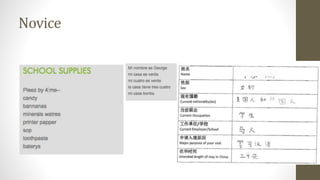
• At the novice level?
• “…lists and notes, primarily by writing words and phrases. ….limited formulaic information
on simple forms and documents. …reproduce practiced material to convey the most
simple messages. …transcribe familiar words or phrases, copy letters of the alphabet or
syllables of a syllabary, or reproduce basic characters with some accuracy.”
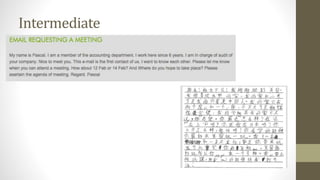
• At the intermediate level?
• “…ability to meet practical writing needs, such as simple messages and letters, requests
for information, and notes. ….ask and respond to simple questions in writing. ….create
with the language and communicate simple facts and ideas in a series of loosely
connected sentences on topics of personal interest and social needs. …primarily in present
time. . . . .basic vocabulary and structures to express meaning that is comprehensible to
those accustomed to the writing of non-natives.”
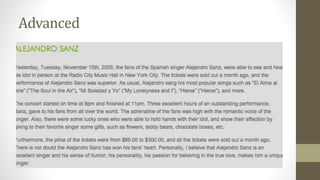
• At the advanced level?
What does writing look like . . .
• At the advanced level?
• . . .ability to write routine informal and some formal correspondence, as well as narratives,
descriptions, and summaries of a factual nature. They can narrate and describe in the
major time frames of past, present, and future, using paraphrasing and elaboration to
provide clarity. Advanced-level writers produce connected discourse of paragraph length
and structure. At this level, writers show good control of the most frequently used
structures and generic vocabulary, allowing them to be understood by those
unaccustomed to the writing of non-natives.
Novice
Intermediate
Advanced
Research
• VanPatten: “all learner production should be meaning-based, or communicative”
• Brown:
Work with students to see that . . .
• Writing is a process
• Texts have a purpose
• Texts have an audience
• Planning and organizing are important
Ideas for writing activities
• Create a comic strip. Try out the Pow! Strip Design app.
• Produce a movie and create closed-captions
• Make a presentation on Google Drive, Prezi, Haiku Deck, Keynote, or PowerPoint.
• Write a story using Storybird, or write a book using the Book Creator app.
• Create a story around an event by blending their own words with what was reported
about it on social media, using Storify.
• Make a poster to present their ideas using poster board or any number of apps with
this capability.
• (Many ideas above from http://www.edutopia.org/blog/authentic-activities-world-
language-classroom-sarah-loyola)
More ideas
• Free writing (journals, texts, emails) – focus on message, not on form (so, what kind
of feedback?)
• Type your ideas in the text box
Feedback
• Feedback vs. grading
• Rubrics
• https://coerll.utexas.edu/methods/modules/writing/04/
• Teachers should act as collaborators in the writing process. Your objective should be
to help students learn how to write well. Giving a simple grade to a written
assignment means that you judge that assignment. Giving it feedback and letting
students revise their written work will make your assignment be truly about writing.
• “Focus on content first, then on accuracy. This sequence will help your students view
writing as genuine interpersonal communication between the author and reader(s).
Research has found that when feedback focuses on content first, the final written
work is better both in content and accuracy (Semke, 1984).”
• “Facilitative comments maintain students' integrity and help keep them motivated.
Instead of writing a comment like "Don't use the subjunctive here", ask them a
question: What does the subjunctive form suggest here? Sometimes, students
intentionally flout linguistic norms for a creative, meaningful purpose (i.e., humor).
Find out before you mark it wrong. Negative statements will shut down your
students, while clarification questions will help them express an idea more
effectively.”
• “Self-correction increases accuracy, linguistic gains, and productivity. Make a few
marks on the paper, then pose questions and offer facilitative comments. This
process "forces" learners to resolve questions they still have and come up with the
solution themselves (with peer or instructor guidance as necessary).”
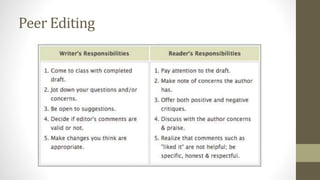
Peer Editing
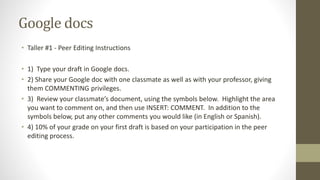
Google docs
• Taller #1 - Peer Editing Instructions
• 1) Type your draft in Google docs.
• 2) Share your Google doc with one classmate as well as with your professor, giving
them COMMENTING privileges.
• 3) Review your classmate’s document, using the symbols below. Highlight the area
you want to comment on, and then use INSERT: COMMENT. In addition to the
symbols below, put any other comments you would like (in English or Spanish).
• 4) 10% of your grade on your first draft is based on your participation in the peer
editing process.
Sample editing guide
• Composition Guidelines -- ABBREVIATIONS FOR GRAMMAR EDITING
GL grammar of the lesson/unit
SVA subject-verb agreement
AA adjective/article - noun agreement
G gender
WT wrong tense
s/e ser vs. Estar
SUB subjunctive necessary/not
Pro wrong pronoun
Prep wrong preposition
WW wrong word
MW missing word
WO word order
voc vocabulary
sp spelling
ac accent missing/unnecessary
a-p personal "a"
p/p por vs. Para
r repeated error
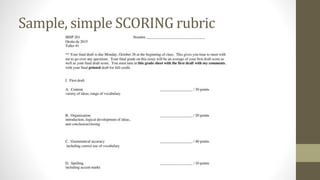
Sample, simple SCORING rubric
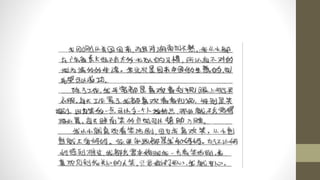
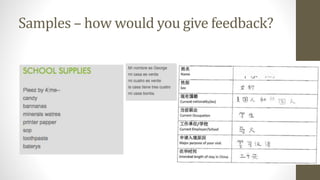
Samples – how would you give feedback?

Writing world language

  • 1.
  • 2.
    Purpose – • Througha review of the research, Teachers will explore high leverage techniques for improving student writing. •Teachers will examine student writing samples to identify high leverage feedback and instructional interventions.
  • 3.
    What is writing? •Is it “merely spoken language put down on paper”? (p. 244, Lee & VanPatten)
  • 4.
    Modes of Communication •Which modes do we engage when we write?
  • 5.
    What does writinglook like . . . • At the novice level? • “…lists and notes, primarily by writing words and phrases. ….limited formulaic information on simple forms and documents. …reproduce practiced material to convey the most simple messages. …transcribe familiar words or phrases, copy letters of the alphabet or syllables of a syllabary, or reproduce basic characters with some accuracy.” • At the intermediate level? • “…ability to meet practical writing needs, such as simple messages and letters, requests for information, and notes. ….ask and respond to simple questions in writing. ….create with the language and communicate simple facts and ideas in a series of loosely connected sentences on topics of personal interest and social needs. …primarily in present time. . . . .basic vocabulary and structures to express meaning that is comprehensible to those accustomed to the writing of non-natives.” • At the advanced level?
  • 6.
    What does writinglook like . . . • At the advanced level? • . . .ability to write routine informal and some formal correspondence, as well as narratives, descriptions, and summaries of a factual nature. They can narrate and describe in the major time frames of past, present, and future, using paraphrasing and elaboration to provide clarity. Advanced-level writers produce connected discourse of paragraph length and structure. At this level, writers show good control of the most frequently used structures and generic vocabulary, allowing them to be understood by those unaccustomed to the writing of non-natives.
  • 7.
  • 8.
  • 9.
  • 11.
    Research • VanPatten: “alllearner production should be meaning-based, or communicative” • Brown:
  • 12.
    Work with studentsto see that . . . • Writing is a process • Texts have a purpose • Texts have an audience • Planning and organizing are important
  • 13.
    Ideas for writingactivities • Create a comic strip. Try out the Pow! Strip Design app. • Produce a movie and create closed-captions • Make a presentation on Google Drive, Prezi, Haiku Deck, Keynote, or PowerPoint. • Write a story using Storybird, or write a book using the Book Creator app. • Create a story around an event by blending their own words with what was reported about it on social media, using Storify. • Make a poster to present their ideas using poster board or any number of apps with this capability. • (Many ideas above from http://www.edutopia.org/blog/authentic-activities-world- language-classroom-sarah-loyola)
  • 14.
    More ideas • Freewriting (journals, texts, emails) – focus on message, not on form (so, what kind of feedback?) • Type your ideas in the text box
  • 15.
    Feedback • Feedback vs.grading • Rubrics • https://coerll.utexas.edu/methods/modules/writing/04/
  • 16.
    • Teachers shouldact as collaborators in the writing process. Your objective should be to help students learn how to write well. Giving a simple grade to a written assignment means that you judge that assignment. Giving it feedback and letting students revise their written work will make your assignment be truly about writing.
  • 17.
    • “Focus oncontent first, then on accuracy. This sequence will help your students view writing as genuine interpersonal communication between the author and reader(s). Research has found that when feedback focuses on content first, the final written work is better both in content and accuracy (Semke, 1984).”
  • 18.
    • “Facilitative commentsmaintain students' integrity and help keep them motivated. Instead of writing a comment like "Don't use the subjunctive here", ask them a question: What does the subjunctive form suggest here? Sometimes, students intentionally flout linguistic norms for a creative, meaningful purpose (i.e., humor). Find out before you mark it wrong. Negative statements will shut down your students, while clarification questions will help them express an idea more effectively.”
  • 19.
    • “Self-correction increasesaccuracy, linguistic gains, and productivity. Make a few marks on the paper, then pose questions and offer facilitative comments. This process "forces" learners to resolve questions they still have and come up with the solution themselves (with peer or instructor guidance as necessary).”
  • 20.
  • 21.
    Google docs • Taller#1 - Peer Editing Instructions • 1) Type your draft in Google docs. • 2) Share your Google doc with one classmate as well as with your professor, giving them COMMENTING privileges. • 3) Review your classmate’s document, using the symbols below. Highlight the area you want to comment on, and then use INSERT: COMMENT. In addition to the symbols below, put any other comments you would like (in English or Spanish). • 4) 10% of your grade on your first draft is based on your participation in the peer editing process.
  • 22.
    Sample editing guide •Composition Guidelines -- ABBREVIATIONS FOR GRAMMAR EDITING GL grammar of the lesson/unit SVA subject-verb agreement AA adjective/article - noun agreement G gender WT wrong tense s/e ser vs. Estar SUB subjunctive necessary/not Pro wrong pronoun Prep wrong preposition WW wrong word MW missing word WO word order voc vocabulary sp spelling ac accent missing/unnecessary a-p personal "a" p/p por vs. Para r repeated error
  • 23.
  • 24.
    Samples – howwould you give feedback?