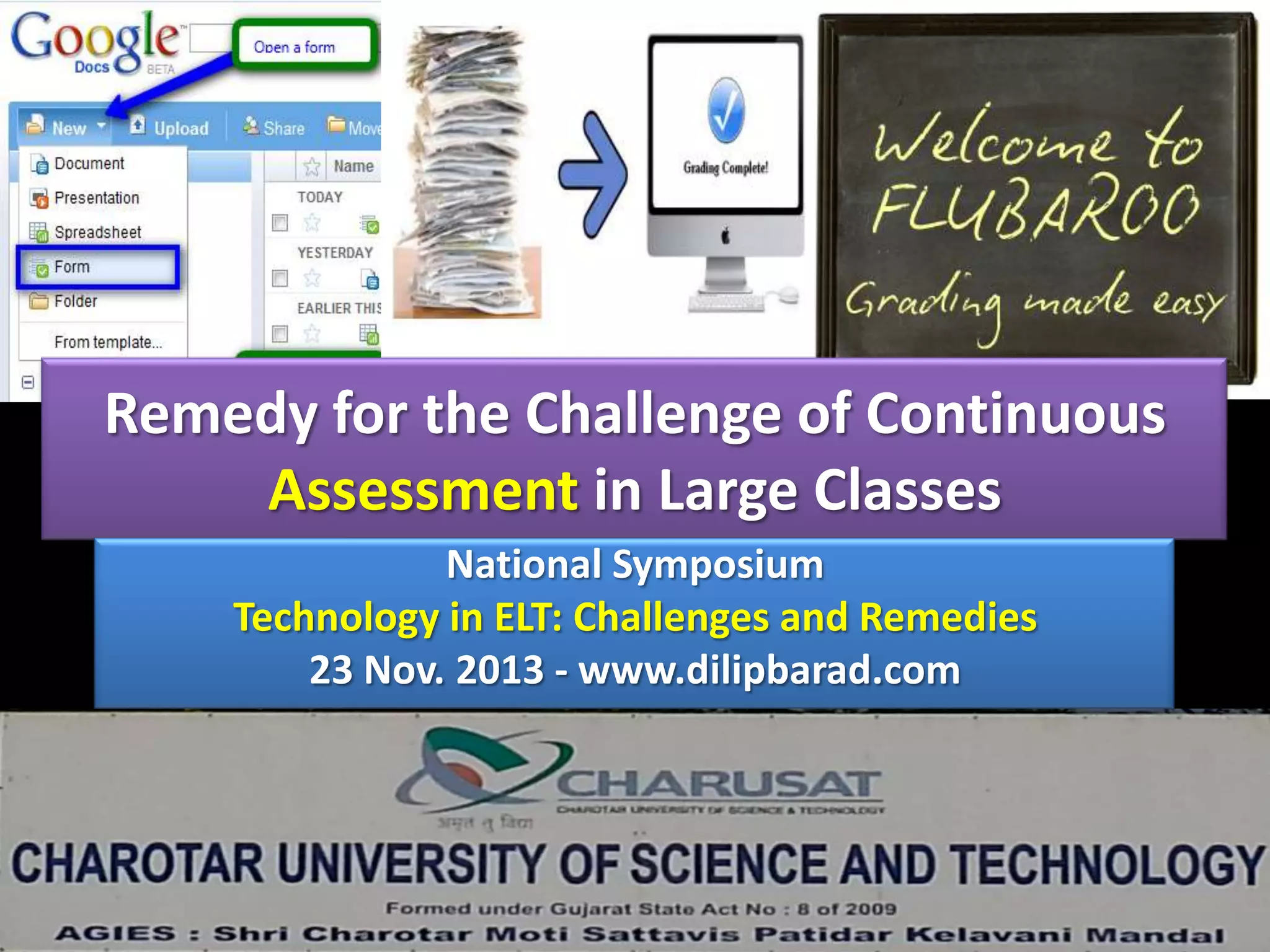


Remedy for the Challenge of Continuous
Assessment in Large Classes
National Symposium
Technology in ELT: Challenges and Remedies
23 Nov. 2013 - www.dilipbarad.com
Paradigm Shift . . .
•
•
•
•

From downloader to uploader…
From users to contributors…
From islands to bridges…
From isolated learning to collaborative
learning…
• From teaching to ‘engage in learning process . . .
• From active learning to interactive learning…
• From face-2-face to blended learning . . .
Need Analysis
• Generally, teacher begins a class with a few
questions :
– to map the mind and
– to concentrate learners attention
– to revise previous class
– to know what students have understood,
remembered
– to see if further revision is necessary or there is a
green signal to move ahead
Is teacher really able to do what he expects?
• No!
• Because most of the questions are answered by a
few enthusiasts / fast learners / class-leaders.
• Teacher moves ahead in teaching without getting
appropriate feedback for which s/he asks
questions.
• But how can a teacher know the progression of
each and every student, in the Indian conditions,
where normal class capacity ranges between 60 –
120 students?
• Here is the need of technology to help teacher!
But why technology?
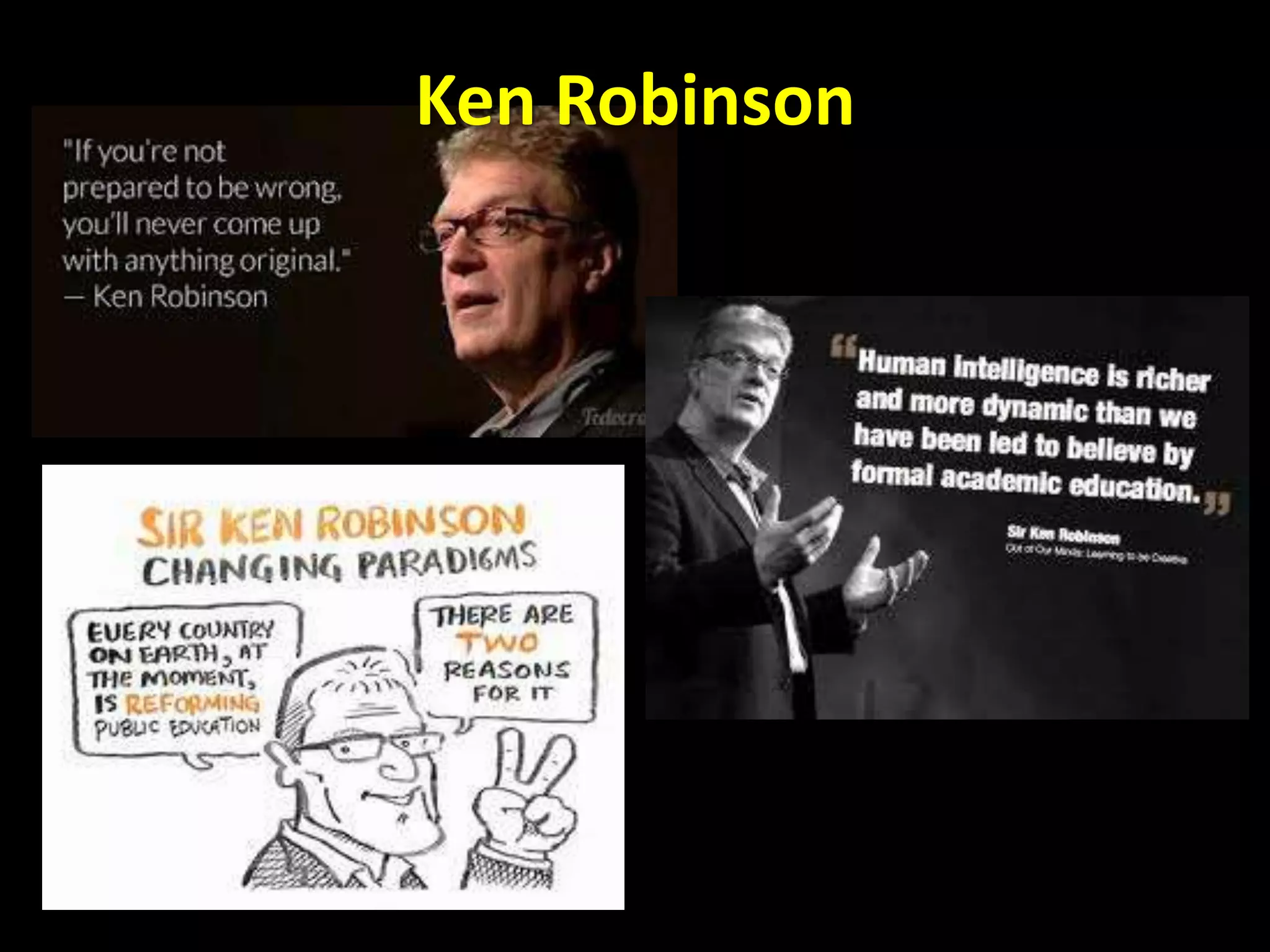
• Ken Robinson: The Changing Paradigm
– The video can be viewed here:
http://www.youtube.com/watch?v=zDZFcDGpL4U

• Sugata Mitra: The School in the Cloud
– The video can be viewed here:

http://www.ted.com/talks/sugata_mitra_build_a_
school_in_the_cloud.html

• Constructivism: Moodle Philosophy
• Digital Era: The MOOCs, Open Courses, Open
Education
Ken Robinson
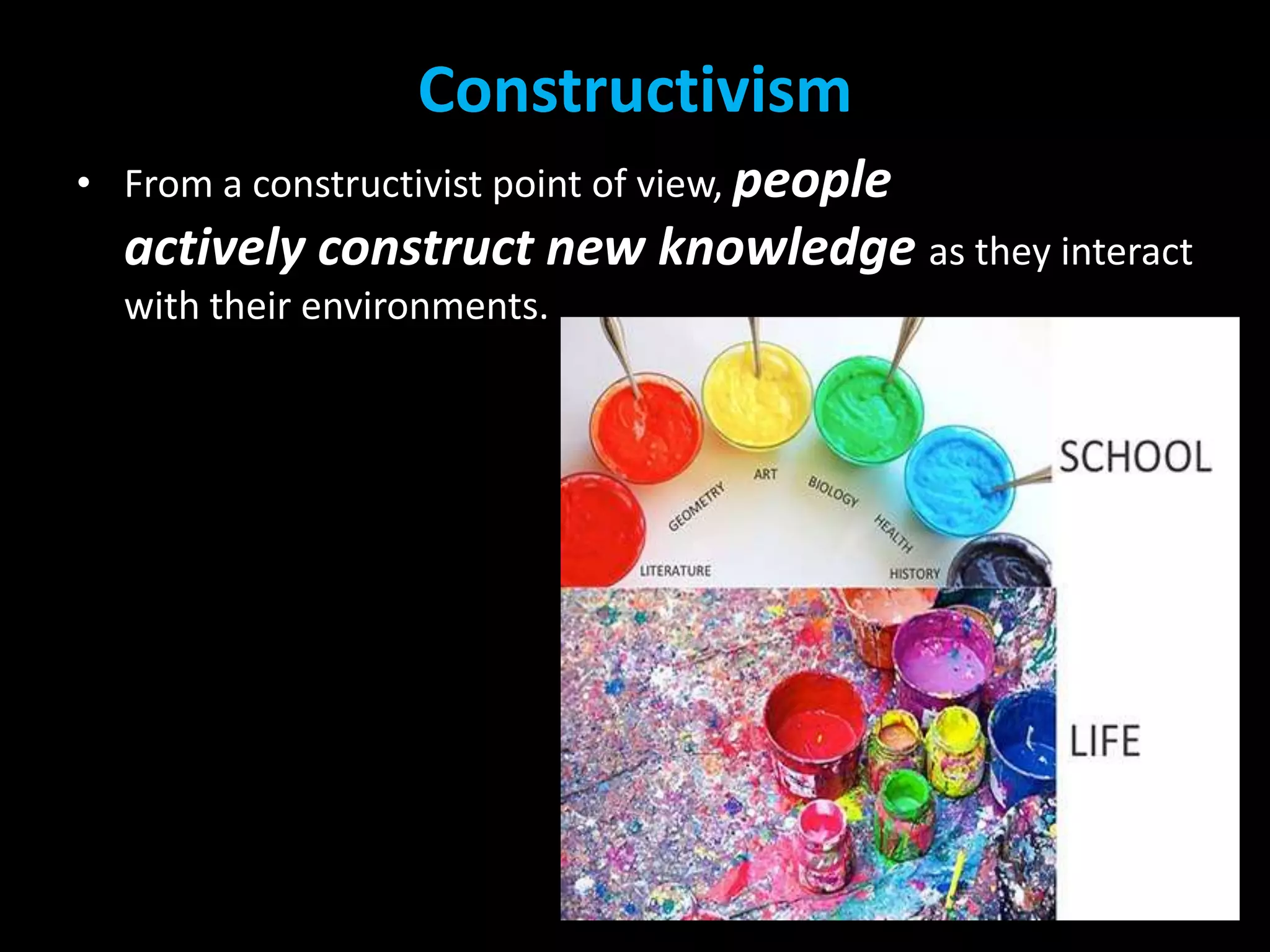
Constructivism
• From a constructivist point of view, people

actively construct new knowledge as they interact
with their environments.
•
•
•
•

•

Philosophy behind Online Learning Environment
Constructivism. What is this?
From a constructivist point of view, people
actively construct new knowledge as they interact with
their environments.
Everything you read, see, hear, feel, and touch is tested
against your prior knowledge and if it is viable within your
mental world, may form new knowledge you carry with you.
Knowledge is strengthened if you can use it successfully in
your wider environment. You are not just a memory bank
passively absorbing information, nor can knowledge be
"transmitted" to you just by reading something or listening
to someone.
This is not to say you can't learn anything from reading a web
page or watching a lecture, obviously you can, it's just
pointing out that there is more interpretation going on than a
transfer of information from one brain to another.
What is Constructionism?
• Constructionism asserts that learning is particularly
effective when constructing something for others to
experience. This can be anything from a spoken
sentence or an internet posting, to more complex
artifacts like a painting, a house or a software package.
• For example, you might read this page several times
and still forget it by tomorrow - but if you were to try
and explain these ideas to someone else in your own
words, or produce a slideshow that explained these
concepts, then it's very likely you'd have a better
understanding that is more integrated into your own
ideas. This is why people take notes during lectures
(even if they never read the notes again).
Social Constructivism
• Social constructivism extends constructivism into
social settings, wherein groups construct knowledge
for one another, collaboratively creating a small
culture of shared artifacts with shared meanings.
• When one is immersed within a culture like this, one
is learning all the time about how to be a part of that
culture, on many levels.
• simple example - a cup -"knowledge" about carrying
liquids.
• complex example - online course - the activities and
texts produced within the group as a whole will help
‘shape knowledge’ how each person behaves within
that group.
Connected and separate
• This idea looks deeper into the motivations of individuals within
a discussion:
• Separate behaviour is when someone tries to remain 'objective'
and 'factual', and tends to defend their own ideas using logic to
find holes in their opponent's ideas.
• Connected behaviour is a more empathic approach that accepts
subjectivity, trying to listen and ask questions in an effort to
understand the other point of view.
• Constructed behaviour is when a person is sensitive to both of
these approaches and is able to choose either of them as
appropriate to the current situation.
• In general, a healthy amount of connected behaviour within a
learning community is a very powerful stimulant for learning,
not only bringing people closer together but promoting deeper
reflection and re-examination of their ‘existing beliefs’.
M.K. Gandhi: Let us stop talking, and ‘do’ it
Testing and Evaluation
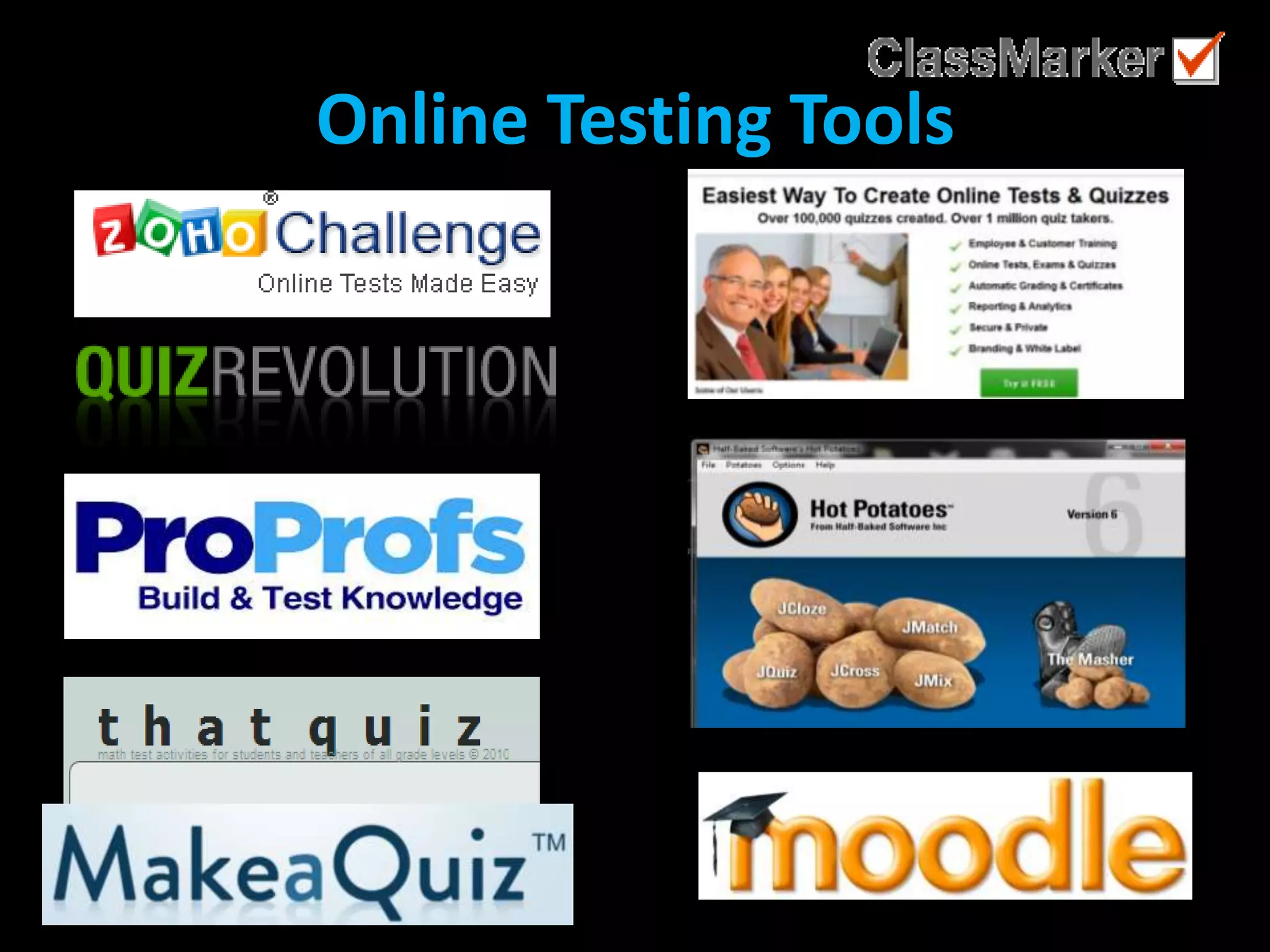
• Online Testing Tools
– Free > > >
– User Friendly – for students as well as teachers

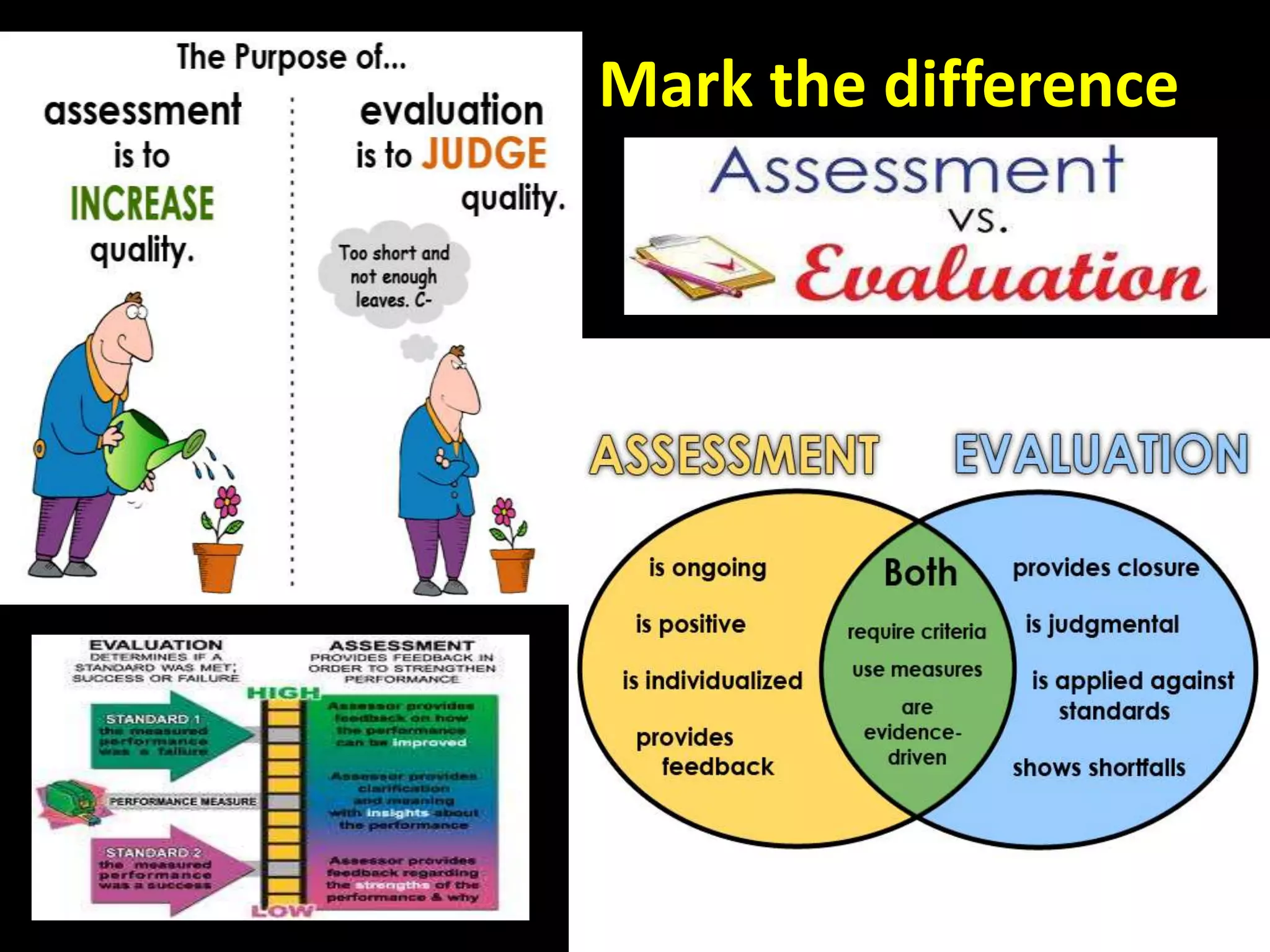
• Evaluation and Assessment
– Difference
– Continuous, almost daily or weekly evaluation
– Impossible task > how technology helps
– Auto generated grade-sheets
Online Testing Tools
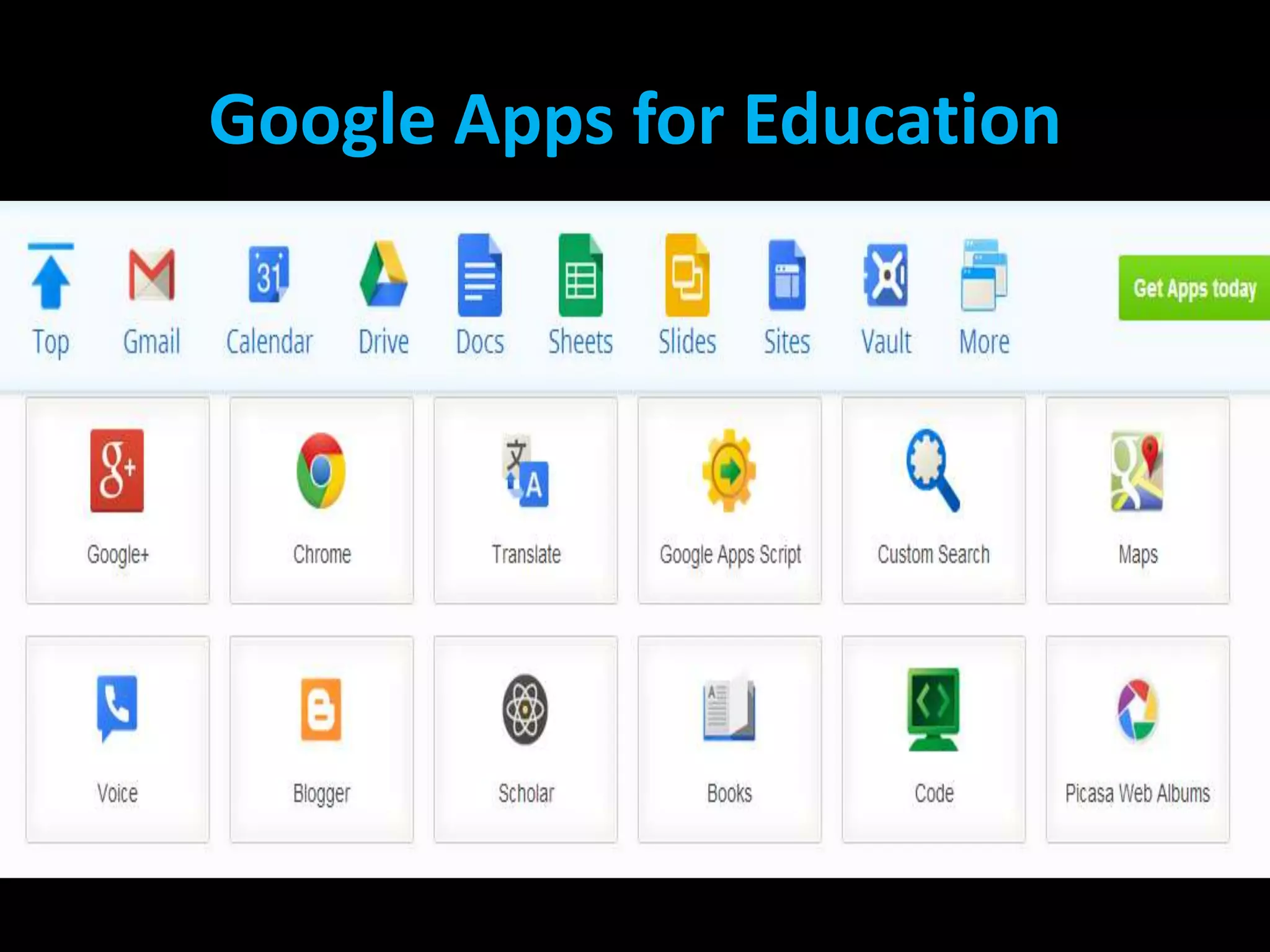
Google Apps for Education
Mark the difference
Daily testing and Evaluation
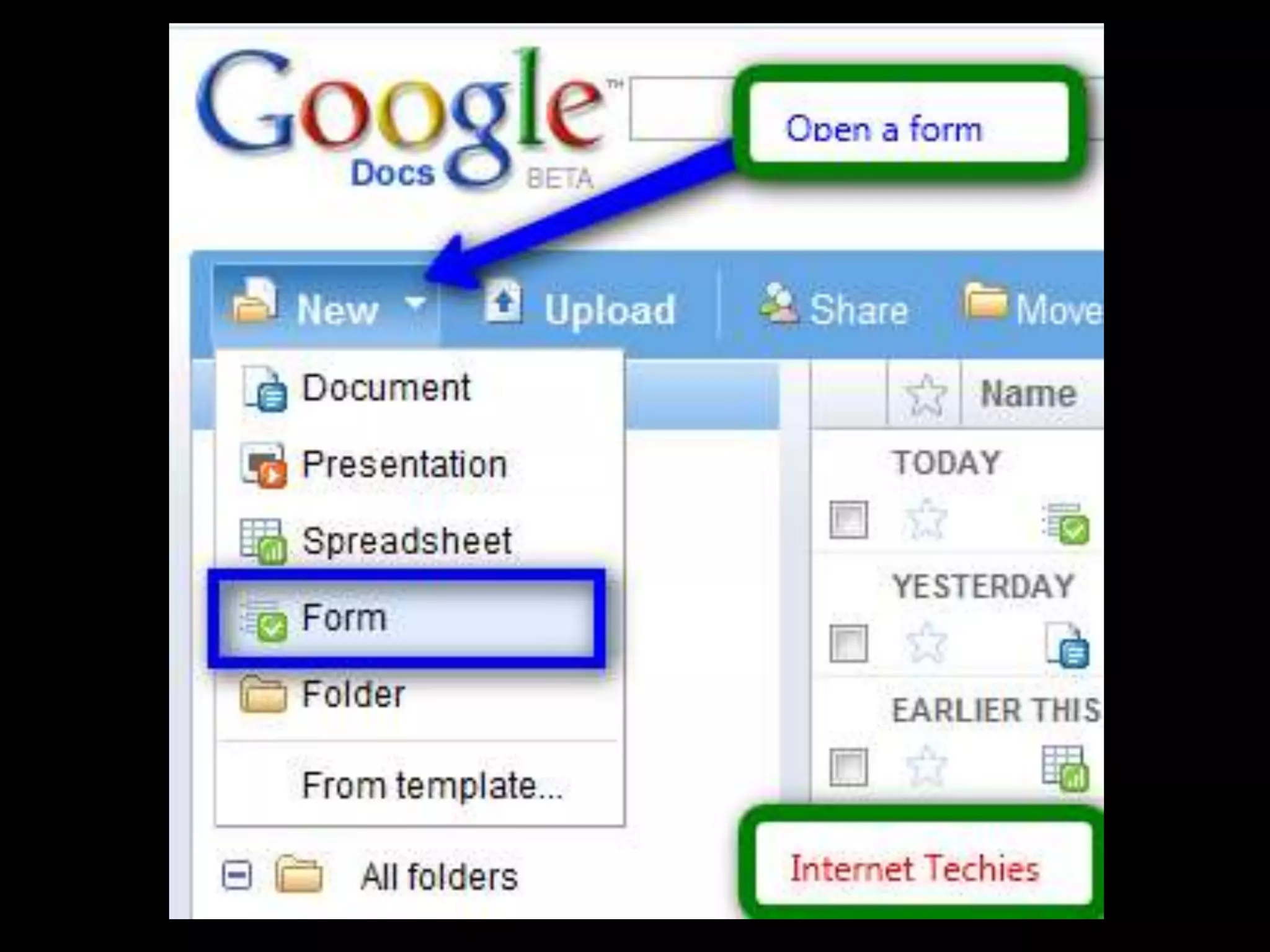
• Google Docs for test
– Allows collaborative / cooperative facility to prepare test
– Allows embedding of tests on Blog or Google Sites

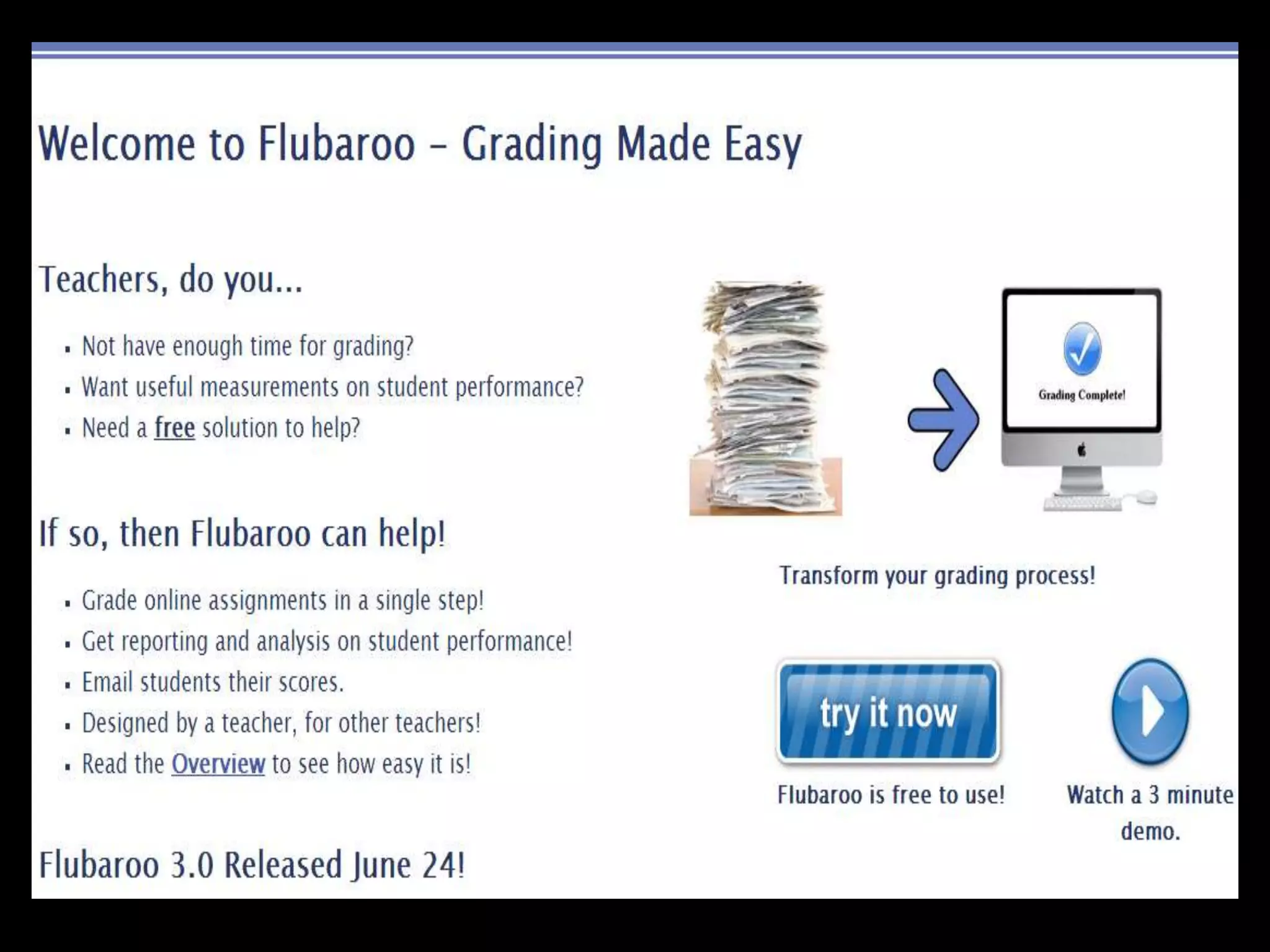
• Flubaroo for evaluation
–
–
–
–

Email grades
Re-grade
Personalized feedback
Allows collaborative / cooperative grading

– Let us see demo . . . Live during symposium with active
participation by a few select participants who came with
their own device (laptop or mobile or tablet or phablet)
Thank you
dilipbarad@gmail.com

Remedy for the Challenge of Continuous Assessment in Large Classes

  • 1.
    Remedy for theChallenge of Continuous Assessment in Large Classes National Symposium Technology in ELT: Challenges and Remedies 23 Nov. 2013 - www.dilipbarad.com
  • 2.
    Paradigm Shift .. . • • • • From downloader to uploader… From users to contributors… From islands to bridges… From isolated learning to collaborative learning… • From teaching to ‘engage in learning process . . . • From active learning to interactive learning… • From face-2-face to blended learning . . .
  • 3.
    Need Analysis • Generally,teacher begins a class with a few questions : – to map the mind and – to concentrate learners attention – to revise previous class – to know what students have understood, remembered – to see if further revision is necessary or there is a green signal to move ahead
  • 4.
    Is teacher reallyable to do what he expects? • No! • Because most of the questions are answered by a few enthusiasts / fast learners / class-leaders. • Teacher moves ahead in teaching without getting appropriate feedback for which s/he asks questions. • But how can a teacher know the progression of each and every student, in the Indian conditions, where normal class capacity ranges between 60 – 120 students? • Here is the need of technology to help teacher!
  • 5.
    But why technology? •Ken Robinson: The Changing Paradigm – The video can be viewed here: http://www.youtube.com/watch?v=zDZFcDGpL4U • Sugata Mitra: The School in the Cloud – The video can be viewed here: http://www.ted.com/talks/sugata_mitra_build_a_ school_in_the_cloud.html • Constructivism: Moodle Philosophy • Digital Era: The MOOCs, Open Courses, Open Education
  • 6.
  • 8.
    Constructivism • From aconstructivist point of view, people actively construct new knowledge as they interact with their environments.
  • 9.
    • • • • • Philosophy behind OnlineLearning Environment Constructivism. What is this? From a constructivist point of view, people actively construct new knowledge as they interact with their environments. Everything you read, see, hear, feel, and touch is tested against your prior knowledge and if it is viable within your mental world, may form new knowledge you carry with you. Knowledge is strengthened if you can use it successfully in your wider environment. You are not just a memory bank passively absorbing information, nor can knowledge be "transmitted" to you just by reading something or listening to someone. This is not to say you can't learn anything from reading a web page or watching a lecture, obviously you can, it's just pointing out that there is more interpretation going on than a transfer of information from one brain to another.
  • 10.
    What is Constructionism? •Constructionism asserts that learning is particularly effective when constructing something for others to experience. This can be anything from a spoken sentence or an internet posting, to more complex artifacts like a painting, a house or a software package. • For example, you might read this page several times and still forget it by tomorrow - but if you were to try and explain these ideas to someone else in your own words, or produce a slideshow that explained these concepts, then it's very likely you'd have a better understanding that is more integrated into your own ideas. This is why people take notes during lectures (even if they never read the notes again).
  • 11.
    Social Constructivism • Socialconstructivism extends constructivism into social settings, wherein groups construct knowledge for one another, collaboratively creating a small culture of shared artifacts with shared meanings. • When one is immersed within a culture like this, one is learning all the time about how to be a part of that culture, on many levels. • simple example - a cup -"knowledge" about carrying liquids. • complex example - online course - the activities and texts produced within the group as a whole will help ‘shape knowledge’ how each person behaves within that group.
  • 12.
    Connected and separate •This idea looks deeper into the motivations of individuals within a discussion: • Separate behaviour is when someone tries to remain 'objective' and 'factual', and tends to defend their own ideas using logic to find holes in their opponent's ideas. • Connected behaviour is a more empathic approach that accepts subjectivity, trying to listen and ask questions in an effort to understand the other point of view. • Constructed behaviour is when a person is sensitive to both of these approaches and is able to choose either of them as appropriate to the current situation. • In general, a healthy amount of connected behaviour within a learning community is a very powerful stimulant for learning, not only bringing people closer together but promoting deeper reflection and re-examination of their ‘existing beliefs’.
  • 13.
    M.K. Gandhi: Letus stop talking, and ‘do’ it
  • 14.
    Testing and Evaluation •Online Testing Tools – Free > > > – User Friendly – for students as well as teachers • Evaluation and Assessment – Difference – Continuous, almost daily or weekly evaluation – Impossible task > how technology helps – Auto generated grade-sheets
  • 15.
  • 16.
    Google Apps forEducation
  • 18.
  • 20.
    Daily testing andEvaluation • Google Docs for test – Allows collaborative / cooperative facility to prepare test – Allows embedding of tests on Blog or Google Sites • Flubaroo for evaluation – – – – Email grades Re-grade Personalized feedback Allows collaborative / cooperative grading – Let us see demo . . . Live during symposium with active participation by a few select participants who came with their own device (laptop or mobile or tablet or phablet)
  • 21.

Editor's Notes

  • #10 http://docs.moodle.org/22/en/Philosophy