Plant Propagation Methodologies
Seeding, Grafting, Budding,
Cuttings and Layering
Roy Beckford – Agriculture & Natural Resources Agent
Plant Propagation
There are two methods of
plant propagation:
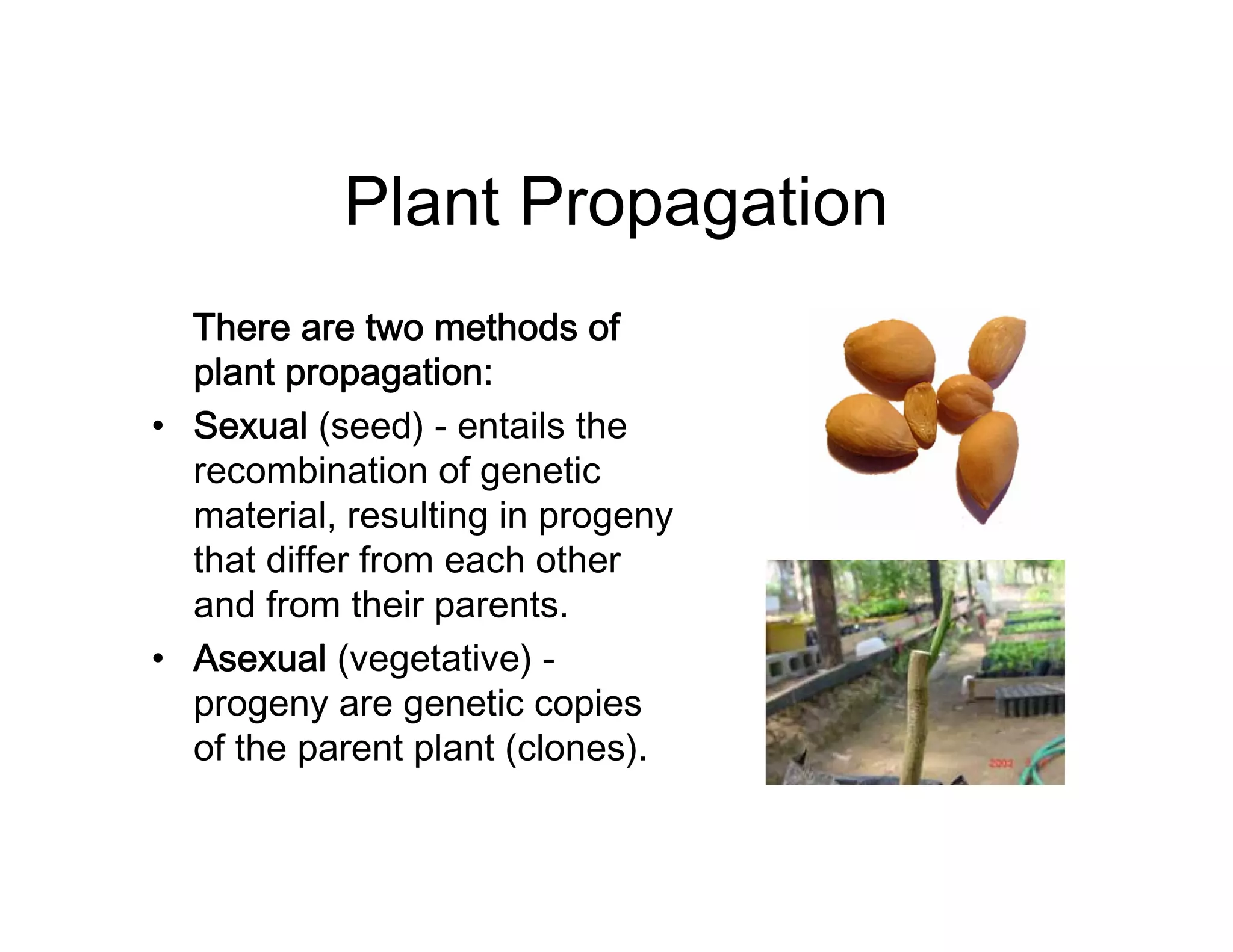
• Sexual (seed) - entails the
recombination of genetic
material, resulting in progeny
that differ from each other
and from their parents.
• Asexual (vegetative) -
progeny are genetic copies
of the parent plant (clones).
Definitions:
• Grafting: - joining the parts of two separate plants so
that they will unite and continue to grow as a single plant
• Budding: - is a modification of grafting, involving the
use of a scion with only a single bud attached to a piece
of bark.
• Scion: - That part of the union to be attached to the
rootstock
• Stock: - That part of the union which contains the root
portion of the union
Grafting and Budding
• Grafting and budding involve joining two
genetically distinct plants so that they
unite to continue growth as a single
plant
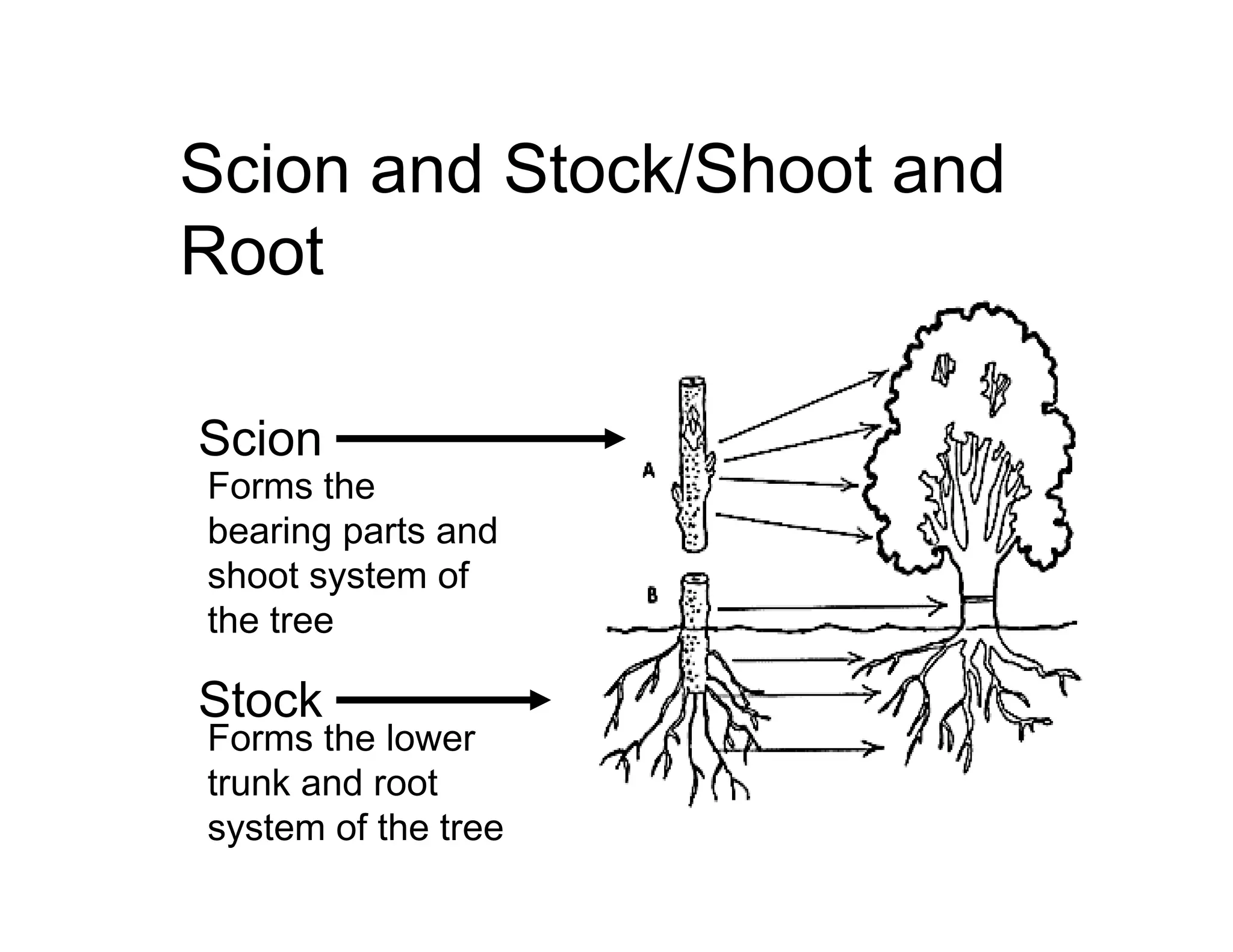
Scion
Stock
Forms the
bearing parts and
shoot system of
the tree
Forms the lower
trunk and root
system of the tree
Scion and Stock/Shoot and
Root
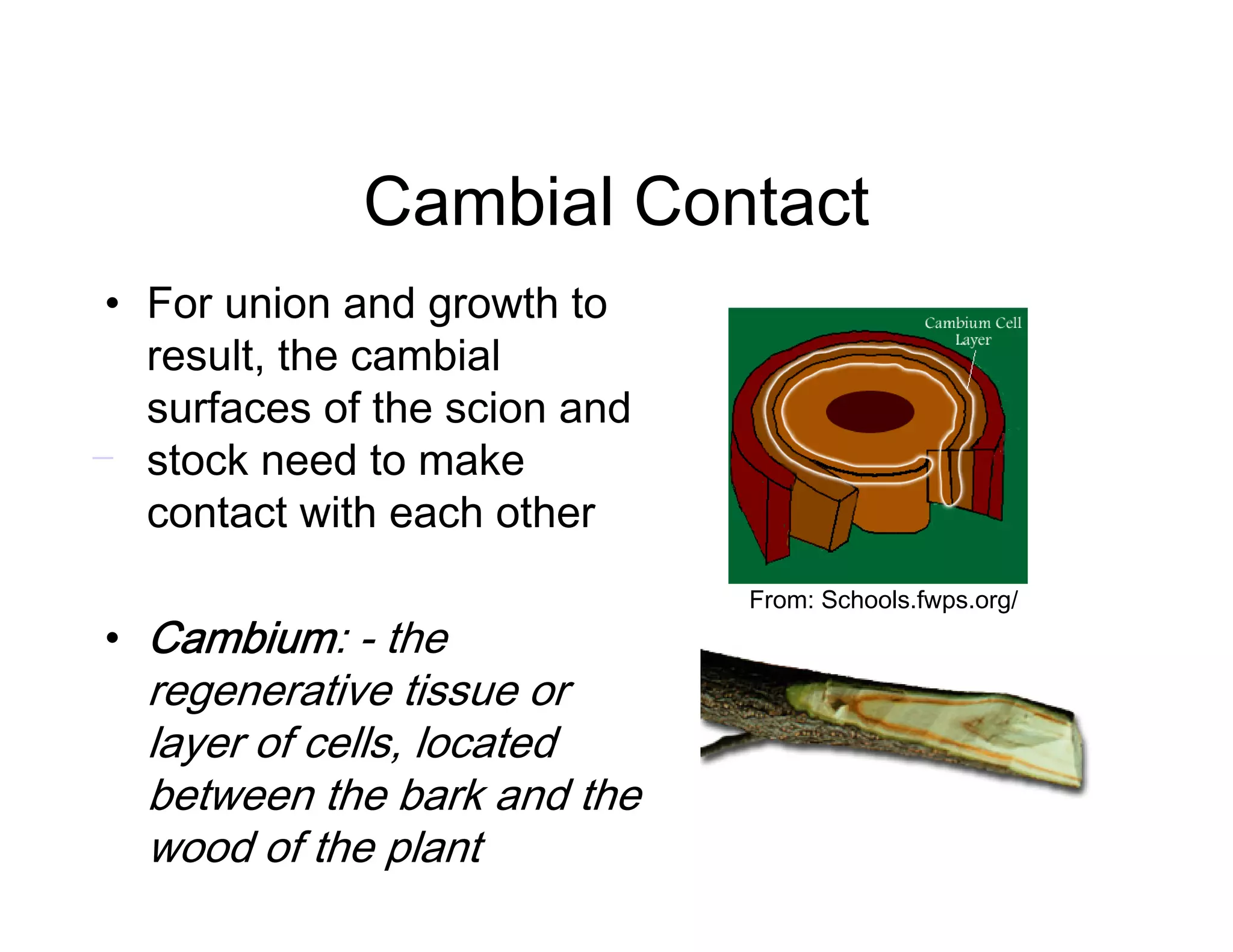
Cambial Contact
• For union and growth to
result, the cambial
surfaces of the scion and
stock need to make
contact with each other
• Cambium: - the
regenerative tissue or
layer of cells, located
between the bark and the
wood of the plant
From: Schools.fwps.org/
Grafting and Budding
• Grafting and Budding are the most important
means of propagating fruit and nut trees for
two reasons:
1. Species and cultivars that cannot be
propagated by cutting or layering can be
propagated by budding and grafting.
2. Budding and grafting allows the use of
rootstocks with desirable characteristics that
make them preferable to growing a tree on
its own roots.
Advantages and Disadvantages
• Quick method of
uniform propagation
• Plants with similar
characteristics (color,
fruit superiority etc.)
• Disease resistance
especially in rootstock
• Greater ability of
producer to control
outcome
• Higher susceptibility
to epidemics
• Hurricane tolerance
lowered?
Grafting and Budding
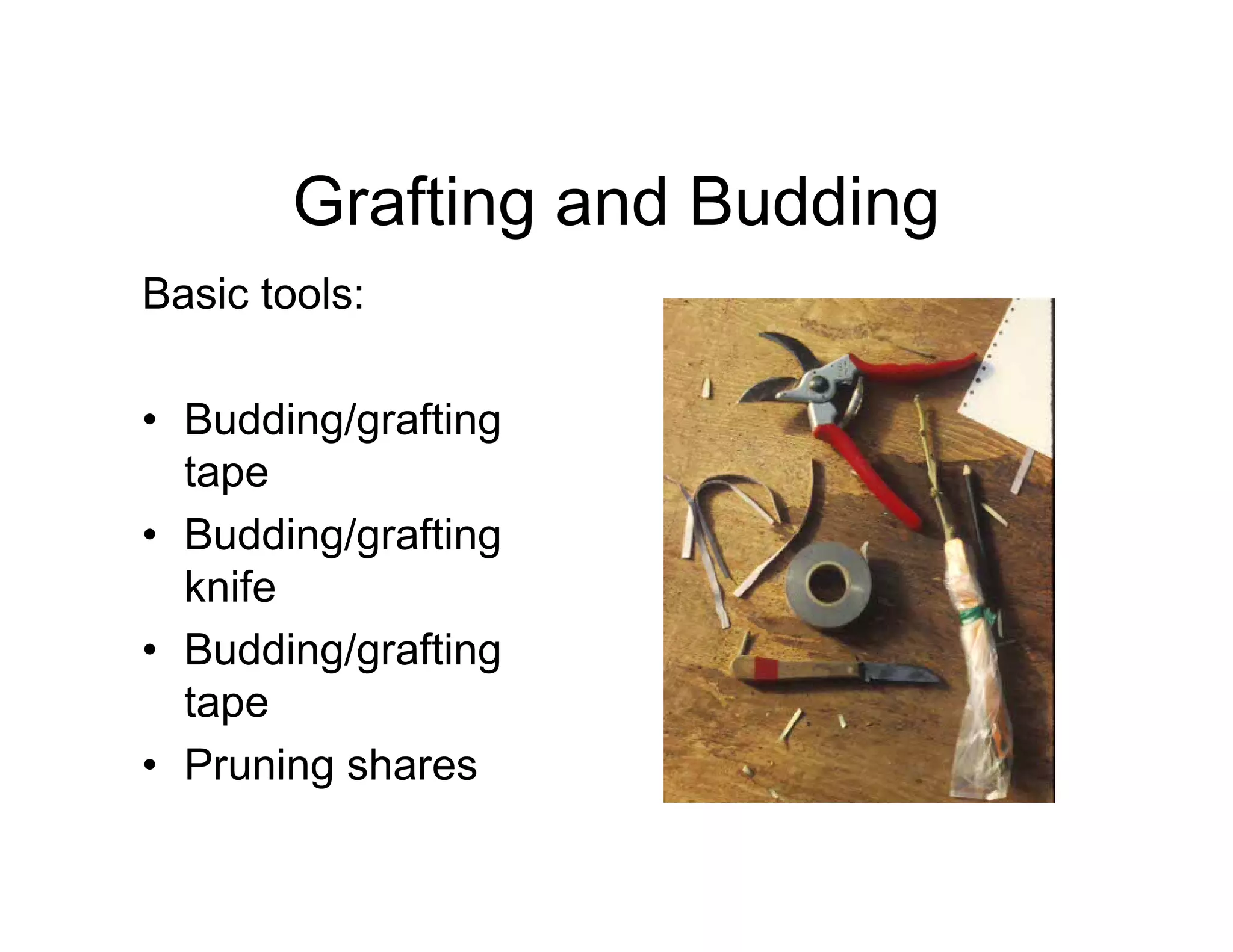
Basic tools:
• Budding/grafting
tape
• Budding/grafting
knife
• Budding/grafting
tape
• Pruning shares
Grafting and Budding
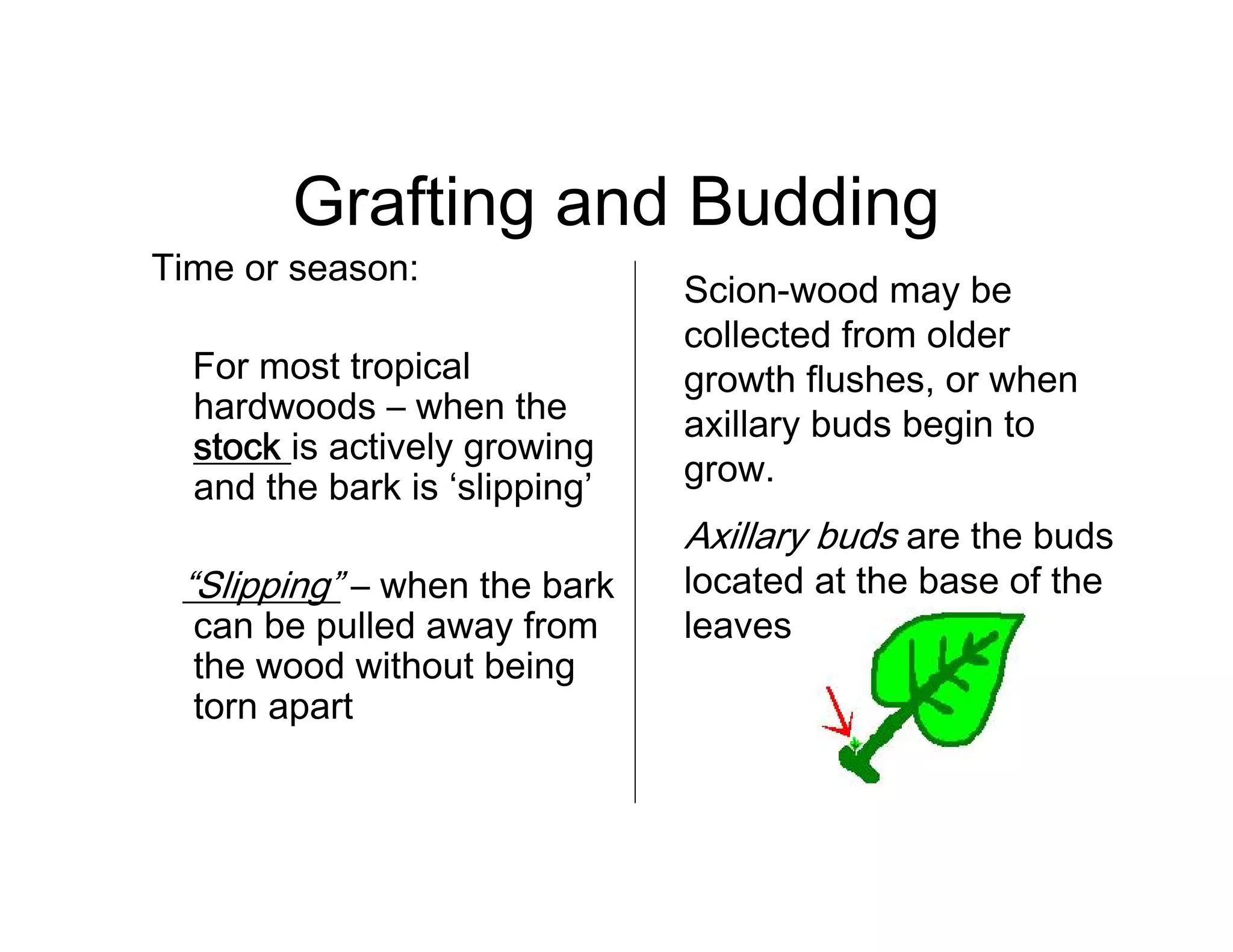
Time or season:
For most tropical
hardwoods – when the
stock is actively growing
and the bark is ‘slipping’
“Slipping” – when the bark
can be pulled away from
the wood without being
torn apart
Scion-wood may be
collected from older
growth flushes, or when
axillary buds begin to
grow.
Axillary buds are the buds
located at the base of the
leaves
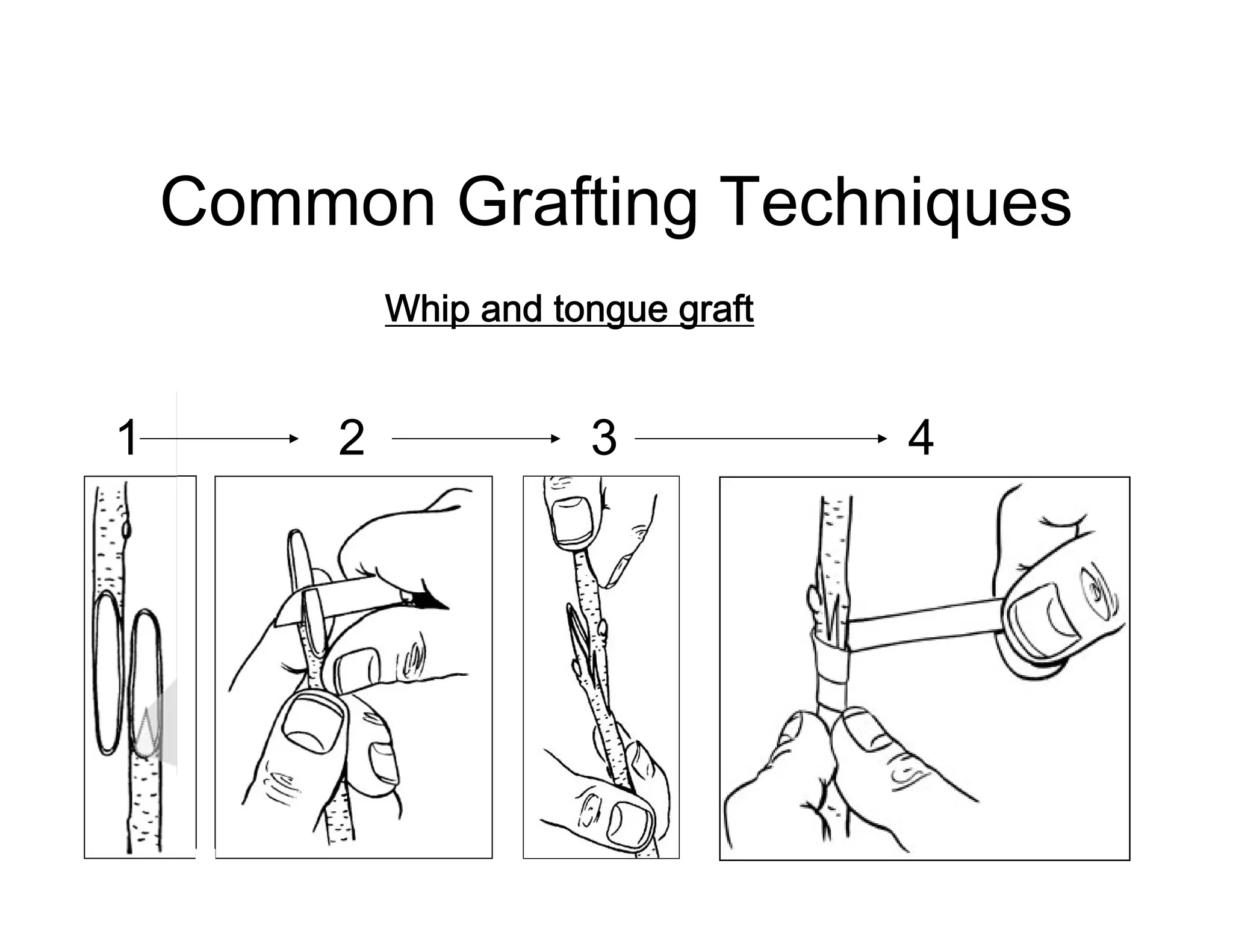
Common Grafting Techniques
Whip and tongue graft
1 2 3 4
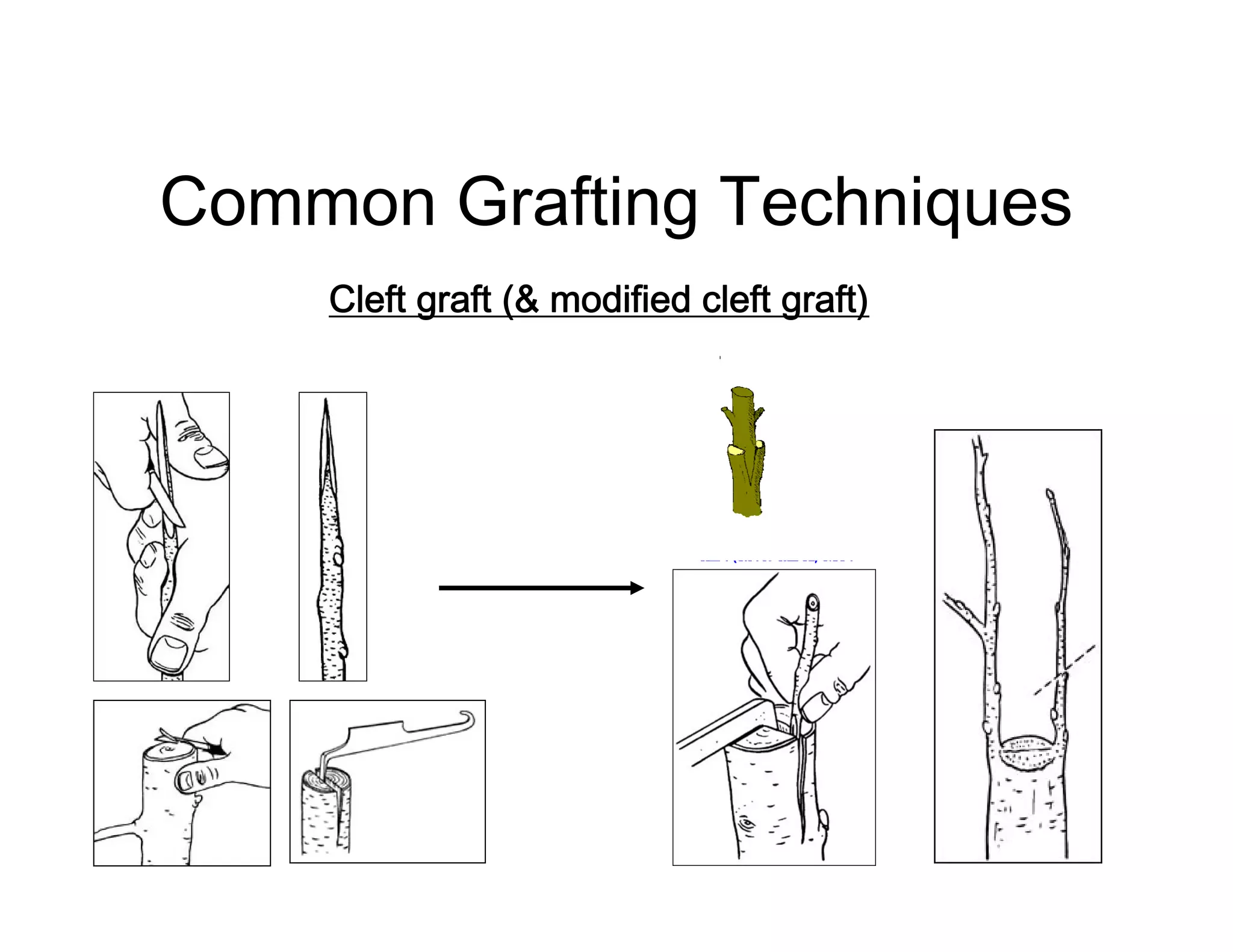
Common Grafting Techniques
Cleft graft (& modified cleft graft)
Common Grafting Techniques
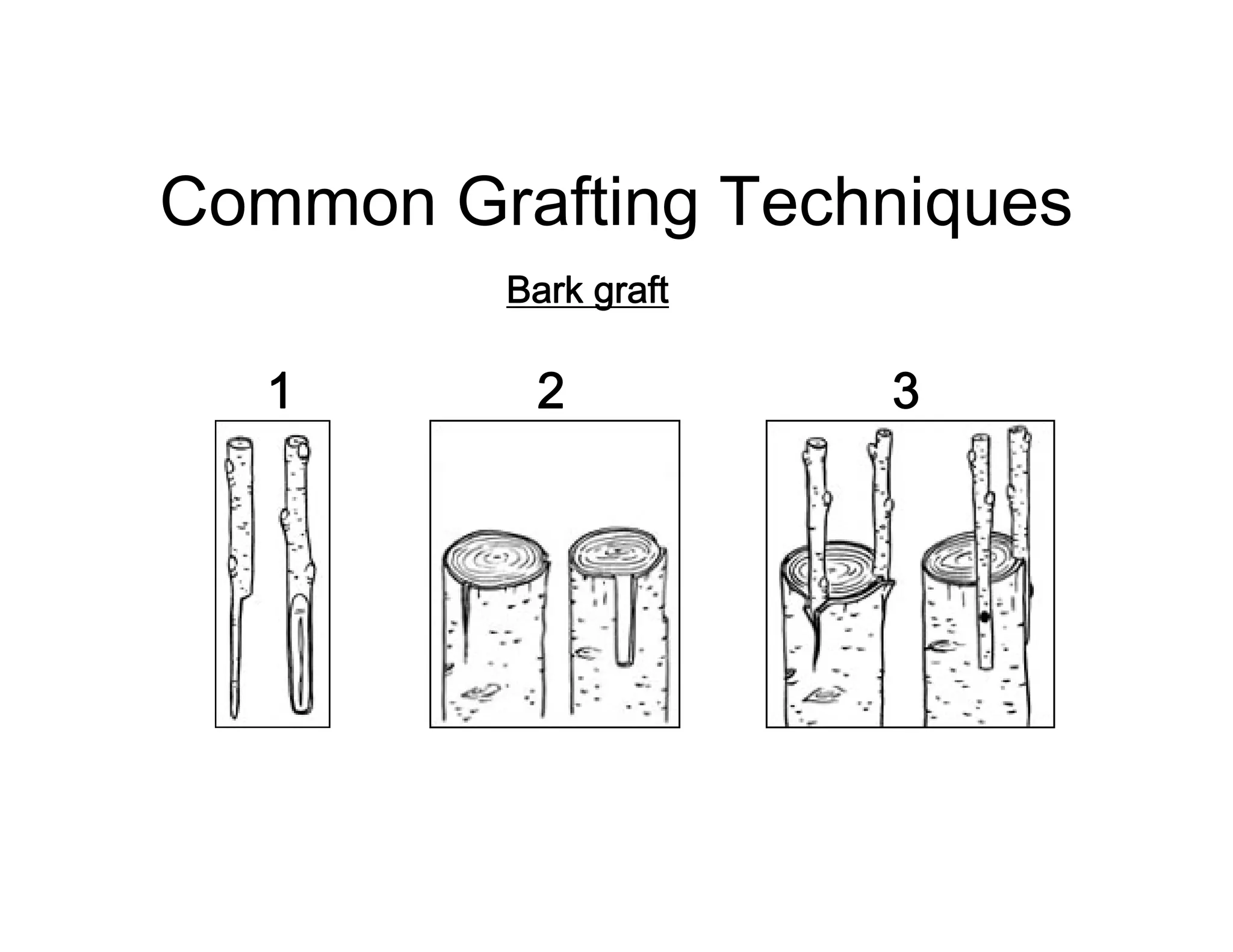
Bark graft
1 2 3
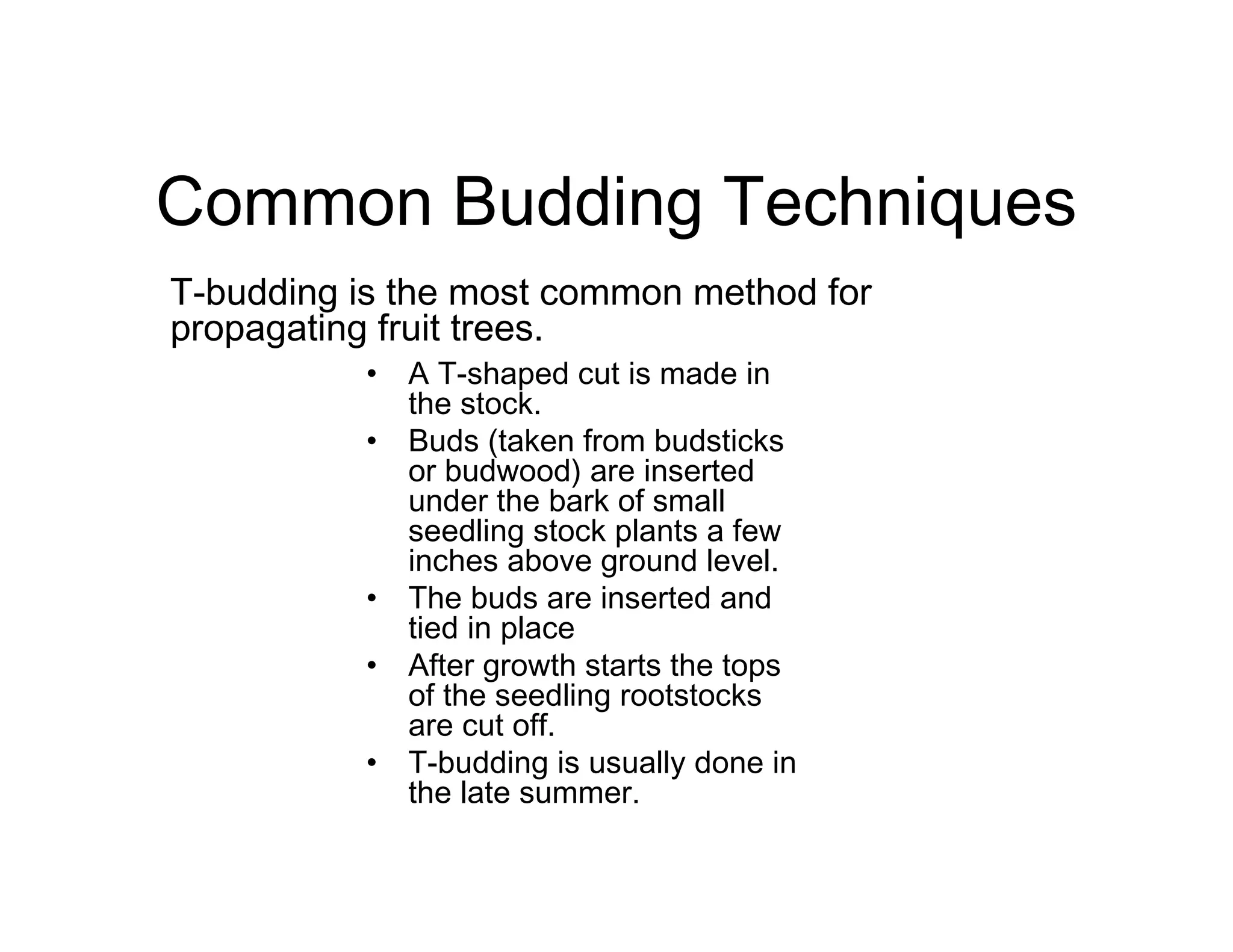
Common Budding Techniques
• A T-shaped cut is made in
the stock.
• Buds (taken from budsticks
or budwood) are inserted
under the bark of small
seedling stock plants a few
inches above ground level.
• The buds are inserted and
tied in place
• After growth starts the tops
of the seedling rootstocks
are cut off.
• T-budding is usually done in
the late summer.
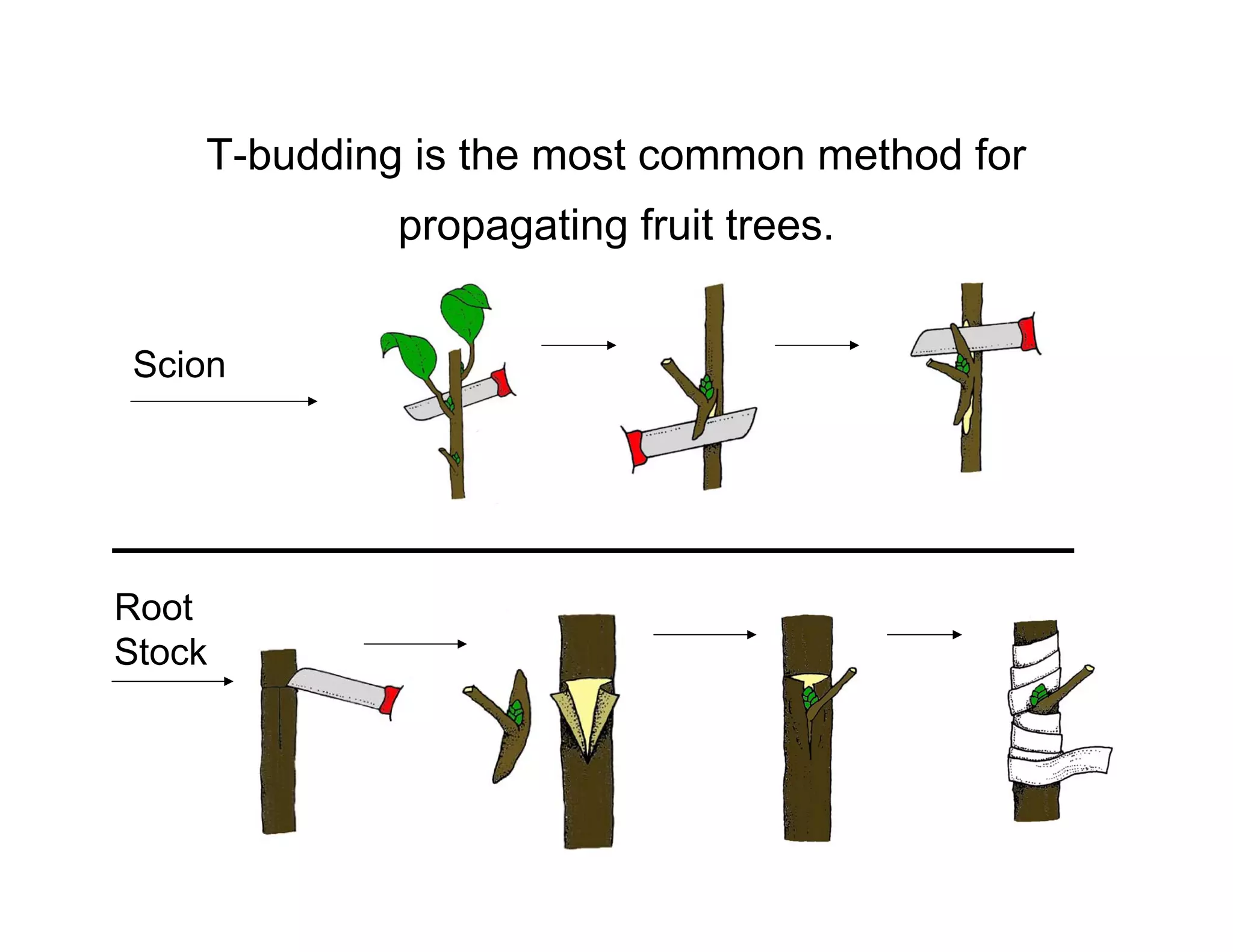
T-budding is the most common method for
propagating fruit trees.
T-budding is the most common method for
propagating fruit trees.
Scion
Root
Stock
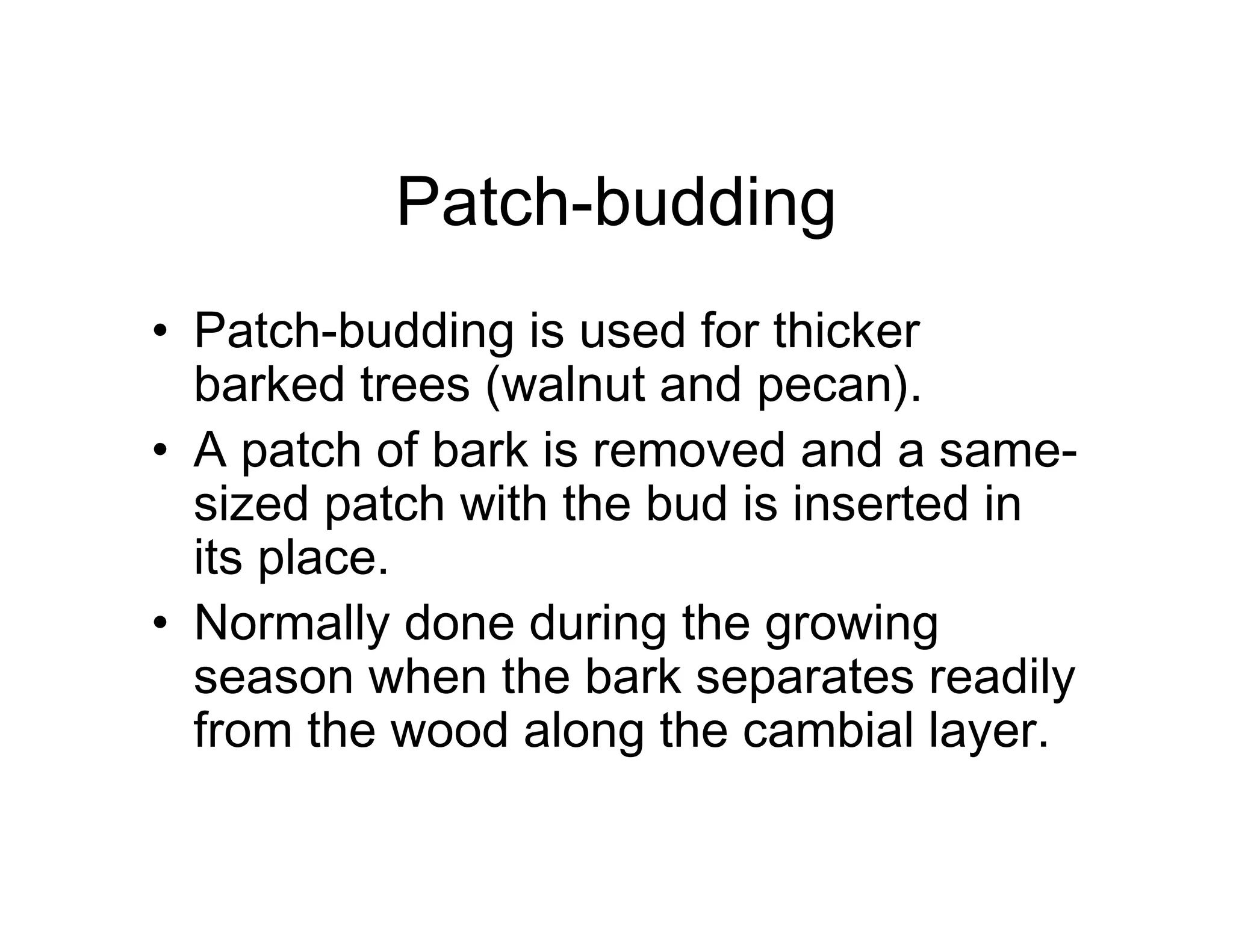
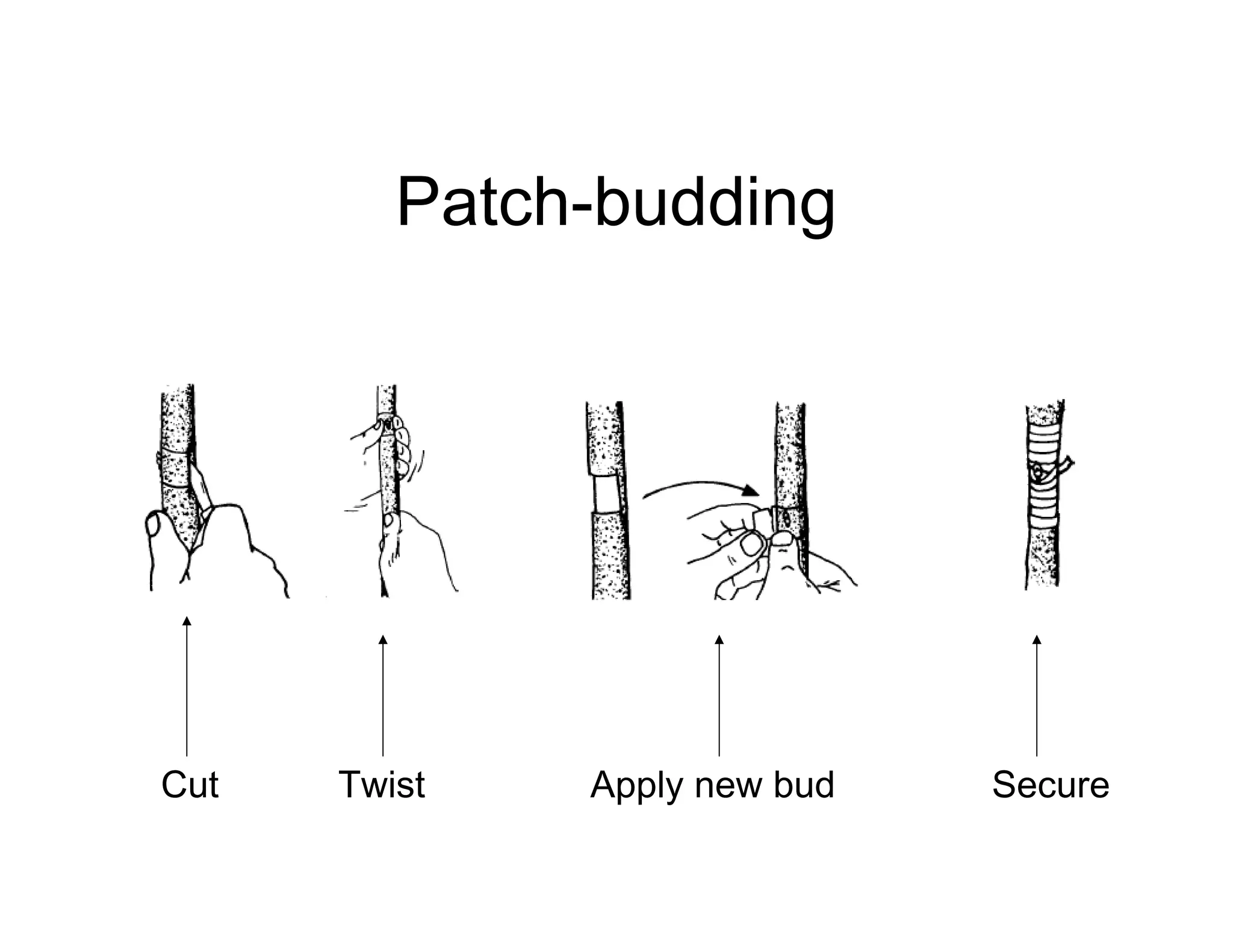
Patch-budding
• Patch-budding is used for thicker
barked trees (walnut and pecan).
• A patch of bark is removed and a same-
sized patch with the bud is inserted in
its place.
• Normally done during the growing
season when the bark separates readily
from the wood along the cambial layer.
Patch-budding
Cut Twist Apply new bud Secure
Propagation by Cuttings
• A cutting is a piece of vegetative tissue (stem,
root or leaf) that, when placed under suitable
environmental conditions, will regenerate the
missing parts and produce a self-sustaining
plant.
• Used mainly in the clonal propagation of
herbaceous and some woody ornamental
species. Cuttings are less frequently used for
fruit and nut trees.
Cuttings
• Some species can be readily propagated
from hardwood cuttings of stems taken in late
winter or early spring.
• Usually 6 - 12 " of stem, are placed in the
ground in nursery rows with just the top bud
showing.
• Cuttings will generate roots and can be
transplanted as self sustaining plants.
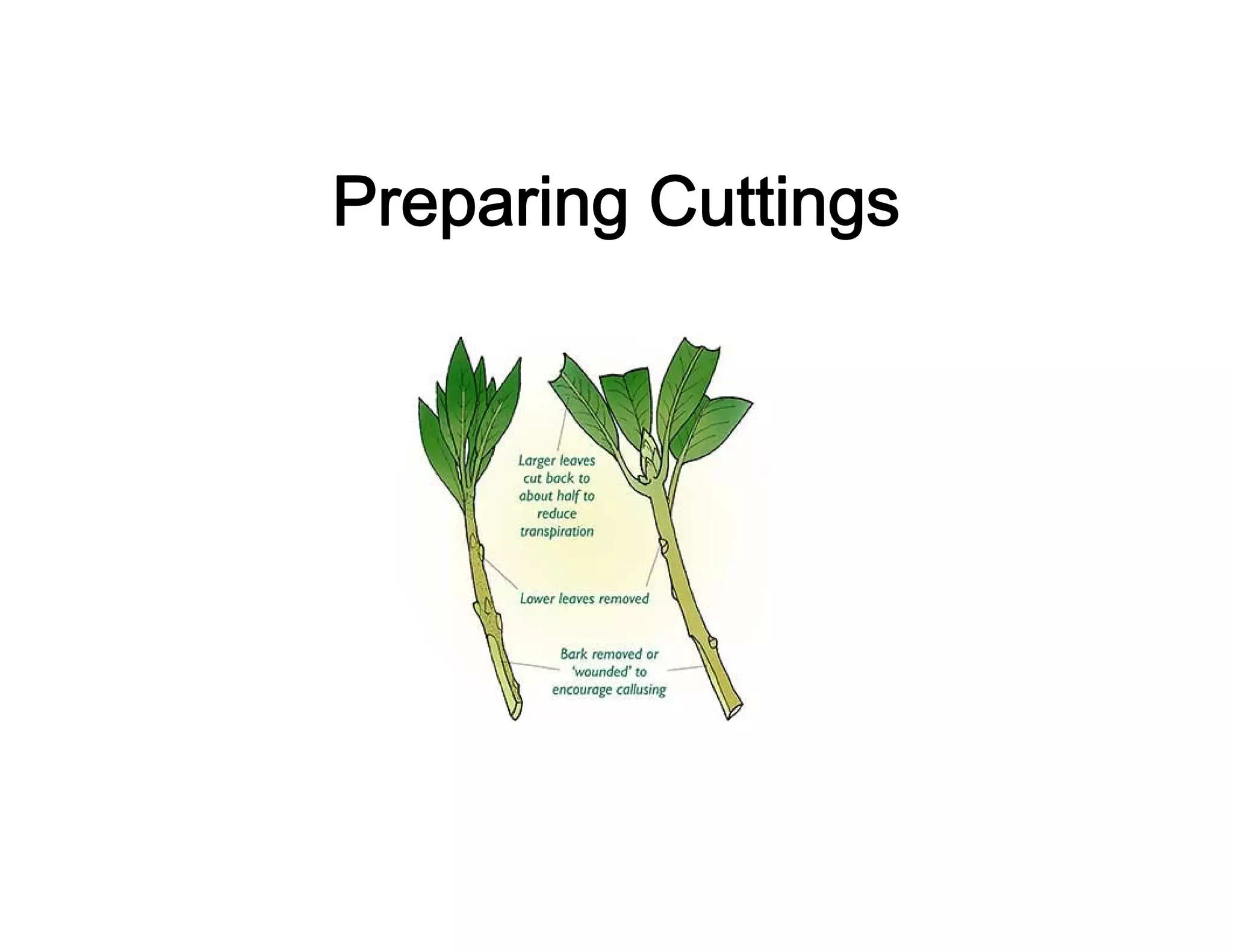
Preparing Cuttings
Sanitation:
• The cutting propagation process fosters conditions
that favor the development of disease and insect
problems.
• Open wounds are avenues through which pest
problems can enter plants
- Cuttings should be disease and insect free
- The instruments used to prepare cuttings should be
clean
- The cutting preparation area should be cleaned
before and after cuttings are prepared
- Be careful not to damage leaves and cuttings
Damaged cuttings are more likely to have problems
in rooting both from disease and insects as well as
from pre-mature aging of damaged tissue
Preparing Cuttings
Hormones:
• Rooting hormones used in the nursery
industry are synthetic versions of naturally
occurring plant compounds called auxins.
• Hormones are needed by plants in very small
quantities so they are sold in ready to use or
ready to be diluted formulations mixed with
something else.
• The most common forms are mixed with talc
and come in a powder form
Preparing Cuttings
Layering
• The development of roots on a stem
while the stem is still attached to the
parent plant is called layering.
• A layer is the rooted stem following
detachment (removal) from the parent
plant.
Types of Layering
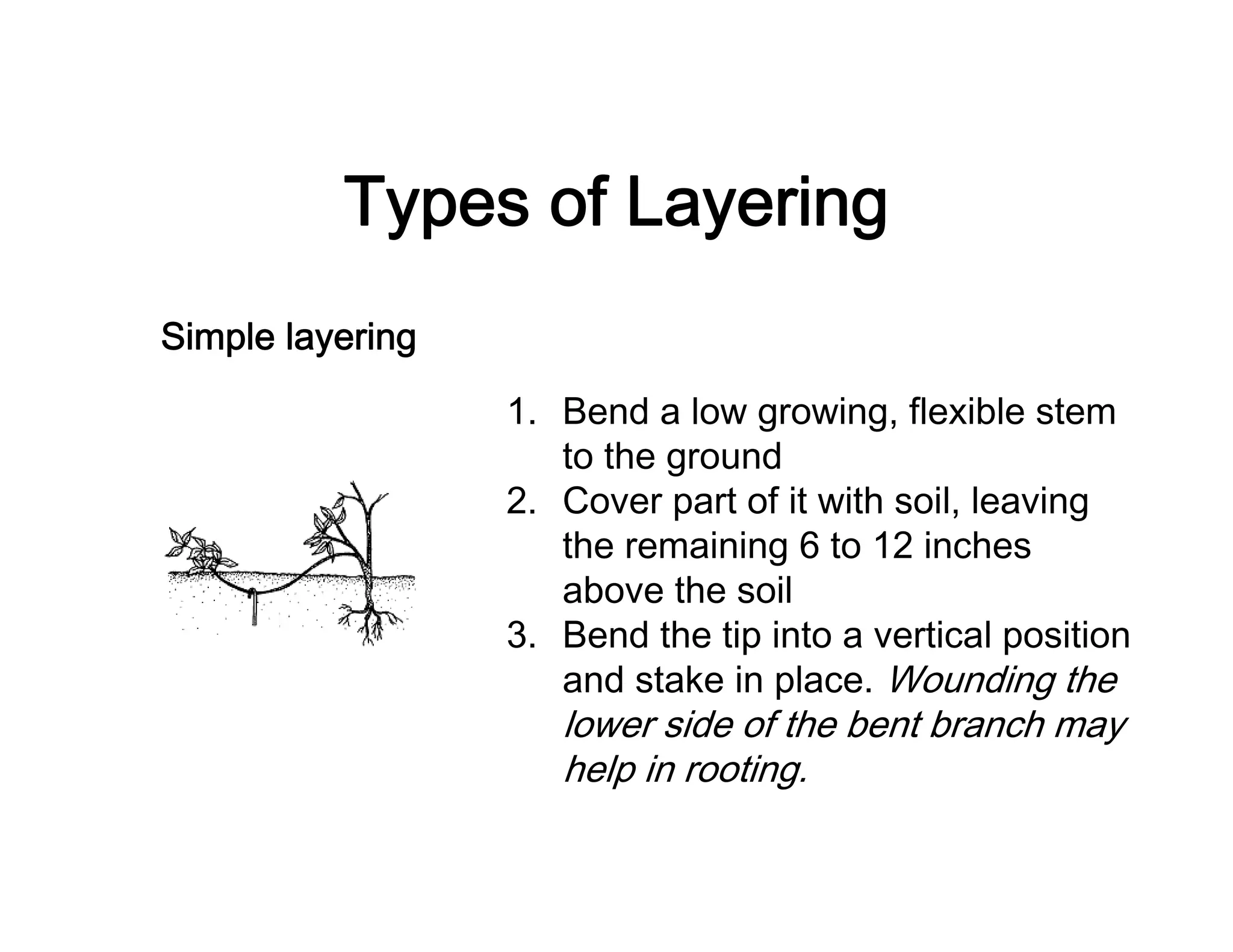
Simple layering
1. Bend a low growing, flexible stem
to the ground
2. Cover part of it with soil, leaving
the remaining 6 to 12 inches
above the soil
3. Bend the tip into a vertical position
and stake in place. Wounding the
lower side of the bent branch may
help in rooting.
Types of Layering
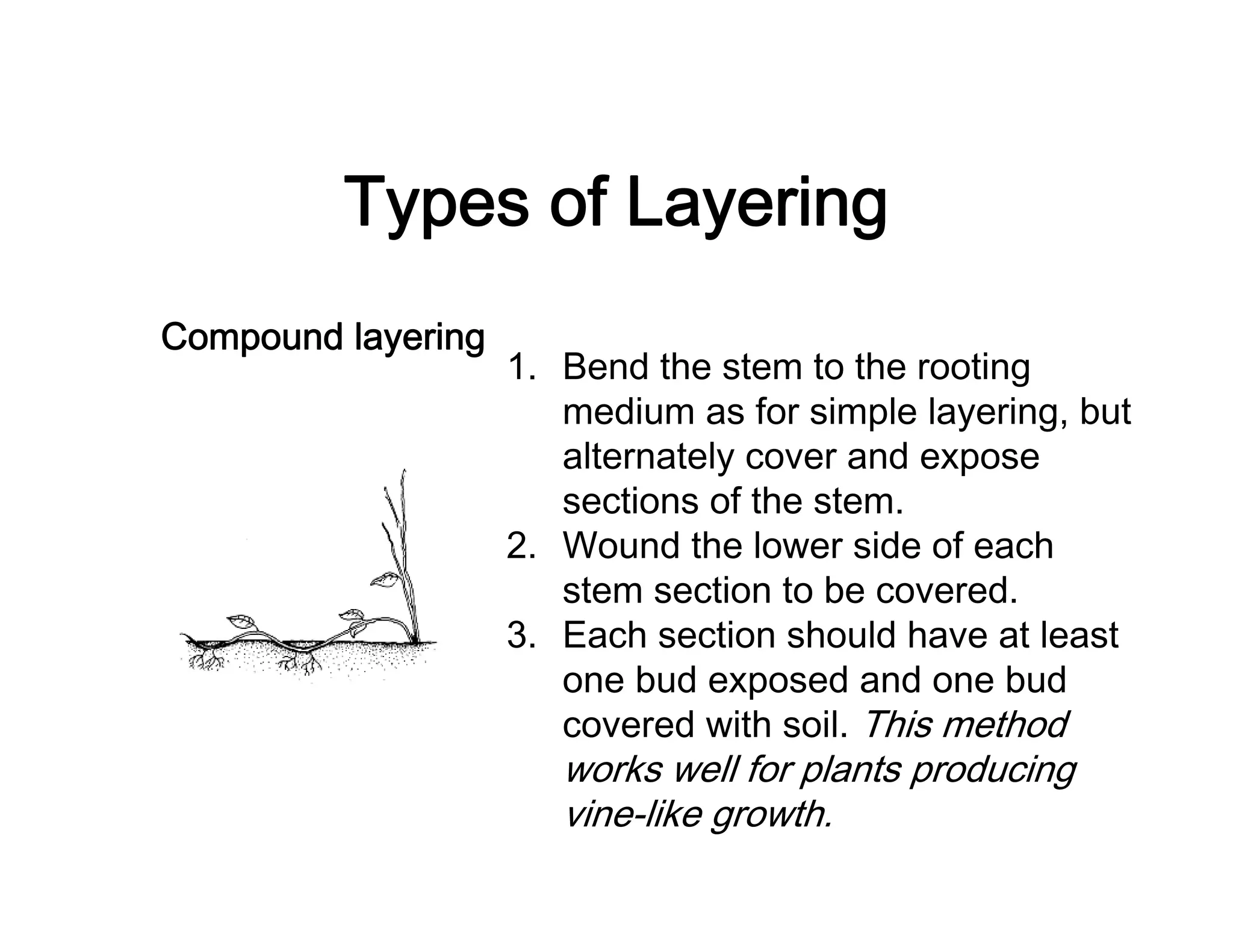
Compound layering
1. Bend the stem to the rooting
medium as for simple layering, but
alternately cover and expose
sections of the stem.
2. Wound the lower side of each
stem section to be covered.
3. Each section should have at least
one bud exposed and one bud
covered with soil. This method
works well for plants producing
vine-like growth.
Types of Layering
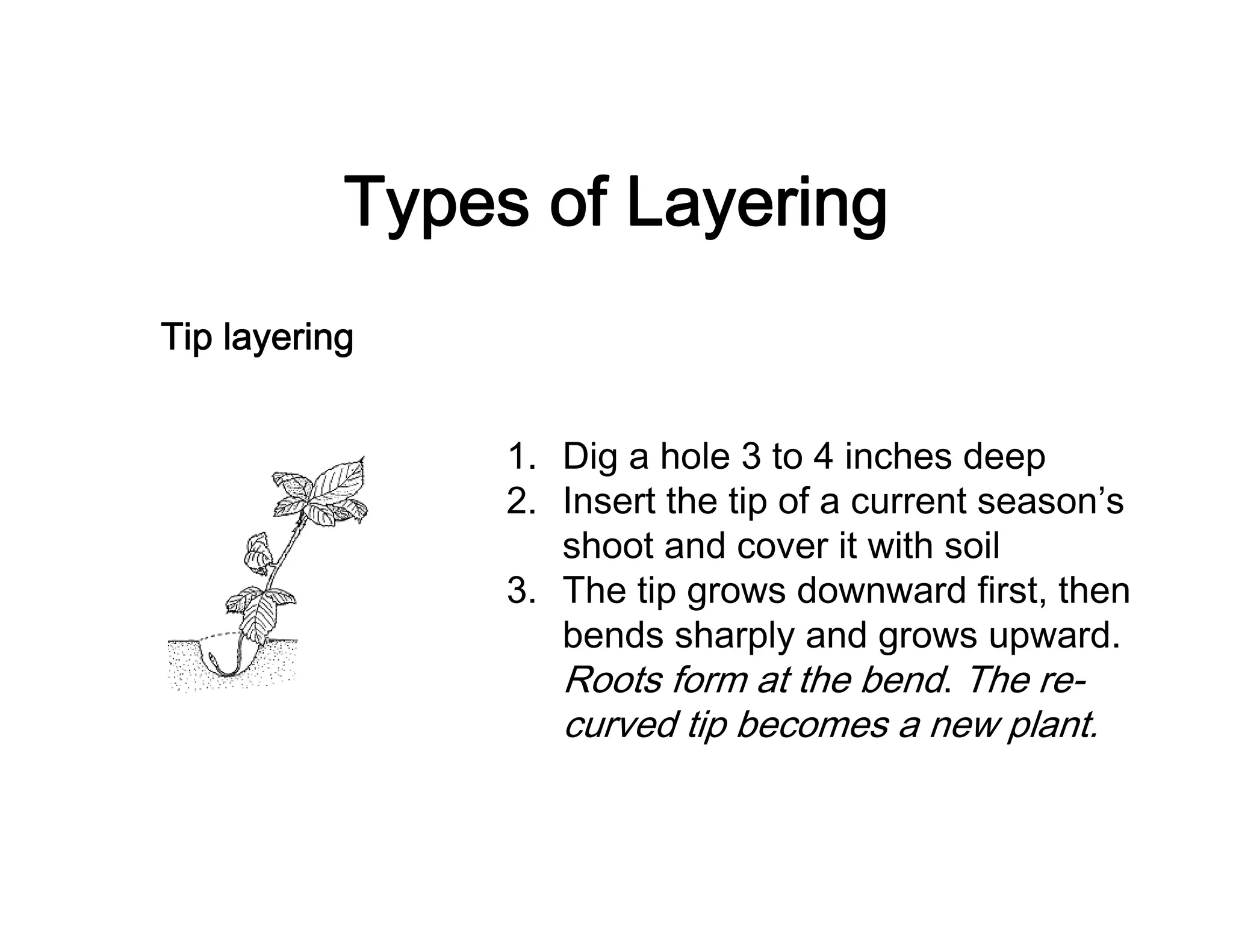
Tip layering
1. Dig a hole 3 to 4 inches deep
2. Insert the tip of a current season’s
shoot and cover it with soil
3. The tip grows downward first, then
bends sharply and grows upward.
Roots form at the bend. The re-
curved tip becomes a new plant.
Types of Layering
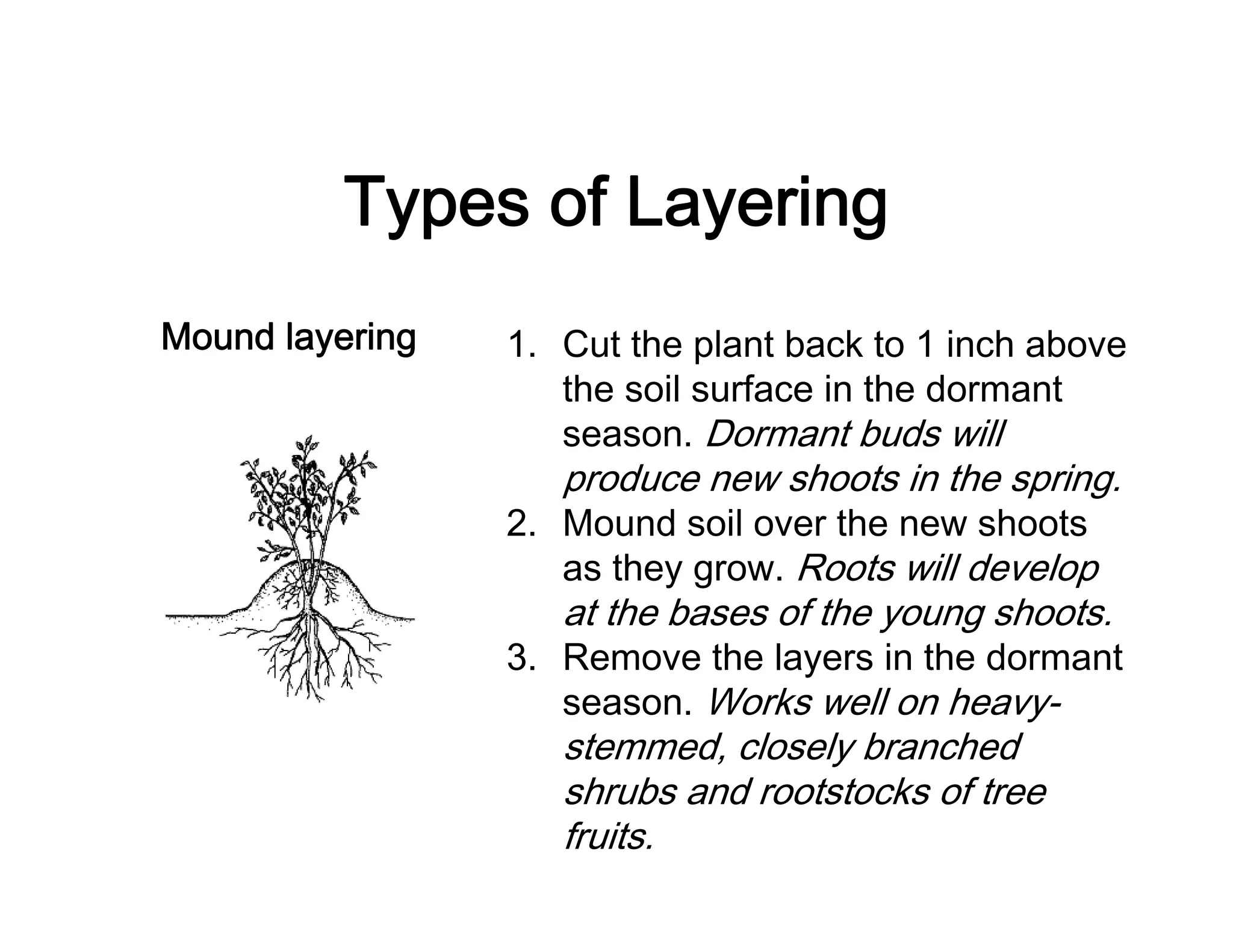
Mound layering 1. Cut the plant back to 1 inch above
the soil surface in the dormant
season. Dormant buds will
produce new shoots in the spring.
2. Mound soil over the new shoots
as they grow. Roots will develop
at the bases of the young shoots.
3. Remove the layers in the dormant
season. Works well on heavy-
stemmed, closely branched
shrubs and rootstocks of tree
fruits.
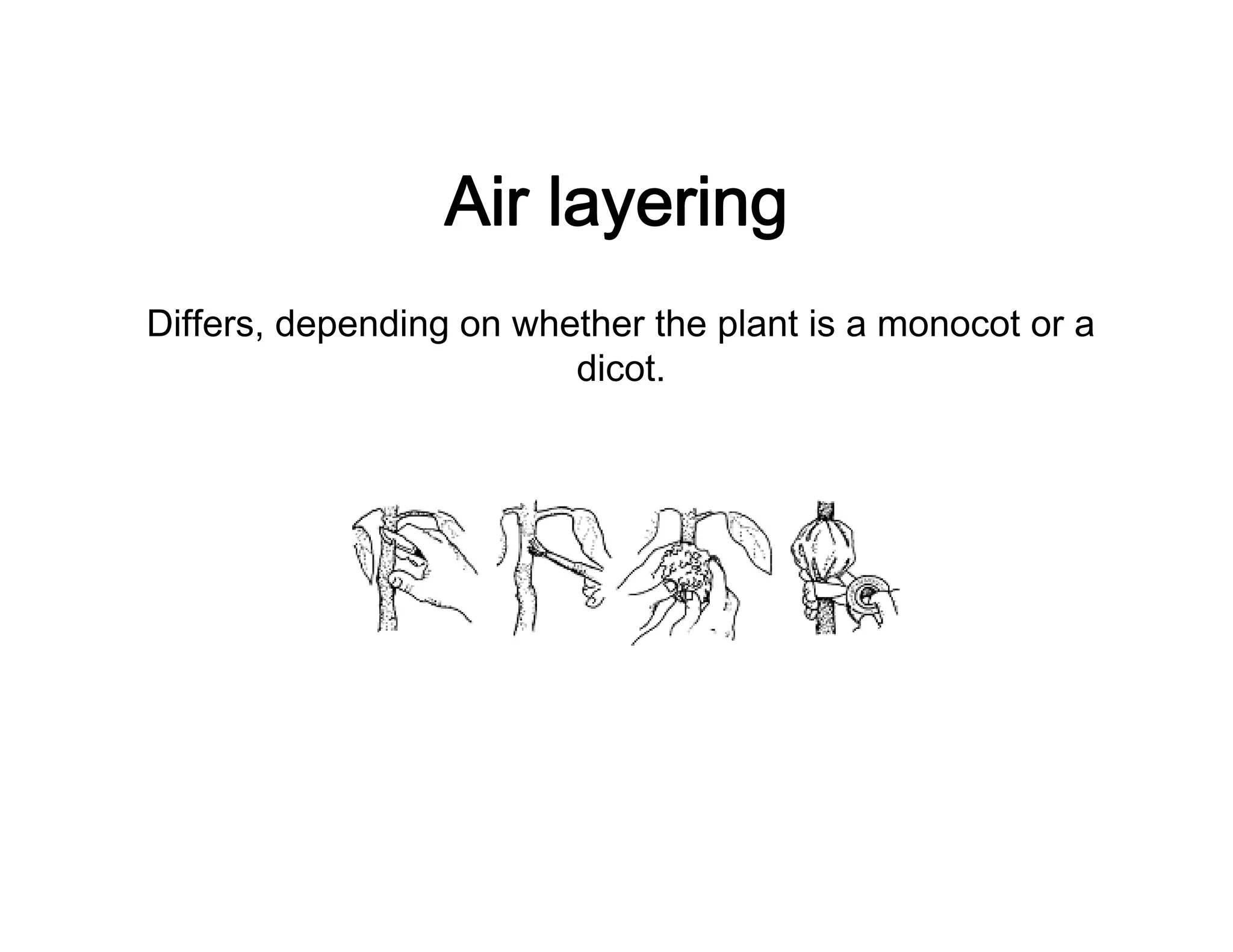
Air layering
Differs, depending on whether the plant is a monocot or a
dicot.
Air Layering Monocots
1. Make an upward 1- to 1 1/2-inch cut about
one-third through the stem. The cut is held
open with a toothpick or wooden match stick.
2. Surround the wound with moist, unmilled
sphagnum moss (about a handful) that has
been soaked in water and squeezed to
remove excess moisture.
3. Wrap the moss with plastic or aluminum foil
and hold in place with twist ties or electrician’s
tape.
Air Layering Dicots
1. With a sharp knife, make two parallel cuts about an
inch apart around the stem and through the bark and
cambium layer.
2. Connect the two parallel cuts with one long cut.
3. Remove the ring of bark, leaving the inner woody
tissue exposed. Scrape the newly bared ring to
remove the cambial tissue to prevent a bridge of
callus tissue from forming. Apply rooting hormone.
4. Wrap and cover using the same procedure as that
described for monocots.
Happy Gardening!!!

Plant propagation methodologies

  • 1.
    Plant Propagation Methodologies Seeding,Grafting, Budding, Cuttings and Layering Roy Beckford – Agriculture & Natural Resources Agent
  • 2.
    Plant Propagation There aretwo methods of plant propagation: • Sexual (seed) - entails the recombination of genetic material, resulting in progeny that differ from each other and from their parents. • Asexual (vegetative) - progeny are genetic copies of the parent plant (clones).
  • 3.
    Definitions: • Grafting: -joining the parts of two separate plants so that they will unite and continue to grow as a single plant • Budding: - is a modification of grafting, involving the use of a scion with only a single bud attached to a piece of bark. • Scion: - That part of the union to be attached to the rootstock • Stock: - That part of the union which contains the root portion of the union
  • 4.
    Grafting and Budding •Grafting and budding involve joining two genetically distinct plants so that they unite to continue growth as a single plant
  • 5.
    Scion Stock Forms the bearing partsand shoot system of the tree Forms the lower trunk and root system of the tree Scion and Stock/Shoot and Root
  • 6.
    Cambial Contact • Forunion and growth to result, the cambial surfaces of the scion and stock need to make contact with each other • Cambium: - the regenerative tissue or layer of cells, located between the bark and the wood of the plant From: Schools.fwps.org/
  • 7.
    Grafting and Budding •Grafting and Budding are the most important means of propagating fruit and nut trees for two reasons: 1. Species and cultivars that cannot be propagated by cutting or layering can be propagated by budding and grafting. 2. Budding and grafting allows the use of rootstocks with desirable characteristics that make them preferable to growing a tree on its own roots.
  • 8.
    Advantages and Disadvantages •Quick method of uniform propagation • Plants with similar characteristics (color, fruit superiority etc.) • Disease resistance especially in rootstock • Greater ability of producer to control outcome • Higher susceptibility to epidemics • Hurricane tolerance lowered?
  • 9.
    Grafting and Budding Basictools: • Budding/grafting tape • Budding/grafting knife • Budding/grafting tape • Pruning shares
  • 10.
    Grafting and Budding Timeor season: For most tropical hardwoods – when the stock is actively growing and the bark is ‘slipping’ “Slipping” – when the bark can be pulled away from the wood without being torn apart Scion-wood may be collected from older growth flushes, or when axillary buds begin to grow. Axillary buds are the buds located at the base of the leaves
  • 11.
    Common Grafting Techniques Whipand tongue graft 1 2 3 4
  • 12.
    Common Grafting Techniques Cleftgraft (& modified cleft graft)
  • 13.
  • 14.
    Common Budding Techniques •A T-shaped cut is made in the stock. • Buds (taken from budsticks or budwood) are inserted under the bark of small seedling stock plants a few inches above ground level. • The buds are inserted and tied in place • After growth starts the tops of the seedling rootstocks are cut off. • T-budding is usually done in the late summer. T-budding is the most common method for propagating fruit trees.
  • 15.
    T-budding is themost common method for propagating fruit trees. Scion Root Stock
  • 16.
    Patch-budding • Patch-budding isused for thicker barked trees (walnut and pecan). • A patch of bark is removed and a same- sized patch with the bud is inserted in its place. • Normally done during the growing season when the bark separates readily from the wood along the cambial layer.
  • 17.
  • 18.
    Propagation by Cuttings •A cutting is a piece of vegetative tissue (stem, root or leaf) that, when placed under suitable environmental conditions, will regenerate the missing parts and produce a self-sustaining plant. • Used mainly in the clonal propagation of herbaceous and some woody ornamental species. Cuttings are less frequently used for fruit and nut trees.
  • 19.
    Cuttings • Some speciescan be readily propagated from hardwood cuttings of stems taken in late winter or early spring. • Usually 6 - 12 " of stem, are placed in the ground in nursery rows with just the top bud showing. • Cuttings will generate roots and can be transplanted as self sustaining plants.
  • 20.
    Preparing Cuttings Sanitation: • Thecutting propagation process fosters conditions that favor the development of disease and insect problems. • Open wounds are avenues through which pest problems can enter plants - Cuttings should be disease and insect free - The instruments used to prepare cuttings should be clean - The cutting preparation area should be cleaned before and after cuttings are prepared - Be careful not to damage leaves and cuttings Damaged cuttings are more likely to have problems in rooting both from disease and insects as well as from pre-mature aging of damaged tissue
  • 21.
    Preparing Cuttings Hormones: • Rootinghormones used in the nursery industry are synthetic versions of naturally occurring plant compounds called auxins. • Hormones are needed by plants in very small quantities so they are sold in ready to use or ready to be diluted formulations mixed with something else. • The most common forms are mixed with talc and come in a powder form
  • 22.
  • 23.
    Layering • The developmentof roots on a stem while the stem is still attached to the parent plant is called layering. • A layer is the rooted stem following detachment (removal) from the parent plant.
  • 24.
    Types of Layering Simplelayering 1. Bend a low growing, flexible stem to the ground 2. Cover part of it with soil, leaving the remaining 6 to 12 inches above the soil 3. Bend the tip into a vertical position and stake in place. Wounding the lower side of the bent branch may help in rooting.
  • 25.
    Types of Layering Compoundlayering 1. Bend the stem to the rooting medium as for simple layering, but alternately cover and expose sections of the stem. 2. Wound the lower side of each stem section to be covered. 3. Each section should have at least one bud exposed and one bud covered with soil. This method works well for plants producing vine-like growth.
  • 26.
    Types of Layering Tiplayering 1. Dig a hole 3 to 4 inches deep 2. Insert the tip of a current season’s shoot and cover it with soil 3. The tip grows downward first, then bends sharply and grows upward. Roots form at the bend. The re- curved tip becomes a new plant.
  • 27.
    Types of Layering Moundlayering 1. Cut the plant back to 1 inch above the soil surface in the dormant season. Dormant buds will produce new shoots in the spring. 2. Mound soil over the new shoots as they grow. Roots will develop at the bases of the young shoots. 3. Remove the layers in the dormant season. Works well on heavy- stemmed, closely branched shrubs and rootstocks of tree fruits.
  • 28.
    Air layering Differs, dependingon whether the plant is a monocot or a dicot.
  • 29.
    Air Layering Monocots 1.Make an upward 1- to 1 1/2-inch cut about one-third through the stem. The cut is held open with a toothpick or wooden match stick. 2. Surround the wound with moist, unmilled sphagnum moss (about a handful) that has been soaked in water and squeezed to remove excess moisture. 3. Wrap the moss with plastic or aluminum foil and hold in place with twist ties or electrician’s tape.
  • 30.
    Air Layering Dicots 1.With a sharp knife, make two parallel cuts about an inch apart around the stem and through the bark and cambium layer. 2. Connect the two parallel cuts with one long cut. 3. Remove the ring of bark, leaving the inner woody tissue exposed. Scrape the newly bared ring to remove the cambial tissue to prevent a bridge of callus tissue from forming. Apply rooting hormone. 4. Wrap and cover using the same procedure as that described for monocots.
  • 31.