RESOURCE MAPPING
BHAVYA RAJ A R
PHYSICAL SCIENCE
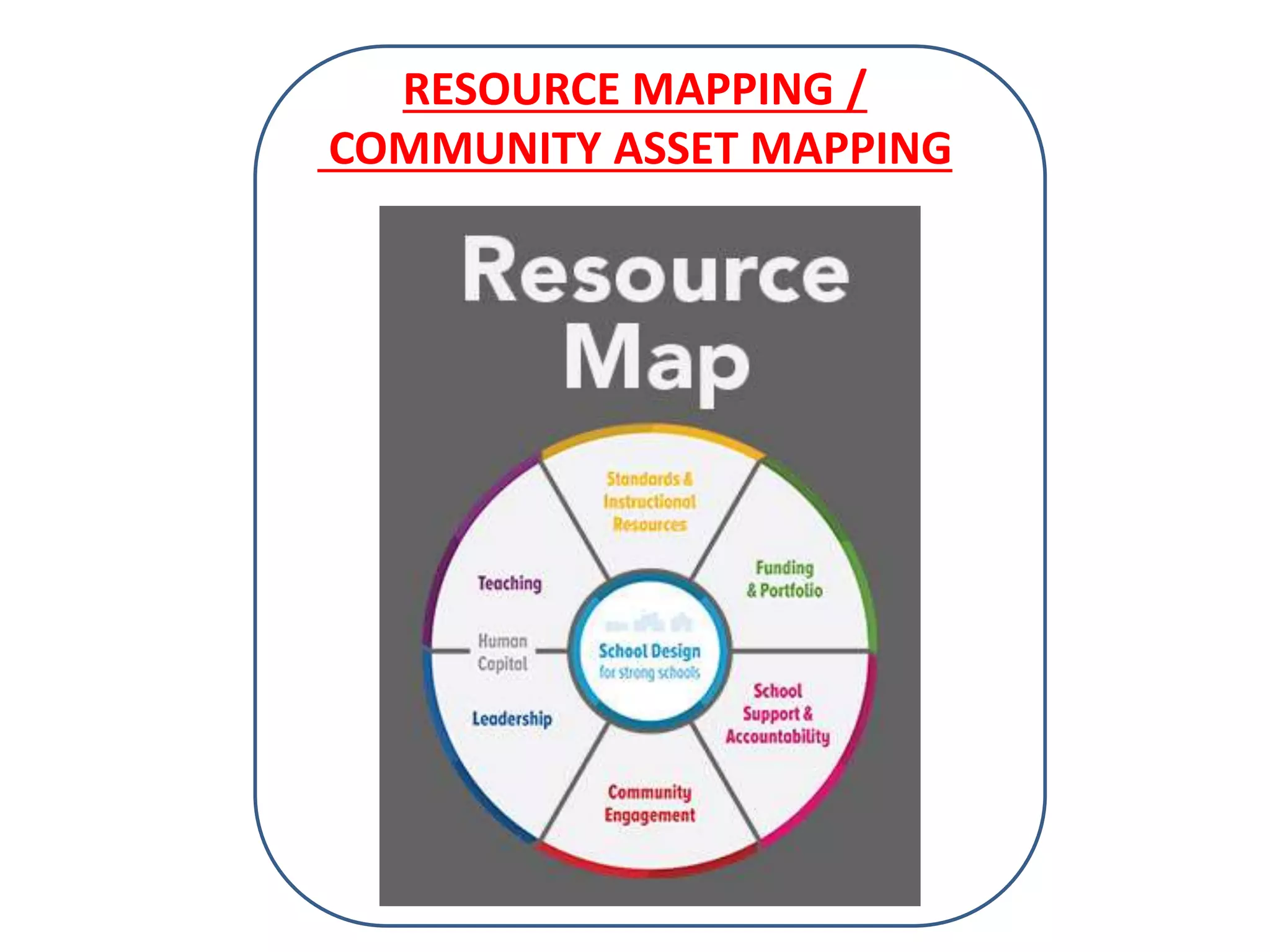
RESOURCE MAPPING /
COMMUNITY ASSET MAPPING
WHY MAPPING RESOURCES IS SO IMPORTANT?
To function well, every system has to fully understand and manage its
resources. Mapping is a first step toward enhancing essential understanding, and
done properly, it is a major intervention in the process of moving forward with
enhancing systemic effectiveness.
Why Mapping Both School And Community Resources Is So Important?
Schools and communities share
 Goals and problems with respect to children, youth, and families.
 The need to develop cost-effective systems, programs, and services to meet
the goals and address the problems.
 Accountability pressures related to improving outcomes.
 The opportunity to improve effectiveness by coordinating and eventually
integrating resources to develop a full continuum of systemic interventions
RESOURCE MAPPING
 There are many programs, interventions, services, and resources available
that can support student well-being and the development of positive school
culture and climate.
 Before adopting new programs or substantially changing current practices,
it is helpful to review and consider school-based programs and resources
that are already in place.
 Resource mapping is a strategy for identifying and analysing the programs,
people, services, and other resources that currently exist in your school.
 This information can help school leaders better assess the needs of the
school and to make informed decisions about where to focus.
 Through resource mapping we will get a deeper understanding of the key
programs and resources related to well-being and culture that the school is
already utilizing.
WHAT ARE RESOURCES?
 Resources include programs, services, outside agencies, space, people,
equipment, materials, supplies, technology, infrastructure mechanisms etc.
 Resources are not only for students but also for families as well as staff.
OBJECTIVES
 To identify the resources that are currently available to the school to
support student well-being and positive school culture and climate.
 To provide documentation or a visual aid of what the school is doing to
achieve its goals.
 To assess how resources are being used and in what capacity.
 To identify gaps, overlaps, and redundancies in resources.
 To identify additional resources or programming that may be needed.
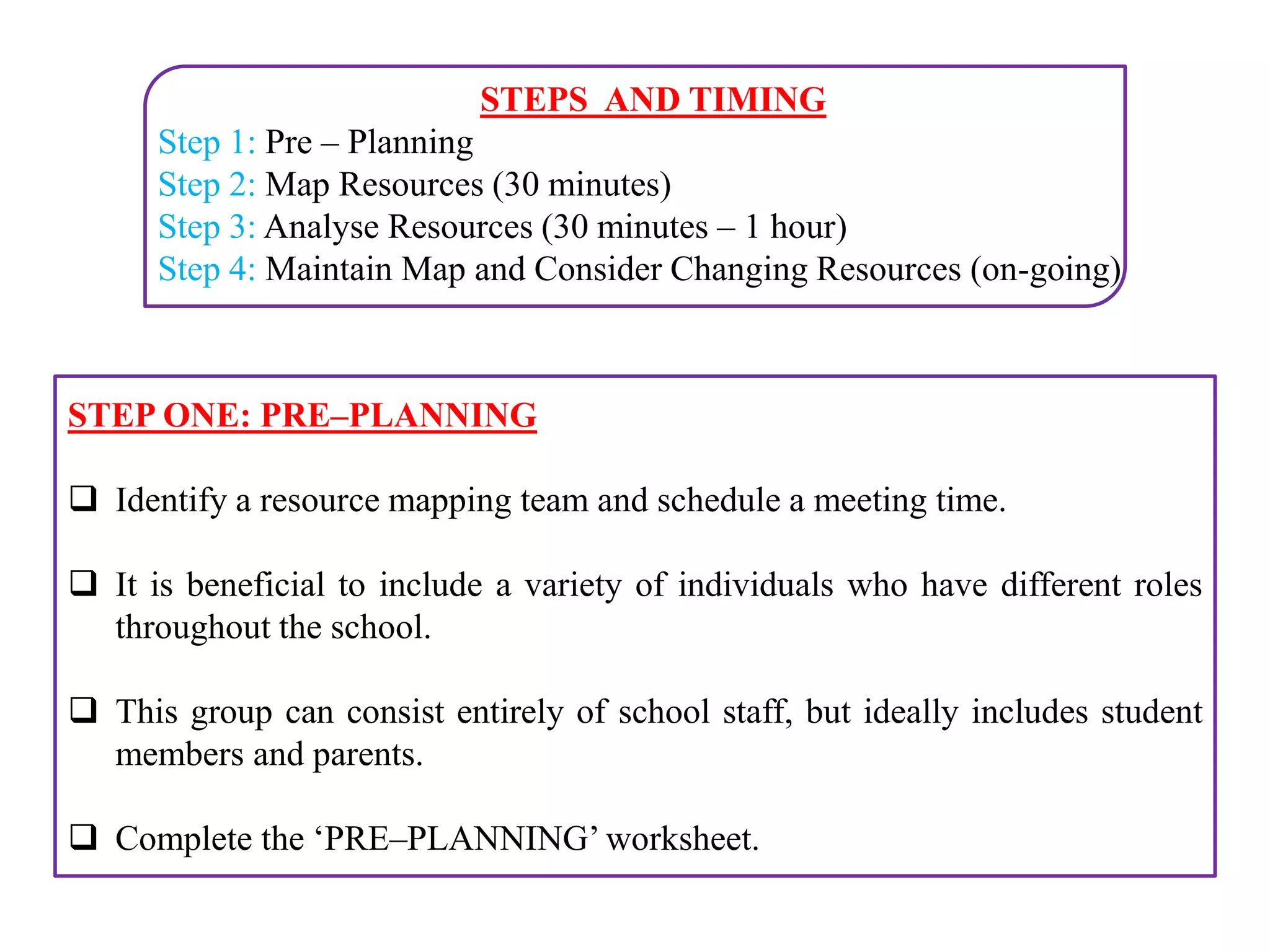
STEPS AND TIMING
Step 1: Pre – Planning
Step 2: Map Resources (30 minutes)
Step 3: Analyse Resources (30 minutes – 1 hour)
Step 4: Maintain Map and Consider Changing Resources (on-going)
STEP ONE: PRE–PLANNING
 Identify a resource mapping team and schedule a meeting time.
 It is beneficial to include a variety of individuals who have different roles
throughout the school.
 This group can consist entirely of school staff, but ideally includes student
members and parents.
 Complete the ‘PRE–PLANNING’ worksheet.
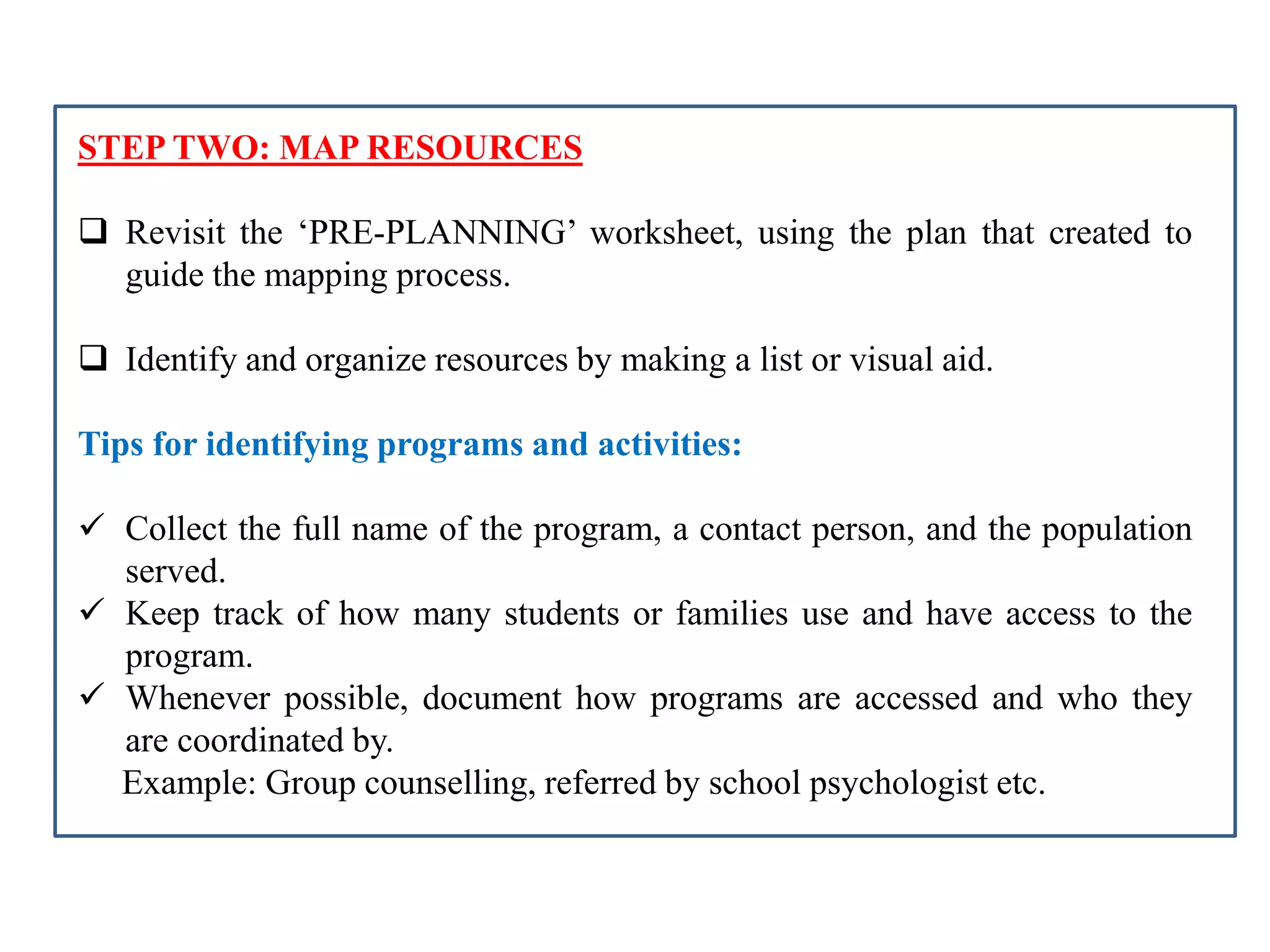
STEP TWO: MAP RESOURCES
 Revisit the ‘PRE-PLANNING’ worksheet, using the plan that created to
guide the mapping process.
 Identify and organize resources by making a list or visual aid.
Tips for identifying programs and activities:
 Collect the full name of the program, a contact person, and the population
served.
 Keep track of how many students or families use and have access to the
program.
 Whenever possible, document how programs are accessed and who they
are coordinated by.
Example: Group counselling, referred by school psychologist etc.
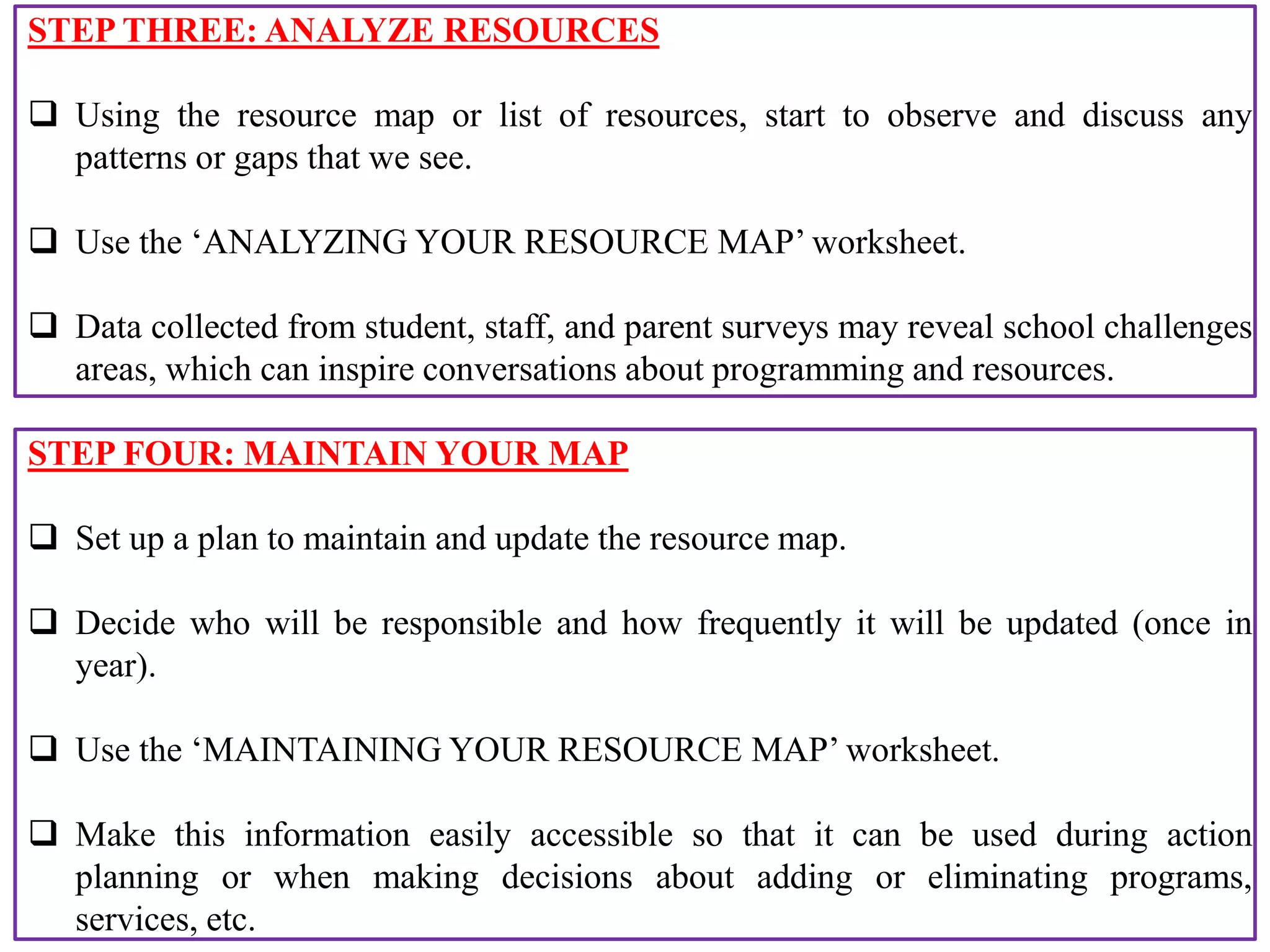
STEP THREE: ANALYZE RESOURCES
 Using the resource map or list of resources, start to observe and discuss any
patterns or gaps that we see.
 Use the ‘ANALYZING YOUR RESOURCE MAP’ worksheet.
 Data collected from student, staff, and parent surveys may reveal school challenges
areas, which can inspire conversations about programming and resources.
STEP FOUR: MAINTAIN YOUR MAP
 Set up a plan to maintain and update the resource map.
 Decide who will be responsible and how frequently it will be updated (once in
year).
 Use the ‘MAINTAINING YOUR RESOURCE MAP’ worksheet.
 Make this information easily accessible so that it can be used during action
planning or when making decisions about adding or eliminating programs,
services, etc.
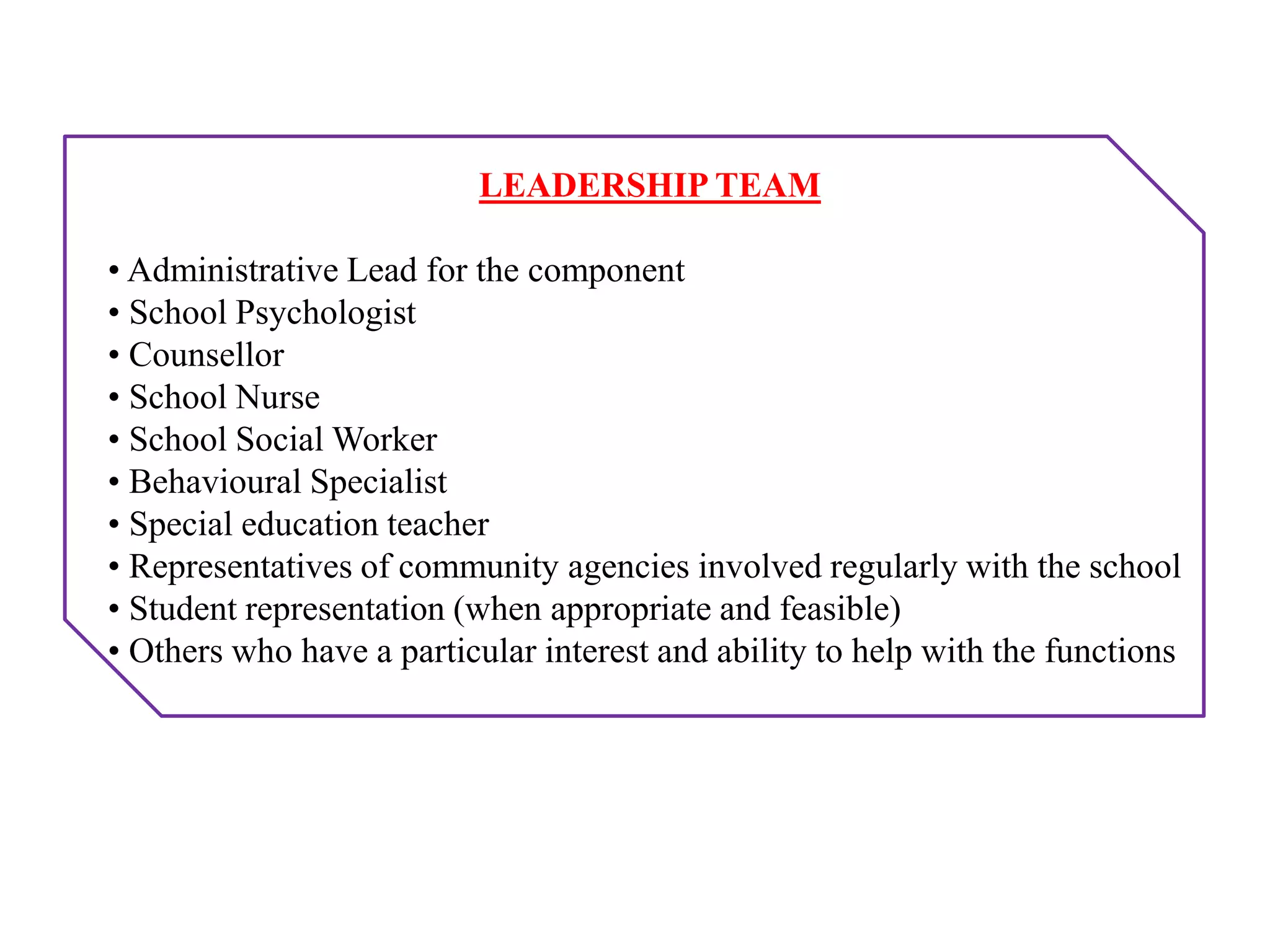
LEADERSHIP TEAM
• Administrative Lead for the component
• School Psychologist
• Counsellor
• School Nurse
• School Social Worker
• Behavioural Specialist
• Special education teacher
• Representatives of community agencies involved regularly with the school
• Student representation (when appropriate and feasible)
• Others who have a particular interest and ability to help with the functions
Resource mapping (4)

Resource mapping (4)

  • 1.
    RESOURCE MAPPING BHAVYA RAJA R PHYSICAL SCIENCE
  • 2.
  • 3.
    WHY MAPPING RESOURCESIS SO IMPORTANT? To function well, every system has to fully understand and manage its resources. Mapping is a first step toward enhancing essential understanding, and done properly, it is a major intervention in the process of moving forward with enhancing systemic effectiveness. Why Mapping Both School And Community Resources Is So Important? Schools and communities share  Goals and problems with respect to children, youth, and families.  The need to develop cost-effective systems, programs, and services to meet the goals and address the problems.  Accountability pressures related to improving outcomes.  The opportunity to improve effectiveness by coordinating and eventually integrating resources to develop a full continuum of systemic interventions
  • 4.
    RESOURCE MAPPING  Thereare many programs, interventions, services, and resources available that can support student well-being and the development of positive school culture and climate.  Before adopting new programs or substantially changing current practices, it is helpful to review and consider school-based programs and resources that are already in place.  Resource mapping is a strategy for identifying and analysing the programs, people, services, and other resources that currently exist in your school.  This information can help school leaders better assess the needs of the school and to make informed decisions about where to focus.  Through resource mapping we will get a deeper understanding of the key programs and resources related to well-being and culture that the school is already utilizing.
  • 5.
    WHAT ARE RESOURCES? Resources include programs, services, outside agencies, space, people, equipment, materials, supplies, technology, infrastructure mechanisms etc.  Resources are not only for students but also for families as well as staff. OBJECTIVES  To identify the resources that are currently available to the school to support student well-being and positive school culture and climate.  To provide documentation or a visual aid of what the school is doing to achieve its goals.  To assess how resources are being used and in what capacity.  To identify gaps, overlaps, and redundancies in resources.  To identify additional resources or programming that may be needed.
  • 6.
    STEPS AND TIMING Step1: Pre – Planning Step 2: Map Resources (30 minutes) Step 3: Analyse Resources (30 minutes – 1 hour) Step 4: Maintain Map and Consider Changing Resources (on-going) STEP ONE: PRE–PLANNING  Identify a resource mapping team and schedule a meeting time.  It is beneficial to include a variety of individuals who have different roles throughout the school.  This group can consist entirely of school staff, but ideally includes student members and parents.  Complete the ‘PRE–PLANNING’ worksheet.
  • 7.
    STEP TWO: MAPRESOURCES  Revisit the ‘PRE-PLANNING’ worksheet, using the plan that created to guide the mapping process.  Identify and organize resources by making a list or visual aid. Tips for identifying programs and activities:  Collect the full name of the program, a contact person, and the population served.  Keep track of how many students or families use and have access to the program.  Whenever possible, document how programs are accessed and who they are coordinated by. Example: Group counselling, referred by school psychologist etc.
  • 8.
    STEP THREE: ANALYZERESOURCES  Using the resource map or list of resources, start to observe and discuss any patterns or gaps that we see.  Use the ‘ANALYZING YOUR RESOURCE MAP’ worksheet.  Data collected from student, staff, and parent surveys may reveal school challenges areas, which can inspire conversations about programming and resources. STEP FOUR: MAINTAIN YOUR MAP  Set up a plan to maintain and update the resource map.  Decide who will be responsible and how frequently it will be updated (once in year).  Use the ‘MAINTAINING YOUR RESOURCE MAP’ worksheet.  Make this information easily accessible so that it can be used during action planning or when making decisions about adding or eliminating programs, services, etc.
  • 9.
    LEADERSHIP TEAM • AdministrativeLead for the component • School Psychologist • Counsellor • School Nurse • School Social Worker • Behavioural Specialist • Special education teacher • Representatives of community agencies involved regularly with the school • Student representation (when appropriate and feasible) • Others who have a particular interest and ability to help with the functions