Philippine Normal University
COLLEGE OF EDUCATION
Taft Avenue, Manila
2nd Semester, SY 2012-2013
ED 503: Research Methods and Scientific Writing
2:00 – 5:00 PM, Saturdays, CED 203
Prof. Lolita H. Nava, Ph.D.
PARTICIPATORY RESEARCH
AND
PARTICIPATORY ACTION RESEARCH
Reynante S. Tagum
M.A. in Education major in Guidance & Counseling
PARTICIPATORY RESEARCH
A collaborative process of research,
education and action (Hall 1981)
explicitly oriented towards social
transformation (McTaggart 1997).
Involves researchers and
participants working together to
examine a problematic situation or
action to change it for the better
(Wadsworth 1998).
Participatory research has three key
elements: people, power and
praxis (Finn, 1994).
It is people-centered (Brown, 1985)
in the sense that the process of
critical inquiry is informed by and
responds to the experiences and
needs of people involved.
Participatory research is about
power. Power is crucial to the
construction of reality, language,
meanings and rituals of truth; power
functions in all knowledge and in
every definition. Power is knowledge
and knowledge creates truth and
therefore power (Foucault, 1980).
Participatory research is also about
praxis. It recognizes the
inseparability of theory and practice
and critical awareness of the
personal-political dialectic.
PARTICIPATORY ACTION RESEARCH
Participatory action research is a
form of action research in which
professional social researchers
operate as full collaborators with
members of organizations in
studying and transforming those
organizations.
It is an ongoing organizational
learning process, a research
approach that emphasizes co-
learning, participation and
organizational transformation
(Greenwood et al, 1993).
Is an attribute of action research in
which the problem is determined by
the people who believe and feel that
the problem is really a problem in
the local setting and the solution to
the problem is within the same
setting without intention of
generalizing its results.
Characteristics of Participatory
Action Researched
1. People-oriented
2. Community involvement
3. Group-research
4. Big crowd
5. Political involvement
Participatory and conventional research: a comparison of process
Participatory research Conventional research
What is the research for? Action Understanding with perhaps action later
Who is the research for? Local people Institution, personal and professional
interest
Whose knowledge counts? Local people's Scientists'
Topic choice influenced by? Local priorities Funding priorities, institutional agendas,
professional interest
Methodology chosen for? Empowerment, mutual learning Disciplinary conventions. 'objectivity' and
'truth'
Who takes part in the stages of research
process?
Problem identification Local people Researcher
Data collection Local people Researcher
Interpretation Local concepts and frameworks Disciplinary concepts and frameworks
Analysis Local people Researcher
Presentation of findings Locally accessible and useful By researcher to other academics or
funding body
Action on findings Integral to the process Separate and may not happen
Who takes action? Local people, with/without external support External agencies
Who owns the results? Shared The researcher
What is emphasized Process Outcomes
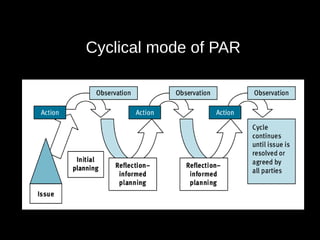
Cyclical mode of PAR
Framework of Participatory
Action Research
1. Identification of the problem and
community
2. Statement of the goals/objectives
3. Identification of participant
4. Organization of the research team
5. Establishment of timetable
6. Conduct of the participatory action
research project
Framework of Participatory
Action Research
6. Conduct of the participatory action
research project
7. Evaluation of results
8. Interpretation of the findings
9. Implications / recommendations
10. Implementation
Advantages of
Participatory Action
Research
Advantages of PAR
1. Research participants increases
their knowledge and ideas as well
as valid analysis of social reality,
thus, more relevant solutions are
achieved.
Advantages of PAR
2. Both researchers and subjects of
the study gain more from the
research process when the
researchers attain greater sensitivity
and self-awareness of the problems.
Advantages of PAR
3. The subject of the study gain trust
and self-confidence at their own rate
and resources to improve their
conditions.
Advantages of PAR
4. Good relationship can be
developed among the research
team, research participants, and
people in the community.
Advantages of PAR
5. Humanistic approach is enhanced
through involvement of everyone in
solving social problems.
Disadvantages of
Participatory Action
Research
Disadvantages of PAR
1. It is time consuming because it
takes time to involve many people in
conducting research.
Disadvantages of PAR
2. It is difficult to gather people and
manage to attend the general
assembly due to large number of
people involved.
Disadvantages of PAR
3. When the research team back-out
while the research process is going
on, a new team is created therefore
you have to start all over again.
Disadvantages of PAR
4. The research team may use their
power to personal needs and most
of the benefits go to them.
Disadvantages of PAR
5. Politicians who get involved in the
research process may use
traditional techniques and the said
technique may prevail.
Disadvantages of PAR
6. Abuse of discretion by research
team may be practiced due to too
much trust and confidence by the
research participants and subjects
of the study to them and they do not
check and balance their activities.
Disadvantages of PAR
7. With full people's participation,
factors such as experiences,
educational qualifications, socio-
economic status , knowledge,
abilities and skills will affect the
benefit of the participants. The less
experiences, knowledge, abilities
and skills one has in participating,
the less one benefits from the
system.
Reference
Calmorin, Laurentina P. & Calmorin Melchor A. (2007).
Research Methods and Thesis Writing. Rex Bookstore, Inc.
Manila.
Kindon, S. L., Pain, R., & Kesby, M. (2007). Participatory
action research approaches and methods: connecting
people, participation and place. Routledge studies in human
geography, 22. London: Routledge.
Sevilla, Consuelo G. et al. (1992). Research Methods. Rex
Book Store, Inc. Quezon City.
Sommer R. & Sommer B. (2002). A Practical Guide to
Behavioral Research. (5th edition) Oxford University Press.
Website
Action Research and Participation. Available at
http://www.aral.com.au/resources/partic.html (accessed January 23, 2013).
Community Based Participatory Research. Available at
http://www.cbpr.org/methods/cbpr/ (accessed January 31, 2013).
Participatory Action Research and Organizational Change. Available at
http://participaction.wordpress.com/whatpar/defining-par/ (accessed January 23,
2013).
Participatory Research Methods: A Methodological Approach in Motion. Available
at http://www.qualitative-research.net/index.php/fqs/article/view/1801/3334
(accessed January 23, 2013).
Participatory Research Approaches. Available at
http://krishanagyanwali.blogspot.com/2011/06/participatory-research-
approaches.html (accessed January 31, 2013).
What is participatory research? Available at
http://www.ncbi.nlm.nih.gov/pubmed/8746866 (accessed January 23, 2013).
Philippine Normal University
COLLEGE OF EDUCATION
Taft Avenue, Manila
2nd Semester, SY 2012-2013
ED 503: Research Methods and Scientific Writing
2:00 – 5:00 PM, Saturdays, CED 203
Prof. Lolita H. Nava, Ph.D.
PARTICIPATORY RESEARCH
AND
PARTICIPATORY ACTION RESEARCH
Reynante S. Tagum
M.A. in Education major in Guidance & Counseling

Participatory Research

  • 1.
    Philippine Normal University COLLEGEOF EDUCATION Taft Avenue, Manila 2nd Semester, SY 2012-2013 ED 503: Research Methods and Scientific Writing 2:00 – 5:00 PM, Saturdays, CED 203 Prof. Lolita H. Nava, Ph.D. PARTICIPATORY RESEARCH AND PARTICIPATORY ACTION RESEARCH Reynante S. Tagum M.A. in Education major in Guidance & Counseling
  • 2.
    PARTICIPATORY RESEARCH A collaborativeprocess of research, education and action (Hall 1981) explicitly oriented towards social transformation (McTaggart 1997).
  • 3.
    Involves researchers and participantsworking together to examine a problematic situation or action to change it for the better (Wadsworth 1998).
  • 4.
    Participatory research hasthree key elements: people, power and praxis (Finn, 1994).
  • 5.
    It is people-centered(Brown, 1985) in the sense that the process of critical inquiry is informed by and responds to the experiences and needs of people involved.
  • 6.
    Participatory research isabout power. Power is crucial to the construction of reality, language, meanings and rituals of truth; power functions in all knowledge and in every definition. Power is knowledge and knowledge creates truth and therefore power (Foucault, 1980).
  • 7.
    Participatory research isalso about praxis. It recognizes the inseparability of theory and practice and critical awareness of the personal-political dialectic.
  • 8.
    PARTICIPATORY ACTION RESEARCH Participatoryaction research is a form of action research in which professional social researchers operate as full collaborators with members of organizations in studying and transforming those organizations.
  • 9.
    It is anongoing organizational learning process, a research approach that emphasizes co- learning, participation and organizational transformation (Greenwood et al, 1993).
  • 10.
    Is an attributeof action research in which the problem is determined by the people who believe and feel that the problem is really a problem in the local setting and the solution to the problem is within the same setting without intention of generalizing its results.
  • 11.
    Characteristics of Participatory ActionResearched 1. People-oriented 2. Community involvement 3. Group-research 4. Big crowd 5. Political involvement
  • 12.
    Participatory and conventionalresearch: a comparison of process Participatory research Conventional research What is the research for? Action Understanding with perhaps action later Who is the research for? Local people Institution, personal and professional interest Whose knowledge counts? Local people's Scientists' Topic choice influenced by? Local priorities Funding priorities, institutional agendas, professional interest Methodology chosen for? Empowerment, mutual learning Disciplinary conventions. 'objectivity' and 'truth' Who takes part in the stages of research process? Problem identification Local people Researcher Data collection Local people Researcher Interpretation Local concepts and frameworks Disciplinary concepts and frameworks Analysis Local people Researcher Presentation of findings Locally accessible and useful By researcher to other academics or funding body Action on findings Integral to the process Separate and may not happen Who takes action? Local people, with/without external support External agencies Who owns the results? Shared The researcher What is emphasized Process Outcomes
  • 13.
  • 14.
    Framework of Participatory ActionResearch 1. Identification of the problem and community 2. Statement of the goals/objectives 3. Identification of participant 4. Organization of the research team 5. Establishment of timetable 6. Conduct of the participatory action research project
  • 15.
    Framework of Participatory ActionResearch 6. Conduct of the participatory action research project 7. Evaluation of results 8. Interpretation of the findings 9. Implications / recommendations 10. Implementation
  • 16.
  • 17.
    Advantages of PAR 1.Research participants increases their knowledge and ideas as well as valid analysis of social reality, thus, more relevant solutions are achieved.
  • 18.
    Advantages of PAR 2.Both researchers and subjects of the study gain more from the research process when the researchers attain greater sensitivity and self-awareness of the problems.
  • 19.
    Advantages of PAR 3.The subject of the study gain trust and self-confidence at their own rate and resources to improve their conditions.
  • 20.
    Advantages of PAR 4.Good relationship can be developed among the research team, research participants, and people in the community.
  • 21.
    Advantages of PAR 5.Humanistic approach is enhanced through involvement of everyone in solving social problems.
  • 22.
  • 23.
    Disadvantages of PAR 1.It is time consuming because it takes time to involve many people in conducting research.
  • 24.
    Disadvantages of PAR 2.It is difficult to gather people and manage to attend the general assembly due to large number of people involved.
  • 25.
    Disadvantages of PAR 3.When the research team back-out while the research process is going on, a new team is created therefore you have to start all over again.
  • 26.
    Disadvantages of PAR 4.The research team may use their power to personal needs and most of the benefits go to them.
  • 27.
    Disadvantages of PAR 5.Politicians who get involved in the research process may use traditional techniques and the said technique may prevail.
  • 28.
    Disadvantages of PAR 6.Abuse of discretion by research team may be practiced due to too much trust and confidence by the research participants and subjects of the study to them and they do not check and balance their activities.
  • 29.
    Disadvantages of PAR 7.With full people's participation, factors such as experiences, educational qualifications, socio- economic status , knowledge, abilities and skills will affect the benefit of the participants. The less experiences, knowledge, abilities and skills one has in participating, the less one benefits from the system.
  • 30.
    Reference Calmorin, Laurentina P.& Calmorin Melchor A. (2007). Research Methods and Thesis Writing. Rex Bookstore, Inc. Manila. Kindon, S. L., Pain, R., & Kesby, M. (2007). Participatory action research approaches and methods: connecting people, participation and place. Routledge studies in human geography, 22. London: Routledge. Sevilla, Consuelo G. et al. (1992). Research Methods. Rex Book Store, Inc. Quezon City. Sommer R. & Sommer B. (2002). A Practical Guide to Behavioral Research. (5th edition) Oxford University Press.
  • 31.
    Website Action Research andParticipation. Available at http://www.aral.com.au/resources/partic.html (accessed January 23, 2013). Community Based Participatory Research. Available at http://www.cbpr.org/methods/cbpr/ (accessed January 31, 2013). Participatory Action Research and Organizational Change. Available at http://participaction.wordpress.com/whatpar/defining-par/ (accessed January 23, 2013). Participatory Research Methods: A Methodological Approach in Motion. Available at http://www.qualitative-research.net/index.php/fqs/article/view/1801/3334 (accessed January 23, 2013). Participatory Research Approaches. Available at http://krishanagyanwali.blogspot.com/2011/06/participatory-research- approaches.html (accessed January 31, 2013). What is participatory research? Available at http://www.ncbi.nlm.nih.gov/pubmed/8746866 (accessed January 23, 2013).
  • 32.
    Philippine Normal University COLLEGEOF EDUCATION Taft Avenue, Manila 2nd Semester, SY 2012-2013 ED 503: Research Methods and Scientific Writing 2:00 – 5:00 PM, Saturdays, CED 203 Prof. Lolita H. Nava, Ph.D. PARTICIPATORY RESEARCH AND PARTICIPATORY ACTION RESEARCH Reynante S. Tagum M.A. in Education major in Guidance & Counseling