
K.சதீஷ்
M.Ed
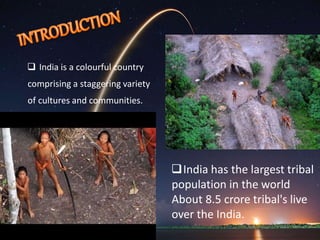
 India is a colourful country
comprising a staggering variety
of cultures and communities.
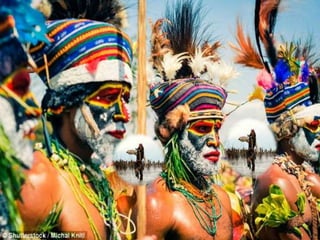
India has the largest tribal
population in the world
About 8.5 crore tribal's live
over the India.
06/17/15 3
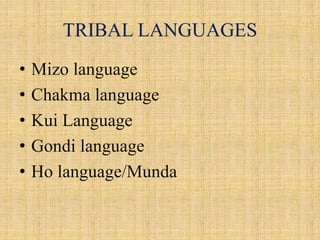
TRIBAL LANGUAGES
• Mizo language
• Chakma language
• Kui Language
• Gondi language
• Ho language/Munda
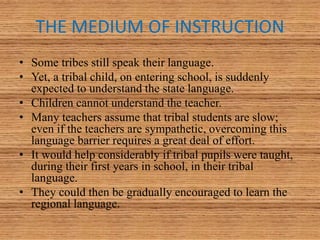
THE MEDIUM OF INSTRUCTION
• Some tribes still speak their language.
• Yet, a tribal child, on entering school, is suddenly
expected to understand the state language.
• Children cannot understand the teacher.
• Many teachers assume that tribal students are slow;
even if the teachers are sympathetic, overcoming this
language barrier requires a great deal of effort.
• It would help considerably if tribal pupils were taught,
during their first years in school, in their tribal
language.
• They could then be gradually encouraged to learn the
regional language.
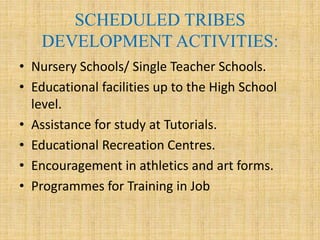
SCHEDULED TRIBES
DEVELOPMENT ACTIVITIES:
• Nursery Schools/ Single Teacher Schools.
• Educational facilities up to the High School
level.
• Assistance for study at Tutorials.
• Educational Recreation Centres.
• Encouragement in athletics and art forms.
• Programmes for Training in Job
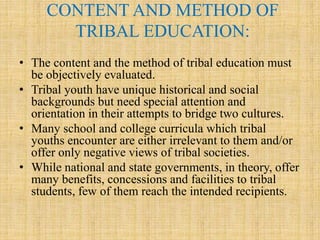
CONTENT AND METHOD OF
TRIBAL EDUCATION:
• The content and the method of tribal education must
be objectively evaluated.
• Tribal youth have unique historical and social
backgrounds but need special attention and
orientation in their attempts to bridge two cultures.
• Many school and college curricula which tribal
youths encounter are either irrelevant to them and/or
offer only negative views of tribal societies.
• While national and state governments, in theory, offer
many benefits, concessions and facilities to tribal
students, few of them reach the intended recipients.
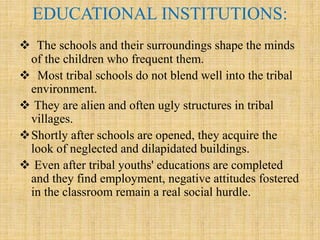
EDUCATIONAL INSTITUTIONS:
 The schools and their surroundings shape the minds
of the children who frequent them.
 Most tribal schools do not blend well into the tribal
environment.
 They are alien and often ugly structures in tribal
villages.
Shortly after schools are opened, they acquire the
look of neglected and dilapidated buildings.
 Even after tribal youths' educations are completed
and they find employment, negative attitudes fostered
in the classroom remain a real social hurdle.
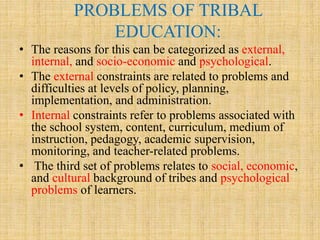
PROBLEMS OF TRIBAL
EDUCATION:
• The reasons for this can be categorized as external,
internal, and socio-economic and psychological.
• The external constraints are related to problems and
difficulties at levels of policy, planning,
implementation, and administration.
• Internal constraints refer to problems associated with
the school system, content, curriculum, medium of
instruction, pedagogy, academic supervision,
monitoring, and teacher-related problems.
• The third set of problems relates to social, economic,
and cultural background of tribes and psychological
problems of learners.
GOVERNMENT SCHEMES FOR
TRIBALS STUDENTS:
 Ashram Schools in Tribal Students
 PRE-MATRIC SCHOLARSHIP (Class IX and X)
 Centrally Sponsored Scheme of Hostels for ST boys and ST Girls
 Post Matric Scholarship (PMS) for ST students
 Rajiv Gandhi National Fellowship for ST Students
 National Overseas Scholarships for Scheduled Tribe Students
 Vocational Training Centres in Tribal Areas
 Upgradation of Merit of ST Students
 Top Class Education for ST Students
 Integrated Tribal Development Project
 Mid Day Meal Scheme
 Janshala Programme
 Tribal Alternate Education Programme 2002-2007
CONCLUSION
Since education does not provide any immediate
benefit and tribes do not see beyond their present
state, the participation of tribal children in education
also becomes limited.
In price rising world the schemes are insufficient to
the development of tribal education.
So the government should plan the policies that help
the people to overcome the present state and should
analyze the result of the policies.
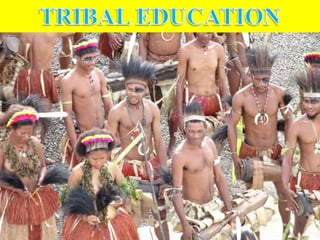
Tribal education