



•1
•2
•3
The Learning
Process
•4
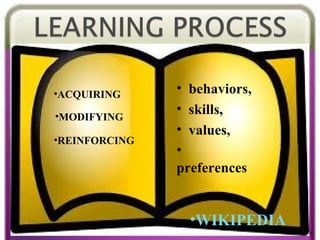
•ACQUIRING
•MODIFYING
•REINFORCING
• behaviors,
• skills,
• values,
•
preferences
•WIKIPEDIA
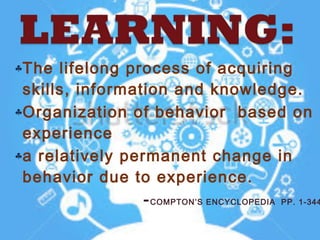
♣The lifelong process of acquiring
skills, information and knowledge.
♣Organization of behavior based on
experience
♣a relatively permanent change in
behavior due to experience.
-COMPTON’S ENCYCLOPEDIA PP. 1-344
•6
•7
•8
•9
•10
•http://home.epix.net/~tcannon1/Physioweek10.htm
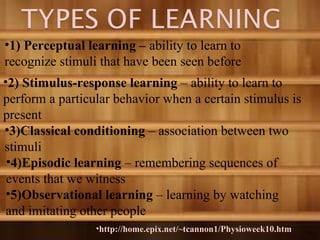
•1) Perceptual learning – ability to learn to
recognize stimuli that have been seen before
•2) Stimulus-response learning – ability to learn to
perform a particular behavior when a certain stimulus is
present
•3)Classical conditioning – association between two
stimuli
•4)Episodic learning – remembering sequences of
events that we witness
•5)Observational learning – learning by watching
and imitating other people
•11
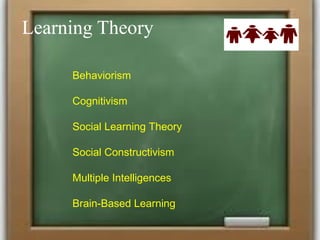
Learning Theory
Behaviorism
Cognitivism
Social Learning Theory
Social Constructivism
Multiple Intelligences
Brain-Based Learning
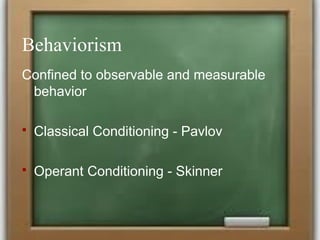
Behaviorism
Confined to observable and measurable
behavior
 Classical Conditioning - Pavlov
 Operant Conditioning - Skinner
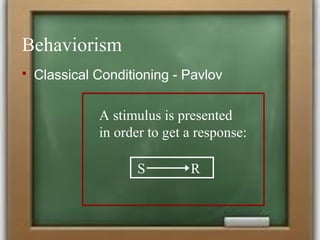
Behaviorism
 Classical Conditioning - Pavlov
S R
A stimulus is presented
in order to get a response:
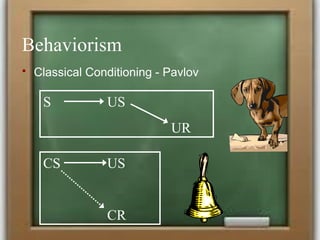
Behaviorism
 Classical Conditioning - Pavlov
S US
UR
CS US
CR
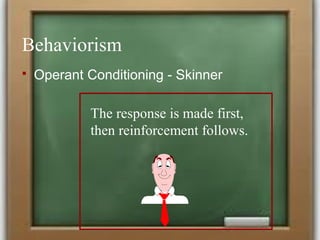
Behaviorism
 Operant Conditioning - Skinner
The response is made first,
then reinforcement follows.
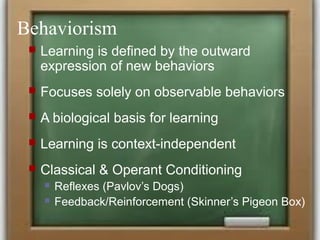
Behaviorism
 Learning is defined by the outward
expression of new behaviors
 Focuses solely on observable behaviors
 A biological basis for learning
 Learning is context-independent
 Classical & Operant Conditioning
 Reflexes (Pavlov’s Dogs)
 Feedback/Reinforcement (Skinner’s Pigeon Box)
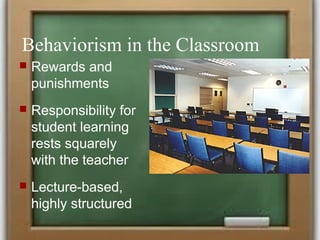
Behaviorism in the Classroom
 Rewards and
punishments
 Responsibility for
student learning
rests squarely
with the teacher
 Lecture-based,
highly structured
Cognitivism
 Grew in response to Behaviorism
 Knowledge is stored cognitively as symbols
 Learning is the process of connecting
symbols in a meaningful & memorable way
 Studies focused on the mental processes
that facilitate symbol connection
Cognitive Learning Theory
 Discovery Learning -
Jerome Bruner
 Meaningful Verbal
Learning -
David Ausubel
Cognitive Learning Theory
 Discovery Learning
1. Bruner said anybody can learn anything at
any age, provided it is stated in terms
they can understand.
Cognitive Learning Theory
 Discovery Learning
2. Powerful Concepts (not isolated facts)
a. Transfer to many different situations
b. Only possible through Discovery Learning
c. Confront the learner with problems and help
them find solutions. Do not present
sequenced materials.
Cognitive Learning Theory
 Meaningful Verbal Learning
Advance Organizers:
New material is
presented in a
systematic way, and
is connected to
existing cognitive
structures in a
meaningful way.
 Meaningful Verbal Learning
Cognitive Learning Theory
When learners have
difficulty with new
material, go back to
the concrete anchors
(Advance Organizers).
Provide a Discovery
approach, and they’ll
learn.
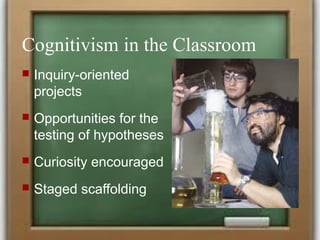
Cognitivism in the Classroom
 Inquiry-oriented
projects
 Opportunities for the
testing of hypotheses
 Curiosity encouraged
 Staged scaffolding
Learning Theory
 Behaviorism
 Social Learning Theory
 Cognitive Learning Theory
Social Learning Theory (SLT)
 Grew out of Cognitivism
 A. Bandura (1973)
 Learning takes place through observation
and sensorial experiences
 Imitation is the sincerest form of flattery
 SLT is the basis of the movement against
violence in media & video games
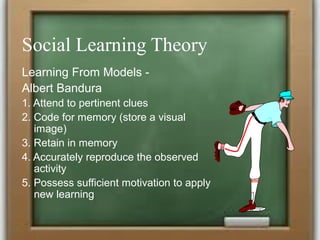
Social Learning Theory
Learning From Models -
Albert Bandura
1. Attend to pertinent clues
2. Code for memory (store a visual
image)
3. Retain in memory
4. Accurately reproduce the observed
activity
5. Possess sufficient motivation to apply
new learning
Social Learning Theory
Research indicates that the following factors
influence the strength of learning from models:
1. How much power the model seems to have
2. How capable the model seems to be
3. How nurturing (caring) the model seems to be
4. How similar the learner perceives self and
model
5. How many models the learner observes
Social Learning Theory
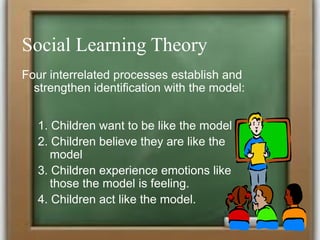
Four interrelated processes establish and
strengthen identification with the model:
1. Children want to be like the model
2. Children believe they are like the
model
3. Children experience emotions like
those the model is feeling.
4. Children act like the model.
Social Learning Theory
Through identification, children come to
believe they have the same
characteristics as the model.
When they identify with a nurturant and
competent model, children feel pleased and
proud.
When they identify with an inadequate model,
children feel unhappy and insecure.
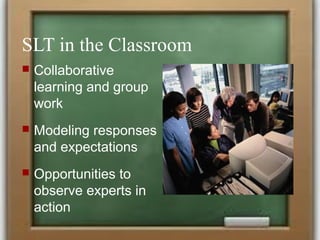
SLT in the Classroom
 Collaborative
learning and group
work
 Modeling responses
and expectations
 Opportunities to
observe experts in
action
Social Constructivism
 Grew out of and in response to Cognitivism, framed
around metacognition
 Knowledge is actively constructed
 Learning is…
 A search for meaning by the learner
 Contextualized
 An inherently social activity
 Dialogic and recursive
 The responsibility of the learner
 Lev Vygotsky
 Social Learning
 Zone of Proximal Development
Social Constructivism in the
Classroom
 Journaling
 Experiential activities
 Personal focus
 Collaborative &
cooperative learning
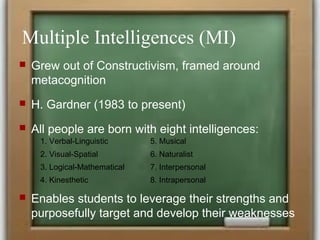
Multiple Intelligences (MI)
 Grew out of Constructivism, framed around
metacognition
 H. Gardner (1983 to present)
 All people are born with eight intelligences:
 Enables students to leverage their strengths and
purposefully target and develop their weaknesses
1. Verbal-Linguistic 5. Musical
2. Visual-Spatial 6. Naturalist
3. Logical-Mathematical 7. Interpersonal
4. Kinesthetic 8. Intrapersonal
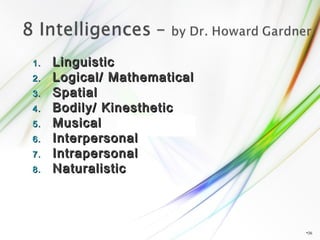
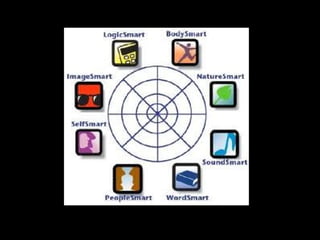
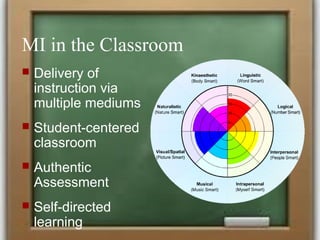
1.1. LinguisticLinguistic
2.2. Logical/ MathematicalLogical/ Mathematical
3.3. SpatialSpatial
4.4. Bodily/ KinestheticBodily/ Kinesthetic
5.5. MusicalMusical
6.6. InterpersonalInterpersonal
7.7. IntrapersonalIntrapersonal
8.8. NaturalisticNaturalistic
•36
 The ability to solve problems thatThe ability to solve problems that
one encounters in real lifeone encounters in real life
 The ability to generate newThe ability to generate new
problems to solveproblems to solve
 The ability to make something orThe ability to make something or
offer a service that is valuedoffer a service that is valued
within one’s culturewithin one’s culture
•37
MI in the Classroom
 Delivery of
instruction via
multiple mediums
 Student-centered
classroom
 Authentic
Assessment
 Self-directed
learning
Brain-Based Learning (BBL)
 Grew out of Neuroscience & Constructivism
 D. Souza, N. Caine & G. Caine, E. Jensen
(1980’s to present)
 12 governing principles
1. Brain is a parallel processor 7. Focused attention & peripheral perception
2. Whole body learning 8. Conscious & unconscious processes
3. A search for meaning 9. Several types of memory
4. Patterning 10. Embedded learning sticks
5. Emotions are critical 11. Challenge & threat
6. Processing of parts and wholes 12. Every brain is unique
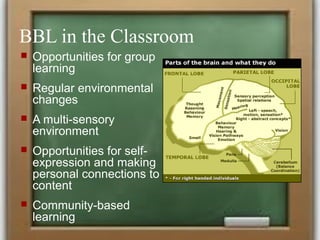
BBL in the Classroom
 Opportunities for group
learning
 Regular environmental
changes
 A multi-sensory
environment
 Opportunities for self-
expression and making
personal connections to
content
 Community-based
learning
Other Learning Theories of Note
 Andragogy (M. Knowles)
 Flow (M. Czikszentmihalyi)
 Situated Learning (J. Lave)
 Subsumption Theory (D. Ausubel)
 Conditions of Learning (R. Gagne)
Humanist
 All students are intrinsically motivated to
self actualize or learn
 Learning is dependent upon meeting a
hierarchy of needs (physiological,
psychological and intellectual)
 Learning should be reinforced.
 Learning is continuous
 Learning is purposeful & must make
sense to the learner
 Learning involves as many senses as
possible
 Learning activities must be appropriate
for the situation
Basic Principles of
Learning:
Basic Principles of
Learning:
 Learning must be stimulating
 Learning must result in the ability to
perform
 Learning is affected by emotions
 Learning is affected by the physical and
social environment
CONDITIONS OF LEARNING
Conditions of Learning
(Robert Gagne)
•Gaining attention (reception)
•Informing learners of the objective
(expectancy)
•Stimulating recall of prior learning (retrieval)
•Presenting the stimulus (selective perception)
•Providing learning guidance (semantic
encoding)
•Eliciting performance (responding)
•Providing feedback (reinforcement)
•Assessing performance (retrieval)
•Enhancing retention and transfer
(generalization).
Principles of Learning

Principles of Learning

  • 1.
  • 2.
  • 3.
  • 4.
  • 5.
    ♣The lifelong processof acquiring skills, information and knowledge. ♣Organization of behavior based on experience ♣a relatively permanent change in behavior due to experience. -COMPTON’S ENCYCLOPEDIA PP. 1-344
  • 6.
  • 7.
  • 8.
  • 9.
  • 10.
    •10 •http://home.epix.net/~tcannon1/Physioweek10.htm •1) Perceptual learning– ability to learn to recognize stimuli that have been seen before •2) Stimulus-response learning – ability to learn to perform a particular behavior when a certain stimulus is present •3)Classical conditioning – association between two stimuli •4)Episodic learning – remembering sequences of events that we witness •5)Observational learning – learning by watching and imitating other people
  • 11.
  • 12.
    Learning Theory Behaviorism Cognitivism Social LearningTheory Social Constructivism Multiple Intelligences Brain-Based Learning
  • 13.
    Behaviorism Confined to observableand measurable behavior  Classical Conditioning - Pavlov  Operant Conditioning - Skinner
  • 14.
    Behaviorism  Classical Conditioning- Pavlov S R A stimulus is presented in order to get a response:
  • 15.
    Behaviorism  Classical Conditioning- Pavlov S US UR CS US CR
  • 16.
    Behaviorism  Operant Conditioning- Skinner The response is made first, then reinforcement follows.
  • 17.
    Behaviorism  Learning isdefined by the outward expression of new behaviors  Focuses solely on observable behaviors  A biological basis for learning  Learning is context-independent  Classical & Operant Conditioning  Reflexes (Pavlov’s Dogs)  Feedback/Reinforcement (Skinner’s Pigeon Box)
  • 18.
    Behaviorism in theClassroom  Rewards and punishments  Responsibility for student learning rests squarely with the teacher  Lecture-based, highly structured
  • 19.
    Cognitivism  Grew inresponse to Behaviorism  Knowledge is stored cognitively as symbols  Learning is the process of connecting symbols in a meaningful & memorable way  Studies focused on the mental processes that facilitate symbol connection
  • 20.
    Cognitive Learning Theory Discovery Learning - Jerome Bruner  Meaningful Verbal Learning - David Ausubel
  • 21.
    Cognitive Learning Theory Discovery Learning 1. Bruner said anybody can learn anything at any age, provided it is stated in terms they can understand.
  • 22.
    Cognitive Learning Theory Discovery Learning 2. Powerful Concepts (not isolated facts) a. Transfer to many different situations b. Only possible through Discovery Learning c. Confront the learner with problems and help them find solutions. Do not present sequenced materials.
  • 23.
    Cognitive Learning Theory Meaningful Verbal Learning Advance Organizers: New material is presented in a systematic way, and is connected to existing cognitive structures in a meaningful way.
  • 24.
     Meaningful VerbalLearning Cognitive Learning Theory When learners have difficulty with new material, go back to the concrete anchors (Advance Organizers). Provide a Discovery approach, and they’ll learn.
  • 25.
    Cognitivism in theClassroom  Inquiry-oriented projects  Opportunities for the testing of hypotheses  Curiosity encouraged  Staged scaffolding
  • 26.
    Learning Theory  Behaviorism Social Learning Theory  Cognitive Learning Theory
  • 27.
    Social Learning Theory(SLT)  Grew out of Cognitivism  A. Bandura (1973)  Learning takes place through observation and sensorial experiences  Imitation is the sincerest form of flattery  SLT is the basis of the movement against violence in media & video games
  • 28.
    Social Learning Theory LearningFrom Models - Albert Bandura 1. Attend to pertinent clues 2. Code for memory (store a visual image) 3. Retain in memory 4. Accurately reproduce the observed activity 5. Possess sufficient motivation to apply new learning
  • 29.
    Social Learning Theory Researchindicates that the following factors influence the strength of learning from models: 1. How much power the model seems to have 2. How capable the model seems to be 3. How nurturing (caring) the model seems to be 4. How similar the learner perceives self and model 5. How many models the learner observes
  • 30.
    Social Learning Theory Fourinterrelated processes establish and strengthen identification with the model: 1. Children want to be like the model 2. Children believe they are like the model 3. Children experience emotions like those the model is feeling. 4. Children act like the model.
  • 31.
    Social Learning Theory Throughidentification, children come to believe they have the same characteristics as the model. When they identify with a nurturant and competent model, children feel pleased and proud. When they identify with an inadequate model, children feel unhappy and insecure.
  • 32.
    SLT in theClassroom  Collaborative learning and group work  Modeling responses and expectations  Opportunities to observe experts in action
  • 33.
    Social Constructivism  Grewout of and in response to Cognitivism, framed around metacognition  Knowledge is actively constructed  Learning is…  A search for meaning by the learner  Contextualized  An inherently social activity  Dialogic and recursive  The responsibility of the learner  Lev Vygotsky  Social Learning  Zone of Proximal Development
  • 34.
    Social Constructivism inthe Classroom  Journaling  Experiential activities  Personal focus  Collaborative & cooperative learning
  • 35.
    Multiple Intelligences (MI) Grew out of Constructivism, framed around metacognition  H. Gardner (1983 to present)  All people are born with eight intelligences:  Enables students to leverage their strengths and purposefully target and develop their weaknesses 1. Verbal-Linguistic 5. Musical 2. Visual-Spatial 6. Naturalist 3. Logical-Mathematical 7. Interpersonal 4. Kinesthetic 8. Intrapersonal
  • 36.
    1.1. LinguisticLinguistic 2.2. Logical/MathematicalLogical/ Mathematical 3.3. SpatialSpatial 4.4. Bodily/ KinestheticBodily/ Kinesthetic 5.5. MusicalMusical 6.6. InterpersonalInterpersonal 7.7. IntrapersonalIntrapersonal 8.8. NaturalisticNaturalistic •36
  • 37.
     The abilityto solve problems thatThe ability to solve problems that one encounters in real lifeone encounters in real life  The ability to generate newThe ability to generate new problems to solveproblems to solve  The ability to make something orThe ability to make something or offer a service that is valuedoffer a service that is valued within one’s culturewithin one’s culture •37
  • 39.
    MI in theClassroom  Delivery of instruction via multiple mediums  Student-centered classroom  Authentic Assessment  Self-directed learning
  • 40.
    Brain-Based Learning (BBL) Grew out of Neuroscience & Constructivism  D. Souza, N. Caine & G. Caine, E. Jensen (1980’s to present)  12 governing principles 1. Brain is a parallel processor 7. Focused attention & peripheral perception 2. Whole body learning 8. Conscious & unconscious processes 3. A search for meaning 9. Several types of memory 4. Patterning 10. Embedded learning sticks 5. Emotions are critical 11. Challenge & threat 6. Processing of parts and wholes 12. Every brain is unique
  • 41.
    BBL in theClassroom  Opportunities for group learning  Regular environmental changes  A multi-sensory environment  Opportunities for self- expression and making personal connections to content  Community-based learning
  • 42.
    Other Learning Theoriesof Note  Andragogy (M. Knowles)  Flow (M. Czikszentmihalyi)  Situated Learning (J. Lave)  Subsumption Theory (D. Ausubel)  Conditions of Learning (R. Gagne)
  • 43.
    Humanist  All studentsare intrinsically motivated to self actualize or learn  Learning is dependent upon meeting a hierarchy of needs (physiological, psychological and intellectual)  Learning should be reinforced.
  • 50.
     Learning iscontinuous  Learning is purposeful & must make sense to the learner  Learning involves as many senses as possible  Learning activities must be appropriate for the situation Basic Principles of Learning:
  • 51.
    Basic Principles of Learning: Learning must be stimulating  Learning must result in the ability to perform  Learning is affected by emotions  Learning is affected by the physical and social environment
  • 52.
    CONDITIONS OF LEARNING Conditionsof Learning (Robert Gagne)
  • 53.
    •Gaining attention (reception) •Informinglearners of the objective (expectancy) •Stimulating recall of prior learning (retrieval) •Presenting the stimulus (selective perception) •Providing learning guidance (semantic encoding) •Eliciting performance (responding) •Providing feedback (reinforcement) •Assessing performance (retrieval) •Enhancing retention and transfer (generalization).

Editor's Notes

  • #16 First Order Classical Conditioning: S = Stimulus(bell) US = Unconditioned Stimulus (food) UR = Unconditioned Response (saliva) CS = Conditioned Stimulus (bell) CR = Conditioned Reponse (saliva)
  • #18 Biological basis for learning – you have it or you don’t…it’s a thing you inherit
  • #20 Grew in response to Behaviorism in an effort to better understand the mental processes behind learning
  • #23 An example of a powerful concept is addition. Instead of drilling facts 1 + 1 = 2 1 + 2 = 3 into people’s heads, teach them the CONCEPT of addition.
  • #24 New material is related to something they already know!
  • #25 .
  • #26 Staged scaffolding: not based on ability or experience…based on developmental stage (age most predominantly)
  • #28 Imitation: Individuals adopt the modeled behavior more readily and completely if the person they are observing is admired by the observer We more readily model behavior if it results in outcomes we value or approve of
  • #34 Knowledge is actively constructed by individuals in light of and in relation to our past experiences, the context of learning, personal motivation, and our beliefs/attitudes/prior knowledge Think of the lab…instead of just watching it being done, the student acts as the active agent conducting the lab, with expert support leading them to the edge of their knowledge and beyond. Dialogic: central focus is on written & spoken dialogue Recursive: new learning is built upon prior learning…scaffolding
  • #36 Metacognition – simply put is learning about learning, but more realistically, it’s about kn owing who you are as a learner, and developing the capacity to leverage your strengths to your advantage while purposefully addressing your weaknesses