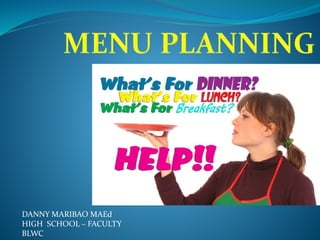
DANNY MARIBAO MAEd
HIGH SCHOOL – FACULTY
BLWC
AREAS of FOCUS
 Menu Planning
 Mechanics of Menu Planning
 Components of Menu Pattern
MENU – A list of food and meals
shown to aid them in choosing.
MENU PLANNING – is done in
advance to serve as a deciding factor
on the kinds of food to be serve in
various meals.
MENU PLANNING
 The Menu is not only a Control Tool. Since
it lists of Items that your operation has to
offer, it also doubles up as a Marketing
tool.
 In this manner the Menu doubles up as a
Control and Marketing Tool and blends
them into a workable system.
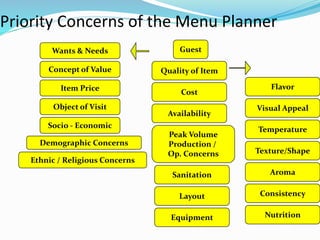
Priority Concerns of the Menu Planner
Guest
Quality of Item
Wants & Needs
Concept of Value
Item Price
Object of Visit
Socio - Economic
Demographic Concerns
Ethnic / Religious Concerns
Cost
Availability
Peak Volume
Production /
Op. Concerns
Sanitation
Layout
Equipment
Flavor
Visual Appeal
Temperature
Texture/Shape
Aroma
Consistency
Nutrition
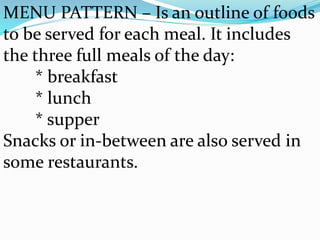
MENU PATTERN – Is an outline of foods
to be served for each meal. It includes
the three full meals of the day:
* breakfast
* lunch
* supper
Snacks or in-between are also served in
some restaurants.
Menu Planning Strategies
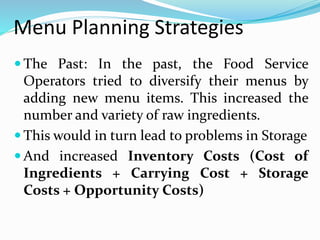
 The Past: In the past, the Food Service
Operators tried to diversify their menus by
adding new menu items. This increased the
number and variety of raw ingredients.
 This would in turn lead to problems in Storage
 And increased Inventory Costs (Cost of
Ingredients + Carrying Cost + Storage
Costs + Opportunity Costs)
Menu Planning Strategies
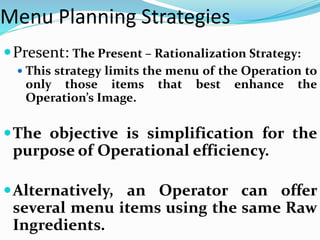
Present: The Present – Rationalization Strategy:
 This strategy limits the menu of the Operation to
only those items that best enhance the
Operation’s Image.
The objective is simplification for the
purpose of Operational efficiency.
Alternatively, an Operator can offer
several menu items using the same Raw
Ingredients.
Menu Planning Strategies
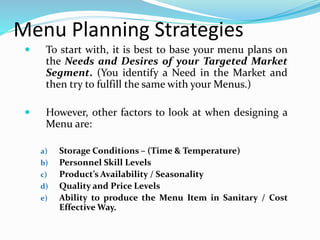
 To start with, it is best to base your menu plans on
the Needs and Desires of your Targeted Market
Segment. (You identify a Need in the Market and
then try to fulfill the same with your Menus.)
 However, other factors to look at when designing a
Menu are:
a) Storage Conditions – (Time & Temperature)
b) Personnel Skill Levels
c) Product’s Availability / Seasonality
d) Quality and Price Levels
e) Ability to produce the Menu Item in Sanitary / Cost
Effective Way.
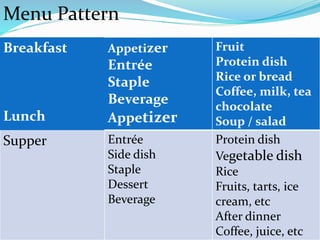
Breakfast
Lunch
Appetizer
Entrée
Staple
Beverage
Appetizer
Fruit
Protein dish
Rice or bread
Coffee, milk, tea
chocolate
Soup / salad
Supper Entrée
Side dish
Staple
Dessert
Beverage
Protein dish
Vegetable dish
Rice
Fruits, tarts, ice
cream, etc
After dinner
Coffee, juice, etc
Menu Pattern
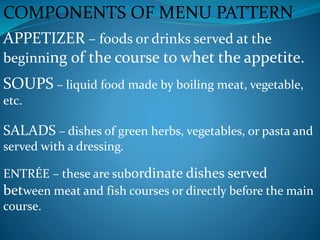
COMPONENTS OF MENU PATTERN
APPETIZER – foods or drinks served at the
beginning of the course to whet the appetite.
SOUPS – liquid food made by boiling meat, vegetable,
etc.
SALADS – dishes of green herbs, vegetables, or pasta and
served with a dressing.
ENTRÉE – these are subordinate dishes served
between meat and fish courses or directly before the main
course.
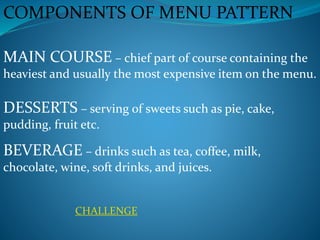
COMPONENTS OF MENU PATTERN
MAIN COURSE – chief part of course containing the
heaviest and usually the most expensive item on the menu.
DESSERTS – serving of sweets such as pie, cake,
pudding, fruit etc.
BEVERAGE – drinks such as tea, coffee, milk,
chocolate, wine, soft drinks, and juices.
CHALLENGE
MAKE YOUR OWN MENU PLAN
DANNY MARIBAO
HS – FACULTY
BLWC

Menu planning

  • 1.
    DANNY MARIBAO MAEd HIGHSCHOOL – FACULTY BLWC
  • 2.
    AREAS of FOCUS Menu Planning  Mechanics of Menu Planning  Components of Menu Pattern
  • 3.
    MENU – Alist of food and meals shown to aid them in choosing. MENU PLANNING – is done in advance to serve as a deciding factor on the kinds of food to be serve in various meals.
  • 4.
    MENU PLANNING  TheMenu is not only a Control Tool. Since it lists of Items that your operation has to offer, it also doubles up as a Marketing tool.  In this manner the Menu doubles up as a Control and Marketing Tool and blends them into a workable system.
  • 5.
    Priority Concerns ofthe Menu Planner Guest Quality of Item Wants & Needs Concept of Value Item Price Object of Visit Socio - Economic Demographic Concerns Ethnic / Religious Concerns Cost Availability Peak Volume Production / Op. Concerns Sanitation Layout Equipment Flavor Visual Appeal Temperature Texture/Shape Aroma Consistency Nutrition
  • 6.
    MENU PATTERN –Is an outline of foods to be served for each meal. It includes the three full meals of the day: * breakfast * lunch * supper Snacks or in-between are also served in some restaurants.
  • 7.
    Menu Planning Strategies The Past: In the past, the Food Service Operators tried to diversify their menus by adding new menu items. This increased the number and variety of raw ingredients.  This would in turn lead to problems in Storage  And increased Inventory Costs (Cost of Ingredients + Carrying Cost + Storage Costs + Opportunity Costs)
  • 8.
    Menu Planning Strategies Present:The Present – Rationalization Strategy:  This strategy limits the menu of the Operation to only those items that best enhance the Operation’s Image. The objective is simplification for the purpose of Operational efficiency. Alternatively, an Operator can offer several menu items using the same Raw Ingredients.
  • 9.
    Menu Planning Strategies To start with, it is best to base your menu plans on the Needs and Desires of your Targeted Market Segment. (You identify a Need in the Market and then try to fulfill the same with your Menus.)  However, other factors to look at when designing a Menu are: a) Storage Conditions – (Time & Temperature) b) Personnel Skill Levels c) Product’s Availability / Seasonality d) Quality and Price Levels e) Ability to produce the Menu Item in Sanitary / Cost Effective Way.
  • 10.
    Breakfast Lunch Appetizer Entrée Staple Beverage Appetizer Fruit Protein dish Rice orbread Coffee, milk, tea chocolate Soup / salad Supper Entrée Side dish Staple Dessert Beverage Protein dish Vegetable dish Rice Fruits, tarts, ice cream, etc After dinner Coffee, juice, etc Menu Pattern
  • 11.
    COMPONENTS OF MENUPATTERN APPETIZER – foods or drinks served at the beginning of the course to whet the appetite. SOUPS – liquid food made by boiling meat, vegetable, etc. SALADS – dishes of green herbs, vegetables, or pasta and served with a dressing. ENTRÉE – these are subordinate dishes served between meat and fish courses or directly before the main course.
  • 12.
    COMPONENTS OF MENUPATTERN MAIN COURSE – chief part of course containing the heaviest and usually the most expensive item on the menu. DESSERTS – serving of sweets such as pie, cake, pudding, fruit etc. BEVERAGE – drinks such as tea, coffee, milk, chocolate, wine, soft drinks, and juices. CHALLENGE
  • 13.
    MAKE YOUR OWNMENU PLAN
  • 14.