Job and contract costing
Cost Accounting-II (Bcom Sem -4)
Commerce
Gokul College of Commerce and
management
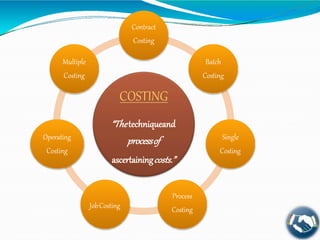
COSTING
“Thetechniqueand
processof
ascertainingcosts.”
Contract
Costing
Batch
Costing
Single
Costing
Process
CostingJobCosting
Operating
Costing
Multiple
Costing
Job costing
 Determine the cost of specific jobs or lots of production, work orderor
project separately.
 Manufacturing firm like presses, machine- tool andnon-manufacturing
concern general engg. Workshop & Auto Repair shop,
 It is used in Job order Industries
Objectives of Job costing
 Determine profit or loss of each job, the actual costs are
compared with the estimated costs, so to ascertaincorrect
estimation & separate the profitable jobs from the
unprofitable ones.
 Helps in minimizing the losses & maximizing profits,
 Cost per unit can be ascertained
Feature of job costing
 Jobs are ascertained against the order of customers,
 Production is not meant for stock or future sale,
 Not a continuous process,
 Different degrees of attention & skills are required for differentjobs,
each job so, no uniformity in Nature of the job decides the process of
the flow of production,
 Separate cost sheet for eachjob
Advantages of Job costing
 Distinguish profitable from the unprofitable jobs,
 Assist in preparing the estimation,
 Detailed analysis of cost elements & functions,
 Helps in future production planning,
 Cost data helps in preparing budgets,
 Spoilage & defective work can be discovered,
 Facilitates in cost plus contracts,
 Helps management in fixing SP of special orders,
Disadvantages of job costing
 Expensive as it involves more clericalwork.
 Historical costing in nature, so it doesn’t give the prompt remedialmeasures
 Non-comparable
 More chance of mistakes
 Not much use for controlpurpose
Contract Costing
Variant of job costing,
Applies to construction works,
Individual cost unit (individual jobs)& cost
centre (department or process),
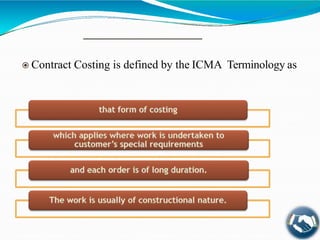
 Contract Costing is defined by the ICMA Terminology as
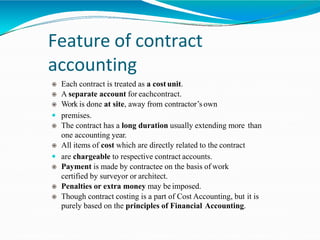
Feature of contract
accounting
 Each contract is treated as a cost unit.
 A separate account for eachcontract.
 Work is done at site, away from contractor’s own
 premises.
 The contract has a long duration usually extending more than
one accounting year.
 All items of cost which are directly related to the contract
 are chargeable to respective contract accounts.
 Payment is made by contractee on the basis of work
certified by surveyor or architect.
 Penalties or extra money may be imposed.
 Though contract costing is a part of Cost Accounting, but it is
purely based on the principles of Financial Accounting.
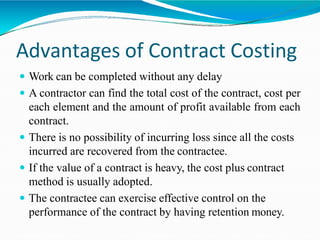
Advantages of Contract Costing
 Work can be completed without any delay
 A contractor can find the total cost of the contract, cost per
each element and the amount of profit available from each
contract.
 There is no possibility of incurring loss since all the costs
incurred are recovered from the contractee.
 If the value of a contract is heavy, the cost plus contract
method is usually adopted.
 The contractee can exercise effective control on the
performance of the contract by having retention money.
Disadvantages of Contract account
 The contract account is not reflecting the efficiency of the
contractor.
 The contractee is affected under the cost plus contract.
The contractor does not care about the amount of expenses
if he assumes work under cost plus contract.
 Disputes and differences often arise between the
contractors and the contractees in many matters.
 If profit percentage is fixed, the contractor does not care
about the quality in the performance of the contract .
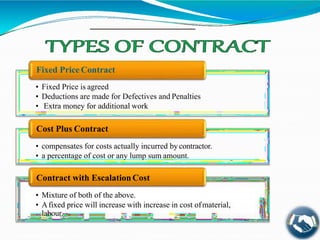
Fixed Price Contract
• Fixed Price is agreed
• Deductions are made for Defectives and Penalties
• Extra money for additional work
Cost Plus Contract
• compensates for costs actually incurred by contractor.
• a percentage of cost or any lump sum amount.
Contract with EscalationCost
• Mixture of both of the above.
• Afixed price will increase with increase in cost ofmaterial,
labour.
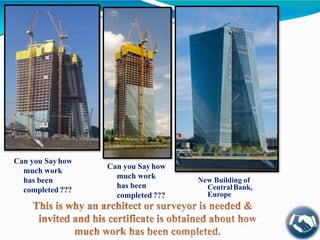
Can you Sayhow
much work
has been
completed ???
Can you Say how
much work
has been
completed ???
New Building of
CentralBank,
Europe
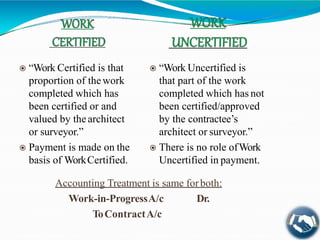
 “Work Certified is that
proportion of thework
completed which has
been certified or and
valued by thearchitect
or surveyor.”
 Payment is made on the
basis of WorkCertified.
 “Work Uncertified is
that part of the work
completed which has not
been certified/approved
by the contractee’s
architect or surveyor.”
 There is no role ofWork
Uncertified in payment.
Accounting Treatment is same forboth:
Work-in-ProgressA/c Dr.
ToContractA/c
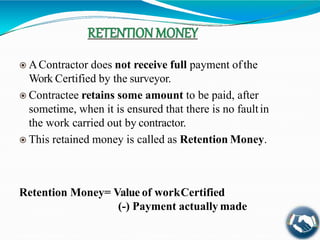
 AContractor does not receive full payment ofthe
Work Certified by the surveyor.
 Contractee retains some amount to be paid, after
sometime, when it is ensured that there is no faultin
the work carried out by contractor.
 This retained money is called as Retention Money.
Retention Money= Value of workCertified
(-) Payment actually made
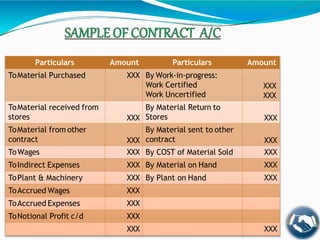
Particulars Amount Particulars Amount
ToMaterial Purchased XXX By Work-in-progress:
Work Certified
Work Uncertified
XXX
XXX
ToMaterial received from
stores XXX
By Material Return to
Stores XXX
ToMaterial from other
contract XXX
By Material sent to other
contract XXX
ToWages XXX By COST of Material Sold XXX
ToIndirect Expenses XXX By Material on Hand XXX
ToPlant & Machinery XXX By Plant on Hand XXX
ToAccrued Wages XXX
ToAccrued Expenses XXX
ToNotional Profit c/d XXX
XXX XXX
Comparison between contract and
Job costing
Size: A job is small in size but the contract is big in size.
Placeof work: Workunderjobcosting isperformed in the
workshop butthe
contract is executed mostlyatsite.
Time forcompletion: A job usuallytakes less time for
completion whereas a contract takes more time to
complete thework.
Paymentof price: Theselling priceof a job ispaid in full
aftercompleting the job
But incaseof contract, theprice ispaid invarious installments
depending uponthe
progress of thework.
Investment: There is heavy investmentonassets incaseof
jobcosting as compared to contractcosting.
Contract account

Contract account

  • 1.
    Job and contractcosting Cost Accounting-II (Bcom Sem -4) Commerce Gokul College of Commerce and management
  • 3.
  • 4.
    Job costing  Determinethe cost of specific jobs or lots of production, work orderor project separately.  Manufacturing firm like presses, machine- tool andnon-manufacturing concern general engg. Workshop & Auto Repair shop,  It is used in Job order Industries
  • 5.
    Objectives of Jobcosting  Determine profit or loss of each job, the actual costs are compared with the estimated costs, so to ascertaincorrect estimation & separate the profitable jobs from the unprofitable ones.  Helps in minimizing the losses & maximizing profits,  Cost per unit can be ascertained
  • 6.
    Feature of jobcosting  Jobs are ascertained against the order of customers,  Production is not meant for stock or future sale,  Not a continuous process,  Different degrees of attention & skills are required for differentjobs, each job so, no uniformity in Nature of the job decides the process of the flow of production,  Separate cost sheet for eachjob
  • 7.
    Advantages of Jobcosting  Distinguish profitable from the unprofitable jobs,  Assist in preparing the estimation,  Detailed analysis of cost elements & functions,  Helps in future production planning,  Cost data helps in preparing budgets,  Spoilage & defective work can be discovered,  Facilitates in cost plus contracts,  Helps management in fixing SP of special orders,
  • 8.
    Disadvantages of jobcosting  Expensive as it involves more clericalwork.  Historical costing in nature, so it doesn’t give the prompt remedialmeasures  Non-comparable  More chance of mistakes  Not much use for controlpurpose
  • 9.
    Contract Costing Variant ofjob costing, Applies to construction works, Individual cost unit (individual jobs)& cost centre (department or process),
  • 10.
     Contract Costingis defined by the ICMA Terminology as
  • 11.
    Feature of contract accounting Each contract is treated as a cost unit.  A separate account for eachcontract.  Work is done at site, away from contractor’s own  premises.  The contract has a long duration usually extending more than one accounting year.  All items of cost which are directly related to the contract  are chargeable to respective contract accounts.  Payment is made by contractee on the basis of work certified by surveyor or architect.  Penalties or extra money may be imposed.  Though contract costing is a part of Cost Accounting, but it is purely based on the principles of Financial Accounting.
  • 12.
    Advantages of ContractCosting  Work can be completed without any delay  A contractor can find the total cost of the contract, cost per each element and the amount of profit available from each contract.  There is no possibility of incurring loss since all the costs incurred are recovered from the contractee.  If the value of a contract is heavy, the cost plus contract method is usually adopted.  The contractee can exercise effective control on the performance of the contract by having retention money.
  • 13.
    Disadvantages of Contractaccount  The contract account is not reflecting the efficiency of the contractor.  The contractee is affected under the cost plus contract. The contractor does not care about the amount of expenses if he assumes work under cost plus contract.  Disputes and differences often arise between the contractors and the contractees in many matters.  If profit percentage is fixed, the contractor does not care about the quality in the performance of the contract .
  • 14.
    Fixed Price Contract •Fixed Price is agreed • Deductions are made for Defectives and Penalties • Extra money for additional work Cost Plus Contract • compensates for costs actually incurred by contractor. • a percentage of cost or any lump sum amount. Contract with EscalationCost • Mixture of both of the above. • Afixed price will increase with increase in cost ofmaterial, labour.
  • 15.
    Can you Sayhow muchwork has been completed ??? Can you Say how much work has been completed ??? New Building of CentralBank, Europe
  • 16.
     “Work Certifiedis that proportion of thework completed which has been certified or and valued by thearchitect or surveyor.”  Payment is made on the basis of WorkCertified.  “Work Uncertified is that part of the work completed which has not been certified/approved by the contractee’s architect or surveyor.”  There is no role ofWork Uncertified in payment. Accounting Treatment is same forboth: Work-in-ProgressA/c Dr. ToContractA/c
  • 17.
     AContractor doesnot receive full payment ofthe Work Certified by the surveyor.  Contractee retains some amount to be paid, after sometime, when it is ensured that there is no faultin the work carried out by contractor.  This retained money is called as Retention Money. Retention Money= Value of workCertified (-) Payment actually made
  • 18.
    Particulars Amount ParticularsAmount ToMaterial Purchased XXX By Work-in-progress: Work Certified Work Uncertified XXX XXX ToMaterial received from stores XXX By Material Return to Stores XXX ToMaterial from other contract XXX By Material sent to other contract XXX ToWages XXX By COST of Material Sold XXX ToIndirect Expenses XXX By Material on Hand XXX ToPlant & Machinery XXX By Plant on Hand XXX ToAccrued Wages XXX ToAccrued Expenses XXX ToNotional Profit c/d XXX XXX XXX
  • 19.
    Comparison between contractand Job costing Size: A job is small in size but the contract is big in size. Placeof work: Workunderjobcosting isperformed in the workshop butthe contract is executed mostlyatsite. Time forcompletion: A job usuallytakes less time for completion whereas a contract takes more time to complete thework. Paymentof price: Theselling priceof a job ispaid in full aftercompleting the job But incaseof contract, theprice ispaid invarious installments depending uponthe progress of thework. Investment: There is heavy investmentonassets incaseof jobcosting as compared to contractcosting.