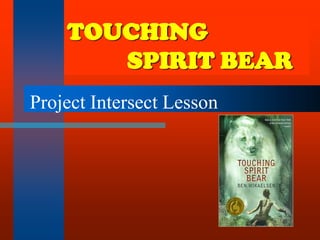
TOUCHING
SPIRIT BEAR
Project Intersect Lesson
Overview
Touching Spirit Bear by Ben Mikaelsen is about
a boy from Minneapolis who is going down the
wrong path in life. He beats up a boy from
school and has to face a Native American
Circle Justice council. They agree that he will
be banished to an island in Alaska to think
through his behavior and try to find the right
path. Within days, he is mauled by a
mysterious white bear and through this, he
starts to accept responsibility for what he has
done in the past.
Idea Development
- Began reading book at the end of January
- Student teacher came in February and
asked if she could read book to students
and develop some lessons
- Throughout book, ideas were generated to
make book more meaningful to students
Lessons
 Journal/Reading Responses
(Writing, Language Arts)
 I Am Poem (Writing, Language Arts,
Social-ethics)
 Spelling activities (Language Arts)
 Play-doh (Science)
 Stranded on an Island (Science,
Language Arts)
 aa.tow blanket (Math)
Journal/Reading Responses
Students had to log entries in a
journal.
- Summarize happening
- Make predictions
- Reactions/Feelings
I Am Poem
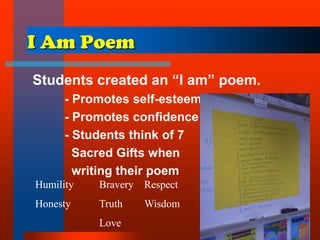
Students created an “I am” poem.
- Promotes self-esteem
- Promotes confidence
- Students think of 7
Sacred Gifts when
writing their poem
Humility Bravery Respect
Honesty Truth Wisdom
Love
Spelling Activities
15 words were chosen
from the book.
Students did various
activities with the words
throughout the week.
Word Sort Word find
Crossword puzzle with definitions
Cloze sentence activity
Practice test Locate words
Play-Doh
- While Cole was in jail, his parole officer, Garvey brought in a
bunch of different ingredients and had him taste each one. He
then had him taste them when they were all mixed together.
Separate they tasted awful but together they created something
wonderful. (If you want to know what it was, read the book!)
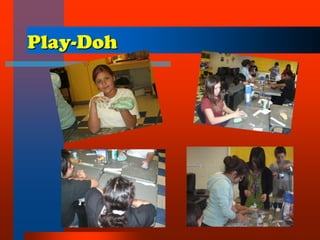
- The students then experienced the same thing. We brought in
various ingredients and had them think about what each could
make separately. We then had them mix them together to create
Play-Doh.
- We used this lesson to teach them about how we can be good at
something when we do it ourselves but if we “mix up” our
knowledge with someone elses, we might be even better.
Play-Doh
Stranded on an Island
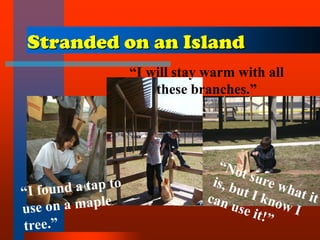
- Cole was given minimal survival provisions when
he was dropped off at the island in Alaska.
- Students had to think about what they might need
in order to survive on an island by themselves.
- We brought students outside and gave them each a
paper bag and told them they had to find at least 3
items they could use for survival.
- Students had to report on each item that they found
and describe how it would help them survive on an
island.
Stranded on an Island
“I will stay warm with all
these branches.”
At.oow Blanket
- Something that is inherited and passed
down from generation to generation.
- Cole used his at.oow for various survival
techniques throughout the book.
- When Cole was mauled by the Spirit Bear,
he felt more comfortable after he was
given the at.oow.
At.oow Blanket
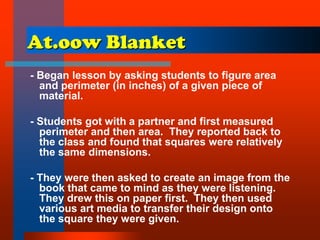
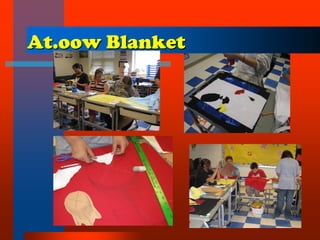
- Began lesson by asking students to figure area
and perimeter (in inches) of a given piece of
material.
- Students got with a partner and first measured
perimeter and then area. They reported back to
the class and found that squares were relatively
the same dimensions.
- They were then asked to create an image from the
book that came to mind as they were listening.
They drew this on paper first. They then used
various art media to transfer their design onto
the square they were given.
At.oow Blanket
At.oow Blanket
Minnesota 5th Grade Standards
Math – 5.3.2.1, 5.3.2.2. Determine the area of triangles and
quadrilaterals.
Language Arts – 5.B.3.2, 5.I.C.3, 5.II.A.1.a,b,e,f, 5.II.C.1-4. The
student will use a variety of strategies to expand reading,
listening, and speaking vocabularies. The student will understand
the meaning of text using a variety of strategies and will
demonstrate literal, interpretive, inferential and evaluative
comprehension. The student will compose various types of
writing – narrative, descriptive, poetry, persuasive. The student
will apply standard English conventions when writing.
Science – 5.1.1.1.5. Understand that different models can be used to
represent the same thing.
Social Studies – VII.B.1,3.1. Protect individual rights and promote
general welfare, provide order, security, predictability.
American Indian Learner Outcomes
Students will be able to illustrate how the process to achieve harmony and balance plays
a vital role in American Indian philosophy and in the daily lives of American Indians.
Students will be able to demonstrate an understanding of the American Indian value
system
Visual Arts:
Standard 1 - Understanding and applying media, techniques and processes
in relation to American Indian/tribal art.
Standard 6 – Making connections between American Indian visual arts and
math, science, social studies, and language arts.
Standard C3 – Develop an understanding of concepts of nature’s diversity,
codependency and the intricate balance between natural forces and how they are
reflected in traditional Indian philosophies and symbols, such as the medicine wheel.
Math:
Standard 1 – Use problem solving approaches to investigate and understand
mathematical content and relate it to the American Indians’ application of
mathematical knowledge, for example, the use of symmetry in beadwork.
Standard 13 – extend their understanding of the concepts of perimeter, area,
volume, angle measure, capacity, and weight and mass as the relate to an
examination of traditional American Indian objects.
Outcomes
 Students enjoyed the variety of lessons
 Students were engaged throughout lessons
 Students were beginning to reference things that
happened in the book and relate them to similar
situations
 Students asked what we were going to read after
finishing this book
 Students were able to feel a sense of
accomplishment and pride, especially after
finishing the at.oow blanket.
 Students asked to present it to the entire school
during our closing ceremony

Document244c2a0c705e8d1

  • 1.
  • 2.
    Overview Touching Spirit Bearby Ben Mikaelsen is about a boy from Minneapolis who is going down the wrong path in life. He beats up a boy from school and has to face a Native American Circle Justice council. They agree that he will be banished to an island in Alaska to think through his behavior and try to find the right path. Within days, he is mauled by a mysterious white bear and through this, he starts to accept responsibility for what he has done in the past.
  • 3.
    Idea Development - Beganreading book at the end of January - Student teacher came in February and asked if she could read book to students and develop some lessons - Throughout book, ideas were generated to make book more meaningful to students
  • 4.
    Lessons  Journal/Reading Responses (Writing,Language Arts)  I Am Poem (Writing, Language Arts, Social-ethics)  Spelling activities (Language Arts)  Play-doh (Science)  Stranded on an Island (Science, Language Arts)  aa.tow blanket (Math)
  • 5.
    Journal/Reading Responses Students hadto log entries in a journal. - Summarize happening - Make predictions - Reactions/Feelings
  • 6.
    I Am Poem Studentscreated an “I am” poem. - Promotes self-esteem - Promotes confidence - Students think of 7 Sacred Gifts when writing their poem Humility Bravery Respect Honesty Truth Wisdom Love
  • 7.
    Spelling Activities 15 wordswere chosen from the book. Students did various activities with the words throughout the week. Word Sort Word find Crossword puzzle with definitions Cloze sentence activity Practice test Locate words
  • 8.
    Play-Doh - While Colewas in jail, his parole officer, Garvey brought in a bunch of different ingredients and had him taste each one. He then had him taste them when they were all mixed together. Separate they tasted awful but together they created something wonderful. (If you want to know what it was, read the book!) - The students then experienced the same thing. We brought in various ingredients and had them think about what each could make separately. We then had them mix them together to create Play-Doh. - We used this lesson to teach them about how we can be good at something when we do it ourselves but if we “mix up” our knowledge with someone elses, we might be even better.
  • 9.
  • 10.
    Stranded on anIsland - Cole was given minimal survival provisions when he was dropped off at the island in Alaska. - Students had to think about what they might need in order to survive on an island by themselves. - We brought students outside and gave them each a paper bag and told them they had to find at least 3 items they could use for survival. - Students had to report on each item that they found and describe how it would help them survive on an island.
  • 11.
    Stranded on anIsland “I will stay warm with all these branches.”
  • 12.
    At.oow Blanket - Somethingthat is inherited and passed down from generation to generation. - Cole used his at.oow for various survival techniques throughout the book. - When Cole was mauled by the Spirit Bear, he felt more comfortable after he was given the at.oow.
  • 13.
    At.oow Blanket - Beganlesson by asking students to figure area and perimeter (in inches) of a given piece of material. - Students got with a partner and first measured perimeter and then area. They reported back to the class and found that squares were relatively the same dimensions. - They were then asked to create an image from the book that came to mind as they were listening. They drew this on paper first. They then used various art media to transfer their design onto the square they were given.
  • 14.
  • 15.
  • 16.
    Minnesota 5th GradeStandards Math – 5.3.2.1, 5.3.2.2. Determine the area of triangles and quadrilaterals. Language Arts – 5.B.3.2, 5.I.C.3, 5.II.A.1.a,b,e,f, 5.II.C.1-4. The student will use a variety of strategies to expand reading, listening, and speaking vocabularies. The student will understand the meaning of text using a variety of strategies and will demonstrate literal, interpretive, inferential and evaluative comprehension. The student will compose various types of writing – narrative, descriptive, poetry, persuasive. The student will apply standard English conventions when writing. Science – 5.1.1.1.5. Understand that different models can be used to represent the same thing. Social Studies – VII.B.1,3.1. Protect individual rights and promote general welfare, provide order, security, predictability.
  • 17.
    American Indian LearnerOutcomes Students will be able to illustrate how the process to achieve harmony and balance plays a vital role in American Indian philosophy and in the daily lives of American Indians. Students will be able to demonstrate an understanding of the American Indian value system Visual Arts: Standard 1 - Understanding and applying media, techniques and processes in relation to American Indian/tribal art. Standard 6 – Making connections between American Indian visual arts and math, science, social studies, and language arts. Standard C3 – Develop an understanding of concepts of nature’s diversity, codependency and the intricate balance between natural forces and how they are reflected in traditional Indian philosophies and symbols, such as the medicine wheel. Math: Standard 1 – Use problem solving approaches to investigate and understand mathematical content and relate it to the American Indians’ application of mathematical knowledge, for example, the use of symmetry in beadwork. Standard 13 – extend their understanding of the concepts of perimeter, area, volume, angle measure, capacity, and weight and mass as the relate to an examination of traditional American Indian objects.
  • 18.
    Outcomes  Students enjoyedthe variety of lessons  Students were engaged throughout lessons  Students were beginning to reference things that happened in the book and relate them to similar situations  Students asked what we were going to read after finishing this book  Students were able to feel a sense of accomplishment and pride, especially after finishing the at.oow blanket.  Students asked to present it to the entire school during our closing ceremony