
Clive Young and Nataša Perović
E-learning Environments, UCL
Arena Blended Connected (ABC)
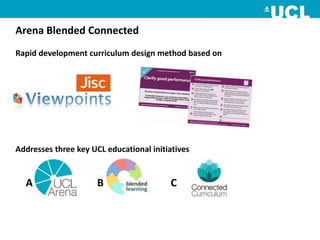
Arena Blended Connected
Rapid development curriculum design method based on
Addresses three key UCL educational initiatives
A B C
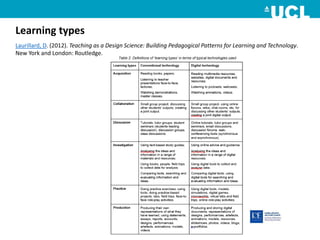
Learning types
Laurillard, D. (2012). Teaching as a Design Science: Building Pedagogical Patterns for Learning and Technology.
New York and London: Routledge.
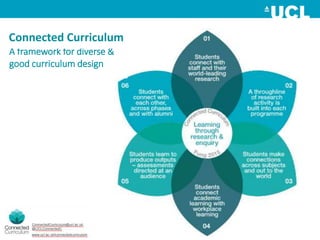
A framework for diverse &
good curriculum design
Connected Curriculum
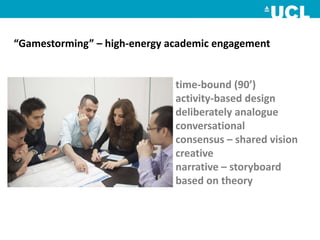
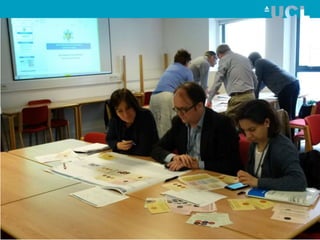
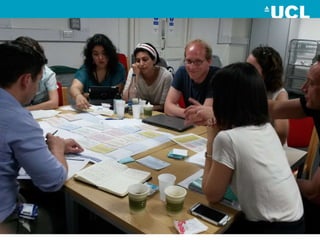
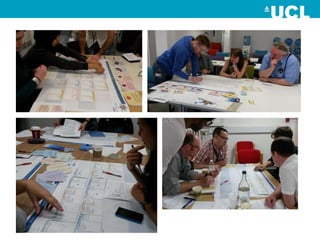
“Gamestorming” – high-energy academic engagement
time-bound (90’)
activity-based design
deliberately analogue
conversational
consensus – shared vision
creative
narrative – storyboard
based on theory
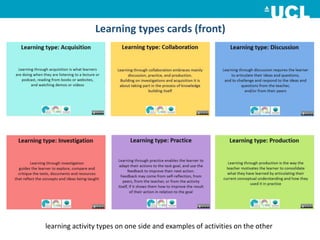
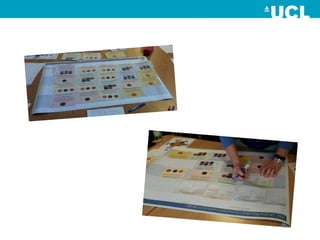
Learning types cards (front)
learning activity types on one side and examples of activities on the other
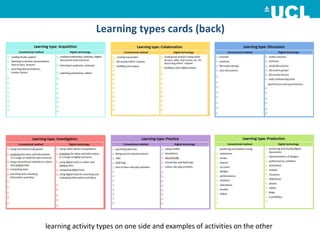
Learning types cards (back)
learning activity types on one side and examples of activities on the other
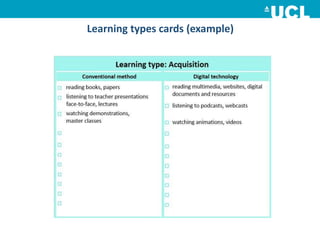
Learning types cards (example)
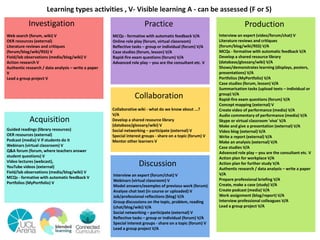
Learning types activities , V- Visible learning A - can be assessed (F or S)
Investigation
Interview an expert (video/forum/chat) V
Literature reviews and critiques
(forum/blog/wiki/RSS) V/A
MCQs - formative with automatic feedback V/A
Develop a shared resource library
(database/glossary/wiki) V/A
Shows/demonstrates learning (displays, posters,
presentations) V/A
Portfolios (MyPortfolio) V/A
Case studies (forum, lesson) V/A
Summarisation tasks (upload texts – individual or
group) V/A
Rapid-fire exam questions (forum) V/A
Concept mapping (external) V
Create video of performance (media) V/A
Audio commentary of performance (media) V/A
Skype or virtual classroom 'viva' V/A
Make and give a presentation (external) V/A
Video blog (external) V/A
Write a report (external) V/A
Make an analysis (external) V/A
Case studies V/A
Advanced role play – you are the consultant etc. V
Action plan for workplace V/A
Action plan for further study V/A
Authentic research / data analysis – write a paper
V/A
Prepare professional briefing V/A
Create, make a case (study) V/A
Create podcast (media) V/A
Work assignment (blog/report) V/A
Interview professional colleagues V/A
Lead a group project V/A
Practice Production
Web search (forum, wiki) V
OER resources (external)
Literature reviews and critiques
(forum/blog/wiki/RSS) V
Field/lab observations (media/blog/wiki) V
Action research V
Authentic research / data analysis – write a paper
V
Lead a group project V
MCQs - formative with automatic feedback V/A
Online role play (forum, virtual classroom)
Reflective tasks – group or individual (forum) V/A
Case studies (forum, lesson) V/A
Rapid-fire exam questions (forum) V/A
Advanced role play – you are the consultant etc. V
;
Acquisition
Guided readings (library resources)
OER resources (external)
Podcast (media) V if students do it
Webinars (virtual classroom) V
Q&A forum (forum, where teachers answer
student questions) V
Video lectures (webcast),
YouTube videos (external)
Field/lab observations (media/blog/wiki) V
MCQs - formative with automatic feedback V
Portfolios (MyPortfolio) V
Collaboration
Collaborative wiki - what do we know about ...?
V/A
Develop a shared resource library
(database/glossary/wiki) V
Social networking – participate (external) V
Special interest groups - share on a topic (forum) V
Mentor other learners V
Interview an expert (forum/chat) V
Webinars (virtual classroom) V
Model answers/examples of previous work (forum)
Analyse chat text (in course or uploaded) V
Job/professional reflections (blog) V/A
Group discussions on the topic, problem, reading
(chat/blog/wiki) V/A
Social networking – participate (external) V
Reflective tasks – group or individual (forum) V/A
Special interest groups - share on a topic (forum) V
Lead a group project V/A
Discussion
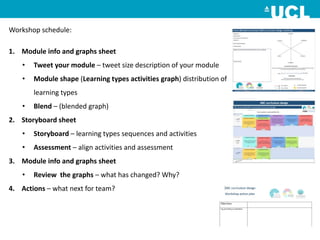
Workshop schedule:
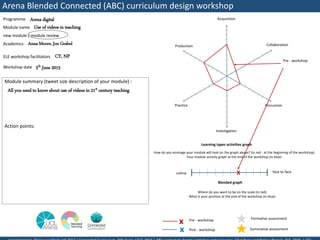
1. Module info and graphs sheet
• Tweet your module – tweet size description of your module
• Module shape (Learning types activities graph) distribution of
learning types
• Blend – (blended graph)
2. Storyboard sheet
• Storyboard – learning types sequences and activities
• Assessment – align activities and assessment
3. Module info and graphs sheet
• Review the graphs – what has changed? Why?
4. Actions – what next for team?
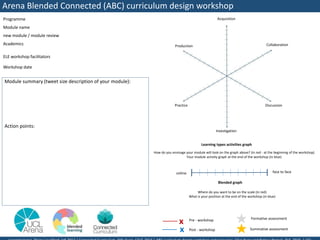
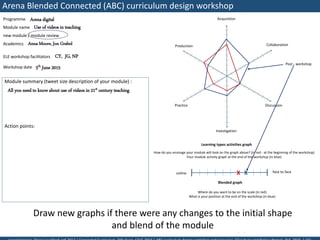
Arena Blended Connected (ABC) curriculum design workshop
Programme
Module name
new module / module review
Academics
Module summary (tweet size description of your module):
Action points:
ELE workshop facilitators
Workshop date
Acquisition
Investigation
Production
Practice
Collaboration
Discussion
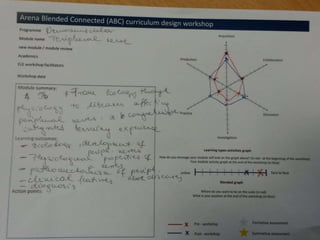
How do you envisage your module will look on the graph above? (in red - at the beginning of the workshop)
Your module activity graph at the end of the workshop (in blue)
Learning types activities graph
Where do you want to be on the scale (in red)
What is your position at the end of the workshop (in blue)
face to faceonline
Blended graph
Formative assessment
Summative assessment
Pre - workshop
Post - workshop
x
x
Arena Blended Connected (ABC) curriculum design workshop
Programme
Module name
new module / module review
Academics
Module summary (tweet size description of your module) :
Action points:
ELE workshop facilitators
Workshop date
Acquisition
Investigation
Production
Practice
Collaboration
Discussion
How do you envisage your module will look on the graph above? (in red - at the beginning of the workshop)
Your module activity graph at the end of the workshop (in blue)
Learning types activities graph
Where do you want to be on the scale (in red)
What is your position at the end of the workshop (in blue)
face to faceonline
Blended graph
Formative assessment
Summative assessment
Pre - workshop
Post - workshop
x
x
x
Pre - workshop
All you need to know about use of videos in 21st century teaching
Arena digital
Use of videos in teaching
Anna Moore, Jon Grabol
CY, NP
5th June 2015
Week
1-4
Week
5-8
project
Induction
Topic 1
Topic 2
Topic 3
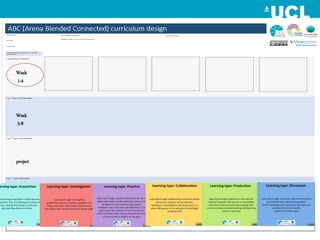
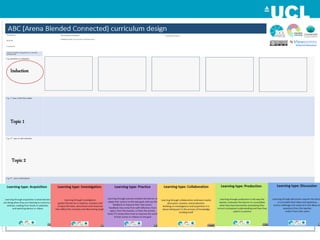
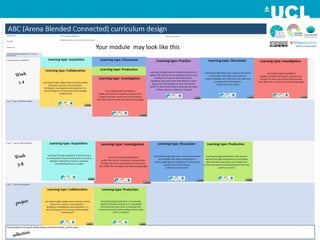
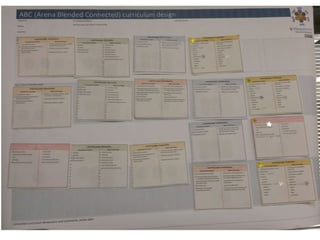
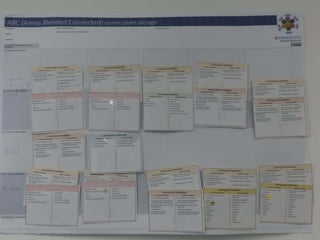
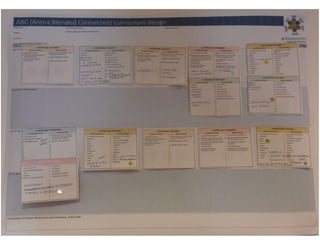
Your module may look like this
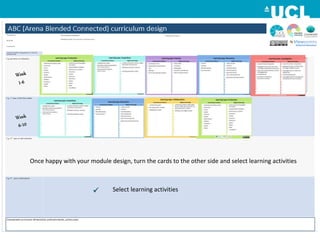
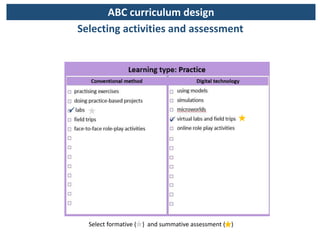
Once happy with your module design, turn the cards to the other side and select learning activities
Select learning activities
Selecting activities and assessment
ABC curriculum design


Select formative ( ) and summative assessment ( )
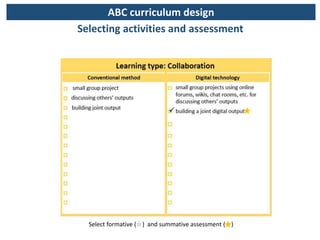
Selecting activities and assessment
ABC curriculum design

Select formative ( ) and summative assessment ( )
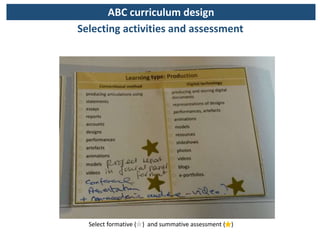
Selecting activities and assessment
ABC curriculum design



(script)
Select formative ( ) and summative assessment ( )
Arena Blended Connected (ABC) curriculum design workshop
Programme
Module name
new module / module review
Academics
Module summary (tweet size description of your module) :
Action points:
ELE workshop facilitators
Workshop date
Acquisition
Investigation
Production
Practice
Collaboration
Discussion
How do you envisage your module will look on the graph above? (in red - at the beginning of the workshop)
Your module activity graph at the end of the workshop (in blue)
Learning types activities graph
Where do you want to be on the scale (in red)
What is your position at the end of the workshop (in blue)
face to faceonline
Blended graph
Formative assessment
Summative assessment
Pre - workshop
Post - workshop
x
x
x
All you need to know about use of videos in 21st century teaching
Arena digital
Use of videos in teaching
Anna Moore, Jon Grabol
CY, JG, NP
5th June 2015
x
Post - workshop
Draw new graphs if there were any changes to the initial shape
and blend of the module
Action plan
ABC curriculum design
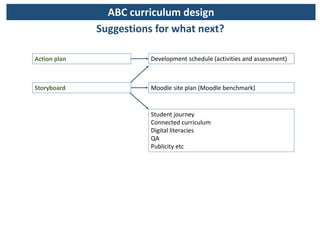
Suggestions for what next?
ABC curriculum design
Student journey
Connected curriculum
Digital literacies
QA
Publicity etc
Action plan Development schedule (activities and assessment)
Storyboard Moodle site plan (Moodle benchmark)
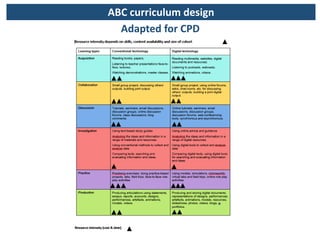
Adapted for CPD
ABC curriculum design
For questions and workshops contact:
c.p.l.young@ucl.ac.uk
n.perovic@ucl.ac.uk
More information:
http://blogs.ucl.ac.uk/ele/2015/04/09/abc-arena-blended-connected-curriculum-design/
http://blogs.ucl.ac.uk/ele/2015/09/30/9169/

M25 ABC Curriculum Design

  • 1.
    Clive Young andNataša Perović E-learning Environments, UCL Arena Blended Connected (ABC)
  • 2.
    Arena Blended Connected Rapiddevelopment curriculum design method based on Addresses three key UCL educational initiatives A B C
  • 3.
    Learning types Laurillard, D.(2012). Teaching as a Design Science: Building Pedagogical Patterns for Learning and Technology. New York and London: Routledge.
  • 4.
    A framework fordiverse & good curriculum design Connected Curriculum
  • 5.
    “Gamestorming” – high-energyacademic engagement time-bound (90’) activity-based design deliberately analogue conversational consensus – shared vision creative narrative – storyboard based on theory
  • 6.
    Learning types cards(front) learning activity types on one side and examples of activities on the other
  • 7.
    Learning types cards(back) learning activity types on one side and examples of activities on the other
  • 8.
  • 9.
    Learning types activities, V- Visible learning A - can be assessed (F or S) Investigation Interview an expert (video/forum/chat) V Literature reviews and critiques (forum/blog/wiki/RSS) V/A MCQs - formative with automatic feedback V/A Develop a shared resource library (database/glossary/wiki) V/A Shows/demonstrates learning (displays, posters, presentations) V/A Portfolios (MyPortfolio) V/A Case studies (forum, lesson) V/A Summarisation tasks (upload texts – individual or group) V/A Rapid-fire exam questions (forum) V/A Concept mapping (external) V Create video of performance (media) V/A Audio commentary of performance (media) V/A Skype or virtual classroom 'viva' V/A Make and give a presentation (external) V/A Video blog (external) V/A Write a report (external) V/A Make an analysis (external) V/A Case studies V/A Advanced role play – you are the consultant etc. V Action plan for workplace V/A Action plan for further study V/A Authentic research / data analysis – write a paper V/A Prepare professional briefing V/A Create, make a case (study) V/A Create podcast (media) V/A Work assignment (blog/report) V/A Interview professional colleagues V/A Lead a group project V/A Practice Production Web search (forum, wiki) V OER resources (external) Literature reviews and critiques (forum/blog/wiki/RSS) V Field/lab observations (media/blog/wiki) V Action research V Authentic research / data analysis – write a paper V Lead a group project V MCQs - formative with automatic feedback V/A Online role play (forum, virtual classroom) Reflective tasks – group or individual (forum) V/A Case studies (forum, lesson) V/A Rapid-fire exam questions (forum) V/A Advanced role play – you are the consultant etc. V ; Acquisition Guided readings (library resources) OER resources (external) Podcast (media) V if students do it Webinars (virtual classroom) V Q&A forum (forum, where teachers answer student questions) V Video lectures (webcast), YouTube videos (external) Field/lab observations (media/blog/wiki) V MCQs - formative with automatic feedback V Portfolios (MyPortfolio) V Collaboration Collaborative wiki - what do we know about ...? V/A Develop a shared resource library (database/glossary/wiki) V Social networking – participate (external) V Special interest groups - share on a topic (forum) V Mentor other learners V Interview an expert (forum/chat) V Webinars (virtual classroom) V Model answers/examples of previous work (forum) Analyse chat text (in course or uploaded) V Job/professional reflections (blog) V/A Group discussions on the topic, problem, reading (chat/blog/wiki) V/A Social networking – participate (external) V Reflective tasks – group or individual (forum) V/A Special interest groups - share on a topic (forum) V Lead a group project V/A Discussion
  • 12.
    Workshop schedule: 1. Moduleinfo and graphs sheet • Tweet your module – tweet size description of your module • Module shape (Learning types activities graph) distribution of learning types • Blend – (blended graph) 2. Storyboard sheet • Storyboard – learning types sequences and activities • Assessment – align activities and assessment 3. Module info and graphs sheet • Review the graphs – what has changed? Why? 4. Actions – what next for team?
  • 13.
    Arena Blended Connected(ABC) curriculum design workshop Programme Module name new module / module review Academics Module summary (tweet size description of your module): Action points: ELE workshop facilitators Workshop date Acquisition Investigation Production Practice Collaboration Discussion How do you envisage your module will look on the graph above? (in red - at the beginning of the workshop) Your module activity graph at the end of the workshop (in blue) Learning types activities graph Where do you want to be on the scale (in red) What is your position at the end of the workshop (in blue) face to faceonline Blended graph Formative assessment Summative assessment Pre - workshop Post - workshop x x
  • 16.
    Arena Blended Connected(ABC) curriculum design workshop Programme Module name new module / module review Academics Module summary (tweet size description of your module) : Action points: ELE workshop facilitators Workshop date Acquisition Investigation Production Practice Collaboration Discussion How do you envisage your module will look on the graph above? (in red - at the beginning of the workshop) Your module activity graph at the end of the workshop (in blue) Learning types activities graph Where do you want to be on the scale (in red) What is your position at the end of the workshop (in blue) face to faceonline Blended graph Formative assessment Summative assessment Pre - workshop Post - workshop x x x Pre - workshop All you need to know about use of videos in 21st century teaching Arena digital Use of videos in teaching Anna Moore, Jon Grabol CY, NP 5th June 2015
  • 17.
  • 18.
  • 19.
    Your module maylook like this
  • 22.
    Once happy withyour module design, turn the cards to the other side and select learning activities Select learning activities
  • 24.
    Selecting activities andassessment ABC curriculum design   Select formative ( ) and summative assessment ( )
  • 25.
    Selecting activities andassessment ABC curriculum design  Select formative ( ) and summative assessment ( )
  • 26.
    Selecting activities andassessment ABC curriculum design    (script) Select formative ( ) and summative assessment ( )
  • 27.
    Arena Blended Connected(ABC) curriculum design workshop Programme Module name new module / module review Academics Module summary (tweet size description of your module) : Action points: ELE workshop facilitators Workshop date Acquisition Investigation Production Practice Collaboration Discussion How do you envisage your module will look on the graph above? (in red - at the beginning of the workshop) Your module activity graph at the end of the workshop (in blue) Learning types activities graph Where do you want to be on the scale (in red) What is your position at the end of the workshop (in blue) face to faceonline Blended graph Formative assessment Summative assessment Pre - workshop Post - workshop x x x All you need to know about use of videos in 21st century teaching Arena digital Use of videos in teaching Anna Moore, Jon Grabol CY, JG, NP 5th June 2015 x Post - workshop Draw new graphs if there were any changes to the initial shape and blend of the module
  • 32.
  • 33.
    Suggestions for whatnext? ABC curriculum design Student journey Connected curriculum Digital literacies QA Publicity etc Action plan Development schedule (activities and assessment) Storyboard Moodle site plan (Moodle benchmark)
  • 34.
    Adapted for CPD ABCcurriculum design
  • 35.
    ABC curriculum design Forquestions and workshops contact: c.p.l.young@ucl.ac.uk n.perovic@ucl.ac.uk More information: http://blogs.ucl.ac.uk/ele/2015/04/09/abc-arena-blended-connected-curriculum-design/ http://blogs.ucl.ac.uk/ele/2015/09/30/9169/

Editor's Notes

  • #5 CENTRE - Every year of study, every programme Inspire program teams to enhance connections across years of study, between staff and students, and between disciplines Think about nature of ‘research’ in and beyond one’s own discipline Framework for good curriculum design: Diversity & Department-specific 01 - Students make connections & conversations ‘Meet your researcher’ Revisiting personal tutor’s role 02 -Sequence of research learning Engaging in research process and thinking at every stage ‘capstone’ research opportunity ‘Vertical’ modules 03 - Clear opportunities to connect subject learning with other disciplines Linking out to the wider world, global citizenship 04 - Opportunities to connect with wider learning and skills Teamwork, project mgmt, creativity, leadership Ability to articulate relevance of learning and skills to future career 05 - Assessment as research ‘output’ Articles, blogs, exhibitions, presentations, videos Impact beyond university Relevance to career 06 - Sense of belonging, being part of a community Connecting with each other Group projects Peer mentoring
  • #17 Module info and graphs sheet Tweet your module – tweet size description of your module Module shape (Learning types activities graph) distribution of learning types Blend – (blended graph)