Preventing Boundaries in Online Education
Through Social Connectedness and a
Collaborative Spirit
Felicia Banks, PhD
Stanford University: Society of Teaching of Psychology (SOTP) Conference
July 14, 2016
Introduction
 Distance education is of great benefit, in that it provides a flexible and creative
connection to learning that may not be accessible traditionally due to several
external factors (i.e. economic factors, crowded classrooms, military duties, or
work-life balance).
 Although distance education provides several benefits, there are two factors that
can hinder the experience, the lack of social connectedness and a collaborative
spirit.
 Both concepts (social connectedness and collaborative spirit)are applied to high
tech and high touch methods that can offer the online student a more personable
experience.
Ineffective Online Student Experience
Social Connectedness and Collaborative
Spirit Defined
Social Connectedness
 “The measure of how people come
together and interact” (Wikipedia,
para 1, n.d.).
 “The relationships people have
with others and the benefits these
relationships can bring to the
individual as well as to society”
(Social Report, para 1, 2010).
Collaborative Spirit
 “The process of two or more
people or organizations working
together to realize shared goals”,
(Wikipedia, para 1, 2016).
 “Most collaboration requires
leadership, although the form of
leadership can be social”,
(Wikipedia, para 2, 2016).
Social Connectedness and a
Collaborative Spirit
Social Connectedness
 An interesting and engaging
Instructor Profile
 Welcome message to students (via
announcements and personal email to
student): This could assist in making
the instructor easier to relate to
(the student will be more optimistic
about contacting the instructor.
 Incorporating a Learning Style
Inventory in your Welcome message
 Ongoing advising messages
Collaborative Spirit
 Sharing Quotes/Inspirations
 Incorporating Real Life Events
 Incorporating Poll Everywhere
 Providing engaging feedback (“the
sandwich” effect, making a
recommendation and then asking
the student what they think about
the feedback)
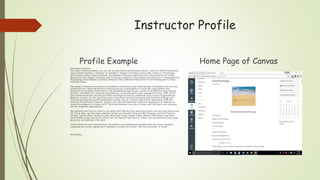
Instructor Profile
Profile Example Home Page of Canvas
Greetings Everyone,
My name is Romona Banks, you can call me Mrs./Instructor/Professor Banks. I hail from North Carolina by
way of South Carolina. I obtained my bachelor's degree in Criminal Justice with a minor in Psychology
from South Carolina State University, my Masters in Business Administration (concentration in Human
Resources) from Strayer University and my doctoral degree in Psychology (concentration in Organizational
Psychology) from Walden University (Research Title: Selected Predictors of Youth Development in Boys
and Girls clubs).
My research interests are inclusive to predictors of positive youth development (motivation and success),
enhancing the e-learning/distance learning process, sustainability of nonprofit organizations and
predictors of workplace performance. My professional experiences consist of the National Guard (Army
and Air), a facilitator for nonprofit organizations, and banking/financial management from 1998-2010; I
then transitioned from the financial field and began to instruct traditional (face to face) Organizational
Behavior courses. For the past three years I have been instructing General and Social Psychology and
Community Organizing and Development online courses. I have to admit that I absolutely LOVE this
method of instruction; however, at times I do miss the traditional classroom experience. In addition to
having the pleasure to instruct at ITT Technical Institute, I am also a Career and Life Coach and volunteer
for two nonprofit organizations.
My husband and I love to travel in our spare time. We also love watching movies (we are huge Marvel and
DC Comic fans), we also enjoy television series (our favorite shows are Ray Donovan, Game of Thrones,
Vikings, Orphan Black, House of Cards, Black Box, Fargo, Happy Valley, Sense 8, Elementary, and Dare
Devil-Netflix series, and So You Think You Can Dance). I also love to collect coin and exercise (I love yoga,
jazzercise and walking in the park).
I look forward to your introductions, discussions and assignments! Anytime that you have a question
regarding the course, please don't hesitate to contact me via the, "Ask The Instructor" or email.
Prof. Banks
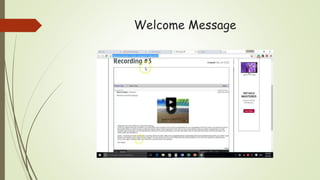
Welcome Message
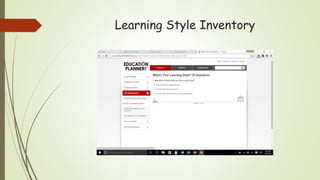
Learning Style Inventory
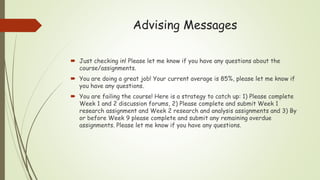
Advising Messages
 Just checking in! Please let me know if you have any questions about the
course/assignments.
 You are doing a great job! Your current average is 85%, please let me know if
you have any questions.
 You are failing the course! Here is a strategy to catch up: 1) Please complete
Week 1 and 2 discussion forums, 2) Please complete and submit Week 1
research assignment and Week 2 research and analysis assignments and 3) By
or before Week 9 please complete and submit any remaining overdue
assignments. Please let me know if you have any questions.
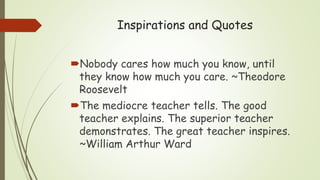
Inspirations and Quotes
Nobody cares how much you know, until
they know how much you care. ~Theodore
Roosevelt
The mediocre teacher tells. The good
teacher explains. The superior teacher
demonstrates. The great teacher inspires.
~William Arthur Ward
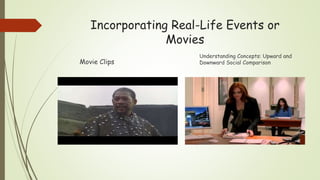
Incorporating Real-Life Events or
Movies
Movie Clips
Understanding Concepts: Upward and
Downward Social Comparison
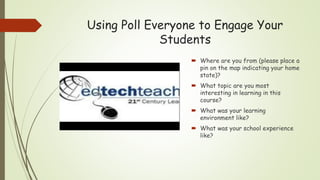
Using Poll Everyone to Engage Your
Students
 Where are you from (please place a
pin on the map indicating your home
state)?
 What topic are you most
interesting in learning in this
course?
 What was your learning
environment like?
 What was your school experience
like?
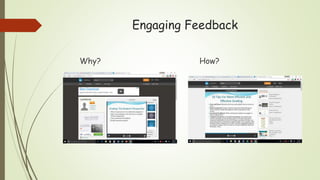
Engaging Feedback
Why? How?
Student and Instructor Success
Online Students’ Time
Management Tips (U.S. News
Education, 2014)
Instructor Engagement: 8 Lessons
Learned from Teaching Online
(Educause, 2013)
 Limit distractions
 Set aside time
 Communicate with your
professor
 Create a calendar
 Guide on the Side
 Sage on the Stage
 Ghost as a Host
 High-Touch is more important than
High-Tech
 Establish social presence
 Use technology intentionally
 The power of external resources
 Make expectations explicit
 Fun playfulness and the unexpected
 Login regularly
 Personal feedback
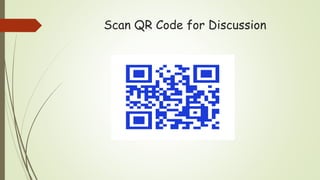
Scan QR Code for Discussion
References
Belinkie, M. (2008). 40 inspirational speeches in 2 minutes. Retrieved from https://www.youtube.com/watch?v=d6wRkzCW5qI
Bixler, B. (n.d.). Learning styles inventory. Retrieved from http://www.personal.psu.edu/bxb11/LSI/LSI.htm
Canvas LMS. (2015). Humanizing online instruction. Retrieved from https://www.youtube.com/watch?v=Us7w1b7UVwU
Education Planner. (2011). Learning styles quiz. Retrieved from http://www.educationplanner.org/students/self-assessments/learning-
styles-quiz.shtml
Educause. (2013). 8 Lessons learned from teaching online. Retrieved from https://www.youtube.com/watch?v=Bp4BG4Me7TU
FacilitadorTube. (2010). E-learning: How to deliver an engaging virtual classroom presentation. Retrieved from
https://www.youtube.com/watch?v=VxY22IhbaH4
Faulkner, B. (2013). The Devil Wears Prada downward social comparison. Retrieve from
https://www.youtube.com/watch?v=c3gGkiWSzvg
Kulowiec, G. (2011). EdTech Teacher Poll Everywhere tutorial. Retrieved from https://www.youtube.com/watch?v=ZZwPL8Ef-CY
Getzlaf, B., Perry, B., Toffner, G., Lamarche, K., & Edwards, M. (2009). Effective instructor feedback: Perceptions of online graduate
students. Journal Of Educators Online, 6(2).
References
Lane, E. (2015). Collaborative Spirit of Millennial Generation may benefit Big Science. Retrieved from
http://www.aaas.org/news/collaborative-spirit-millennial-generation-may-benefit-big-science
McDaniel, A. (2009). Online student experience. Retrieved from https://www.youtube.com/watch?v=nWPI35WGsTc
Smith, V., & Palenque, S. (2015). Ten Tips for More Efficient and Effective Grading. Retrieved from
http://www.facultyfocus.com/articles/educational- assessment/ten-tips-efficient-effective-grading/
Spread-The-Word. (2013). Ten free online proofreading tools. Retrieved from http://www.spread-the-word.co.za/free-proofreading-
tools/
SquaredOnline. (2015). The Squared Online student experience. Retrieved from https://www.youtube.com/watch?v=tlPoJfXDgqc
TED. (2012). Daphne Koller: What we’re learning from online education. Retrieved from
https://www.youtube.com/watch?v=U6FvJ6jMGHU
The Penguin Prof. (2010). How to manage time, reduce stress and increase happiness. Retrieved from
https://www.youtube.com/watch?v=N4YVLkuRBe8
The Social Report. (2010). Social connectedness. Retrieved from http://socialreport.msd.govt.nz/social-connectedness/
U.S. News Education. (2014). Online students share time management tips. Retrieved from
https://www.youtube.com/watch?v=L2FWUQvlths
Wikipedia. (2016). Collaborative Spirit. Retrieved from https://en.wikipedia.org/wiki/Collaboration
Wikipedia. (2015). Social connectedness. Retrieved from https://en.wikipedia.org/wiki/Social_connectedness

July conference1

  • 1.
    Preventing Boundaries inOnline Education Through Social Connectedness and a Collaborative Spirit Felicia Banks, PhD Stanford University: Society of Teaching of Psychology (SOTP) Conference July 14, 2016
  • 2.
    Introduction  Distance educationis of great benefit, in that it provides a flexible and creative connection to learning that may not be accessible traditionally due to several external factors (i.e. economic factors, crowded classrooms, military duties, or work-life balance).  Although distance education provides several benefits, there are two factors that can hinder the experience, the lack of social connectedness and a collaborative spirit.  Both concepts (social connectedness and collaborative spirit)are applied to high tech and high touch methods that can offer the online student a more personable experience.
  • 3.
  • 4.
    Social Connectedness andCollaborative Spirit Defined Social Connectedness  “The measure of how people come together and interact” (Wikipedia, para 1, n.d.).  “The relationships people have with others and the benefits these relationships can bring to the individual as well as to society” (Social Report, para 1, 2010). Collaborative Spirit  “The process of two or more people or organizations working together to realize shared goals”, (Wikipedia, para 1, 2016).  “Most collaboration requires leadership, although the form of leadership can be social”, (Wikipedia, para 2, 2016).
  • 5.
    Social Connectedness anda Collaborative Spirit Social Connectedness  An interesting and engaging Instructor Profile  Welcome message to students (via announcements and personal email to student): This could assist in making the instructor easier to relate to (the student will be more optimistic about contacting the instructor.  Incorporating a Learning Style Inventory in your Welcome message  Ongoing advising messages Collaborative Spirit  Sharing Quotes/Inspirations  Incorporating Real Life Events  Incorporating Poll Everywhere  Providing engaging feedback (“the sandwich” effect, making a recommendation and then asking the student what they think about the feedback)
  • 6.
    Instructor Profile Profile ExampleHome Page of Canvas Greetings Everyone, My name is Romona Banks, you can call me Mrs./Instructor/Professor Banks. I hail from North Carolina by way of South Carolina. I obtained my bachelor's degree in Criminal Justice with a minor in Psychology from South Carolina State University, my Masters in Business Administration (concentration in Human Resources) from Strayer University and my doctoral degree in Psychology (concentration in Organizational Psychology) from Walden University (Research Title: Selected Predictors of Youth Development in Boys and Girls clubs). My research interests are inclusive to predictors of positive youth development (motivation and success), enhancing the e-learning/distance learning process, sustainability of nonprofit organizations and predictors of workplace performance. My professional experiences consist of the National Guard (Army and Air), a facilitator for nonprofit organizations, and banking/financial management from 1998-2010; I then transitioned from the financial field and began to instruct traditional (face to face) Organizational Behavior courses. For the past three years I have been instructing General and Social Psychology and Community Organizing and Development online courses. I have to admit that I absolutely LOVE this method of instruction; however, at times I do miss the traditional classroom experience. In addition to having the pleasure to instruct at ITT Technical Institute, I am also a Career and Life Coach and volunteer for two nonprofit organizations. My husband and I love to travel in our spare time. We also love watching movies (we are huge Marvel and DC Comic fans), we also enjoy television series (our favorite shows are Ray Donovan, Game of Thrones, Vikings, Orphan Black, House of Cards, Black Box, Fargo, Happy Valley, Sense 8, Elementary, and Dare Devil-Netflix series, and So You Think You Can Dance). I also love to collect coin and exercise (I love yoga, jazzercise and walking in the park). I look forward to your introductions, discussions and assignments! Anytime that you have a question regarding the course, please don't hesitate to contact me via the, "Ask The Instructor" or email. Prof. Banks
  • 7.
  • 8.
  • 9.
    Advising Messages  Justchecking in! Please let me know if you have any questions about the course/assignments.  You are doing a great job! Your current average is 85%, please let me know if you have any questions.  You are failing the course! Here is a strategy to catch up: 1) Please complete Week 1 and 2 discussion forums, 2) Please complete and submit Week 1 research assignment and Week 2 research and analysis assignments and 3) By or before Week 9 please complete and submit any remaining overdue assignments. Please let me know if you have any questions.
  • 10.
    Inspirations and Quotes Nobodycares how much you know, until they know how much you care. ~Theodore Roosevelt The mediocre teacher tells. The good teacher explains. The superior teacher demonstrates. The great teacher inspires. ~William Arthur Ward
  • 11.
    Incorporating Real-Life Eventsor Movies Movie Clips Understanding Concepts: Upward and Downward Social Comparison
  • 12.
    Using Poll Everyoneto Engage Your Students  Where are you from (please place a pin on the map indicating your home state)?  What topic are you most interesting in learning in this course?  What was your learning environment like?  What was your school experience like?
  • 13.
  • 14.
    Student and InstructorSuccess Online Students’ Time Management Tips (U.S. News Education, 2014) Instructor Engagement: 8 Lessons Learned from Teaching Online (Educause, 2013)  Limit distractions  Set aside time  Communicate with your professor  Create a calendar  Guide on the Side  Sage on the Stage  Ghost as a Host  High-Touch is more important than High-Tech  Establish social presence  Use technology intentionally  The power of external resources  Make expectations explicit  Fun playfulness and the unexpected  Login regularly  Personal feedback
  • 15.
    Scan QR Codefor Discussion
  • 16.
    References Belinkie, M. (2008).40 inspirational speeches in 2 minutes. Retrieved from https://www.youtube.com/watch?v=d6wRkzCW5qI Bixler, B. (n.d.). Learning styles inventory. Retrieved from http://www.personal.psu.edu/bxb11/LSI/LSI.htm Canvas LMS. (2015). Humanizing online instruction. Retrieved from https://www.youtube.com/watch?v=Us7w1b7UVwU Education Planner. (2011). Learning styles quiz. Retrieved from http://www.educationplanner.org/students/self-assessments/learning- styles-quiz.shtml Educause. (2013). 8 Lessons learned from teaching online. Retrieved from https://www.youtube.com/watch?v=Bp4BG4Me7TU FacilitadorTube. (2010). E-learning: How to deliver an engaging virtual classroom presentation. Retrieved from https://www.youtube.com/watch?v=VxY22IhbaH4 Faulkner, B. (2013). The Devil Wears Prada downward social comparison. Retrieve from https://www.youtube.com/watch?v=c3gGkiWSzvg Kulowiec, G. (2011). EdTech Teacher Poll Everywhere tutorial. Retrieved from https://www.youtube.com/watch?v=ZZwPL8Ef-CY Getzlaf, B., Perry, B., Toffner, G., Lamarche, K., & Edwards, M. (2009). Effective instructor feedback: Perceptions of online graduate students. Journal Of Educators Online, 6(2).
  • 17.
    References Lane, E. (2015).Collaborative Spirit of Millennial Generation may benefit Big Science. Retrieved from http://www.aaas.org/news/collaborative-spirit-millennial-generation-may-benefit-big-science McDaniel, A. (2009). Online student experience. Retrieved from https://www.youtube.com/watch?v=nWPI35WGsTc Smith, V., & Palenque, S. (2015). Ten Tips for More Efficient and Effective Grading. Retrieved from http://www.facultyfocus.com/articles/educational- assessment/ten-tips-efficient-effective-grading/ Spread-The-Word. (2013). Ten free online proofreading tools. Retrieved from http://www.spread-the-word.co.za/free-proofreading- tools/ SquaredOnline. (2015). The Squared Online student experience. Retrieved from https://www.youtube.com/watch?v=tlPoJfXDgqc TED. (2012). Daphne Koller: What we’re learning from online education. Retrieved from https://www.youtube.com/watch?v=U6FvJ6jMGHU The Penguin Prof. (2010). How to manage time, reduce stress and increase happiness. Retrieved from https://www.youtube.com/watch?v=N4YVLkuRBe8 The Social Report. (2010). Social connectedness. Retrieved from http://socialreport.msd.govt.nz/social-connectedness/ U.S. News Education. (2014). Online students share time management tips. Retrieved from https://www.youtube.com/watch?v=L2FWUQvlths Wikipedia. (2016). Collaborative Spirit. Retrieved from https://en.wikipedia.org/wiki/Collaboration Wikipedia. (2015). Social connectedness. Retrieved from https://en.wikipedia.org/wiki/Social_connectedness

Editor's Notes

  • #4 https://www.youtube.com/watch?v=nWPI35WGsTc
  • #6 Do your students feel as if they have a vested interested in the course/do you assist your students in feeling as if they have a voice or what they think matters? This can create social connectedness and a collaborative spirit!
  • #7 The complete Instructor Profile Message can be found below. The Home Page above (that can also include your Profile) can be found on Canvas/Instructure https://canvas.instructure.com/courses/977742 Greetings Everyone, My name is Romona Banks, you can call me Mrs./Instructor/Professor Banks. I hail from North Carolina by way of South Carolina. I obtained my bachelor's degree in Criminal Justice with a minor in Psychology from South Carolina State University, my Masters in Business Administration (concentration in Human Resources) from Strayer University and my doctoral degree in Psychology (concentration in Organizational Psychology) from Walden University (Research Title: Selected Predictors of Youth Development in Boys and Girls clubs). My research interests are inclusive to predictors of positive youth development (motivation and success), enhancing the e-learning/distance learning process, sustainability of nonprofit organizations and predictors of workplace performance. My professional experiences consist of the National Guard (Army and Air), a facilitator for nonprofit organizations, and banking/financial management from 1998-2010; I then transitioned from the financial field and began to instruct traditional (face to face) Organizational Behavior courses. For the past three years I have been instructing General and Social Psychology and Community Organizing and Development online courses. I have to admit that I absolutely LOVE this method of instruction; however, at times I do miss the traditional classroom experience. In addition to having the pleasure to instruct at ITT Technical Institute, I am also a Career and Life Coach and volunteer for two nonprofit organizations. My husband and I love to travel in our spare time. We also love watching movies (we are huge Marvel and DC Comic fans), we also enjoy television series (our favorite shows are Ray Donovan, Game of Thrones, Vikings, Orphan Black, House of Cards, Black Box, Fargo, Happy Valley, Sense 8, Elementary, and Dare Devil-Netflix series, and So You Think You Can Dance). I also love to collect coin and exercise (I love yoga, jazzercise and walking in the park). I look forward to your introductions, discussions and assignments! Anytime that you have a question regarding the course, please don't hesitate to contact me via the, "Ask The Instructor" or email. Prof. Banks
  • #8 The Welcome message above is posted on Screencast-o-mactic (another wonderful resource tool to engage your online students https://screencast-o-matic.com/watch/col6emhUiV).
  • #9 The Learning Style Inventory above can be found at http://www.educationplanner.org/students/self-assessments/learning-styles-quiz.shtml There is a second Learning Style Inventory that can be found at http://www.personal.psu.edu/bxb11/LSI/LSI.htm
  • #10 I send at least three advising messages to my students per quarter (more, if they are in jeopardy of failing the course). I also include their current average in the course in the advising messages (in addition, I provide a strategy on how we can get caught up on assignments).
  • #11 The ironic part about sharing weekly quotes and inspirations with my students, is that they also help to inspire and motivate ME!!! Many of my students have told me that they really appreciate the quotes and inspirations. I believe that adding this aspect to your course could also possibly make you approachable.
  • #13 The questions above could be used as ice breakers, either before the first day of the online course or on the first day of the course.
  • #14 The Slides above can be found on Slide Share http://www.slideshare.net/coachfeliciab/why-is-assessment-feedback-important-innovative-ways-to-grade The Student’s Perspective Why is it necessary for me to submit this assignment? After I receive feedback, will I know how to complete all future assignments. I don’t understand the feedback! Should I question my grade? The Instructor’s Perspective If I post it, will they read it? 100 papers down, 200 more to go! Is this feedback helping their progression? On the path to scholarly writing! How: Grammar Resources  Paper Rater is a free online proofreading service with basic grammar and editing capabilities.  1Checker is a free online checker (requires registration) which checks your spelling and grammar and enhances text readability. You can also download 1Checker software for free.  After the Deadline offers a quick and helpful free online spelling, grammar and style check. They also have free apps to download for a variety of platforms.  VirtualWritingTutor is a free grammar checker that finds common spelling and grammar errors for learners of English as a second language. It is quick and easy to use with good feedback.  LanguageTool is a free online style and grammar proofreading service in more than 20 languages. You can also download Language Tool software for free.  Grammar Check offers a free spelling, style and grammar check.  SpellCheckPlus has a free online grammar checking tool (limited to 250 words at a time).  Proofread Bot checks the style and grammar of your text and gives you an extremely detailed report (limited to one free proofreading of 600 words per week).  Reverso online spellchecker checks grammar and spelling (limited to 600 characters).  Ginger is a free online proofreader for up to 600 words. The online proofreader didn’t work for me for some reason, but they have a fantastic free software to download which works across all text on your computer including emails.  http://www.grammarly.com/ Incorporate the feedback that you receive from these resources, to create your own “Comment Bank” Use your Comment Bank to provide qualitative feedback to your students (use it as a stand alone feedback, in the rubric, or in track changes along with the numeric grade) Your Comment Bank may not be like TurnItIn’s QuickMark Drag-and-drop comments or other resources; however, as you build your Comment Bank, I believe that it can be used to provide effective feedback to your students. 10 Tips For More Efficient and Effective Grading  One and Done: Mention the error and explain how to correct it once.  Bank Comments: Keep a bank of comments about frequent errors students make and organize them in groups for easy access.  Frontload Feedback: Write comments students can apply to future assignments.  “Global Comments vs. Local Corrections: If a student has written the paper in the incorrect genre in his/her first draft, comment minimally on local-level issues, grammar, format, etc, and instead focus comments on global issues. For example, if the student writes a summary of a work, and the assignment asks for an analysis instead, then it is best to comment globally (Smith & Palenque, 2015).” 30. 10 Tips Continued “KISS (Keep It Simple for Students): When making grading a teachable moment, be sure comments do not become so convoluted as to impair learning (Smith & Palenque, 2015).” Attitude and Approach: Make student learning the primary goal. According to Getzlaf, et al (2009) effective feedback is a mutual process involving both student and instructor. Conscious Use of Comments: According to Getzlaf et al (2009), effective feedback is applicable to future situations. 31. 10 Tips Continued  “Avoid Surprises: Publish or distribute rubrics well in advance of assignment due dates so that students know how their papers will be evaluated (Smith & Palenque, 2015).”  Less is More: Instructors should avoid the temptation to respond to everything that calls for adjustments or changes.  “Questions for Reflection: Consider inviting reflective, critical thinking and further conversation in a productive, scholarly exchange with the student. Instead of telling students what they did "wrong," ask them to rethink their approach. For example, consider using a phrase such as "What is the most interesting aspect of your essay?" Or "What would draw your attention to this topic, as a reader?" This way, the student is not only prompted to make more thoughtful revisions, but also is given tools to use when considering how to write a hook for future essays (Smith & Palenque).”
  • #15 https://www.youtube.com/watch?v=J3IUyZiXAQo&spfreload=10
  • #16 QR Code link to youtube video presentation: https://www.youtube.com/watch?v=ORCPARgSQ_E