An Overview: 
Basic and Advanced Life Support 
             2005 
               K.S. Chew 
     Emergency Medicine Department 
       School of Medical Sciences 
        UniversiF Sains Malaysia 
IntroducFon 
•  “ResuscitaFon is most successful if 
   defibrillaFon is performed in about 5 minutes 
   aLer collapse” 
     •  AHA Guidelines 2005 
IntroducFon 
•  “In many communiFes, the Fme interval from 
   EMS call to EMS arrival is 7 – 8 minutes or 
   longer.   
•  This means that in the first minutes aLer 
   collapse, the vicFm’s chance of survival is in 
   the hands of bystanders.” 
     •  AHA Guidelines 2005 
IntroducFon 
•  “Many SCA vicFms can survive if bystanders 
   act immediately while VF is sFll present, but 
   successful resuscitaFon is unlikely once the 
   rhythm deteriorates to asystole” 
  –  AHA Guidelines 2005 
CPR Facts 
•  “About 75 percent to 80 percent of all out‐of‐
   hospital cardiac arrests happen at home, so 
   being trained to perform cardiopulmonary 
   resuscitaFon (CPR) can mean the difference 
   between life and death for a loved one.” 
     •  AHA Guidelines 2005 
CPR Facts 
•  “EffecFve bystander CPR, provided 
   immediately aLer cardiac arrest, can double a 
   vicFm’s chance of survival” 
  –  AHA Guidelines 2005 
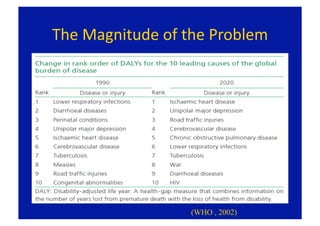
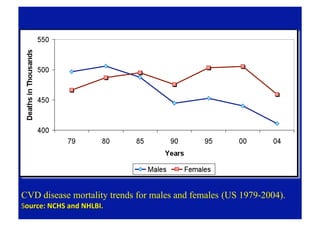
The Magnitude of the Problem 


                  (WHO , 2002)
IntervenFons that Improve Survival 

•   The intervenFons that unquesFonably contribute 
    to improved survival aLer cardiac arrest are 
1.  Early defibrillaFon for VF/pulseless VT 
2.  Prompt effecFve bystander BLS 
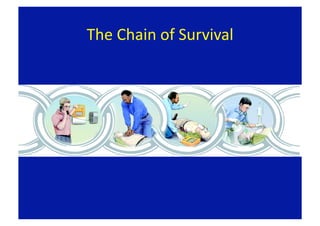
Chain of Survival 
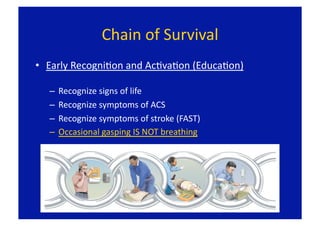
•  Early RecogniFon and AcFvaFon (EducaFon) 

  –  Recognize signs of life 
  –  Recognize symptoms of ACS 
  –  Recognize symptoms of stroke (FAST) 
  –  Occasional gasping IS NOT breathing 
Chain of Survival 
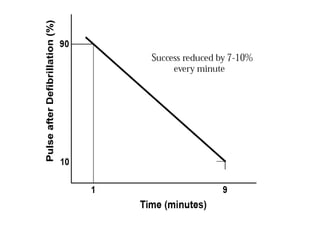
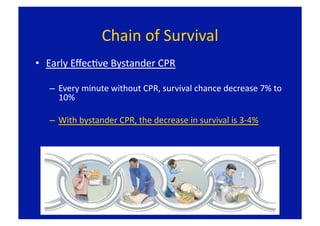
•  Early EffecFve Bystander CPR 

   –  Every minute without CPR, survival chance decrease 7% to 
      10% 

   –  With bystander CPR, the decrease in survival is 3‐4% 
Chain of Survival 
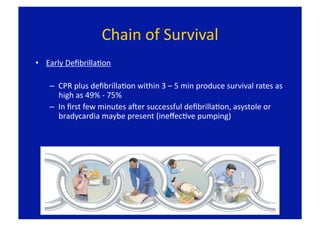
•  Early DefibrillaFon 

    –  CPR plus defibrillaFon within 3 – 5 min produce survival rates as 
       high as 49% ‐ 75% 
    –  In first few minutes aLer successful defibrillaFon, asystole or 
       bradycardia maybe present (ineffecFve pumping) 
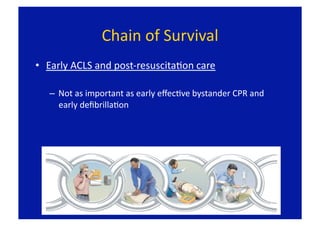
Chain of Survival 
•  Early ACLS and post‐resuscitaFon care 

   –  Not as important as early effecFve bystander CPR and 
      early defibrillaFon 
“Push Hard, Push Fast” 
                EffecFve CPR 
•  Compress at a rate of about 100 compression 
   per minute 
•  Depth of 1½ to 2 inches (approximately 4 to 5 
   cm) 
•  Allow chest to recoil completely aLer each 
   compression 
  –  To improve venous return 
  –  Reduce intrathoracic pressure 
  –  Improve coronary perfusion 
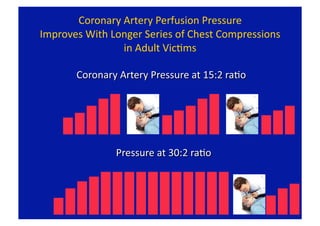
Coronary Artery Perfusion Pressure  
Improves With Longer Series of Chest Compressions 
                in Adult VicFms 
Minimal InterrupFons During Chest 
             Compression 
•  Ideally, compressions should only be 
   interrupted for 

A.  VenFlaFon (unFl an advanced airway is 
    placed) 
B.  Rhythm check 
C.  Shock delivery 
One Single RaFo 
•  VenFlaFon: Compression raFo of 30:2 for all 
   (adults, children and infants) 

•  ExcepFons 
1.  Two healthcare providers performing CPR for 
    a child and infant 
2.  For newborns 
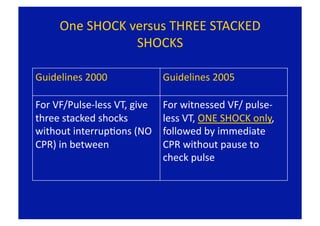
One SHOCK versus THREE STACKED 
                SHOCKS 

Guidelines 2000               Guidelines 2005 

For VF/Pulse‐less VT, give    For witnessed VF/ pulse‐
three stacked shocks          less VT, ONE SHOCK only, 
without interrupFons (NO      followed by immediate 
CPR) in between               CPR without pause to 
                              check pulse 
Four Reasons Why Single Shock With 
              Immediate CPR 

1.  High first shock efficacy 

2.  Post terminaFon iniFal non‐perfusing rhythm (PEA 
    or asystole)  

3.  Prolonged interrupFon to CPR (29‐37 seconds) if 
    giving stacked shocks and pulse check 

4.  Even if a perfusing rhythm is already restored, 
    giving chest compressions does not increase the 
    chance of VF recurring 
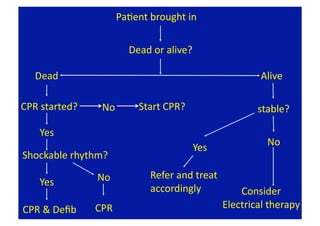
The Chain of Survival 
PaFent brought in 


                         Dead or alive? 

   Dead                                                   Alive 

CPR started?     No        Start CPR?                    stable? 

    Yes 
                                                           No 
                                         Yes 
Shockable rhythm? 

                No            Refer and treat 
    Yes 
                              accordingly            Consider 
CPR & Defib      CPR                              Electrical therapy 
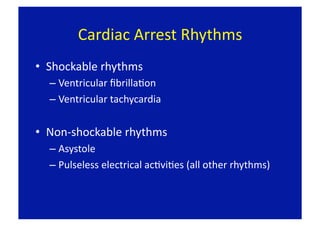
Cardiac Arrest Rhythms 
•  Shockable rhythms 
  –  Ventricular fibrillaFon 
  –  Ventricular tachycardia 


•  Non‐shockable rhythms 
  –  Asystole 
  –  Pulseless electrical acFviFes (all other rhythms) 
Basic Life Support 
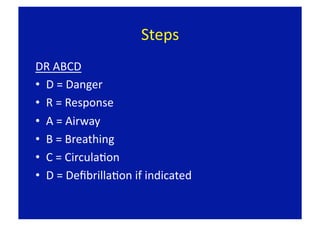
Steps 
DR ABCD 
•  D = Danger 
•  R = Response 
•  A = Airway 
•  B = Breathing 
•  C = CirculaFon 
•  D = DefibrillaFon if indicated 
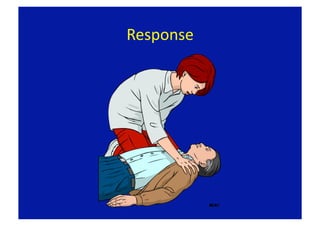
Response 
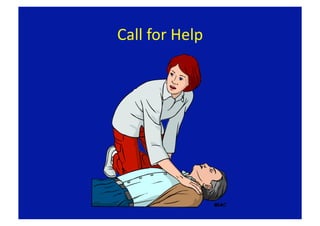
Call for Help 
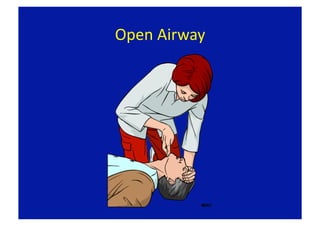
Open Airway 
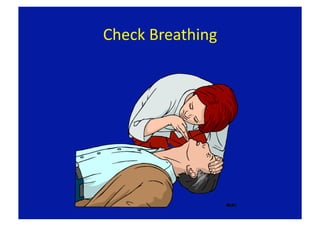
Check Breathing 
Agonal Breathing 
•  Occurs shortly aLer the heart stops  
   in up to 40% of cardiac arrests 

•  Described as barely, heavy, noisy or gasping 
   breathing 

•  Recognise as a sign of cardiac arrest 
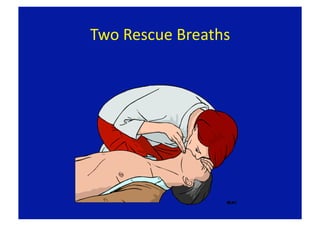
Two Rescue Breaths 
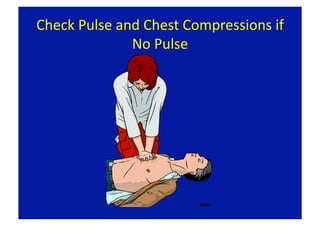
Check Pulse and Chest Compressions if 
              No Pulse 
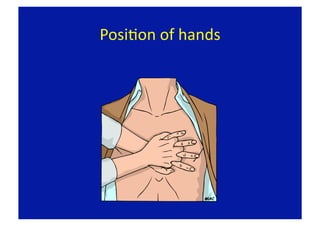
PosiFon of hands 
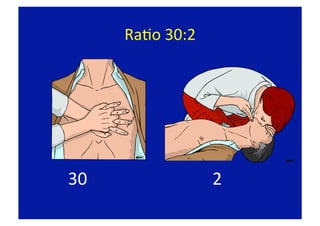
RaFo 30:2 


      30                    2 
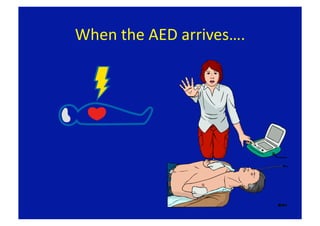
When the AED arrives…. 
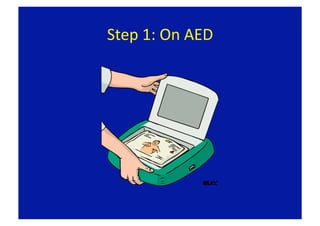
Step 1: On AED 
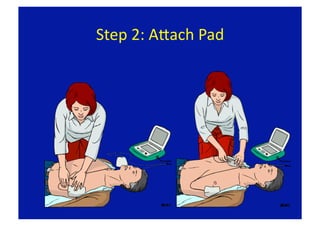
Step 2: Apach Pad 
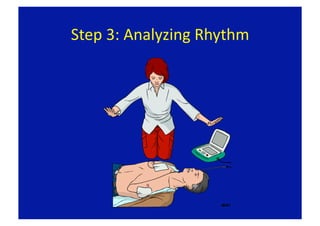
Step 3: Analyzing Rhythm 
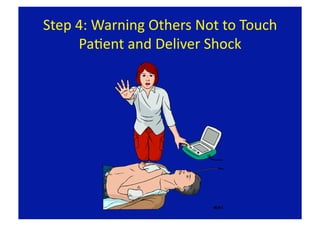
Step 4: Warning Others Not to Touch 
     PaFent and Deliver Shock 
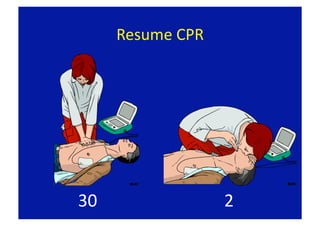
Resume CPR 


          30                      2 
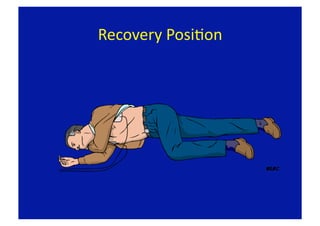
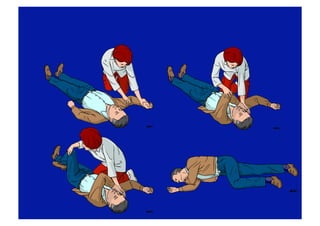
Recovery PosiFon 
CPR 

•  Chest compression with mouth‐to‐mouth 
   breathing 
•  Chest compression with mask‐to‐mouth 
   breathing 
•  Chest compression only (without rescue 
   breathing) 
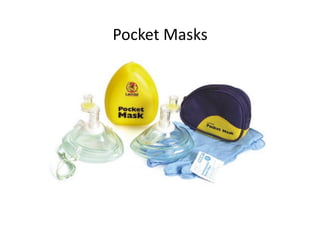
Pocket Masks 
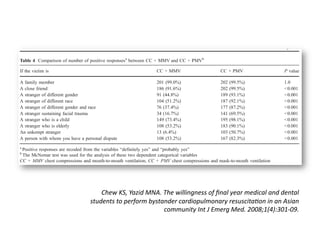
Chew KS, Yazid MNA. The willingness of final year medical and dental 
students to perform bystander cardiopulmonary resuscitaBon in an Asian 
                         community Int J Emerg Med. 2008;1(4):301‐09. 
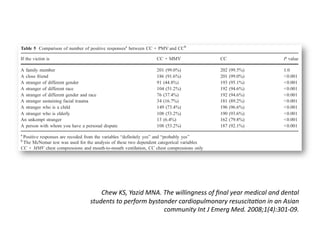
Chew KS, Yazid MNA. The willingness of final year medical and dental 
students to perform bystander cardiopulmonary resuscitaBon in an Asian 
                         community Int J Emerg Med. 2008;1(4):301‐09. 
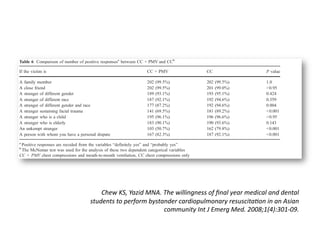
Chew KS, Yazid MNA. The willingness of final year medical and dental 
students to perform bystander cardiopulmonary resuscitaBon in an Asian 
                         community Int J Emerg Med. 2008;1(4):301‐09. 
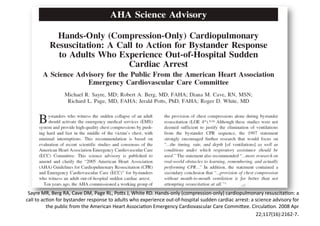
Hands‐Only CPR 
•  On March 31, 2008, the American Heart 
   AssociaFon changed its guidelines to include 
   hands‐only CPR, a new version using chest 
   compressions only.  

•  Hands‐only CPR is intended for untrained 
   rescuers and only for witnessed cardiac arrest. 
Sayre MR, Berg RA, Cave DM, Page RL, Pops J, White RD. Hands‐only (compression‐only) cardiopulmonary resuscitaFon: a 
call to acFon for bystander response to adults who experience out‐of‐hospital sudden cardiac arrest: a science advisory for 
          the public from the American Heart AssociaFon Emergency Cardiovascular Care Commipee. CirculaFon. 2008 Apr 
                                                                                                       22;117(16):2162‐7. 
Hands‐Only CPR 
•  “Bystanders who witness the sudden collapse of 
   an adult should immediately call 9‐1‐1 and start 
   what we call Hands‐Only CPR. This involves 
   providing high‐quality chest compressions by 
   pushing hard and fast in the middle of the vicBm’s 
   chest, without stopping unBl emergency medical 
   services (EMS) responders arrive….” 
      •  Michael Sayre, M.D., chair of the statement wriFng 
         commipee and associate professor in the Ohio State 
         University Department of Emergency Medicine in Columbus. 
Advanced Life Support 
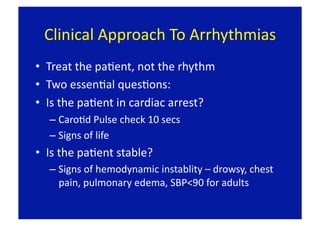
Clinical Approach To Arrhythmias 
•  Treat the paFent, not the rhythm 
•  Two essenFal quesFons: 
•  Is the paFent in cardiac arrest? 
  –  CaroFd Pulse check 10 secs 
  –  Signs of life 
•  Is the paFent stable? 
  –  Signs of hemodynamic instablity – drowsy, chest 
     pain, pulmonary edema, SBP<90 for adults 
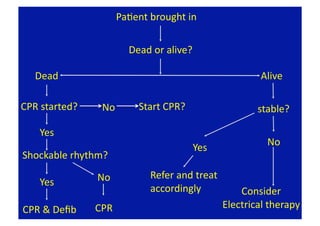
PaFent brought in 


                         Dead or alive? 

   Dead                                                   Alive 

CPR started?     No        Start CPR?                    stable? 

    Yes 
                                                           No 
                                         Yes 
Shockable rhythm? 

                No            Refer and treat 
    Yes 
                              accordingly            Consider 
CPR & Defib      CPR                              Electrical therapy 
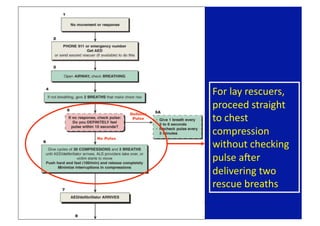
For lay rescuers, 
proceed straight 
to chest 
compression 
without checking 
pulse aLer 
delivering two 
rescue breaths 
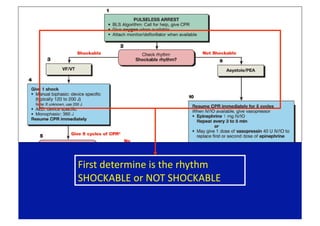
First determine is the rhythm 
SHOCKABLE or NOT SHOCKABLE 
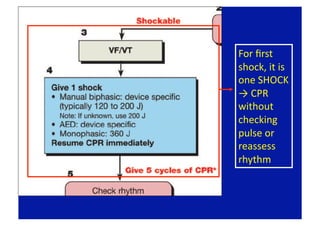
For first 
shock, it is 
one SHOCK 
→ CPR 
without 
checking 
pulse or 
reassess 
rhythm 
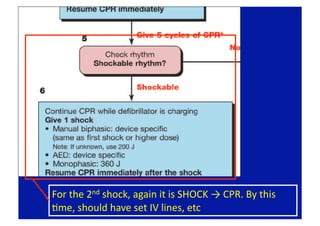
For the 2nd shock, again it is SHOCK → CPR. By this 
Fme, should have set IV lines, etc 
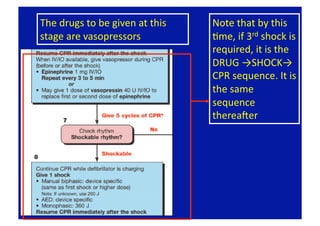
The drugs to be given at this    Note that by this 
stage are vasopressors           Fme, if 3rd shock is 
                                 required, it is the 
                                 DRUG →SHOCK→ 
                                 CPR sequence. It is 
                                 the same 
                                 sequence 
                                 thereaLer 
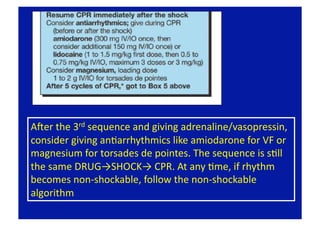
ALer the 3rd sequence and giving adrenaline/vasopressin, 
consider giving anFarrhythmics like amiodarone for VF or 
magnesium for torsades de pointes. The sequence is sFll 
the same DRUG→SHOCK→ CPR. At any Fme, if rhythm 
becomes non‐shockable, follow the non‐shockable 
algorithm 
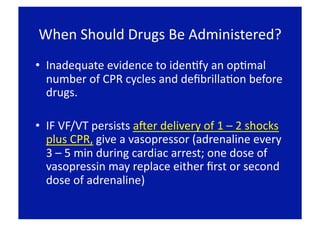
When Should Drugs Be Administered? 
•  Inadequate evidence to idenFfy an opFmal 
   number of CPR cycles and defibrillaFon before 
   drugs. 

•  IF VF/VT persists aLer delivery of 1 – 2 shocks 
   plus CPR, give a vasopressor (adrenaline every 
   3 – 5 min during cardiac arrest; one dose of 
   vasopressin may replace either first or second 
   dose of adrenaline) 
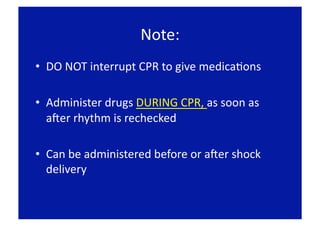
Note: 
•  DO NOT interrupt CPR to give medicaFons 

•  Administer drugs DURING CPR, as soon as 
   aLer rhythm is rechecked 

•  Can be administered before or aLer shock 
   delivery 
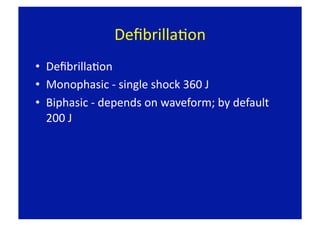
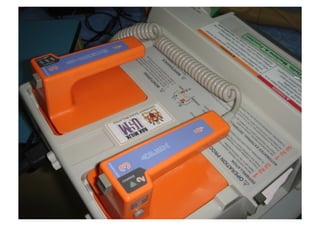
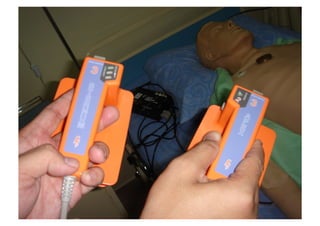
DefibrillaFon 
•  DefibrillaFon 
•  Monophasic ‐ single shock 360 J 
•  Biphasic ‐ depends on waveform; by default 
   200 J 
Types of Defibrillator Waveforms and 
                 Energy 
•  It is the transmyocardial current flow that 
   defibrillates (not the energy) 
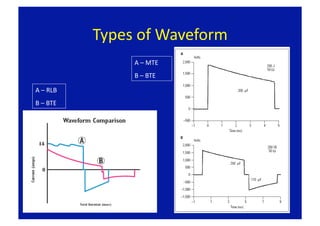
•  Monophasic 
   –  Monophasic Damped Sinusoidal Waveform 
   –  Monophasic Truncated ExponenFal Waveform 
•  Biphasic 
   –  Biphasic Truncated ExponenFal Waveform 
   –  RecFlinear Biphasic Waveform  
Dose for Biphasic Waveform Device 
•  Refer to manufacturers’ recommendaFons 
•  If manufacturers’ recommendaFons not 
   available, use 200 J for first shock 
•  This 200 J default energy is a consensus 
   default dose and not the ideal dose 
•  This has been chosen because it falls within 
   the reported range of selected doses that are 
   effecFve for first and subsequent shocks 
Types of Waveform 
                 A – MTE 
                 B – BTE  

A – RLB 
B – BTE  
Oxygen Safety and DefibrillaFon 
•  In an oxygen enriched atmosphere, sparking 
   from poorly applied defibrillator paddles can 
   cause a fire 
Minimize risk by 
•  Take off any oxygen mask or nasal cannula and 
   place them at least 1 m away from paFent’s 
   chest 
•  Leave the venFlaFon bag connected to 
   tracheal tube or other airway adjunct 
Oxygen Safety and DefibrillaFon 
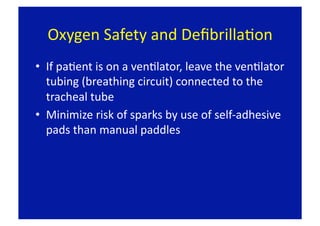
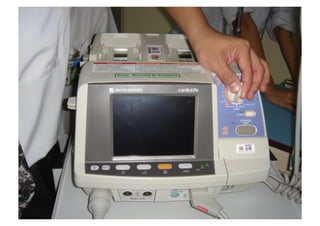
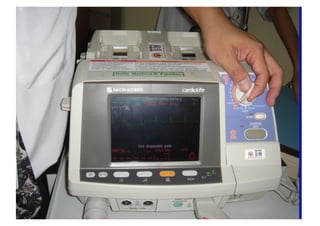
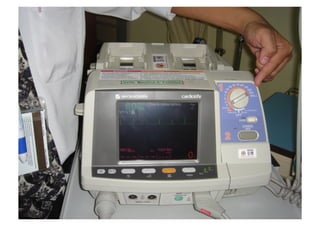
•  If paFent is on a venFlator, leave the venFlator 
   tubing (breathing circuit) connected to the 
   tracheal tube 
•  Minimize risk of sparks by use of self‐adhesive 
   pads than manual paddles 
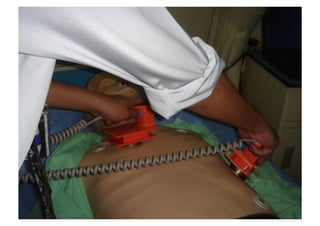
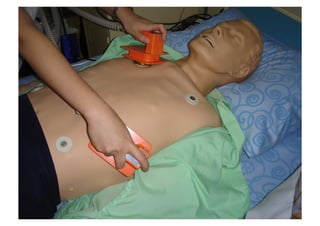
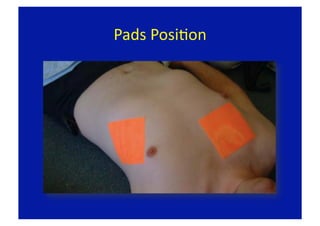
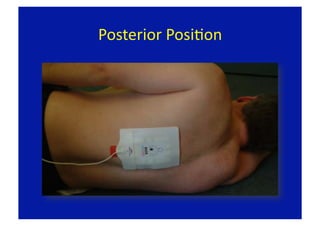
Pads PosiFon 
Posterior PosiFon 
Shock first or CPR first? 
•  Most criFcal intervenFons during the first 
   minutes of VF or pulseless VT: 
  –  immediate bystander CPR with minimal 
     interrupFon in chest compressions 
  –  DefibrillaFon 


•  Shock first or CPR first? 
Shock first or CPR first? 
If 
•  Witnessed arrest + defibrillator available ON 
    SITE, then defibrillate immediately  

•  Otherwise, CPR first 
Why? 
•  If VF/pulseless VT been present for more than 
   a few minutes, the myocardium is depleted of 
   oxygen and metabolic substrates.  

•  A brief period of chest compressions can 
   deliver oxygen and energy substrates to 
   increase the likelihood that a perfusing 
   rhythm will return aLer shock delivery. 
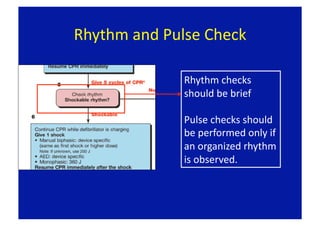
Rhythm and Pulse Check 

              Rhythm checks 
              should be brief 

              Pulse checks should 
              be performed only if 
              an organized rhythm 
              is observed. 
Cardiac Arrhythmias 
Cardiac Arrhythmias 
Two most important quesFons: 
1.  Is the paFent dead or alive? 
  –  Dead              per ALS algorithm 
  –  Alive         go to quesFon 2 
2.  If the paFent is alive, is the paFent stable or 
    unstable? 
   –  Unstable         electrical therapies 
   –  Stable         further invesFgaFons 
When the Arrhythmias is Unstable 
Four main signs 
1.  Signs of low cardiac output – systolic 
    hypotension < 90 mmHg, altered mental 
    status 
2.  Excessive rates: <40/min or >150/min 
3.  Chest pain 
4.  Heart failure 
•  If unstable, electrical therapy: cardioversion 
    for tachyarrhythmias, pacing for 
    bradyarrhythmias 
Electrical therapies 
•  Tachyarrhythmias – cardioversion  

•  Bradyarrhythmias – electrical pacing 
  –  Transcutaneous pacing 
  –  Transvenous pacing 
     •  Temporary 
     •  Permanent  
DefibrillaFon 
•  DefibrillaFon 
•  Monophasic ‐ single shock 360 J 
•  Biphasic ‐ depends on waveform; by default 
   200 J 
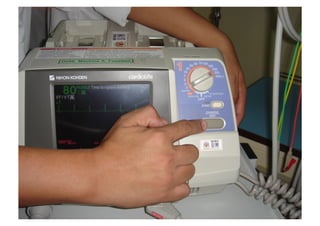
Cardioversion 
•  SynchronizaFon with R waves rather than T 
   wave 
•  Because VF can be induced if a shock is 
   delivered during relaFve refractory period of 
   cardiac cycle 
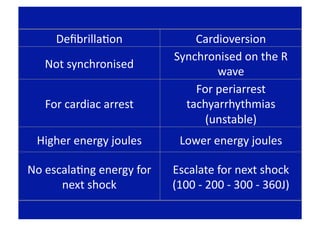
DefibrillaFon              Cardioversion 
                           Synchronised on the R 
   Not synchronised 
                                   wave 
                               For periarrest 
   For cardiac arrest        tachyarrhythmias 
                                 (unstable) 
 Higher energy joules       Lower energy joules 

No escalaFng energy for    Escalate for next shock 
      next shock           (100 ‐ 200 ‐ 300 ‐ 360J) 
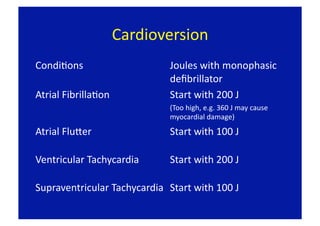
Cardioversion 
CondiFons                     Joules with monophasic 
                              defibrillator 
Atrial FibrillaFon            Start with 200 J 
                              (Too high, e.g. 360 J may cause 
                              myocardial damage) 
Atrial Fluper                 Start with 100 J 

Ventricular Tachycardia       Start with 200 J 

Supraventricular Tachycardia  Start with 100 J 
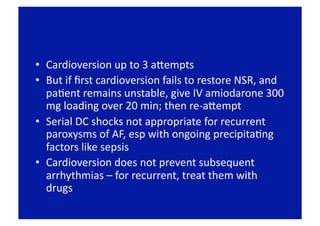
•  Cardioversion up to 3 apempts 
•  But if first cardioversion fails to restore NSR, and 
   paFent remains unstable, give IV amiodarone 300 
   mg loading over 20 min; then re‐apempt 
•  Serial DC shocks not appropriate for recurrent 
   paroxysms of AF, esp with ongoing precipitaFng 
   factors like sepsis 
•  Cardioversion does not prevent subsequent 
   arrhythmias – for recurrent, treat them with 
   drugs 
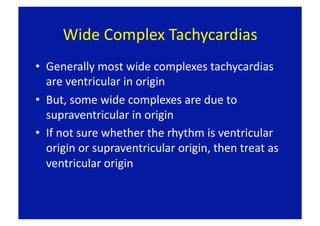
Wide Complex Tachycardias 
•  Generally most wide complexes tachycardias 
   are ventricular in origin 
•  But, some wide complexes are due to 
   supraventricular in origin 
•  If not sure whether the rhythm is ventricular 
   origin or supraventricular origin, then treat as 
   ventricular origin 
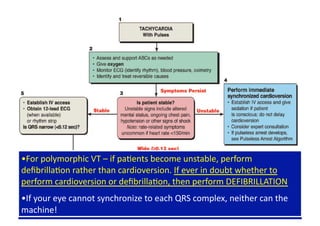
• For polymorphic VT – if paFents become unstable, perform 
defibrillaFon rather than cardioversion. If ever in doubt whether to 
perform cardioversion or defibrillaFon, then perform DEFIBRILLATION 
• If your eye cannot synchronize to each QRS complex, neither can the 
machine! 
If the tachyarrhythmias are 
          stable…… 
Tachyarrhythmias 
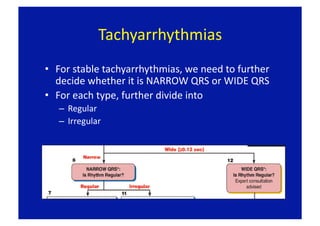
•  For stable tachyarrhythmias, we need to further 
   decide whether it is NARROW QRS or WIDE QRS 
•  For each type, further divide into 
   –  Regular 
   –  Irregular 
Tachyarrhythmias 
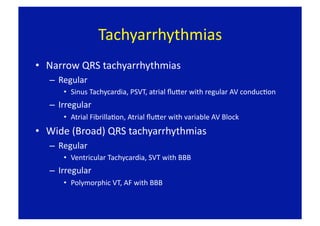
•  Narrow QRS tachyarrhythmias 
   –  Regular 
       •  Sinus Tachycardia, PSVT, atrial fluper with regular AV conducFon 
   –  Irregular 
       •  Atrial FibrillaFon, Atrial fluper with variable AV Block 
•  Wide (Broad) QRS tachyarrhythmias 
   –  Regular 
       •  Ventricular Tachycardia, SVT with BBB 
   –  Irregular 
       •  Polymorphic VT, AF with BBB 
Management of Narrow Complex 
           Tachycardia 
•  Vagal maneuver 
  –  Valsalva maneuver is the most effecFve 
  –  Blow into a 20ml syringe with enough force to 
     push back the plunger 
•  Adenosine 
•  Successful terminaFon pf a tachyarrhythmias 
   by vagal maneuver or adenosine indicates that 
   it is almost certainly AVNRT or AVRT.  
Atrio‐Ventricular Tachyarrhythmias 
•  AVNRT versus AVRT 
•  AVNRT = atrioventricular nodal reentrant 
   tachycardia 
  –  Due to reentrant circuit loop formed by 2 
     pathways, slow and fast, in the AV node (micro‐
     reentry) 
•  AVRT = atrioventricular reentrant tachycardia 
  –  Due to a large re‐entry circuit caused by an 
     aberrant myocardial accessory pathways or bypass 
     tracts 
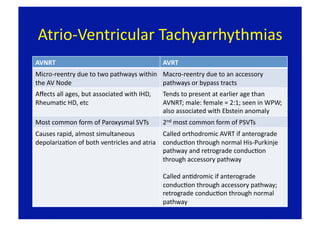
Atrio‐Ventricular Tachyarrhythmias 
AVNRT                                        AVRT 
Micro‐reentry due to two pathways within  Macro‐reentry due to an accessory 
the AV Node                               pathways or bypass tracts 
Affects all ages, but associated with IHD,    Tends to present at earlier age than 
RheumaFc HD, etc                             AVNRT; male: female = 2:1; seen in WPW; 
                                             also associated with Ebstein anomaly 
Most common form of Paroxysmal SVTs          2nd most common form of PSVTs 
Causes rapid, almost simultaneous           Called orthodromic AVRT if anterograde 
depolarizaFon of both ventricles and atria  conducFon through normal His‐Purkinje 
                                            pathway and retrograde conducFon 
                                            through accessory pathway 

                                             Called anFdromic if anterograde 
                                             conducFon through accessory pathway; 
                                             retrograde conducFon through normal 
                                             pathway 
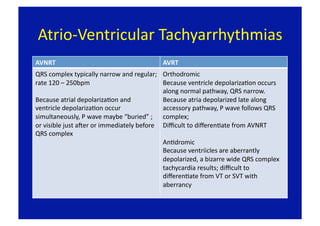
Atrio‐Ventricular Tachyarrhythmias 
AVNRT                                      AVRT 
QRS complex typically narrow and regular;  Orthodromic 
rate 120 – 250bpm                           Because ventricle depolarizaFon occurs 
                                            along normal pathway, QRS narrow. 
Because atrial depolarizaFon and            Because atria depolarized late along 
ventricle depolarizaFon occur               accessory pathway, P wave follows QRS 
simultaneously, P wave maybe “buried” ;  complex; 
or visible just aLer or immediately before  Difficult to differenFate from AVNRT 
QRS complex 
                                            AnFdromic 
                                            Because ventriicles are aberrantly 
                                            depolarized, a bizarre wide QRS complex 
                                            tachycardia results; difficult to 
                                            differenFate from VT or SVT with 
                                            aberrancy 
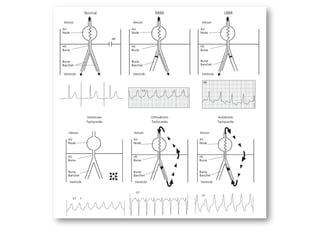
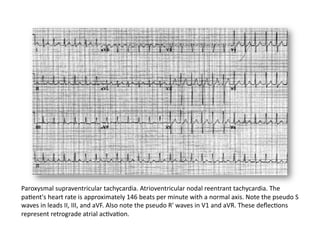
Paroxysmal supraventricular tachycardia. Atrioventricular nodal reentrant tachycardia. The 
paFent's heart rate is approximately 146 beats per minute with a normal axis. Note the pseudo S 
waves in leads II, III, and aVF. Also note the pseudo R' waves in V1 and aVR. These deflecFons 
represent retrograde atrial acFvaFon. 
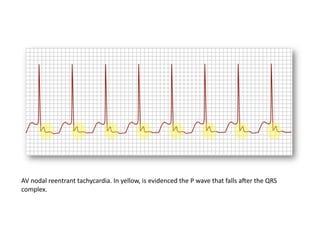
AV nodal reentrant tachycardia. In yellow, is evidenced the P wave that falls aLer the QRS 
complex. 
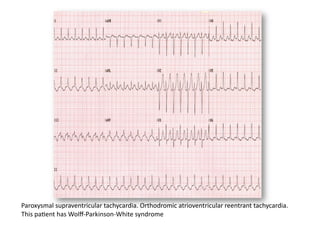
Paroxysmal supraventricular tachycardia. Orthodromic atrioventricular reentrant tachycardia. 
This paFent has Wolff‐Parkinson‐White syndrome 
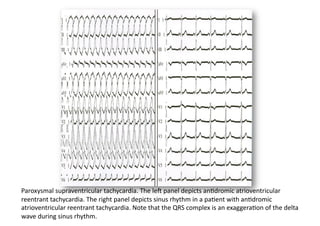
Paroxysmal supraventricular tachycardia. The leL panel depicts anFdromic atrioventricular 
reentrant tachycardia. The right panel depicts sinus rhythm in a paFent with anFdromic 
atrioventricular reentrant tachycardia. Note that the QRS complex is an exaggeraFon of the delta 
wave during sinus rhythm. 
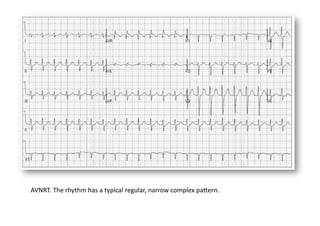
AVNRT. The rhythm has a typical regular, narrow complex papern. 
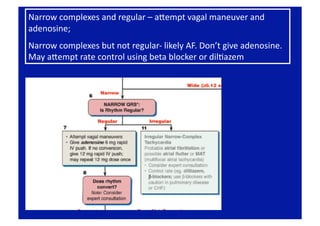
Narrow complexes and regular – apempt vagal maneuver and 
adenosine; 
Narrow complexes but not regular‐ likely AF. Don’t give adenosine.  
May apempt rate control using beta blocker or dilFazem 
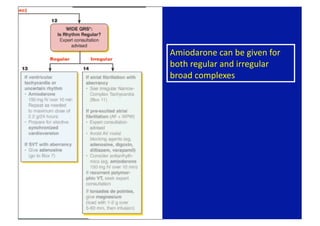
Amiodarone can be given for 
both regular and irregular 
broad complexes 
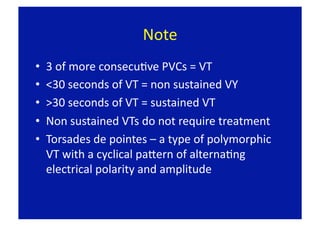
Note 
•    3 of more consecuFve PVCs = VT 
•    <30 seconds of VT = non sustained VY 
•    >30 seconds of VT = sustained VT 
•    Non sustained VTs do not require treatment 
•    Torsades de pointes – a type of polymorphic 
     VT with a cyclical papern of alternaFng 
     electrical polarity and amplitude 
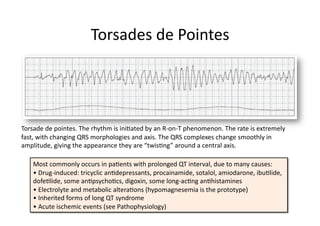
Torsades de Pointes 


Torsade de pointes. The rhythm is iniFated by an R‐on‐T phenomenon. The rate is extremely 
fast, with changing QRS morphologies and axis. The QRS complexes change smoothly in 
amplitude, giving the appearance they are “twisFng” around a central axis. 

   Most commonly occurs in paFents with prolonged QT interval, due to many causes: 
   • Drug‐induced: tricyclic anFdepressants, procainamide, sotalol, amiodarone, ibuFlide, 
   dofeFlide, some anFpsychoFcs, digoxin, some long‐acFng anFhistamines 
   • Electrolyte and metabolic alteraFons (hypomagnesemia is the prototype) 
   • Inherited forms of long QT syndrome 
   • Acute ischemic events (see Pathophysiology) 
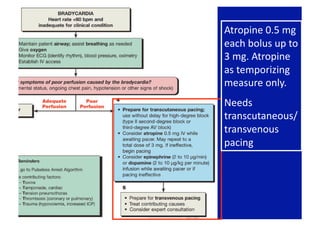
Bradyarrhythmias 
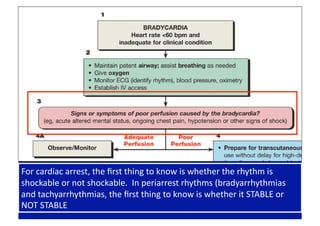
For cardiac arrest, the first thing to know is whether the rhythm is 
shockable or not shockable.  In periarrest rhythms (bradyarrhythmias 
and tachyarrhythmias, the first thing to know is whether it STABLE or 
NOT STABLE 
When the Arrhythmias is Unstable 
Four main signs 
1.  Signs of low cardiac output – systolic 
    hypotension < 90 mmHg, altered mental 
    status 
2.  Excessive rates: <40/min or >150/min 
3.  Chest pain 
4.  Heart failure 
•  If unstable, electrical therapy: cardioversion 
    for tachyarrhythmias, pacing for 
    bradyarrhythmias 
Atropine 0.5 mg 
each bolus up to 
3 mg. Atropine 
as temporizing 
measure only. 
Needs 
transcutaneous/
transvenous 
pacing 
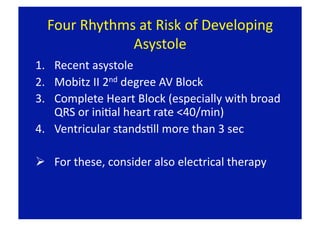
Four Rhythms at Risk of Developing 
              Asystole 
1.  Recent asystole 
2.  Mobitz II 2nd degree AV Block 
3.  Complete Heart Block (especially with broad 
    QRS or iniFal heart rate <40/min) 
4.  Ventricular standsFll more than 3 sec 

  For these, consider also electrical therapy 
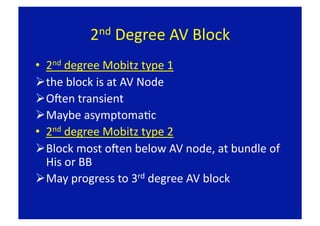
2nd Degree AV Block 

•  2nd degree Mobitz type 1 
 the block is at AV Node 
 OLen transient 
 Maybe asymptomaFc 
•  2nd degree Mobitz type 2 
 Block most oLen below AV node, at bundle of 
   His or BB 
 May progress to 3rd degree AV block  
Other Topics 
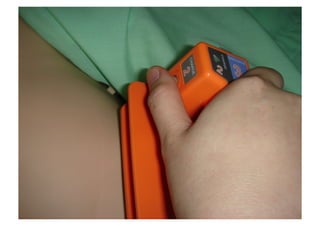
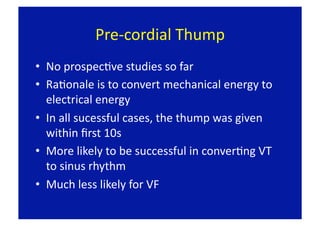
Pre‐cordial Thump 
•  No prospecFve studies so far 
•  RaFonale is to convert mechanical energy to 
   electrical energy 
•  In all sucessful cases, the thump was given 
   within first 10s 
•  More likely to be successful in converFng VT 
   to sinus rhythm 
•  Much less likely for VF 
Pre‐cordial Thump 
•  Consider as an opFon for witnessed, sudden 
   collapse and defibrillator NOT immediately 
   available 
•  Thump may cause deterioraFon: 
  –  Rate acceleraFon of VT 
  –  Conversion of VT to VF 
  –  Complete Heart Block 
  –  Asystole 
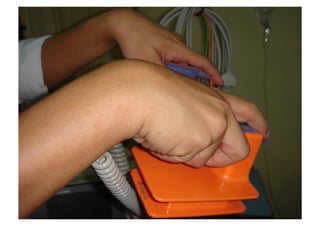
Pre‐cordial Thump 
•  Only by trained healthcare providers 
   immediately confirm cardiac arrest 
•  Use ulnar edge of Fghtly clenched fist 
•  Deliver a sharp impact to the lower half of the 
   sternum from a height of 20 cm 
•  ALer that, immediately retract the fist 
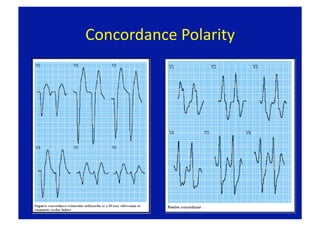
Four Features SuggesFve Ventricular 
                    Origin 

•    Concordance Polarity 
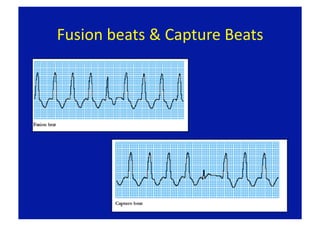
•    Fusion beats and Capture beats 
•    Bizzare QRS complexes 
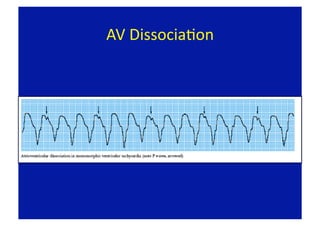
•    AV DissociaFon 
Concordance Polarity 
Fusion beats & Capture Beats 
AV DissociaFon 

Basic and Advanced Life Support