CAPACITY PLANNING
with reference to McDonalds
Hi, friends I am
Ronald’s
Yes, I am here to
tell you about my
story
Story of McDonald

My Team members are:
Sai Praveen
Piyush Singh
Ankit Verma
Anand Batra
CAPACITY
Capacity is the upper limit on the load that
an operating unit can handle.
• The basic questions in capacity handling
are:
• What kind of capacity is needed?
• How much is needed?
• When is it needed?
CAPACITY PLANNING
• Capacity planning is the process of
determining the production capacity
needed by an organization to meet
changing demands for its products.
• In the context of capacity planning,
“capacity" is the maximum amount of
work that an organization is capable of
completing in a given period of time.
• A discrepancy between the capacity of an
organization and the demands of its customers
results in an inefficiency, either in under-utilized
resources or unfulfilled customers.
• The goal of capacity planning is to minimize this
discrepancy.
• Capacity can be increased through introducing
new techniques, equipment and materials,
increasing the number of workers or machines,
increasing the number of shifts, or acquiring
additional production facilities.
Mc Donalds
• McDonald's is the world's leading food service
retailer with more than 33,000 restaurants in 118
countries serving more than 67 million customers
each day.
• In India, it operates under two parent franchisees
 Hardcastle Restaurants Pvt. Ltd – West and South
 Vikram Bakshi's Connaught Plaza Restaurants
Private Limited – North and East
• McDonald's India is a leader in the food retail
space, with a presence of more than 250
restaurants serving more than 6.5 lakh customers
daily in India.
McDonalds (Sonipat)
• Located at Ansal Plaza Mall, Kundli,
Sonipat 131001
• Operation Hours – (8a.m-11p.m)
• 115 covers
• 1 Restaurant Manager , 2 Astt. Manager
• 1 Relationship Executive ,1 Crew Trainer
• 25 crews
FACTORS AFFECTING CAPACITY
PLANNING
• Product Design
Every product has its own unique recipe

• Process Design
Process of a making of product should be
time
effective but quality cannot
be reduced
• Product Variety
Product having less variation can be
processed together to reduce overall time
• Product Quality
Test & Inspection are made in order to
keep a check on quality of product.

• Product Scheduling
Scheduling that keeps the product flow
well balanced and synchronized
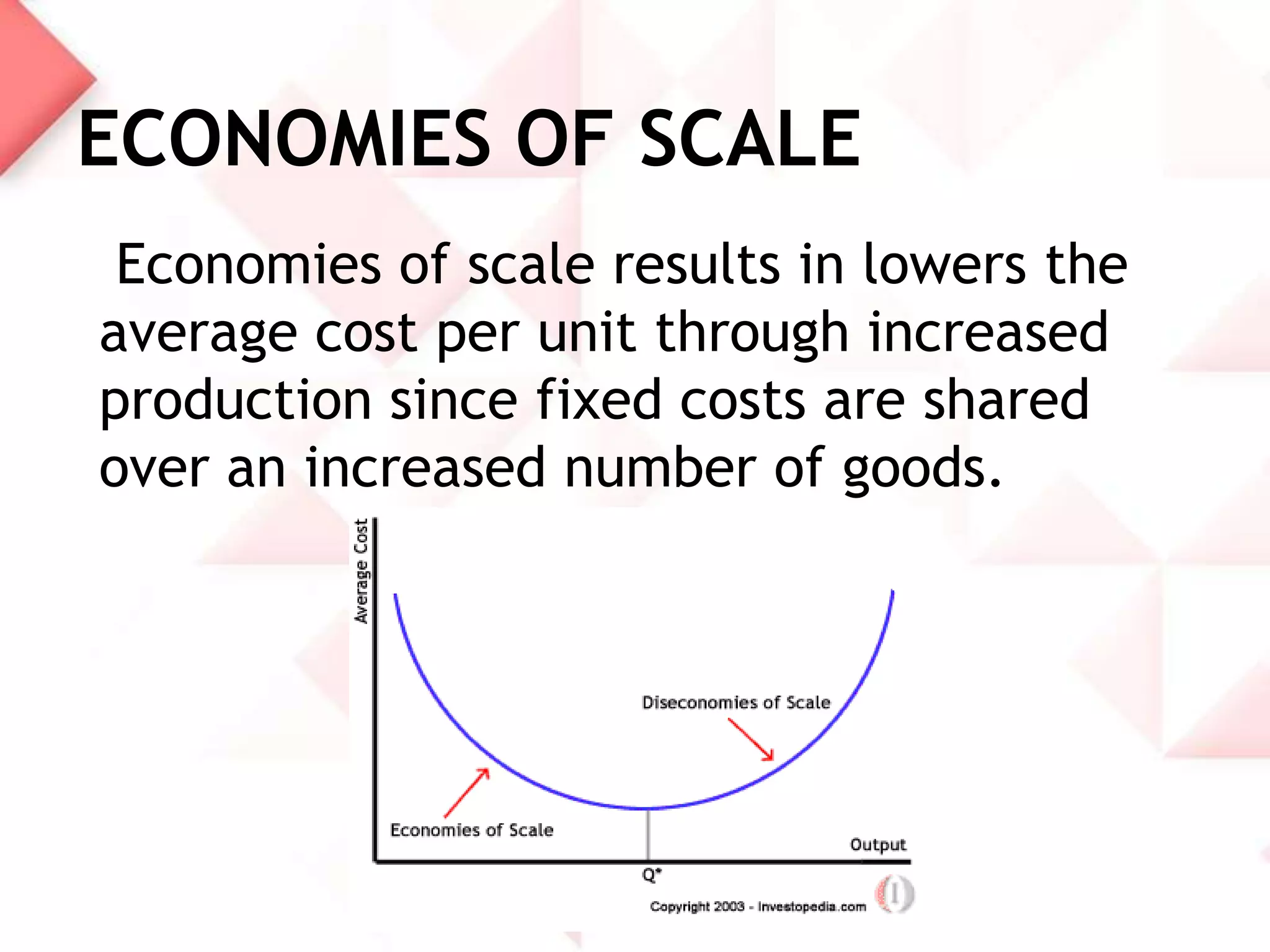
ECONOMIES OF SCALE
Economies of scale results in lowers the
average cost per unit through increased
production since fixed costs are shared
over an increased number of goods.
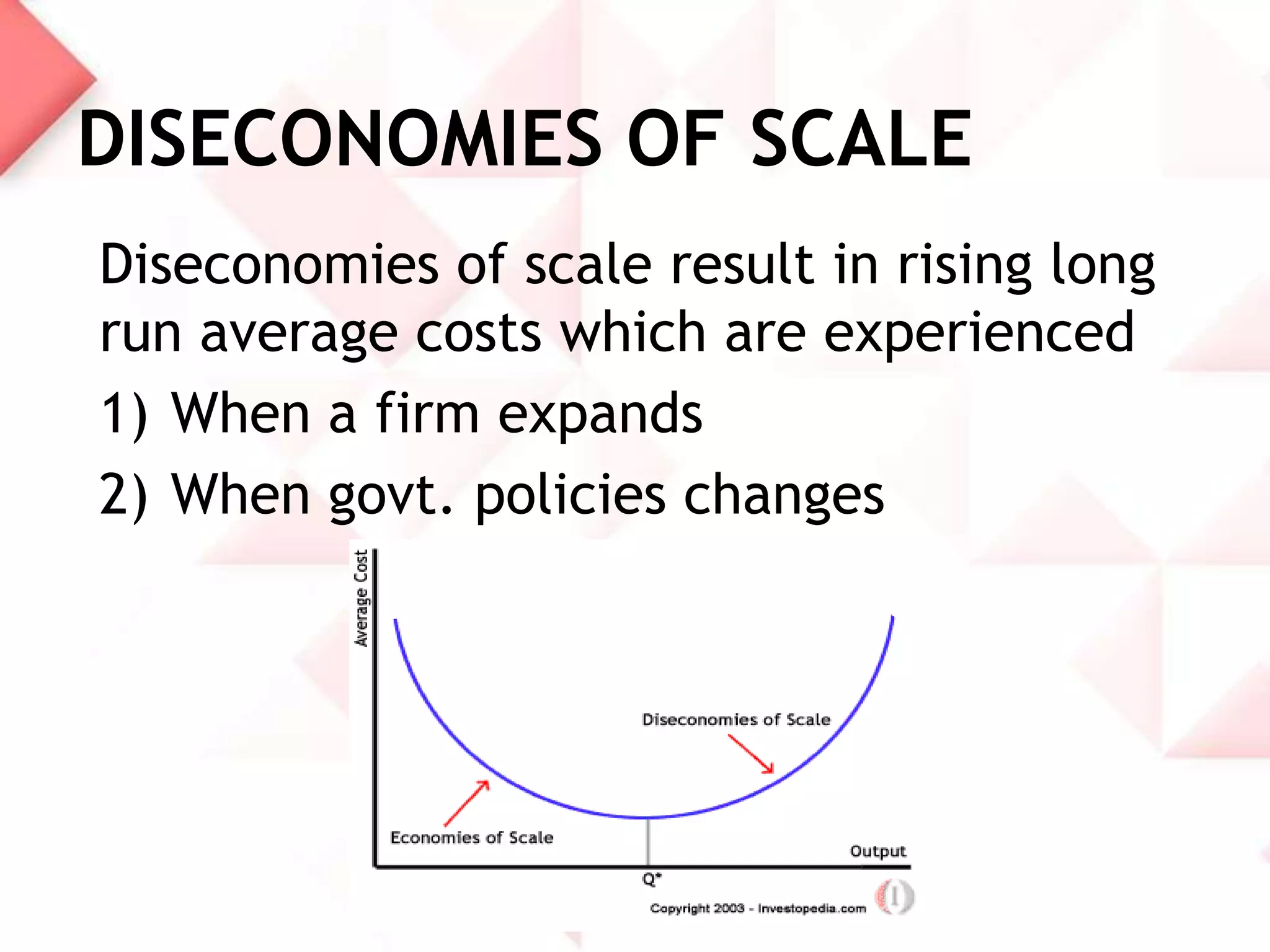
DISECONOMIES OF SCALE
Diseconomies of scale result in rising long
run average costs which are experienced
1) When a firm expands
2) When govt. policies changes
Capacity strategies
• Lead strategy-the company increases
its production capacity in advance of
anticipated increases in demand.
• Lag strategy-the company responds to
actual increases in demand by
boosting capacity after the operation
is running at full steam.
• Match strategy-the company matches
the demand and supply.
McDonalds’ capacity strategy
• The company uses lead strategy
• Bun inventory- 2 days advance
• FCD(Fried chilled dried) inventory- 3 days
advance
• Coke inventory- 15 days advance
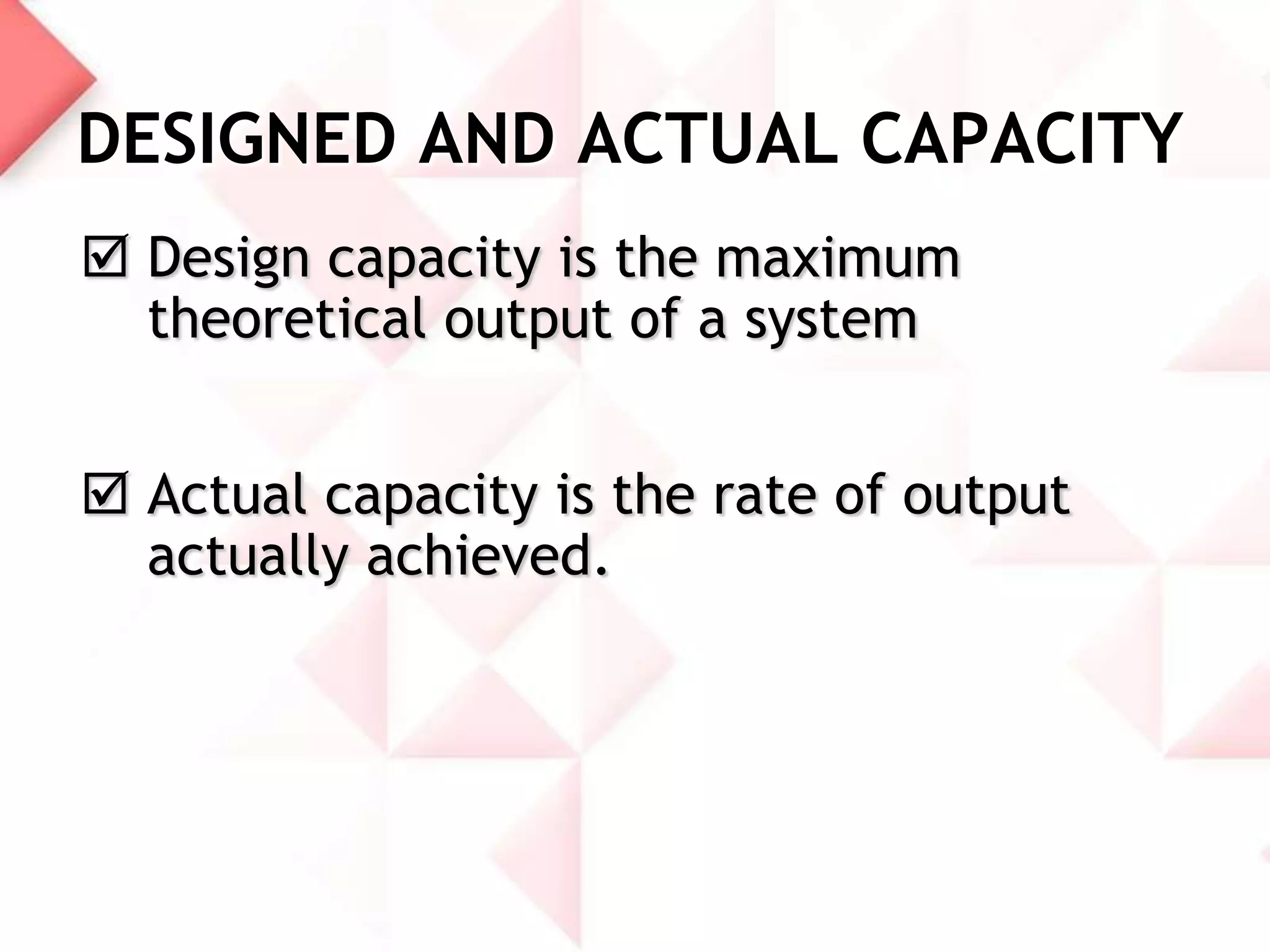
DESIGNED AND ACTUAL CAPACITY
 Design capacity is the maximum
theoretical output of a system
 Actual capacity is the rate of output
actually achieved.
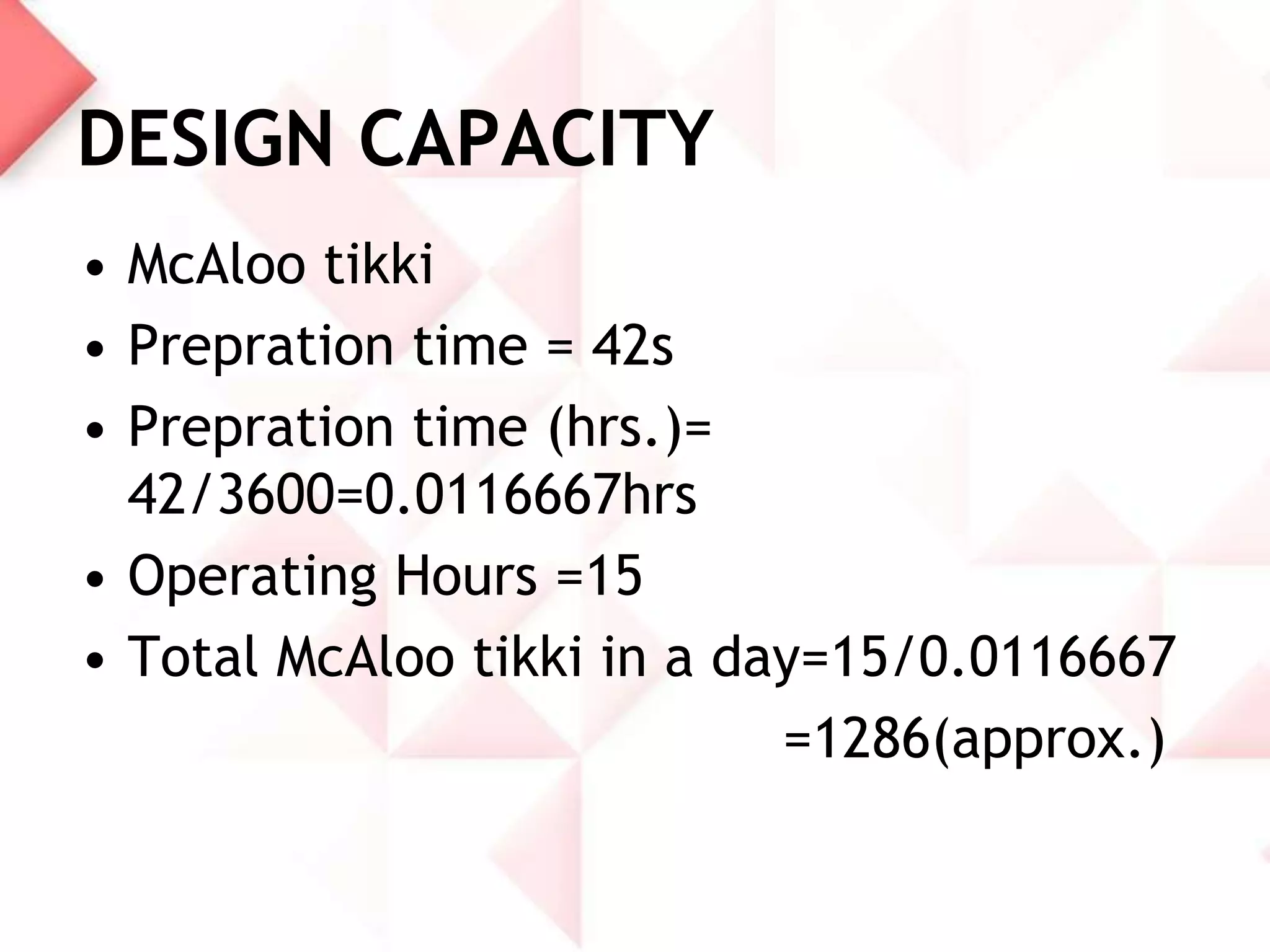
DESIGN CAPACITY
• McAloo tikki
• Prepration time = 42s
• Prepration time (hrs.)=
42/3600=0.0116667hrs
• Operating Hours =15
• Total McAloo tikki in a day=15/0.0116667
=1286(approx.)
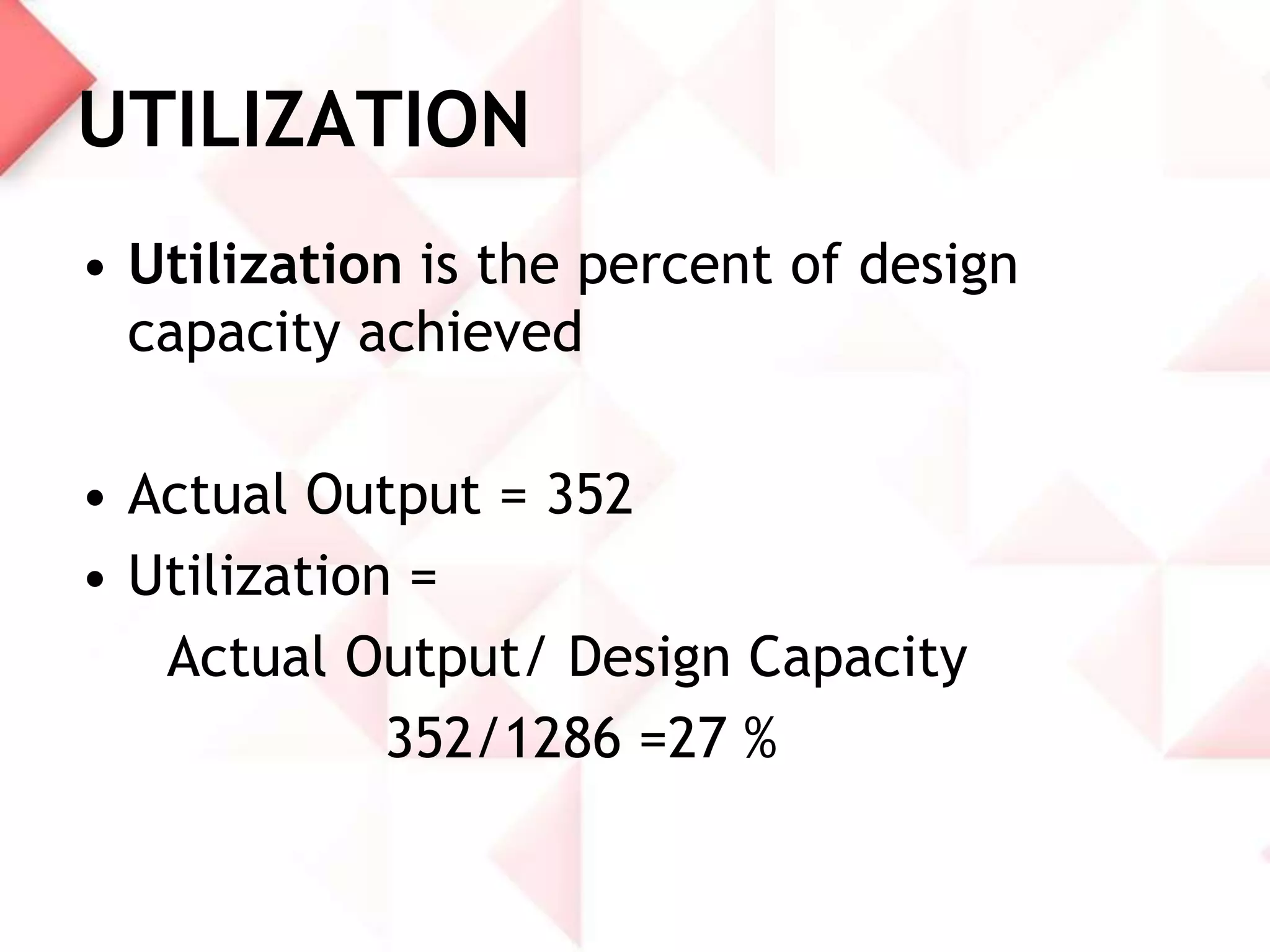
UTILIZATION
• Utilization is the percent of design
capacity achieved
• Actual Output = 352
• Utilization =
Actual Output/ Design Capacity
352/1286 =27 %
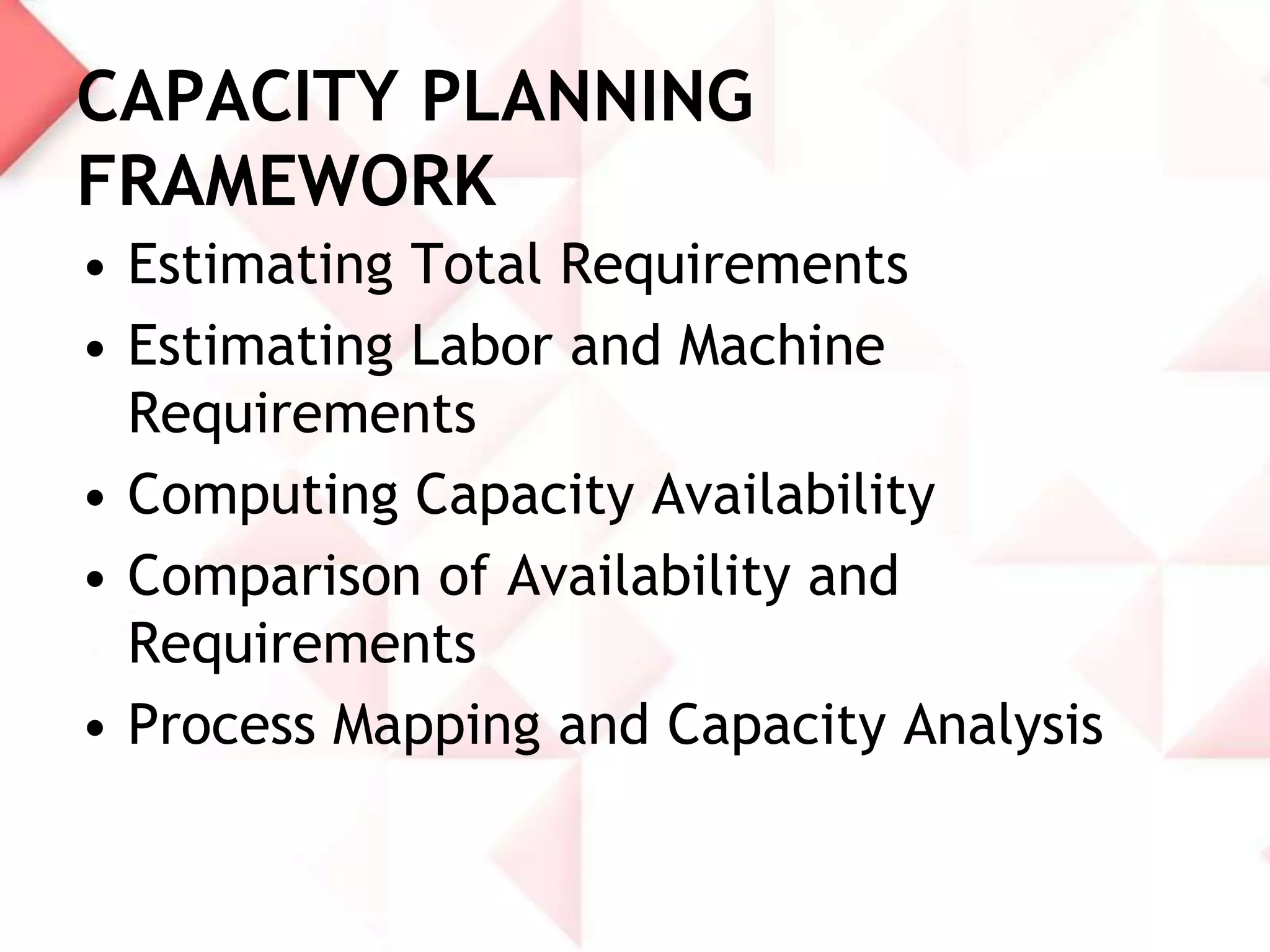
CAPACITY PLANNING
FRAMEWORK
• Estimating Total Requirements
• Estimating Labor and Machine
Requirements
• Computing Capacity Availability
• Comparison of Availability and
Requirements
• Process Mapping and Capacity Analysis
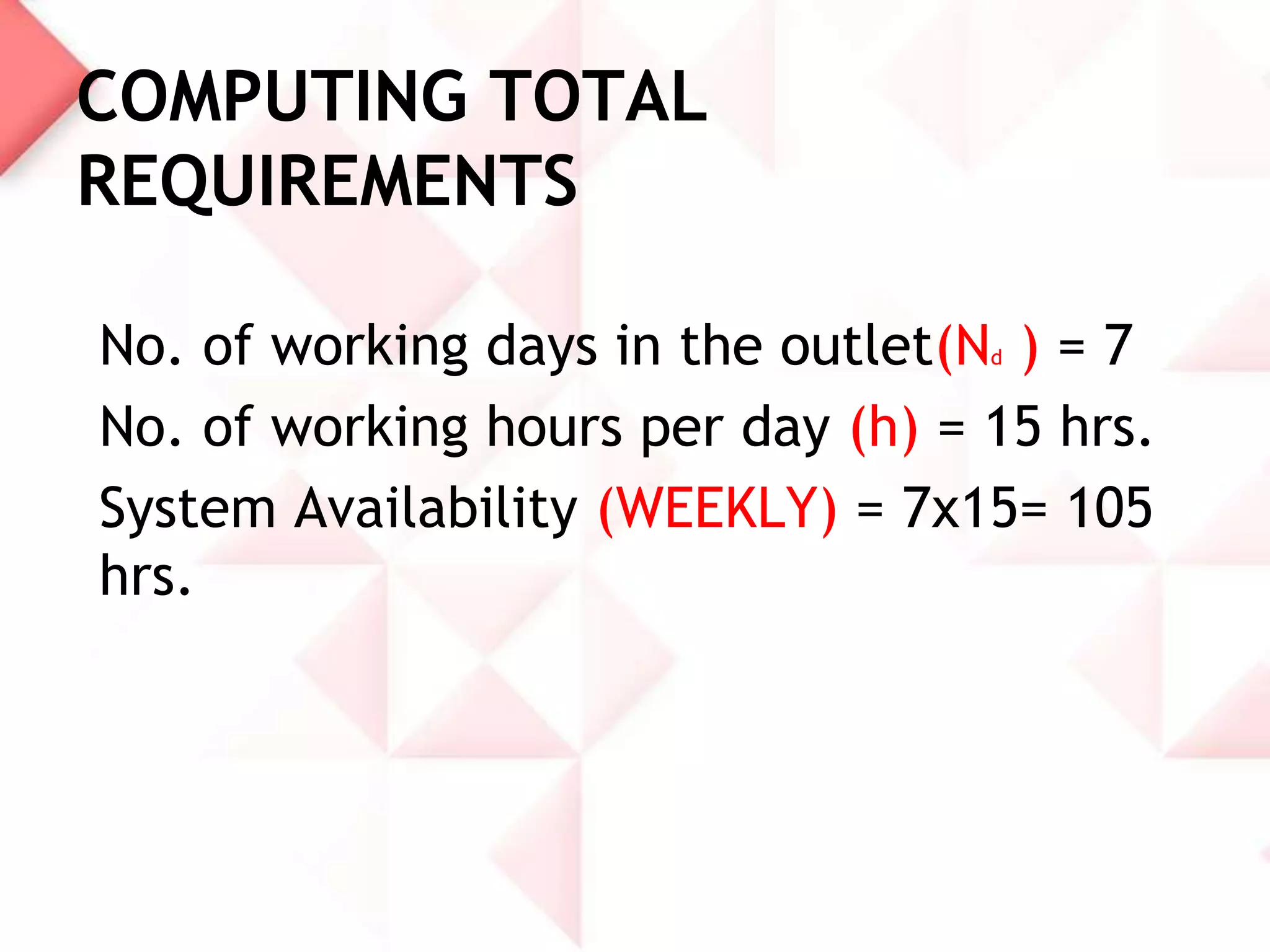
COMPUTING TOTAL
REQUIREMENTS
No. of working days in the outlet(N ) = 7
No. of working hours per day (h) = 15 hrs.
System Availability (WEEKLY) = 7x15= 105
hrs.
d
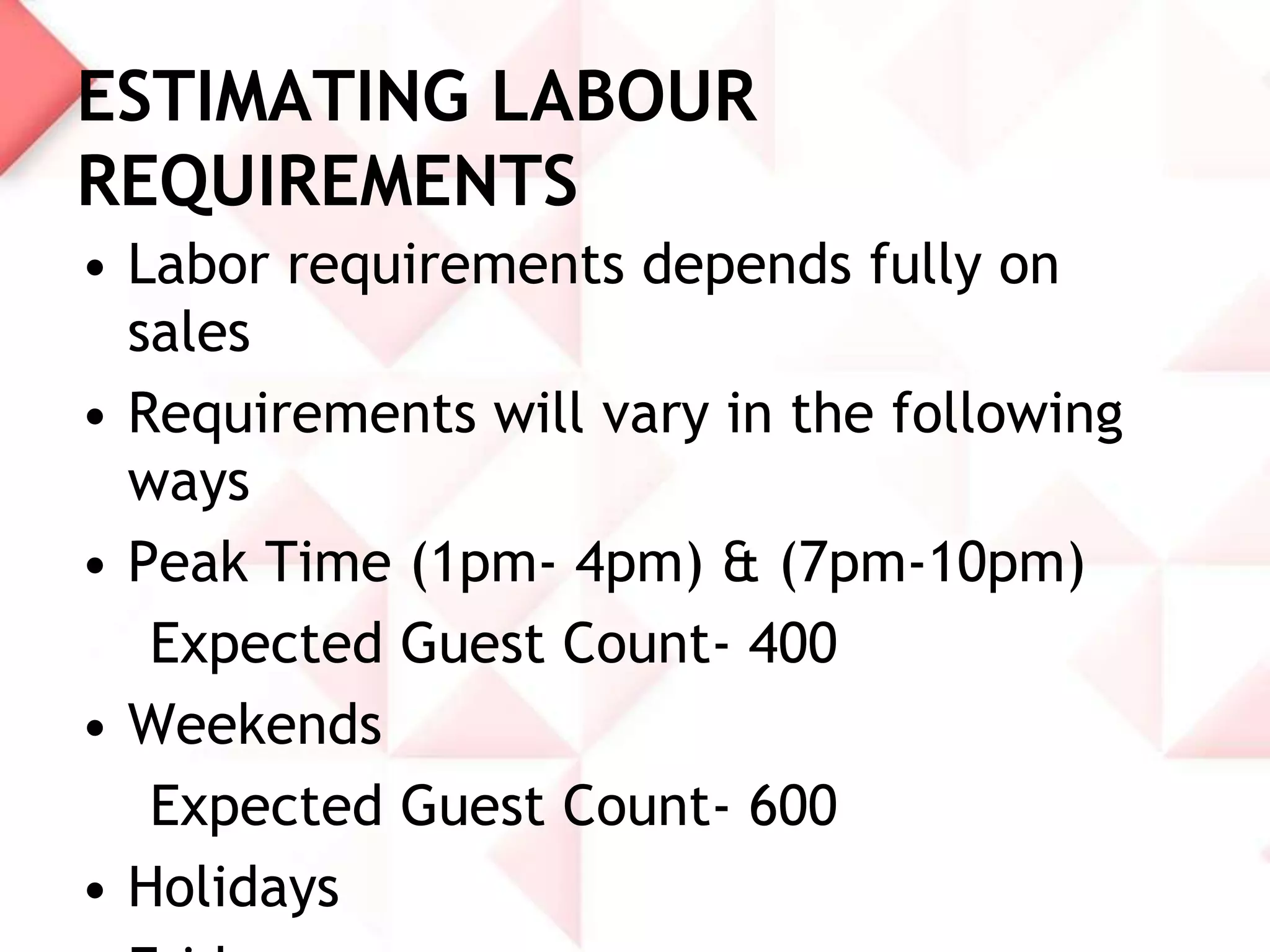
ESTIMATING LABOUR
REQUIREMENTS
• Labor requirements depends fully on
sales
• Requirements will vary in the following
ways
• Peak Time (1pm- 4pm) & (7pm-10pm)
Expected Guest Count- 400
• Weekends
Expected Guest Count- 600
• Holidays
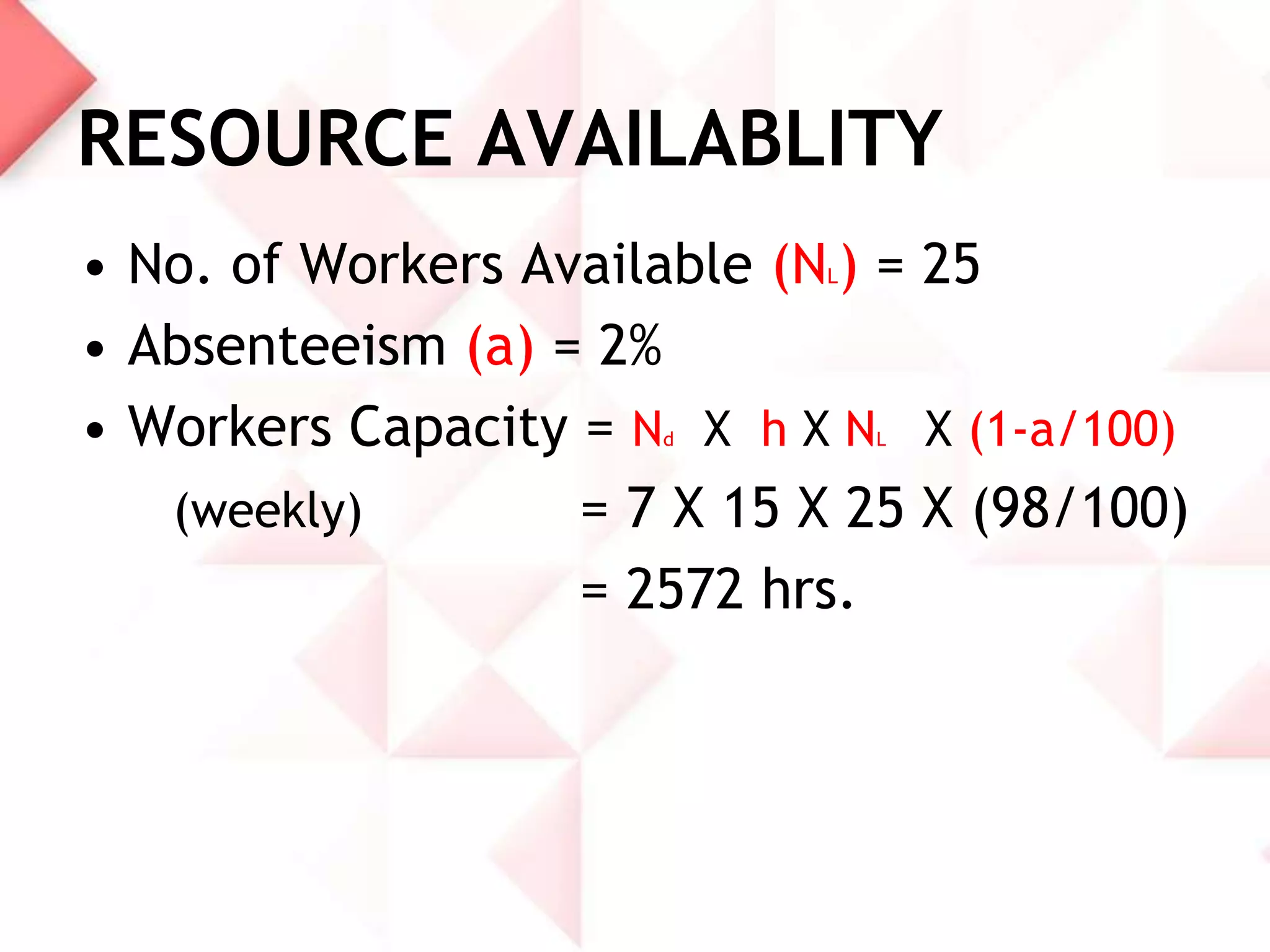
RESOURCE AVAILABLITY
• No. of Workers Available (N ) = 25
• Absenteeism (a) = 2%
• Workers Capacity = N X h X N X (1-a/100)
(weekly)
= 7 X 15 X 25 X (98/100)
= 2572 hrs.
L

d

L
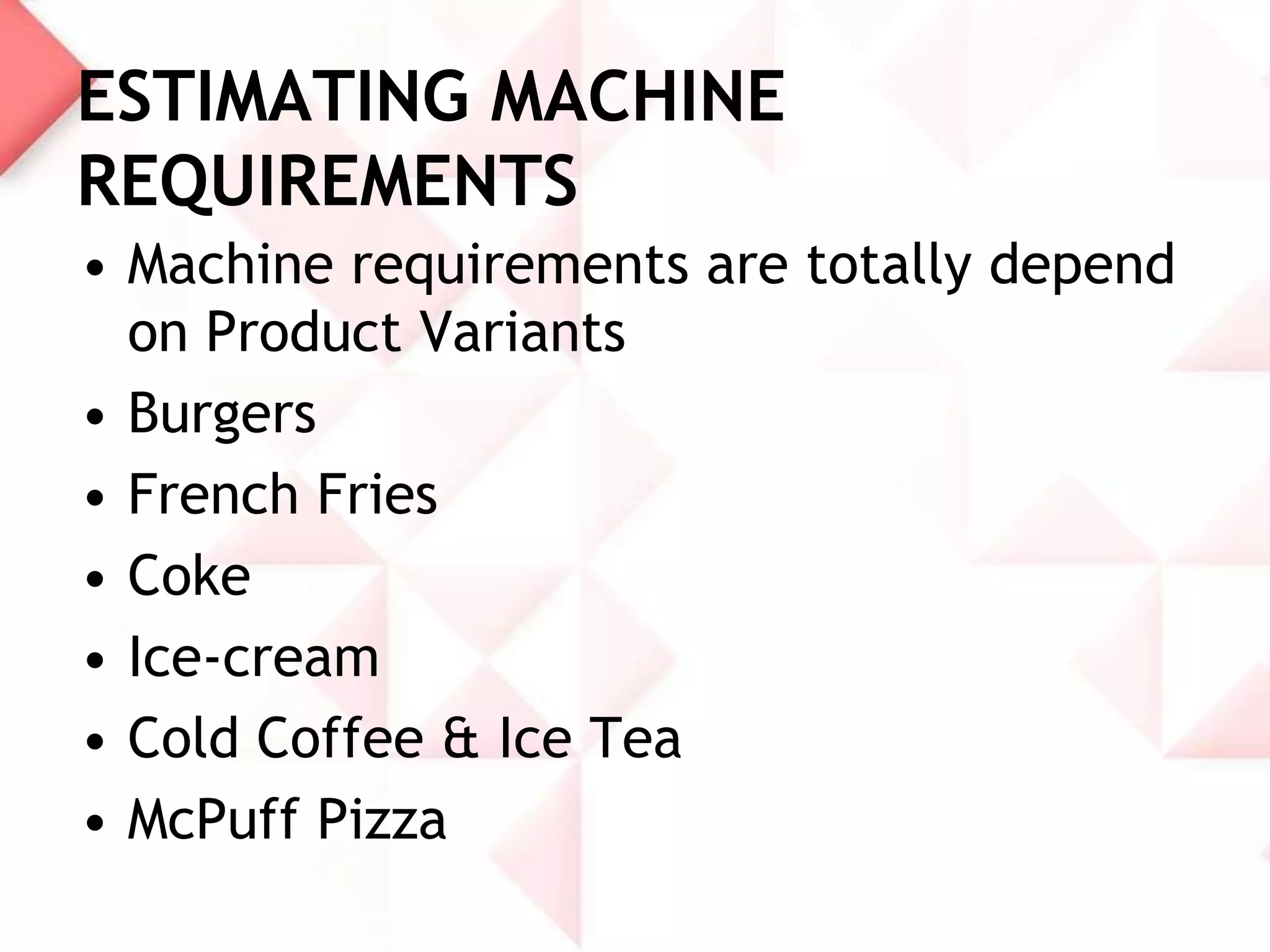
ESTIMATING MACHINE
REQUIREMENTS
• Machine requirements are totally depend
on Product Variants
• Burgers
• French Fries
• Coke
• Ice-cream
• Cold Coffee & Ice Tea
• McPuff Pizza
RESOURCE AVAILABILITY
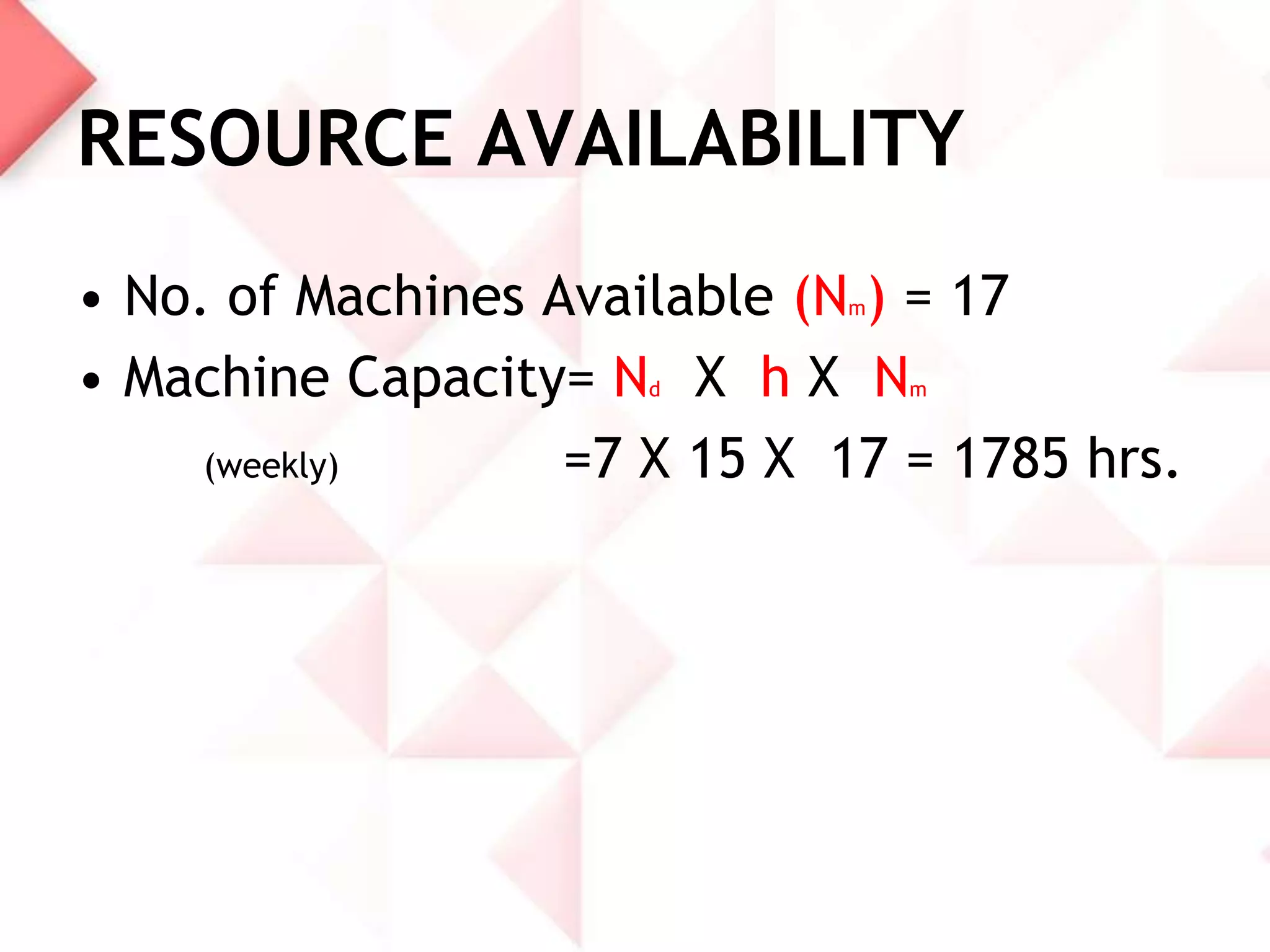
• No. of Machines Available (N ) = 17
• Machine Capacity= N X h X N
(weekly)
=7 X 15 X 17 = 1785 hrs.
m

d

m
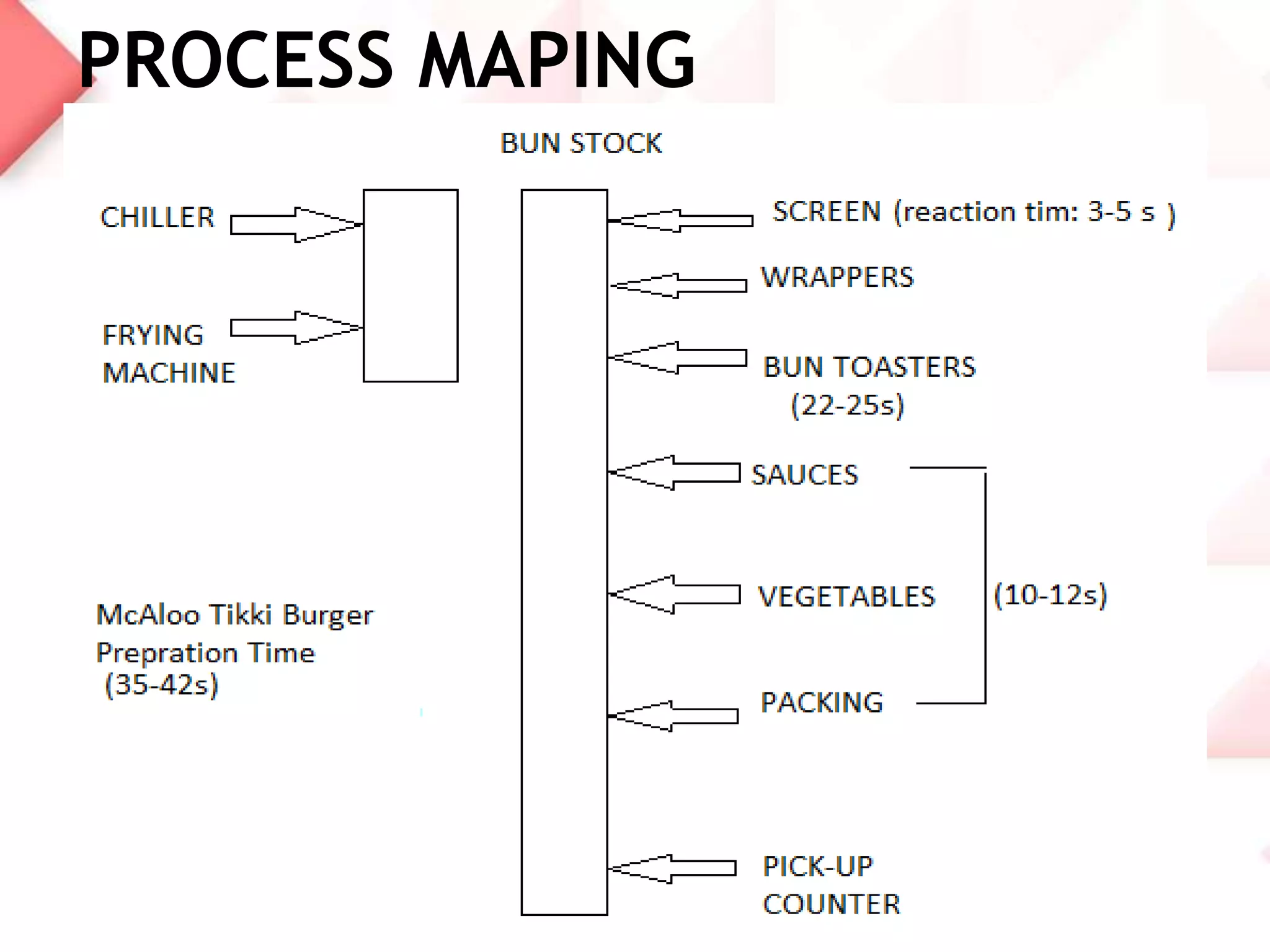
PROCESS MAPING
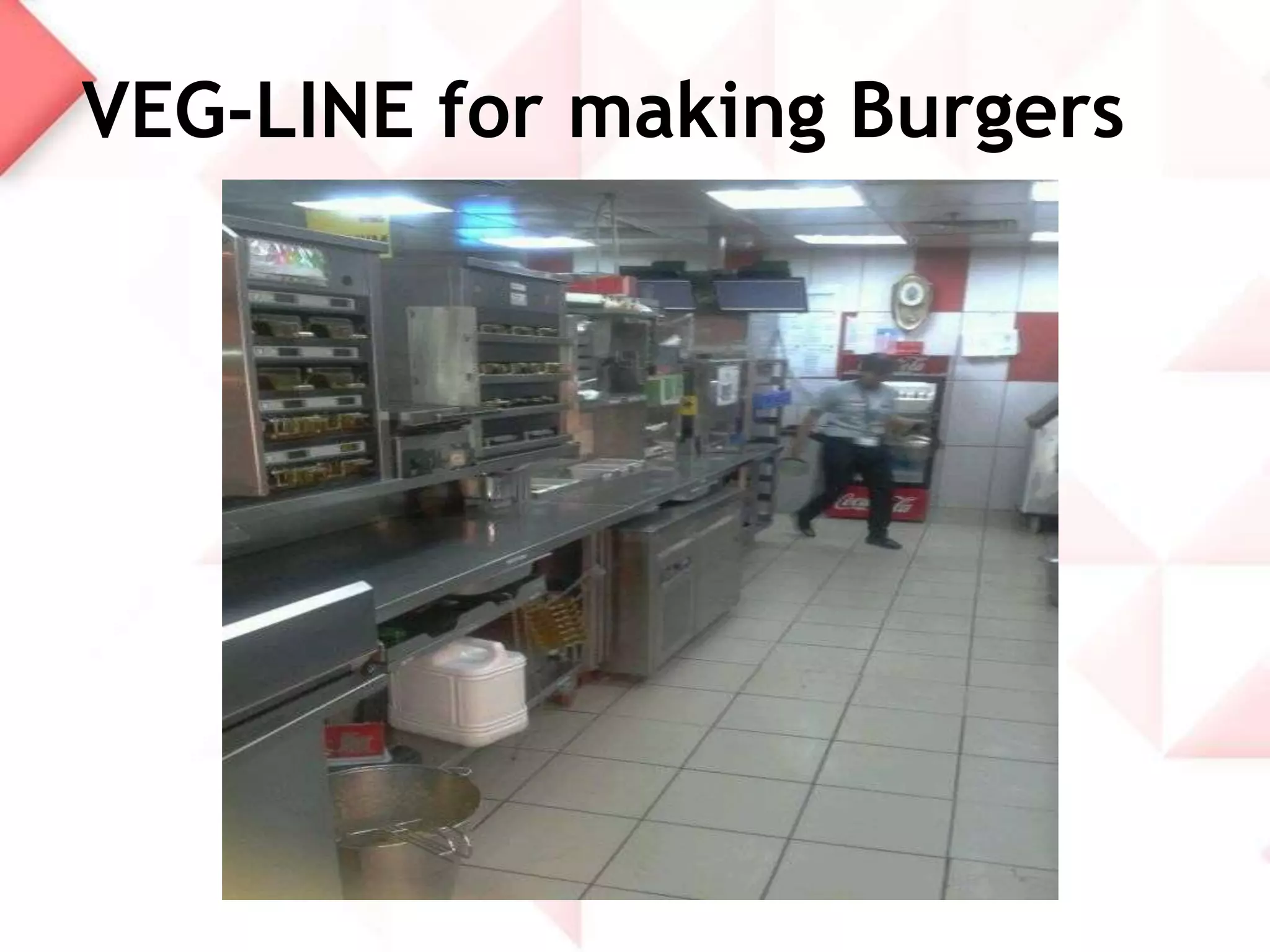
VEG-LINE for making Burgers
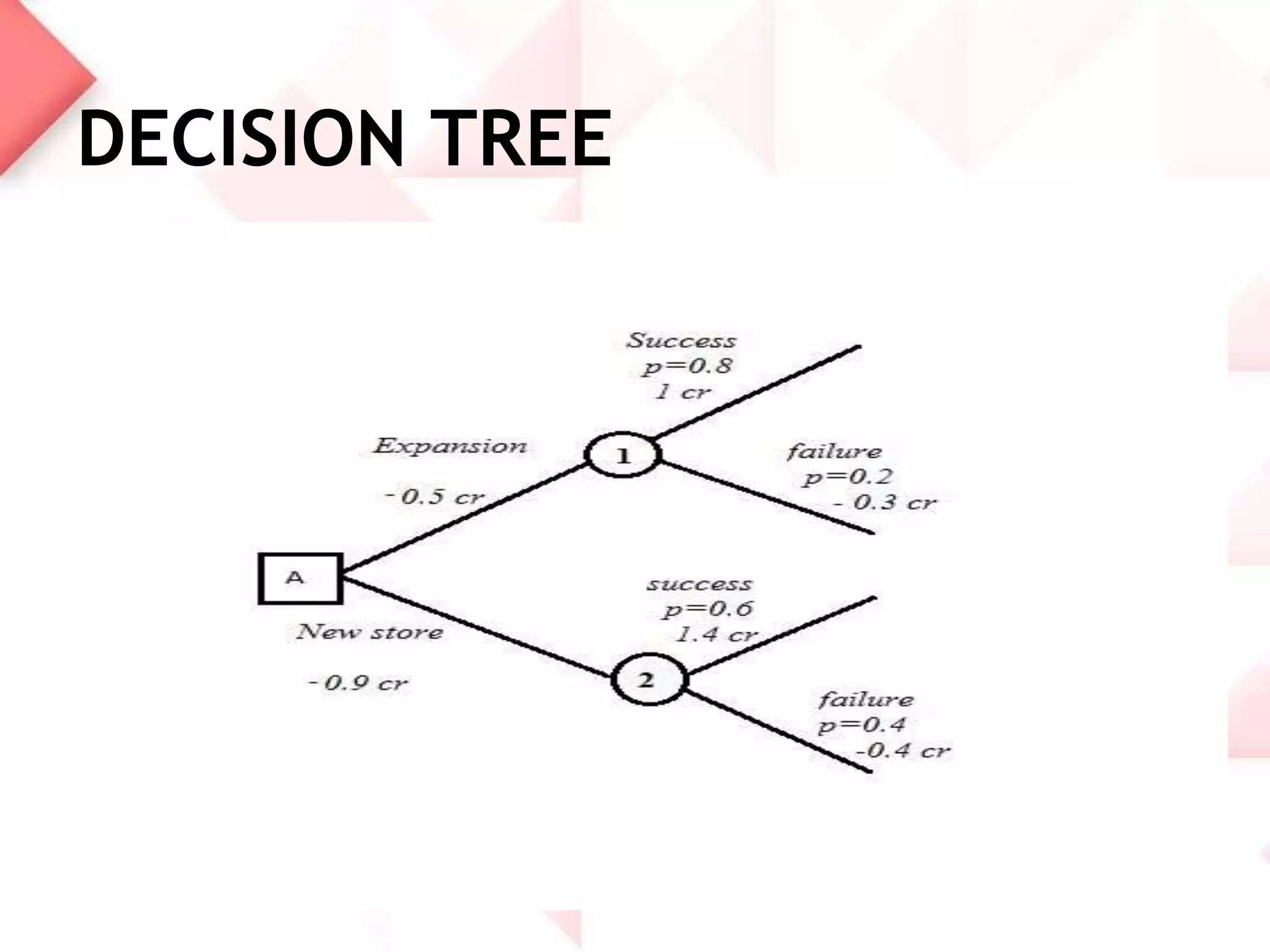
HYPOTHETICAL PROBLEM
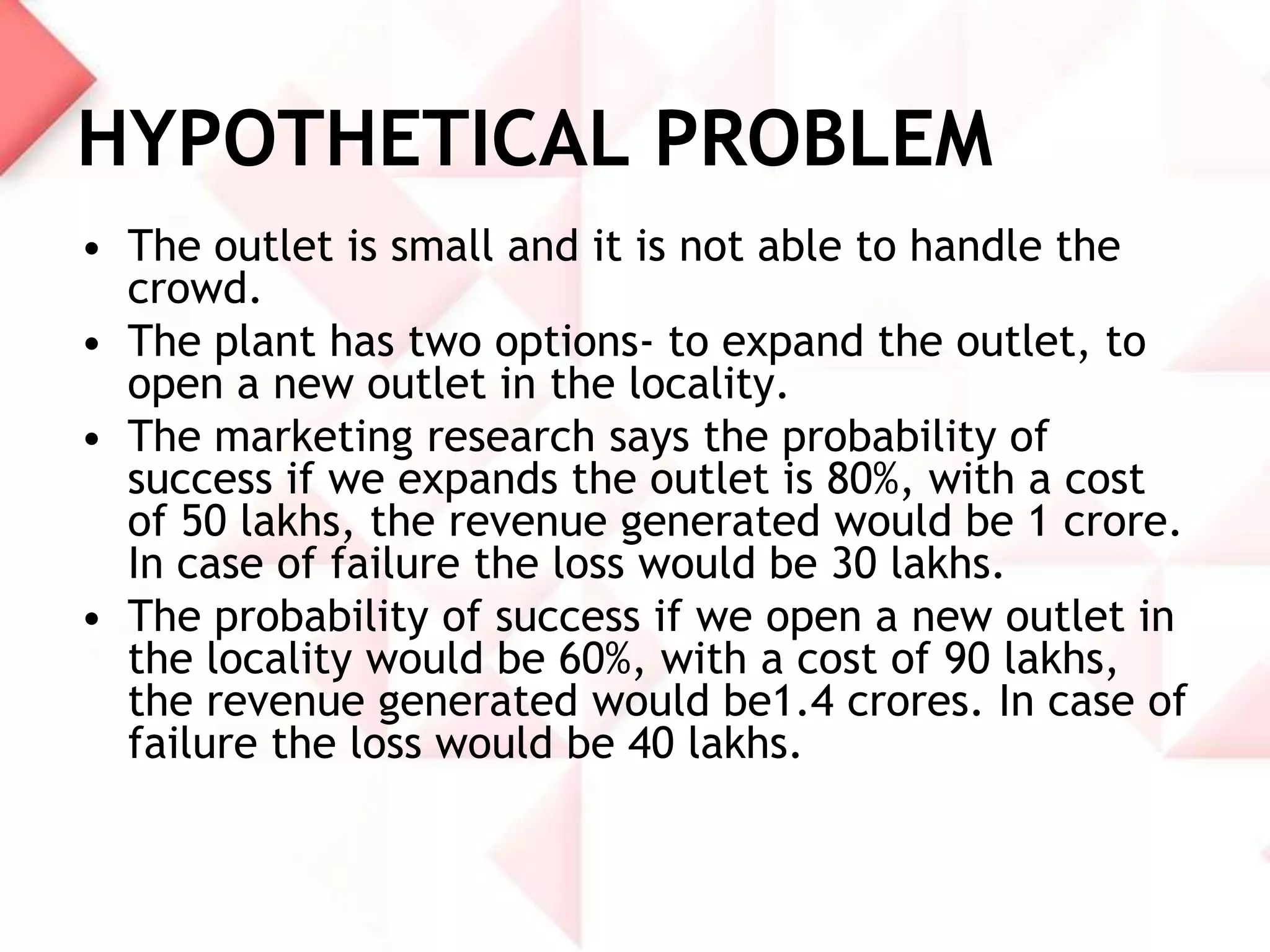
• The outlet is small and it is not able to handle the
crowd.
• The plant has two options- to expand the outlet, to
open a new outlet in the locality.
• The marketing research says the probability of
success if we expands the outlet is 80%, with a cost
of 50 lakhs, the revenue generated would be 1 crore.
In case of failure the loss would be 30 lakhs.
• The probability of success if we open a new outlet in
the locality would be 60%, with a cost of 90 lakhs,
the revenue generated would be1.4 crores. In case of
failure the loss would be 40 lakhs.
DECISION TREE
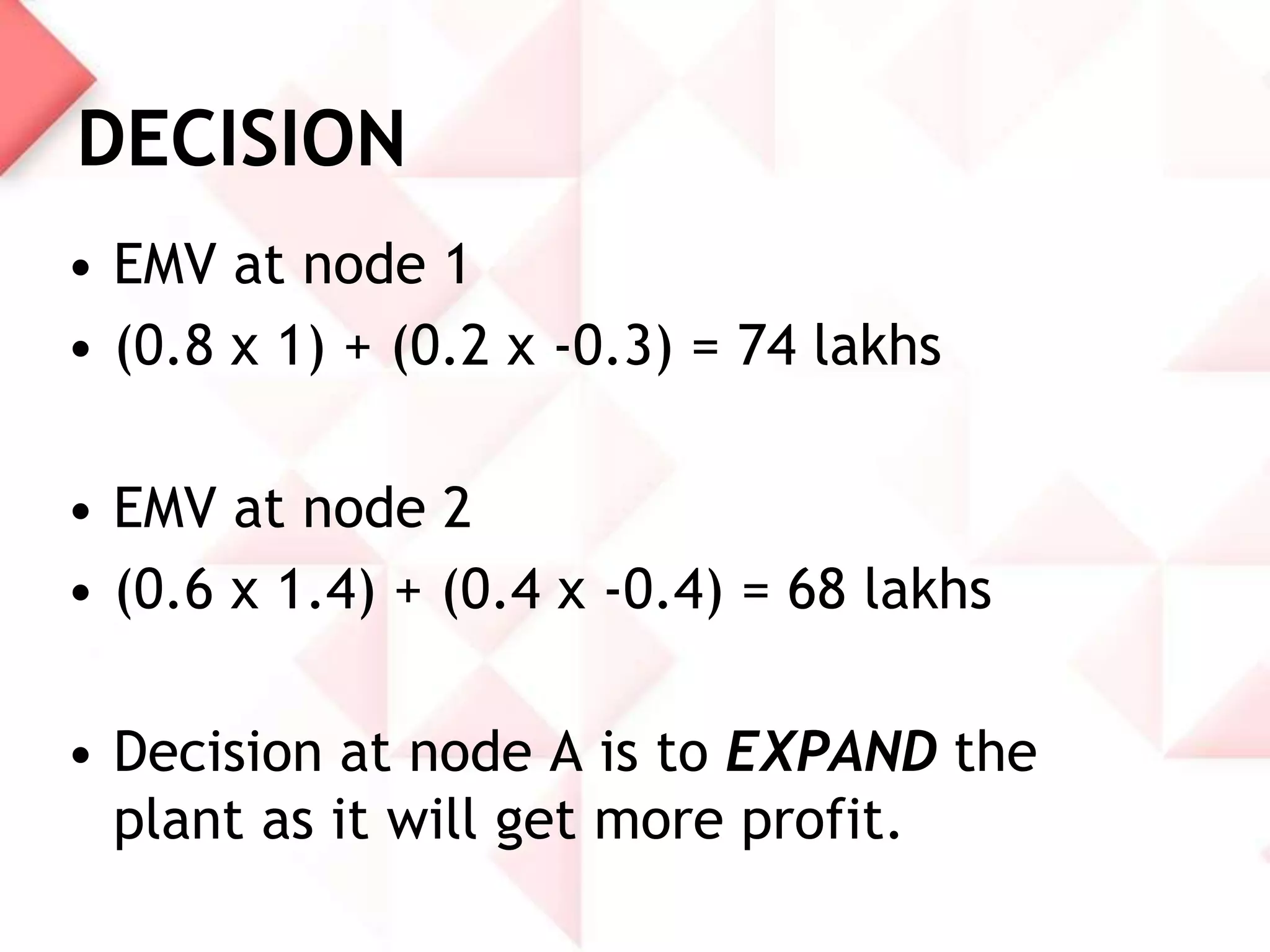
DECISION
• EMV at node 1
• (0.8 x 1) + (0.2 x -0.3) = 74 lakhs
• EMV at node 2
• (0.6 x 1.4) + (0.4 x -0.4) = 68 lakhs

• Decision at node A is to EXPAND the
plant as it will get more profit.
LEARNINGS
• It helped us to ensure that current &
future capacity and performance aspects
of the business requirements are
provided in cost effective manners.
• It helped us in understanding the
importance of decision –tree in order to
select the most effective & efficient
method of capacity expansion.
Capacity Planning with reference to McDonlds

Capacity Planning with reference to McDonlds

  • 1.
  • 2.
    Hi, friends Iam Ronald’s Yes, I am here to tell you about my story Story of McDonald My Team members are: Sai Praveen Piyush Singh Ankit Verma Anand Batra
  • 3.
    CAPACITY Capacity is theupper limit on the load that an operating unit can handle. • The basic questions in capacity handling are: • What kind of capacity is needed? • How much is needed? • When is it needed?
  • 4.
    CAPACITY PLANNING • Capacityplanning is the process of determining the production capacity needed by an organization to meet changing demands for its products. • In the context of capacity planning, “capacity" is the maximum amount of work that an organization is capable of completing in a given period of time.
  • 5.
    • A discrepancybetween the capacity of an organization and the demands of its customers results in an inefficiency, either in under-utilized resources or unfulfilled customers. • The goal of capacity planning is to minimize this discrepancy. • Capacity can be increased through introducing new techniques, equipment and materials, increasing the number of workers or machines, increasing the number of shifts, or acquiring additional production facilities.
  • 6.
    Mc Donalds • McDonald'sis the world's leading food service retailer with more than 33,000 restaurants in 118 countries serving more than 67 million customers each day. • In India, it operates under two parent franchisees  Hardcastle Restaurants Pvt. Ltd – West and South  Vikram Bakshi's Connaught Plaza Restaurants Private Limited – North and East • McDonald's India is a leader in the food retail space, with a presence of more than 250 restaurants serving more than 6.5 lakh customers daily in India.
  • 7.
    McDonalds (Sonipat) • Locatedat Ansal Plaza Mall, Kundli, Sonipat 131001 • Operation Hours – (8a.m-11p.m) • 115 covers • 1 Restaurant Manager , 2 Astt. Manager • 1 Relationship Executive ,1 Crew Trainer • 25 crews
  • 8.
    FACTORS AFFECTING CAPACITY PLANNING •Product Design Every product has its own unique recipe • Process Design Process of a making of product should be time effective but quality cannot be reduced • Product Variety Product having less variation can be processed together to reduce overall time
  • 9.
    • Product Quality Test& Inspection are made in order to keep a check on quality of product. • Product Scheduling Scheduling that keeps the product flow well balanced and synchronized
  • 10.
    ECONOMIES OF SCALE Economiesof scale results in lowers the average cost per unit through increased production since fixed costs are shared over an increased number of goods.
  • 11.
    DISECONOMIES OF SCALE Diseconomiesof scale result in rising long run average costs which are experienced 1) When a firm expands 2) When govt. policies changes
  • 12.
    Capacity strategies • Leadstrategy-the company increases its production capacity in advance of anticipated increases in demand. • Lag strategy-the company responds to actual increases in demand by boosting capacity after the operation is running at full steam. • Match strategy-the company matches the demand and supply.
  • 13.
    McDonalds’ capacity strategy •The company uses lead strategy • Bun inventory- 2 days advance • FCD(Fried chilled dried) inventory- 3 days advance • Coke inventory- 15 days advance
  • 14.
    DESIGNED AND ACTUALCAPACITY  Design capacity is the maximum theoretical output of a system  Actual capacity is the rate of output actually achieved.
  • 15.
    DESIGN CAPACITY • McAlootikki • Prepration time = 42s • Prepration time (hrs.)= 42/3600=0.0116667hrs • Operating Hours =15 • Total McAloo tikki in a day=15/0.0116667 =1286(approx.)
  • 16.
    UTILIZATION • Utilization isthe percent of design capacity achieved • Actual Output = 352 • Utilization = Actual Output/ Design Capacity 352/1286 =27 %
  • 17.
    CAPACITY PLANNING FRAMEWORK • EstimatingTotal Requirements • Estimating Labor and Machine Requirements • Computing Capacity Availability • Comparison of Availability and Requirements • Process Mapping and Capacity Analysis
  • 18.
    COMPUTING TOTAL REQUIREMENTS No. ofworking days in the outlet(N ) = 7 No. of working hours per day (h) = 15 hrs. System Availability (WEEKLY) = 7x15= 105 hrs. d
  • 19.
    ESTIMATING LABOUR REQUIREMENTS • Laborrequirements depends fully on sales • Requirements will vary in the following ways • Peak Time (1pm- 4pm) & (7pm-10pm) Expected Guest Count- 400 • Weekends Expected Guest Count- 600 • Holidays
  • 20.
    RESOURCE AVAILABLITY • No.of Workers Available (N ) = 25 • Absenteeism (a) = 2% • Workers Capacity = N X h X N X (1-a/100) (weekly) = 7 X 15 X 25 X (98/100) = 2572 hrs. L d L
  • 21.
    ESTIMATING MACHINE REQUIREMENTS • Machinerequirements are totally depend on Product Variants • Burgers • French Fries • Coke • Ice-cream • Cold Coffee & Ice Tea • McPuff Pizza
  • 22.
    RESOURCE AVAILABILITY • No.of Machines Available (N ) = 17 • Machine Capacity= N X h X N (weekly) =7 X 15 X 17 = 1785 hrs. m d m
  • 23.
  • 24.
  • 25.
    HYPOTHETICAL PROBLEM • Theoutlet is small and it is not able to handle the crowd. • The plant has two options- to expand the outlet, to open a new outlet in the locality. • The marketing research says the probability of success if we expands the outlet is 80%, with a cost of 50 lakhs, the revenue generated would be 1 crore. In case of failure the loss would be 30 lakhs. • The probability of success if we open a new outlet in the locality would be 60%, with a cost of 90 lakhs, the revenue generated would be1.4 crores. In case of failure the loss would be 40 lakhs.
  • 26.
  • 27.
    DECISION • EMV atnode 1 • (0.8 x 1) + (0.2 x -0.3) = 74 lakhs • EMV at node 2 • (0.6 x 1.4) + (0.4 x -0.4) = 68 lakhs • Decision at node A is to EXPAND the plant as it will get more profit.
  • 28.
    LEARNINGS • It helpedus to ensure that current & future capacity and performance aspects of the business requirements are provided in cost effective manners. • It helped us in understanding the importance of decision –tree in order to select the most effective & efficient method of capacity expansion.