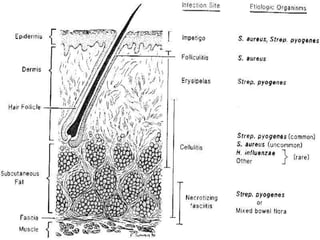
Bacterial infections of the skin
By
Dr Hussein Abulfotouh
Consultant Dermatology & veneriology
Natural Defenses of the Skin
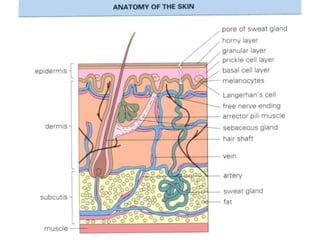
• Temperature less than 37°C
• Dry: usual infection sites are wet areas: skin folds, armpit,
groin
• Keratin
• Skin sloughing
• Sebum: low pH, high lipid content
• Sweat: - low pH, high salt,
- Lysozyme &toxic lipids
• Skin-associated lymphoid tissue (SALT)
• Resident microflora (mainly Gram positives)
Normal Skin Flora
• Propionibacterium acnes
• Corynebacterium sp.
• Staphylococci
– Staphylococcus epidermidis
– Staphylococcus aureus
• Streptococci sp.
• Candida albicans (yeast)
• Many others
Route of infection
1) Skin (pores, hair follicles).
2) Wounds (scratches, cuts, burns).
3) Insect & animal bites.
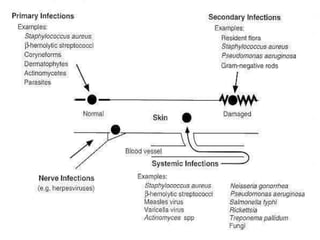
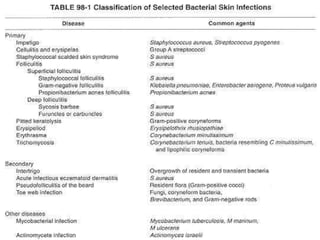
Primary Infections
• caused by a single pathogen, usually affect normal skin.
• Impetigo, folliculitis, and boils are common types.
• The most common primary skin pathogens are S
aureus ,β-hemolytic streptococci, and coryneform
bacteria.
• Organisms usually enter through a break in the skin.
Secondary Infections
• Secondary infections occur in skin that is already
diseased.
• Because of the underlying disease, the clinical picture
and course of these infections vary.
• Intertrigo and toe web infection are examples
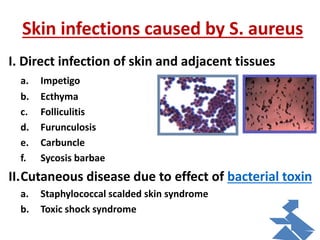
Skin infections caused by S. aureus
I. Direct infection of skin and adjacent tissues
a. Impetigo
b. Ecthyma
c. Folliculitis
d. Furunculosis
e. Carbuncle
f. Sycosis barbae
II.Cutaneous disease due to effect of bacterial toxin
a. Staphylococcal scalded skin syndrome
b. Toxic shock syndrome
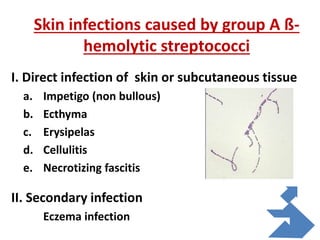
Skin infections caused by group A ß-
hemolytic streptococci
I. Direct infection of skin or subcutaneous tissue
a. Impetigo (non bullous)
b. Ecthyma
c. Erysipelas
d. Cellulitis
e. Necrotizing fascitis
II. Secondary infection
Eczema infection
Skin and Soft Tissue Infections
1. Impetigo: Initially a vesicular infection that rapidly
evolves into pustules that rupture, with dried discharge
forming honey-colored crust on an erythematous base.
2. Ecthyma (Pustules): Begin as vesicles that rupture,
creating circular erythematous lesions with adherent
crusts.
3. Folliculitis: Inflammation at the opening of the hair
follicle that causes erythematouspapules and pustules
surrounding individual hairs.
4. Furuncle: Deep-seated inflammatory nodule with a
pustular center that develops around a hair follicle.
(painful, localized, abscess).
5. Carbuncle: Involvement of several adjacent follicles,
with pus discharging from multiple follicular orifices.
6. Cutaneous abscesses: Painful, fluctuant, red,
tender swelling, on which may rest a pustule.
7. Erysipelas: Erythema and swelling of the
cutaneous surface, involves the superficial dermis
(redness-lymphangitis).
8. Cellulitis: Erythematous, hot, swollen skin
with irregular edge (affects the deeper dermis and
subcutaneous fat).
9. Acne: Infection of sebaceous follicles with plugs of
keratin blocking the sebaceous canal, resulting in
“blackheads”.
10. Necrotizing fasciitis: Rapidly spreading cellulitis
with necrosis (skin and deeper fascia; may
involve muscle).
Begin with fever, systemic toxicity, severe pain
in the development of a painful, red swelling that
rapidly progress to necrosis of the subcutaneous
tissue and overlying skin.
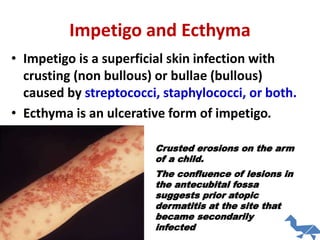
Impetigo and Ecthyma
• Impetigo is a superficial skin infection with
crusting (non bullous) or bullae (bullous)
caused by streptococci, staphylococci, or both.
• Ecthyma is an ulcerative form of impetigo.
Crusted erosions on the arm
of a child.
The confluence of lesions in
the antecubital fossa
suggests prior atopic
dermatitis at the site that
became secondarily
infected
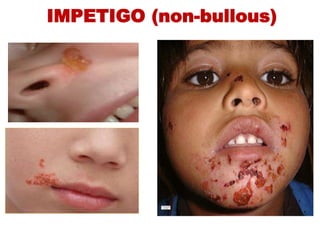
IMPETIGO (non-bullous)
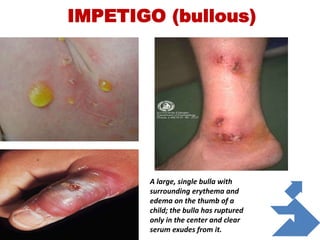
IMPETIGO (bullous)
A large, single bulla with
surrounding erythema and
edema on the thumb of a
child; the bulla has ruptured
only in the center and clear
serum exudes from it.
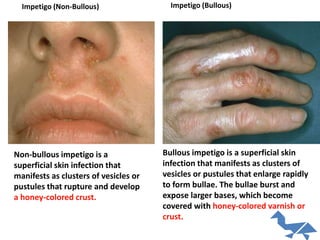
Non-bullous impetigo is a
superficial skin infection that
manifests as clusters of vesicles or
pustules that rupture and develop
a honey-colored crust.
Bullous impetigo is a superficial skin
infection that manifests as clusters of
vesicles or pustules that enlarge rapidly
to form bullae. The bullae burst and
expose larger bases, which become
covered with honey-colored varnish or
crust.
Impetigo (Bullous)Impetigo (Non-Bullous)
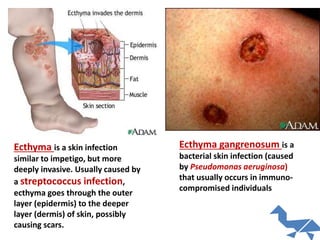
Ecthyma gangrenosum is a
bacterial skin infection (caused
by Pseudomonas aeruginosa)
that usually occurs in immuno-
compromised individuals
Ecthyma is a skin infection
similar to impetigo, but more
deeply invasive. Usually caused by
a streptococcus infection,
ecthyma goes through the outer
layer (epidermis) to the deeper
layer (dermis) of skin, possibly
causing scars.
Folliculitis
• Folliculitis is a bacterial infection of hair follicles.
• It is usually caused by Staphylococcus aureus but
occasionally Pseudomonas aeruginosa (hot-tub
folliculitis)
• The bacteria is commonly found in contaminated
whirlpools, hot tubs or physiotherapy pools .
• Children tend to get hot tub folliculitis more.
• Hot-tub folliculitis occurs because of inadequate
treatment of water with chlorine or bromine.
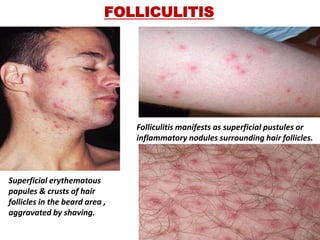
FOLLICULITIS
Superficial erythematous
papules & crusts of hair
follicles in the beard area ,
aggravated by shaving.
Folliculitis manifests as superficial pustules or
inflammatory nodules surrounding hair follicles.
Furuncles and Carbuncles
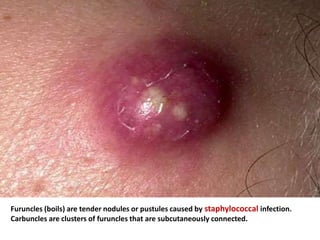
• Furuncles are skin abscesses caused by
staphylococcal infection, which involve a hair
follicle and surrounding tissue.
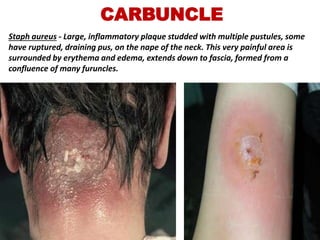
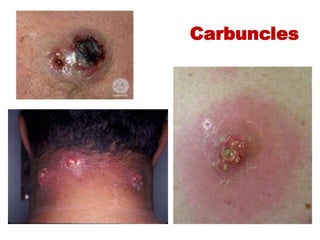
• Carbuncles are clusters of furuncles connected
subcutaneously, causing deeper suppuration
and scarring. They are smaller and more
superficial than subcutaneous abscesses
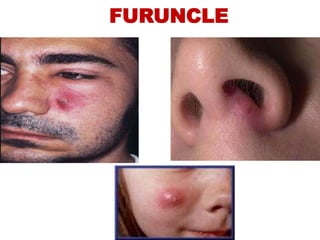
FURUNCLE
Furuncles (boils) are tender nodules or pustules caused by staphylococcal infection.
Carbuncles are clusters of furuncles that are subcutaneously connected.
CARBUNCLE
Staph aureus - Large, inflammatory plaque studded with multiple pustules, some
have ruptured, draining pus, on the nape of the neck. This very painful area is
surrounded by erythema and edema, extends down to fascia, formed from a
confluence of many furuncles.
Carbuncles
Cellulitis
• Cellulitis is an acute bacterial infection of the skin
and subcutaneous tissue most often caused by
streptococci or staphylococci.
• Some people are at risk for infection by other types of
bacteria. They include people with weak immune system,
and those who handle fish, meat, poultry, or soil without
using gloves.
• Cellulitis can occur anywhere on the body. In
adults, it often occurs on the legs, face, or arms. In
children, it is most common on the face or around
the anus. An infection on the face could lead to a
dangerous eye infection.
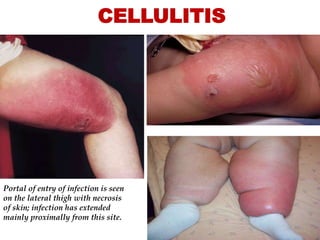
CELLULITIS
Portal of entry of infection is seen
on the lateral thigh with necrosis
of skin; infection has extended
mainly proximally from this site.
Erysipelas
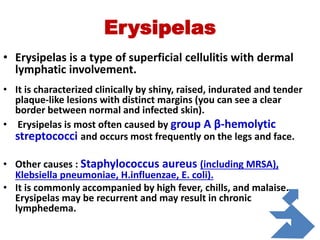
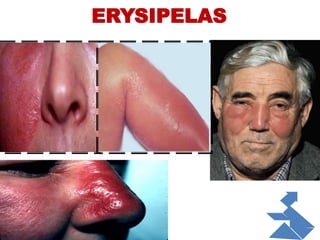
• Erysipelas is a type of superficial cellulitis with dermal
lymphatic involvement.
• It is characterized clinically by shiny, raised, indurated and tender
plaque-like lesions with distinct margins (you can see a clear
border between normal and infected skin).
• Erysipelas is most often caused by group A β-hemolytic
streptococci and occurs most frequently on the legs and face.
• Other causes : Staphylococcus aureus (including MRSA),
Klebsiella pneumoniae, H.influenzae, E. coli).
• It is commonly accompanied by high fever, chills, and malaise.
Erysipelas may be recurrent and may result in chronic
lymphedema.
ERYSIPELAS
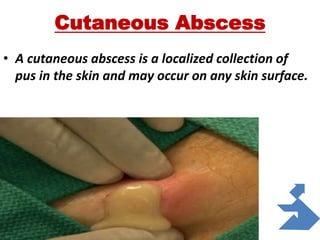
Cutaneous Abscess
• A cutaneous abscess is a localized collection of
pus in the skin and may occur on any skin surface.
Necrotizing Subcutaneous Infection
(Necrotizing Fasciitis)
• Typically caused by a mixture of aerobic &
anaerobic organisms that cause necrosis of
subcutaneous tissue, usually including the fascia.
• This infection most commonly affects the extremities
and perineum. Affected tissues become red, hot, and
swollen, resembling severe cellulitis.
• Without timely treatment, the area becomes
gangrenous. Diagnosis is by history and examination.
• Treatment involves: antibiotics,surgical debridement,
Amputation if necessary
• Prognosis is poor without early, aggressive treatment.
Necrotizing Fasciitis “Flesh Eating Strep”
Streptococcus pyogenes (Group A β hemolytic Streptococci (GABHS) is
the causative agent
• Necrotizing fasciitis:
The disease starts as localized infection that rapidly
spreading cellulitis with necrosis (skin and deeper
fascia; may involve muscle).
• Begin with fever, systemic toxicity and severe pain
• The development of a painful, red swelling that rapidly
progress to necrosis of the subcutaneous tissue and
overlying skin.
• The Invasive & spreading cellulitis may lead to
loss of limb
• May lead to toxic shock
NECROTIZING FASCIITIS
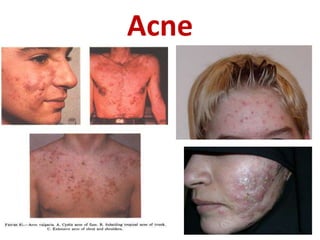
Acne
Acne
• Most common skin disease in humans
• Propionibacterium acnes: Gram +ve rod ,causative agent
• Pathogenesis: bacteria digest sebum , Attracts neutrophils
- Neutrophil digestive enzymes cause lesions, “pus pockets”
• Obstruction of sebaceous follicles (oil glands)
• Open comedones or closed comedones
• Usually on the face, chest, back
• Risk factors:
– Stressful events (hormonal changes)
– Friction acne
– Oil based cosmetics
– NO correlation between chocolate, chips or colas
(No effects of diet)
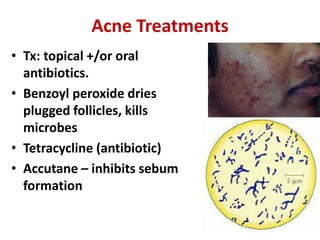
Acne Treatments
• Tx: topical +/or oral
antibiotics.
• Benzoyl peroxide dries
plugged follicles, kills
microbes
• Tetracycline (antibiotic)
• Accutane – inhibits sebum
formation
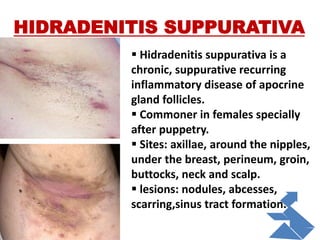
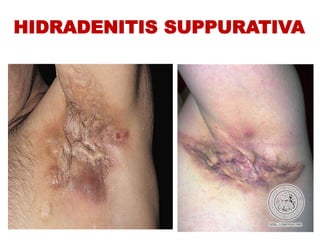
HIDRADENITIS SUPPURATIVA
 Hidradenitis suppurativa is a
chronic, suppurative recurring
inflammatory disease of apocrine
gland follicles.
 Commoner in females specially
after puppetry.
 Sites: axillae, around the nipples,
under the breast, perineum, groin,
buttocks, neck and scalp.
 lesions: nodules, abcesses,
scarring,sinus tract formation.
HIDRADENITIS SUPPURATIVA
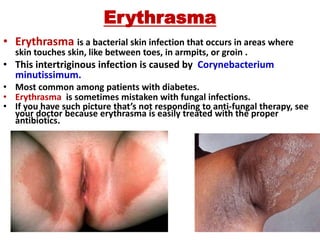
Erythrasma
• Erythrasma is a bacterial skin infection that occurs in areas where
skin touches skin, like between toes, in armpits, or groin .
• This intertriginous infection is caused by Corynebacterium
minutissimum.
• Most common among patients with diabetes.
• Erythrasma is sometimes mistaken with fungal infections.
• If you have such picture that’s not responding to anti-fungal therapy, see
your doctor because erythrasma is easily treated with the proper
antibiotics.
MRSA skin infections
• Methicillin-resistant Staphylococcus aureus
• “super-bug” – caused by staph, antibiotics abuse
• Outwits all but the most powerful of drugs – vancomycin
• Enters through cuts & wounds
• Types: CA (community acquired) or HA (Hospital acquired)
• S/S: small red bumps that resemble pimples, quickly turn to
painful abscesses that can burrow deep into the body, swelling,
redness, pus
• Risk Factors: recent hospitalization, long-term care, recent
antiobiotic use, young age, contact sports, sharing towels, weak
immune system, living in groups, health-care workers
• Dx: Tissue sample – 48hrs
• Tx: trial & error with strong antiobiotics
• Prevention: WASH HANDS, surfaces, cover wounds,
use only personal items
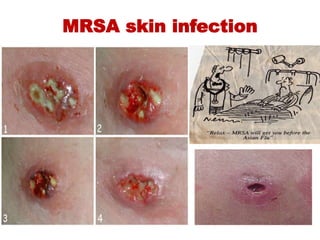
MRSA skin infection
Recurrent skin infections
• Recurrent skin infections should raise suspicion
of colonization
– Staphylococcal nasal carriage
– Resistant strains of bacteria (eg. MRSA),
– Cancer
– Poorly controlled diabetes
– Other reasons for immuno-suppression (eg, HIV,
hepatitis, advanced age,….).
Staph. carriage elimination
• Nasal & perineal care
• Rifampicin 600 mg/d 7-10 days
• Clindamycin 150 mg/d 3 months
• Topical mupirocin
• Replacement of microflora with a less
pathogenic strains of S.aurus (strain 502)
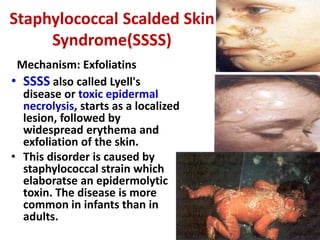
Staphylococcal Scalded Skin
Syndrome(SSSS)
Mechanism: Exfoliatins
• SSSS also called Lyell's
disease or toxic epidermal
necrolysis, starts as a localized
lesion, followed by
widespread erythema and
exfoliation of the skin.
• This disorder is caused by
staphylococcal strain which
elaboratse an epidermolytic
toxin. The disease is more
common in infants than in
adults.
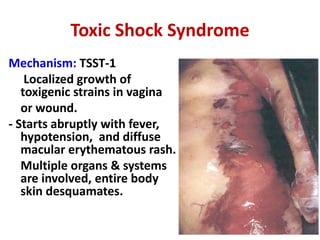
Toxic Shock Syndrome
Mechanism: TSST-1
Localized growth of
toxigenic strains in vagina
or wound.
- Starts abruptly with fever,
hypotension, and diffuse
macular erythematous rash.
Multiple organs & systems
are involved, entire body
skin desquamates.
Laboratory Diagnosis of Bacterial
Infections of Skin (1)
Specimen collection:
1. Skin biopsy
2. Skin swab
3. Pus swab
4. Nasal swab
N.B.
When pustules or vesicles are present, the roof or crust
is removed with a sterile surgical blade. Pus or
exudate is spread as thinly as possible on a clear
glass slide for Gram staining
Laboratory Diagnosis of Bacterial
Infections of Skin (2)
Suspected organisms
• Impetigo: Group A Streptococcus, Staphylococcus
aureus
• Folliculitis: Staphylococcus aureus, Pseudomonas
aeruginosa
• Furuncles: Staphylococcus aureus
• Carbuncles: Staphylococcus aureus
• Cellulitis: Group A Streptococcus, Staphylococcus
aureus, Hemophilus influenzae
• Erysipelas: Group A Streptococcus
• Necrotizing fasciitis: Group A Streptococcus,
Clostridium perfringens and
other species, Bacteroides fragilis,
the anaerobes, Enterobacteriaceae,
Pseudomonas aeruginosa
Laboratory Diagnosis of Bacterial
Infections of Skin (3)
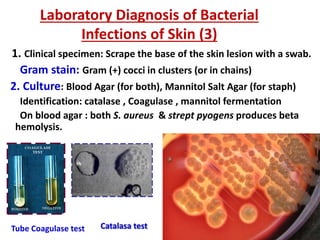
1. Clinical specimen: Scrape the base of the skin lesion with a swab.
Gram stain: Gram (+) cocci in clusters (or in chains)
2. Culture: Blood Agar (for both), Mannitol Salt Agar (for staph)
Identification: catalase , Coagulase , mannitol fermentation
On blood agar : both S. aureus & strept pyogens produces beta
hemolysis.
Catalasa testTube Coagulase test
Laboratory Diagnosis of Bacterial
Infections of Skin (4)
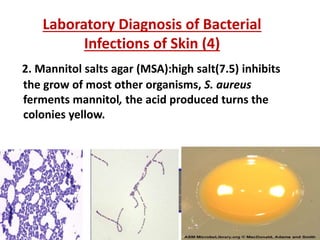
2. Mannitol salts agar (MSA):high salt(7.5) inhibits
the grow of most other organisms, S. aureus
ferments mannitol, the acid produced turns the
colonies yellow.
Principles of therapy of pyoderma
• Good personal hygiene
• Management of predisposing factors
• Aluminum chloride, a drying agent, inhibits overgrowth of
opportunistic bacteria in foot, perineal, and axillary areas.
• Keratinolytic agents (e.g., topical salicylates) remove
hyperkeratotic lesions that harbor pathogens, improving
the exposure of the infected skin surface to other topical
treatments .
Systemic
• Treatment of disease like DM
• Nutritional deficiency
• Immunodeficiency
Principles of therapy of pyoderma
• Local therapy
– Cleaning with soap-water and weak KMN04
solution
– Removal of crusts with KMN04 solution
– Application of antibacterial creams or ointments
• Systemic therapy
– Antibiotics
Topical Treatment
• Topical antibiotics contain a combination of:
neomycin, bacitracin, and polymyxin.
• Some newer preparations contain: mupirocin,
gramicidin, or erythromycin, and others combine
these antibiotics with steroids.
Systemic Therapy
• Systemic treatment with antibiotics is mandatory for
extensive pyoderma.
• Systemic antibiotics can be administered orally or
parenterally. Oral therapy is sufficient for most
extensive dermal infections, but the parenteral route
is preferred for severe infections.
CHRONIC BACTERIAL SKIN INFECTION
• Tuberculosis: caused by mycobacterium tuberculosis
• Etiology:
• Primary inf. : acquiring the bacilli for the 1st time
• Post primary inf. occurs in pt with previous TB or
previous BCG vaccination.
• A- Localized: as lupus vulgaris, scrofuloderma and TB
verrucosa cutis.
• B- General: as miliary lesions, in pt with miliary TB &
immune suppressed, multiple TB abscesses.
• C- Tuberculide
1. papulonecrotic tuberculide.
2. Lichen scrofulosorm.
3. Erythema induratum.
• primary TB infection
[tuberculous chancre]
• Lupus vulgaris
Scrofuloderm
• Tuberculous warts:
[tuberculosis
verrucosa cutis]
• Orificial TB
• Papulonecrotic
tuberculide
Lichen scrofulosorum
Erythema induratum
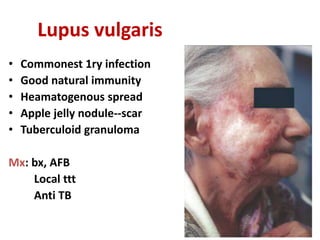
Lupus vulgaris
• Commonest 1ry infection
• Good natural immunity
• Heamatogenous spread
• Apple jelly nodule--scar
• Tuberculoid granuloma
Mx: bx, AFB
Local ttt
Anti TB
Diagnosis of skin TB
• confirmed either by find the microorganism in
culture media (never to be seen in skin lesion)
• PCR
• Presence of acid fast bacilli (by ZN stain)
• History, positive tuberculin test, presence of
caseating granuloma on histopathology and
therapeutic response to anti-TB drugs
Bacterial skin infections

Bacterial skin infections

  • 1.
    Bacterial infections ofthe skin By Dr Hussein Abulfotouh Consultant Dermatology & veneriology
  • 3.
    Natural Defenses ofthe Skin • Temperature less than 37°C • Dry: usual infection sites are wet areas: skin folds, armpit, groin • Keratin • Skin sloughing • Sebum: low pH, high lipid content • Sweat: - low pH, high salt, - Lysozyme &toxic lipids • Skin-associated lymphoid tissue (SALT) • Resident microflora (mainly Gram positives)
  • 4.
    Normal Skin Flora •Propionibacterium acnes • Corynebacterium sp. • Staphylococci – Staphylococcus epidermidis – Staphylococcus aureus • Streptococci sp. • Candida albicans (yeast) • Many others
  • 5.
    Route of infection 1)Skin (pores, hair follicles). 2) Wounds (scratches, cuts, burns). 3) Insect & animal bites.
  • 6.
    Primary Infections • causedby a single pathogen, usually affect normal skin. • Impetigo, folliculitis, and boils are common types. • The most common primary skin pathogens are S aureus ,β-hemolytic streptococci, and coryneform bacteria. • Organisms usually enter through a break in the skin. Secondary Infections • Secondary infections occur in skin that is already diseased. • Because of the underlying disease, the clinical picture and course of these infections vary. • Intertrigo and toe web infection are examples
  • 9.
    Skin infections causedby S. aureus I. Direct infection of skin and adjacent tissues a. Impetigo b. Ecthyma c. Folliculitis d. Furunculosis e. Carbuncle f. Sycosis barbae II.Cutaneous disease due to effect of bacterial toxin a. Staphylococcal scalded skin syndrome b. Toxic shock syndrome
  • 10.
    Skin infections causedby group A ß- hemolytic streptococci I. Direct infection of skin or subcutaneous tissue a. Impetigo (non bullous) b. Ecthyma c. Erysipelas d. Cellulitis e. Necrotizing fascitis II. Secondary infection Eczema infection
  • 11.
    Skin and SoftTissue Infections 1. Impetigo: Initially a vesicular infection that rapidly evolves into pustules that rupture, with dried discharge forming honey-colored crust on an erythematous base. 2. Ecthyma (Pustules): Begin as vesicles that rupture, creating circular erythematous lesions with adherent crusts. 3. Folliculitis: Inflammation at the opening of the hair follicle that causes erythematouspapules and pustules surrounding individual hairs.
  • 12.
    4. Furuncle: Deep-seatedinflammatory nodule with a pustular center that develops around a hair follicle. (painful, localized, abscess). 5. Carbuncle: Involvement of several adjacent follicles, with pus discharging from multiple follicular orifices. 6. Cutaneous abscesses: Painful, fluctuant, red, tender swelling, on which may rest a pustule. 7. Erysipelas: Erythema and swelling of the cutaneous surface, involves the superficial dermis (redness-lymphangitis).
  • 13.
    8. Cellulitis: Erythematous,hot, swollen skin with irregular edge (affects the deeper dermis and subcutaneous fat). 9. Acne: Infection of sebaceous follicles with plugs of keratin blocking the sebaceous canal, resulting in “blackheads”. 10. Necrotizing fasciitis: Rapidly spreading cellulitis with necrosis (skin and deeper fascia; may involve muscle). Begin with fever, systemic toxicity, severe pain in the development of a painful, red swelling that rapidly progress to necrosis of the subcutaneous tissue and overlying skin.
  • 14.
    Impetigo and Ecthyma •Impetigo is a superficial skin infection with crusting (non bullous) or bullae (bullous) caused by streptococci, staphylococci, or both. • Ecthyma is an ulcerative form of impetigo. Crusted erosions on the arm of a child. The confluence of lesions in the antecubital fossa suggests prior atopic dermatitis at the site that became secondarily infected
  • 15.
  • 16.
    IMPETIGO (bullous) A large,single bulla with surrounding erythema and edema on the thumb of a child; the bulla has ruptured only in the center and clear serum exudes from it.
  • 17.
    Non-bullous impetigo isa superficial skin infection that manifests as clusters of vesicles or pustules that rupture and develop a honey-colored crust. Bullous impetigo is a superficial skin infection that manifests as clusters of vesicles or pustules that enlarge rapidly to form bullae. The bullae burst and expose larger bases, which become covered with honey-colored varnish or crust. Impetigo (Bullous)Impetigo (Non-Bullous)
  • 18.
    Ecthyma gangrenosum isa bacterial skin infection (caused by Pseudomonas aeruginosa) that usually occurs in immuno- compromised individuals Ecthyma is a skin infection similar to impetigo, but more deeply invasive. Usually caused by a streptococcus infection, ecthyma goes through the outer layer (epidermis) to the deeper layer (dermis) of skin, possibly causing scars.
  • 19.
    Folliculitis • Folliculitis isa bacterial infection of hair follicles. • It is usually caused by Staphylococcus aureus but occasionally Pseudomonas aeruginosa (hot-tub folliculitis) • The bacteria is commonly found in contaminated whirlpools, hot tubs or physiotherapy pools . • Children tend to get hot tub folliculitis more. • Hot-tub folliculitis occurs because of inadequate treatment of water with chlorine or bromine.
  • 21.
    FOLLICULITIS Superficial erythematous papules &crusts of hair follicles in the beard area , aggravated by shaving. Folliculitis manifests as superficial pustules or inflammatory nodules surrounding hair follicles.
  • 22.
    Furuncles and Carbuncles •Furuncles are skin abscesses caused by staphylococcal infection, which involve a hair follicle and surrounding tissue. • Carbuncles are clusters of furuncles connected subcutaneously, causing deeper suppuration and scarring. They are smaller and more superficial than subcutaneous abscesses
  • 23.
  • 24.
    Furuncles (boils) aretender nodules or pustules caused by staphylococcal infection. Carbuncles are clusters of furuncles that are subcutaneously connected.
  • 25.
    CARBUNCLE Staph aureus -Large, inflammatory plaque studded with multiple pustules, some have ruptured, draining pus, on the nape of the neck. This very painful area is surrounded by erythema and edema, extends down to fascia, formed from a confluence of many furuncles.
  • 26.
  • 27.
    Cellulitis • Cellulitis isan acute bacterial infection of the skin and subcutaneous tissue most often caused by streptococci or staphylococci. • Some people are at risk for infection by other types of bacteria. They include people with weak immune system, and those who handle fish, meat, poultry, or soil without using gloves. • Cellulitis can occur anywhere on the body. In adults, it often occurs on the legs, face, or arms. In children, it is most common on the face or around the anus. An infection on the face could lead to a dangerous eye infection.
  • 28.
    CELLULITIS Portal of entryof infection is seen on the lateral thigh with necrosis of skin; infection has extended mainly proximally from this site.
  • 29.
    Erysipelas • Erysipelas isa type of superficial cellulitis with dermal lymphatic involvement. • It is characterized clinically by shiny, raised, indurated and tender plaque-like lesions with distinct margins (you can see a clear border between normal and infected skin). • Erysipelas is most often caused by group A β-hemolytic streptococci and occurs most frequently on the legs and face. • Other causes : Staphylococcus aureus (including MRSA), Klebsiella pneumoniae, H.influenzae, E. coli). • It is commonly accompanied by high fever, chills, and malaise. Erysipelas may be recurrent and may result in chronic lymphedema.
  • 30.
  • 31.
    Cutaneous Abscess • Acutaneous abscess is a localized collection of pus in the skin and may occur on any skin surface.
  • 32.
    Necrotizing Subcutaneous Infection (NecrotizingFasciitis) • Typically caused by a mixture of aerobic & anaerobic organisms that cause necrosis of subcutaneous tissue, usually including the fascia. • This infection most commonly affects the extremities and perineum. Affected tissues become red, hot, and swollen, resembling severe cellulitis. • Without timely treatment, the area becomes gangrenous. Diagnosis is by history and examination. • Treatment involves: antibiotics,surgical debridement, Amputation if necessary • Prognosis is poor without early, aggressive treatment.
  • 33.
    Necrotizing Fasciitis “FleshEating Strep” Streptococcus pyogenes (Group A β hemolytic Streptococci (GABHS) is the causative agent • Necrotizing fasciitis: The disease starts as localized infection that rapidly spreading cellulitis with necrosis (skin and deeper fascia; may involve muscle). • Begin with fever, systemic toxicity and severe pain • The development of a painful, red swelling that rapidly progress to necrosis of the subcutaneous tissue and overlying skin. • The Invasive & spreading cellulitis may lead to loss of limb • May lead to toxic shock
  • 34.
  • 35.
  • 36.
    Acne • Most commonskin disease in humans • Propionibacterium acnes: Gram +ve rod ,causative agent • Pathogenesis: bacteria digest sebum , Attracts neutrophils - Neutrophil digestive enzymes cause lesions, “pus pockets” • Obstruction of sebaceous follicles (oil glands) • Open comedones or closed comedones • Usually on the face, chest, back • Risk factors: – Stressful events (hormonal changes) – Friction acne – Oil based cosmetics – NO correlation between chocolate, chips or colas (No effects of diet)
  • 37.
    Acne Treatments • Tx:topical +/or oral antibiotics. • Benzoyl peroxide dries plugged follicles, kills microbes • Tetracycline (antibiotic) • Accutane – inhibits sebum formation
  • 38.
    HIDRADENITIS SUPPURATIVA  Hidradenitissuppurativa is a chronic, suppurative recurring inflammatory disease of apocrine gland follicles.  Commoner in females specially after puppetry.  Sites: axillae, around the nipples, under the breast, perineum, groin, buttocks, neck and scalp.  lesions: nodules, abcesses, scarring,sinus tract formation.
  • 39.
  • 40.
    Erythrasma • Erythrasma isa bacterial skin infection that occurs in areas where skin touches skin, like between toes, in armpits, or groin . • This intertriginous infection is caused by Corynebacterium minutissimum. • Most common among patients with diabetes. • Erythrasma is sometimes mistaken with fungal infections. • If you have such picture that’s not responding to anti-fungal therapy, see your doctor because erythrasma is easily treated with the proper antibiotics.
  • 41.
    MRSA skin infections •Methicillin-resistant Staphylococcus aureus • “super-bug” – caused by staph, antibiotics abuse • Outwits all but the most powerful of drugs – vancomycin • Enters through cuts & wounds • Types: CA (community acquired) or HA (Hospital acquired) • S/S: small red bumps that resemble pimples, quickly turn to painful abscesses that can burrow deep into the body, swelling, redness, pus • Risk Factors: recent hospitalization, long-term care, recent antiobiotic use, young age, contact sports, sharing towels, weak immune system, living in groups, health-care workers • Dx: Tissue sample – 48hrs • Tx: trial & error with strong antiobiotics • Prevention: WASH HANDS, surfaces, cover wounds, use only personal items
  • 42.
  • 43.
    Recurrent skin infections •Recurrent skin infections should raise suspicion of colonization – Staphylococcal nasal carriage – Resistant strains of bacteria (eg. MRSA), – Cancer – Poorly controlled diabetes – Other reasons for immuno-suppression (eg, HIV, hepatitis, advanced age,….).
  • 44.
    Staph. carriage elimination •Nasal & perineal care • Rifampicin 600 mg/d 7-10 days • Clindamycin 150 mg/d 3 months • Topical mupirocin • Replacement of microflora with a less pathogenic strains of S.aurus (strain 502)
  • 45.
    Staphylococcal Scalded Skin Syndrome(SSSS) Mechanism:Exfoliatins • SSSS also called Lyell's disease or toxic epidermal necrolysis, starts as a localized lesion, followed by widespread erythema and exfoliation of the skin. • This disorder is caused by staphylococcal strain which elaboratse an epidermolytic toxin. The disease is more common in infants than in adults.
  • 46.
    Toxic Shock Syndrome Mechanism:TSST-1 Localized growth of toxigenic strains in vagina or wound. - Starts abruptly with fever, hypotension, and diffuse macular erythematous rash. Multiple organs & systems are involved, entire body skin desquamates.
  • 47.
    Laboratory Diagnosis ofBacterial Infections of Skin (1) Specimen collection: 1. Skin biopsy 2. Skin swab 3. Pus swab 4. Nasal swab N.B. When pustules or vesicles are present, the roof or crust is removed with a sterile surgical blade. Pus or exudate is spread as thinly as possible on a clear glass slide for Gram staining
  • 48.
    Laboratory Diagnosis ofBacterial Infections of Skin (2) Suspected organisms • Impetigo: Group A Streptococcus, Staphylococcus aureus • Folliculitis: Staphylococcus aureus, Pseudomonas aeruginosa • Furuncles: Staphylococcus aureus • Carbuncles: Staphylococcus aureus • Cellulitis: Group A Streptococcus, Staphylococcus aureus, Hemophilus influenzae • Erysipelas: Group A Streptococcus • Necrotizing fasciitis: Group A Streptococcus, Clostridium perfringens and other species, Bacteroides fragilis, the anaerobes, Enterobacteriaceae, Pseudomonas aeruginosa
  • 49.
    Laboratory Diagnosis ofBacterial Infections of Skin (3) 1. Clinical specimen: Scrape the base of the skin lesion with a swab. Gram stain: Gram (+) cocci in clusters (or in chains) 2. Culture: Blood Agar (for both), Mannitol Salt Agar (for staph) Identification: catalase , Coagulase , mannitol fermentation On blood agar : both S. aureus & strept pyogens produces beta hemolysis. Catalasa testTube Coagulase test
  • 50.
    Laboratory Diagnosis ofBacterial Infections of Skin (4) 2. Mannitol salts agar (MSA):high salt(7.5) inhibits the grow of most other organisms, S. aureus ferments mannitol, the acid produced turns the colonies yellow.
  • 51.
    Principles of therapyof pyoderma • Good personal hygiene • Management of predisposing factors • Aluminum chloride, a drying agent, inhibits overgrowth of opportunistic bacteria in foot, perineal, and axillary areas. • Keratinolytic agents (e.g., topical salicylates) remove hyperkeratotic lesions that harbor pathogens, improving the exposure of the infected skin surface to other topical treatments . Systemic • Treatment of disease like DM • Nutritional deficiency • Immunodeficiency
  • 52.
    Principles of therapyof pyoderma • Local therapy – Cleaning with soap-water and weak KMN04 solution – Removal of crusts with KMN04 solution – Application of antibacterial creams or ointments • Systemic therapy – Antibiotics
  • 53.
    Topical Treatment • Topicalantibiotics contain a combination of: neomycin, bacitracin, and polymyxin. • Some newer preparations contain: mupirocin, gramicidin, or erythromycin, and others combine these antibiotics with steroids. Systemic Therapy • Systemic treatment with antibiotics is mandatory for extensive pyoderma. • Systemic antibiotics can be administered orally or parenterally. Oral therapy is sufficient for most extensive dermal infections, but the parenteral route is preferred for severe infections.
  • 54.
    CHRONIC BACTERIAL SKININFECTION • Tuberculosis: caused by mycobacterium tuberculosis • Etiology: • Primary inf. : acquiring the bacilli for the 1st time • Post primary inf. occurs in pt with previous TB or previous BCG vaccination. • A- Localized: as lupus vulgaris, scrofuloderma and TB verrucosa cutis. • B- General: as miliary lesions, in pt with miliary TB & immune suppressed, multiple TB abscesses. • C- Tuberculide 1. papulonecrotic tuberculide. 2. Lichen scrofulosorm. 3. Erythema induratum.
  • 55.
    • primary TBinfection [tuberculous chancre] • Lupus vulgaris Scrofuloderm
  • 56.
    • Tuberculous warts: [tuberculosis verrucosacutis] • Orificial TB • Papulonecrotic tuberculide Lichen scrofulosorum Erythema induratum
  • 57.
    Lupus vulgaris • Commonest1ry infection • Good natural immunity • Heamatogenous spread • Apple jelly nodule--scar • Tuberculoid granuloma Mx: bx, AFB Local ttt Anti TB
  • 58.
    Diagnosis of skinTB • confirmed either by find the microorganism in culture media (never to be seen in skin lesion) • PCR • Presence of acid fast bacilli (by ZN stain) • History, positive tuberculin test, presence of caseating granuloma on histopathology and therapeutic response to anti-TB drugs