Bacterial Skin Disorders
By:- Hely Parikh
Normal Skin Flora
Resident Flora
(Non- Pathogenic)
Resident Flora
(Pathogenic)
Staphylococcus Epidermitis Staphylococcus aureus
Corneybacterium Staphylococcus pyogens
Functions of Resident Flora
❏ Compete with pathogenic organisms for nutrients.
❏ Produce antibiotics and other chemicals which inhibit growth
of pathogens.
❏ Modify secretions of skin to make skin a less favorable habitat
for pathogens.
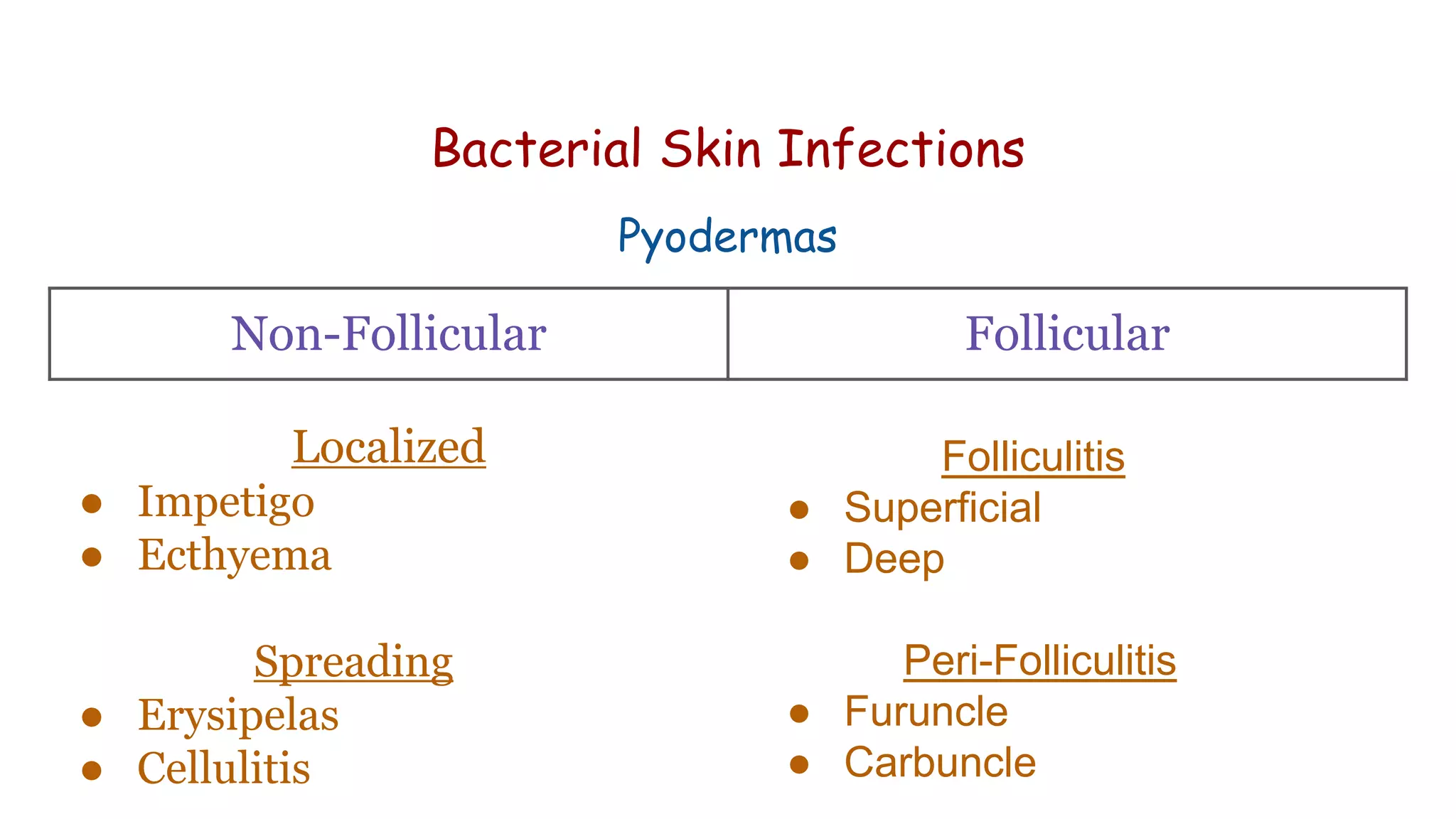
Bacterial Skin Infections
Pyodermas
Non-Follicular Follicular
Localized
● Impetigo
● Ecthyema
Spreading
● Erysipelas
● Cellulitis
Folliculitis
● Superficial
● Deep
Peri-Folliculitis
● Furuncle
● Carbuncle
Impetigo Contagiosa
Caused By
S. aureus (in developed countries)
S. pyogenes
Age: Preschool and young school children.
Gender: males > females.
Morphology
● Multiple lesions
● Thin-walled bulla on an erythematous base
● Exudative plaque covered with honey-colored crusts
● Removal of the crust reveals an erosion
● On drying, the crust falls leaving erythema which fades
without scarring.
Common Sites: Face (periorificial area)
Differential diagnosis
❖ Bullous Impetigo
❖ HSV infection
Treatment
❖ Localized lesions: Topical antibiotics like fusidic acid or mupirocin
❖ Extensive lesions: Systemic antibiotics (erythromycin group) If
resistance present then amoxicillin–clavulanic acid or cephalexin
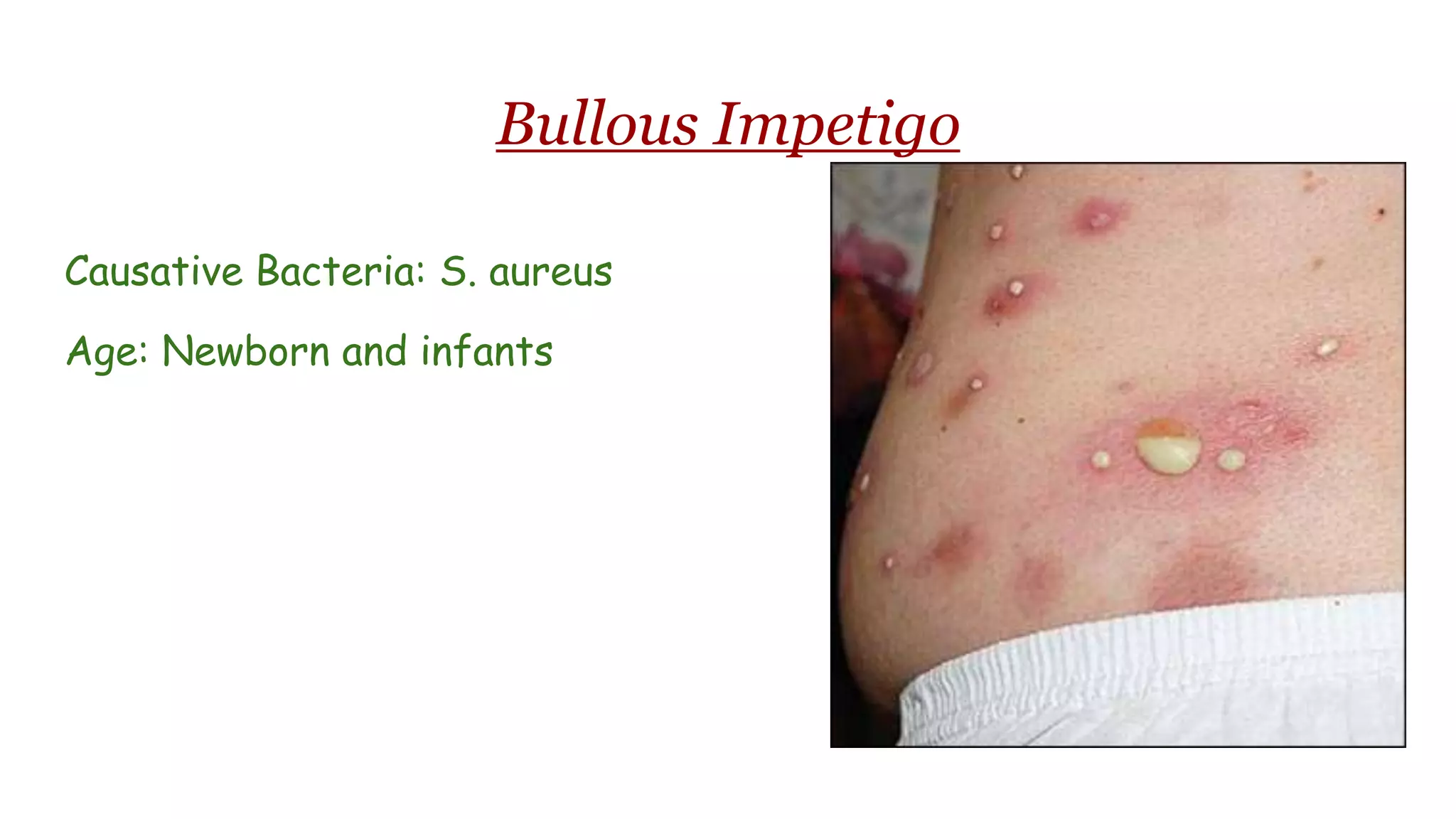
Bullous Impetigo
Causative Bacteria: S. aureus
Age: Newborn and infants
Morphology
● Bullae, containing turbid fluid
● Erythematous halo (+/-)
● Rupture after a few days and forms thin, varnish-like crusts
● Heal in the center to form annular plaques.
● Sites: Face (sites of existing skin disease)
Differential Diagnosis
❏ Impetigo Contagiosa
Complications
❏ Staphylococcal scalded skin
syndrome
❏ Lymphadenopathy (Rare)
Treatment
❏ Local hygiene
❏ Localized lesions: Topical
antibiotics (Mupirocin)
❏ Extensive lesions: Systemic
antibiotics (amoxicillin
clavulanic acid, methicillin)
SSSS
❖ Staphylococcal Scalded Skin
Syndrome
❖ S. aureus infection present at
distant sites, like middle ear,
lungs, skin which produces an
exotoxin (exfoliative toxin)
which spreads hematogenously
and causes a split in the upper
layers of epidermis
Clinical Features
Infants.
Onset is acute with fever and skin tenderness.
Initial erythema and tenderness followed by superficial peeling of the skin in
thin sheets to reveal moist erythematous floor
Mucous membranes spared
However, Lesions DO NOT contain any
microorganism
Treatment
❏ Supportive and nursing
measures
❏ initially intravenous later oral
antistaphylococcal antibiotics
Ecthyema
A consequence of neglected impetigo contagiosa.
Deep Pyoderma
Causative Organism:
● S. pyogenes.
● S. aureus
Predisposing factors:
★ Poor hygiene
★ Malnutrition
★ Minor injuries
★ Insect bites
★ Scabies
Morphology
❏ Small bulla or pustule on an erythematous base
❏ Forming a crusted, indurated, tender plaque, with an
erythematous, edematous areola
❏ Removal of crust reveals an irregular punched out ulcer
❏ Site: legs, thighs, and buttocks
Treatment
● Local hygiene.
● Treat predisposing factors.
● Systemic antibiotics (penicillin/ erythromycin group).
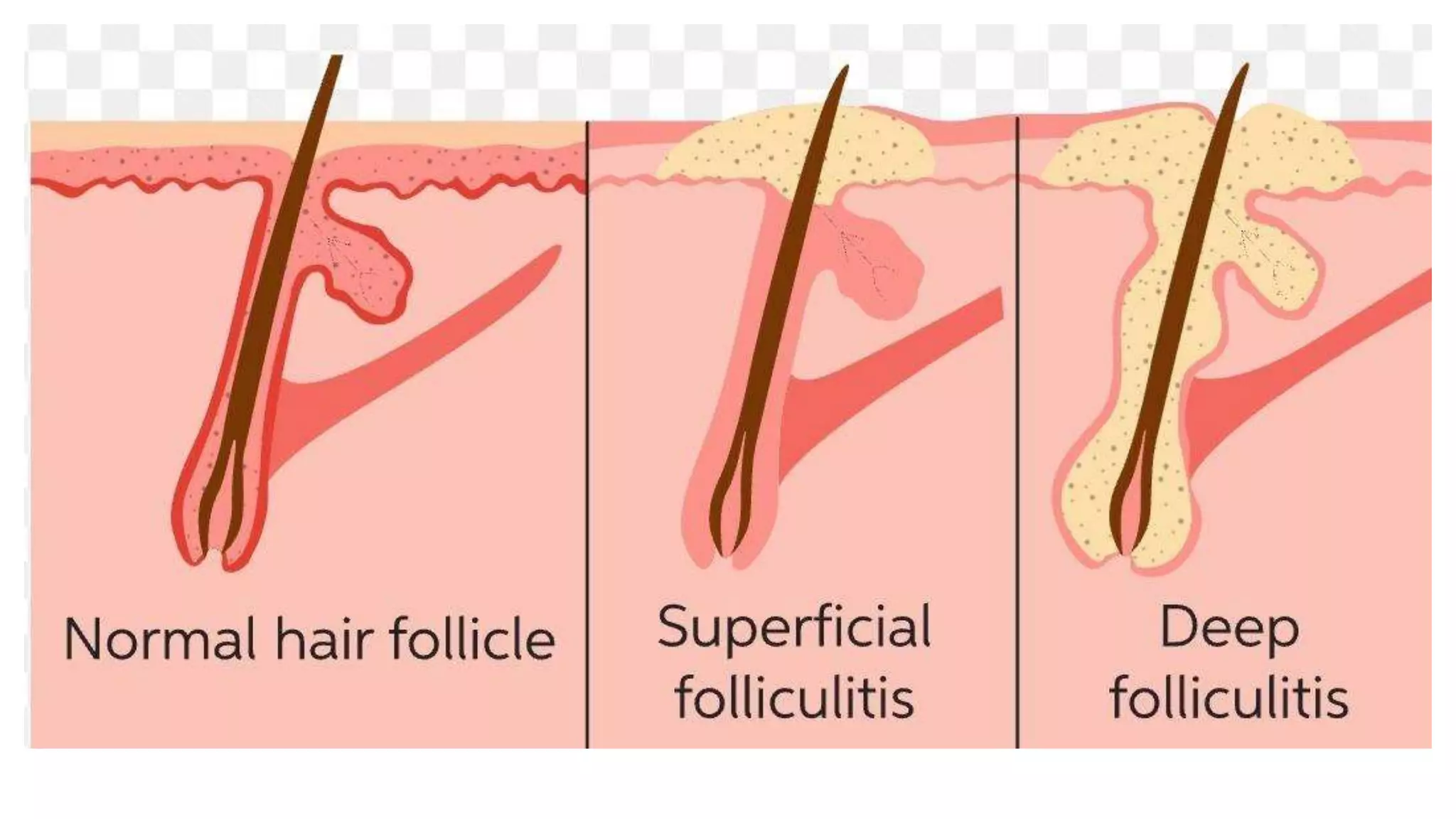
Superficial Folliculitis
❏ Infectious: S. aureus
❏ Can also be Chemical.
Eg. Mineral Oils, Petroleum,
Cosmetic exposure
Or
❏ Mechanical
Eg. Post Shave/Wax.
Morphology
● Dome-shaped follicular pustules
○ Site: Legs > Forearms
● Mechanical aka Pseudo-folliculitis
○ beard area (after shaving)
○ thighs or and arms (after hair removal eg. waxing)
Treatment
● Infectious
○ Localized: Topical Antibiotics
○ Extensive: Systemic Antibiotics
● Chemical/ Mechanical
○ Removal of trigger
○ Correction of shaving/waxing technique
○ Topical steroid-antibiotic combination
○ Retinol
Deep Folliculitis
● Etiology: S. aureus
● Deep seated, erythematous follicular papules and pustules
● Sites: Beard
○ Scalp
● Treatment
○ Systemic Antibiotics
Furuncle
● A painful, pus-filled bump under the skin
caused by infected, inflamed hair follicles.
● Deep-seated follicular and perifollicular
infection
● Etiology: S. aureus
● Adolescent boys most susceptible
Predisposing Factors
❏ Nasal/perineal carriage of S.
aureus.
❏ Diabetes, HIV infection.
❏ Underlying skin disease, e.g.,
scabies, atopic dermatitis
Clinical Features
● Pain at site
● Usually one to two tender, firm red, follicular nodules which become
necrotic and discharge their central core.
● Lesions heal with barely perceptible scarring
● Sites: Hair-bearing, friction prone sites eg. face axillae, buttocks, legs
and perineal region
Treatment
Acute Episode
Hot Compress
Antibiotics
Surgical incision and
drainage of pus
Chronic/ recurrent episodes
Antibiotics
Treat carrier state with topical
mupirocin applied intranasally
and in perineum
Rifampicin
Carbuncle
Deep infection of contiguous hair
follicles
Etiology: S. aureus
Deep infection of contiguous hair
follicles seen most frequently in
diabetics and in patients on
steroid therapy
Males > Females
Clinical Features
❏ Fever always present
❏ Lesions excruciatingly painful
❏ Tender, lobulated, indurated, intensely erythematous plaque
discharging pus from many openings
❏ Heals with scarring
Sites: Back >>> Neck > Thighs
Treatment
Hot Compress
Aggressive treatment with flucloxacillin or other penicillinase-resistant
antibiotics
Incision and drainage
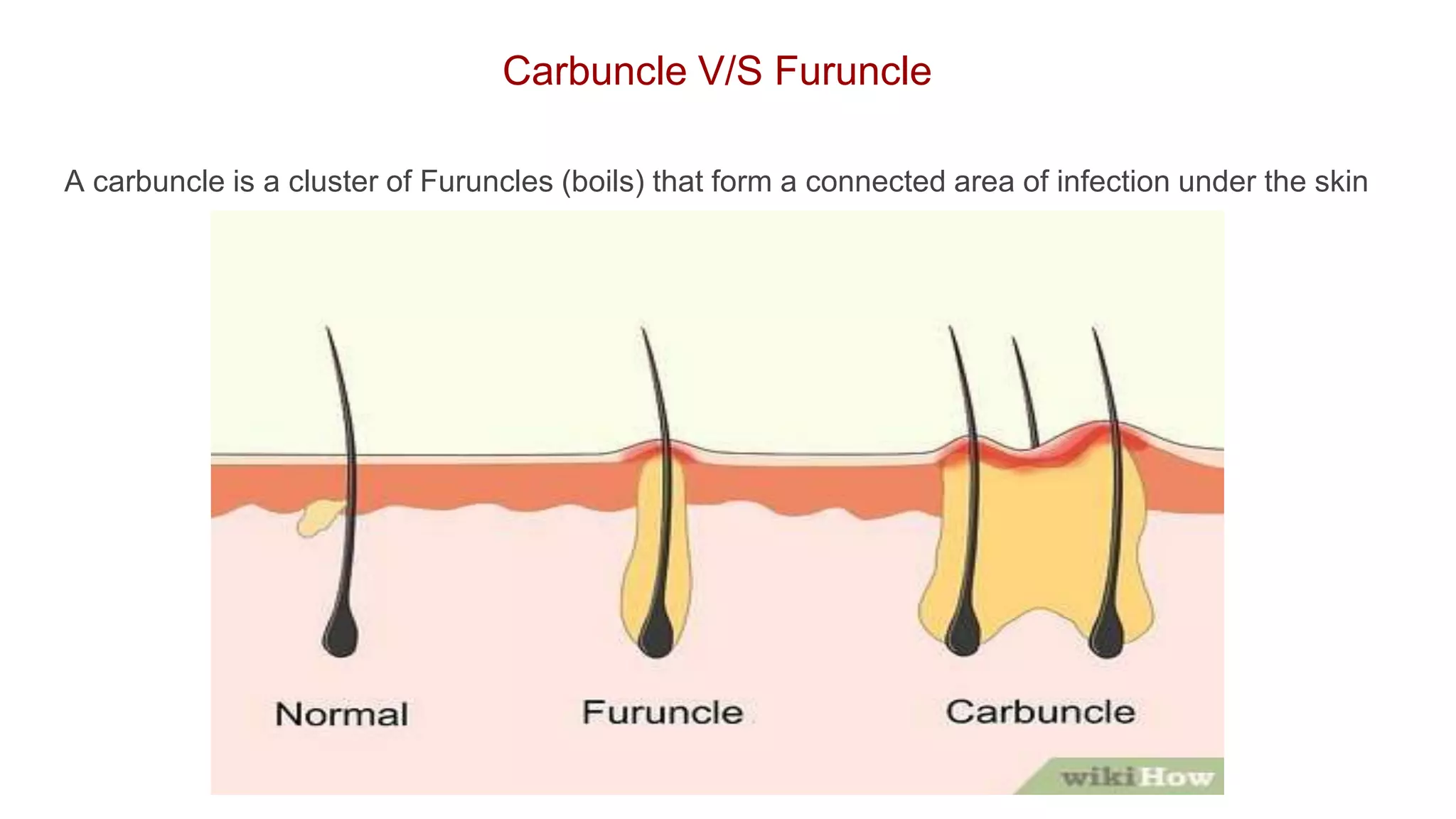
Carbuncle V/S Furuncle
A carbuncle is a cluster of Furuncles (boils) that form a connected area of infection under the skin
Erysipelas Cellulitis
Erysipelas is a superficial spreading
pyoderma
Cellulitis is deeper spreading pyoderma
Clinical Features
Acute erythematous, warm,
indurated, rapidly spreading
plaques
Margin is sharply defined
and superficial vesiculation
may occur on the plaque
Acute erythematous, warm,
indurated, rapidly spreading
plaques
Lesion is ill-defined and deeper
Skip areas characteristic
Sites: Lower > Upper Limb > Face
Fatal
If untreated
Treatment
● Symptomatic treatment
○ Rest.
○ Limb elevation.
○ Nonsteroidal anti-inflammatory drugs
● Specific Treatment
○ Parenteral Penicillin
○ Erythromycin
● Recurrence managed with Benzathine Penicillin
Thank You

Bacterial Skin Disorders.pptx

  • 1.
  • 2.
    Normal Skin Flora ResidentFlora (Non- Pathogenic) Resident Flora (Pathogenic) Staphylococcus Epidermitis Staphylococcus aureus Corneybacterium Staphylococcus pyogens
  • 3.
    Functions of ResidentFlora ❏ Compete with pathogenic organisms for nutrients. ❏ Produce antibiotics and other chemicals which inhibit growth of pathogens. ❏ Modify secretions of skin to make skin a less favorable habitat for pathogens.
  • 4.
    Bacterial Skin Infections Pyodermas Non-FollicularFollicular Localized ● Impetigo ● Ecthyema Spreading ● Erysipelas ● Cellulitis Folliculitis ● Superficial ● Deep Peri-Folliculitis ● Furuncle ● Carbuncle
  • 5.
    Impetigo Contagiosa Caused By S.aureus (in developed countries) S. pyogenes Age: Preschool and young school children. Gender: males > females.
  • 6.
    Morphology ● Multiple lesions ●Thin-walled bulla on an erythematous base ● Exudative plaque covered with honey-colored crusts ● Removal of the crust reveals an erosion ● On drying, the crust falls leaving erythema which fades without scarring. Common Sites: Face (periorificial area)
  • 8.
    Differential diagnosis ❖ BullousImpetigo ❖ HSV infection Treatment ❖ Localized lesions: Topical antibiotics like fusidic acid or mupirocin ❖ Extensive lesions: Systemic antibiotics (erythromycin group) If resistance present then amoxicillin–clavulanic acid or cephalexin
  • 9.
    Bullous Impetigo Causative Bacteria:S. aureus Age: Newborn and infants
  • 10.
    Morphology ● Bullae, containingturbid fluid ● Erythematous halo (+/-) ● Rupture after a few days and forms thin, varnish-like crusts ● Heal in the center to form annular plaques. ● Sites: Face (sites of existing skin disease)
  • 12.
    Differential Diagnosis ❏ ImpetigoContagiosa Complications ❏ Staphylococcal scalded skin syndrome ❏ Lymphadenopathy (Rare) Treatment ❏ Local hygiene ❏ Localized lesions: Topical antibiotics (Mupirocin) ❏ Extensive lesions: Systemic antibiotics (amoxicillin clavulanic acid, methicillin)
  • 14.
    SSSS ❖ Staphylococcal ScaldedSkin Syndrome ❖ S. aureus infection present at distant sites, like middle ear, lungs, skin which produces an exotoxin (exfoliative toxin) which spreads hematogenously and causes a split in the upper layers of epidermis
  • 15.
    Clinical Features Infants. Onset isacute with fever and skin tenderness. Initial erythema and tenderness followed by superficial peeling of the skin in thin sheets to reveal moist erythematous floor Mucous membranes spared However, Lesions DO NOT contain any microorganism
  • 16.
    Treatment ❏ Supportive andnursing measures ❏ initially intravenous later oral antistaphylococcal antibiotics
  • 17.
    Ecthyema A consequence ofneglected impetigo contagiosa. Deep Pyoderma Causative Organism: ● S. pyogenes. ● S. aureus
  • 18.
    Predisposing factors: ★ Poorhygiene ★ Malnutrition ★ Minor injuries ★ Insect bites ★ Scabies
  • 20.
    Morphology ❏ Small bullaor pustule on an erythematous base ❏ Forming a crusted, indurated, tender plaque, with an erythematous, edematous areola ❏ Removal of crust reveals an irregular punched out ulcer ❏ Site: legs, thighs, and buttocks
  • 21.
    Treatment ● Local hygiene. ●Treat predisposing factors. ● Systemic antibiotics (penicillin/ erythromycin group).
  • 22.
    Superficial Folliculitis ❏ Infectious:S. aureus ❏ Can also be Chemical. Eg. Mineral Oils, Petroleum, Cosmetic exposure Or ❏ Mechanical Eg. Post Shave/Wax.
  • 23.
    Morphology ● Dome-shaped follicularpustules ○ Site: Legs > Forearms ● Mechanical aka Pseudo-folliculitis ○ beard area (after shaving) ○ thighs or and arms (after hair removal eg. waxing)
  • 24.
    Treatment ● Infectious ○ Localized:Topical Antibiotics ○ Extensive: Systemic Antibiotics ● Chemical/ Mechanical ○ Removal of trigger ○ Correction of shaving/waxing technique ○ Topical steroid-antibiotic combination ○ Retinol
  • 25.
    Deep Folliculitis ● Etiology:S. aureus ● Deep seated, erythematous follicular papules and pustules ● Sites: Beard ○ Scalp ● Treatment ○ Systemic Antibiotics
  • 28.
    Furuncle ● A painful,pus-filled bump under the skin caused by infected, inflamed hair follicles. ● Deep-seated follicular and perifollicular infection ● Etiology: S. aureus ● Adolescent boys most susceptible
  • 29.
    Predisposing Factors ❏ Nasal/perinealcarriage of S. aureus. ❏ Diabetes, HIV infection. ❏ Underlying skin disease, e.g., scabies, atopic dermatitis
  • 30.
    Clinical Features ● Painat site ● Usually one to two tender, firm red, follicular nodules which become necrotic and discharge their central core. ● Lesions heal with barely perceptible scarring ● Sites: Hair-bearing, friction prone sites eg. face axillae, buttocks, legs and perineal region
  • 31.
    Treatment Acute Episode Hot Compress Antibiotics Surgicalincision and drainage of pus Chronic/ recurrent episodes Antibiotics Treat carrier state with topical mupirocin applied intranasally and in perineum Rifampicin
  • 32.
    Carbuncle Deep infection ofcontiguous hair follicles Etiology: S. aureus Deep infection of contiguous hair follicles seen most frequently in diabetics and in patients on steroid therapy Males > Females
  • 33.
    Clinical Features ❏ Feveralways present ❏ Lesions excruciatingly painful ❏ Tender, lobulated, indurated, intensely erythematous plaque discharging pus from many openings ❏ Heals with scarring Sites: Back >>> Neck > Thighs
  • 34.
    Treatment Hot Compress Aggressive treatmentwith flucloxacillin or other penicillinase-resistant antibiotics Incision and drainage
  • 35.
    Carbuncle V/S Furuncle Acarbuncle is a cluster of Furuncles (boils) that form a connected area of infection under the skin
  • 36.
    Erysipelas Cellulitis Erysipelas isa superficial spreading pyoderma Cellulitis is deeper spreading pyoderma
  • 37.
    Clinical Features Acute erythematous,warm, indurated, rapidly spreading plaques Margin is sharply defined and superficial vesiculation may occur on the plaque Acute erythematous, warm, indurated, rapidly spreading plaques Lesion is ill-defined and deeper Skip areas characteristic
  • 38.
    Sites: Lower >Upper Limb > Face Fatal If untreated
  • 39.
    Treatment ● Symptomatic treatment ○Rest. ○ Limb elevation. ○ Nonsteroidal anti-inflammatory drugs ● Specific Treatment ○ Parenteral Penicillin ○ Erythromycin ● Recurrence managed with Benzathine Penicillin
  • 40.