Room-Temperature DNA-Catalyzed Hydrogen
Fuel Cell
Wen-Bing Lai,2 Jyun-Lin Huang,2 Chungpin Liao,1,2,* Li-Shen Yeh2
(賴玟柄) (黃均霖) (廖重賓) (葉立紳)
1Graduate School of Electro-Optic and Materials Science,
National Formosa University (NFU), Huwei, Taiwan 632, ROC.
2Advanced Research & Business Laboratory (ARBL),
Taichung, Taiwan 407, ROC.
*Corresponding Author: cpliao@alum.mit.edu and Speaker
2016/8/16 1CCL Group
2016/8/16 2CCL Group
Outline
• Background and motivation
– the success of pheophytin (pheo, 脫鎂葉綠素) catalyst
• Porphyrin-ring family and roles of their derivative morphologies
• 1st-principle simulation of simplified H2 decomposition steps
involving derivative DNA base pairs  energetically favorable?
• Dry DNA-catalyzed hydrogen fuel cell under room
temperature
• Summary and conclusions
• Similar derivatives within DNA base pairs
• Wet DNA-catalyzed chemical battery experiment and result
2016/8/16 CCL Group 3
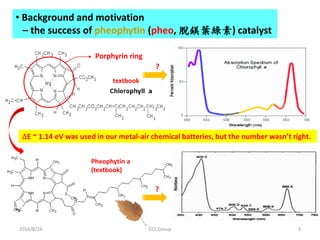
• Background and motivation
– the success of pheophytin (pheo, 脫鎂葉綠素) catalyst
Pheophytin a
(textbook)
textbook
Porphyrin ring
E ~ 1.14 eV was used in our metal-air chemical batteries, but the number wasn’t right.
?
?
2016/8/16 4CCL Group
Chlorophyll batteries
Some “products” were made back then, without paying attention to the real mechanism.
2016/8/16 CCL Group 5
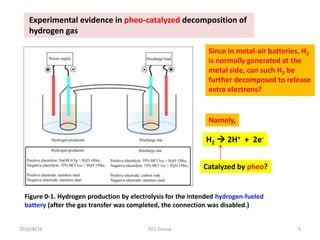
Figure 0-1. Hydrogen production by electrolysis for the intended hydrogen-fueled
battery (after the gas transfer was completed, the connection was disabled.)
Experimental evidence in pheo-catalyzed decomposition of
hydrogen gas
H2  2H+ + 2e-
Catalyzed by pheo?
Since in metal-air batteries, H2
is normally generated at the
metal side, can such H2 be
further decomposed to release
extra electrons?
Namely,
2016/8/16 CCL Group 6
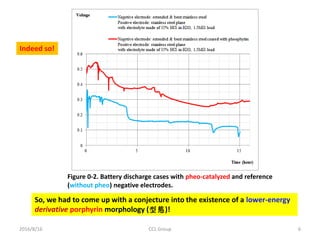
Figure 0-2. Battery discharge cases with pheo-catalyzed and reference
(without pheo) negative electrodes.
So, we had to come up with a conjecture into the existence of a lower-energy
derivative porphyrin morphology (型態)!
Indeed so!
2016/8/16 CCL Group 7
• Porphyrin-ring family and roles of their derivative morphologies
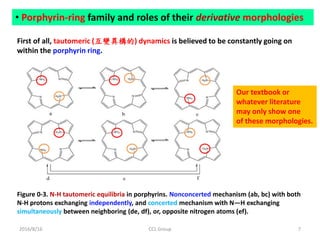
Figure 0-3. N-H tautomeric equilibria in porphyrins. Nonconcerted mechanism (ab, bc) with both
N-H protons exchanging independently, and concerted mechanism with N—H exchanging
simultaneously between neighboring (de, df), or, opposite nitrogen atoms (ef).
First of all, tautomeric (互變異構的) dynamics is believed to be constantly going on
within the porphyrin ring.
Our textbook or
whatever literature
may only show one
of these morphologies.
2016/8/16 CCL Group 8
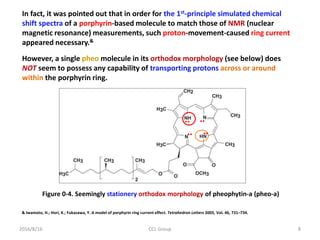
Figure 0-4. Seemingly stationery orthodox morphology of pheophytin-a (pheo-a)
In fact, it was pointed out that in order for the 1st-principle simulated chemical
shift spectra of a porphyrin-based molecule to match those of NMR (nuclear
magnetic resonance) measurements, such proton-movement-caused ring current
appeared necessary.&
However, a single pheo molecule in its orthodox morphology (see below) does
NOT seem to possess any capability of transporting protons across or around
within the porphyrin ring.
& Iwamoto, H.; Hori, K.; Fukazawa, Y. A model of porphyrin ring current effect. Tetrahedron Letters 2005, Vol. 46, 731–734.
2016/8/16 CCL Group 9
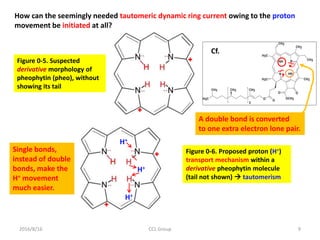
How can the seemingly needed tautomeric dynamic ring current owing to the proton
movement be initiated at all?
Figure 0-5. Suspected
derivative morphology of
pheophytin (pheo), without
showing its tail
Figure 0-6. Proposed proton (H+)
transport mechanism within a
derivative pheophytin molecule
(tail not shown)  tautomerism
H+
H+
H+
Cf.
A double bond is converted
to one extra electron lone pair.
Single bonds,
instead of double
bonds, make the
H+ movement
much easier.
2016/8/16 CCL Group 10
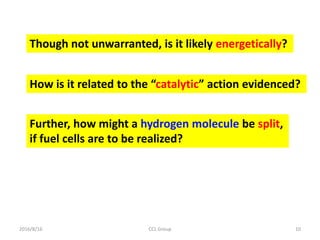
Though not unwarranted, is it likely energetically?
Further, how might a hydrogen molecule be split,
if fuel cells are to be realized?
How is it related to the “catalytic” action evidenced?
2016/8/16 CCL Group 11
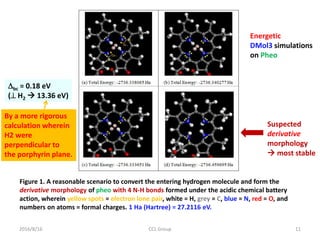
Figure 1. A reasonable scenario to convert the entering hydrogen molecule and form the
derivative morphology of pheo with 4 N-H bonds formed under the acidic chemical battery
action, wherein yellow spots = electron lone pair, white = H, grey = C, blue = N, red = O, and
numbers on atoms = formal charges. 1 Ha (Hartree) = 27.2116 eV.
Suspected
derivative
morphology
 most stable
Energetic
DMol3 simulations
on Pheo
bc = 0.18 eV
( H2  13.36 eV)
By a more rigorous
calculation wherein
H2 were
perpendicular to
the porphyrin plane.
2016/8/16 CCL Group 12
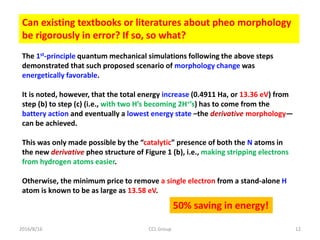
Can existing textbooks or literatures about pheo morphology
be rigorously in error? If so, so what?
The 1st-principle quantum mechanical simulations following the above steps
demonstrated that such proposed scenario of morphology change was
energetically favorable.
It is noted, however, that the total energy increase (0.4911 Ha, or 13.36 eV) from
step (b) to step (c) (i.e., with two H’s becoming 2H+’s) has to come from the
battery action and eventually a lowest energy state –the derivative morphology—
can be achieved.
This was only made possible by the “catalytic” presence of both the N atoms in
the new derivative pheo structure of Figure 1 (b), i.e., making stripping electrons
from hydrogen atoms easier.
Otherwise, the minimum price to remove a single electron from a stand-alone H
atom is known to be as large as 13.58 eV.
50% saving in energy!
2016/8/16 CCL Group 13
• Similar derivatives within DNA base pairs
Figure 2. DNA double helix [Courtesy of Wikipedia]
Key features for “action zones”:
• Porphyrin ring-like structure
• Presence of N atoms with
2 lone electron pairs
• With N-H away from N atoms
A = adenine (腺嘌呤)
T = thymine (胸腺嘧啶)
G = guanine (鳥嘌呤)
C = cytosine (胞嘧啶)
2016/8/16 CCL Group 14
Figure 3. DNA base pairs A-T and G-C [Courtesy of
Wikipedia], with indication of N atoms associated
with double bonds and subjected to a nearby H
bond, as the action zones for catalytic reactions.
Active zones
2016/8/16 CCL Group 15
• 1st-principle simulation of simplified H2 decomposition steps
involving derivative DNA base pairs  energetically favorable?
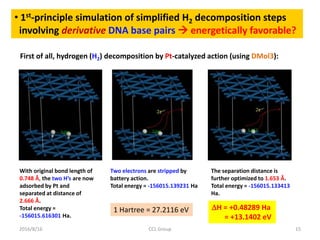
First of all, hydrogen (H2) decomposition by Pt-catalyzed action (using DMol3):
With original bond length of
0.748 Å, the two H’s are now
adsorbed by Pt and
separated at distance of
2.666 Å.
Total energy =
-156015.616301 Ha.
Two electrons are stripped by
battery action.
Total energy = -156015.139231 Ha
The separation distance is
further optimized to 1.653 Å.
Total energy = -156015.133413
Ha.
H = +0.48289 Ha
= +13.1402 eV
1 Hartree = 27.2116 eV
2016/8/16 CCL Group 16
Figure 4. Proposed simplified
scenario of hydrogen catalytic
decomposition by actions of
derivative morphologies of an A-T
base pair (including deoxyriboses),
with:
(a) one A-T pair approached by a
hydrogen gas molecule
(-1762.678093 Ha).
(b) semi-derivative A-T plus H2 in
perpendicular orientation and
elongated from 0.75 Å to 1.781Å
(-1763.0246307 Ha).
(c) the above situation but with two
electrons further stripped away by
an external electromotive force
(-1762.482609 Ha).
[Difference = 0.54202 Ha = 14.75 eV]
[Needed voltage = 7.4 V]
(d) the full derivative morphology (-
1762.7022339 Ha) with one H atom
drifted from A to T, where 1 Ha =
27.2116 eV.
2016/8/16 CCL Group 17
Figure 5. Proposed simplified
scenario of hydrogen catalytic
decomposition by actions of
derivative morphologies of an G-C
base pair (including deoxyriboses),
with:
(a) one G-C pair approached by a
hydrogen gas molecule
(-1778.740383 Ha).
(b) semi-derivative G-C plus H2 in
perpendicular orientation and
elongated from 0.75 Å to 2.371Å
(-1779.1065312 Ha).
(c) the above situation but with two
electrons further stripped away by
an external electromotive force (of
battery)(-1778.5357000 Ha).
[Difference = 0.57083 Ha = 15.53 eV]
[Needed voltage = 7.8 V]
(d) the full derivative morphology (-
1778.7922571 Ha) with one H atom
drifted from G to C, where 1 Ha =
27.2116 eV.
2016/8/16 CCL Group 18
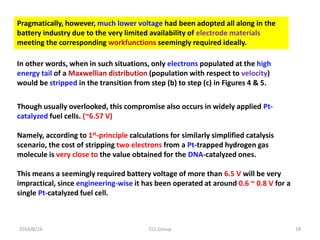
Pragmatically, however, much lower voltage had been adopted all along in the
battery industry due to the very limited availability of electrode materials
meeting the corresponding workfunctions seemingly required ideally.
In other words, when in such situations, only electrons populated at the high
energy tail of a Maxwellian distribution (population with respect to velocity)
would be stripped in the transition from step (b) to step (c) in Figures 4 & 5.
Though usually overlooked, this compromise also occurs in widely applied Pt-
catalyzed fuel cells. (~6.57 V)
Namely, according to 1st-principle calculations for similarly simplified catalysis
scenario, the cost of stripping two electrons from a Pt-trapped hydrogen gas
molecule is very close to the value obtained for the DNA-catalyzed ones.
This means a seemingly required battery voltage of more than 6.5 V will be very
impractical, since engineering-wise it has been operated at around 0.6 ~ 0.8 V for a
single Pt-catalyzed fuel cell.
2016/8/16 CCL Group 19
Experiments
2016/8/16 CCL Group 20
Figure 6. Spectra of
(a) extracted DNA’s from
pork liver- averaged, to
compare with that of
(b) (b) standard reference
[Courtesy of Rittman et
al. (2012)*].
* Rittman M., Hoffmann S. V., Gilroy E.,
Hicks M. R., Finkenstadt B. and Rodger A.,
“Probing the structure of long DNA
molecules in solution using synchrotron
radiation linear dichroism,” Phys. Chem.
Chem. Phys., 14, 353–366 (2012).
2016/8/16 CCL Group 21
• Wet DNA-catalyzed chemical battery experiment and result
0
0.1
0.2
0.3
0.4
0.5
0.6
0 10 20 30 40
Reference_A
Experimental_A
Reference_B
Experimental_B
Voltage
Time (hr)
Load : 1.5MΩ
Figure 7. Performance of DNA-catalyzed hydrogen fuel cells (with DNA’s from pork liver), as compared with that
of the reference case without DNA’s on the negative electrode. [The constructed chemical battery consisted of a
vase containing an acidic electrolyte (35% HCl : H2O = 1 : 150 in volume), a negative stainless steel (SUS-301)
strip electrode (4 cm wide, 7 cm long, 0.1 mm thick) sealed in a tube filled with hydrogen gas together with 0.2
g of dried DNA’s in the electrolyte, and a graphite positive electrode. The two electrodes were connected
through a resistive load of 1.5 M.]
2016/8/16 22CCL Group
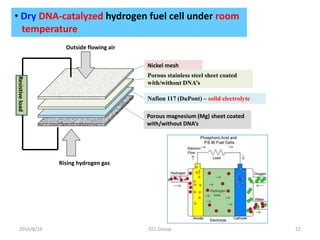
• Dry DNA-catalyzed hydrogen fuel cell under room
temperature
Rising hydrogen gas
Outside flowing air
Nickel mesh
Porous stainless steel sheet coated
with/without DNA’s
Nafion 117 (DuPont) – solid electrolyte
Porous magnesium (Mg) sheet coated
with/without DNA’s
Resistiveload
2016/8/16 23CCL Group
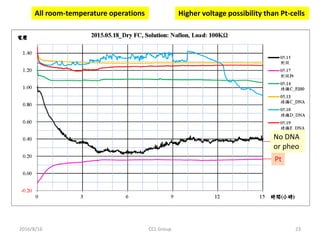
Pt
No DNA
or pheo
All room-temperature operations Higher voltage possibility than Pt-cells
2016/8/16 CCL Group 24
• Summary and conclusions
Possessing similar structure as does pheophytin (which was found to be a catalyst for
hydrogen oxidation and oxygen reduction), DNA A-T & G-C base pairs were shown to
be hydrogen oxidation catalysts as well (though not oxygen reduction catalyst).
Hence, DNA-catalyzed, room-temperature fuel cells can be realized, which are not
susceptible to CO poisoning as are Pt-catalyzed ones ( temperature dilemma).
An extrapolation from experimental data offered a comparison of power generation
efficiency among Pt- and DNA-catalyzed fuel cells as (under room condition):
Pt: 0.747 mW/cm2, DNA: 1.44 μW/cm2. (> 500 times difference)
However, by weight, it becomes: Pt: 40 MW/g, DNA: 2 MW/g (about 20 times difference),
and apparently there is big cost and availability difference between Pt and DNA.
Abundant DNA source can be algae (綠藻) and offal from living creatures and livestock.
Decay of DNA’s should not be a concern if week-by-week coating of them onto the porous
Mg (or others, on the negative electrode side) can be implemented automatically.
(Great if the much expensive Niafion film can be replaced by cheaper alternatives)

Room-Temperature DNA-Catalyzed Hydrogen Fuel Cell

  • 1.
    Room-Temperature DNA-Catalyzed Hydrogen FuelCell Wen-Bing Lai,2 Jyun-Lin Huang,2 Chungpin Liao,1,2,* Li-Shen Yeh2 (賴玟柄) (黃均霖) (廖重賓) (葉立紳) 1Graduate School of Electro-Optic and Materials Science, National Formosa University (NFU), Huwei, Taiwan 632, ROC. 2Advanced Research & Business Laboratory (ARBL), Taichung, Taiwan 407, ROC. *Corresponding Author: cpliao@alum.mit.edu and Speaker 2016/8/16 1CCL Group
  • 2.
    2016/8/16 2CCL Group Outline •Background and motivation – the success of pheophytin (pheo, 脫鎂葉綠素) catalyst • Porphyrin-ring family and roles of their derivative morphologies • 1st-principle simulation of simplified H2 decomposition steps involving derivative DNA base pairs  energetically favorable? • Dry DNA-catalyzed hydrogen fuel cell under room temperature • Summary and conclusions • Similar derivatives within DNA base pairs • Wet DNA-catalyzed chemical battery experiment and result
  • 3.
    2016/8/16 CCL Group3 • Background and motivation – the success of pheophytin (pheo, 脫鎂葉綠素) catalyst Pheophytin a (textbook) textbook Porphyrin ring E ~ 1.14 eV was used in our metal-air chemical batteries, but the number wasn’t right. ? ?
  • 4.
    2016/8/16 4CCL Group Chlorophyllbatteries Some “products” were made back then, without paying attention to the real mechanism.
  • 5.
    2016/8/16 CCL Group5 Figure 0-1. Hydrogen production by electrolysis for the intended hydrogen-fueled battery (after the gas transfer was completed, the connection was disabled.) Experimental evidence in pheo-catalyzed decomposition of hydrogen gas H2  2H+ + 2e- Catalyzed by pheo? Since in metal-air batteries, H2 is normally generated at the metal side, can such H2 be further decomposed to release extra electrons? Namely,
  • 6.
    2016/8/16 CCL Group6 Figure 0-2. Battery discharge cases with pheo-catalyzed and reference (without pheo) negative electrodes. So, we had to come up with a conjecture into the existence of a lower-energy derivative porphyrin morphology (型態)! Indeed so!
  • 7.
    2016/8/16 CCL Group7 • Porphyrin-ring family and roles of their derivative morphologies Figure 0-3. N-H tautomeric equilibria in porphyrins. Nonconcerted mechanism (ab, bc) with both N-H protons exchanging independently, and concerted mechanism with N—H exchanging simultaneously between neighboring (de, df), or, opposite nitrogen atoms (ef). First of all, tautomeric (互變異構的) dynamics is believed to be constantly going on within the porphyrin ring. Our textbook or whatever literature may only show one of these morphologies.
  • 8.
    2016/8/16 CCL Group8 Figure 0-4. Seemingly stationery orthodox morphology of pheophytin-a (pheo-a) In fact, it was pointed out that in order for the 1st-principle simulated chemical shift spectra of a porphyrin-based molecule to match those of NMR (nuclear magnetic resonance) measurements, such proton-movement-caused ring current appeared necessary.& However, a single pheo molecule in its orthodox morphology (see below) does NOT seem to possess any capability of transporting protons across or around within the porphyrin ring. & Iwamoto, H.; Hori, K.; Fukazawa, Y. A model of porphyrin ring current effect. Tetrahedron Letters 2005, Vol. 46, 731–734.
  • 9.
    2016/8/16 CCL Group9 How can the seemingly needed tautomeric dynamic ring current owing to the proton movement be initiated at all? Figure 0-5. Suspected derivative morphology of pheophytin (pheo), without showing its tail Figure 0-6. Proposed proton (H+) transport mechanism within a derivative pheophytin molecule (tail not shown)  tautomerism H+ H+ H+ Cf. A double bond is converted to one extra electron lone pair. Single bonds, instead of double bonds, make the H+ movement much easier.
  • 10.
    2016/8/16 CCL Group10 Though not unwarranted, is it likely energetically? Further, how might a hydrogen molecule be split, if fuel cells are to be realized? How is it related to the “catalytic” action evidenced?
  • 11.
    2016/8/16 CCL Group11 Figure 1. A reasonable scenario to convert the entering hydrogen molecule and form the derivative morphology of pheo with 4 N-H bonds formed under the acidic chemical battery action, wherein yellow spots = electron lone pair, white = H, grey = C, blue = N, red = O, and numbers on atoms = formal charges. 1 Ha (Hartree) = 27.2116 eV. Suspected derivative morphology  most stable Energetic DMol3 simulations on Pheo bc = 0.18 eV ( H2  13.36 eV) By a more rigorous calculation wherein H2 were perpendicular to the porphyrin plane.
  • 12.
    2016/8/16 CCL Group12 Can existing textbooks or literatures about pheo morphology be rigorously in error? If so, so what? The 1st-principle quantum mechanical simulations following the above steps demonstrated that such proposed scenario of morphology change was energetically favorable. It is noted, however, that the total energy increase (0.4911 Ha, or 13.36 eV) from step (b) to step (c) (i.e., with two H’s becoming 2H+’s) has to come from the battery action and eventually a lowest energy state –the derivative morphology— can be achieved. This was only made possible by the “catalytic” presence of both the N atoms in the new derivative pheo structure of Figure 1 (b), i.e., making stripping electrons from hydrogen atoms easier. Otherwise, the minimum price to remove a single electron from a stand-alone H atom is known to be as large as 13.58 eV. 50% saving in energy!
  • 13.
    2016/8/16 CCL Group13 • Similar derivatives within DNA base pairs Figure 2. DNA double helix [Courtesy of Wikipedia] Key features for “action zones”: • Porphyrin ring-like structure • Presence of N atoms with 2 lone electron pairs • With N-H away from N atoms A = adenine (腺嘌呤) T = thymine (胸腺嘧啶) G = guanine (鳥嘌呤) C = cytosine (胞嘧啶)
  • 14.
    2016/8/16 CCL Group14 Figure 3. DNA base pairs A-T and G-C [Courtesy of Wikipedia], with indication of N atoms associated with double bonds and subjected to a nearby H bond, as the action zones for catalytic reactions. Active zones
  • 15.
    2016/8/16 CCL Group15 • 1st-principle simulation of simplified H2 decomposition steps involving derivative DNA base pairs  energetically favorable? First of all, hydrogen (H2) decomposition by Pt-catalyzed action (using DMol3): With original bond length of 0.748 Å, the two H’s are now adsorbed by Pt and separated at distance of 2.666 Å. Total energy = -156015.616301 Ha. Two electrons are stripped by battery action. Total energy = -156015.139231 Ha The separation distance is further optimized to 1.653 Å. Total energy = -156015.133413 Ha. H = +0.48289 Ha = +13.1402 eV 1 Hartree = 27.2116 eV
  • 16.
    2016/8/16 CCL Group16 Figure 4. Proposed simplified scenario of hydrogen catalytic decomposition by actions of derivative morphologies of an A-T base pair (including deoxyriboses), with: (a) one A-T pair approached by a hydrogen gas molecule (-1762.678093 Ha). (b) semi-derivative A-T plus H2 in perpendicular orientation and elongated from 0.75 Å to 1.781Å (-1763.0246307 Ha). (c) the above situation but with two electrons further stripped away by an external electromotive force (-1762.482609 Ha). [Difference = 0.54202 Ha = 14.75 eV] [Needed voltage = 7.4 V] (d) the full derivative morphology (- 1762.7022339 Ha) with one H atom drifted from A to T, where 1 Ha = 27.2116 eV.
  • 17.
    2016/8/16 CCL Group17 Figure 5. Proposed simplified scenario of hydrogen catalytic decomposition by actions of derivative morphologies of an G-C base pair (including deoxyriboses), with: (a) one G-C pair approached by a hydrogen gas molecule (-1778.740383 Ha). (b) semi-derivative G-C plus H2 in perpendicular orientation and elongated from 0.75 Å to 2.371Å (-1779.1065312 Ha). (c) the above situation but with two electrons further stripped away by an external electromotive force (of battery)(-1778.5357000 Ha). [Difference = 0.57083 Ha = 15.53 eV] [Needed voltage = 7.8 V] (d) the full derivative morphology (- 1778.7922571 Ha) with one H atom drifted from G to C, where 1 Ha = 27.2116 eV.
  • 18.
    2016/8/16 CCL Group18 Pragmatically, however, much lower voltage had been adopted all along in the battery industry due to the very limited availability of electrode materials meeting the corresponding workfunctions seemingly required ideally. In other words, when in such situations, only electrons populated at the high energy tail of a Maxwellian distribution (population with respect to velocity) would be stripped in the transition from step (b) to step (c) in Figures 4 & 5. Though usually overlooked, this compromise also occurs in widely applied Pt- catalyzed fuel cells. (~6.57 V) Namely, according to 1st-principle calculations for similarly simplified catalysis scenario, the cost of stripping two electrons from a Pt-trapped hydrogen gas molecule is very close to the value obtained for the DNA-catalyzed ones. This means a seemingly required battery voltage of more than 6.5 V will be very impractical, since engineering-wise it has been operated at around 0.6 ~ 0.8 V for a single Pt-catalyzed fuel cell.
  • 19.
    2016/8/16 CCL Group19 Experiments
  • 20.
    2016/8/16 CCL Group20 Figure 6. Spectra of (a) extracted DNA’s from pork liver- averaged, to compare with that of (b) (b) standard reference [Courtesy of Rittman et al. (2012)*]. * Rittman M., Hoffmann S. V., Gilroy E., Hicks M. R., Finkenstadt B. and Rodger A., “Probing the structure of long DNA molecules in solution using synchrotron radiation linear dichroism,” Phys. Chem. Chem. Phys., 14, 353–366 (2012).
  • 21.
    2016/8/16 CCL Group21 • Wet DNA-catalyzed chemical battery experiment and result 0 0.1 0.2 0.3 0.4 0.5 0.6 0 10 20 30 40 Reference_A Experimental_A Reference_B Experimental_B Voltage Time (hr) Load : 1.5MΩ Figure 7. Performance of DNA-catalyzed hydrogen fuel cells (with DNA’s from pork liver), as compared with that of the reference case without DNA’s on the negative electrode. [The constructed chemical battery consisted of a vase containing an acidic electrolyte (35% HCl : H2O = 1 : 150 in volume), a negative stainless steel (SUS-301) strip electrode (4 cm wide, 7 cm long, 0.1 mm thick) sealed in a tube filled with hydrogen gas together with 0.2 g of dried DNA’s in the electrolyte, and a graphite positive electrode. The two electrodes were connected through a resistive load of 1.5 M.]
  • 22.
    2016/8/16 22CCL Group •Dry DNA-catalyzed hydrogen fuel cell under room temperature Rising hydrogen gas Outside flowing air Nickel mesh Porous stainless steel sheet coated with/without DNA’s Nafion 117 (DuPont) – solid electrolyte Porous magnesium (Mg) sheet coated with/without DNA’s Resistiveload
  • 23.
    2016/8/16 23CCL Group Pt NoDNA or pheo All room-temperature operations Higher voltage possibility than Pt-cells
  • 24.
    2016/8/16 CCL Group24 • Summary and conclusions Possessing similar structure as does pheophytin (which was found to be a catalyst for hydrogen oxidation and oxygen reduction), DNA A-T & G-C base pairs were shown to be hydrogen oxidation catalysts as well (though not oxygen reduction catalyst). Hence, DNA-catalyzed, room-temperature fuel cells can be realized, which are not susceptible to CO poisoning as are Pt-catalyzed ones ( temperature dilemma). An extrapolation from experimental data offered a comparison of power generation efficiency among Pt- and DNA-catalyzed fuel cells as (under room condition): Pt: 0.747 mW/cm2, DNA: 1.44 μW/cm2. (> 500 times difference) However, by weight, it becomes: Pt: 40 MW/g, DNA: 2 MW/g (about 20 times difference), and apparently there is big cost and availability difference between Pt and DNA. Abundant DNA source can be algae (綠藻) and offal from living creatures and livestock. Decay of DNA’s should not be a concern if week-by-week coating of them onto the porous Mg (or others, on the negative electrode side) can be implemented automatically. (Great if the much expensive Niafion film can be replaced by cheaper alternatives)

Editor's Notes

  • #3 This research was motivated by the past success of realizing pheo was an effective catalyst for the chemical cell, namely, ionization of H2 and reduction of O2. In it, the porphyrin ring, in its derivative morphologies, was structurally crucial for the evidenced catalyzing mechanism.
  • #4 4 pyrrols  porphyrin ring; Each N can have only 3 bonds. Mg is bonded to only two N atoms, while only under the Van der Waals force influence of the other two N atoms. Note the tautomerism of porphyrin ring. The known absorption spectra may not correspond to the morphologies shown, as will be elaborated in this afternoon’s talk.
  • #8 ab, be: one H at a time de: counter-clockwise rotation, df: clockwise rotation, ef: jump across simultaneously
  • #9 Note the double bonds connecting to N atoms in the orthodox morphology, which make the transport of protons hard.
  • #12 Note the energy needed to strip the two electrons from H atoms. Note the action zone features: porphyrin ring, N atoms, nearby H bond.
  • #23 Nafion film – let through of H+ but not e-. Porous Mg to let through uprising H2 gas.