


















Writing better
elearning
scripts.
by Cammy Bean
VP of Learning Design, Kineo US
Published at Learning Solutions 2014
It was a dark and stormy night.
Across town a subject matter expert
handed off a 62 slide deck to an
instructional designer.
Suddenly, a shot rang out…
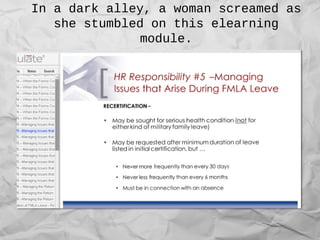
In a dark alley, a woman screamed as
she stumbled on this elearning
module.
The people wept in despair.
How can we write
better programs
to stop this
horror?
Sharpen your quills as we
share some top tips for
writing better elearning
scripts.
1. Keep it light.
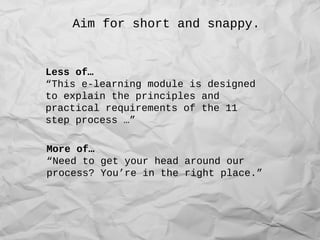
Aim for short and snappy.
Less of…
“This e-learning module is designed
to explain the principles and
practical requirements of the 11
step process …”
More of…
“Need to get your head around our
process? You’re in the right place.”
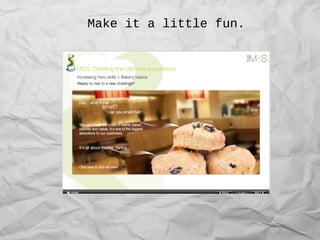
Make it a little fun.
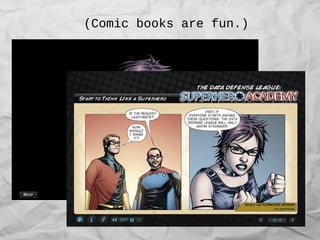
(Comic books are fun.)
Joseph Conrad
A writer without interest or
sympathy for the foibles of his
fellow man is not conceivable as a
writer.
2. Make it human.
Talk to me, baby.
Less of…
“Negotiating effectively is an important
skill that we all use on a daily basis”
More of…
“When was the last time you negotiated
something?
Maybe it was more recently than you
think….”
It’s all about you. Make it
personal.
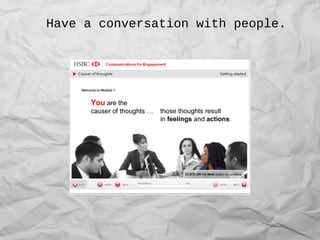
Have a conversation with people.
Connect the content back to people.
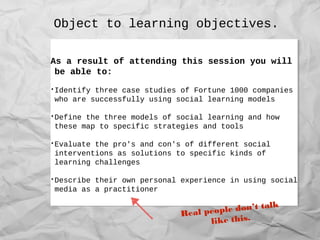
Object to learning objectives.
As a result of attending this session you will
be able to:
•Identify three case studies of Fortune 1000 companies
who are successfully using social learning models
•Define the three models of social learning and how
these map to specific strategies and tools
•Evaluate the pro's and con's of different social
interventions as solutions to specific kinds of
learning challenges
•Describe their own personal experience in using social
media as a practitioner
As a result of attending this session you will
be able to:
•Identify three case studies of Fortune 1000 companies
who are successfully using social learning models
•Define the three models of social learning and how
these map to specific strategies and tools
•Evaluate the pro's and con's of different social
interventions as solutions to specific kinds of
learning challenges
•Describe their own personal experience in using social
media as a practitioner
Real people don’t talk
like this.
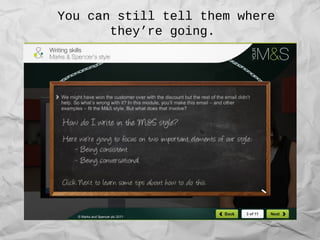
You can still tell them where
they’re going.
So how can we make this better?
List the characteristics of humans that we
need to be aware of when designing ships.
List the characteristics of humans that we
need to be aware of when designing ships.
What about this one?
Define the three main potential risks of not
having an ITAM program in place.
Define the three main potential risks of not
having an ITAM program in place.
Is there hope for this one?
Define the three models of social learning and how
these map to specific strategies and tools.
Define the three models of social learning and how
these map to specific strategies and tools.
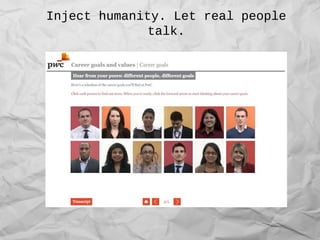
Read it out loud. Would you want to
listen?
Inject humanity. Let real people
talk.
Somerset Maugham
If you can tell stories, create
characters, devise incidents, and
have sincerity and passion, it
doesn’t matter a damn how you write.
3. Tell great stories.
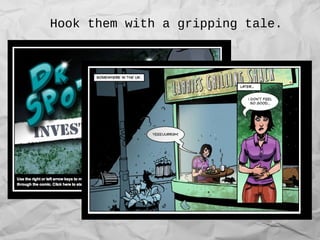
Hook them with a gripping tale.
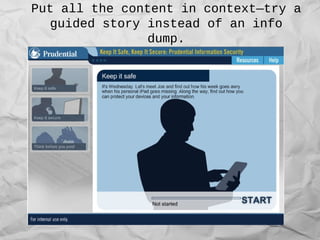
Put all the content in context—try a
guided story instead of an info
dump.
Win them with gossip.
Grab their attention with tales of
risk and intrigue.
Alice Munro
Anecdotes don’t make good stories.
Generally I dig down underneath them
so far that the story that finally
comes out is not what people thought
their anecdotes were about.
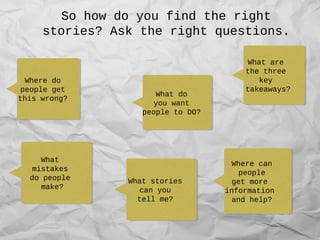
So how do you find the right
stories? Ask the right questions.
Where do
people get
this wrong?
Where do
people get
this wrong?
What do
you want
people to DO?
What do
you want
people to DO?
What
mistakes
do people
make?
What
mistakes
do people
make?
Where can
people
get more
information
and help?
Where can
people
get more
information
and help?
What are
the three
key
takeaways?
What are
the three
key
takeaways?
What stories
can you
tell me?
What stories
can you
tell me?
Ask your experts to think out loud.
Get them narrate their work and walk
you through the process.
Have them tell you a story. The
story about their slide deck.
(It’s often whats NOT written on the slide that really
matters!)
Use the words they say, not the
words they write.
It helps if you type
really fast or can
record the conversation!
4. Give it spirit.
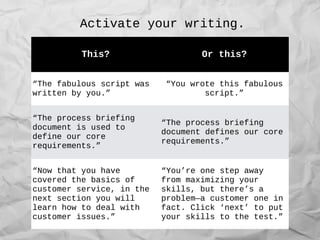
Activate your writing.
This? Or this?
“The fabulous script was
written by you.”
“You wrote this fabulous
script.”
“The process briefing
document is used to
define our core
requirements.”
“The process briefing
document defines our core
requirements.”
“Now that you have
covered the basics of
customer service, in the
next section you will
learn how to deal with
customer issues.”
“You’re one step away
from maximizing your
skills, but there’s a
problem—a customer one in
fact. Click ‘next’ to put
your skills to the test.”
Rainer Maria Rilke
May what I do flow from me like a
river, no forcing and no holding
back, the way it is with children.
5. Make it flow.
Stitch your ideas together, connect the
dots, make sure the story flows from one
piece to the next.
Henry David Thoreau
Not that the story need be long, but
it will take a long while to make it
short.
6. Cut it.
Cut the blather and focus on the
doing.
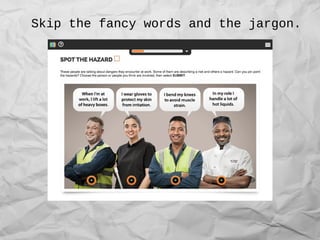
Skip the fancy words and the jargon.
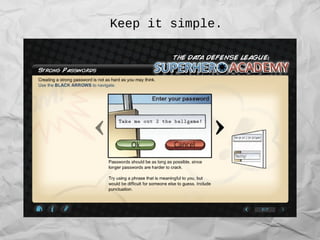
Keep it simple.
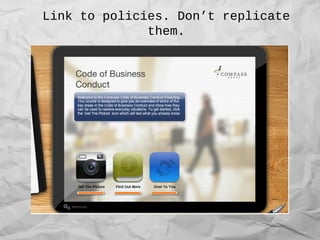
Link to policies. Don’t replicate
them.
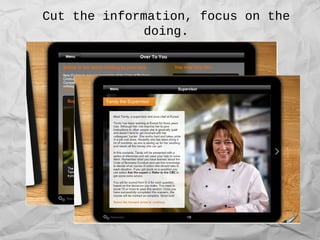
Cut the information, focus on the
doing.
E.B. White
No one can write decently who is
distrustful of the reader’s
intelligence or whose attitude is
patronizing.
7. Don’t patronize.
Oops. Do you feel patronized
now?
Talk adult-to-adult.
Do you like being told what to do?
“By now you have learned…”
“You must do…”
“This will take 90 minutes.”
“To advance to the next screen click the
‘next’ button in the bottom right corner
of your screen.”
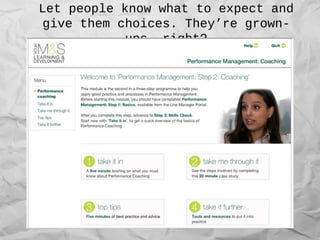
Let people know what to expect and
give them choices. They’re grown-
ups, right?
Henry Wadsworth Longfellow
Great is the art of beginning, but
greater is the art of ending.
8. Write the
never-ending
story.
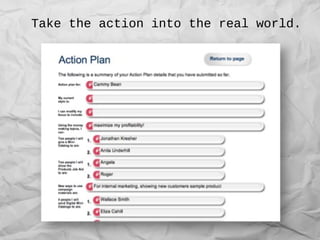
Take the action into the real world.
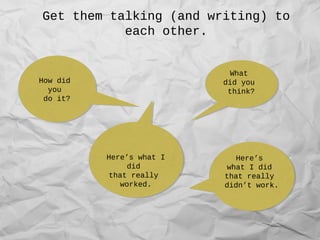
Get them talking (and writing) to
each other.
What
did you
think?
What
did you
think?
How did
you
do it?
How did
you
do it?
Here’s what I
did
that really
worked.
Here’s what I
did
that really
worked.
Here’s
what I did
that really
didn’t work.
Here’s
what I did
that really
didn’t work.
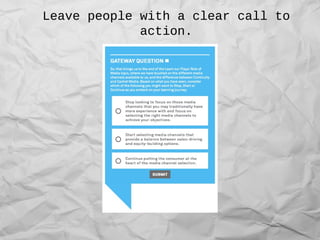
Leave people with a clear call to
action.
Repeat after me.
Keep it light.
Make it human.
Tell great stories.
Give it spirit (or “spirt”, even!).
Make it flow.
Cut it.
Don’t patronize.
Write the never-ending story.
Ernest Hemingway (A Moveable
Feast)
I would stand and look out over the roofs of
Paris and think, 'Do not worry. You have always
written before and you will write now. All you
have to do is write one true sentence. Write the
truest sentence that you know.’
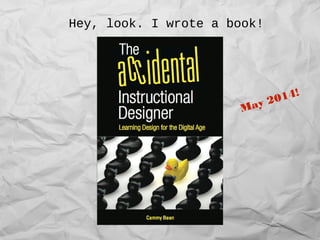
Hey, look. I wrote a book!
May 2014!
Write home.
cammy.bean@kineo.com
www.kineo.com
Twitter: @cammybean
Blog:
cammybean.kineo.com
Writing better e learning

Writing better e learning

  • 1.
    Writing better elearning scripts. by CammyBean VP of Learning Design, Kineo US Published at Learning Solutions 2014
  • 2.
    It was adark and stormy night.
  • 3.
    Across town asubject matter expert handed off a 62 slide deck to an instructional designer.
  • 4.
    Suddenly, a shotrang out…
  • 5.
    In a darkalley, a woman screamed as she stumbled on this elearning module.
  • 6.
    The people weptin despair.
  • 7.
    How can wewrite better programs to stop this horror?
  • 8.
    Sharpen your quillsas we share some top tips for writing better elearning scripts.
  • 9.
    1. Keep itlight.
  • 10.
    Aim for shortand snappy. Less of… “This e-learning module is designed to explain the principles and practical requirements of the 11 step process …” More of… “Need to get your head around our process? You’re in the right place.”
  • 11.
    Make it alittle fun.
  • 12.
  • 13.
    Joseph Conrad A writerwithout interest or sympathy for the foibles of his fellow man is not conceivable as a writer.
  • 14.
    2. Make ithuman.
  • 15.
    Talk to me,baby. Less of… “Negotiating effectively is an important skill that we all use on a daily basis” More of… “When was the last time you negotiated something? Maybe it was more recently than you think….”
  • 16.
    It’s all aboutyou. Make it personal.
  • 17.
    Have a conversationwith people.
  • 18.
    Connect the contentback to people.
  • 19.
    Object to learningobjectives. As a result of attending this session you will be able to: •Identify three case studies of Fortune 1000 companies who are successfully using social learning models •Define the three models of social learning and how these map to specific strategies and tools •Evaluate the pro's and con's of different social interventions as solutions to specific kinds of learning challenges •Describe their own personal experience in using social media as a practitioner As a result of attending this session you will be able to: •Identify three case studies of Fortune 1000 companies who are successfully using social learning models •Define the three models of social learning and how these map to specific strategies and tools •Evaluate the pro's and con's of different social interventions as solutions to specific kinds of learning challenges •Describe their own personal experience in using social media as a practitioner Real people don’t talk like this.
  • 20.
    You can stilltell them where they’re going.
  • 21.
    So how canwe make this better? List the characteristics of humans that we need to be aware of when designing ships. List the characteristics of humans that we need to be aware of when designing ships.
  • 22.
    What about thisone? Define the three main potential risks of not having an ITAM program in place. Define the three main potential risks of not having an ITAM program in place.
  • 23.
    Is there hopefor this one? Define the three models of social learning and how these map to specific strategies and tools. Define the three models of social learning and how these map to specific strategies and tools.
  • 24.
    Read it outloud. Would you want to listen?
  • 25.
    Inject humanity. Letreal people talk.
  • 26.
    Somerset Maugham If youcan tell stories, create characters, devise incidents, and have sincerity and passion, it doesn’t matter a damn how you write.
  • 27.
    3. Tell greatstories.
  • 28.
    Hook them witha gripping tale.
  • 29.
    Put all thecontent in context—try a guided story instead of an info dump.
  • 30.
  • 31.
    Grab their attentionwith tales of risk and intrigue.
  • 32.
    Alice Munro Anecdotes don’tmake good stories. Generally I dig down underneath them so far that the story that finally comes out is not what people thought their anecdotes were about.
  • 33.
    So how doyou find the right stories? Ask the right questions. Where do people get this wrong? Where do people get this wrong? What do you want people to DO? What do you want people to DO? What mistakes do people make? What mistakes do people make? Where can people get more information and help? Where can people get more information and help? What are the three key takeaways? What are the three key takeaways? What stories can you tell me? What stories can you tell me?
  • 34.
    Ask your expertsto think out loud. Get them narrate their work and walk you through the process.
  • 35.
    Have them tellyou a story. The story about their slide deck. (It’s often whats NOT written on the slide that really matters!)
  • 36.
    Use the wordsthey say, not the words they write. It helps if you type really fast or can record the conversation!
  • 37.
    4. Give itspirit.
  • 38.
    Activate your writing. This?Or this? “The fabulous script was written by you.” “You wrote this fabulous script.” “The process briefing document is used to define our core requirements.” “The process briefing document defines our core requirements.” “Now that you have covered the basics of customer service, in the next section you will learn how to deal with customer issues.” “You’re one step away from maximizing your skills, but there’s a problem—a customer one in fact. Click ‘next’ to put your skills to the test.”
  • 39.
    Rainer Maria Rilke Maywhat I do flow from me like a river, no forcing and no holding back, the way it is with children.
  • 40.
  • 41.
    Stitch your ideastogether, connect the dots, make sure the story flows from one piece to the next.
  • 42.
    Henry David Thoreau Notthat the story need be long, but it will take a long while to make it short.
  • 43.
  • 44.
    Cut the blatherand focus on the doing.
  • 45.
    Skip the fancywords and the jargon.
  • 46.
  • 47.
    Link to policies.Don’t replicate them.
  • 48.
    Cut the information,focus on the doing.
  • 49.
    E.B. White No onecan write decently who is distrustful of the reader’s intelligence or whose attitude is patronizing.
  • 50.
    7. Don’t patronize. Oops.Do you feel patronized now?
  • 51.
  • 52.
    Do you likebeing told what to do? “By now you have learned…” “You must do…” “This will take 90 minutes.” “To advance to the next screen click the ‘next’ button in the bottom right corner of your screen.”
  • 53.
    Let people knowwhat to expect and give them choices. They’re grown- ups, right?
  • 54.
    Henry Wadsworth Longfellow Greatis the art of beginning, but greater is the art of ending.
  • 55.
  • 56.
    Take the actioninto the real world.
  • 57.
    Get them talking(and writing) to each other. What did you think? What did you think? How did you do it? How did you do it? Here’s what I did that really worked. Here’s what I did that really worked. Here’s what I did that really didn’t work. Here’s what I did that really didn’t work.
  • 58.
    Leave people witha clear call to action.
  • 59.
    Repeat after me. Keepit light. Make it human. Tell great stories. Give it spirit (or “spirt”, even!). Make it flow. Cut it. Don’t patronize. Write the never-ending story.
  • 60.
    Ernest Hemingway (AMoveable Feast) I would stand and look out over the roofs of Paris and think, 'Do not worry. You have always written before and you will write now. All you have to do is write one true sentence. Write the truest sentence that you know.’
  • 62.
    Hey, look. Iwrote a book! May 2014!
  • 63.

Editor's Notes

  • #41 Finding the flow is about using simple techniques to make one slide build off the previous slide to connect ideas and show people how it all fits together. It’s how we talk to each other and how we share ideas.