DATA COLLECTION
& DATA
PRESENTATION
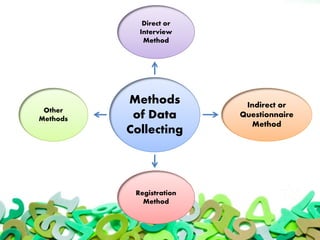
Methods
of Data
Collecting
Indirect or
Questionnaire
Method
Registration
Method
Other
Methods
Direct or
Interview
Method
Direct or Interview Method
1. One of the most effective methods of
collecting original data
2. There is an interviewer and a respondent
3. Interview method advantage:
* Can give complete information needed in
the study
4. Disadvantages:
* Can yield inaccurate information
* The interviewer may cheat
* The interviewer may influence the
respondent
Indirect or Questionnaire Method
1. One of the easiest methods
2. It takes time to prepare
3. Directions included, must be precise, clear
and explanatory
4. Advantages:
* less expensive
* less time-consuming
* confidential responses
* free from any influence
Indirect or Questionnaire Method
5. Limitations:
* cannot be accomplished by illiterates
* high proportion of non response or
non return
* tend to give wrong information
* tend to give incomplete information
Registration Method
1. Respondents provide information in
compliance with certain laws, policies,
or standard practices
2. Examples: marriage contract, birth
certificate, cedula, etc.
Other Methods
1. Observation: gather data regarding
attitudes, behavior, values and cultural
patterns
2. Telephone interview: questions to be
asked must be brief and few. Ex: favorite
program on tv
3. Experiments: collect or gather data if the
investigator wants to control the factors
affecting the variable being studied
Data Presentation
In the statistic class of 40 students, 3 obtained
the perfect score of 50. Sixteen students got a
score of 40 and above, while only 3 got 19
and below. Generally, the students
performed well in the test with 23 or 70%
getting a passing score of 38 and above.
Data Presentation
Data Presentation
Data collection

Data collection

  • 1.
  • 2.
  • 3.
    Direct or InterviewMethod 1. One of the most effective methods of collecting original data 2. There is an interviewer and a respondent 3. Interview method advantage: * Can give complete information needed in the study 4. Disadvantages: * Can yield inaccurate information * The interviewer may cheat * The interviewer may influence the respondent
  • 4.
    Indirect or QuestionnaireMethod 1. One of the easiest methods 2. It takes time to prepare 3. Directions included, must be precise, clear and explanatory 4. Advantages: * less expensive * less time-consuming * confidential responses * free from any influence
  • 5.
    Indirect or QuestionnaireMethod 5. Limitations: * cannot be accomplished by illiterates * high proportion of non response or non return * tend to give wrong information * tend to give incomplete information
  • 6.
    Registration Method 1. Respondentsprovide information in compliance with certain laws, policies, or standard practices 2. Examples: marriage contract, birth certificate, cedula, etc.
  • 7.
    Other Methods 1. Observation:gather data regarding attitudes, behavior, values and cultural patterns 2. Telephone interview: questions to be asked must be brief and few. Ex: favorite program on tv 3. Experiments: collect or gather data if the investigator wants to control the factors affecting the variable being studied
  • 8.
    Data Presentation In thestatistic class of 40 students, 3 obtained the perfect score of 50. Sixteen students got a score of 40 and above, while only 3 got 19 and below. Generally, the students performed well in the test with 23 or 70% getting a passing score of 38 and above.
  • 9.
  • 10.