The Stack
 Frame

An Ivaylo Marinkov presentation
        ivaylo@tsarstva.bg
Call Stack
A stack data structure storing
information of a computer program's
active subroutines.
Whilst important for the software's
proper functioning, its details are
usually hidden and usage is automated
in high-level programming languages.
Call Stack Purpose


Keeping record of the point to which
each active subroutine should return
control when finished.
Active Subroutine
A routine that has been called but
has not finished execution yet.
Afterwords, control should be
returned to the point where the call
has been made.
Routines may be nested to any level
and recursion is possibe – hence the
stack structure.
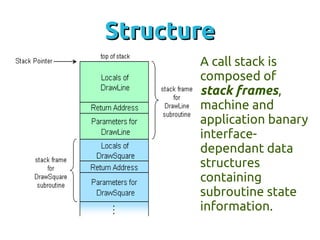
For example, the DrawSquare
subroutine calls the DrawLine
subroutine from four different
places. DrawLine must know where
to return once completed.
This is accomplished by pushing the
address following the call
instruction – the return address –
onto the stack with each call.
Call Stack Inner Workings
 The caller pushes the return address onto
 the stack (winding).
 The called subroutine, when it finishes,
 pops the return address off the stack and
 transfers control to it (unwinding).
 If a called subroutine calls on yet another
 subroutine, it will push another address
 onto the stack, and so on, with the
 information stacking up and unstacking as
 the program dictates.
Should pushing consume all the
space allocated for the call stack, an
error called stack overflow will
occur.
There is usually a single call stack
associated with each process thread.
However, the program may create
additional call stacks for tasks such as
signal-hadling or cooperative
multitasking.
Additional Call Stack Functions
Local data storage – keeping local-scope
variable values.
Parameter passing – storage for values
passed by calling code.
Evalution stack – in some cases
operands for logical and
arithmetic operations may be
stored in the call stack.
Current instance pointer –
for this pointer in
object-oriented languages.
Structure
       A call stack is
       composed of
       stack frames,
       machine and
       application banary
       interface-
       dependant data
       structures
       containing
       subroutine state
       information.
The Stack Frame

Generally speaking, a
procedure's stack frame contains
all the information necessary to
save and restore the state of the
procedure.
Strictly speaking, it is only necessary
for the calling program and the
called procedure to agree on the
structure of the stack frame for each
procedure call.
However, the specification of a
calling convention facilitates the use
of procedure libraries by defining
the structure of the stack frame
uniformly for all procedure calls.
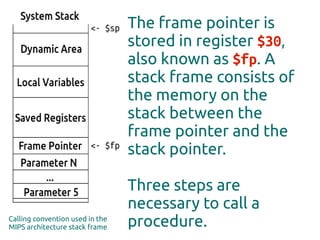
The frame pointer is
                                 stored in register $30,
                                 also known as $fp. A
                                 stack frame consists of
                                 the memory on the
                                 stack between the
                                 frame pointer and the
                                 stack pointer.

                                 Three steps are
                                 necessary to call a
Calling convention used in the
MIPS architecture stack frame    procedure.
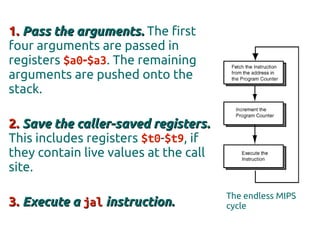
1. Pass the arguments. The first
four arguments are passed in
registers $a0-$a3. The remaining
arguments are pushed onto the
stack.

2. Save the caller-saved registers.
This includes registers $t0-$t9, if
they contain live values at the call
site.

                                       The endless MIPS
3. Execute a jal instruction.          cycle
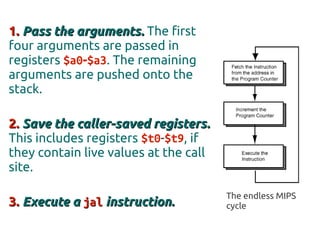
1. Pass the arguments. The first
four arguments are passed in
registers $a0-$a3. The remaining
arguments are pushed onto the
stack.

2. Save the caller-saved registers.
This includes registers $t0-$t9, if
they contain live values at the call
site.

                                       The endless MIPS
3. Execute a jal instruction.          cycle
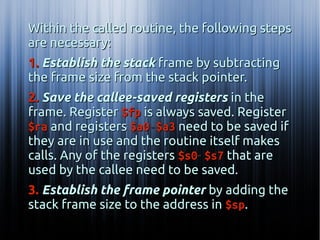
Within the called routine, the following steps
are necessary:
1. Establish the stack frame by subtracting
the frame size from the stack pointer.
2. Save the callee-saved registers in the
frame. Register $fp is always saved. Register
$ra and registers $a0-$a3 need to be saved if
they are in use and the routine itself makes
calls. Any of the registers $s0- $s7 that are
used by the callee need to be saved.
3. Establish the frame pointer by adding the
stack frame size to the address in $sp.
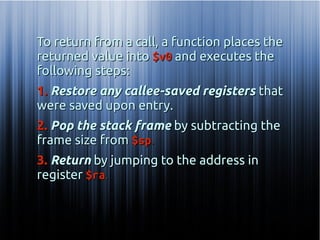
To return from a call, a function places the
returned value into $v0 and executes the
following steps:
1. Restore any callee-saved registers that
were saved upon entry.
2. Pop the stack frame by subtracting the
frame size from $sp.
3. Return by jumping to the address in
register $ra.
Debugging
The purpose of a debugger such
as GDB (gnu.org/software/gdb) is
to allow you to see what is going
on “inside” another program
while it executes--or what
another program was doing at
the moment it crashed.
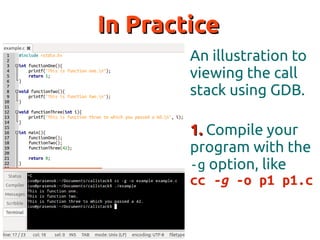
In Practice
        An illustration to
        viewing the call
        stack using GDB.

        1. Compile your
        program with the
        -g option, like
        cc -g -o p1 p1.c
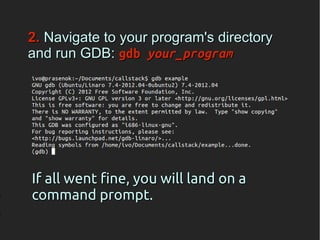
2. Navigate to your program's directory
and run GDB: gdb your_program


If all went fine, you will land on a
command prompt.
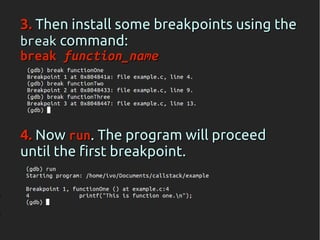
3. Then install some breakpoints using the
break command:
break function_name


4. Now run. The program will proceed
until the first breakpoint.
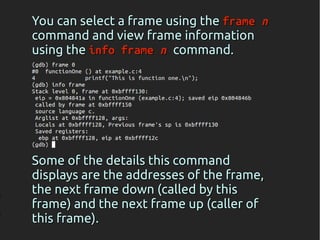
You can select a frame using the frame n
command and view frame information
using the info frame n command.


Some of the details this command
displays are the addresses of the frame,
the next frame down (called by this
frame) and the next frame up (caller of
this frame).
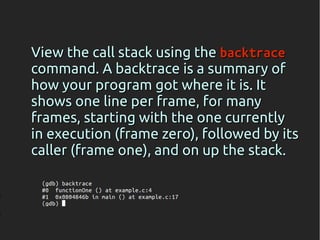
View the call stack using the backtrace
command. A backtrace is a summary of
how your program got where it is. It
shows one line per frame, for many
frames, starting with the one currently
in execution (frame zero), followed by its
caller (frame one), and on up the stack.
Resources
https://en.wikipedia.org/wiki/Call_stack
http://www.cs.uaf.edu/~cs301/notes/Chapter9/node11.html
http://chortle.ccsu.edu/assemblytutorial/Chapter-26/ass26_4.html
http://www.chemie.fu-berlin.de/chemnet/use/info/gdb/
http://www.freebsd.org/doc/en/books/developers-handbook/debugging.html
https://www.gnu.org/software/gdb/
Background images from various sources.


   This presentation was created using only free and open
    source software including the Ubuntu Linux operating
     system, LibreOffice, Mozilla Firefox, Geany, GDB and
                        KolourPaint.

The Stack Frame

  • 1.
    The Stack Frame AnIvaylo Marinkov presentation ivaylo@tsarstva.bg
  • 2.
    Call Stack A stackdata structure storing information of a computer program's active subroutines. Whilst important for the software's proper functioning, its details are usually hidden and usage is automated in high-level programming languages.
  • 3.
    Call Stack Purpose Keepingrecord of the point to which each active subroutine should return control when finished.
  • 4.
    Active Subroutine A routinethat has been called but has not finished execution yet. Afterwords, control should be returned to the point where the call has been made. Routines may be nested to any level and recursion is possibe – hence the stack structure.
  • 5.
    For example, theDrawSquare subroutine calls the DrawLine subroutine from four different places. DrawLine must know where to return once completed. This is accomplished by pushing the address following the call instruction – the return address – onto the stack with each call.
  • 6.
    Call Stack InnerWorkings The caller pushes the return address onto the stack (winding). The called subroutine, when it finishes, pops the return address off the stack and transfers control to it (unwinding). If a called subroutine calls on yet another subroutine, it will push another address onto the stack, and so on, with the information stacking up and unstacking as the program dictates.
  • 7.
    Should pushing consumeall the space allocated for the call stack, an error called stack overflow will occur. There is usually a single call stack associated with each process thread. However, the program may create additional call stacks for tasks such as signal-hadling or cooperative multitasking.
  • 8.
    Additional Call StackFunctions Local data storage – keeping local-scope variable values. Parameter passing – storage for values passed by calling code. Evalution stack – in some cases operands for logical and arithmetic operations may be stored in the call stack. Current instance pointer – for this pointer in object-oriented languages.
  • 9.
    Structure A call stack is composed of stack frames, machine and application banary interface- dependant data structures containing subroutine state information.
  • 10.
    The Stack Frame Generallyspeaking, a procedure's stack frame contains all the information necessary to save and restore the state of the procedure.
  • 11.
    Strictly speaking, itis only necessary for the calling program and the called procedure to agree on the structure of the stack frame for each procedure call. However, the specification of a calling convention facilitates the use of procedure libraries by defining the structure of the stack frame uniformly for all procedure calls.
  • 12.
    The frame pointeris stored in register $30, also known as $fp. A stack frame consists of the memory on the stack between the frame pointer and the stack pointer. Three steps are necessary to call a Calling convention used in the MIPS architecture stack frame procedure.
  • 13.
    1. Pass thearguments. The first four arguments are passed in registers $a0-$a3. The remaining arguments are pushed onto the stack. 2. Save the caller-saved registers. This includes registers $t0-$t9, if they contain live values at the call site. The endless MIPS 3. Execute a jal instruction. cycle
  • 14.
    1. Pass thearguments. The first four arguments are passed in registers $a0-$a3. The remaining arguments are pushed onto the stack. 2. Save the caller-saved registers. This includes registers $t0-$t9, if they contain live values at the call site. The endless MIPS 3. Execute a jal instruction. cycle
  • 15.
    Within the calledroutine, the following steps are necessary: 1. Establish the stack frame by subtracting the frame size from the stack pointer. 2. Save the callee-saved registers in the frame. Register $fp is always saved. Register $ra and registers $a0-$a3 need to be saved if they are in use and the routine itself makes calls. Any of the registers $s0- $s7 that are used by the callee need to be saved. 3. Establish the frame pointer by adding the stack frame size to the address in $sp.
  • 16.
    To return froma call, a function places the returned value into $v0 and executes the following steps: 1. Restore any callee-saved registers that were saved upon entry. 2. Pop the stack frame by subtracting the frame size from $sp. 3. Return by jumping to the address in register $ra.
  • 17.
    Debugging The purpose ofa debugger such as GDB (gnu.org/software/gdb) is to allow you to see what is going on “inside” another program while it executes--or what another program was doing at the moment it crashed.
  • 18.
    In Practice An illustration to viewing the call stack using GDB. 1. Compile your program with the -g option, like cc -g -o p1 p1.c
  • 19.
    2. Navigate toyour program's directory and run GDB: gdb your_program If all went fine, you will land on a command prompt.
  • 20.
    3. Then installsome breakpoints using the break command: break function_name 4. Now run. The program will proceed until the first breakpoint.
  • 21.
    You can selecta frame using the frame n command and view frame information using the info frame n command. Some of the details this command displays are the addresses of the frame, the next frame down (called by this frame) and the next frame up (caller of this frame).
  • 22.
    View the callstack using the backtrace command. A backtrace is a summary of how your program got where it is. It shows one line per frame, for many frames, starting with the one currently in execution (frame zero), followed by its caller (frame one), and on up the stack.
  • 23.