Namespace
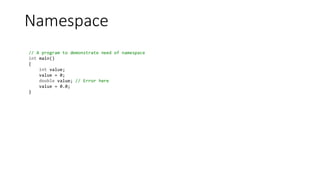
// A programto demonstrate need of namespace
int main()
{
int value;
value = 0;
double value; // Error here
value = 0.0;
}
3.
Namespace 2
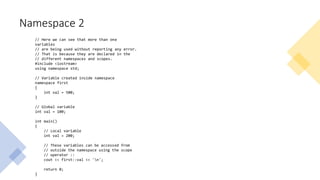
// Herewe can see that more than one
variables
// are being used without reporting any error.
// That is because they are declared in the
// different namespaces and scopes.
#include <iostream>
using namespace std;
// Variable created inside namespace
namespace first
{
int val = 500;
}
// Global variable
int val = 100;
int main()
{
// Local variable
int val = 200;
// These variables can be accessed from
// outside the namespace using the scope
// operator ::
cout << first::val << 'n';
return 0;
}
4.
Namespace 3
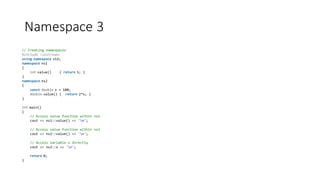
// Creatingnamespaces
#include <iostream>
using namespace std;
namespace ns1
{
int value() { return 5; }
}
namespace ns2
{
const double x = 100;
double value() { return 2*x; }
}
int main()
{
// Access value function within ns1
cout << ns1::value() << 'n';
// Access value function within ns2
cout << ns2::value() << 'n';
// Access variable x directly
cout << ns2::x << 'n';
return 0;
}
5.
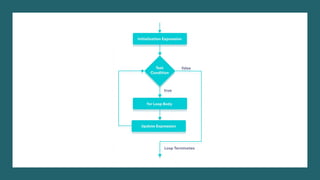
For loops
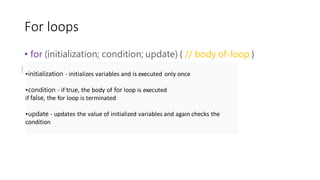
• for(initialization; condition; update) { // body of-loop }
•initialization - initializes variables and is executed only once
•condition - if true, the body of for loop is executed
if false, the for loop is terminated
•update - updates the value of initialized variables and again checks the
condition
7.
Range based forloops c++11
// the initializer may be a braced-init-list
for (int n : {0, 1, 2, 3, 4, 5})
std::cout << n << ' ';
std::cout << 'n';
// Iterating over array
int a[] = {0, 1, 2, 3, 4, 5};
for (int n : a)
std::cout << n << ' ';
std::cout << 'n';
// Just running a loop for every array
// element
for (int n : a)
std::cout << "In loop" << ' ';
• The Courseconsists of the followingtopics:
• Memory Layout
• Stack
• Call Stack
• Data Segment
• Heap
• Rodata segment
Outline
12
13.
• The Courseconsists of the followingtopics:
• Memory Layout
• Stack
• Call Stack
• Data Segment
• Heap
• Rodata segment
Outline
13
14.
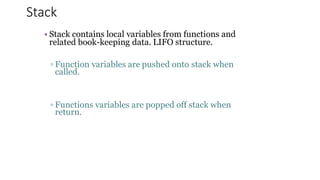
Stack
• Stack containslocal variables from functions and
related book-keeping data. LIFO structure.
▫ Function variables are pushed onto stack when
called.
▫ Functions variables are popped off stack when
return.
15.
• The Courseconsists of the followingtopics:
• Memory Layout
• Stack
• Call Stack
• Data Segment
• Heap
• Rodata segment
Outline
15
16.
• The Courseconsists of the followingtopics:
• Memory Layout
• Stack
• Call Stack
• Data Segment
• Heap
• Rodata segment
Outline
16
17.
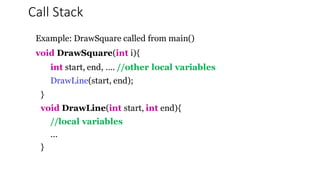
Call Stack
Example: DrawSquarecalled from main()
void DrawSquare(int i){
int start, end, …. //other local variables
DrawLine(start, end);
}
void DrawLine(int start, int end){
//local variables
...
}
18.
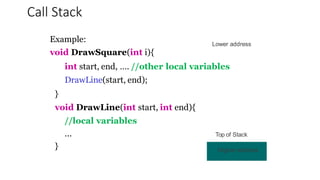
Lower address
Call Stack
Example:
voidDrawSquare(int i){
int start, end, …. //other local variables
DrawLine(start, end);
}
void DrawLine(int start, int end){
//local variables
...
}
Top of Stack
Higher address
19.
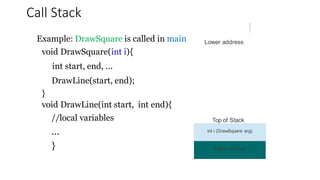
int i (DrawSquarearg)
Higher address
Lower address
Call Stack
Example: DrawSquare is called in main
void DrawSquare(int i){
int start, end, ...
DrawLine(start, end);
}
void DrawLine(int start, int end){
//local variables
...
}
Top of Stack
20.
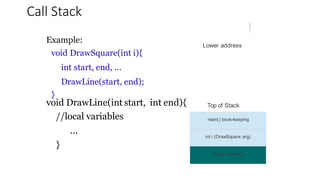
main() book-keeping
int i(DrawSquare arg)
Higher address
Lower address
Call Stack
Example:
void DrawSquare(int i){
int start, end, ...
DrawLine(start, end);
}
void DrawLine(int start, int end){
//local variables
...
}
Top of Stack
21.
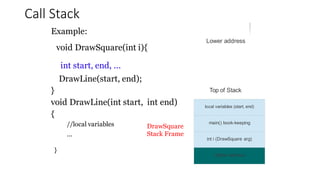
local variables (start,end)
main() book-keeping
int i (DrawSquare arg)
Higher address
Lower address
//local variables
...
}
Call Stack
Example:
void DrawSquare(int i){
int start, end, ...
DrawLine(start, end);
}
void DrawLine(int start, int end)
{
DrawSquare
Stack Frame
Top of Stack
22.
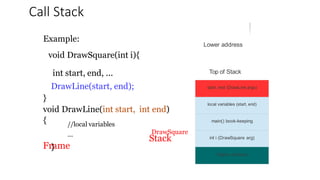
start, end (DrawLineargs)
local variables (start, end)
main() book-keeping
int i (DrawSquare arg)
Higher address
Lower address
Call Stack
Example:
void DrawSquare(int i){
int start, end, ...
DrawLine(start, end);
}
void DrawLine(int start, int end)
{
DrawSquare
Stack
Frame
Top of Stack
//local variables
...
}
23.
DrawSquare book-keeping
start, end(DrawLine args)
local variables (start, end)
main() book-keeping
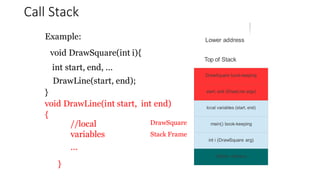
int i (DrawSquare arg)
Higher address
Lower address
Call Stack
Example:
void DrawSquare(int i){
int start, end, ...
DrawLine(start, end);
}
void DrawLine(int start, int end)
{
DrawSquare
Top of Stack
Stack Frame
//local
variables
...
}
24.
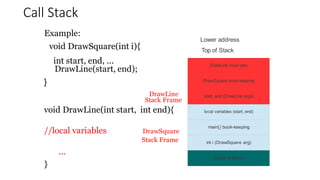
Lower address
Top ofStack
Call Stack
Example:
void DrawSquare(int i){
int start, end, ...
DrawLine(start, end);
}
DrawLine
Stack Frame
void DrawLine(int start, int end){
//local variables DrawSquare
Stack Frame
...
}
DrawLine local vars
DrawSquare book-keeping
start, end (DrawLine args)
local variables (start, end)
main() book-keeping
int i (DrawSquare arg)
Higher address
25.
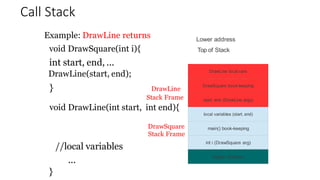
Lower address
Top ofStack
Call Stack
Example: DrawLine returns
void DrawSquare(int i){
int start, end, ...
DrawLine(start, end);
} DrawLine
Stack Frame
void DrawLine(int start, int end){
DrawSquare
Stack Frame
//local variables
...
}
DrawLine local vars
DrawSquare book-keeping
start, end (DrawLine args)
local variables (start, end)
main() book-keeping
int i (DrawSquare arg)
Higher address
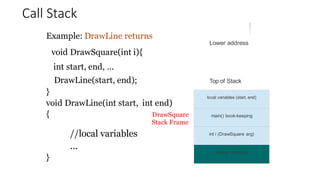
26.
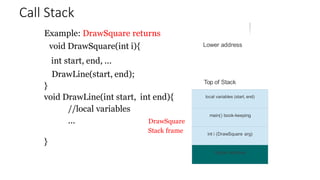
local variables (start,end)
main() book-keeping
int i (DrawSquare arg)
Higher address
Lower address
Call Stack
Example: DrawLine returns
void DrawSquare(int i){
int start, end, ...
DrawLine(start, end);
}
void DrawLine(int start, int end)
{ DrawSquare
Stack Frame
//local variables
...
}
Top of Stack
27.
local variables (start,end)
main() book-keeping
int i (DrawSquare arg)
Higher address
Lower address
Call Stack
Example: DrawSquare returns
void DrawSquare(int i){
int start, end, ...
DrawLine(start, end);
}
void DrawLine(int start, int end){
//local variables
... DrawSquare
Stack frame
}
Top of Stack
28.
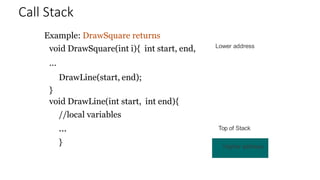
Lower address
Call Stack
Example:DrawSquare returns
void DrawSquare(int i){ int start, end,
...
DrawLine(start, end);
}
void DrawLine(int start, int end){
//local variables
...
}
Top of Stack
Higher address
29.
Reference
• A referencevariable is an alias, that is, another name for an
already existing variable. Once a reference is initialized with a
variable, either the variable name or the reference name may
be used to refer to the variable.
30.
Reference Vs Pointers
•References are often confused with pointers but three major
differences between references and pointers are −
• You cannot have NULL references. You must always be able to
assume that a reference is connected to a legitimate piece of
storage.
• Once a reference is initialized to an object, it cannot be changed
to refer to another object. Pointers can be pointed to another
object at any time.
• A reference must be initialized when it is created. Pointers can
be initialized at any time.

![Range based for loops c++11
// the initializer may be a braced-init-list
for (int n : {0, 1, 2, 3, 4, 5})
std::cout << n << ' ';
std::cout << 'n';
// Iterating over array
int a[] = {0, 1, 2, 3, 4, 5};
for (int n : a)
std::cout << n << ' ';
std::cout << 'n';
// Just running a loop for every array
// element
for (int n : a)
std::cout << "In loop" << ' ';](https://image.slidesharecdn.com/namespace-250713143507-7f57eb76/85/intro_to_cpp_namespace_robotics_corner-pdf-7-320.jpg)


![谷歌留痕技术教程[ 𝙩𝙤𝙥 𝟮𝟯𝟯. 𝙘 𝙤𝙢 ]](https://cdn.slidesharecdn.com/ss_thumbnails/top233-260130173900-2eb784f9-thumbnail.jpg?width=640&height=640&fit=bounds)


