Clinical Trial Requirements for Market
Approval of Medical Devices
Prof. (Dr.) Bhaswat S. Chakraborty
Emeritus Professor, Institute of Pharmacy, Nirma University
Former Sr.VP &Chair, R&D, Cadila Pharmaceuticals
Former Director, Biopharmaceutics, Biovail, Toronto
Former Sr. Efficacy & Safety Reviewer, TPD (Canadian FDA), Ottawa
Presented at the ACIES Plus and International Conference on Med-
Tech Innovation for Primary Health Care, IIPH Gandhinagar, India,
December 27, 2018
From Clinical point of view, they
are of different risk classes
requiring different clinical
efficacy & safety evidence
Two Official Documents Aiding Market
Authorisation
• Medical Devices Rules 2017, published by
Indian Ministry of Health and Family
Welfare and a subsequent recent Guidance
document by Indian Pharmacopoeia
Commission clarify requirements for
approval of medical devices in India.
• Among various aspects, Quality and Efficacy
& Safety requirements for approval of
medical devices have been stated.
• None of the official guidance documents of
India describes the clinical trials (CTs) data
requirement in details.
Medical Devices Rules 2017
Guidance by IPC
Classification
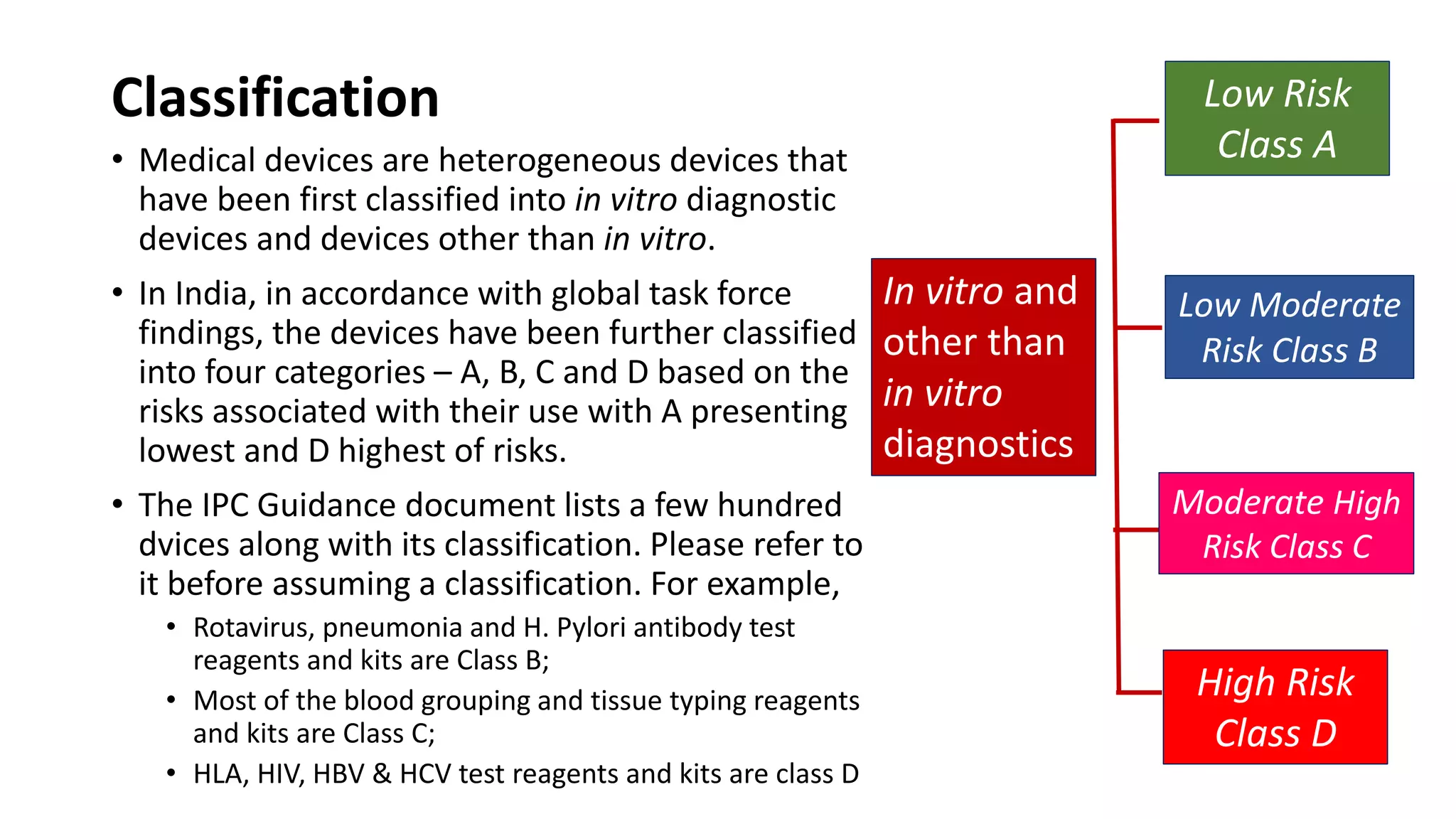
• Medical devices are heterogeneous devices that
have been first classified into in vitro diagnostic
devices and devices other than in vitro.
• In India, in accordance with global task force
findings, the devices have been further classified
into four categories – A, B, C and D based on the
risks associated with their use with A presenting
lowest and D highest of risks.
• The IPC Guidance document lists a few hundred
dvices along with its classification. Please refer to
it before assuming a classification. For example,
• Rotavirus, pneumonia and H. Pylori antibody test
reagents and kits are Class B;
• Most of the blood grouping and tissue typing reagents
and kits are Class C;
• HLA, HIV, HBV & HCV test reagents and kits are class D
In vitro and
other than
in vitro
diagnostics
Low Risk
Class A
Low Moderate
Risk Class B
Moderate High
Risk Class C
High Risk
Class D
Clinical Investigations: MD Rules 2017
• Although the medical devices rules 2017 does not give any details of data
requirements for clinical investigations medical devices, they do mention
and give at least three clear indications:
• 1. A pilot clinical investigation meaning a clinical study may have to be carried out
for the first time in human beings
• A pivotal clinical investigation meaning a confirmatory clinical trial based on the
data emerging from pilot clinical trial [may have to be carried out for Class C & D]
• 3. Medical devices requiring clinical trials but claiming substantial equivalence
cannot be marketed without official approval
A 510(k) Type CT to Establish Substantial Equivalence
• Non-inferiority CT with a well-
defined non-inferiority margin
• Equivalence and non-inferiority are
similar but not the same thing….most
510(k) ‘substantial equivalence’ trials
are technically ‘non-inferiority’ trials
• One-sided or uni-directional statistical
criteria
• Sometimes a bioequivalence trial of a
MD is possible
Clinical Trial(s) Data Requirement
• The Global Harmonization Task Force (GHTF) was established in 1992
(Australia, Canada, the EU, Japan & US); aim of the GHTF is to
harmonize the regulatory systems around the globe
• US or EU MD CT guidances are developed and are of great help
• US FDA classifies the MDS as Class I (general controls); Class II (special
controls); and Class III (pre-market approval – PMA)
• Certain Class I, II & III can enter the market through 510(k) of the ACT – once
determined substantially equivalent to a legally marketed device that does not
require PMA
• PMA requires complete evidence of efficacy & safety; often pivotal CTs for
Class III MDs
• Class I & II are exempt from the above II but not from general controls
Non-Inferiority CTs for Substantial Equivalence
• Pivotal trials of orthopedic surgical devices in the United States: predominance of two-arm non-
inferiority designs
• By S. Raymond Golish https://doi.org/10.1186/s13063-017-2032-2
• Background: Background: The United States Food and Drug Administration (FDA) reviews class III
orthopedic devices submitted for premarket approval with pivotal clinical trials. The purpose of this
study was to determine the types of orthopedic devices reviewed, the design of their pivotal clinical
trials, and the subjective factors affecting the interpretation of clinical trial data.
• Methods: Meeting materials were collected from FDA electronic archives and notes were made
regarding the device-type and subsequent approval and recall, the design of pivotal clinical trials,
and issues of trial interpretation debated during panel deliberations.
• Results: Of the 23 pivotal trials, 20 (87.0%) were randomized controlled trials (RCTs), consisting of
13 (65.0%) non-inferiority trials and 7 (35.0%) superiority trials, and all RCTs were two-arm trials. At
panel, the most commonly debated issues were related to the design and interpretation of non-
inferiority trials.
• Conclusions: A broad array of device types is reviewed by the FDA. The
predominance of two-arm non-inferiority trials as pivotal studies indicates that
the nuances of their design and interpretation are commercially important.
CTs for Medical Devices: Key Points
• Trial Objectives
• Clinical endpoints consistent with primary trial objectives
• Pilot or Feasibility Study
• Evidence to support trial
• Study Population
• Control and Experimental
• Sample size (usually N ≤ 1000 for MD Pivotal RCTs)
• Statistically justified by effect size, anticipated variability & desired α and
power
• Robust, appropriate outcome variables
• Minimizing effects of confounding variables
CTs for Medical Devices: Key Points..
• Trial Design
• Parallel, crossover?
• Statistical plan
• Follow up
• Missing Data Handling
• Handling plan
• Adverse Events
• Interim Analysis, DMC
• Alpha spending
• Stop or go rules
• Efficacy and Secondary Endpoints
• Efficacy endpoints are often part of primary objectives of an MD
Sequence of Events
• Patient requires a device
• Patient eligible for inclusion in the
trial
• Clinician willing to accept
randomization
• Patient consent is obtained
• Patient formally entered on the trial
• Device assignment obtained from
the randomization list
• On study forms completed
13
• Trial commences
• Clinical monitoring commences
• Central collection of all data
• Query generation & cleaning
• Portion (1/3 or 1/2) of data
complete for Interim Analysis
• Continuation of rial
• Cleaning of data etc.
• Trial Complete
• Follow up
Case Study Example: PMA Number P150033
Micra Transcatheter Pacing System
(Implantable Cardiac Pacemaker (IPG))
INDICATION FOR USE
• The Micra Transcatheter Pacing System is
indicated for use in patients of:
• symptomatic paroxysmal or permanent
high-grade AV block in the presence of
Atrial Fibrillation (AF)
• symptomatic paroxysmal or permanent
high-grade AV block in the absence of AF,
as an alternative to dual chamber pacing
• symptomatic bradycardia-tachycardia
syndrome or sinus node dysfunction
Rate-responsive pacing is indicated to provide
increased heart rate appropriate to increasing
levels of activity.
Inclusion Criteria
Criteria Rationale
Subjects who have a Class I or II indication for
implantation of a single chamber ventricular
pacemaker according to ACC/AHA/HRS 2008
guidelines and any national guidelines1,2
Study will be evaluated in the standard
patient population that is actually
indicated for the device under
evaluation.
Subjects who are able and willing to undergo the study
requirements and are expected to be geographically
stable for the duration of the follow-up.
Ensure ascertainment of data required
for clinical evaluation.
Subjects who are at least 18 years of age (or older, if
required by local law).
Ensure age is appropriate to provide
informed consent.
Micra Case Study: Clinical Endpoints – Effectiveness
• The primary effectiveness objective was to demonstrate the percentage of
subjects with an adequate pacing capture threshold at 6-months post-implant
exceeds 80% (i.e. the lower two-sided confidence interval must exceed 80%).
• An adequate pacing capture threshold (PCT) is defined as:
1. A 6-month PCT ≤ 2V at a pulse duration of 0.24 ms and
2. An increase in PCT from implant to 6-months ≤ 1.5 months (0.24 ms pulse width)
• Hypothesis
• H0: π ≤ 80%, versus
• Ha: π > 80% where π is the percentage of successfully implanted subjects with an adequate
6-month pacing capture threshold (PCT).
Micra Case Study: Clinical Endpoints – Safety
• The primary safety objective was to demonstrate that the freedom from major
complications related to the Micra system and/or procedure at 6-months post-
implant is greater than 83% (i.e., the lower boundary of the two-sided 95%
confidence interval must be greater than 83%).
• Hypothesis
• Ho: S(6 months) ≤ 83%, versus
• Ha: S(6 months) > 83% where S(6-months) is the freedom rate at 6-months (183 days) post-
implant for major complications related to the Micra system and/or procedure.
Micra Case Study: Efficacy Performance Requirement
• The lower boundary of the two-sided confidence interval for the
percentage of subjects with an adequate 6-month pacing capture
threshold must be greater than 80% for the null hypothesis to be
rejected.
• Interim analysis α adjustment:
• The null hypothesis could be rejected if the nominal P-value is less than
0.0067 at the first interim analysis.
Micra Case Study: Efficacy Results
Subjects1 Subjects
with
Adequate
6- Month
PCT
% Subjects
with
Adequate 6-
Month PCT
98.66% CI2 Performance
Goal
Nominal
One-
sided P-
value3
297 292 98.3% (95.4%,
99.6%)
80% <0.0001
1. Of the 297 subjects who contributed to the primary efficacy analysis, 292 (98.3%) had
an adequate 6-month PCT, meaning they had a 6-month PCT no greater than 2.0V
and had a rise in PCT from implant to 6-months of no more than 1.5V.
2. This observed percentage of subjects with an adequate safety margin was greater
than the pre-specified goal of 80% since the nominal one-sided P-value was lower
than the nominal alpha level of 0.0067
Micra Case Study: Safety Results
• There were 28 major complications in 25 subjects related to the Micra system or
procedure as determined by the CEC occurring in the 725 subjects with a Micra
implant attempt during a total of 3124.1 months of follow-up.
• The Kaplan-Meier estimate for the freedom from major complications related to Micr
system or procedure at 6-months (183 days) post-implant was 96.0% (98.66% CI:
93.3% - 97.6%).
• This was higher than the pre-specified performance criterion of 83% (P<0.0001). Since
the p-value associated with this test was lower than the p-value required to reject the
null hypothesis at the first interim analysis (0.0067).
• The null hypothesis was rejected and the primary safety objective was considered
met.
Thank You Very Much

Clinical Trial Requirements Medical Devices 27 dec2018

  • 1.
    Clinical Trial Requirementsfor Market Approval of Medical Devices Prof. (Dr.) Bhaswat S. Chakraborty Emeritus Professor, Institute of Pharmacy, Nirma University Former Sr.VP &Chair, R&D, Cadila Pharmaceuticals Former Director, Biopharmaceutics, Biovail, Toronto Former Sr. Efficacy & Safety Reviewer, TPD (Canadian FDA), Ottawa Presented at the ACIES Plus and International Conference on Med- Tech Innovation for Primary Health Care, IIPH Gandhinagar, India, December 27, 2018
  • 2.
    From Clinical pointof view, they are of different risk classes requiring different clinical efficacy & safety evidence
  • 5.
    Two Official DocumentsAiding Market Authorisation • Medical Devices Rules 2017, published by Indian Ministry of Health and Family Welfare and a subsequent recent Guidance document by Indian Pharmacopoeia Commission clarify requirements for approval of medical devices in India. • Among various aspects, Quality and Efficacy & Safety requirements for approval of medical devices have been stated. • None of the official guidance documents of India describes the clinical trials (CTs) data requirement in details. Medical Devices Rules 2017 Guidance by IPC
  • 6.
    Classification • Medical devicesare heterogeneous devices that have been first classified into in vitro diagnostic devices and devices other than in vitro. • In India, in accordance with global task force findings, the devices have been further classified into four categories – A, B, C and D based on the risks associated with their use with A presenting lowest and D highest of risks. • The IPC Guidance document lists a few hundred dvices along with its classification. Please refer to it before assuming a classification. For example, • Rotavirus, pneumonia and H. Pylori antibody test reagents and kits are Class B; • Most of the blood grouping and tissue typing reagents and kits are Class C; • HLA, HIV, HBV & HCV test reagents and kits are class D In vitro and other than in vitro diagnostics Low Risk Class A Low Moderate Risk Class B Moderate High Risk Class C High Risk Class D
  • 7.
    Clinical Investigations: MDRules 2017 • Although the medical devices rules 2017 does not give any details of data requirements for clinical investigations medical devices, they do mention and give at least three clear indications: • 1. A pilot clinical investigation meaning a clinical study may have to be carried out for the first time in human beings • A pivotal clinical investigation meaning a confirmatory clinical trial based on the data emerging from pilot clinical trial [may have to be carried out for Class C & D] • 3. Medical devices requiring clinical trials but claiming substantial equivalence cannot be marketed without official approval
  • 8.
    A 510(k) TypeCT to Establish Substantial Equivalence • Non-inferiority CT with a well- defined non-inferiority margin • Equivalence and non-inferiority are similar but not the same thing….most 510(k) ‘substantial equivalence’ trials are technically ‘non-inferiority’ trials • One-sided or uni-directional statistical criteria • Sometimes a bioequivalence trial of a MD is possible
  • 9.
    Clinical Trial(s) DataRequirement • The Global Harmonization Task Force (GHTF) was established in 1992 (Australia, Canada, the EU, Japan & US); aim of the GHTF is to harmonize the regulatory systems around the globe • US or EU MD CT guidances are developed and are of great help • US FDA classifies the MDS as Class I (general controls); Class II (special controls); and Class III (pre-market approval – PMA) • Certain Class I, II & III can enter the market through 510(k) of the ACT – once determined substantially equivalent to a legally marketed device that does not require PMA • PMA requires complete evidence of efficacy & safety; often pivotal CTs for Class III MDs • Class I & II are exempt from the above II but not from general controls
  • 10.
    Non-Inferiority CTs forSubstantial Equivalence • Pivotal trials of orthopedic surgical devices in the United States: predominance of two-arm non- inferiority designs • By S. Raymond Golish https://doi.org/10.1186/s13063-017-2032-2 • Background: Background: The United States Food and Drug Administration (FDA) reviews class III orthopedic devices submitted for premarket approval with pivotal clinical trials. The purpose of this study was to determine the types of orthopedic devices reviewed, the design of their pivotal clinical trials, and the subjective factors affecting the interpretation of clinical trial data. • Methods: Meeting materials were collected from FDA electronic archives and notes were made regarding the device-type and subsequent approval and recall, the design of pivotal clinical trials, and issues of trial interpretation debated during panel deliberations. • Results: Of the 23 pivotal trials, 20 (87.0%) were randomized controlled trials (RCTs), consisting of 13 (65.0%) non-inferiority trials and 7 (35.0%) superiority trials, and all RCTs were two-arm trials. At panel, the most commonly debated issues were related to the design and interpretation of non- inferiority trials. • Conclusions: A broad array of device types is reviewed by the FDA. The predominance of two-arm non-inferiority trials as pivotal studies indicates that the nuances of their design and interpretation are commercially important.
  • 11.
    CTs for MedicalDevices: Key Points • Trial Objectives • Clinical endpoints consistent with primary trial objectives • Pilot or Feasibility Study • Evidence to support trial • Study Population • Control and Experimental • Sample size (usually N ≤ 1000 for MD Pivotal RCTs) • Statistically justified by effect size, anticipated variability & desired α and power • Robust, appropriate outcome variables • Minimizing effects of confounding variables
  • 12.
    CTs for MedicalDevices: Key Points.. • Trial Design • Parallel, crossover? • Statistical plan • Follow up • Missing Data Handling • Handling plan • Adverse Events • Interim Analysis, DMC • Alpha spending • Stop or go rules • Efficacy and Secondary Endpoints • Efficacy endpoints are often part of primary objectives of an MD
  • 13.
    Sequence of Events •Patient requires a device • Patient eligible for inclusion in the trial • Clinician willing to accept randomization • Patient consent is obtained • Patient formally entered on the trial • Device assignment obtained from the randomization list • On study forms completed 13 • Trial commences • Clinical monitoring commences • Central collection of all data • Query generation & cleaning • Portion (1/3 or 1/2) of data complete for Interim Analysis • Continuation of rial • Cleaning of data etc. • Trial Complete • Follow up
  • 14.
    Case Study Example:PMA Number P150033 Micra Transcatheter Pacing System (Implantable Cardiac Pacemaker (IPG)) INDICATION FOR USE • The Micra Transcatheter Pacing System is indicated for use in patients of: • symptomatic paroxysmal or permanent high-grade AV block in the presence of Atrial Fibrillation (AF) • symptomatic paroxysmal or permanent high-grade AV block in the absence of AF, as an alternative to dual chamber pacing • symptomatic bradycardia-tachycardia syndrome or sinus node dysfunction Rate-responsive pacing is indicated to provide increased heart rate appropriate to increasing levels of activity.
  • 15.
    Inclusion Criteria Criteria Rationale Subjectswho have a Class I or II indication for implantation of a single chamber ventricular pacemaker according to ACC/AHA/HRS 2008 guidelines and any national guidelines1,2 Study will be evaluated in the standard patient population that is actually indicated for the device under evaluation. Subjects who are able and willing to undergo the study requirements and are expected to be geographically stable for the duration of the follow-up. Ensure ascertainment of data required for clinical evaluation. Subjects who are at least 18 years of age (or older, if required by local law). Ensure age is appropriate to provide informed consent.
  • 16.
    Micra Case Study:Clinical Endpoints – Effectiveness • The primary effectiveness objective was to demonstrate the percentage of subjects with an adequate pacing capture threshold at 6-months post-implant exceeds 80% (i.e. the lower two-sided confidence interval must exceed 80%). • An adequate pacing capture threshold (PCT) is defined as: 1. A 6-month PCT ≤ 2V at a pulse duration of 0.24 ms and 2. An increase in PCT from implant to 6-months ≤ 1.5 months (0.24 ms pulse width) • Hypothesis • H0: π ≤ 80%, versus • Ha: π > 80% where π is the percentage of successfully implanted subjects with an adequate 6-month pacing capture threshold (PCT).
  • 17.
    Micra Case Study:Clinical Endpoints – Safety • The primary safety objective was to demonstrate that the freedom from major complications related to the Micra system and/or procedure at 6-months post- implant is greater than 83% (i.e., the lower boundary of the two-sided 95% confidence interval must be greater than 83%). • Hypothesis • Ho: S(6 months) ≤ 83%, versus • Ha: S(6 months) > 83% where S(6-months) is the freedom rate at 6-months (183 days) post- implant for major complications related to the Micra system and/or procedure.
  • 18.
    Micra Case Study:Efficacy Performance Requirement • The lower boundary of the two-sided confidence interval for the percentage of subjects with an adequate 6-month pacing capture threshold must be greater than 80% for the null hypothesis to be rejected. • Interim analysis α adjustment: • The null hypothesis could be rejected if the nominal P-value is less than 0.0067 at the first interim analysis.
  • 19.
    Micra Case Study:Efficacy Results Subjects1 Subjects with Adequate 6- Month PCT % Subjects with Adequate 6- Month PCT 98.66% CI2 Performance Goal Nominal One- sided P- value3 297 292 98.3% (95.4%, 99.6%) 80% <0.0001 1. Of the 297 subjects who contributed to the primary efficacy analysis, 292 (98.3%) had an adequate 6-month PCT, meaning they had a 6-month PCT no greater than 2.0V and had a rise in PCT from implant to 6-months of no more than 1.5V. 2. This observed percentage of subjects with an adequate safety margin was greater than the pre-specified goal of 80% since the nominal one-sided P-value was lower than the nominal alpha level of 0.0067
  • 20.
    Micra Case Study:Safety Results • There were 28 major complications in 25 subjects related to the Micra system or procedure as determined by the CEC occurring in the 725 subjects with a Micra implant attempt during a total of 3124.1 months of follow-up. • The Kaplan-Meier estimate for the freedom from major complications related to Micr system or procedure at 6-months (183 days) post-implant was 96.0% (98.66% CI: 93.3% - 97.6%). • This was higher than the pre-specified performance criterion of 83% (P<0.0001). Since the p-value associated with this test was lower than the p-value required to reject the null hypothesis at the first interim analysis (0.0067). • The null hypothesis was rejected and the primary safety objective was considered met.
  • 21.