Prepared By,
Ms. Snehal S. Zoman
First Year M. Pharm
Regulatory Affairs
Semester-II
Roll No.:15
Sanjivani College of Pharmaceutical Education and Research,
Kopargaon, Ahmednagar, Maharashtra
Guided By,
Ms. Dimple Marathe Ma’am
Introduction
Countries covered
Study of the World Map
Study of Various committees across the globe (ASEAN, APEC, EAC, GCC, PANDRH, SADC)
Reference
2
o Emerging Markets can be defined
as developing prosperous countries
in which investment is expected to
result in higher income despite high
risks.
o Emerging Markets are not only
influential in their own regions but
represent a significant proportion
of the world’s population and trade.
o They also represent a growing
share of global healthcare
spending. As such they offer an
attractive growth prospect for the
pharmaceutical industry.
3
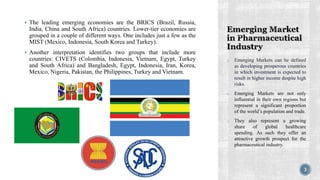
 The leading emerging economies are the BRICS (Brazil, Russia,
India, China and South Africa) countries. Lower-tier economies are
grouped in a couple of different ways. One includes just a few as the
MIST (Mexico, Indonesia, South Korea and Turkey).
 Another interpretation identifies two groups that include more
countries: CIVETS (Colombia, Indonesia, Vietnam, Egypt, Turkey
and South Africa) and Bangladesh, Egypt, Indonesia, Iran, Korea,
Mexico, Nigeria, Pakistan, the Philippines, Turkey and Vietnam.
Complex Environment.
Diverse regions with different regulatory authorities.
Some Harmonization GCC, ASEAN.
Agencies becoming more sophisticated demanding more information.
A number of markets moving towards or recognising ICH.
Companies need to have a local presence in the country either an affiliate office or partner with
distributor.
4
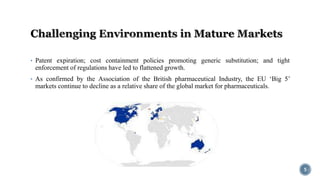
• Patent expiration; cost containment policies promoting generic substitution; and tight
enforcement of regulations have led to flattened growth.
• As confirmed by the Association of the British pharmaceutical Industry, the EU ‘Big 5’
markets continue to decline as a relative share of the global market for pharmaceuticals.
5
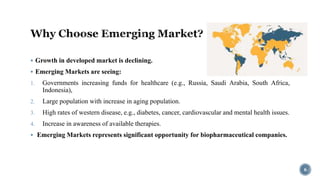
 Growth in developed market is declining.
 Emerging Markets are seeing:
1. Governments increasing funds for healthcare (e.g., Russia, Saudi Arabia, South Africa,
Indonesia),
2. Large population with increase in aging population.
3. High rates of western disease, e.g., diabetes, cancer, cardiovascular and mental health issues.
4. Increase in awareness of available therapies.
 Emerging Markets represents significant opportunity for biopharmaceutical companies.
6
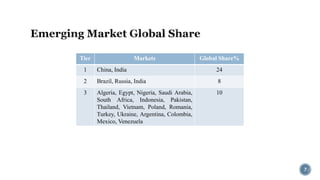
Tier Markets Global Share%
1 China, India 24
2 Brazil, Russia, India 8
3 Algeria, Egypt, Nigeria, Saudi Arabia,
South Africa, Indonesia, Pakistan,
Thailand, Vietnam, Poland, Romania,
Turkey, Ukraine, Argentina, Colombia,
Mexico, Venezuela
10
7
8
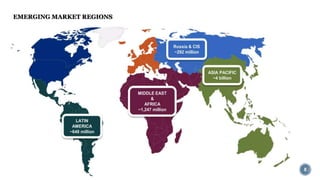
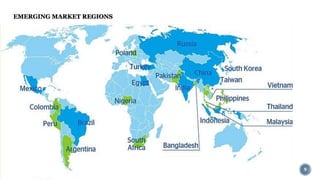
EMERGING MARKET REGIONS
9
EMERGING MARKET REGIONS
 Emerging market consists of mainly the countries from Asia Pacific, Latin America, Africa,
and Gulf countries.
 These countries differ in their region and also in many other aspects as regulation of
Pharmaceuticals, using different Guidelines for registration, registration fees, requirements to
maintain registration, duration of registration Patent regulation, and legislation for the drug.
 The different groups of nations across the globe such as ASEAN, APEC, EAC, GCC,
PANDRH, and SADC are discussed further.
10
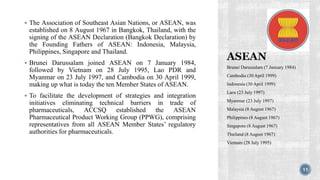
 The Association of Southeast Asian Nations, or ASEAN, was
established on 8 August 1967 in Bangkok, Thailand, with the
signing of the ASEAN Declaration (Bangkok Declaration) by
the Founding Fathers of ASEAN: Indonesia, Malaysia,
Philippines, Singapore and Thailand.
 Brunei Darussalam joined ASEAN on 7 January 1984,
followed by Vietnam on 28 July 1995, Lao PDR and
Myanmar on 23 July 1997, and Cambodia on 30 April 1999,
making up what is today the ten Member States of ASEAN.
 To facilitate the development of strategies and integration
initiatives eliminating technical barriers in trade of
pharmaceuticals, ACCSQ established the ASEAN
Pharmaceutical Product Working Group (PPWG), comprising
representatives from all ASEAN Member States’ regulatory
authorities for pharmaceuticals.
Brunei Darussalam (7 January 1984)
Cambodia (30 April 1999)
Indonesia (30 April 1999)
Laos (23 July 1997)
Myanmar (23 July 1997)
Malaysia (8 August 1967)
Philippines (8 August 1967)
Singapore (8 August 1967)
Thailand (8 August 1967)
Vietnam (28 July 1995)
11
12
• The PPWG has been established:
1. To support a reduction of technical barriers to trade in the pharmaceutical products; and
2. To provide improved access to pharmaceutical products, without compromising the safety,
efficacy and quality of pharmaceutical products placed in the ASEAN market.
• Since its establishment, PPWG has pursued harmonization and recognition in several important
areas of pharmaceutical regulation. The results of these initiatives include the development of:
a. ASEAN Sectoral MRA on GMP Inspection for Manufacturers of Medicinal Products (GMP
MRA);
b. Post Market Alert System (PMAS);
c. ASEAN Common Technical Dossier (ACTD);
d. ASEAN Common Technical Requirements (ACTR);
e. ASEAN MRA for Bioequivalence of Study Reports of Generic Medicinal Products (BE MRA).
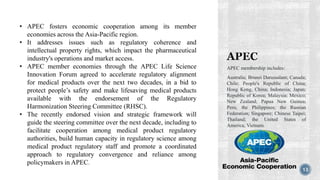
APEC membership includes:
Australia; Brunei Darussalam; Canada;
Chile; People's Republic of China;
Hong Kong, China; Indonesia; Japan;
Republic of Korea; Malaysia; Mexico;
New Zealand; Papua New Guinea;
Peru; the Philippines; the Russian
Federation; Singapore; Chinese Taipei;
Thailand; the United States of
America; Vietnam.
13
• APEC fosters economic cooperation among its member
economies across the Asia-Pacific region.
• It addresses issues such as regulatory coherence and
intellectual property rights, which impact the pharmaceutical
industry's operations and market access.
• APEC member economies through the APEC Life Science
Innovation Forum agreed to accelerate regulatory alignment
for medical products over the next two decades, in a bid to
protect people’s safety and make lifesaving medical products
available with the endorsement of the Regulatory
Harmonization Steering Committee (RHSC).
• The recently endorsed vision and strategic framework will
guide the steering committee over the next decade, including to
facilitate cooperation among medical product regulatory
authorities, build human capacity in regulatory science among
medical product regulatory staff and promote a coordinated
approach to regulatory convergence and reliance among
policymakers in APEC.
 EAC aims to promote economic development and integration
among its member states in East Africa.
 It works on harmonizing pharmaceutical regulations and
improving healthcare infrastructure to facilitate trade and
access to medicines.
 The blueprint for the development of the pharmaceutical
manufacturing sector in the EAC includes four targets:
1. Reduce imports from 70% to less than 50%.
2. Support expansion of product portfolio to cater for 90% of
disease burden.
3. Governments to procure at least 50% from local
manufacturers.
4. At least five companies to produce more advanced
formulations such as delayed-release formulations, small
volume injectables, vaccines, etc.
The East African Community (EAC)
is a regional intergovernmental
organization of eight (8) Partner
States, comprising the Republic of
Burundi, Democratic Republic of
Congo, Republic of Kenya, Republic
of Rwanda, Federal Republic of
Somalia, Republic of South Sudan,
Republic of Uganda and United
Republic of Tanzania, with its
headquarters in Arusha, Tanzania.
14
 GCC promotes economic and social integration among Arab
states in the Persian Gulf region.
 It addresses pharmaceutical regulations and standards to
facilitate trade and investment in the healthcare sector.
 The regulations of Gulf countries are encouraging the import
of quality generic products.
 Gulf Cooperation Council regulatory authorities - Gulf
Central Committee for Drug Registrations (GCC-DR)
• Approved in May 1999.
• Located in the executive office for Health Ministers, Riyadh,
Saudi Arabia
The Gulf Cooperation Council
(GCC) brings together six Arab
countries –
• Bahrain,
• Kuwait,
• Oman,
• Qatar,
• Saudi Arabia, and the
• United Arab Emirates
15
 The Pan American Network for Drug Regulatory
Harmonization (PANDRH) is an initiative of the national
regulatory authorities within the Region, and PAHO, that
supports the processes of pharmaceutical regulatory
harmonization in the Americas, within the framework of
national and sub-regional health policies and recognizing pre-
existing asymmetries.
 PANDRH fosters collaboration among drug regulatory
authorities in the Americas to harmonize regulatory
requirements and facilitate access to safe and effective
medicines across the region.
•SUBREGION: North America.
Central America, Cuba, and
Dominican Republic. Caribbean.
Andean Region. Southern Cone.
•MAIN COUNTRY: United States.
El Salvador. Suriname. Ecuador.
Uruguay.
•ALTERNATIVE COUNTRY:
Mexico. Costa Rica. Bahamas.
Chile. Paraguay.
16
 SADC promotes regional cooperation and integration among
its member states in Southern Africa.
 It addresses healthcare challenges and pharmaceutical
regulation to improve access to healthcare
services and medicines.
The Southern African Development
Community (SADC) is a Regional
Economic Community comprising 16
Member States; Angola, Botswana,
Comoros, Democratic Republic of Congo,
Eswatini, Lesotho, Madagascar, Malawi,
Mauritius, Mozambique, Namibia,
Seychelles, South Africa, United Republic
of Tanzania, Zambia and Zimbabwe.
17
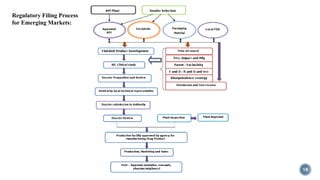
18
Regulatory Filing Process
for Emerging Markets:
19
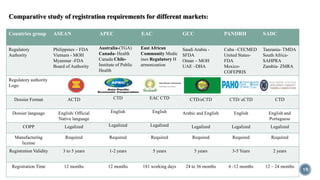
Countries group ASEAN APEC EAC GCC PANDRH SADC
Regulatory
Authority
Philippines – FDA
Vietnam - MOH
Myanmar -FDA
Board of Authority
Australia-(TGA)
Canada- Health
Canada Chile-
Institute of Public
Health
East African
Community Medic
ines Regulatory H
armonization
Saudi Arabia -
SFDA
Oman – MOH
UAE –DHA
Cuba –CECMED
United States-
FDA
Mexico-
COFEPRIS
Tanzania- TMDA
South Africa-
SAHPRA
Zambia- ZMRA
Regulatory authority
Logo
Dossier Format ACTD CTD EAC CTD CTD/eCTD CTD/ eCTD CTD
Dossier language English/ Official
Native language
English English Arabic and English English English and
Portuguese
COPP Legalized Legalized Legalized Legalized Legalized Legalized
Manufacturing
license
Required Required Required Required Required Required
Registration Validity 3 to 5 years 1-2 years 5 years 5 years 3-5 Years 2 years
Registration Time 12 months 12 months 181 working days 24 to 36 months 6 -12 months 12 – 24 months
Comparative study of registration requirements for different markets:
1. https://www.parexel.com/
2. https://windrosecg.com/posts/emerging-markets-series-topic-
3#:~:text=They%20also%20represent%20a%20growing,higher%20income%20despite%20high%20ri
sks
3. https://asean.org/wp-content/uploads/2022/12/ASEAN-Pharmaceutical-Regulatory-Policy-Sample-
Print-REV-20122022-.pdf
4. https://www.apec.org/
5. https://www.eac.int/medicines-regulatory-guidelines
6. https://www.ncbi.nlm.nih.gov/pmc/articles/PMC3122046/
7. https://www.paho.org/en/pan-american-network-drug-regulatory-harmonization-pandrh
8. https://www.sadc.int/
20
21

Editor's Notes

  • #4 ASEAN, BRICS, CIS, LATAM