Survival of the Fittest – Utilization of Natural selection Mechanisms for Improving PLE Behnam Taraghi,  Christian Stickel, Martin Ebner
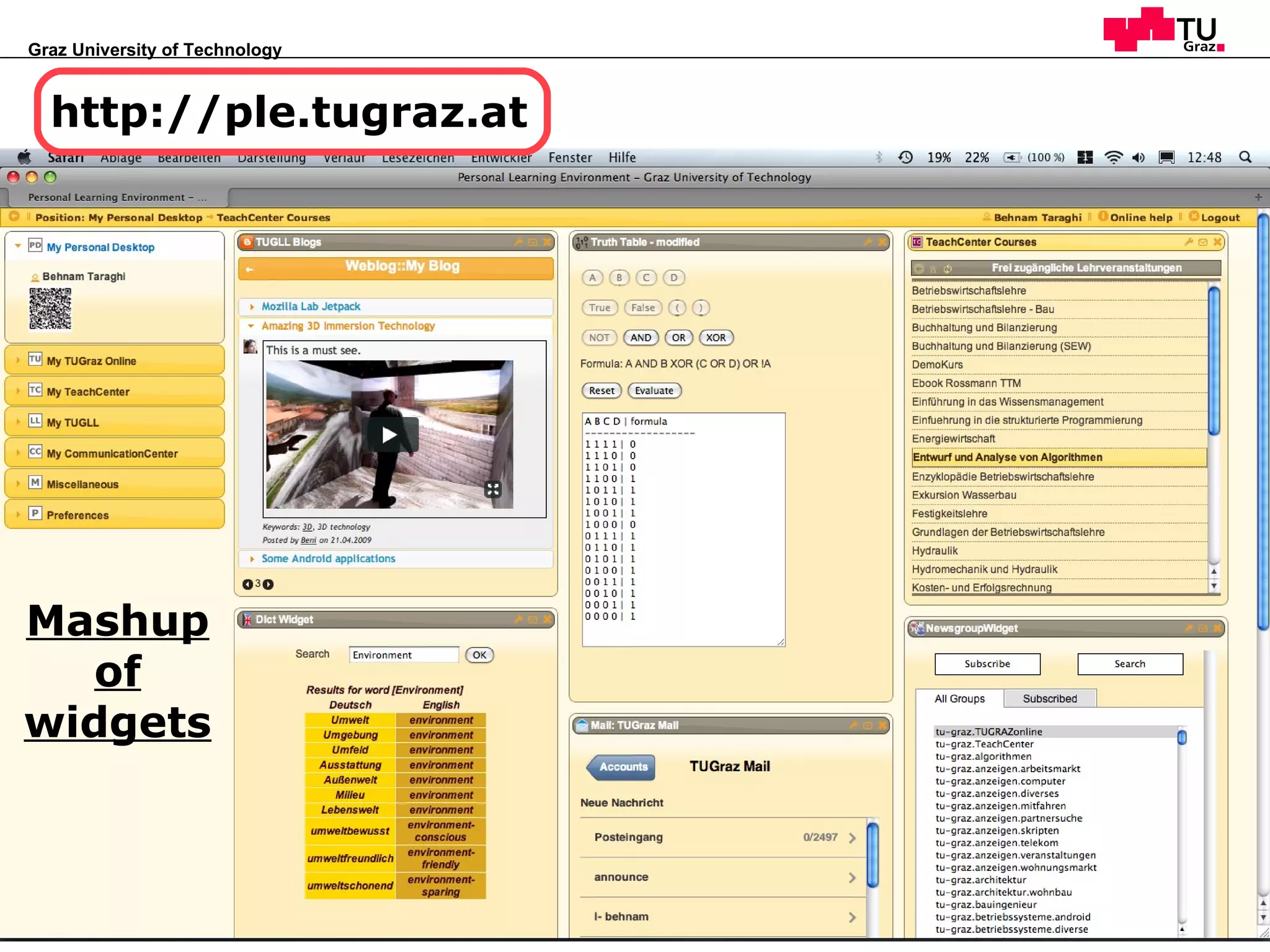
http://ple.tugraz.at Mashup of widgets
Darwin’s theory - Survival of the fittest - Selection, Variation - Macro evolution - Micro evolution
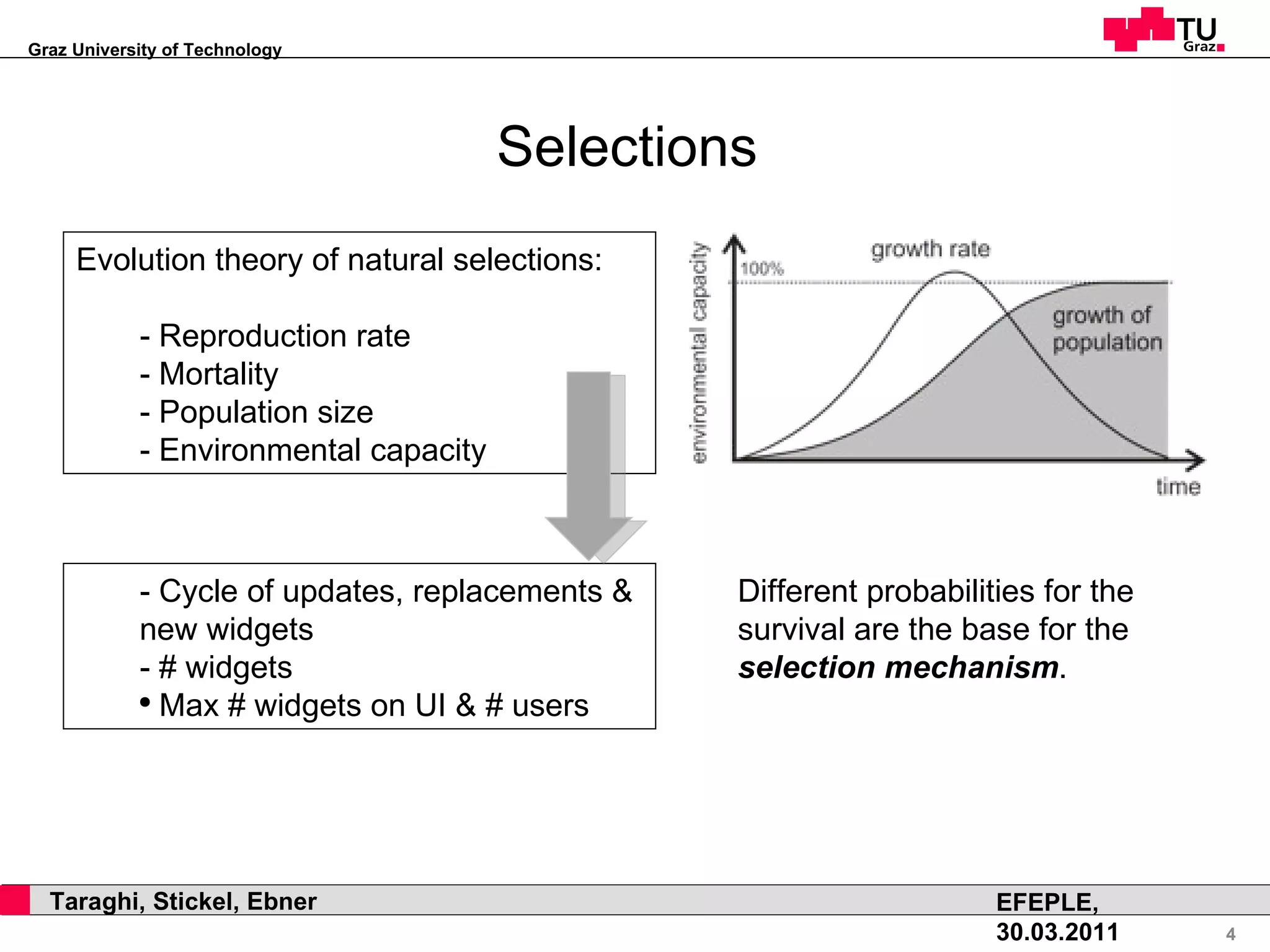
Selections Evolution theory of natural selections: - Reproduction rate - Mortality - Population size - Environmental capacity - Cycle of updates, replacements & new widgets - # widgets Max # widgets on UI & # users Different probabilities for the survival are the base for the  selection mechanism .
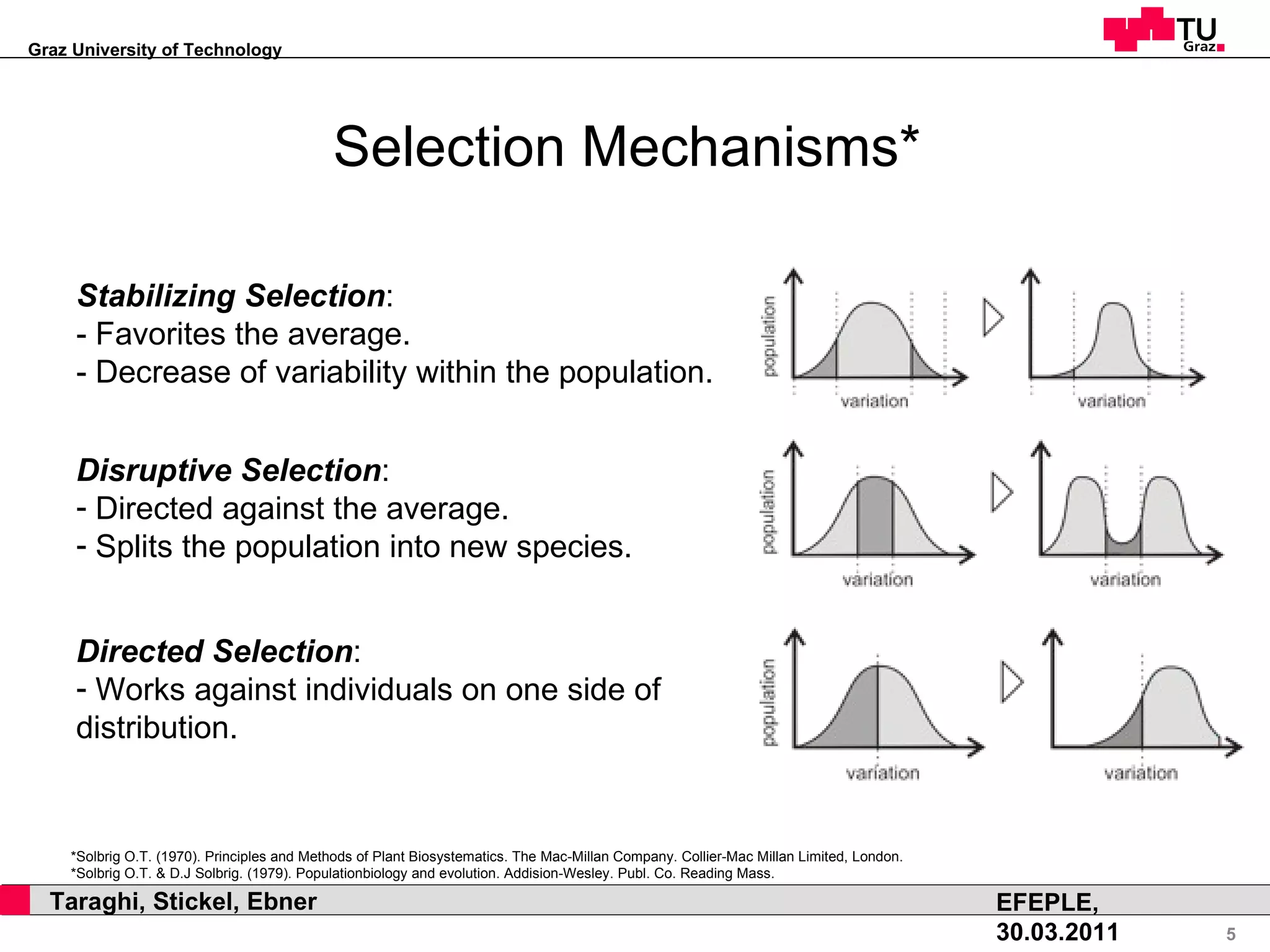
Selection Mechanisms* Stabilizing Selection : - Favorites the average. - Decrease of variability within the population.  Disruptive Selection : Directed against the average. Splits the population into new species. Directed Selection : Works against individuals on one side of distribution. *Solbrig O.T. (1970). Principles and Methods of Plant Biosystematics. The Mac-Millan Company. Collier-Mac Millan Limited, London. *Solbrig O.T. & D.J Solbrig. (1979). Populationbiology and evolution. Addision-Wesley. Publ. Co. Reading Mass.
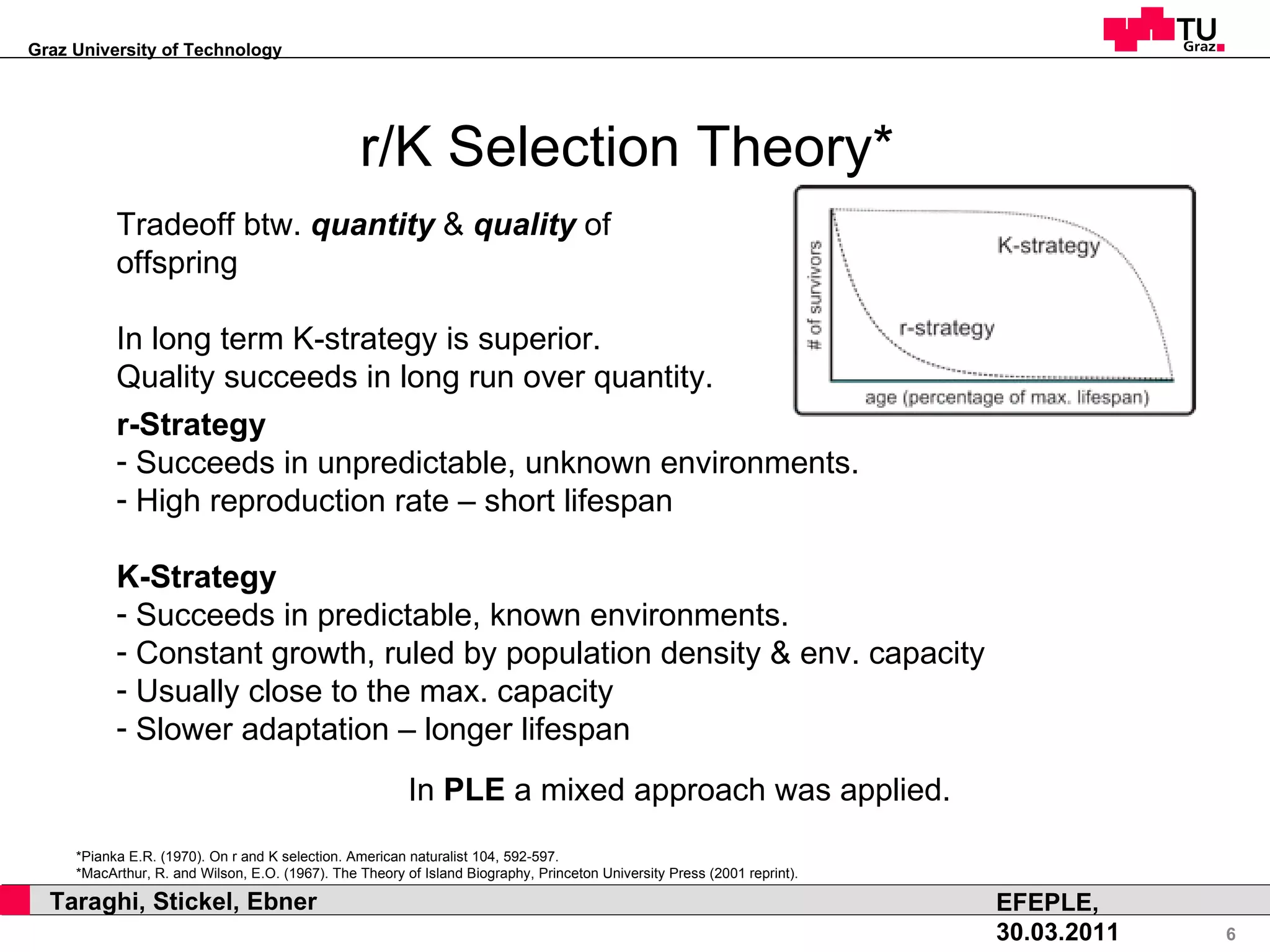
r/K Selection Theory* Tradeoff btw.  quantity  &  quality  of offspring In long term K-strategy is superior. Quality succeeds in long run over quantity. r-Strategy Succeeds in unpredictable, unknown environments. High reproduction rate – short lifespan K-Strategy Succeeds in predictable, known environments. Constant growth, ruled by population density & env. capacity Usually close to the max. capacity Slower adaptation – longer lifespan In  PLE  a mixed approach was applied. *Pianka E.R. (1970). On r and K selection. American naturalist 104, 592-597. *MacArthur, R. and Wilson, E.O. (1967). The Theory of Island Biography, Princeton University Press (2001 reprint).
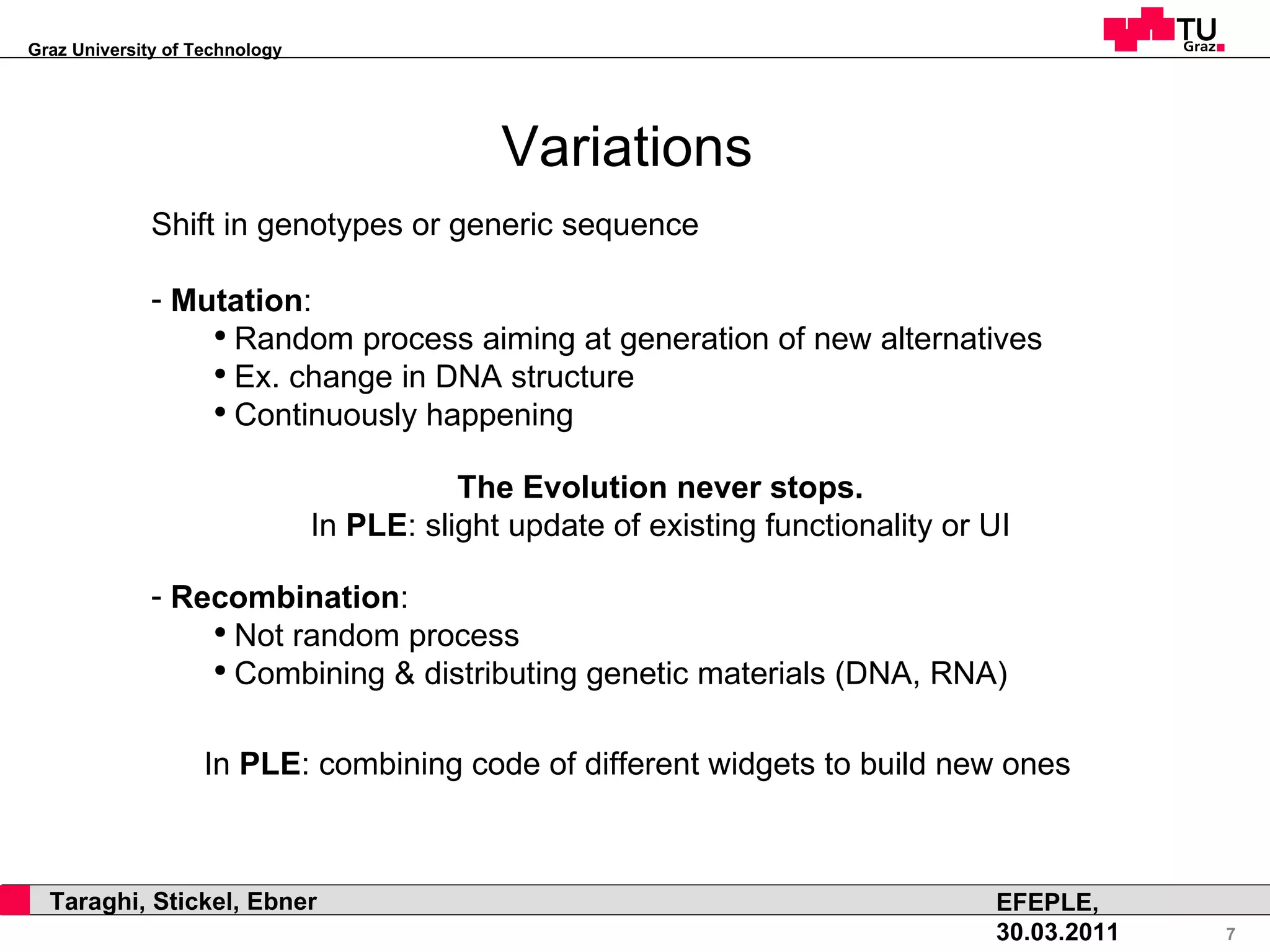
Variations Shift in genotypes or generic sequence Mutation : Random process aiming at generation of new alternatives Ex. change in DNA structure Continuously happening Recombination : Not random process Combining & distributing genetic materials (DNA, RNA) The Evolution never stops. In  PLE : slight update of existing functionality or UI In  PLE : combining code of different widgets to build new ones
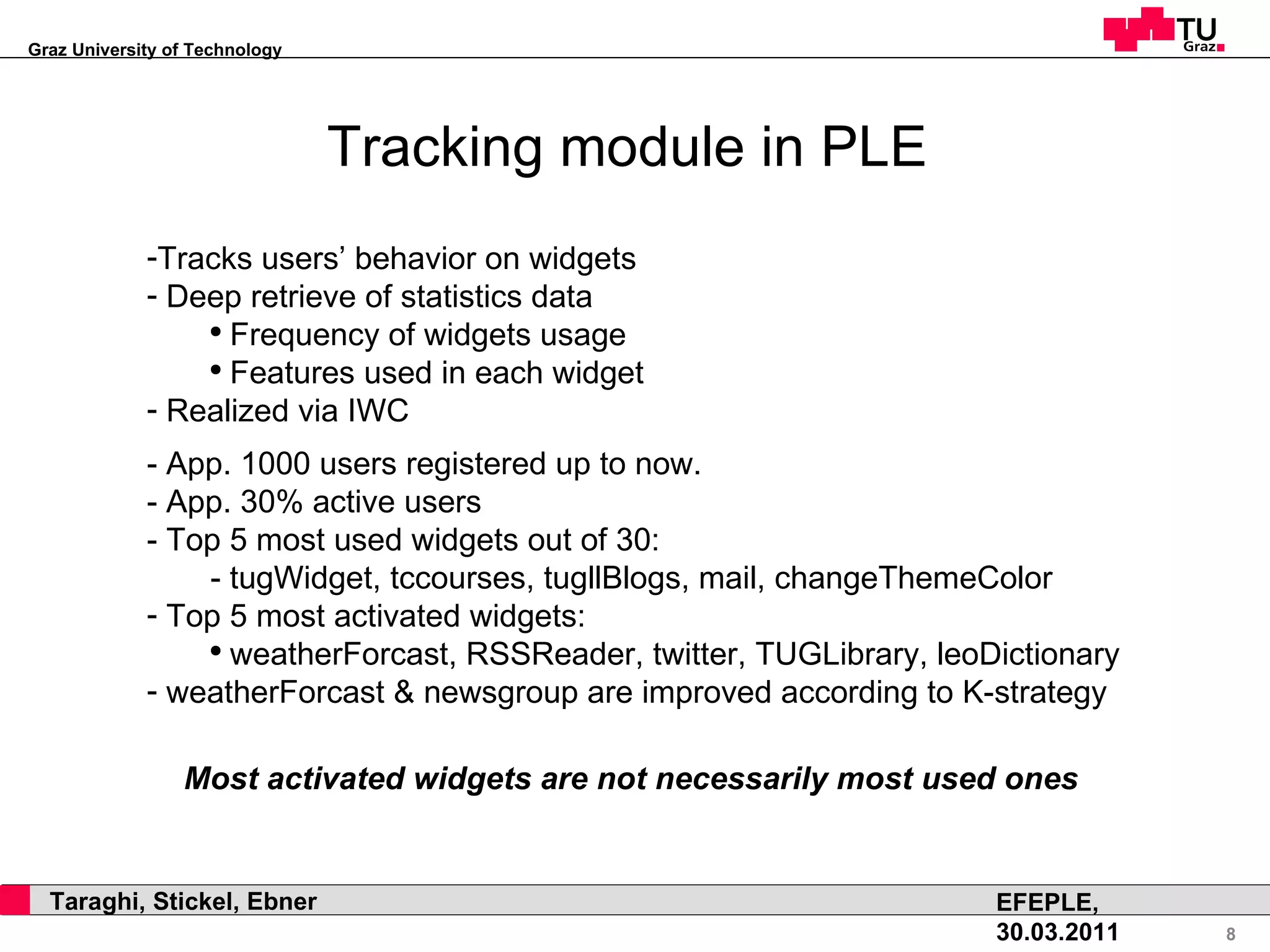
Tracking module in PLE Tracks users’ behavior on widgets Deep retrieve of statistics data Frequency of widgets usage Features used in each widget Realized via IWC - App. 1000 users registered up to now. - App. 30% active users - Top 5 most used widgets out of 30: - tugWidget, tccourses, tugllBlogs, mail, changeThemeColor Top 5 most activated widgets: weatherForcast, RSSReader, twitter, TUGLibrary, leoDictionary weatherForcast & newsgroup are improved according to K-strategy Most activated widgets are not necessarily most used ones
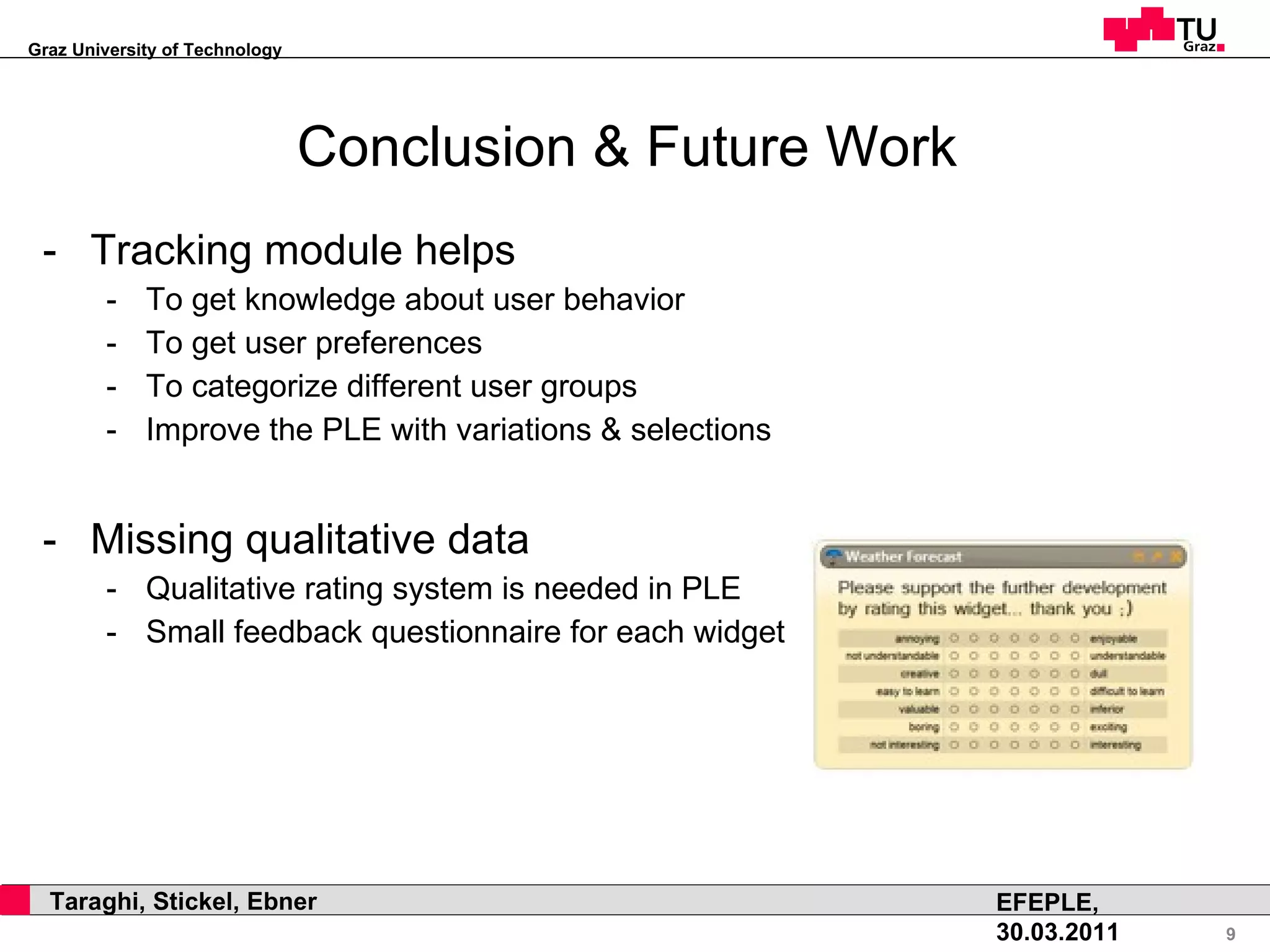
Conclusion & Future Work Tracking module helps To get knowledge about user behavior To get user preferences To categorize different user groups Improve the PLE with variations & selections Missing qualitative data Qualitative rating system is needed in PLE Small feedback questionnaire for each widget
SOCIAL LEARNING Computer and Information Services http://tugraz.at http:// elearning .tugraz.at Slides available at:  http:// www.slideshare.net/behi_at b.taraghi(at)tugraz.at

Survival of the Fittest – Utilization of Natural selection Mechanisms for Improving PLE

  • 1.
    Survival of theFittest – Utilization of Natural selection Mechanisms for Improving PLE Behnam Taraghi, Christian Stickel, Martin Ebner
  • 2.
  • 3.
    Darwin’s theory -Survival of the fittest - Selection, Variation - Macro evolution - Micro evolution
  • 4.
    Selections Evolution theoryof natural selections: - Reproduction rate - Mortality - Population size - Environmental capacity - Cycle of updates, replacements & new widgets - # widgets Max # widgets on UI & # users Different probabilities for the survival are the base for the selection mechanism .
  • 5.
    Selection Mechanisms* StabilizingSelection : - Favorites the average. - Decrease of variability within the population. Disruptive Selection : Directed against the average. Splits the population into new species. Directed Selection : Works against individuals on one side of distribution. *Solbrig O.T. (1970). Principles and Methods of Plant Biosystematics. The Mac-Millan Company. Collier-Mac Millan Limited, London. *Solbrig O.T. & D.J Solbrig. (1979). Populationbiology and evolution. Addision-Wesley. Publ. Co. Reading Mass.
  • 6.
    r/K Selection Theory*Tradeoff btw. quantity & quality of offspring In long term K-strategy is superior. Quality succeeds in long run over quantity. r-Strategy Succeeds in unpredictable, unknown environments. High reproduction rate – short lifespan K-Strategy Succeeds in predictable, known environments. Constant growth, ruled by population density & env. capacity Usually close to the max. capacity Slower adaptation – longer lifespan In PLE a mixed approach was applied. *Pianka E.R. (1970). On r and K selection. American naturalist 104, 592-597. *MacArthur, R. and Wilson, E.O. (1967). The Theory of Island Biography, Princeton University Press (2001 reprint).
  • 7.
    Variations Shift ingenotypes or generic sequence Mutation : Random process aiming at generation of new alternatives Ex. change in DNA structure Continuously happening Recombination : Not random process Combining & distributing genetic materials (DNA, RNA) The Evolution never stops. In PLE : slight update of existing functionality or UI In PLE : combining code of different widgets to build new ones
  • 8.
    Tracking module inPLE Tracks users’ behavior on widgets Deep retrieve of statistics data Frequency of widgets usage Features used in each widget Realized via IWC - App. 1000 users registered up to now. - App. 30% active users - Top 5 most used widgets out of 30: - tugWidget, tccourses, tugllBlogs, mail, changeThemeColor Top 5 most activated widgets: weatherForcast, RSSReader, twitter, TUGLibrary, leoDictionary weatherForcast & newsgroup are improved according to K-strategy Most activated widgets are not necessarily most used ones
  • 9.
    Conclusion & FutureWork Tracking module helps To get knowledge about user behavior To get user preferences To categorize different user groups Improve the PLE with variations & selections Missing qualitative data Qualitative rating system is needed in PLE Small feedback questionnaire for each widget
  • 10.
    SOCIAL LEARNING Computerand Information Services http://tugraz.at http:// elearning .tugraz.at Slides available at: http:// www.slideshare.net/behi_at b.taraghi(at)tugraz.at