Self-Extending Symbiosis: A Mechanism for
Increasing Robustness Through Evolution
Hiroaki Kitano
Sony Computer Science Laboratories, Inc.
Shinagawa, Tokyo, Japan
&
The Systems Biology Institute
Shibuya, Tokyo, Japan
Correspondence to: kitano@symbio.jst.go.jp
Kanae Oda
The Systems Biology Institute
Shibuya, Tokyo, Japan
Abstract
Robustness is a fundamental property of biological systems,
observed ubiquitously across species and at different levels of
organization from gene regulation to ecosystem. The theory
of biological robustness argues that robustness fosters evolv-
ability and that together they entail various tradeoffs as well
as characteristic architectures and mechanisms. We argue that
classes of biological systems have evolved to enhance their ro-
bustness by extending their system boundary through a series
of symbioses with foreign biological entities (“self-extending
symbiosis”). A series of major biological innovations has been
achieved by events consistent with this framework: horizontal
gene transfer, serial endosymbiosis, oocytes-mediated verti-
cal infection, and host-symbiont mutualism for bacterial flora.
Self-extending symbiosis contributes to robustness because
symbiotic foreign biological entities can enhance the adapta-
tive capacity of the system against environmental perturbations
as well as contribute novel functions. In addition, evolution-
ary history indicates that the degree of symbiosis achieved has
substantially changed from tight integration into the genome
(which is less adaptive) to loose integration as bacterial flora
(which can be highly adaptive). The most dramatic example
can be seen in the symbiosis of host immune system and bacte-
rial flora in which substantial function of host defense depends
on the proper maintenance of bacterial flora and its adaptive
capability. Biological systems following this type of evolu-
tionary path might have attained high levels of functionality,
robustness, and evolvability. Thus, robustness, evolution, and
self-extending symbiosis may form essential system principles
for biology.
Keywords
bacterial flora, evolvability, immune system, robustness, sym-
biosis
September 30, 2005; accepted October 25, 2005
Biological Theory 1(1) 2006, 61–66. c 2006 Konrad Lorenz Institute for Evolution and Cognition Research 61
Self-Extending Symbiosis
Robust Evolvable Systems
Robustness is one of the fundamental properties of biological
systems that is ubiquitously observed. The theory of biological
robustness argues that it fosters evolvability and that selection
tends to favor individuals with robust traits, and thus evolv-
able robust systems, such as living organisms, progressively
adapt to become more robust against the environment in which
they are embedded (Kitano 2004). At the same time an inher-
ent tradeoff exists in which systems that are robust against
certain perturbations are often extremely fragile against unex-
pected perturbations. In addition, being a more robust system
is often accompanied by additional tradeoffs in resource de-
mands and therefore in the performance of specific functions
of the system. This suggests an interesting principle whereby
the potentially conflicting demands of robustness and its
associated tradeoffs play an important role in defining the
properties of evolvable complex systems. The theory of bio-
logical robustness also argues for the existence of a character-
istic global architecture that is universal for robust evolvable
systems, an architecture that is a nested modularized bow-tie
structure with a number of system controls imposed (Kitano
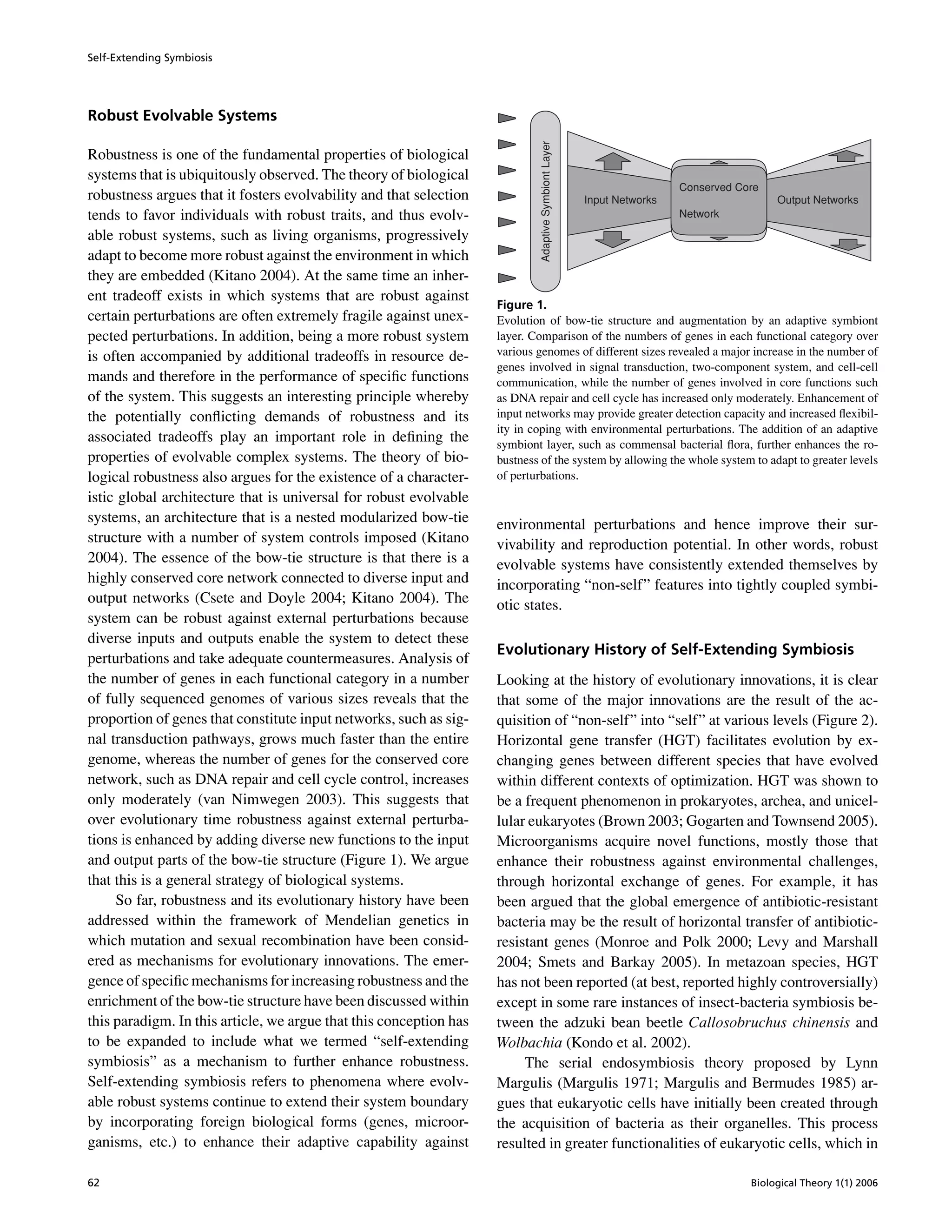
2004). The essence of the bow-tie structure is that there is a
highly conserved core network connected to diverse input and
output networks (Csete and Doyle 2004; Kitano 2004). The
system can be robust against external perturbations because
diverse inputs and outputs enable the system to detect these
perturbations and take adequate countermeasures. Analysis of
the number of genes in each functional category in a number
of fully sequenced genomes of various sizes reveals that the
proportion of genes that constitute input networks, such as sig-
nal transduction pathways, grows much faster than the entire
genome, whereas the number of genes for the conserved core
network, such as DNA repair and cell cycle control, increases
only moderately (van Nimwegen 2003). This suggests that
over evolutionary time robustness against external perturba-
tions is enhanced by adding diverse new functions to the input
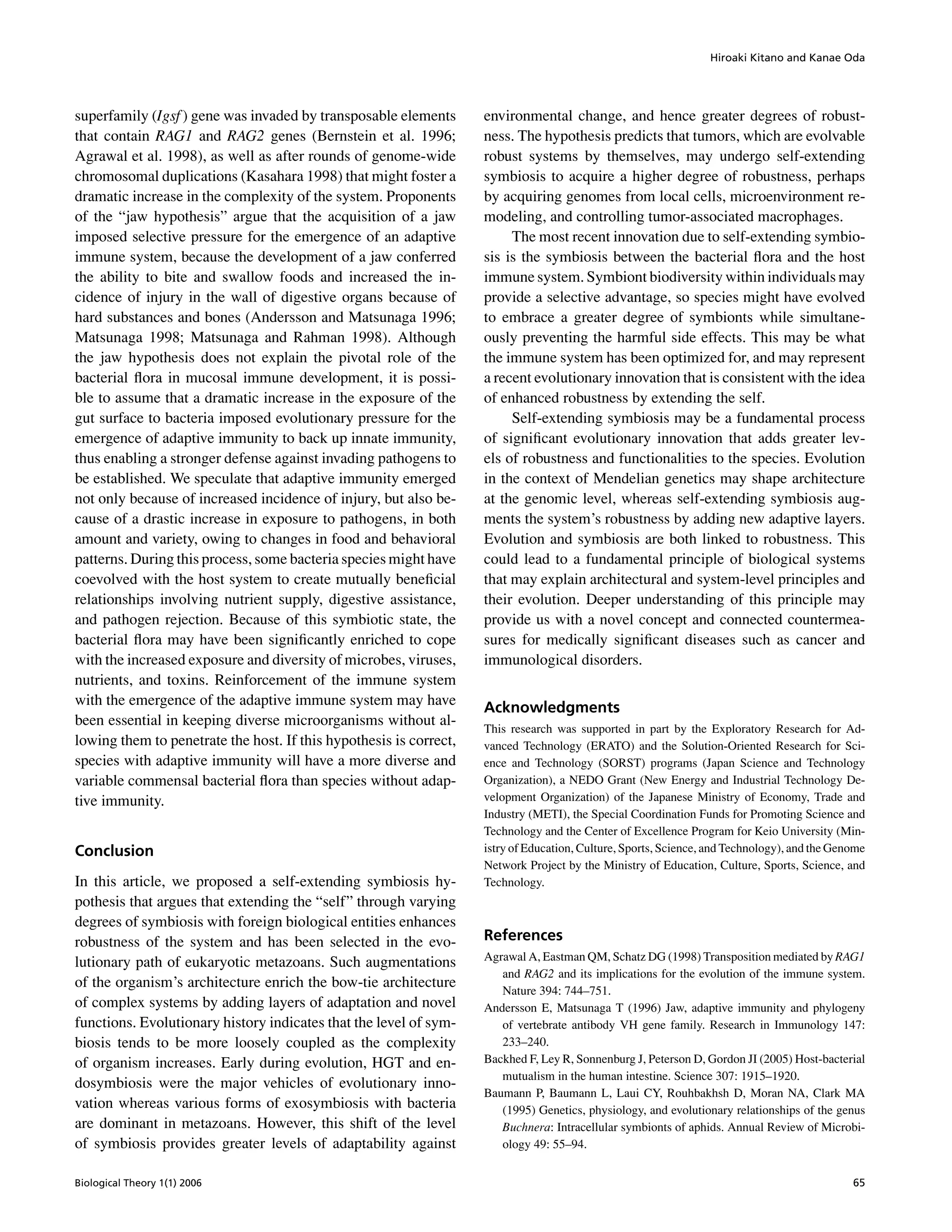
and output parts of the bow-tie structure (Figure 1). We argue
that this is a general strategy of biological systems.
So far, robustness and its evolutionary history have been
addressed within the framework of Mendelian genetics in
which mutation and sexual recombination have been consid-
ered as mechanisms for evolutionary innovations. The emer-
gence of specific mechanisms for increasing robustness and the
enrichment of the bow-tie structure have been discussed within
this paradigm. In this article, we argue that this conception has
to be expanded to include what we termed “self-extending
symbiosis” as a mechanism to further enhance robustness.
Self-extending symbiosis refers to phenomena where evolv-
able robust systems continue to extend their system boundary
by incorporating foreign biological forms (genes, microor-
ganisms, etc.) to enhance their adaptive capability against
AdaptiveSymbiontLayer
Input Networks
Conserved Core
Network
Output Networks
Figure 1.
Evolution of bow-tie structure and augmentation by an adaptive symbiont
layer. Comparison of the numbers of genes in each functional category over
various genomes of different sizes revealed a major increase in the number of
genes involved in signal transduction, two-component system, and cell-cell
communication, while the number of genes involved in core functions such
as DNA repair and cell cycle has increased only moderately. Enhancement of
input networks may provide greater detection capacity and increased flexibil-
ity in coping with environmental perturbations. The addition of an adaptive
symbiont layer, such as commensal bacterial flora, further enhances the ro-
bustness of the system by allowing the whole system to adapt to greater levels
of perturbations.
environmental perturbations and hence improve their sur-
vivability and reproduction potential. In other words, robust
evolvable systems have consistently extended themselves by
incorporating “non-self” features into tightly coupled symbi-
otic states.
Evolutionary History of Self-Extending Symbiosis
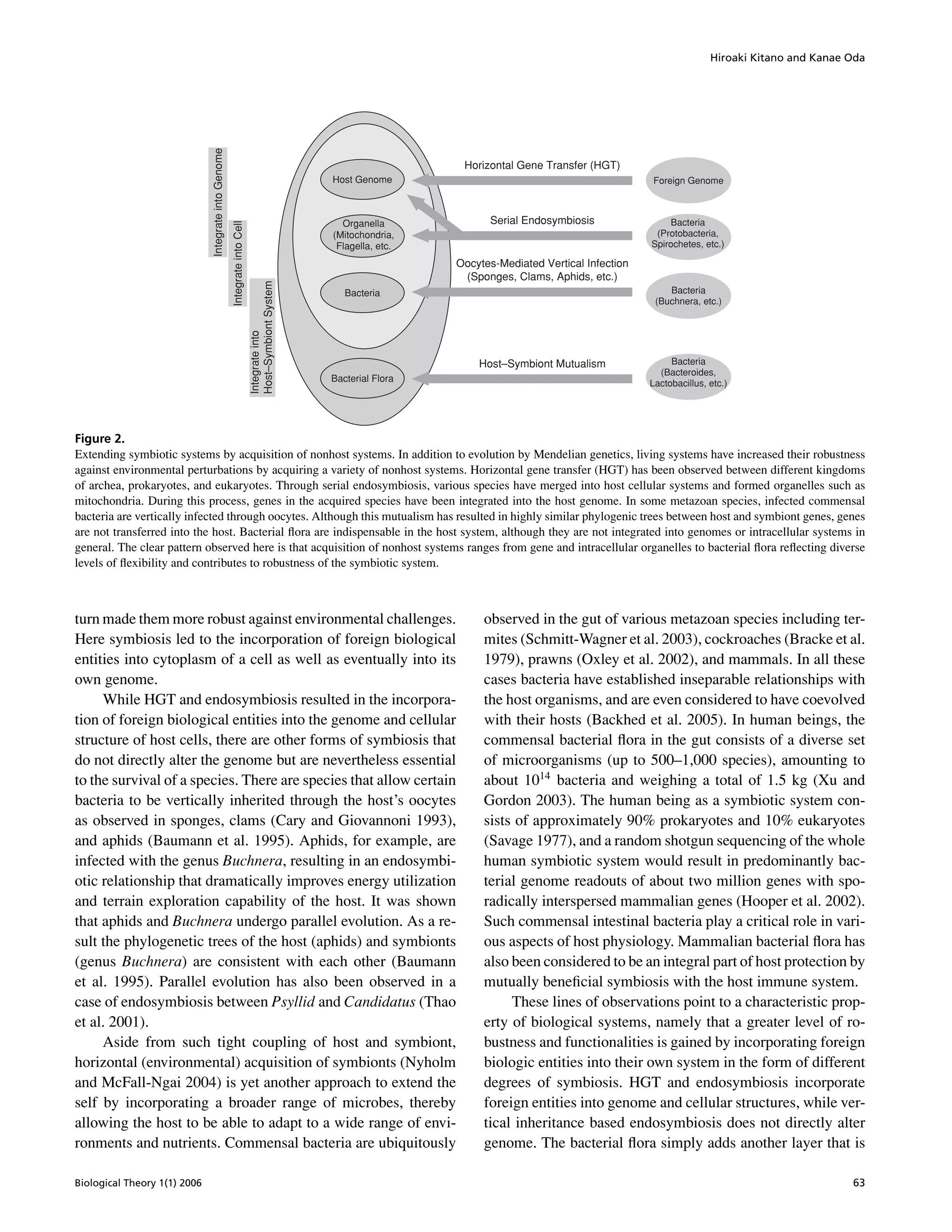
Looking at the history of evolutionary innovations, it is clear
that some of the major innovations are the result of the ac-
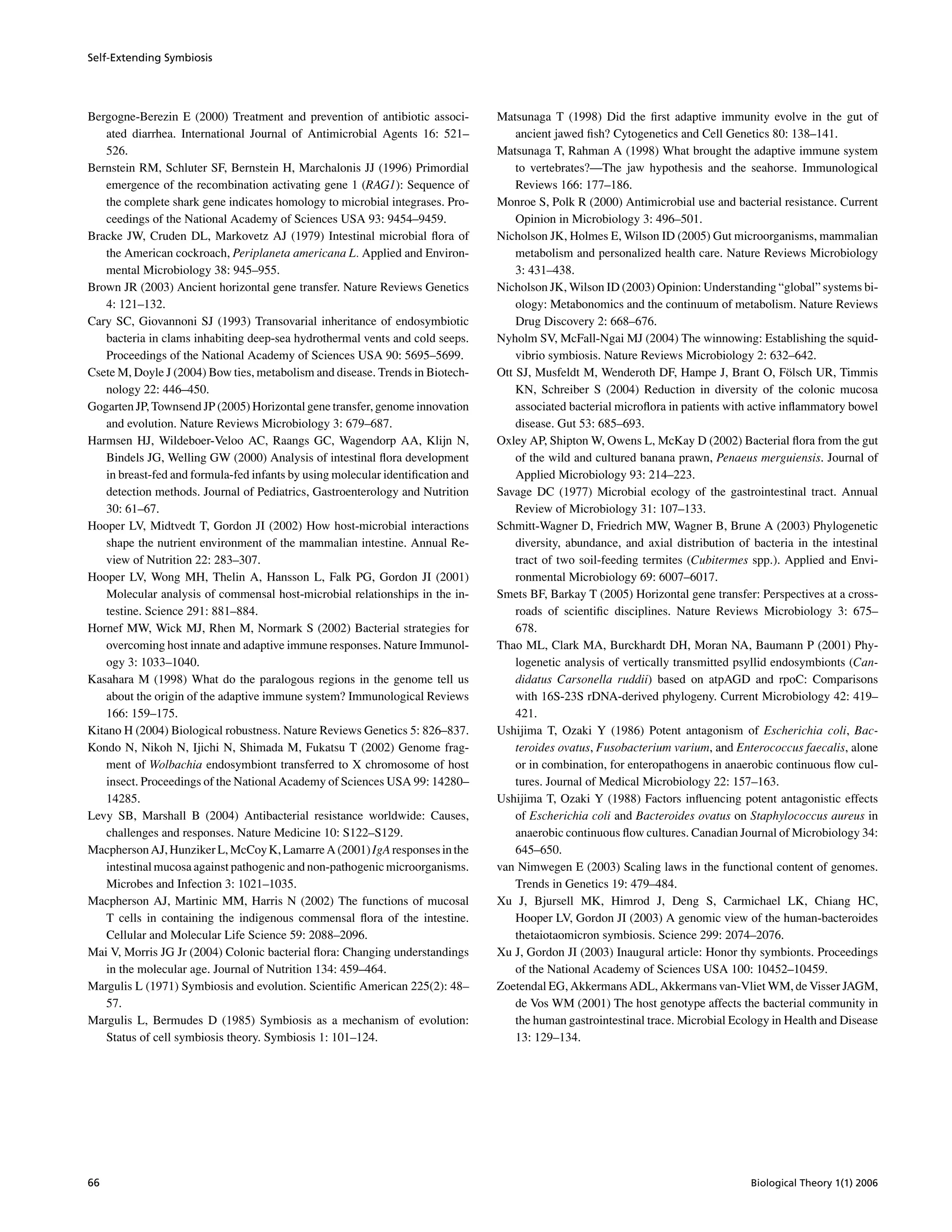
quisition of “non-self” into “self” at various levels (Figure 2).
Horizontal gene transfer (HGT) facilitates evolution by ex-
changing genes between different species that have evolved
within different contexts of optimization. HGT was shown to
be a frequent phenomenon in prokaryotes, archea, and unicel-
lular eukaryotes (Brown 2003; Gogarten and Townsend 2005).
Microorganisms acquire novel functions, mostly those that
enhance their robustness against environmental challenges,
through horizontal exchange of genes. For example, it has
been argued that the global emergence of antibiotic-resistant
bacteria may be the result of horizontal transfer of antibiotic-
resistant genes (Monroe and Polk 2000; Levy and Marshall
2004; Smets and Barkay 2005). In metazoan species, HGT
has not been reported (at best, reported highly controversially)
except in some rare instances of insect-bacteria symbiosis be-
tween the adzuki bean beetle Callosobruchus chinensis and
Wolbachia (Kondo et al. 2002).
The serial endosymbiosis theory proposed by Lynn
Margulis (Margulis 1971; Margulis and Bermudes 1985) ar-
gues that eukaryotic cells have initially been created through
the acquisition of bacteria as their organelles. This process
resulted in greater functionalities of eukaryotic cells, which in
62 Biological Theory 1(1) 2006
Hiroaki Kitano and Kanae Oda
IntegrateintoGenome
IntegrateintoCell
Integrateinto
Host–SymbiontSystem
Organella
(Mitochondria,
Flagella, etc.
Bacteria
Bacterial Flora
Horizontal Gene Transfer (HGT)
Serial Endosymbiosis
Oocytes-Mediated Vertical Infection
(Sponges, Clams, Aphids, etc.)
Host–Symbiont Mutualism Bacteria
(Bacteroides,
Lactobacillus, etc.)
Foreign Genome
Bacteria
(Protobacteria,
Spirochetes, etc.)
Bacteria
(Buchnera, etc.)
Host Genome
Figure 2.
Extending symbiotic systems by acquisition of nonhost systems. In addition to evolution by Mendelian genetics, living systems have increased their robustness
against environmental perturbations by acquiring a variety of nonhost systems. Horizontal gene transfer (HGT) has been observed between different kingdoms
of archea, prokaryotes, and eukaryotes. Through serial endosymbiosis, various species have merged into host cellular systems and formed organelles such as
mitochondria. During this process, genes in the acquired species have been integrated into the host genome. In some metazoan species, infected commensal
bacteria are vertically infected through oocytes. Although this mutualism has resulted in highly similar phylogenic trees between host and symbiont genes, genes
are not transferred into the host. Bacterial flora are indispensable in the host system, although they are not integrated into genomes or intracellular systems in
general. The clear pattern observed here is that acquisition of nonhost systems ranges from gene and intracellular organelles to bacterial flora reflecting diverse
levels of flexibility and contributes to robustness of the symbiotic system.
turn made them more robust against environmental challenges.
Here symbiosis led to the incorporation of foreign biological
entities into cytoplasm of a cell as well as eventually into its
own genome.
While HGT and endosymbiosis resulted in the incorpora-
tion of foreign biological entities into the genome and cellular
structure of host cells, there are other forms of symbiosis that
do not directly alter the genome but are nevertheless essential
to the survival of a species. There are species that allow certain
bacteria to be vertically inherited through the host’s oocytes
as observed in sponges, clams (Cary and Giovannoni 1993),
and aphids (Baumann et al. 1995). Aphids, for example, are
infected with the genus Buchnera, resulting in an endosymbi-
otic relationship that dramatically improves energy utilization
and terrain exploration capability of the host. It was shown
that aphids and Buchnera undergo parallel evolution. As a re-
sult the phylogenetic trees of the host (aphids) and symbionts
(genus Buchnera) are consistent with each other (Baumann
et al. 1995). Parallel evolution has also been observed in a
case of endosymbiosis between Psyllid and Candidatus (Thao
et al. 2001).
Aside from such tight coupling of host and symbiont,
horizontal (environmental) acquisition of symbionts (Nyholm
and McFall-Ngai 2004) is yet another approach to extend the
self by incorporating a broader range of microbes, thereby
allowing the host to be able to adapt to a wide range of envi-
ronments and nutrients. Commensal bacteria are ubiquitously
observed in the gut of various metazoan species including ter-
mites (Schmitt-Wagner et al. 2003), cockroaches (Bracke et al.
1979), prawns (Oxley et al. 2002), and mammals. In all these
cases bacteria have established inseparable relationships with
the host organisms, and are even considered to have coevolved
with their hosts (Backhed et al. 2005). In human beings, the
commensal bacterial flora in the gut consists of a diverse set
of microorganisms (up to 500–1,000 species), amounting to
about 1014
bacteria and weighing a total of 1.5 kg (Xu and
Gordon 2003). The human being as a symbiotic system con-
sists of approximately 90% prokaryotes and 10% eukaryotes
(Savage 1977), and a random shotgun sequencing of the whole
human symbiotic system would result in predominantly bac-
terial genome readouts of about two million genes with spo-
radically interspersed mammalian genes (Hooper et al. 2002).
Such commensal intestinal bacteria play a critical role in vari-
ous aspects of host physiology. Mammalian bacterial flora has
also been considered to be an integral part of host protection by
mutually beneficial symbiosis with the host immune system.
These lines of observations point to a characteristic prop-
erty of biological systems, namely that a greater level of ro-
bustness and functionalities is gained by incorporating foreign
biologic entities into their own system in the form of different
degrees of symbiosis. HGT and endosymbiosis incorporate
foreign entities into genome and cellular structures, while ver-
tical inheritance based endosymbiosis does not directly alter
genome. The bacterial flora simply adds another layer that is
Biological Theory 1(1) 2006 63
Self-Extending Symbiosis
symbiotically interacting with the mucosal immune system of
the host to its adaptive system. The general tendency observed
here is the continuous addition of external layers to the host
system by means of symbiotic incorporation of foreign enti-
ties, and it results in an increased level of robustness against
environmental perturbation.
Symbiosis of the Host Immune System
and Bacterial Flora
The relationship between the bacterial flora and the host
immune system provides an interesting example of how
symbiosis adds robustness to the host organism by offering
flexibility against environmental changes. This is a significant
example because the role of the host immune system is to re-
ject pathogens including bacteria. The symbiotic relationship
between bacteria and host is thus a consequence of a complex
dynamic interaction between the host immune system and the
bacteria. Some species of bacteria not only successfully col-
onize our body but also provide us with essential functions
without which we could not survive, such as stimulation of
the gut immune system development, rejection of pathogenic
bacteria, and contributions to our nutrient supply.
It was demonstrated that germ-free mice that have no
commensal bacterial flora have an undeveloped mucosal
immune system that has hypoplastic Peyer’s patches, as well as
significantly reduced numbers of IgA-producing plasma cells
and lamina propria CD4+
T cells (Macpherson et al. 2001,
2002).
Commensal bacteria even protect against pathogenic bac-
teria, a phenomenon known as colonization resistance. Contin-
uous flow experiments using a smaller subset of commensal
bacteria revealed that this effect is due to the antipathogen
function of commensal bacteria including Escherichia coli
and competition for nutrients and spaces that are sustained
by the dynamics of an intermicrobial metabolic network
(Ushijima and Ozaki 1986, 1988). Such a phenomenon is
medically relevant, as perturbation of commensal bacteria due
to the use of antibiotics causes antibiotic-associated diarrhea
(AAD) (Bergogne-Berezin 2000) by allowing pathogenic bac-
teria such as Clostridium difficile to proliferate. In addition, the
intestinal bacterial flora contributes to the host’s nutrient sup-
ply by starch digestion, amino acid homeostasis, vitamin syn-
thesis, etc. (Hooper et al. 2002). Some metabolic interactions
are so tightly coupled that metabolites are produced which nei-
ther the host nor bacteria alone can produce (Nicholson and
Wilson 2003; Nicholson et al. 2005). Such Sym-xenobiotic
metabolism signifies the level of symbiosis achieved between
the host and commensal bacteria. The composition of bacte-
rial flora also changes dynamically with changes in dietary and
nutrient contents (Harmsen et al. 2000; Mai and Morris 2004);
thus it is essential for the host to be able to harbor a broad
range of bacteria to enable its flora to cope with environmen-
tal perturbations. A genomic study revealed that the bacterial
flora even manipulates host gene expression in order to estab-
lish mutually advantageous partnerships (Xu et al. 2003), and
that host gene expression changes according to the composi-
tion of microbes in the flora (Hooper et al. 2001). Not only
does the bacterial flora affect the host, but the host also affects
the activity and composition of the flora through its genotype
(Zoetendal et al. 2001) and immunological responses (Hornef
et al. 2002). Because of the intricate relationship between bac-
terial flora and the host, some believe that the flora should be
considered as an additional “organ” rather than as an unwanted
guest (Hooper et al. 2002).
It should be noted that this “organ” provides enhanced
robustness against environmental perturbations by stimulating
immune system development, nutrient processing and biosyn-
thesis, and resistance to pathogenic microbes, and it has been
argued that this relationship has coevolved (Backhed et al.
2005). It has also been found that loss of biodiversity of the
bacterial flora of the intestine is associated with inflammatory
bowel diseases (Ott et al. 2004). These findings suggest that
the bacterial flora is an essential part of the system, and that
the immune system might have coevolved to allow diverse
symbionts to reside within the host without compromising the
defense of the host against other pathogens.
Has Bacterial Flora Been Enriched by the
Emergence of Adaptive Immunity?
Given the line of reasoning so far, we hypothesize that the
immune system evolved to provide robustness to the host-
symbiont system against a variety of pathogenic threats from
the environment, instead of providing defense to the host or-
ganism alone. This means that the immune system enhances
the robustness of the organisms by enabling them to harbor
a broader range of symbionts, yet rejecting pathogenic mi-
croorganisms and toxins. The premise of this hypothesis is
that harboring a broader range of symbionts contributes more
to the robustness of the host organism by enabling a spectrum
of adaptive responses against changes in dietary and nutrient
contents and the exposure to pathogenic microorganisms.
If this hypothesis is correct, the diversity of the commen-
sal bacterial flora may correlate with a variety of perturba-
tions that the species encountered. This means that a species
that has been exposed to a broader range of foods, microor-
ganisms, and threats from the environment possibly caused
by an expanding range of habitat and food intake behavior
will harbor a more diverse bacterial flora. Another interesting
hypothesis may provide additional support for this specula-
tion. Studies of evolution of the immune system show that
adaptive immunity emerged primarily after the origin of the
jawed vertebrates, possibly when the variable (V) type of an Ig
64 Biological Theory 1(1) 2006
Hiroaki Kitano and Kanae Oda
superfamily (Igsf) gene was invaded by transposable elements
that contain RAG1 and RAG2 genes (Bernstein et al. 1996;
Agrawal et al. 1998), as well as after rounds of genome-wide
chromosomal duplications (Kasahara 1998) that might foster a
dramatic increase in the complexity of the system. Proponents
of the “jaw hypothesis” argue that the acquisition of a jaw
imposed selective pressure for the emergence of an adaptive
immune system, because the development of a jaw conferred
the ability to bite and swallow foods and increased the in-
cidence of injury in the wall of digestive organs because of
hard substances and bones (Andersson and Matsunaga 1996;
Matsunaga 1998; Matsunaga and Rahman 1998). Although
the jaw hypothesis does not explain the pivotal role of the
bacterial flora in mucosal immune development, it is possi-
ble to assume that a dramatic increase in the exposure of the
gut surface to bacteria imposed evolutionary pressure for the
emergence of adaptive immunity to back up innate immunity,
thus enabling a stronger defense against invading pathogens to
be established. We speculate that adaptive immunity emerged
not only because of increased incidence of injury, but also be-
cause of a drastic increase in exposure to pathogens, in both
amount and variety, owing to changes in food and behavioral
patterns. During this process, some bacteria species might have
coevolved with the host system to create mutually beneficial
relationships involving nutrient supply, digestive assistance,
and pathogen rejection. Because of this symbiotic state, the
bacterial flora may have been significantly enriched to cope
with the increased exposure and diversity of microbes, viruses,
nutrients, and toxins. Reinforcement of the immune system
with the emergence of the adaptive immune system may have
been essential in keeping diverse microorganisms without al-
lowing them to penetrate the host. If this hypothesis is correct,
species with adaptive immunity will have a more diverse and
variable commensal bacterial flora than species without adap-
tive immunity.
Conclusion
In this article, we proposed a self-extending symbiosis hy-
pothesis that argues that extending the “self” through varying
degrees of symbiosis with foreign biological entities enhances
robustness of the system and has been selected in the evo-
lutionary path of eukaryotic metazoans. Such augmentations
of the organism’s architecture enrich the bow-tie architecture
of complex systems by adding layers of adaptation and novel
functions. Evolutionary history indicates that the level of sym-
biosis tends to be more loosely coupled as the complexity
of organism increases. Early during evolution, HGT and en-
dosymbiosis were the major vehicles of evolutionary inno-
vation whereas various forms of exosymbiosis with bacteria
are dominant in metazoans. However, this shift of the level
of symbiosis provides greater levels of adaptability against
environmental change, and hence greater degrees of robust-
ness. The hypothesis predicts that tumors, which are evolvable
robust systems by themselves, may undergo self-extending
symbiosis to acquire a higher degree of robustness, perhaps
by acquiring genomes from local cells, microenvironment re-
modeling, and controlling tumor-associated macrophages.
The most recent innovation due to self-extending symbio-
sis is the symbiosis between the bacterial flora and the host
immune system. Symbiont biodiversity within individuals may
provide a selective advantage, so species might have evolved
to embrace a greater degree of symbionts while simultane-
ously preventing the harmful side effects. This may be what
the immune system has been optimized for, and may represent
a recent evolutionary innovation that is consistent with the idea
of enhanced robustness by extending the self.
Self-extending symbiosis may be a fundamental process
of significant evolutionary innovation that adds greater lev-
els of robustness and functionalities to the species. Evolution
in the context of Mendelian genetics may shape architecture
at the genomic level, whereas self-extending symbiosis aug-
ments the system’s robustness by adding new adaptive layers.
Evolution and symbiosis are both linked to robustness. This
could lead to a fundamental principle of biological systems
that may explain architectural and system-level principles and
their evolution. Deeper understanding of this principle may
provide us with a novel concept and connected countermea-
sures for medically significant diseases such as cancer and
immunological disorders.
Acknowledgments
This research was supported in part by the Exploratory Research for Ad-
vanced Technology (ERATO) and the Solution-Oriented Research for Sci-
ence and Technology (SORST) programs (Japan Science and Technology
Organization), a NEDO Grant (New Energy and Industrial Technology De-
velopment Organization) of the Japanese Ministry of Economy, Trade and
Industry (METI), the Special Coordination Funds for Promoting Science and
Technology and the Center of Excellence Program for Keio University (Min-
istry of Education, Culture, Sports, Science, and Technology), and the Genome
Network Project by the Ministry of Education, Culture, Sports, Science, and
Technology.
References
Agrawal A, Eastman QM, Schatz DG (1998) Transposition mediated by RAG1
and RAG2 and its implications for the evolution of the immune system.
Nature 394: 744–751.
Andersson E, Matsunaga T (1996) Jaw, adaptive immunity and phylogeny
of vertebrate antibody VH gene family. Research in Immunology 147:
233–240.
Backhed F, Ley R, Sonnenburg J, Peterson D, Gordon JI (2005) Host-bacterial
mutualism in the human intestine. Science 307: 1915–1920.
Baumann P, Baumann L, Laui CY, Rouhbakhsh D, Moran NA, Clark MA
(1995) Genetics, physiology, and evolutionary relationships of the genus
Buchnera: Intracellular symbionts of aphids. Annual Review of Microbi-
ology 49: 55–94.
Biological Theory 1(1) 2006 65
Self-Extending Symbiosis
Bergogne-Berezin E (2000) Treatment and prevention of antibiotic associ-
ated diarrhea. International Journal of Antimicrobial Agents 16: 521–
526.
Bernstein RM, Schluter SF, Bernstein H, Marchalonis JJ (1996) Primordial
emergence of the recombination activating gene 1 (RAG1): Sequence of
the complete shark gene indicates homology to microbial integrases. Pro-
ceedings of the National Academy of Sciences USA 93: 9454–9459.
Bracke JW, Cruden DL, Markovetz AJ (1979) Intestinal microbial flora of
the American cockroach, Periplaneta americana L. Applied and Environ-
mental Microbiology 38: 945–955.
Brown JR (2003) Ancient horizontal gene transfer. Nature Reviews Genetics
4: 121–132.
Cary SC, Giovannoni SJ (1993) Transovarial inheritance of endosymbiotic
bacteria in clams inhabiting deep-sea hydrothermal vents and cold seeps.
Proceedings of the National Academy of Sciences USA 90: 5695–5699.
Csete M, Doyle J (2004) Bow ties, metabolism and disease. Trends in Biotech-
nology 22: 446–450.
Gogarten JP, Townsend JP (2005) Horizontal gene transfer, genome innovation
and evolution. Nature Reviews Microbiology 3: 679–687.
Harmsen HJ, Wildeboer-Veloo AC, Raangs GC, Wagendorp AA, Klijn N,
Bindels JG, Welling GW (2000) Analysis of intestinal flora development
in breast-fed and formula-fed infants by using molecular identification and
detection methods. Journal of Pediatrics, Gastroenterology and Nutrition
30: 61–67.
Hooper LV, Midtvedt T, Gordon JI (2002) How host-microbial interactions
shape the nutrient environment of the mammalian intestine. Annual Re-
view of Nutrition 22: 283–307.
Hooper LV, Wong MH, Thelin A, Hansson L, Falk PG, Gordon JI (2001)
Molecular analysis of commensal host-microbial relationships in the in-
testine. Science 291: 881–884.
Hornef MW, Wick MJ, Rhen M, Normark S (2002) Bacterial strategies for
overcoming host innate and adaptive immune responses. Nature Immunol-
ogy 3: 1033–1040.
Kasahara M (1998) What do the paralogous regions in the genome tell us
about the origin of the adaptive immune system? Immunological Reviews
166: 159–175.
Kitano H (2004) Biological robustness. Nature Reviews Genetics 5: 826–837.
Kondo N, Nikoh N, Ijichi N, Shimada M, Fukatsu T (2002) Genome frag-
ment of Wolbachia endosymbiont transferred to X chromosome of host
insect. Proceedings of the National Academy of Sciences USA 99: 14280–
14285.
Levy SB, Marshall B (2004) Antibacterial resistance worldwide: Causes,
challenges and responses. Nature Medicine 10: S122–S129.
Macpherson AJ,Hunziker L,McCoy K,LamarreA(2001)IgA responsesin the
intestinal mucosa against pathogenic and non-pathogenic microorganisms.
Microbes and Infection 3: 1021–1035.
Macpherson AJ, Martinic MM, Harris N (2002) The functions of mucosal
T cells in containing the indigenous commensal flora of the intestine.
Cellular and Molecular Life Science 59: 2088–2096.
Mai V, Morris JG Jr (2004) Colonic bacterial flora: Changing understandings
in the molecular age. Journal of Nutrition 134: 459–464.
Margulis L (1971) Symbiosis and evolution. Scientific American 225(2): 48–
57.
Margulis L, Bermudes D (1985) Symbiosis as a mechanism of evolution:
Status of cell symbiosis theory. Symbiosis 1: 101–124.
Matsunaga T (1998) Did the first adaptive immunity evolve in the gut of
ancient jawed fish? Cytogenetics and Cell Genetics 80: 138–141.
Matsunaga T, Rahman A (1998) What brought the adaptive immune system
to vertebrates?—The jaw hypothesis and the seahorse. Immunological
Reviews 166: 177–186.
Monroe S, Polk R (2000) Antimicrobial use and bacterial resistance. Current
Opinion in Microbiology 3: 496–501.
Nicholson JK, Holmes E, Wilson ID (2005) Gut microorganisms, mammalian
metabolism and personalized health care. Nature Reviews Microbiology
3: 431–438.
Nicholson JK, Wilson ID (2003) Opinion: Understanding “global” systems bi-
ology: Metabonomics and the continuum of metabolism. Nature Reviews
Drug Discovery 2: 668–676.
Nyholm SV, McFall-Ngai MJ (2004) The winnowing: Establishing the squid-
vibrio symbiosis. Nature Reviews Microbiology 2: 632–642.
Ott SJ, Musfeldt M, Wenderoth DF, Hampe J, Brant O, F¨olsch UR, Timmis
KN, Schreiber S (2004) Reduction in diversity of the colonic mucosa
associated bacterial microflora in patients with active inflammatory bowel
disease. Gut 53: 685–693.
Oxley AP, Shipton W, Owens L, McKay D (2002) Bacterial flora from the gut
of the wild and cultured banana prawn, Penaeus merguiensis. Journal of
Applied Microbiology 93: 214–223.
Savage DC (1977) Microbial ecology of the gastrointestinal tract. Annual
Review of Microbiology 31: 107–133.
Schmitt-Wagner D, Friedrich MW, Wagner B, Brune A (2003) Phylogenetic
diversity, abundance, and axial distribution of bacteria in the intestinal
tract of two soil-feeding termites (Cubitermes spp.). Applied and Envi-
ronmental Microbiology 69: 6007–6017.
Smets BF, Barkay T (2005) Horizontal gene transfer: Perspectives at a cross-
roads of scientific disciplines. Nature Reviews Microbiology 3: 675–
678.
Thao ML, Clark MA, Burckhardt DH, Moran NA, Baumann P (2001) Phy-
logenetic analysis of vertically transmitted psyllid endosymbionts (Can-
didatus Carsonella ruddii) based on atpAGD and rpoC: Comparisons
with 16S-23S rDNA-derived phylogeny. Current Microbiology 42: 419–
421.
Ushijima T, Ozaki Y (1986) Potent antagonism of Escherichia coli, Bac-
teroides ovatus, Fusobacterium varium, and Enterococcus faecalis, alone
or in combination, for enteropathogens in anaerobic continuous flow cul-
tures. Journal of Medical Microbiology 22: 157–163.
Ushijima T, Ozaki Y (1988) Factors influencing potent antagonistic effects
of Escherichia coli and Bacteroides ovatus on Staphylococcus aureus in
anaerobic continuous flow cultures. Canadian Journal of Microbiology 34:
645–650.
van Nimwegen E (2003) Scaling laws in the functional content of genomes.
Trends in Genetics 19: 479–484.
Xu J, Bjursell MK, Himrod J, Deng S, Carmichael LK, Chiang HC,
Hooper LV, Gordon JI (2003) A genomic view of the human-bacteroides
thetaiotaomicron symbiosis. Science 299: 2074–2076.
Xu J, Gordon JI (2003) Inaugural article: Honor thy symbionts. Proceedings
of the National Academy of Sciences USA 100: 10452–10459.
Zoetendal EG, Akkermans ADL, Akkermans van-Vliet WM, de Visser JAGM,
de Vos WM (2001) The host genotype affects the bacterial community in
the human gastrointestinal trace. Microbial Ecology in Health and Disease
13: 129–134.
66 Biological Theory 1(1) 2006

Biot.2006.1.1

  • 1.
    Self-Extending Symbiosis: AMechanism for Increasing Robustness Through Evolution Hiroaki Kitano Sony Computer Science Laboratories, Inc. Shinagawa, Tokyo, Japan & The Systems Biology Institute Shibuya, Tokyo, Japan Correspondence to: kitano@symbio.jst.go.jp Kanae Oda The Systems Biology Institute Shibuya, Tokyo, Japan Abstract Robustness is a fundamental property of biological systems, observed ubiquitously across species and at different levels of organization from gene regulation to ecosystem. The theory of biological robustness argues that robustness fosters evolv- ability and that together they entail various tradeoffs as well as characteristic architectures and mechanisms. We argue that classes of biological systems have evolved to enhance their ro- bustness by extending their system boundary through a series of symbioses with foreign biological entities (“self-extending symbiosis”). A series of major biological innovations has been achieved by events consistent with this framework: horizontal gene transfer, serial endosymbiosis, oocytes-mediated verti- cal infection, and host-symbiont mutualism for bacterial flora. Self-extending symbiosis contributes to robustness because symbiotic foreign biological entities can enhance the adapta- tive capacity of the system against environmental perturbations as well as contribute novel functions. In addition, evolution- ary history indicates that the degree of symbiosis achieved has substantially changed from tight integration into the genome (which is less adaptive) to loose integration as bacterial flora (which can be highly adaptive). The most dramatic example can be seen in the symbiosis of host immune system and bacte- rial flora in which substantial function of host defense depends on the proper maintenance of bacterial flora and its adaptive capability. Biological systems following this type of evolu- tionary path might have attained high levels of functionality, robustness, and evolvability. Thus, robustness, evolution, and self-extending symbiosis may form essential system principles for biology. Keywords bacterial flora, evolvability, immune system, robustness, sym- biosis September 30, 2005; accepted October 25, 2005 Biological Theory 1(1) 2006, 61–66. c 2006 Konrad Lorenz Institute for Evolution and Cognition Research 61
  • 2.
    Self-Extending Symbiosis Robust EvolvableSystems Robustness is one of the fundamental properties of biological systems that is ubiquitously observed. The theory of biological robustness argues that it fosters evolvability and that selection tends to favor individuals with robust traits, and thus evolv- able robust systems, such as living organisms, progressively adapt to become more robust against the environment in which they are embedded (Kitano 2004). At the same time an inher- ent tradeoff exists in which systems that are robust against certain perturbations are often extremely fragile against unex- pected perturbations. In addition, being a more robust system is often accompanied by additional tradeoffs in resource de- mands and therefore in the performance of specific functions of the system. This suggests an interesting principle whereby the potentially conflicting demands of robustness and its associated tradeoffs play an important role in defining the properties of evolvable complex systems. The theory of bio- logical robustness also argues for the existence of a character- istic global architecture that is universal for robust evolvable systems, an architecture that is a nested modularized bow-tie structure with a number of system controls imposed (Kitano 2004). The essence of the bow-tie structure is that there is a highly conserved core network connected to diverse input and output networks (Csete and Doyle 2004; Kitano 2004). The system can be robust against external perturbations because diverse inputs and outputs enable the system to detect these perturbations and take adequate countermeasures. Analysis of the number of genes in each functional category in a number of fully sequenced genomes of various sizes reveals that the proportion of genes that constitute input networks, such as sig- nal transduction pathways, grows much faster than the entire genome, whereas the number of genes for the conserved core network, such as DNA repair and cell cycle control, increases only moderately (van Nimwegen 2003). This suggests that over evolutionary time robustness against external perturba- tions is enhanced by adding diverse new functions to the input and output parts of the bow-tie structure (Figure 1). We argue that this is a general strategy of biological systems. So far, robustness and its evolutionary history have been addressed within the framework of Mendelian genetics in which mutation and sexual recombination have been consid- ered as mechanisms for evolutionary innovations. The emer- gence of specific mechanisms for increasing robustness and the enrichment of the bow-tie structure have been discussed within this paradigm. In this article, we argue that this conception has to be expanded to include what we termed “self-extending symbiosis” as a mechanism to further enhance robustness. Self-extending symbiosis refers to phenomena where evolv- able robust systems continue to extend their system boundary by incorporating foreign biological forms (genes, microor- ganisms, etc.) to enhance their adaptive capability against AdaptiveSymbiontLayer Input Networks Conserved Core Network Output Networks Figure 1. Evolution of bow-tie structure and augmentation by an adaptive symbiont layer. Comparison of the numbers of genes in each functional category over various genomes of different sizes revealed a major increase in the number of genes involved in signal transduction, two-component system, and cell-cell communication, while the number of genes involved in core functions such as DNA repair and cell cycle has increased only moderately. Enhancement of input networks may provide greater detection capacity and increased flexibil- ity in coping with environmental perturbations. The addition of an adaptive symbiont layer, such as commensal bacterial flora, further enhances the ro- bustness of the system by allowing the whole system to adapt to greater levels of perturbations. environmental perturbations and hence improve their sur- vivability and reproduction potential. In other words, robust evolvable systems have consistently extended themselves by incorporating “non-self” features into tightly coupled symbi- otic states. Evolutionary History of Self-Extending Symbiosis Looking at the history of evolutionary innovations, it is clear that some of the major innovations are the result of the ac- quisition of “non-self” into “self” at various levels (Figure 2). Horizontal gene transfer (HGT) facilitates evolution by ex- changing genes between different species that have evolved within different contexts of optimization. HGT was shown to be a frequent phenomenon in prokaryotes, archea, and unicel- lular eukaryotes (Brown 2003; Gogarten and Townsend 2005). Microorganisms acquire novel functions, mostly those that enhance their robustness against environmental challenges, through horizontal exchange of genes. For example, it has been argued that the global emergence of antibiotic-resistant bacteria may be the result of horizontal transfer of antibiotic- resistant genes (Monroe and Polk 2000; Levy and Marshall 2004; Smets and Barkay 2005). In metazoan species, HGT has not been reported (at best, reported highly controversially) except in some rare instances of insect-bacteria symbiosis be- tween the adzuki bean beetle Callosobruchus chinensis and Wolbachia (Kondo et al. 2002). The serial endosymbiosis theory proposed by Lynn Margulis (Margulis 1971; Margulis and Bermudes 1985) ar- gues that eukaryotic cells have initially been created through the acquisition of bacteria as their organelles. This process resulted in greater functionalities of eukaryotic cells, which in 62 Biological Theory 1(1) 2006
  • 3.
    Hiroaki Kitano andKanae Oda IntegrateintoGenome IntegrateintoCell Integrateinto Host–SymbiontSystem Organella (Mitochondria, Flagella, etc. Bacteria Bacterial Flora Horizontal Gene Transfer (HGT) Serial Endosymbiosis Oocytes-Mediated Vertical Infection (Sponges, Clams, Aphids, etc.) Host–Symbiont Mutualism Bacteria (Bacteroides, Lactobacillus, etc.) Foreign Genome Bacteria (Protobacteria, Spirochetes, etc.) Bacteria (Buchnera, etc.) Host Genome Figure 2. Extending symbiotic systems by acquisition of nonhost systems. In addition to evolution by Mendelian genetics, living systems have increased their robustness against environmental perturbations by acquiring a variety of nonhost systems. Horizontal gene transfer (HGT) has been observed between different kingdoms of archea, prokaryotes, and eukaryotes. Through serial endosymbiosis, various species have merged into host cellular systems and formed organelles such as mitochondria. During this process, genes in the acquired species have been integrated into the host genome. In some metazoan species, infected commensal bacteria are vertically infected through oocytes. Although this mutualism has resulted in highly similar phylogenic trees between host and symbiont genes, genes are not transferred into the host. Bacterial flora are indispensable in the host system, although they are not integrated into genomes or intracellular systems in general. The clear pattern observed here is that acquisition of nonhost systems ranges from gene and intracellular organelles to bacterial flora reflecting diverse levels of flexibility and contributes to robustness of the symbiotic system. turn made them more robust against environmental challenges. Here symbiosis led to the incorporation of foreign biological entities into cytoplasm of a cell as well as eventually into its own genome. While HGT and endosymbiosis resulted in the incorpora- tion of foreign biological entities into the genome and cellular structure of host cells, there are other forms of symbiosis that do not directly alter the genome but are nevertheless essential to the survival of a species. There are species that allow certain bacteria to be vertically inherited through the host’s oocytes as observed in sponges, clams (Cary and Giovannoni 1993), and aphids (Baumann et al. 1995). Aphids, for example, are infected with the genus Buchnera, resulting in an endosymbi- otic relationship that dramatically improves energy utilization and terrain exploration capability of the host. It was shown that aphids and Buchnera undergo parallel evolution. As a re- sult the phylogenetic trees of the host (aphids) and symbionts (genus Buchnera) are consistent with each other (Baumann et al. 1995). Parallel evolution has also been observed in a case of endosymbiosis between Psyllid and Candidatus (Thao et al. 2001). Aside from such tight coupling of host and symbiont, horizontal (environmental) acquisition of symbionts (Nyholm and McFall-Ngai 2004) is yet another approach to extend the self by incorporating a broader range of microbes, thereby allowing the host to be able to adapt to a wide range of envi- ronments and nutrients. Commensal bacteria are ubiquitously observed in the gut of various metazoan species including ter- mites (Schmitt-Wagner et al. 2003), cockroaches (Bracke et al. 1979), prawns (Oxley et al. 2002), and mammals. In all these cases bacteria have established inseparable relationships with the host organisms, and are even considered to have coevolved with their hosts (Backhed et al. 2005). In human beings, the commensal bacterial flora in the gut consists of a diverse set of microorganisms (up to 500–1,000 species), amounting to about 1014 bacteria and weighing a total of 1.5 kg (Xu and Gordon 2003). The human being as a symbiotic system con- sists of approximately 90% prokaryotes and 10% eukaryotes (Savage 1977), and a random shotgun sequencing of the whole human symbiotic system would result in predominantly bac- terial genome readouts of about two million genes with spo- radically interspersed mammalian genes (Hooper et al. 2002). Such commensal intestinal bacteria play a critical role in vari- ous aspects of host physiology. Mammalian bacterial flora has also been considered to be an integral part of host protection by mutually beneficial symbiosis with the host immune system. These lines of observations point to a characteristic prop- erty of biological systems, namely that a greater level of ro- bustness and functionalities is gained by incorporating foreign biologic entities into their own system in the form of different degrees of symbiosis. HGT and endosymbiosis incorporate foreign entities into genome and cellular structures, while ver- tical inheritance based endosymbiosis does not directly alter genome. The bacterial flora simply adds another layer that is Biological Theory 1(1) 2006 63
  • 4.
    Self-Extending Symbiosis symbiotically interactingwith the mucosal immune system of the host to its adaptive system. The general tendency observed here is the continuous addition of external layers to the host system by means of symbiotic incorporation of foreign enti- ties, and it results in an increased level of robustness against environmental perturbation. Symbiosis of the Host Immune System and Bacterial Flora The relationship between the bacterial flora and the host immune system provides an interesting example of how symbiosis adds robustness to the host organism by offering flexibility against environmental changes. This is a significant example because the role of the host immune system is to re- ject pathogens including bacteria. The symbiotic relationship between bacteria and host is thus a consequence of a complex dynamic interaction between the host immune system and the bacteria. Some species of bacteria not only successfully col- onize our body but also provide us with essential functions without which we could not survive, such as stimulation of the gut immune system development, rejection of pathogenic bacteria, and contributions to our nutrient supply. It was demonstrated that germ-free mice that have no commensal bacterial flora have an undeveloped mucosal immune system that has hypoplastic Peyer’s patches, as well as significantly reduced numbers of IgA-producing plasma cells and lamina propria CD4+ T cells (Macpherson et al. 2001, 2002). Commensal bacteria even protect against pathogenic bac- teria, a phenomenon known as colonization resistance. Contin- uous flow experiments using a smaller subset of commensal bacteria revealed that this effect is due to the antipathogen function of commensal bacteria including Escherichia coli and competition for nutrients and spaces that are sustained by the dynamics of an intermicrobial metabolic network (Ushijima and Ozaki 1986, 1988). Such a phenomenon is medically relevant, as perturbation of commensal bacteria due to the use of antibiotics causes antibiotic-associated diarrhea (AAD) (Bergogne-Berezin 2000) by allowing pathogenic bac- teria such as Clostridium difficile to proliferate. In addition, the intestinal bacterial flora contributes to the host’s nutrient sup- ply by starch digestion, amino acid homeostasis, vitamin syn- thesis, etc. (Hooper et al. 2002). Some metabolic interactions are so tightly coupled that metabolites are produced which nei- ther the host nor bacteria alone can produce (Nicholson and Wilson 2003; Nicholson et al. 2005). Such Sym-xenobiotic metabolism signifies the level of symbiosis achieved between the host and commensal bacteria. The composition of bacte- rial flora also changes dynamically with changes in dietary and nutrient contents (Harmsen et al. 2000; Mai and Morris 2004); thus it is essential for the host to be able to harbor a broad range of bacteria to enable its flora to cope with environmen- tal perturbations. A genomic study revealed that the bacterial flora even manipulates host gene expression in order to estab- lish mutually advantageous partnerships (Xu et al. 2003), and that host gene expression changes according to the composi- tion of microbes in the flora (Hooper et al. 2001). Not only does the bacterial flora affect the host, but the host also affects the activity and composition of the flora through its genotype (Zoetendal et al. 2001) and immunological responses (Hornef et al. 2002). Because of the intricate relationship between bac- terial flora and the host, some believe that the flora should be considered as an additional “organ” rather than as an unwanted guest (Hooper et al. 2002). It should be noted that this “organ” provides enhanced robustness against environmental perturbations by stimulating immune system development, nutrient processing and biosyn- thesis, and resistance to pathogenic microbes, and it has been argued that this relationship has coevolved (Backhed et al. 2005). It has also been found that loss of biodiversity of the bacterial flora of the intestine is associated with inflammatory bowel diseases (Ott et al. 2004). These findings suggest that the bacterial flora is an essential part of the system, and that the immune system might have coevolved to allow diverse symbionts to reside within the host without compromising the defense of the host against other pathogens. Has Bacterial Flora Been Enriched by the Emergence of Adaptive Immunity? Given the line of reasoning so far, we hypothesize that the immune system evolved to provide robustness to the host- symbiont system against a variety of pathogenic threats from the environment, instead of providing defense to the host or- ganism alone. This means that the immune system enhances the robustness of the organisms by enabling them to harbor a broader range of symbionts, yet rejecting pathogenic mi- croorganisms and toxins. The premise of this hypothesis is that harboring a broader range of symbionts contributes more to the robustness of the host organism by enabling a spectrum of adaptive responses against changes in dietary and nutrient contents and the exposure to pathogenic microorganisms. If this hypothesis is correct, the diversity of the commen- sal bacterial flora may correlate with a variety of perturba- tions that the species encountered. This means that a species that has been exposed to a broader range of foods, microor- ganisms, and threats from the environment possibly caused by an expanding range of habitat and food intake behavior will harbor a more diverse bacterial flora. Another interesting hypothesis may provide additional support for this specula- tion. Studies of evolution of the immune system show that adaptive immunity emerged primarily after the origin of the jawed vertebrates, possibly when the variable (V) type of an Ig 64 Biological Theory 1(1) 2006
  • 5.
    Hiroaki Kitano andKanae Oda superfamily (Igsf) gene was invaded by transposable elements that contain RAG1 and RAG2 genes (Bernstein et al. 1996; Agrawal et al. 1998), as well as after rounds of genome-wide chromosomal duplications (Kasahara 1998) that might foster a dramatic increase in the complexity of the system. Proponents of the “jaw hypothesis” argue that the acquisition of a jaw imposed selective pressure for the emergence of an adaptive immune system, because the development of a jaw conferred the ability to bite and swallow foods and increased the in- cidence of injury in the wall of digestive organs because of hard substances and bones (Andersson and Matsunaga 1996; Matsunaga 1998; Matsunaga and Rahman 1998). Although the jaw hypothesis does not explain the pivotal role of the bacterial flora in mucosal immune development, it is possi- ble to assume that a dramatic increase in the exposure of the gut surface to bacteria imposed evolutionary pressure for the emergence of adaptive immunity to back up innate immunity, thus enabling a stronger defense against invading pathogens to be established. We speculate that adaptive immunity emerged not only because of increased incidence of injury, but also be- cause of a drastic increase in exposure to pathogens, in both amount and variety, owing to changes in food and behavioral patterns. During this process, some bacteria species might have coevolved with the host system to create mutually beneficial relationships involving nutrient supply, digestive assistance, and pathogen rejection. Because of this symbiotic state, the bacterial flora may have been significantly enriched to cope with the increased exposure and diversity of microbes, viruses, nutrients, and toxins. Reinforcement of the immune system with the emergence of the adaptive immune system may have been essential in keeping diverse microorganisms without al- lowing them to penetrate the host. If this hypothesis is correct, species with adaptive immunity will have a more diverse and variable commensal bacterial flora than species without adap- tive immunity. Conclusion In this article, we proposed a self-extending symbiosis hy- pothesis that argues that extending the “self” through varying degrees of symbiosis with foreign biological entities enhances robustness of the system and has been selected in the evo- lutionary path of eukaryotic metazoans. Such augmentations of the organism’s architecture enrich the bow-tie architecture of complex systems by adding layers of adaptation and novel functions. Evolutionary history indicates that the level of sym- biosis tends to be more loosely coupled as the complexity of organism increases. Early during evolution, HGT and en- dosymbiosis were the major vehicles of evolutionary inno- vation whereas various forms of exosymbiosis with bacteria are dominant in metazoans. However, this shift of the level of symbiosis provides greater levels of adaptability against environmental change, and hence greater degrees of robust- ness. The hypothesis predicts that tumors, which are evolvable robust systems by themselves, may undergo self-extending symbiosis to acquire a higher degree of robustness, perhaps by acquiring genomes from local cells, microenvironment re- modeling, and controlling tumor-associated macrophages. The most recent innovation due to self-extending symbio- sis is the symbiosis between the bacterial flora and the host immune system. Symbiont biodiversity within individuals may provide a selective advantage, so species might have evolved to embrace a greater degree of symbionts while simultane- ously preventing the harmful side effects. This may be what the immune system has been optimized for, and may represent a recent evolutionary innovation that is consistent with the idea of enhanced robustness by extending the self. Self-extending symbiosis may be a fundamental process of significant evolutionary innovation that adds greater lev- els of robustness and functionalities to the species. Evolution in the context of Mendelian genetics may shape architecture at the genomic level, whereas self-extending symbiosis aug- ments the system’s robustness by adding new adaptive layers. Evolution and symbiosis are both linked to robustness. This could lead to a fundamental principle of biological systems that may explain architectural and system-level principles and their evolution. Deeper understanding of this principle may provide us with a novel concept and connected countermea- sures for medically significant diseases such as cancer and immunological disorders. Acknowledgments This research was supported in part by the Exploratory Research for Ad- vanced Technology (ERATO) and the Solution-Oriented Research for Sci- ence and Technology (SORST) programs (Japan Science and Technology Organization), a NEDO Grant (New Energy and Industrial Technology De- velopment Organization) of the Japanese Ministry of Economy, Trade and Industry (METI), the Special Coordination Funds for Promoting Science and Technology and the Center of Excellence Program for Keio University (Min- istry of Education, Culture, Sports, Science, and Technology), and the Genome Network Project by the Ministry of Education, Culture, Sports, Science, and Technology. References Agrawal A, Eastman QM, Schatz DG (1998) Transposition mediated by RAG1 and RAG2 and its implications for the evolution of the immune system. Nature 394: 744–751. Andersson E, Matsunaga T (1996) Jaw, adaptive immunity and phylogeny of vertebrate antibody VH gene family. Research in Immunology 147: 233–240. Backhed F, Ley R, Sonnenburg J, Peterson D, Gordon JI (2005) Host-bacterial mutualism in the human intestine. Science 307: 1915–1920. Baumann P, Baumann L, Laui CY, Rouhbakhsh D, Moran NA, Clark MA (1995) Genetics, physiology, and evolutionary relationships of the genus Buchnera: Intracellular symbionts of aphids. Annual Review of Microbi- ology 49: 55–94. Biological Theory 1(1) 2006 65
  • 6.
    Self-Extending Symbiosis Bergogne-Berezin E(2000) Treatment and prevention of antibiotic associ- ated diarrhea. International Journal of Antimicrobial Agents 16: 521– 526. Bernstein RM, Schluter SF, Bernstein H, Marchalonis JJ (1996) Primordial emergence of the recombination activating gene 1 (RAG1): Sequence of the complete shark gene indicates homology to microbial integrases. Pro- ceedings of the National Academy of Sciences USA 93: 9454–9459. Bracke JW, Cruden DL, Markovetz AJ (1979) Intestinal microbial flora of the American cockroach, Periplaneta americana L. Applied and Environ- mental Microbiology 38: 945–955. Brown JR (2003) Ancient horizontal gene transfer. Nature Reviews Genetics 4: 121–132. Cary SC, Giovannoni SJ (1993) Transovarial inheritance of endosymbiotic bacteria in clams inhabiting deep-sea hydrothermal vents and cold seeps. Proceedings of the National Academy of Sciences USA 90: 5695–5699. Csete M, Doyle J (2004) Bow ties, metabolism and disease. Trends in Biotech- nology 22: 446–450. Gogarten JP, Townsend JP (2005) Horizontal gene transfer, genome innovation and evolution. Nature Reviews Microbiology 3: 679–687. Harmsen HJ, Wildeboer-Veloo AC, Raangs GC, Wagendorp AA, Klijn N, Bindels JG, Welling GW (2000) Analysis of intestinal flora development in breast-fed and formula-fed infants by using molecular identification and detection methods. Journal of Pediatrics, Gastroenterology and Nutrition 30: 61–67. Hooper LV, Midtvedt T, Gordon JI (2002) How host-microbial interactions shape the nutrient environment of the mammalian intestine. Annual Re- view of Nutrition 22: 283–307. Hooper LV, Wong MH, Thelin A, Hansson L, Falk PG, Gordon JI (2001) Molecular analysis of commensal host-microbial relationships in the in- testine. Science 291: 881–884. Hornef MW, Wick MJ, Rhen M, Normark S (2002) Bacterial strategies for overcoming host innate and adaptive immune responses. Nature Immunol- ogy 3: 1033–1040. Kasahara M (1998) What do the paralogous regions in the genome tell us about the origin of the adaptive immune system? Immunological Reviews 166: 159–175. Kitano H (2004) Biological robustness. Nature Reviews Genetics 5: 826–837. Kondo N, Nikoh N, Ijichi N, Shimada M, Fukatsu T (2002) Genome frag- ment of Wolbachia endosymbiont transferred to X chromosome of host insect. Proceedings of the National Academy of Sciences USA 99: 14280– 14285. Levy SB, Marshall B (2004) Antibacterial resistance worldwide: Causes, challenges and responses. Nature Medicine 10: S122–S129. Macpherson AJ,Hunziker L,McCoy K,LamarreA(2001)IgA responsesin the intestinal mucosa against pathogenic and non-pathogenic microorganisms. Microbes and Infection 3: 1021–1035. Macpherson AJ, Martinic MM, Harris N (2002) The functions of mucosal T cells in containing the indigenous commensal flora of the intestine. Cellular and Molecular Life Science 59: 2088–2096. Mai V, Morris JG Jr (2004) Colonic bacterial flora: Changing understandings in the molecular age. Journal of Nutrition 134: 459–464. Margulis L (1971) Symbiosis and evolution. Scientific American 225(2): 48– 57. Margulis L, Bermudes D (1985) Symbiosis as a mechanism of evolution: Status of cell symbiosis theory. Symbiosis 1: 101–124. Matsunaga T (1998) Did the first adaptive immunity evolve in the gut of ancient jawed fish? Cytogenetics and Cell Genetics 80: 138–141. Matsunaga T, Rahman A (1998) What brought the adaptive immune system to vertebrates?—The jaw hypothesis and the seahorse. Immunological Reviews 166: 177–186. Monroe S, Polk R (2000) Antimicrobial use and bacterial resistance. Current Opinion in Microbiology 3: 496–501. Nicholson JK, Holmes E, Wilson ID (2005) Gut microorganisms, mammalian metabolism and personalized health care. Nature Reviews Microbiology 3: 431–438. Nicholson JK, Wilson ID (2003) Opinion: Understanding “global” systems bi- ology: Metabonomics and the continuum of metabolism. Nature Reviews Drug Discovery 2: 668–676. Nyholm SV, McFall-Ngai MJ (2004) The winnowing: Establishing the squid- vibrio symbiosis. Nature Reviews Microbiology 2: 632–642. Ott SJ, Musfeldt M, Wenderoth DF, Hampe J, Brant O, F¨olsch UR, Timmis KN, Schreiber S (2004) Reduction in diversity of the colonic mucosa associated bacterial microflora in patients with active inflammatory bowel disease. Gut 53: 685–693. Oxley AP, Shipton W, Owens L, McKay D (2002) Bacterial flora from the gut of the wild and cultured banana prawn, Penaeus merguiensis. Journal of Applied Microbiology 93: 214–223. Savage DC (1977) Microbial ecology of the gastrointestinal tract. Annual Review of Microbiology 31: 107–133. Schmitt-Wagner D, Friedrich MW, Wagner B, Brune A (2003) Phylogenetic diversity, abundance, and axial distribution of bacteria in the intestinal tract of two soil-feeding termites (Cubitermes spp.). Applied and Envi- ronmental Microbiology 69: 6007–6017. Smets BF, Barkay T (2005) Horizontal gene transfer: Perspectives at a cross- roads of scientific disciplines. Nature Reviews Microbiology 3: 675– 678. Thao ML, Clark MA, Burckhardt DH, Moran NA, Baumann P (2001) Phy- logenetic analysis of vertically transmitted psyllid endosymbionts (Can- didatus Carsonella ruddii) based on atpAGD and rpoC: Comparisons with 16S-23S rDNA-derived phylogeny. Current Microbiology 42: 419– 421. Ushijima T, Ozaki Y (1986) Potent antagonism of Escherichia coli, Bac- teroides ovatus, Fusobacterium varium, and Enterococcus faecalis, alone or in combination, for enteropathogens in anaerobic continuous flow cul- tures. Journal of Medical Microbiology 22: 157–163. Ushijima T, Ozaki Y (1988) Factors influencing potent antagonistic effects of Escherichia coli and Bacteroides ovatus on Staphylococcus aureus in anaerobic continuous flow cultures. Canadian Journal of Microbiology 34: 645–650. van Nimwegen E (2003) Scaling laws in the functional content of genomes. Trends in Genetics 19: 479–484. Xu J, Bjursell MK, Himrod J, Deng S, Carmichael LK, Chiang HC, Hooper LV, Gordon JI (2003) A genomic view of the human-bacteroides thetaiotaomicron symbiosis. Science 299: 2074–2076. Xu J, Gordon JI (2003) Inaugural article: Honor thy symbionts. Proceedings of the National Academy of Sciences USA 100: 10452–10459. Zoetendal EG, Akkermans ADL, Akkermans van-Vliet WM, de Visser JAGM, de Vos WM (2001) The host genotype affects the bacterial community in the human gastrointestinal trace. Microbial Ecology in Health and Disease 13: 129–134. 66 Biological Theory 1(1) 2006