Universal SMILES
            Finally, a canonical SMILES string?


                          Noel M. O’Boyle
Analytical and Biological Chemistry Research Facility, University College
                             Cork, Ireland
         (Current address: NextMove Software, Cambridge, UK)

                                Apr 2013
                        245th ACS National Meeting
                              New Orleans


                                                               Open Babel
2


Introduction to Canonical
        SMILES
3

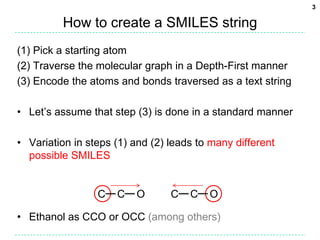
         How to create a SMILES string
(1) Pick a starting atom
(2) Traverse the molecular graph in a Depth-First manner
(3) Encode the atoms and bonds traversed as a text string

• Let’s assume that step (3) is done in a standard manner

• Variation in steps (1) and (2) leads to many different
  possible SMILES


                 C   C    O      C   C   O

• Ethanol as CCO or OCC (among others)
4

  How to create a canonical SMILES string
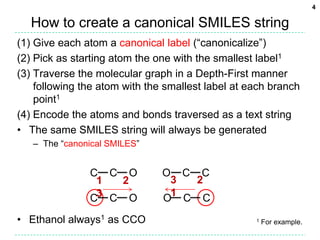
(1) Give each atom a canonical label (“canonicalize”)
(2) Pick as starting atom the one with the smallest label1
(3) Traverse the molecular graph in a Depth-First manner
    following the atom with the smallest label at each branch
    point1
(4) Encode the atoms and bonds traversed as a text string
• The same SMILES string will always be generated
   – The “canonical SMILES”


               C C O           O C C
                1  2            3   2
               C3 C O          O1 C C

• Ethanol always1 as CCO                           1   For example.
5

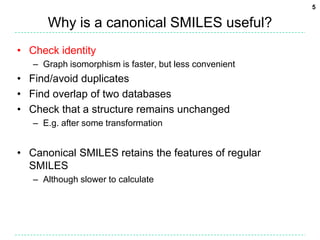
      Why is a canonical SMILES useful?
• Check identity
   – Graph isomorphism is faster, but less convenient
• Find/avoid duplicates
• Find overlap of two databases
• Check that a structure remains unchanged
   – E.g. after some transformation


• Canonical SMILES retains the features of regular
  SMILES
   – Although slower to calculate
6

  Why are there different canonical SMILES?

• There is no published canonical SMILES implementation
  for the general case
    – Neither Weininger, Weininger nor Weininger [1] described how to
      handle stereochemistry


• Canonicalization is difficult
    – Not a simple algorithm, many corner cases
    – Trade secret


• End result: Each cheminformatics toolkit generates its
  own canonical SMILES

[1] Weininger D, Weininger A, Weininger JL. SMILES. 2. Algorithm for generation of
    unique SMILES notation. J. Chem. Inf. Comput. Sci. 1989, 29, 97.
7

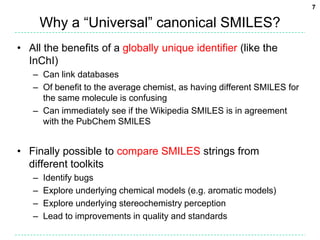
       Why a “Universal” canonical SMILES?
• All the benefits of a globally unique identifier (like the
  InChI)
   – Can link databases
   – Of benefit to the average chemist, as having different SMILES for
     the same molecule is confusing
   – Can immediately see if the Wikipedia SMILES is in agreement
     with the PubChem SMILES


• Finally possible to compare SMILES strings from
  different toolkits
   –   Identify bugs
   –   Explore underlying chemical models (e.g. aromatic models)
   –   Explore underlying stereochemistry perception
   –   Lead to improvements in quality and standards
8

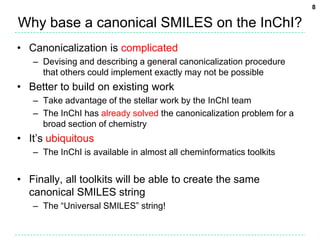
Why base a canonical SMILES on the InChI?
• Canonicalization is complicated
   – Devising and describing a general canonicalization procedure
     that others could implement exactly may not be possible
• Better to build on existing work
   – Take advantage of the stellar work by the InChI team
   – The InChI has already solved the canonicalization problem for a
     broad section of chemistry
• It’s ubiquitous
   – The InChI is available in almost all cheminformatics toolkits


• Finally, all toolkits will be able to create the same
  canonical SMILES string
   – The “Universal SMILES” string!
9


How to use the InChI to create
 a Universal SMILES string
10

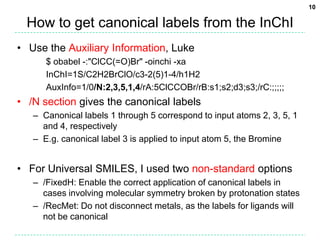
  How to get canonical labels from the InChI
• Use the Auxiliary Information, Luke
      $ obabel -:"ClCC(=O)Br" -oinchi -xa
      InChI=1S/C2H2BrClO/c3-2(5)1-4/h1H2
      AuxInfo=1/0/N:2,3,5,1,4/rA:5ClCCOBr/rB:s1;s2;d3;s3;/rC:;;;;;
• /N section gives the canonical labels
   – Canonical labels 1 through 5 correspond to input atoms 2, 3, 5, 1
     and 4, respectively
   – E.g. canonical label 3 is applied to input atom 5, the Bromine


• For Universal SMILES, I used two non-standard options
   – /FixedH: Enable the correct application of canonical labels in
     cases involving molecular symmetry broken by protonation states
   – /RecMet: Do not disconnect metals, as the labels for ligands will
     not be canonical
11

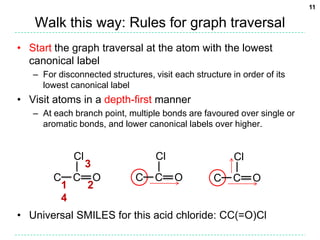
   Walk this way: Rules for graph traversal
• Start the graph traversal at the atom with the lowest
  canonical label
   – For disconnected structures, visit each structure in order of its
     lowest canonical label
• Visit atoms in a depth-first manner
   – At each branch point, multiple bonds are favoured over single or
     aromatic bonds, and lower canonical labels over higher.


             Cl                    Cl                   Cl
                  3
        C C O                 C    C    O         C     C    O
         1  2
         4
• Universal SMILES for this acid chloride: CC(=O)Cl
12

          Corner case: Explicit hydrogens
• Sometimes a SMILES string contains explicit hydrogens
   – Hydrogen isotopes, dihydrogen, hydrogen atoms, hydrogen ions
• Sometimes the InChI labels hydrogens
   – Hydrogen atoms, bridging hydrogens


• The problem:
   – What to do about explicit hydrogens unlabelled by the InChI?
• A solution:
   – Consider these to have a low canonical label
   – That is, in the traversal visit these hydrogens prior to other singly-
     bonded branches


         C([2H])([3H])Cl rather than C(Cl)([3H])[2H]
13

     A standard way to encode the SMILES
• The graph traversal gives us a canonical atom order
• However, despite this, many different SMILES strings
  may be written for the same molecule

The following SMILES strings for ethanol all have the same atom order:
             CCO, C-C-O, C1.C12.O2, C(C(O)), [CH3]CO


• For Universal SMILES, one particular form must be
  adopted
   – The standard form described by the Open SMILES specification
       Ref: Craig James et al, The Open SMILES specification, http://opensmiles.org
   – E.g. Don’t write single bonds explicitly, only use parentheses if
     there is a branch
14

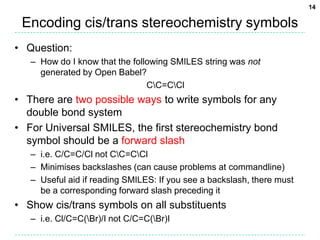
 Encoding cis/trans stereochemistry symbols
• Question:
   – How do I know that the following SMILES string was not
     generated by Open Babel?
                                CC=CCl
• There are two possible ways to write symbols for any
  double bond system
• For Universal SMILES, the first stereochemistry bond
  symbol should be a forward slash
   – i.e. C/C=C/Cl not CC=CCl
   – Minimises backslashes (can cause problems at commandline)
   – Useful aid if reading SMILES: If you see a backslash, there must
     be a corresponding forward slash preceding it
• Show cis/trans symbols on all substituents
   – i.e. Cl/C=C(Br)/I not C/C=C(Br)I
15


Does it work?
16

       Datasets for testing implementation
• Universal SMILES was added to Open Babel v2.3.2
        $ obabel -:"c1(cc(ccc1)[N+](=O)[O-])/C=C/F" -osmi -xU
        c1cc(/C=C/F)cc(c1)[N+](=O)[O-]


• ChEMBL Release 13
   – 1.14 million compounds as 2D MOL
   – Highly curated, and normalised


• PubChem Substance subset
   – 1.04 million compounds as 2D or 3D MOL (those with SIDS from 0
     to 2 million)
   – As deposited from a variety of sources
   – Duplicates exist as well as errors
   – 1.1% were discarded as InChIs could not be generated for them
17

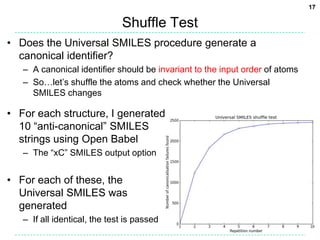
                              Shuffle Test
• Does the Universal SMILES procedure generate a
  canonical identifier?
   – A canonical identifier should be invariant to the input order of atoms
   – So…let’s shuffle the atoms and check whether the Universal
     SMILES changes

• For each structure, I generated
  10 “anti-canonical” SMILES
  strings using Open Babel
   – The “xC” SMILES output option


• For each of these, the
  Universal SMILES was
  generated
   – If all identical, the test is passed
18

                       Shuffle Test Results
• ChEMBL dataset
   – 2,425 canonicalization failures (0.21%)
   – 2,248 excluding failures for Open Babel’s own canonical SMILES
       • These failures are mainly due to kekulization problems

• Differences in the stereochemical model used (81%)
   – 722 failures due to disagreement on the number of tetrahedral
     stereocenters (fault with OB typically)
   – 1105 failures for stereogenic double bonds
• Handling of delocalized charges
   – Where molecular graph symmetry is broken only by
     charge states in a delocalised system, the InChI will
     regard as equivalent atoms which appear as different
     charge states in the SMILES string.
   – Two different Universal SMILES for the example:
       • C[n+]1ccn(C)c1 and Cn1cc[n+](C)c1
19

                      Shuffle Test Results
• PubChem dataset
   – 2,410 canonicalization failures (0.23%)
   – 2,183 excluding failures for Open Babel’s own canonical SMILES
• Differences in the stereochemical model used (72%)

• 56 cases of non-canonicalization of isotopes
   – Bug in InChI auxiliary information (they are aware of this)

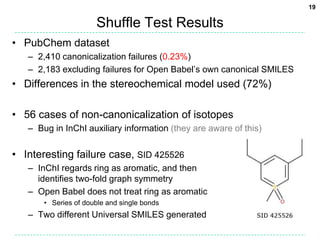
• Interesting failure case, SID 425526
   – InChI regards ring as aromatic, and then
     identifies two-fold graph symmetry
   – Open Babel does not treat ring as aromatic
       • Series of double and single bonds
   – Two different Universal SMILES generated
20

                            Duplicate Test
• Use the Universal SMILES to find duplicates
   – True duplicates
   – False duplicates
       • A shortcoming of Universal SMILES or its implementation
       • A normalization of distinct structures


• ChEMBL dataset
   – There should not be any duplicates
   – 63 sets of duplicates according to InChI
       • Errors in database which had already been corrected in development version

• PubChem dataset
   – 143,157 sets of duplicates


• Duplicates according to InChI removed from further
  consideration
21

                   Duplicate Test Results
• ChEMBL dataset
   – 29 duplicates found
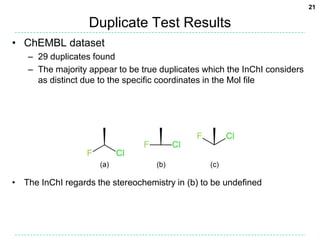
   – The majority appear to be true duplicates which the InChI considers
     as distinct due to the specific coordinates in the Mol file


• The InChI regards the stereochemistry in (b) to be undefined
22


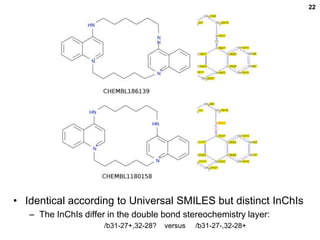
• Identical according to Universal SMILES but distinct InChIs
   – The InChIs differ in the double bond stereochemistry layer:
                      /b31-27+,32-28?   versus   /b31-27-,32-28+
23

                 Duplicate Test Results
• PubChem dataset
   – 47 duplicates found


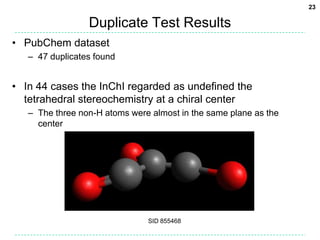
• In 44 cases the InChI regarded as undefined the
  tetrahedral stereochemistry at a chiral center
   – The three non-H atoms were almost in the same plane as the
     center


                               SID 855468
24


Discussion and conclusions
25

                     Overview of results
• Universal SMILES can generate canonical identifiers…
   – for 99.79% of the ChEMBL database
   – for 99.77% of a subset of the PubChem Substance database
   – Disagreements between InChI and the underlying stereochemical
     model used by Open Babel, and the handling of delocalized
     charges


• Performance could be improved further
   – Improvements in stereochemistry perception in Open Babel, or
     somehow use the stereochemistry perception from the InChI
• Outstanding issues:
   – Failures due to delocalized charges
   – The Daylight aromaticity model is not well-described and so
     different Universal SMILES implementations will vary in what is
     treated as an aromatic system
26

                     Overview of results

• The InChI is quite sensitive to the specific geometry used
  at stereocenters
   – Some structures in databases may need to be redrawn


• These ideas could be applied to other chemical file
  formats
   – Canonical forms of other line notations
   – Canonicalization of atom order in Mol files
27

                What I didn’t talk about…

• Inchified SMILES
   – A way to include the InChI normalizations into the SMILES string,
     by roundtripping through the InChI
   – A SMILES string representation of the InChI string
   – Available as Open Babel SMILES output option “I”
   – For more info see the paper (J. Cheminf., 2012, 4, 22)
Universal        Finally a canonical SMILES
          SMILES           string?


   J. Cheminf., 2012, 4, 22               baoilleach@gmail.com
blueobelisk-smiles@lists.sf.net        http://baoilleach.blogspot.com

Acknowledgements
Craig James (eMolecules): For OpenSMILES and the SMILES writer in
Open Babel


Funding
Health Research Board: Career Development Fellowship

Universal Smiles: Finally a canonical SMILES string

  • 1.
    Universal SMILES Finally, a canonical SMILES string? Noel M. O’Boyle Analytical and Biological Chemistry Research Facility, University College Cork, Ireland (Current address: NextMove Software, Cambridge, UK) Apr 2013 245th ACS National Meeting New Orleans Open Babel
  • 2.
  • 3.
    3 How to create a SMILES string (1) Pick a starting atom (2) Traverse the molecular graph in a Depth-First manner (3) Encode the atoms and bonds traversed as a text string • Let’s assume that step (3) is done in a standard manner • Variation in steps (1) and (2) leads to many different possible SMILES C C O C C O • Ethanol as CCO or OCC (among others)
  • 4.
    4 Howto create a canonical SMILES string (1) Give each atom a canonical label (“canonicalize”) (2) Pick as starting atom the one with the smallest label1 (3) Traverse the molecular graph in a Depth-First manner following the atom with the smallest label at each branch point1 (4) Encode the atoms and bonds traversed as a text string • The same SMILES string will always be generated – The “canonical SMILES” C C O O C C 1 2 3 2 C3 C O O1 C C • Ethanol always1 as CCO 1 For example.
  • 5.
    5 Why is a canonical SMILES useful? • Check identity – Graph isomorphism is faster, but less convenient • Find/avoid duplicates • Find overlap of two databases • Check that a structure remains unchanged – E.g. after some transformation • Canonical SMILES retains the features of regular SMILES – Although slower to calculate
  • 6.
    6 Whyare there different canonical SMILES? • There is no published canonical SMILES implementation for the general case – Neither Weininger, Weininger nor Weininger [1] described how to handle stereochemistry • Canonicalization is difficult – Not a simple algorithm, many corner cases – Trade secret • End result: Each cheminformatics toolkit generates its own canonical SMILES [1] Weininger D, Weininger A, Weininger JL. SMILES. 2. Algorithm for generation of unique SMILES notation. J. Chem. Inf. Comput. Sci. 1989, 29, 97.
  • 7.
    7 Why a “Universal” canonical SMILES? • All the benefits of a globally unique identifier (like the InChI) – Can link databases – Of benefit to the average chemist, as having different SMILES for the same molecule is confusing – Can immediately see if the Wikipedia SMILES is in agreement with the PubChem SMILES • Finally possible to compare SMILES strings from different toolkits – Identify bugs – Explore underlying chemical models (e.g. aromatic models) – Explore underlying stereochemistry perception – Lead to improvements in quality and standards
  • 8.
    8 Why base acanonical SMILES on the InChI? • Canonicalization is complicated – Devising and describing a general canonicalization procedure that others could implement exactly may not be possible • Better to build on existing work – Take advantage of the stellar work by the InChI team – The InChI has already solved the canonicalization problem for a broad section of chemistry • It’s ubiquitous – The InChI is available in almost all cheminformatics toolkits • Finally, all toolkits will be able to create the same canonical SMILES string – The “Universal SMILES” string!
  • 9.
    9 How to usethe InChI to create a Universal SMILES string
  • 10.
    10 Howto get canonical labels from the InChI • Use the Auxiliary Information, Luke $ obabel -:"ClCC(=O)Br" -oinchi -xa InChI=1S/C2H2BrClO/c3-2(5)1-4/h1H2 AuxInfo=1/0/N:2,3,5,1,4/rA:5ClCCOBr/rB:s1;s2;d3;s3;/rC:;;;;; • /N section gives the canonical labels – Canonical labels 1 through 5 correspond to input atoms 2, 3, 5, 1 and 4, respectively – E.g. canonical label 3 is applied to input atom 5, the Bromine • For Universal SMILES, I used two non-standard options – /FixedH: Enable the correct application of canonical labels in cases involving molecular symmetry broken by protonation states – /RecMet: Do not disconnect metals, as the labels for ligands will not be canonical
  • 11.
    11 Walk this way: Rules for graph traversal • Start the graph traversal at the atom with the lowest canonical label – For disconnected structures, visit each structure in order of its lowest canonical label • Visit atoms in a depth-first manner – At each branch point, multiple bonds are favoured over single or aromatic bonds, and lower canonical labels over higher. Cl Cl Cl 3 C C O C C O C C O 1 2 4 • Universal SMILES for this acid chloride: CC(=O)Cl
  • 12.
    12 Corner case: Explicit hydrogens • Sometimes a SMILES string contains explicit hydrogens – Hydrogen isotopes, dihydrogen, hydrogen atoms, hydrogen ions • Sometimes the InChI labels hydrogens – Hydrogen atoms, bridging hydrogens • The problem: – What to do about explicit hydrogens unlabelled by the InChI? • A solution: – Consider these to have a low canonical label – That is, in the traversal visit these hydrogens prior to other singly- bonded branches C([2H])([3H])Cl rather than C(Cl)([3H])[2H]
  • 13.
    13 A standard way to encode the SMILES • The graph traversal gives us a canonical atom order • However, despite this, many different SMILES strings may be written for the same molecule The following SMILES strings for ethanol all have the same atom order: CCO, C-C-O, C1.C12.O2, C(C(O)), [CH3]CO • For Universal SMILES, one particular form must be adopted – The standard form described by the Open SMILES specification Ref: Craig James et al, The Open SMILES specification, http://opensmiles.org – E.g. Don’t write single bonds explicitly, only use parentheses if there is a branch
  • 14.
    14 Encoding cis/transstereochemistry symbols • Question: – How do I know that the following SMILES string was not generated by Open Babel? CC=CCl • There are two possible ways to write symbols for any double bond system • For Universal SMILES, the first stereochemistry bond symbol should be a forward slash – i.e. C/C=C/Cl not CC=CCl – Minimises backslashes (can cause problems at commandline) – Useful aid if reading SMILES: If you see a backslash, there must be a corresponding forward slash preceding it • Show cis/trans symbols on all substituents – i.e. Cl/C=C(Br)/I not C/C=C(Br)I
  • 15.
  • 16.
    16 Datasets for testing implementation • Universal SMILES was added to Open Babel v2.3.2 $ obabel -:"c1(cc(ccc1)[N+](=O)[O-])/C=C/F" -osmi -xU c1cc(/C=C/F)cc(c1)[N+](=O)[O-] • ChEMBL Release 13 – 1.14 million compounds as 2D MOL – Highly curated, and normalised • PubChem Substance subset – 1.04 million compounds as 2D or 3D MOL (those with SIDS from 0 to 2 million) – As deposited from a variety of sources – Duplicates exist as well as errors – 1.1% were discarded as InChIs could not be generated for them
  • 17.
    17 Shuffle Test • Does the Universal SMILES procedure generate a canonical identifier? – A canonical identifier should be invariant to the input order of atoms – So…let’s shuffle the atoms and check whether the Universal SMILES changes • For each structure, I generated 10 “anti-canonical” SMILES strings using Open Babel – The “xC” SMILES output option • For each of these, the Universal SMILES was generated – If all identical, the test is passed
  • 18.
    18 Shuffle Test Results • ChEMBL dataset – 2,425 canonicalization failures (0.21%) – 2,248 excluding failures for Open Babel’s own canonical SMILES • These failures are mainly due to kekulization problems • Differences in the stereochemical model used (81%) – 722 failures due to disagreement on the number of tetrahedral stereocenters (fault with OB typically) – 1105 failures for stereogenic double bonds • Handling of delocalized charges – Where molecular graph symmetry is broken only by charge states in a delocalised system, the InChI will regard as equivalent atoms which appear as different charge states in the SMILES string. – Two different Universal SMILES for the example: • C[n+]1ccn(C)c1 and Cn1cc[n+](C)c1
  • 19.
    19 Shuffle Test Results • PubChem dataset – 2,410 canonicalization failures (0.23%) – 2,183 excluding failures for Open Babel’s own canonical SMILES • Differences in the stereochemical model used (72%) • 56 cases of non-canonicalization of isotopes – Bug in InChI auxiliary information (they are aware of this) • Interesting failure case, SID 425526 – InChI regards ring as aromatic, and then identifies two-fold graph symmetry – Open Babel does not treat ring as aromatic • Series of double and single bonds – Two different Universal SMILES generated
  • 20.
    20 Duplicate Test • Use the Universal SMILES to find duplicates – True duplicates – False duplicates • A shortcoming of Universal SMILES or its implementation • A normalization of distinct structures • ChEMBL dataset – There should not be any duplicates – 63 sets of duplicates according to InChI • Errors in database which had already been corrected in development version • PubChem dataset – 143,157 sets of duplicates • Duplicates according to InChI removed from further consideration
  • 21.
    21 Duplicate Test Results • ChEMBL dataset – 29 duplicates found – The majority appear to be true duplicates which the InChI considers as distinct due to the specific coordinates in the Mol file • The InChI regards the stereochemistry in (b) to be undefined
  • 22.
    22 • Identical accordingto Universal SMILES but distinct InChIs – The InChIs differ in the double bond stereochemistry layer: /b31-27+,32-28? versus /b31-27-,32-28+
  • 23.
    23 Duplicate Test Results • PubChem dataset – 47 duplicates found • In 44 cases the InChI regarded as undefined the tetrahedral stereochemistry at a chiral center – The three non-H atoms were almost in the same plane as the center SID 855468
  • 24.
  • 25.
    25 Overview of results • Universal SMILES can generate canonical identifiers… – for 99.79% of the ChEMBL database – for 99.77% of a subset of the PubChem Substance database – Disagreements between InChI and the underlying stereochemical model used by Open Babel, and the handling of delocalized charges • Performance could be improved further – Improvements in stereochemistry perception in Open Babel, or somehow use the stereochemistry perception from the InChI • Outstanding issues: – Failures due to delocalized charges – The Daylight aromaticity model is not well-described and so different Universal SMILES implementations will vary in what is treated as an aromatic system
  • 26.
    26 Overview of results • The InChI is quite sensitive to the specific geometry used at stereocenters – Some structures in databases may need to be redrawn • These ideas could be applied to other chemical file formats – Canonical forms of other line notations – Canonicalization of atom order in Mol files
  • 27.
    27 What I didn’t talk about… • Inchified SMILES – A way to include the InChI normalizations into the SMILES string, by roundtripping through the InChI – A SMILES string representation of the InChI string – Available as Open Babel SMILES output option “I” – For more info see the paper (J. Cheminf., 2012, 4, 22)
  • 28.
    Universal Finally a canonical SMILES SMILES string? J. Cheminf., 2012, 4, 22 baoilleach@gmail.com blueobelisk-smiles@lists.sf.net http://baoilleach.blogspot.com Acknowledgements Craig James (eMolecules): For OpenSMILES and the SMILES writer in Open Babel Funding Health Research Board: Career Development Fellowship