Open Babel
Noel M. O’Boyle
An open chemical toolbox
Open Babel development team and NextMove Software, Cambridge, UK
EMBL-EBI May 2016
MIOSS – Molecular Informatics Open-Source Software
J. Cheminf. 2011, 3, 33.
http://openbabel.org
Image credit: AJ Cann (AJC1 on Flickr)
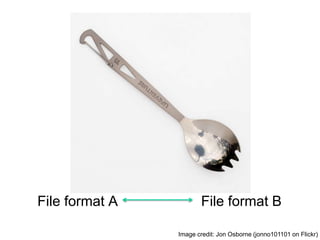
File format A
Image credit: Jon Osborne (jonno101101 on Flickr)
File format B
What is Open Babel?
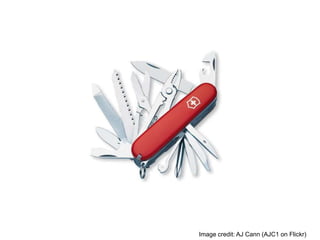
• A programming library in C++
– With access from Perl, Python, Java, Ruby, .NET/Mono, Ruby,
R, PHP
• A set of command-line applications
– Most famously obabel for interconverting chemical file formats
• A graphical user interface for interconverting chemical file
formats
• Available on Win/Mac/Lin, through
conda/pip/brew/apt/yum/dnf, or from http://openbabel.org
History
Sources: Andrew Dalke
http://www.dalkescientific.com/writings/diary/archive/2004/01/03/available_toolkits.html,Roger Sayle
• 1992
– Matt Stahl and Pat Walters wrote Babel (an open source
molecule converter) at the University of Arizona
• 1999
– Matt joined OpenEye Scientific and based their cheminformatics
library OELib on Babel – this was also open source
• 2001
– OpenEye decided to rewrite their cheminformatics library as a
proprietary library, OEChem
– OELib was renamed to Open Babel, and continued as a
community project led by Geoff Hutchison
• 2002 (Dec)
– First release (1.0)
Features
• Multiple chemical file formats (+ options) and utility
formats
• 2D coordinate generation and depiction (PNG and SVG)
• 3D coordinate generation, forcefield minimisation,
conformer generation
• Binary fingerprints (path-based, substructure-based) and
associated “fast search” database
• Bond perception, aromaticity detection and atom-typing
• Canonical labelling, automorphisms, alignment
• Materials science: computational chemistry, molecular
dynamics, crystal structures
• Charge models: MMFF, Gasteiger, EEM, (E)QEq, QTPIE
Known Usage
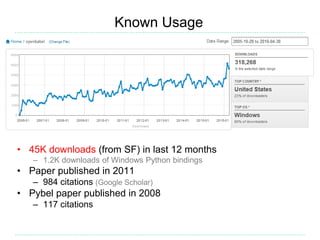
• 45K downloads (from SF) in last 12 months
– 1.2K downloads of Windows Python bindings
• Paper published in 2011
– 984 citations (Google Scholar)
• Pybel paper published in 2008
– 117 citations
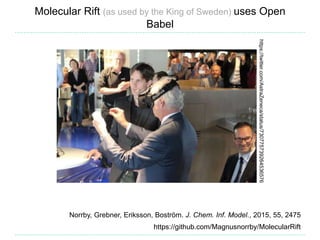
https://github.com/Magnusnorrby/MolecularRift
https://twitter.com/AstraZeneca/status/730775739264536576
Molecular Rift (as used by the King of Sweden) uses Open
Babel
Norrby, Grebner, Eriksson, Boström. J. Chem. Inf. Model., 2015, 55, 2475
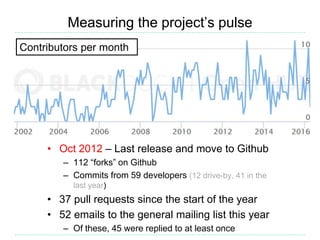
Measuring the project’s pulse
• Oct 2012 – Last release and move to Github
– 112 “forks” on Github
– Commits from 59 developers (12 drive-by, 41 in the
last year)
• 37 pull requests since the start of the year
• 52 emails to the general mailing list this year
– Of these, 45 were replied to at least once
Contributors per month
Most committed developers in last 12 months
• Geoff Hutchison
– Professor, materials chemistry, Uni Pitt, Avogadro
• Dmitriy Fomichev
– PhD student, comp chemistry, Lobachevsky Uni, Russia
• Alexandr Fonari
– Assoc developer, Schrödinger, materials science, NWChem,
Quantum Espresso
• David van der Spoel
– Prof, Cell and Mol Biol, Uppsala Uni, Gromacs
• David Koes
– Assistant Prof, Comp and Sys Biology, Uni Pittsburgh,
3DMol.js, pharmit, pharmer
• Jeff Janes
– PI, Calibr (California Institute for Biomed Res), PostgreSQL
Chemistry file formats
• Chemists love inventing new file formats
• Every new chemistry application has its own file format
– Some exceptions: e.g. Avogadro
– De facto standards such as Daylight SMILES and
MDL/Symyx/Accelrys/Biovia/Dassault MOL
• The ability to read and interconvert chemical file formats is
important, both for scientitific and economic reasons
– To unlock chemical data for analysis
– To avoid vendor lock-in
– To develop workflows/pipelines
Formats: most recent additions
• Siesta [read]
– ab initio molecular dynamics
• STL [write]
– (STereoLithography) 3D
printing
• Point cloud format [write]
– Write VdW surface as points
• AOForce [read]
– Turbomole vibrational freqs
• MDFF [read/write]
– MD fitting to density maps
• EXYZ [read/write]
– Extended XYZ
git log --pretty=oneline --name-status | grep "^A" | grep src/formats | grep -v inchi | grep -v
libxml | less
Formats: most recent additions
• Siesta [read]
– ab initio molecular dynamics
• STL [write]
– (STereoLithography) 3D
printing
• Point cloud format [write]
– Write VdW surface as points
• AOForce [read]
– Turbomole vibrational freqs
• MDFF [read/write]
– MD fitting to density maps
• EXYZ [read/write]
– Extended XYZ
git log --pretty=oneline --name-status | grep "^A" | grep src/formats | grep -v inchi | grep -v
libxml | less
• Orca [read/write]
– QM package
• JSON formats [read/write]
– ChemDoodle JSON
– PubChem JSON
• Confab report [write]
– Conformation generation
• Dalton [read]
– QM package
• LPMD [read/write]
– MD with interatomic potentials
• Smiley [read]
– Validating SMILES parser
Consider rolling your own plugins
• The Open Babel library itself is fairly compact and
much of the functionality is implemented as plugins
– File formats, descriptors, fingerprints, and arbitrary
operations that take molecules and do something
• Relatively straightforward to add your own plugins,
even if you have never programmed in C++ before
– Easier to add a plugin than write your own C++ application
– Can use the obabel command-line to call it
– Can optionally donate the plugin to the community
• Almost anything can be a plugin
– I have written an entire conformation generator as a plugin
(Confab)
The GPL and industry
• Companies can use or modify Open Babel, add
plugins, and write their own code using it without any
problem
• If they distribute the resulting software outside the
company then they need to provide the source code
under the GPL
– This clause really only affects software companies
developing their own products, not end users in companies
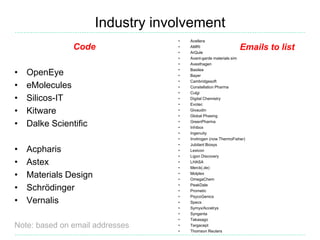
Industry involvement
Code
• OpenEye
• eMolecules
• Silicos-IT
• Kitware
• Dalke Scientific
• Acpharis
• Astex
• Materials Design
• Schrödinger
• Vernalis
Note: based on email addresses
• Acellera
• AMRI
• ArQule
• Avant-garde materials sim
• Avesthagen
• Basilea
• Bayer
• Cambridgesoft
• Constellation Pharma
• Culgi
• Digital Chemistry
• Evotec
• Givaudin
• Global Phasing
• GreenPharma
• Inhibox
• Ingenuity
• Invitrogen (now ThermoFisher)
• Jubilant Biosys
• Lexicon
• Ligon Discovery
• LHASA
• Merck(.de)
• Molplex
• OmegaChem
• PeakDale
• Prometic
• PsycoGenics
• Specs
• Symyx/Accelrys
• Syngenta
• Takasago
• Targacept
• Thomson Reuters
Emails to list
Supporting open source
• When emailing a list, please give your affiliation
– It’s nice to know companies find it useful
• Spread the word, give credit in talks
• Give feedback
– What we’re doing right/wrong
– Can help reorder our priorities/reality check
• Bug bounty?
Future outlook
• Dude, there’s a plan??
• New features are driven by needs/interests of individuals
– Research interests
– Gaps in functionality
– Features needed ‘downstream’ by software using the library
• Avogadro is driving improved support for QM/MD
packages
• Generation of 3D structures based on distance geometry
• Housekeeping: Kekulization rewrite, implicit valency
• Improved performance? Has historically been low on the
agenda.
• Would be nice to have meetings like RDKit does
• What do *you* think we should be focusing on?
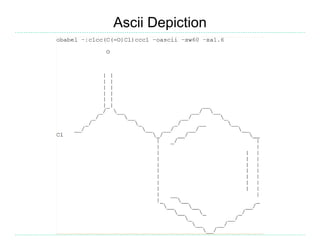
Ascii Depiction
A cry for help
Like mailing lists?
openbabel-
discuss@lists.sf.net
Like forums?
http://forums.openbabel.org
Like to email a developer
directly?
Step away from the keyboard
:-)
Don’t forget to read the
docs first and Google it
http://openbabel.org/docs
Image: Tintin44 (Flickr)

Open Babel project overview

  • 1.
    Open Babel Noel M.O’Boyle An open chemical toolbox Open Babel development team and NextMove Software, Cambridge, UK EMBL-EBI May 2016 MIOSS – Molecular Informatics Open-Source Software J. Cheminf. 2011, 3, 33. http://openbabel.org
  • 2.
    Image credit: AJCann (AJC1 on Flickr)
  • 4.
    File format A Imagecredit: Jon Osborne (jonno101101 on Flickr) File format B
  • 5.
    What is OpenBabel? • A programming library in C++ – With access from Perl, Python, Java, Ruby, .NET/Mono, Ruby, R, PHP • A set of command-line applications – Most famously obabel for interconverting chemical file formats • A graphical user interface for interconverting chemical file formats • Available on Win/Mac/Lin, through conda/pip/brew/apt/yum/dnf, or from http://openbabel.org
  • 6.
    History Sources: Andrew Dalke http://www.dalkescientific.com/writings/diary/archive/2004/01/03/available_toolkits.html,RogerSayle • 1992 – Matt Stahl and Pat Walters wrote Babel (an open source molecule converter) at the University of Arizona • 1999 – Matt joined OpenEye Scientific and based their cheminformatics library OELib on Babel – this was also open source • 2001 – OpenEye decided to rewrite their cheminformatics library as a proprietary library, OEChem – OELib was renamed to Open Babel, and continued as a community project led by Geoff Hutchison • 2002 (Dec) – First release (1.0)
  • 7.
    Features • Multiple chemicalfile formats (+ options) and utility formats • 2D coordinate generation and depiction (PNG and SVG) • 3D coordinate generation, forcefield minimisation, conformer generation • Binary fingerprints (path-based, substructure-based) and associated “fast search” database • Bond perception, aromaticity detection and atom-typing • Canonical labelling, automorphisms, alignment • Materials science: computational chemistry, molecular dynamics, crystal structures • Charge models: MMFF, Gasteiger, EEM, (E)QEq, QTPIE
  • 9.
    Known Usage • 45Kdownloads (from SF) in last 12 months – 1.2K downloads of Windows Python bindings • Paper published in 2011 – 984 citations (Google Scholar) • Pybel paper published in 2008 – 117 citations
  • 12.
    https://github.com/Magnusnorrby/MolecularRift https://twitter.com/AstraZeneca/status/730775739264536576 Molecular Rift (asused by the King of Sweden) uses Open Babel Norrby, Grebner, Eriksson, Boström. J. Chem. Inf. Model., 2015, 55, 2475
  • 13.
    Measuring the project’spulse • Oct 2012 – Last release and move to Github – 112 “forks” on Github – Commits from 59 developers (12 drive-by, 41 in the last year) • 37 pull requests since the start of the year • 52 emails to the general mailing list this year – Of these, 45 were replied to at least once Contributors per month
  • 14.
    Most committed developersin last 12 months • Geoff Hutchison – Professor, materials chemistry, Uni Pitt, Avogadro • Dmitriy Fomichev – PhD student, comp chemistry, Lobachevsky Uni, Russia • Alexandr Fonari – Assoc developer, Schrödinger, materials science, NWChem, Quantum Espresso • David van der Spoel – Prof, Cell and Mol Biol, Uppsala Uni, Gromacs • David Koes – Assistant Prof, Comp and Sys Biology, Uni Pittsburgh, 3DMol.js, pharmit, pharmer • Jeff Janes – PI, Calibr (California Institute for Biomed Res), PostgreSQL
  • 15.
    Chemistry file formats •Chemists love inventing new file formats • Every new chemistry application has its own file format – Some exceptions: e.g. Avogadro – De facto standards such as Daylight SMILES and MDL/Symyx/Accelrys/Biovia/Dassault MOL • The ability to read and interconvert chemical file formats is important, both for scientitific and economic reasons – To unlock chemical data for analysis – To avoid vendor lock-in – To develop workflows/pipelines
  • 16.
    Formats: most recentadditions • Siesta [read] – ab initio molecular dynamics • STL [write] – (STereoLithography) 3D printing • Point cloud format [write] – Write VdW surface as points • AOForce [read] – Turbomole vibrational freqs • MDFF [read/write] – MD fitting to density maps • EXYZ [read/write] – Extended XYZ git log --pretty=oneline --name-status | grep "^A" | grep src/formats | grep -v inchi | grep -v libxml | less
  • 17.
    Formats: most recentadditions • Siesta [read] – ab initio molecular dynamics • STL [write] – (STereoLithography) 3D printing • Point cloud format [write] – Write VdW surface as points • AOForce [read] – Turbomole vibrational freqs • MDFF [read/write] – MD fitting to density maps • EXYZ [read/write] – Extended XYZ git log --pretty=oneline --name-status | grep "^A" | grep src/formats | grep -v inchi | grep -v libxml | less • Orca [read/write] – QM package • JSON formats [read/write] – ChemDoodle JSON – PubChem JSON • Confab report [write] – Conformation generation • Dalton [read] – QM package • LPMD [read/write] – MD with interatomic potentials • Smiley [read] – Validating SMILES parser
  • 18.
    Consider rolling yourown plugins • The Open Babel library itself is fairly compact and much of the functionality is implemented as plugins – File formats, descriptors, fingerprints, and arbitrary operations that take molecules and do something • Relatively straightforward to add your own plugins, even if you have never programmed in C++ before – Easier to add a plugin than write your own C++ application – Can use the obabel command-line to call it – Can optionally donate the plugin to the community • Almost anything can be a plugin – I have written an entire conformation generator as a plugin (Confab)
  • 19.
    The GPL andindustry • Companies can use or modify Open Babel, add plugins, and write their own code using it without any problem • If they distribute the resulting software outside the company then they need to provide the source code under the GPL – This clause really only affects software companies developing their own products, not end users in companies
  • 20.
    Industry involvement Code • OpenEye •eMolecules • Silicos-IT • Kitware • Dalke Scientific • Acpharis • Astex • Materials Design • Schrödinger • Vernalis Note: based on email addresses • Acellera • AMRI • ArQule • Avant-garde materials sim • Avesthagen • Basilea • Bayer • Cambridgesoft • Constellation Pharma • Culgi • Digital Chemistry • Evotec • Givaudin • Global Phasing • GreenPharma • Inhibox • Ingenuity • Invitrogen (now ThermoFisher) • Jubilant Biosys • Lexicon • Ligon Discovery • LHASA • Merck(.de) • Molplex • OmegaChem • PeakDale • Prometic • PsycoGenics • Specs • Symyx/Accelrys • Syngenta • Takasago • Targacept • Thomson Reuters Emails to list
  • 21.
    Supporting open source •When emailing a list, please give your affiliation – It’s nice to know companies find it useful • Spread the word, give credit in talks • Give feedback – What we’re doing right/wrong – Can help reorder our priorities/reality check • Bug bounty?
  • 22.
    Future outlook • Dude,there’s a plan?? • New features are driven by needs/interests of individuals – Research interests – Gaps in functionality – Features needed ‘downstream’ by software using the library • Avogadro is driving improved support for QM/MD packages • Generation of 3D structures based on distance geometry • Housekeeping: Kekulization rewrite, implicit valency • Improved performance? Has historically been low on the agenda. • Would be nice to have meetings like RDKit does • What do *you* think we should be focusing on?
  • 23.
  • 24.
    A cry forhelp Like mailing lists? openbabel- discuss@lists.sf.net Like forums? http://forums.openbabel.org Like to email a developer directly? Step away from the keyboard :-) Don’t forget to read the docs first and Google it http://openbabel.org/docs Image: Tintin44 (Flickr)

Editor's Notes

  • #3 OB is like a Swiss army knife, not a…
  • #5 …spork!
  • #24 “The 70s are calling. They want their depiction back.”