BME Research Day 2013
May 28, 2013
Natal van Riel
Eindhoven University of Technology, the Netherlands
Dept. of Biomedical Engineering,
Institute for Complex Molecular Systems
n.a.w.v.riel@tue.nl
Systems Biology and Metabolic Diseases
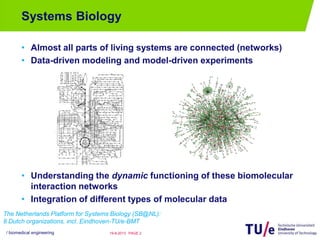
Systems Biology
• Almost all parts of living systems are connected (networks)
• Data-driven modeling and model-driven experiments
• Understanding the dynamic functioning of these biomolecular
interaction networks
• Integration of different types of molecular data
/ biomedical engineering PAGE 219-8-2013
The Netherlands Platform for Systems Biology (SB@NL):
8 Dutch organizations, incl. Eindhoven-TU/e-BMT
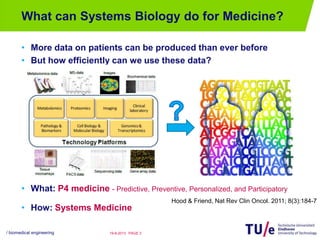
What can Systems Biology do for Medicine?
• More data on patients can be produced than ever before
• But how efficiently can we use these data?
• What: P4 medicine - Predictive, Preventive, Personalized, and Participatory
• How: Systems Medicine
/ biomedical engineering PAGE 319-8-2013
Hood & Friend, Nat Rev Clin Oncol. 2011; 8(3):184-7
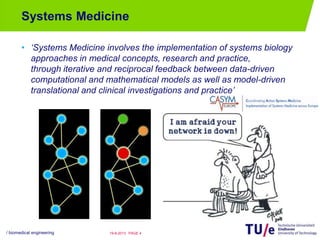
Systems Medicine
• ‘Systems Medicine involves the implementation of systems biology
approaches in medical concepts, research and practice,
through iterative and reciprocal feedback between data-driven
computational and mathematical models as well as model-driven
translational and clinical investigations and practice’
/ biomedical engineering PAGE 419-8-2013
Metabolic Syndrome (MetS)
/ biomedical engineering PAGE 519-8-2013
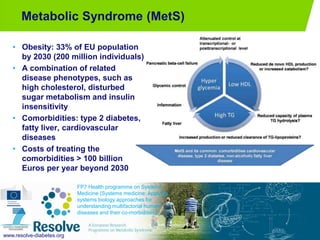
• Obesity: 33% of EU population
by 2030 (200 million individuals)
• A combination of related
disease phenotypes, such as
high cholesterol, disturbed
sugar metabolism and insulin
insensitivity
• Comorbidities: type 2 diabetes,
fatty liver, cardiovascular
diseases
• Costs of treating the
comorbidities > 100 billion
Euros per year beyond 2030
www.resolve-diabetes.org
FP7 Health programme on Systems
Medicine (Systems medicine: Applying
systems biology approaches for
understanding multifactorial human
diseases and their co-morbidities).
Systems Medicine of MetS
/ biomedical engineering PAGE 619-8-2013
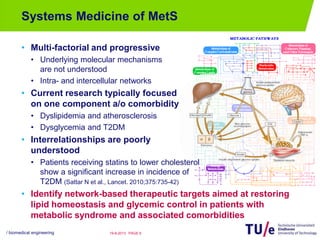
• Multi-factorial and progressive
• Underlying molecular mechanisms
are not understood
• Intra- and intercellular networks
• Current research typically focused
on one component a/o comorbidity
• Dyslipidemia and atherosclerosis
• Dysglycemia and T2DM
• Interrelationships are poorly
understood
• Patients receiving statins to lower cholesterol
show a significant increase in incidence of
T2DM (Sattar N et al., Lancet. 2010;375:735-42)
• Identify network-based therapeutic targets aimed at restoring
lipid homeostasis and glycemic control in patients with
metabolic syndrome and associated comorbidities
Understanding effects of existing therapies
and interventions
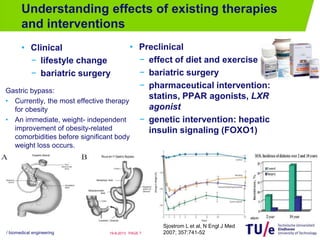
• Clinical
− lifestyle change
− bariatric surgery
/ biomedical engineering PAGE 719-8-2013
Sjostrom L et al, N Engl J Med
2007; 357:741-52
• Preclinical
− effect of diet and exercise
− bariatric surgery
− pharmaceutical intervention:
statins, PPAR agonists, LXR
agonist
− genetic intervention: hepatic
insulin signaling (FOXO1)
Gastric bypass:
• Currently, the most effective therapy
for obesity
• An immediate, weight- independent
improvement of obesity-related
comorbidities before significant body
weight loss occurs.
The computational model
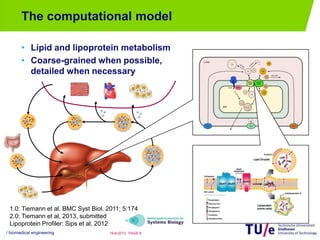
• Lipid and lipoprotein metabolism
• Coarse-grained when possible,
detailed when necessary
/ biomedical engineering PAGE 819-8-2013
1.0: Tiemann et al. BMC Syst Biol. 2011; 5:174
2.0: Tiemann et al, 2013, submitted
Lipoprotein Profiler: Sips et al, 2012
The computational method: ADAPT
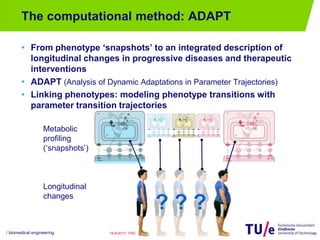
• From phenotype ‘snapshots’ to an integrated description of
longitudinal changes in progressive diseases and therapeutic
interventions
• ADAPT (Analysis of Dynamic Adaptations in Parameter Trajectories)
• Linking phenotypes: modeling phenotype transitions with
parameter transition trajectories
/ biomedical engineering PAGE 919-8-2013
? ? ?
Metabolic
profiling
(‘snapshots’)
Longitudinal
changes
The computational method: ADAPT
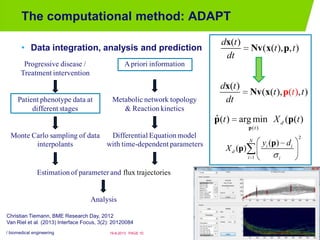
• Data integration, analysis and prediction
/ biomedical engineering PAGE 1019-8-2013
Christian Tiemann, BME Research Day, 2012
Van Riel et al. (2013) Interface Focus, 3(2): 20120084
( )
( ( ), , )
d t
t t
dt
x
Nv x p
( )
( ( ) ,( ), )
d t
t t
dt
t
x
Nv x p
2
1
( )
( )
N
i i
d
i i
y d
X
p
p
( )
ˆ( ) arg min ( ( )d
t
t X t
p
p p
Progressive disease /
Treatment intervention
Patient phenotype data at
different stages
Monte Carlo sampling of data
interpolants
Estimation of parameter and flux trajectories
Analysis
A priori information
Metabolic network topology
& Reaction kinetics
Differential Equation model
with time-dependent parameters
Novel cholesterol lowering medication
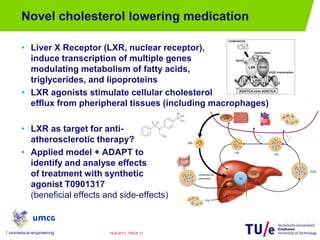
• Liver X Receptor (LXR, nuclear receptor),
induce transcription of multiple genes
modulating metabolism of fatty acids,
triglycerides, and lipoproteins
• LXR agonists stimulate cellular cholesterol
efflux from pheripheral tissues (including macrophages)
• LXR as target for anti-
atherosclerotic therapy?
• Applied model + ADAPT to
identify and analyse effects
of treatment with synthetic
agonist T0901317
(beneficial effects and side-effects)
/ biomedical engineering PAGE 1119-8-2013
VLDL
IDL
LDL
HDL
chylomicron
remnants
FFA
TG
LXR
LXR
Extensive phenotyping
/ biomedical engineering PAGE 1219-8-2013
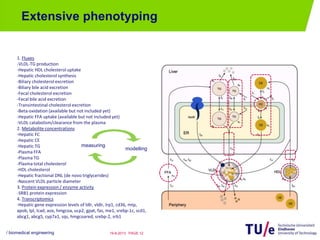
1. Fluxes
-VLDL-TG production
-Hepatic HDL cholesterol uptake
-Hepatic cholesterol synthesis
-Biliary cholesterol excretion
-Biliary bile acid excretion
-Fecal cholesterol excretion
-Fecal bile acid excretion
-Transintestinal cholesterol excretion
-Beta-oxidation (available but not included yet)
-Hepatic FFA uptake (available but not included yet)
-VLDL catabolism/clearance from the plasma
2. Metabolite concentrations
-Hepatic FC
-Hepatic CE
-Hepatic TG
-Plasma FFA
-Plasma TG
-Plasma total cholesterol
-HDL cholesterol
-Hepatic fractional DNL (de novo triglycerides)
-Nascent VLDL particle diameter
3. Protein expression / enzyme activity
-SRB1 protein expression
4. Transcriptomics
-Hepatic gene expression levels of ldlr, vldlr, lrp1, cd36, mtp,
apob, lpl, lcad, aox, hmgcoa, ucp2, gpat, fas, me1, srebp-1c, scd1,
abcg1, abcg5, cyp7a1, sqs, hmgcoared, srebp-2, srb1
measuring
modelling
Preclinical study of pharmaceutical
intervention
• Longitudinal data: control, treated for 1, 2, 4, 7, 14, and 21 days
/ biomedical engineering PAGE 1319-8-2013
0 10 20
0
100
200
Hepatic TG
Time [days]
[umol/g]
0 10 20
0
1
2
3
Hepatic CE
Time [days]
[umol/g]
0 10 20
0
2
4
6
Hepatic FC
Time [days]
[umol/g]
0 10 20
0
50
100
Hepatic TG
Time [days]
[umol]
0 10 20
0
0.5
1
1.5
Hepatic CE
Time [days]
[umol]
0 10 20
0
2
4
Hepatic FC
Time [days]
[umol]
0 10 20
0
1000
2000
3000
Plasma CE
Time [days]
[umol/L]
0 10 20
0
1000
2000
3000
HDL-CE
Time [days]
[umol/L]
0 10 20
0
500
1000
1500
Plasma TG
Time [days]
[umol/L]
0 10 20
6
8
10
12
VLDL clearance
Time [days]
[-]
0 10 20
100
200
300
400
ratio TG/CE
Time [days]
[-]
0 10 20
0
5
10
15
VLDL diameter
Time [days]
[nm]
0 10 20
0
1
2
3
VLDL-TG production
Time [days]
[umol/h]
0 10 20
1
2
3
Hepatic mass
Time [days]
[gram]
0 10 20
0
0.2
0.4
DNL
Time [days]
[-]
Grefhorst et al. Atherosclerosis, 2012, 222: 382– 389
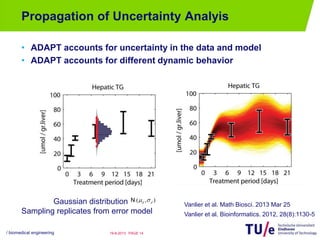
Propagation of Uncertainty Analyis
• ADAPT accounts for uncertainty in the data and model
• ADAPT accounts for different dynamic behavior
/ biomedical engineering PAGE 1419-8-2013
Gaussian distribution
Sampling replicates from error model
( , )d dN
Vanlier et al. Math Biosci. 2013 Mar 25
Vanlier et al. Bioinformatics. 2012, 28(8):1130-5
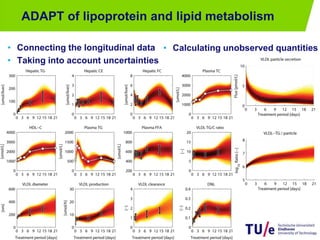
ADAPT of lipoprotein and lipid metabolism
• Connecting the longitudinal data
• Taking into account uncertainties
/ biomedical engineering PAGE 1519-8-2013
• Calculating unobserved quantities
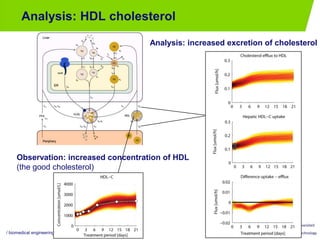
Analysis: HDL cholesterol
/ biomedical engineering PAGE 1619-8-2013
Analysis: increased excretion of cholesterol
Observation: increased concentration of HDL
(the good cholesterol)
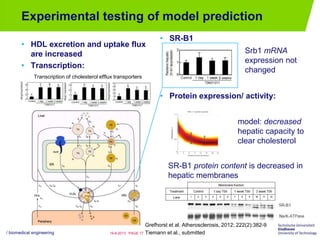
• SR-B1
• Protein expression/ activity:
Experimental testing of model prediction
• HDL excretion and uptake flux
are increased
• Transcription:
/ biomedical engineering PAGE 1719-8-2013
Transcription of cholesterol efflux transporters
Grefhorst et al. Atherosclerosis, 2012; 222(2):382-9
Tiemann et al., submitted
SR-B1 protein content is decreased in
hepatic membranes
Srb1 mRNA
expression not
changed
model: decreased
hepatic capacity to
clear cholesterol
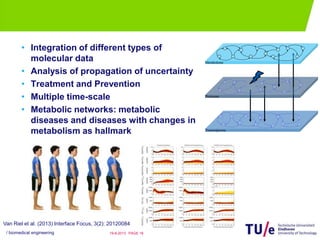
• Integration of different types of
molecular data
• Analysis of propagation of uncertainty
• Treatment and Prevention
• Multiple time-scale
• Metabolic networks: metabolic
diseases and diseases with changes in
metabolism as hallmark
/ biomedical engineering PAGE 1819-8-2013
Metabolome
Proteome
Transcriptome
Van Riel et al. (2013) Interface Focus, 3(2): 20120084
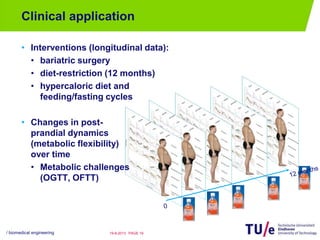
Clinical application
• Interventions (longitudinal data):
• bariatric surgery
• diet-restriction (12 months)
• hypercaloric diet and
feeding/fasting cycles
• Changes in post-
prandial dynamics
(metabolic flexibility)
over time
• Metabolic challenges
(OGTT, OFTT)
/ biomedical engineering PAGE 1919-8-2013
/ biomedical engineering PAGE 2019-8-2013
Peter Hilbers
Christian Tiemann
Joep Vanlier
Ceylan Çölmekçi Öncü
Anne Maas
Joep Schmitz
Fianne Sips
Huili Yuan
Niels Dekkers
Marijke Dermois
Robbin van den Eijnde
Wouter Gevers
Gijs Hendriks
Tim Kuijpers
Stefan Mariën
Yvonne Rozendaal
Roderick Snel
Sjanneke Zwaan

Systems Medicine and Metabolic Diseases

  • 1.
    BME Research Day2013 May 28, 2013 Natal van Riel Eindhoven University of Technology, the Netherlands Dept. of Biomedical Engineering, Institute for Complex Molecular Systems n.a.w.v.riel@tue.nl Systems Biology and Metabolic Diseases
  • 2.
    Systems Biology • Almostall parts of living systems are connected (networks) • Data-driven modeling and model-driven experiments • Understanding the dynamic functioning of these biomolecular interaction networks • Integration of different types of molecular data / biomedical engineering PAGE 219-8-2013 The Netherlands Platform for Systems Biology (SB@NL): 8 Dutch organizations, incl. Eindhoven-TU/e-BMT
  • 3.
    What can SystemsBiology do for Medicine? • More data on patients can be produced than ever before • But how efficiently can we use these data? • What: P4 medicine - Predictive, Preventive, Personalized, and Participatory • How: Systems Medicine / biomedical engineering PAGE 319-8-2013 Hood & Friend, Nat Rev Clin Oncol. 2011; 8(3):184-7
  • 4.
    Systems Medicine • ‘SystemsMedicine involves the implementation of systems biology approaches in medical concepts, research and practice, through iterative and reciprocal feedback between data-driven computational and mathematical models as well as model-driven translational and clinical investigations and practice’ / biomedical engineering PAGE 419-8-2013
  • 5.
    Metabolic Syndrome (MetS) /biomedical engineering PAGE 519-8-2013 • Obesity: 33% of EU population by 2030 (200 million individuals) • A combination of related disease phenotypes, such as high cholesterol, disturbed sugar metabolism and insulin insensitivity • Comorbidities: type 2 diabetes, fatty liver, cardiovascular diseases • Costs of treating the comorbidities > 100 billion Euros per year beyond 2030 www.resolve-diabetes.org FP7 Health programme on Systems Medicine (Systems medicine: Applying systems biology approaches for understanding multifactorial human diseases and their co-morbidities).
  • 6.
    Systems Medicine ofMetS / biomedical engineering PAGE 619-8-2013 • Multi-factorial and progressive • Underlying molecular mechanisms are not understood • Intra- and intercellular networks • Current research typically focused on one component a/o comorbidity • Dyslipidemia and atherosclerosis • Dysglycemia and T2DM • Interrelationships are poorly understood • Patients receiving statins to lower cholesterol show a significant increase in incidence of T2DM (Sattar N et al., Lancet. 2010;375:735-42) • Identify network-based therapeutic targets aimed at restoring lipid homeostasis and glycemic control in patients with metabolic syndrome and associated comorbidities
  • 7.
    Understanding effects ofexisting therapies and interventions • Clinical − lifestyle change − bariatric surgery / biomedical engineering PAGE 719-8-2013 Sjostrom L et al, N Engl J Med 2007; 357:741-52 • Preclinical − effect of diet and exercise − bariatric surgery − pharmaceutical intervention: statins, PPAR agonists, LXR agonist − genetic intervention: hepatic insulin signaling (FOXO1) Gastric bypass: • Currently, the most effective therapy for obesity • An immediate, weight- independent improvement of obesity-related comorbidities before significant body weight loss occurs.
  • 8.
    The computational model •Lipid and lipoprotein metabolism • Coarse-grained when possible, detailed when necessary / biomedical engineering PAGE 819-8-2013 1.0: Tiemann et al. BMC Syst Biol. 2011; 5:174 2.0: Tiemann et al, 2013, submitted Lipoprotein Profiler: Sips et al, 2012
  • 9.
    The computational method:ADAPT • From phenotype ‘snapshots’ to an integrated description of longitudinal changes in progressive diseases and therapeutic interventions • ADAPT (Analysis of Dynamic Adaptations in Parameter Trajectories) • Linking phenotypes: modeling phenotype transitions with parameter transition trajectories / biomedical engineering PAGE 919-8-2013 ? ? ? Metabolic profiling (‘snapshots’) Longitudinal changes
  • 10.
    The computational method:ADAPT • Data integration, analysis and prediction / biomedical engineering PAGE 1019-8-2013 Christian Tiemann, BME Research Day, 2012 Van Riel et al. (2013) Interface Focus, 3(2): 20120084 ( ) ( ( ), , ) d t t t dt x Nv x p ( ) ( ( ) ,( ), ) d t t t dt t x Nv x p 2 1 ( ) ( ) N i i d i i y d X p p ( ) ˆ( ) arg min ( ( )d t t X t p p p Progressive disease / Treatment intervention Patient phenotype data at different stages Monte Carlo sampling of data interpolants Estimation of parameter and flux trajectories Analysis A priori information Metabolic network topology & Reaction kinetics Differential Equation model with time-dependent parameters
  • 11.
    Novel cholesterol loweringmedication • Liver X Receptor (LXR, nuclear receptor), induce transcription of multiple genes modulating metabolism of fatty acids, triglycerides, and lipoproteins • LXR agonists stimulate cellular cholesterol efflux from pheripheral tissues (including macrophages) • LXR as target for anti- atherosclerotic therapy? • Applied model + ADAPT to identify and analyse effects of treatment with synthetic agonist T0901317 (beneficial effects and side-effects) / biomedical engineering PAGE 1119-8-2013 VLDL IDL LDL HDL chylomicron remnants FFA TG LXR LXR
  • 12.
    Extensive phenotyping / biomedicalengineering PAGE 1219-8-2013 1. Fluxes -VLDL-TG production -Hepatic HDL cholesterol uptake -Hepatic cholesterol synthesis -Biliary cholesterol excretion -Biliary bile acid excretion -Fecal cholesterol excretion -Fecal bile acid excretion -Transintestinal cholesterol excretion -Beta-oxidation (available but not included yet) -Hepatic FFA uptake (available but not included yet) -VLDL catabolism/clearance from the plasma 2. Metabolite concentrations -Hepatic FC -Hepatic CE -Hepatic TG -Plasma FFA -Plasma TG -Plasma total cholesterol -HDL cholesterol -Hepatic fractional DNL (de novo triglycerides) -Nascent VLDL particle diameter 3. Protein expression / enzyme activity -SRB1 protein expression 4. Transcriptomics -Hepatic gene expression levels of ldlr, vldlr, lrp1, cd36, mtp, apob, lpl, lcad, aox, hmgcoa, ucp2, gpat, fas, me1, srebp-1c, scd1, abcg1, abcg5, cyp7a1, sqs, hmgcoared, srebp-2, srb1 measuring modelling
  • 13.
    Preclinical study ofpharmaceutical intervention • Longitudinal data: control, treated for 1, 2, 4, 7, 14, and 21 days / biomedical engineering PAGE 1319-8-2013 0 10 20 0 100 200 Hepatic TG Time [days] [umol/g] 0 10 20 0 1 2 3 Hepatic CE Time [days] [umol/g] 0 10 20 0 2 4 6 Hepatic FC Time [days] [umol/g] 0 10 20 0 50 100 Hepatic TG Time [days] [umol] 0 10 20 0 0.5 1 1.5 Hepatic CE Time [days] [umol] 0 10 20 0 2 4 Hepatic FC Time [days] [umol] 0 10 20 0 1000 2000 3000 Plasma CE Time [days] [umol/L] 0 10 20 0 1000 2000 3000 HDL-CE Time [days] [umol/L] 0 10 20 0 500 1000 1500 Plasma TG Time [days] [umol/L] 0 10 20 6 8 10 12 VLDL clearance Time [days] [-] 0 10 20 100 200 300 400 ratio TG/CE Time [days] [-] 0 10 20 0 5 10 15 VLDL diameter Time [days] [nm] 0 10 20 0 1 2 3 VLDL-TG production Time [days] [umol/h] 0 10 20 1 2 3 Hepatic mass Time [days] [gram] 0 10 20 0 0.2 0.4 DNL Time [days] [-] Grefhorst et al. Atherosclerosis, 2012, 222: 382– 389
  • 14.
    Propagation of UncertaintyAnalyis • ADAPT accounts for uncertainty in the data and model • ADAPT accounts for different dynamic behavior / biomedical engineering PAGE 1419-8-2013 Gaussian distribution Sampling replicates from error model ( , )d dN Vanlier et al. Math Biosci. 2013 Mar 25 Vanlier et al. Bioinformatics. 2012, 28(8):1130-5
  • 15.
    ADAPT of lipoproteinand lipid metabolism • Connecting the longitudinal data • Taking into account uncertainties / biomedical engineering PAGE 1519-8-2013 • Calculating unobserved quantities
  • 16.
    Analysis: HDL cholesterol /biomedical engineering PAGE 1619-8-2013 Analysis: increased excretion of cholesterol Observation: increased concentration of HDL (the good cholesterol)
  • 17.
    • SR-B1 • Proteinexpression/ activity: Experimental testing of model prediction • HDL excretion and uptake flux are increased • Transcription: / biomedical engineering PAGE 1719-8-2013 Transcription of cholesterol efflux transporters Grefhorst et al. Atherosclerosis, 2012; 222(2):382-9 Tiemann et al., submitted SR-B1 protein content is decreased in hepatic membranes Srb1 mRNA expression not changed model: decreased hepatic capacity to clear cholesterol
  • 18.
    • Integration ofdifferent types of molecular data • Analysis of propagation of uncertainty • Treatment and Prevention • Multiple time-scale • Metabolic networks: metabolic diseases and diseases with changes in metabolism as hallmark / biomedical engineering PAGE 1819-8-2013 Metabolome Proteome Transcriptome Van Riel et al. (2013) Interface Focus, 3(2): 20120084
  • 19.
    Clinical application • Interventions(longitudinal data): • bariatric surgery • diet-restriction (12 months) • hypercaloric diet and feeding/fasting cycles • Changes in post- prandial dynamics (metabolic flexibility) over time • Metabolic challenges (OGTT, OFTT) / biomedical engineering PAGE 1919-8-2013
  • 20.
    / biomedical engineeringPAGE 2019-8-2013 Peter Hilbers Christian Tiemann Joep Vanlier Ceylan Çölmekçi Öncü Anne Maas Joep Schmitz Fianne Sips Huili Yuan Niels Dekkers Marijke Dermois Robbin van den Eijnde Wouter Gevers Gijs Hendriks Tim Kuijpers Stefan Mariën Yvonne Rozendaal Roderick Snel Sjanneke Zwaan