ISO 14001 : 2004
12 Feb, 2015
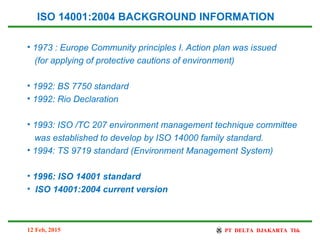
• 1973 : Europe Community principles I. Action plan was issued
(for applying of protective cautions of environment)
• 1992: BS 7750 standard
• 1992: Rio Declaration
• 1993: ISO /TC 207 environment management technique committee
was established to develop by ISO 14000 family standard.
• 1994: TS 9719 standard (Environment Management System)
• 1996: ISO 14001 standard
• ISO 14001:2004 current version
ISO 14001:2004 BACKGROUND INFORMATION
12 Feb, 2015
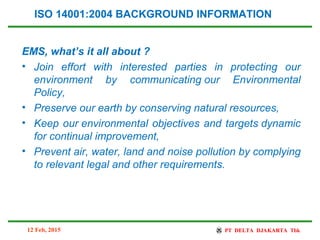
EMS, what’s it all about ?
• Join effort with interested parties in protecting our
environment by communicating our Environmental
Policy,
• Preserve our earth by conserving natural resources,
• Keep our environmental objectives and targets dynamic
for continual improvement,
• Prevent air, water, land and noise pollution by complying
to relevant legal and other requirements.
ISO 14001:2004 BACKGROUND INFORMATION
12 Feb, 2015
EMS, what’s it all about ?
• Environmental impact of our business.
• Making sure that we have EMS that keeps our
business within the law.
• Fines and imprisonment are real possibilities.
• And the media love a good story based on
contravention and pollution.
ISO 14001:2004 BACKGROUND INFORMATION
12 Feb, 2015
ISO 14001:2004 is an Environmental Management System
It maps out a framework that a company or organization
follow an effective environmental management system.
It provide assurance to company management and
employees as well as external stakeholders that
environmental impact is being measured and improved.
The benefits of ISO 14001:2004 :
• Reduced cost of waste management
• Savings in consumption of energy and materials
• Improved image among regulators, customers and public.
ISO 14001:2004 BACKGROUND INFORMATION
12 Feb, 2015
ISO 14000 FAMILY
• ISO 14001 is the standard that gives the requirements
for an environmental management system.
• ISO 14001:2004 is the latest, improved version.
• It is the only standard in the ISO 14000 family that
can be used for certification.
• The ISO 14000 family includes 21 other standards
that can help an organization specific aspects such as
auditing, environmental labelling, life cycle analysis…
12 Feb, 2015
STANDARD CLAUSES ISO 14001:2004
1. SCOPE
2. NORMATIVE STANDARDS
3. DEFINITIONS
4. EMS REQUIREMENTS AND MAIN ELEMENTS
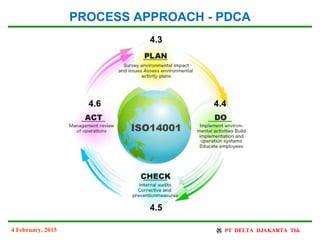
• 4.1 GENERAL REQUIREMENTS
• 4.2 ENVIRONMENT POLICY
• 4.3 PLANNING
o 4.3.1 Environment aspects
o 4.3.2 Legal and other requirements
o 4.3.3 Objectives, targets and programs
12 Feb, 2015
4 February, 2015
PROCESS APPROACH - PDCA
• 4.4 IMPLEMENTATION AND OPERATION
o 4.4.1 Resources, roles, responsibility and authority
o 4.4.2 Competence, training and awareness
o 4.4.3 Communication
o 4.4.4 Documentation
o 4.4.5 Control of document
o 4.4.6 Operational control
o 4.4.7 Emergency preparedness and response
• 4.5 CHECKING
o 4.5.1 Monitoring and measurement
o 4.5.2 Evaluation of compliance
o 4.5.3 Nonconformance, corrective action & preventive action
o 4.5.4 Control of records
o 4.5.5 Internal audit
• 4.6 MANAGEMENT REVIEW
17 Jan, 2015
REQUIREMENT ISO 14001:2004
1. General Requirements: defines the scope of the EMS, i.e. the boundaries of
the organization to which the EMS applies (4.1).
2. Environmental Policy - statement of the organization’s commitment to the
environment (4.2)
3. Environmental Aspects and Impacts - identify environmental attributes of
products, activities and services and their effects on the environment (4.3.1)
4. Legal and Other Requirements - identify and ensure access to relevant
laws and regulations (4.3.2)
5. Objectives and Targets and Environmental Management Program - set
environmental goals for the organization and plan actions to achieve
objectives and targets (4.3.3)
6. Resources, roles, responsibility and authority - roles and responsibilities
within the organization (4.4.1)
7. Training, Awareness and Competence - employees are aware and capable
of their environmental responsibilities (4.4.2)
8. Communication - develop processes for internal and external
communication on environmental management issues (4.4.3)
4 February, 2008
8. EMS Documentation-information about the EMS documents (4.4.4)
9. Document Control - ensure effective management of procedures and
other documents (4.4.5)
10.Operational Control - identify, plan and manage the organization’s
operations and activities in line with the policy, objectives & targets (4.4.6)
11.Emergency Preparedness and Response - develop procedures for
preventing and responding to potential emergencies (4.4.7)
12.Monitoring and Measuring - monitor key activities and track performance
including periodic compliance evaluation (4.5.1)
13.Evaluation of Compliance - develop procedure to periodically evaluate
compliance with legal and other requirements (4.5.2)
14.Nonconformance and Corrective and Preventive Action - identify and
correct problems and prevent recurrences (4.5.3)
15.Records - keep adequate records of EMS performance (4.5.4)
16.EMS Audit - periodically verify that the EMS is effective and achieving
objectives and targets (4.5.5)
17.Management Review - review the EMS (4.6)
REQUIREMENT ISO 14001:2004
4 February, 2015
PROCESS APPROACH - PDCA
MANAGEMENT REVIEW
• Periodic reviews to ensure its continuing suitability, adequacy, and effectiveness.
• Assess opportunities for improvement.
• Assess the need to change the EMS including:
o ƒ Changes to the environmental policy,
o ƒ Changes to environmental objectives, and
o ƒ Changes to environmental targets and programs
• ƒ Minimum management review inputs:
o ƒ Internal audit results,
o ƒ Evaluation of compliance with legal and other requirements,
o ƒ Communication from external parties, including complaints,
o ƒ Environmental performance,
o ƒ Status of objectives, targets, and programs,
o ƒ Status of corrective and preventive actions,
o ƒ Follow-up to action items from previous management reviews,
o ƒ Planed changes that could affect environmental aspects,
o ƒ Changes to legal and other requirements, and
o ƒ Recommendations for improvement.
• Document any decisions and actions regarding changes and improvements to the EMS.
• Keep records of the management review and its results.
4 February, 2015
PROCESS APPROACH - PDCA
4.3
4.6
4.5
4.4
KEMENTERIAN LINGKUNGAN HIDUP
14
PROPER
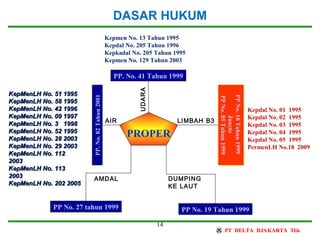
DASAR HUKUM
AIR
PP. No. 41 Tahun 1999
UDARA
PP No. 27 tahun 1999 PP No. 19 Tahun 1999
PP.No.82Tahun2001
LIMBAH B3
AMDAL DUMPING
KE LAUT
Kepmen No. 13 Tahun 1995
Kepdal No. 205 Tahun 1996
Kepkadal No. 205 Tahun 1995
Kepmen No. 129 Tahun 2003
PPNo.18Tahun1999
Juncto
PPNo.85Tahun1999
Kepdal No. 01 1995
Kepdal No. 02 1995
Kepdal No. 03 1995
Kepdal No. 04 1995
Kepdal No. 05 1995
PermenLH No.18 2009
KepMenLHKepMenLH No. 51 1995No. 51 1995
KepMenLH No. 58 1995KepMenLH No. 58 1995
KepMenLH No. 42 1996KepMenLH No. 42 1996
KepMenLH No. 09 1997KepMenLH No. 09 1997
KepMenLH No. 3KepMenLH No. 3 19981998
KepMenLH No. 52 1995KepMenLH No. 52 1995
KepMenLH No. 28 2003KepMenLH No. 28 2003
KepMenLH No. 29 2003KepMenLH No. 29 2003
KepMenLH No. 112KepMenLH No. 112
20032003
KepMenLH No. 113KepMenLH No. 113
20032003
KepMenLH No. 202 2005KepMenLH No. 202 2005
15
01/22/16
BEYOND COMPLIANCE AREA
PRINSIP DASAR PENILAIAN PROPER
PENGENDALIAN PENCEMARAN LAUT
PENGELOLAAN LIMBAH B3
PENGENDALIAN PENCEMARAN UDARA
PENGENDALIAN PENCEMARAN AIR
PENERAPAN AMDAL
Pemanfaatan
Sumber Daya
Pelaksanaan
Pengembangan
Masyarakat
(Community
Development)
EMAS
HIJAU
S
K
O
R
E
B O B O T
N
I
L
A
I
Penerapan
Sistem
Manajemen
Lingkungan
Passing Grade
Passing Grade
Best Practices ; Best Available Technology;
Best Corporate Social Responsibility
X =
HITAMTIDAK ADA UPAYATIDAK ADA UPAYA
BELUM TAATBELUM TAAT
MERAH --
MERAH
TAATTAAT
BIRU
BIRU --
4 February, 2015
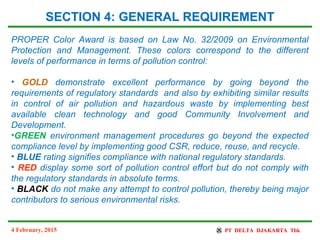
SECTION 4: GENERAL REQUIREMENT
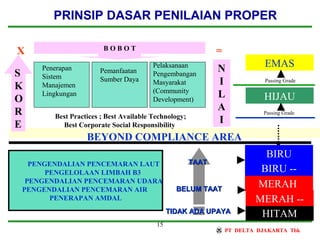
PROPER Color Award is based on Law No. 32/2009 on Environmental
Protection and Management. These colors correspond to the different
levels of performance in terms of pollution control:
• GOLD demonstrate excellent performance by going beyond the
requirements of regulatory standards and also by exhibiting similar results
in control of air pollution and hazardous waste by implementing best
available clean technology and good Community Involvement and
Development.
•GREEN environment management procedures go beyond the expected
compliance level by implementing good CSR, reduce, reuse, and recycle.
• BLUE rating signifies compliance with national regulatory standards.
• RED display some sort of pollution control effort but do not comply with
the regulatory standards in absolute terms.
• BLACK do not make any attempt to control pollution, thereby being major
contributors to serious environmental risks.
4 February, 2015
TERIMA KASIH
4 February, 2015
End of Slide

Iso 14001

  • 1.
    ISO 14001 :2004 12 Feb, 2015
  • 2.
    • 1973 :Europe Community principles I. Action plan was issued (for applying of protective cautions of environment) • 1992: BS 7750 standard • 1992: Rio Declaration • 1993: ISO /TC 207 environment management technique committee was established to develop by ISO 14000 family standard. • 1994: TS 9719 standard (Environment Management System) • 1996: ISO 14001 standard • ISO 14001:2004 current version ISO 14001:2004 BACKGROUND INFORMATION 12 Feb, 2015
  • 3.
    EMS, what’s itall about ? • Join effort with interested parties in protecting our environment by communicating our Environmental Policy, • Preserve our earth by conserving natural resources, • Keep our environmental objectives and targets dynamic for continual improvement, • Prevent air, water, land and noise pollution by complying to relevant legal and other requirements. ISO 14001:2004 BACKGROUND INFORMATION 12 Feb, 2015
  • 4.
    EMS, what’s itall about ? • Environmental impact of our business. • Making sure that we have EMS that keeps our business within the law. • Fines and imprisonment are real possibilities. • And the media love a good story based on contravention and pollution. ISO 14001:2004 BACKGROUND INFORMATION 12 Feb, 2015
  • 5.
    ISO 14001:2004 isan Environmental Management System It maps out a framework that a company or organization follow an effective environmental management system. It provide assurance to company management and employees as well as external stakeholders that environmental impact is being measured and improved. The benefits of ISO 14001:2004 : • Reduced cost of waste management • Savings in consumption of energy and materials • Improved image among regulators, customers and public. ISO 14001:2004 BACKGROUND INFORMATION 12 Feb, 2015
  • 6.
    ISO 14000 FAMILY •ISO 14001 is the standard that gives the requirements for an environmental management system. • ISO 14001:2004 is the latest, improved version. • It is the only standard in the ISO 14000 family that can be used for certification. • The ISO 14000 family includes 21 other standards that can help an organization specific aspects such as auditing, environmental labelling, life cycle analysis… 12 Feb, 2015
  • 7.
    STANDARD CLAUSES ISO14001:2004 1. SCOPE 2. NORMATIVE STANDARDS 3. DEFINITIONS 4. EMS REQUIREMENTS AND MAIN ELEMENTS • 4.1 GENERAL REQUIREMENTS • 4.2 ENVIRONMENT POLICY • 4.3 PLANNING o 4.3.1 Environment aspects o 4.3.2 Legal and other requirements o 4.3.3 Objectives, targets and programs 12 Feb, 2015
  • 8.
    4 February, 2015 PROCESSAPPROACH - PDCA • 4.4 IMPLEMENTATION AND OPERATION o 4.4.1 Resources, roles, responsibility and authority o 4.4.2 Competence, training and awareness o 4.4.3 Communication o 4.4.4 Documentation o 4.4.5 Control of document o 4.4.6 Operational control o 4.4.7 Emergency preparedness and response • 4.5 CHECKING o 4.5.1 Monitoring and measurement o 4.5.2 Evaluation of compliance o 4.5.3 Nonconformance, corrective action & preventive action o 4.5.4 Control of records o 4.5.5 Internal audit • 4.6 MANAGEMENT REVIEW
  • 9.
    17 Jan, 2015 REQUIREMENTISO 14001:2004 1. General Requirements: defines the scope of the EMS, i.e. the boundaries of the organization to which the EMS applies (4.1). 2. Environmental Policy - statement of the organization’s commitment to the environment (4.2) 3. Environmental Aspects and Impacts - identify environmental attributes of products, activities and services and their effects on the environment (4.3.1) 4. Legal and Other Requirements - identify and ensure access to relevant laws and regulations (4.3.2) 5. Objectives and Targets and Environmental Management Program - set environmental goals for the organization and plan actions to achieve objectives and targets (4.3.3) 6. Resources, roles, responsibility and authority - roles and responsibilities within the organization (4.4.1) 7. Training, Awareness and Competence - employees are aware and capable of their environmental responsibilities (4.4.2) 8. Communication - develop processes for internal and external communication on environmental management issues (4.4.3)
  • 10.
    4 February, 2008 8.EMS Documentation-information about the EMS documents (4.4.4) 9. Document Control - ensure effective management of procedures and other documents (4.4.5) 10.Operational Control - identify, plan and manage the organization’s operations and activities in line with the policy, objectives & targets (4.4.6) 11.Emergency Preparedness and Response - develop procedures for preventing and responding to potential emergencies (4.4.7) 12.Monitoring and Measuring - monitor key activities and track performance including periodic compliance evaluation (4.5.1) 13.Evaluation of Compliance - develop procedure to periodically evaluate compliance with legal and other requirements (4.5.2) 14.Nonconformance and Corrective and Preventive Action - identify and correct problems and prevent recurrences (4.5.3) 15.Records - keep adequate records of EMS performance (4.5.4) 16.EMS Audit - periodically verify that the EMS is effective and achieving objectives and targets (4.5.5) 17.Management Review - review the EMS (4.6) REQUIREMENT ISO 14001:2004
  • 11.
    4 February, 2015 PROCESSAPPROACH - PDCA MANAGEMENT REVIEW • Periodic reviews to ensure its continuing suitability, adequacy, and effectiveness. • Assess opportunities for improvement. • Assess the need to change the EMS including: o ƒ Changes to the environmental policy, o ƒ Changes to environmental objectives, and o ƒ Changes to environmental targets and programs • ƒ Minimum management review inputs: o ƒ Internal audit results, o ƒ Evaluation of compliance with legal and other requirements, o ƒ Communication from external parties, including complaints, o ƒ Environmental performance, o ƒ Status of objectives, targets, and programs, o ƒ Status of corrective and preventive actions, o ƒ Follow-up to action items from previous management reviews, o ƒ Planed changes that could affect environmental aspects, o ƒ Changes to legal and other requirements, and o ƒ Recommendations for improvement. • Document any decisions and actions regarding changes and improvements to the EMS. • Keep records of the management review and its results.
  • 12.
    4 February, 2015 PROCESSAPPROACH - PDCA 4.3 4.6 4.5 4.4
  • 13.
  • 14.
    14 PROPER DASAR HUKUM AIR PP. No.41 Tahun 1999 UDARA PP No. 27 tahun 1999 PP No. 19 Tahun 1999 PP.No.82Tahun2001 LIMBAH B3 AMDAL DUMPING KE LAUT Kepmen No. 13 Tahun 1995 Kepdal No. 205 Tahun 1996 Kepkadal No. 205 Tahun 1995 Kepmen No. 129 Tahun 2003 PPNo.18Tahun1999 Juncto PPNo.85Tahun1999 Kepdal No. 01 1995 Kepdal No. 02 1995 Kepdal No. 03 1995 Kepdal No. 04 1995 Kepdal No. 05 1995 PermenLH No.18 2009 KepMenLHKepMenLH No. 51 1995No. 51 1995 KepMenLH No. 58 1995KepMenLH No. 58 1995 KepMenLH No. 42 1996KepMenLH No. 42 1996 KepMenLH No. 09 1997KepMenLH No. 09 1997 KepMenLH No. 3KepMenLH No. 3 19981998 KepMenLH No. 52 1995KepMenLH No. 52 1995 KepMenLH No. 28 2003KepMenLH No. 28 2003 KepMenLH No. 29 2003KepMenLH No. 29 2003 KepMenLH No. 112KepMenLH No. 112 20032003 KepMenLH No. 113KepMenLH No. 113 20032003 KepMenLH No. 202 2005KepMenLH No. 202 2005
  • 15.
    15 01/22/16 BEYOND COMPLIANCE AREA PRINSIPDASAR PENILAIAN PROPER PENGENDALIAN PENCEMARAN LAUT PENGELOLAAN LIMBAH B3 PENGENDALIAN PENCEMARAN UDARA PENGENDALIAN PENCEMARAN AIR PENERAPAN AMDAL Pemanfaatan Sumber Daya Pelaksanaan Pengembangan Masyarakat (Community Development) EMAS HIJAU S K O R E B O B O T N I L A I Penerapan Sistem Manajemen Lingkungan Passing Grade Passing Grade Best Practices ; Best Available Technology; Best Corporate Social Responsibility X = HITAMTIDAK ADA UPAYATIDAK ADA UPAYA BELUM TAATBELUM TAAT MERAH -- MERAH TAATTAAT BIRU BIRU --
  • 16.
    4 February, 2015 SECTION4: GENERAL REQUIREMENT PROPER Color Award is based on Law No. 32/2009 on Environmental Protection and Management. These colors correspond to the different levels of performance in terms of pollution control: • GOLD demonstrate excellent performance by going beyond the requirements of regulatory standards and also by exhibiting similar results in control of air pollution and hazardous waste by implementing best available clean technology and good Community Involvement and Development. •GREEN environment management procedures go beyond the expected compliance level by implementing good CSR, reduce, reuse, and recycle. • BLUE rating signifies compliance with national regulatory standards. • RED display some sort of pollution control effort but do not comply with the regulatory standards in absolute terms. • BLACK do not make any attempt to control pollution, thereby being major contributors to serious environmental risks.
  • 17.
  • 18.