ISO 14001:2015
Summary of changes
Environmental Management System Requirements
Transition Series
Compliance Training Panel
Compliance Training Panel-Transition Series
Introduction
This document has been prepared to provide a summary on the changes between ISO
14001:2004 and ISO 14001:2015. The documents contains the following:
a. Benefits of the new version of the standard.
b. Few key definitions
c. Mapping between the versions as per ISO.org.
d. Summary of key changes between the versions of the standard.
e. List of documented information requirements as per the new version of the
standard.
Why standards are revised?
The standards are revised to reflect the changes in the marketplace and to ensure they
remain as useful tool for the stakeholders. Organizations operate in increasingly complex
environment when compared to last decade and the standards are revised to adapt to
the changing world.
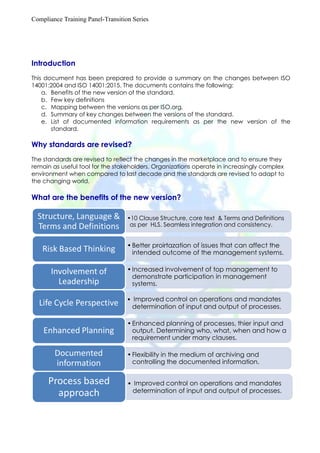
What are the benefits of the new version?
•10 Clause Structure, core text & Terms and Definitions
as per HLS. Seamless integration and consistency.
Structure, Language &
Terms and Definitions
•Better proirtazation of issues that can affect the
intended outcome of the management systems.Risk Based Thinking
•Increased involvement of top management to
demonstrate participation in management
systems.
Involvement of
Leadership
• Improved control on operations and mandates
determination of input and output of processes.
Life Cycle Perspective
•Enhanced planning of processes, thier input and
output. Determining who, what, when and how a
requirement under many clauses.
Enhanced Planning
•Flexibility in the medium of archiving and
controlling the documented information.
Documented
information
• Improved control on operations and mandates
determination of input and output of processes.
Process based
approach
Compliance Training Panel-Transition Series
Visit us at www.compliancetrainingpanel.com
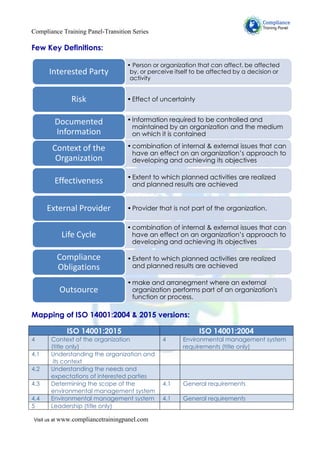
Few Key Definitions:
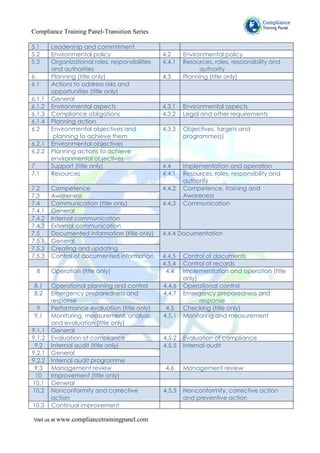
Mapping of ISO 14001:2004 & 2015 versions:
ISO 14001:2015 ISO 14001:2004
4 Context of the organization
(title only)
4 Environmental management system
requirements (title only)
4.1 Understanding the organization and
its context
4.2 Understanding the needs and
expectations of interested parties
4.3 Determining the scope of the
environmental management system
4.1 General requirements
4.4 Environmental management system 4.1 General requirements
5 Leadership (title only)
• Person or organization that can affect, be affected
by, or perceive itself to be affected by a decision or
activity
Interested Party
•Effect of uncertaintyRisk
•Information required to be controlled and
maintained by an organization and the medium
on which it is contained
Documented
Information
•combination of internal & external issues that can
have an effect on an organization’s approach to
developing and achieving its objectives
Context of the
Organization
•Extent to which planned activities are realized
and planned results are achievedEffectiveness
•Provider that is not part of the organization.External Provider
•combination of internal & external issues that can
have an effect on an organization’s approach to
developing and achieving its objectives
Life Cycle
•Extent to which planned activities are realized
and planned results are achieved
Compliance
Obligations
•make and arranegment where an external
organization performs part of an organization's
function or process.
Outsource
Compliance Training Panel-Transition Series
Visit us at www.compliancetrainingpanel.com
5.1 Leadership and commitment
5.2 Environmental policy 4.2 Environmental policy
5.3 Organizational roles, responsibilities
and authorities
4.4.1 Resources, roles, responsibility and
authority
6 Planning (title only) 4.3 Planning (title only)
6.1 Actions to address risks and
opportunities (title only)
6.1.1 General
6.1.2 Environmental aspects 4.3.1 Environmental aspects
6.1.3 Compliance obligations 4.3.2 Legal and other requirements
6.1.4 Planning action
6.2 Environmental objectives and
planning to achieve them
4.3.3 Objectives, targets and
programme(s)
6.2.1 Environmental objectives
6.2.2 Planning actions to achieve
environmental objectives
7 Support (title only) 4.4 Implementation and operation
7.1 Resources 4.4.1 Resources, roles, responsibility and
authority
7.2 Competence 4.4.2 Competence, training and
Awareness7.3 Awareness
7.4 Communication (title only) 4.4.3 Communication
7.4.1 General
7.4.2 Internal communication
7.4.3 External communication
7.5 Documented information (title only) 4.4.4 Documentation
7.5.1 General
7.5.2 Creating and updating
7.5.3 Control of documented information 4.4.5 Control of documents
4.5.4 Control of records
8 Operation (title only) 4.4 Implementation and operation (title
only)
8.1 Operational planning and control 4.4.6 Operational control
8.2 Emergency preparedness and
response
4.4.7 Emergency preparedness and
response
9 Performance evaluation (title only) 4.5 Checking (title only)
9.1 Monitoring, measurement, analysis
and evaluation (title only)
4.5.1 Monitoring and measurement
9.1.1 General
9.1.2 Evaluation of compliance 4.5.2 Evaluation of compliance
9.2 Internal audit (title only) 4.5.5 Internal audit
9.2.1 General
9.2.2 Internal audit programme
9.3 Management review 4.6 Management review
10 Improvement (title only)
10.1 General
10.2 Nonconformity and corrective
action
4.5.3 Nonconformity, corrective action
and preventive action
10.3 Continual improvement
Compliance Training Panel-Transition Series
Visit us at www.compliancetrainingpanel.com
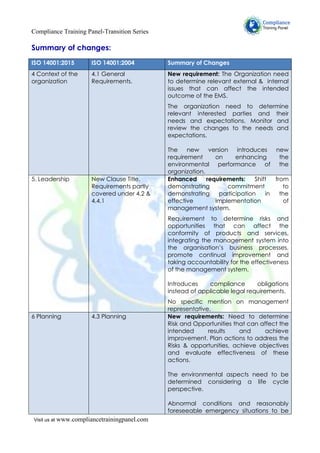
Summary of changes:
ISO 14001:2015 ISO 14001:2004 Summary of Changes
4 Context of the
organization
4.1 General
Requirements.
New requirement: The Organization need
to determine relevant external & internal
issues that can affect the intended
outcome of the EMS.
The organization need to determine
relevant interested parties and their
needs and expectations. Monitor and
review the changes to the needs and
expectations.
The new version introduces new
requirement on enhancing the
environmental performance of the
organization.
5. Leadership New Clause Title.
Requirements partly
covered under 4.2 &
4.4.1
Enhanced requirements: Shift from
demonstrating commitment to
demonstrating participation in the
effective implementation of
management system.
Requirement to determine risks and
opportunities that can affect the
conformity of products and services,
integrating the management system into
the organisation’s business processes,
promote continual improvement and
taking accountability for the effectiveness
of the management system.
Introduces compliance obligations
instead of applicable legal requirements.
No specific mention on management
representative.
6 Planning 4.3 Planning New requirements: Need to determine
Risk and Opportunities that can affect the
intended results and achieve
improvement. Plan actions to address the
Risks & opportunities, achieve objectives
and evaluate effectiveness of these
actions.
The environmental aspects need to be
determined considering a life cycle
perspective.
Abnormal conditions and reasonably
foreseeable emergency situations to be
Compliance Training Panel-Transition Series
Visit us at www.compliancetrainingpanel.com
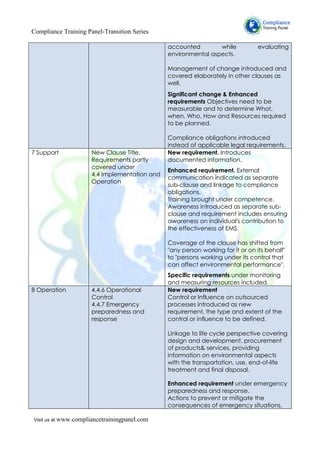
accounted while evaluating
environmental aspects.
Management of change introduced and
covered elaborately in other clauses as
well.
Significant change & Enhanced
requirements Objectives need to be
measurable and to determine What,
when, Who, How and Resources required
to be planned.
Compliance obligations introduced
instead of applicable legal requirements.
7 Support New Clause Title.
Requirements partly
covered under
4.4 Implementation and
Operation
New requirement. Introduces
documented information.
Enhanced requirement. External
communication indicated as separate
sub-clause and linkage to compliance
obligations.
Training brought under competence.
Awareness introduced as separate sub-
clause and requirement includes ensuring
awareness on individual's contribution to
the effectiveness of EMS.
Coverage of the clause has shifted from
"any person working for it or on its behalf"
to "persons working under its control that
can affect environmental performance".
Specific requirements under monitoring
and measuring resources included.
8 Operation 4.4.6 Operational
Control
4.4.7 Emergency
preparedness and
response
New requirement
Control or Influence on outsourced
processes introduced as new
requirement, the type and extent of the
control or influence to be defined.
Linkage to life cycle perspective covering
design and development, procurement
of products& services, providing
information on environmental aspects
with the transportation, use, end-of-life
treatment and final disposal.
Enhanced requirement under emergency
preparedness and response.
Actions to prevent or mitigate the
consequences of emergency situations,
Compliance Training Panel-Transition Series
Visit us at www.compliancetrainingpanel.com
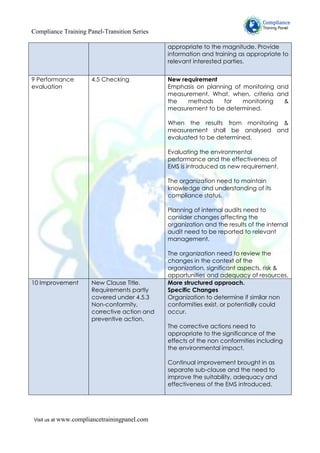
appropriate to the magnitude. Provide
information and training as appropriate to
relevant interested parties.
9 Performance
evaluation
4.5 Checking New requirement
Emphasis on planning of monitoring and
measurement. What, when, criteria and
the methods for monitoring &
measurement to be determined.
When the results from monitoring &
measurement shall be analysed and
evaluated to be determined.
Evaluating the environmental
performance and the effectiveness of
EMS is introduced as new requirement.
The organization need to maintain
knowledge and understanding of its
compliance status.
Planning of internal audits need to
consider changes affecting the
organization and the results of the internal
audit need to be reported to relevant
management.
The organization need to review the
changes in the context of the
organization, significant aspects, risk &
opportunities and adequacy of resources.
10 Improvement New Clause Title.
Requirements partly
covered under 4.5.3
Non-conformity,
corrective action and
preventive action.
More structured approach.
Specific Changes
Organization to determine if similar non
conformities exist, or potentially could
occur.
The corrective actions need to
appropriate to the significance of the
effects of the non conformities including
the environmental impact.
Continual improvement brought in as
separate sub-clause and the need to
improve the suitability, adequacy and
effectiveness of the EMS introduced.
Compliance Training Panel-Transition Series
Visit us at www.compliancetrainingpanel.com
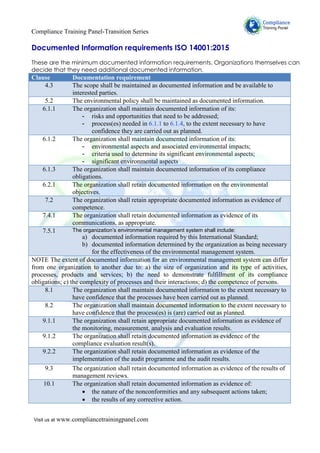
Documented Information requirements ISO 14001:2015
These are the minimum documented information requirements. Organizations themselves can
decide that they need additional documented information.
Clause Documentation requirement
4.3 The scope shall be maintained as documented information and be available to
interested parties.
5.2 The environmental policy shall be maintained as documented information.
6.1.1 The organization shall maintain documented information of its:
- risks and opportunities that need to be addressed;
- process(es) needed in 6.1.1 to 6.1.4, to the extent necessary to have
confidence they are carried out as planned.
6.1.2 The organization shall maintain documented information of its:
- environmental aspects and associated environmental impacts;
- criteria used to determine its significant environmental aspects;
- significant environmental aspects
6.1.3 The organization shall maintain documented information of its compliance
obligations.
6.2.1 The organization shall retain documented information on the environmental
objectives.
7.2 The organization shall retain appropriate documented information as evidence of
competence.
7.4.1 The organization shall retain documented information as evidence of its
communications, as appropriate.
7.5.1 The organization’s environmental management system shall include:
a) documented information required by this International Standard;
b) documented information determined by the organization as being necessary
for the effectiveness of the environmental management system.
NOTE The extent of documented information for an environmental management system can differ
from one organization to another due to: a) the size of organization and its type of activities,
processes, products and services; b) the need to demonstrate fulfillment of its compliance
obligations; c) the complexity of processes and their interactions; d) the competence of persons.
8.1 The organization shall maintain documented information to the extent necessary to
have confidence that the processes have been carried out as planned.
8.2 The organization shall maintain documented information to the extent necessary to
have confidence that the process(es) is (are) carried out as planned.
9.1.1 The organization shall retain appropriate documented information as evidence of
the monitoring, measurement, analysis and evaluation results.
9.1.2 The organization shall retain documented information as evidence of the
compliance evaluation result(s).
9.2.2 The organization shall retain documented information as evidence of the
implementation of the audit programme and the audit results.
9.3 The organization shall retain documented information as evidence of the results of
management reviews.
10.1 The organization shall retain documented information as evidence of:
 the nature of the nonconformities and any subsequent actions taken;
 the results of any corrective action.

Transition to ISO 14001:2015

  • 1.
    ISO 14001:2015 Summary ofchanges Environmental Management System Requirements Transition Series Compliance Training Panel
  • 2.
    Compliance Training Panel-TransitionSeries Introduction This document has been prepared to provide a summary on the changes between ISO 14001:2004 and ISO 14001:2015. The documents contains the following: a. Benefits of the new version of the standard. b. Few key definitions c. Mapping between the versions as per ISO.org. d. Summary of key changes between the versions of the standard. e. List of documented information requirements as per the new version of the standard. Why standards are revised? The standards are revised to reflect the changes in the marketplace and to ensure they remain as useful tool for the stakeholders. Organizations operate in increasingly complex environment when compared to last decade and the standards are revised to adapt to the changing world. What are the benefits of the new version? •10 Clause Structure, core text & Terms and Definitions as per HLS. Seamless integration and consistency. Structure, Language & Terms and Definitions •Better proirtazation of issues that can affect the intended outcome of the management systems.Risk Based Thinking •Increased involvement of top management to demonstrate participation in management systems. Involvement of Leadership • Improved control on operations and mandates determination of input and output of processes. Life Cycle Perspective •Enhanced planning of processes, thier input and output. Determining who, what, when and how a requirement under many clauses. Enhanced Planning •Flexibility in the medium of archiving and controlling the documented information. Documented information • Improved control on operations and mandates determination of input and output of processes. Process based approach
  • 3.
    Compliance Training Panel-TransitionSeries Visit us at www.compliancetrainingpanel.com Few Key Definitions: Mapping of ISO 14001:2004 & 2015 versions: ISO 14001:2015 ISO 14001:2004 4 Context of the organization (title only) 4 Environmental management system requirements (title only) 4.1 Understanding the organization and its context 4.2 Understanding the needs and expectations of interested parties 4.3 Determining the scope of the environmental management system 4.1 General requirements 4.4 Environmental management system 4.1 General requirements 5 Leadership (title only) • Person or organization that can affect, be affected by, or perceive itself to be affected by a decision or activity Interested Party •Effect of uncertaintyRisk •Information required to be controlled and maintained by an organization and the medium on which it is contained Documented Information •combination of internal & external issues that can have an effect on an organization’s approach to developing and achieving its objectives Context of the Organization •Extent to which planned activities are realized and planned results are achievedEffectiveness •Provider that is not part of the organization.External Provider •combination of internal & external issues that can have an effect on an organization’s approach to developing and achieving its objectives Life Cycle •Extent to which planned activities are realized and planned results are achieved Compliance Obligations •make and arranegment where an external organization performs part of an organization's function or process. Outsource
  • 4.
    Compliance Training Panel-TransitionSeries Visit us at www.compliancetrainingpanel.com 5.1 Leadership and commitment 5.2 Environmental policy 4.2 Environmental policy 5.3 Organizational roles, responsibilities and authorities 4.4.1 Resources, roles, responsibility and authority 6 Planning (title only) 4.3 Planning (title only) 6.1 Actions to address risks and opportunities (title only) 6.1.1 General 6.1.2 Environmental aspects 4.3.1 Environmental aspects 6.1.3 Compliance obligations 4.3.2 Legal and other requirements 6.1.4 Planning action 6.2 Environmental objectives and planning to achieve them 4.3.3 Objectives, targets and programme(s) 6.2.1 Environmental objectives 6.2.2 Planning actions to achieve environmental objectives 7 Support (title only) 4.4 Implementation and operation 7.1 Resources 4.4.1 Resources, roles, responsibility and authority 7.2 Competence 4.4.2 Competence, training and Awareness7.3 Awareness 7.4 Communication (title only) 4.4.3 Communication 7.4.1 General 7.4.2 Internal communication 7.4.3 External communication 7.5 Documented information (title only) 4.4.4 Documentation 7.5.1 General 7.5.2 Creating and updating 7.5.3 Control of documented information 4.4.5 Control of documents 4.5.4 Control of records 8 Operation (title only) 4.4 Implementation and operation (title only) 8.1 Operational planning and control 4.4.6 Operational control 8.2 Emergency preparedness and response 4.4.7 Emergency preparedness and response 9 Performance evaluation (title only) 4.5 Checking (title only) 9.1 Monitoring, measurement, analysis and evaluation (title only) 4.5.1 Monitoring and measurement 9.1.1 General 9.1.2 Evaluation of compliance 4.5.2 Evaluation of compliance 9.2 Internal audit (title only) 4.5.5 Internal audit 9.2.1 General 9.2.2 Internal audit programme 9.3 Management review 4.6 Management review 10 Improvement (title only) 10.1 General 10.2 Nonconformity and corrective action 4.5.3 Nonconformity, corrective action and preventive action 10.3 Continual improvement
  • 5.
    Compliance Training Panel-TransitionSeries Visit us at www.compliancetrainingpanel.com Summary of changes: ISO 14001:2015 ISO 14001:2004 Summary of Changes 4 Context of the organization 4.1 General Requirements. New requirement: The Organization need to determine relevant external & internal issues that can affect the intended outcome of the EMS. The organization need to determine relevant interested parties and their needs and expectations. Monitor and review the changes to the needs and expectations. The new version introduces new requirement on enhancing the environmental performance of the organization. 5. Leadership New Clause Title. Requirements partly covered under 4.2 & 4.4.1 Enhanced requirements: Shift from demonstrating commitment to demonstrating participation in the effective implementation of management system. Requirement to determine risks and opportunities that can affect the conformity of products and services, integrating the management system into the organisation’s business processes, promote continual improvement and taking accountability for the effectiveness of the management system. Introduces compliance obligations instead of applicable legal requirements. No specific mention on management representative. 6 Planning 4.3 Planning New requirements: Need to determine Risk and Opportunities that can affect the intended results and achieve improvement. Plan actions to address the Risks & opportunities, achieve objectives and evaluate effectiveness of these actions. The environmental aspects need to be determined considering a life cycle perspective. Abnormal conditions and reasonably foreseeable emergency situations to be
  • 6.
    Compliance Training Panel-TransitionSeries Visit us at www.compliancetrainingpanel.com accounted while evaluating environmental aspects. Management of change introduced and covered elaborately in other clauses as well. Significant change & Enhanced requirements Objectives need to be measurable and to determine What, when, Who, How and Resources required to be planned. Compliance obligations introduced instead of applicable legal requirements. 7 Support New Clause Title. Requirements partly covered under 4.4 Implementation and Operation New requirement. Introduces documented information. Enhanced requirement. External communication indicated as separate sub-clause and linkage to compliance obligations. Training brought under competence. Awareness introduced as separate sub- clause and requirement includes ensuring awareness on individual's contribution to the effectiveness of EMS. Coverage of the clause has shifted from "any person working for it or on its behalf" to "persons working under its control that can affect environmental performance". Specific requirements under monitoring and measuring resources included. 8 Operation 4.4.6 Operational Control 4.4.7 Emergency preparedness and response New requirement Control or Influence on outsourced processes introduced as new requirement, the type and extent of the control or influence to be defined. Linkage to life cycle perspective covering design and development, procurement of products& services, providing information on environmental aspects with the transportation, use, end-of-life treatment and final disposal. Enhanced requirement under emergency preparedness and response. Actions to prevent or mitigate the consequences of emergency situations,
  • 7.
    Compliance Training Panel-TransitionSeries Visit us at www.compliancetrainingpanel.com appropriate to the magnitude. Provide information and training as appropriate to relevant interested parties. 9 Performance evaluation 4.5 Checking New requirement Emphasis on planning of monitoring and measurement. What, when, criteria and the methods for monitoring & measurement to be determined. When the results from monitoring & measurement shall be analysed and evaluated to be determined. Evaluating the environmental performance and the effectiveness of EMS is introduced as new requirement. The organization need to maintain knowledge and understanding of its compliance status. Planning of internal audits need to consider changes affecting the organization and the results of the internal audit need to be reported to relevant management. The organization need to review the changes in the context of the organization, significant aspects, risk & opportunities and adequacy of resources. 10 Improvement New Clause Title. Requirements partly covered under 4.5.3 Non-conformity, corrective action and preventive action. More structured approach. Specific Changes Organization to determine if similar non conformities exist, or potentially could occur. The corrective actions need to appropriate to the significance of the effects of the non conformities including the environmental impact. Continual improvement brought in as separate sub-clause and the need to improve the suitability, adequacy and effectiveness of the EMS introduced.
  • 8.
    Compliance Training Panel-TransitionSeries Visit us at www.compliancetrainingpanel.com Documented Information requirements ISO 14001:2015 These are the minimum documented information requirements. Organizations themselves can decide that they need additional documented information. Clause Documentation requirement 4.3 The scope shall be maintained as documented information and be available to interested parties. 5.2 The environmental policy shall be maintained as documented information. 6.1.1 The organization shall maintain documented information of its: - risks and opportunities that need to be addressed; - process(es) needed in 6.1.1 to 6.1.4, to the extent necessary to have confidence they are carried out as planned. 6.1.2 The organization shall maintain documented information of its: - environmental aspects and associated environmental impacts; - criteria used to determine its significant environmental aspects; - significant environmental aspects 6.1.3 The organization shall maintain documented information of its compliance obligations. 6.2.1 The organization shall retain documented information on the environmental objectives. 7.2 The organization shall retain appropriate documented information as evidence of competence. 7.4.1 The organization shall retain documented information as evidence of its communications, as appropriate. 7.5.1 The organization’s environmental management system shall include: a) documented information required by this International Standard; b) documented information determined by the organization as being necessary for the effectiveness of the environmental management system. NOTE The extent of documented information for an environmental management system can differ from one organization to another due to: a) the size of organization and its type of activities, processes, products and services; b) the need to demonstrate fulfillment of its compliance obligations; c) the complexity of processes and their interactions; d) the competence of persons. 8.1 The organization shall maintain documented information to the extent necessary to have confidence that the processes have been carried out as planned. 8.2 The organization shall maintain documented information to the extent necessary to have confidence that the process(es) is (are) carried out as planned. 9.1.1 The organization shall retain appropriate documented information as evidence of the monitoring, measurement, analysis and evaluation results. 9.1.2 The organization shall retain documented information as evidence of the compliance evaluation result(s). 9.2.2 The organization shall retain documented information as evidence of the implementation of the audit programme and the audit results. 9.3 The organization shall retain documented information as evidence of the results of management reviews. 10.1 The organization shall retain documented information as evidence of:  the nature of the nonconformities and any subsequent actions taken;  the results of any corrective action.