Agile can work in the enterprise – with a multi-
dimensional framework that coordinates, manages
and automates process, architecture, artifacts and
legacy viewpoints.
David Sprott 2014
Enterprise Agile – The Undiscovered Country?
© 2014 Everware-CBDI Inc
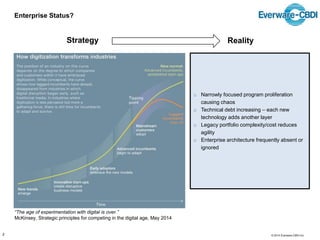
Enterprise Status?
Strategy Reality
o Narrowly focused program proliferation
causing chaos
o Technical debt increasing – each new
technology adds another layer
o Legacy portfolio complexity/cost reduces
agility
o Enterprise architecture frequently absent or
ignored
2
“The age of experimentation with digital is over.”
McKinsey, Strategic principles for competing in the digital age, May 2014
© 2014 Everware-CBDI Inc
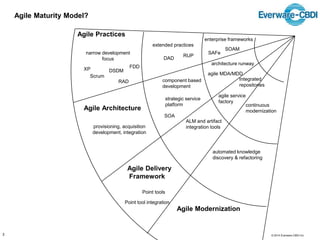
Agile Modernization
Agile Delivery
Framework
narrow development
focus
RAD
XP
Scrum
DSDM
FDD
extended practices
RUP
DAD
SAFe
enterprise frameworks
SOAM
Agile Practices
Agile Architecture
component based
development
SOA
agile MDA/MDD
strategic service
platform
agile service
factory
ALM and artifact
integration tools
automated knowledge
discovery & refactoring
continuous
modernization
architecture runway
Agile Maturity Model?
provisioning, acquisition
development, integration
Point tools
Point tool integration
Integrated
repositories
3
© 2014 Everware-CBDI Inc
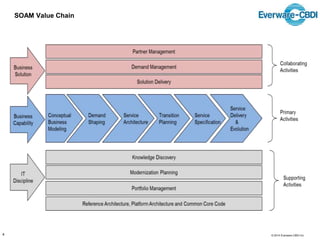
SOAM Value Chain
4
© 2014 Everware-CBDI Inc
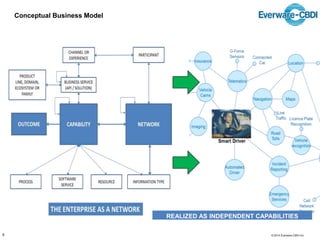
Conceptual Business Model
REALIZED AS INDEPENDENT CAPABILITIES
5
© 2014 Everware-CBDI Inc
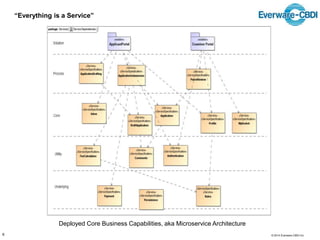
“Everything is a Service”
Deployed Core Business Capabilities, aka Microservice Architecture
6
© 2014 Everware-CBDI Inc
Service Factory
Service
Delivery
Architecture
Conceptual
Business
Modeling
Demand Shaping
Knowledge
Discovery
Integration
Transition
Engineering
Portfolio Management
Specification
Release
Management
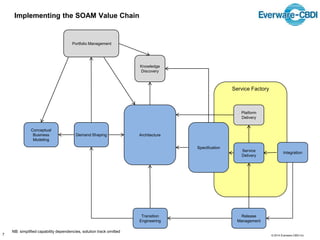
Implementing the SOAM Value Chain
Platform
Delivery
NB: simplified capability dependencies, solution track omitted
7
© 2014 Everware-CBDI Inc
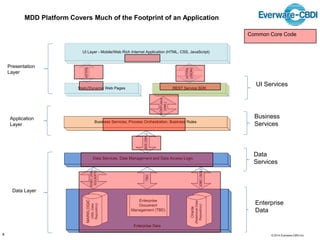
UI Layer - Mobile/Web Rich Internet Application (HTML, CSS, JavaScript)
Static/Dynamic Web Pages REST Service SDKHTTPS
HTTPS
(JSON)
MDD Platform Covers Much of the Footprint of an Application
Presentation
Layer
UI Services
Business
Services
Data
Services
Enterprise
Data
Data Layer
Application
Layer
Common Core Code
8
 Everware-CBDI Inc
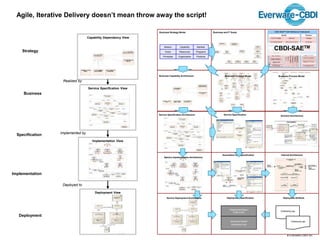
Mission Capability Markets
Vision Resources Programs
Principles Organization Products
Implementation
Deployment
Specification
Strategy
Business
Service Implementation Architecture
Internal ArchitectureAutomation Unit Specification
Deployable Artifacts
Orderentry.jsp
Orderentry.ejb
Service Deployment Architecture Deployment Specification
«DeploymentSpec»
Order Entry
execution:thread
transaction:true
Service Specification Architecture Service Specification Solution Architecture
Business Concept ModelBusiness Capability Architecture Business Process Model
Business and IT GoalsBusiness Strategy Model
Implementation View
Service Specification View
Capability Dependency View
Deployment View
Realized by
Implemented by
Deployed to
CBDI-SAETM
Agile, Iterative Delivery doesn’t mean throw away the script!
© 2014 Everware-CBDI Inc
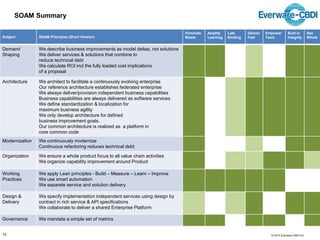
SOAM Summary
Subject SOAM Principles (Short Version)
Eliminate
Waste
Amplify
Learning
Late
Binding
Deliver
Fast
Empower
Team
Built in
Integrity
See
Whole
Demand
Shaping
We describe business improvements as model deltas, not solutions
We deliver services & solutions that combine to
reduce technical debt
We calculate ROI incl the fully loaded cost implications
of a proposal
Architecture We architect to facilitate a continuously evolving enterprise
Our reference architecture establishes federated enterprise
We always deliver/provision independent business capabilities
Business capabilities are always delivered as software services
We define standardization & localization for
maximum business agility
We only develop architecture for defined
business improvement goals.
Our common architecture is realized as a platform in
core common code
Modernization We continuously modernize
Continuous refactoring reduces technical debt
Organization We ensure a whole product focus to all value chain activities
We organize capability improvement around Product
Working
Practices
We apply Lean principles - Build – Measure – Learn – Improve
We use smart automation
We separate service and solution delivery
Design &
Delivery
We specify implementation independent services using design by
contract in rich service & API specifications
We collaborate to deliver a shared Enterprise Platform
Governance We mandate a simple set of metrics
10
© 2014 Everware-CBDI Inc11
agileservicefactory.com

Enterprise Agile - The Undiscovered Country

  • 1.
    Agile can workin the enterprise – with a multi- dimensional framework that coordinates, manages and automates process, architecture, artifacts and legacy viewpoints. David Sprott 2014 Enterprise Agile – The Undiscovered Country?
  • 2.
    © 2014 Everware-CBDIInc Enterprise Status? Strategy Reality o Narrowly focused program proliferation causing chaos o Technical debt increasing – each new technology adds another layer o Legacy portfolio complexity/cost reduces agility o Enterprise architecture frequently absent or ignored 2 “The age of experimentation with digital is over.” McKinsey, Strategic principles for competing in the digital age, May 2014
  • 3.
    © 2014 Everware-CBDIInc Agile Modernization Agile Delivery Framework narrow development focus RAD XP Scrum DSDM FDD extended practices RUP DAD SAFe enterprise frameworks SOAM Agile Practices Agile Architecture component based development SOA agile MDA/MDD strategic service platform agile service factory ALM and artifact integration tools automated knowledge discovery & refactoring continuous modernization architecture runway Agile Maturity Model? provisioning, acquisition development, integration Point tools Point tool integration Integrated repositories 3
  • 4.
    © 2014 Everware-CBDIInc SOAM Value Chain 4
  • 5.
    © 2014 Everware-CBDIInc Conceptual Business Model REALIZED AS INDEPENDENT CAPABILITIES 5
  • 6.
    © 2014 Everware-CBDIInc “Everything is a Service” Deployed Core Business Capabilities, aka Microservice Architecture 6
  • 7.
    © 2014 Everware-CBDIInc Service Factory Service Delivery Architecture Conceptual Business Modeling Demand Shaping Knowledge Discovery Integration Transition Engineering Portfolio Management Specification Release Management Implementing the SOAM Value Chain Platform Delivery NB: simplified capability dependencies, solution track omitted 7
  • 8.
    © 2014 Everware-CBDIInc UI Layer - Mobile/Web Rich Internet Application (HTML, CSS, JavaScript) Static/Dynamic Web Pages REST Service SDKHTTPS HTTPS (JSON) MDD Platform Covers Much of the Footprint of an Application Presentation Layer UI Services Business Services Data Services Enterprise Data Data Layer Application Layer Common Core Code 8
  • 9.
     Everware-CBDI Inc MissionCapability Markets Vision Resources Programs Principles Organization Products Implementation Deployment Specification Strategy Business Service Implementation Architecture Internal ArchitectureAutomation Unit Specification Deployable Artifacts Orderentry.jsp Orderentry.ejb Service Deployment Architecture Deployment Specification «DeploymentSpec» Order Entry execution:thread transaction:true Service Specification Architecture Service Specification Solution Architecture Business Concept ModelBusiness Capability Architecture Business Process Model Business and IT GoalsBusiness Strategy Model Implementation View Service Specification View Capability Dependency View Deployment View Realized by Implemented by Deployed to CBDI-SAETM Agile, Iterative Delivery doesn’t mean throw away the script!
  • 10.
    © 2014 Everware-CBDIInc SOAM Summary Subject SOAM Principles (Short Version) Eliminate Waste Amplify Learning Late Binding Deliver Fast Empower Team Built in Integrity See Whole Demand Shaping We describe business improvements as model deltas, not solutions We deliver services & solutions that combine to reduce technical debt We calculate ROI incl the fully loaded cost implications of a proposal Architecture We architect to facilitate a continuously evolving enterprise Our reference architecture establishes federated enterprise We always deliver/provision independent business capabilities Business capabilities are always delivered as software services We define standardization & localization for maximum business agility We only develop architecture for defined business improvement goals. Our common architecture is realized as a platform in core common code Modernization We continuously modernize Continuous refactoring reduces technical debt Organization We ensure a whole product focus to all value chain activities We organize capability improvement around Product Working Practices We apply Lean principles - Build – Measure – Learn – Improve We use smart automation We separate service and solution delivery Design & Delivery We specify implementation independent services using design by contract in rich service & API specifications We collaborate to deliver a shared Enterprise Platform Governance We mandate a simple set of metrics 10
  • 11.
    © 2014 Everware-CBDIInc11 agileservicefactory.com

Editor's Notes

  • #3 Let’s just stop and consider where the enterprise is today. More enterprises are facing a period of great change, frequently driven by the fast emerging digital business and innovation economy. And many enterprises are deeply immersed in making the change from the industrial economy where highly structured business processes are the dominant model, to the innovation economy, where flexibility, customization, content, choice, differentiated, added value are key requirements in a world where resources are at least equally important as physical assets. Yet the reality is that for many enterprises large programs are high risk. Outsourcing doesn’t necessarily deliver flexibility, in fact it can reduce agility and skills. Agile projects are frequently successful in a narrow focus arena, but do not scale to the enterprise resulting in duplication of capability and inconsistent customer experience. Similarly EA has not been uniformly successful and closely related SOA and platform initiatives, still seen as essential enablers of strategic business goals, become compromised by project specific requirements. As a consequence high levels of business and IT capability duplication proliferate and legacy applications remain as major inhibitors to business agility.
  • #10 Our architecture deliverables structure looks something like this, with each deliverable defined by the underlying meta model and reporting formats. The three basic project patterns clearly require architecture activity to be undertaken at different stages of a project. Just because a project is labelled Agile, doesn’t mean that there is less structure to the project overall, and particularly architecture activity. In fact in most Agile projects there needs to be greater clarity and precision of structure to allow for better metrics, automation and management.