RHYTHM
AND METER
European University of Bangladesh
ENG:1O4 Critical appreciation: rhetoric and prosody
SUBMIT TED BY
AYA Z M A H M U D
B I T H E A K T E R S U M I YA
S H R A B O N I H O S S A I N
M A S U D S H I K D E R H I M E L
Y E A S I N A R A FAT E M O N
2 2 0 2 0 5 0 2 0
2 2 0 2 0 5 0 0 7
2 2 0 2 0 5 0 5 4
2 2 0 2 0 5 0 5 1
2 2 0 2 0 5 0 2 2
METER
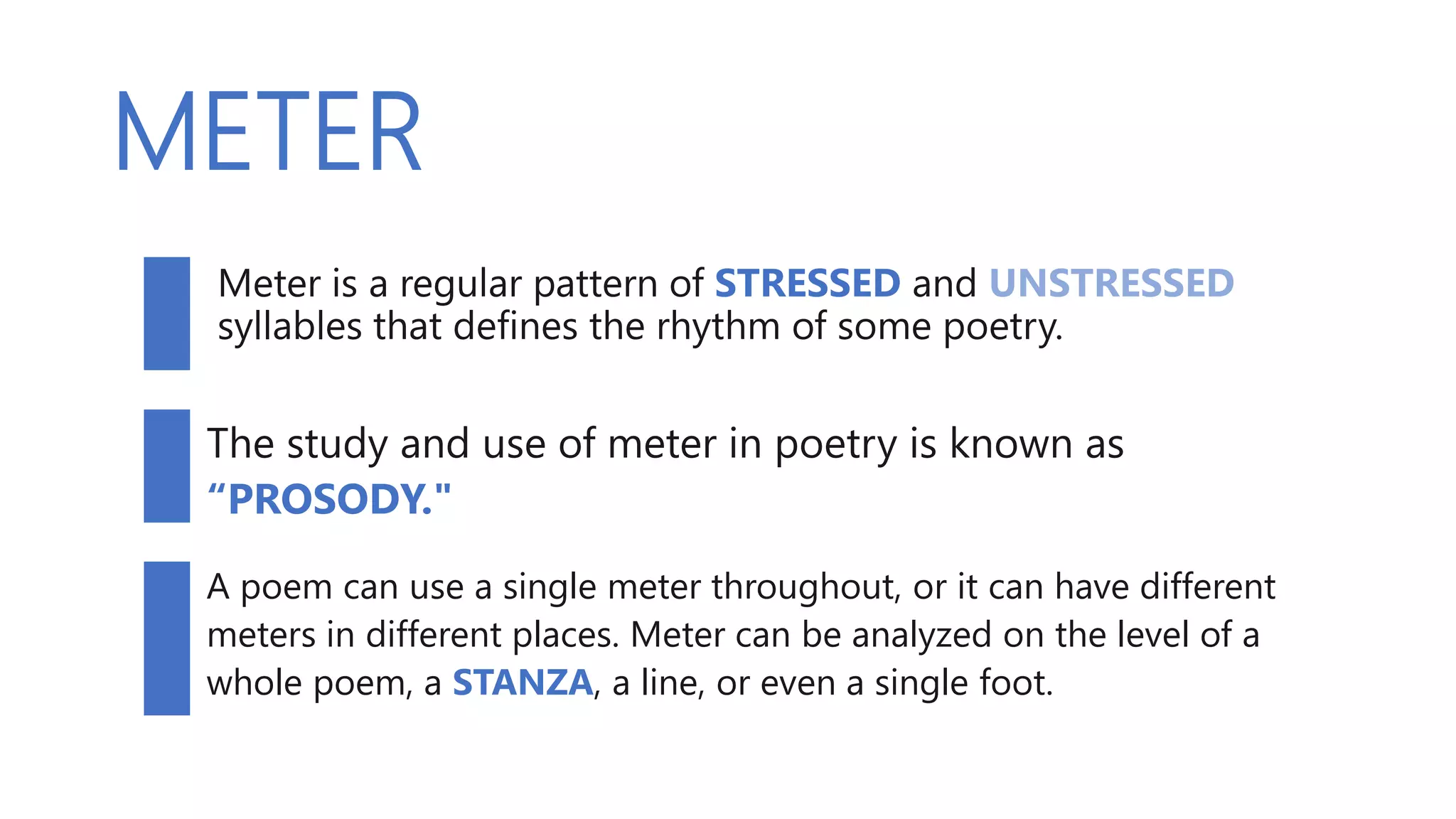
Meter is a regular pattern of STRESSED and UNSTRESSED
syllables that defines the rhythm of some poetry.
The study and use of meter in poetry is known as
“PROSODY."
A poem can use a single meter throughout, or it can have different
meters in different places. Meter can be analyzed on the level of a
whole poem, a STANZA, a line, or even a single foot.
POETIC FOOT
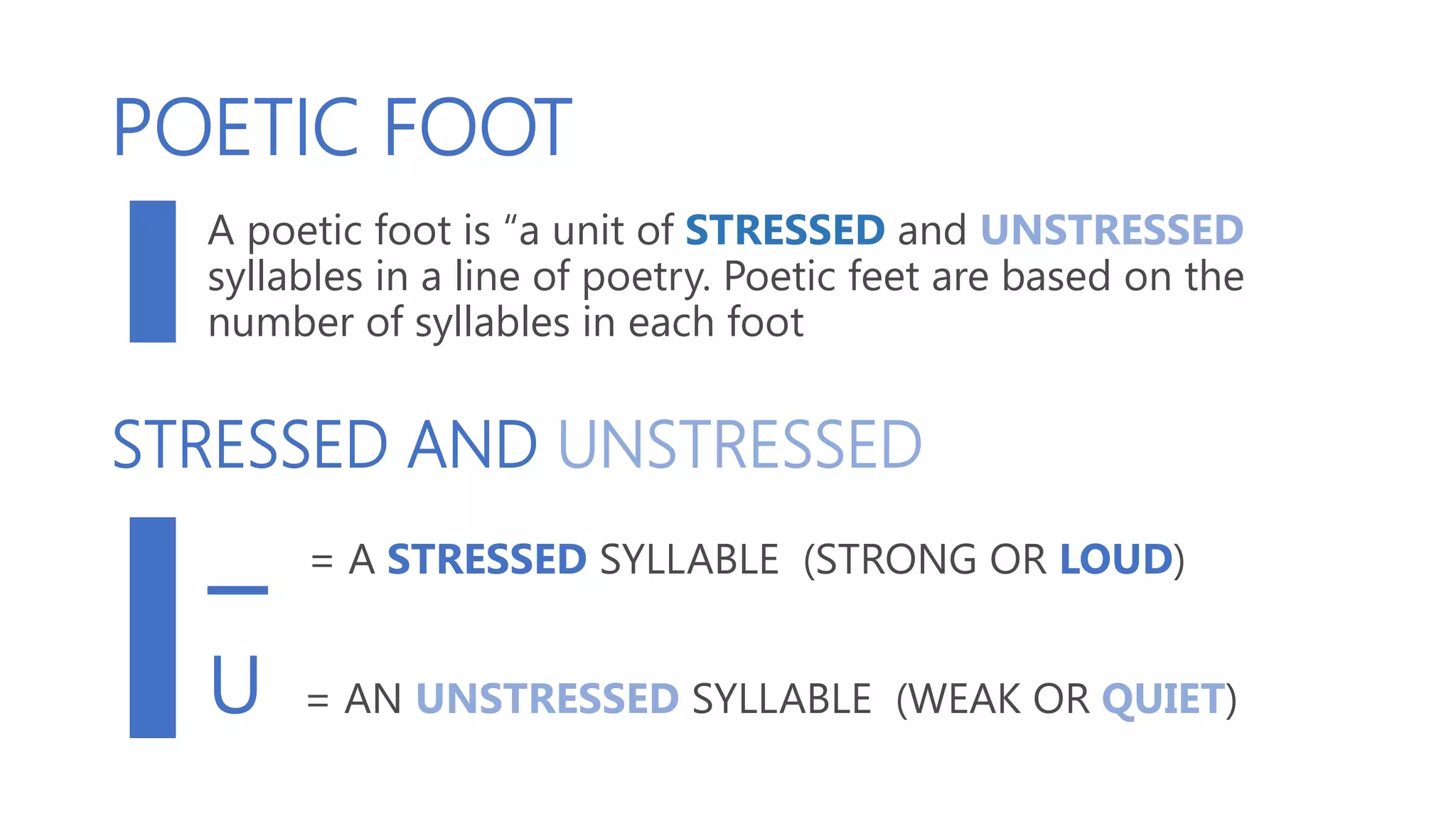
A poetic foot is “a unit of STRESSED and UNSTRESSED
syllables in a line of poetry. Poetic feet are based on the
number of syllables in each foot
STRESSED AND UNSTRESSED
_ = A STRESSED SYLLABLE (STRONG OR LOUD)
U = AN UNSTRESSED SYLLABLE (WEAK OR QUIET)
TYPES OF POETIC METER
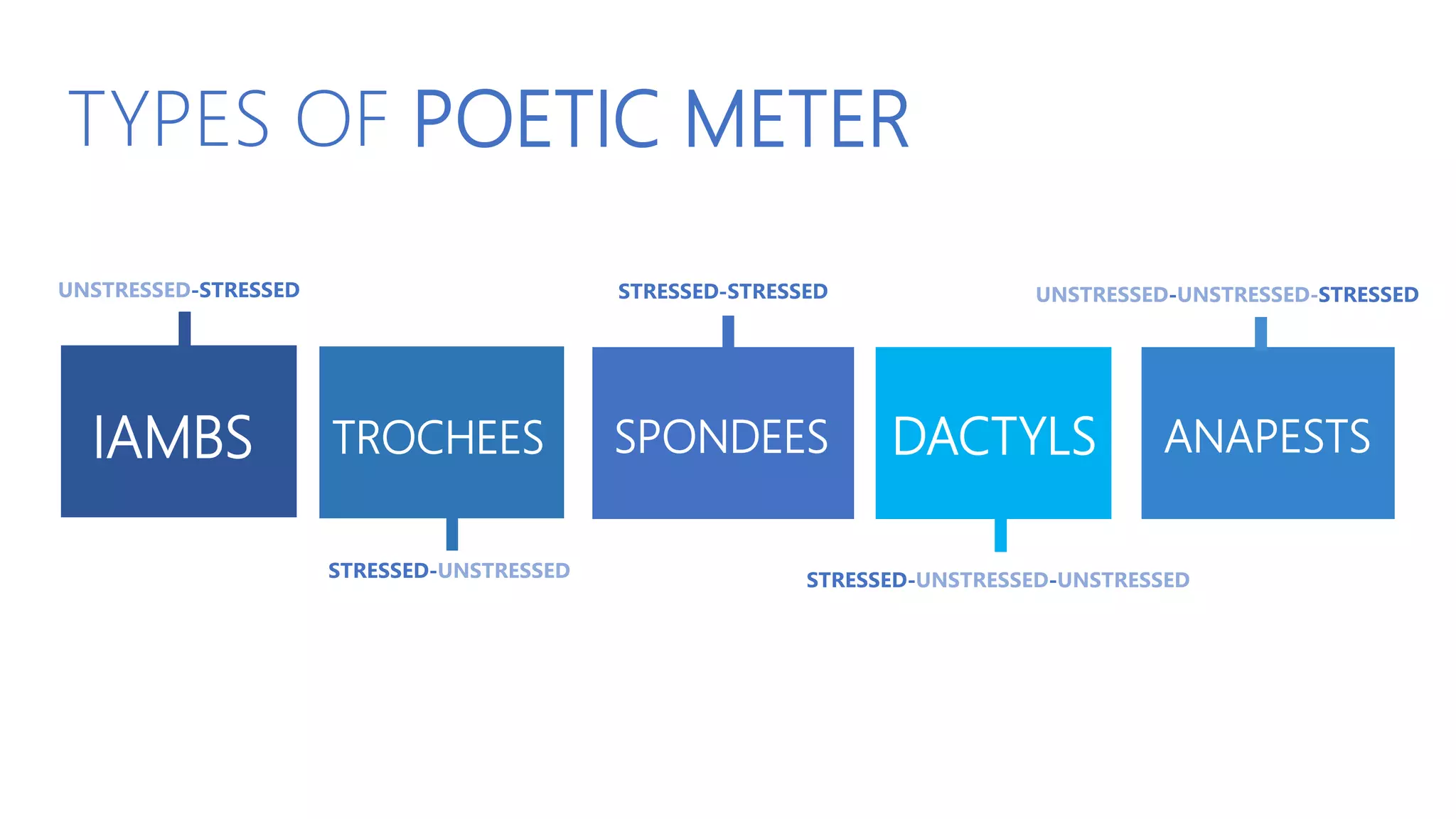
TROCHEES
IAMBS SPONDEES DACTYLS ANAPESTS
UNSTRESSED-STRESSED
STRESSED-UNSTRESSED
STRESSED-STRESSED
STRESSED-UNSTRESSED-UNSTRESSED
UNSTRESSED-UNSTRESSED-STRESSED
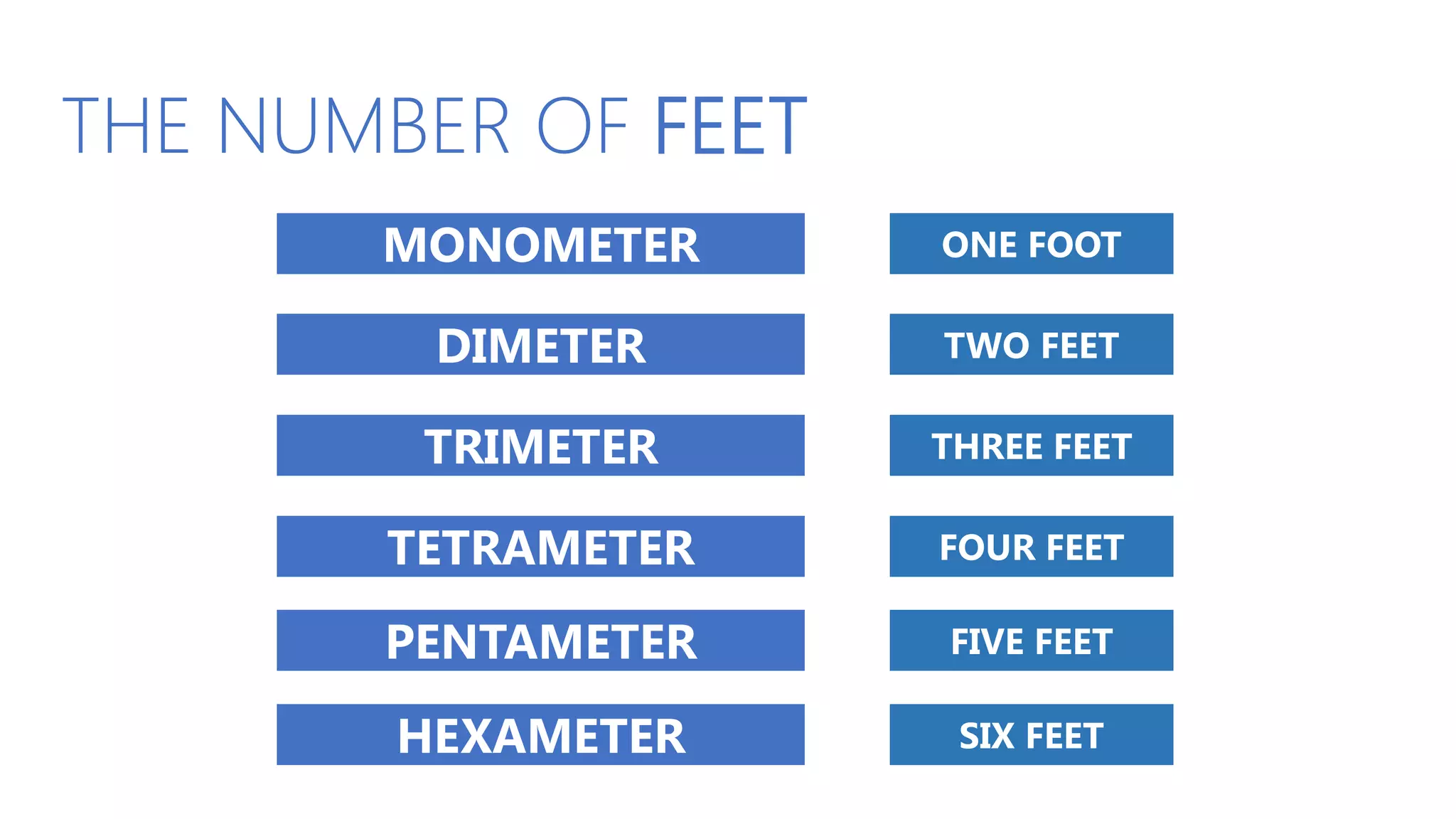
THE NUMBER OF FEET
MONOMETER ONE FOOT
DIMETER TWO FEET
TRIMETER THREE FEET
TETRAMETER FOUR FEET
PENTAMETER FIVE FEET
HEXAMETER SIX FEET
SO POEMS CAN BE IDENTIFIED BY THE TYPE OF FEET (E.G. IAMBIC)
AND THE NUMBER OF FEET IN A LINE (E.G.PENTAMETER)
IAMB (IAMBIC)
Weak UNSTRESSED syllable followed by strong STRECCHED
syllable, Here’s a line from Rubaiyat of Omar Khayyam
A book / of ver / se un / derneath / the bough
U ___ / U ___ / U __ / U _____ / U _____
1 2 3 4 5
AS THIS LINE HAS 05 IAMBIC FEETS, WE CAN CALL IT AS AN
IAMBIC PENTAMETER
OTHER EXAMPLES OF
IAMBIC PENTAMETER
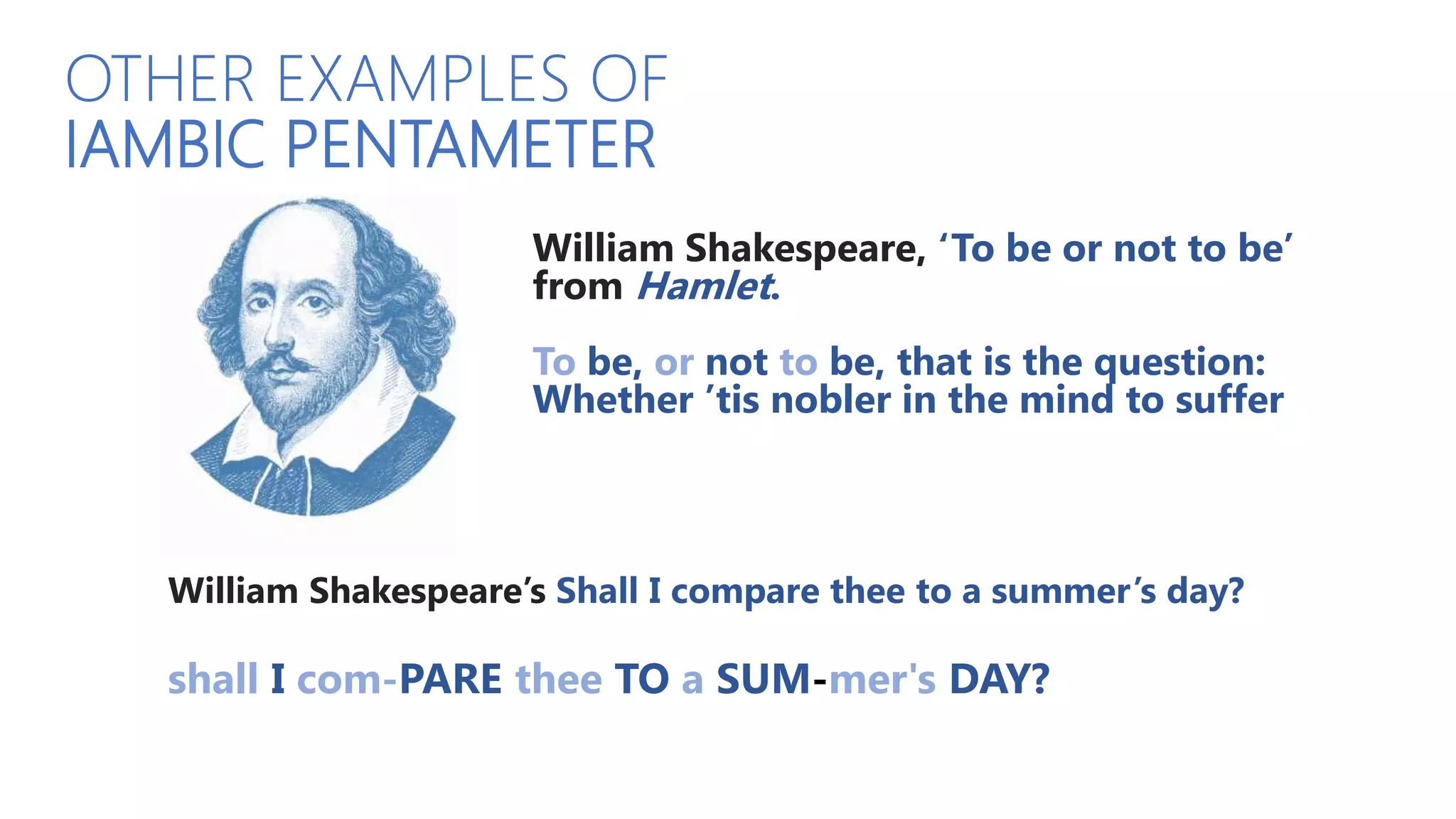
William Shakespeare, ‘To be or not to be’
from Hamlet.
To be, or not to be, that is the question:
Whether ’tis nobler in the mind to suffer
William Shakespeare’s Shall I compare thee to a summer’s day?
shall I com-PARE thee TO a SUM-mer's DAY?
TROCHEE (TROCHAIC)
Strong STRECCHED syllable followed by Weak UNSTRESSED
syllable, A line from “Lines on the Mermaid Tavern” by John Keats
Fairer / than the / mermaid / tavern
__ U / ___ U / ___ U / ___U
1 2 3 4
AS THIS LINE HAS 04 TROCHAIC FEETS, WE CAN CALL IT AS AN
TROCHAIC TETRAMETER
OTHER EXAMPLES OF TROCHAIC TETRAMETER
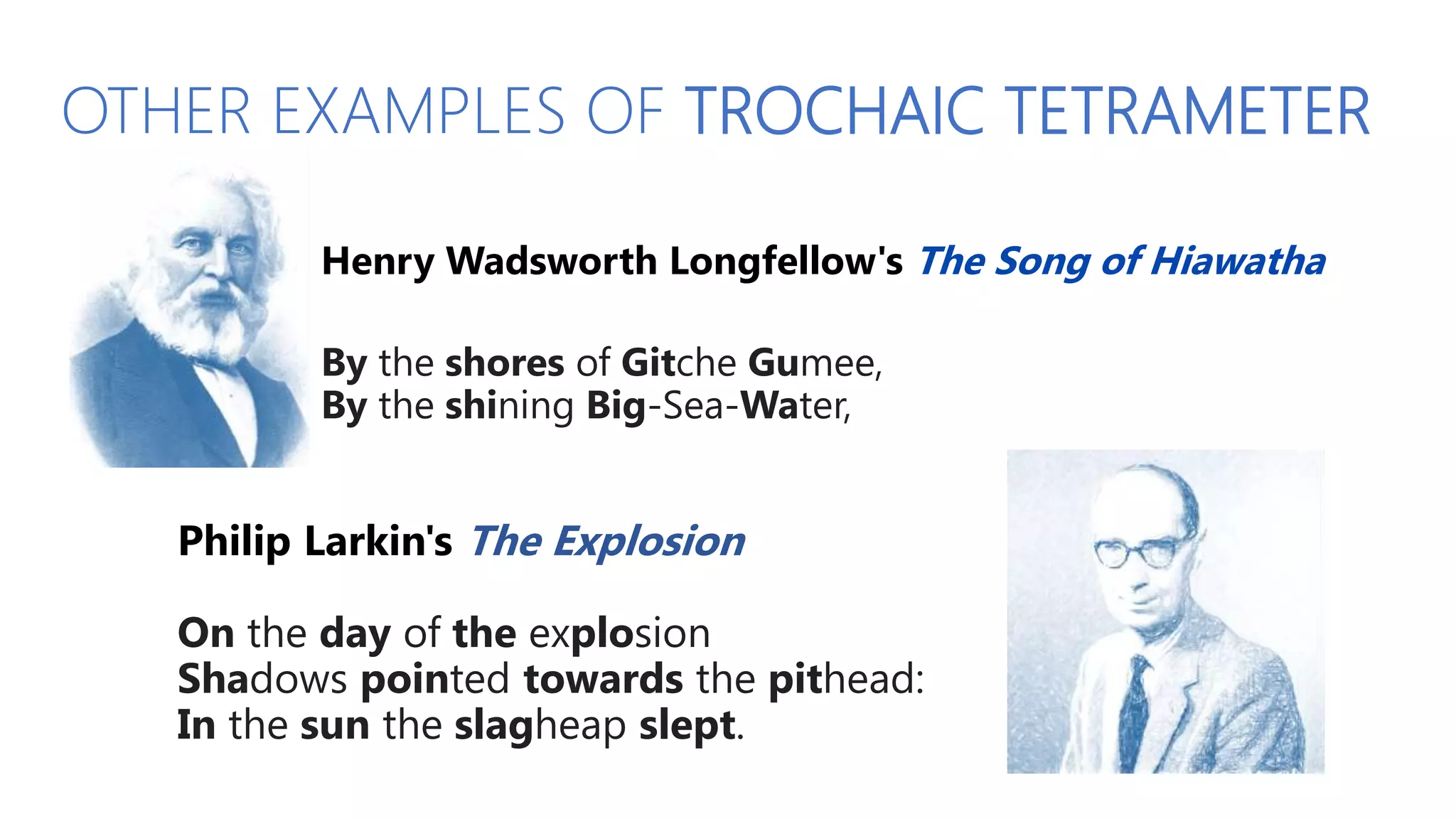
Henry Wadsworth Longfellow's The Song of Hiawatha
By the shores of Gitche Gumee,
By the shining Big-Sea-Water,
Philip Larkin's The Explosion
On the day of the explosion
Shadows pointed towards the pithead:
In the sun the slagheap slept.
SPONDEC (SPONDAIC)
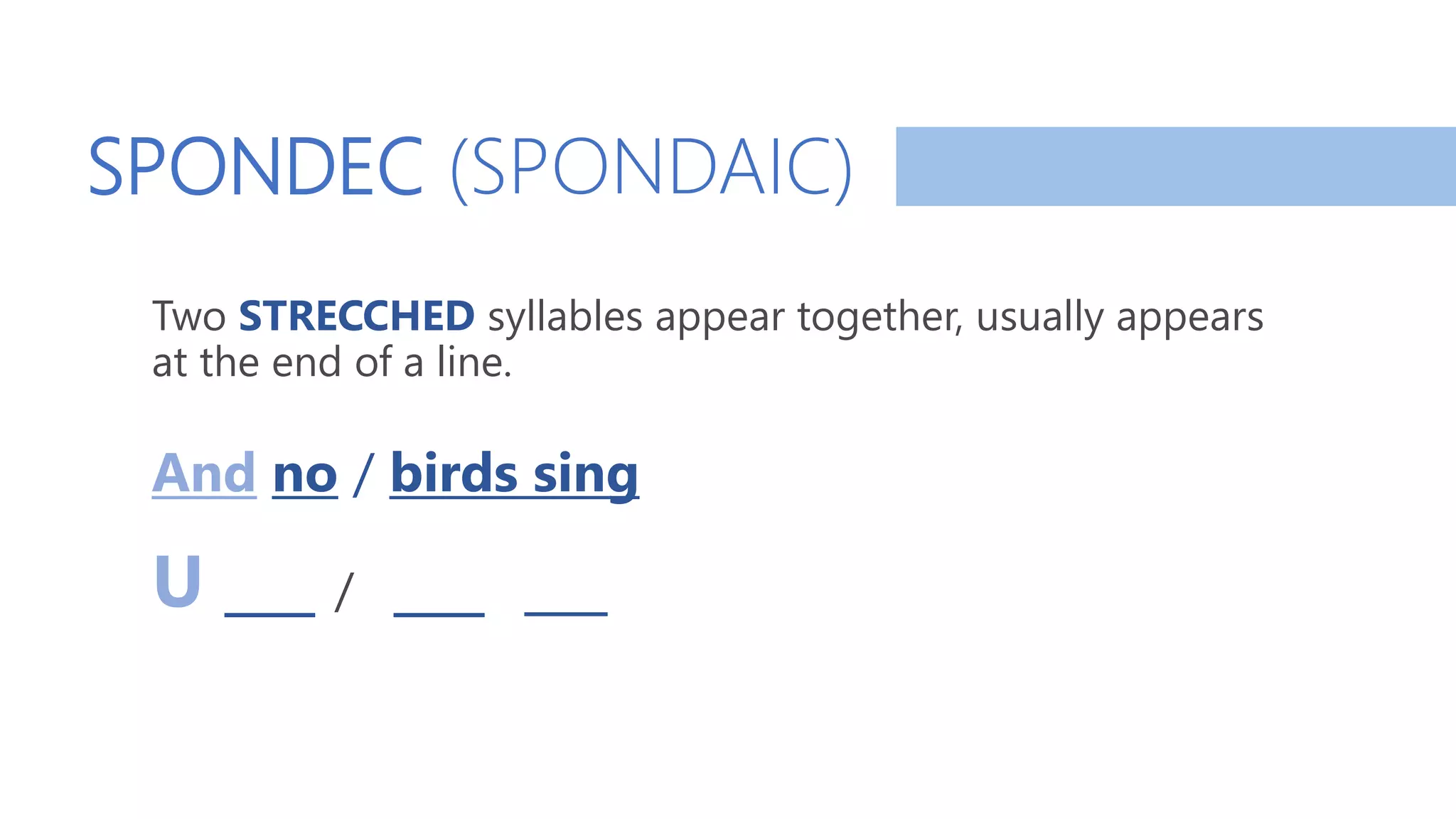
Two STRECCHED syllables appear together, usually appears
at the end of a line.
And no / birds sing
U ___ / ___ ___ 4
EXAMPLES OF SPONDEE
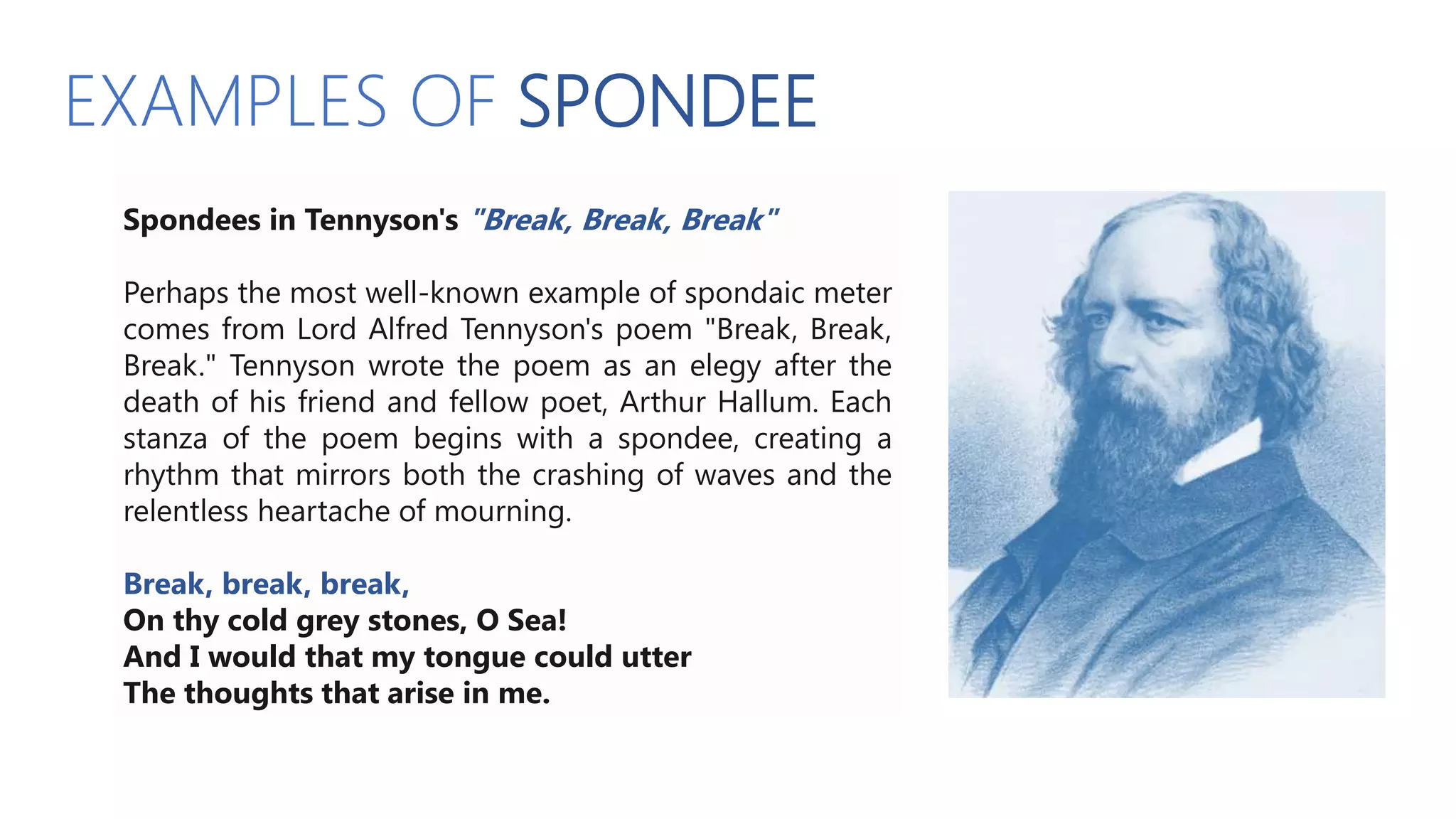
Spondees in Tennyson's "Break, Break, Break"
Perhaps the most well-known example of spondaic meter
comes from Lord Alfred Tennyson's poem "Break, Break,
Break." Tennyson wrote the poem as an elegy after the
death of his friend and fellow poet, Arthur Hallum. Each
stanza of the poem begins with a spondee, creating a
rhythm that mirrors both the crashing of waves and the
relentless heartache of mourning.
Break, break, break,
On thy cold grey stones, O Sea!
And I would that my tongue could utter
The thoughts that arise in me.
DACTYL (DACTYLIC)
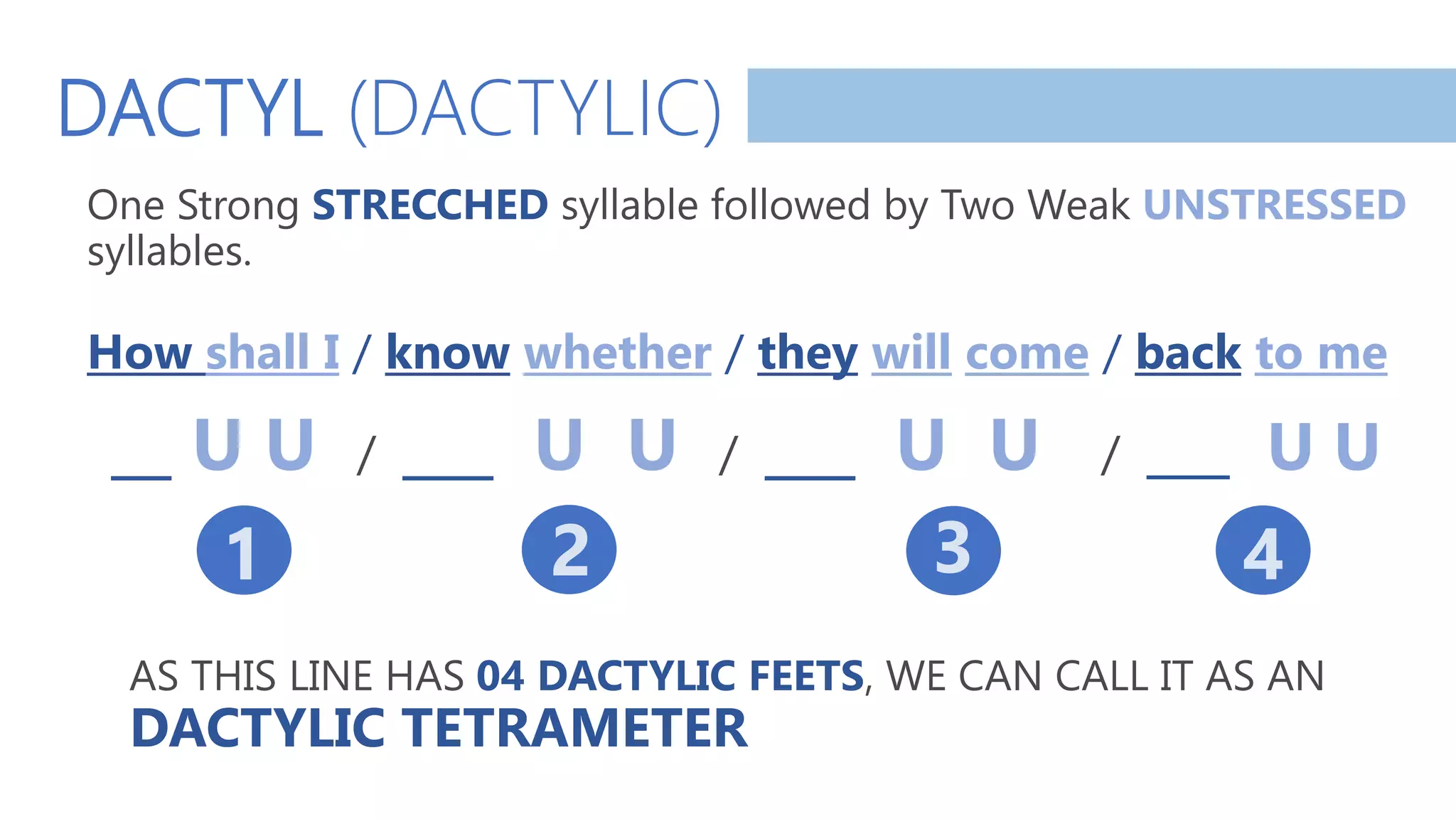
One Strong STRECCHED syllable followed by Two Weak UNSTRESSED
syllables.
How shall I / know whether / they will come / back to me
__ U U / ___ U U / ___ U U / ___ U U
1 2 3 4
AS THIS LINE HAS 04 DACTYLIC FEETS, WE CAN CALL IT AS AN
DACTYLIC TETRAMETER
OTHER EXAMPLES OF DACTYLIC TETRAMETER
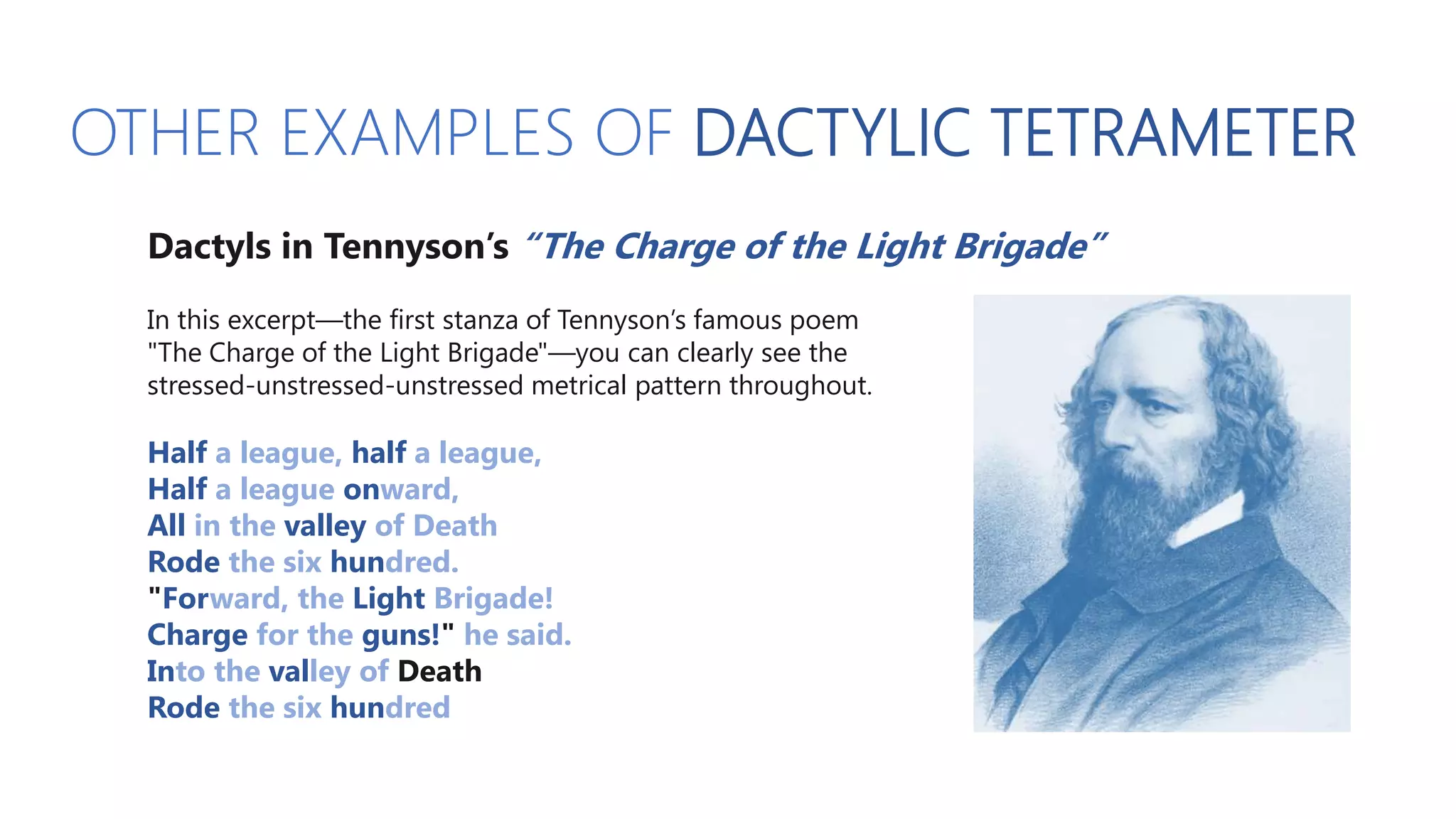
Dactyls in Tennyson’s “The Charge of the Light Brigade”
In this excerpt—the first stanza of Tennyson’s famous poem
"The Charge of the Light Brigade"—you can clearly see the
stressed-unstressed-unstressed metrical pattern throughout.
Half a league, half a league,
Half a league onward,
All in the valley of Death
Rode the six hundred.
"Forward, the Light Brigade!
Charge for the guns!" he said.
Into the valley of Death
Rode the six hundred
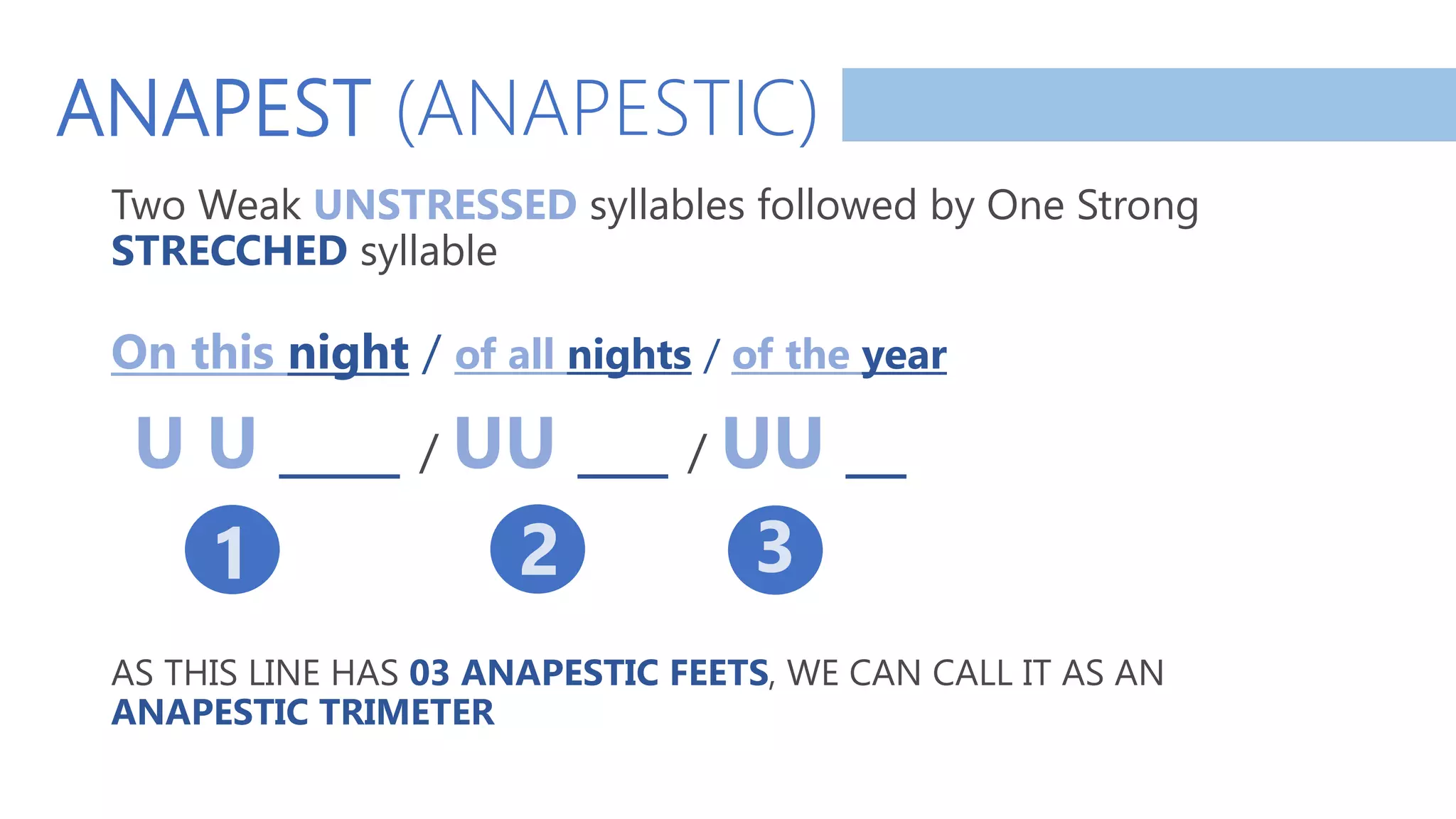
ANAPEST (ANAPESTIC)
Two Weak UNSTRESSED syllables followed by One Strong
STRECCHED syllable
On this night / of all nights / of the year
U U ____ / UU ___ / UU __
1 2 3
AS THIS LINE HAS 03 ANAPESTIC FEETS, WE CAN CALL IT AS AN
ANAPESTIC TRIMETER
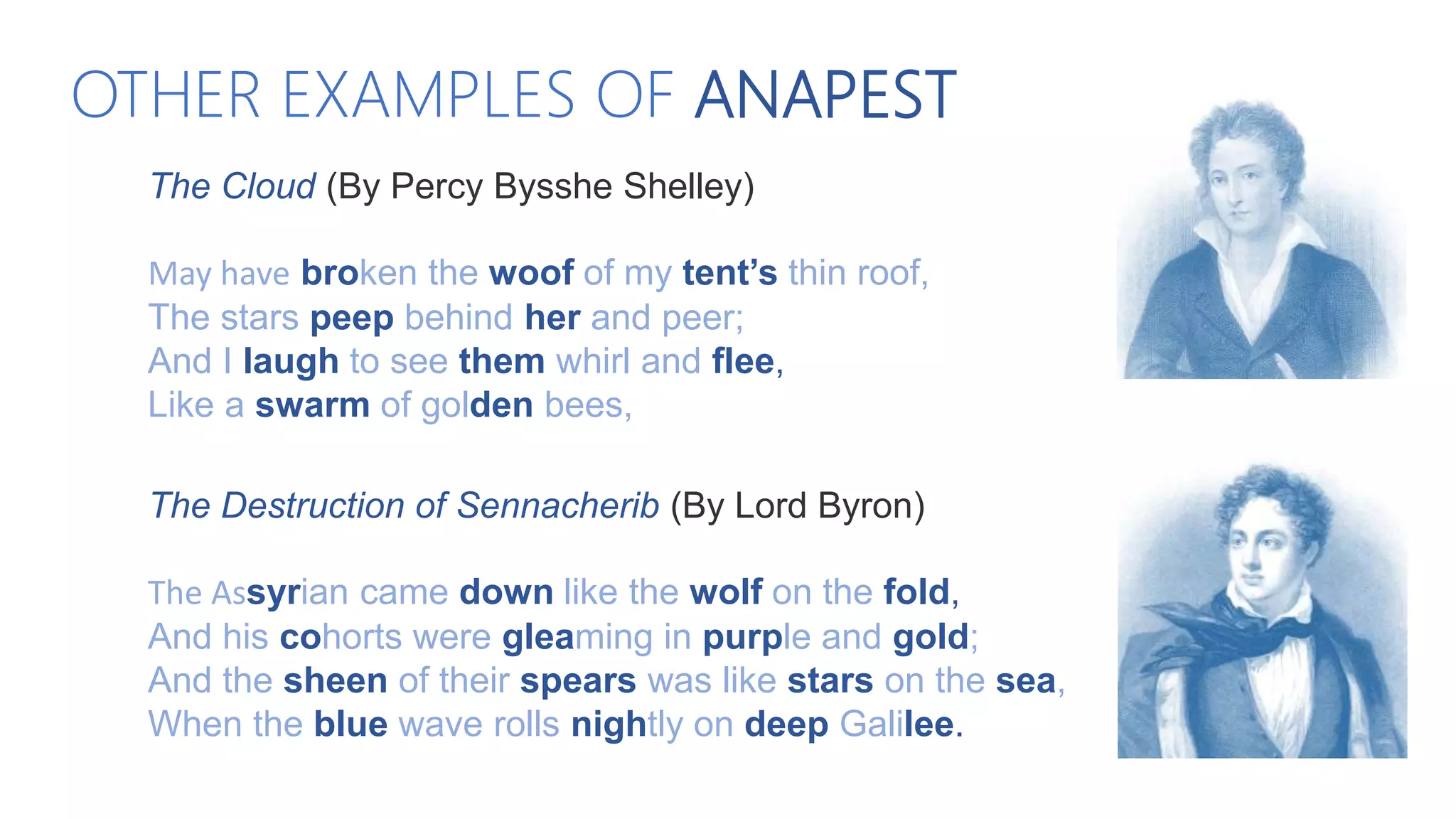
OTHER EXAMPLES OF ANAPEST
The Cloud (By Percy Bysshe Shelley)
May have broken the woof of my tent’s thin roof,
The stars peep behind her and peer;
And I laugh to see them whirl and flee,
Like a swarm of golden bees,
The Destruction of Sennacherib (By Lord Byron)
The Assyrian came down like the wolf on the fold,
And his cohorts were gleaming in purple and gold;
And the sheen of their spears was like stars on the sea,
When the blue wave rolls nightly on deep Galilee.
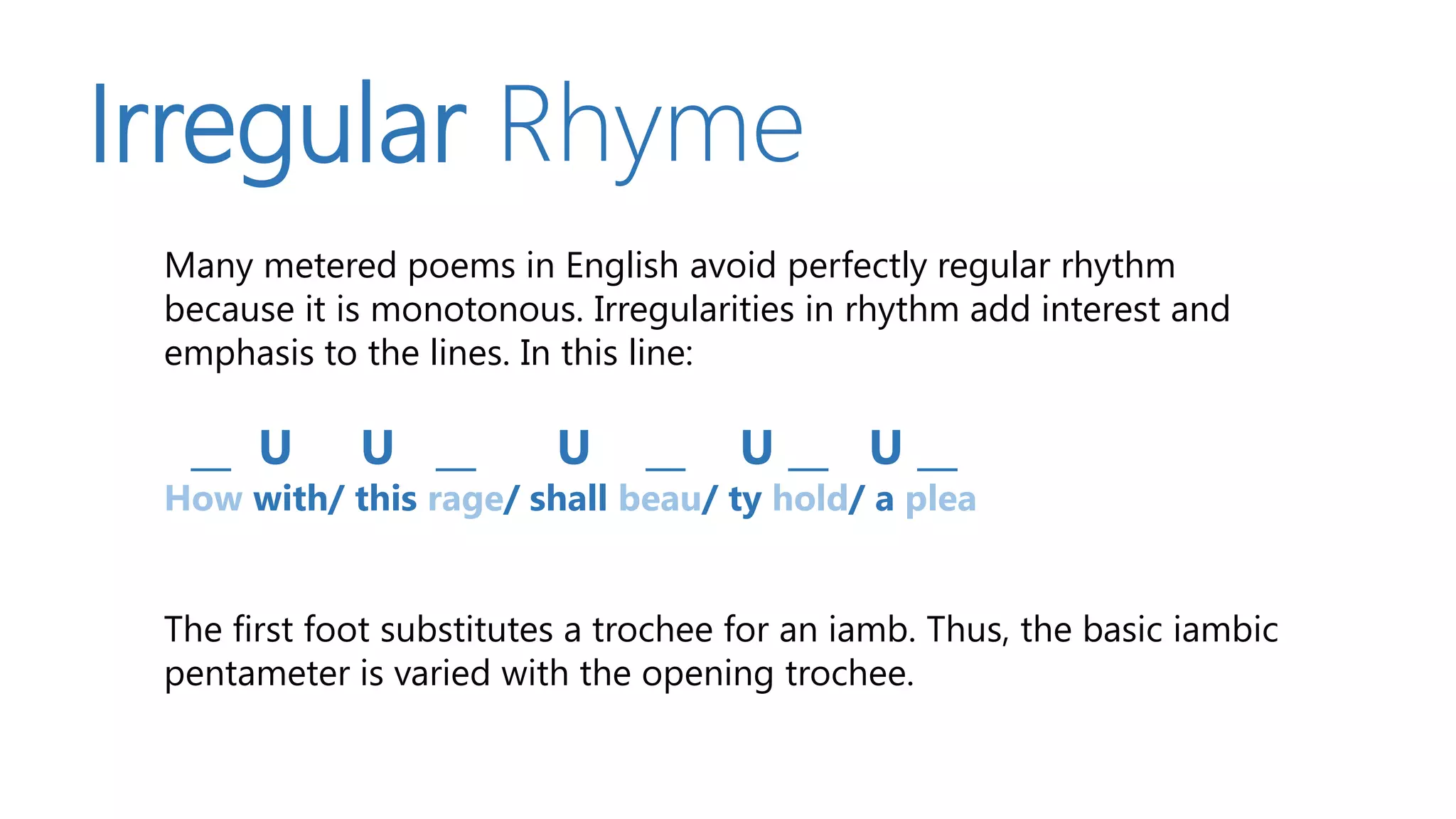
Irregular Rhyme
Many metered poems in English avoid perfectly regular rhythm
because it is monotonous. Irregularities in rhythm add interest and
emphasis to the lines. In this line:
__ U U __ U __ U __ U __
How with/ this rage/ shall beau/ ty hold/ a plea
The first foot substitutes a trochee for an iamb. Thus, the basic iambic
pentameter is varied with the opening trochee.
Any poetry that does have a set metrical pattern (usually iambic
pentameter), but does not have rhyme, is blank verse.
Shakespeare frequently used unrhymed iambic pentameter in
his plays; his works are an early example of blank verse.
Blank Verse
Example of Blank Verse
Mending Walls by Robert Frost
Something there is that doesn’t love a wall.
That sends the frozen-ground-swell under it,
And spills the upper boulders in the sun;
This poem has no proper rhyme scheme. However, there is a
consistent meter in 10 syllables of each line. It is following the
iambic pentameter pattern with five feet in each line. Only the first
line is written in a trochee pattern. All the stressed syllables are
marked in bold.
Hamlet by William Shakespeare
But, woe is me, you are so sick of late,
So far from cheer and from your former state,
That I distrust you. Yet, though I distrust,
Discomfort you, my lord, it nothing must. …
Hamlet gives us a perfect example of a typical blank verse, written in iambic
pentameter. Shakespeare employed a deliberate effort to use the syllables
in a particular way. He brought variation by using caesuras (pause) in the
middle of the line, as in the third line. Shakespeare has other literary pieces
that are also good sources of blank verse examples.
Most modern poetry no longer follows strict rules of meter or rhyme,
especially throughout an entire poem. Free verse, frankly, has no rules
about meter or rhyme whatsoever!
So, you may find it difficult to find regular iambic pentameter in a
modern poem, though you might find it in particular lines. Modern
poets do like to throw in the occasional line or phrase of metered
poetry, particularly if they’re trying to create a certain effect. Free
verse can also apply to a lack of a formal verse structure.
Free Verse
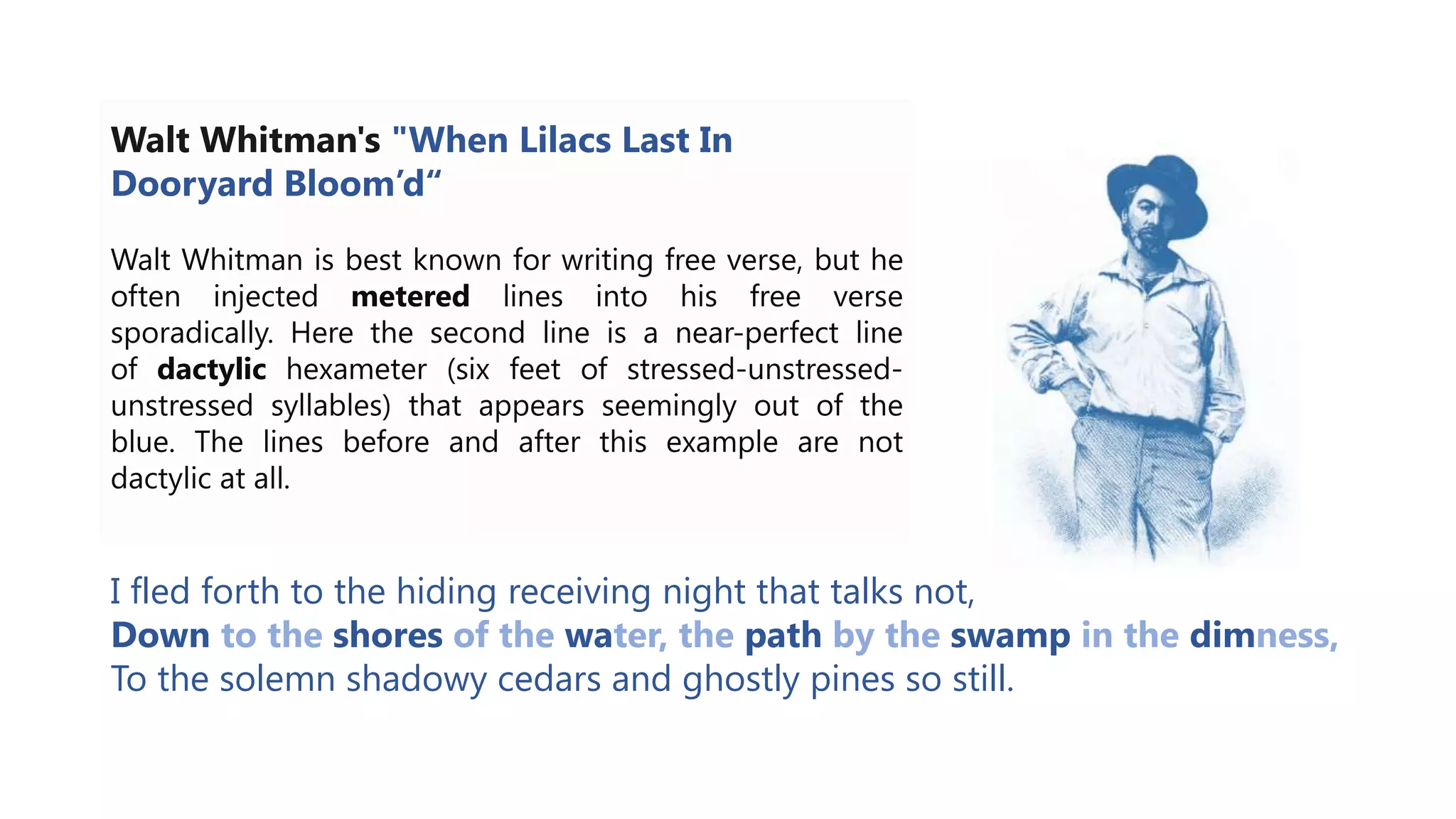
Walt Whitman's "When Lilacs Last In
Dooryard Bloom’d“
Walt Whitman is best known for writing free verse, but he
often injected metered lines into his free verse
sporadically. Here the second line is a near-perfect line
of dactylic hexameter (six feet of stressed-unstressed-
unstressed syllables) that appears seemingly out of the
blue. The lines before and after this example are not
dactylic at all.
I fled forth to the hiding receiving night that talks not,
Down to the shores of the water, the path by the swamp in the dimness,
To the solemn shadowy cedars and ghostly pines so still.
THANK
YOU

RHYTHM AND METER IN POETRY.pptx

  • 1.
    RHYTHM AND METER European Universityof Bangladesh ENG:1O4 Critical appreciation: rhetoric and prosody SUBMIT TED BY AYA Z M A H M U D B I T H E A K T E R S U M I YA S H R A B O N I H O S S A I N M A S U D S H I K D E R H I M E L Y E A S I N A R A FAT E M O N 2 2 0 2 0 5 0 2 0 2 2 0 2 0 5 0 0 7 2 2 0 2 0 5 0 5 4 2 2 0 2 0 5 0 5 1 2 2 0 2 0 5 0 2 2
  • 2.
    METER Meter is aregular pattern of STRESSED and UNSTRESSED syllables that defines the rhythm of some poetry. The study and use of meter in poetry is known as “PROSODY." A poem can use a single meter throughout, or it can have different meters in different places. Meter can be analyzed on the level of a whole poem, a STANZA, a line, or even a single foot.
  • 3.
    POETIC FOOT A poeticfoot is “a unit of STRESSED and UNSTRESSED syllables in a line of poetry. Poetic feet are based on the number of syllables in each foot STRESSED AND UNSTRESSED _ = A STRESSED SYLLABLE (STRONG OR LOUD) U = AN UNSTRESSED SYLLABLE (WEAK OR QUIET)
  • 4.
    TYPES OF POETICMETER TROCHEES IAMBS SPONDEES DACTYLS ANAPESTS UNSTRESSED-STRESSED STRESSED-UNSTRESSED STRESSED-STRESSED STRESSED-UNSTRESSED-UNSTRESSED UNSTRESSED-UNSTRESSED-STRESSED
  • 5.
    THE NUMBER OFFEET MONOMETER ONE FOOT DIMETER TWO FEET TRIMETER THREE FEET TETRAMETER FOUR FEET PENTAMETER FIVE FEET HEXAMETER SIX FEET
  • 6.
    SO POEMS CANBE IDENTIFIED BY THE TYPE OF FEET (E.G. IAMBIC) AND THE NUMBER OF FEET IN A LINE (E.G.PENTAMETER)
  • 7.
    IAMB (IAMBIC) Weak UNSTRESSEDsyllable followed by strong STRECCHED syllable, Here’s a line from Rubaiyat of Omar Khayyam A book / of ver / se un / derneath / the bough U ___ / U ___ / U __ / U _____ / U _____ 1 2 3 4 5 AS THIS LINE HAS 05 IAMBIC FEETS, WE CAN CALL IT AS AN IAMBIC PENTAMETER
  • 8.
    OTHER EXAMPLES OF IAMBICPENTAMETER William Shakespeare, ‘To be or not to be’ from Hamlet. To be, or not to be, that is the question: Whether ’tis nobler in the mind to suffer William Shakespeare’s Shall I compare thee to a summer’s day? shall I com-PARE thee TO a SUM-mer's DAY?
  • 9.
    TROCHEE (TROCHAIC) Strong STRECCHEDsyllable followed by Weak UNSTRESSED syllable, A line from “Lines on the Mermaid Tavern” by John Keats Fairer / than the / mermaid / tavern __ U / ___ U / ___ U / ___U 1 2 3 4 AS THIS LINE HAS 04 TROCHAIC FEETS, WE CAN CALL IT AS AN TROCHAIC TETRAMETER
  • 10.
    OTHER EXAMPLES OFTROCHAIC TETRAMETER Henry Wadsworth Longfellow's The Song of Hiawatha By the shores of Gitche Gumee, By the shining Big-Sea-Water, Philip Larkin's The Explosion On the day of the explosion Shadows pointed towards the pithead: In the sun the slagheap slept.
  • 11.
    SPONDEC (SPONDAIC) Two STRECCHEDsyllables appear together, usually appears at the end of a line. And no / birds sing U ___ / ___ ___ 4
  • 12.
    EXAMPLES OF SPONDEE Spondeesin Tennyson's "Break, Break, Break" Perhaps the most well-known example of spondaic meter comes from Lord Alfred Tennyson's poem "Break, Break, Break." Tennyson wrote the poem as an elegy after the death of his friend and fellow poet, Arthur Hallum. Each stanza of the poem begins with a spondee, creating a rhythm that mirrors both the crashing of waves and the relentless heartache of mourning. Break, break, break, On thy cold grey stones, O Sea! And I would that my tongue could utter The thoughts that arise in me.
  • 13.
    DACTYL (DACTYLIC) One StrongSTRECCHED syllable followed by Two Weak UNSTRESSED syllables. How shall I / know whether / they will come / back to me __ U U / ___ U U / ___ U U / ___ U U 1 2 3 4 AS THIS LINE HAS 04 DACTYLIC FEETS, WE CAN CALL IT AS AN DACTYLIC TETRAMETER
  • 14.
    OTHER EXAMPLES OFDACTYLIC TETRAMETER Dactyls in Tennyson’s “The Charge of the Light Brigade” In this excerpt—the first stanza of Tennyson’s famous poem "The Charge of the Light Brigade"—you can clearly see the stressed-unstressed-unstressed metrical pattern throughout. Half a league, half a league, Half a league onward, All in the valley of Death Rode the six hundred. "Forward, the Light Brigade! Charge for the guns!" he said. Into the valley of Death Rode the six hundred
  • 15.
    ANAPEST (ANAPESTIC) Two WeakUNSTRESSED syllables followed by One Strong STRECCHED syllable On this night / of all nights / of the year U U ____ / UU ___ / UU __ 1 2 3 AS THIS LINE HAS 03 ANAPESTIC FEETS, WE CAN CALL IT AS AN ANAPESTIC TRIMETER
  • 16.
    OTHER EXAMPLES OFANAPEST The Cloud (By Percy Bysshe Shelley) May have broken the woof of my tent’s thin roof, The stars peep behind her and peer; And I laugh to see them whirl and flee, Like a swarm of golden bees, The Destruction of Sennacherib (By Lord Byron) The Assyrian came down like the wolf on the fold, And his cohorts were gleaming in purple and gold; And the sheen of their spears was like stars on the sea, When the blue wave rolls nightly on deep Galilee.
  • 17.
    Irregular Rhyme Many meteredpoems in English avoid perfectly regular rhythm because it is monotonous. Irregularities in rhythm add interest and emphasis to the lines. In this line: __ U U __ U __ U __ U __ How with/ this rage/ shall beau/ ty hold/ a plea The first foot substitutes a trochee for an iamb. Thus, the basic iambic pentameter is varied with the opening trochee.
  • 18.
    Any poetry thatdoes have a set metrical pattern (usually iambic pentameter), but does not have rhyme, is blank verse. Shakespeare frequently used unrhymed iambic pentameter in his plays; his works are an early example of blank verse. Blank Verse
  • 19.
    Example of BlankVerse Mending Walls by Robert Frost Something there is that doesn’t love a wall. That sends the frozen-ground-swell under it, And spills the upper boulders in the sun; This poem has no proper rhyme scheme. However, there is a consistent meter in 10 syllables of each line. It is following the iambic pentameter pattern with five feet in each line. Only the first line is written in a trochee pattern. All the stressed syllables are marked in bold.
  • 20.
    Hamlet by WilliamShakespeare But, woe is me, you are so sick of late, So far from cheer and from your former state, That I distrust you. Yet, though I distrust, Discomfort you, my lord, it nothing must. … Hamlet gives us a perfect example of a typical blank verse, written in iambic pentameter. Shakespeare employed a deliberate effort to use the syllables in a particular way. He brought variation by using caesuras (pause) in the middle of the line, as in the third line. Shakespeare has other literary pieces that are also good sources of blank verse examples.
  • 21.
    Most modern poetryno longer follows strict rules of meter or rhyme, especially throughout an entire poem. Free verse, frankly, has no rules about meter or rhyme whatsoever! So, you may find it difficult to find regular iambic pentameter in a modern poem, though you might find it in particular lines. Modern poets do like to throw in the occasional line or phrase of metered poetry, particularly if they’re trying to create a certain effect. Free verse can also apply to a lack of a formal verse structure. Free Verse
  • 22.
    Walt Whitman's "WhenLilacs Last In Dooryard Bloom’d“ Walt Whitman is best known for writing free verse, but he often injected metered lines into his free verse sporadically. Here the second line is a near-perfect line of dactylic hexameter (six feet of stressed-unstressed- unstressed syllables) that appears seemingly out of the blue. The lines before and after this example are not dactylic at all. I fled forth to the hiding receiving night that talks not, Down to the shores of the water, the path by the swamp in the dimness, To the solemn shadowy cedars and ghostly pines so still.
  • 23.