PRESENTED BY, 
ASWATHY S NAIR 
PHYSICAL SCIENCE 
ROLL NO : 04
 Ability of a liquid to flow in narrow spaces without the 
assistance of, and in opposition to, external forces like gravity 
 Capillary action is sometimes called capillarity, capillary 
motion, or wicking
 Drawing up of liquids between the hairs of a paint-brush 
 Drainage of constantly produced tear fluid from the eye 
 Observed in thin layer chromatography 
 draws ink to the tips of fountain pen nibs 
 moving groundwater from wet areas of the soil to dry areas
 Capillarities are of two types 
 Capillarity rise 
 Capillarity fall
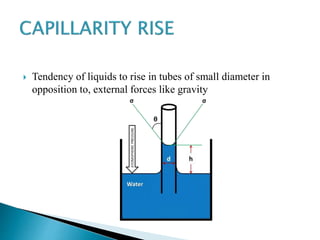
 Tendency of liquids to rise in tubes of small diameter in 
opposition to, external forces like gravity
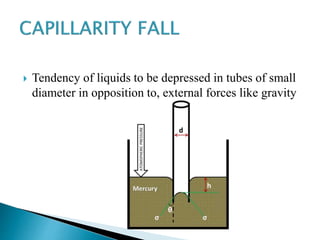
 Tendency of liquids to be depressed in tubes of small 
diameter in opposition to, external forces like gravity
 Lubricating oil spread easily on all parts because of their low 
surface tension. 
 Cotton dresses are preferred in summer because cotton dresses 
have fine pores which act as capillaries for sweat. 
 Dirt get removed when detergents are added while washing 
clothes because surface tension of water is reduced.
 The absorption of ink by a blotting paper is due to 
capillary action, as the blotting paper is porous. When 
it is placed over the ink, the ink raises into the pores. 
Also rise of oil in the wick of a lamp is due to capillary 
action. 
 If one end of a towel is dipped into a bucket of water 
and the other end hangs over the bucket, the entire 
towel soon becomes wet due to capillary action. 
 Supply of water to the leaves at the top of even a tall 
tree is through capillary rise.
 A fabric can be waterproof, by adding suitable 
waterproofing materials to the fabric. This addition 
increases the angle of contact, thereby making the 
fabric waterproof.
Capillarity ppt

Capillarity ppt

  • 1.
    PRESENTED BY, ASWATHYS NAIR PHYSICAL SCIENCE ROLL NO : 04
  • 2.
     Ability ofa liquid to flow in narrow spaces without the assistance of, and in opposition to, external forces like gravity  Capillary action is sometimes called capillarity, capillary motion, or wicking
  • 3.
     Drawing upof liquids between the hairs of a paint-brush  Drainage of constantly produced tear fluid from the eye  Observed in thin layer chromatography  draws ink to the tips of fountain pen nibs  moving groundwater from wet areas of the soil to dry areas
  • 4.
     Capillarities areof two types  Capillarity rise  Capillarity fall
  • 5.
     Tendency ofliquids to rise in tubes of small diameter in opposition to, external forces like gravity
  • 6.
     Tendency ofliquids to be depressed in tubes of small diameter in opposition to, external forces like gravity
  • 7.
     Lubricating oilspread easily on all parts because of their low surface tension.  Cotton dresses are preferred in summer because cotton dresses have fine pores which act as capillaries for sweat.  Dirt get removed when detergents are added while washing clothes because surface tension of water is reduced.
  • 8.
     The absorptionof ink by a blotting paper is due to capillary action, as the blotting paper is porous. When it is placed over the ink, the ink raises into the pores. Also rise of oil in the wick of a lamp is due to capillary action.  If one end of a towel is dipped into a bucket of water and the other end hangs over the bucket, the entire towel soon becomes wet due to capillary action.  Supply of water to the leaves at the top of even a tall tree is through capillary rise.
  • 9.
     A fabriccan be waterproof, by adding suitable waterproofing materials to the fabric. This addition increases the angle of contact, thereby making the fabric waterproof.