Fourier Transform Infrared Spectroscopy (FTIR)
By: Asaye Dessie
Getaneh Alamir
Fourier Transform Infrared Spectroscopy (FTIR)
By: Asaye Dessie
Getaneh Alamir
Content
 Introduction
o Brief history of development of FTIR
o Theoretical background
 Mathematical expressions of Fourier transforms
 Components of FTIR spectroscopy
 The working principles of Michelson interferometer
 Generating the spectrum
 Principle of Absorption
 FT-IR Analysis
 Characterization of textile fibers by FTIR spectra
 Advantages of FT-IR
 Limitation of FTIR
 Application of FT-IR in Textiles
 Reference
Content
 Introduction
o Brief history of development of FTIR
o Theoretical background
 Mathematical expressions of Fourier transforms
 Components of FTIR spectroscopy
 The working principles of Michelson interferometer
 Generating the spectrum
 Principle of Absorption
 FT-IR Analysis
 Characterization of textile fibers by FTIR spectra
 Advantages of FT-IR
 Limitation of FTIR
 Application of FT-IR in Textiles
 Reference
BRIEF HISTORY OF DEVELOPMENT OF FTIR
 FT-IR spectrometry was developed in order to overcome the
limitations encountered with dispersive instruments.
 The limitation of Dispersive was the slow scanning process and
measuring individual infrared frequencies.
 A method for measuring all of the infrared frequencies
simultaneously and very simple optical was needed.
 Fourier had developed mathematical transform (FT) method in 1700.
 Albert Michelson had perfected FT-IR instrument in 1887 and design
the spectra of organic and his interferometer in 1891.
 FT-IR was combined with personal computers to make widely used,
versatile, and cost-effective method of analysis in 1980s
 FT-IR spectrometry was developed in order to overcome the
limitations encountered with dispersive instruments.
 The limitation of Dispersive was the slow scanning process and
measuring individual infrared frequencies.
 A method for measuring all of the infrared frequencies
simultaneously and very simple optical was needed.
 Fourier had developed mathematical transform (FT) method in 1700.
 Albert Michelson had perfected FT-IR instrument in 1887 and design
the spectra of organic and his interferometer in 1891.
 FT-IR was combined with personal computers to make widely used,
versatile, and cost-effective method of analysis in 1980s
THEORETICAL BACKGROUND
 Spectroscopy is the study of matter and its properties by
investigating light, sound, or particles that are emitted, absorbed or
scattered by the matter under investigation.
 It is the study of the interaction between light and matter.
 Infrared frequencies of light are used to study fundamental vibrations
and associated rotational-vibrational structure via vibrational
resonance and selective absorption.
Infrared SpectroscopyInfrared Spectroscopy
 Spectroscopy is the study of matter and its properties by
investigating light, sound, or particles that are emitted, absorbed or
scattered by the matter under investigation.
 It is the study of the interaction between light and matter.
 Infrared frequencies of light are used to study fundamental vibrations
and associated rotational-vibrational structure via vibrational
resonance and selective absorption.
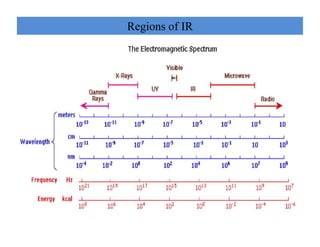
Regions of IR
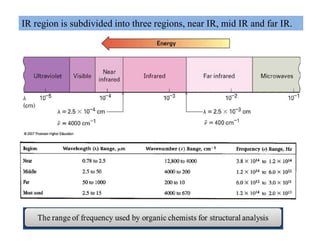
IR region is subdivided into three regions, near IR, mid IR and far IR.
Cont.…
 Generally there are two types of infrared spectroscopy
Dispersive infrared spectroscopy
Fourier transform infrared spectroscopy
 Dispersive spectrophotometers, which use a monochromatic to
produce an infrared spectrum one resolution element at a time.
 Michelson interferometers, which use a moving mirror
adjustment to create an interferogram, from which all resolution
elements are determined simultaneously.
 Generally there are two types of infrared spectroscopy
Dispersive infrared spectroscopy
Fourier transform infrared spectroscopy
 Dispersive spectrophotometers, which use a monochromatic to
produce an infrared spectrum one resolution element at a time.
 Michelson interferometers, which use a moving mirror
adjustment to create an interferogram, from which all resolution
elements are determined simultaneously.
FOURIER TRANSFORM INFRARED SPECTROSCOPY
 FT-IR stands for Fourier Transform InfraRed, the preferred method
of infrared spectroscopy.
 Fourier infrared spectroscopy is the study of interactions between
matter and electromagnetic fields in the IR region.
 In this spectral region, the EM waves mainly couple with the
molecular vibrations.
 A molecule can be excited to a higher vibrational state by absorbing
IR radiation.
 It covers a range of techniques, mostly based on absorption spectroscopy
 This makes infrared spectroscopy useful for several types of analysis.
 FT-IR stands for Fourier Transform InfraRed, the preferred method
of infrared spectroscopy.
 Fourier infrared spectroscopy is the study of interactions between
matter and electromagnetic fields in the IR region.
 In this spectral region, the EM waves mainly couple with the
molecular vibrations.
 A molecule can be excited to a higher vibrational state by absorbing
IR radiation.
 It covers a range of techniques, mostly based on absorption spectroscopy
 This makes infrared spectroscopy useful for several types of analysis.
Cont.…
Cont.…
 FT-IR can provide the following information.
It can identify unknown materials
It can determine the quality or consistency of a sample
It can determine the amount of components in a mixture
 Infrared spectroscopy can result in a positive identification
(qualitative analysis) of every different kind of material.
 With modern software algorithms, infrared is an excellent tool for
quantitative analysis.
 FT-IR can provide the following information.
It can identify unknown materials
It can determine the quality or consistency of a sample
It can determine the amount of components in a mixture
 Infrared spectroscopy can result in a positive identification
(qualitative analysis) of every different kind of material.
 With modern software algorithms, infrared is an excellent tool for
quantitative analysis.
MATHEMATICAL EXPRESSIONS OF FOURIER TRANSFORM
tTRANSFORMS FTIR spectrometer operates on a different principle called Fourier
transform.
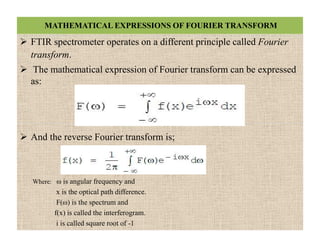
 The mathematical expression of Fourier transform can be expressed
as:
 And the reverse Fourier transform is;
Where: ω is angular frequency and
x is the optical path difference.
F(ω) is the spectrum and
f(x) is called the interferogram.
i is called square root of -1
 FTIR spectrometer operates on a different principle called Fourier
transform.
 The mathematical expression of Fourier transform can be expressed
as:
 And the reverse Fourier transform is;
Where: ω is angular frequency and
x is the optical path difference.
F(ω) is the spectrum and
f(x) is called the interferogram.
i is called square root of -1
Components of FTIR Spectroscopy
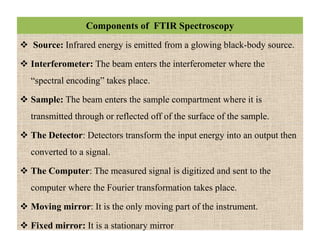
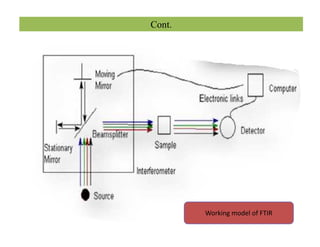
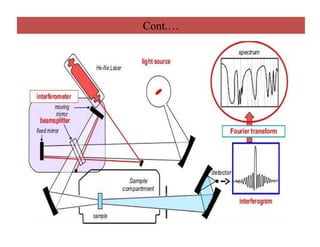
 Source: Infrared energy is emitted from a glowing black-body source.
 Interferometer: The beam enters the interferometer where the
“spectral encoding” takes place.
 Sample: The beam enters the sample compartment where it is
transmitted through or reflected off of the surface of the sample.
 The Detector: Detectors transform the input energy into an output then
converted to a signal.
 The Computer: The measured signal is digitized and sent to the
computer where the Fourier transformation takes place.
 Moving mirror: It is the only moving part of the instrument.
 Fixed mirror: It is a stationary mirror
 Source: Infrared energy is emitted from a glowing black-body source.
 Interferometer: The beam enters the interferometer where the
“spectral encoding” takes place.
 Sample: The beam enters the sample compartment where it is
transmitted through or reflected off of the surface of the sample.
 The Detector: Detectors transform the input energy into an output then
converted to a signal.
 The Computer: The measured signal is digitized and sent to the
computer where the Fourier transformation takes place.
 Moving mirror: It is the only moving part of the instrument.
 Fixed mirror: It is a stationary mirror
Cont.
Working model of FTIR
Working principles of Michelson Interferometer
 Light from the light source is directed to the beam splitter.
 Half of the light is reflected and half is transmitted.
 The reflected light goes to the fixed mirror where it is reflected back
to the beam splitter.
 The transmitted light is sent to the moving mirror and is also
reflected back towards the mirror.
 At the beam splitter, each of the two beams (from the fixed and
moving mirrors) are split into two:
One goes back to the source and
The other goes towards the detector.
 Light from the light source is directed to the beam splitter.
 Half of the light is reflected and half is transmitted.
 The reflected light goes to the fixed mirror where it is reflected back
to the beam splitter.
 The transmitted light is sent to the moving mirror and is also
reflected back towards the mirror.
 At the beam splitter, each of the two beams (from the fixed and
moving mirrors) are split into two:
One goes back to the source and
The other goes towards the detector.
Cont.
 The two beams reaching the detector come from the same source and have
an optical path difference determined by the positions of the two mirrors,
 That means they have a fixed phase difference and the two beams interfere.
 The two beams interfere constructively or destructively for a particular
frequency by positioning the moving mirror.
 If the moving mirror is scanned over a range, a sinusoidal signal will be
detected for that frequency with its
maximum corresponding to constructive interference and
minimum corresponding to destructive interference.
 This sinusoidal signal is called interferogram – detector signal (intensity)
against optical path difference.
 The two beams reaching the detector come from the same source and have
an optical path difference determined by the positions of the two mirrors,
 That means they have a fixed phase difference and the two beams interfere.
 The two beams interfere constructively or destructively for a particular
frequency by positioning the moving mirror.
 If the moving mirror is scanned over a range, a sinusoidal signal will be
detected for that frequency with its
maximum corresponding to constructive interference and
minimum corresponding to destructive interference.
 This sinusoidal signal is called interferogram – detector signal (intensity)
against optical path difference.
Cont.…
Generating the Spectrum
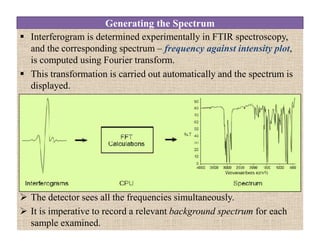
 Interferogram is determined experimentally in FTIR spectroscopy,
and the corresponding spectrum – frequency against intensity plot,
is computed using Fourier transform.
 This transformation is carried out automatically and the spectrum is
displayed.
 The detector sees all the frequencies simultaneously.
 It is imperative to record a relevant background spectrum for each
sample examined.
 Interferogram is determined experimentally in FTIR spectroscopy,
and the corresponding spectrum – frequency against intensity plot,
is computed using Fourier transform.
 This transformation is carried out automatically and the spectrum is
displayed.
 The detector sees all the frequencies simultaneously.
 It is imperative to record a relevant background spectrum for each
sample examined.
Cont.
Background spectrum:
 The empty beam background (no sample in the light path) is
recorded first.
 This spectrum shows the instrument energy profile.
Sample spectrum:
 The sample is placed in the combined beam.
 The sample spectrum is the ratio of the spectrum containing sample
against that of the background.
 In recording the background spectrum, the light path should be made
as close to that of the sample spectrum as possible.
Background spectrum:
 The empty beam background (no sample in the light path) is
recorded first.
 This spectrum shows the instrument energy profile.
Sample spectrum:
 The sample is placed in the combined beam.
 The sample spectrum is the ratio of the spectrum containing sample
against that of the background.
 In recording the background spectrum, the light path should be made
as close to that of the sample spectrum as possible.
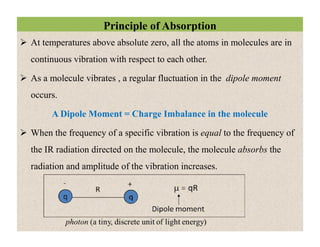
Principle of Absorption
 At temperatures above absolute zero, all the atoms in molecules are in
continuous vibration with respect to each other.
 As a molecule vibrates , a regular fluctuation in the dipole moment
occurs.
A Dipole Moment = Charge Imbalance in the molecule
 When the frequency of a specific vibration is equal to the frequency of
the IR radiation directed on the molecule, the molecule absorbs the
radiation and amplitude of the vibration increases.
 At temperatures above absolute zero, all the atoms in molecules are in
continuous vibration with respect to each other.
 As a molecule vibrates , a regular fluctuation in the dipole moment
occurs.
A Dipole Moment = Charge Imbalance in the molecule
 When the frequency of a specific vibration is equal to the frequency of
the IR radiation directed on the molecule, the molecule absorbs the
radiation and amplitude of the vibration increases.
Cont.
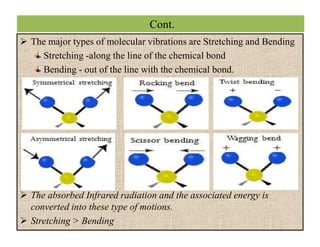
 The major types of molecular vibrations are Stretching and Bending
Stretching -along the line of the chemical bond
Bending - out of the line with the chemical bond.
 The absorbed Infrared radiation and the associated energy is
converted into these type of motions.
 Stretching > Bending
 The major types of molecular vibrations are Stretching and Bending
Stretching -along the line of the chemical bond
Bending - out of the line with the chemical bond.
 The absorbed Infrared radiation and the associated energy is
converted into these type of motions.
 Stretching > Bending
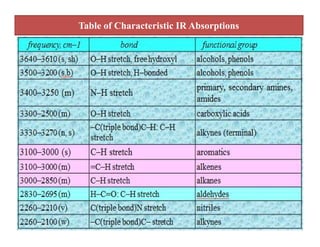
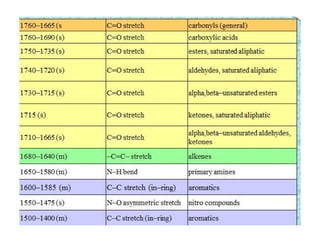
Table of Characteristic IR Absorptions
FT-IR Analysis
In fiber characterization by FTIR, analysis is done in two ways:
1. Qualitative Analysis
 For qualitative identification purposes, the spectrum is commonly presented as
transmittance vs wave number.
 It is possible to identify a functional group of a molecule by comparing its
vibrational frequency on an IR spectrum to an IR stored data bank.
 Functional groups have their characteristic fundamental vibrations which give rise
to absorption at certain frequency range in the spectrum.
 However, several functional groups may absorb at the same frequency range, and
a functional group may have multiple-characteristic absorption peaks, especially
for 1500 – 650 cm-1, which is called the fingerprint region.
 In addition, the size of the peaks in the spectrum is a direct indication of the
amount of material present.
In fiber characterization by FTIR, analysis is done in two ways:
1. Qualitative Analysis
 For qualitative identification purposes, the spectrum is commonly presented as
transmittance vs wave number.
 It is possible to identify a functional group of a molecule by comparing its
vibrational frequency on an IR spectrum to an IR stored data bank.
 Functional groups have their characteristic fundamental vibrations which give rise
to absorption at certain frequency range in the spectrum.
 However, several functional groups may absorb at the same frequency range, and
a functional group may have multiple-characteristic absorption peaks, especially
for 1500 – 650 cm-1, which is called the fingerprint region.
 In addition, the size of the peaks in the spectrum is a direct indication of the
amount of material present.
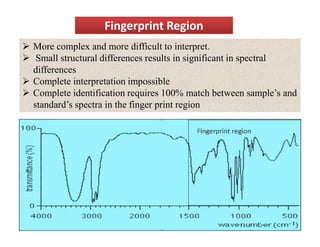
Fingerprint RegionFingerprint Region
 More complex and more difficult to interpret.
 Small structural differences results in significant in spectral
differences
 Complete interpretation impossible
 Complete identification requires 100% match between sample’s and
standard’s spectra in the finger print region
Cont.
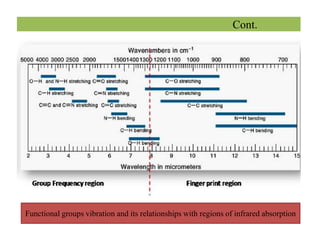
Functional groups vibration and its relationships with regions of infrared absorption
Cont.
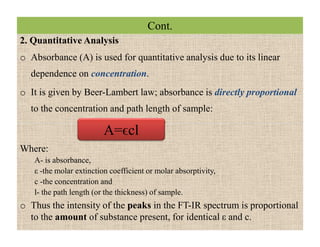
2. Quantitative Analysis
o Absorbance (A) is used for quantitative analysis due to its linear
dependence on concentration.
o It is given by Beer-Lambert law; absorbance is directly proportional
to the concentration and path length of sample:
Where:
A- is absorbance,
ε -the molar extinction coefficient or molar absorptivity,
c -the concentration and
l- the path length (or the thickness) of sample.
o Thus the intensity of the peaks in the FT-IR spectrum is proportional
to the amount of substance present, for identical ε and c.
A=ϵcl
2. Quantitative Analysis
o Absorbance (A) is used for quantitative analysis due to its linear
dependence on concentration.
o It is given by Beer-Lambert law; absorbance is directly proportional
to the concentration and path length of sample:
Where:
A- is absorbance,
ε -the molar extinction coefficient or molar absorptivity,
c -the concentration and
l- the path length (or the thickness) of sample.
o Thus the intensity of the peaks in the FT-IR spectrum is proportional
to the amount of substance present, for identical ε and c.
A=ϵcl
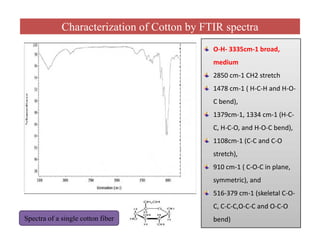
Characterization of Cotton by FTIR spectraCharacterization of Cotton by FTIR spectra
O-H- 3335cm-1 broad,
medium
2850 cm-1 CH2 stretch
1478 cm-1 ( H-C-H and H-O-
C bend),
1379cm-1, 1334 cm-1 (H-C-
C, H-C-O, and H-O-C bend),
1108cm-1 (C-C and C-O
stretch),
910 cm-1 ( C-O-C in plane,
symmetric), and
516-379 cm-1 (skeletal C-O-
C, C-C-C,O-C-C and O-C-O
bend)
O-H- 3335cm-1 broad,
medium
2850 cm-1 CH2 stretch
1478 cm-1 ( H-C-H and H-O-
C bend),
1379cm-1, 1334 cm-1 (H-C-
C, H-C-O, and H-O-C bend),
1108cm-1 (C-C and C-O
stretch),
910 cm-1 ( C-O-C in plane,
symmetric), and
516-379 cm-1 (skeletal C-O-
C, C-C-C,O-C-C and O-C-O
bend)
O-H- 3335cm-1 broad,
medium
2850 cm-1 CH2 stretch
1478 cm-1 ( H-C-H and H-O-
C bend),
1379cm-1, 1334 cm-1 (H-C-
C, H-C-O, and H-O-C bend),
1108cm-1 (C-C and C-O
stretch),
910 cm-1 ( C-O-C in plane,
symmetric), and
516-379 cm-1 (skeletal C-O-
C, C-C-C,O-C-C and O-C-O
bend)
O-H- 3335cm-1 broad,
medium
2850 cm-1 CH2 stretch
1478 cm-1 ( H-C-H and H-O-
C bend),
1379cm-1, 1334 cm-1 (H-C-
C, H-C-O, and H-O-C bend),
1108cm-1 (C-C and C-O
stretch),
910 cm-1 ( C-O-C in plane,
symmetric), and
516-379 cm-1 (skeletal C-O-
C, C-C-C,O-C-C and O-C-O
bend)Spectra of a single cotton fiber
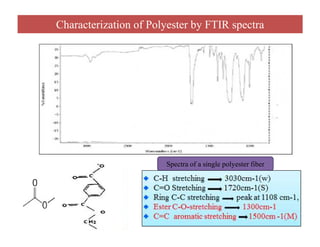
Characterization of Polyester by FTIR spectraCharacterization of Polyester by FTIR spectra
Spectra of a single polyester fiber
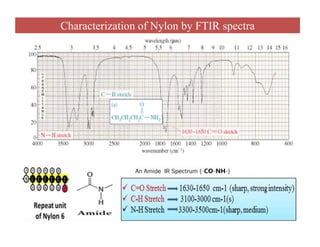
Characterization of Nylon by FTIR spectraCharacterization of Nylon by FTIR spectra
ADVANTAGES OF FTIR
 Fourier transform infrared spectroscopy is preferred over dispersive
or filter methods of infrared spectral analysis for several reasons:
It is a non-destructive technique
Speed
Sensitivity
Mechanical simplicity
Internally calibrated (self-calibrating)
 Fourier transform infrared spectroscopy is preferred over dispersive
or filter methods of infrared spectral analysis for several reasons:
It is a non-destructive technique
Speed
Sensitivity
Mechanical simplicity
Internally calibrated (self-calibrating)
LIMITATIONS OF FTIR
It cannot be used to detect all the vibration modes in a molecule.
It is not possible to know molecular weight of substance
It is not possible to know whether it is pure compound or a mixture
of compound.
Interferogram are difficult to interpret without first performing a
Fourier transform to produce a spectrum.
Accuracy of FT-IR remains true if there is no change in atmospheric
conditions throughout the experiment.
It cannot be used to detect all the vibration modes in a molecule.
It is not possible to know molecular weight of substance
It is not possible to know whether it is pure compound or a mixture
of compound.
Interferogram are difficult to interpret without first performing a
Fourier transform to produce a spectrum.
Accuracy of FT-IR remains true if there is no change in atmospheric
conditions throughout the experiment.
Application of FT-IR in Textile
• Identification of compounds by matching spectrum of unknown
compound with reference spectrum (fingerprinting)
• Identification of functional groups in unknown substances
• Identification of reaction components and kinetic studies of reactions
• Identification of molecular orientation in polymer films.
• Detection of molecular impurities or additives present
• The same way it determines Percentage of trash particles or foreign
matter present in fiber, yarn or fabric.
• Identification of polymers, plastics, and resins.
• Identification of compounds by matching spectrum of unknown
compound with reference spectrum (fingerprinting)
• Identification of functional groups in unknown substances
• Identification of reaction components and kinetic studies of reactions
• Identification of molecular orientation in polymer films.
• Detection of molecular impurities or additives present
• The same way it determines Percentage of trash particles or foreign
matter present in fiber, yarn or fabric.
• Identification of polymers, plastics, and resins.
Fourier transform infrared spectroscopy

Fourier transform infrared spectroscopy

  • 1.
    Fourier Transform InfraredSpectroscopy (FTIR) By: Asaye Dessie Getaneh Alamir Fourier Transform Infrared Spectroscopy (FTIR) By: Asaye Dessie Getaneh Alamir
  • 2.
    Content  Introduction o Briefhistory of development of FTIR o Theoretical background  Mathematical expressions of Fourier transforms  Components of FTIR spectroscopy  The working principles of Michelson interferometer  Generating the spectrum  Principle of Absorption  FT-IR Analysis  Characterization of textile fibers by FTIR spectra  Advantages of FT-IR  Limitation of FTIR  Application of FT-IR in Textiles  Reference Content  Introduction o Brief history of development of FTIR o Theoretical background  Mathematical expressions of Fourier transforms  Components of FTIR spectroscopy  The working principles of Michelson interferometer  Generating the spectrum  Principle of Absorption  FT-IR Analysis  Characterization of textile fibers by FTIR spectra  Advantages of FT-IR  Limitation of FTIR  Application of FT-IR in Textiles  Reference
  • 3.
    BRIEF HISTORY OFDEVELOPMENT OF FTIR  FT-IR spectrometry was developed in order to overcome the limitations encountered with dispersive instruments.  The limitation of Dispersive was the slow scanning process and measuring individual infrared frequencies.  A method for measuring all of the infrared frequencies simultaneously and very simple optical was needed.  Fourier had developed mathematical transform (FT) method in 1700.  Albert Michelson had perfected FT-IR instrument in 1887 and design the spectra of organic and his interferometer in 1891.  FT-IR was combined with personal computers to make widely used, versatile, and cost-effective method of analysis in 1980s  FT-IR spectrometry was developed in order to overcome the limitations encountered with dispersive instruments.  The limitation of Dispersive was the slow scanning process and measuring individual infrared frequencies.  A method for measuring all of the infrared frequencies simultaneously and very simple optical was needed.  Fourier had developed mathematical transform (FT) method in 1700.  Albert Michelson had perfected FT-IR instrument in 1887 and design the spectra of organic and his interferometer in 1891.  FT-IR was combined with personal computers to make widely used, versatile, and cost-effective method of analysis in 1980s
  • 4.
    THEORETICAL BACKGROUND  Spectroscopyis the study of matter and its properties by investigating light, sound, or particles that are emitted, absorbed or scattered by the matter under investigation.  It is the study of the interaction between light and matter.  Infrared frequencies of light are used to study fundamental vibrations and associated rotational-vibrational structure via vibrational resonance and selective absorption. Infrared SpectroscopyInfrared Spectroscopy  Spectroscopy is the study of matter and its properties by investigating light, sound, or particles that are emitted, absorbed or scattered by the matter under investigation.  It is the study of the interaction between light and matter.  Infrared frequencies of light are used to study fundamental vibrations and associated rotational-vibrational structure via vibrational resonance and selective absorption.
  • 5.
  • 6.
    IR region issubdivided into three regions, near IR, mid IR and far IR.
  • 7.
    Cont.…  Generally thereare two types of infrared spectroscopy Dispersive infrared spectroscopy Fourier transform infrared spectroscopy  Dispersive spectrophotometers, which use a monochromatic to produce an infrared spectrum one resolution element at a time.  Michelson interferometers, which use a moving mirror adjustment to create an interferogram, from which all resolution elements are determined simultaneously.  Generally there are two types of infrared spectroscopy Dispersive infrared spectroscopy Fourier transform infrared spectroscopy  Dispersive spectrophotometers, which use a monochromatic to produce an infrared spectrum one resolution element at a time.  Michelson interferometers, which use a moving mirror adjustment to create an interferogram, from which all resolution elements are determined simultaneously.
  • 8.
    FOURIER TRANSFORM INFRAREDSPECTROSCOPY  FT-IR stands for Fourier Transform InfraRed, the preferred method of infrared spectroscopy.  Fourier infrared spectroscopy is the study of interactions between matter and electromagnetic fields in the IR region.  In this spectral region, the EM waves mainly couple with the molecular vibrations.  A molecule can be excited to a higher vibrational state by absorbing IR radiation.  It covers a range of techniques, mostly based on absorption spectroscopy  This makes infrared spectroscopy useful for several types of analysis.  FT-IR stands for Fourier Transform InfraRed, the preferred method of infrared spectroscopy.  Fourier infrared spectroscopy is the study of interactions between matter and electromagnetic fields in the IR region.  In this spectral region, the EM waves mainly couple with the molecular vibrations.  A molecule can be excited to a higher vibrational state by absorbing IR radiation.  It covers a range of techniques, mostly based on absorption spectroscopy  This makes infrared spectroscopy useful for several types of analysis.
  • 9.
  • 10.
    Cont.…  FT-IR canprovide the following information. It can identify unknown materials It can determine the quality or consistency of a sample It can determine the amount of components in a mixture  Infrared spectroscopy can result in a positive identification (qualitative analysis) of every different kind of material.  With modern software algorithms, infrared is an excellent tool for quantitative analysis.  FT-IR can provide the following information. It can identify unknown materials It can determine the quality or consistency of a sample It can determine the amount of components in a mixture  Infrared spectroscopy can result in a positive identification (qualitative analysis) of every different kind of material.  With modern software algorithms, infrared is an excellent tool for quantitative analysis.
  • 11.
    MATHEMATICAL EXPRESSIONS OFFOURIER TRANSFORM tTRANSFORMS FTIR spectrometer operates on a different principle called Fourier transform.  The mathematical expression of Fourier transform can be expressed as:  And the reverse Fourier transform is; Where: ω is angular frequency and x is the optical path difference. F(ω) is the spectrum and f(x) is called the interferogram. i is called square root of -1  FTIR spectrometer operates on a different principle called Fourier transform.  The mathematical expression of Fourier transform can be expressed as:  And the reverse Fourier transform is; Where: ω is angular frequency and x is the optical path difference. F(ω) is the spectrum and f(x) is called the interferogram. i is called square root of -1
  • 12.
    Components of FTIRSpectroscopy  Source: Infrared energy is emitted from a glowing black-body source.  Interferometer: The beam enters the interferometer where the “spectral encoding” takes place.  Sample: The beam enters the sample compartment where it is transmitted through or reflected off of the surface of the sample.  The Detector: Detectors transform the input energy into an output then converted to a signal.  The Computer: The measured signal is digitized and sent to the computer where the Fourier transformation takes place.  Moving mirror: It is the only moving part of the instrument.  Fixed mirror: It is a stationary mirror  Source: Infrared energy is emitted from a glowing black-body source.  Interferometer: The beam enters the interferometer where the “spectral encoding” takes place.  Sample: The beam enters the sample compartment where it is transmitted through or reflected off of the surface of the sample.  The Detector: Detectors transform the input energy into an output then converted to a signal.  The Computer: The measured signal is digitized and sent to the computer where the Fourier transformation takes place.  Moving mirror: It is the only moving part of the instrument.  Fixed mirror: It is a stationary mirror
  • 13.
  • 14.
    Working principles ofMichelson Interferometer  Light from the light source is directed to the beam splitter.  Half of the light is reflected and half is transmitted.  The reflected light goes to the fixed mirror where it is reflected back to the beam splitter.  The transmitted light is sent to the moving mirror and is also reflected back towards the mirror.  At the beam splitter, each of the two beams (from the fixed and moving mirrors) are split into two: One goes back to the source and The other goes towards the detector.  Light from the light source is directed to the beam splitter.  Half of the light is reflected and half is transmitted.  The reflected light goes to the fixed mirror where it is reflected back to the beam splitter.  The transmitted light is sent to the moving mirror and is also reflected back towards the mirror.  At the beam splitter, each of the two beams (from the fixed and moving mirrors) are split into two: One goes back to the source and The other goes towards the detector.
  • 15.
    Cont.  The twobeams reaching the detector come from the same source and have an optical path difference determined by the positions of the two mirrors,  That means they have a fixed phase difference and the two beams interfere.  The two beams interfere constructively or destructively for a particular frequency by positioning the moving mirror.  If the moving mirror is scanned over a range, a sinusoidal signal will be detected for that frequency with its maximum corresponding to constructive interference and minimum corresponding to destructive interference.  This sinusoidal signal is called interferogram – detector signal (intensity) against optical path difference.  The two beams reaching the detector come from the same source and have an optical path difference determined by the positions of the two mirrors,  That means they have a fixed phase difference and the two beams interfere.  The two beams interfere constructively or destructively for a particular frequency by positioning the moving mirror.  If the moving mirror is scanned over a range, a sinusoidal signal will be detected for that frequency with its maximum corresponding to constructive interference and minimum corresponding to destructive interference.  This sinusoidal signal is called interferogram – detector signal (intensity) against optical path difference.
  • 16.
  • 17.
    Generating the Spectrum Interferogram is determined experimentally in FTIR spectroscopy, and the corresponding spectrum – frequency against intensity plot, is computed using Fourier transform.  This transformation is carried out automatically and the spectrum is displayed.  The detector sees all the frequencies simultaneously.  It is imperative to record a relevant background spectrum for each sample examined.  Interferogram is determined experimentally in FTIR spectroscopy, and the corresponding spectrum – frequency against intensity plot, is computed using Fourier transform.  This transformation is carried out automatically and the spectrum is displayed.  The detector sees all the frequencies simultaneously.  It is imperative to record a relevant background spectrum for each sample examined.
  • 18.
    Cont. Background spectrum:  Theempty beam background (no sample in the light path) is recorded first.  This spectrum shows the instrument energy profile. Sample spectrum:  The sample is placed in the combined beam.  The sample spectrum is the ratio of the spectrum containing sample against that of the background.  In recording the background spectrum, the light path should be made as close to that of the sample spectrum as possible. Background spectrum:  The empty beam background (no sample in the light path) is recorded first.  This spectrum shows the instrument energy profile. Sample spectrum:  The sample is placed in the combined beam.  The sample spectrum is the ratio of the spectrum containing sample against that of the background.  In recording the background spectrum, the light path should be made as close to that of the sample spectrum as possible.
  • 19.
    Principle of Absorption At temperatures above absolute zero, all the atoms in molecules are in continuous vibration with respect to each other.  As a molecule vibrates , a regular fluctuation in the dipole moment occurs. A Dipole Moment = Charge Imbalance in the molecule  When the frequency of a specific vibration is equal to the frequency of the IR radiation directed on the molecule, the molecule absorbs the radiation and amplitude of the vibration increases.  At temperatures above absolute zero, all the atoms in molecules are in continuous vibration with respect to each other.  As a molecule vibrates , a regular fluctuation in the dipole moment occurs. A Dipole Moment = Charge Imbalance in the molecule  When the frequency of a specific vibration is equal to the frequency of the IR radiation directed on the molecule, the molecule absorbs the radiation and amplitude of the vibration increases.
  • 20.
    Cont.  The majortypes of molecular vibrations are Stretching and Bending Stretching -along the line of the chemical bond Bending - out of the line with the chemical bond.  The absorbed Infrared radiation and the associated energy is converted into these type of motions.  Stretching > Bending  The major types of molecular vibrations are Stretching and Bending Stretching -along the line of the chemical bond Bending - out of the line with the chemical bond.  The absorbed Infrared radiation and the associated energy is converted into these type of motions.  Stretching > Bending
  • 21.
  • 23.
    FT-IR Analysis In fibercharacterization by FTIR, analysis is done in two ways: 1. Qualitative Analysis  For qualitative identification purposes, the spectrum is commonly presented as transmittance vs wave number.  It is possible to identify a functional group of a molecule by comparing its vibrational frequency on an IR spectrum to an IR stored data bank.  Functional groups have their characteristic fundamental vibrations which give rise to absorption at certain frequency range in the spectrum.  However, several functional groups may absorb at the same frequency range, and a functional group may have multiple-characteristic absorption peaks, especially for 1500 – 650 cm-1, which is called the fingerprint region.  In addition, the size of the peaks in the spectrum is a direct indication of the amount of material present. In fiber characterization by FTIR, analysis is done in two ways: 1. Qualitative Analysis  For qualitative identification purposes, the spectrum is commonly presented as transmittance vs wave number.  It is possible to identify a functional group of a molecule by comparing its vibrational frequency on an IR spectrum to an IR stored data bank.  Functional groups have their characteristic fundamental vibrations which give rise to absorption at certain frequency range in the spectrum.  However, several functional groups may absorb at the same frequency range, and a functional group may have multiple-characteristic absorption peaks, especially for 1500 – 650 cm-1, which is called the fingerprint region.  In addition, the size of the peaks in the spectrum is a direct indication of the amount of material present.
  • 24.
    Fingerprint RegionFingerprint Region More complex and more difficult to interpret.  Small structural differences results in significant in spectral differences  Complete interpretation impossible  Complete identification requires 100% match between sample’s and standard’s spectra in the finger print region
  • 25.
    Cont. Functional groups vibrationand its relationships with regions of infrared absorption
  • 26.
    Cont. 2. Quantitative Analysis oAbsorbance (A) is used for quantitative analysis due to its linear dependence on concentration. o It is given by Beer-Lambert law; absorbance is directly proportional to the concentration and path length of sample: Where: A- is absorbance, ε -the molar extinction coefficient or molar absorptivity, c -the concentration and l- the path length (or the thickness) of sample. o Thus the intensity of the peaks in the FT-IR spectrum is proportional to the amount of substance present, for identical ε and c. A=ϵcl 2. Quantitative Analysis o Absorbance (A) is used for quantitative analysis due to its linear dependence on concentration. o It is given by Beer-Lambert law; absorbance is directly proportional to the concentration and path length of sample: Where: A- is absorbance, ε -the molar extinction coefficient or molar absorptivity, c -the concentration and l- the path length (or the thickness) of sample. o Thus the intensity of the peaks in the FT-IR spectrum is proportional to the amount of substance present, for identical ε and c. A=ϵcl
  • 27.
    Characterization of Cottonby FTIR spectraCharacterization of Cotton by FTIR spectra O-H- 3335cm-1 broad, medium 2850 cm-1 CH2 stretch 1478 cm-1 ( H-C-H and H-O- C bend), 1379cm-1, 1334 cm-1 (H-C- C, H-C-O, and H-O-C bend), 1108cm-1 (C-C and C-O stretch), 910 cm-1 ( C-O-C in plane, symmetric), and 516-379 cm-1 (skeletal C-O- C, C-C-C,O-C-C and O-C-O bend) O-H- 3335cm-1 broad, medium 2850 cm-1 CH2 stretch 1478 cm-1 ( H-C-H and H-O- C bend), 1379cm-1, 1334 cm-1 (H-C- C, H-C-O, and H-O-C bend), 1108cm-1 (C-C and C-O stretch), 910 cm-1 ( C-O-C in plane, symmetric), and 516-379 cm-1 (skeletal C-O- C, C-C-C,O-C-C and O-C-O bend) O-H- 3335cm-1 broad, medium 2850 cm-1 CH2 stretch 1478 cm-1 ( H-C-H and H-O- C bend), 1379cm-1, 1334 cm-1 (H-C- C, H-C-O, and H-O-C bend), 1108cm-1 (C-C and C-O stretch), 910 cm-1 ( C-O-C in plane, symmetric), and 516-379 cm-1 (skeletal C-O- C, C-C-C,O-C-C and O-C-O bend) O-H- 3335cm-1 broad, medium 2850 cm-1 CH2 stretch 1478 cm-1 ( H-C-H and H-O- C bend), 1379cm-1, 1334 cm-1 (H-C- C, H-C-O, and H-O-C bend), 1108cm-1 (C-C and C-O stretch), 910 cm-1 ( C-O-C in plane, symmetric), and 516-379 cm-1 (skeletal C-O- C, C-C-C,O-C-C and O-C-O bend)Spectra of a single cotton fiber
  • 28.
    Characterization of Polyesterby FTIR spectraCharacterization of Polyester by FTIR spectra Spectra of a single polyester fiber
  • 29.
    Characterization of Nylonby FTIR spectraCharacterization of Nylon by FTIR spectra
  • 30.
    ADVANTAGES OF FTIR Fourier transform infrared spectroscopy is preferred over dispersive or filter methods of infrared spectral analysis for several reasons: It is a non-destructive technique Speed Sensitivity Mechanical simplicity Internally calibrated (self-calibrating)  Fourier transform infrared spectroscopy is preferred over dispersive or filter methods of infrared spectral analysis for several reasons: It is a non-destructive technique Speed Sensitivity Mechanical simplicity Internally calibrated (self-calibrating)
  • 31.
    LIMITATIONS OF FTIR Itcannot be used to detect all the vibration modes in a molecule. It is not possible to know molecular weight of substance It is not possible to know whether it is pure compound or a mixture of compound. Interferogram are difficult to interpret without first performing a Fourier transform to produce a spectrum. Accuracy of FT-IR remains true if there is no change in atmospheric conditions throughout the experiment. It cannot be used to detect all the vibration modes in a molecule. It is not possible to know molecular weight of substance It is not possible to know whether it is pure compound or a mixture of compound. Interferogram are difficult to interpret without first performing a Fourier transform to produce a spectrum. Accuracy of FT-IR remains true if there is no change in atmospheric conditions throughout the experiment.
  • 32.
    Application of FT-IRin Textile • Identification of compounds by matching spectrum of unknown compound with reference spectrum (fingerprinting) • Identification of functional groups in unknown substances • Identification of reaction components and kinetic studies of reactions • Identification of molecular orientation in polymer films. • Detection of molecular impurities or additives present • The same way it determines Percentage of trash particles or foreign matter present in fiber, yarn or fabric. • Identification of polymers, plastics, and resins. • Identification of compounds by matching spectrum of unknown compound with reference spectrum (fingerprinting) • Identification of functional groups in unknown substances • Identification of reaction components and kinetic studies of reactions • Identification of molecular orientation in polymer films. • Detection of molecular impurities or additives present • The same way it determines Percentage of trash particles or foreign matter present in fiber, yarn or fabric. • Identification of polymers, plastics, and resins.