Linking Knowledge Management Technologies to Strategy André Saito  and  Katsuhiro Umemoto Japan Advanced Institute of Science and Technology Graduate School of Knowledge Science Ver 4.0 –  2005.3.16 Congresso Anual de Tecnologia de Informação – CATI 2005 June 29 - July 1, São Paulo, Brazil
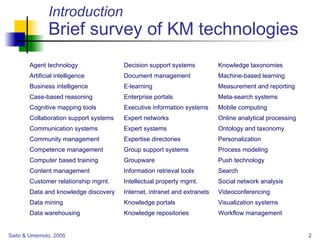
Introduction Brief survey of KM technologies Knowledge taxonomies Machine-based learning Measurement and reporting Meta-search systems Mobile computing Online analytical processing Ontology and taxonomy Personalization Process modeling Push technology Search Social network analysis Videoconferencing Visualization systems Workflow management Decision support systems Document management E-learning Enterprise portals Executive information systems Expert networks Expert systems Expertise directories Group support systems Groupware Information retrieval tools Intellectual property mgmt. Internet, intranet and extranets Knowledge portals Knowledge repositories Agent technology Artificial intelligence Business intelligence Case-based reasoning Cognitive mapping tools Collaboration support systems Communication systems Community management Competence management Computer based training Content management Customer relationship mgmt. Data and knowledge discovery Data mining Data warehousing
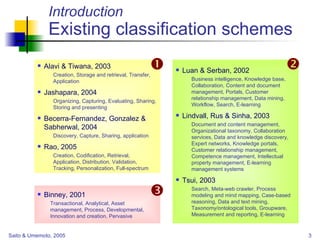
Introduction Existing classification schemes Alavi & Tiwana, 2003 Creation, Storage and retrieval, Transfer, Application Jashapara, 2004 Organizing, Capturing, Evaluating, Sharing, Storing and presenting Becerra-Fernandez, Gonzalez & Sabherwal, 2004 Discovery, Capture, Sharing, application Rao, 2005 Creation, Codification, Retrieval, Application, Distribution, Validation, Tracking, Personalization, Full-spectrum Luan & Serban, 2002 Business intelligence, Knowledge base, Collaboration, Content and document management, Portals, Customer relationship management, Data mining, Workflow, Search, E-learning Lindvall, Rus & Sinha, 2003 Document and content management, Organizational taxonomy, Collaboration services, Data and knowledge discovery, Expert networks, Knowledge portals, Customer relationship management, Competence management, Intellectual property management, E-learning management systems Tsui, 2003 Search, Meta-web crawler, Process modeling and mind mapping, Case-based reasoning, Data and text mining, Taxonomy/ontological tools, Groupware, Measurement and reporting, E-learning Binney, 2001 Transactional, Analytical, Asset management, Process, Developmental, Innovation and creation, Pervasive   
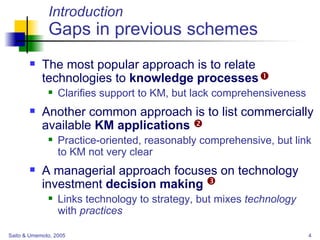
Introduction Gaps in previous schemes  The most popular approach is to relate technologies to  knowledge processes Clarifies support to KM, but lack comprehensiveness Another common approach is to list commercially available  KM applications Practice-oriented, reasonably comprehensive, but link to KM not very clear A managerial approach focuses on technology investment  decision making Links technology to strategy, but mixes  technology  with  practices   
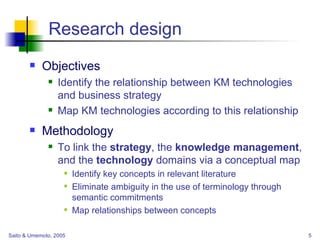
Research design Objectives Identify the relationship between KM technologies and business strategy Map KM technologies according to this relationship Methodology To link the  strategy , the  knowledge management , and the  technology  domains via a conceptual map Identify key concepts in relevant literature Eliminate ambiguity in the use of terminology through semantic commitments Map relationships between concepts
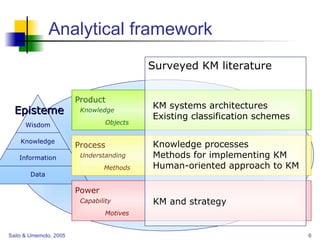
Analytical framework Product Knowledge Objects Process Understanding Methods Power Capability Motives Surveyed KM literature KM systems architectures Existing classification schemes Knowledge processes Methods for implementing KM Human-oriented approach to KM KM and strategy Episteme Data Information Knowledge Wisdom
KM technologies and   KM systems architecture KM component technologies are integrated into KM applications’ layers Source: Adapted from Maier, 2004. Access and Personalization Knowledge services Infrastructure and Integration Discovery Publication Collaboration Learning Data and knowledge sources
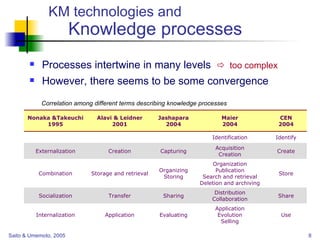
KM technologies and   Knowledge processes Processes intertwine in many levels     too complex However, there seems to be some convergence Correlation among different terms describing knowledge processes Use Application Evolution Selling Evaluating Application Internalization Share Distribution Collaboration Sharing Transfer Socialization Store Organization Publication Search and retrieval Deletion and archiving Organizing Storing Storage and retrieval Combination Create Acquisition Creation Capturing Creation Externalization Identify Identification CEN 2004 Maier 2004 Jashapara 2004 Alavi & Leidner 2001 Nonaka &Takeuchi 1995
KM technologies and   KM implementation There is confusion between two related, but different concepts:  KM technologies  vs.  KM practices Equivalent terms used in the literature  KM activities KM activities KM systems KM mechanisms KM techniques Knowledge technologies KM processes Knowledge tasks Knowledge activities KM tools KM instruments KM applications KM solutions KM tools KM instruments KM applications KM solutions  Knowledge processes KM practices KM technologies
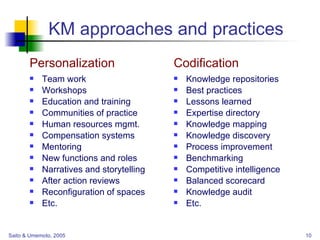
KM approaches and practices  Personalization Team work Workshops Education and training Communities of practice Human resources mgmt. Compensation systems Mentoring New functions and roles Narratives and storytelling After action reviews Reconfiguration of spaces  Etc. Codification Knowledge repositories Best practices Lessons learned Expertise directory Knowledge mapping Knowledge discovery Process improvement Benchmarking Competitive intelligence Balanced scorecard Knowledge audit Etc.
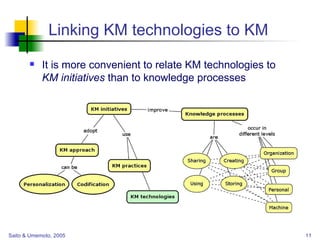
Linking KM technologies to KM It is more convenient to relate KM technologies to  KM initiatives  than to knowledge processes
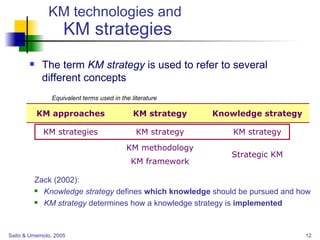
KM technologies and   KM strategies The term  KM strategy  is used to refer to several different concepts Zack (2002): Knowledge strategy  defines  which knowledge  should be pursued and how KM strategy  determines how a knowledge strategy is  implemented Equivalent terms used in the literature  Strategic KM KM methodology KM framework KM strategy KM strategies KM strategy Knowledge strategy KM strategy KM approaches
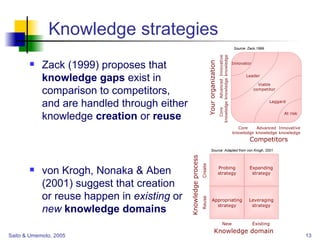
Knowledge strategies Zack (1999) proposes that  knowledge gaps  exist in comparison to competitors, and are handled through either knowledge  creation  or  reuse von Krogh, Nonaka & Aben (2001) suggest that creation or reuse happen in  existing  or  new   knowledge domains Knowledge domain Knowledge process New Existing Create Reuse Source: Zack,1999. Source: Adapted from von Krogh, 2001 Innovative knowledge Advanced knowledge Core knowledge Innovative knowledge Advanced knowledge Core knowledge Innovator Leader Viable competitor Laggard At risk Your organization Competitors Probing strategy Expanding strategy Appropriating strategy Leveraging strategy
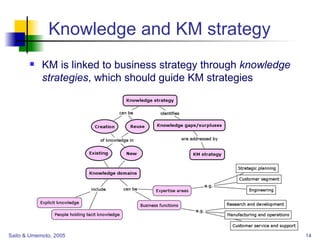
Knowledge and KM strategy KM is linked to business strategy through  knowledge strategies , which should guide KM strategies
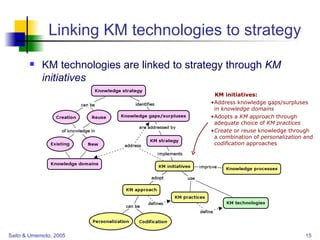
Linking KM technologies to strategy KM technologies are linked to strategy through  KM initiatives KM initiatives: Address knowledge gaps/surpluses in  knowledge domains Adopts a  KM approach  through adequate choice of  KM practices Create  or  reuse  knowledge through a combination of  personalization  and  codification  approaches
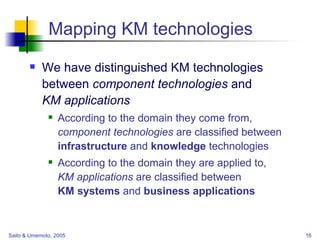
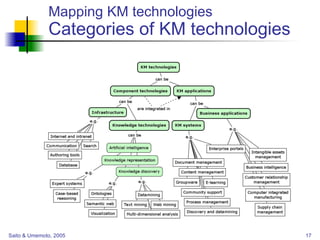
Mapping KM technologies We have distinguished KM technologies between  component technologies  and  KM applications According to the domain they come from,  component technologies  are classified between  infrastructure  and  knowledge  technologies According to the domain they are applied to,  KM applications  are classified between  KM systems  and  business applications
Mapping KM technologies Categories of KM technologies
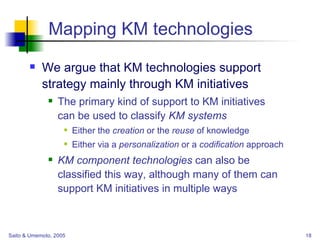
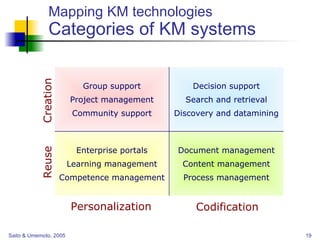
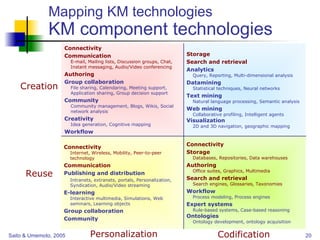
Mapping KM technologies We argue that KM technologies support strategy mainly through KM initiatives The primary kind of support to KM initiatives  can be used to classify  KM systems Either the  creation  or the  reuse  of knowledge Either via a  personalization  or a  codification  approach KM component technologies  can also be  classified this way, although many of them can support KM initiatives in multiple ways
Mapping KM technologies Categories of KM systems Document management Content management Process management Enterprise portals Learning management Competence management Decision support Search and retrieval Discovery and datamining Group support Project management Community support Creation Reuse Personalization Codification
Mapping KM technologies KM component technologies Connectivity Storage Databases, Repositories, Data warehouses Authoring Office suites, Graphics, Multimedia Search and retrieval Search engines, Glossaries, Taxonomies Workflow Process modeling, Process engines Expert systems Rule-based systems, Case-based reasoning Ontologies Ontology development, ontology acquisition Connectivity Internet, Wireless, Mobility, Peer-to-peer technology Communication Publishing and distribution Intranets, extranets, portals, Personalization, Syndication, Audio/Video streaming E-learning Interactive multimedia, Simulations, Web seminars, Learning objects Group collaboration Community Storage Search and retrieval Analytics Query, Reporting, Multi-dimensional analysis Datamining Statistical techniques, Neural networks Text mining Natural language processing, Semantic analysis Web mining Collaborative profiling, Intelligent agents Visualization 2D and 3D navigation, geographic mapping Connectivity Communication E-mail, Mailing lists, Discussion groups, Chat, Instant messaging, Audio/Video conferencing Authoring Group collaboration File sharing, Calendaring, Meeting support, Application sharing, Group decision support Community Community management, Blogs, Wikis, Social network analysis Creativity Idea generation, Cognitive mapping Workflow Creation Reuse Personalization Codification
Conclusion We argue that the best way to relate KM technologies to strategy is through  KM initiatives , that address knowledge gaps  in particular knowledge domains We suggest a categorization of KM technologies according to their primary  kind of support  to KM initiatives:  either creation or reuse of knowledge either a personalization or a codification approach

KM technologies and strategy

  • 1.
    Linking Knowledge ManagementTechnologies to Strategy André Saito and Katsuhiro Umemoto Japan Advanced Institute of Science and Technology Graduate School of Knowledge Science Ver 4.0 – 2005.3.16 Congresso Anual de Tecnologia de Informação – CATI 2005 June 29 - July 1, São Paulo, Brazil
  • 2.
    Introduction Brief surveyof KM technologies Knowledge taxonomies Machine-based learning Measurement and reporting Meta-search systems Mobile computing Online analytical processing Ontology and taxonomy Personalization Process modeling Push technology Search Social network analysis Videoconferencing Visualization systems Workflow management Decision support systems Document management E-learning Enterprise portals Executive information systems Expert networks Expert systems Expertise directories Group support systems Groupware Information retrieval tools Intellectual property mgmt. Internet, intranet and extranets Knowledge portals Knowledge repositories Agent technology Artificial intelligence Business intelligence Case-based reasoning Cognitive mapping tools Collaboration support systems Communication systems Community management Competence management Computer based training Content management Customer relationship mgmt. Data and knowledge discovery Data mining Data warehousing
  • 3.
    Introduction Existing classificationschemes Alavi & Tiwana, 2003 Creation, Storage and retrieval, Transfer, Application Jashapara, 2004 Organizing, Capturing, Evaluating, Sharing, Storing and presenting Becerra-Fernandez, Gonzalez & Sabherwal, 2004 Discovery, Capture, Sharing, application Rao, 2005 Creation, Codification, Retrieval, Application, Distribution, Validation, Tracking, Personalization, Full-spectrum Luan & Serban, 2002 Business intelligence, Knowledge base, Collaboration, Content and document management, Portals, Customer relationship management, Data mining, Workflow, Search, E-learning Lindvall, Rus & Sinha, 2003 Document and content management, Organizational taxonomy, Collaboration services, Data and knowledge discovery, Expert networks, Knowledge portals, Customer relationship management, Competence management, Intellectual property management, E-learning management systems Tsui, 2003 Search, Meta-web crawler, Process modeling and mind mapping, Case-based reasoning, Data and text mining, Taxonomy/ontological tools, Groupware, Measurement and reporting, E-learning Binney, 2001 Transactional, Analytical, Asset management, Process, Developmental, Innovation and creation, Pervasive   
  • 4.
    Introduction Gaps inprevious schemes The most popular approach is to relate technologies to knowledge processes Clarifies support to KM, but lack comprehensiveness Another common approach is to list commercially available KM applications Practice-oriented, reasonably comprehensive, but link to KM not very clear A managerial approach focuses on technology investment decision making Links technology to strategy, but mixes technology with practices   
  • 5.
    Research design ObjectivesIdentify the relationship between KM technologies and business strategy Map KM technologies according to this relationship Methodology To link the strategy , the knowledge management , and the technology domains via a conceptual map Identify key concepts in relevant literature Eliminate ambiguity in the use of terminology through semantic commitments Map relationships between concepts
  • 6.
    Analytical framework ProductKnowledge Objects Process Understanding Methods Power Capability Motives Surveyed KM literature KM systems architectures Existing classification schemes Knowledge processes Methods for implementing KM Human-oriented approach to KM KM and strategy Episteme Data Information Knowledge Wisdom
  • 7.
    KM technologies and KM systems architecture KM component technologies are integrated into KM applications’ layers Source: Adapted from Maier, 2004. Access and Personalization Knowledge services Infrastructure and Integration Discovery Publication Collaboration Learning Data and knowledge sources
  • 8.
    KM technologies and Knowledge processes Processes intertwine in many levels  too complex However, there seems to be some convergence Correlation among different terms describing knowledge processes Use Application Evolution Selling Evaluating Application Internalization Share Distribution Collaboration Sharing Transfer Socialization Store Organization Publication Search and retrieval Deletion and archiving Organizing Storing Storage and retrieval Combination Create Acquisition Creation Capturing Creation Externalization Identify Identification CEN 2004 Maier 2004 Jashapara 2004 Alavi & Leidner 2001 Nonaka &Takeuchi 1995
  • 9.
    KM technologies and KM implementation There is confusion between two related, but different concepts: KM technologies vs. KM practices Equivalent terms used in the literature KM activities KM activities KM systems KM mechanisms KM techniques Knowledge technologies KM processes Knowledge tasks Knowledge activities KM tools KM instruments KM applications KM solutions KM tools KM instruments KM applications KM solutions Knowledge processes KM practices KM technologies
  • 10.
    KM approaches andpractices Personalization Team work Workshops Education and training Communities of practice Human resources mgmt. Compensation systems Mentoring New functions and roles Narratives and storytelling After action reviews Reconfiguration of spaces Etc. Codification Knowledge repositories Best practices Lessons learned Expertise directory Knowledge mapping Knowledge discovery Process improvement Benchmarking Competitive intelligence Balanced scorecard Knowledge audit Etc.
  • 11.
    Linking KM technologiesto KM It is more convenient to relate KM technologies to KM initiatives than to knowledge processes
  • 12.
    KM technologies and KM strategies The term KM strategy is used to refer to several different concepts Zack (2002): Knowledge strategy defines which knowledge should be pursued and how KM strategy determines how a knowledge strategy is implemented Equivalent terms used in the literature Strategic KM KM methodology KM framework KM strategy KM strategies KM strategy Knowledge strategy KM strategy KM approaches
  • 13.
    Knowledge strategies Zack(1999) proposes that knowledge gaps exist in comparison to competitors, and are handled through either knowledge creation or reuse von Krogh, Nonaka & Aben (2001) suggest that creation or reuse happen in existing or new knowledge domains Knowledge domain Knowledge process New Existing Create Reuse Source: Zack,1999. Source: Adapted from von Krogh, 2001 Innovative knowledge Advanced knowledge Core knowledge Innovative knowledge Advanced knowledge Core knowledge Innovator Leader Viable competitor Laggard At risk Your organization Competitors Probing strategy Expanding strategy Appropriating strategy Leveraging strategy
  • 14.
    Knowledge and KMstrategy KM is linked to business strategy through knowledge strategies , which should guide KM strategies
  • 15.
    Linking KM technologiesto strategy KM technologies are linked to strategy through KM initiatives KM initiatives: Address knowledge gaps/surpluses in knowledge domains Adopts a KM approach through adequate choice of KM practices Create or reuse knowledge through a combination of personalization and codification approaches
  • 16.
    Mapping KM technologiesWe have distinguished KM technologies between component technologies and KM applications According to the domain they come from, component technologies are classified between infrastructure and knowledge technologies According to the domain they are applied to, KM applications are classified between KM systems and business applications
  • 17.
    Mapping KM technologiesCategories of KM technologies
  • 18.
    Mapping KM technologiesWe argue that KM technologies support strategy mainly through KM initiatives The primary kind of support to KM initiatives can be used to classify KM systems Either the creation or the reuse of knowledge Either via a personalization or a codification approach KM component technologies can also be classified this way, although many of them can support KM initiatives in multiple ways
  • 19.
    Mapping KM technologiesCategories of KM systems Document management Content management Process management Enterprise portals Learning management Competence management Decision support Search and retrieval Discovery and datamining Group support Project management Community support Creation Reuse Personalization Codification
  • 20.
    Mapping KM technologiesKM component technologies Connectivity Storage Databases, Repositories, Data warehouses Authoring Office suites, Graphics, Multimedia Search and retrieval Search engines, Glossaries, Taxonomies Workflow Process modeling, Process engines Expert systems Rule-based systems, Case-based reasoning Ontologies Ontology development, ontology acquisition Connectivity Internet, Wireless, Mobility, Peer-to-peer technology Communication Publishing and distribution Intranets, extranets, portals, Personalization, Syndication, Audio/Video streaming E-learning Interactive multimedia, Simulations, Web seminars, Learning objects Group collaboration Community Storage Search and retrieval Analytics Query, Reporting, Multi-dimensional analysis Datamining Statistical techniques, Neural networks Text mining Natural language processing, Semantic analysis Web mining Collaborative profiling, Intelligent agents Visualization 2D and 3D navigation, geographic mapping Connectivity Communication E-mail, Mailing lists, Discussion groups, Chat, Instant messaging, Audio/Video conferencing Authoring Group collaboration File sharing, Calendaring, Meeting support, Application sharing, Group decision support Community Community management, Blogs, Wikis, Social network analysis Creativity Idea generation, Cognitive mapping Workflow Creation Reuse Personalization Codification
  • 21.
    Conclusion We arguethat the best way to relate KM technologies to strategy is through KM initiatives , that address knowledge gaps in particular knowledge domains We suggest a categorization of KM technologies according to their primary kind of support to KM initiatives: either creation or reuse of knowledge either a personalization or a codification approach