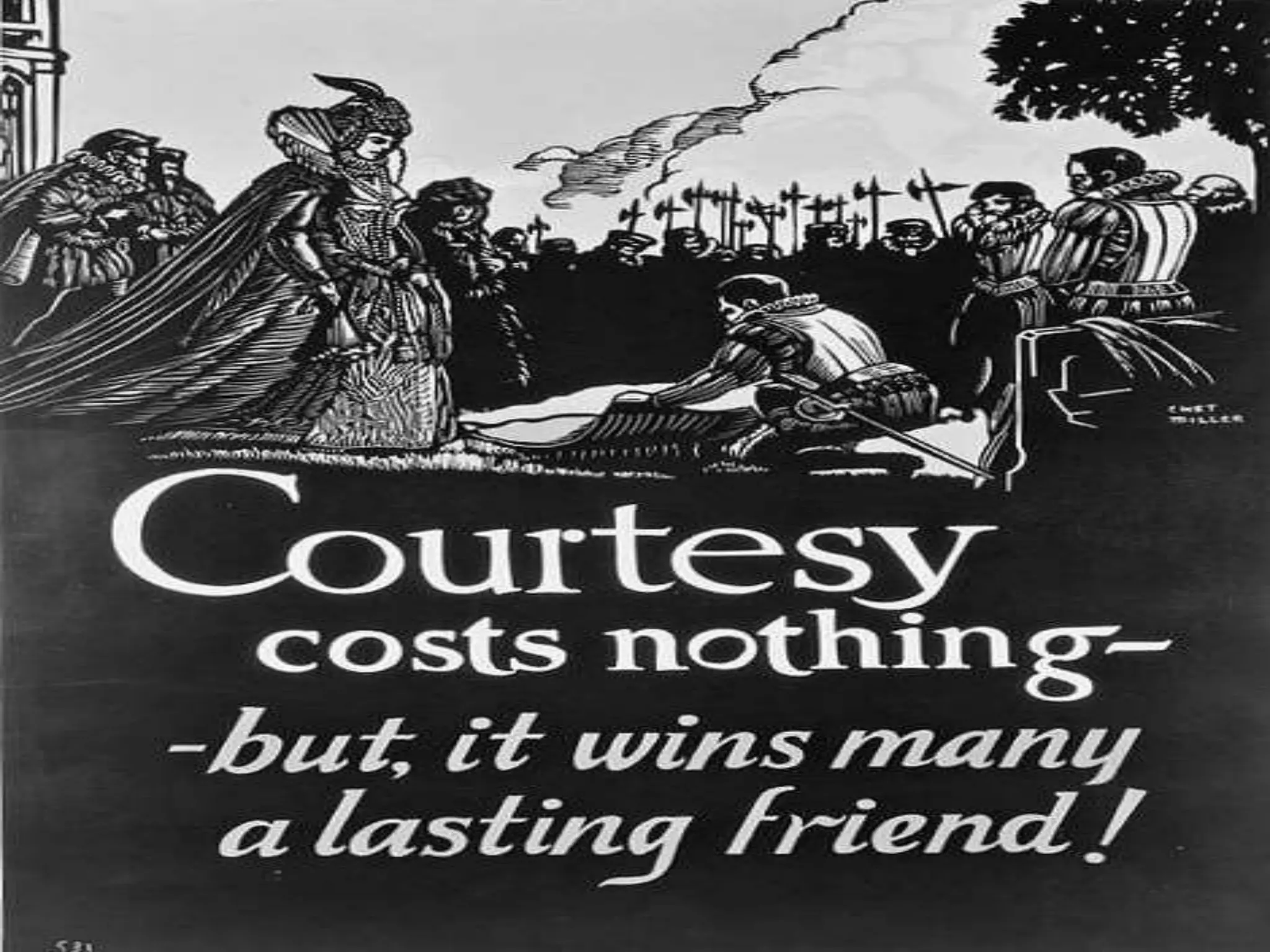
COURTESY
True courtesy involves being aware not only of the
perspective of others, but also their feelings. Courtesy
System form a sincere you attitude. It is not merely politeness
with mechanical insertions of “please” and “thank you",
although applying socially accepted manners is a form of
courtesy. Rather it is politeness that grows out of respect and
concern for others.
COURTESY
• RULES FOR COURTESY:
• Be sincerely tactful, thoughtful, and appreciative.
• Use expressions that show respect.
• Choose non discriminatory expressions.
Be sincerely tactful Thoughtful and Appreciative
• Though few people are intentionally abrupt or blunt,
these negative traits are a common cause of
discourtesy. Sometimes they stem from mistaken
idea of conciseness, sometime from a negative
personal attitudes, sometimes from not knowing the
culture of a country or even groups of people. Avoid
expressions which are irritating.
Thoughtful and Appreciative
Writer who sends cordial courteous messages of
deserved congratulations and appreciations help to
build good will. Be especially thoughtful and
courteous when communicating with Asian cultures
they like the soft ,more polite approach in both
written and oral communication.
Example
• Wow that’s an amazing idea where are you before
when we are in a great trouble but it was a great job
your idea gave us energy it will also push our project
to next level.
Example
• “I wanted to take a moment to say how much I
appreciated the great insight you offered at this
morning’s brainstorming session. Your idea got us all
energized about the road ahead, and is just the kind of
innovative thinking we needed to push our project to
the next level. “
Courtesy
• When returning a well-executed project submitted for
comment, consider attaching a post-it note with a
warm note of appreciation or thanks.
2:Use Expression that show respect
• No reader wants to receive messages that offend.
Such expressions are discussed in two groups.
• Irritating expressions.
• Questionable humor.
Choose Non Discriminatory Expressions
Another requirement for courtesy is the use of non
discriminatory language that reflects equal treatment
of people regardless of gender ,race, ethnic origin,
and physical features. The suggestions selected here
ca be particularly useful for your written and oral
business communication.
Choose Non Discriminatory Expressions
• Names:
When using names , treat each gender with respect.
courtesy 7C's of communication

courtesy 7C's of communication

  • 2.
    COURTESY True courtesy involvesbeing aware not only of the perspective of others, but also their feelings. Courtesy System form a sincere you attitude. It is not merely politeness with mechanical insertions of “please” and “thank you", although applying socially accepted manners is a form of courtesy. Rather it is politeness that grows out of respect and concern for others.
  • 3.
    COURTESY • RULES FORCOURTESY: • Be sincerely tactful, thoughtful, and appreciative. • Use expressions that show respect. • Choose non discriminatory expressions.
  • 4.
    Be sincerely tactfulThoughtful and Appreciative • Though few people are intentionally abrupt or blunt, these negative traits are a common cause of discourtesy. Sometimes they stem from mistaken idea of conciseness, sometime from a negative personal attitudes, sometimes from not knowing the culture of a country or even groups of people. Avoid expressions which are irritating.
  • 5.
    Thoughtful and Appreciative Writerwho sends cordial courteous messages of deserved congratulations and appreciations help to build good will. Be especially thoughtful and courteous when communicating with Asian cultures they like the soft ,more polite approach in both written and oral communication.
  • 6.
    Example • Wow that’san amazing idea where are you before when we are in a great trouble but it was a great job your idea gave us energy it will also push our project to next level.
  • 7.
    Example • “I wantedto take a moment to say how much I appreciated the great insight you offered at this morning’s brainstorming session. Your idea got us all energized about the road ahead, and is just the kind of innovative thinking we needed to push our project to the next level. “
  • 8.
    Courtesy • When returninga well-executed project submitted for comment, consider attaching a post-it note with a warm note of appreciation or thanks.
  • 9.
    2:Use Expression thatshow respect • No reader wants to receive messages that offend. Such expressions are discussed in two groups. • Irritating expressions. • Questionable humor.
  • 10.
    Choose Non DiscriminatoryExpressions Another requirement for courtesy is the use of non discriminatory language that reflects equal treatment of people regardless of gender ,race, ethnic origin, and physical features. The suggestions selected here ca be particularly useful for your written and oral business communication.
  • 11.
    Choose Non DiscriminatoryExpressions • Names: When using names , treat each gender with respect.