Give it a REST already

   Arnon Rotem-Gal-Oz
     http://arnon.me
Some
Theory
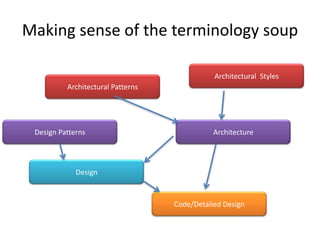
Making sense of the terminology soup

                                              Architectural Styles
          Architectural Patterns


 Design Patterns                              Architecture


             Design


                                   Code/Detailed Design
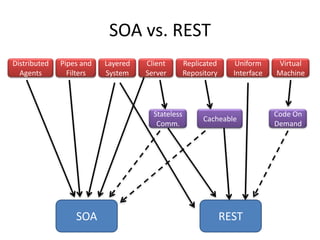
SOA vs. REST
Distributed   Pipes and   Layered   Client        Replicated      Uniform    Virtual
  Agents        Filters   System    Server        Repository     Interface   Machine


                                      Stateless                              Code On
                                                       Cacheable
                                       Comm.                                 Demand


                  SOA                                          REST
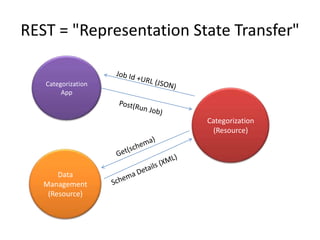
REST = "Representation State Transfer"

   Categorization
        App


                         Categorization
                          (Resource)


       Data
   Management
    (Resource)
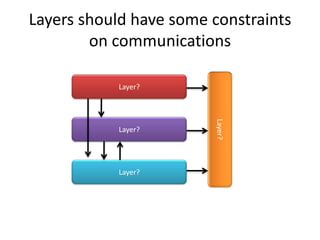
Layers should have some constraints
        on communications

            Layer?


                        Layer?
            Layer?


            Layer?
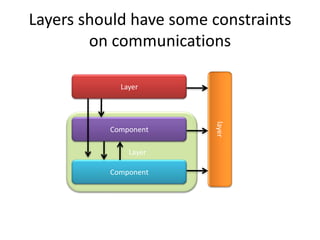
Layers should have some constraints
        on communications

            Layer


                        layer
          Component

              Layer

          Component
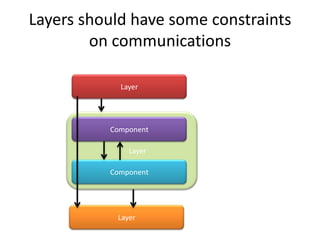
Layers should have some constraints
        on communications

            Layer


          Component

              Layer

          Component


           Layer
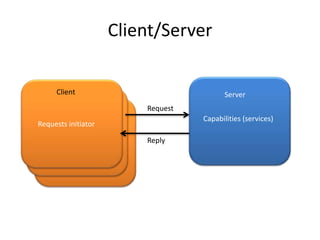
Client/Server

     Client                              Server
                         Request
                                   Capabilities (services)
Requests initiator

                         Reply
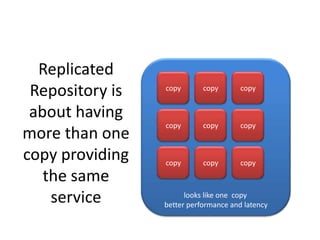
Replicated
 Repository is   copy       copy       copy


 about having
                 copy       copy       copy
more than one
copy providing   copy       copy       copy
   the same
    service            looks like one copy
                 better performance and latency
The uniform
 interface
Document Centric
messages provide
the client with the
   needed state
    and allow
     stateless
 communications
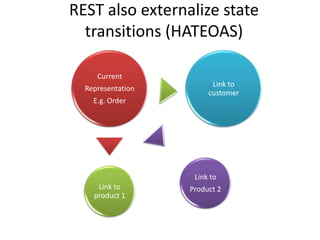
REST also externalize state
  transitions (HATEOAS)

     Current
                         Link to
  Representation
                        customer
    E.g. Order


                    Link to
     Link to       Product 2
    product 1
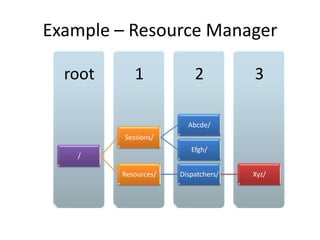
Example – Resource Manager

  root      1             2          3

                        Abcde/
         Sessions/
                         Efgh/
   /

         Resources/   Dispatchers/   Xyz/
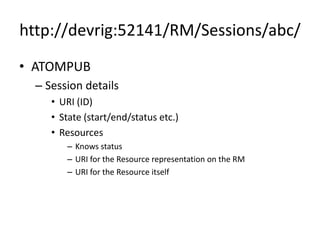
http://devrig:52141/RM/Sessions/abc/
• ATOMPUB
  – Session details
     • URI (ID)
     • State (start/end/status etc.)
     • Resources
        – Knows status
        – URI for the Resource representation on the RM
        – URI for the Resource itself
Use IDs that are links
e.g. a
HTTP is the most common REST
        implementation
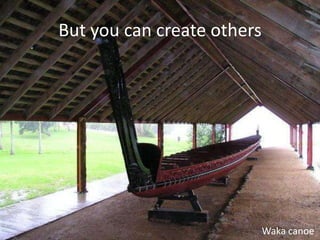
But you can create others


                            Waka canoe
GET = query/read a resource for a
        representation
PUT = create with
ID set by the client
     / replace
POST = Create a subordinate resource
   with ID set by server / update
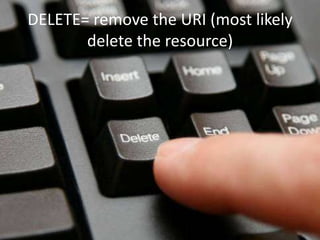
DELETE= remove the URI (most likely
       delete the resource)
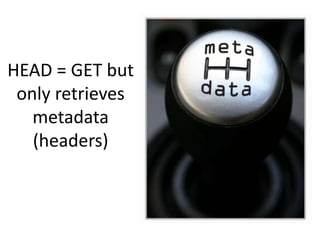
HEAD = GET but
 only retrieves
   metadata
   (headers)
OPTIONS – The
currently available
      verbs /
 requirements for
  communication
Why
REST?
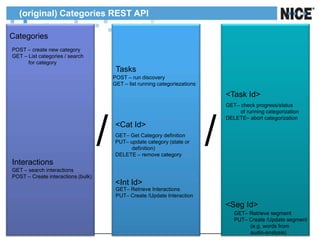
(original) Categories REST API

Categories
POST – create new category
GET – List categories / search
      for category
                                         Tasks
                                        POST – run discovery
                                        GET – list running categoriezations

                                                                                  <Task Id>
                                                                                  GET– check progress/status
                                                                                       of running categorization


                                    /                                         /
                                                                                  DELETE– abort categorization
                                         <Cat Id>
                                         GET– Get Category definition
                                         PUT– update category (state or
                                              definition)
                                         DELETE – remove category
Interactions
GET – search interactions
POST – Create interactions (bulk)
                                         <Int Id>
                                         GET– Retrieve Interactions
                                         PUT– Create /Update Interaction
                                                                                  <Seg Id>
                                                                                     GET– Retrieve segment
                                                                                     PUT– Create /Update segment
                                                                                          (e.g. words from
                                                                                          audio-analysis)
Technology Mapping
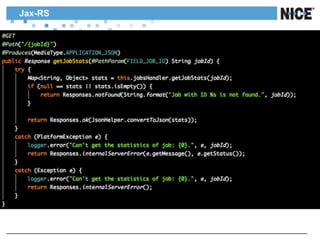
Jax-RS
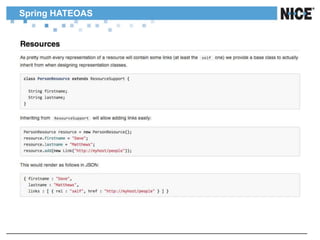
Spring HATEOAS
Common REST misconceptions
REST = CRUD
REST is the ultimate architecture
REST = HTTP
REST will automagically make you
write perfect distributed systems
REST is Simpler

REST presentation

Editor's Notes

  • #5 I am not going to talk about the “Code On Demand” since it is optional (also easy to understand – think javascript)
  • #11 RR is the precursor for cacheability (!)
  • #12 trades-off efficiency of interaction for easier of integration and better independent evolvability of resources
  • #13 In a nutshell document-centric means that the message contains enough information to represent a complete unit of work. RPC calls tend to be geared toward sending just the parameters needed to perform the action and have some stateful expectations from the service. Document-centric message, on the other hand, don’t make these assumptions, having a complete unit-of-work, means that the service has enough information or context in the message to understand all the state it needs. This also means that document centric messages are usually more coarse grained compared with their RPC counterparts. Table 5.2 below demonstrates 3 ways document centric messages can contain more context. ContextExplanationHistoryThe message can contain the interaction up to this point - sort of like breadcrumbs in ht Hansel and Gretel tale. For instance in an Ordering scenario, if the first step was to get customer data and the current step is to set the order (each step can be with another service) the message would contain the customer information when it goes into the ordering service.Future The message can include the options the consumer can take to complete the interaction. Again, if we think about an ordering scenario, if the previous step was to reserve the order (see Reservation pattern in chapter 6), the return message can include the information needed to confirm the reservation.Complete Future Another way to provide context is for the message format to contain the complete details needed for the interaction. For the ordering example, this would mean that the message would have a skeleton to support all the order and related details and the parties involved will fill in the blanks as the interaction progresses.
  • #14 (contrast this to objects that encapsulate them)
  • #17 where you can actually find the thingor rather Representations of ite.g.in this case (www.uri.com.hk) representations of underwear fashion
  • #18 HTTP defined a protocol (headers, verbs + response type etc.)GETPUTPOSTDELETEOPTIONSHEAD(TRACE –loop back the request as it is received by the server, can be a security hazard) CONNECT – defined in the spec as reserved)
  • #19 e.g. Waka by Roy Fielding with things likeRender ~ GetMonitor – subscribe to changes
  • #21 In UPDATE you can send only the “diff” using put (and the document centric messaging) you can only replace
  • #24 Can be used to check if state changed since last time if retrieving the body is a heavy operation
  • #25 e.g. when you call the root URI it will let you know
  • #26 Easier integration It isn’t that integration magically happen because of the uniform interface – but it is easier for humans to understandIn RESTful HTTP integration is even easier because HTTP is ubiquitous so it is also easy to integrate cross-platformEasy to expose services to UI esp. in the technologies we choseaNot without challenges e.g. – getting security right, getting URIs right
  • #32 We already seen that
  • #33 As mentioned REST trades-off efficiency for interoperability and integrationWhen you do need efficiency then REST is wrongIt was also designed for Hypermedia systems (i.e. Web) if your solutions can’t support that, than it is wrong.If you have to integrate existing stuff that is not RESTful than it is wrongEtc.
  • #35 A lot of people don’t understand REST and can create havoc just like in RPC based systeme.g. translating every verb into a URI:http://www.example.com/DoActionThe fallacies of distributed computing still matter REST does encourage some of the recommended practices (e.g. statelessness of communications, document centric messages, use of cache etc.)
  • #36 It builds on simple concepts But you should be mindful to get it rightDefine the correct ResourcesUse cache (e.g. ETAG and Last-Modified in HTTP) Parse data in and out etc