"Evolution, Morpheus.
Evolution! LikeThe
Dinosaur. Look Out That
Window. You've Had Your
Time. The Future Is OUR
World, Morpheus. The
Future Is OUR Time."
Agenda
● Getting intuitionfor the technology and
buzzword
● How to maximize value from working
with AI and what are the limitations
5.
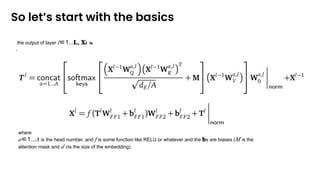
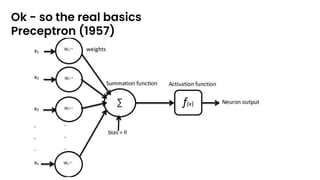
So let’s startwith the basics
where
𝑎∈1...𝐴 is the head number, and 𝑓 is some function like RELU or whatever and the 𝐛s are biases (𝑀 is the
attention mask and 𝑑 𝐸is the size of the embedding).
the output of layer 𝑙∈1...𝐋, 𝐗𝐥 is
,
6.
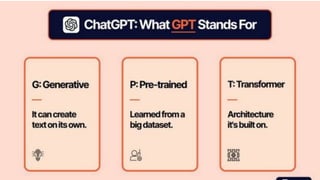
LMM - LargeLanguage Model
● Large - trained on a huge data set and
uses a huge number of parameters
● Language - geared toward understanding
language (
● Model - a type of Neural Network
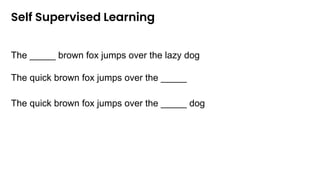
Self Supervised Learning
Thequick brown fox jumps over the _____
The quick brown fox jumps over the _____ dog
The _____ brown fox jumps over the lazy dog
13.
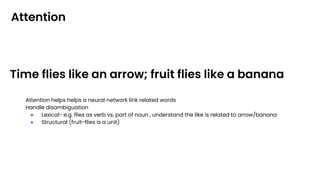
Attention
Attention helps helpsa neural network link related words
Handle disambiguation
● Lexical- e.g. flies as verb vs. part of noun , understand the like is related to arrow/banana
● Structural (fruit-flies is a unit)
Time flies like an arrow; fruit flies like a banana
14.
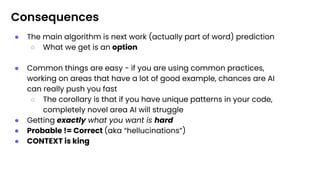
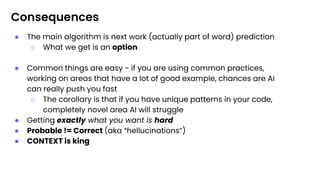
Consequences
● The mainalgorithm is next work (actually part of word) prediction
○ What we get is an option
● Common things are easy - if you are using common practices,
working on areas that have a lot of good example, chances are AI
can really push you fast
○ The corollary is that if you have unique patterns in your code,
completely novel area AI will struggle
● Getting exactly what you want is hard
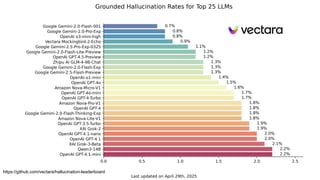
● Probable != Correct (aka “hellucinations”)
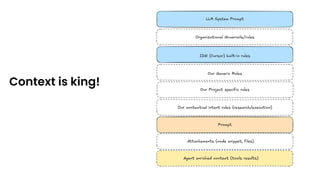
● CONTEXT is king
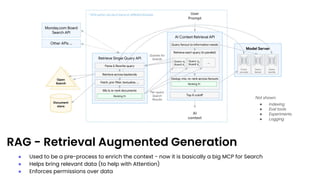
RAG - RetrievalAugmented Generation
● Used to be a pre-process to enrich the context - now it is basically a big MCP for Search
● Helps bring relevant data (to help with Attention)
● Enforces permissions over data
21.
Consequences
● The mainalgorithm is next work (actually part of word) prediction
○ What we get is an option
● Common things are easy - if you are using common practices,
working on areas that have a lot of good example, chances are AI
can really push you fast
○ The corollary is that if you have unique patterns in your code,
completely novel area AI will struggle
● Getting exactly what you want is hard
● Probable != Correct (aka “hellucinations”)
● CONTEXT is king
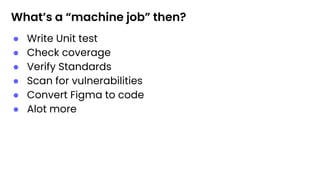
What’s a “machinejob” then?
● Write Unit test
● Check coverage
● Verify Standards
● Scan for vulnerabilities
● Convert Figma to code
● Alot more
25.
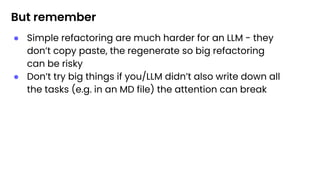
But remember
● Simplerefactoring are much harder for an LLM - they
don’t copy paste, the regenerate so big refactoring
can be risky
● Don’t try big things if you/LLM didn’t also write down all
the tasks (e.g. in an MD file) the attention can break
26.
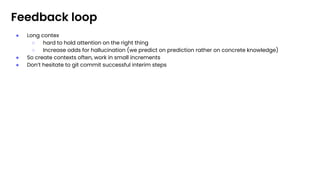
Feedback loop
● Longcontex
○ hard to hold attention on the right thing
○ Increase odds for hallucination (we predict on prediction rather on concrete knowledge)
● So create contexts often, work in small increments
● Don’t hesitate to git commit successful interim steps
27.
“We Can NeverSee
Past The Choices We
Don't Understand.”
28.
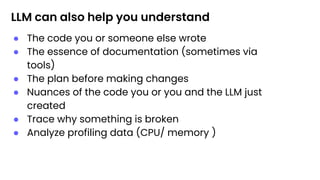
LLM can alsohelp you understand
● The code you or someone else wrote
● The essence of documentation (sometimes via
tools)
● The plan before making changes
● Nuances of the code you or you and the LLM just
created
● Trace why something is broken
● Analyze profiling data (CPU/ memory )
29.
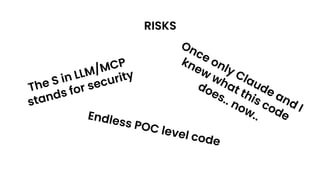
RISKS
The S inLLM/MCP
stands for security
Once only Claude and I
knew
what this code
does.. now..
Endless POC level code
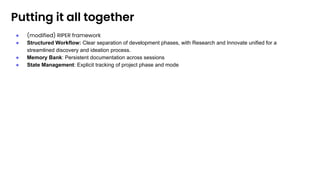
Putting it alltogether
● (modified) RIPER framework
● Structured Workflow: Clear separation of development phases, with Research and Innovate unified for a
streamlined discovery and ideation process.
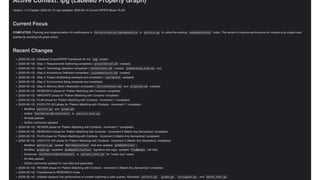
● Memory Bank: Persistent documentation across sessions
● State Management: Explicit tracking of project phase and mode
36.
"I Don't KnowThe Future. I Didn't Come Here To Tell
You How This Is Going To End. I Came Here To Tell You
How It's Going To Begin.








![[BDD 2025 - Artificial Intelligence] Building AI Systems That Users (and Comp...](https://cdn.slidesharecdn.com/ss_thumbnails/ai-buildingaisystemsthatusersandcompanieslove-251124030845-038f7732-thumbnail.jpg?width=640&height=640&fit=bounds)


![Conviction LP Letter - Dec 2023 [Redacted]](https://cdn.slidesharecdn.com/ss_thumbnails/convictionlpletter-dec2023sentredacted-250215033237-61bacefc-thumbnail.jpg?width=640&height=640&fit=bounds)


